
How Will the New Presidential Administration

Description: How Will the New Presidential Administration Impact International Law? Edward C. Harris Assistant Dean Associate Professor Chicago-Kent College of Law Who knows!!??? We are just over a month into the new administration all very
Related Topics
Download Presentation
"How Will the New Presidential Administration" is the property of its rightful owner. Permission is granted to download and print the materials on this website for personal, non-commercial use only, and to display it on your personal computer provided you do not modify the materials and that you retain all copyright notices contained in the materials. By downloading content from our website, you accept the terms of this agreement.
Presentation Transcript
slide1. How Will the New Presidential Administration Impact International Law? Edward C. Harris
Assistant Dean & Associate Professor
Chicago-Kent College of Law<br>
slide2. Who knows!!??? We are just over a month into the new administration… all very speculative right now. But:
We know who Donald Trump is;
We have campaign statements and promises;
We have statements and actions from the transition period and in these first couple of weeks<br>
slide3. An Overwhelming Topic Difficult to separate law and policy, and legal and practical implications…
My focus will be on three main areas:
International Trade (aspects different from those discussed by my co-panelist, Dr. Nolt)
Immigration
Conflicts of interest<br>
slide4. International Trade The President made “terrible” U.S. trade deals a centerpiece of his campaign for office. And, the President has broad authority on trade.
Some “Trump on Trade” specifics:
Scrapping of the TPP; (E.O. Jan. 23rd)
Renegotiate NAFTA or shred it;
Proposal to reorganize trade-related aspects of federal agencies into a single office within the Dept. of Commerce<br>
slide5. International Trade “Trump on Trade” (con’t)
The possibility of lifting sanctions on Russia;
The possibility of imposing a broad regime of tariffs on China (or other counties which the President views as “unfair” trading partners)
Questions on whether the administration will respect and use multilateral trade orgs, e.g., WTO;
Potential for “Buy American” regulations for government projects;<br>
slide6. International Trade “Trump on Trade” (con’t)
Apparently, the President is friendly to foreign investment in the U.S., and U.S. companies investing abroad;
The President’s clear favor for bilateral trade relations over the larger more comprehensive multilateral deals.<br>
slide7. International Trade The above items show a pretty radical departure from a world trade system that has been developing since the end of WWII.
The world has been on a consistent trajectory since after WWII to reduce tariffs, reduce NTBs, open markets, standardize trade rules, and institutionalize mechanisms for dealing with trade matters (e.g., disputes).
Theory: Increase Int’l Economic Development = Increase Global Peace and Stability<br>
slide8. International Trade Can it fairly be said that Trump is “anti-trade.” He (must?) recognize the importance of at least:
Exports
Attracting foreign investment
Capital flows in international financial markets
According to the administration’s statements, the strategy appears to be aimed at improving the U.S. position in int’l trade.<br>
slide9. International Trade The administration’s stance seems to suggest that putting the breaks on the more comprehensive “free trade” pacts is the way to improve the American position in international trade, and thus, improve the American economy.
But, is that likely???<br>
slide10. International Trade What is the general consensus among economists on the benefits of free trade? Good or bad?
There appears to be a fairly strong consensus among economists that free trade is a good thing:
2007 survey results of American Economic Association members published in an article by Robert Whaples, Econ. Journal Watch, September 2009:<br>
slide11. International Trade “The economics profession continues to show consensus in favor of unfettered international trade, as 83 percent agree and only 10 percent disagree that the United States should eliminate remaining tariffs and other barriers.” Whaples adds that 52% favor the idea of increasing benefits to workers who lose their jobs due to impacts of international trade.<br>
slide12. International Trade The Initiative on Global Markets at University of Chicago’s Booth School of Business polls economists on various interesting propositions. Two such propositions related to trade are:
“Past major trade deals have benefited most Americans” (2014, updated to 2017)
23% strongly agree; 70% agree; 7% uncertain; 0% disagree; 0% strongly disagree<br>
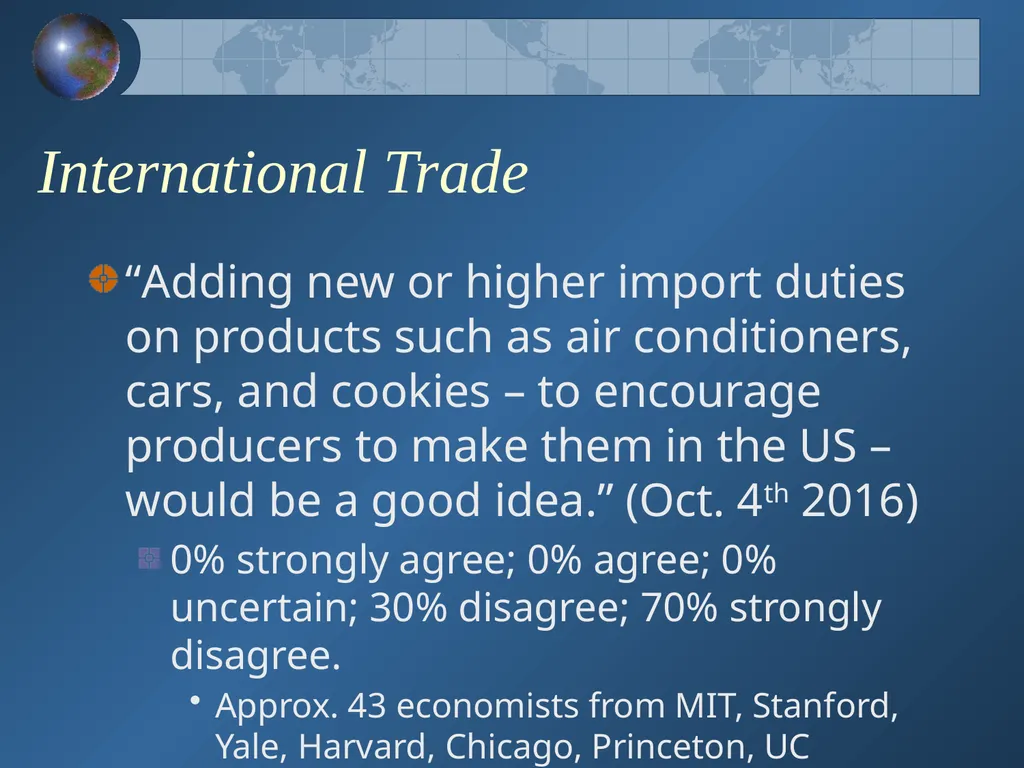
slide13. International Trade “Adding new or higher import duties on products such as air conditioners, cars, and cookies – to encourage producers to make them in the US – would be a good idea.” (Oct. 4th 2016)
0% strongly agree; 0% agree; 0% uncertain; 30% disagree; 70% strongly disagree.
Approx. 43 economists from MIT, Stanford, Yale, Harvard, Chicago, Princeton, UC Berkeley<br>
slide14. International Trade There’s a lot of source material out there that says economists generally believe more and freer trade is a good thing for the U.S.
But agreement is not universal, and certainly many recognize that free trade has caused some job loss in some industries.<br>
slide15. International Trade Most economists, however, think that the benefits….
lower consumer/industry prices,
integrated supply chains (and resulting US business efficiencies),
free flow of capital, and
A host of non-economic benefits
Far outweigh the costs.
Economists also seem to think that technology and automation is a far bigger culprit on job loss than are trade deals.<br>
slide16. International Trade What are the possible effects of the Trump administration’s (likely) trade policies in favor of bilateral, individualized trade deals over multilateral trade deals?
Basic trade-related and int’l law effects:
With respect to countries not included in new bilateral deals: higher costs on imports; higher prices on exports; reduced access to foreign markets; reduced influence on other issues; likely overall negative impacts on the U.S. economy<br>
slide17. International Trade Overall sense by other countries that the U.S. does not take its international treaty obligations seriously and does not respect international law. VCLT and customary int’l law.
Reduced effectiveness of use of international legal rules by the U.S. in future trade disputes (unclean hands).<br>
slide18. International Trade Multilateral trade treaties are usually package deals with agreements on specific subjects such as IP, environment, trade in services, labor standards, etc. We stand to lose some specific protections and/or leverage applicable to all member states by scrapping these. Could these be individually negotiated???<br>
slide19. International Trade Some political and business effects:
Increasing tariffs and other barriers to access U.S. markets, presents a very real possibility of a trade war, particularly with the countries singled out by the President as “unfair.”
Trade war will increase prices on imports, while simultaneously cutting off access to export markets, not to mention many other negative impacts, such as: deteriorate political relations, negatively impact U.S. businesses with investments in the trade partner/opponent or block<br>
slide20. International Trade Reduction of foreign investment in the U.S. economy.
Lessening our ability to attract the best and the brightest (see also immigration policy), and thereby reducing America’s role as a leader in scientific research.<br>
slide21. International Trade Increase in global instability - poor political relations and less economic opportunity in developing countries.
Opening opportunities for our trade rivals, e.g., China poised to take U.S. trading position in Mexico. Russia?
“Buy American” regs likely to lead to higher costs for U.S. businesses<br>
slide22. International Trade U.S. businesses (especially large ones) are organized on a platform to compete and succeed in the global economy. Restricting international trade and the negative consequences that would likely follow, will be a major disruptor for U.S. businesses, but this is not a tech disruptor. It can be avoided.<br>
slide23. International Trade Perhaps not all bad…
Consolidation of trade matters within Fed gov.
Possible resort to international trade legal institutions to accomplish goals, which could continue to strengthen these.
Many have commented on Trump’s trade points as a “negotiating strategy.” What’s wrong with this?<br>
slide24. Immigration Again, broad presidential authority.
The Travel Ban
Impacts already felt by families, business, and in research and academic institutions, but perhaps not significant enough to cause widespread disruptions in the economy or to destabilize international political relations.<br>
slide25. Immigration “Extreme vetting” – not sure what it means when the U.S. already has the most stringent visa requirements on the planet.
H1B (skilled) employment visas: Does he favor?
Trump the businessman has used H2B (and likely H1B) for at least 1,100 foreign workers since 2000
Early campaigning said “no” to H1Bs – taking the good jobs away from Americans; getting rid of H1B will allow hi tech industry to diversify by hiring more minorities and females.<br>
slide26. Immigration “Only big corporations are benefiting at the expense of American workers”
The administration appears to be changing its tune as it recognizes the realities:
American companies depend on highly skilled immigrant labor because we don’t have it domestically.
Instead of eliminating H1B, there will likely be quotas, and possibly a tax on employers for using H1B labor<br>
slide27. Immigration F-1, J-1 student and scholar visas
897K International students at U.S. universities in 2014-15, contributed approx. $36 bil to the U.S. economy (IIE)
In Illinois, 50,000 international students accounted for $1.6 bil in revenue in the state in 2015 (NAFSA)
Hugely important to the financial health of our universities and to attracting brain power<br>
slide28. Immigration Up to this point, only students and scholars from the countries listed in the travel ban have been affected, but speculation abounds about what is next;
Evidence that international students are becoming jittery about studying in the U.S.
Universities are staking out positions:
Issuing public statements; lobbying Congress; crafting policies, e.g, refusing to release student information without subpoena; providing legal services<br>
slide29. Immigration EB-5 – somewhat controversial immigration/FDI program under the Immigration Act of 1990
Gives a up to 10,000 foreign nationals per year permanent U.S. residency if they invest a certain number of dollars and create at least 10 jobs;<br>
slide30. Immigration Estimated $16.9 bil in FDI into U.S. economy since 2008 through EB-5
Anticipated changes under the Trump administration:
Already a draft bill offered by DHS and the administration may attempt a similar change in the law<br>
slide31. Immigration Increase the minimum $ amount of investment;
Redefine how a TEA – Targeted Employment Area – is created. Critics say that TEAs are defined by states in ways that get around the intended maximum benefit to economically disadvantaged areas.<br>
slide32. Immigration The concern: some say that making these reforms accomplishes nothing toward national security or protection of the U.S. economy, and according to many immigration attorneys, the reforms will kill the program.
Immigration lawyers report a sharp uptick in EB-5 business since the election.<br>
slide33. Conflicts of Interest Unprecedented potential for conflicts of interest presented by Donald Trump the businessman (and the Trump Organization) and Donald Trump the President.
Can the President prevent the Trump business from influencing the presidency, U.S. dom. or int’l policy, etc. ???<br>
slide34. Conflicts of Interest These conflicts questions are compounded by both the way in which the President has attempted to separate himself from his business dealings, and the fact that some of his closest advisers are not separated from the Trump business interests.
The entanglements are deep and global
How might some of these conflicts play out internationally?<br>
slide35. Conflicts of Interest Mar-a-Lago:
Doubling of member fees, the Prime Minister of Japan, a N. Korean nuke test, diplomatic/ int’l security discussion in public, and photos snapped by club members and posted on social media.<br>
slide36. Conflicts of Interest Mar-a-Lago (con’t)
Ivanka Trump and husband Jared Kushner, both close and trusted advisers to the President, also sat in on the meetings with Prime Minister Abe;
Ivanka, at that time, was in negotiation with Japanese apparel company Sanei International, whose parent company is owned in large part by the Japanese gov’t.<br>
slide37. Conflicts of Interest The Golf Resort in Aberdeen:
Discussions with British politician Nigel Farage (of Brexit fame) about a proposed wind farm that will obstruct views;
Moving forward with resort expansions in spite of pledge not to pursue new foreign deals and halt all pending foreign deals. Expansion doesn’t count, according to the administration. So, this may be the tact.<br>
slide38. Conflicts of Interest As Richard Painter, who served as George W. Bush’s chief ethics adviser, puts it: [the ambiguous conflicts policy] “clearly illustrates that around the world, he will just simply expand around various holdings and as they continue to expand, the conflicts of interest expand.”
Relationship with the U.K. or other foreign policy questions could be colored by the President’s thinking of his property value.<br>
slide39. Conflicts of Interest The Taiwan phone call
At the time, seen as a potential breach of a decades old diplomatic protocol designed to preserve relations with China.
At the time, the Trump organization was pursuing plans to expand into Taiwan.
Speculation on whether the President nearly created a major international incident in an effort to help his business.<br>
slide40. Conflicts of Interest Many, many, more potential conflicts and open questions due to the extent of Mr. Trump’s business dealings.
Are the means taken by the administration to insulate the President (and close advisers) from conflicts of interest sufficient?
What might these means say to the rest of the international community about how we view ethical responsibilities?<br>
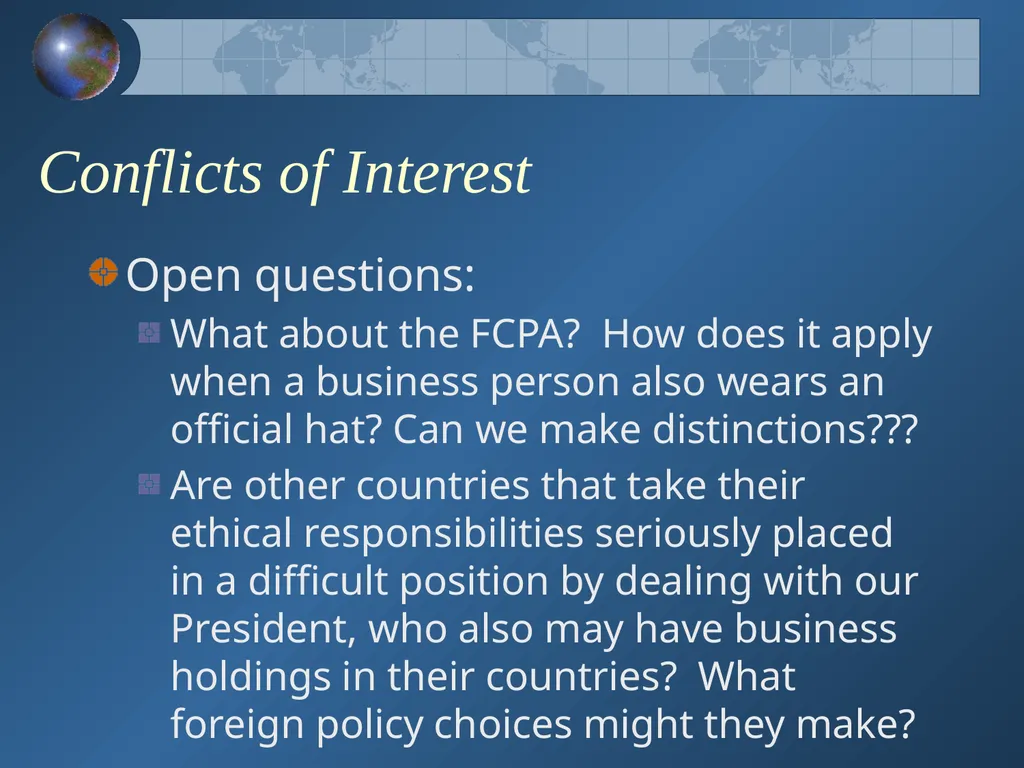
slide41. Conflicts of Interest Open questions:
What about the FCPA? How does it apply when a business person also wears an official hat? Can we make distinctions???
Are other countries that take their ethical responsibilities seriously placed in a difficult position by dealing with our President, who also may have business holdings in their countries? What foreign policy choices might they make?<br>
Assistant Dean & Associate Professor
Chicago-Kent College of Law<br>
slide2. Who knows!!??? We are just over a month into the new administration… all very speculative right now. But:
We know who Donald Trump is;
We have campaign statements and promises;
We have statements and actions from the transition period and in these first couple of weeks<br>
slide3. An Overwhelming Topic Difficult to separate law and policy, and legal and practical implications…
My focus will be on three main areas:
International Trade (aspects different from those discussed by my co-panelist, Dr. Nolt)
Immigration
Conflicts of interest<br>
slide4. International Trade The President made “terrible” U.S. trade deals a centerpiece of his campaign for office. And, the President has broad authority on trade.
Some “Trump on Trade” specifics:
Scrapping of the TPP; (E.O. Jan. 23rd)
Renegotiate NAFTA or shred it;
Proposal to reorganize trade-related aspects of federal agencies into a single office within the Dept. of Commerce<br>
slide5. International Trade “Trump on Trade” (con’t)
The possibility of lifting sanctions on Russia;
The possibility of imposing a broad regime of tariffs on China (or other counties which the President views as “unfair” trading partners)
Questions on whether the administration will respect and use multilateral trade orgs, e.g., WTO;
Potential for “Buy American” regulations for government projects;<br>
slide6. International Trade “Trump on Trade” (con’t)
Apparently, the President is friendly to foreign investment in the U.S., and U.S. companies investing abroad;
The President’s clear favor for bilateral trade relations over the larger more comprehensive multilateral deals.<br>
slide7. International Trade The above items show a pretty radical departure from a world trade system that has been developing since the end of WWII.
The world has been on a consistent trajectory since after WWII to reduce tariffs, reduce NTBs, open markets, standardize trade rules, and institutionalize mechanisms for dealing with trade matters (e.g., disputes).
Theory: Increase Int’l Economic Development = Increase Global Peace and Stability<br>
slide8. International Trade Can it fairly be said that Trump is “anti-trade.” He (must?) recognize the importance of at least:
Exports
Attracting foreign investment
Capital flows in international financial markets
According to the administration’s statements, the strategy appears to be aimed at improving the U.S. position in int’l trade.<br>
slide9. International Trade The administration’s stance seems to suggest that putting the breaks on the more comprehensive “free trade” pacts is the way to improve the American position in international trade, and thus, improve the American economy.
But, is that likely???<br>
slide10. International Trade What is the general consensus among economists on the benefits of free trade? Good or bad?
There appears to be a fairly strong consensus among economists that free trade is a good thing:
2007 survey results of American Economic Association members published in an article by Robert Whaples, Econ. Journal Watch, September 2009:<br>
slide11. International Trade “The economics profession continues to show consensus in favor of unfettered international trade, as 83 percent agree and only 10 percent disagree that the United States should eliminate remaining tariffs and other barriers.” Whaples adds that 52% favor the idea of increasing benefits to workers who lose their jobs due to impacts of international trade.<br>
slide12. International Trade The Initiative on Global Markets at University of Chicago’s Booth School of Business polls economists on various interesting propositions. Two such propositions related to trade are:
“Past major trade deals have benefited most Americans” (2014, updated to 2017)
23% strongly agree; 70% agree; 7% uncertain; 0% disagree; 0% strongly disagree<br>
slide13. International Trade “Adding new or higher import duties on products such as air conditioners, cars, and cookies – to encourage producers to make them in the US – would be a good idea.” (Oct. 4th 2016)
0% strongly agree; 0% agree; 0% uncertain; 30% disagree; 70% strongly disagree.
Approx. 43 economists from MIT, Stanford, Yale, Harvard, Chicago, Princeton, UC Berkeley<br>
slide14. International Trade There’s a lot of source material out there that says economists generally believe more and freer trade is a good thing for the U.S.
But agreement is not universal, and certainly many recognize that free trade has caused some job loss in some industries.<br>
slide15. International Trade Most economists, however, think that the benefits….
lower consumer/industry prices,
integrated supply chains (and resulting US business efficiencies),
free flow of capital, and
A host of non-economic benefits
Far outweigh the costs.
Economists also seem to think that technology and automation is a far bigger culprit on job loss than are trade deals.<br>
slide16. International Trade What are the possible effects of the Trump administration’s (likely) trade policies in favor of bilateral, individualized trade deals over multilateral trade deals?
Basic trade-related and int’l law effects:
With respect to countries not included in new bilateral deals: higher costs on imports; higher prices on exports; reduced access to foreign markets; reduced influence on other issues; likely overall negative impacts on the U.S. economy<br>
slide17. International Trade Overall sense by other countries that the U.S. does not take its international treaty obligations seriously and does not respect international law. VCLT and customary int’l law.
Reduced effectiveness of use of international legal rules by the U.S. in future trade disputes (unclean hands).<br>
slide18. International Trade Multilateral trade treaties are usually package deals with agreements on specific subjects such as IP, environment, trade in services, labor standards, etc. We stand to lose some specific protections and/or leverage applicable to all member states by scrapping these. Could these be individually negotiated???<br>
slide19. International Trade Some political and business effects:
Increasing tariffs and other barriers to access U.S. markets, presents a very real possibility of a trade war, particularly with the countries singled out by the President as “unfair.”
Trade war will increase prices on imports, while simultaneously cutting off access to export markets, not to mention many other negative impacts, such as: deteriorate political relations, negatively impact U.S. businesses with investments in the trade partner/opponent or block<br>
slide20. International Trade Reduction of foreign investment in the U.S. economy.
Lessening our ability to attract the best and the brightest (see also immigration policy), and thereby reducing America’s role as a leader in scientific research.<br>
slide21. International Trade Increase in global instability - poor political relations and less economic opportunity in developing countries.
Opening opportunities for our trade rivals, e.g., China poised to take U.S. trading position in Mexico. Russia?
“Buy American” regs likely to lead to higher costs for U.S. businesses<br>
slide22. International Trade U.S. businesses (especially large ones) are organized on a platform to compete and succeed in the global economy. Restricting international trade and the negative consequences that would likely follow, will be a major disruptor for U.S. businesses, but this is not a tech disruptor. It can be avoided.<br>
slide23. International Trade Perhaps not all bad…
Consolidation of trade matters within Fed gov.
Possible resort to international trade legal institutions to accomplish goals, which could continue to strengthen these.
Many have commented on Trump’s trade points as a “negotiating strategy.” What’s wrong with this?<br>
slide24. Immigration Again, broad presidential authority.
The Travel Ban
Impacts already felt by families, business, and in research and academic institutions, but perhaps not significant enough to cause widespread disruptions in the economy or to destabilize international political relations.<br>
slide25. Immigration “Extreme vetting” – not sure what it means when the U.S. already has the most stringent visa requirements on the planet.
H1B (skilled) employment visas: Does he favor?
Trump the businessman has used H2B (and likely H1B) for at least 1,100 foreign workers since 2000
Early campaigning said “no” to H1Bs – taking the good jobs away from Americans; getting rid of H1B will allow hi tech industry to diversify by hiring more minorities and females.<br>
slide26. Immigration “Only big corporations are benefiting at the expense of American workers”
The administration appears to be changing its tune as it recognizes the realities:
American companies depend on highly skilled immigrant labor because we don’t have it domestically.
Instead of eliminating H1B, there will likely be quotas, and possibly a tax on employers for using H1B labor<br>
slide27. Immigration F-1, J-1 student and scholar visas
897K International students at U.S. universities in 2014-15, contributed approx. $36 bil to the U.S. economy (IIE)
In Illinois, 50,000 international students accounted for $1.6 bil in revenue in the state in 2015 (NAFSA)
Hugely important to the financial health of our universities and to attracting brain power<br>
slide28. Immigration Up to this point, only students and scholars from the countries listed in the travel ban have been affected, but speculation abounds about what is next;
Evidence that international students are becoming jittery about studying in the U.S.
Universities are staking out positions:
Issuing public statements; lobbying Congress; crafting policies, e.g, refusing to release student information without subpoena; providing legal services<br>
slide29. Immigration EB-5 – somewhat controversial immigration/FDI program under the Immigration Act of 1990
Gives a up to 10,000 foreign nationals per year permanent U.S. residency if they invest a certain number of dollars and create at least 10 jobs;<br>
slide30. Immigration Estimated $16.9 bil in FDI into U.S. economy since 2008 through EB-5
Anticipated changes under the Trump administration:
Already a draft bill offered by DHS and the administration may attempt a similar change in the law<br>
slide31. Immigration Increase the minimum $ amount of investment;
Redefine how a TEA – Targeted Employment Area – is created. Critics say that TEAs are defined by states in ways that get around the intended maximum benefit to economically disadvantaged areas.<br>
slide32. Immigration The concern: some say that making these reforms accomplishes nothing toward national security or protection of the U.S. economy, and according to many immigration attorneys, the reforms will kill the program.
Immigration lawyers report a sharp uptick in EB-5 business since the election.<br>
slide33. Conflicts of Interest Unprecedented potential for conflicts of interest presented by Donald Trump the businessman (and the Trump Organization) and Donald Trump the President.
Can the President prevent the Trump business from influencing the presidency, U.S. dom. or int’l policy, etc. ???<br>
slide34. Conflicts of Interest These conflicts questions are compounded by both the way in which the President has attempted to separate himself from his business dealings, and the fact that some of his closest advisers are not separated from the Trump business interests.
The entanglements are deep and global
How might some of these conflicts play out internationally?<br>
slide35. Conflicts of Interest Mar-a-Lago:
Doubling of member fees, the Prime Minister of Japan, a N. Korean nuke test, diplomatic/ int’l security discussion in public, and photos snapped by club members and posted on social media.<br>
slide36. Conflicts of Interest Mar-a-Lago (con’t)
Ivanka Trump and husband Jared Kushner, both close and trusted advisers to the President, also sat in on the meetings with Prime Minister Abe;
Ivanka, at that time, was in negotiation with Japanese apparel company Sanei International, whose parent company is owned in large part by the Japanese gov’t.<br>
slide37. Conflicts of Interest The Golf Resort in Aberdeen:
Discussions with British politician Nigel Farage (of Brexit fame) about a proposed wind farm that will obstruct views;
Moving forward with resort expansions in spite of pledge not to pursue new foreign deals and halt all pending foreign deals. Expansion doesn’t count, according to the administration. So, this may be the tact.<br>
slide38. Conflicts of Interest As Richard Painter, who served as George W. Bush’s chief ethics adviser, puts it: [the ambiguous conflicts policy] “clearly illustrates that around the world, he will just simply expand around various holdings and as they continue to expand, the conflicts of interest expand.”
Relationship with the U.K. or other foreign policy questions could be colored by the President’s thinking of his property value.<br>
slide39. Conflicts of Interest The Taiwan phone call
At the time, seen as a potential breach of a decades old diplomatic protocol designed to preserve relations with China.
At the time, the Trump organization was pursuing plans to expand into Taiwan.
Speculation on whether the President nearly created a major international incident in an effort to help his business.<br>
slide40. Conflicts of Interest Many, many, more potential conflicts and open questions due to the extent of Mr. Trump’s business dealings.
Are the means taken by the administration to insulate the President (and close advisers) from conflicts of interest sufficient?
What might these means say to the rest of the international community about how we view ethical responsibilities?<br>
slide41. Conflicts of Interest Open questions:
What about the FCPA? How does it apply when a business person also wears an official hat? Can we make distinctions???
Are other countries that take their ethical responsibilities seriously placed in a difficult position by dealing with our President, who also may have business holdings in their countries? What foreign policy choices might they make?<br>