
HR Data Management: An Historical, Technological
LO
Published · 68 slides · 0 views
1 / 1

Description
HR Data Management: An Historical, Technological and Global Approach Introduction Objectives Define HRIS and provide examples of how it can be used in a variety of human resource functions. Understand why project management is critical in
Related Topics
Share
Embed code
Download this presentation From Below
"HR Data Management: An Historical, Technological" is the property of its rightful owner. Permission is granted to download and print the materials on this website for personal, non-commercial use only, and to display it on your personal computer provided you do not modify the materials and that you retain all copyright notices contained in the materials. By downloading content from our website, you accept the terms of this agreement.
Presentation Transcript
01
HR Data Management: An Historical, Technological and Global Approach Introduction<br>
02
Objectives Define HRIS and provide examples of how it can be used in a variety of human resource functions.
Understand why project management is critical in the integration of an HRIS.
Apply the basics of project management to an HRIS integration. 2<br>
Understand why project management is critical in the integration of an HRIS.
Apply the basics of project management to an HRIS integration. 2<br>
03
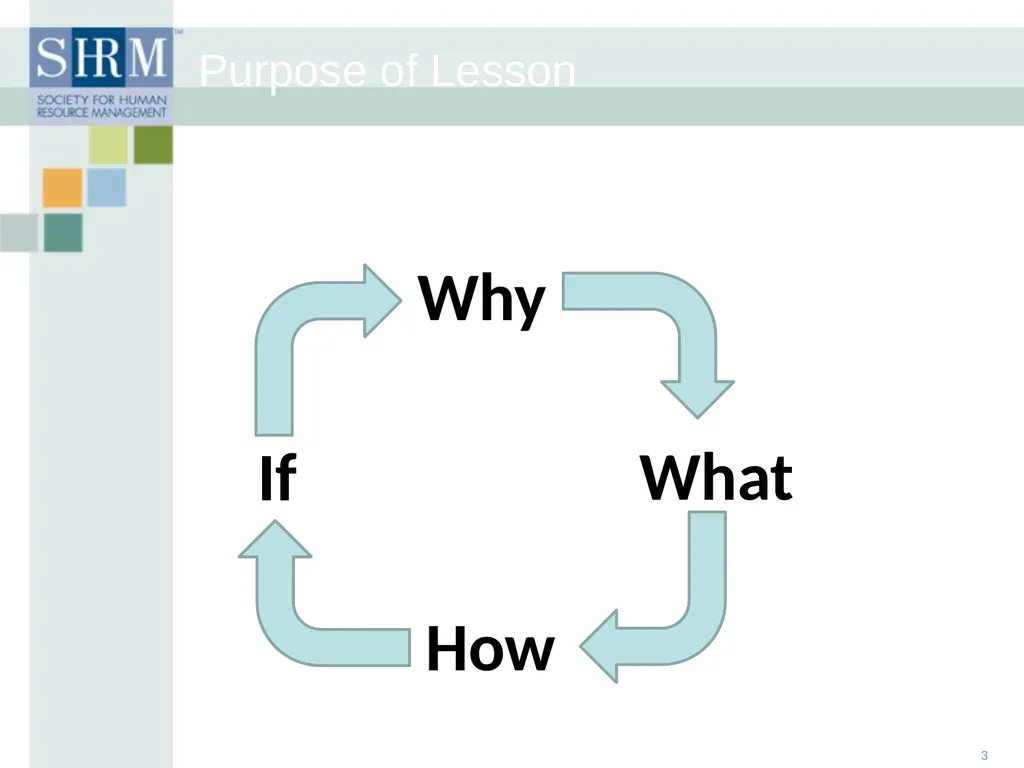
Purpose of Lesson Why What How If 3<br>
04
Why are these topics together? HRIS
Project Management ? 4<br>
Project Management ? 4<br>
05
SECTION #1 HRIS –
HUMAN RESOURCE INFORMATION SYSTEMS 5<br>
06
What will be covered in this class? HRIS
What is an HRIS?
How is it used in organizations?
The history of HRIS
Project Management
Methods of project management
Project life cycle
Project management tools and skills
Integrating an HRIS across cultures
Integration process
Integration issues 6<br>
What is an HRIS?
How is it used in organizations?
The history of HRIS
Project Management
Methods of project management
Project life cycle
Project management tools and skills
Integrating an HRIS across cultures
Integration process
Integration issues 6<br>
07
HRIS HRIS Defined
“HRIS can be briefly defined as integrated systems used to gather, store and analyze information regarding an organization’s human resources.” (Hedrickson, 2003, p.381).
HRIS “One which is used to acquire, store, manipulate, analyze, retrieve and distribute information about an organization’s human resources.” (Tannenbaum 1990) 7<br>
“HRIS can be briefly defined as integrated systems used to gather, store and analyze information regarding an organization’s human resources.” (Hedrickson, 2003, p.381).
HRIS “One which is used to acquire, store, manipulate, analyze, retrieve and distribute information about an organization’s human resources.” (Tannenbaum 1990) 7<br>
08
HRIS Not just technology:
“HRIS is not limited to the computer hardware and software applications that comprise the technical part of the system: it also includes the people, policies, procedures and data required to manage the HR function.” (Hedrickson, 2003, p.381). 8<br>
“HRIS is not limited to the computer hardware and software applications that comprise the technical part of the system: it also includes the people, policies, procedures and data required to manage the HR function.” (Hedrickson, 2003, p.381). 8<br>
09
History of HRIS Early (pre-WW II)
Personnel
Old term for human resources
Historically isolated from core organizational functions
Record keeping
Name, address, phone, employment history 9<br>
Personnel
Old term for human resources
Historically isolated from core organizational functions
Record keeping
Name, address, phone, employment history 9<br>
10
History of HRIS Between 1945 and 1960
Human capital issues
Employee morale
Formal selection and development
No real changes from earlier days 10<br>
Human capital issues
Employee morale
Formal selection and development
No real changes from earlier days 10<br>
11
History of HRIS Early (1960s to 1980s)
Personnel became HR
HR was seen as key in organizations
Government and regulatory agencies increased reporting requirements:
Affirmative action
EEO
OSHA
Still, HRIS was used mostly for keeping administrative records 11<br>
Personnel became HR
HR was seen as key in organizations
Government and regulatory agencies increased reporting requirements:
Affirmative action
EEO
OSHA
Still, HRIS was used mostly for keeping administrative records 11<br>
12
History of HRIS Contemporary HRIS
Large and small businesses are utilizing HRIS
Personal computers have made HRIS available and affordable for any sized firm
HRIS has evolved from simple record-keeping to complex analytical tools to assist management decision making 12<br>
Large and small businesses are utilizing HRIS
Personal computers have made HRIS available and affordable for any sized firm
HRIS has evolved from simple record-keeping to complex analytical tools to assist management decision making 12<br>
13
Who uses HRIS and how is it used? HR Professionals
Reporting and compliance
Payroll and compensation analysis
Benefits administration
Applicant tracking, skills inventory
Functional Managers
Performance management and appraisal
Recruitment and resume processing
Team and project management
Training and skills testing
Management development 13<br>
Reporting and compliance
Payroll and compensation analysis
Benefits administration
Applicant tracking, skills inventory
Functional Managers
Performance management and appraisal
Recruitment and resume processing
Team and project management
Training and skills testing
Management development 13<br>
14
Who uses HRIS and how is it used? Individual Employees
Self-service benefit options
Career planning
Training and development 14<br>
Self-service benefit options
Career planning
Training and development 14<br>
15
Benefits of HRIS Increased Efficiency –
more transactions with fewer resources
Increased Effectiveness –
more accurate information and simplification of processes 15<br>
more transactions with fewer resources
Increased Effectiveness –
more accurate information and simplification of processes 15<br>
16
HRIS Terminology HRIS –
Generic term referring to any information system used for obtaining relevant and timely information on which to base human resource decisions. (Mondy)
ERP –
Enterprise Resource Planning
Software system that integrates several data sources and processes into a unified system. An ERP system provides the functions of at least two separate systems. i.e. Accounting and Inventory Management. (www.bestpricecomputers.co.uk) 16<br>
Generic term referring to any information system used for obtaining relevant and timely information on which to base human resource decisions. (Mondy)
ERP –
Enterprise Resource Planning
Software system that integrates several data sources and processes into a unified system. An ERP system provides the functions of at least two separate systems. i.e. Accounting and Inventory Management. (www.bestpricecomputers.co.uk) 16<br>
17
HRIS Terminology SAP –
System Applications and Products
World’s largest business software company providing integrated software systems. In business since 1972
Discussion –
What are some examples of HRIS systems, including both ERP and stand alone? 17<br>
System Applications and Products
World’s largest business software company providing integrated software systems. In business since 1972
Discussion –
What are some examples of HRIS systems, including both ERP and stand alone? 17<br>
18
Discussion Topics Provide specific examples of HRIS systems and provide the details (costs, system requirements and web site resources etc.).
What are the strengths of the systems?
What are the weaknesses of the systems?
Respond to other student’s examples.
As a group, decide which HRIS is best for a large organization and which one is best for a small organization. 18<br>
What are the strengths of the systems?
What are the weaknesses of the systems?
Respond to other student’s examples.
As a group, decide which HRIS is best for a large organization and which one is best for a small organization. 18<br>
19
Discussion Activity What are your perceptions of an HRIS?
Possible discussion topics:
List HRIS software you have heard of and what functions they can complete.
What can an HRIS do for an organization?
List why your organization would want or does use an HRIS. 19<br>
Possible discussion topics:
List HRIS software you have heard of and what functions they can complete.
What can an HRIS do for an organization?
List why your organization would want or does use an HRIS. 19<br>
20
SECTION #2 PROJECT MANAGEMENT 20<br>
21
Project Management Project Management –
a carefully planned and organized effort to accomplish a specific (and usually) one-time effort.
www.managementhelp.org (retrieved 7/2/08)
A project is a series of tasks and activities that has a stated goal and objectives, a schedule with defined start and end dates, and a budget that sets limits on the project’s dedicated use of resources.
SHRM Learning System, © 2008 , Module One Strategic Management, p. 1-21 21<br>
a carefully planned and organized effort to accomplish a specific (and usually) one-time effort.
www.managementhelp.org (retrieved 7/2/08)
A project is a series of tasks and activities that has a stated goal and objectives, a schedule with defined start and end dates, and a budget that sets limits on the project’s dedicated use of resources.
SHRM Learning System, © 2008 , Module One Strategic Management, p. 1-21 21<br>
22
Project Management Projects are characterized by –
A group of people
A goal
Limited time and money
A level of uncertainty regarding achievement 22<br>
A group of people
A goal
Limited time and money
A level of uncertainty regarding achievement 22<br>
23
The Process of Project Management Project Management Life Cycle
Defining (Scoping)
Answers the question – What will be covered by this project?
Planning
Identifies: Who, What, When and With what resources
Executing
Organizing people, allocating resources and scheduling tasks
Monitoring and Controlling
Tracking progress and taking corrective actions
Closing
Project completion and evaluation 23<br>
Defining (Scoping)
Answers the question – What will be covered by this project?
Planning
Identifies: Who, What, When and With what resources
Executing
Organizing people, allocating resources and scheduling tasks
Monitoring and Controlling
Tracking progress and taking corrective actions
Closing
Project completion and evaluation 23<br>
24
The Process of Project Management The MPMM Project Management Life Cycle
Project Initiation
Project Definition
Project Planning
Detailed Planning
Project Execution
Monitoring and Control
Project Closure
Post Implementation Review
www.mpmm.com/project-management-methodology 24<br>
Project Initiation
Project Definition
Project Planning
Detailed Planning
Project Execution
Monitoring and Control
Project Closure
Post Implementation Review
www.mpmm.com/project-management-methodology 24<br>
25
The Process of Project Management The Rational Unified Process (RUP)
The Inception Phase
Primary goal is to achieve consensus on project objectives and to obtain funding for the project
The Elaboration Phase
Identifies details of the project and architecture for the system
The Construction Phase
Development of the new system to the point where it is ready for deployment
The Transition Phase
The focus is on delivering the system into production, testing and fine tuning 25<br>
The Inception Phase
Primary goal is to achieve consensus on project objectives and to obtain funding for the project
The Elaboration Phase
Identifies details of the project and architecture for the system
The Construction Phase
Development of the new system to the point where it is ready for deployment
The Transition Phase
The focus is on delivering the system into production, testing and fine tuning 25<br>
26
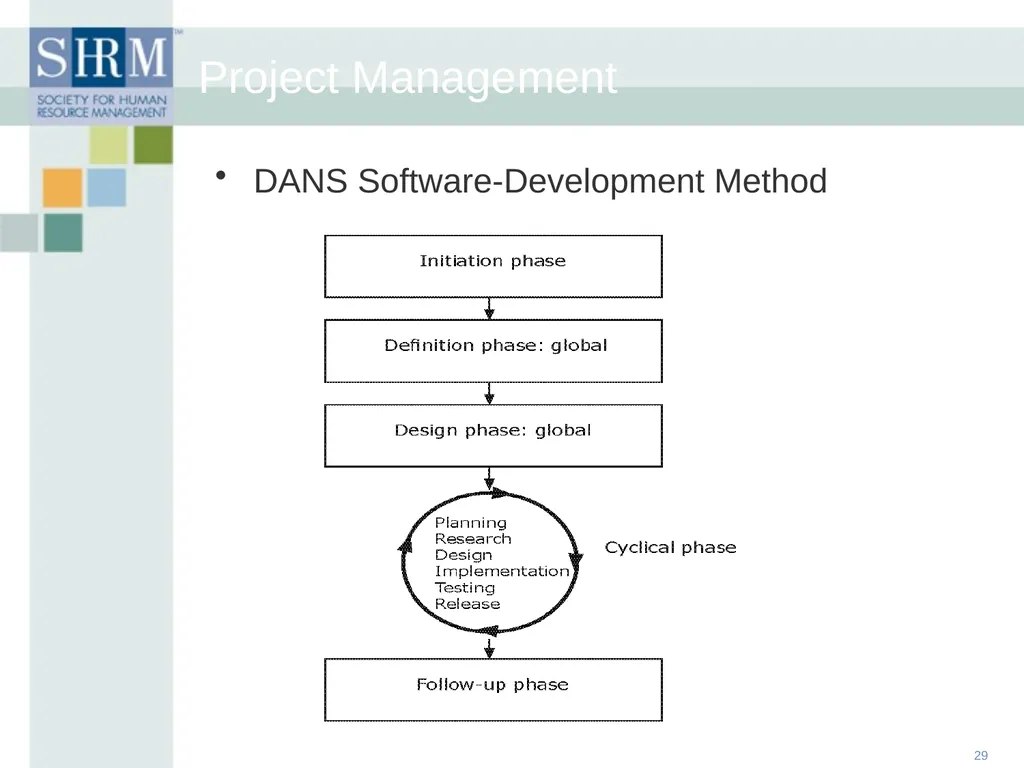
The Process of Project Management DANS –
Initiation phase – Idea
Are we going to do this project?
Definition phase – What?
Is it possible? What is required?
Design phase – How?
Is it desirable? What will be the result?
Development phase – How to implement?
Is it feasible? How will we implement the project?
Implementation phase – Carrying out the project
Is the result adequate? How will we evaluate the project?
Follow-up phase – Maintenance
Final report 26<br>
Initiation phase – Idea
Are we going to do this project?
Definition phase – What?
Is it possible? What is required?
Design phase – How?
Is it desirable? What will be the result?
Development phase – How to implement?
Is it feasible? How will we implement the project?
Implementation phase – Carrying out the project
Is the result adequate? How will we evaluate the project?
Follow-up phase – Maintenance
Final report 26<br>
27
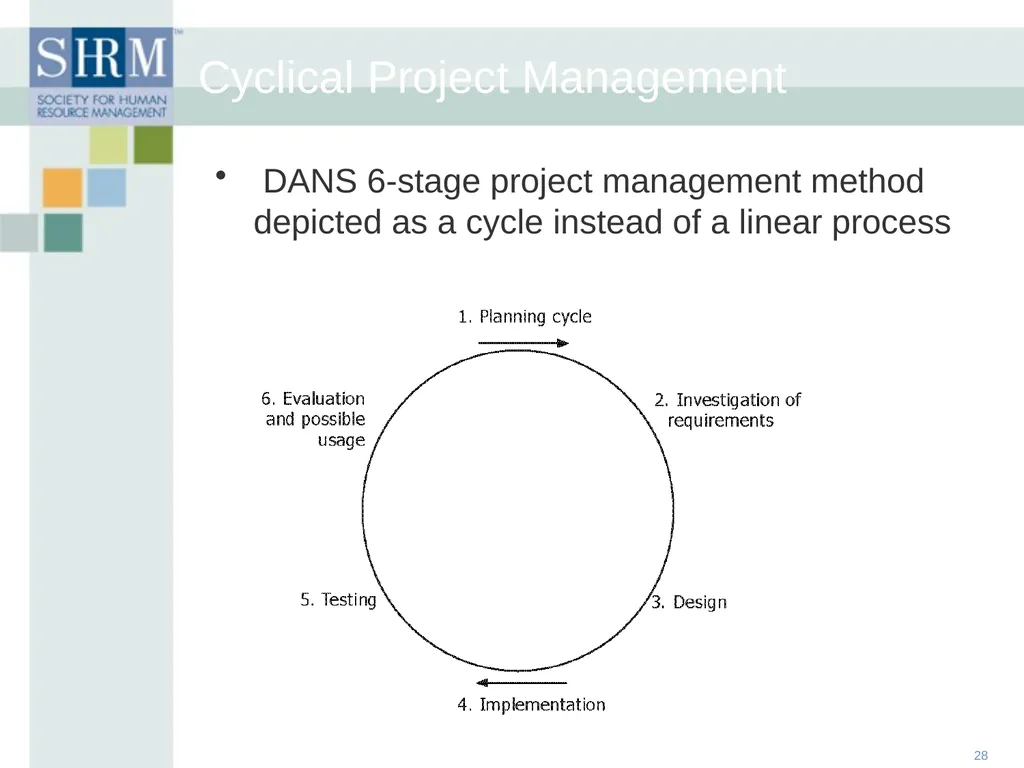
Project Management Systems for Software Development Linear process – Waterfall model
Cyclical Project Management
Preferred for software development
Software development is a creative process
Impossible to identify all requirements beforehand
Difficult to estimate amount of time necessary for implementation
Intermediate results must be tested by users throughout the entire project 27<br>
Cyclical Project Management
Preferred for software development
Software development is a creative process
Impossible to identify all requirements beforehand
Difficult to estimate amount of time necessary for implementation
Intermediate results must be tested by users throughout the entire project 27<br>
28
Cyclical Project Management DANS 6-stage project management method depicted as a cycle instead of a linear process 28<br>
29
Project Management DANS Software-Development Method 29<br>
30
Discussion Activity What is the hardest for the HR professional to control in a project (time, cost, scope)?
What can the HR professional do to help ensure success in time, cost, and scope? 30<br>
What can the HR professional do to help ensure success in time, cost, and scope? 30<br>
31
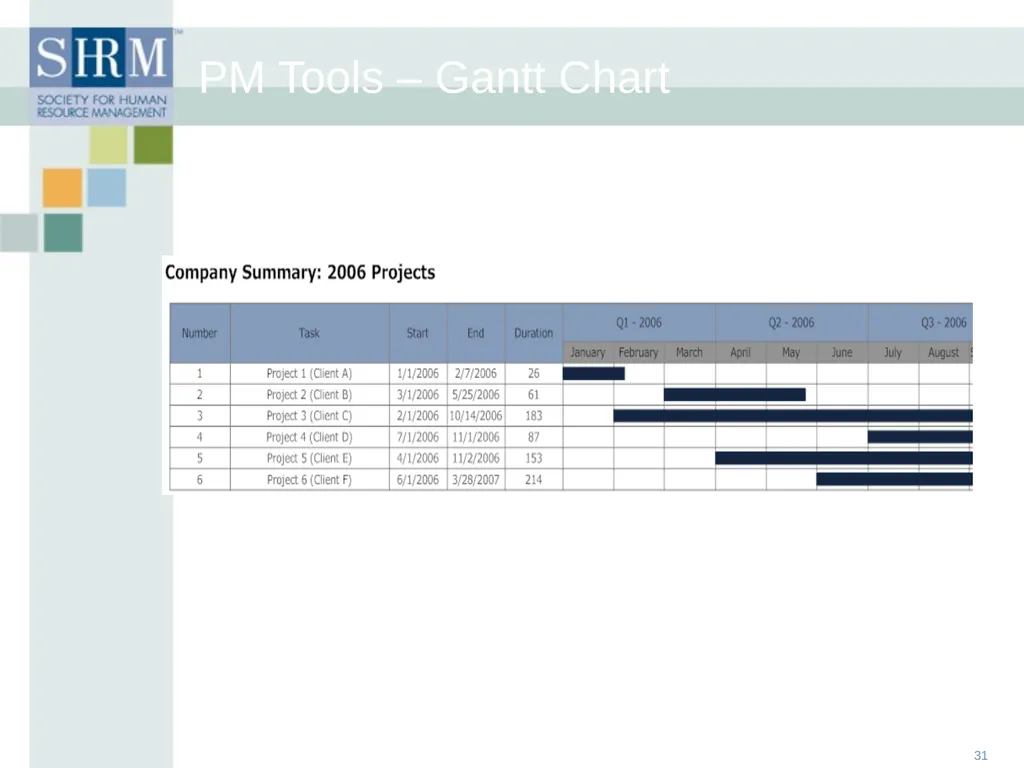
PM Tools – Gantt Chart 31<br>
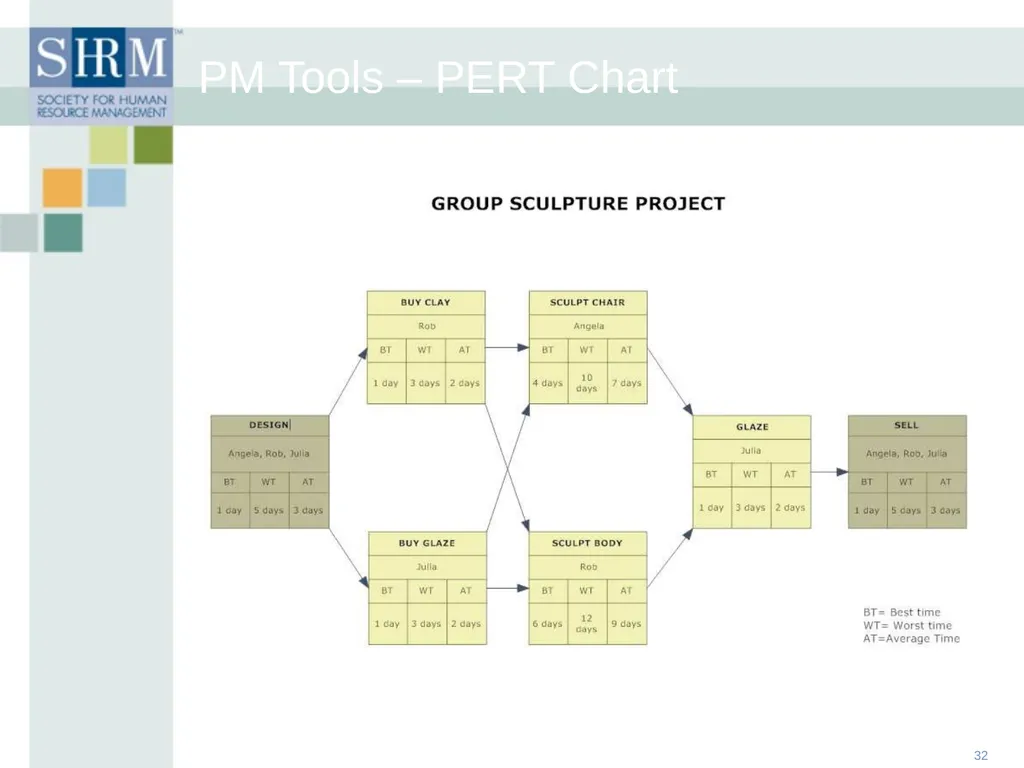
32
PM Tools – PERT Chart 32<br>
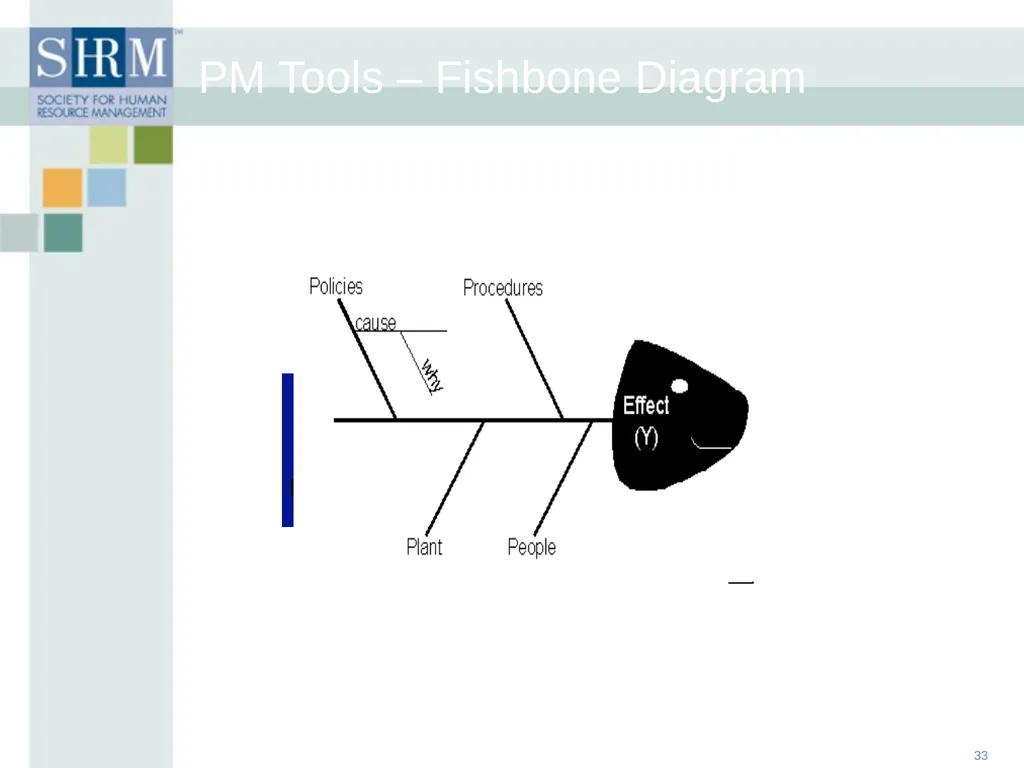
33
PM Tools – Fishbone Diagram 33<br>
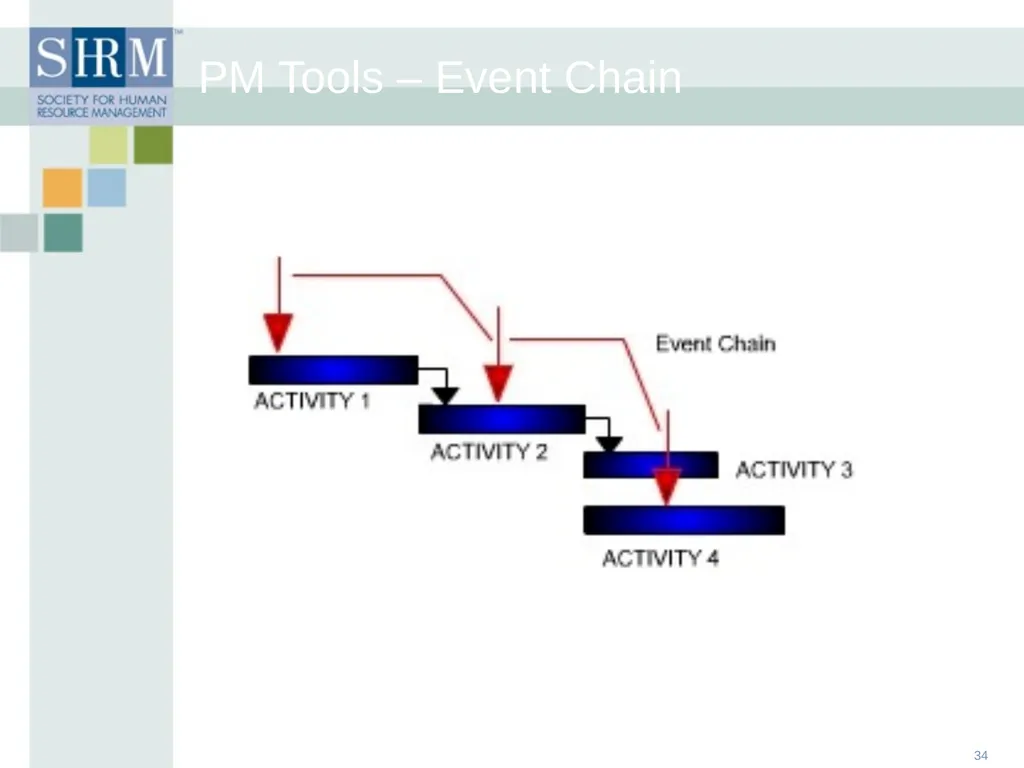
34
PM Tools – Event Chain 34<br>
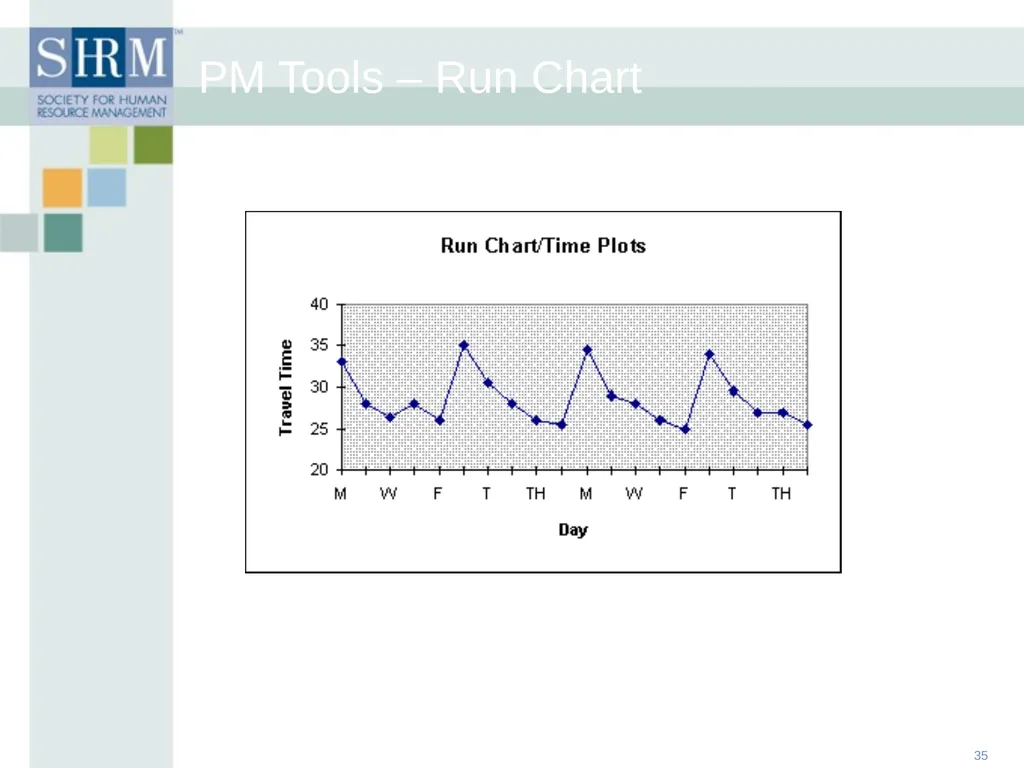
35
PM Tools – Run Chart 35<br>
36
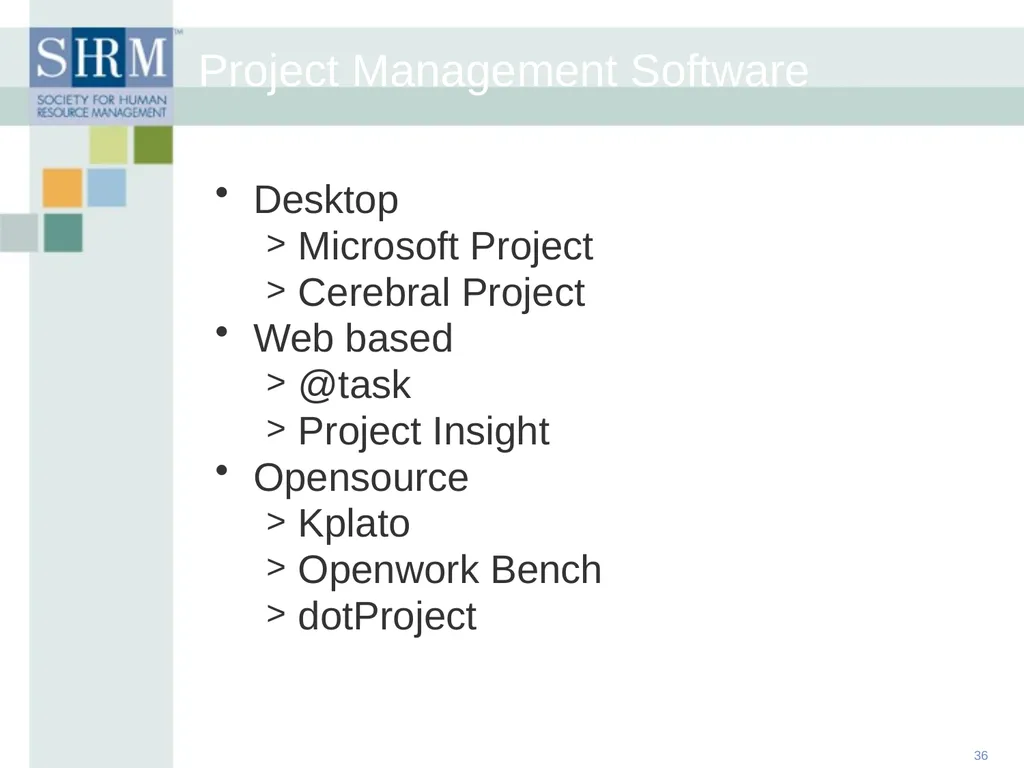
Project Management Software Desktop
Microsoft Project
Cerebral Project
Web based
@task
Project Insight
Opensource
Kplato
Openwork Bench
dotProject 36<br>
Microsoft Project
Cerebral Project
Web based
@task
Project Insight
Opensource
Kplato
Openwork Bench
dotProject 36<br>
37
Discussion Topics Provide an example of a project management tool and discuss how it could be used.
Provide one software resource and identify its strengths and weaknesses. 37<br>
Provide one software resource and identify its strengths and weaknesses. 37<br>
38
SECTION #3 MANAGING PROJECTS AND HRIS 38<br>
39
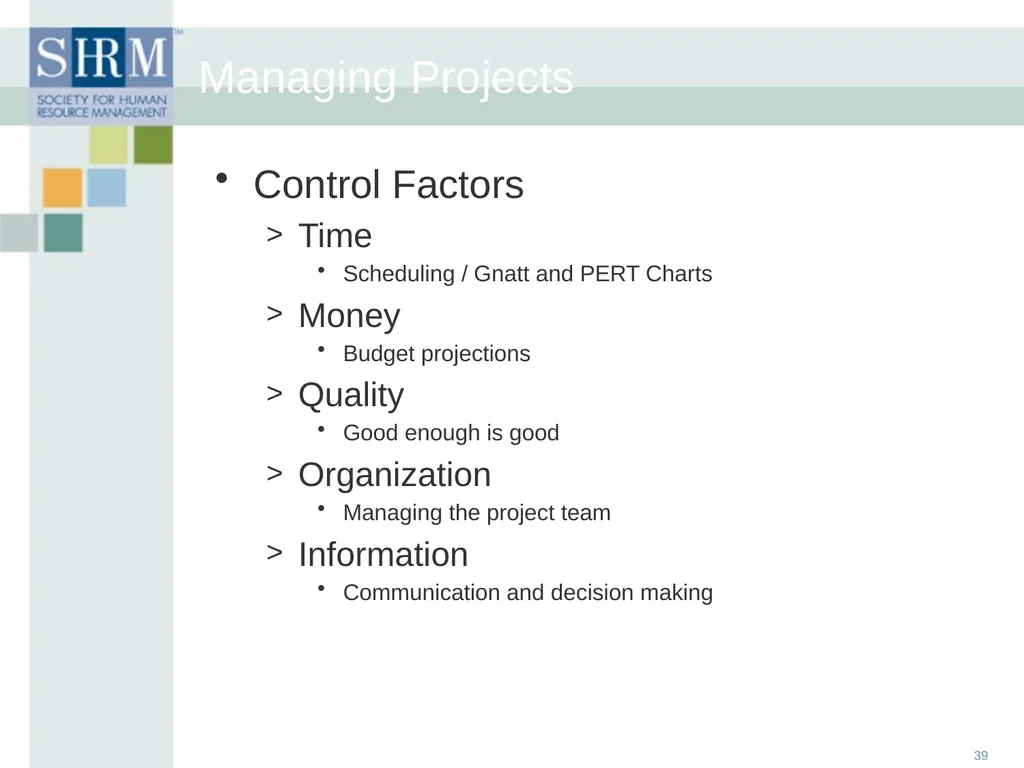
Managing Projects Control Factors
Time
Scheduling / Gnatt and PERT Charts
Money
Budget projections
Quality
Good enough is good
Organization
Managing the project team
Information
Communication and decision making 39<br>
Time
Scheduling / Gnatt and PERT Charts
Money
Budget projections
Quality
Good enough is good
Organization
Managing the project team
Information
Communication and decision making 39<br>
40
People and the Project Project Stakeholders and Tasks
The Project Sponsor
Member of management
Leadership role in getting project approved, funded and off the ground
Organizational Management
Identifies need for the project
Approves budget and assesses risk 40<br>
The Project Sponsor
Member of management
Leadership role in getting project approved, funded and off the ground
Organizational Management
Identifies need for the project
Approves budget and assesses risk 40<br>
41
People and the Project Project Stakeholders and Tasks
The Project Manager
Manages the team and the process, has ultimate responsibility for project success
Roles of the Project Manager
Interpersonal
Informational
Decisional 41<br>
The Project Manager
Manages the team and the process, has ultimate responsibility for project success
Roles of the Project Manager
Interpersonal
Informational
Decisional 41<br>
42
People and the Project Project Stakeholders and Tasks
The Project Team
Carries out the activities for project completion 42<br>
The Project Team
Carries out the activities for project completion 42<br>
43
Communications Within the Project Team
Kick-off meeting
Communications Plan: who, when, what, how
Review/scope
Technical review
Establish how the team will be informed of issues and decisions
Face-to-face
Email
Virtual teams
International communications
One voice
Language of customer
Informing stakeholders 43<br>
Kick-off meeting
Communications Plan: who, when, what, how
Review/scope
Technical review
Establish how the team will be informed of issues and decisions
Face-to-face
Virtual teams
International communications
One voice
Language of customer
Informing stakeholders 43<br>
44
Leadership Effective Project Managers
Problem-Solving expertise
Leadership expertise
Context knowledge
Analytical skill
People skills
Communication skills
Administrative expertise 44<br>
Problem-Solving expertise
Leadership expertise
Context knowledge
Analytical skill
People skills
Communication skills
Administrative expertise 44<br>
45
Project Management and HRIS Integrating HRIS systems
Project Management expertise
HR knowledge
Foundation Business knowledge
Understanding of the Organization 45<br>
Project Management expertise
HR knowledge
Foundation Business knowledge
Understanding of the Organization 45<br>
46
PM Phases in an HRIS Implementation Initiation
Planning
Executing
Controlling
Closure/Evaluation 46<br>
Planning
Executing
Controlling
Closure/Evaluation 46<br>
47
Initiation Feasibility study
Establish charter
Set up project office
Review phase 47<br>
Establish charter
Set up project office
Review phase 47<br>
48
Project Planning Resource plan:
People
Financial
Time
Quality
Risk
Communication
Procurement of materials
Contact suppliers
Contingency plan
Perform review of planning phase 48<br>
People
Financial
Time
Quality
Risk
Communication
Procurement of materials
Contact suppliers
Contingency plan
Perform review of planning phase 48<br>
49
Project Execution Doing the project – Build the deliverables
Monitor and Control
Time
Cost
Quality
Risk
Resources
Acceptance
Communications 49<br>
Monitor and Control
Time
Cost
Quality
Risk
Resources
Acceptance
Communications 49<br>
50
Project Execution Issues Management
Change Process
Review of Project Execution 50<br>
Change Process
Review of Project Execution 50<br>
51
Project Control Set baselines
Measure:
Progress
Performance
Compare:
Plan
Actual
Take action 51<br>
Measure:
Progress
Performance
Compare:
Plan
Actual
Take action 51<br>
52
Closure/Evaluation Project closure
Project review
Project evaluation
Lessons learned 52<br>
Project review
Project evaluation
Lessons learned 52<br>
53
Specifics of PM to an HRIS Integration Initiation
Planning
Executing
Controlling
Closure/Evaluation 53<br>
Planning
Executing
Controlling
Closure/Evaluation 53<br>
54
Engagement Exercise Create a list of critical risks and contingencies for an HRIS implementation. As a team or individually, create an outline of how each of phase of project management is affected. 54<br>
55
SECTION #4 HRIS IMPLEMENTATION 55<br>
56
Traditional HRIS Administrative Uses:
Monitor absences
Salary structures
Training information
Recruitment
Media response
Current information
Medical information
Global administration 56<br>
Monitor absences
Salary structures
Training information
Recruitment
Media response
Current information
Medical information
Global administration 56<br>
57
HRIS in Business Decision Making Analytical Processes:
Budget control
Applicant tracking and screening
Skills matching
Appraisals
Feedback
Manpower planning
Succession planning
Skills monitoring
Training needs analysis
Global analysis 57<br>
Budget control
Applicant tracking and screening
Skills matching
Appraisals
Feedback
Manpower planning
Succession planning
Skills monitoring
Training needs analysis
Global analysis 57<br>
58
Why Not More? HRIS in Business Decision Making Organization size
Organization culture
HR as a strategic partner
Internal culture and politics
HRIS time in use.
HR has limited IT and analytical skills.
IT has limited HR skills. 58<br>
Organization culture
HR as a strategic partner
Internal culture and politics
HRIS time in use.
HR has limited IT and analytical skills.
IT has limited HR skills. 58<br>
59
Application of HRIS Strategic Management
Environmental scanning
Tracks quality and productivity improvements
Workforce Planning and Employment
Tracks promotions, transfers, hiring and termination rates
Maintains and prints EEOC data in the required form
Prints applicant flow and utilization reports for affirmative action programs
Human Resource Development
Outlines career path development
Tracks, education, skills and training programs
Registers employees in courses
Evaluates employee performance 59<br>
Environmental scanning
Tracks quality and productivity improvements
Workforce Planning and Employment
Tracks promotions, transfers, hiring and termination rates
Maintains and prints EEOC data in the required form
Prints applicant flow and utilization reports for affirmative action programs
Human Resource Development
Outlines career path development
Tracks, education, skills and training programs
Registers employees in courses
Evaluates employee performance 59<br>
60
Application of HRIS Total Rewards
Tracks salary survey information
Tracks retirement planning, tuition reimbursement, COBRA and HIPAA info.
Facilitates benefit administration and salary analysis across job classifications
Employee and Labor Relations
Stores employee discipline records
Records union data and labor distribution data
Maintains attitude survey results
Risk Management
Identifies accident and illness trends
Tracks safety records, insurance and workers’ comp. claims
Monitors high-risk conditions and accidents 60<br>
Tracks salary survey information
Tracks retirement planning, tuition reimbursement, COBRA and HIPAA info.
Facilitates benefit administration and salary analysis across job classifications
Employee and Labor Relations
Stores employee discipline records
Records union data and labor distribution data
Maintains attitude survey results
Risk Management
Identifies accident and illness trends
Tracks safety records, insurance and workers’ comp. claims
Monitors high-risk conditions and accidents 60<br>
61
Legal Aspects of Data Employee information
What information should be gathered?
How should it be used?
Who should have access to data?
How should data be safeguarded?
Privacy:
Directly related to job
Need-to-know basis
Social security number. 61<br>
What information should be gathered?
How should it be used?
Who should have access to data?
How should data be safeguarded?
Privacy:
Directly related to job
Need-to-know basis
Social security number. 61<br>
62
Data Security Issues What’s causing the problem?
Inconsistent legal standards
More telecommuters and distance workers
More use of vendors and outsourcing
Increasing of organization wide IT systems
Demand for ease of use for e-mail, downloads, etc. 62<br>
Inconsistent legal standards
More telecommuters and distance workers
More use of vendors and outsourcing
Increasing of organization wide IT systems
Demand for ease of use for e-mail, downloads, etc. 62<br>
63
U.S. Laws and Employee Privacy Fair Credit Reporting Act
Electronic Communications Privacy Act
Health Insurance Portability and Accountability Act (HIPPA)
Sarbanes – Oxley Act 63<br>
Electronic Communications Privacy Act
Health Insurance Portability and Accountability Act (HIPPA)
Sarbanes – Oxley Act 63<br>
64
Globalization and Employee Privacy EU Data Protection Directive – 1998
Companies must give consumers (or employees) access to correct their data
Personal data can be used only for the purpose for which it was obtained
Companies may NOT transfer personal data to countries that lack adequate data protection laws
Canadian Privacy Laws
Federal Rules
Provincial Regulation 64<br>
Companies must give consumers (or employees) access to correct their data
Personal data can be used only for the purpose for which it was obtained
Companies may NOT transfer personal data to countries that lack adequate data protection laws
Canadian Privacy Laws
Federal Rules
Provincial Regulation 64<br>
65
Conflicts of Globalization Conflicting Privacy Regulations
Collection of data
Transfer of data
Employee hot-lines
What’s a company to do?
“Safe Harbor” program 65<br>
Collection of data
Transfer of data
Employee hot-lines
What’s a company to do?
“Safe Harbor” program 65<br>
66
Other Issues in Globalization Language barriers:
Royal English vs. American English.
Belgium (part of country): In Brussels employee selects (Dutch or French)
Processes differ slightly:
In U.S. address may trigger benefit changes
In Europe this is not a concern
Government regulations and reporting
Requirements will vary among countries
Terminology
may be different from one country to another
Culture
Individual vs. Collective 66<br>
Royal English vs. American English.
Belgium (part of country): In Brussels employee selects (Dutch or French)
Processes differ slightly:
In U.S. address may trigger benefit changes
In Europe this is not a concern
Government regulations and reporting
Requirements will vary among countries
Terminology
may be different from one country to another
Culture
Individual vs. Collective 66<br>
67
Change Management and HR Integrating HRIS What is the role of HR during change?
Recognize individuals may react negatively to change
Anticipate resistance and find ways to deal with it
Show commitment and present a positive attitude toward the change
Involve people in the process
Ensure top management is visible and supportive
Remind management and others that change is a process and successful change takes time
Reinforce change with incentives
Communicate with employees & management 67<br>
Recognize individuals may react negatively to change
Anticipate resistance and find ways to deal with it
Show commitment and present a positive attitude toward the change
Involve people in the process
Ensure top management is visible and supportive
Remind management and others that change is a process and successful change takes time
Reinforce change with incentives
Communicate with employees & management 67<br>
68
Conclusions HRIS
History of HRIS
Project management.
Integrating HRIS and project management
HRIS in business decision making
Globalization, legal, cultural and organizational change issues 68<br>
History of HRIS
Project management.
Integrating HRIS and project management
HRIS in business decision making
Globalization, legal, cultural and organizational change issues 68<br>