HUMAN POPULATION GROWTH:IMPACT ON ENVIRONMENT, HUMAN HEALTH AND WELFARE INTRODUCTION The growth of population is basic to interaction between man and his environment. According to an estimate, over eighty million people are added to worlds
"HUMAN POPULATION GROWTH:IMPACT ON ENVIRONMENT," is the property of its rightful owner. Permission is granted to
download and print the materials on this website for personal, non-commercial use only, and to display it
on your personal computer provided you do not modify the materials and that you retain all copyright
notices contained in the materials. By downloading content from our website, you accept the terms of this
agreement.
Presentation Transcript
01
HUMAN POPULATION GROWTH:IMPACT ON ENVIRONMENT, HUMAN HEALTH AND WELFARE<br>
02
INTRODUCTION The growth of population is basic to interaction between man and his environment.
According to an estimate, over eighty million people are added to world’s population every year. That means more food must be produced, more water for drinking and agricultural purposes, more materials to provide shelter and so on.
Bigger population has put bigger pressure on environment and increased the demand for the earth’s resources.
The impact of human activity on environment was negligible three thousand years ago, when less than hundred million people inhabited the earth today is tremendous.<br>
03
continued Besides, the geographic distribution of people, the concentration of people in urban areas and the demographic characteristics of regional population also have an important influence in the effects of human activity on the environment.
Every two years, the united Nation makes projection for future population growth. Its latest median projection is a population of 9.7bn in 2050 and 10.9bn in 2100.
Thomas Malthus theorized that populations grew in geometric progression. A geometric progression is a sequence of numbers where each term after the first is found by multiplying the previous one by a fixed, non-zero number called the common ratio.<br>
04
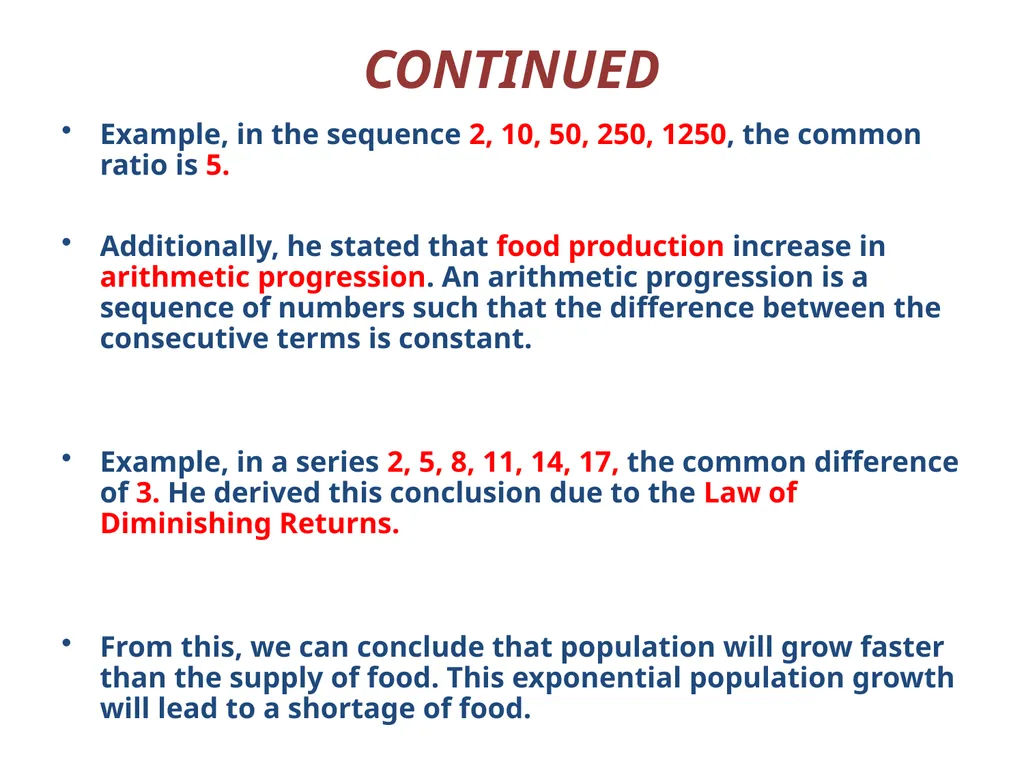
CONTINUED Example, in the sequence 2, 10, 50, 250, 1250, the common ratio is 5.
Additionally, he stated that food production increase in arithmetic progression. An arithmetic progression is a sequence of numbers such that the difference between the consecutive terms is constant.
Example, in a series 2, 5, 8, 11, 14, 17, the common difference of 3. He derived this conclusion due to the Law of Diminishing Returns.
From this, we can conclude that population will grow faster than the supply of food. This exponential population growth will lead to a shortage of food.<br>
05
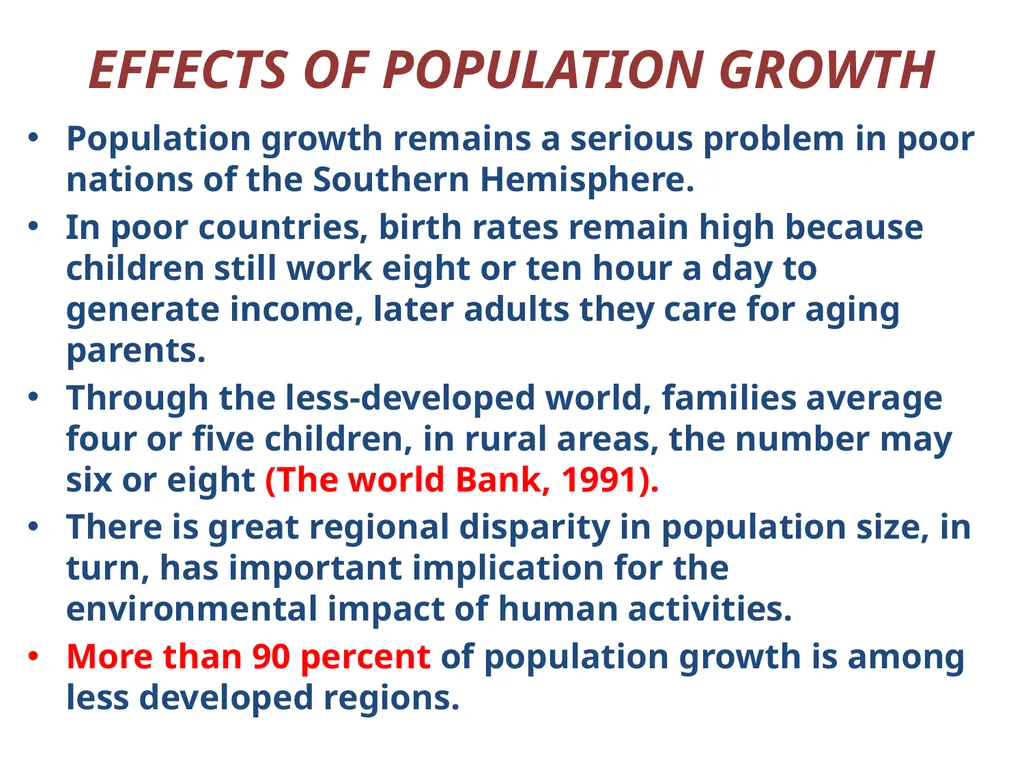
EFFECTS OF POPULATION GROWTH Population growth remains a serious problem in poor nations of the Southern Hemisphere.
In poor countries, birth rates remain high because children still work eight or ten hour a day to generate income, later adults they care for aging parents.
Through the less-developed world, families average four or five children, in rural areas, the number may six or eight (The world Bank, 1991).
There is great regional disparity in population size, in turn, has important implication for the environmental impact of human activities.
More than 90 percent of population growth is among less developed regions.<br>
06
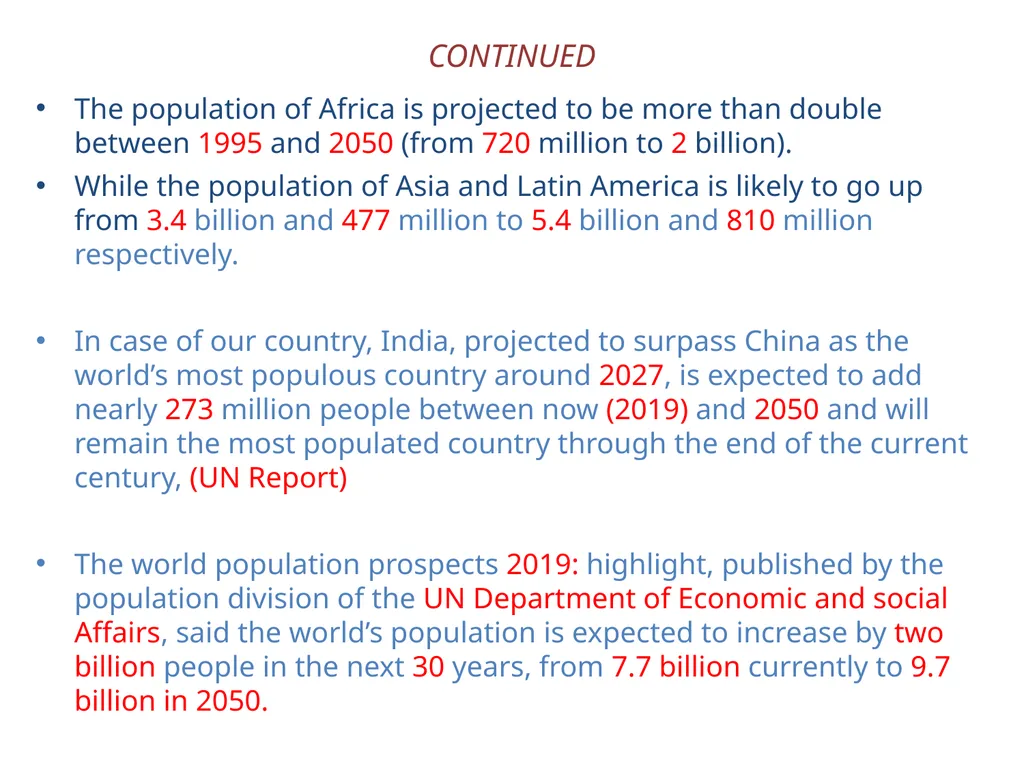
CONTINUED The population of Africa is projected to be more than double between 1995 and 2050 (from 720 million to 2 billion).
While the population of Asia and Latin America is likely to go up from 3.4 billion and 477 million to 5.4 billion and 810 million respectively.
In case of our country, India, projected to surpass China as the world’s most populous country around 2027, is expected to add nearly 273 million people between now (2019) and 2050 and will remain the most populated country through the end of the current century, (UN Report)
The world population prospects 2019: highlight, published by the population division of the UN Department of Economic and social Affairs, said the world’s population is expected to increase by two billion people in the next 30 years, from 7.7 billion currently to 9.7 billion in 2050.<br>
07
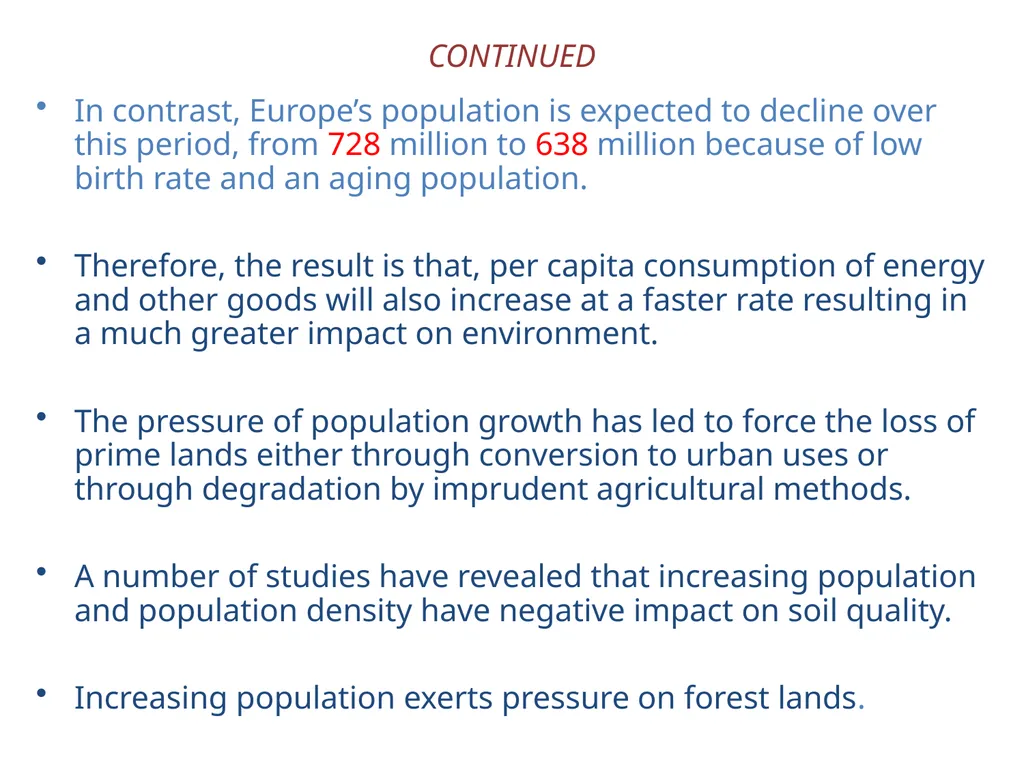
CONTINUED In contrast, Europe’s population is expected to decline over this period, from 728 million to 638 million because of low birth rate and an aging population.
Therefore, the result is that, per capita consumption of energy and other goods will also increase at a faster rate resulting in a much greater impact on environment.
The pressure of population growth has led to force the loss of prime lands either through conversion to urban uses or through degradation by imprudent agricultural methods.
A number of studies have revealed that increasing population and population density have negative impact on soil quality.
Increasing population exerts pressure on forest lands.<br>
08
CONTINUED Shrinking Habitat
Regional imbalances
Population explosion
Causes of population explosion
A) High birth rate B) Declining death rate
High birth rate is a function of both of social and economic factors.
(1) Social factors
Social factors include (1) marriage a universal phenomenon in India, (2) Joint family system, (3) Preference for a son, (4) Rise in natural fertility.
(2) Economic factors
Economic factors include (1) Wide spread poverty, (2) High infant mortality rate, (3) Indifference toward family planning<br>