
HUMAN RESOURCES NUTR 468 SPRING 2017 TYPES OF
LS
Published · 48 slides · 0 views
1 / 1
Description
HUMAN RESOURCES NUTR 468 SPRING 2017 TYPES OF EMPLOYEES 2 Types of Employees In dietetics practice, four types of employeesworkers predominate: Professional Staff Supervisory Personnel Skilled Workers Unskilled Workers The descriptions are
Related Topics
Share
Embed code
Download this presentation From Below
"HUMAN RESOURCES NUTR 468 SPRING 2017 TYPES OF" is the property of its rightful owner. Permission is granted to download and print the materials on this website for personal, non-commercial use only, and to display it on your personal computer provided you do not modify the materials and that you retain all copyright notices contained in the materials. By downloading content from our website, you accept the terms of this agreement.
Presentation Transcript
01
HUMAN RESOURCES NUTR 468
SPRING 2017<br>
SPRING 2017<br>
02
TYPES OF EMPLOYEES 2<br>
03
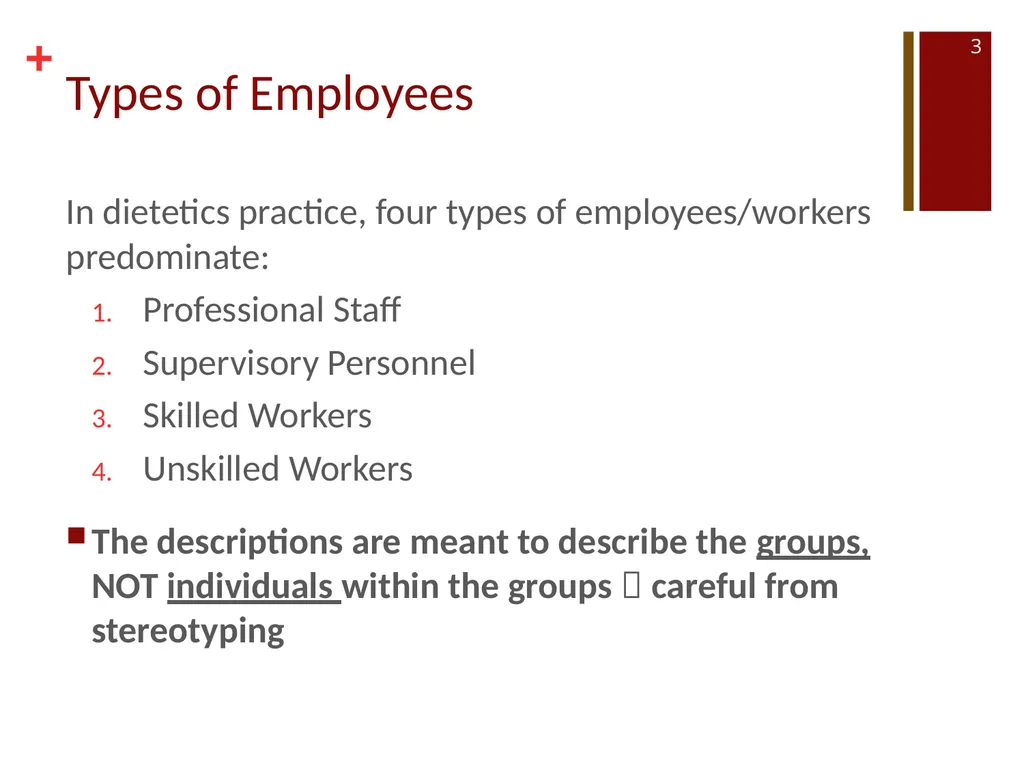
Types of Employees In dietetics practice, four types of employees/workers predominate:
Professional Staff
Supervisory Personnel
Skilled Workers
Unskilled Workers
The descriptions are meant to describe the groups, NOT individuals within the groups careful from stereotyping 3<br>
Professional Staff
Supervisory Personnel
Skilled Workers
Unskilled Workers
The descriptions are meant to describe the groups, NOT individuals within the groups careful from stereotyping 3<br>
04
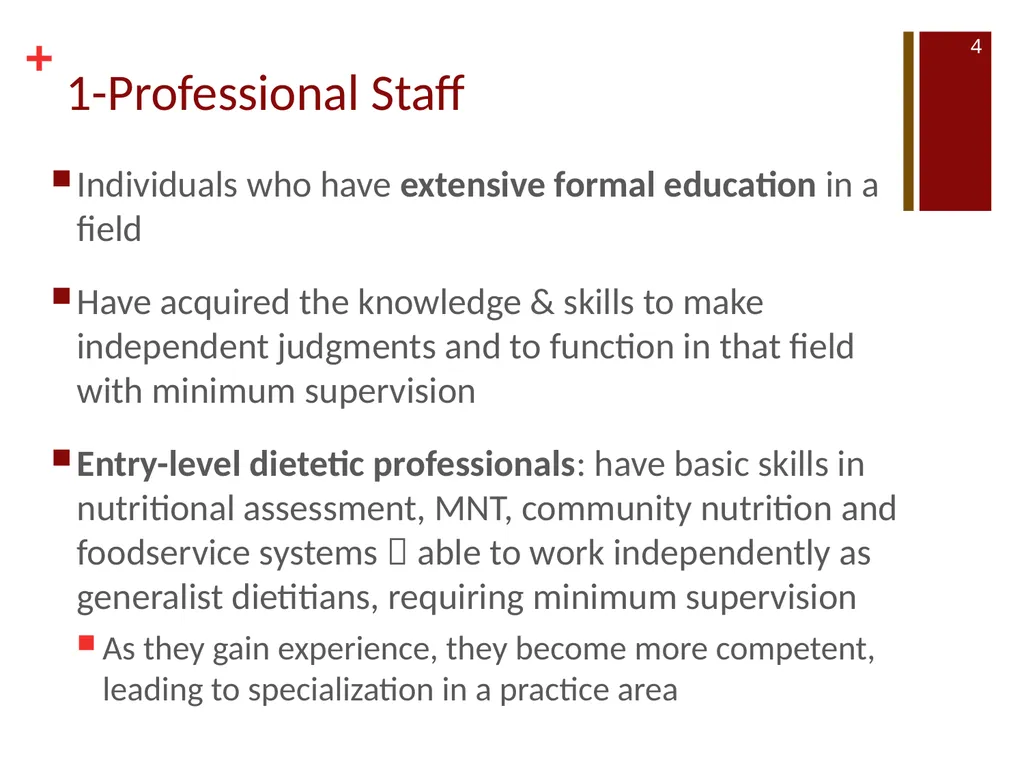
1-Professional Staff Individuals who have extensive formal education in a field
Have acquired the knowledge & skills to make independent judgments and to function in that field with minimum supervision
Entry-level dietetic professionals: have basic skills in nutritional assessment, MNT, community nutrition and foodservice systems able to work independently as generalist dietitians, requiring minimum supervision
As they gain experience, they become more competent, leading to specialization in a practice area 4<br>
Have acquired the knowledge & skills to make independent judgments and to function in that field with minimum supervision
Entry-level dietetic professionals: have basic skills in nutritional assessment, MNT, community nutrition and foodservice systems able to work independently as generalist dietitians, requiring minimum supervision
As they gain experience, they become more competent, leading to specialization in a practice area 4<br>
05
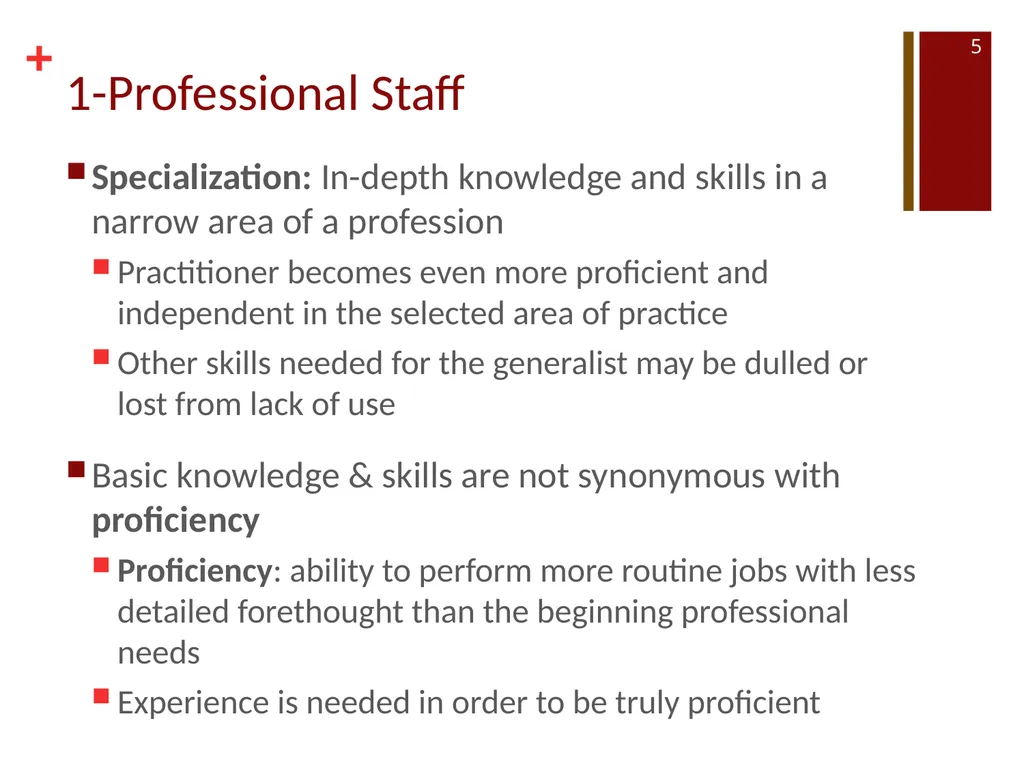
1-Professional Staff Specialization: In-depth knowledge and skills in a narrow area of a profession
Practitioner becomes even more proficient and independent in the selected area of practice
Other skills needed for the generalist may be dulled or lost from lack of use
Basic knowledge & skills are not synonymous with proficiency
Proficiency: ability to perform more routine jobs with less detailed forethought than the beginning professional needs
Experience is needed in order to be truly proficient 5<br>
Practitioner becomes even more proficient and independent in the selected area of practice
Other skills needed for the generalist may be dulled or lost from lack of use
Basic knowledge & skills are not synonymous with proficiency
Proficiency: ability to perform more routine jobs with less detailed forethought than the beginning professional needs
Experience is needed in order to be truly proficient 5<br>
06
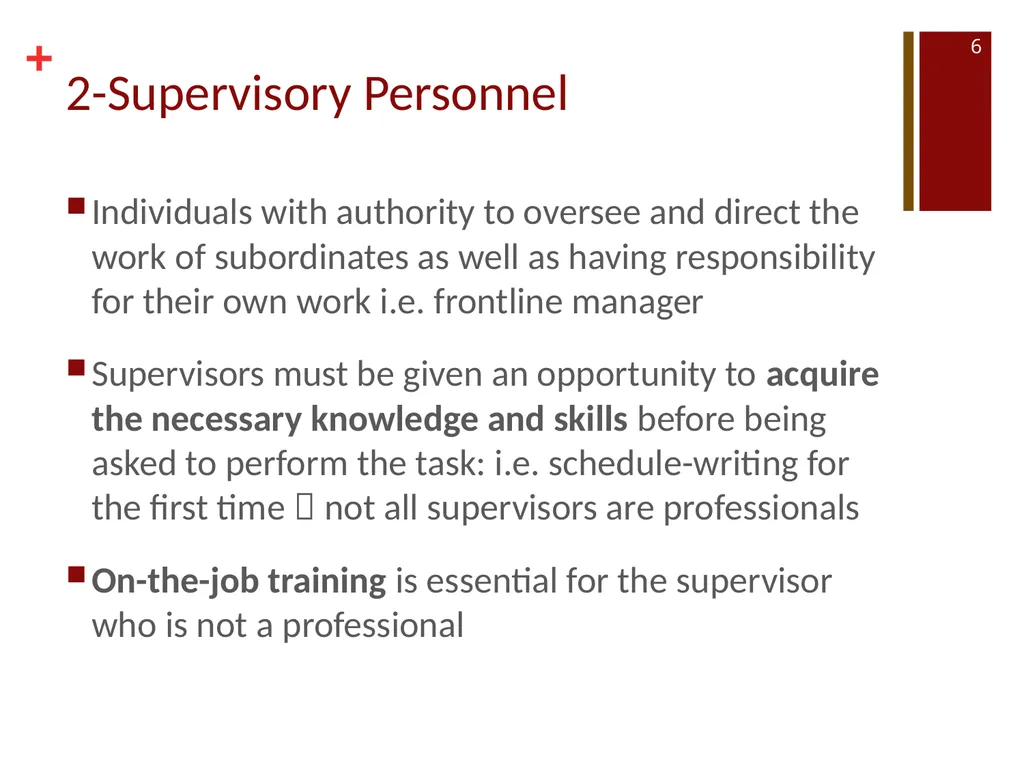
2-Supervisory Personnel Individuals with authority to oversee and direct the work of subordinates as well as having responsibility for their own work i.e. frontline manager
Supervisors must be given an opportunity to acquire the necessary knowledge and skills before being asked to perform the task: i.e. schedule-writing for the first time not all supervisors are professionals
On-the-job training is essential for the supervisor who is not a professional 6<br>
Supervisors must be given an opportunity to acquire the necessary knowledge and skills before being asked to perform the task: i.e. schedule-writing for the first time not all supervisors are professionals
On-the-job training is essential for the supervisor who is not a professional 6<br>
07
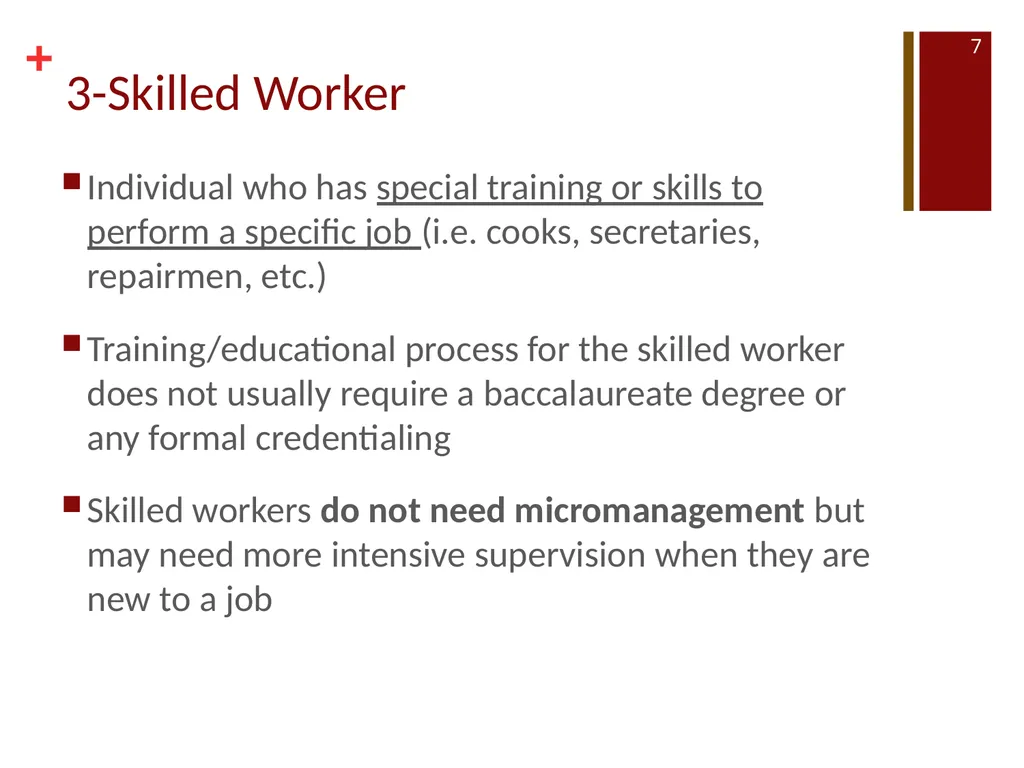
3-Skilled Worker Individual who has special training or skills to perform a specific job (i.e. cooks, secretaries, repairmen, etc.)
Training/educational process for the skilled worker does not usually require a baccalaureate degree or any formal credentialing
Skilled workers do not need micromanagement but may need more intensive supervision when they are new to a job 7<br>
Training/educational process for the skilled worker does not usually require a baccalaureate degree or any formal credentialing
Skilled workers do not need micromanagement but may need more intensive supervision when they are new to a job 7<br>
08
4-Unskilled Worker Employee who brings no marketable skills to the job and are trained in the workplace to perform the required tasks (i.e. foodservice workers, housekeeping staff etc.)
Trainer may be an experienced peer or the supervisor
Often earn minimum wage though not always the case
Employer may provide workers with training on literacy 8<br>
Trainer may be an experienced peer or the supervisor
Often earn minimum wage though not always the case
Employer may provide workers with training on literacy 8<br>
09
EMPLOYEE EMPLOYMENT STATUS 9<br>
10
Employee Employment Status Employment status:
Full-time
Part-time
Short-hour
Casual/on call
Job sharing
Probation
Temporary
Contract
No standard definitions for many of these terms- may have different meaning from region to region or from employer to employer 10<br>
Full-time
Part-time
Short-hour
Casual/on call
Job sharing
Probation
Temporary
Contract
No standard definitions for many of these terms- may have different meaning from region to region or from employer to employer 10<br>
11
Employee Employment Status Keep in mind:
It is cost-effective to retain employees whenever possible
Minimum costs associated with hiring & training a new employee is around $2,500 USD
Range can extend beyond $100,000 for upper-level executives 11<br>
It is cost-effective to retain employees whenever possible
Minimum costs associated with hiring & training a new employee is around $2,500 USD
Range can extend beyond $100,000 for upper-level executives 11<br>
12
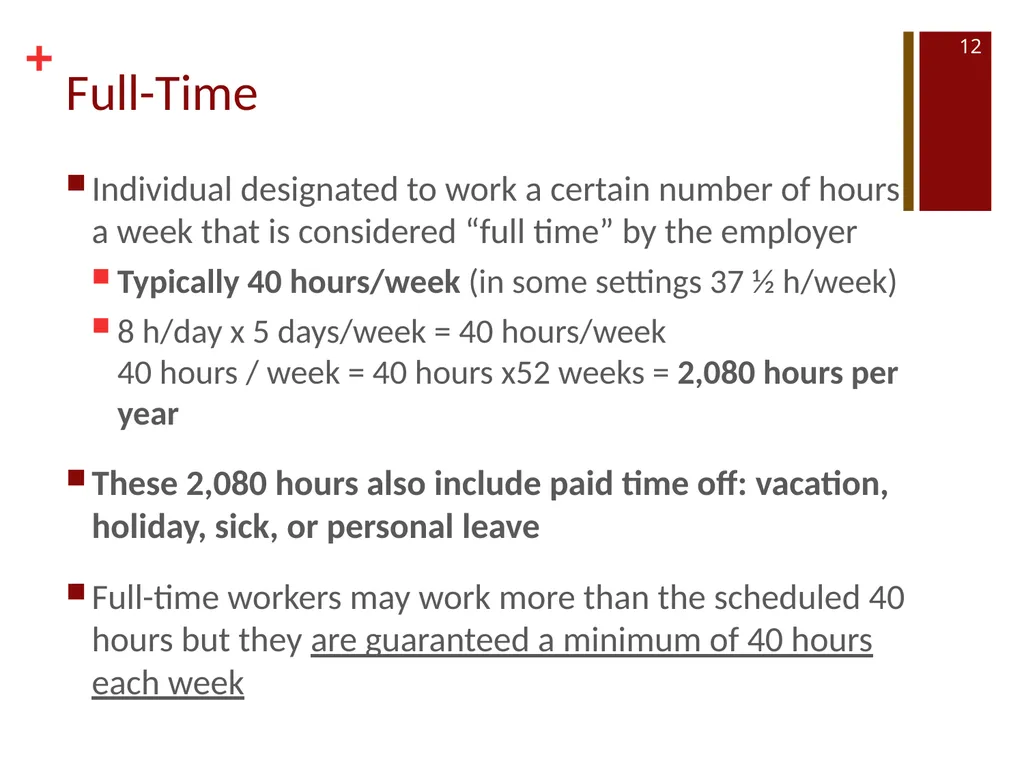
Full-Time Individual designated to work a certain number of hours a week that is considered “full time” by the employer
Typically 40 hours/week (in some settings 37 ½ h/week)
8 h/day x 5 days/week = 40 hours/week 40 hours / week = 40 hours x52 weeks = 2,080 hours per year
These 2,080 hours also include paid time off: vacation, holiday, sick, or personal leave
Full-time workers may work more than the scheduled 40 hours but they are guaranteed a minimum of 40 hours each week 12<br>
Typically 40 hours/week (in some settings 37 ½ h/week)
8 h/day x 5 days/week = 40 hours/week 40 hours / week = 40 hours x52 weeks = 2,080 hours per year
These 2,080 hours also include paid time off: vacation, holiday, sick, or personal leave
Full-time workers may work more than the scheduled 40 hours but they are guaranteed a minimum of 40 hours each week 12<br>
13
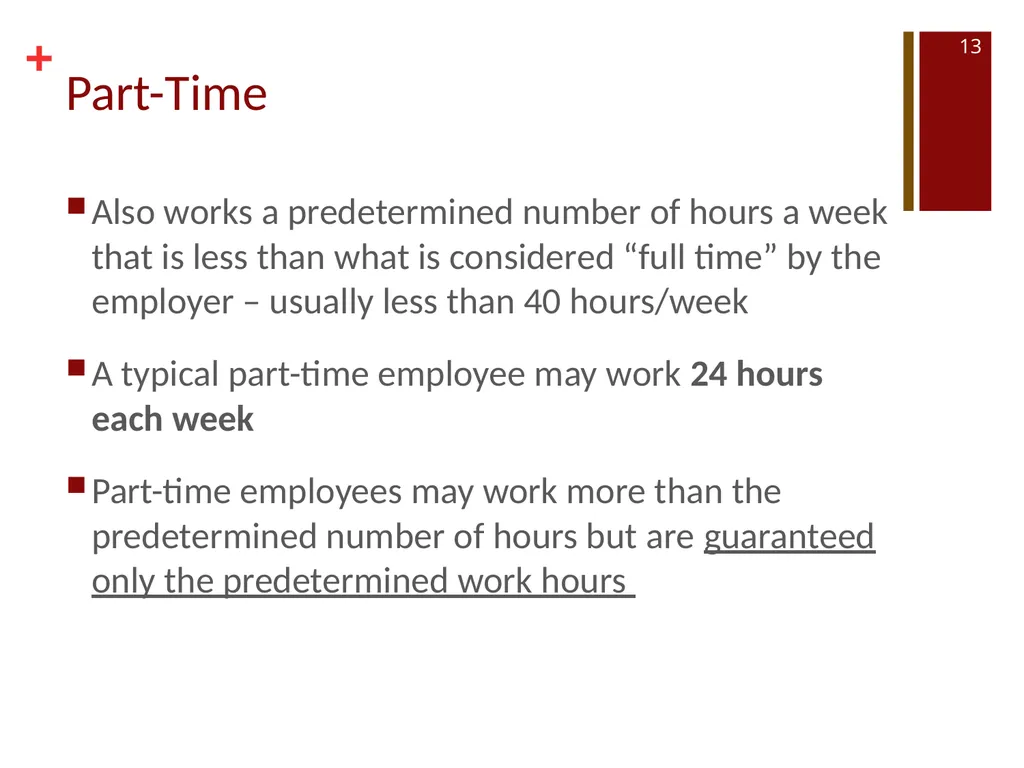
Part-Time Also works a predetermined number of hours a week that is less than what is considered “full time” by the employer – usually less than 40 hours/week
A typical part-time employee may work 24 hours each week
Part-time employees may work more than the predetermined number of hours but are guaranteed only the predetermined work hours 13<br>
A typical part-time employee may work 24 hours each week
Part-time employees may work more than the predetermined number of hours but are guaranteed only the predetermined work hours 13<br>
14
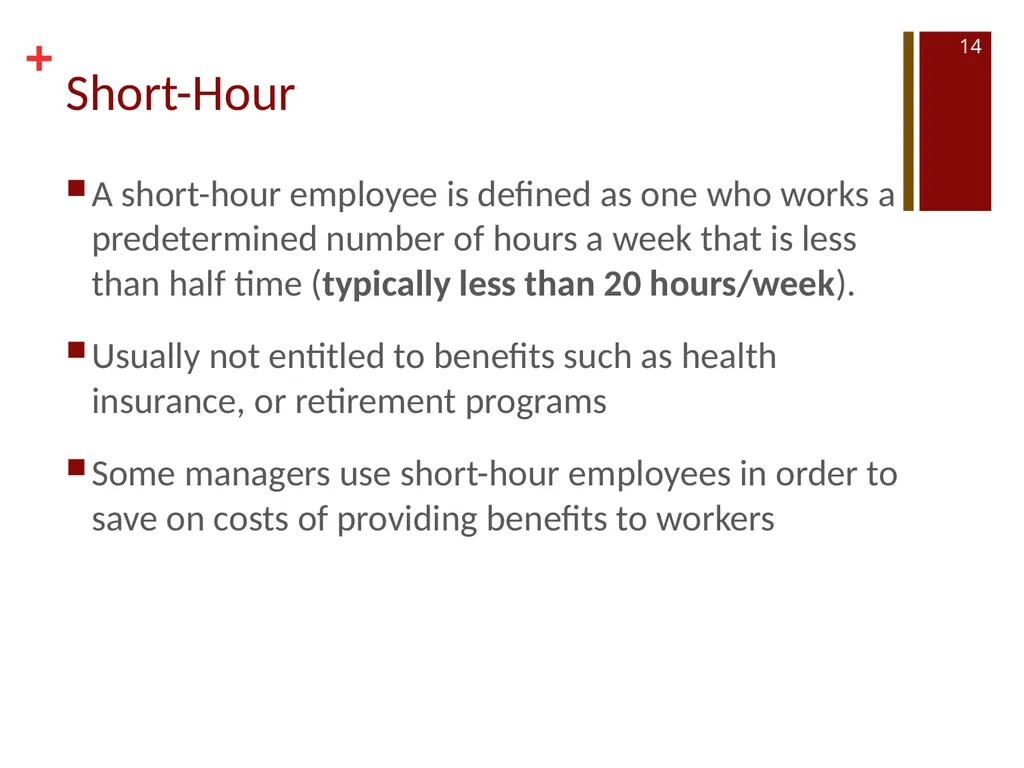
Short-Hour A short-hour employee is defined as one who works a predetermined number of hours a week that is less than half time (typically less than 20 hours/week).
Usually not entitled to benefits such as health insurance, or retirement programs
Some managers use short-hour employees in order to save on costs of providing benefits to workers 14<br>
Usually not entitled to benefits such as health insurance, or retirement programs
Some managers use short-hour employees in order to save on costs of providing benefits to workers 14<br>
15
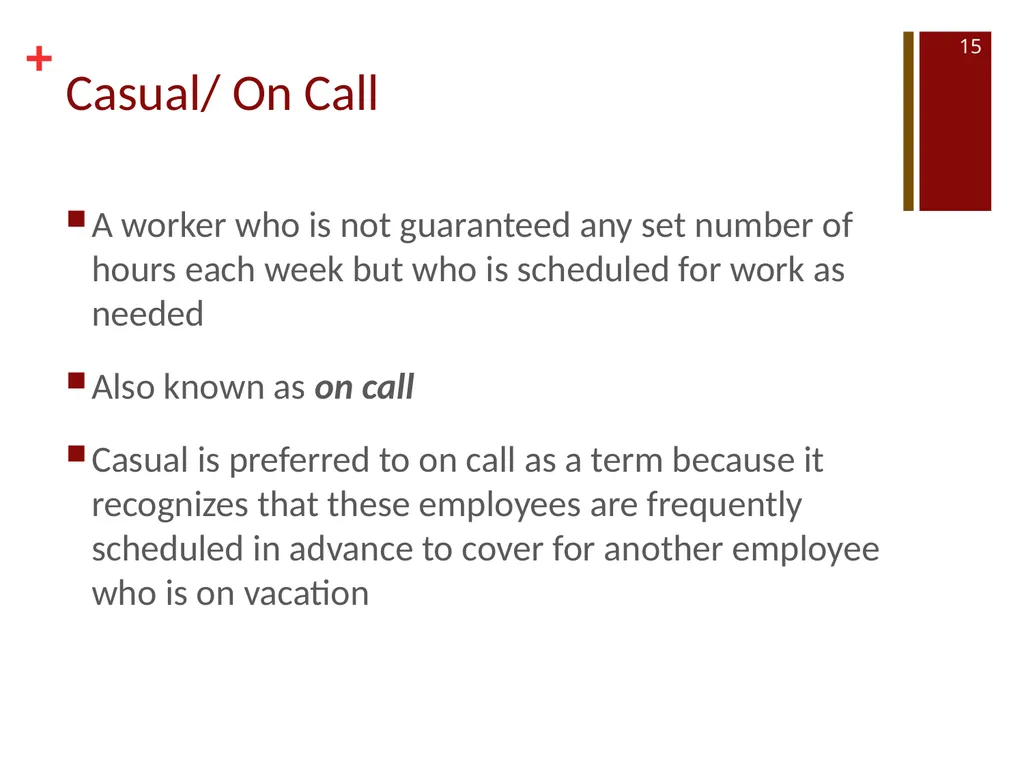
Casual/ On Call A worker who is not guaranteed any set number of hours each week but who is scheduled for work as needed
Also known as on call
Casual is preferred to on call as a term because it recognizes that these employees are frequently scheduled in advance to cover for another employee who is on vacation 15<br>
Also known as on call
Casual is preferred to on call as a term because it recognizes that these employees are frequently scheduled in advance to cover for another employee who is on vacation 15<br>
16
Job Sharing Relatively new concept of having two employees share one full-time job
Benefits: the employer has two individuals who bring their ideas, talents and skills to the job
Disadvantages
Lack of continuity and decreased productivity
A lot of time is spent communicating with each other to avoid duplication of effort or omission of essential elements of the job
No set patterns determining how benefits are allocated, or how vacations are scheduled-determined by employers 16<br>
Benefits: the employer has two individuals who bring their ideas, talents and skills to the job
Disadvantages
Lack of continuity and decreased productivity
A lot of time is spent communicating with each other to avoid duplication of effort or omission of essential elements of the job
No set patterns determining how benefits are allocated, or how vacations are scheduled-determined by employers 16<br>
17
Probation Probationary employee: one who is newly hired
Has not demonstrated (yet) that he can successfully perform the job for which he was hired
Given a set period of time, often 60 or 90 days to learn the job
During this time, it is the manager’s prerogative to dismiss the worker “without cause”
Dismissal should take place during the probationary period 17<br>
Has not demonstrated (yet) that he can successfully perform the job for which he was hired
Given a set period of time, often 60 or 90 days to learn the job
During this time, it is the manager’s prerogative to dismiss the worker “without cause”
Dismissal should take place during the probationary period 17<br>
18
Temporary Hired for a finite period of time (i.e. to cover a leave of absence, transient need for more employees, students who cover summertime vacations of permanent workers)
May or may not be placed on the employer’s payroll
If placed on the employer’s payroll:
Usually work for several months which justifies the cost of hiring and training them
Typically work without benefits, though some employers offer pay in lieu of benefits to them 18<br>
May or may not be placed on the employer’s payroll
If placed on the employer’s payroll:
Usually work for several months which justifies the cost of hiring and training them
Typically work without benefits, though some employers offer pay in lieu of benefits to them 18<br>
19
Temporary If NOT on the employer’s payroll:
Hired through a temporary employment agency for a published fee i.e. unskilled workers hired and paid through an agency
Type of arrangement typically used when shortages in staff are unexpected (illness, two-week vacation when no other staff member can perform job functions)
Expensive (paying the employee and agency’s fees) but may be worth it rather than having to train a new employee 19<br>
Hired through a temporary employment agency for a published fee i.e. unskilled workers hired and paid through an agency
Type of arrangement typically used when shortages in staff are unexpected (illness, two-week vacation when no other staff member can perform job functions)
Expensive (paying the employee and agency’s fees) but may be worth it rather than having to train a new employee 19<br>
20
Contract Usually hired to complete a project/do a job that is finite in nature i.e. computer engineers, data entry personnel, graphic designers etc.
Typically not on the employer’s payroll
May be paid a fee for the project or paid an hourly/monthly consultant fee
Fee is higher than if the consultant were on the payroll
Costs are usually offset by the savings of not having to hire, train and provide benefits to an employee
Contractors and consultants must provide their own benefits and pay taxes on the consultant fees 20<br>
Typically not on the employer’s payroll
May be paid a fee for the project or paid an hourly/monthly consultant fee
Fee is higher than if the consultant were on the payroll
Costs are usually offset by the savings of not having to hire, train and provide benefits to an employee
Contractors and consultants must provide their own benefits and pay taxes on the consultant fees 20<br>
21
EMPLOYEE COMPENSATION 21<br>
22
Salaried & Hourly Compensation Hourly: paid for the number of hours worked vs. salaried: paid a set salary
Hourly workers also called nonexempt
Salaried workers are called exempt
Managers should become familiar with the precise meanings of these terms in their workplaces – these terms do not have universal definitions 22<br>
Hourly workers also called nonexempt
Salaried workers are called exempt
Managers should become familiar with the precise meanings of these terms in their workplaces – these terms do not have universal definitions 22<br>
23
Hourly Worker/Nonexempt Paid a set rate for each hour worked
Paid at least the minimum wage set by the government
Hourly rate for an individual is also known as the base rate
Differential rates of pay are calculated based on the base rate
i.e. if a short-hour worker has a base rate of $8.00/hr and is to receive pay in lieu of benefits 10% actually pay rate for this worker would be: $8.80 ($8.00 x 10% = $ 0.80; $8.00+$0.80 = $8.80 per hour) 23<br>
Paid at least the minimum wage set by the government
Hourly rate for an individual is also known as the base rate
Differential rates of pay are calculated based on the base rate
i.e. if a short-hour worker has a base rate of $8.00/hr and is to receive pay in lieu of benefits 10% actually pay rate for this worker would be: $8.80 ($8.00 x 10% = $ 0.80; $8.00+$0.80 = $8.80 per hour) 23<br>
24
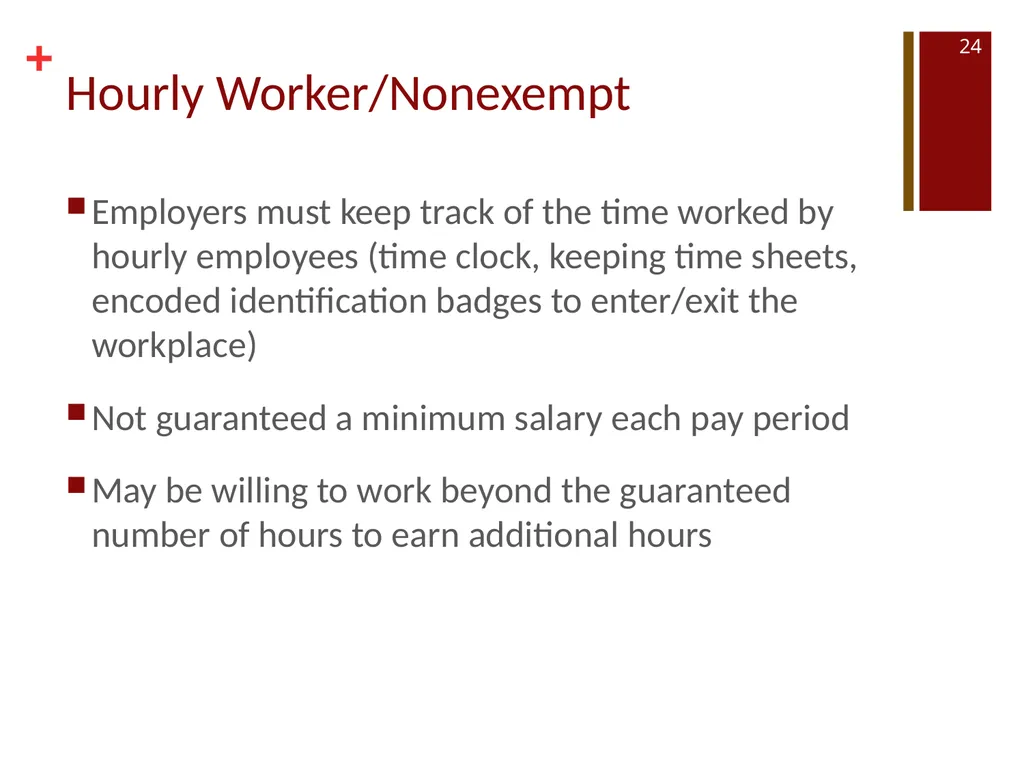
Hourly Worker/Nonexempt Employers must keep track of the time worked by hourly employees (time clock, keeping time sheets, encoded identification badges to enter/exit the workplace)
Not guaranteed a minimum salary each pay period
May be willing to work beyond the guaranteed number of hours to earn additional hours 24<br>
Not guaranteed a minimum salary each pay period
May be willing to work beyond the guaranteed number of hours to earn additional hours 24<br>
25
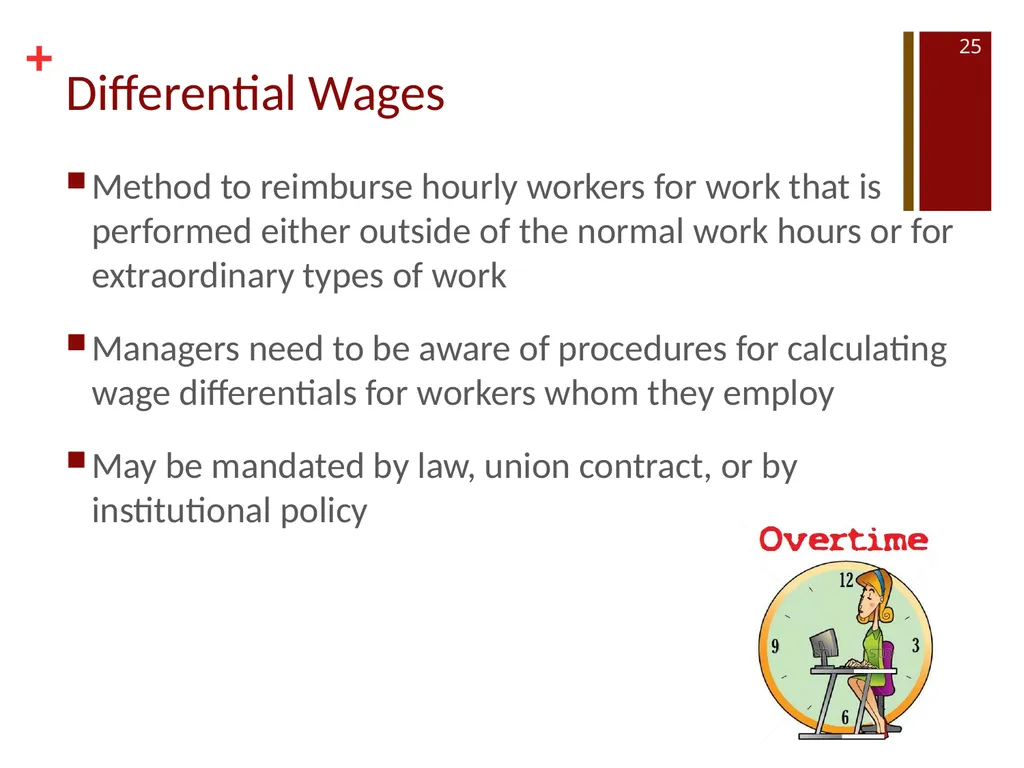
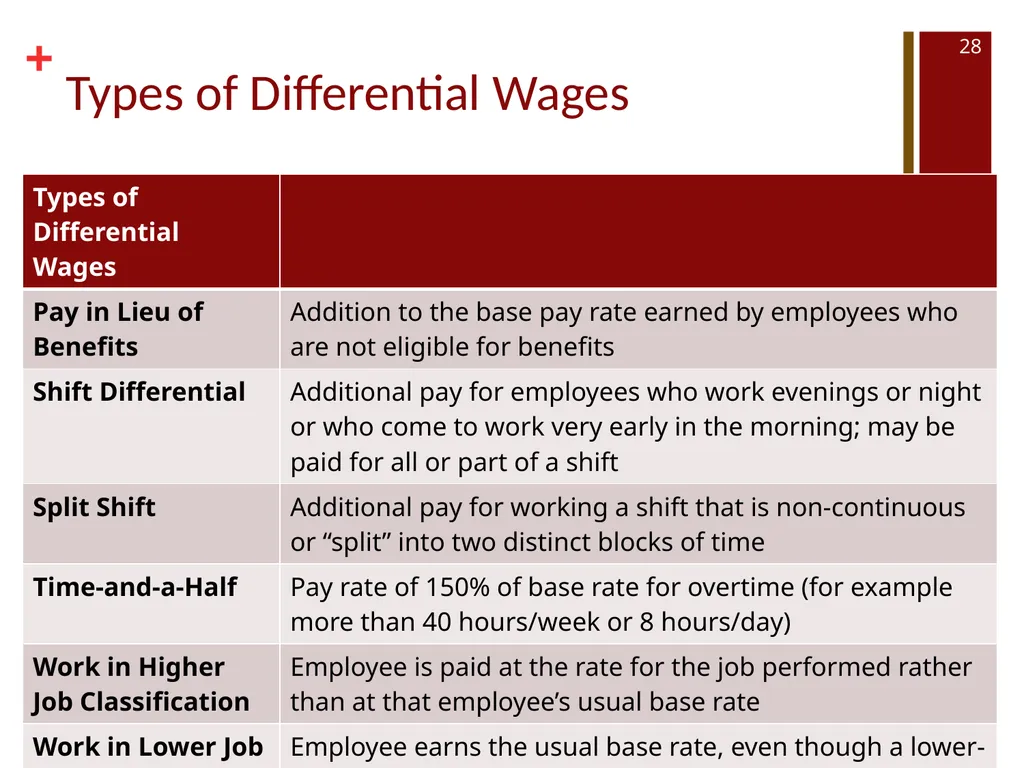
Differential Wages Method to reimburse hourly workers for work that is performed either outside of the normal work hours or for extraordinary types of work
Managers need to be aware of procedures for calculating wage differentials for workers whom they employ
May be mandated by law, union contract, or by institutional policy 25<br>
Managers need to be aware of procedures for calculating wage differentials for workers whom they employ
May be mandated by law, union contract, or by institutional policy 25<br>
26
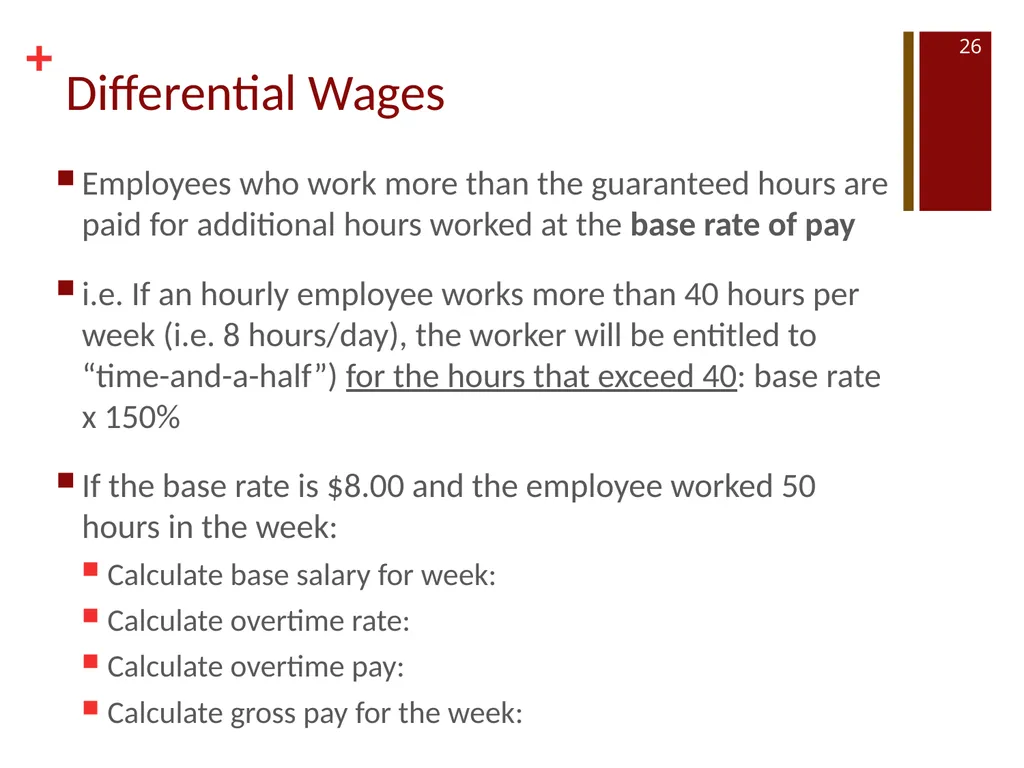
Differential Wages Employees who work more than the guaranteed hours are paid for additional hours worked at the base rate of pay
i.e. If an hourly employee works more than 40 hours per week (i.e. 8 hours/day), the worker will be entitled to “time-and-a-half”) for the hours that exceed 40: base rate x 150%
If the base rate is $8.00 and the employee worked 50 hours in the week:
Calculate base salary for week:
Calculate overtime rate:
Calculate overtime pay:
Calculate gross pay for the week: 26<br>
i.e. If an hourly employee works more than 40 hours per week (i.e. 8 hours/day), the worker will be entitled to “time-and-a-half”) for the hours that exceed 40: base rate x 150%
If the base rate is $8.00 and the employee worked 50 hours in the week:
Calculate base salary for week:
Calculate overtime rate:
Calculate overtime pay:
Calculate gross pay for the week: 26<br>
27
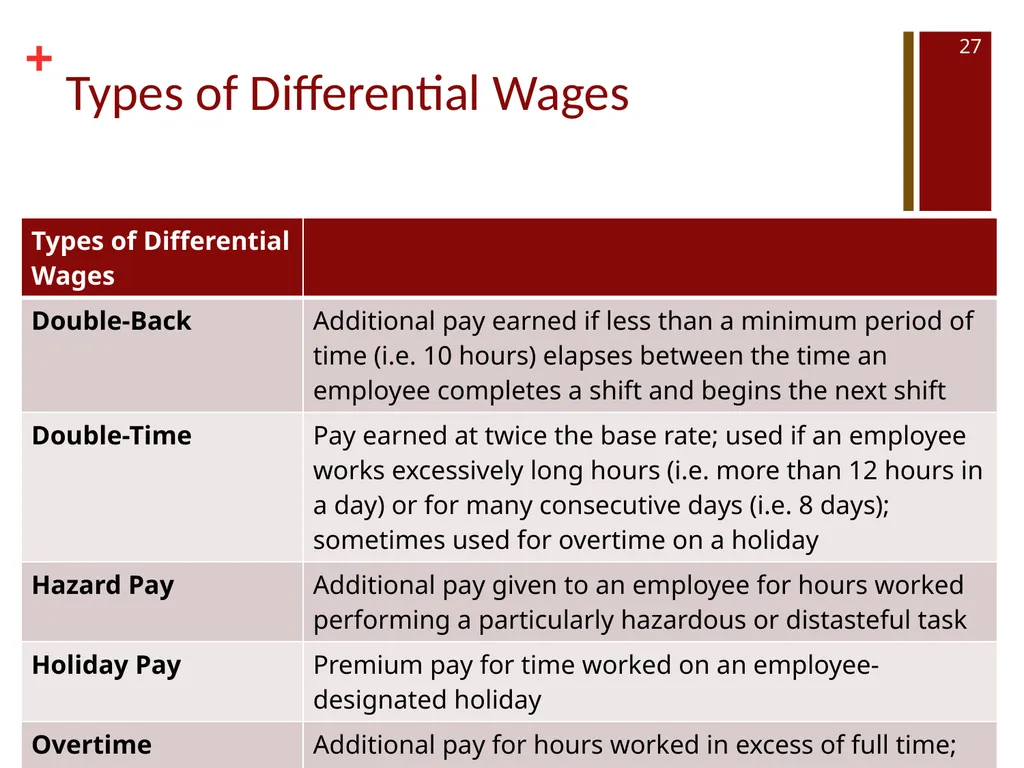
Types of Differential Wages 27<br>
28
Types of Differential Wages 28<br>
29
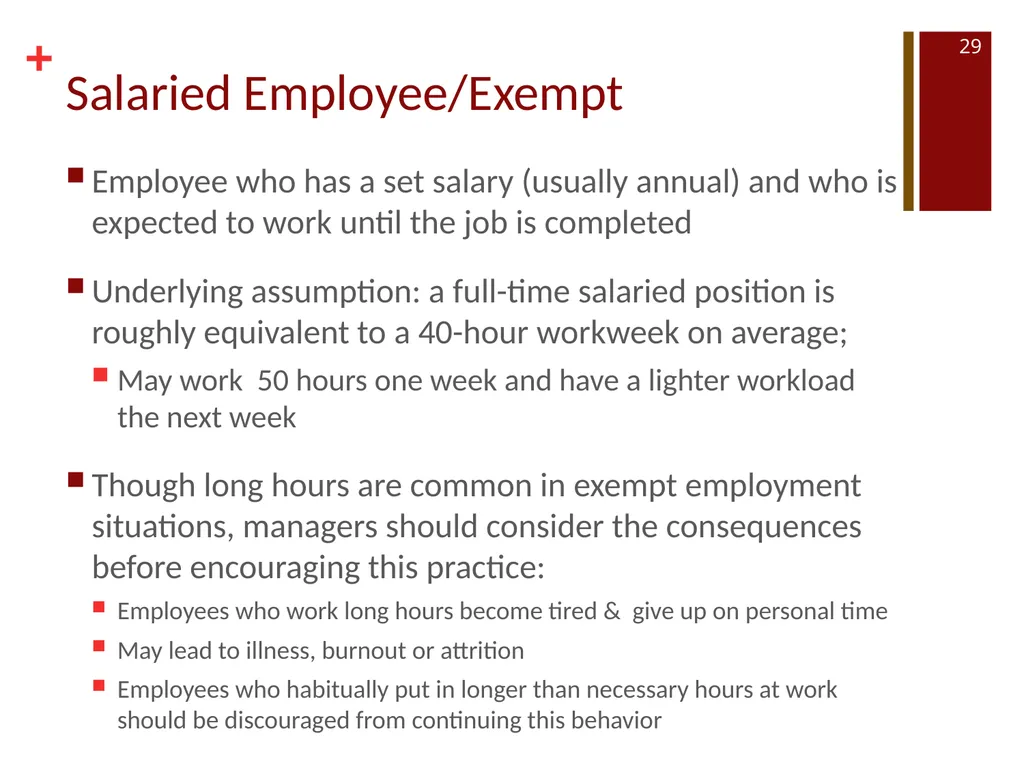
Salaried Employee/Exempt Employee who has a set salary (usually annual) and who is expected to work until the job is completed
Underlying assumption: a full-time salaried position is roughly equivalent to a 40-hour workweek on average;
May work 50 hours one week and have a lighter workload the next week
Though long hours are common in exempt employment situations, managers should consider the consequences before encouraging this practice:
Employees who work long hours become tired & give up on personal time
May lead to illness, burnout or attrition
Employees who habitually put in longer than necessary hours at work should be discouraged from continuing this behavior 29<br>
Underlying assumption: a full-time salaried position is roughly equivalent to a 40-hour workweek on average;
May work 50 hours one week and have a lighter workload the next week
Though long hours are common in exempt employment situations, managers should consider the consequences before encouraging this practice:
Employees who work long hours become tired & give up on personal time
May lead to illness, burnout or attrition
Employees who habitually put in longer than necessary hours at work should be discouraged from continuing this behavior 29<br>
30
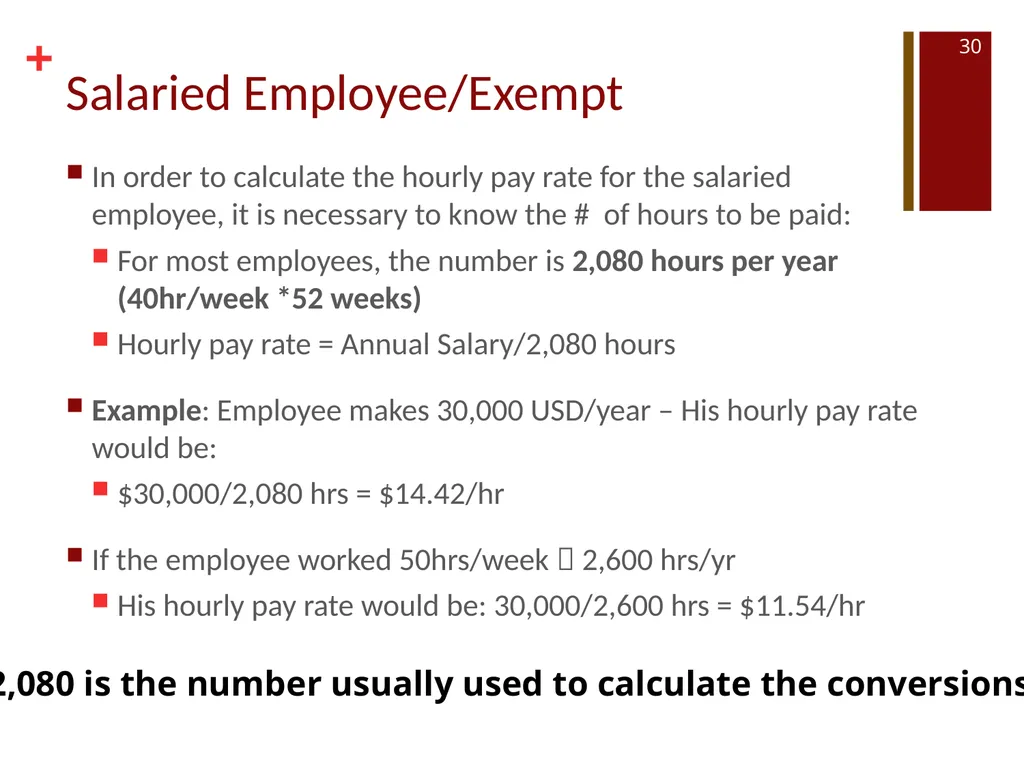
Salaried Employee/Exempt In order to calculate the hourly pay rate for the salaried employee, it is necessary to know the # of hours to be paid:
For most employees, the number is 2,080 hours per year (40hr/week *52 weeks)
Hourly pay rate = Annual Salary/2,080 hours
Example: Employee makes 30,000 USD/year – His hourly pay rate would be:
$30,000/2,080 hrs = $14.42/hr
If the employee worked 50hrs/week 2,600 hrs/yr
His hourly pay rate would be: 30,000/2,600 hrs = $11.54/hr 2,080 is the number usually used to calculate the conversions 30<br>
For most employees, the number is 2,080 hours per year (40hr/week *52 weeks)
Hourly pay rate = Annual Salary/2,080 hours
Example: Employee makes 30,000 USD/year – His hourly pay rate would be:
$30,000/2,080 hrs = $14.42/hr
If the employee worked 50hrs/week 2,600 hrs/yr
His hourly pay rate would be: 30,000/2,600 hrs = $11.54/hr 2,080 is the number usually used to calculate the conversions 30<br>
31
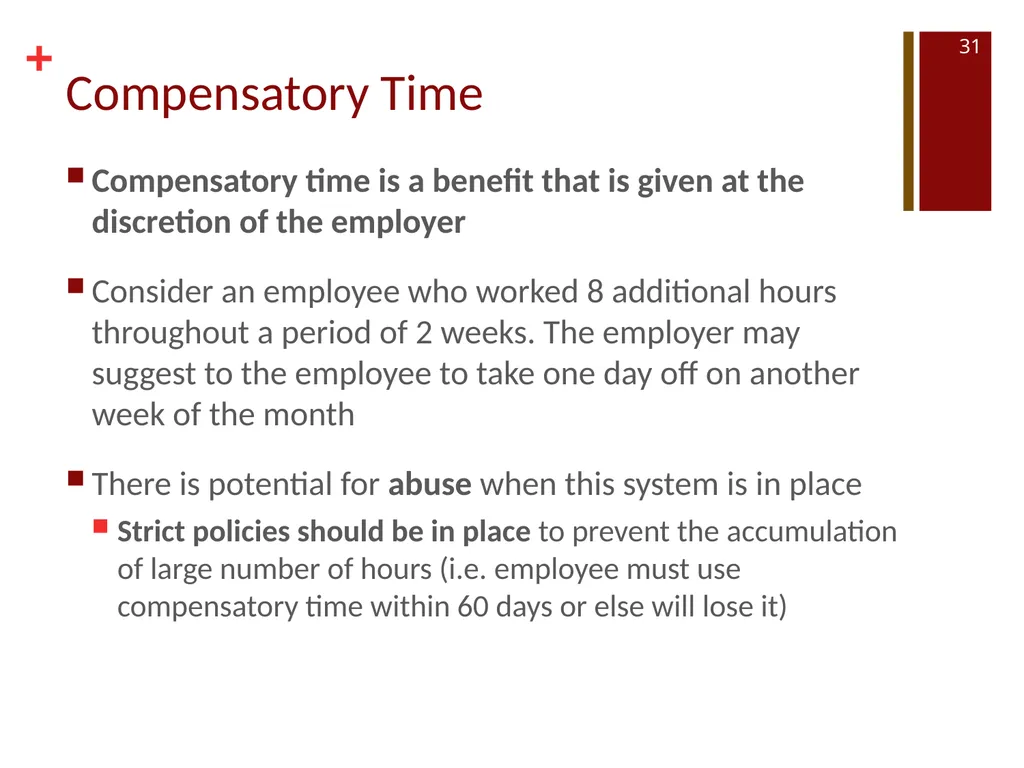
Compensatory Time Compensatory time is a benefit that is given at the discretion of the employer
Consider an employee who worked 8 additional hours throughout a period of 2 weeks. The employer may suggest to the employee to take one day off on another week of the month
There is potential for abuse when this system is in place
Strict policies should be in place to prevent the accumulation of large number of hours (i.e. employee must use compensatory time within 60 days or else will lose it) 31<br>
Consider an employee who worked 8 additional hours throughout a period of 2 weeks. The employer may suggest to the employee to take one day off on another week of the month
There is potential for abuse when this system is in place
Strict policies should be in place to prevent the accumulation of large number of hours (i.e. employee must use compensatory time within 60 days or else will lose it) 31<br>
32
On Call Some positions require that an employee be available to be called in to work in case of an emergency. It requires that the individual be available during off hours via a beeper, a cellular phone, e-mail etc. (i.e. physicians, pharmacists, dietitians etc.)
Must be stated in the job description as a condition of employment and employees should know how frequently they will be scheduled to be on call
Employers may set up a pay structure to compensate individuals for the time that they are on call or for the hours that they work when they are called in; in other situations, it is paid back in compensatory time off and/or may even be considered part of the job and there is no additional pay 32<br>
Must be stated in the job description as a condition of employment and employees should know how frequently they will be scheduled to be on call
Employers may set up a pay structure to compensate individuals for the time that they are on call or for the hours that they work when they are called in; in other situations, it is paid back in compensatory time off and/or may even be considered part of the job and there is no additional pay 32<br>
33
DETERMINING STAFFING NEEDS 33<br>
34
Determining Staffing Needs Employee labor is the single largest expense in foodservice operations
The challenge for managers is to match the number & skill set of employees to the level of services needed
Food service experiences significant changes in meal volume during peak meal time periods
Managers must evaluate the current production and delivery models but also closely monitor the changing industry to find the best mix of equipment and labor for their operation 34<br>
The challenge for managers is to match the number & skill set of employees to the level of services needed
Food service experiences significant changes in meal volume during peak meal time periods
Managers must evaluate the current production and delivery models but also closely monitor the changing industry to find the best mix of equipment and labor for their operation 34<br>
35
Why Do we Use FTE ? Important for budgeting purposes, staffing and determining productivity
FTEs are obtained by dividing the total number of labor hours worked in a week by all employees by 40; in a year by 2080 35<br>
FTEs are obtained by dividing the total number of labor hours worked in a week by all employees by 40; in a year by 2080 35<br>
36
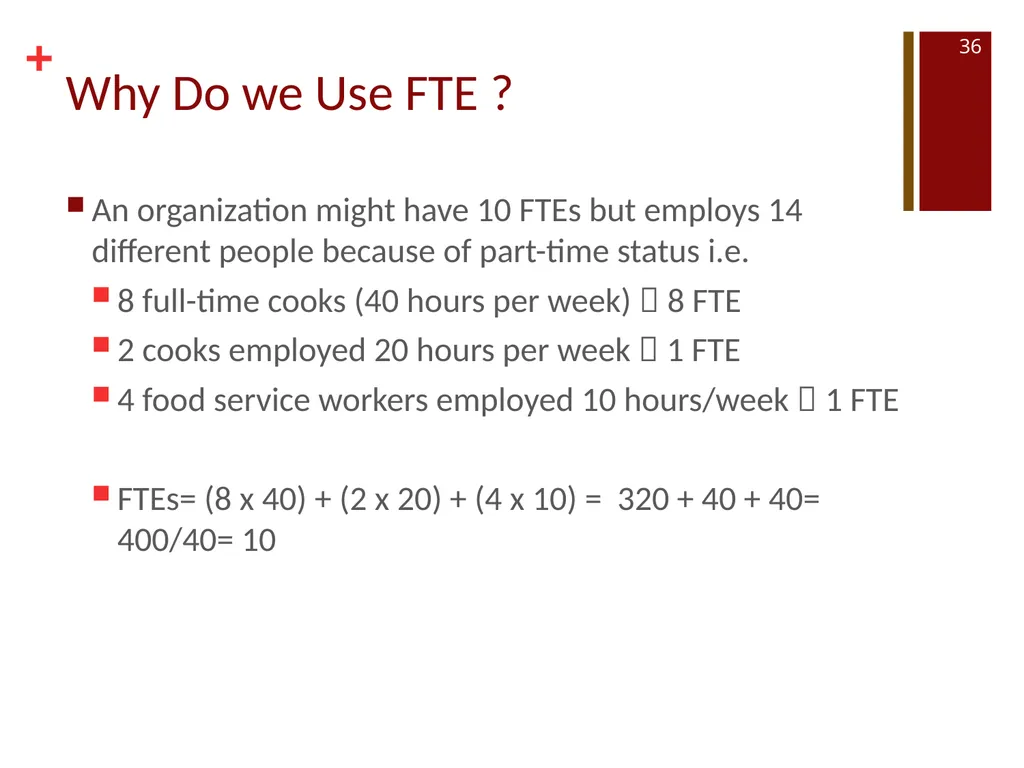
Why Do we Use FTE ? An organization might have 10 FTEs but employs 14 different people because of part-time status i.e.
8 full-time cooks (40 hours per week) 8 FTE
2 cooks employed 20 hours per week 1 FTE
4 food service workers employed 10 hours/week 1 FTE
FTEs= (8 x 40) + (2 x 20) + (4 x 10) = 320 + 40 + 40= 400/40= 10 36<br>
8 full-time cooks (40 hours per week) 8 FTE
2 cooks employed 20 hours per week 1 FTE
4 food service workers employed 10 hours/week 1 FTE
FTEs= (8 x 40) + (2 x 20) + (4 x 10) = 320 + 40 + 40= 400/40= 10 36<br>
37
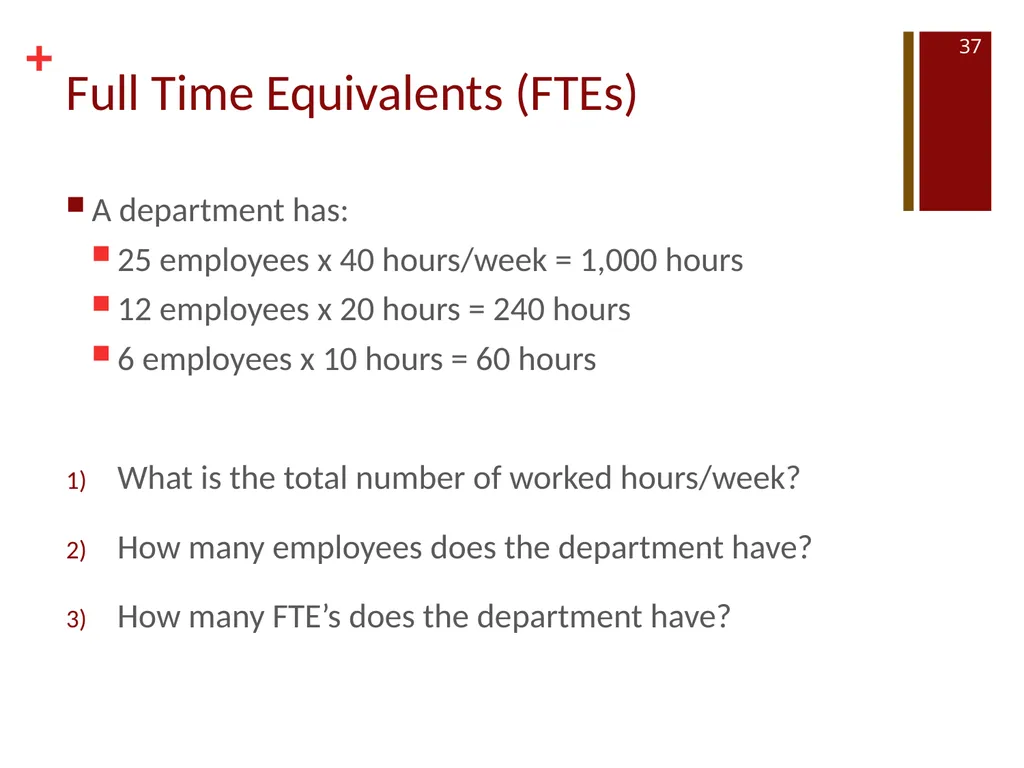
Full Time Equivalents (FTEs) A department has:
25 employees x 40 hours/week = 1,000 hours
12 employees x 20 hours = 240 hours
6 employees x 10 hours = 60 hours
What is the total number of worked hours/week?
How many employees does the department have?
How many FTE’s does the department have? 37<br>
25 employees x 40 hours/week = 1,000 hours
12 employees x 20 hours = 240 hours
6 employees x 10 hours = 60 hours
What is the total number of worked hours/week?
How many employees does the department have?
How many FTE’s does the department have? 37<br>
38
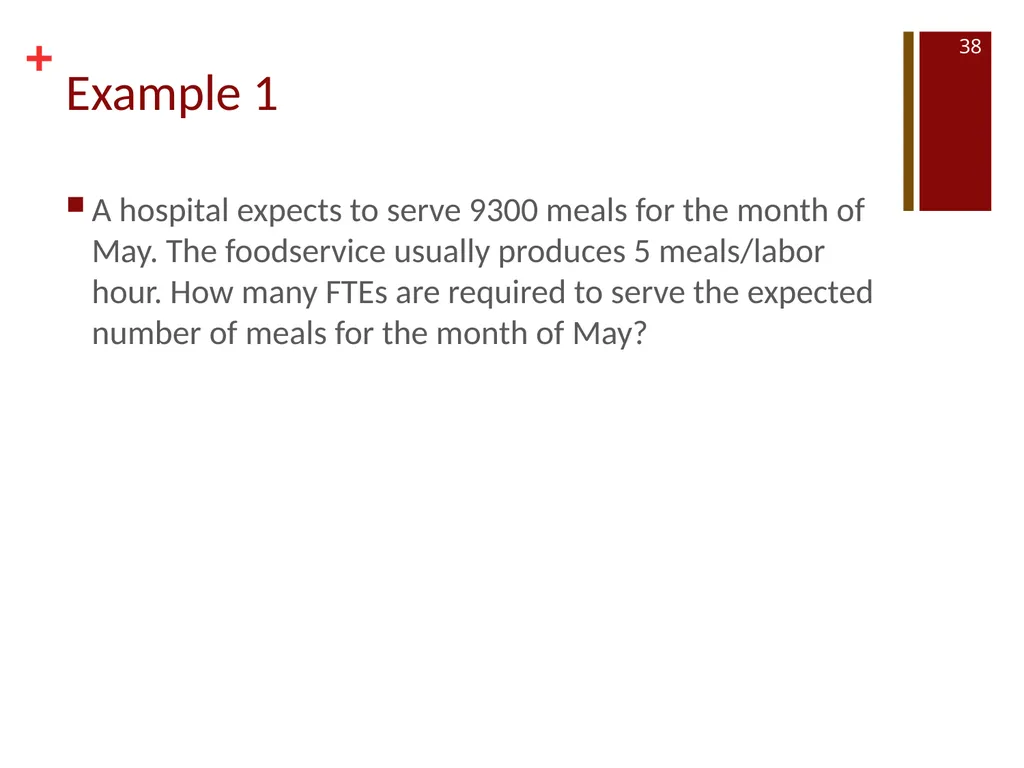
Example 1 A hospital expects to serve 9300 meals for the month of May. The foodservice usually produces 5 meals/labor hour. How many FTEs are required to serve the expected number of meals for the month of May? 38<br>
39
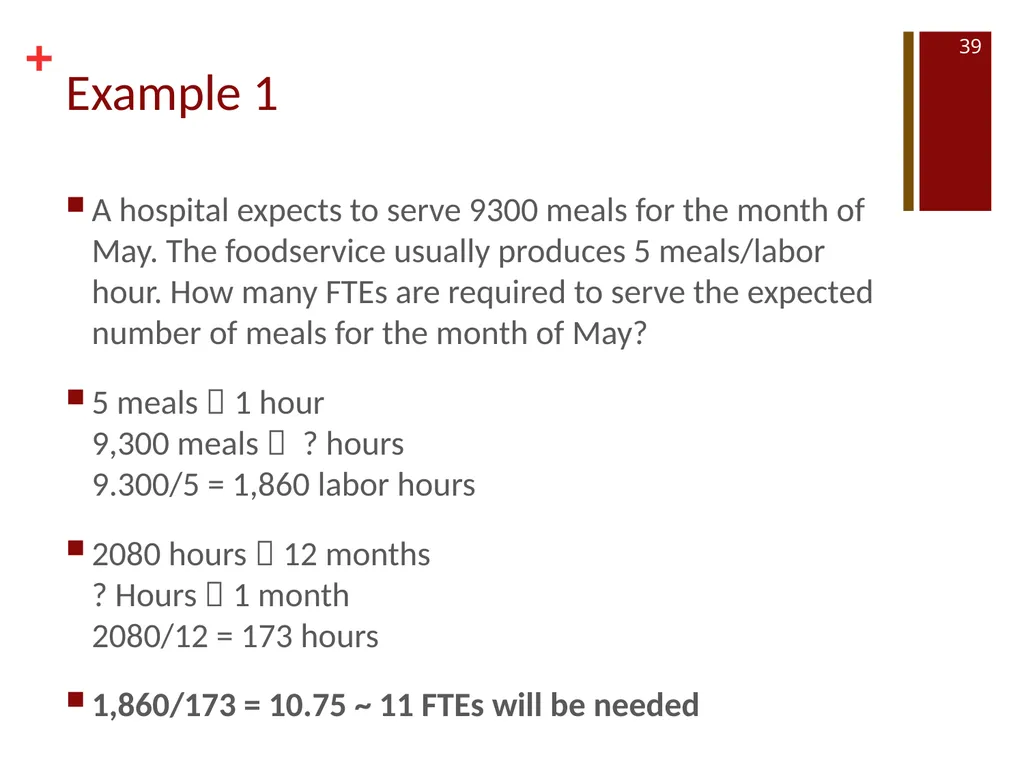
Example 1 A hospital expects to serve 9300 meals for the month of May. The foodservice usually produces 5 meals/labor hour. How many FTEs are required to serve the expected number of meals for the month of May?
5 meals 1 hour 9,300 meals ? hours 9.300/5 = 1,860 labor hours
2080 hours 12 months ? Hours 1 month 2080/12 = 173 hours
1,860/173 = 10.75 ~ 11 FTEs will be needed 39<br>
5 meals 1 hour 9,300 meals ? hours 9.300/5 = 1,860 labor hours
2080 hours 12 months ? Hours 1 month 2080/12 = 173 hours
1,860/173 = 10.75 ~ 11 FTEs will be needed 39<br>
40
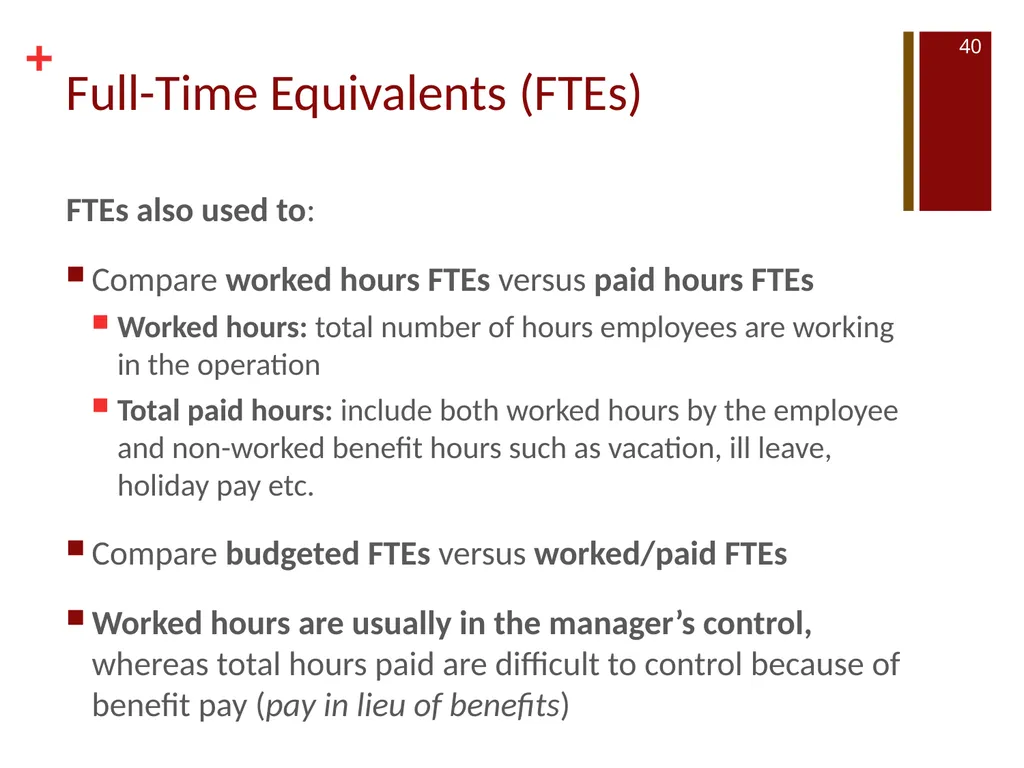
Full-Time Equivalents (FTEs) FTEs also used to:
Compare worked hours FTEs versus paid hours FTEs
Worked hours: total number of hours employees are working in the operation
Total paid hours: include both worked hours by the employee and non-worked benefit hours such as vacation, ill leave, holiday pay etc.
Compare budgeted FTEs versus worked/paid FTEs
Worked hours are usually in the manager’s control, whereas total hours paid are difficult to control because of benefit pay (pay in lieu of benefits) 40<br>
Compare worked hours FTEs versus paid hours FTEs
Worked hours: total number of hours employees are working in the operation
Total paid hours: include both worked hours by the employee and non-worked benefit hours such as vacation, ill leave, holiday pay etc.
Compare budgeted FTEs versus worked/paid FTEs
Worked hours are usually in the manager’s control, whereas total hours paid are difficult to control because of benefit pay (pay in lieu of benefits) 40<br>
41
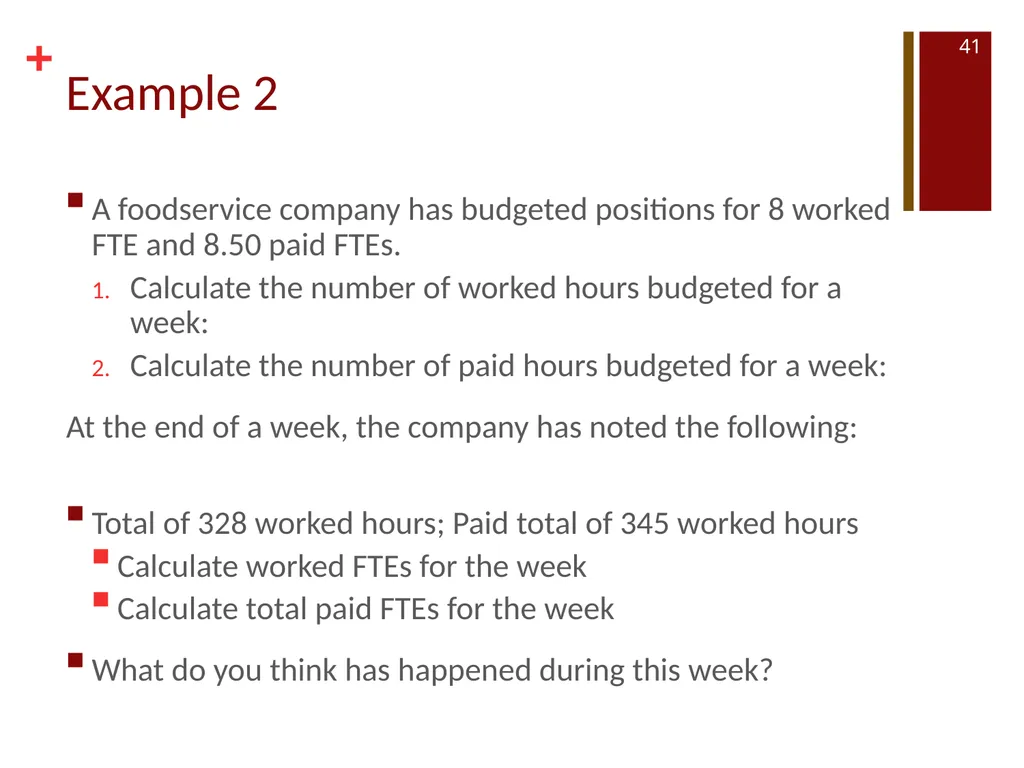
Example 2 A foodservice company has budgeted positions for 8 worked FTE and 8.50 paid FTEs.
Calculate the number of worked hours budgeted for a week:
Calculate the number of paid hours budgeted for a week:
At the end of a week, the company has noted the following:
Total of 328 worked hours; Paid total of 345 worked hours
Calculate worked FTEs for the week
Calculate total paid FTEs for the week
What do you think has happened during this week? 41<br>
Calculate the number of worked hours budgeted for a week:
Calculate the number of paid hours budgeted for a week:
At the end of a week, the company has noted the following:
Total of 328 worked hours; Paid total of 345 worked hours
Calculate worked FTEs for the week
Calculate total paid FTEs for the week
What do you think has happened during this week? 41<br>
42
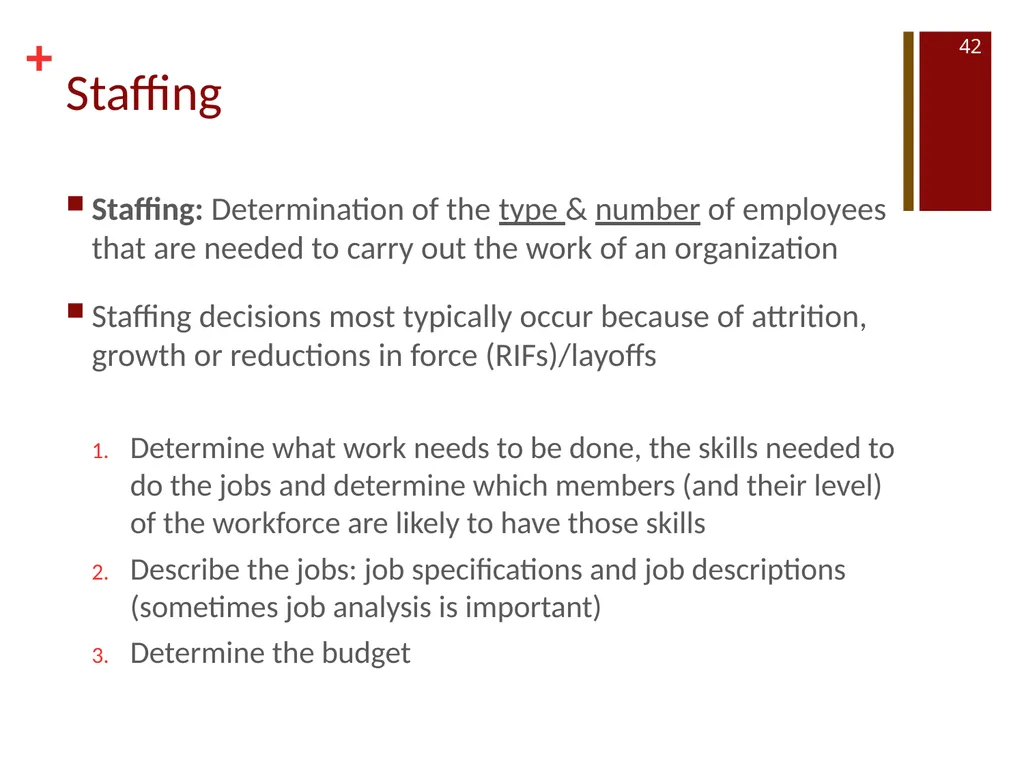
Staffing Staffing: Determination of the type & number of employees that are needed to carry out the work of an organization
Staffing decisions most typically occur because of attrition, growth or reductions in force (RIFs)/layoffs
Determine what work needs to be done, the skills needed to do the jobs and determine which members (and their level) of the workforce are likely to have those skills
Describe the jobs: job specifications and job descriptions (sometimes job analysis is important)
Determine the budget 42<br>
Staffing decisions most typically occur because of attrition, growth or reductions in force (RIFs)/layoffs
Determine what work needs to be done, the skills needed to do the jobs and determine which members (and their level) of the workforce are likely to have those skills
Describe the jobs: job specifications and job descriptions (sometimes job analysis is important)
Determine the budget 42<br>
43
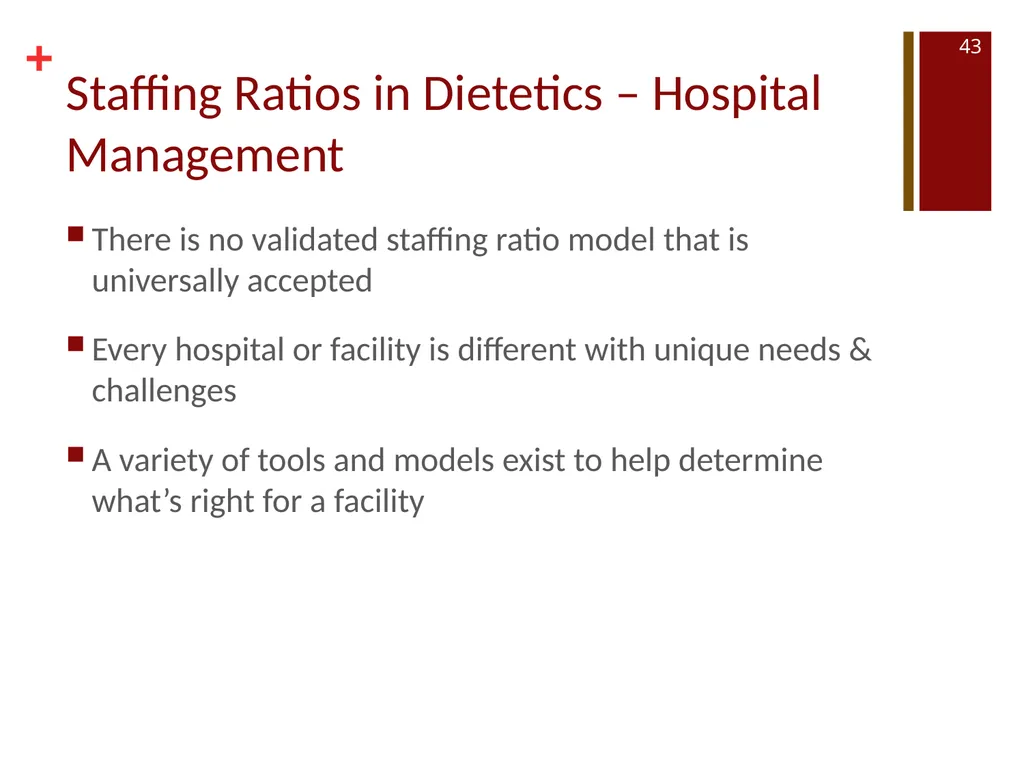
Staffing Ratios in Dietetics – Hospital Management There is no validated staffing ratio model that is universally accepted
Every hospital or facility is different with unique needs & challenges
A variety of tools and models exist to help determine what’s right for a facility 43<br>
Every hospital or facility is different with unique needs & challenges
A variety of tools and models exist to help determine what’s right for a facility 43<br>
44
LABOR SCHEDULES 44<br>
45
Labor Schedules – Master Schedule Management tool used to designate the hours and days each employee is to work
Management’s needs are the primary needs to be met through the work schedule
Planning labor schedules with fairness, consistency and consideration for the needs of employees
Employee preferences are to be taken into consideration whenever it is possible; employees must be able to anticipate days off and be able to plan their lives
Using work schedules to punish or show favoritism is dangerous practice. Lack of fairness will undermine the credibility of the manager.
Weekends, holidays, vacations, shifts etc.
Important to consult with the employees before posting the schedule 45<br>
Management’s needs are the primary needs to be met through the work schedule
Planning labor schedules with fairness, consistency and consideration for the needs of employees
Employee preferences are to be taken into consideration whenever it is possible; employees must be able to anticipate days off and be able to plan their lives
Using work schedules to punish or show favoritism is dangerous practice. Lack of fairness will undermine the credibility of the manager.
Weekends, holidays, vacations, shifts etc.
Important to consult with the employees before posting the schedule 45<br>
46
Labor Schedules: How and Where to Start? Step 1: Know how many workers are needed each day and what positions need to be covered.
Step 2: Enter days off: regularly scheduled days off, holidays, vacations, and special requests
Step 3: Write in hours for all full-time employees to ensure that they are scheduled for their guaranteed number of hours
Step 4: Schedule the guaranteed hours for part-time and short-hour employees
Step 5: Schedule casual employees to fill in positions as needed
Step 6: Consider cost-effectiveness (cross-trained employees) 46<br>
Step 2: Enter days off: regularly scheduled days off, holidays, vacations, and special requests
Step 3: Write in hours for all full-time employees to ensure that they are scheduled for their guaranteed number of hours
Step 4: Schedule the guaranteed hours for part-time and short-hour employees
Step 5: Schedule casual employees to fill in positions as needed
Step 6: Consider cost-effectiveness (cross-trained employees) 46<br>
47
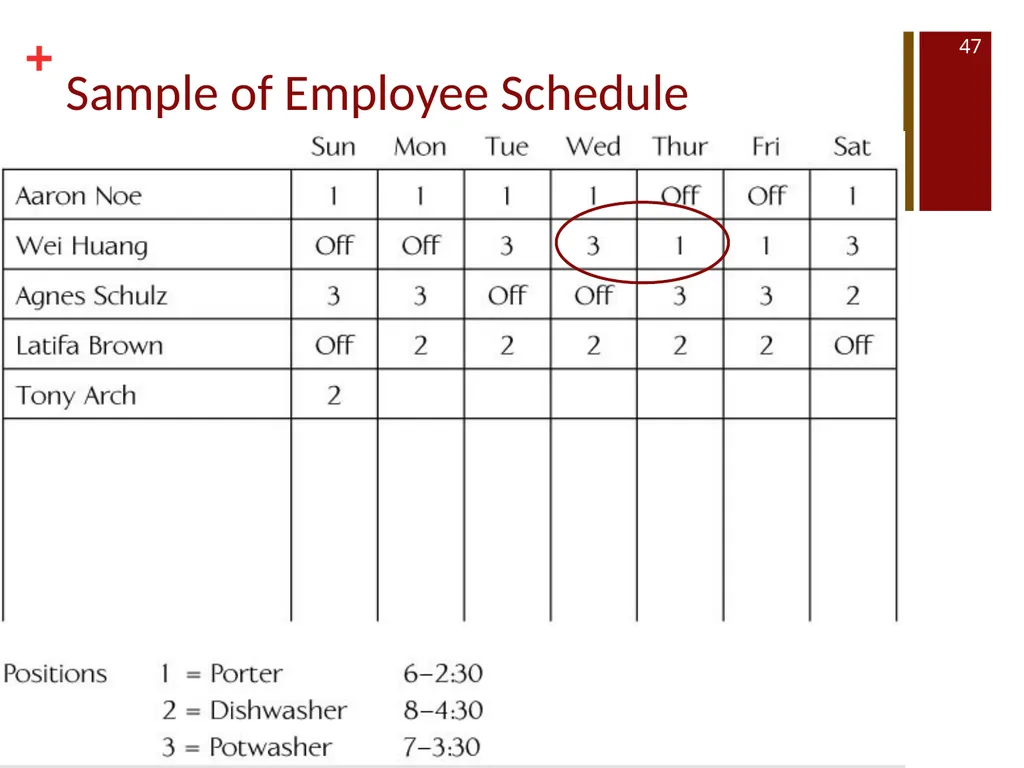
Sample of Employee Schedule 47<br>
48
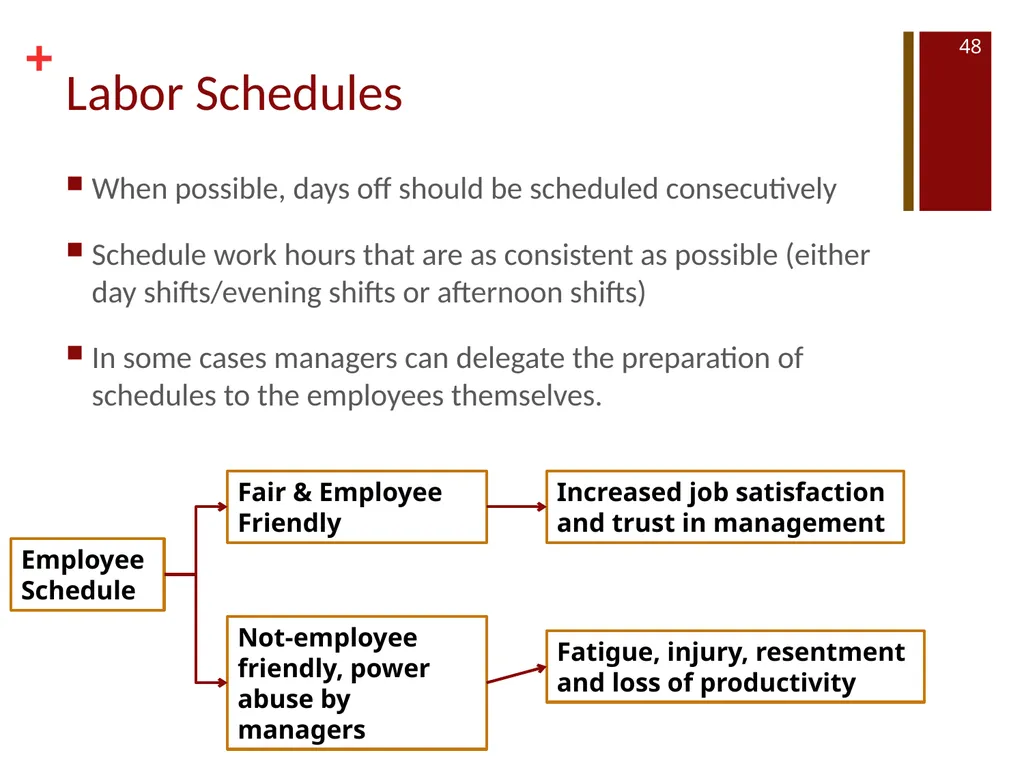
Labor Schedules When possible, days off should be scheduled consecutively
Schedule work hours that are as consistent as possible (either day shifts/evening shifts or afternoon shifts)
In some cases managers can delegate the preparation of schedules to the employees themselves. Employee Schedule Fair & Employee Friendly Not-employee friendly, power abuse by managers Increased job satisfaction and trust in management Fatigue, injury, resentment and loss of productivity 48<br>
Schedule work hours that are as consistent as possible (either day shifts/evening shifts or afternoon shifts)
In some cases managers can delegate the preparation of schedules to the employees themselves. Employee Schedule Fair & Employee Friendly Not-employee friendly, power abuse by managers Increased job satisfaction and trust in management Fatigue, injury, resentment and loss of productivity 48<br>