
HUMAN SETTLEMENTS EMERGENCY RESPONSE FRAMEWORK 26
AM
Published · 21 slides · 0 views
1 / 1


Description
HUMAN SETTLEMENTS EMERGENCY RESPONSE FRAMEWORK 26 November 2025 Presentation Outline Background Legislative Framework Institutional Arrangements Province-by Province Hazard profiles Identified Disaster National Hotspots Festive Season
Related Topics
Share
Embed code
Download this presentation From Below
"HUMAN SETTLEMENTS EMERGENCY RESPONSE FRAMEWORK 26" is the property of its rightful owner. Permission is granted to download and print the materials on this website for personal, non-commercial use only, and to display it on your personal computer provided you do not modify the materials and that you retain all copyright notices contained in the materials. By downloading content from our website, you accept the terms of this agreement.
Presentation Transcript
01
HUMAN SETTLEMENTS EMERGENCY RESPONSE FRAMEWORK 26 November 2025<br>
02
Presentation Outline Background
Legislative Framework
Institutional Arrangements
Province-by Province Hazard profiles
Identified Disaster National Hotspots
Festive Season Response Arrangements
Financial Implications
Recommendations<br>
Legislative Framework
Institutional Arrangements
Province-by Province Hazard profiles
Identified Disaster National Hotspots
Festive Season Response Arrangements
Financial Implications
Recommendations<br>
03
Background The increasing frequency and intensity of disasters—such as floods, fires, and structural collapses—pose significant threats to human lives, infrastructure, and livelihoods.
These challenges have necessitated the National Department to develop a Human Settlements Emergency Response Framework with the intention to provide a standardised provincial approach for preparing own plans, coordinating and responding to disaster incidents as a sector.
The framework will also ensure that there is clarity and consistency in providing interventions in disaster affected areas in all Provinces.
It will also assist in making sure that the sector’s interventions are timely, effective, and aligned with the legislative and policy frameworks governing disaster management and housing development in the country.
These recent disaster challenges underscore the urgent need for a coordinated and proactive approach to disaster preparedness and response within the human settlements sector.
Provinces were engaged on the framework and requested to develop plans focusing on local areas. Some Provinces had already developed plans in line with guidance provided by their Provincial Disaster Operation Centers(PDOCs).
The Department will act as a coordinating agency in the context of the broader disaster management architecture (national, provincial and municipal centres) while focusing on the human‐settlements dimension<br>
These challenges have necessitated the National Department to develop a Human Settlements Emergency Response Framework with the intention to provide a standardised provincial approach for preparing own plans, coordinating and responding to disaster incidents as a sector.
The framework will also ensure that there is clarity and consistency in providing interventions in disaster affected areas in all Provinces.
It will also assist in making sure that the sector’s interventions are timely, effective, and aligned with the legislative and policy frameworks governing disaster management and housing development in the country.
These recent disaster challenges underscore the urgent need for a coordinated and proactive approach to disaster preparedness and response within the human settlements sector.
Provinces were engaged on the framework and requested to develop plans focusing on local areas. Some Provinces had already developed plans in line with guidance provided by their Provincial Disaster Operation Centers(PDOCs).
The Department will act as a coordinating agency in the context of the broader disaster management architecture (national, provincial and municipal centres) while focusing on the human‐settlements dimension<br>
04
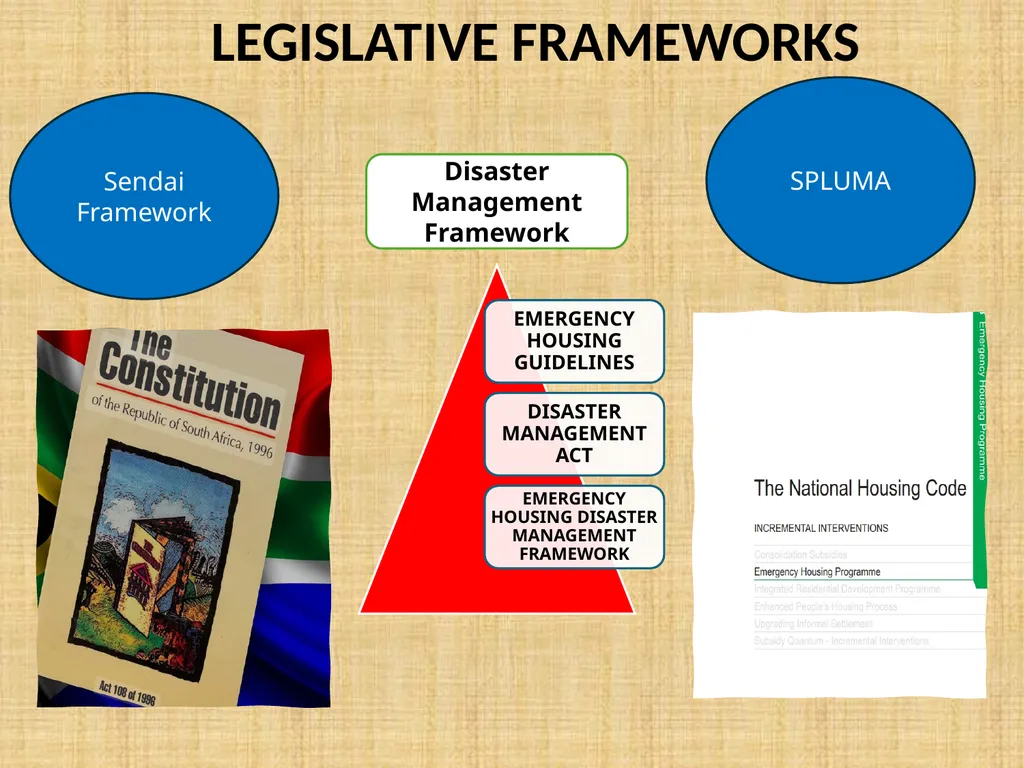
LEGISLATIVE FRAMEWORKS Disaster Management Framework SPLUMA Sendai Framework<br>
05
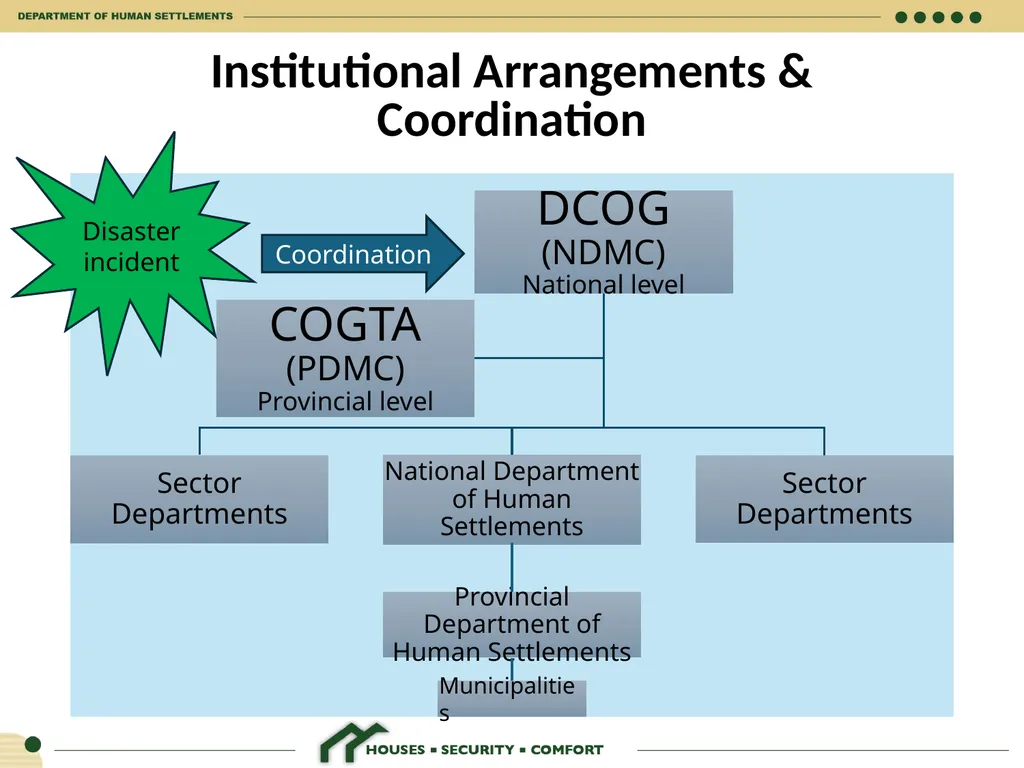
Institutional Arrangements & Coordination Disaster incident Coordination Municipalities<br>
06
Province-by-Province Hazard Profile<br>
07
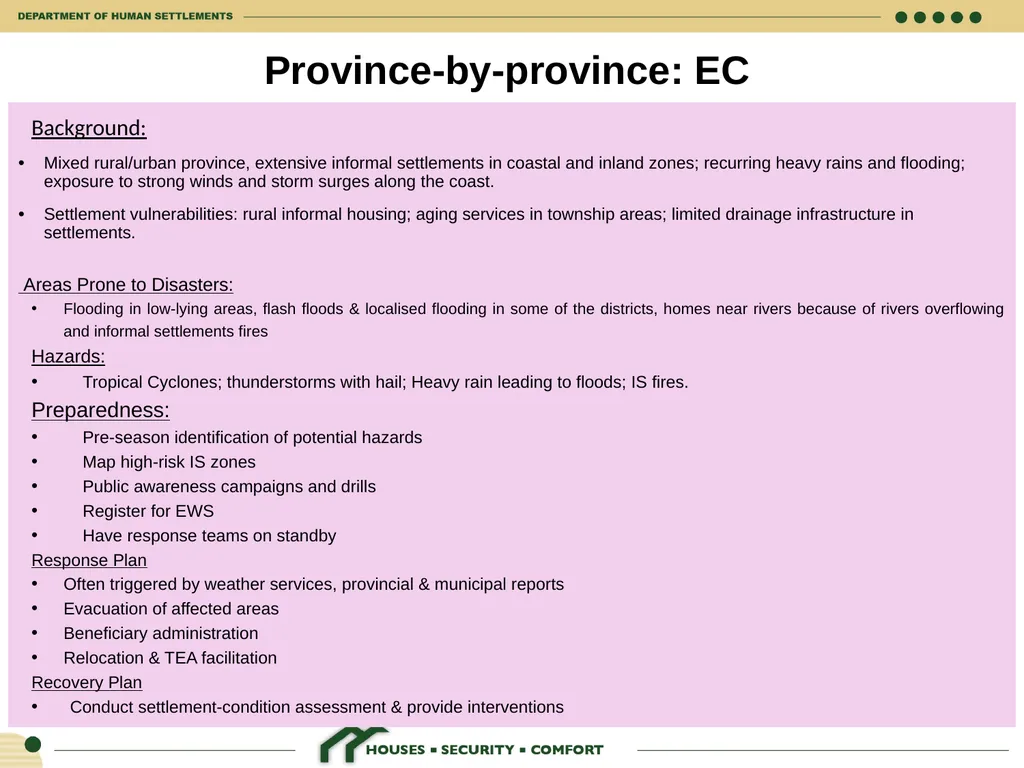
Province-by-province: EC Background:
Mixed rural/urban province, extensive informal settlements in coastal and inland zones; recurring heavy rains and flooding; exposure to strong winds and storm surges along the coast.
Settlement vulnerabilities: rural informal housing; aging services in township areas; limited drainage infrastructure in settlements.
Areas Prone to Disasters:
Flooding in low-lying areas, flash floods & localised flooding in some of the districts, homes near rivers because of rivers overflowing and informal settlements fires
Hazards:
Tropical Cyclones; thunderstorms with hail; Heavy rain leading to floods; IS fires.
Preparedness:
Pre-season identification of potential hazards
Map high-risk IS zones
Public awareness campaigns and drills
Register for EWS
Have response teams on standby
Response Plan
Often triggered by weather services, provincial & municipal reports
Evacuation of affected areas
Beneficiary administration
Relocation & TEA facilitation
Recovery Plan
Conduct settlement-condition assessment & provide interventions<br>
Mixed rural/urban province, extensive informal settlements in coastal and inland zones; recurring heavy rains and flooding; exposure to strong winds and storm surges along the coast.
Settlement vulnerabilities: rural informal housing; aging services in township areas; limited drainage infrastructure in settlements.
Areas Prone to Disasters:
Flooding in low-lying areas, flash floods & localised flooding in some of the districts, homes near rivers because of rivers overflowing and informal settlements fires
Hazards:
Tropical Cyclones; thunderstorms with hail; Heavy rain leading to floods; IS fires.
Preparedness:
Pre-season identification of potential hazards
Map high-risk IS zones
Public awareness campaigns and drills
Register for EWS
Have response teams on standby
Response Plan
Often triggered by weather services, provincial & municipal reports
Evacuation of affected areas
Beneficiary administration
Relocation & TEA facilitation
Recovery Plan
Conduct settlement-condition assessment & provide interventions<br>
08
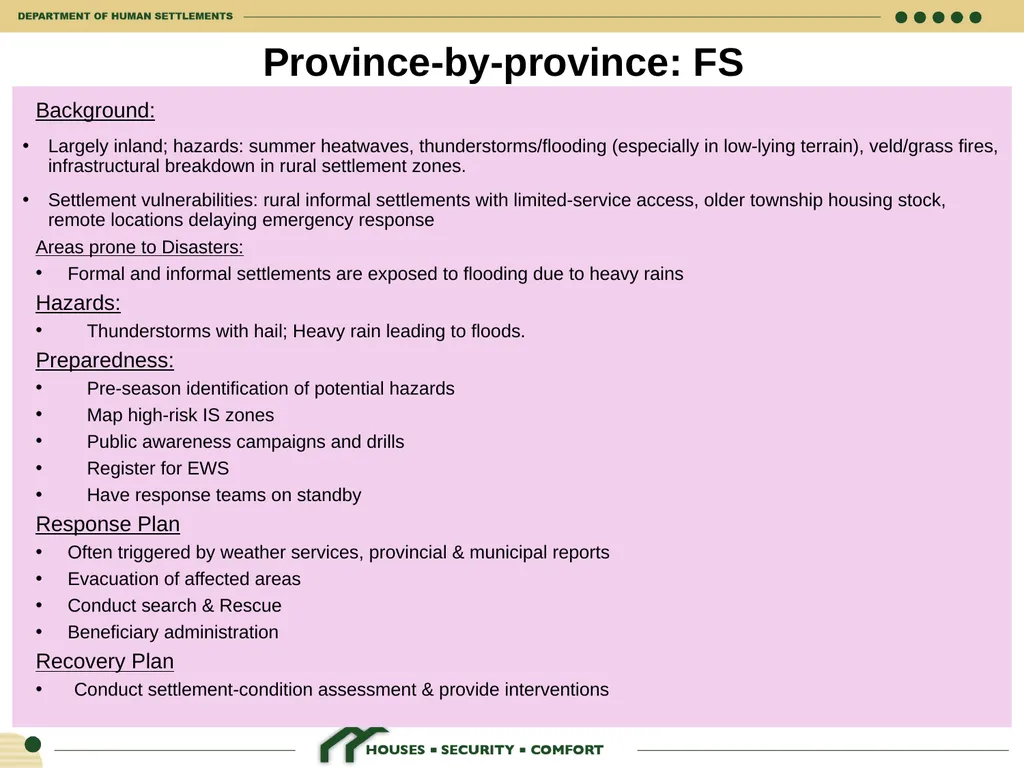
Province-by-province: FS Background:
Largely inland; hazards: summer heatwaves, thunderstorms/flooding (especially in low‐lying terrain), veld/grass fires, infrastructural breakdown in rural settlement zones.
Settlement vulnerabilities: rural informal settlements with limited-service access, older township housing stock, remote locations delaying emergency response
Areas prone to Disasters:
Formal and informal settlements are exposed to flooding due to heavy rains
Hazards:
Thunderstorms with hail; Heavy rain leading to floods.
Preparedness:
Pre-season identification of potential hazards
Map high-risk IS zones
Public awareness campaigns and drills
Register for EWS
Have response teams on standby
Response Plan
Often triggered by weather services, provincial & municipal reports
Evacuation of affected areas
Conduct search & Rescue
Beneficiary administration
Recovery Plan
Conduct settlement-condition assessment & provide interventions<br>
Largely inland; hazards: summer heatwaves, thunderstorms/flooding (especially in low‐lying terrain), veld/grass fires, infrastructural breakdown in rural settlement zones.
Settlement vulnerabilities: rural informal settlements with limited-service access, older township housing stock, remote locations delaying emergency response
Areas prone to Disasters:
Formal and informal settlements are exposed to flooding due to heavy rains
Hazards:
Thunderstorms with hail; Heavy rain leading to floods.
Preparedness:
Pre-season identification of potential hazards
Map high-risk IS zones
Public awareness campaigns and drills
Register for EWS
Have response teams on standby
Response Plan
Often triggered by weather services, provincial & municipal reports
Evacuation of affected areas
Conduct search & Rescue
Beneficiary administration
Recovery Plan
Conduct settlement-condition assessment & provide interventions<br>
09
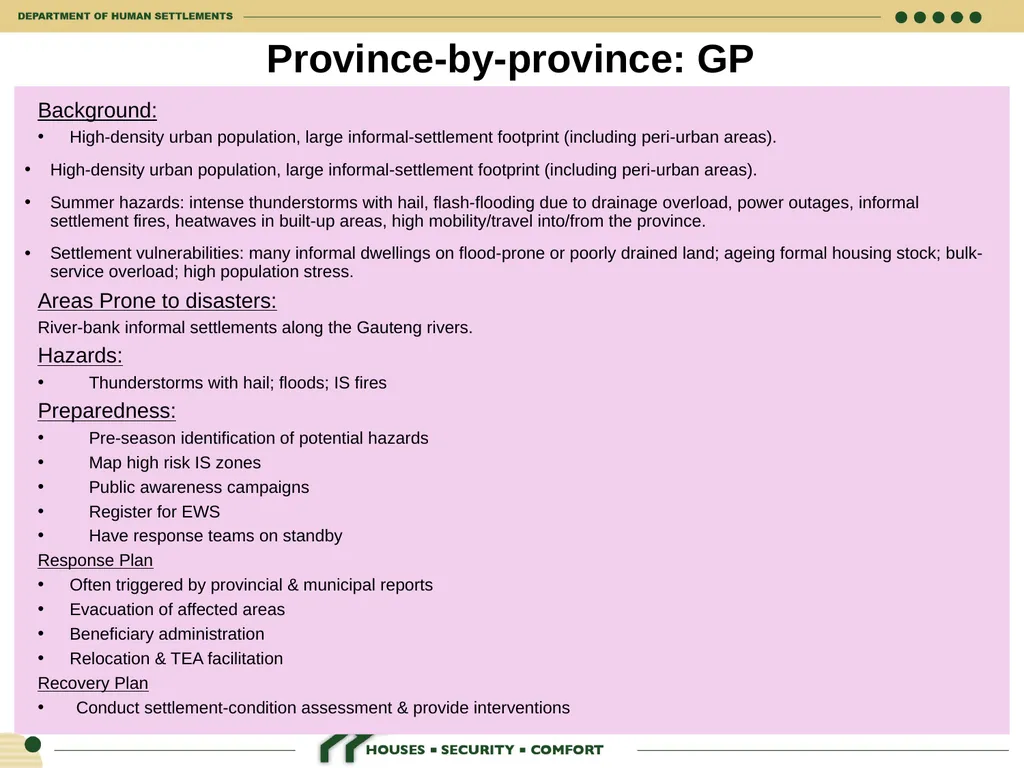
Province-by-province: GP Background:
High-density urban population, large informal-settlement footprint (including peri-urban areas).
High-density urban population, large informal-settlement footprint (including peri-urban areas).
Summer hazards: intense thunderstorms with hail, flash‐flooding due to drainage overload, power outages, informal settlement fires, heatwaves in built-up areas, high mobility/travel into/from the province.
Settlement vulnerabilities: many informal dwellings on flood-prone or poorly drained land; ageing formal housing stock; bulk‐service overload; high population stress.
Areas Prone to disasters:
River-bank informal settlements along the Gauteng rivers.
Hazards:
Thunderstorms with hail; floods; IS fires
Preparedness:
Pre-season identification of potential hazards
Map high risk IS zones
Public awareness campaigns
Register for EWS
Have response teams on standby
Response Plan
Often triggered by provincial & municipal reports
Evacuation of affected areas
Beneficiary administration
Relocation & TEA facilitation
Recovery Plan
Conduct settlement-condition assessment & provide interventions<br>
High-density urban population, large informal-settlement footprint (including peri-urban areas).
High-density urban population, large informal-settlement footprint (including peri-urban areas).
Summer hazards: intense thunderstorms with hail, flash‐flooding due to drainage overload, power outages, informal settlement fires, heatwaves in built-up areas, high mobility/travel into/from the province.
Settlement vulnerabilities: many informal dwellings on flood-prone or poorly drained land; ageing formal housing stock; bulk‐service overload; high population stress.
Areas Prone to disasters:
River-bank informal settlements along the Gauteng rivers.
Hazards:
Thunderstorms with hail; floods; IS fires
Preparedness:
Pre-season identification of potential hazards
Map high risk IS zones
Public awareness campaigns
Register for EWS
Have response teams on standby
Response Plan
Often triggered by provincial & municipal reports
Evacuation of affected areas
Beneficiary administration
Relocation & TEA facilitation
Recovery Plan
Conduct settlement-condition assessment & provide interventions<br>
10
Province-by-province: KZN Background:
Coastal province: risk of tropical cyclones, heavy summer rainfall, storm surges, riverine flooding, high winds, landslides in hilly terrain; informal settlements along rivers/coast, informal settlement fires.
Settlement vulnerabilities: informal dwellings on steep slopes or flood‐plains, older formal housing in coastal towns, inadequate evacuation routes in some settlements.
Areas Prone to disasters:
Informal settlements in low-lying land, landslides and structural fires in informal settlements.
Hazards:
Tropical Cyclones; thunderstorms with hail; Heavy rain leading to floods; IS fires; landslides.
Preparedness:
Pre-season identification of potential hazards
Map high-risk IS zones
Public awareness campaigns and drills
Register for EWS
Have response teams on standby
Response Plan
Often triggered by weather services, provincial & municipal reports
Evacuation of affected areas
Beneficiary administration
Relocation & TEA facilitation
Recovery Plan
Conduct settlement-condition assessment & provide interventions<br>
Coastal province: risk of tropical cyclones, heavy summer rainfall, storm surges, riverine flooding, high winds, landslides in hilly terrain; informal settlements along rivers/coast, informal settlement fires.
Settlement vulnerabilities: informal dwellings on steep slopes or flood‐plains, older formal housing in coastal towns, inadequate evacuation routes in some settlements.
Areas Prone to disasters:
Informal settlements in low-lying land, landslides and structural fires in informal settlements.
Hazards:
Tropical Cyclones; thunderstorms with hail; Heavy rain leading to floods; IS fires; landslides.
Preparedness:
Pre-season identification of potential hazards
Map high-risk IS zones
Public awareness campaigns and drills
Register for EWS
Have response teams on standby
Response Plan
Often triggered by weather services, provincial & municipal reports
Evacuation of affected areas
Beneficiary administration
Relocation & TEA facilitation
Recovery Plan
Conduct settlement-condition assessment & provide interventions<br>
11
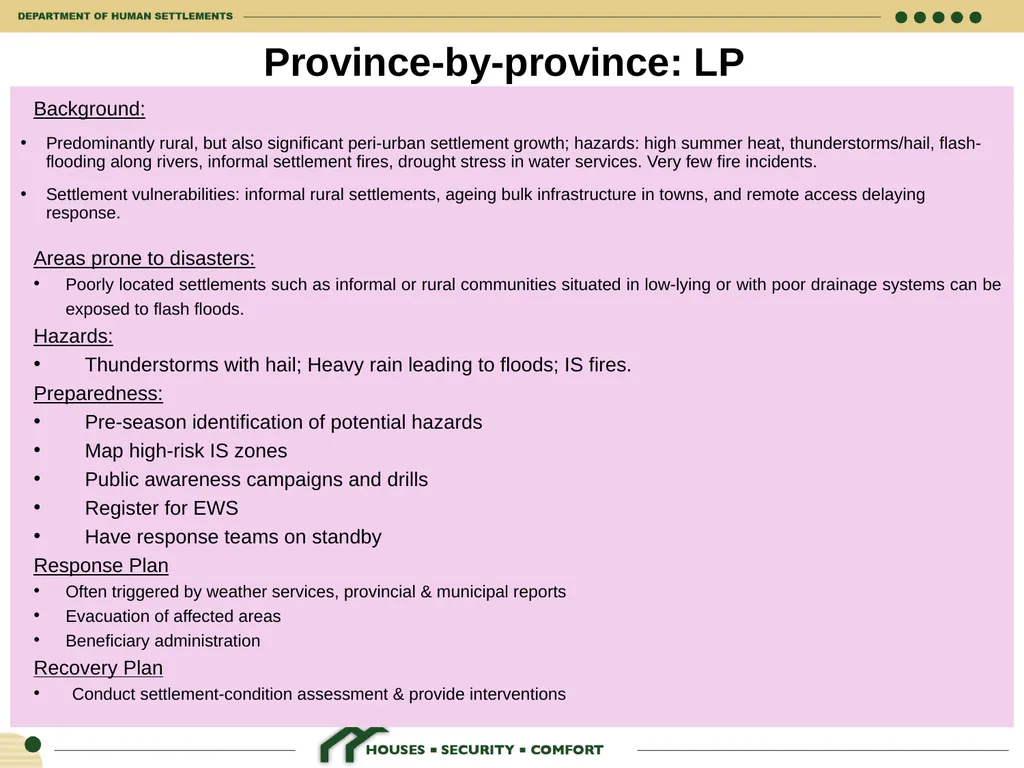
Province-by-province: LP Background:
Predominantly rural, but also significant peri-urban settlement growth; hazards: high summer heat, thunderstorms/hail, flash‐flooding along rivers, informal settlement fires, drought stress in water services. Very few fire incidents.
Settlement vulnerabilities: informal rural settlements, ageing bulk infrastructure in towns, and remote access delaying response.
Areas prone to disasters:
Poorly located settlements such as informal or rural communities situated in low-lying or with poor drainage systems can be exposed to flash floods.
Hazards:
Thunderstorms with hail; Heavy rain leading to floods; IS fires.
Preparedness:
Pre-season identification of potential hazards
Map high-risk IS zones
Public awareness campaigns and drills
Register for EWS
Have response teams on standby
Response Plan
Often triggered by weather services, provincial & municipal reports
Evacuation of affected areas
Beneficiary administration
Recovery Plan
Conduct settlement-condition assessment & provide interventions<br>
Predominantly rural, but also significant peri-urban settlement growth; hazards: high summer heat, thunderstorms/hail, flash‐flooding along rivers, informal settlement fires, drought stress in water services. Very few fire incidents.
Settlement vulnerabilities: informal rural settlements, ageing bulk infrastructure in towns, and remote access delaying response.
Areas prone to disasters:
Poorly located settlements such as informal or rural communities situated in low-lying or with poor drainage systems can be exposed to flash floods.
Hazards:
Thunderstorms with hail; Heavy rain leading to floods; IS fires.
Preparedness:
Pre-season identification of potential hazards
Map high-risk IS zones
Public awareness campaigns and drills
Register for EWS
Have response teams on standby
Response Plan
Often triggered by weather services, provincial & municipal reports
Evacuation of affected areas
Beneficiary administration
Recovery Plan
Conduct settlement-condition assessment & provide interventions<br>
12
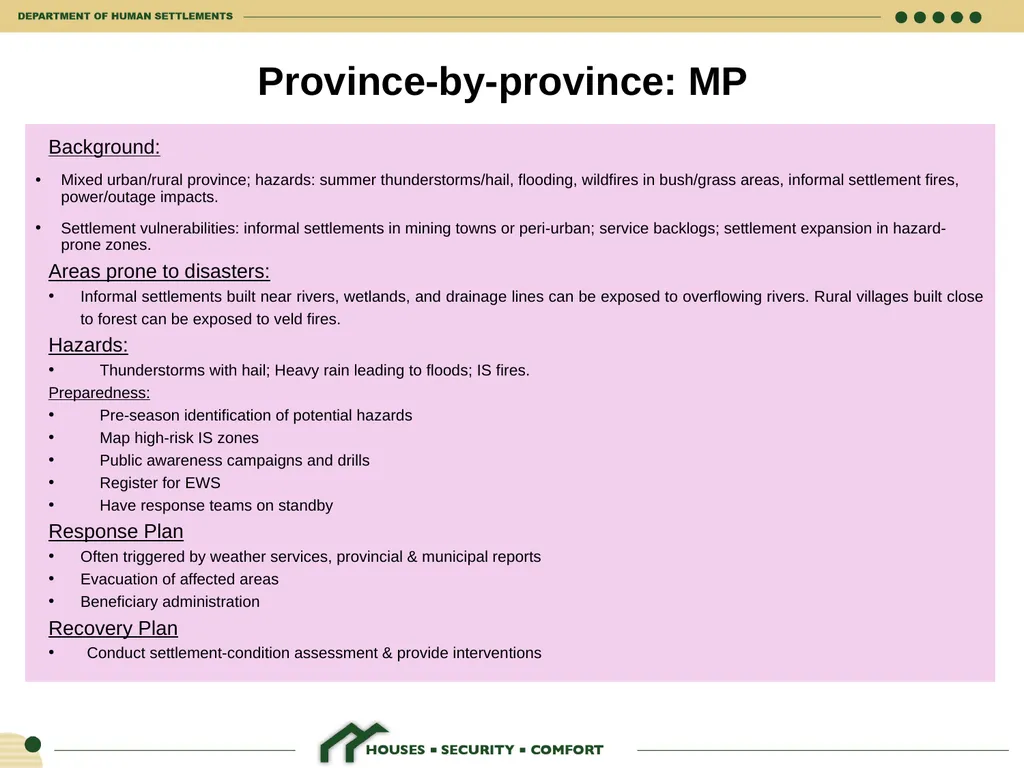
Province-by-province: MP Background:
Mixed urban/rural province; hazards: summer thunderstorms/hail, flooding, wildfires in bush/grass areas, informal settlement fires, power/outage impacts.
Settlement vulnerabilities: informal settlements in mining towns or peri-urban; service backlogs; settlement expansion in hazard‐prone zones.
Areas prone to disasters:
Informal settlements built near rivers, wetlands, and drainage lines can be exposed to overflowing rivers. Rural villages built close to forest can be exposed to veld fires.
Hazards:
Thunderstorms with hail; Heavy rain leading to floods; IS fires.
Preparedness:
Pre-season identification of potential hazards
Map high-risk IS zones
Public awareness campaigns and drills
Register for EWS
Have response teams on standby
Response Plan
Often triggered by weather services, provincial & municipal reports
Evacuation of affected areas
Beneficiary administration
Recovery Plan
Conduct settlement-condition assessment & provide interventions<br>
Mixed urban/rural province; hazards: summer thunderstorms/hail, flooding, wildfires in bush/grass areas, informal settlement fires, power/outage impacts.
Settlement vulnerabilities: informal settlements in mining towns or peri-urban; service backlogs; settlement expansion in hazard‐prone zones.
Areas prone to disasters:
Informal settlements built near rivers, wetlands, and drainage lines can be exposed to overflowing rivers. Rural villages built close to forest can be exposed to veld fires.
Hazards:
Thunderstorms with hail; Heavy rain leading to floods; IS fires.
Preparedness:
Pre-season identification of potential hazards
Map high-risk IS zones
Public awareness campaigns and drills
Register for EWS
Have response teams on standby
Response Plan
Often triggered by weather services, provincial & municipal reports
Evacuation of affected areas
Beneficiary administration
Recovery Plan
Conduct settlement-condition assessment & provide interventions<br>
13
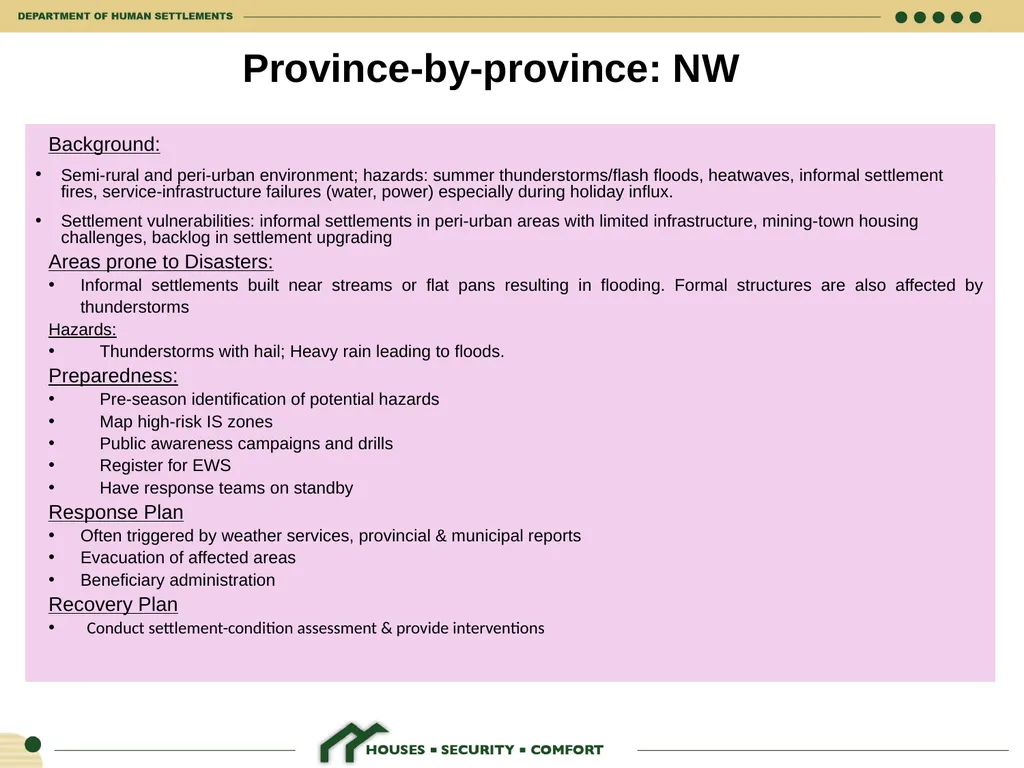
Province-by-province: NW Background:
Semi-rural and peri-urban environment; hazards: summer thunderstorms/flash floods, heatwaves, informal settlement fires, service-infrastructure failures (water, power) especially during holiday influx.
Settlement vulnerabilities: informal settlements in peri‐urban areas with limited infrastructure, mining-town housing challenges, backlog in settlement upgrading
Areas prone to Disasters:
Informal settlements built near streams or flat pans resulting in flooding. Formal structures are also affected by thunderstorms
Hazards:
Thunderstorms with hail; Heavy rain leading to floods.
Preparedness:
Pre-season identification of potential hazards
Map high-risk IS zones
Public awareness campaigns and drills
Register for EWS
Have response teams on standby
Response Plan
Often triggered by weather services, provincial & municipal reports
Evacuation of affected areas
Beneficiary administration
Recovery Plan
Conduct settlement-condition assessment & provide interventions<br>
Semi-rural and peri-urban environment; hazards: summer thunderstorms/flash floods, heatwaves, informal settlement fires, service-infrastructure failures (water, power) especially during holiday influx.
Settlement vulnerabilities: informal settlements in peri‐urban areas with limited infrastructure, mining-town housing challenges, backlog in settlement upgrading
Areas prone to Disasters:
Informal settlements built near streams or flat pans resulting in flooding. Formal structures are also affected by thunderstorms
Hazards:
Thunderstorms with hail; Heavy rain leading to floods.
Preparedness:
Pre-season identification of potential hazards
Map high-risk IS zones
Public awareness campaigns and drills
Register for EWS
Have response teams on standby
Response Plan
Often triggered by weather services, provincial & municipal reports
Evacuation of affected areas
Beneficiary administration
Recovery Plan
Conduct settlement-condition assessment & provide interventions<br>
14
Province-by-province: NC Background:
Sparsely populated, but summer hazards include extreme heatwaves, drought conditions, thunderstorms/flash flooding in arid terrain, informal settlement fires, remote settlement vulnerabilities.
Settlement vulnerabilities: informal dwellings in remote rural zones, water‐service shortages, limited access roads for emergency response, remote municipalities with limited capacity.
Hazards:
Thunderstorm and flooding.
Preparedness:
Pre-season identification of potential hazards
Map high-risk IS zones
Public awareness campaigns and drills
Register for EWS
Have response teams on standby
Response Plan
Often triggered by weather services, provincial & municipal reports
Evacuation of affected areas
Beneficiary administration
Recovery Plan
Conduct settlement-condition assessment & provide interventions<br>
Sparsely populated, but summer hazards include extreme heatwaves, drought conditions, thunderstorms/flash flooding in arid terrain, informal settlement fires, remote settlement vulnerabilities.
Settlement vulnerabilities: informal dwellings in remote rural zones, water‐service shortages, limited access roads for emergency response, remote municipalities with limited capacity.
Hazards:
Thunderstorm and flooding.
Preparedness:
Pre-season identification of potential hazards
Map high-risk IS zones
Public awareness campaigns and drills
Register for EWS
Have response teams on standby
Response Plan
Often triggered by weather services, provincial & municipal reports
Evacuation of affected areas
Beneficiary administration
Recovery Plan
Conduct settlement-condition assessment & provide interventions<br>
15
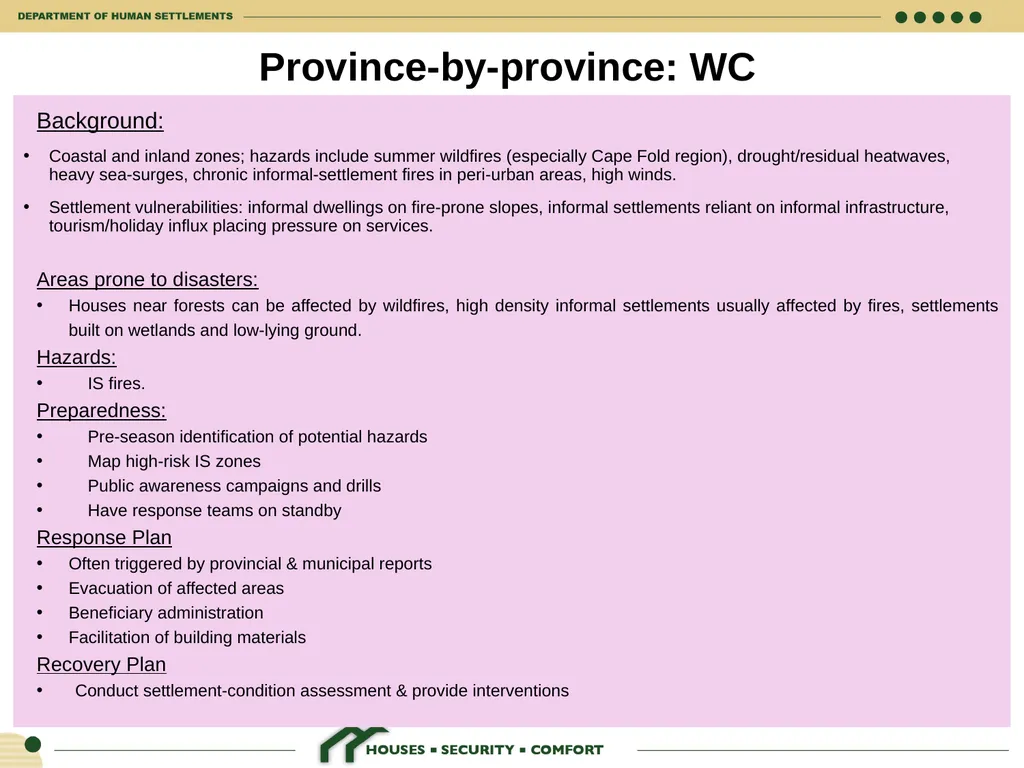
Province-by-province: WC Background:
Coastal and inland zones; hazards include summer wildfires (especially Cape Fold region), drought/residual heatwaves, heavy sea-surges, chronic informal-settlement fires in peri-urban areas, high winds.
Settlement vulnerabilities: informal dwellings on fire-prone slopes, informal settlements reliant on informal infrastructure, tourism/holiday influx placing pressure on services.
Areas prone to disasters:
Houses near forests can be affected by wildfires, high density informal settlements usually affected by fires, settlements built on wetlands and low-lying ground.
Hazards:
IS fires.
Preparedness:
Pre-season identification of potential hazards
Map high-risk IS zones
Public awareness campaigns and drills
Have response teams on standby
Response Plan
Often triggered by provincial & municipal reports
Evacuation of affected areas
Beneficiary administration
Facilitation of building materials
Recovery Plan
Conduct settlement-condition assessment & provide interventions<br>
Coastal and inland zones; hazards include summer wildfires (especially Cape Fold region), drought/residual heatwaves, heavy sea-surges, chronic informal-settlement fires in peri-urban areas, high winds.
Settlement vulnerabilities: informal dwellings on fire-prone slopes, informal settlements reliant on informal infrastructure, tourism/holiday influx placing pressure on services.
Areas prone to disasters:
Houses near forests can be affected by wildfires, high density informal settlements usually affected by fires, settlements built on wetlands and low-lying ground.
Hazards:
IS fires.
Preparedness:
Pre-season identification of potential hazards
Map high-risk IS zones
Public awareness campaigns and drills
Have response teams on standby
Response Plan
Often triggered by provincial & municipal reports
Evacuation of affected areas
Beneficiary administration
Facilitation of building materials
Recovery Plan
Conduct settlement-condition assessment & provide interventions<br>
16
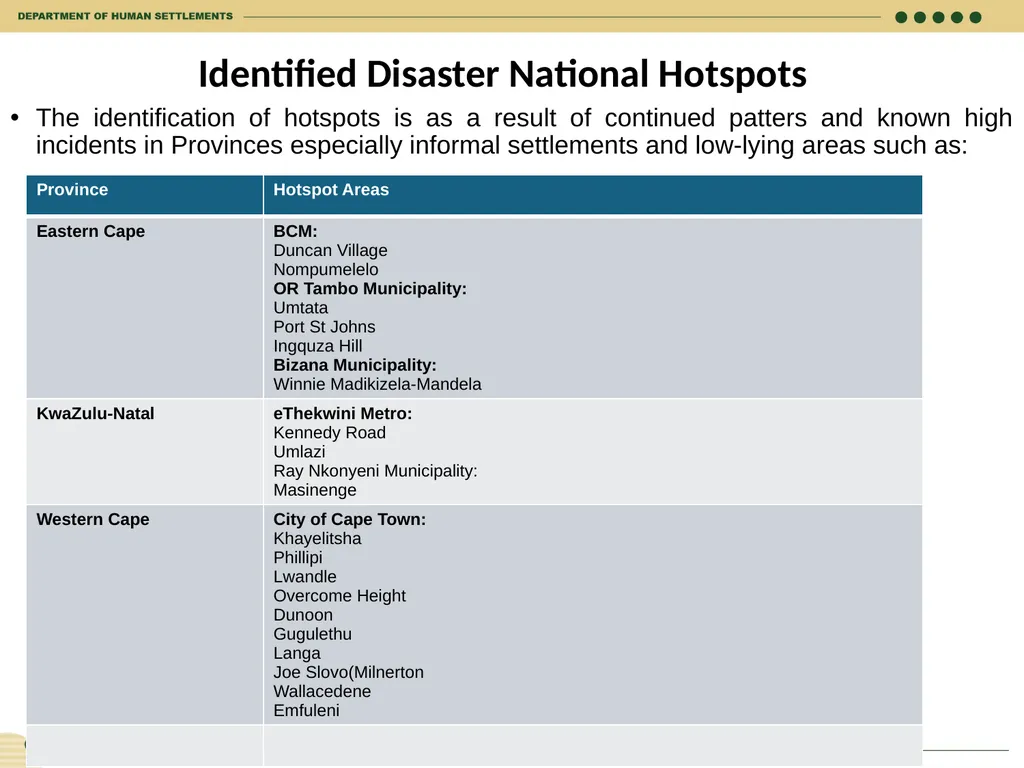
Identified Disaster National Hotspots The identification of hotspots is as a result of continued patters and known high incidents in Provinces especially informal settlements and low-lying areas such as:<br>
17
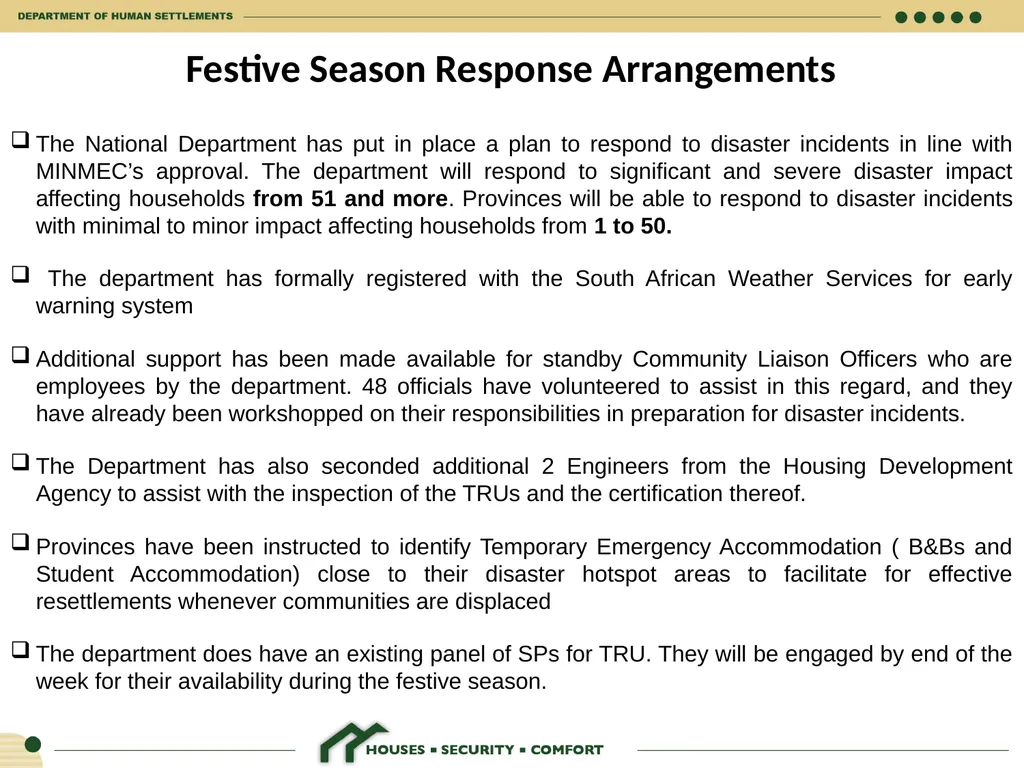
Festive Season Response Arrangements The National Department has put in place a plan to respond to disaster incidents in line with MINMEC’s approval. The department will respond to significant and severe disaster impact affecting households from 51 and more. Provinces will be able to respond to disaster incidents with minimal to minor impact affecting households from 1 to 50.
The department has formally registered with the South African Weather Services for early warning system
Additional support has been made available for standby Community Liaison Officers who are employees by the department. 48 officials have volunteered to assist in this regard, and they have already been workshopped on their responsibilities in preparation for disaster incidents.
The Department has also seconded additional 2 Engineers from the Housing Development Agency to assist with the inspection of the TRUs and the certification thereof.
Provinces have been instructed to identify Temporary Emergency Accommodation ( B&Bs and Student Accommodation) close to their disaster hotspot areas to facilitate for effective resettlements whenever communities are displaced
The department does have an existing panel of SPs for TRU. They will be engaged by end of the week for their availability during the festive season.<br>
The department has formally registered with the South African Weather Services for early warning system
Additional support has been made available for standby Community Liaison Officers who are employees by the department. 48 officials have volunteered to assist in this regard, and they have already been workshopped on their responsibilities in preparation for disaster incidents.
The Department has also seconded additional 2 Engineers from the Housing Development Agency to assist with the inspection of the TRUs and the certification thereof.
Provinces have been instructed to identify Temporary Emergency Accommodation ( B&Bs and Student Accommodation) close to their disaster hotspot areas to facilitate for effective resettlements whenever communities are displaced
The department does have an existing panel of SPs for TRU. They will be engaged by end of the week for their availability during the festive season.<br>
18
Financial Implications The Emergency Housing Response Fund under the DHS for the human‐settlements sector remains available for the following:
Temporary Emergency Accommodation for resettlement
Building materials/Fire Kits for informal settlements
TRUs for relocation and or damaged structures
NHBRC structural assessment on damaged formal structures
Building material for self repairs
Funding has been made available as follows:
Current budget allocation for Emergency Housing
Approved roll-over funds
Approved funding for unforeseen and unavoidable
Provincial Funding
Provinces and Metros will be allowed to utilise 1% of their ISUPG & HSDG<br>
Temporary Emergency Accommodation for resettlement
Building materials/Fire Kits for informal settlements
TRUs for relocation and or damaged structures
NHBRC structural assessment on damaged formal structures
Building material for self repairs
Funding has been made available as follows:
Current budget allocation for Emergency Housing
Approved roll-over funds
Approved funding for unforeseen and unavoidable
Provincial Funding
Provinces and Metros will be allowed to utilise 1% of their ISUPG & HSDG<br>
19
NDHS contacts General email: emergencyhousing@dhs.gov.za
Focal persons:
Mr. Thabang Moji
Thabang.moji@dhs.gov.za
(0781210836)
Mr. Sanjay Arjun
Sanjay.arjun@dhs.gov.za
(0788007495)<br>
Focal persons:
Mr. Thabang Moji
Thabang.moji@dhs.gov.za
(0781210836)
Mr. Sanjay Arjun
Sanjay.arjun@dhs.gov.za
(0788007495)<br>
20
Recommendations It is recommended that:
The Portfolio Committee should note the Provinces notes the Human Settlements Emergency Response Framework and
To also note that Provinces will present their detailed response plans.<br>
The Portfolio Committee should note the Provinces notes the Human Settlements Emergency Response Framework and
To also note that Provinces will present their detailed response plans.<br>