Hydrology and its impact on crop yields using SWAT under CMIP6 climate projections D. N. Kowshika Project Associate National Agro Foundation, Chengalpattu, Tamilnadu, India Introduction Water is an essential component in all life forms,
"Hydrology and its impact on crop yields using SWAT" is the property of its rightful owner. Permission is granted to
download and print the materials on this website for personal, non-commercial use only, and to display it
on your personal computer provided you do not modify the materials and that you retain all copyright
notices contained in the materials. By downloading content from our website, you accept the terms of this
agreement.
Presentation Transcript
01
Hydrology and its impact on crop yields using SWAT under CMIP6 climate projections D. N. Kowshika
Project Associate
National Agro Foundation, Chengalpattu, Tamilnadu, India<br>
02
Introduction Water is an essential component in all life forms, especially in agricultural sector.
Information about availability of irrigation water both as rainfall and reservoir storage proves to be vital in deciding the cropping pattern, cropping system, crop variety and other agricultural operations.
But on-farm trials or existing studies are either time consuming or inadequate in determining the future needs.
Here comes the role of simulation models through computers which tend to analyse the future needs with existing/minimal inputs.
Hydrological models can be efficient in assessing water resources, determining best management practices, climate and land use changes etc.<br>
03
Background Study Analysis of the interactions between the region’s hydrological cycle and the functioning of its ecosystems are particularly lacking, owing to the dearth of reliable, long term observations and projections of climate (Aloysius et al., 2015)
Potential changes in climate will affect stream flow regimes differently across the globe, and are likely to have implications for freshwater ecosystems and water availability for human uses (Jiménez-Cisneros et al., 2014).
It is therefore increasingly important to quantify climate change impacts on water regimes by pairing climate model data with hydrologic models to better inform decision makers in mitigating watershed scale climate change impacts.<br>
04
Objectives Project hydrological changes in a watershed under CMIP6 future projections.
Analyse the impact of hydrological changes on yields of major crops for the selected watershed using SWAT (Soil and Water Assessment Tool) model
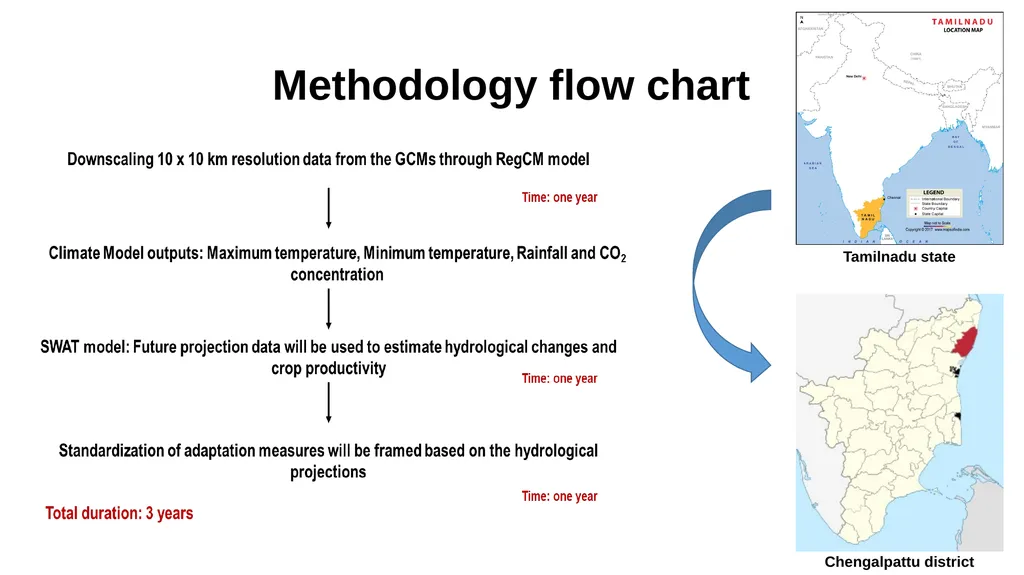
Develop efficient cropping pattern for the watershed on climate change conditions of future. Methodology A watershed will be chosen to understand the stream flow. – Chengalpattu district, Tamilnadu, India
Following this, future sensitivities on changing climate using CMIP6 projections would be simulated - HadGEM, CCSM4 and MIROC-ESM - downscaled through a RegCM (RCM) for the selected area.
The impact of hydrological changes in future will be studied using the simulations of SWAT model for major crops of the selected watershed.<br>
05
Regional Downscaling using RegCM model RegCM system shows good performances in reproducing temperature and precipitation
The model shows more detailed geographical features
Accounts for different broad-scale change patterns
Addresses better on atmospheric changes
It takes GCM drivers on regional scale
Relatively simpler and easier to use 10 km x 10 km resolution data
Representative Concentration Pathways – 4.5 and 8.5 W/m2
RCP 4.5 - intermediate stabilisation pathway in which radiative forcing is stabilised at approximately after 2100
RCP 8.5 - high pathway for which radiative forcing reaches greater than 8.5 W m-2 by 2100 and continues to rise for some amount of time
Locations: A macro-watershed at Chengalpattu district of Tamilnadu needs to be chosen. But downscaling could be done for entire Tamilnadu.<br>
06
Methodology flow chart Tamilnadu state Chengalpattu district<br>
07
Significance of the project
Hydrological models have been in usage to simulate crop yield as a response to hydrology and water budget.
The recent CMIP6 projections would provide a strength in understanding the hydrological changes and its impact on crop yield for aiming adaptations.
Studies until now have been done focusing for hydrological projections and suggesting the adaptation measures. Thus, an attempt towards evaluation and standardization of adaptation measures would an new path in Climate change impact assessment at watershed level.<br>