
I N T E R V I E W Using
OM
Published · 73 slides · 0 views
1 / 1
Description
I N T E R V I E W Using Weingarten, Due Process and the Douglas Factors to better represent our Membership in a Pre Disciplinary Interview or Investigative Interview Advanced Training on the most basic skill By Eric Chornoby, MPWU
Related Topics
Download this presentation From Below
"I N T E R V I E W Using" is the property of its rightful owner. Permission is granted to download and print the materials on this website for personal, non-commercial use only, and to display it on your personal computer provided you do not modify the materials and that you retain all copyright notices contained in the materials. By downloading content from our website, you accept the terms of this agreement.
Share
Embed code
Presentation Transcript
01
I N T E R V I E W Using Weingarten, Due Process and the Douglas Factors to better represent our Membership in a Pre – Disciplinary Interview or Investigative Interview
“Advanced Training on the most basic skill”
By Eric Chornoby, MPWU Executive Secretary<br>
“Advanced Training on the most basic skill”
By Eric Chornoby, MPWU Executive Secretary<br>
02
introduction Why this training is important!
Who am I?
Why I hate (most) training
What qualifies me to teach this?
The Goal is not to create Cookie Cutter Stewards, it is to learn tactics that work and learn to apply them!<br>
Who am I?
Why I hate (most) training
What qualifies me to teach this?
The Goal is not to create Cookie Cutter Stewards, it is to learn tactics that work and learn to apply them!<br>
03
The Purpose of the Union in an Investigative Interview The investigative interview is a Just Cause right prior to the decision to issue discipline; and often the investigative interview is Managements way to ensure the employee has their Procedural Due Process rights as granted by the US Constitution
Our responsibility in an investigative interview is to REPRESENT the employee, and assist them in exercising their rights
The investigative interview is not to argue against management, or ‘win the case’ in the interview
While we can push the envelope of our rights, we risk losing any future Grievance and harming the employee if we do not fulfill our legally mandated responsibilities<br>
Our responsibility in an investigative interview is to REPRESENT the employee, and assist them in exercising their rights
The investigative interview is not to argue against management, or ‘win the case’ in the interview
While we can push the envelope of our rights, we risk losing any future Grievance and harming the employee if we do not fulfill our legally mandated responsibilities<br>
04
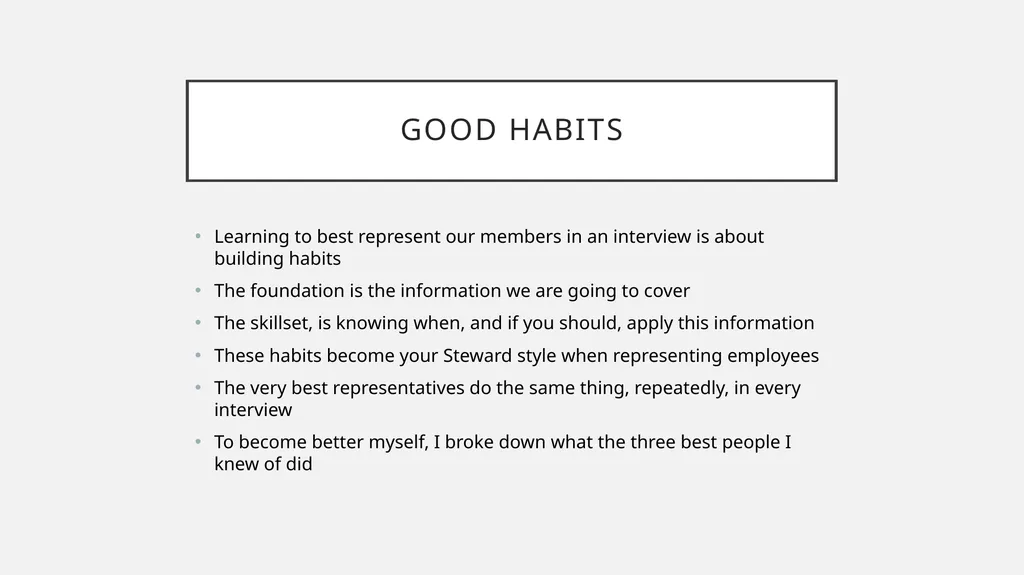
Good Habits Learning to best represent our members in an interview is about building habits
The foundation is the information we are going to cover
The skillset, is knowing when, and if you should, apply this information
These habits become your Steward style when representing employees
The very best representatives do the same thing, repeatedly, in every interview
To become better myself, I broke down what the three best people I knew of did<br>
The foundation is the information we are going to cover
The skillset, is knowing when, and if you should, apply this information
These habits become your Steward style when representing employees
The very best representatives do the same thing, repeatedly, in every interview
To become better myself, I broke down what the three best people I knew of did<br>
05
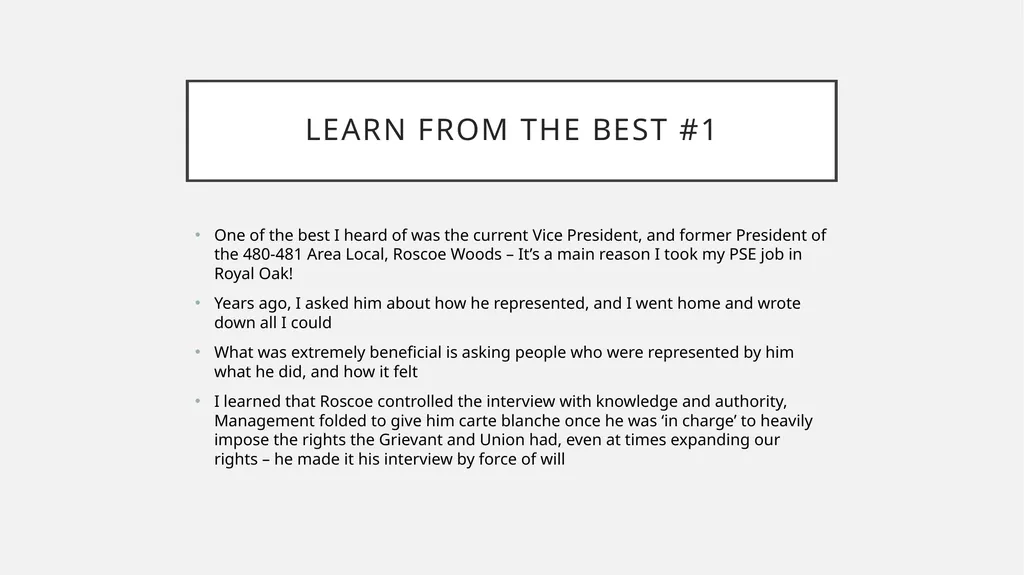
Learn from the best #1 One of the best I heard of was the current Vice President, and former President of the 480-481 Area Local, Roscoe Woods – It’s a main reason I took my PSE job in Royal Oak!
Years ago, I asked him about how he represented, and I went home and wrote down all I could
What was extremely beneficial is asking people who were represented by him what he did, and how it felt
I learned that Roscoe controlled the interview with knowledge and authority, Management folded to give him carte blanche once he was ‘in charge’ to heavily impose the rights the Grievant and Union had, even at times expanding our rights – he made it his interview by force of will<br>
Years ago, I asked him about how he represented, and I went home and wrote down all I could
What was extremely beneficial is asking people who were represented by him what he did, and how it felt
I learned that Roscoe controlled the interview with knowledge and authority, Management folded to give him carte blanche once he was ‘in charge’ to heavily impose the rights the Grievant and Union had, even at times expanding our rights – he made it his interview by force of will<br>
06
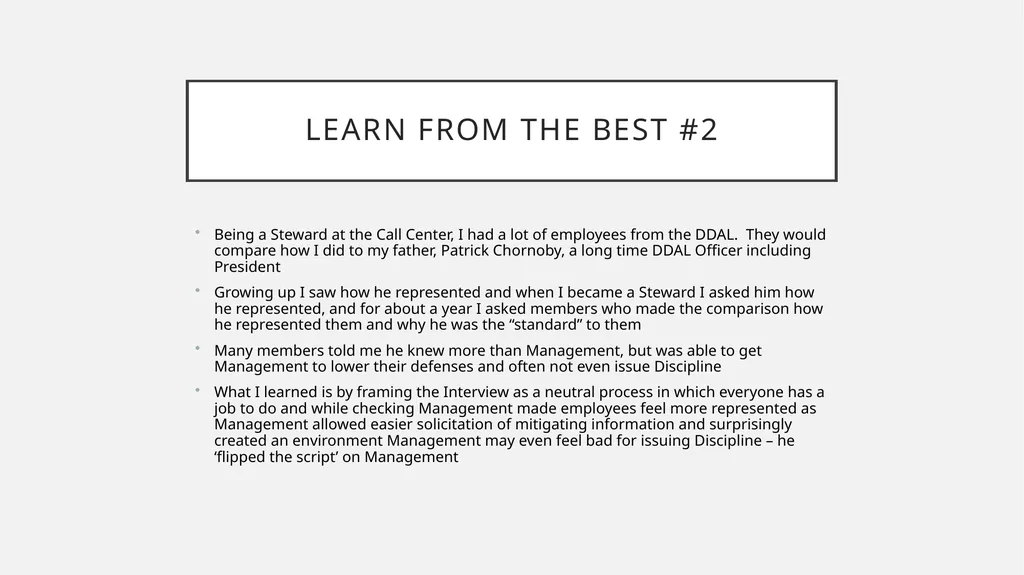
Learn from the best #2 Being a Steward at the Call Center, I had a lot of employees from the DDAL. They would compare how I did to my father, Patrick Chornoby, a long time DDAL Officer including President
Growing up I saw how he represented and when I became a Steward I asked him how he represented, and for about a year I asked members who made the comparison how he represented them and why he was the “standard” to them
Many members told me he knew more than Management, but was able to get Management to lower their defenses and often not even issue Discipline
What I learned is by framing the Interview as a neutral process in which everyone has a job to do and while checking Management made employees feel more represented as Management allowed easier solicitation of mitigating information and surprisingly created an environment Management may even feel bad for issuing Discipline – he ‘flipped the script’ on Management<br>
Growing up I saw how he represented and when I became a Steward I asked him how he represented, and for about a year I asked members who made the comparison how he represented them and why he was the “standard” to them
Many members told me he knew more than Management, but was able to get Management to lower their defenses and often not even issue Discipline
What I learned is by framing the Interview as a neutral process in which everyone has a job to do and while checking Management made employees feel more represented as Management allowed easier solicitation of mitigating information and surprisingly created an environment Management may even feel bad for issuing Discipline – he ‘flipped the script’ on Management<br>
07
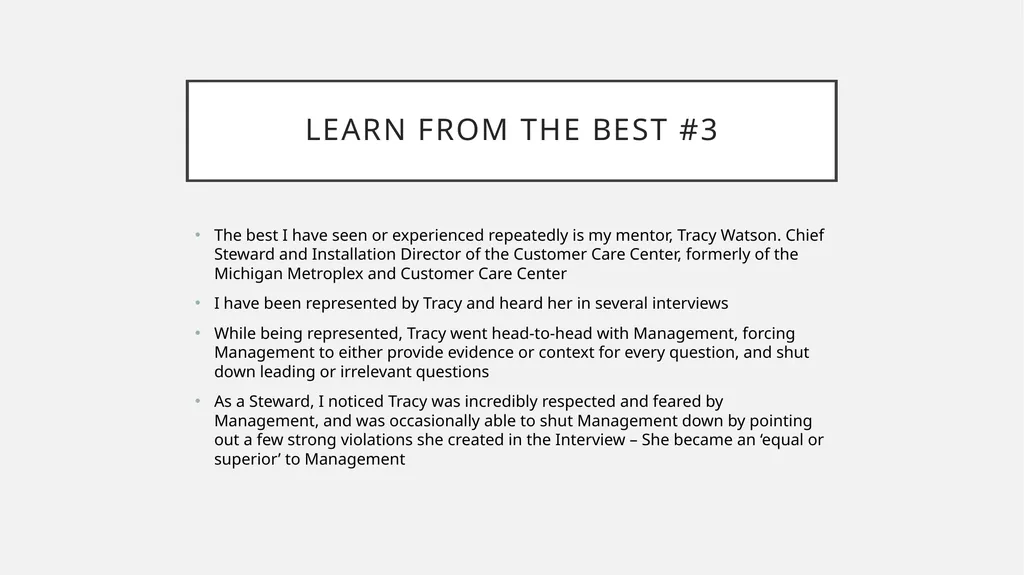
Learn from the best #3 The best I have seen or experienced repeatedly is my mentor, Tracy Watson. Chief Steward and Installation Director of the Customer Care Center, formerly of the Michigan Metroplex and Customer Care Center
I have been represented by Tracy and heard her in several interviews
While being represented, Tracy went head-to-head with Management, forcing Management to either provide evidence or context for every question, and shut down leading or irrelevant questions
As a Steward, I noticed Tracy was incredibly respected and feared by Management, and was occasionally able to shut Management down by pointing out a few strong violations she created in the Interview – She became an ‘equal or superior’ to Management<br>
I have been represented by Tracy and heard her in several interviews
While being represented, Tracy went head-to-head with Management, forcing Management to either provide evidence or context for every question, and shut down leading or irrelevant questions
As a Steward, I noticed Tracy was incredibly respected and feared by Management, and was occasionally able to shut Management down by pointing out a few strong violations she created in the Interview – She became an ‘equal or superior’ to Management<br>
08
Putting it Together I took what I could learn from the 3 best I have seen, heard of, or experienced and identified what they did that worked – Control, Knowledge, Challenging Management and Took Notes (When Needed)
I then researched our legal rights and found which tactics we could use in the Grievance procedure – including Supreme Court Cases, Legal Precedence and Grievances
After over a thousand interviews (Up to seven a day, five days a week for several years), testing, and research I have identified the best tools Stewards can employ
This is the point of this training – Learning the ‘how’ behind what the successful Stewards do, learn our legal rights, package the violations correctly for arbitrators and creating a system to consistently apply this information<br>
I then researched our legal rights and found which tactics we could use in the Grievance procedure – including Supreme Court Cases, Legal Precedence and Grievances
After over a thousand interviews (Up to seven a day, five days a week for several years), testing, and research I have identified the best tools Stewards can employ
This is the point of this training – Learning the ‘how’ behind what the successful Stewards do, learn our legal rights, package the violations correctly for arbitrators and creating a system to consistently apply this information<br>
09
CONCEPT #1 – Weingarten rights Weingarten Rights are the rights of employees and their representatives in an Investigative Interview or Interview with their employer which could lead to Disciplinary Action
Notable rights include: The right of the Union to be in the interview; the right to speak to the Grievant prior to the interview; the right to be a non – passive observer; the right to advise the Grievant; the right to object to confusing or leading questions; the right to advise employees to not answer abusive, misleading, badgering or harassing questions; provide information to justify the employee’s actions at the end of the interview; and the right to ask Management to clarify confusing questions.
Granted by the Supreme Court in the 1975 case of NLRB v. J. Weingarten 420 US 251, 88 LRRM 2689, the JCIM Article 17.4 and SEVERAL NLRB Charges / Cases against the USPS
Best defined by Robert M. Schwartz in his book The Legal Rights of Union Stewards<br>
Notable rights include: The right of the Union to be in the interview; the right to speak to the Grievant prior to the interview; the right to be a non – passive observer; the right to advise the Grievant; the right to object to confusing or leading questions; the right to advise employees to not answer abusive, misleading, badgering or harassing questions; provide information to justify the employee’s actions at the end of the interview; and the right to ask Management to clarify confusing questions.
Granted by the Supreme Court in the 1975 case of NLRB v. J. Weingarten 420 US 251, 88 LRRM 2689, the JCIM Article 17.4 and SEVERAL NLRB Charges / Cases against the USPS
Best defined by Robert M. Schwartz in his book The Legal Rights of Union Stewards<br>
10
Basic Weingarten Rights The supervisor or manager must inform the steward of the subject matter of the interview: in other words, the type of misconduct being investigated.
The steward must be allowed to have a private meeting with the employee before questioning begins.
The steward can speak during the interview but cannot insist that the interview be ended.
The steward can object to a confusing question and can request that the question be clarified so that the employee understands what is being asked.
The steward can advise the employee not to answer questions that are abusive, misleading, badgering, or harassing.
When the questioning ends, the steward can provide information to justify the employee’s conduct.<br>
The steward must be allowed to have a private meeting with the employee before questioning begins.
The steward can speak during the interview but cannot insist that the interview be ended.
The steward can object to a confusing question and can request that the question be clarified so that the employee understands what is being asked.
The steward can advise the employee not to answer questions that are abusive, misleading, badgering, or harassing.
When the questioning ends, the steward can provide information to justify the employee’s conduct.<br>
11
When Weingarten applies Any interview, in which the employee has a reasonable belief the result could be Corrective and/or Disciplinary Action
This includes Pre-Disciplinary Interviews and Investigative Interviews
It does apply to interviews with the OIG (Office of Inspector General) and USPIS (Postal Inspectors)
NOTE: When dealing with the OIG or USPIS you must be familiar with how they operate, when to recommend a Lawyer, and the Kalkines / Garrity Warnings
This does not apply to Documented / 16.2 Discussions, ELM 370 Performance Evaluations, Attendance Reviews, 30-60-80 Day Evaluations, and so on<br>
This includes Pre-Disciplinary Interviews and Investigative Interviews
It does apply to interviews with the OIG (Office of Inspector General) and USPIS (Postal Inspectors)
NOTE: When dealing with the OIG or USPIS you must be familiar with how they operate, when to recommend a Lawyer, and the Kalkines / Garrity Warnings
This does not apply to Documented / 16.2 Discussions, ELM 370 Performance Evaluations, Attendance Reviews, 30-60-80 Day Evaluations, and so on<br>
12
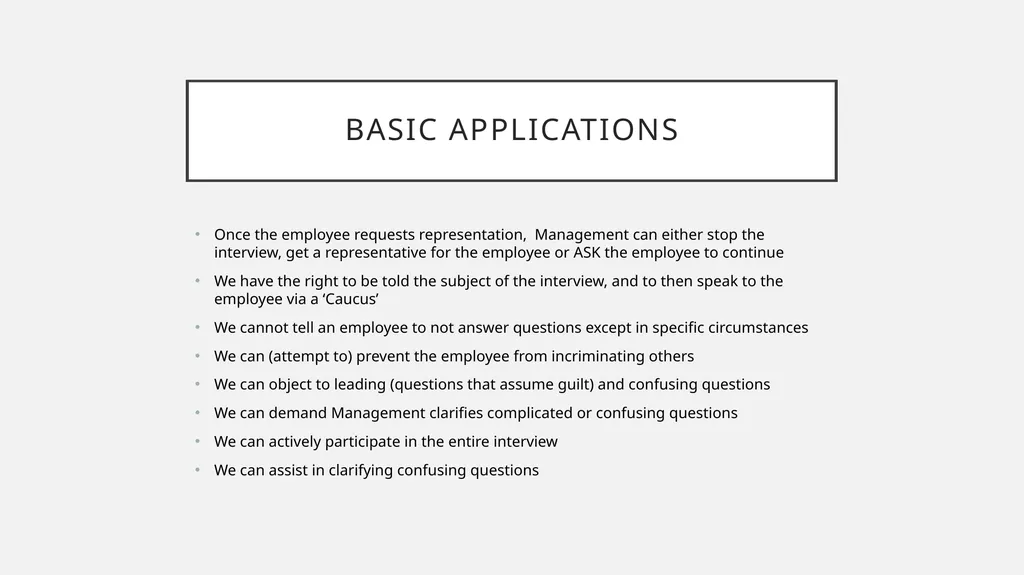
Basic Applications Once the employee requests representation, Management can either stop the interview, get a representative for the employee or ASK the employee to continue
We have the right to be told the subject of the interview, and to then speak to the employee via a ‘Caucus’
We cannot tell an employee to not answer questions except in specific circumstances
We can (attempt to) prevent the employee from incriminating others
We can object to leading (questions that assume guilt) and confusing questions
We can demand Management clarifies complicated or confusing questions
We can actively participate in the entire interview
We can assist in clarifying confusing questions<br>
We have the right to be told the subject of the interview, and to then speak to the employee via a ‘Caucus’
We cannot tell an employee to not answer questions except in specific circumstances
We can (attempt to) prevent the employee from incriminating others
We can object to leading (questions that assume guilt) and confusing questions
We can demand Management clarifies complicated or confusing questions
We can actively participate in the entire interview
We can assist in clarifying confusing questions<br>
13
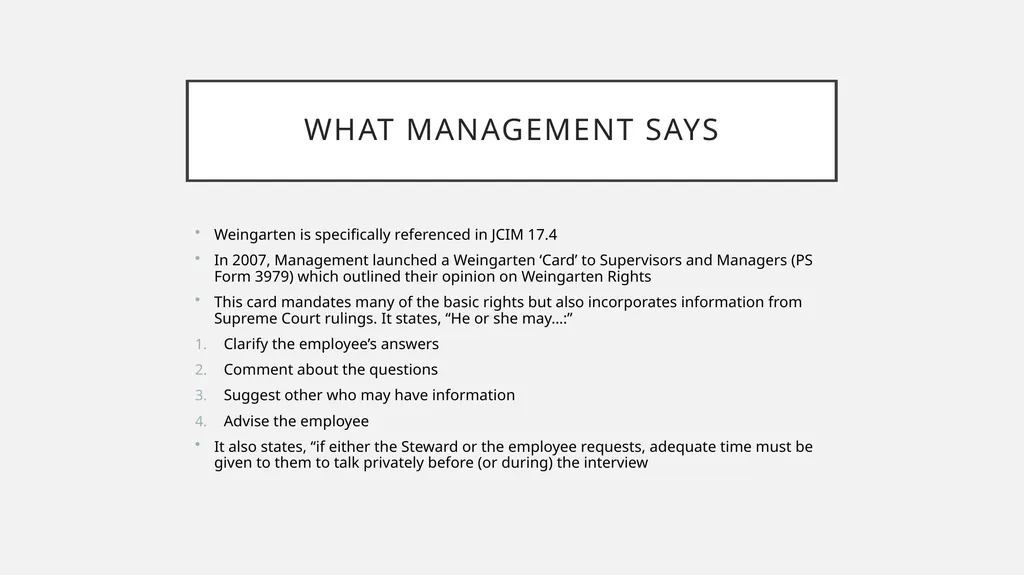
What Management says Weingarten is specifically referenced in JCIM 17.4
In 2007, Management launched a Weingarten ‘Card’ to Supervisors and Managers (PS Form 3979) which outlined their opinion on Weingarten Rights
This card mandates many of the basic rights but also incorporates information from Supreme Court rulings. It states, “He or she may…:”
Clarify the employee’s answers
Comment about the questions
Suggest other who may have information
Advise the employee
It also states, “if either the Steward or the employee requests, adequate time must be given to them to talk privately before (or during) the interview<br>
In 2007, Management launched a Weingarten ‘Card’ to Supervisors and Managers (PS Form 3979) which outlined their opinion on Weingarten Rights
This card mandates many of the basic rights but also incorporates information from Supreme Court rulings. It states, “He or she may…:”
Clarify the employee’s answers
Comment about the questions
Suggest other who may have information
Advise the employee
It also states, “if either the Steward or the employee requests, adequate time must be given to them to talk privately before (or during) the interview<br>
14
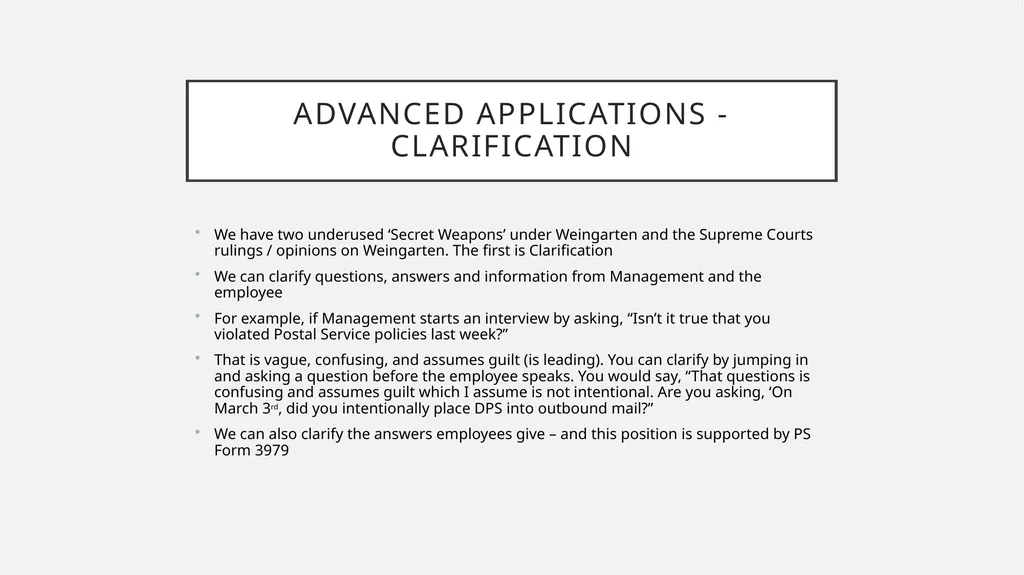
Advanced Applications - Clarification We have two underused ‘Secret Weapons’ under Weingarten and the Supreme Courts rulings / opinions on Weingarten. The first is Clarification
We can clarify questions, answers and information from Management and the employee
For example, if Management starts an interview by asking, “Isn’t it true that you violated Postal Service policies last week?”
That is vague, confusing, and assumes guilt (is leading). You can clarify by jumping in and asking a question before the employee speaks. You would say, “That questions is confusing and assumes guilt which I assume is not intentional. Are you asking, ‘On March 3rd, did you intentionally place DPS into outbound mail?”
We can also clarify the answers employees give – and this position is supported by PS Form 3979<br>
We can clarify questions, answers and information from Management and the employee
For example, if Management starts an interview by asking, “Isn’t it true that you violated Postal Service policies last week?”
That is vague, confusing, and assumes guilt (is leading). You can clarify by jumping in and asking a question before the employee speaks. You would say, “That questions is confusing and assumes guilt which I assume is not intentional. Are you asking, ‘On March 3rd, did you intentionally place DPS into outbound mail?”
We can also clarify the answers employees give – and this position is supported by PS Form 3979<br>
15
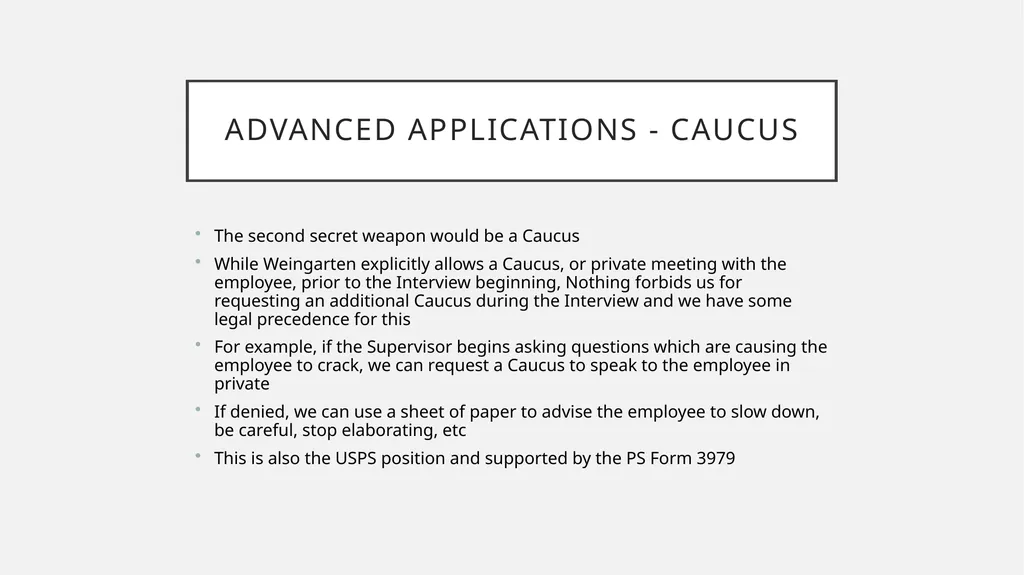
Advanced Applications - Caucus The second secret weapon would be a Caucus
While Weingarten explicitly allows a Caucus, or private meeting with the employee, prior to the Interview beginning, Nothing forbids us for requesting an additional Caucus during the Interview and we have some legal precedence for this
For example, if the Supervisor begins asking questions which are causing the employee to crack, we can request a Caucus to speak to the employee in private
If denied, we can use a sheet of paper to advise the employee to slow down, be careful, stop elaborating, etc
This is also the USPS position and supported by the PS Form 3979<br>
While Weingarten explicitly allows a Caucus, or private meeting with the employee, prior to the Interview beginning, Nothing forbids us for requesting an additional Caucus during the Interview and we have some legal precedence for this
For example, if the Supervisor begins asking questions which are causing the employee to crack, we can request a Caucus to speak to the employee in private
If denied, we can use a sheet of paper to advise the employee to slow down, be careful, stop elaborating, etc
This is also the USPS position and supported by the PS Form 3979<br>
16
Using Weingarten When an employee asks for a Steward, we should immediately determine the subject of the Interview, and have a Caucus, or conversation, with them
We should actively clarify Management’s questions and the employee’s answers
We should object to leading, confusing, abusive questions we cannot ‘clarify’ to the employee’s benefit
We should actively provide information such as other witnesses, mitigating circumstances, or more concise summaries of the employee’s answers
We should always end the interview by providing an excuse, or summary of the members excuses to ensure an appropriate defense is on the record<br>
We should actively clarify Management’s questions and the employee’s answers
We should object to leading, confusing, abusive questions we cannot ‘clarify’ to the employee’s benefit
We should actively provide information such as other witnesses, mitigating circumstances, or more concise summaries of the employee’s answers
We should always end the interview by providing an excuse, or summary of the members excuses to ensure an appropriate defense is on the record<br>
17
A Weingarten Grievance When citing or arguing Weingarten, cite Article 17.4
When arguing Weingarten quote the JCIM when applicable: “The employee has the right to a steward’s assistance, not just a silent presence, during an interview covered by the Weingarten rule. An employee’s Weingarten rights are violated when the Union representative is not allowed to speak or is restricted to the role of a passive observer.”
For a violation not listed in the CBA/JCIM, quote 17 and state, “The Union contends article 17 was violated when the Grievant and Union were denied their Weingarten Rights.”<br>
When arguing Weingarten quote the JCIM when applicable: “The employee has the right to a steward’s assistance, not just a silent presence, during an interview covered by the Weingarten rule. An employee’s Weingarten rights are violated when the Union representative is not allowed to speak or is restricted to the role of a passive observer.”
For a violation not listed in the CBA/JCIM, quote 17 and state, “The Union contends article 17 was violated when the Grievant and Union were denied their Weingarten Rights.”<br>
18
Weingarten Summary Weingarten Rights are important because they are directly in the CBA / JCIM, are well known by Arbitrators, are well known by Management, and if violated we can Labor Charge under the NLRB
If you are shut down, you need to include this in your notes – this is not a battle and being shut down allows us to make inferences in the Grievance procedure or Labor Charge
Weingarten Rights should be cited as a Contractual Violation in your Grievances when an issue occurs
We do have other rights which are equally as important, but seldomly used. The most glaring right is the right of Procedural Due Process
Before we move on to Due Process, do you have any questions on Weingarten?<br>
If you are shut down, you need to include this in your notes – this is not a battle and being shut down allows us to make inferences in the Grievance procedure or Labor Charge
Weingarten Rights should be cited as a Contractual Violation in your Grievances when an issue occurs
We do have other rights which are equally as important, but seldomly used. The most glaring right is the right of Procedural Due Process
Before we move on to Due Process, do you have any questions on Weingarten?<br>
19
CONCEPT #2 – Procedural Due process Procedural Due Process is a Constitutional Right we have as Federal Employees which grants us Procedural Fairness
The most important elements for the APWU Steward are Notice of the proposed action and the grounds asserted for it; Opportunity to present reasons why the proposed action should not be taken; The right to present evidence; The right to know opposing evidence; A decision based exclusively on the evidence presented
Right Granted by: US Constitution; 14th Amendment; Cleveland Board of Education vs Loudermill (1985); Morrissey v Brewer, LaChance v Erickson (1998); Federal Deposit Ins. Corp v Mallen (1988); Board of Regents v Roth (1972); Perry v Sindermann (1972); Mathews v. Eldridge (1976) and Judge Henry Friendly’s “Some Kind of Hearing”
Best defined in Procedural Due Process by Rhonda Wasserman<br>
The most important elements for the APWU Steward are Notice of the proposed action and the grounds asserted for it; Opportunity to present reasons why the proposed action should not be taken; The right to present evidence; The right to know opposing evidence; A decision based exclusively on the evidence presented
Right Granted by: US Constitution; 14th Amendment; Cleveland Board of Education vs Loudermill (1985); Morrissey v Brewer, LaChance v Erickson (1998); Federal Deposit Ins. Corp v Mallen (1988); Board of Regents v Roth (1972); Perry v Sindermann (1972); Mathews v. Eldridge (1976) and Judge Henry Friendly’s “Some Kind of Hearing”
Best defined in Procedural Due Process by Rhonda Wasserman<br>
20
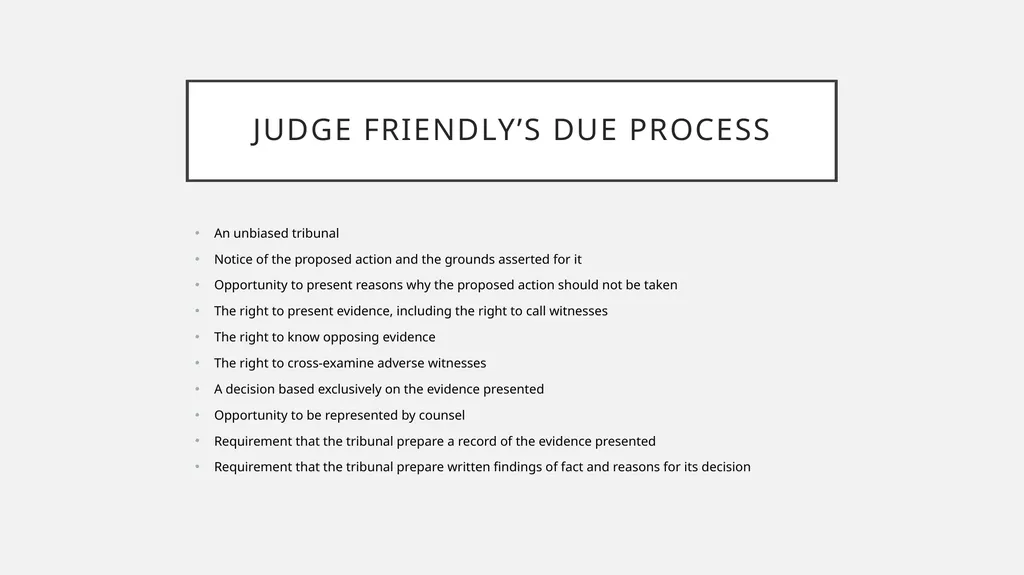
Judge Friendly’s Due Process An unbiased tribunal
Notice of the proposed action and the grounds asserted for it
Opportunity to present reasons why the proposed action should not be taken
The right to present evidence, including the right to call witnesses
The right to know opposing evidence
The right to cross-examine adverse witnesses
A decision based exclusively on the evidence presented
Opportunity to be represented by counsel
Requirement that the tribunal prepare a record of the evidence presented
Requirement that the tribunal prepare written findings of fact and reasons for its decision<br>
Notice of the proposed action and the grounds asserted for it
Opportunity to present reasons why the proposed action should not be taken
The right to present evidence, including the right to call witnesses
The right to know opposing evidence
The right to cross-examine adverse witnesses
A decision based exclusively on the evidence presented
Opportunity to be represented by counsel
Requirement that the tribunal prepare a record of the evidence presented
Requirement that the tribunal prepare written findings of fact and reasons for its decision<br>
21
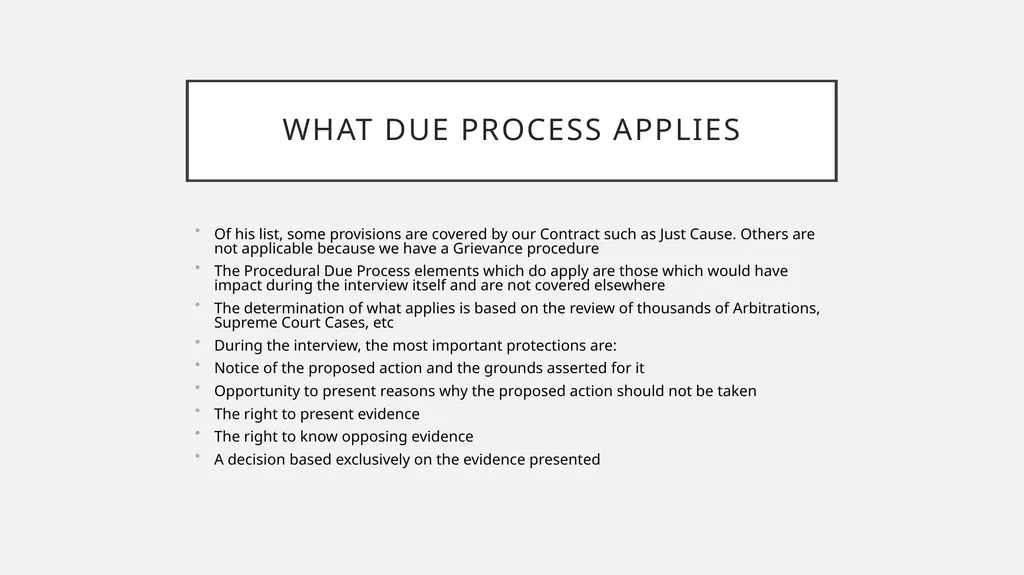
What Due Process Applies Of his list, some provisions are covered by our Contract such as Just Cause. Others are not applicable because we have a Grievance procedure
The Procedural Due Process elements which do apply are those which would have impact during the interview itself and are not covered elsewhere
The determination of what applies is based on the review of thousands of Arbitrations, Supreme Court Cases, etc
During the interview, the most important protections are:
Notice of the proposed action and the grounds asserted for it
Opportunity to present reasons why the proposed action should not be taken
The right to present evidence
The right to know opposing evidence
A decision based exclusively on the evidence presented<br>
The Procedural Due Process elements which do apply are those which would have impact during the interview itself and are not covered elsewhere
The determination of what applies is based on the review of thousands of Arbitrations, Supreme Court Cases, etc
During the interview, the most important protections are:
Notice of the proposed action and the grounds asserted for it
Opportunity to present reasons why the proposed action should not be taken
The right to present evidence
The right to know opposing evidence
A decision based exclusively on the evidence presented<br>
22
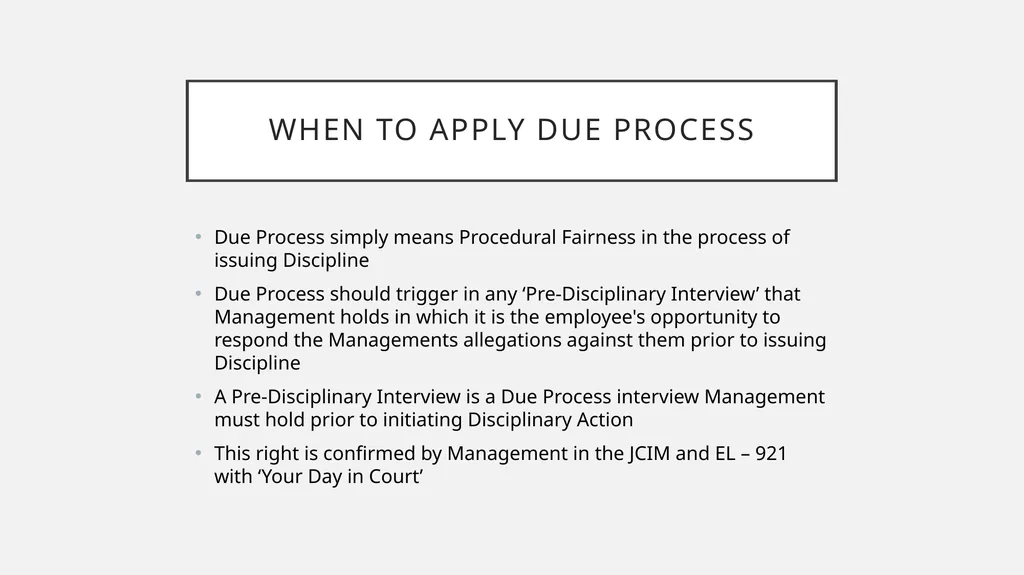
When to apply due process Due Process simply means Procedural Fairness in the process of issuing Discipline
Due Process should trigger in any ‘Pre-Disciplinary Interview’ that Management holds in which it is the employee's opportunity to respond the Managements allegations against them prior to issuing Discipline
A Pre-Disciplinary Interview is a Due Process interview Management must hold prior to initiating Disciplinary Action
This right is confirmed by Management in the JCIM and EL – 921 with ‘Your Day in Court’<br>
Due Process should trigger in any ‘Pre-Disciplinary Interview’ that Management holds in which it is the employee's opportunity to respond the Managements allegations against them prior to issuing Discipline
A Pre-Disciplinary Interview is a Due Process interview Management must hold prior to initiating Disciplinary Action
This right is confirmed by Management in the JCIM and EL – 921 with ‘Your Day in Court’<br>
23
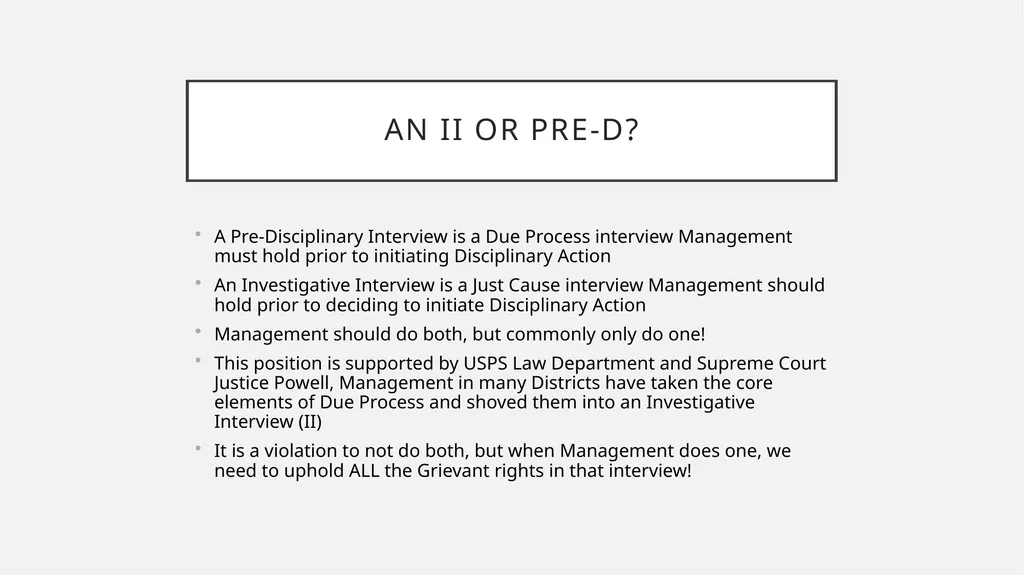
an ii or Pre-D? A Pre-Disciplinary Interview is a Due Process interview Management must hold prior to initiating Disciplinary Action
An Investigative Interview is a Just Cause interview Management should hold prior to deciding to initiate Disciplinary Action
Management should do both, but commonly only do one!
This position is supported by USPS Law Department and Supreme Court Justice Powell, Management in many Districts have taken the core elements of Due Process and shoved them into an Investigative Interview (II)
It is a violation to not do both, but when Management does one, we need to uphold ALL the Grievant rights in that interview!<br>
An Investigative Interview is a Just Cause interview Management should hold prior to deciding to initiate Disciplinary Action
Management should do both, but commonly only do one!
This position is supported by USPS Law Department and Supreme Court Justice Powell, Management in many Districts have taken the core elements of Due Process and shoved them into an Investigative Interview (II)
It is a violation to not do both, but when Management does one, we need to uphold ALL the Grievant rights in that interview!<br>
24
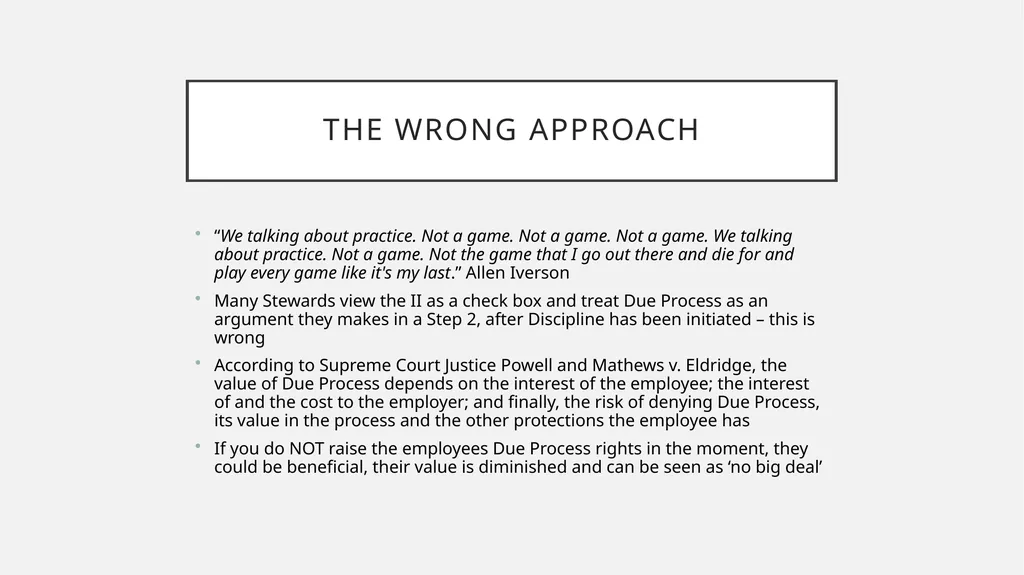
The WRONG approach “We talking about practice. Not a game. Not a game. Not a game. We talking about practice. Not a game. Not the game that I go out there and die for and play every game like it's my last.” Allen Iverson
Many Stewards view the II as a check box and treat Due Process as an argument they makes in a Step 2, after Discipline has been initiated – this is wrong
According to Supreme Court Justice Powell and Mathews v. Eldridge, the value of Due Process depends on the interest of the employee; the interest of and the cost to the employer; and finally, the risk of denying Due Process, its value in the process and the other protections the employee has
If you do NOT raise the employees Due Process rights in the moment, they could be beneficial, their value is diminished and can be seen as ‘no big deal’<br>
Many Stewards view the II as a check box and treat Due Process as an argument they makes in a Step 2, after Discipline has been initiated – this is wrong
According to Supreme Court Justice Powell and Mathews v. Eldridge, the value of Due Process depends on the interest of the employee; the interest of and the cost to the employer; and finally, the risk of denying Due Process, its value in the process and the other protections the employee has
If you do NOT raise the employees Due Process rights in the moment, they could be beneficial, their value is diminished and can be seen as ‘no big deal’<br>
25
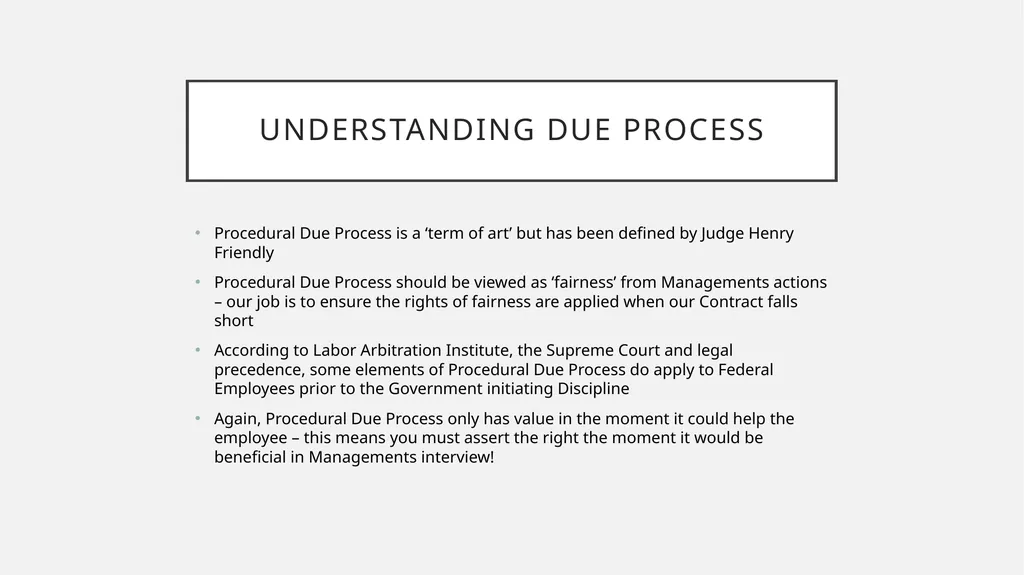
Understanding Due Process Procedural Due Process is a ‘term of art’ but has been defined by Judge Henry Friendly
Procedural Due Process should be viewed as ‘fairness’ from Managements actions – our job is to ensure the rights of fairness are applied when our Contract falls short
According to Labor Arbitration Institute, the Supreme Court and legal precedence, some elements of Procedural Due Process do apply to Federal Employees prior to the Government initiating Discipline
Again, Procedural Due Process only has value in the moment it could help the employee – this means you must assert the right the moment it would be beneficial in Managements interview!<br>
Procedural Due Process should be viewed as ‘fairness’ from Managements actions – our job is to ensure the rights of fairness are applied when our Contract falls short
According to Labor Arbitration Institute, the Supreme Court and legal precedence, some elements of Procedural Due Process do apply to Federal Employees prior to the Government initiating Discipline
Again, Procedural Due Process only has value in the moment it could help the employee – this means you must assert the right the moment it would be beneficial in Managements interview!<br>
26
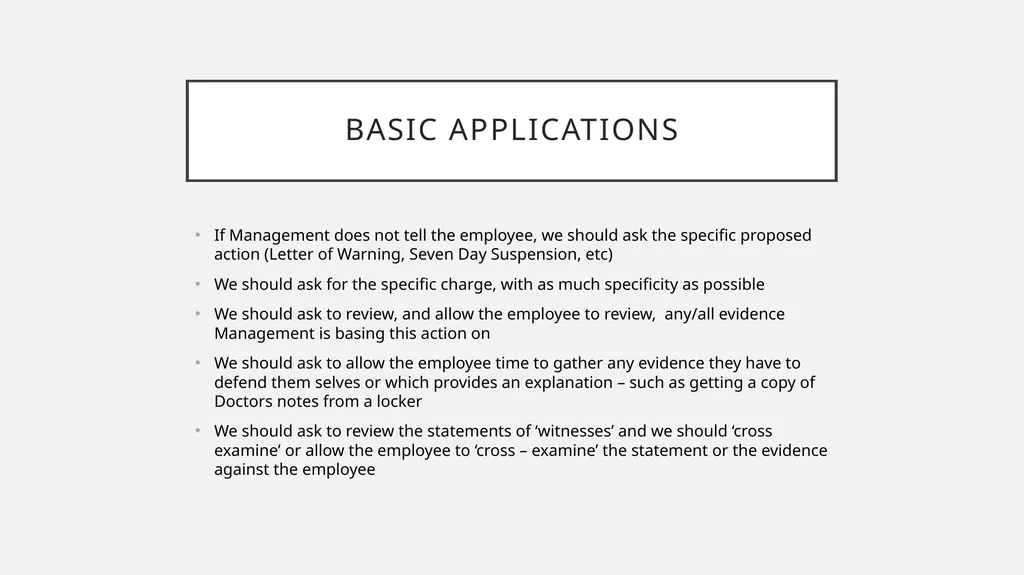
Basic applications If Management does not tell the employee, we should ask the specific proposed action (Letter of Warning, Seven Day Suspension, etc)
We should ask for the specific charge, with as much specificity as possible
We should ask to review, and allow the employee to review, any/all evidence Management is basing this action on
We should ask to allow the employee time to gather any evidence they have to defend them selves or which provides an explanation – such as getting a copy of Doctors notes from a locker
We should ask to review the statements of ‘witnesses’ and we should ‘cross examine’ or allow the employee to ‘cross – examine’ the statement or the evidence against the employee<br>
We should ask for the specific charge, with as much specificity as possible
We should ask to review, and allow the employee to review, any/all evidence Management is basing this action on
We should ask to allow the employee time to gather any evidence they have to defend them selves or which provides an explanation – such as getting a copy of Doctors notes from a locker
We should ask to review the statements of ‘witnesses’ and we should ‘cross examine’ or allow the employee to ‘cross – examine’ the statement or the evidence against the employee<br>
27
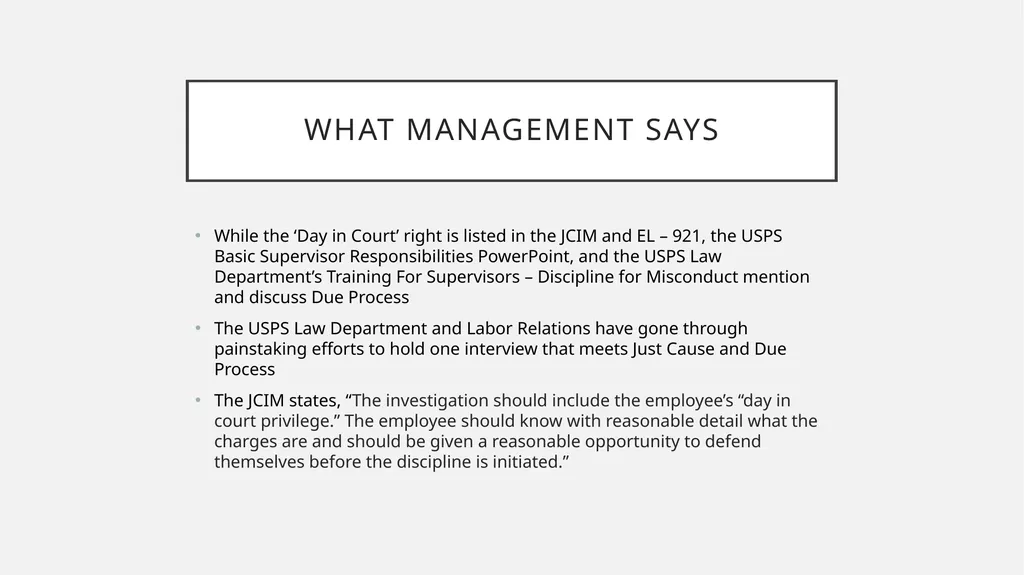
What Management says While the ‘Day in Court’ right is listed in the JCIM and EL – 921, the USPS Basic Supervisor Responsibilities PowerPoint, and the USPS Law Department’s Training For Supervisors – Discipline for Misconduct mention and discuss Due Process
The USPS Law Department and Labor Relations have gone through painstaking efforts to hold one interview that meets Just Cause and Due Process
The JCIM states, “The investigation should include the employee’s “day in court privilege.” The employee should know with reasonable detail what the charges are and should be given a reasonable opportunity to defend themselves before the discipline is initiated.”<br>
The USPS Law Department and Labor Relations have gone through painstaking efforts to hold one interview that meets Just Cause and Due Process
The JCIM states, “The investigation should include the employee’s “day in court privilege.” The employee should know with reasonable detail what the charges are and should be given a reasonable opportunity to defend themselves before the discipline is initiated.”<br>
28
Advanced application Unlike Weingarten and Just Cause, Management does not have a lot of training on Due Process
When you raise the right, or ask a question, Management is likely to answer incorrectly (Such as proposed level of discipline) or state the evidence shown is all they have (The right to review all evidence against the employee)
The mere fact of using these rights is an advanced application!
You must ensure you raise every process impacting Procedural Due Process element in the Investigative Interview<br>
When you raise the right, or ask a question, Management is likely to answer incorrectly (Such as proposed level of discipline) or state the evidence shown is all they have (The right to review all evidence against the employee)
The mere fact of using these rights is an advanced application!
You must ensure you raise every process impacting Procedural Due Process element in the Investigative Interview<br>
29
Determine the Remedy Procedural Due Process, unlike Just Cause, is the total harm to the process
“Due process is flexible and calls for such procedural protections as the particular situation demands," Morrissey v. Brewer, 408 U. S. 471, 408 U. S. 481
In your Grievance you must be reasonable when determining the appropriate remedy
On the slide, “Basic applications” we cover five elements which apply – but they do have different value
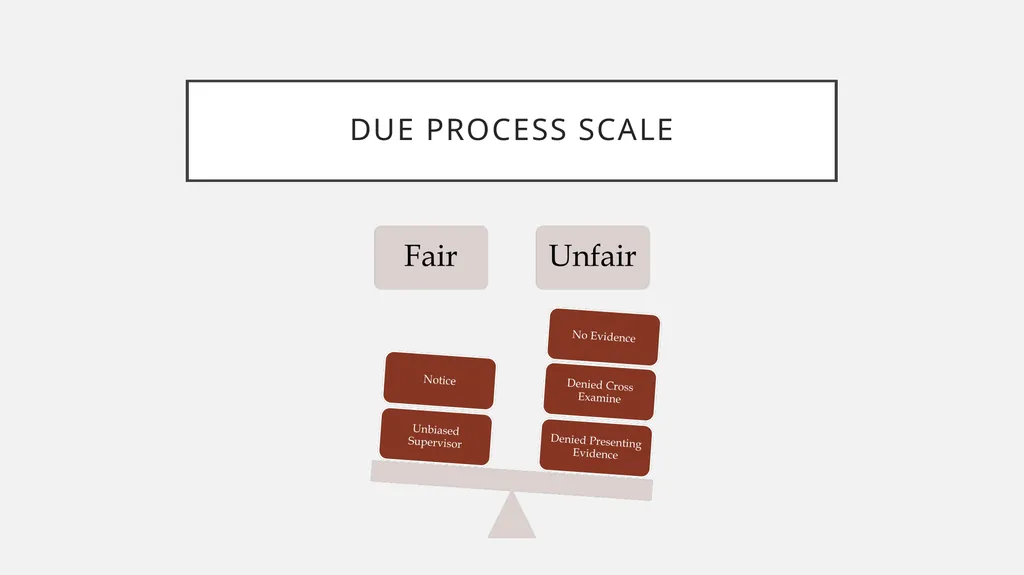
Not reviewing the evidence against the employee is the strongest violation
As a basic rule - If 2 or 3 elements were violated, you can easily argue a reduction; if all five were violated, argue expunging<br>
“Due process is flexible and calls for such procedural protections as the particular situation demands," Morrissey v. Brewer, 408 U. S. 471, 408 U. S. 481
In your Grievance you must be reasonable when determining the appropriate remedy
On the slide, “Basic applications” we cover five elements which apply – but they do have different value
Not reviewing the evidence against the employee is the strongest violation
As a basic rule - If 2 or 3 elements were violated, you can easily argue a reduction; if all five were violated, argue expunging<br>
30
Due Process Scale<br>
31
A Due Process Grievance When citing or arguing Due Process, cite Article 16 (Specifically “Was a thorough Investigation Completed” as needed)
While you can argue the nexus through arbitrations, the Constitution, etc; this is wasted argument, space and opens the Union up to rebuttal – Simply argue that “Article 16 was violated when the Grievant's Procedural Due Process rights were denied.”
You should explicitly list each Procedural Due Process violation in your Step 2 Appeal to Management
At Step 1 you can mention the specific violation, but this tends to be wasted effort as Management does not ‘know’ Procedural Due Process<br>
While you can argue the nexus through arbitrations, the Constitution, etc; this is wasted argument, space and opens the Union up to rebuttal – Simply argue that “Article 16 was violated when the Grievant's Procedural Due Process rights were denied.”
You should explicitly list each Procedural Due Process violation in your Step 2 Appeal to Management
At Step 1 you can mention the specific violation, but this tends to be wasted effort as Management does not ‘know’ Procedural Due Process<br>
32
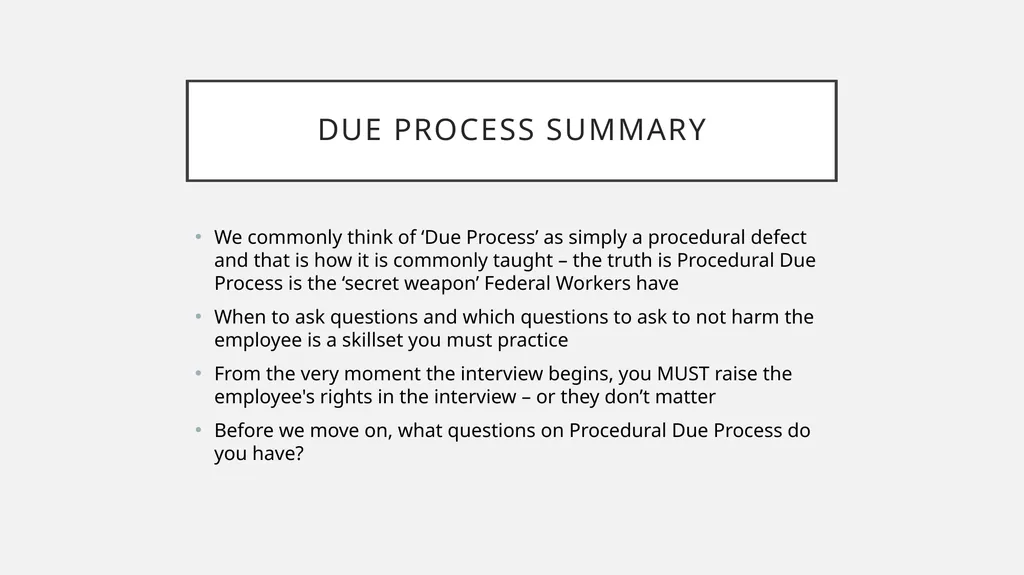
Due Process Summary We commonly think of ‘Due Process’ as simply a procedural defect and that is how it is commonly taught – the truth is Procedural Due Process is the ‘secret weapon’ Federal Workers have
When to ask questions and which questions to ask to not harm the employee is a skillset you must practice
From the very moment the interview begins, you MUST raise the employee's rights in the interview – or they don’t matter
Before we move on, what questions on Procedural Due Process do you have?<br>
When to ask questions and which questions to ask to not harm the employee is a skillset you must practice
From the very moment the interview begins, you MUST raise the employee's rights in the interview – or they don’t matter
Before we move on, what questions on Procedural Due Process do you have?<br>
33
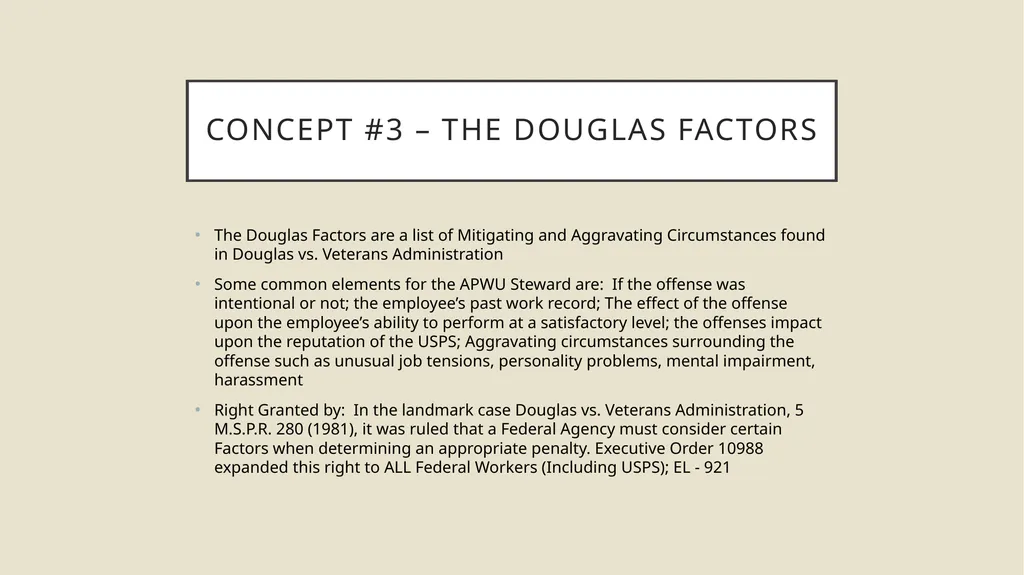
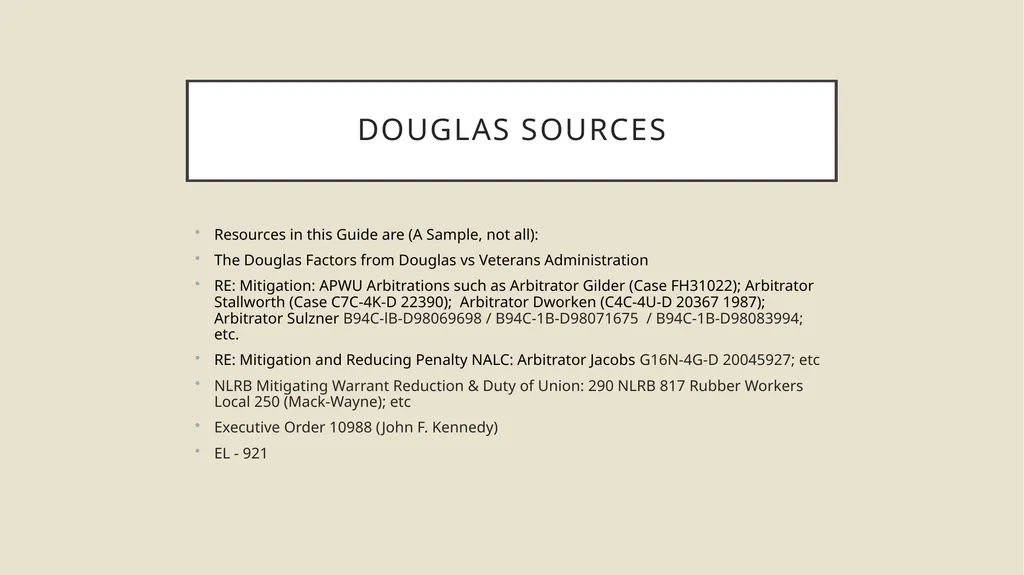
CONCEPT #3 – The Douglas Factors The Douglas Factors are a list of Mitigating and Aggravating Circumstances found in Douglas vs. Veterans Administration
Some common elements for the APWU Steward are: If the offense was intentional or not; the employee’s past work record; The effect of the offense upon the employee’s ability to perform at a satisfactory level; the offenses impact upon the reputation of the USPS; Aggravating circumstances surrounding the offense such as unusual job tensions, personality problems, mental impairment, harassment
Right Granted by: In the landmark case Douglas vs. Veterans Administration, 5 M.S.P.R. 280 (1981), it was ruled that a Federal Agency must consider certain Factors when determining an appropriate penalty. Executive Order 10988 expanded this right to ALL Federal Workers (Including USPS); EL - 921<br>
Some common elements for the APWU Steward are: If the offense was intentional or not; the employee’s past work record; The effect of the offense upon the employee’s ability to perform at a satisfactory level; the offenses impact upon the reputation of the USPS; Aggravating circumstances surrounding the offense such as unusual job tensions, personality problems, mental impairment, harassment
Right Granted by: In the landmark case Douglas vs. Veterans Administration, 5 M.S.P.R. 280 (1981), it was ruled that a Federal Agency must consider certain Factors when determining an appropriate penalty. Executive Order 10988 expanded this right to ALL Federal Workers (Including USPS); EL - 921<br>
34
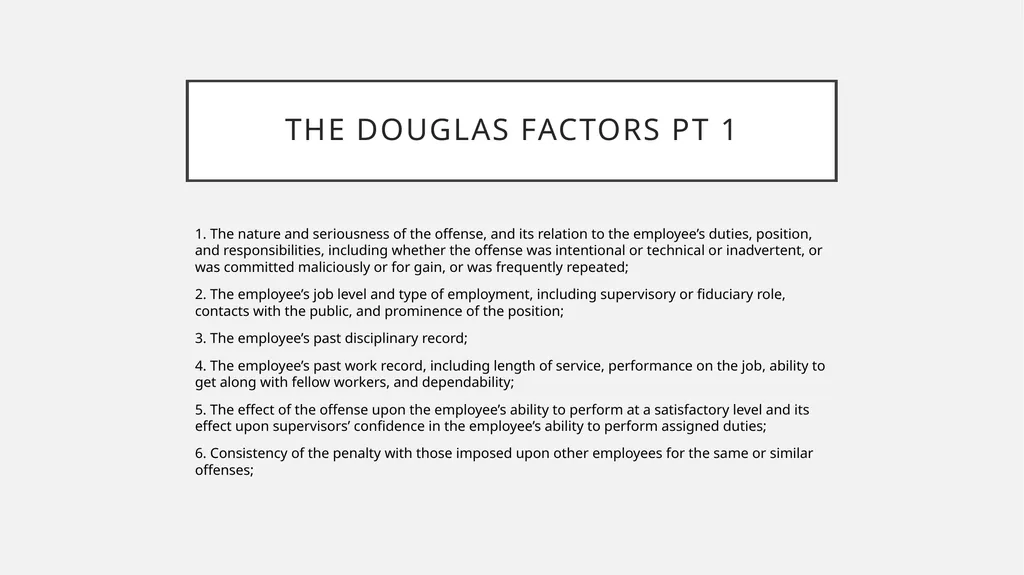
The Douglas Factors PT 1 1. The nature and seriousness of the offense, and its relation to the employee’s duties, position, and responsibilities, including whether the offense was intentional or technical or inadvertent, or was committed maliciously or for gain, or was frequently repeated;
2. The employee’s job level and type of employment, including supervisory or fiduciary role, contacts with the public, and prominence of the position;
3. The employee’s past disciplinary record;
4. The employee’s past work record, including length of service, performance on the job, ability to get along with fellow workers, and dependability;
5. The effect of the offense upon the employee’s ability to perform at a satisfactory level and its effect upon supervisors’ confidence in the employee’s ability to perform assigned duties;
6. Consistency of the penalty with those imposed upon other employees for the same or similar offenses;<br>
2. The employee’s job level and type of employment, including supervisory or fiduciary role, contacts with the public, and prominence of the position;
3. The employee’s past disciplinary record;
4. The employee’s past work record, including length of service, performance on the job, ability to get along with fellow workers, and dependability;
5. The effect of the offense upon the employee’s ability to perform at a satisfactory level and its effect upon supervisors’ confidence in the employee’s ability to perform assigned duties;
6. Consistency of the penalty with those imposed upon other employees for the same or similar offenses;<br>
35
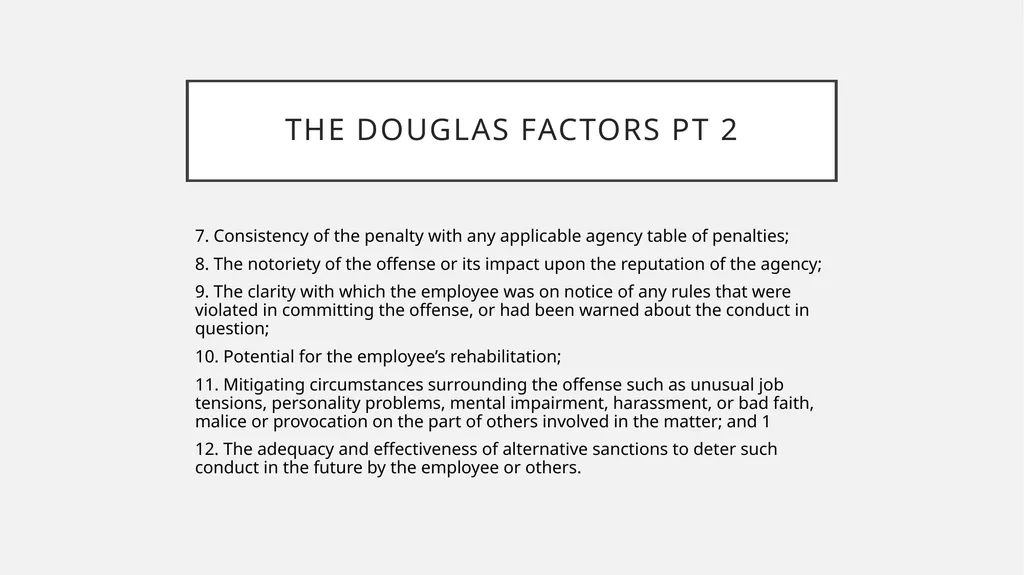
The Douglas Factors PT 2 7. Consistency of the penalty with any applicable agency table of penalties;
8. The notoriety of the offense or its impact upon the reputation of the agency;
9. The clarity with which the employee was on notice of any rules that were violated in committing the offense, or had been warned about the conduct in question;
10. Potential for the employee’s rehabilitation;
11. Mitigating circumstances surrounding the offense such as unusual job tensions, personality problems, mental impairment, harassment, or bad faith, malice or provocation on the part of others involved in the matter; and 1
12. The adequacy and effectiveness of alternative sanctions to deter such conduct in the future by the employee or others.<br>
8. The notoriety of the offense or its impact upon the reputation of the agency;
9. The clarity with which the employee was on notice of any rules that were violated in committing the offense, or had been warned about the conduct in question;
10. Potential for the employee’s rehabilitation;
11. Mitigating circumstances surrounding the offense such as unusual job tensions, personality problems, mental impairment, harassment, or bad faith, malice or provocation on the part of others involved in the matter; and 1
12. The adequacy and effectiveness of alternative sanctions to deter such conduct in the future by the employee or others.<br>
36
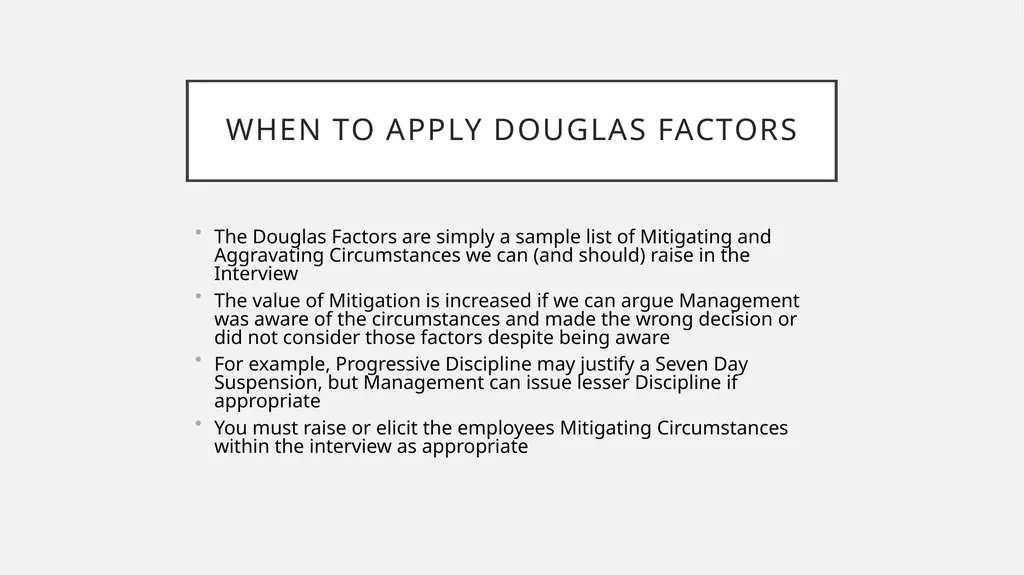
When to apply Douglas Factors The Douglas Factors are simply a sample list of Mitigating and Aggravating Circumstances we can (and should) raise in the Interview
The value of Mitigation is increased if we can argue Management was aware of the circumstances and made the wrong decision or did not consider those factors despite being aware
For example, Progressive Discipline may justify a Seven Day Suspension, but Management can issue lesser Discipline if appropriate
You must raise or elicit the employees Mitigating Circumstances within the interview as appropriate<br>
The value of Mitigation is increased if we can argue Management was aware of the circumstances and made the wrong decision or did not consider those factors despite being aware
For example, Progressive Discipline may justify a Seven Day Suspension, but Management can issue lesser Discipline if appropriate
You must raise or elicit the employees Mitigating Circumstances within the interview as appropriate<br>
37
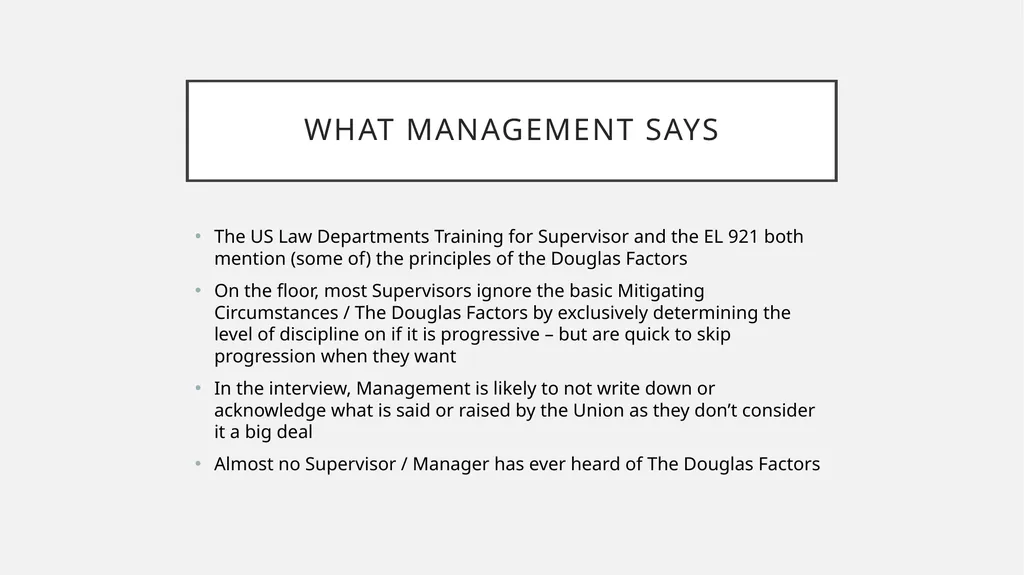
What Management says The US Law Departments Training for Supervisor and the EL 921 both mention (some of) the principles of the Douglas Factors
On the floor, most Supervisors ignore the basic Mitigating Circumstances / The Douglas Factors by exclusively determining the level of discipline on if it is progressive – but are quick to skip progression when they want
In the interview, Management is likely to not write down or acknowledge what is said or raised by the Union as they don’t consider it a big deal
Almost no Supervisor / Manager has ever heard of The Douglas Factors<br>
On the floor, most Supervisors ignore the basic Mitigating Circumstances / The Douglas Factors by exclusively determining the level of discipline on if it is progressive – but are quick to skip progression when they want
In the interview, Management is likely to not write down or acknowledge what is said or raised by the Union as they don’t consider it a big deal
Almost no Supervisor / Manager has ever heard of The Douglas Factors<br>
38
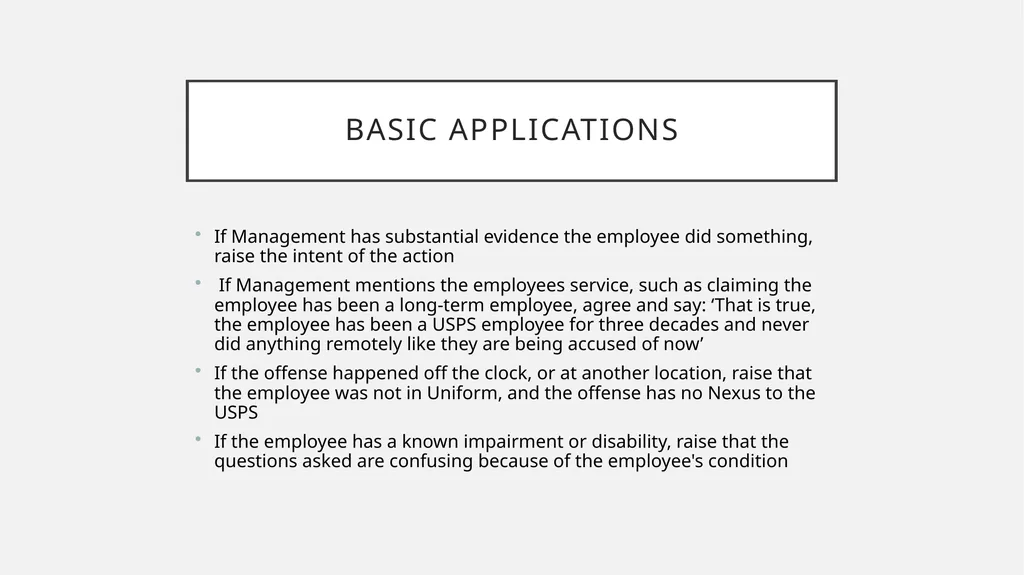
Basic Applications If Management has substantial evidence the employee did something, raise the intent of the action
If Management mentions the employees service, such as claiming the employee has been a long-term employee, agree and say: ‘That is true, the employee has been a USPS employee for three decades and never did anything remotely like they are being accused of now’
If the offense happened off the clock, or at another location, raise that the employee was not in Uniform, and the offense has no Nexus to the USPS
If the employee has a known impairment or disability, raise that the questions asked are confusing because of the employee's condition<br>
If Management mentions the employees service, such as claiming the employee has been a long-term employee, agree and say: ‘That is true, the employee has been a USPS employee for three decades and never did anything remotely like they are being accused of now’
If the offense happened off the clock, or at another location, raise that the employee was not in Uniform, and the offense has no Nexus to the USPS
If the employee has a known impairment or disability, raise that the questions asked are confusing because of the employee's condition<br>
39
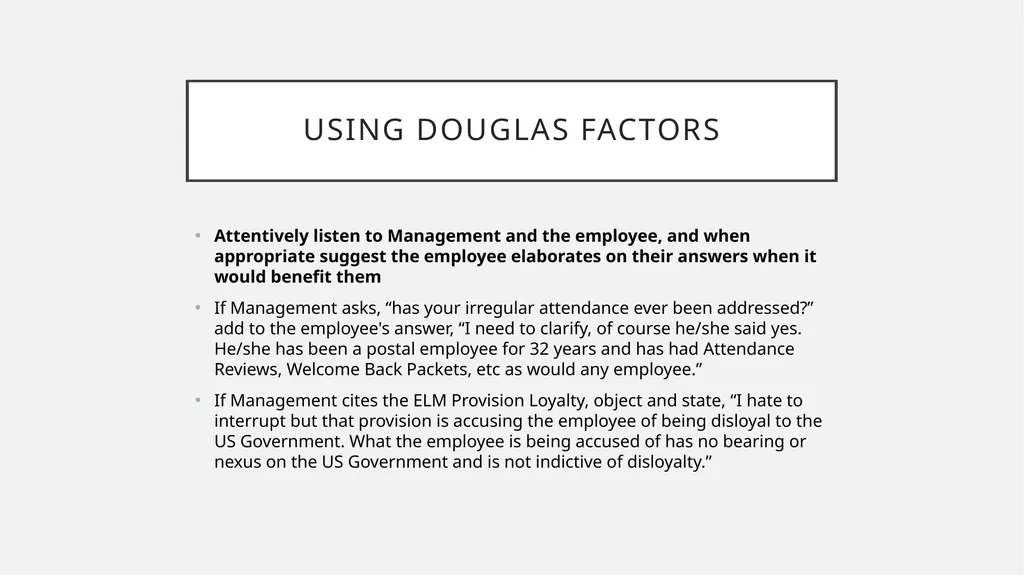
Using Douglas Factors Attentively listen to Management and the employee, and when appropriate suggest the employee elaborates on their answers when it would benefit them
If Management asks, “has your irregular attendance ever been addressed?” add to the employee's answer, “I need to clarify, of course he/she said yes. He/she has been a postal employee for 32 years and has had Attendance Reviews, Welcome Back Packets, etc as would any employee.”
If Management cites the ELM Provision Loyalty, object and state, “I hate to interrupt but that provision is accusing the employee of being disloyal to the US Government. What the employee is being accused of has no bearing or nexus on the US Government and is not indictive of disloyalty.”<br>
If Management asks, “has your irregular attendance ever been addressed?” add to the employee's answer, “I need to clarify, of course he/she said yes. He/she has been a postal employee for 32 years and has had Attendance Reviews, Welcome Back Packets, etc as would any employee.”
If Management cites the ELM Provision Loyalty, object and state, “I hate to interrupt but that provision is accusing the employee of being disloyal to the US Government. What the employee is being accused of has no bearing or nexus on the US Government and is not indictive of disloyalty.”<br>
40
A Douglas Grievance When citing or arguing Douglas Factors, cite Article 16 and 19 to reference the EL – 921
While you can argue the nexus via the Executive Order, this is a waste of time and energy. The easiest and correct way to argue Douglas Factors is to simply argue them as “Mitigating and Aggravating Circumstances”
Aggravating Circumstances are citable as Due Process violations per Ward vs USPS (And must be listed as considerations for the charge or cannot be introduced later)
Example: “Management violated Due Process by considering Aggravating Circumstance of a Supervisor being a witness but not allowing the employee to respond to the accusation / evidence in the Investigative Interview.”<br>
While you can argue the nexus via the Executive Order, this is a waste of time and energy. The easiest and correct way to argue Douglas Factors is to simply argue them as “Mitigating and Aggravating Circumstances”
Aggravating Circumstances are citable as Due Process violations per Ward vs USPS (And must be listed as considerations for the charge or cannot be introduced later)
Example: “Management violated Due Process by considering Aggravating Circumstance of a Supervisor being a witness but not allowing the employee to respond to the accusation / evidence in the Investigative Interview.”<br>
41
Douglas Factor Summary The Douglas Factors have a convoluted connection to the USPS, but through the EL- 921 we do have a Nexus
You should use the Douglas Factors as a list of examples of Mitigating Circumstances
Raising these Mitigating Circumstances in the interview allows you to argue that Management is punitive as they did not consider relevant factors
The appropriate provisions are Article 19 - EL – 921, and Article 16 – Just Cause
Now that you have a basic understanding, you need to combine these elements!<br>
You should use the Douglas Factors as a list of examples of Mitigating Circumstances
Raising these Mitigating Circumstances in the interview allows you to argue that Management is punitive as they did not consider relevant factors
The appropriate provisions are Article 19 - EL – 921, and Article 16 – Just Cause
Now that you have a basic understanding, you need to combine these elements!<br>
42
Using The CONCEPTS We must treat Weingarten as the foundation – the basic rights you and the employee has
Weingarten provides us the most NLRB rulings, Arbitration awards and support from USPS handbooks / manuals / letters
Procedural Due Process expands our rights and creates a standard for employees, and it is a legal precedence
The Douglas Factors are best used as a list of suggested Mitigating Circumstances<br>
Weingarten provides us the most NLRB rulings, Arbitration awards and support from USPS handbooks / manuals / letters
Procedural Due Process expands our rights and creates a standard for employees, and it is a legal precedence
The Douglas Factors are best used as a list of suggested Mitigating Circumstances<br>
43
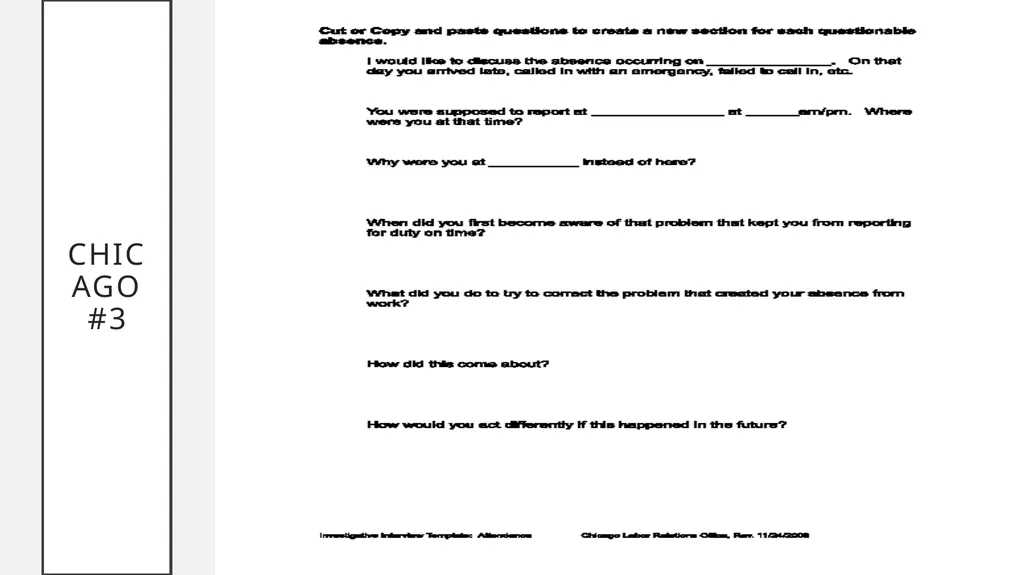
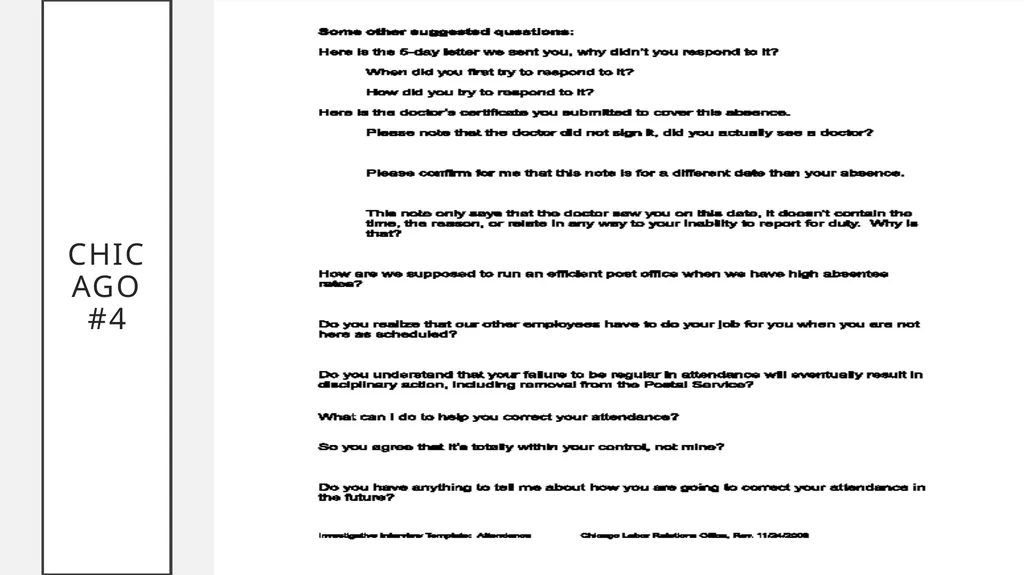
Exercise #1 – Sample Interview Questions This first exercise is, as group, we are going to review real sample questions from a Labor Relations Investigative Interview Template from Chicago
The purpose of this exercise is to be able to identify which of our rights or defenses apply in which situation – if any!
I want everyone to refer to “Chicago 3” and “Chicago 4” from the accompanying material
As a group, we are going to go over each question and I want volunteers to point out which covered right could be exercised for each question
There is no ‘perfect’ answer as representational styles differ – our only goal is to ensure we know the material!<br>
The purpose of this exercise is to be able to identify which of our rights or defenses apply in which situation – if any!
I want everyone to refer to “Chicago 3” and “Chicago 4” from the accompanying material
As a group, we are going to go over each question and I want volunteers to point out which covered right could be exercised for each question
There is no ‘perfect’ answer as representational styles differ – our only goal is to ensure we know the material!<br>
44
Chicago #3<br>
45
Chicago #4<br>
46
RECAP Part 1 Several of those questions are leading and you could simply rebut as such by challenging them and saying – “That is a leading question which assumes guilt, this is an Investigative Interview, and the employee has the Weingarten right to not answer such questions.”
You could also exercise your right of clarification, for questions such as, “Do you understand that your failure to be regular in attendance…” You could object and state, “That question is confusing, as discipline is not predetermined. We are exercising our Weingarten Right to have the question clarified to be factual and not presumptive.”<br>
You could also exercise your right of clarification, for questions such as, “Do you understand that your failure to be regular in attendance…” You could object and state, “That question is confusing, as discipline is not predetermined. We are exercising our Weingarten Right to have the question clarified to be factual and not presumptive.”<br>
47
RECAP Part 2 You could also exercise Procedural Due Process for questions such as, “Here is the Doctor’s certificate…” You could raise Procedural Due Process and state, “That question is making a medical evaluation of an employee's medical record. Per Management Instruction EL – 860 – 98 – 2 and ELM 863.34, that information should be held in the Employee Medical Folder, retained by the Health Unit / OHNA. ELM 860 series also requires that the OHNA is whom evaluates the medical documentation. We are requesting to review the statement and evaluation of the OHNA or Medical Professional who reviewed the Medical Documentation and deemed it insufficient.”
Or you could simply state, “If you are disputing the Medical Note, we need to review the statement and evaluation made by the OHNA or Health Service Office Staff who determined it was insufficient to properly answer your questions.”<br>
Or you could simply state, “If you are disputing the Medical Note, we need to review the statement and evaluation made by the OHNA or Health Service Office Staff who determined it was insufficient to properly answer your questions.”<br>
48
RECAP Part 3 These are just examples, but you do not need to be overly detailed
For example, when Management asks, “How are we supposed to run an efficient postal service when you have high absentee rates?” You could simply respond, “I am confused, and we need clarification. To answer this question the employee needs you to clarify what exactly are high absentee rates?”
If you don’t know the relevant provisions, such as Medical Documentation, you can simply raise what you do know, such as Douglass Factors / Mitigation – “I must interject and object to the questioning of the Medical Note. Correct me if I am wrong, but the employee has submitted Medical Documentation like this for the past 20 years and has never been questioned. What raised this scrutiny?”<br>
For example, when Management asks, “How are we supposed to run an efficient postal service when you have high absentee rates?” You could simply respond, “I am confused, and we need clarification. To answer this question the employee needs you to clarify what exactly are high absentee rates?”
If you don’t know the relevant provisions, such as Medical Documentation, you can simply raise what you do know, such as Douglass Factors / Mitigation – “I must interject and object to the questioning of the Medical Note. Correct me if I am wrong, but the employee has submitted Medical Documentation like this for the past 20 years and has never been questioned. What raised this scrutiny?”<br>
49
A Real Investigative Interview We are going to look at a real Interview and Grievance I represented an employee in
Each of you has a copy of Management’s Interview Notes, my interview notes, and a copy of the cited previous settlement
All documents were edited to remove private information – but the facts / circumstances are real!
If the case were to be appealed, my notes would be edited to remove personal notes, but for this exercise everything is included<br>
Each of you has a copy of Management’s Interview Notes, my interview notes, and a copy of the cited previous settlement
All documents were edited to remove private information – but the facts / circumstances are real!
If the case were to be appealed, my notes would be edited to remove personal notes, but for this exercise everything is included<br>
50
Exercise #2 – Review a real ii This next exercise is I want us to break into small groups and compare Managements interview notes, and the Unions interview notes
I want you to pay attention to three things:
The questions or statements made by the Steward
What Management excluded from their notes
How Management responded to the Steward
During this time if anyone has any questions feel free to ask!<br>
I want you to pay attention to three things:
The questions or statements made by the Steward
What Management excluded from their notes
How Management responded to the Steward
During this time if anyone has any questions feel free to ask!<br>
51
Exercise #2 – Takeaways You have a laundry list of violations created because Management did not respond correctly and did not take notes properly
Some violations are:
Article 17: Weingarten – Did not record the Unions input, especially at the end which is a direct Weingarten violation
Article 16: Punitive, Not Corrective – By excluding the Unions input and the Grievant’s Mitigation, the negative / adverse inference is Management did not consider the information and wanted the Grievant to appear guilty
Article 16: Just Cause – A complete investigation was not conducted, as well as Procedural Due Process was violated several times<br>
Some violations are:
Article 17: Weingarten – Did not record the Unions input, especially at the end which is a direct Weingarten violation
Article 16: Punitive, Not Corrective – By excluding the Unions input and the Grievant’s Mitigation, the negative / adverse inference is Management did not consider the information and wanted the Grievant to appear guilty
Article 16: Just Cause – A complete investigation was not conducted, as well as Procedural Due Process was violated several times<br>
52
Using this information What we have covered so far is: Weingarten, Procedural Due Process, and The Douglas Factors
We reviewed a real interview in which the rights were used and connected the dots to real, Contractual violations
To finish this seminar, we are going to fill in the missing blanks and do a mock Investigative Interview!<br>
We reviewed a real interview in which the rights were used and connected the dots to real, Contractual violations
To finish this seminar, we are going to fill in the missing blanks and do a mock Investigative Interview!<br>
53
Control What every ‘great’ representative does in an interview is they Control the interview
You can control by setting the stage / giving an introduction, you can control the interview with knowledge and checking Management, you could control the interview by playing dumb and asking many questions for clarification or you could control through constant objections
It doesn’t matter how you control the tempo of the interview, but control is an essential element of representing the member<br>
You can control by setting the stage / giving an introduction, you can control the interview with knowledge and checking Management, you could control the interview by playing dumb and asking many questions for clarification or you could control through constant objections
It doesn’t matter how you control the tempo of the interview, but control is an essential element of representing the member<br>
54
Knowledge You must know about the employee, their grievance background, and their personal circumstances
You must know what the interview is about, and if possible be prepared with basic information concerning the subject (Handbooks, ELM Provisions, Contract Language, etc)
What is the most essential is to be fully appraised of Weingarten, Procedural Due Process and the Douglas Factors we covered here
A failure to be prepared and not being knowledgeable results in a member not represented!<br>
You must know what the interview is about, and if possible be prepared with basic information concerning the subject (Handbooks, ELM Provisions, Contract Language, etc)
What is the most essential is to be fully appraised of Weingarten, Procedural Due Process and the Douglas Factors we covered here
A failure to be prepared and not being knowledgeable results in a member not represented!<br>
55
Challenging Management This job requires a backbone!
Management will get upset, try to shut you down, and argue you are wrong
You must be prepared to hit your head against the wall over and over again
We have no responsibility to show Management how to do their job – We don’t need to explain what Supreme Court Justice Powell said, or what Judge Henry Friendly said in an interview!
If Management shuts you down, keep raising the appropriate objections and make note each time you are shut down!<br>
Management will get upset, try to shut you down, and argue you are wrong
You must be prepared to hit your head against the wall over and over again
We have no responsibility to show Management how to do their job – We don’t need to explain what Supreme Court Justice Powell said, or what Judge Henry Friendly said in an interview!
If Management shuts you down, keep raising the appropriate objections and make note each time you are shut down!<br>
56
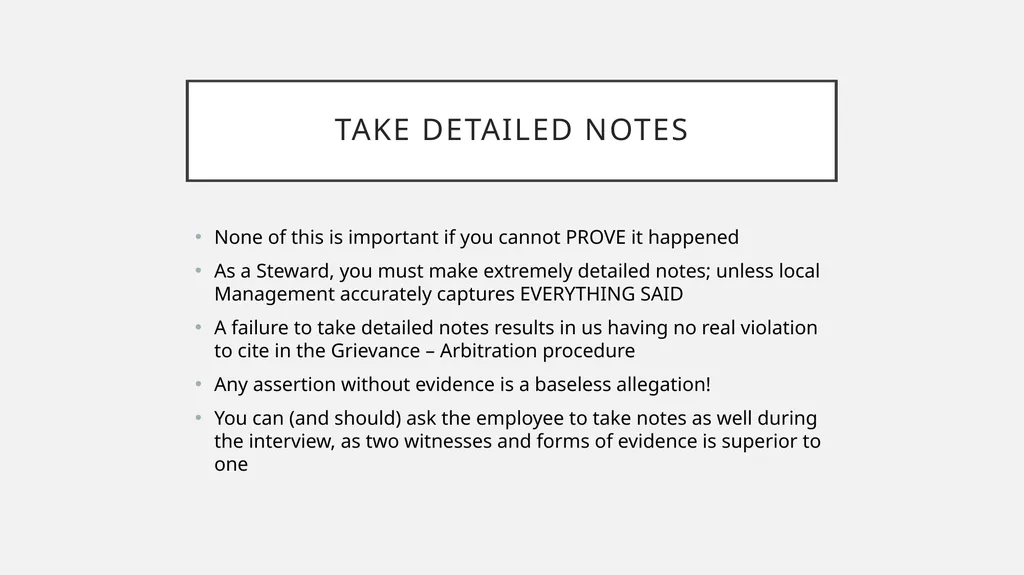
Take Detailed Notes None of this is important if you cannot PROVE it happened
As a Steward, you must make extremely detailed notes; unless local Management accurately captures EVERYTHING SAID
A failure to take detailed notes results in us having no real violation to cite in the Grievance – Arbitration procedure
Any assertion without evidence is a baseless allegation!
You can (and should) ask the employee to take notes as well during the interview, as two witnesses and forms of evidence is superior to one<br>
As a Steward, you must make extremely detailed notes; unless local Management accurately captures EVERYTHING SAID
A failure to take detailed notes results in us having no real violation to cite in the Grievance – Arbitration procedure
Any assertion without evidence is a baseless allegation!
You can (and should) ask the employee to take notes as well during the interview, as two witnesses and forms of evidence is superior to one<br>
57
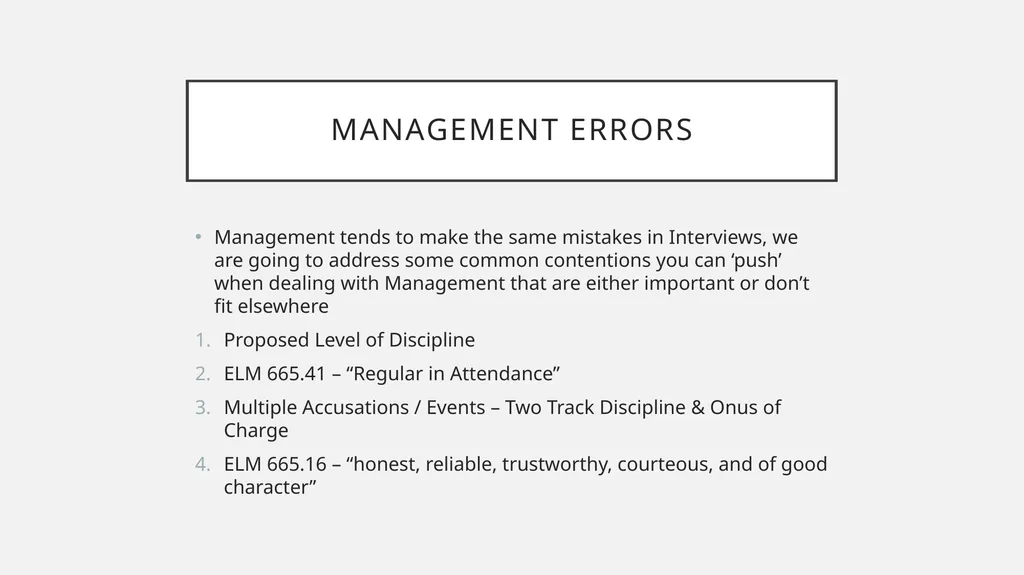
Management Errors Management tends to make the same mistakes in Interviews, we are going to address some common contentions you can ‘push’ when dealing with Management that are either important or don’t fit elsewhere
Proposed Level of Discipline
ELM 665.41 – “Regular in Attendance”
Multiple Accusations / Events – Two Track Discipline & Onus of Charge
ELM 665.16 – “honest, reliable, trustworthy, courteous, and of good character”<br>
Proposed Level of Discipline
ELM 665.41 – “Regular in Attendance”
Multiple Accusations / Events – Two Track Discipline & Onus of Charge
ELM 665.16 – “honest, reliable, trustworthy, courteous, and of good character”<br>
58
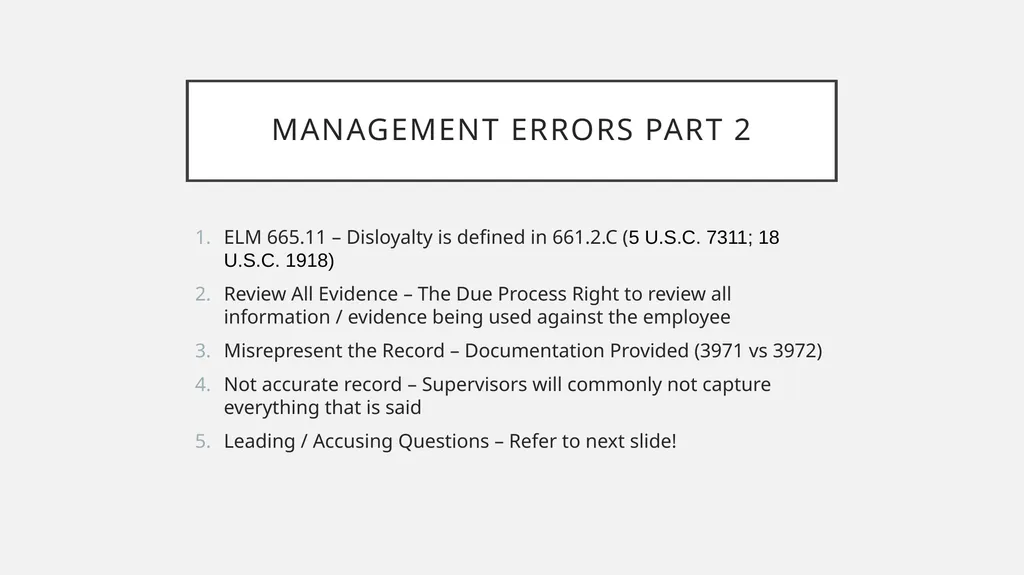
Management Errors Part 2 ELM 665.11 – Disloyalty is defined in 661.2.C (5 U.S.C. 7311; 18 U.S.C. 1918)
Review All Evidence – The Due Process Right to review all information / evidence being used against the employee
Misrepresent the Record – Documentation Provided (3971 vs 3972)
Not accurate record – Supervisors will commonly not capture everything that is said
Leading / Accusing Questions – Refer to next slide!<br>
Review All Evidence – The Due Process Right to review all information / evidence being used against the employee
Misrepresent the Record – Documentation Provided (3971 vs 3972)
Not accurate record – Supervisors will commonly not capture everything that is said
Leading / Accusing Questions – Refer to next slide!<br>
59
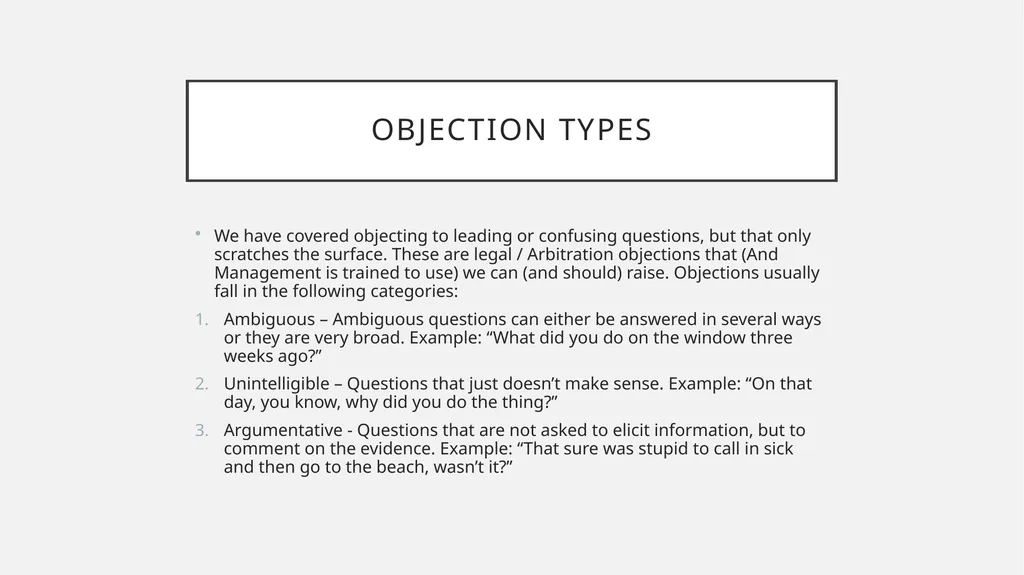
Objection Types We have covered objecting to leading or confusing questions, but that only scratches the surface. These are legal / Arbitration objections that (And Management is trained to use) we can (and should) raise. Objections usually fall in the following categories:
Ambiguous – Ambiguous questions can either be answered in several ways or they are very broad. Example: “What did you do on the window three weeks ago?”
Unintelligible – Questions that just doesn’t make sense. Example: “On that day, you know, why did you do the thing?”
Argumentative - Questions that are not asked to elicit information, but to comment on the evidence. Example: “That sure was stupid to call in sick and then go to the beach, wasn’t it?”<br>
Ambiguous – Ambiguous questions can either be answered in several ways or they are very broad. Example: “What did you do on the window three weeks ago?”
Unintelligible – Questions that just doesn’t make sense. Example: “On that day, you know, why did you do the thing?”
Argumentative - Questions that are not asked to elicit information, but to comment on the evidence. Example: “That sure was stupid to call in sick and then go to the beach, wasn’t it?”<br>
60
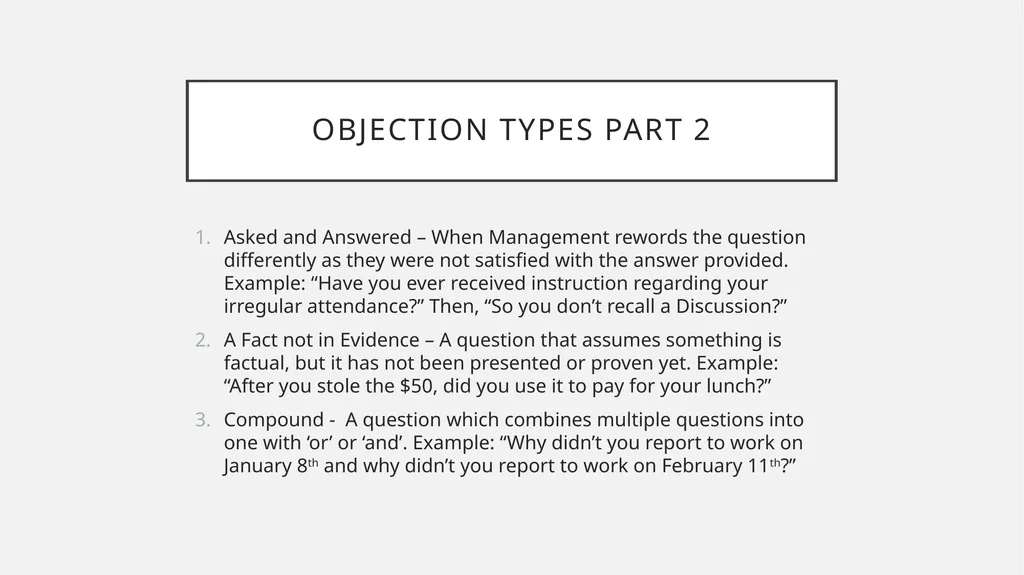
Objection Types Part 2 Asked and Answered – When Management rewords the question differently as they were not satisfied with the answer provided. Example: “Have you ever received instruction regarding your irregular attendance?” Then, “So you don’t recall a Discussion?”
A Fact not in Evidence – A question that assumes something is factual, but it has not been presented or proven yet. Example: “After you stole the $50, did you use it to pay for your lunch?”
Compound - A question which combines multiple questions into one with ‘or’ or ‘and’. Example: “Why didn’t you report to work on January 8th and why didn’t you report to work on February 11th?”<br>
A Fact not in Evidence – A question that assumes something is factual, but it has not been presented or proven yet. Example: “After you stole the $50, did you use it to pay for your lunch?”
Compound - A question which combines multiple questions into one with ‘or’ or ‘and’. Example: “Why didn’t you report to work on January 8th and why didn’t you report to work on February 11th?”<br>
61
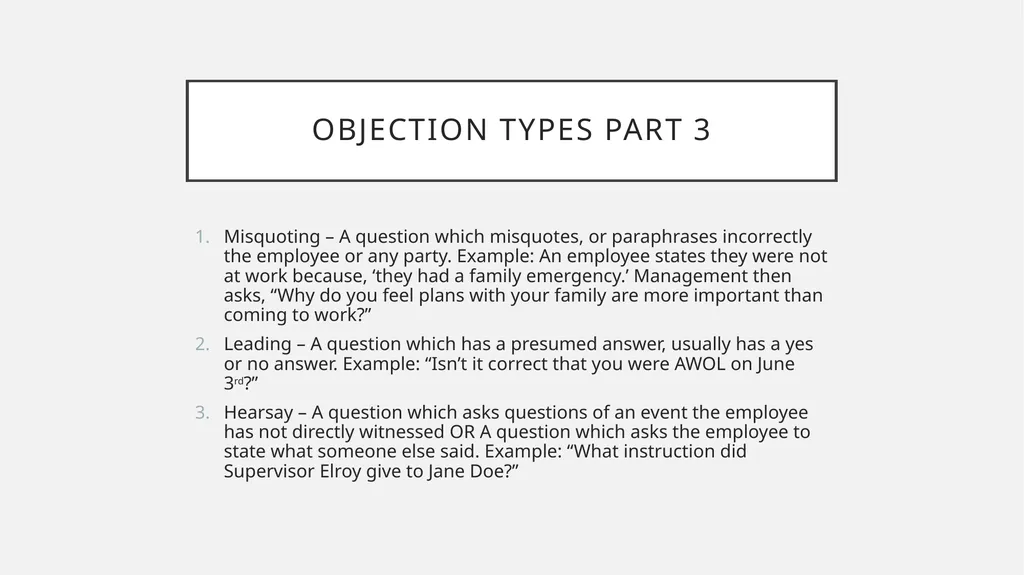
Objection Types Part 3 Misquoting – A question which misquotes, or paraphrases incorrectly the employee or any party. Example: An employee states they were not at work because, ‘they had a family emergency.’ Management then asks, “Why do you feel plans with your family are more important than coming to work?”
Leading – A question which has a presumed answer, usually has a yes or no answer. Example: “Isn’t it correct that you were AWOL on June 3rd?”
Hearsay – A question which asks questions of an event the employee has not directly witnessed OR A question which asks the employee to state what someone else said. Example: “What instruction did Supervisor Elroy give to Jane Doe?”<br>
Leading – A question which has a presumed answer, usually has a yes or no answer. Example: “Isn’t it correct that you were AWOL on June 3rd?”
Hearsay – A question which asks questions of an event the employee has not directly witnessed OR A question which asks the employee to state what someone else said. Example: “What instruction did Supervisor Elroy give to Jane Doe?”<br>
62
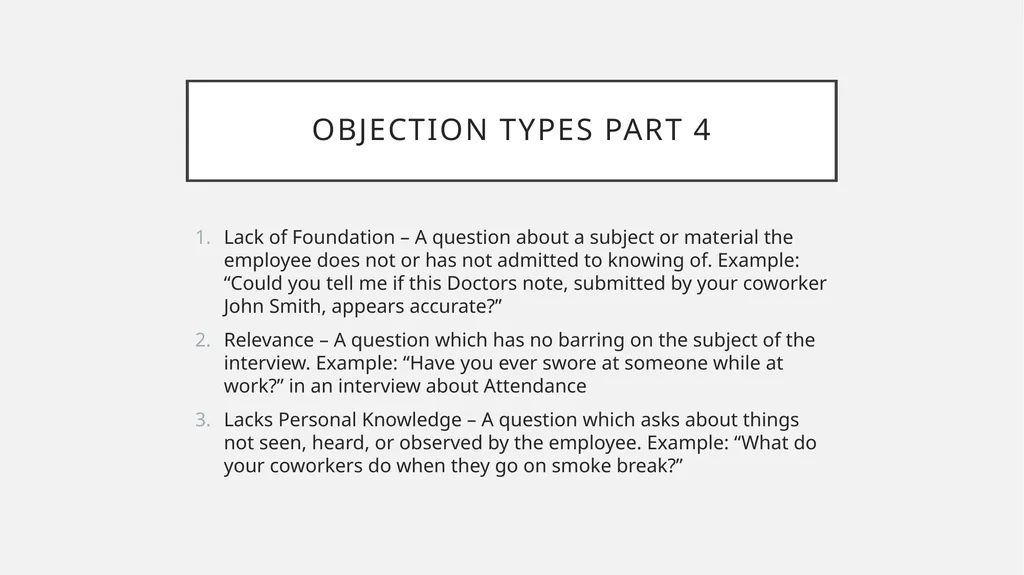
Objection Types Part 4 Lack of Foundation – A question about a subject or material the employee does not or has not admitted to knowing of. Example: “Could you tell me if this Doctors note, submitted by your coworker John Smith, appears accurate?”
Relevance – A question which has no barring on the subject of the interview. Example: “Have you ever swore at someone while at work?” in an interview about Attendance
Lacks Personal Knowledge – A question which asks about things not seen, heard, or observed by the employee. Example: “What do your coworkers do when they go on smoke break?”<br>
Relevance – A question which has no barring on the subject of the interview. Example: “Have you ever swore at someone while at work?” in an interview about Attendance
Lacks Personal Knowledge – A question which asks about things not seen, heard, or observed by the employee. Example: “What do your coworkers do when they go on smoke break?”<br>
63
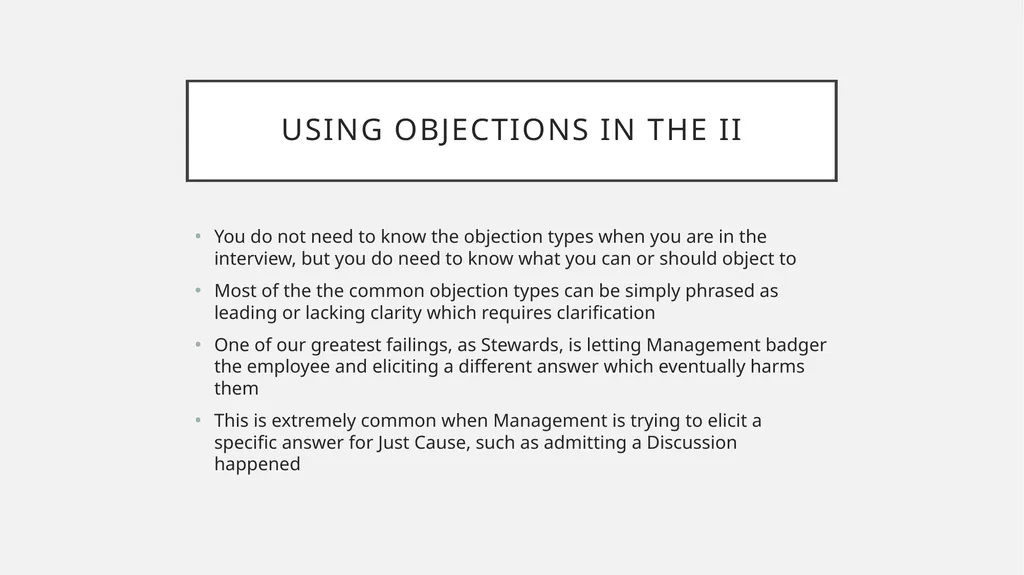
Using Objections in the II You do not need to know the objection types when you are in the interview, but you do need to know what you can or should object to
Most of the the common objection types can be simply phrased as leading or lacking clarity which requires clarification
One of our greatest failings, as Stewards, is letting Management badger the employee and eliciting a different answer which eventually harms them
This is extremely common when Management is trying to elicit a specific answer for Just Cause, such as admitting a Discussion happened<br>
Most of the the common objection types can be simply phrased as leading or lacking clarity which requires clarification
One of our greatest failings, as Stewards, is letting Management badger the employee and eliciting a different answer which eventually harms them
This is extremely common when Management is trying to elicit a specific answer for Just Cause, such as admitting a Discussion happened<br>
64
Employee Mistakes Employees commonly make similar mistakes in their interviews with Management. It is recommended to advise the employee against these common issues prior to the interview:
Always tell the truth, especially when Management has evidence
Do not volunteer information unless explicitly asked
Before answering, think about your answers carefully and fully
Speak slowly and make sure I (Your Steward) am done writing before you continue
Keep your answers short and do not rush your answers<br>
Always tell the truth, especially when Management has evidence
Do not volunteer information unless explicitly asked
Before answering, think about your answers carefully and fully
Speak slowly and make sure I (Your Steward) am done writing before you continue
Keep your answers short and do not rush your answers<br>
65
Employee Mistakes Part 2 Employees commonly make mistakes with the Union, it is advised to also recommend:
Never lie to me (Your Steward), even if you need to tell me something in private
If I (Your Steward) asks a question, you must answer it
If I (Your Steward) asks Management a question, do not continue until Management answers or addresses the question asked
If Management tries to pressure you to continue when I (Your Steward) Object, tell Management, “I will continue answering once I can speak to my Steward again, in private”<br>
Never lie to me (Your Steward), even if you need to tell me something in private
If I (Your Steward) asks a question, you must answer it
If I (Your Steward) asks Management a question, do not continue until Management answers or addresses the question asked
If Management tries to pressure you to continue when I (Your Steward) Object, tell Management, “I will continue answering once I can speak to my Steward again, in private”<br>
66
Steward Errors No one is expected to know ‘everything’ or get it all right every interview. When in the moment details will get lost. Despite this fact, Stewards commonly:
Do not write down everything (What is said, questions, mannerisms of participants, etc.)
Do not make note of their words or comments
Do not write down what the Supervisor excludes or removes from the record (Removing absences, striking questions, etc.)
Do not accurately record all evidence presented (3971s, 3972, etc)<br>
Do not write down everything (What is said, questions, mannerisms of participants, etc.)
Do not make note of their words or comments
Do not write down what the Supervisor excludes or removes from the record (Removing absences, striking questions, etc.)
Do not accurately record all evidence presented (3971s, 3972, etc)<br>
67
Steward Errors Part 2 Trying to stop the interview (When not appropriate)
Being unprepared to answer questions the employee has during the interview
Not appraising the employee of their rights or your role in the interview
Not holding a caucus prior to the interview beginning
Arguing with Management / the Supervisor
Arguing with the employee (Unless in a caucus)
Not interrupting the employee when saying something ‘stupid’<br>
Being unprepared to answer questions the employee has during the interview
Not appraising the employee of their rights or your role in the interview
Not holding a caucus prior to the interview beginning
Arguing with Management / the Supervisor
Arguing with the employee (Unless in a caucus)
Not interrupting the employee when saying something ‘stupid’<br>
68
Exercise #3 – Blank II The final exercise is we are going to roleplay an Interview
We can either do a single demonstration in front of the group, or we can pair up
We should be in groups of three – A Supervisor, A Steward, and the member
Each interview should be held to 10 – 15 minutes
Each person should have an opportunity to roleplay as each position<br>
We can either do a single demonstration in front of the group, or we can pair up
We should be in groups of three – A Supervisor, A Steward, and the member
Each interview should be held to 10 – 15 minutes
Each person should have an opportunity to roleplay as each position<br>
69
Conclusion The following pages cover some of the resources used to make this training – the list is not exhaustive by any means, but credit is made where credit is due
If you want to learn more, visit my website, www.apwusteward.com. My website has training manuals, sample interviews, sample forms, other training I have made and conducted, and The Unofficial Grievance Guide – Over 60 Chapters on handling Grievances (About 30 Contractual and 30+ on Discipline)
We will end this with a Question-and-Answer session – What are your Questions?<br>
If you want to learn more, visit my website, www.apwusteward.com. My website has training manuals, sample interviews, sample forms, other training I have made and conducted, and The Unofficial Grievance Guide – Over 60 Chapters on handling Grievances (About 30 Contractual and 30+ on Discipline)
We will end this with a Question-and-Answer session – What are your Questions?<br>
70
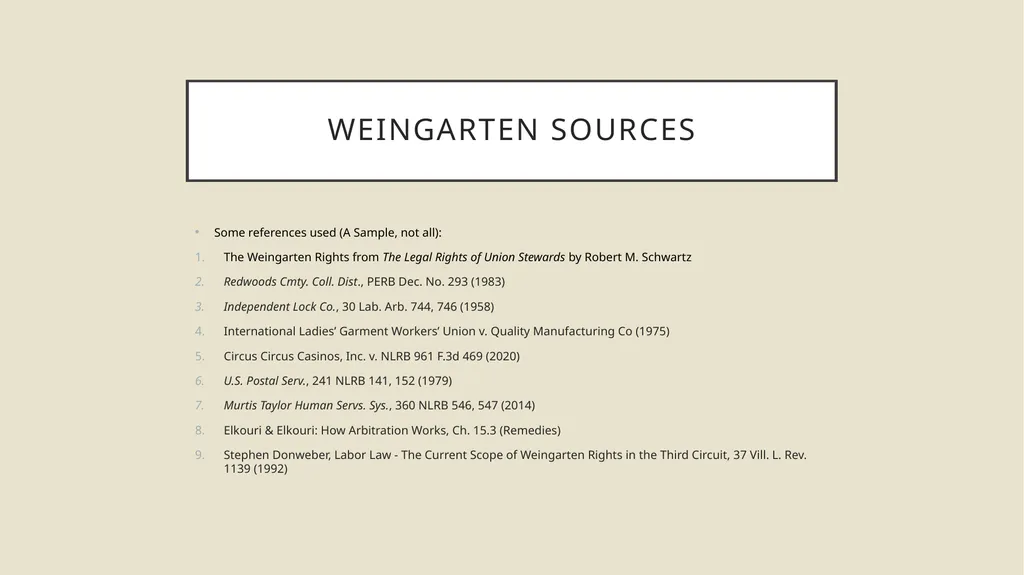
Weingarten Sources Some references used (A Sample, not all):
The Weingarten Rights from The Legal Rights of Union Stewards by Robert M. Schwartz
Redwoods Cmty. Coll. Dist., PERB Dec. No. 293 (1983)
Independent Lock Co., 30 Lab. Arb. 744, 746 (1958)
International Ladies’ Garment Workers’ Union v. Quality Manufacturing Co (1975)
Circus Circus Casinos, Inc. v. NLRB 961 F.3d 469 (2020)
U.S. Postal Serv., 241 NLRB 141, 152 (1979)
Murtis Taylor Human Servs. Sys., 360 NLRB 546, 547 (2014)
Elkouri & Elkouri: How Arbitration Works, Ch. 15.3 (Remedies)
Stephen Donweber, Labor Law - The Current Scope of Weingarten Rights in the Third Circuit, 37 Vill. L. Rev. 1139 (1992)<br>
The Weingarten Rights from The Legal Rights of Union Stewards by Robert M. Schwartz
Redwoods Cmty. Coll. Dist., PERB Dec. No. 293 (1983)
Independent Lock Co., 30 Lab. Arb. 744, 746 (1958)
International Ladies’ Garment Workers’ Union v. Quality Manufacturing Co (1975)
Circus Circus Casinos, Inc. v. NLRB 961 F.3d 469 (2020)
U.S. Postal Serv., 241 NLRB 141, 152 (1979)
Murtis Taylor Human Servs. Sys., 360 NLRB 546, 547 (2014)
Elkouri & Elkouri: How Arbitration Works, Ch. 15.3 (Remedies)
Stephen Donweber, Labor Law - The Current Scope of Weingarten Rights in the Third Circuit, 37 Vill. L. Rev. 1139 (1992)<br>
71
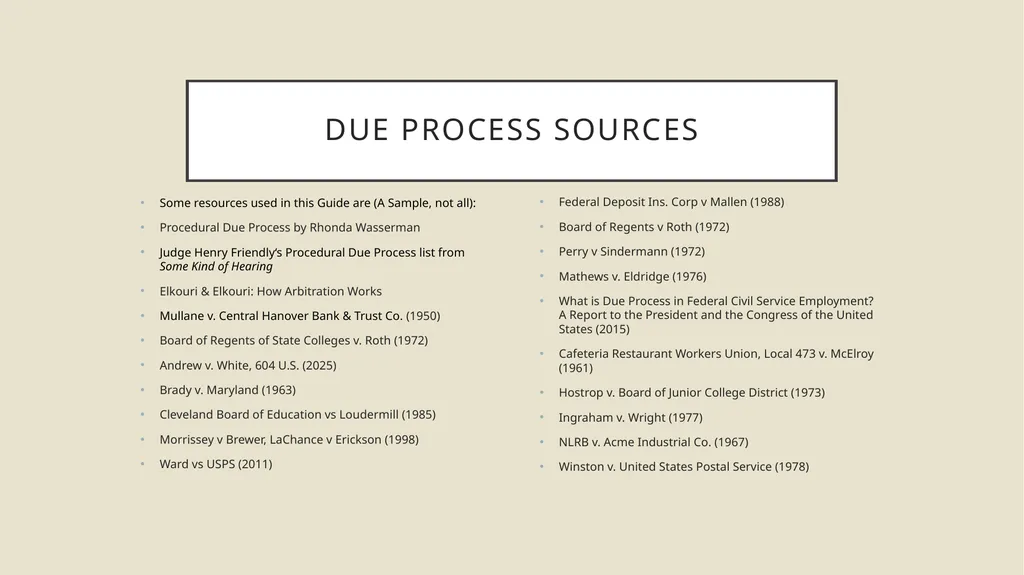
Some resources used in this Guide are (A Sample, not all):
Procedural Due Process by Rhonda Wasserman
Judge Henry Friendly‘s Procedural Due Process list from Some Kind of Hearing
Elkouri & Elkouri: How Arbitration Works
Mullane v. Central Hanover Bank & Trust Co. (1950)
Board of Regents of State Colleges v. Roth (1972)
Andrew v. White, 604 U.S. (2025)
Brady v. Maryland (1963)
Cleveland Board of Education vs Loudermill (1985)
Morrissey v Brewer, LaChance v Erickson (1998)
Ward vs USPS (2011) Federal Deposit Ins. Corp v Mallen (1988)
Board of Regents v Roth (1972)
Perry v Sindermann (1972)
Mathews v. Eldridge (1976)
What is Due Process in Federal Civil Service Employment? A Report to the President and the Congress of the United States (2015)
Cafeteria Restaurant Workers Union, Local 473 v. McElroy (1961)
Hostrop v. Board of Junior College District (1973)
Ingraham v. Wright (1977)
NLRB v. Acme Industrial Co. (1967)
Winston v. United States Postal Service (1978) Due Process Sources<br>
Procedural Due Process by Rhonda Wasserman
Judge Henry Friendly‘s Procedural Due Process list from Some Kind of Hearing
Elkouri & Elkouri: How Arbitration Works
Mullane v. Central Hanover Bank & Trust Co. (1950)
Board of Regents of State Colleges v. Roth (1972)
Andrew v. White, 604 U.S. (2025)
Brady v. Maryland (1963)
Cleveland Board of Education vs Loudermill (1985)
Morrissey v Brewer, LaChance v Erickson (1998)
Ward vs USPS (2011) Federal Deposit Ins. Corp v Mallen (1988)
Board of Regents v Roth (1972)
Perry v Sindermann (1972)
Mathews v. Eldridge (1976)
What is Due Process in Federal Civil Service Employment? A Report to the President and the Congress of the United States (2015)
Cafeteria Restaurant Workers Union, Local 473 v. McElroy (1961)
Hostrop v. Board of Junior College District (1973)
Ingraham v. Wright (1977)
NLRB v. Acme Industrial Co. (1967)
Winston v. United States Postal Service (1978) Due Process Sources<br>
72
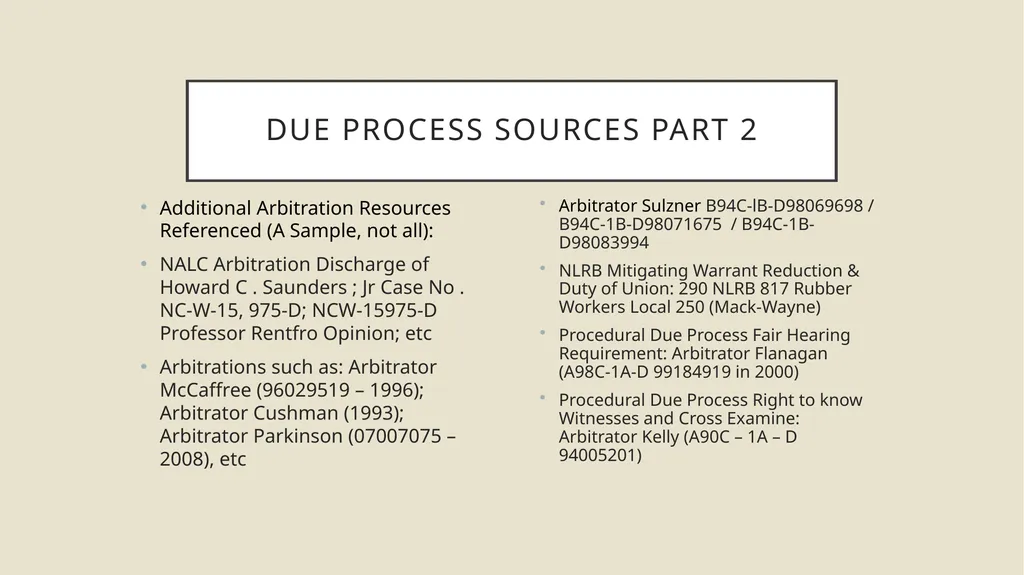
Additional Arbitration Resources Referenced (A Sample, not all):
NALC Arbitration Discharge of Howard C . Saunders ; Jr Case No . NC-W-15, 975-D; NCW-15975-D Professor Rentfro Opinion; etc
Arbitrations such as: Arbitrator McCaffree (96029519 – 1996); Arbitrator Cushman (1993); Arbitrator Parkinson (07007075 – 2008), etc Arbitrator Sulzner B94C-lB-D98069698 / B94C-1B-D98071675 / B94C-1B-D98083994
NLRB Mitigating Warrant Reduction & Duty of Union: 290 NLRB 817 Rubber Workers Local 250 (Mack-Wayne)
Procedural Due Process Fair Hearing Requirement: Arbitrator Flanagan (A98C-1A-D 99184919 in 2000)
Procedural Due Process Right to know Witnesses and Cross Examine: Arbitrator Kelly (A90C – 1A – D 94005201) Due Process Sources Part 2<br>
NALC Arbitration Discharge of Howard C . Saunders ; Jr Case No . NC-W-15, 975-D; NCW-15975-D Professor Rentfro Opinion; etc
Arbitrations such as: Arbitrator McCaffree (96029519 – 1996); Arbitrator Cushman (1993); Arbitrator Parkinson (07007075 – 2008), etc Arbitrator Sulzner B94C-lB-D98069698 / B94C-1B-D98071675 / B94C-1B-D98083994
NLRB Mitigating Warrant Reduction & Duty of Union: 290 NLRB 817 Rubber Workers Local 250 (Mack-Wayne)
Procedural Due Process Fair Hearing Requirement: Arbitrator Flanagan (A98C-1A-D 99184919 in 2000)
Procedural Due Process Right to know Witnesses and Cross Examine: Arbitrator Kelly (A90C – 1A – D 94005201) Due Process Sources Part 2<br>
73
Douglas Sources Resources in this Guide are (A Sample, not all):
The Douglas Factors from Douglas vs Veterans Administration
RE: Mitigation: APWU Arbitrations such as Arbitrator Gilder (Case FH31022); Arbitrator Stallworth (Case C7C-4K-D 22390); Arbitrator Dworken (C4C-4U-D 20367 1987); Arbitrator Sulzner B94C-lB-D98069698 / B94C-1B-D98071675 / B94C-1B-D98083994; etc.
RE: Mitigation and Reducing Penalty NALC: Arbitrator Jacobs G16N-4G-D 20045927; etc
NLRB Mitigating Warrant Reduction & Duty of Union: 290 NLRB 817 Rubber Workers Local 250 (Mack-Wayne); etc
Executive Order 10988 (John F. Kennedy)
EL - 921<br>
The Douglas Factors from Douglas vs Veterans Administration
RE: Mitigation: APWU Arbitrations such as Arbitrator Gilder (Case FH31022); Arbitrator Stallworth (Case C7C-4K-D 22390); Arbitrator Dworken (C4C-4U-D 20367 1987); Arbitrator Sulzner B94C-lB-D98069698 / B94C-1B-D98071675 / B94C-1B-D98083994; etc.
RE: Mitigation and Reducing Penalty NALC: Arbitrator Jacobs G16N-4G-D 20045927; etc
NLRB Mitigating Warrant Reduction & Duty of Union: 290 NLRB 817 Rubber Workers Local 250 (Mack-Wayne); etc
Executive Order 10988 (John F. Kennedy)
EL - 921<br>