
ICH Purpose, participants, process of




Description: ICH Purpose, participants, process of harmonization, Brief overview of QSEM, with special emphasis on Q-series guidelines, ICH stability testing guidelines INTERNATIONAL COUNCIL FOR HARMONIZATION ICH Guidelines : Inception 1990
Related Topics
Download Presentation
"ICH Purpose, participants, process of" is the property of its rightful owner. Permission is granted to download and print the materials on this website for personal, non-commercial use only, and to display it on your personal computer provided you do not modify the materials and that you retain all copyright notices contained in the materials. By downloading content from our website, you accept the terms of this agreement.
Presentation Transcript
slide1. ICH
Purpose, participants, process of harmonization, Brief overview of QSEM, with special emphasis on Q-series guidelines, ICH stability testing guidelines INTERNATIONAL COUNCIL FOR HARMONIZATION<br>
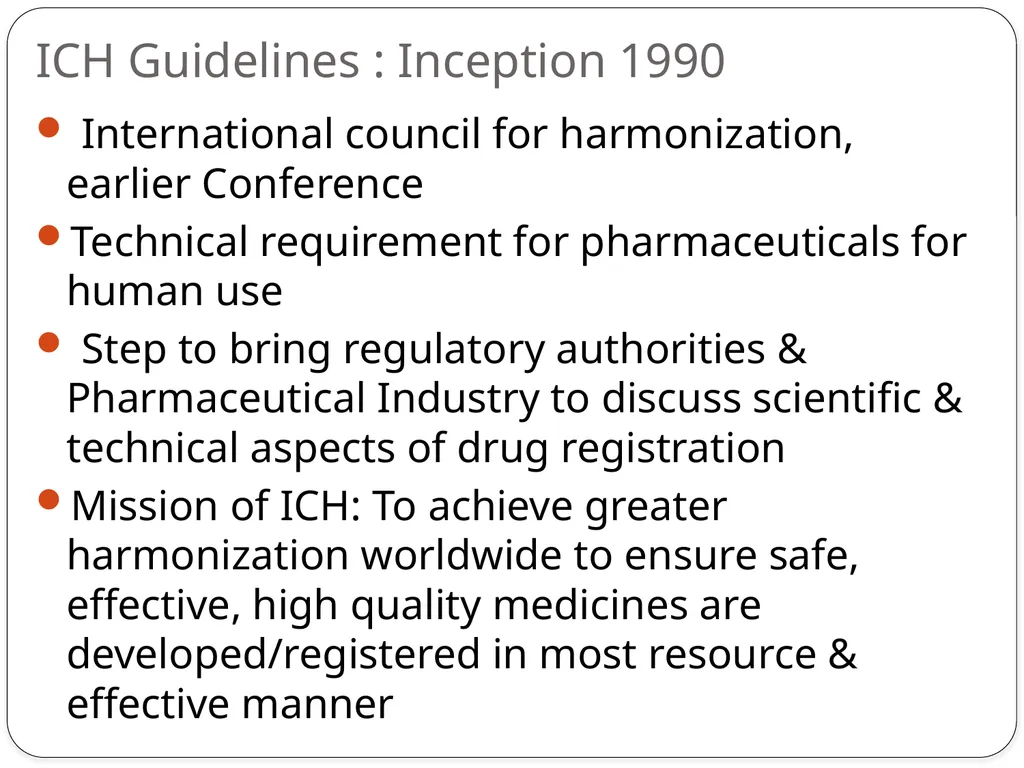
slide2. ICH Guidelines : Inception 1990 International council for harmonization, earlier Conference
Technical requirement for pharmaceuticals for human use
Step to bring regulatory authorities & Pharmaceutical Industry to discuss scientific & technical aspects of drug registration
Mission of ICH: To achieve greater harmonization worldwide to ensure safe, effective, high quality medicines are developed/registered in most resource & effective manner<br>
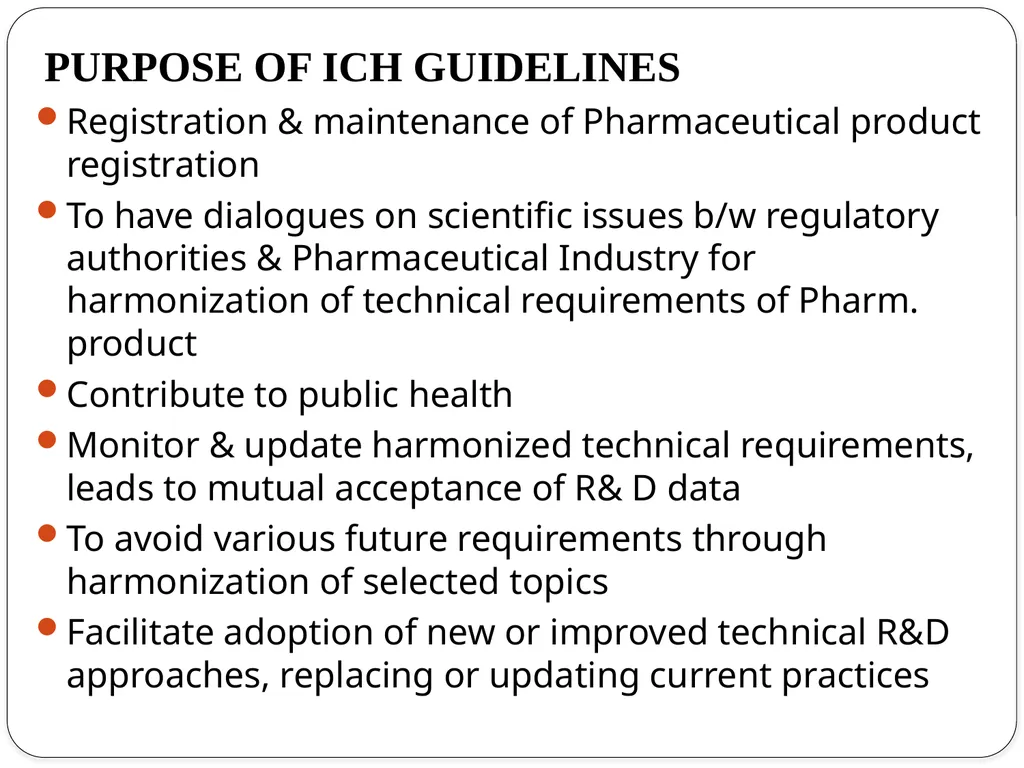
slide3. PURPOSE OF ICH GUIDELINES Registration & maintenance of Pharmaceutical product registration
To have dialogues on scientific issues b/w regulatory authorities & Pharmaceutical Industry for harmonization of technical requirements of Pharm. product
Contribute to public health
Monitor & update harmonized technical requirements, leads to mutual acceptance of R& D data
To avoid various future requirements through harmonization of selected topics
Facilitate adoption of new or improved technical R&D approaches, replacing or updating current practices<br>
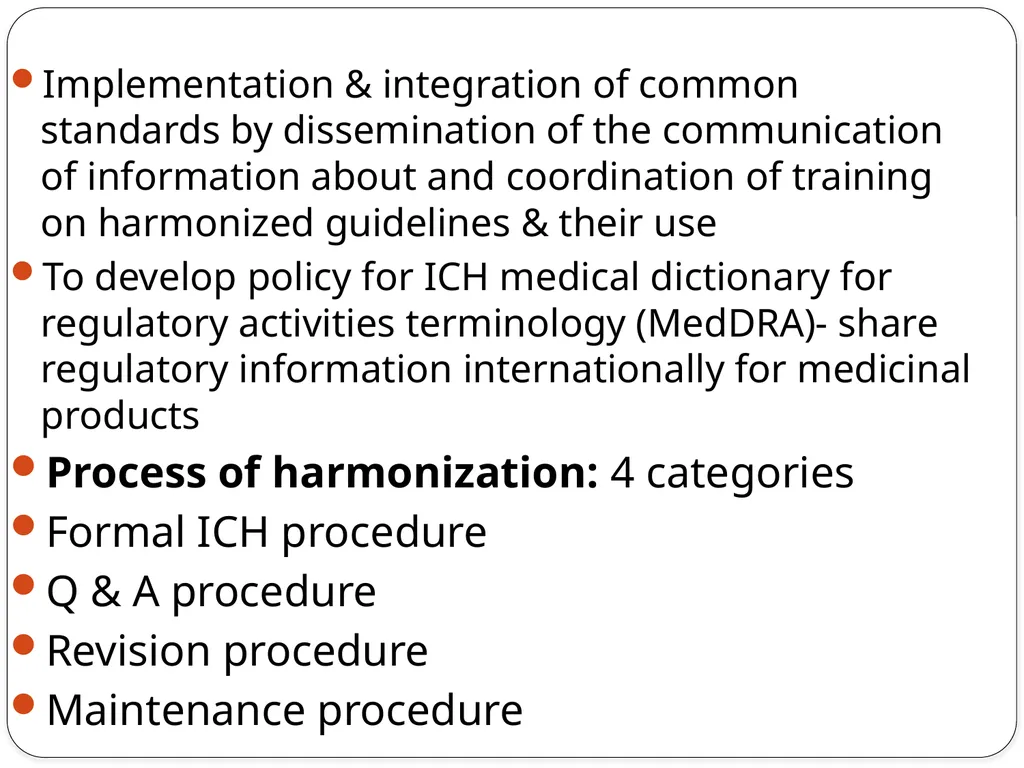
slide4. Implementation & integration of common standards by dissemination of the communication of information about and coordination of training on harmonized guidelines & their use
To develop policy for ICH medical dictionary for regulatory activities terminology (MedDRA)- share regulatory information internationally for medicinal products
Process of harmonization: 4 categories
Formal ICH procedure
Q & A procedure
Revision procedure
Maintenance procedure<br>
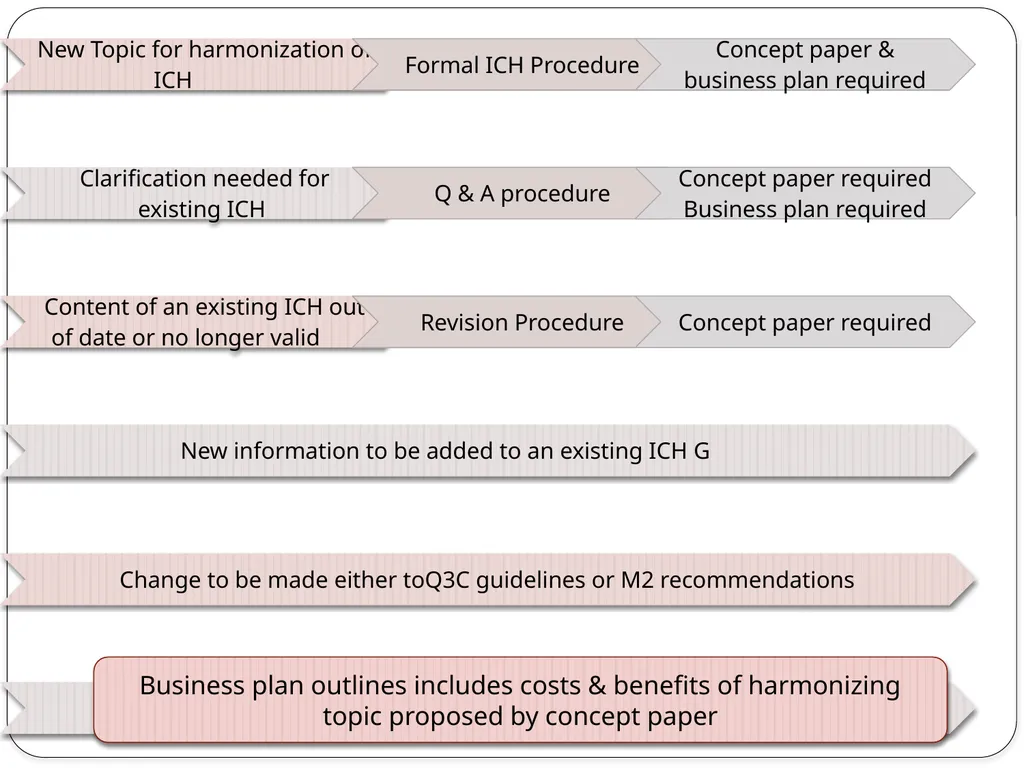
slide5. Business plan outlines includes costs & benefits of harmonizing topic proposed by concept paper<br>
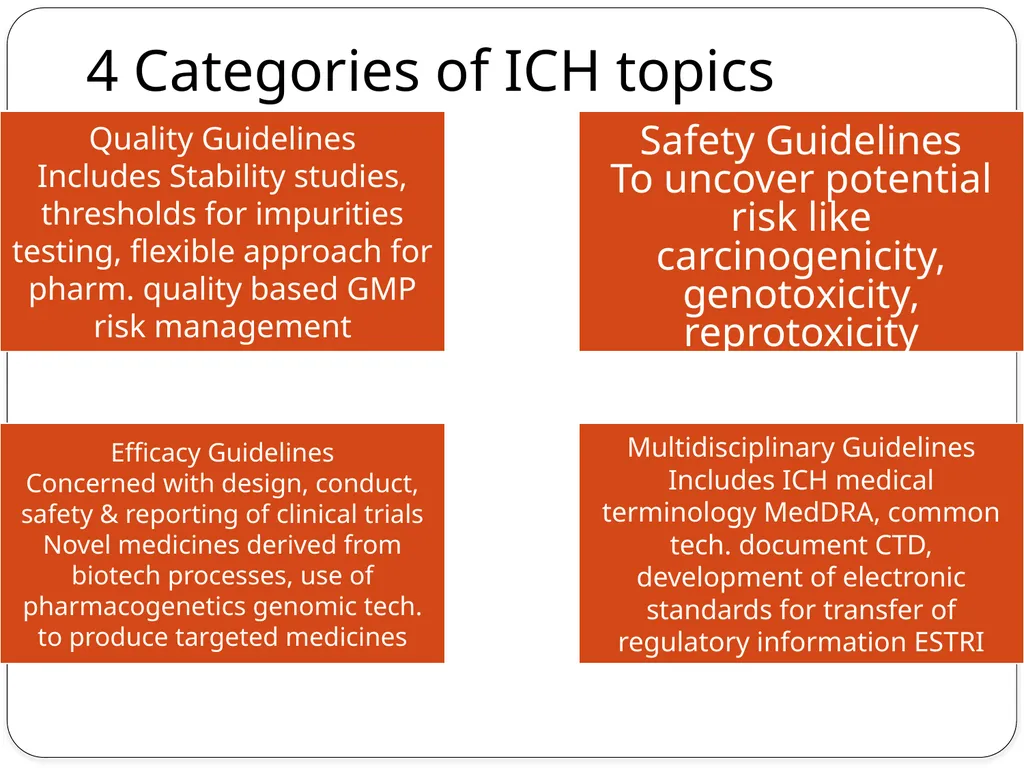
slide6. 4 Categories of ICH topics<br>
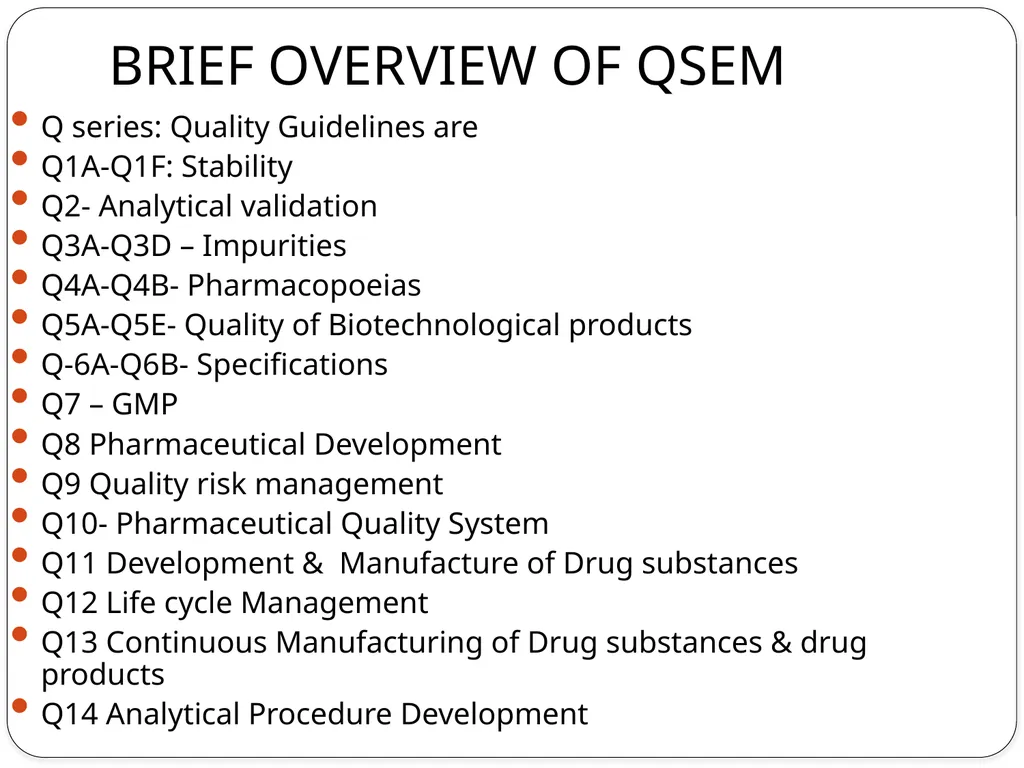
slide7. BRIEF OVERVIEW OF QSEM Q series: Quality Guidelines are
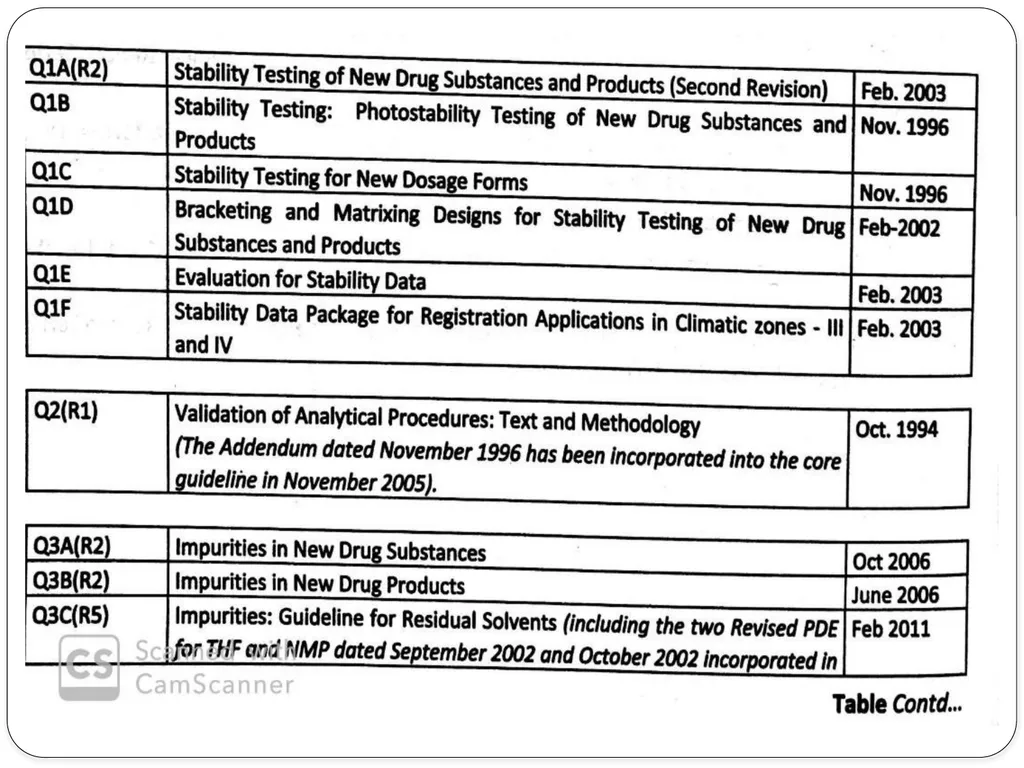
Q1A-Q1F: Stability
Q2- Analytical validation
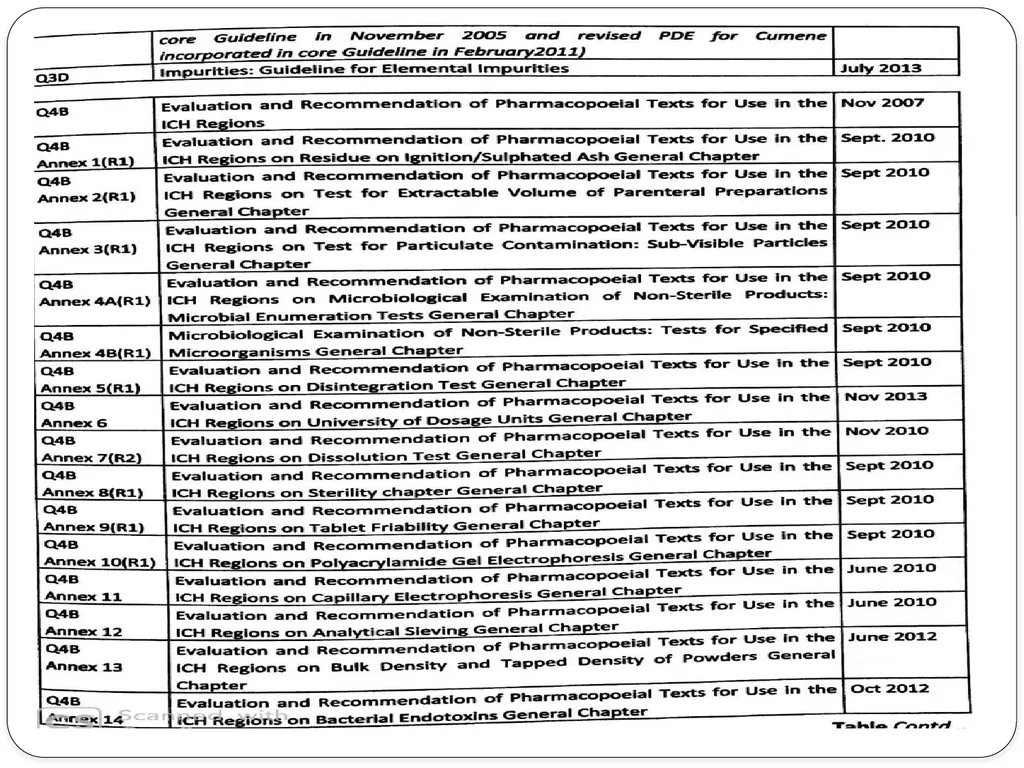
Q3A-Q3D – Impurities
Q4A-Q4B- Pharmacopoeias
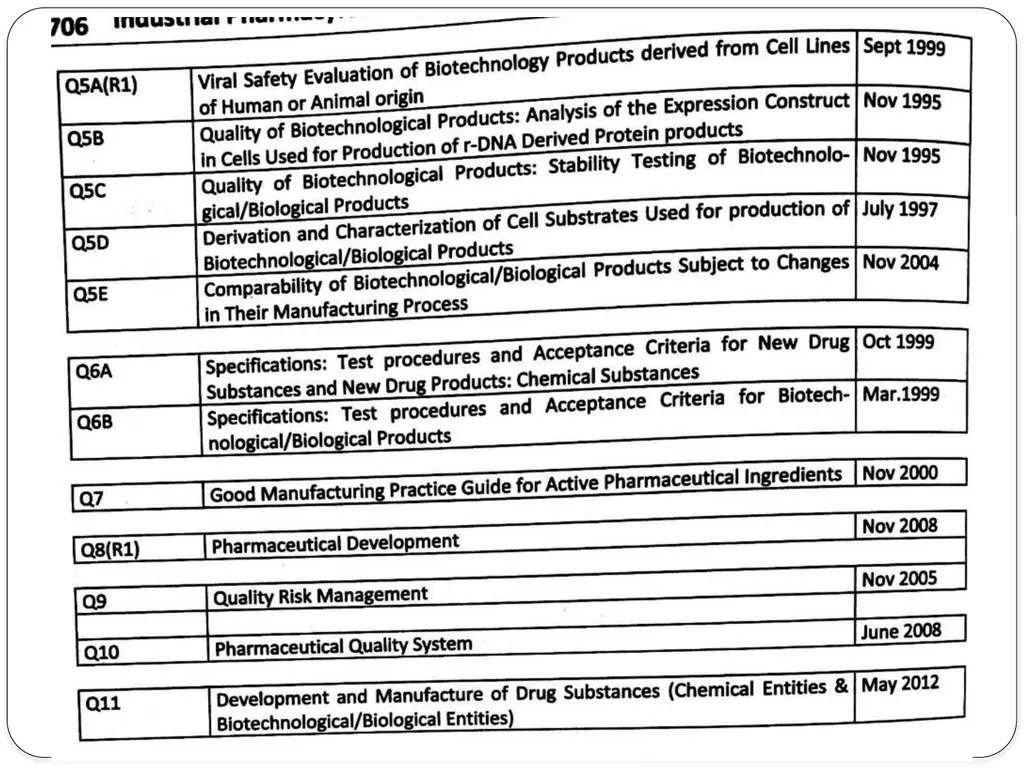
Q5A-Q5E- Quality of Biotechnological products
Q-6A-Q6B- Specifications
Q7 – GMP
Q8 Pharmaceutical Development
Q9 Quality risk management
Q10- Pharmaceutical Quality System
Q11 Development & Manufacture of Drug substances
Q12 Life cycle Management
Q13 Continuous Manufacturing of Drug substances & drug products
Q14 Analytical Procedure Development<br>
slide8. S1A - S1C- Carcinogenicity studies
S3A-S3B- Toxicokinetics & Pharmacokinetics
S4- Toxicity testing
S5 Reproductive testing
S6 Biotechnological Product
S7A-S7B- Pharmacology studies
S8- Immunotoxicology studies
S9 Non clinical evaluation of anticancer pharmaceuticals
S10 Photosafety
S11 Non clinical pediatric safety Safety Guidelines S Series<br>
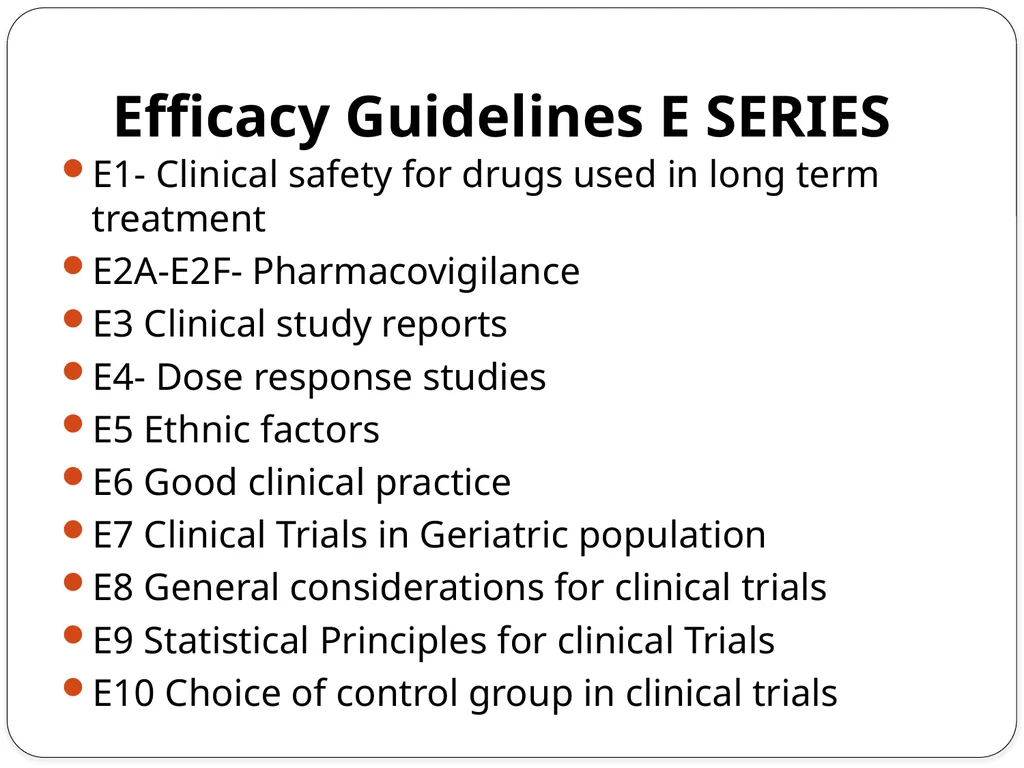
slide9. Efficacy Guidelines E SERIES E1- Clinical safety for drugs used in long term treatment
E2A-E2F- Pharmacovigilance
E3 Clinical study reports
E4- Dose response studies
E5 Ethnic factors
E6 Good clinical practice
E7 Clinical Trials in Geriatric population
E8 General considerations for clinical trials
E9 Statistical Principles for clinical Trials
E10 Choice of control group in clinical trials<br>
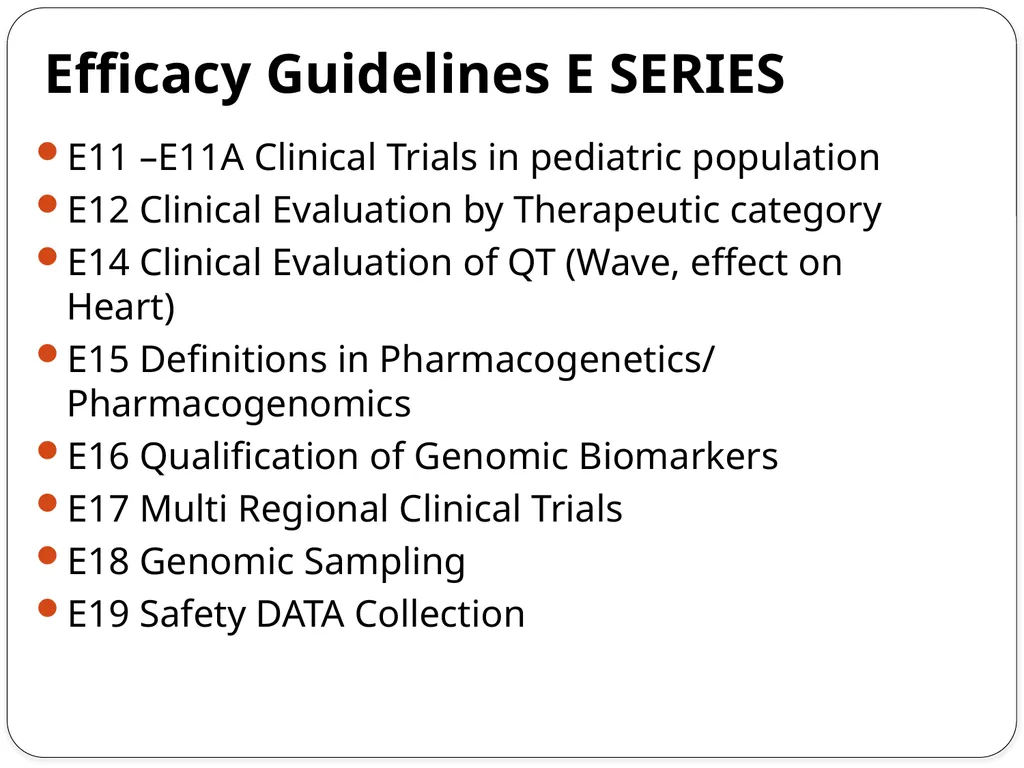
slide10. Efficacy Guidelines E SERIES E11 –E11A Clinical Trials in pediatric population
E12 Clinical Evaluation by Therapeutic category
E14 Clinical Evaluation of QT (Wave, effect on Heart)
E15 Definitions in Pharmacogenetics/ Pharmacogenomics
E16 Qualification of Genomic Biomarkers
E17 Multi Regional Clinical Trials
E18 Genomic Sampling
E19 Safety DATA Collection<br>
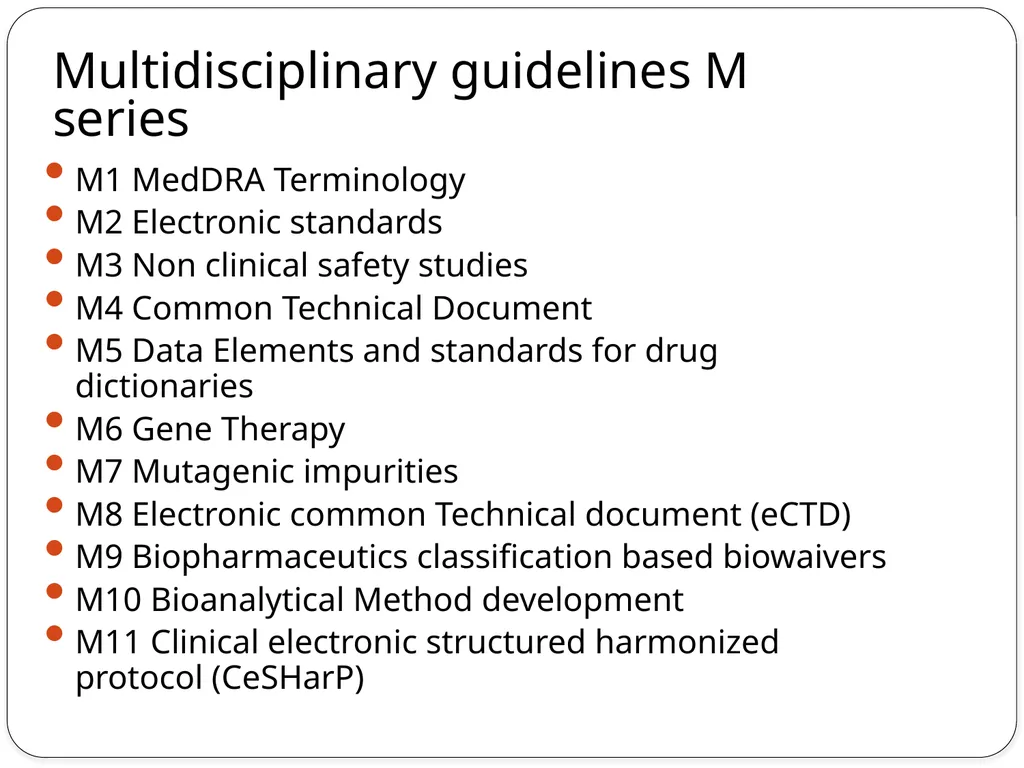
slide11. Multidisciplinary guidelines M series M1 MedDRA Terminology
M2 Electronic standards
M3 Non clinical safety studies
M4 Common Technical Document
M5 Data Elements and standards for drug dictionaries
M6 Gene Therapy
M7 Mutagenic impurities
M8 Electronic common Technical document (eCTD)
M9 Biopharmaceutics classification based biowaivers
M10 Bioanalytical Method development
M11 Clinical electronic structured harmonized protocol (CeSHarP)<br>
slide15. Special emphasis on Q series<br>
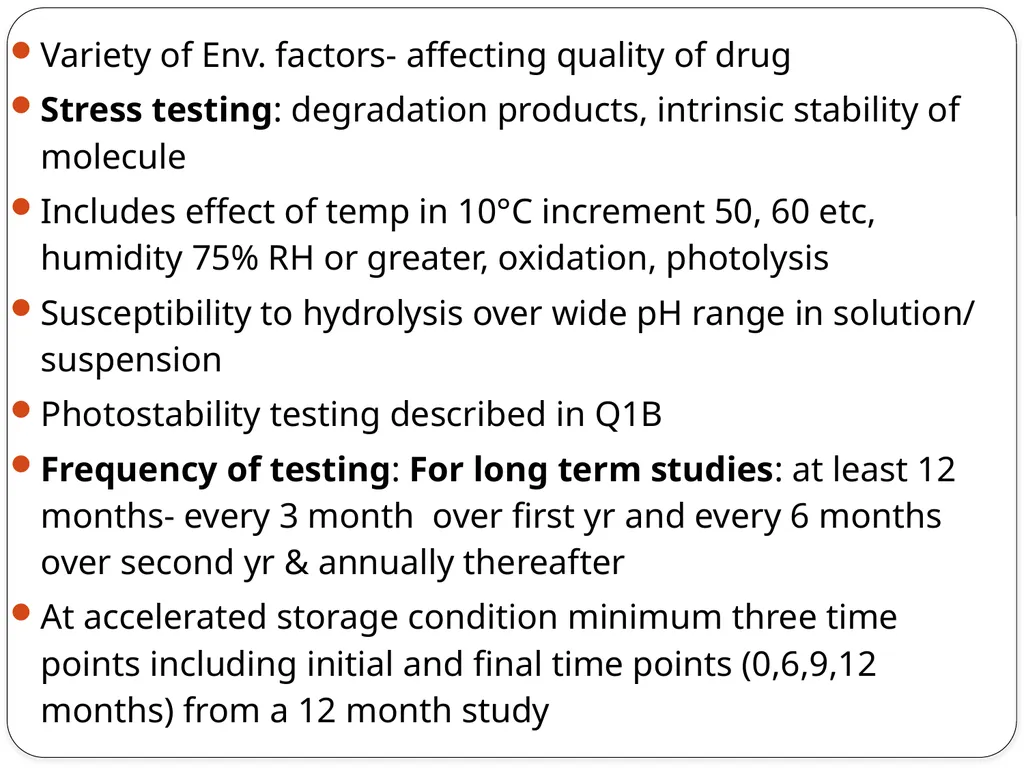
slide16. Variety of Env. factors- affecting quality of drug
Stress testing: degradation products, intrinsic stability of molecule
Includes effect of temp in 10°C increment 50, 60 etc, humidity 75% RH or greater, oxidation, photolysis
Susceptibility to hydrolysis over wide pH range in solution/ suspension
Photostability testing described in Q1B
Frequency of testing: For long term studies: at least 12 months- every 3 month over first yr and every 6 months over second yr & annually thereafter
At accelerated storage condition minimum three time points including initial and final time points (0,6,9,12 months) from a 12 month study<br>
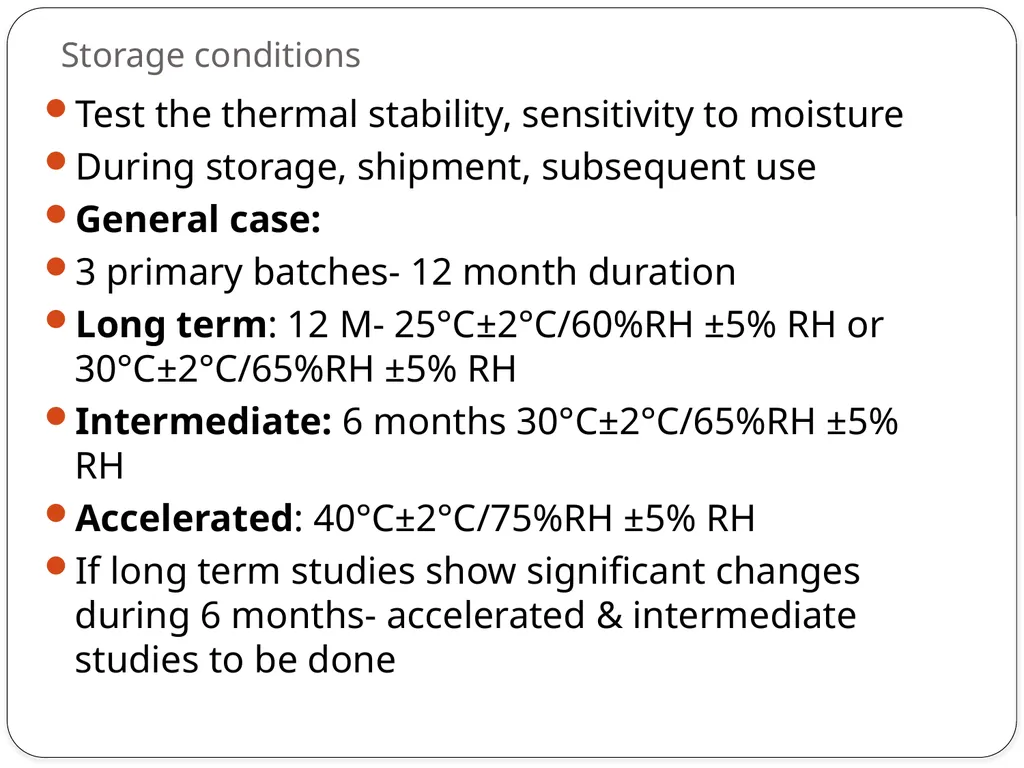
slide17. Storage conditions Test the thermal stability, sensitivity to moisture
During storage, shipment, subsequent use
General case:
3 primary batches- 12 month duration
Long term: 12 M- 25°C±2°C/60%RH ±5% RH or 30°C±2°C/65%RH ±5% RH
Intermediate: 6 months 30°C±2°C/65%RH ±5% RH
Accelerated: 40°C±2°C/75%RH ±5% RH
If long term studies show significant changes during 6 months- accelerated & intermediate studies to be done<br>
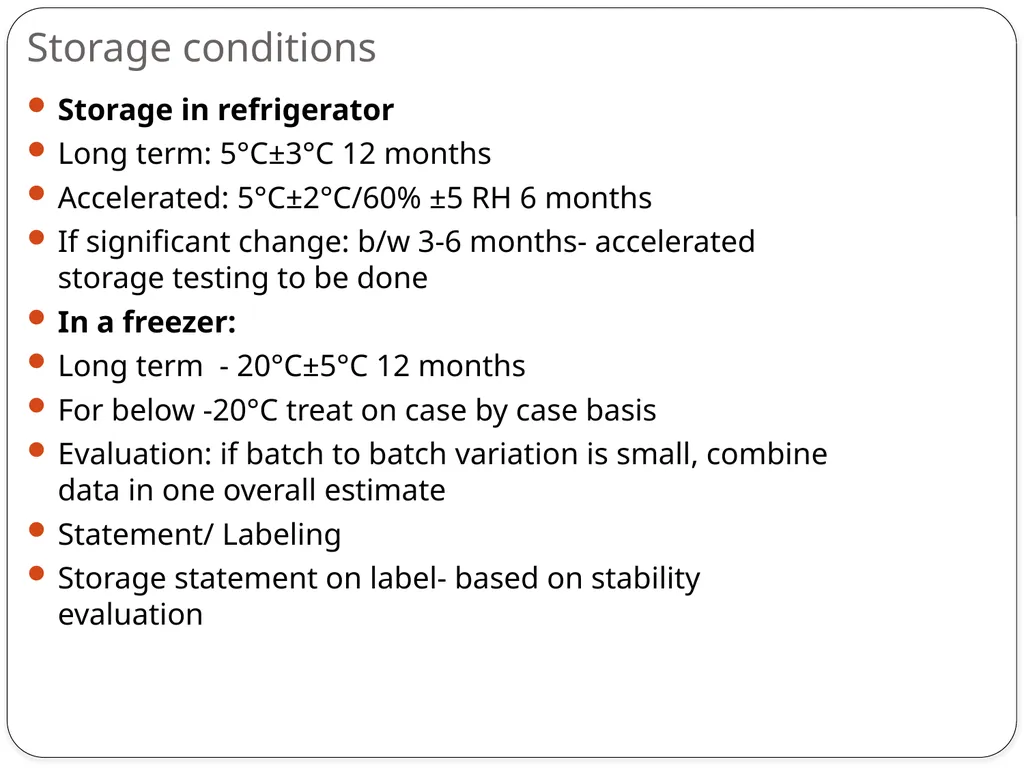
slide18. Storage in refrigerator
Long term: 5°C±3°C 12 months
Accelerated: 5°C±2°C/60% ±5 RH 6 months
If significant change: b/w 3-6 months- accelerated storage testing to be done
In a freezer:
Long term - 20°C±5°C 12 months
For below -20°C treat on case by case basis
Evaluation: if batch to batch variation is small, combine data in one overall estimate
Statement/ Labeling
Storage statement on label- based on stability evaluation Storage conditions<br>
Purpose, participants, process of harmonization, Brief overview of QSEM, with special emphasis on Q-series guidelines, ICH stability testing guidelines INTERNATIONAL COUNCIL FOR HARMONIZATION<br>
slide2. ICH Guidelines : Inception 1990 International council for harmonization, earlier Conference
Technical requirement for pharmaceuticals for human use
Step to bring regulatory authorities & Pharmaceutical Industry to discuss scientific & technical aspects of drug registration
Mission of ICH: To achieve greater harmonization worldwide to ensure safe, effective, high quality medicines are developed/registered in most resource & effective manner<br>
slide3. PURPOSE OF ICH GUIDELINES Registration & maintenance of Pharmaceutical product registration
To have dialogues on scientific issues b/w regulatory authorities & Pharmaceutical Industry for harmonization of technical requirements of Pharm. product
Contribute to public health
Monitor & update harmonized technical requirements, leads to mutual acceptance of R& D data
To avoid various future requirements through harmonization of selected topics
Facilitate adoption of new or improved technical R&D approaches, replacing or updating current practices<br>
slide4. Implementation & integration of common standards by dissemination of the communication of information about and coordination of training on harmonized guidelines & their use
To develop policy for ICH medical dictionary for regulatory activities terminology (MedDRA)- share regulatory information internationally for medicinal products
Process of harmonization: 4 categories
Formal ICH procedure
Q & A procedure
Revision procedure
Maintenance procedure<br>
slide5. Business plan outlines includes costs & benefits of harmonizing topic proposed by concept paper<br>
slide6. 4 Categories of ICH topics<br>
slide7. BRIEF OVERVIEW OF QSEM Q series: Quality Guidelines are
Q1A-Q1F: Stability
Q2- Analytical validation
Q3A-Q3D – Impurities
Q4A-Q4B- Pharmacopoeias
Q5A-Q5E- Quality of Biotechnological products
Q-6A-Q6B- Specifications
Q7 – GMP
Q8 Pharmaceutical Development
Q9 Quality risk management
Q10- Pharmaceutical Quality System
Q11 Development & Manufacture of Drug substances
Q12 Life cycle Management
Q13 Continuous Manufacturing of Drug substances & drug products
Q14 Analytical Procedure Development<br>
slide8. S1A - S1C- Carcinogenicity studies
S3A-S3B- Toxicokinetics & Pharmacokinetics
S4- Toxicity testing
S5 Reproductive testing
S6 Biotechnological Product
S7A-S7B- Pharmacology studies
S8- Immunotoxicology studies
S9 Non clinical evaluation of anticancer pharmaceuticals
S10 Photosafety
S11 Non clinical pediatric safety Safety Guidelines S Series<br>
slide9. Efficacy Guidelines E SERIES E1- Clinical safety for drugs used in long term treatment
E2A-E2F- Pharmacovigilance
E3 Clinical study reports
E4- Dose response studies
E5 Ethnic factors
E6 Good clinical practice
E7 Clinical Trials in Geriatric population
E8 General considerations for clinical trials
E9 Statistical Principles for clinical Trials
E10 Choice of control group in clinical trials<br>
slide10. Efficacy Guidelines E SERIES E11 –E11A Clinical Trials in pediatric population
E12 Clinical Evaluation by Therapeutic category
E14 Clinical Evaluation of QT (Wave, effect on Heart)
E15 Definitions in Pharmacogenetics/ Pharmacogenomics
E16 Qualification of Genomic Biomarkers
E17 Multi Regional Clinical Trials
E18 Genomic Sampling
E19 Safety DATA Collection<br>
slide11. Multidisciplinary guidelines M series M1 MedDRA Terminology
M2 Electronic standards
M3 Non clinical safety studies
M4 Common Technical Document
M5 Data Elements and standards for drug dictionaries
M6 Gene Therapy
M7 Mutagenic impurities
M8 Electronic common Technical document (eCTD)
M9 Biopharmaceutics classification based biowaivers
M10 Bioanalytical Method development
M11 Clinical electronic structured harmonized protocol (CeSHarP)<br>
slide15. Special emphasis on Q series<br>
slide16. Variety of Env. factors- affecting quality of drug
Stress testing: degradation products, intrinsic stability of molecule
Includes effect of temp in 10°C increment 50, 60 etc, humidity 75% RH or greater, oxidation, photolysis
Susceptibility to hydrolysis over wide pH range in solution/ suspension
Photostability testing described in Q1B
Frequency of testing: For long term studies: at least 12 months- every 3 month over first yr and every 6 months over second yr & annually thereafter
At accelerated storage condition minimum three time points including initial and final time points (0,6,9,12 months) from a 12 month study<br>
slide17. Storage conditions Test the thermal stability, sensitivity to moisture
During storage, shipment, subsequent use
General case:
3 primary batches- 12 month duration
Long term: 12 M- 25°C±2°C/60%RH ±5% RH or 30°C±2°C/65%RH ±5% RH
Intermediate: 6 months 30°C±2°C/65%RH ±5% RH
Accelerated: 40°C±2°C/75%RH ±5% RH
If long term studies show significant changes during 6 months- accelerated & intermediate studies to be done<br>
slide18. Storage in refrigerator
Long term: 5°C±3°C 12 months
Accelerated: 5°C±2°C/60% ±5 RH 6 months
If significant change: b/w 3-6 months- accelerated storage testing to be done
In a freezer:
Long term - 20°C±5°C 12 months
For below -20°C treat on case by case basis
Evaluation: if batch to batch variation is small, combine data in one overall estimate
Statement/ Labeling
Storage statement on label- based on stability evaluation Storage conditions<br>