Idaho State Tax Commission Ratio Study Compliance Market Value, Statistical Tests, and Category Comparisons Alan S. Dornfest, Property Tax Policy Bureau Chief Kathlynn Ireland, Property Tax Policy Specialist Benefit the people of Idaho with
"Idaho State Tax Commission Ratio Study Compliance" is the property of its rightful owner. Permission is granted to
download and print the materials on this website for personal, non-commercial use only, and to display it
on your personal computer provided you do not modify the materials and that you retain all copyright
notices contained in the materials. By downloading content from our website, you accept the terms of this
agreement.
Presentation Transcript
01
Idaho State Tax Commission Ratio Study Compliance
Market Value, Statistical Tests, and Category Comparisons
Alan S. Dornfest, Property Tax Policy Bureau Chief
Kathlynn Ireland, Property Tax Policy Specialist Benefit the people of Idaho with courteous customer service and education by providing fair, efficient, and effective revenue and tax administration.<br>
02
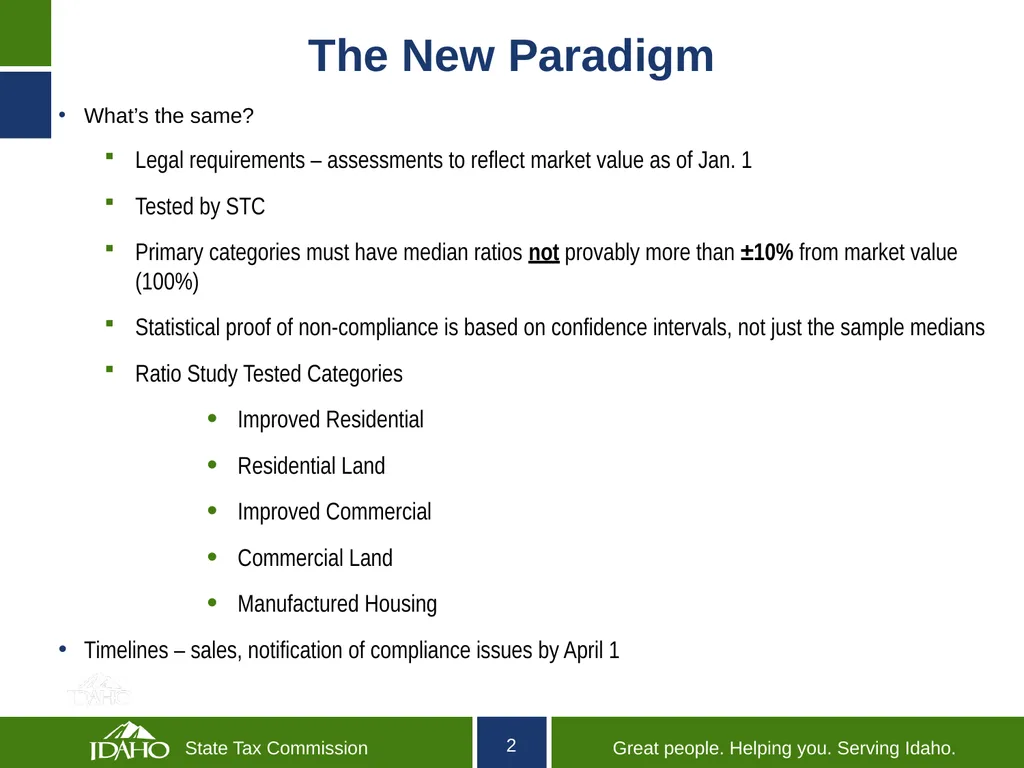
The New Paradigm What’s the same?
Legal requirements – assessments to reflect market value as of Jan. 1
Tested by STC
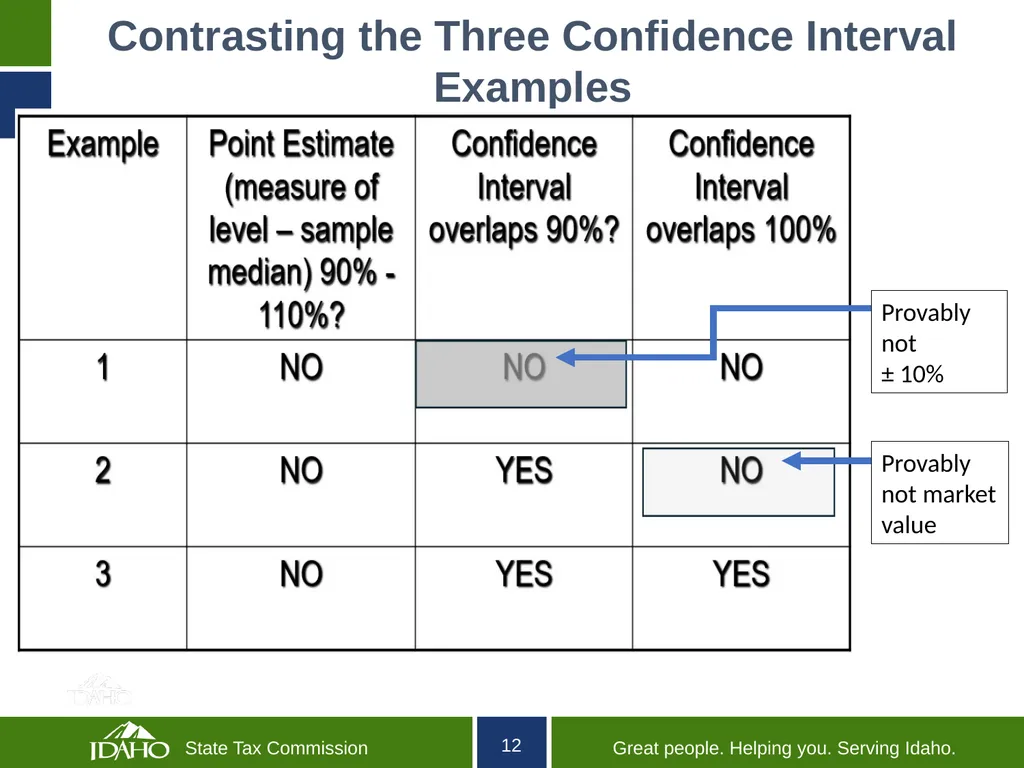
Primary categories must have median ratios not provably more than ±10% from market value (100%)
Statistical proof of non-compliance is based on confidence intervals, not just the sample medians
Ratio Study Tested Categories
Improved Residential
Residential Land
Improved Commercial
Commercial Land
Manufactured Housing
Timelines – sales, notification of compliance issues by April 1 2<br>
03
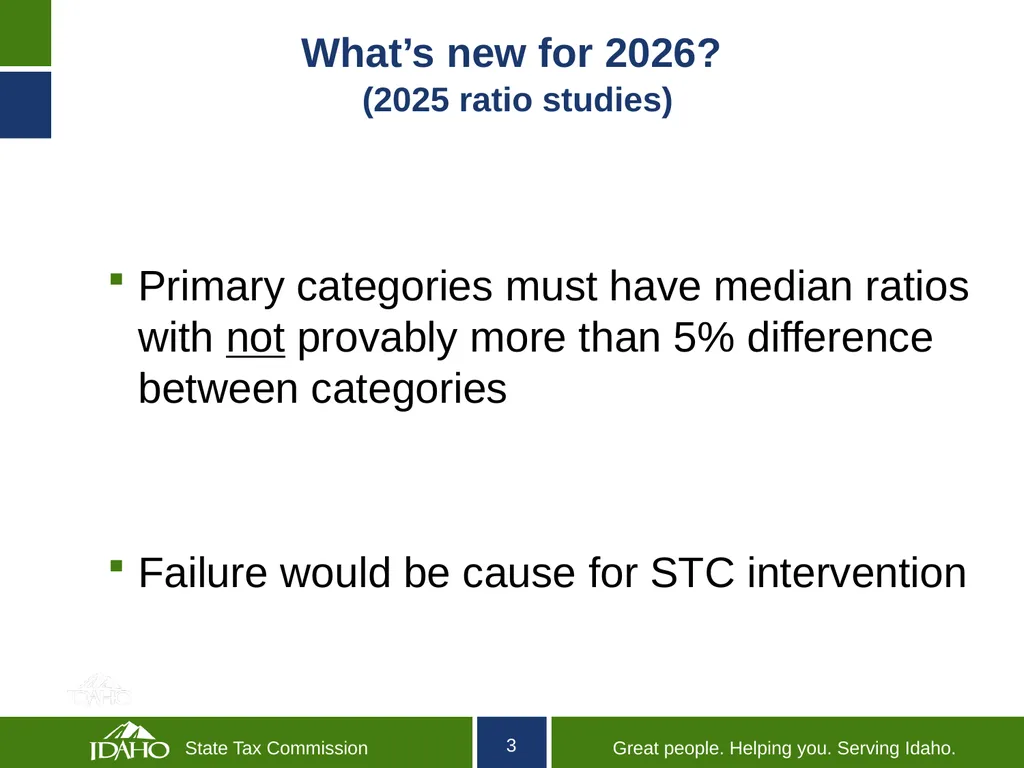
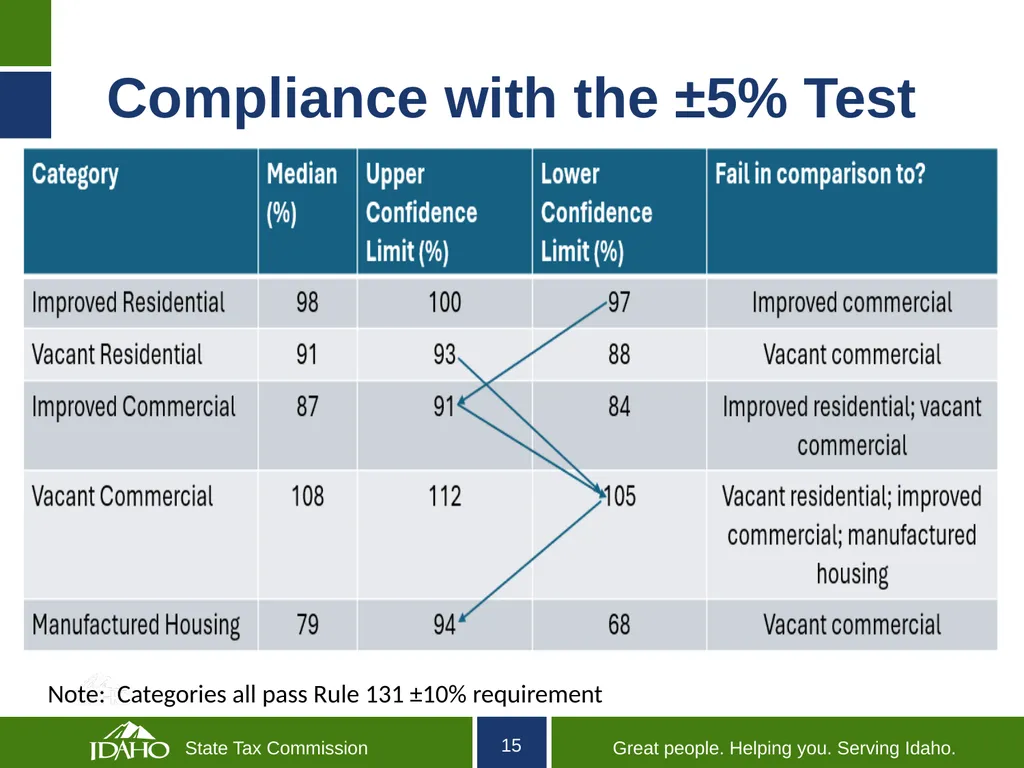
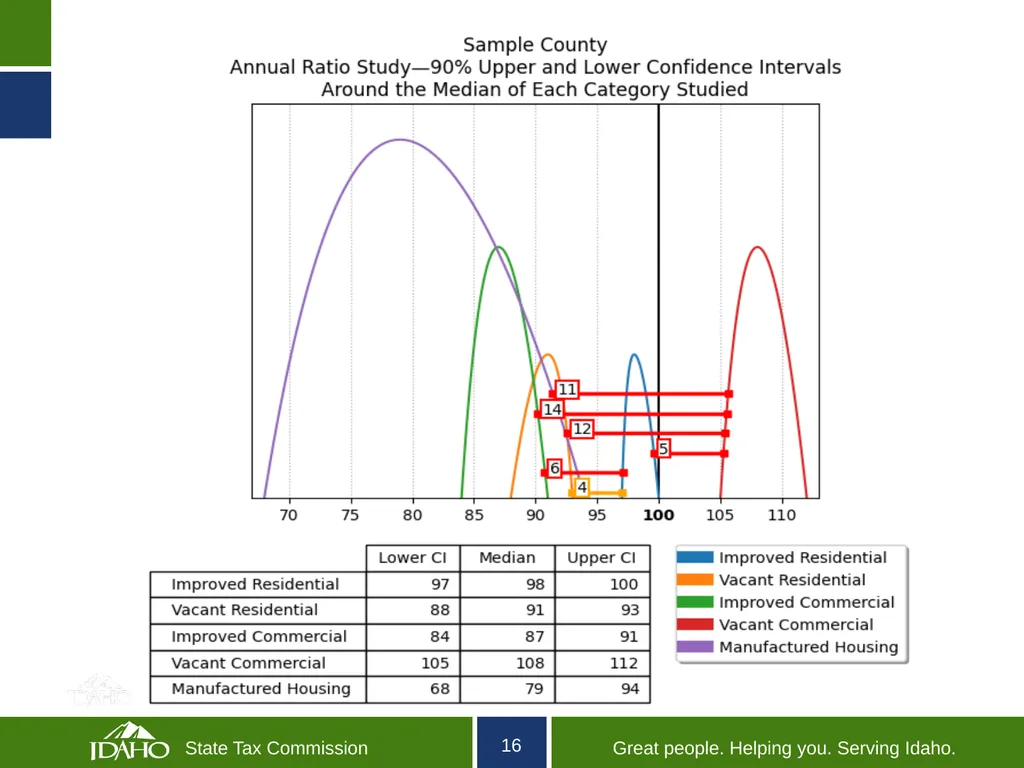
What’s new for 2026? (2025 ratio studies) Primary categories must have median ratios with not provably more than 5% difference between categories
Failure would be cause for STC intervention 3<br>
04
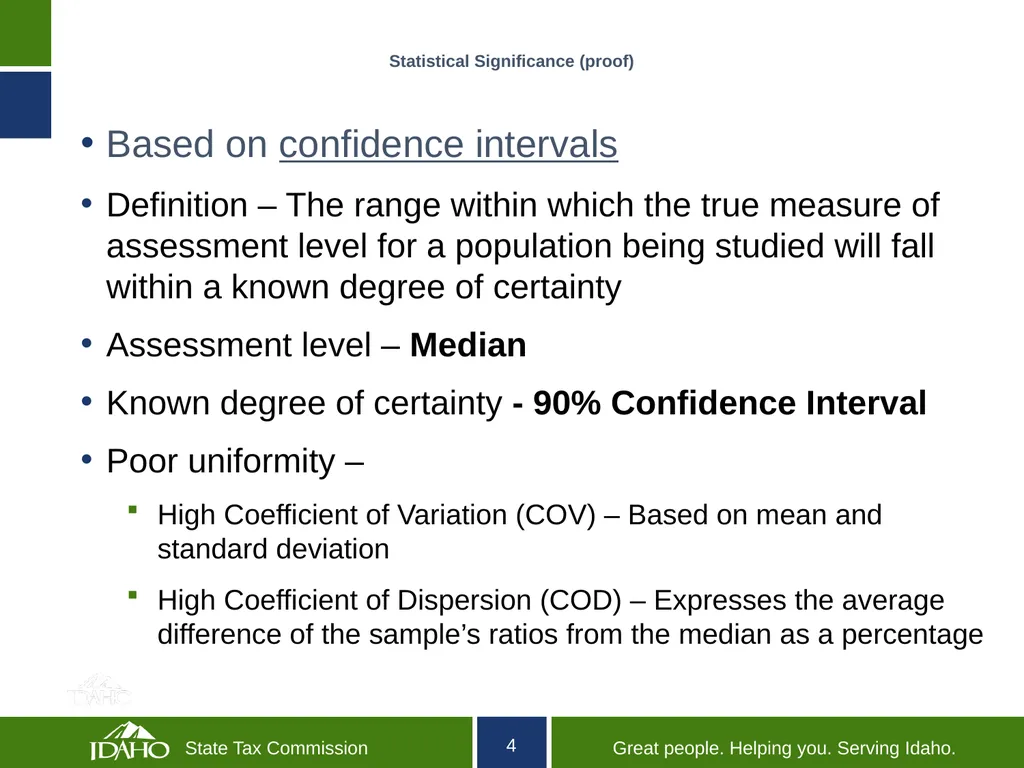
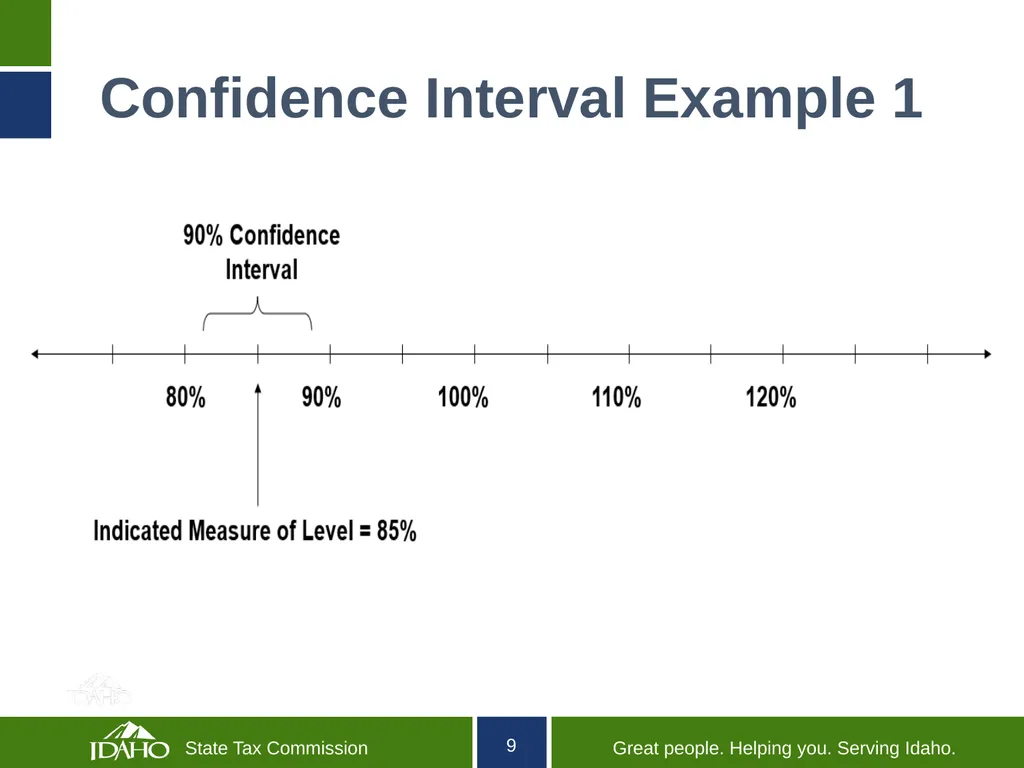
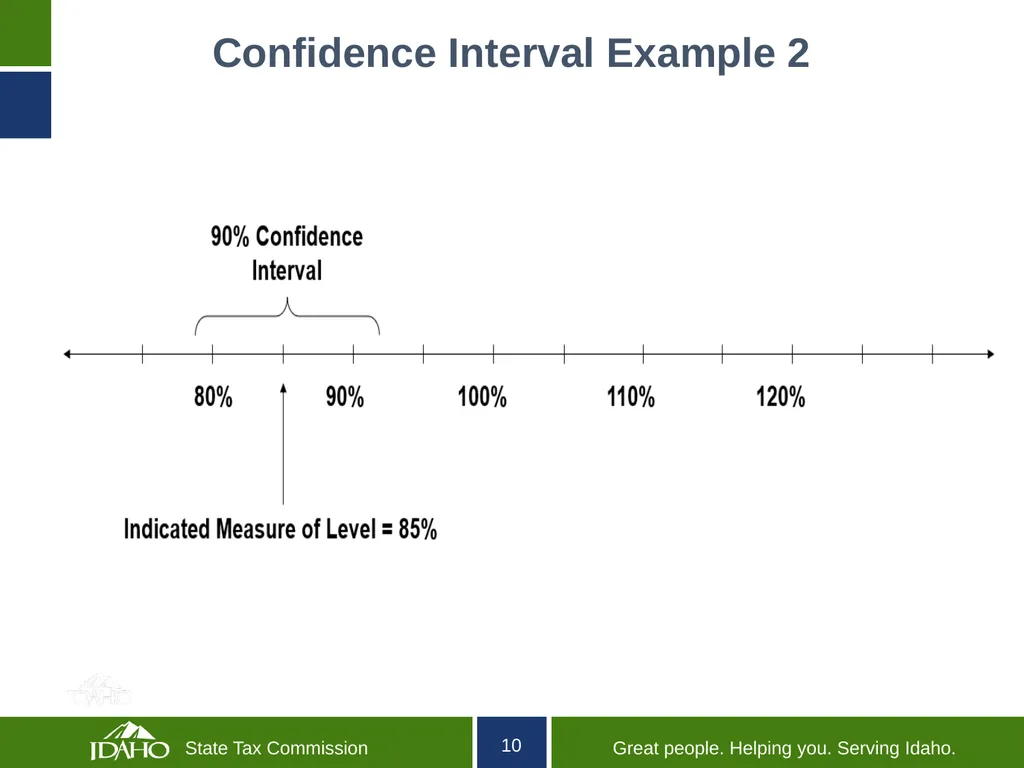
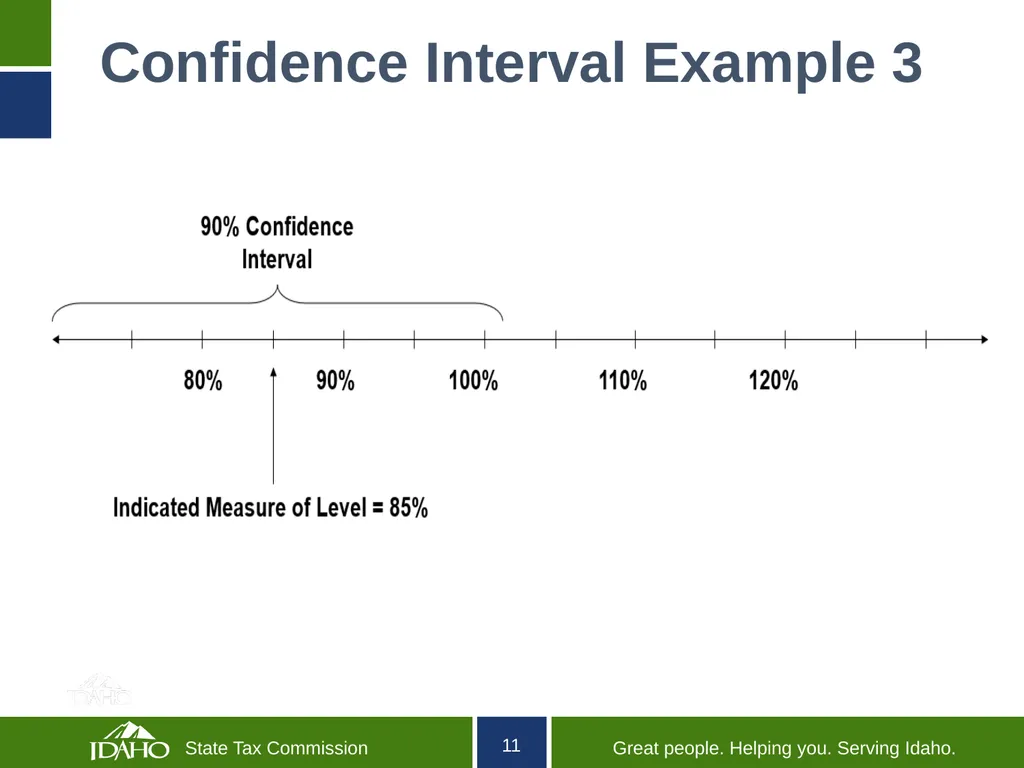
Statistical Significance (proof) Based on confidence intervals
Definition – The range within which the true measure of assessment level for a population being studied will fall within a known degree of certainty
Assessment level – Median
Known degree of certainty - 90% Confidence Interval
Poor uniformity –
High Coefficient of Variation (COV) – Based on mean and standard deviation
High Coefficient of Dispersion (COD) – Expresses the average difference of the sample’s ratios from the median as a percentage 4<br>
05
What can be tested in this way? Is assessment level for a category lower or higher than market value?
Is assessment level for a category more than ±10% from market value?
Is assessment level for one category more than 5% different from that of a different category? 5<br>
06
What cannot be tested in this way? Are individual properties in a given category at market value?
Are individual properties in a given category within 10% of market value?
Similar statistical measures can provide estimates of the proportion of properties above or below:
market value
Selected point, such as 120% of market value
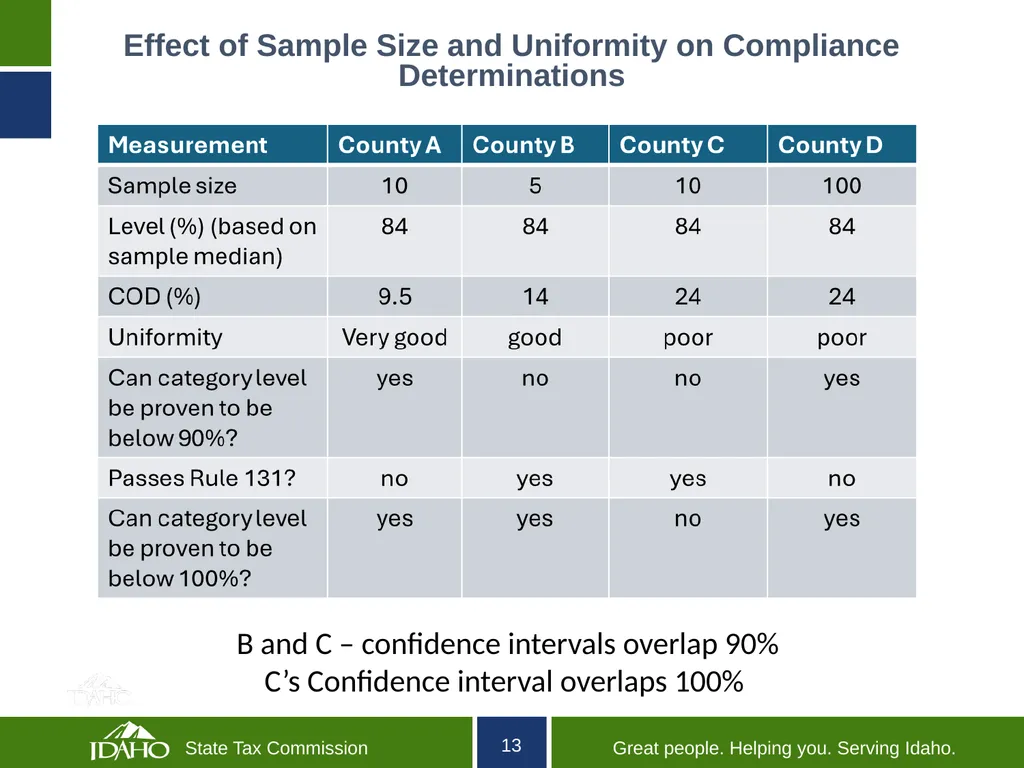
Small samples and poor uniformity lead to wide confidence intervals which make proving any of these conditions doubtful
In the absence of proof, compliance is assumed 6<br>
07
7<br>
08
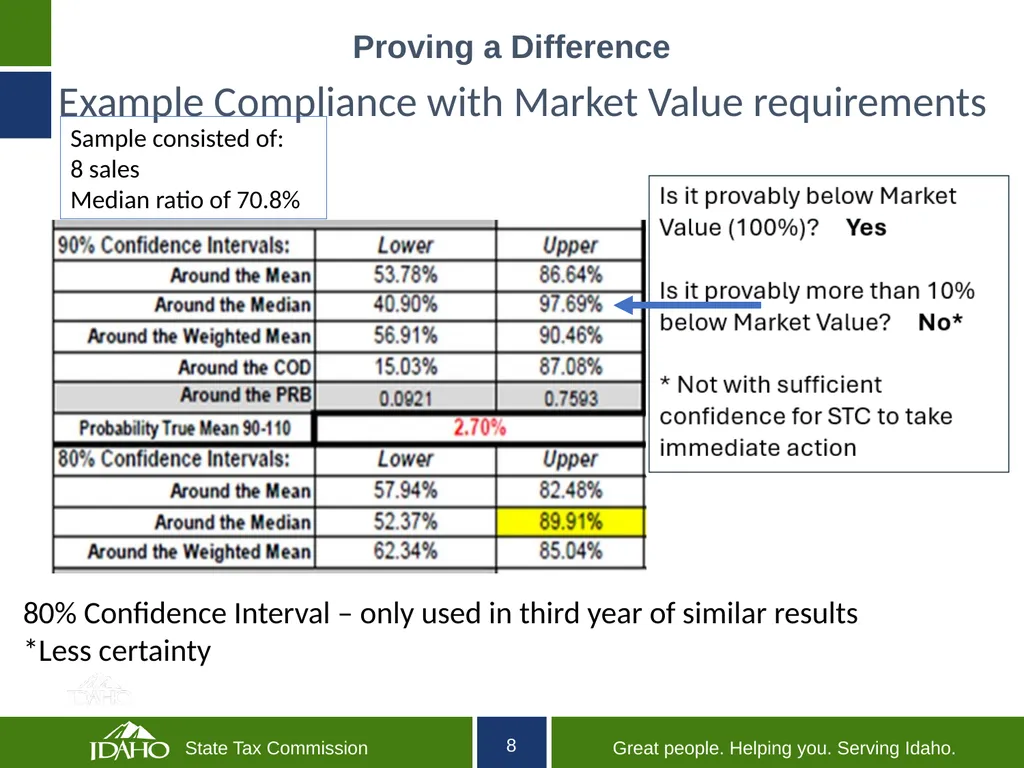
Proving a Difference 8 Example Compliance with Market Value requirements Sample consisted of:
8 sales
Median ratio of 70.8% 80% Confidence Interval – only used in third year of similar results
*Less certainty<br>
09
Confidence Interval Example 1 9<br>
10
Confidence Interval Example 2 10<br>
11
Confidence Interval Example 3 11<br>
12
Contrasting the Three Confidence Interval Examples 12 Provably not
± 10% Provably not market value<br>
13
Effect of Sample Size and Uniformity on Compliance Determinations 13 B and C – confidence intervals overlap 90%
C’s Confidence interval overlaps 100%<br>
14
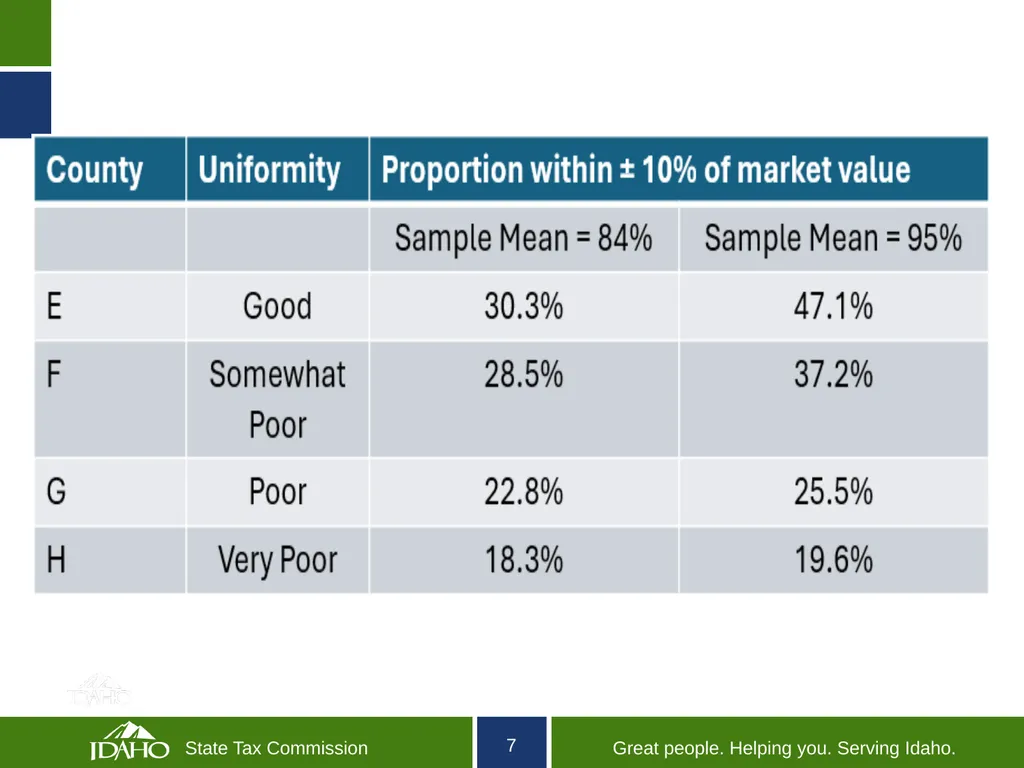
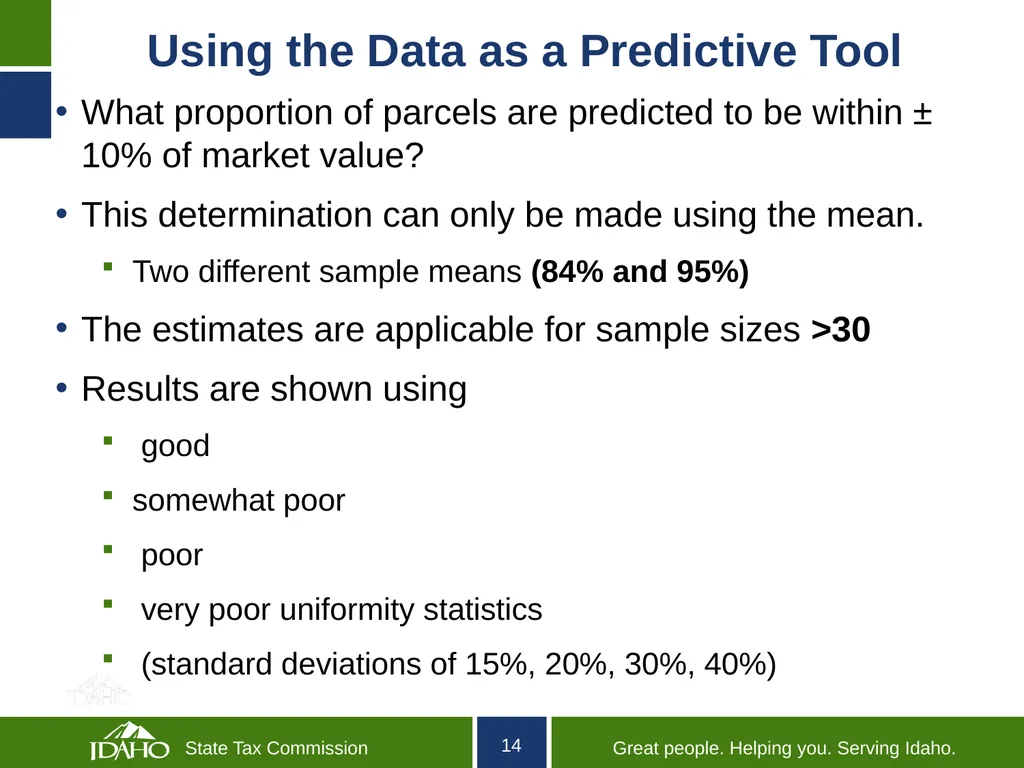
Using the Data as a Predictive Tool What proportion of parcels are predicted to be within ± 10% of market value?
This determination can only be made using the mean.
Two different sample means (84% and 95%)
The estimates are applicable for sample sizes >30
Results are shown using
good
somewhat poor
poor
very poor uniformity statistics
(standard deviations of 15%, 20%, 30%, 40%) 14<br>
15
Compliance with the ±5% Test 15 Note: Categories all pass Rule 131 ±10% requirement<br>