
Illuminating Language Interpretation and
T
Published · 90 slides · 0 views
1 / 1



Description
Illuminating Language Interpretation and Understanding in Gadamer and Davidson Byørn Torgrim Ramberg 1 What happens when we understand? What happens when we understand what a text or an utterance means? Both Hans-Georg Gadamer and Donald
Related Topics
Share
Embed code
Download this presentation From Below
"Illuminating Language Interpretation and" is the property of its rightful owner. Permission is granted to download and print the materials on this website for personal, non-commercial use only, and to display it on your personal computer provided you do not modify the materials and that you retain all copyright notices contained in the materials. By downloading content from our website, you accept the terms of this agreement.
Presentation Transcript
01
Illuminating Language
Interpretation and Understanding in Gadamer and Davidson Byørn Torgrim Ramberg 1<br>
02
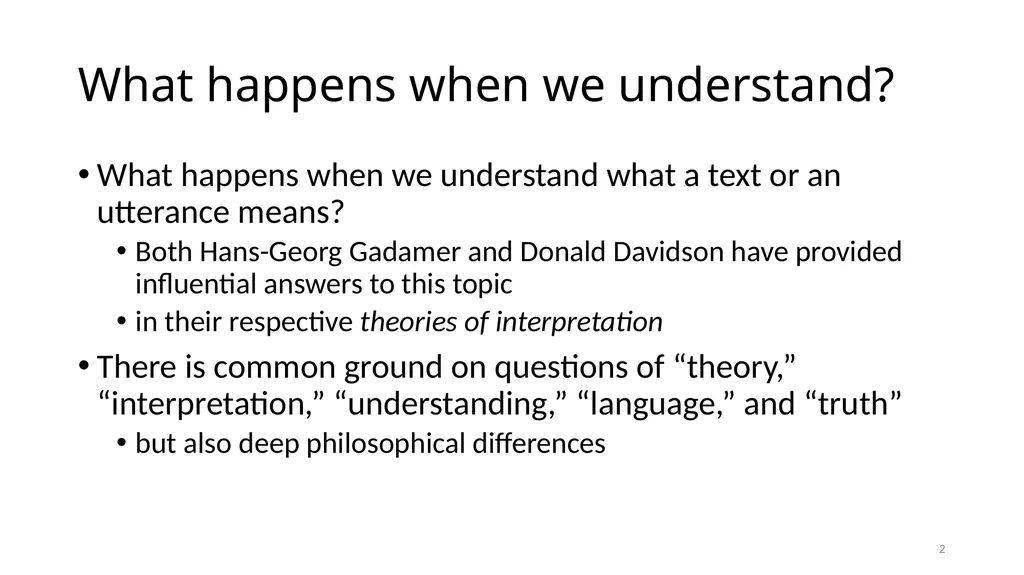
What happens when we understand? What happens when we understand what a text or an utterance means?
Both Hans-Georg Gadamer and Donald Davidson have provided influential answers to this topic
in their respective theories of interpretation
There is common ground on questions of “theory,” “interpretation,” “understanding,” “language,” and “truth”
but also deep philosophical differences 2<br>
Both Hans-Georg Gadamer and Donald Davidson have provided influential answers to this topic
in their respective theories of interpretation
There is common ground on questions of “theory,” “interpretation,” “understanding,” “language,” and “truth”
but also deep philosophical differences 2<br>
03
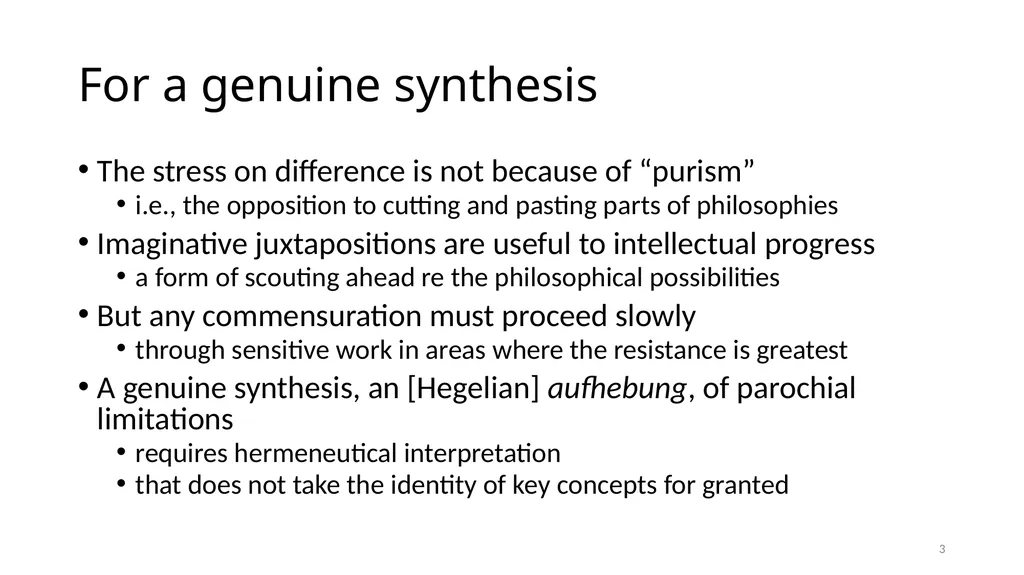
For a genuine synthesis The stress on difference is not because of “purism”
i.e., the opposition to cutting and pasting parts of philosophies
Imaginative juxtapositions are useful to intellectual progress
a form of scouting ahead re the philosophical possibilities
But any commensuration must proceed slowly
through sensitive work in areas where the resistance is greatest
A genuine synthesis, an [Hegelian] aufhebung, of parochial limitations
requires hermeneutical interpretation
that does not take the identity of key concepts for granted 3<br>
04
Gadamer 4<br>
05
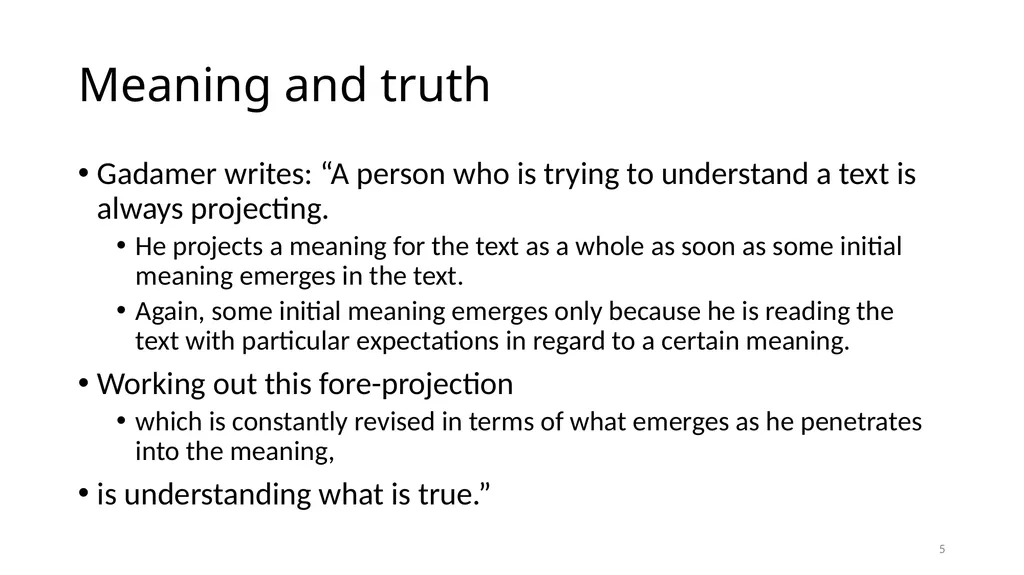
Meaning and truth Gadamer writes: “A person who is trying to understand a text is always projecting.
He projects a meaning for the text as a whole as soon as some initial meaning emerges in the text.
Again, some initial meaning emerges only because he is reading the text with particular expectations in regard to a certain meaning.
Working out this fore-projection
which is constantly revised in terms of what emerges as he penetrates into the meaning,
is understanding what is true.” 5<br>
06
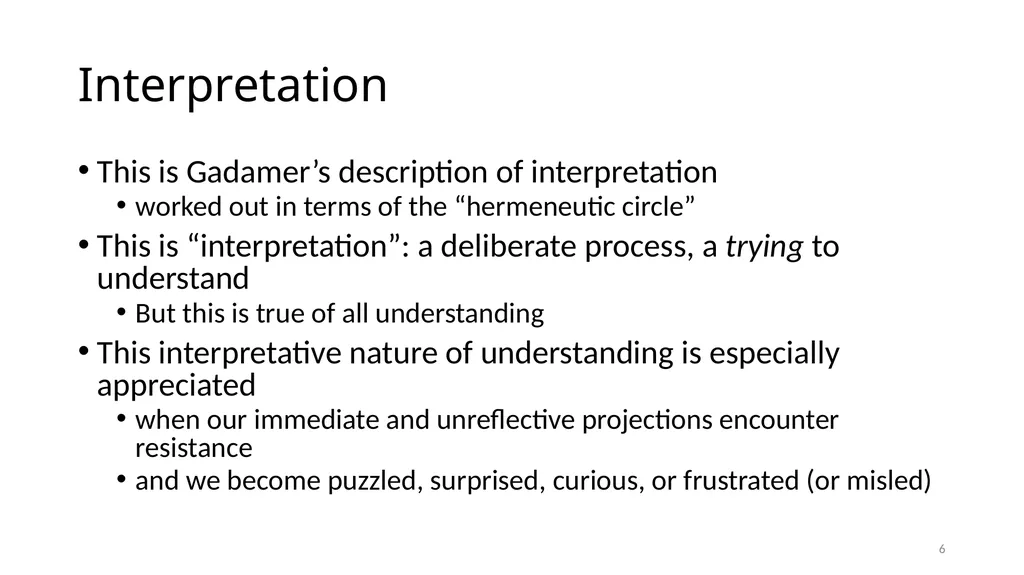
Interpretation This is Gadamer’s description of interpretation
worked out in terms of the “hermeneutic circle”
This is “interpretation”: a deliberate process, a trying to understand
But this is true of all understanding
This interpretative nature of understanding is especially appreciated
when our immediate and unreflective projections encounter resistance
and we become puzzled, surprised, curious, or frustrated (or misled) 6<br>
07
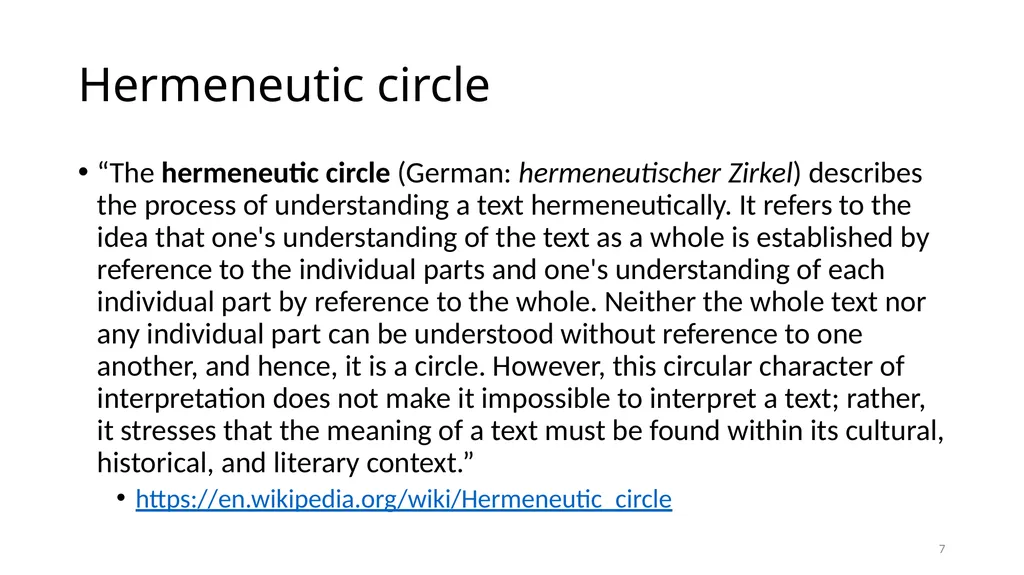
Hermeneutic circle “The hermeneutic circle (German: hermeneutischer Zirkel) describes the process of understanding a text hermeneutically. It refers to the idea that one's understanding of the text as a whole is established by reference to the individual parts and one's understanding of each individual part by reference to the whole. Neither the whole text nor any individual part can be understood without reference to one another, and hence, it is a circle. However, this circular character of interpretation does not make it impossible to interpret a text; rather, it stresses that the meaning of a text must be found within its cultural, historical, and literary context.”
https://en.wikipedia.org/wiki/Hermeneutic_circle 7<br>
https://en.wikipedia.org/wiki/Hermeneutic_circle 7<br>
08
It’s not a method Gadamer is not laying the grounds for a method of trying to understand when meaning is elusive
He is drawing attention to a movement in all understanding,
including the most unreflective interpretation of meaning
This movement is a dynamic part-whole relationship
a reciprocal accommodation
fueled by our expectations of meaning
progressing through revisability and flexibility of expectation
This is a “formal assumption”
that what is interpreted is a part-whole unity of meaning 8<br>
09
The governing assumption: truth But the governing assumption has to do with content, not this formal feature of interpretation
“To understand is primarily to understand the content of what is said
And only secondarily to understand another’s meaning as such.”
This means to take what is said as being about the world
and only secondarily as opinion, as psychological attitude
i.e., taking what is said, as far as possible, as true
Such an approach is inevitable, the prejudice of completeness
It “implies not only this formal element—that a text should completely express its meaning—
but also that what it says should be the complete truth.” 9<br>
10
Understanding is to see utterances as elements of a whole The fore-conception of completeness governs all understanding
all successful interpretation of texts and other expressions
Coming to understand someone in communication
is to see her utterances as elements of a whole
that represents a coherent point of view on the subject matter 10<br>
all successful interpretation of texts and other expressions
Coming to understand someone in communication
is to see her utterances as elements of a whole
that represents a coherent point of view on the subject matter 10<br>
11
Coherence and truth This is not to equate coherence and truth
or reduce truth to coherence
The part-whole coherence that we come to understand through dialogue is a coherence owed to truth
The coherence of her expression comes to us by taking it as one from which truth is in view
In conversation, a mutual grasp of truth is what makes meaning available 11<br>
or reduce truth to coherence
The part-whole coherence that we come to understand through dialogue is a coherence owed to truth
The coherence of her expression comes to us by taking it as one from which truth is in view
In conversation, a mutual grasp of truth is what makes meaning available 11<br>
12
Davidson 12<br>
13
What is the philosophical goal of radical interpretation? Davidson’s “Radical interpretation” shows how
the general knowledge that the creature is an agent
can frame observations of its behavior
to yield fine-gained knowledge of its language and attitudes
We (Ramberg) ask: What philosophical goal is thereby achieved? 13<br>
the general knowledge that the creature is an agent
can frame observations of its behavior
to yield fine-gained knowledge of its language and attitudes
We (Ramberg) ask: What philosophical goal is thereby achieved? 13<br>
14
Gavagai! The interpretation is radical where the interpreter doesn’t understand the language
E.g., an anthropologist comes into a society whose language she doesn’t understand at all
How does she learn this language?
E.g., the speaker of the foreign language says “Gavagai”
And the interpreter notes that he is looking at a rabbit leaping out from behind a tree
She forms the hypothesis that “Gavagai” means “rabbit”
And continues from there … 14<br>
15
Two questions Ramberg cites Davidson in “Radical Interpretation”:
Kurt “utters the words ‘Es regnet’
and under the right conditions we know that he has said that it is raining.
Having identified his utterance as intentional and linguistic, we are able to go on to interpret his words;
we can say what his words, on that occasion, meant.
[1] What could we know that would enable us to do this?
[2] How could be come to know it?” 15<br>
16
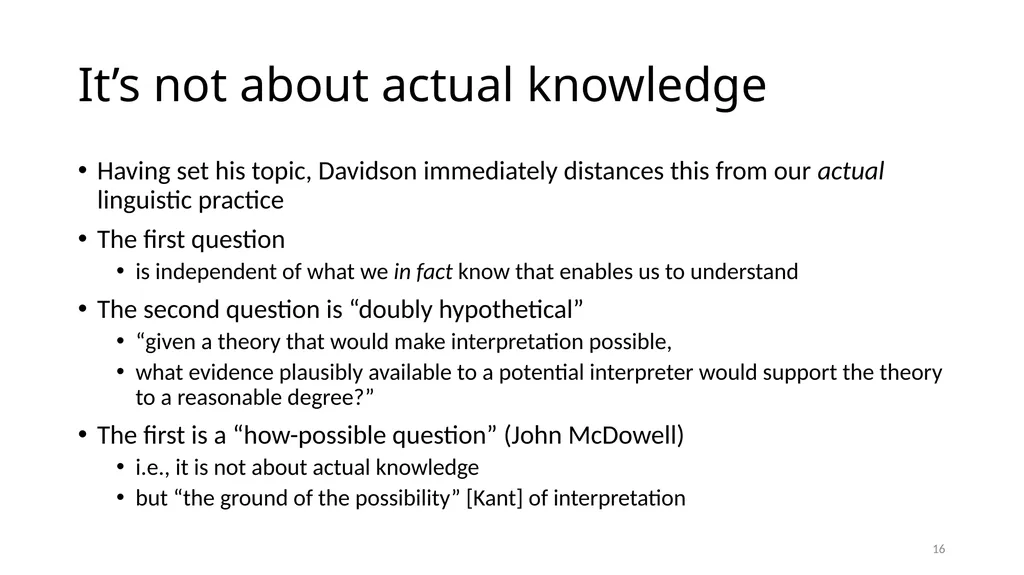
It’s not about actual knowledge Having set his topic, Davidson immediately distances this from our actual linguistic practice
The first question
is independent of what we in fact know that enables us to understand
The second question is “doubly hypothetical”
“given a theory that would make interpretation possible,
what evidence plausibly available to a potential interpreter would support the theory to a reasonable degree?”
The first is a “how-possible question” (John McDowell)
i.e., it is not about actual knowledge
but “the ground of the possibility” [Kant] of interpretation 16<br>
17
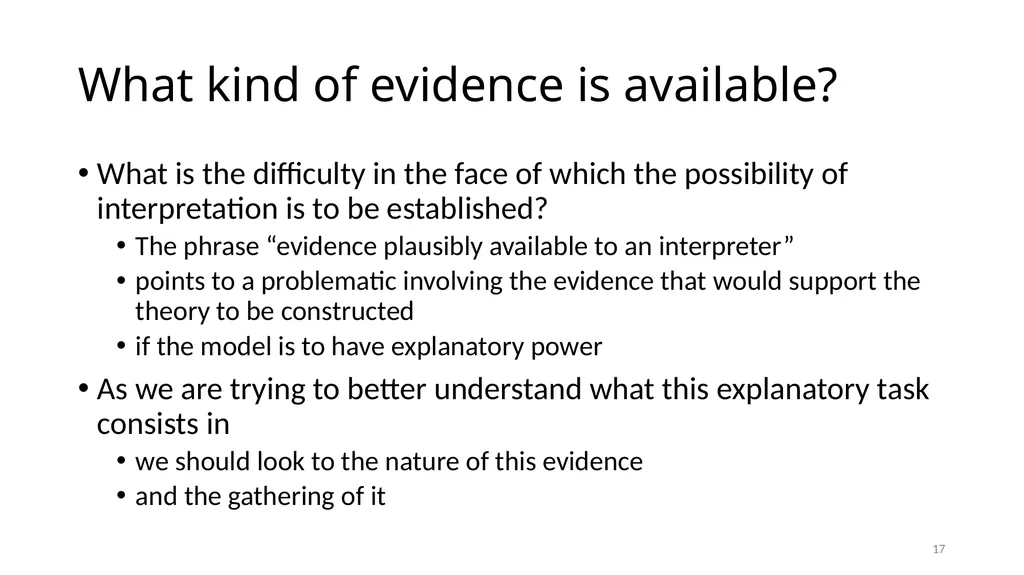
What kind of evidence is available? What is the difficulty in the face of which the possibility of interpretation is to be established?
The phrase “evidence plausibly available to an interpreter”
points to a problematic involving the evidence that would support the theory to be constructed
if the model is to have explanatory power
As we are trying to better understand what this explanatory task consists in
we should look to the nature of this evidence
and the gathering of it 17<br>
18
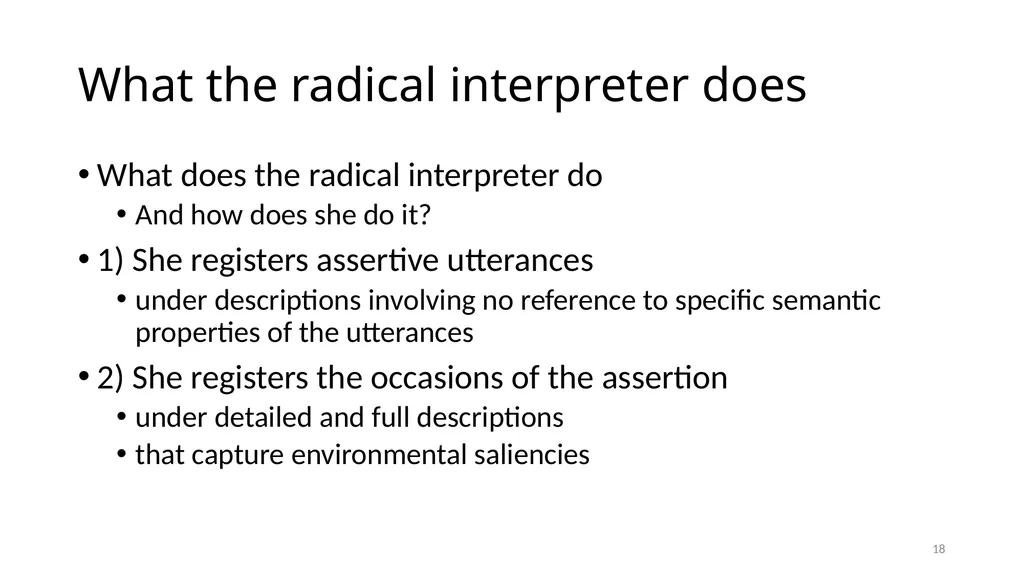
What the radical interpreter does What does the radical interpreter do
And how does she do it?
1) She registers assertive utterances
under descriptions involving no reference to specific semantic properties of the utterances
2) She registers the occasions of the assertion
under detailed and full descriptions
that capture environmental saliencies 18<br>
And how does she do it?
1) She registers assertive utterances
under descriptions involving no reference to specific semantic properties of the utterances
2) She registers the occasions of the assertion
under detailed and full descriptions
that capture environmental saliencies 18<br>
19
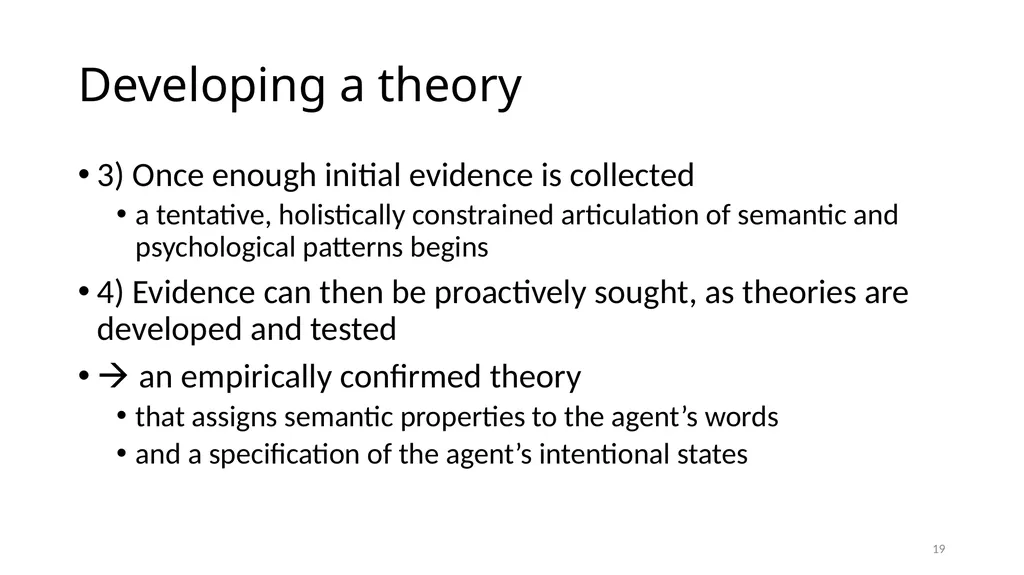
Developing a theory 3) Once enough initial evidence is collected
a tentative, holistically constrained articulation of semantic and psychological patterns begins
4) Evidence can then be proactively sought, as theories are developed and tested
an empirically confirmed theory
that assigns semantic properties to the agent’s words
and a specification of the agent’s intentional states 19<br>
20
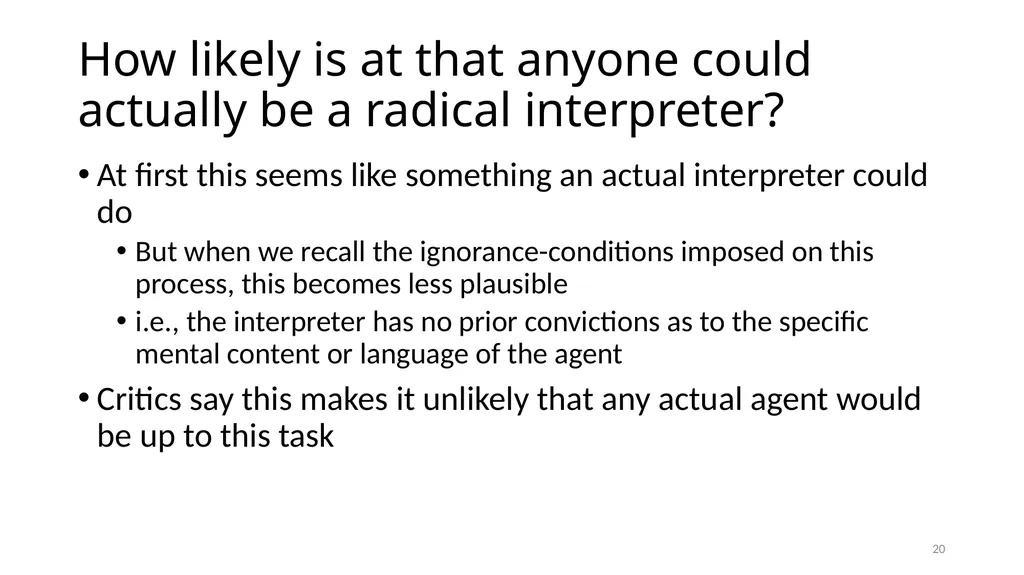
How likely is at that anyone could actually be a radical interpreter? At first this seems like something an actual interpreter could do
But when we recall the ignorance-conditions imposed on this process, this becomes less plausible
i.e., the interpreter has no prior convictions as to the specific mental content or language of the agent
Critics say this makes it unlikely that any actual agent would be up to this task 20<br>
But when we recall the ignorance-conditions imposed on this process, this becomes less plausible
i.e., the interpreter has no prior convictions as to the specific mental content or language of the agent
Critics say this makes it unlikely that any actual agent would be up to this task 20<br>
21
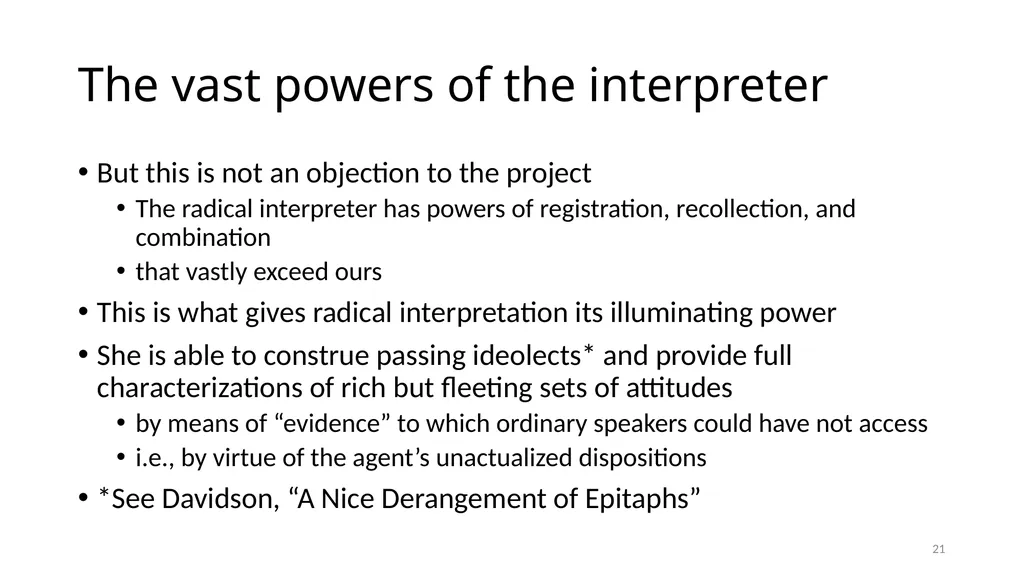
The vast powers of the interpreter But this is not an objection to the project
The radical interpreter has powers of registration, recollection, and combination
that vastly exceed ours
This is what gives radical interpretation its illuminating power
She is able to construe passing ideolects* and provide full characterizations of rich but fleeting sets of attitudes
by means of “evidence” to which ordinary speakers could have not access
i.e., by virtue of the agent’s unactualized dispositions
*See Davidson, “A Nice Derangement of Epitaphs” 21<br>
22
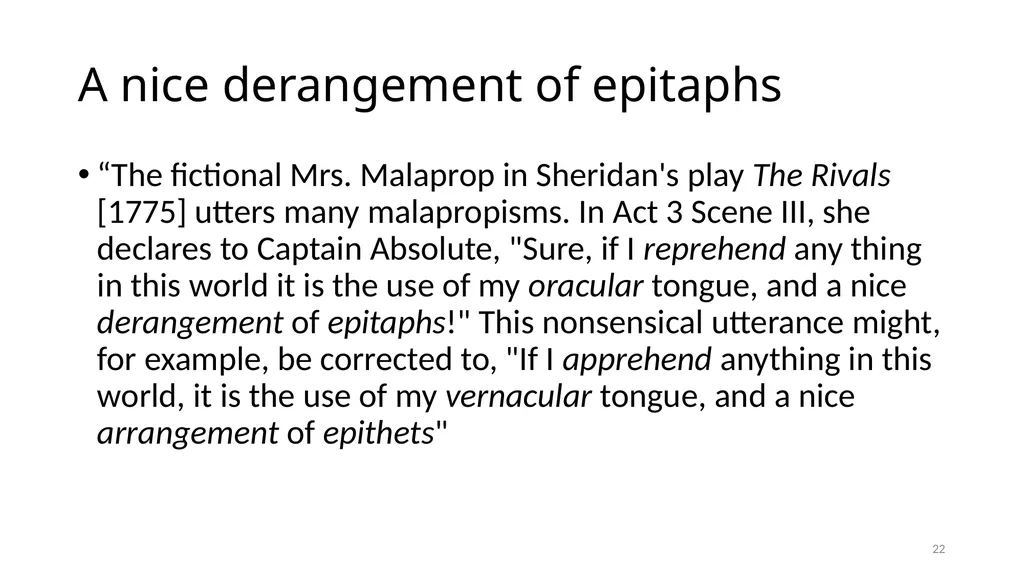
A nice derangement of epitaphs “The fictional Mrs. Malaprop in Sheridan's play The Rivals [1775] utters many malapropisms. In Act 3 Scene III, she declares to Captain Absolute, "Sure, if I reprehend any thing in this world it is the use of my oracular tongue, and a nice derangement of epitaphs!" This nonsensical utterance might, for example, be corrected to, "If I apprehend anything in this world, it is the use of my vernacular tongue, and a nice arrangement of epithets" 22<br>
23
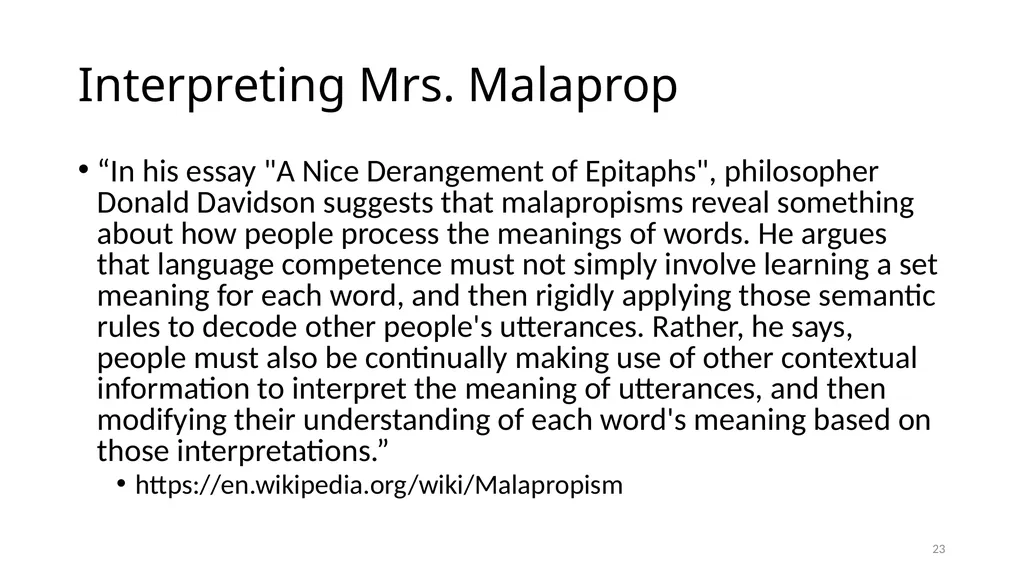
Interpreting Mrs. Malaprop “In his essay "A Nice Derangement of Epitaphs", philosopher Donald Davidson suggests that malapropisms reveal something about how people process the meanings of words. He argues that language competence must not simply involve learning a set meaning for each word, and then rigidly applying those semantic rules to decode other people's utterances. Rather, he says, people must also be continually making use of other contextual information to interpret the meaning of utterances, and then modifying their understanding of each word's meaning based on those interpretations.”
https://en.wikipedia.org/wiki/Malapropism 23<br>
https://en.wikipedia.org/wiki/Malapropism 23<br>
24
There are no such things as languages,
just people For Davidson, a language is
never fully identified by any actual interpreter
and never spoken uniquely by any actual speaker
A language is an abstract object for a theory
Davidson re languages: “there are no such things in the world;
there are only people and their various written and acoustical products.” 24<br>
never fully identified by any actual interpreter
and never spoken uniquely by any actual speaker
A language is an abstract object for a theory
Davidson re languages: “there are no such things in the world;
there are only people and their various written and acoustical products.” 24<br>
25
There are no such things as radical interpreters But similarly, Ramberg proposes, there are no radical interpreters in the world
Radical interpretation is idealized
to capture maximum fineness of grain of empirically differentiable semantic structures
so that any properties of language beyond the powers of this ideal interpreter are empirically vacuous 25<br>
Radical interpretation is idealized
to capture maximum fineness of grain of empirically differentiable semantic structures
so that any properties of language beyond the powers of this ideal interpreter are empirically vacuous 25<br>
26
The radical interpreter is a machine This idealization of the radical interpreter suggests that we think of her or him as an it
A device embodying a mechanism designed to run a particular process
i.e., take a certain kind of input and yield a certain kind of output
The point is to see
what kind of resources might suffice to make the device work
to render transparent what in real creatures is an opaque capacity 26<br>
A device embodying a mechanism designed to run a particular process
i.e., take a certain kind of input and yield a certain kind of output
The point is to see
what kind of resources might suffice to make the device work
to render transparent what in real creatures is an opaque capacity 26<br>
27
The point of radical interpretation The point is to reveal the ground of the possibility of our communication by showing
how resources that would in general be available to creatures like us might suffice to account explicitly and systematically
for the distinctions and attributions that we actual speakers all know how to make
without being able to state in what our capacity consists 27<br>
how resources that would in general be available to creatures like us might suffice to account explicitly and systematically
for the distinctions and attributions that we actual speakers all know how to make
without being able to state in what our capacity consists 27<br>
28
Triangulation makes error possible This idealization becomes even more apparent in relation to Davidson’s discussion of “triangulation”
The structure that must be in place for there to be talk of minds and content at all
Two creatures’ mutually recognized recognitions of common environmental saliencies [it’s raining, or there’s a rabbit]
is a prerequisite for objective reference
for only then is there “a space for the concept of error, which appears when there is a divergence in normally similar reactions.” 28<br>
29
Anchoring our responses in a common cause Only when responses to stimuli are anchored in a recognized common cause
is it possible to interpret those responses to stimuli
as expressions of concepts of the objects that cause them
because only this anchor makes misapplication possible
Because it makes error conceivable,
“the social scene provides a setting in which we can make sense of the transition from mere dispositions to conceptualization.” 29<br>
30
The core of Davidson’s question The core of Davidson’s question about the possibility of interpretation
is the question about how normativity (i.e., the truth-error contrast)
is possible at all
The point of this question must be situated in the context of the inheritance of Quine (Davidson’s mentor)
There is truth
and so a constraint on our thinking about ourselves
in the idea that “physics has full coverage” 30<br>
31
Causal regularity I.e., any event is a natural event
and in nature all events are instances of causal regularity
The fact that this notion contains an important insight
is the fundamental challenge to the possibility of normativity
that Davidson’s philosophy of interpretation is designed to meet
And so it is unproblematic that we have dispositions
i.e., causally defined states 31<br>
32
From causation to agency The question is how states describable in terms of causal regularities
can also be captured in the normative terms of the language of agency
The philosophical goal for Davidson:
to see how the normatively laden intentional concepts of the vocabulary of agency can be attributed
by virtue of observation of the behavior of other creatures,
behavior that we can also observe and describe in a nonintentional vocabulary 32<br>
33
Causal generalizations underlie meaning So no event, no reality, need be supposed to account for the fact that we hear meaningful utterances
and impute knowledge, belief, aims, intentions, etc.
beyond what could also be characterized in a language of causal generalizations 33<br>
and impute knowledge, belief, aims, intentions, etc.
beyond what could also be characterized in a language of causal generalizations 33<br>
34
[Normativity and truth] Compare Kant:
since causality is an a priori condition for understanding, in reality and in practical life we could be free agents, determining our lives
And so we can make normative decisions: should I tell a lie or tell the truth
in a situation in which everything pushing me to tell a lie
But the question of whether it is true that it is raining is also a normative matter
It is not determined solely by causal events in the environment
Our truth-oriented linguistic behavior involving truth and error—science itself—is also an expression of agency
It is not a purely mechanical process. How then can “physics have full coverage”? 34<br>
35
It’s a theoretical account Davidson’s account is theoretical
while Gadamer’s is ontological
1) Its plausibility depends on an idealized model of a human capacity
2) The conditions for applying the key concepts related to agency are those imposed by the radical interpreter
i.e., the task of accounting for thought and linguistic interaction from a third person point of view 35<br>
36
It’s a theory of truth Davidson ties detailed proposals in formal semantics (i.e., Tarski)
to triangulation reflections that lead to the conclusion that
agents come in sets of more than one
Radical interpretation turns on the ability of the interpreter
to systematically individuate semantic and psychological properties
on the basis of observations of behavior treated as intentional action
that centrally involve truth theories 36<br>
37
Social interaction is necessary for truth This is an account that makes social interaction a necessary condition of thought
i.e., the triangle between observer, agent, and environment
in order to create space for the truth-error contrast of Tarskian semantics
i.e., “Es regnet” means “it is raining” if and only if it is true that it is raining.
But if the observer sees that it is not raining, and yet the agent says “Es regnet,” then this interpretation must be false
refinement of the theory (maybe she’s a Mrs. Malaprop, and means that “It reigns”) 37<br>
38
How meaning is extracted from truth Davidson’s “radical interpretation” suggests how meaning may be extracted from truth.
That truth undergirds communication will be familiar to readers of Davidson
Radical interpretation is supposed to show how an interpreter
with evidence that is restricted
might move
from knowing only general features of minds and language
to a detailed account of what someone’s words mean or what his propositional attitudes are 38<br>
39
Truth is the basis of interpretation The point is to show how the imputation of thought and semantic content as we know it
could be supported by evidence from observable behavior
The account does not reduce or analyze
intentional concepts in terms of non-intentional
The role of the concept of truth makes this clear
That the minded creatures—agents—are knowers of truth
is the basis on which interpretation proceeds to give individuating content to the behavior 39<br>
40
It’s not correspondence This is not a correspondence theory
Although it may look like it if “Gavagai” is true if and only if there is a rabbit
However this is not a situation of an isolated observer
A matter of communication between individuals in a worldly context
So we encountered Davidson previously (in Prado) saying against Searle:
“[n]othing, no thing, makes sentences and theories true; not experience … not the world, can make a sentence true.” 40<br>
41
The observed creature is an agent The interpreter’s belief is an empirical one
that some creature is an agent [i.e., not a parrot in a human suit]
making assertions, entertaining attitudes, realizing intentions (or failing to do so)
Decisive warrant for this belief, however, relies on intentional notions
The role of observation and evidence is brought out
But this is not independent of or prior to the characterization of the observed creature as an agent 41<br>
42
Taking something to be an agent The kind of evidence and observation is made available
only insofar as we take the observed person, the subject, to be an agent
Davidson’s account would show how the supposition that something is an agent
a creature with knowledge of the world
and with goals for conduct in the world
may be implemented in or employed to constrain
descriptions of the behavior of the agent
in such a way that individuating features of that particular mind and language are systematically revealed 42<br>
43
Criterion of success: an axiomatic semantic theory There is a clear success criterion for the radical interpreter:
the production of an axiomatic semantic theory
that allows for the deduction of the proper theorems
E.g., the sentence, s, in the alien language means p, if and only if p.
--i.e., those that allow the interpreter to interpret sentences of the agent’s language
such that the speech and behavior is compatible with the imputation of a largely sound view of the world
A suitable axiomatic semantic theory is one that
characterizes the truth-functional role of the elements of the agent’s language
assigning truth-conditions to the sentences of the language 43<br>
44
Evidence for the theory Evidence for this assigning is framed in terms of
relative preferences of the agent for the truth of different sentences
The task of radical interpretation is
to capture these preferences and to construe their content
by articulating a truth-theory for the agent’s language
on the basis of observation of utterances and their environmentally salient causes and behavior generally 44<br>
45
Some tough questions It is a tough and complicated question
whether an extensional characterization of elements of a natural language
will capture all the semantic properties that we would want to invoke in an account of linguistic competence
One may also have doubts about the rationality-constraint
built into the general theory of mind
that gives the radical interpreter a truth-theoretic grip on behavior in the first place
But this article will not be concerned with these challenges to Davidson’s theory 45<br>
46
Treating creatures as knowing truths and aiming for the good These objections question whether
possessing the concept of truth
having knowledge of the world
and being able to understand a language
are as directly and intimately linked as Davidson suggests
But this close link is what connects Davidson and Gadamer
So let us proceed on the assumption
that the construction of truth-theories allows us to characterize the semantic properties of a language
and that the radical interpreter succeeds in constructing them by treating creatures as knowing truths and aiming for the good 46<br>
47
Gadamer 47<br>
48
The distance between them For Gadamer, there are no constructive explanatory tasks
as there is in what Rorty called “pure philosophy of language”
[Davidson seeks to construct a logic that would explain human understanding and communication]
This is because of the distance between
hermeneutic ontology
and human action and choice
This is not the kind of distance we find in Davidson
between theory
and actual practice
[The distance in Gadamer is not so extreme] 48<br>
49
Going beyond science Gadamer’s own descriptions “are concerned to seek
the experience of truth that transcends the domains of scientific method wherever that experience is to be found,
and to enquire into its legitimacy …
the experience of philosophy, of art, and of history itself …
cannot be verified by the methodological means proper to science.”
In each of these domains “a truth is experienced that we cannot attain in any other way.” 49<br>
50
An experience, not an account 1) Gadamer is not seeking an account of truth
as in Davidson’s third person approach that would tell us what it is for something to be true
but an experience of truth
ways in which we encounter truth
He is aiming at persuading his readers
by means of his ability to characterize the particular experience
as actually or potentially our experience
Phenomenological persuasiveness self-recognition on the part of the reader 50<br>
51
Scientism 2) The experience of truth here is communicative
What is to be illuminated: the understanding of truth as expressed in a work or an utterance
The experience is available to us as dialogically engaged [not as detached observers]
3) The phenomenological account of communicative experience has normative significance
There are sui generis forms of dialogically available knowledge and insight
that cannot be characterized in terms of methodological reflection
[Gadamer’s main book: Truth and Method]
Versus scientism:
the tendency to take science as having a fundamental legitimizing role
because of its distinctive epistemic procedures [i.e., its methods] 51<br>
52
How is truth at all possible for historical creatures? Even science is subject to hermeneutic contextualization
There is no escape from historicity
The scientistic error is corrected
by insight into the fact that it is an arena of wirkungsgeschichtliches Bewusstsein (historically effected consciousness)
The real philosophical challenge is not scientism
but how the experience of historical creatures can be an encounter with truth at all 52<br>
53
Our sciences too are historically conditioned If methodological objectivity is not a foundation for the aspiration to truth
how is such aspiration even possible?
The historicity of understanding:
The limitation of the self-reflective power of individual consciousness
its historical effectedness
including on our sciences 53<br>
how is such aspiration even possible?
The historicity of understanding:
The limitation of the self-reflective power of individual consciousness
its historical effectedness
including on our sciences 53<br>
54
No new method for this “One should not see in it merely a modification of self-consciousness;
say, something like an awareness that history is working on us;
nor even something upon which one could base a new hermeneutical method.
Rather through this term one has to recognize the limitation placed on consciousness by history having its effect—
that is wirkungsgeschichte,
the history within whose effects we all exist.
It is something that we can never completely go beyond.” 54<br>
55
A gift or a curse All cognitive resources are conditioned by time and chance
All thinking is locally conditioned, temporally and spatially
Our norms, anticipations of meaning, intuitions about what makes sense
are the gift or curse of our particular past
that made us what we are 55<br>
All thinking is locally conditioned, temporally and spatially
Our norms, anticipations of meaning, intuitions about what makes sense
are the gift or curse of our particular past
that made us what we are 55<br>
56
All understanding is prejudiced All understanding happens by way of our prejudices
which mark our particularity, our finiteness
our belonging to the traditions that shape us as thinkers
And so how can there be an experience of truth?
rather than a mere application of prejudice,
an idiosyncratic reaction 56<br>
which mark our particularity, our finiteness
our belonging to the traditions that shape us as thinkers
And so how can there be an experience of truth?
rather than a mere application of prejudice,
an idiosyncratic reaction 56<br>
57
The negativity of experience Gadamer’s response: the hermeneutic concept of experience
Experience “involves many disappointments of one’s expectations
and only thus is experience acquired….
Every experience worthy of the name thwarts an expectation.
Thus the historical nature of man essentially implies a fundamental negativity
that emerges in the relation between experience and insight.” 57<br>
58
Positive results The insight of experience is always a matter of self-knowledge
“the limits of the power and the self-knowledge of planning reason—
The limited degree to which the future is still open to expectation and planning…
genuine experience is experience of one’s historicity.”
Positively, experience as the encounter with one’s own historicity
provides discernment
an ability to judge aright and to understand correctly
But this positive ability is not a matter
of possessing specific knowledge,
of mastering rules or procedures 58<br>
59
Being experienced “The consummation of … experience, the perfection that we call ‘being experienced,’
does not consist in the fact that someone already knows better than anyone else.
Rather the experienced person proves to be, on the contrary, someone who is radically undogmatic …
the dialectic of experience has its proper fulfillment not in definitive knowledge
but in the openness of experience that is made possible by experience itself.” 59<br>
60
Feeling the ground give way Experience is not a matter of acquiring knowledge
but of developing the ability to ask and understand questions.
Versus the dogmatist—the one who does not question
Failure to question is a failure to understand
“To understand a question means to ask it.”
The negative dimension of insight:
to be brought by experience to question
to feel the ground of expectation give way
to be brought up short by the inadequacy of one’s prejudices in the face of what is said or what happens 60<br>
61
Cognitive virtue We go beyond mere historical accretion of contingent reactions
and on to understanding
as we become transformed into better questioners
Becoming insightful as a cognitive virtue
is not a matter of acquiring greater certainty of belief
or more beliefs to be certain about
But of becoming a better understander by asking better questions 61<br>
and on to understanding
as we become transformed into better questioners
Becoming insightful as a cognitive virtue
is not a matter of acquiring greater certainty of belief
or more beliefs to be certain about
But of becoming a better understander by asking better questions 61<br>
62
A crippling tension The key point: by shifting the measure of understanding
from what we are able to assert
to what we are able to question
Gadamer employs the concept of experience to recontextualize and render cognitively productive the apparently crippling tension
between the aspiration to validity, to truth
and the contingency of historical conditioning that is the lot of finite, temporal agents 62<br>
63
Dialogical transformation The encounter with truth beyond method
Gadamer’s central book: Truth and Method
is the experience of dialogical transformation
i.e., to be brought to new insight
by understanding an utterance or a work as an adequate answer
to a question we previously could not put
but which the negativity of experience has now opened up to us 63<br>
Gadamer’s central book: Truth and Method
is the experience of dialogical transformation
i.e., to be brought to new insight
by understanding an utterance or a work as an adequate answer
to a question we previously could not put
but which the negativity of experience has now opened up to us 63<br>
64
The experience of truth This experience of truth
is always one of experiencing limitations and of transcending these limitations
of gaining new cognitive ground as new questions are opened up to us
As insight, such experience is always articulate
but never exhaustively articulated 64<br>
is always one of experiencing limitations and of transcending these limitations
of gaining new cognitive ground as new questions are opened up to us
As insight, such experience is always articulate
but never exhaustively articulated 64<br>
65
What is language? It is an achievement of language
the medium that allows what is particular, finite, limited, contingent
to reach beyond the merely particular
and to participate in a process guided by the aspiration to universal validity, to truth 65<br>
the medium that allows what is particular, finite, limited, contingent
to reach beyond the merely particular
and to participate in a process guided by the aspiration to universal validity, to truth 65<br>
66
Language makes it possible to be challenged The particular nature of historical agents ensures that the universal validity-claims
will be challenged, refuted, and overcome without end
But it is thanks to language that our particularity finds expression in something that is challengeable at all
[Mute animals, without language, are wholly immersed in their particularity.] 66<br>
will be challenged, refuted, and overcome without end
But it is thanks to language that our particularity finds expression in something that is challengeable at all
[Mute animals, without language, are wholly immersed in their particularity.] 66<br>
67
Beyond rightness or wrongness Gadamer’s redescription of the tension
the duality at the heart of the concrete exercise of reason by finite temporal creatures
has little to do with criteria of justification or procedures of validation
As ontological, it lies beyond the rightness or wrongness of any particular claim 67<br>
the duality at the heart of the concrete exercise of reason by finite temporal creatures
has little to do with criteria of justification or procedures of validation
As ontological, it lies beyond the rightness or wrongness of any particular claim 67<br>
68
Assertion and submission Any judgment of truth, any interpretation of content, however right or wrong, responsible or cavalier
is a creative act of self-assertion
and a yielding act of submission
The tension between these two sides
produces the dynamic that drives dialogical reason
that makes reason possible for historically existing individuals
For such individuals the exercise of reason is always
the affirmation of the validity of the relevant norms
that is beholden for its persuasive force to norms not expressed or accounted for 68<br>
69
Enrichment through deficiency Any interpretation
re utterances in conversation between individuals
or in the appropriation of historical events
points beyond itself
and depends on what is left unaccounted for
The fullest manifestation of this duality of reason:
the transformative power of experience
where reflective understanding is enriched
by encountering its shortcomings
its fundamental self-insufficiency 69<br>
70
Undermining our legitimizing claims Gadamer’s ontological account does not provide a more legitimate repertoire of criteria of validity
Rather, our confidence in such legitimizing claims will be undermined
We will perceive our ability to both understand and critically evaluate truth-claims
as an expression and affirmation of our intellectual dependence
on the resources of the discourse that allows our evaluation to be expressed 70<br>
71
Steps to new questions And think of our interpretive ability
as an ability to participate in a dialectical process of questioning
And of truths we may come to know
as steps on the way to new questions
not as achievements to be collected 71<br>
as an ability to participate in a dialectical process of questioning
And of truths we may come to know
as steps on the way to new questions
not as achievements to be collected 71<br>
72
Davidson and Gadamer 72<br>
73
What a hermeneuticist wants to ask From the standpoint of a hermeneutic account of understanding one would want to ask
how an interpreter would actually achieve the sort of understanding of another that that radical interpreter models
What actually goes on when the interpreter gets a grip on the other as a unified pattern of rational speech and activity?
When human beings come to an understanding, it can’t just be a look and see affair when they
map their descriptions
coordinate saliences
penetrate each others motivations and guiding concerns 73<br>
74
A Davidsonian who reads Gadamer We have a right to ask such questions, but Davidson doesn’t give us much to work on here
in trying to see radical interpretation as an actual possibility for a real human thinker
Someone who is familiar with Davidson, and then reads Gadamer, might think
Gadamer has a lot to say about “coming to find a common language”
(his definition of the process of interpretation)
We should not be misled by the fact that for Davidson the two speakers do not share a common language
His point is simply that understanding may be unimpeded even though we have different languages 74<br>
75
Sharing a common language For Gadamer, finding a common language
= bringing one’s concepts into mutual alignment
enabling each to express the other’s concepts by using his own
does not depend on using the same words
The same concepts or thought-content can be expressed in different words
Gadamer’s account: a description of
bringing one’s concepts into alignment with another’s
obtaining confidence that we have become equipped to capture each other’s thoughts 75<br>
76
Both appeal to truth The idea of fusing radical interpretation and the hermeneutic circle
is encouraged by the basic appeal to truth common to both
--the idea that a grip on common truth makes it possible for sapient creatures to meet in communication
Gadamer calls his an ontological account—it is being, reality that brings us together
We have prejudices or “foreconceptions”
There is a circular movement of their transformation in the encounter with the other person 76<br>
77
Fusion of horizons There is a “fusion of horizons”
when we are able to achieve a perspective
that allows us to articulate the thoughts and concerns of the other
in a compelling way, as compelling
Gadamer’s phenomenology of the dynamics of the hermeneutic circle
contains the truth-constraint of radical interpretation
in terms that connect with actual human experience and possibility 77<br>
78
All understanding is linguistic Both Gadamer and Davidson insist on the linguistic nature of all understanding
on the mind as a phenomenon of language
For both, interpretation is a holistic affair
The fusion of horizons in dialogue is a symmetrical event
Interlocutors transform themselves in the interpretation of the other
Radical interpretation creates the impression of a unidirectional process
But this is not the triangulation that Davidson describes 78<br>
79
Commonality For both, understanding is the unique achievement of language-users
which is possible only for agents interacting in a common world
This commonality, shared belonging to the world, is seen in
the truth-constraint of radical interpretation
and the universality of the hermeneutic anticipation of completeness 79<br>
which is possible only for agents interacting in a common world
This commonality, shared belonging to the world, is seen in
the truth-constraint of radical interpretation
and the universality of the hermeneutic anticipation of completeness 79<br>
80
Seeing Davidson as an hermeneuticist Hence David Hoy writes (in “Post-Cartesian Interpretation: Hans-Georg Gadamer and Donald Davidson”) that both “are at least engaged in the same enterprise”
concerned with “how interpretation is possible”
and giving closely related answers
Perhaps then we should see the Davidsonian radical interpreter as a hermeneuticist
performing a dialogical transformation of her own horizon
as she articulates the perspective on the world of the other
And we might see the formal features of radical interpretation
as cashing out the metaphorical talk of horizon fusing 80<br>
81
Revising our interpretation of the two interpreters And so a merger of the two horizons would give a fuller illumination of what it is to be a language-using creature
a better understanding of human understanding
This suggests that Gadamer is aiming at a theory of content
in his typically wordy, Continental manner
And that Davidson is aiming at an account of actual practice
of intuitions about psychological and historical reality
about what we are actually able to do
and what we actually experience in coming to understand 81<br>
82
Pulled in different directions But both theories must be held at a philosophical distance from attempts to capture our actual doings and saying
pulled away from descriptions of actual practice
but in different directions
Consider this a difference between theory and ontology
responding to different intellectual pressures
and serving different philosophical purposes 82<br>
pulled away from descriptions of actual practice
but in different directions
Consider this a difference between theory and ontology
responding to different intellectual pressures
and serving different philosophical purposes 82<br>
83
Different challenges Hoy’s idea seems plausible that both want to establish the possibility of interpretation
But if this is not readily apparent it is because there is a difficulty or obstacle that is operating and philosophically motivating for each
They are rising to different challenges
Hoy’s truth is thus a thin one
Substantive differences remain
re interpretation, understanding, and language 83<br>
But if this is not readily apparent it is because there is a difficulty or obstacle that is operating and philosophically motivating for each
They are rising to different challenges
Hoy’s truth is thus a thin one
Substantive differences remain
re interpretation, understanding, and language 83<br>
84
Where is the common context? Points of connection between Gadamer and Davidson
make it tempting to use them to overcome gaps and parochialisms in 20th c philosophy
But this will be deceptive without a clear common context of inquiry
for the theoretical point of radical interpretation
and the ontological self-reflective significance of hermeneutics
But Ramberg’s article calls into question such a common context 84<br>
85
Davidson’s theory provides a model Davidson provides a theoretical account: A model constructed along chosen lines of idealization
illuminating conditions of application of the terms that constitute the vocabulary of agency in a particular way
i.e., such that those conditions appear to be satisfiable, if circumstances are right,
in a world that is also describable in the nonintentional vocabulary of causal regularity [science!] 85<br>
86
Gadamer’s ontological task Gadamer provides no model
concerned to describe finite thinkers as we actually are (ontology)
no matter what we do (methodologically)
The ontological task:
to show that our finitude, our lack of self-transparency and of self-sufficiency, far from being an obstacle to truth,
is what makes possible the particular self-transforming questioning that opens up new possibilities
= the experience of truth 86<br>
87
No hermeneutics of radical interpretation Hence the differences oppose our taking them as supplementary accounts of a unified “interpretation”
1) The idealizations of radical interpretation, particularly the ignorance conditions
render it incapable of illuminating hermeneutic experience
2) Experience for Gadamer can only befall a creature that is historical
guided by expectations and preconceptions beyond its reflective control and power
3) Davidson’s radical interpreter fuses no horizons, suffers no experience and attains no transforming insights
There can be no hermeneutics of radical interpretation 87<br>
88
Both challenges can be gripping But both challenges can be gripping, presenting challenges to one’s faith in a life of reason
Davidson: the ubiquity and lawful character of natural events
Gadamer: the transience, contingency, and historicity of human norms and judgment
A common horizon may be developing
which may provide a beautiful and fascinating view of what it means to be a thinking being
And a richer view of our philosophical past and present 88<br>
89
A fusion of horizons is not a matter of will But there is no gain in underplaying the deep diversities in forms and tasks
Progress only comes in bringing these out in detail
Gadamer’s fusion of horizons
is not something we can do at will
but something that happens to us in our thinking
It is a transforming experience we undergo when we are moved
by the force of argument against us
by the strength of resistance to our interpretation
to question in other ways
and see things in richer and more nuanced ways 89<br>
90
90<br>