Immune Response to Bacterial Infection Dr Mohammed Shoeb Assistant Professor Department of Zoology Govt. Dr WW Patankar Girls PG College, Durg Introduction Bacteria enter the body either through The respiratory tract The gastrointestinal
"Immune Response to Bacterial Infection Dr Mohammed" is the property of its rightful owner. Permission is granted to
download and print the materials on this website for personal, non-commercial use only, and to display it
on your personal computer provided you do not modify the materials and that you retain all copyright
notices contained in the materials. By downloading content from our website, you accept the terms of this
agreement.
Presentation Transcript
01
Immune Response to Bacterial Infection Dr Mohammed Shoeb Assistant Professor Department of Zoology Govt. Dr WW Patankar Girl’s PG College, Durg<br>
02
Introduction Bacteria enter the body either through
The respiratory tract
The gastrointestinal tract
The genitourinary tract or through normally inaccessible routes opened up by breaks in mucous membranes or skin<br>
03
The immune response to bacteria depends on the number of bacteria(Inoculum Size) and virulence.
In case of low inoculum size and virulence localized tissue phagocytes may be able to eliminate the bacteria with an innate, nonspecific defense.
Larger inoculums or organisms with greater virulence tend to induce an adaptive, specific immune response.<br>
04
Immune Responses to Extracellular and Intracellular Bacteria Can Differ Immune response to extracellular bacteria induce production of humoral antibodies secreted by plasma cells in regional lymph nodes and the submucosa of the respiratory and gastrointestinal tracts.
Antibodies help in removal or inactivation of bacterial toxins. The toxins can be endotoxins or exotoxins.<br>
05
Endotoxins, such as lipopolysaccharides (LPS), are generally components of bacterial cell walls, while exotoxins, such as diphtheria toxin, are secreted by the bacteria.
Antibodies binding to the surface antigen along with the C3b component of complement, act as an opsonin that increases phagocytosis and thus clearance of the bacterium.<br>
06
In the case of some bacteria—notably, the gram-negative organisms—complement activation can lead directly to lysis of the organism.
Antibody-mediated activation of the complement system can also induce localized production of immune effector molecules that help to develop an amplified and more effective inflammatory response.<br>
07
Complement system components such as C3a, C4a, and C5a act anaphylatoxins causing mast cell degranulation and extravasation of neutrophils and phagocytes.
Other complement split products serve as chemotactic factors for neutrophils and macrophages, thereby contributing to the buildup of phagocytic cells at the site of infection.<br>
08
Antibody to a bacteria toxin may bind to the toxin and neutralize it; the antibody-toxin complexes are then cleared by phagocytic cells.<br>
09
Intracellular bacterial infections induce a cell-mediated immune response, specifically, delayed type hypersensitivity.
In this response, cytokines secreted by CD4+ T cells are important—notably IFN-γ, which activates macrophages to kill ingested pathogens more effectively.<br>
10
Bacteria Can Effectively Evade Host Defense Mechanisms There are four primary steps in bacterial infection:
Attachment to host cells
Proliferation
Invasion of host tissue
Toxin-induced damage to host cells
Host-defense mechanisms act at each of these steps, and many bacteria have evolved ways to circumvent some of these host defenses.<br>
11
Special structures of Gram negative bacteria have like Pili or adhesion molecules help in enhancing attachment of bacteria to the host cells.
Some bacteria (e.g., Neisseria gonorrhoeae, Haemophilus influenzae, and Neisseria meningitidis) evade the IgA response by secreting proteases that cleave secretory IgA are not able to agglutinate microorganisms.<br>
12
Some bacteria evade the IgA response of the host by changing these surface antigens. In N. gonorrhoeae, for example, pilin, the protein component of the pili, has a highly variable structure. The continual changes in the pilin sequence allow the organism to evade neutralization by IgA.<br>
13
Some bacteria possess surface structures that serve to inhibit phagocytosis. A classic example is Streptococcus pneumoniae, whose polysaccharide capsule prevents phagocytosis very effectively.
Some gram negative bacteria cell wall components help resist complement lysis.
A number of bacteria escape host defense mechanisms by their ability to survive within phagocytic cells.<br>
14
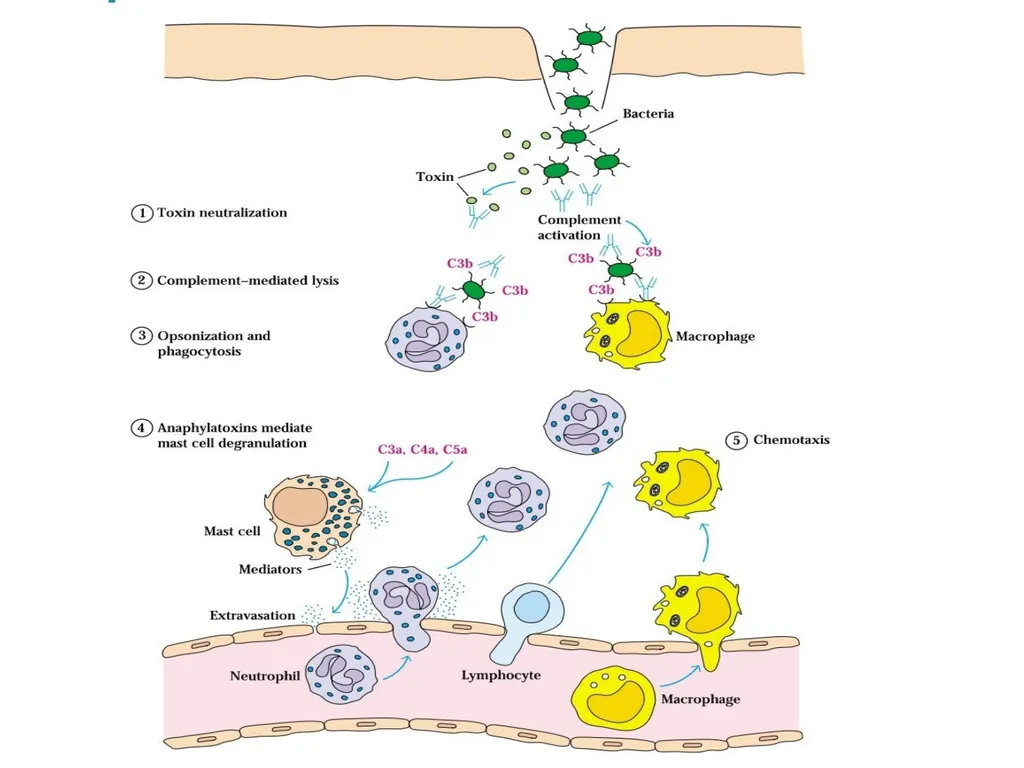
Antibody-mediated mechanisms for combating infection by extracellular bacteria. Antibody neutralizes bacterial toxins.
Complement activation on bacterial surfaces leads to complement-mediated lysis of bacteria.
Antibody and the complement split product C3b bind to bacteria, serving as opsonins to increase phagocytosis.
C3a, C4a, and C5a, generated by antibody initiated complement activation, induce local mast cell degranulation, releasing substances that mediate vasodilation and extravasation of lymphocytes and neutrophils.
Other complement split products are chemotactic for neutrophils and macrophages.<br>