
Implementation of Enhanced Barrier Precautions in


Description: Implementation of Enhanced Barrier Precautions in Nursing Homes to Prevent Spread of Multidrug-resistant Organisms Definitions of Common Terms and Abbreviations Multidrug-resistant Organism (MDRO): bacteria or fungi resistant to multiple
Related Topics
Download Presentation
"Implementation of Enhanced Barrier Precautions in" is the property of its rightful owner. Permission is granted to download and print the materials on this website for personal, non-commercial use only, and to display it on your personal computer provided you do not modify the materials and that you retain all copyright notices contained in the materials. By downloading content from our website, you accept the terms of this agreement.
Presentation Transcript
slide1. Implementation of Enhanced Barrier Precautions in Nursing Homes to Prevent Spread of
Multidrug-resistant Organisms<br>
slide2. Definitions of Common Terms and Abbreviations Multidrug-resistant Organism (MDRO): bacteria or fungi resistant to multiple antimicrobials
Colonization: germ is found on or in the body but is not causing infection<br>
slide3. Presentation Outline Impact and burden of MDROs in nursing homes
Need for Enhanced Barrier Precautions (EBP)
Indications for and use of EBP
How to be successful<br>
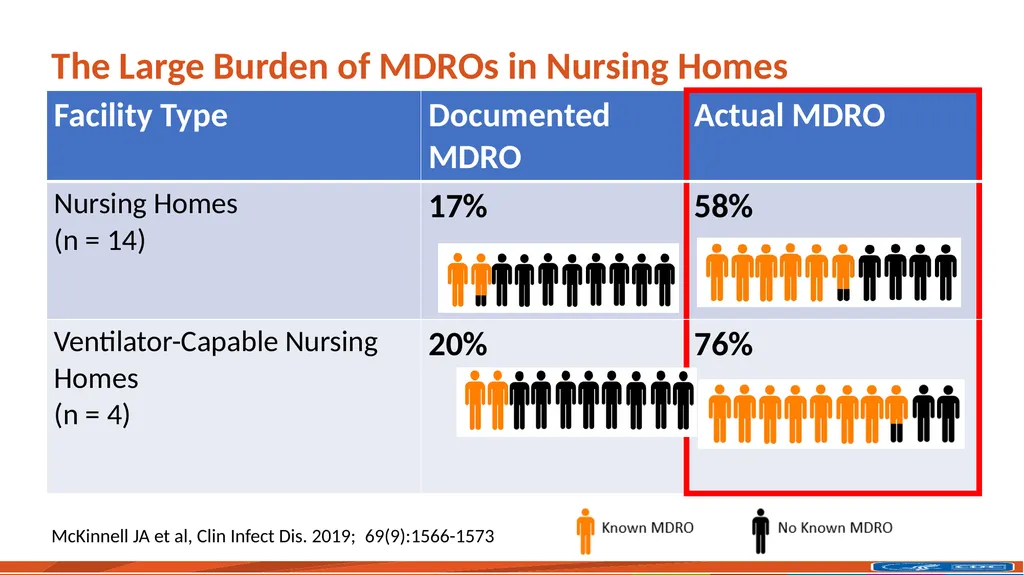
slide4. MDROs Have Significant Impact in Nursing Homes Many nursing home residents are unknowingly colonized with an MDRO, especially residents with risk factors like indwelling medical devices or wounds
Residents who have an MDRO can develop serious infections, remain colonized for long time periods, and spread MDROs to others
Healthcare personnel can spread MDROs through contaminated hands and clothing<br>
slide5. The Large Burden of MDROs in Nursing Homes McKinnell JA et al, Clin Infect Dis. 2019; 69(9):1566-1573<br>
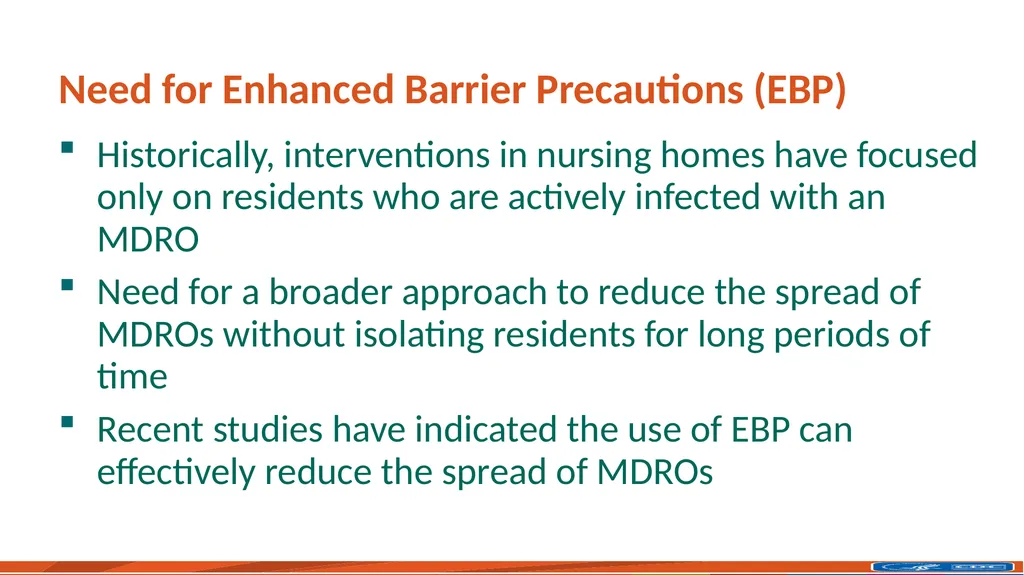
slide6. Need for Enhanced Barrier Precautions (EBP) Historically, interventions in nursing homes have focused only on residents who are actively infected with an MDRO
Need for a broader approach to reduce the spread of MDROs without isolating residents for long periods of time
Recent studies have indicated the use of EBP can effectively reduce the spread of MDROs<br>
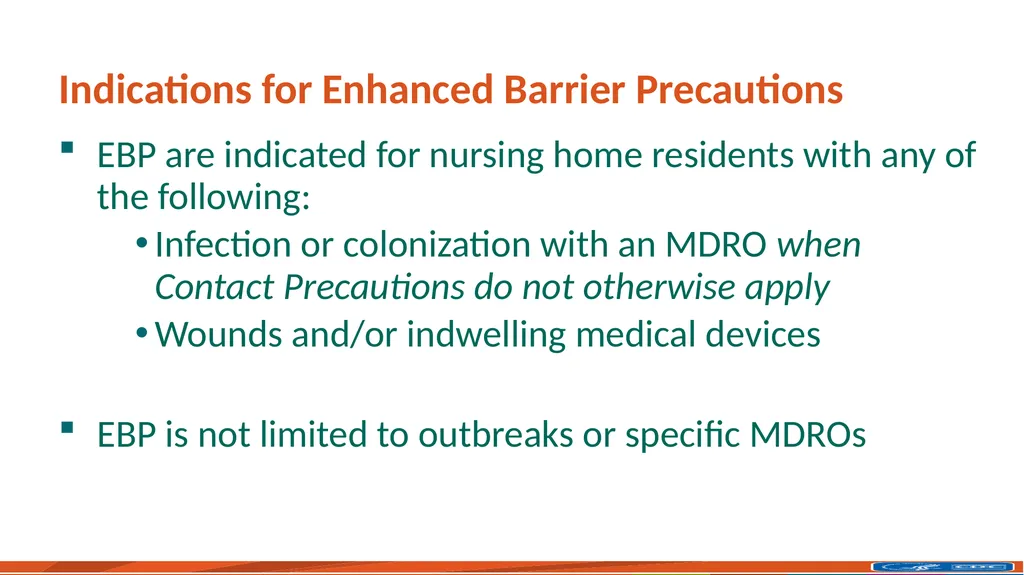
slide7. Indications for Enhanced Barrier Precautions EBP are indicated for nursing home residents with any of the following:
Infection or colonization with an MDRO when Contact Precautions do not otherwise apply
Wounds and/or indwelling medical devices
EBP is not limited to outbreaks or specific MDROs<br>
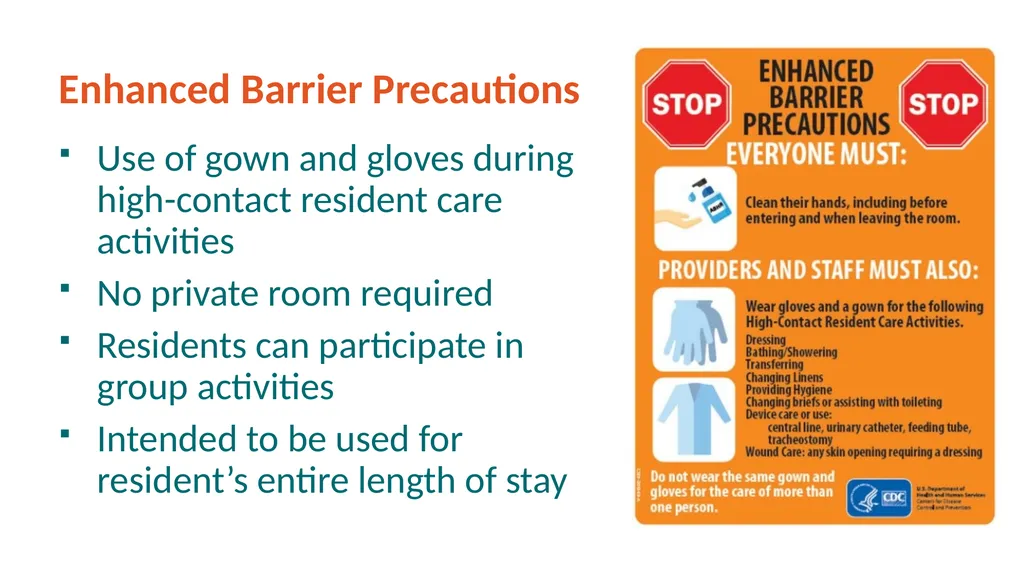
slide8. Enhanced Barrier Precautions Use of gown and gloves during high-contact resident care activities
No private room required
Residents can participate in group activities
Intended to be used for resident’s entire length of stay<br>
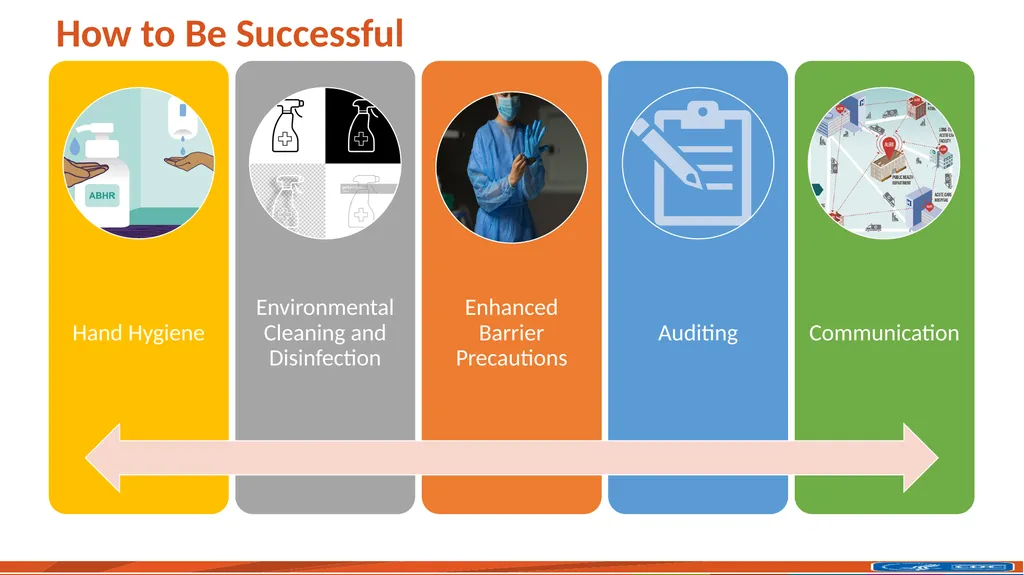
slide9. How to Be Successful<br>
slide10. Resources for Enhanced Barrier Precautions Implementation of Personal Protective Equipment (PPE) Use in Nursing Homes to Prevent Spread of Multidrug-resistant Organisms (MDROs) https://www.cdc.gov/hai/containment/PPE-Nursing-Homes.html
Frequently Asked Questions (FAQs) about Enhanced Barrier Precautions in Nursing Homes https://www.cdc.gov/hai/containment/faqs.html
Considerations for Use of Enhanced Barrier Precautions in Skilled Nursing Facilities
https://www.cdc.gov/hicpac/workgroup/EnhancedBarrierPrecautions.html?msclkid=39038417aed311ec8c868e1e03c50297
Enhanced Barrier Precautions Letter to Nursing Home Residents, Families, Friends, and Volunteers https://www.cdc.gov/hai/pdfs/containment/Letter-Nursing-Home-Residents-Families-Friends.pdf
Enhanced Barrier Precautions Letter to Nursing Home Staff https://www.cdc.gov/hai/pdfs/containment/Letter-Nursing-Home-Staff.pdf<br>
slide11. Thank you.<br>
slide12. Optional Q&A<br>
slide13. Question #1: Which residents should be placed into Enhanced Barrier Precautions? EBP are indicated for nursing home residents with any of the following:
Infection or colonization with an MDRO when Contact Precautions do not otherwise apply
Wounds and/or indwelling medical devices<br>
slide14. Question #2: Which activities are included under "providing hygiene"? Providing hygiene refers to practices such as brushing teeth, combing hair, and shaving
Many of the high-contact resident care activities listed in the guidance are commonly bundled as part of morning and evening care for the resident rather than occurring as multiple isolated interactions with the resident throughout the day
Isolated combing of a resident’s hair that is not otherwise bundled with other high-contact resident care activities would not generally necessitate use of a gown and gloves<br>
slide15. Question #3: The guidance advises using EBP for the “care and use” of indwelling medical devices. What does that mean? The safest practice would be to wear a gown and gloves for any care (e.g., dressing changes) or use (e.g., injecting or infusing medications or tube feeds) of the indwelling medical device
It may be acceptable to use gloves alone for some uses of a medical device that involves only limited physical contact between healthcare worker and resident (e.g., passing meds through a feeding tube)
Facilities should define these limited contact activities in their policies and procedures and educate healthcare personnel to ensure consistent application of Enhanced Barrier Precautions<br>
slide16. Question #4: What is the definition of “indwelling medical device”? An indwelling medical device provides a direct pathway for pathogens in the environment to enter the body and cause infection
Examples include, but are not limited to, central vascular lines (including hemodialysis catheters), indwelling urinary catheters, feeding tubes, and tracheostomy tubes
Devices that are fully embedded in the body, without components that communicate with the outside, such as pacemakers, would not be considered an indication for Enhanced Barrier Precautions<br>
slide17. Question #5: Are gowns and gloves recommended for EBP when transferring a resident from a wheelchair to chair in the dayroom or dining room? In general, gowns and gloves would not be recommended when performing transfers in common areas such as dining or activity rooms, where contact is anticipated to be shorter in duration
Outside the resident’s rooms, EBP should be followed when performing transfers or assisting during bathing in a shared/common shower room and when working with residents in the therapy gym, specifically when anticipating close physical contact while assisting with transfers and mobility<br>
slide2. Definitions of Common Terms and Abbreviations Multidrug-resistant Organism (MDRO): bacteria or fungi resistant to multiple antimicrobials
Colonization: germ is found on or in the body but is not causing infection<br>
slide3. Presentation Outline Impact and burden of MDROs in nursing homes
Need for Enhanced Barrier Precautions (EBP)
Indications for and use of EBP
How to be successful<br>
slide4. MDROs Have Significant Impact in Nursing Homes Many nursing home residents are unknowingly colonized with an MDRO, especially residents with risk factors like indwelling medical devices or wounds
Residents who have an MDRO can develop serious infections, remain colonized for long time periods, and spread MDROs to others
Healthcare personnel can spread MDROs through contaminated hands and clothing<br>
slide5. The Large Burden of MDROs in Nursing Homes McKinnell JA et al, Clin Infect Dis. 2019; 69(9):1566-1573<br>
slide6. Need for Enhanced Barrier Precautions (EBP) Historically, interventions in nursing homes have focused only on residents who are actively infected with an MDRO
Need for a broader approach to reduce the spread of MDROs without isolating residents for long periods of time
Recent studies have indicated the use of EBP can effectively reduce the spread of MDROs<br>
slide7. Indications for Enhanced Barrier Precautions EBP are indicated for nursing home residents with any of the following:
Infection or colonization with an MDRO when Contact Precautions do not otherwise apply
Wounds and/or indwelling medical devices
EBP is not limited to outbreaks or specific MDROs<br>
slide8. Enhanced Barrier Precautions Use of gown and gloves during high-contact resident care activities
No private room required
Residents can participate in group activities
Intended to be used for resident’s entire length of stay<br>
slide9. How to Be Successful<br>
slide10. Resources for Enhanced Barrier Precautions Implementation of Personal Protective Equipment (PPE) Use in Nursing Homes to Prevent Spread of Multidrug-resistant Organisms (MDROs) https://www.cdc.gov/hai/containment/PPE-Nursing-Homes.html
Frequently Asked Questions (FAQs) about Enhanced Barrier Precautions in Nursing Homes https://www.cdc.gov/hai/containment/faqs.html
Considerations for Use of Enhanced Barrier Precautions in Skilled Nursing Facilities
https://www.cdc.gov/hicpac/workgroup/EnhancedBarrierPrecautions.html?msclkid=39038417aed311ec8c868e1e03c50297
Enhanced Barrier Precautions Letter to Nursing Home Residents, Families, Friends, and Volunteers https://www.cdc.gov/hai/pdfs/containment/Letter-Nursing-Home-Residents-Families-Friends.pdf
Enhanced Barrier Precautions Letter to Nursing Home Staff https://www.cdc.gov/hai/pdfs/containment/Letter-Nursing-Home-Staff.pdf<br>
slide11. Thank you.<br>
slide12. Optional Q&A<br>
slide13. Question #1: Which residents should be placed into Enhanced Barrier Precautions? EBP are indicated for nursing home residents with any of the following:
Infection or colonization with an MDRO when Contact Precautions do not otherwise apply
Wounds and/or indwelling medical devices<br>
slide14. Question #2: Which activities are included under "providing hygiene"? Providing hygiene refers to practices such as brushing teeth, combing hair, and shaving
Many of the high-contact resident care activities listed in the guidance are commonly bundled as part of morning and evening care for the resident rather than occurring as multiple isolated interactions with the resident throughout the day
Isolated combing of a resident’s hair that is not otherwise bundled with other high-contact resident care activities would not generally necessitate use of a gown and gloves<br>
slide15. Question #3: The guidance advises using EBP for the “care and use” of indwelling medical devices. What does that mean? The safest practice would be to wear a gown and gloves for any care (e.g., dressing changes) or use (e.g., injecting or infusing medications or tube feeds) of the indwelling medical device
It may be acceptable to use gloves alone for some uses of a medical device that involves only limited physical contact between healthcare worker and resident (e.g., passing meds through a feeding tube)
Facilities should define these limited contact activities in their policies and procedures and educate healthcare personnel to ensure consistent application of Enhanced Barrier Precautions<br>
slide16. Question #4: What is the definition of “indwelling medical device”? An indwelling medical device provides a direct pathway for pathogens in the environment to enter the body and cause infection
Examples include, but are not limited to, central vascular lines (including hemodialysis catheters), indwelling urinary catheters, feeding tubes, and tracheostomy tubes
Devices that are fully embedded in the body, without components that communicate with the outside, such as pacemakers, would not be considered an indication for Enhanced Barrier Precautions<br>
slide17. Question #5: Are gowns and gloves recommended for EBP when transferring a resident from a wheelchair to chair in the dayroom or dining room? In general, gowns and gloves would not be recommended when performing transfers in common areas such as dining or activity rooms, where contact is anticipated to be shorter in duration
Outside the resident’s rooms, EBP should be followed when performing transfers or assisting during bathing in a shared/common shower room and when working with residents in the therapy gym, specifically when anticipating close physical contact while assisting with transfers and mobility<br>