04
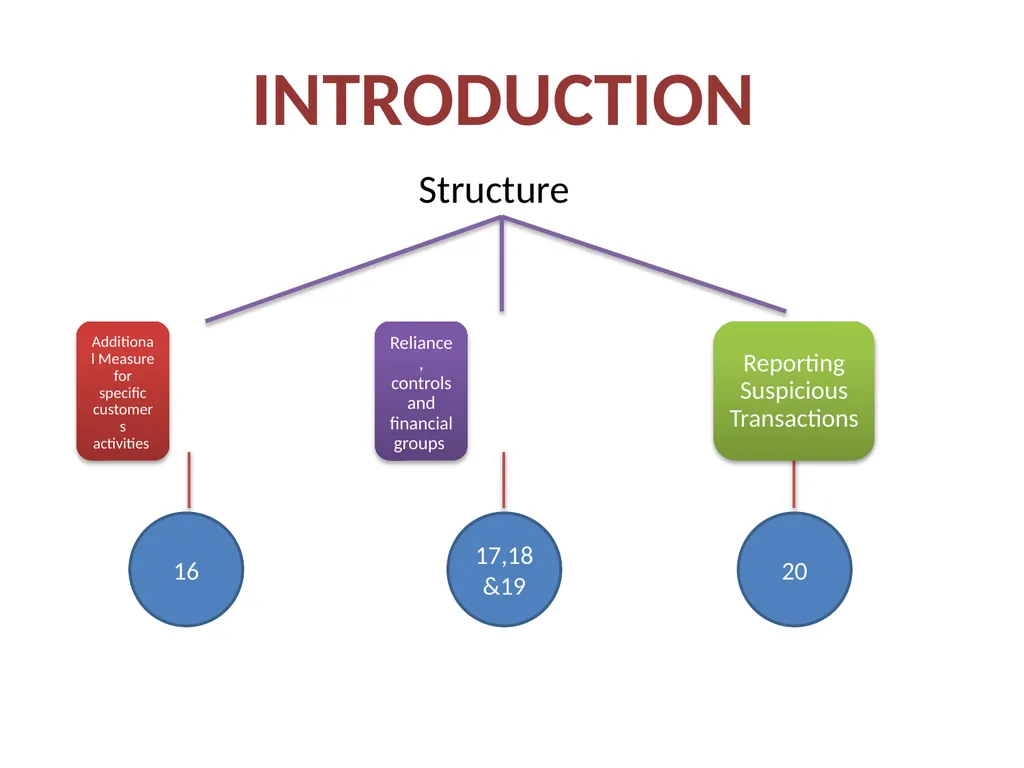
RECOMMENDATION 16 Wire Transfer
(Regulation 23)<br>
05
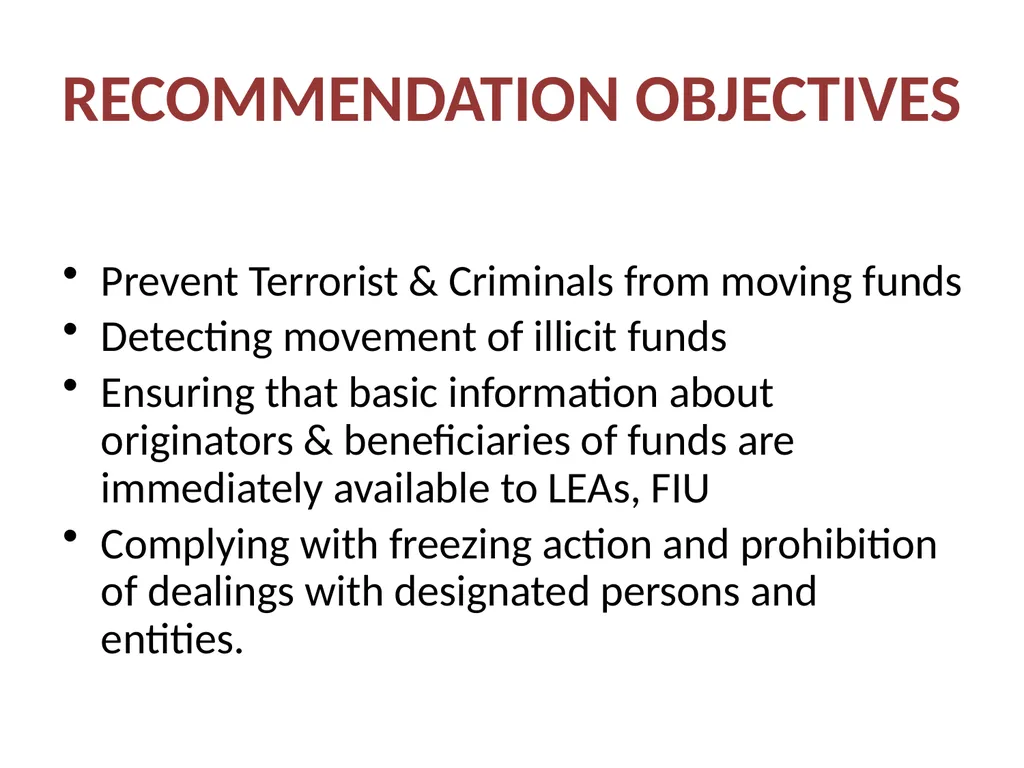
RECOMMENDATION OBJECTIVES Prevent Terrorist & Criminals from moving funds
Detecting movement of illicit funds
Ensuring that basic information about originators & beneficiaries of funds are immediately available to LEAs, FIU
Complying with freezing action and prohibition of dealings with designated persons and entities.<br>
06
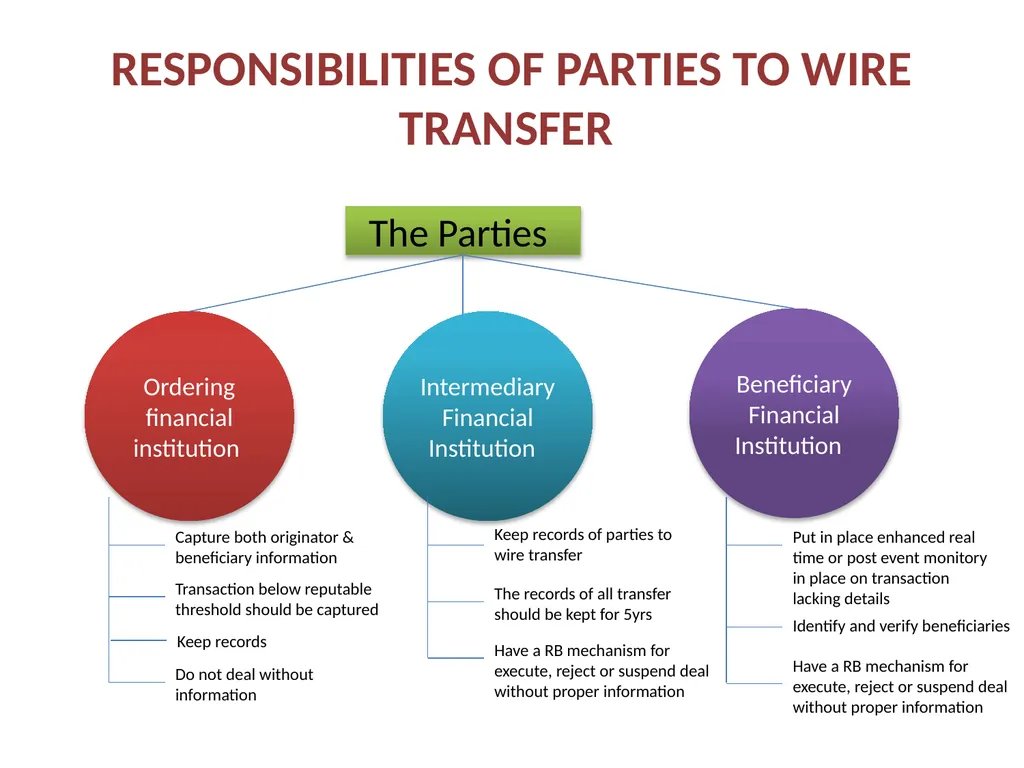
RESPONSIBILITIES OF PARTIES TO WIRE TRANSFER The Parties Ordering financial institution Intermediary Financial Institution Beneficiary Financial Institution Capture both originator & beneficiary information Transaction below reputable threshold should be captured Keep records Do not deal without information Keep records of parties to wire transfer The records of all transfer should be kept for 5yrs Have a RB mechanism for execute, reject or suspend deal without proper information Put in place enhanced real time or post event monitory in place on transaction lacking details Identify and verify beneficiaries Have a RB mechanism for execute, reject or suspend deal without proper information<br>
07
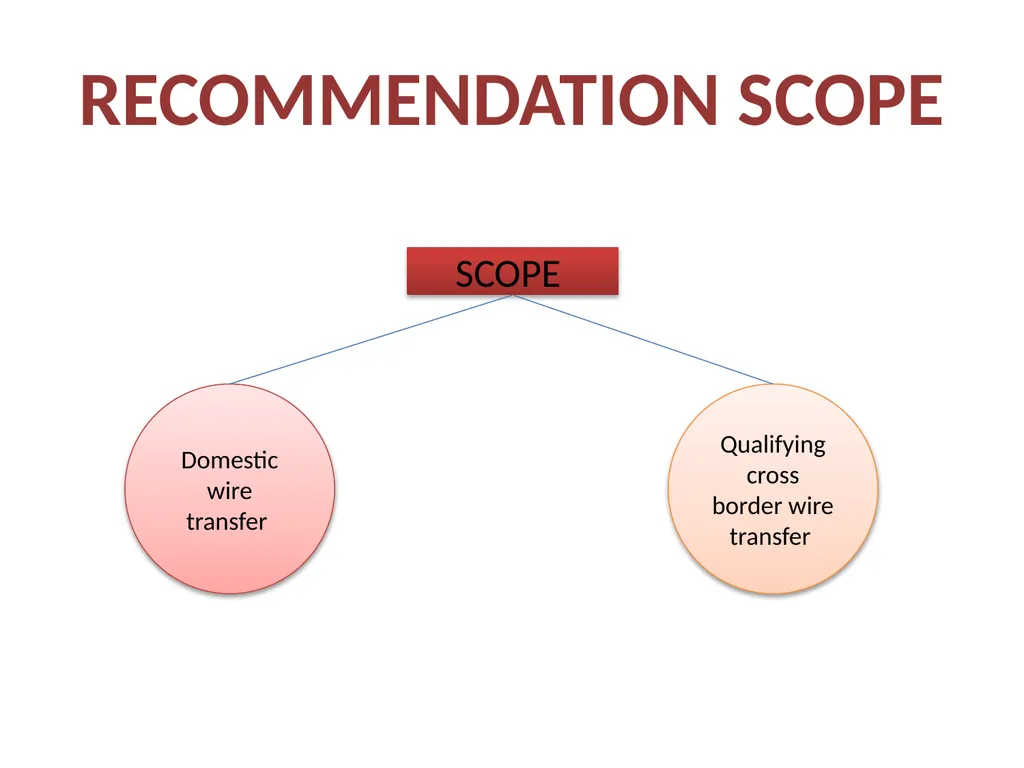
RECOMMENDATION SCOPE SCOPE Domestic wire transfer Qualifying cross border wire transfer<br>
08
DOMESTIC WIRE TRANSFER Capture originator information
Account number
Transaction reference number
Information should be made available on request or within a maximum period of (3) working days to:
Beneficiary financial institutions
Statutory bodies
LEAs<br>
09
QUALIFYING CROSS BORDER WIRE TRANSFER Capture name of the originator
Capture account number if used to process transaction
Capture identification details
Capture name of beneficiary
Capture account number of beneficiary if used<br>
10
LIMITATION TO WIRE TRANSFER Purchases transaction involving debit/credit/prepaid card accompanied by card numbers
Financial institution to financial institutions<br>
11
REGULATORY FRAMEWORK (REG. 23) Get originator info
File STR to NFIU where info is not available
Restrict/terminate relationship with originator financial institution that fail to meet standard<br>
12
RECOMMENDATION 17 Reliance on third party
Regulation 28<br>
13
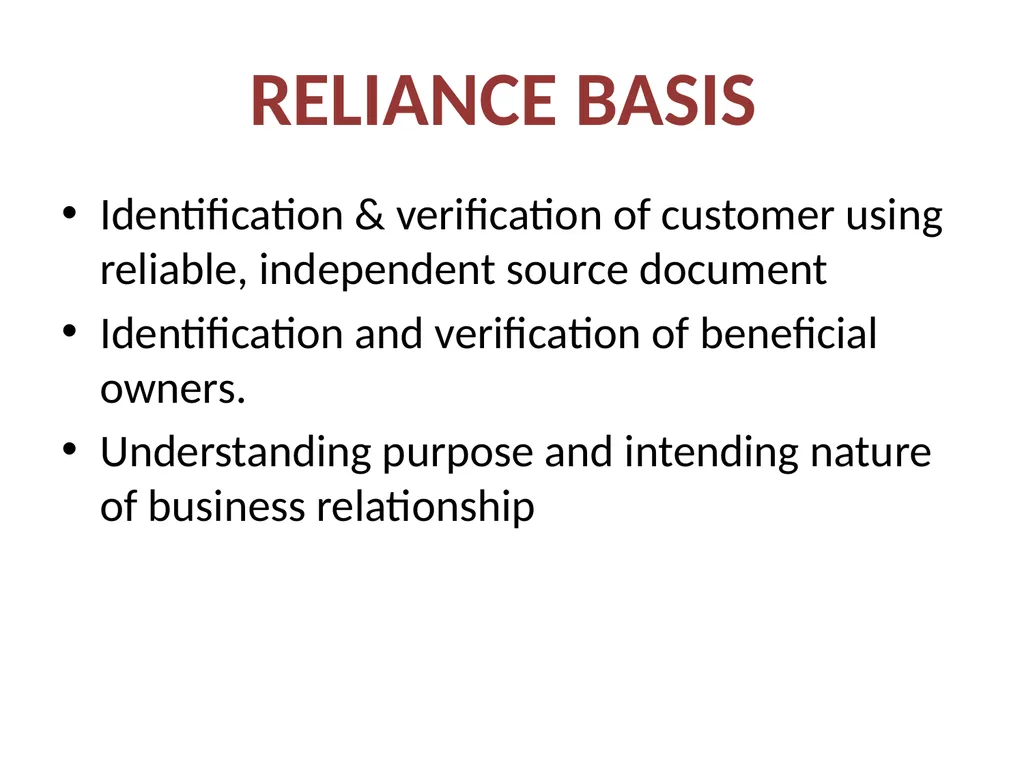
RELIANCE BASIS Identification & verification of customer using reliable, independent source document
Identification and verification of beneficial owners.
Understanding purpose and intending nature of business relationship<br>
14
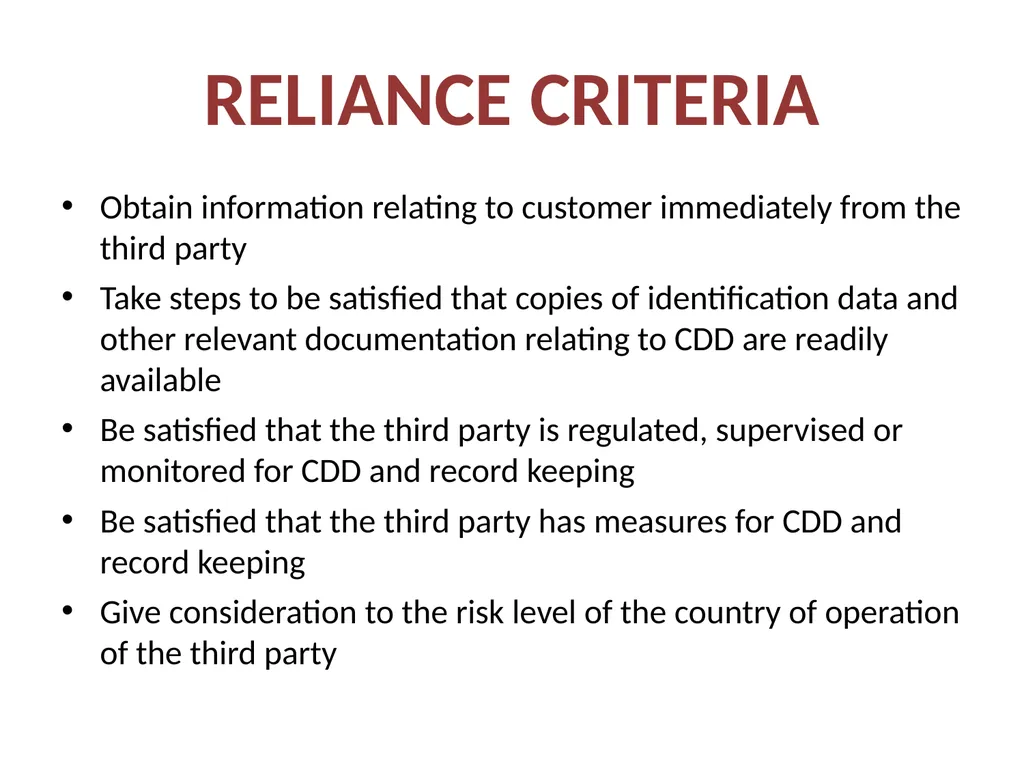
RELIANCE CRITERIA Obtain information relating to customer immediately from the third party
Take steps to be satisfied that copies of identification data and other relevant documentation relating to CDD are readily available
Be satisfied that the third party is regulated, supervised or monitored for CDD and record keeping
Be satisfied that the third party has measures for CDD and record keeping
Give consideration to the risk level of the country of operation of the third party<br>
15
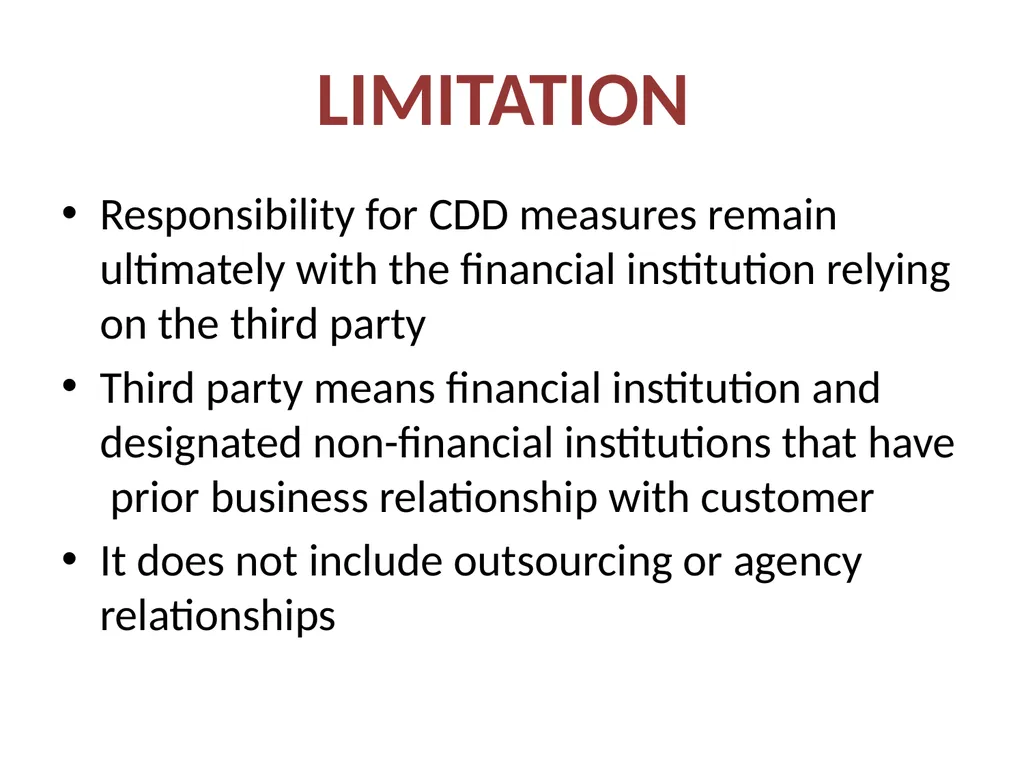
LIMITATION Responsibility for CDD measures remain ultimately with the financial institution relying on the third party
Third party means financial institution and designated non-financial institutions that have prior business relationship with customer
It does not include outsourcing or agency relationships<br>
16
RECOMMENDATION 18 Internal Controls and Foreign Branches and Subsidiaries<br>
17
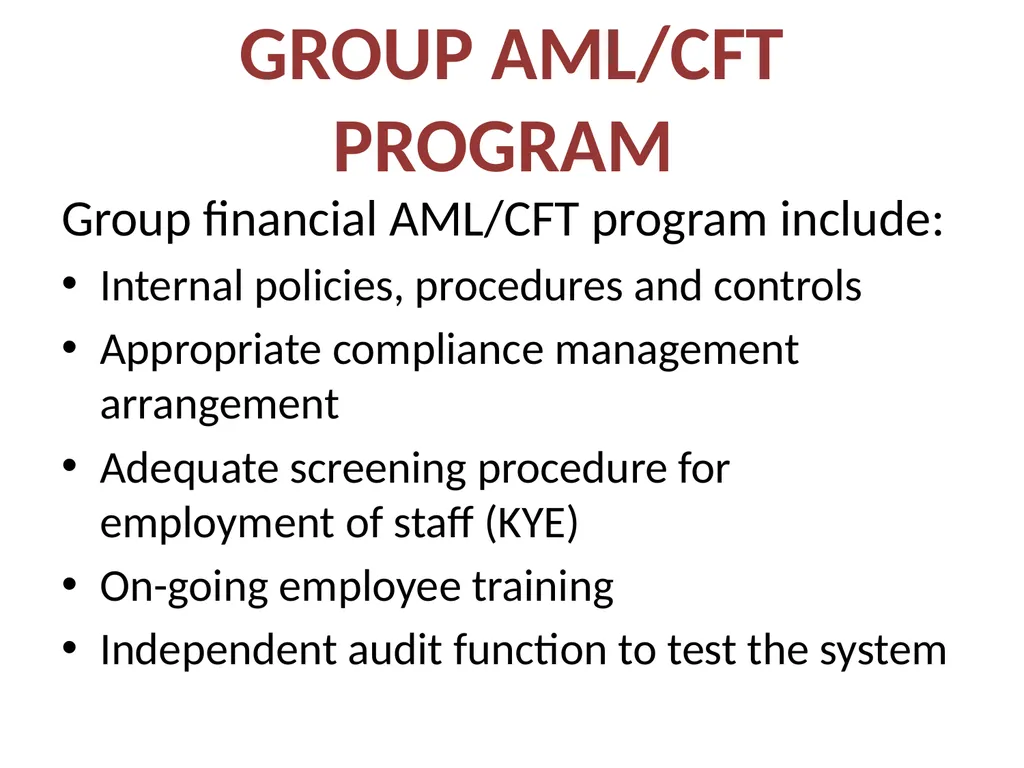
GROUP AML/CFT PROGRAM Group financial AML/CFT program include:
Internal policies, procedures and controls
Appropriate compliance management arrangement
Adequate screening procedure for employment of staff (KYE)
On-going employee training
Independent audit function to test the system<br>
19
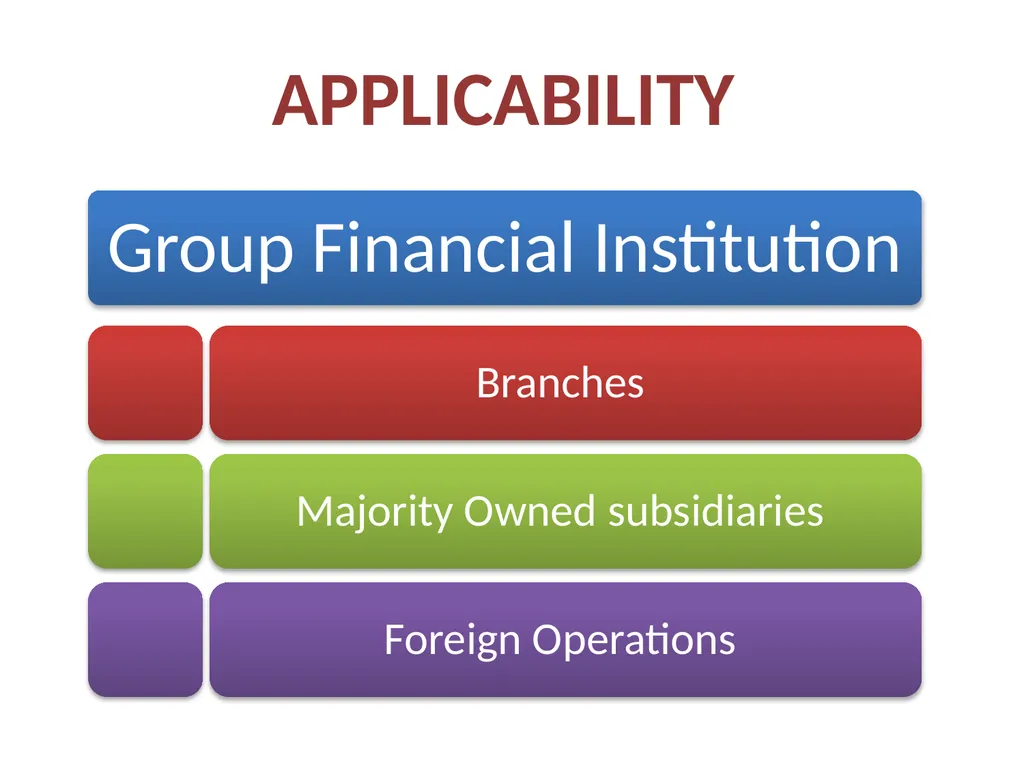
BRANCHES & MAJORITY-OWNED SUBSIDIARIES AML/CFT programs should be made applicable to all branches and subsidiaries
Implementation of the AML/CFT programs should be effective
The program should include policies & procedure for sharing CDD and risk management information.
Safeguards on the confidentiality of information should be put in place<br>
20
FOREIGN OPERATIONS Home country FIs should export their AML/CFT to Host country FIs where host country is less strict.
Implementation should be subject to host country’s extent of permission
Where proper implementation is not possible in host countries, additional measures should be taken and home supervisors should be informed of ML/TF risks<br>
21
RECOMMENDATION 19 Higher Risk Countries<br>
22
FRAMEWORK FIs to apply EDD to business relationships in higher risk countries. This is applicable to relationship involving:
Natural person
Legal persons
Financial institutions.
Countries to also apply countermeasures to Higher risk countries
The application of the measures will be at the instance of FATF<br>
23
HIGHER RISK COUNTRIES Identified by credible sources (i.e. mutual evaluation reports) as having inadequate AML/CFT systems
Countries subject to sanctions, embargoes or similar measures issued by, for example, United Nations
Countries identified by credible sources having significant levels of corruptions or other criminal activity.
Countries identified by credible sources as supporting or have designated terrorist organisation operating within its territories<br>
24
EDD MEASURES Obtain additional information on the customer using public database and internet
Update customer and beneficial owner identification regularly
Obtain additional information on intended nature of business relationship
Obtain information on the source of funds and source of wealth of the customer
Obtain information on the reason for intended or performed transaction
Obtain Senior Management Approval to commence or continue relationship
Conduct enhanced monitoring of the business relationship by increasing timing of controls and setting of patterns of transaction requiring further examination
Requesting first payment to be made through an account in customers name with a bank subject to similar CDD measures<br>
25
COUNTERMEASURES BY COUNTRIES Financial institutions to apply specific EDD measures
Introducing specific reporting mechanisms
Refusing to have branch/subsidiaries in such jurisdiction and taking cognisance of ML/TF risk level in dealing with FIs in such jurisdiction
Linking business relationship with the identified country/persons
Not relying on third party for CDD procedures
Review, amend or terminate correspondence relationship
Increased monitoring of activities on branches and subsidiaries
Increased external audit of branches/subsidiaries operating in identified country.<br>
26
RECOMMENDATION 20 Reporting of Suspicious Transactions
(Section 15 MLPA 2011, (As Amended)
Regulation 31 of CBN, AML/CFT Regulation 2013<br>
27
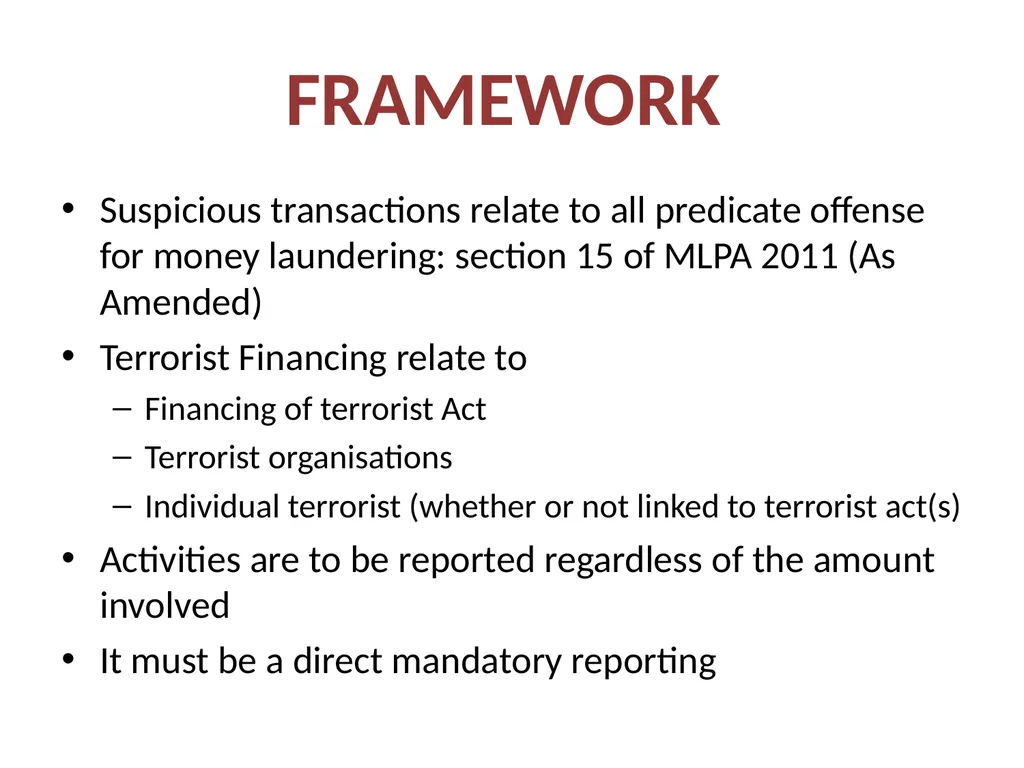
FRAMEWORK Suspicious transactions relate to all predicate offense for money laundering: section 15 of MLPA 2011 (As Amended)
Terrorist Financing relate to
Financing of terrorist Act
Terrorist organisations
Individual terrorist (whether or not linked to terrorist act(s)
Activities are to be reported regardless of the amount involved
It must be a direct mandatory reporting<br>
28
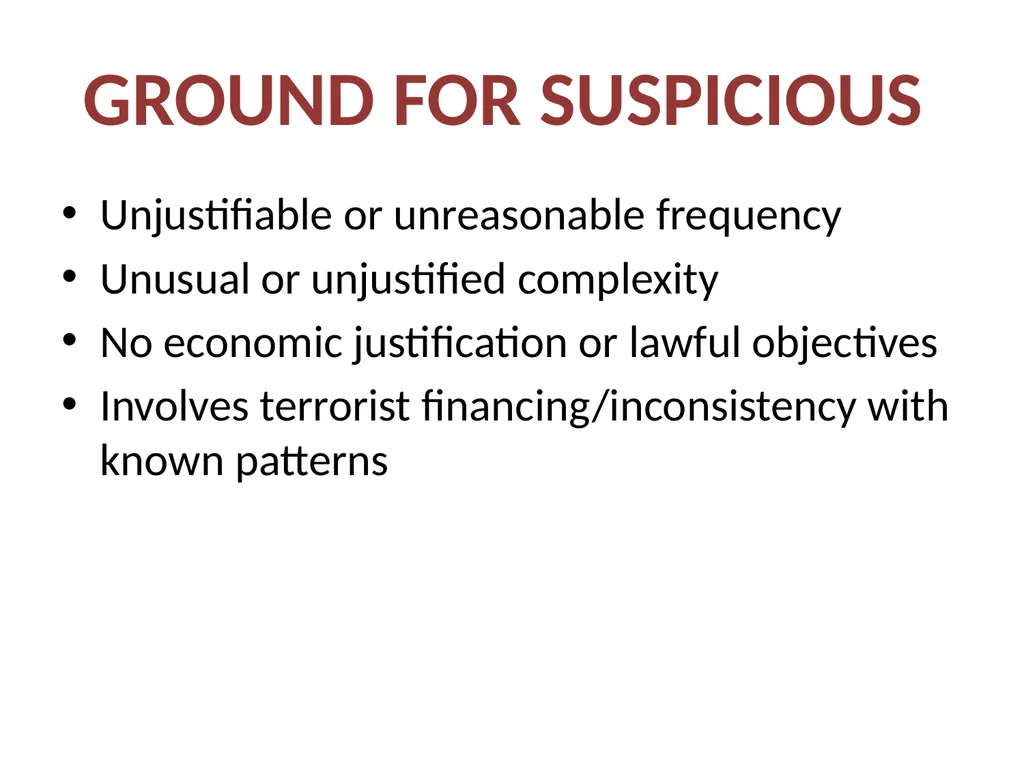
GROUND FOR SUSPICIOUS Unjustifiable or unreasonable frequency
Unusual or unjustified complexity
No economic justification or lawful objectives
Involves terrorist financing/inconsistency with known patterns<br>
29
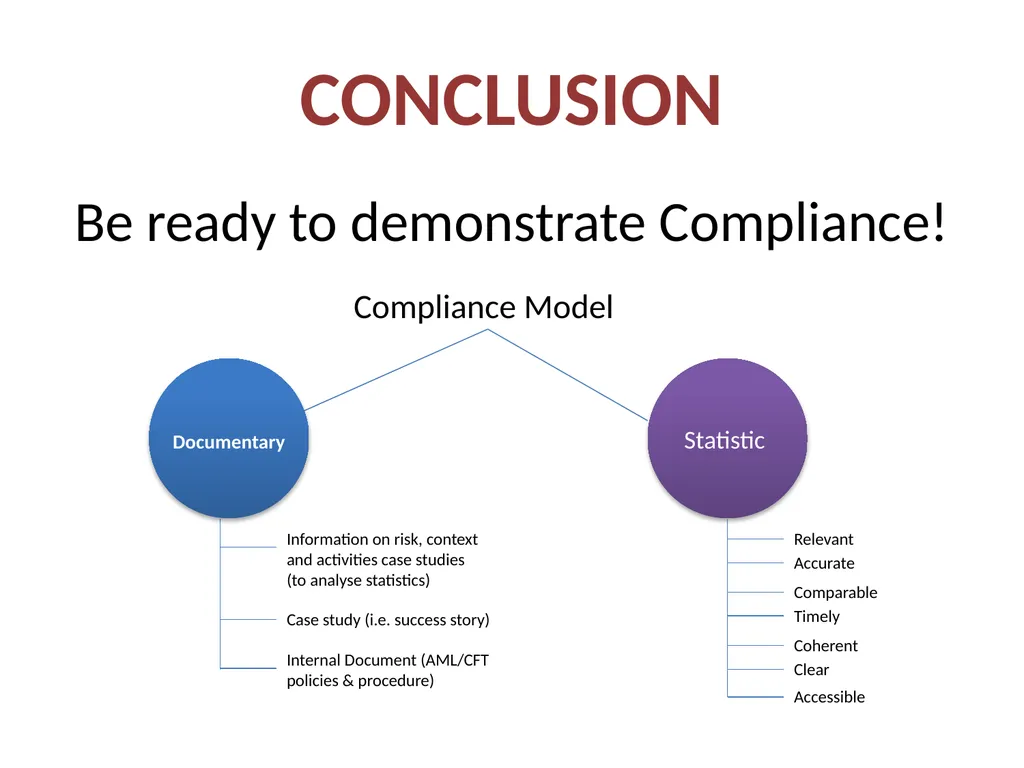
CONCLUSION Be ready to demonstrate Compliance! Compliance Model Statistic Information on risk, context and activities case studies (to analyse statistics) Case study (i.e. success story) Internal Document (AML/CFT policies & procedure) Documentary Relevant Accurate Comparable Timely Coherent Clear Accessible<br>