
Important information for Clinical faculty April
CP
Published · 46 slides · 0 views
1 / 1



Description
Important information for Clinical faculty April O. Buchanan, MD Associate dean for curriculum Content Overview of UofSC School of Medicine Greenville Brief Overview of M3 and M4 Years Program Level Objectives, Course Objectives, and
Related Topics
Share
Embed code
Download this presentation From Below
"Important information for Clinical faculty April" is the property of its rightful owner. Permission is granted to download and print the materials on this website for personal, non-commercial use only, and to display it on your personal computer provided you do not modify the materials and that you retain all copyright notices contained in the materials. By downloading content from our website, you accept the terms of this agreement.
Presentation Transcript
01
Important information for Clinical faculty
April O. Buchanan, MD
Associate dean for curriculum<br>
April O. Buchanan, MD
Associate dean for curriculum<br>
02
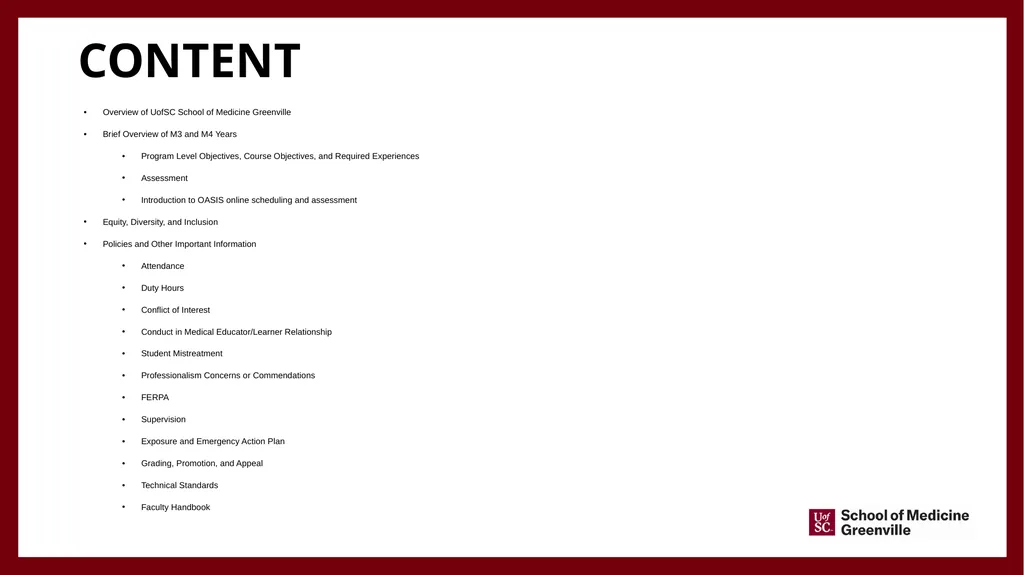
Content Overview of UofSC School of Medicine Greenville
Brief Overview of M3 and M4 Years
Program Level Objectives, Course Objectives, and Required Experiences
Assessment
Introduction to OASIS online scheduling and assessment
Equity, Diversity, and Inclusion
Policies and Other Important Information
Attendance
Duty Hours
Conflict of Interest
Conduct in Medical Educator/Learner Relationship
Student Mistreatment
Professionalism Concerns or Commendations
FERPA
Supervision
Exposure and Emergency Action Plan
Grading, Promotion, and Appeal
Technical Standards
Faculty Handbook<br>
Brief Overview of M3 and M4 Years
Program Level Objectives, Course Objectives, and Required Experiences
Assessment
Introduction to OASIS online scheduling and assessment
Equity, Diversity, and Inclusion
Policies and Other Important Information
Attendance
Duty Hours
Conflict of Interest
Conduct in Medical Educator/Learner Relationship
Student Mistreatment
Professionalism Concerns or Commendations
FERPA
Supervision
Exposure and Emergency Action Plan
Grading, Promotion, and Appeal
Technical Standards
Faculty Handbook<br>
03
Our vision Cultivate a Culture of Curiosity and
Commitment to others
to Transform the Health and Wellness of
Communities<br>
Commitment to others
to Transform the Health and Wellness of
Communities<br>
04
Our mission We prepare physicians committed to improving the health and wellness of your family and your community through creative teaching, innovative research and quality clinical care.<br>
05
Office for Academic Affairs Senior Associate Dean for Academic Affairs
Angela Sharkey, MD Associate Dean for Curriculum
April Buchanan, MD Manager of Academic Affairs and Clinical Education
Anne Green Buckner
M3 Curriculum Coordinator M4 Curriculum Coordinator
Theresa Baultrippe Shannon Ruppel<br>
Angela Sharkey, MD Associate Dean for Curriculum
April Buchanan, MD Manager of Academic Affairs and Clinical Education
Anne Green Buckner
M3 Curriculum Coordinator M4 Curriculum Coordinator
Theresa Baultrippe Shannon Ruppel<br>
06
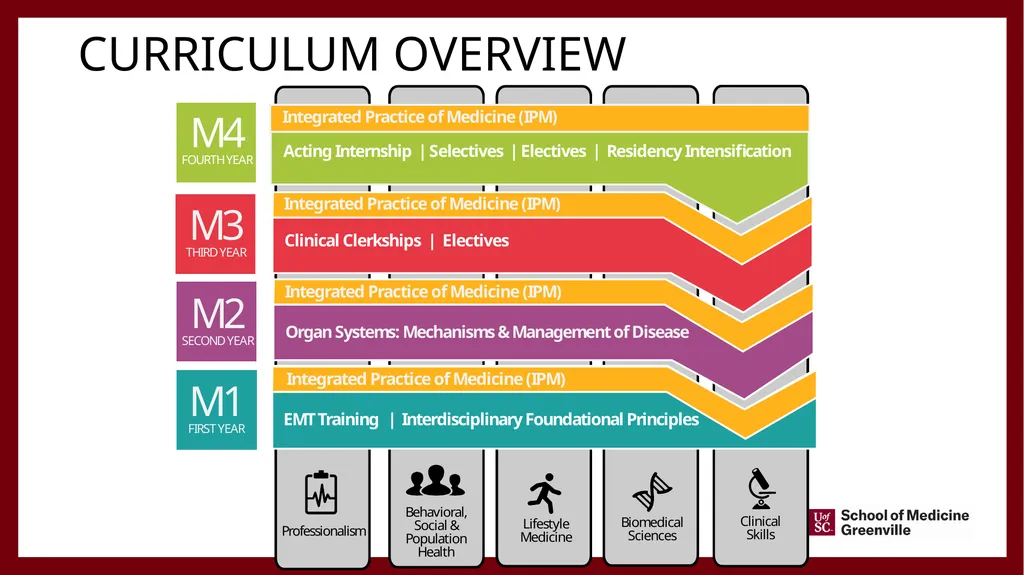
Curriculum overview<br>
07
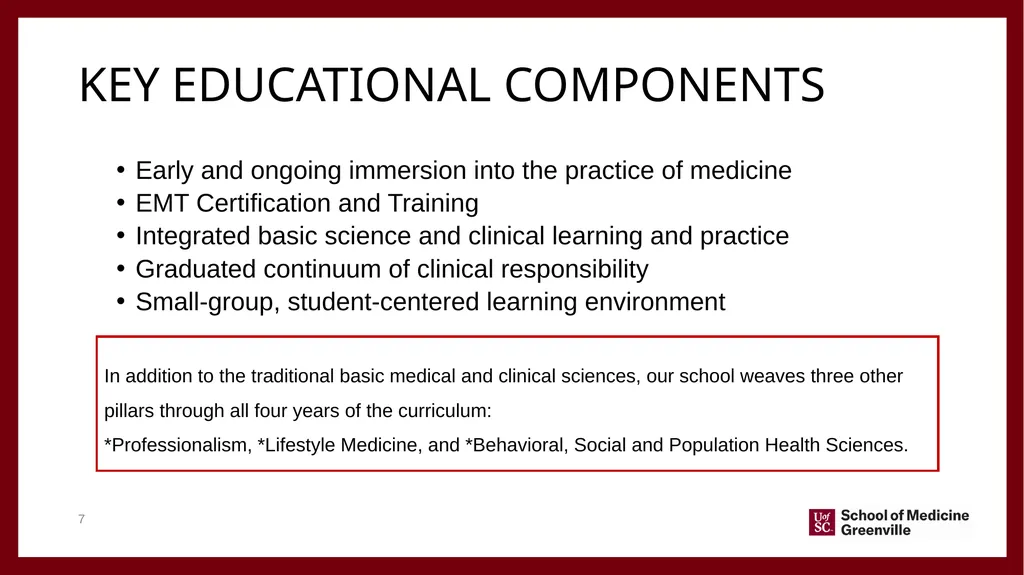
Key educational components Early and ongoing immersion into the practice of medicine
EMT Certification and Training
Integrated basic science and clinical learning and practice
Graduated continuum of clinical responsibility
Small-group, student-centered learning environment 7 In addition to the traditional basic medical and clinical sciences, our school weaves three other pillars through all four years of the curriculum:
*Professionalism, *Lifestyle Medicine, and *Behavioral, Social and Population Health Sciences.<br>
EMT Certification and Training
Integrated basic science and clinical learning and practice
Graduated continuum of clinical responsibility
Small-group, student-centered learning environment 7 In addition to the traditional basic medical and clinical sciences, our school weaves three other pillars through all four years of the curriculum:
*Professionalism, *Lifestyle Medicine, and *Behavioral, Social and Population Health Sciences.<br>
08
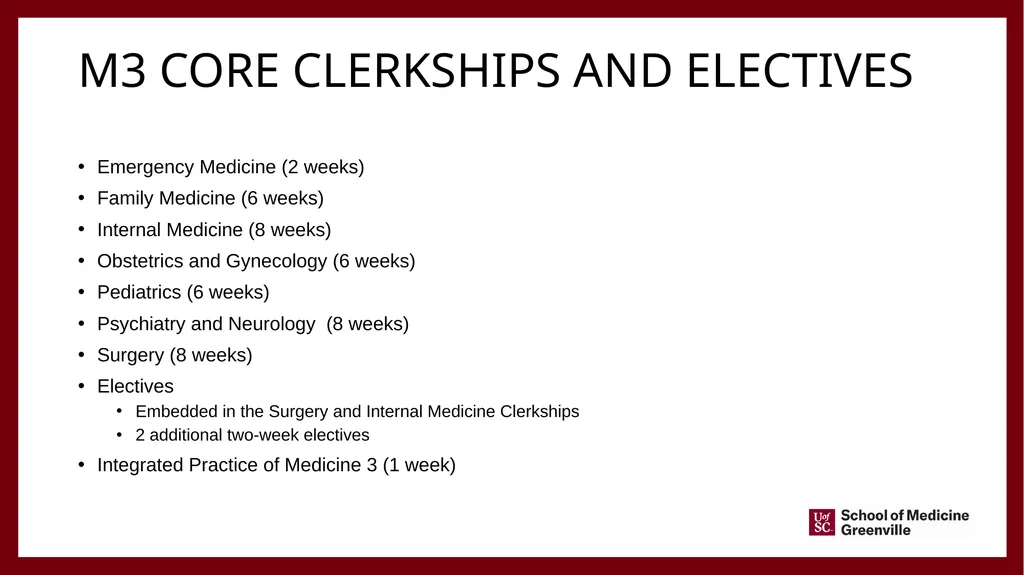
M3 Core clerkships and electives Emergency Medicine (2 weeks)
Family Medicine (6 weeks)
Internal Medicine (8 weeks)
Obstetrics and Gynecology (6 weeks)
Pediatrics (6 weeks)
Psychiatry and Neurology (8 weeks)
Surgery (8 weeks)
Electives
Embedded in the Surgery and Internal Medicine Clerkships
2 additional two-week electives
Integrated Practice of Medicine 3 (1 week)<br>
Family Medicine (6 weeks)
Internal Medicine (8 weeks)
Obstetrics and Gynecology (6 weeks)
Pediatrics (6 weeks)
Psychiatry and Neurology (8 weeks)
Surgery (8 weeks)
Electives
Embedded in the Surgery and Internal Medicine Clerkships
2 additional two-week electives
Integrated Practice of Medicine 3 (1 week)<br>
09
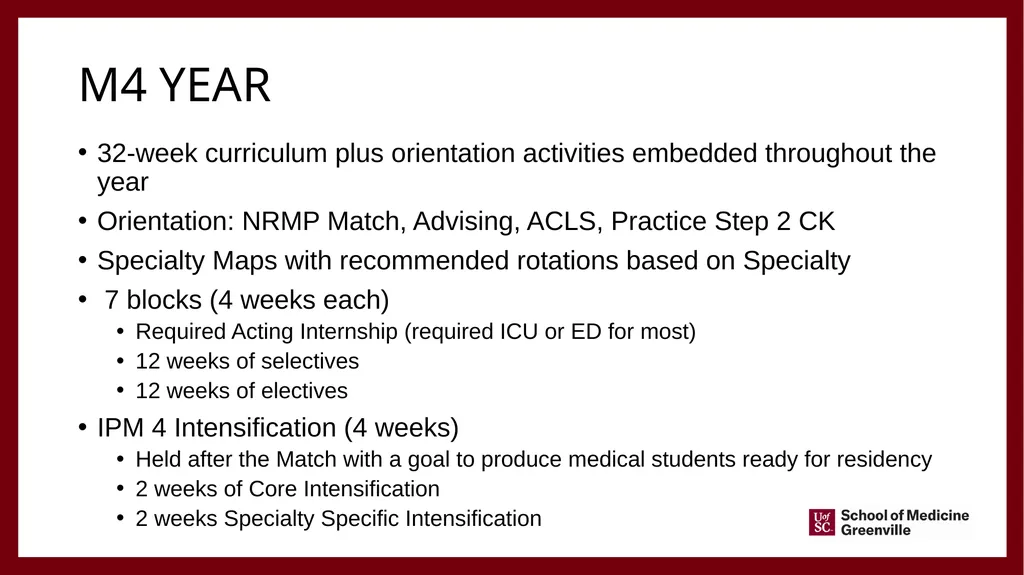
M4 year 32-week curriculum plus orientation activities embedded throughout the year
Orientation: NRMP Match, Advising, ACLS, Practice Step 2 CK
Specialty Maps with recommended rotations based on Specialty
7 blocks (4 weeks each)
Required Acting Internship (required ICU or ED for most)
12 weeks of selectives
12 weeks of electives
IPM 4 Intensification (4 weeks)
Held after the Match with a goal to produce medical students ready for residency
2 weeks of Core Intensification
2 weeks Specialty Specific Intensification<br>
Orientation: NRMP Match, Advising, ACLS, Practice Step 2 CK
Specialty Maps with recommended rotations based on Specialty
7 blocks (4 weeks each)
Required Acting Internship (required ICU or ED for most)
12 weeks of selectives
12 weeks of electives
IPM 4 Intensification (4 weeks)
Held after the Match with a goal to produce medical students ready for residency
2 weeks of Core Intensification
2 weeks Specialty Specific Intensification<br>
10
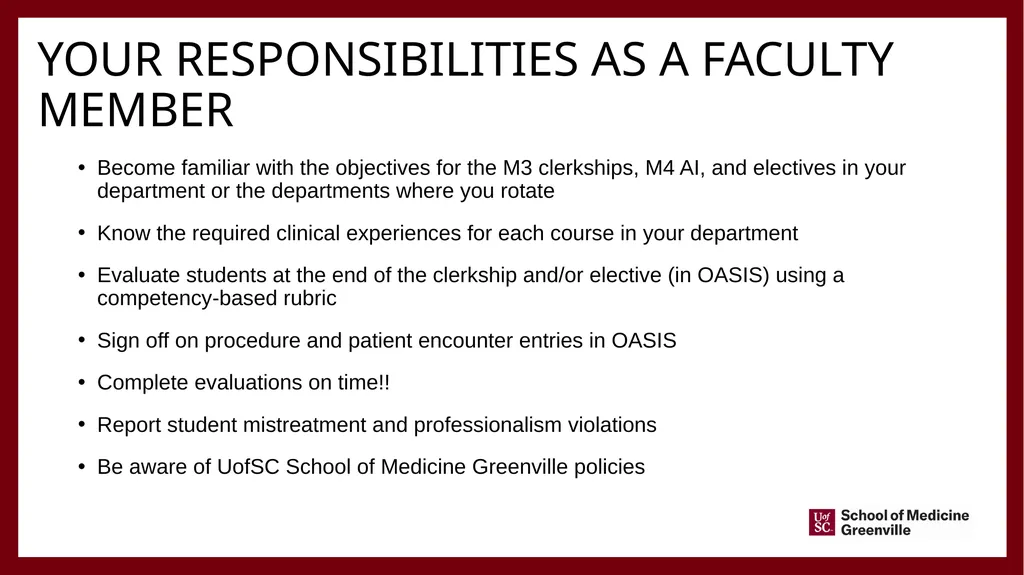
Your responsibilities as a faculty member Become familiar with the objectives for the M3 clerkships, M4 AI, and electives in your department or the departments where you rotate
Know the required clinical experiences for each course in your department
Evaluate students at the end of the clerkship and/or elective (in OASIS) using a competency-based rubric
Sign off on procedure and patient encounter entries in OASIS
Complete evaluations on time!!
Report student mistreatment and professionalism violations
Be aware of UofSC School of Medicine Greenville policies<br>
Know the required clinical experiences for each course in your department
Evaluate students at the end of the clerkship and/or elective (in OASIS) using a competency-based rubric
Sign off on procedure and patient encounter entries in OASIS
Complete evaluations on time!!
Report student mistreatment and professionalism violations
Be aware of UofSC School of Medicine Greenville policies<br>
11
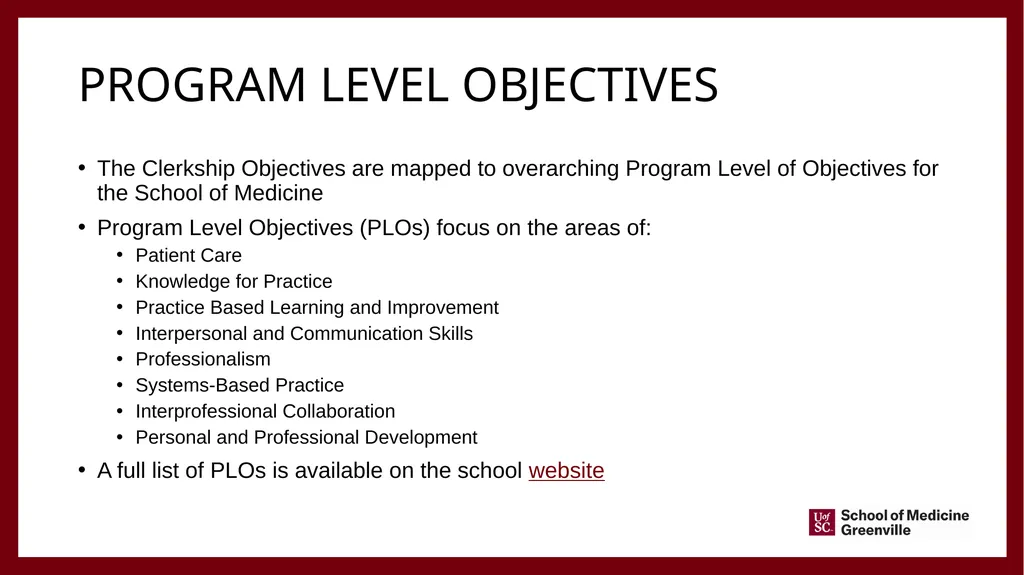
Program level objectives The Clerkship Objectives are mapped to overarching Program Level of Objectives for the School of Medicine
Program Level Objectives (PLOs) focus on the areas of:
Patient Care
Knowledge for Practice
Practice Based Learning and Improvement
Interpersonal and Communication Skills
Professionalism
Systems-Based Practice
Interprofessional Collaboration
Personal and Professional Development
A full list of PLOs is available on the school website<br>
Program Level Objectives (PLOs) focus on the areas of:
Patient Care
Knowledge for Practice
Practice Based Learning and Improvement
Interpersonal and Communication Skills
Professionalism
Systems-Based Practice
Interprofessional Collaboration
Personal and Professional Development
A full list of PLOs is available on the school website<br>
12
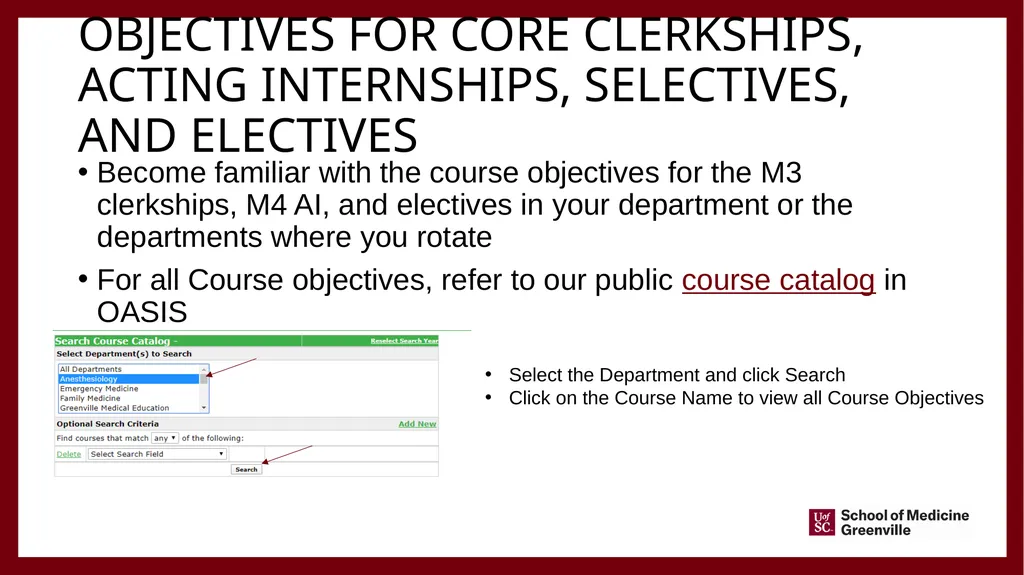
Objectives for core clerkships, Acting Internships, Selectives, and Electives Become familiar with the course objectives for the M3 clerkships, M4 AI, and electives in your department or the departments where you rotate
For all Course objectives, refer to our public course catalog in OASIS Select the Department and click Search
Click on the Course Name to view all Course Objectives<br>
For all Course objectives, refer to our public course catalog in OASIS Select the Department and click Search
Click on the Course Name to view all Course Objectives<br>
13
Required clinical experiences for clerkships, Acting Internships, Selectives, and Electives Clinical Experiences for required clerkships are posted to the school website.
For required clinical experiences for AIs, Selectives, and Electives, refer to OASIS and Course Syllabi.<br>
For required clinical experiences for AIs, Selectives, and Electives, refer to OASIS and Course Syllabi.<br>
14
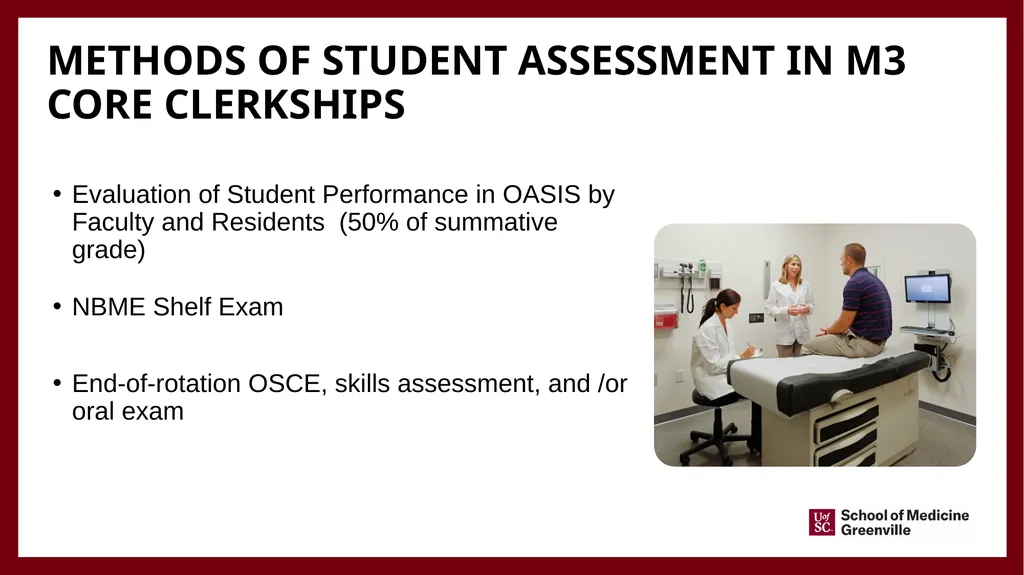
Methods of Student Assessment in M3 Core Clerkships Evaluation of Student Performance in OASIS by Faculty and Residents (50% of summative grade)
NBME Shelf Exam
End-of-rotation OSCE, skills assessment, and /or oral exam<br>
NBME Shelf Exam
End-of-rotation OSCE, skills assessment, and /or oral exam<br>
15
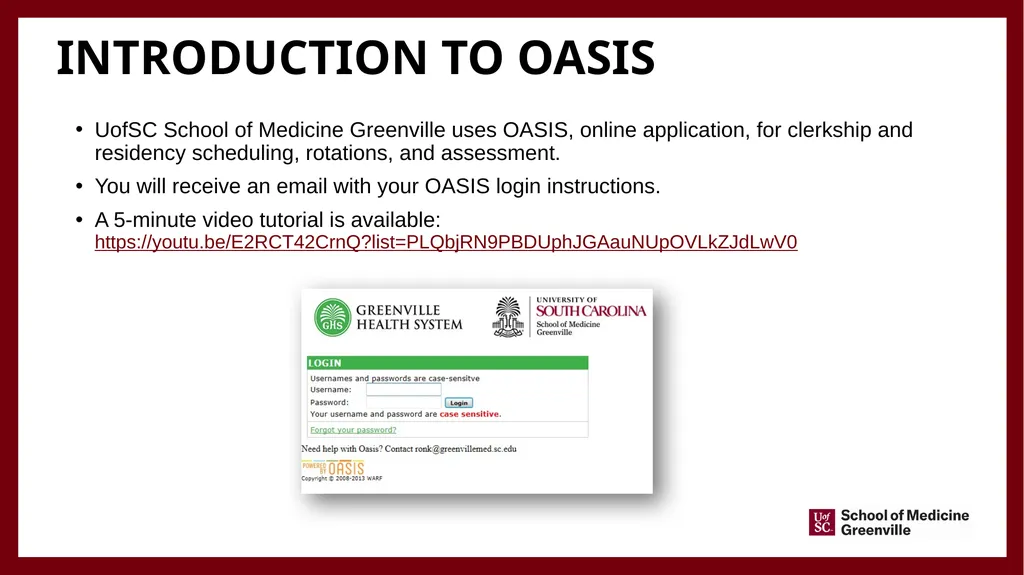
Introduction to OASIS UofSC School of Medicine Greenville uses OASIS, online application, for clerkship and residency scheduling, rotations, and assessment.
You will receive an email with your OASIS login instructions.
A 5-minute video tutorial is available: https://youtu.be/E2RCT42CrnQ?list=PLQbjRN9PBDUphJGAauNUpOVLkZJdLwV0<br>
You will receive an email with your OASIS login instructions.
A 5-minute video tutorial is available: https://youtu.be/E2RCT42CrnQ?list=PLQbjRN9PBDUphJGAauNUpOVLkZJdLwV0<br>
16
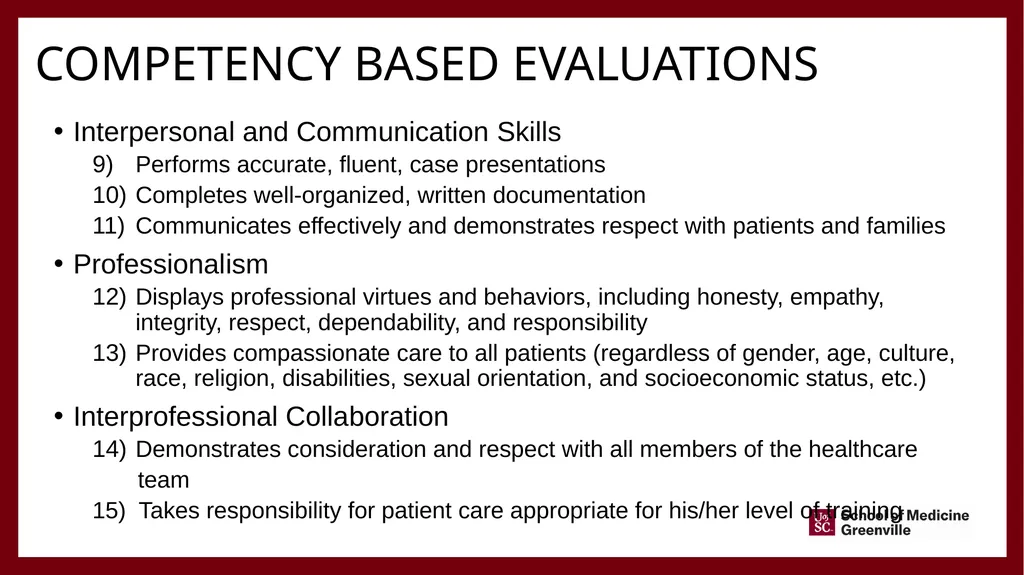
Competency based evaluations Patient Care
Obtains appropriate history for the patient presentation
Performs appropriate examination of the presenting problem
Develops reasoned differential diagnoses of patients’ clinical problems
Appropriate recommends and/or interprets diagnostic and screening tests
Applies clinical problem solving skills to develop therapeutic plans, including the use of evidence-based guidelines when appropriate
Knowledge for Practice
6) Integrates medical knowledge from basic science for the development of
a diagnosis, management, and prevention of disease
Demonstrates understanding of psychosocial and cultural influences on health and disease
Practice-Based Learning and Improvement
Recognizes personal limitations, actively seeks help and advice as appropriate, and modifies behavior in response to feedback<br>
Obtains appropriate history for the patient presentation
Performs appropriate examination of the presenting problem
Develops reasoned differential diagnoses of patients’ clinical problems
Appropriate recommends and/or interprets diagnostic and screening tests
Applies clinical problem solving skills to develop therapeutic plans, including the use of evidence-based guidelines when appropriate
Knowledge for Practice
6) Integrates medical knowledge from basic science for the development of
a diagnosis, management, and prevention of disease
Demonstrates understanding of psychosocial and cultural influences on health and disease
Practice-Based Learning and Improvement
Recognizes personal limitations, actively seeks help and advice as appropriate, and modifies behavior in response to feedback<br>
17
Competency based evaluations Interpersonal and Communication Skills
Performs accurate, fluent, case presentations
Completes well-organized, written documentation
Communicates effectively and demonstrates respect with patients and families
Professionalism
Displays professional virtues and behaviors, including honesty, empathy, integrity, respect, dependability, and responsibility
Provides compassionate care to all patients (regardless of gender, age, culture, race, religion, disabilities, sexual orientation, and socioeconomic status, etc.)
Interprofessional Collaboration
Demonstrates consideration and respect with all members of the healthcare
team
15) Takes responsibility for patient care appropriate for his/her level of training<br>
Performs accurate, fluent, case presentations
Completes well-organized, written documentation
Communicates effectively and demonstrates respect with patients and families
Professionalism
Displays professional virtues and behaviors, including honesty, empathy, integrity, respect, dependability, and responsibility
Provides compassionate care to all patients (regardless of gender, age, culture, race, religion, disabilities, sexual orientation, and socioeconomic status, etc.)
Interprofessional Collaboration
Demonstrates consideration and respect with all members of the healthcare
team
15) Takes responsibility for patient care appropriate for his/her level of training<br>
18
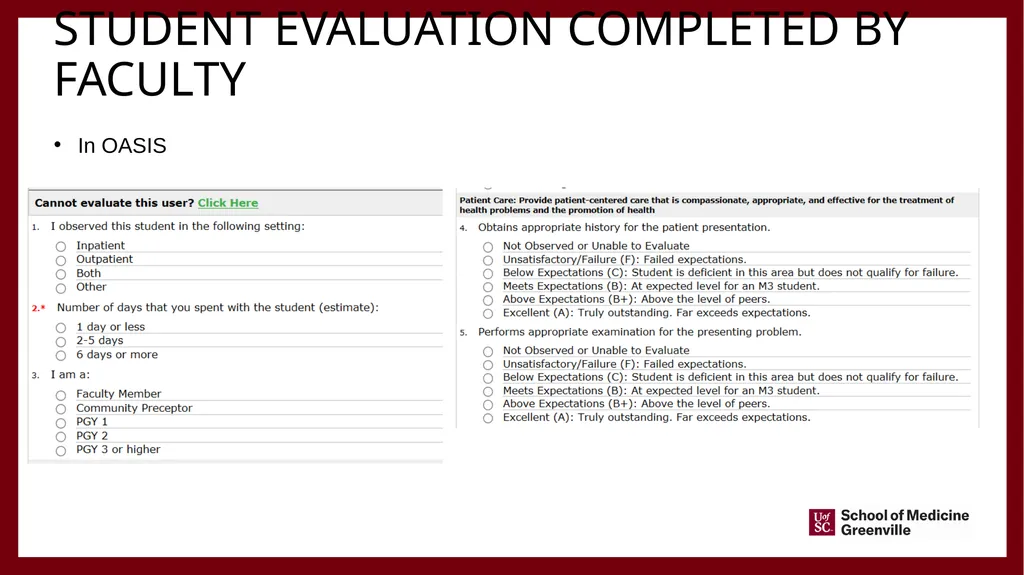
Student evaluation completed by faculty In OASIS<br>
19
Summative assessment Narrative Comments
Summative Evaluation (REQUIRED) – Comment on specific attributes that characterize this student’s performance. When possible, please relate specific instances that form the basis of your comments. This section is VERY important and will be included in Medical Student Performance Evaluation/ “Dean’s Letter.”
Recommendations for Improvement -- Please be as specific as possible and provide specific instances that form the basis of your comments. This information is given to the student but is not included in MSPE/ “Dean’s Letter.”
In clerkships, all faculty submit narrative descriptions of student performance in Oasis per the Narrative Assessment Policy<br>
Summative Evaluation (REQUIRED) – Comment on specific attributes that characterize this student’s performance. When possible, please relate specific instances that form the basis of your comments. This section is VERY important and will be included in Medical Student Performance Evaluation/ “Dean’s Letter.”
Recommendations for Improvement -- Please be as specific as possible and provide specific instances that form the basis of your comments. This information is given to the student but is not included in MSPE/ “Dean’s Letter.”
In clerkships, all faculty submit narrative descriptions of student performance in Oasis per the Narrative Assessment Policy<br>
20
Timeliness of grades For clinical evaluations, individual faculty and residents will receive up to two automatic individual notifications from Oasis as reminders to complete the student performance evaluations. With the third and final reminder, the respective Clerkship Director and Vice Chair of Academics will be included on the notification.
Link to Timeliness of Grade Reporting policy 20<br>
Link to Timeliness of Grade Reporting policy 20<br>
21
M3/M4 Student Encounters/logs Sign off on student clinical experiences/logs in OASIS
Understand that if a student fails to achieve experiences, the student will be required to remediate
Link to Required Clinical Experiences policy<br>
Understand that if a student fails to achieve experiences, the student will be required to remediate
Link to Required Clinical Experiences policy<br>
22
Formative feedback Clerkship Directors are responsible for providing formal formative feedback at the mid-point of the clerkship which will include a compilation of multiple faculty/resident/preceptor evaluations of the student’s performance in the School’s core competencies.
Each clerkship will offer purposeful opportunities for formative feedback regarding clinical performance and achievement of requirements at the mid-point of the rotation including:
Assessment of student performance
Confirmation of adherence to duty hours policy
Review of patient encounter log
Review of other clerkship requirements (online cases, H&Ps, etc.)
See the Formative Feedback policy for more details. 22<br>
Each clerkship will offer purposeful opportunities for formative feedback regarding clinical performance and achievement of requirements at the mid-point of the rotation including:
Assessment of student performance
Confirmation of adherence to duty hours policy
Review of patient encounter log
Review of other clerkship requirements (online cases, H&Ps, etc.)
See the Formative Feedback policy for more details. 22<br>
23
faculty Evaluations completed by Students How well does this faculty perform in the following areas?
Consistent clinical knowledge and abilities
Ability to teach in a formal conference or small group learning session
Effectiveness as a teacher in settings such as ambulatory clinic or inpatient rounds
Effectiveness as a teacher in the operating room or during other procedures (if applicable)
Willingness and ability to involve students in patient care
Timely, constructive feedback that is appropriate to you and the context
Enthusiasm for teaching
Interpersonal skills with students
Interpersonal relations with patients and families
Mentor or role model
Organization of the learning environment through team leadership
Unable to evaluate,
Unacceptable, in need of help
Below average, in the bottom 25%
Good, in the middle 50%
Very good, in the top 25%
Truly outstanding, in the top 5%<br>
Consistent clinical knowledge and abilities
Ability to teach in a formal conference or small group learning session
Effectiveness as a teacher in settings such as ambulatory clinic or inpatient rounds
Effectiveness as a teacher in the operating room or during other procedures (if applicable)
Willingness and ability to involve students in patient care
Timely, constructive feedback that is appropriate to you and the context
Enthusiasm for teaching
Interpersonal skills with students
Interpersonal relations with patients and families
Mentor or role model
Organization of the learning environment through team leadership
Unable to evaluate,
Unacceptable, in need of help
Below average, in the bottom 25%
Good, in the middle 50%
Very good, in the top 25%
Truly outstanding, in the top 5%<br>
24
In his/her treatment of medical students, this faculty member was:
Always appropriate
Not always appropriate (Comments required)
Comments on things this Faculty member did well:
Suggestions for improvement: FACULTY EVALUATIONS COMPLETED BY STUDENTS<br>
Always appropriate
Not always appropriate (Comments required)
Comments on things this Faculty member did well:
Suggestions for improvement: FACULTY EVALUATIONS COMPLETED BY STUDENTS<br>
25
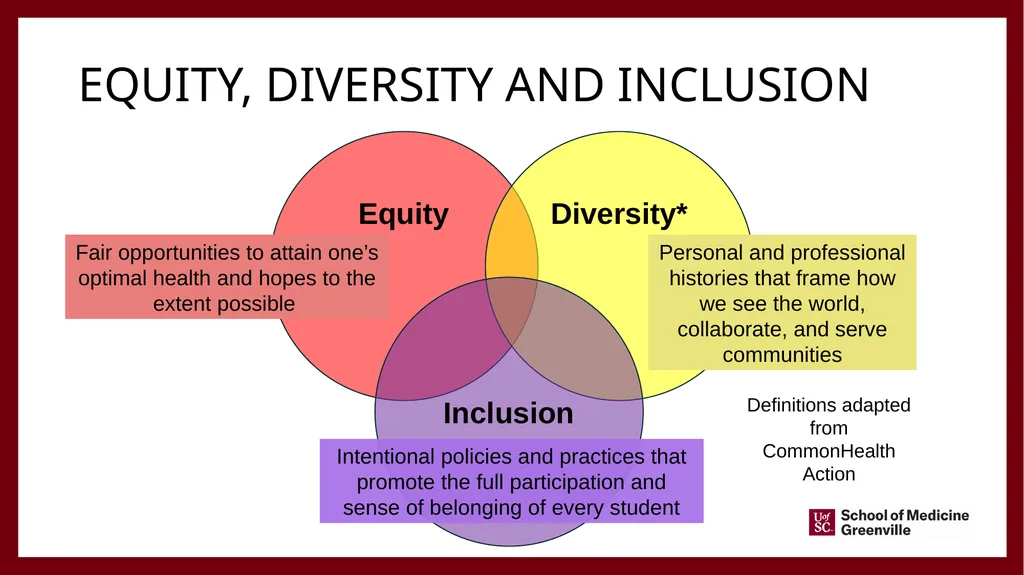
Equity Diversity* Inclusion Intentional policies and practices that promote the full participation and sense of belonging of every student Fair opportunities to attain one’s optimal health and hopes to the extent possible Definitions adapted from CommonHealth Action Personal and professional histories that frame how we see the world, collaborate, and serve communities Equity, Diversity and inclusion<br>
26
Anti-Discrimination policy The UofSC School of Medicine Greenville does not discriminate in educational opportunities for qualified persons on the basis of race, ethnicity, religion, creed, sex, gender identity, national origin, age, disability, sexual orientation or veteran status.
Equal Education Opportunity and Anti-Discrimination policy 26<br>
Equal Education Opportunity and Anti-Discrimination policy 26<br>
27
Our commitment The University of South Carolina School of Medicine Greenville is deeply committed to fostering a culture of fairness, equity and inclusion among its diverse students, faculty, staff and other key stakeholders.
Diversity and cultural competence is intentionally embedded into the curriculum
Opportunities for mentoring are available
Student organizations that foster diversity are available
For more details, visit our website 27<br>
Diversity and cultural competence is intentionally embedded into the curriculum
Opportunities for mentoring are available
Student organizations that foster diversity are available
For more details, visit our website 27<br>
28
Policies and Other Important Information<br>
29
Attendance Policy Students may not miss more than 3 excused days of an 8-week clerkship
Students may not miss more than 2 days of an Acting Internship or 4-week elective
Students are allowed 1 excused absence in a 2-week elective
A scheduled healthcare appointment can be excused by the Clerkship Director
Please notify the clerkship coordinator of any student absences
Link to M3 and M4 Student Attendance policy<br>
Students may not miss more than 2 days of an Acting Internship or 4-week elective
Students are allowed 1 excused absence in a 2-week elective
A scheduled healthcare appointment can be excused by the Clerkship Director
Please notify the clerkship coordinator of any student absences
Link to M3 and M4 Student Attendance policy<br>
30
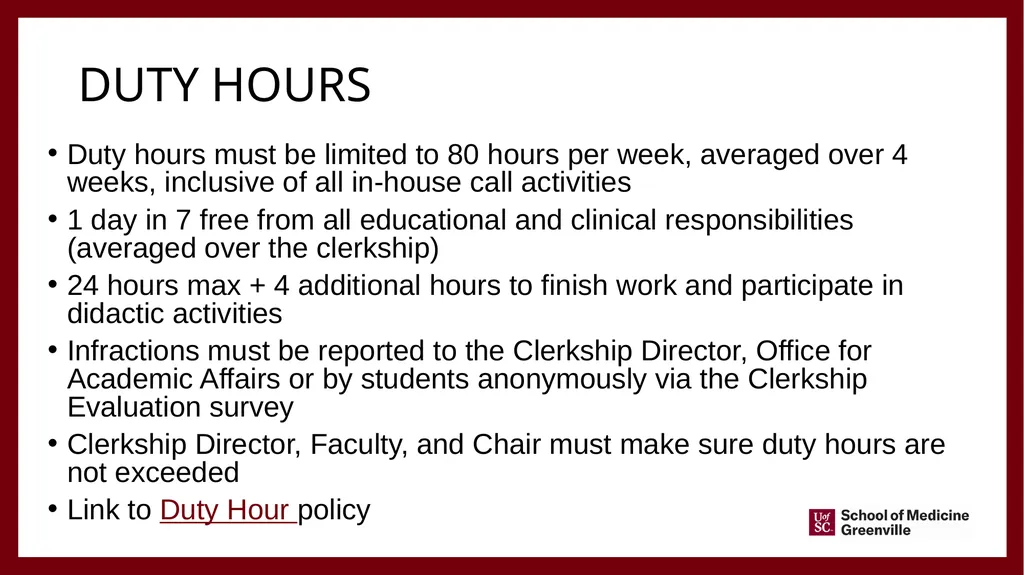
Duty Hours Duty hours must be limited to 80 hours per week, averaged over 4 weeks, inclusive of all in-house call activities
1 day in 7 free from all educational and clinical responsibilities (averaged over the clerkship)
24 hours max + 4 additional hours to finish work and participate in didactic activities
Infractions must be reported to the Clerkship Director, Office for Academic Affairs or by students anonymously via the Clerkship Evaluation survey
Clerkship Director, Faculty, and Chair must make sure duty hours are not exceeded
Link to Duty Hour policy<br>
1 day in 7 free from all educational and clinical responsibilities (averaged over the clerkship)
24 hours max + 4 additional hours to finish work and participate in didactic activities
Infractions must be reported to the Clerkship Director, Office for Academic Affairs or by students anonymously via the Clerkship Evaluation survey
Clerkship Director, Faculty, and Chair must make sure duty hours are not exceeded
Link to Duty Hour policy<br>
31
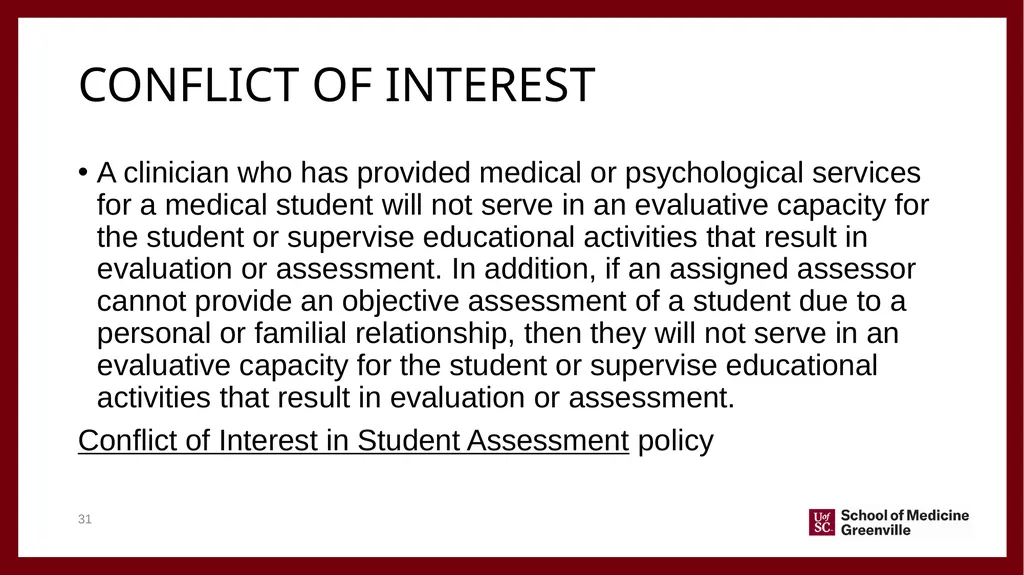
Conflict of interest A clinician who has provided medical or psychological services for a medical student will not serve in an evaluative capacity for the student or supervise educational activities that result in evaluation or assessment. In addition, if an assigned assessor cannot provide an objective assessment of a student due to a personal or familial relationship, then they will not serve in an evaluative capacity for the student or supervise educational activities that result in evaluation or assessment.
Conflict of Interest in Student Assessment policy 31<br>
Conflict of Interest in Student Assessment policy 31<br>
32
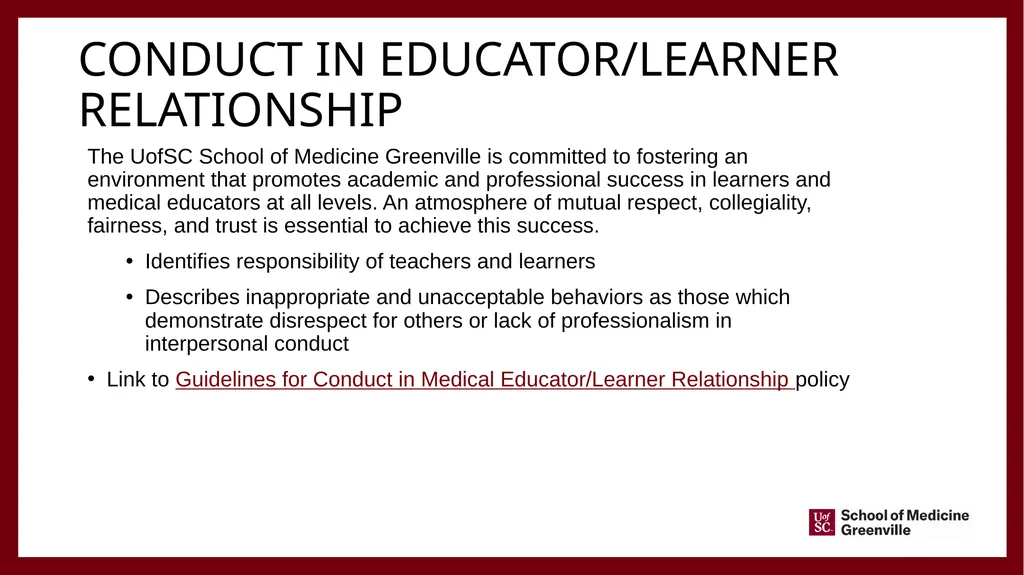
Conduct in educator/learner relationship The UofSC School of Medicine Greenville is committed to fostering an environment that promotes academic and professional success in learners and medical educators at all levels. An atmosphere of mutual respect, collegiality, fairness, and trust is essential to achieve this success.
Identifies responsibility of teachers and learners
Describes inappropriate and unacceptable behaviors as those which demonstrate disrespect for others or lack of professionalism in interpersonal conduct
Link to Guidelines for Conduct in Medical Educator/Learner Relationship policy<br>
Identifies responsibility of teachers and learners
Describes inappropriate and unacceptable behaviors as those which demonstrate disrespect for others or lack of professionalism in interpersonal conduct
Link to Guidelines for Conduct in Medical Educator/Learner Relationship policy<br>
33
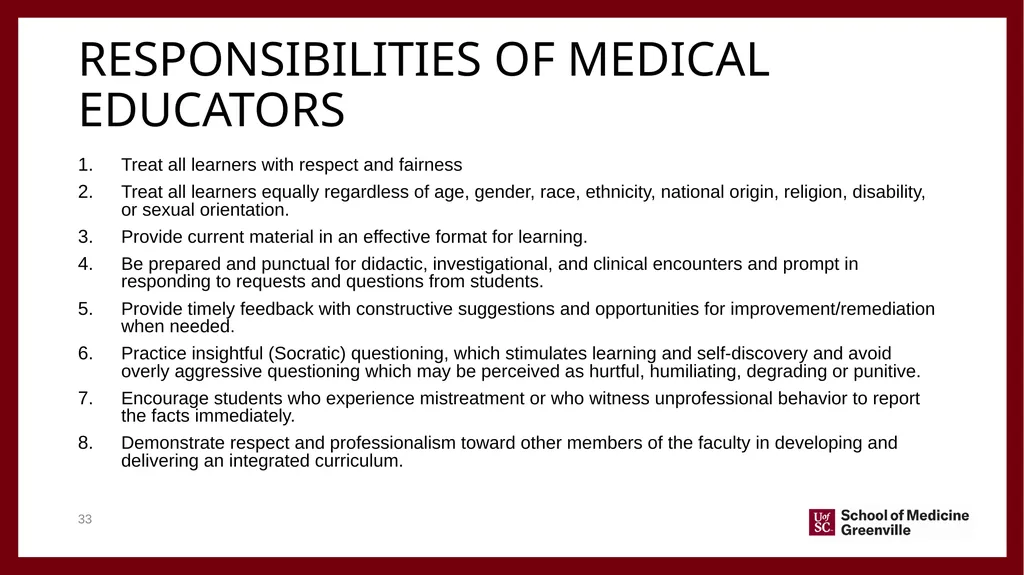
Responsibilities of Medical Educators Treat all learners with respect and fairness
Treat all learners equally regardless of age, gender, race, ethnicity, national origin, religion, disability, or sexual orientation.
Provide current material in an effective format for learning.
Be prepared and punctual for didactic, investigational, and clinical encounters and prompt in responding to requests and questions from students.
Provide timely feedback with constructive suggestions and opportunities for improvement/remediation when needed.
Practice insightful (Socratic) questioning, which stimulates learning and self-discovery and avoid overly aggressive questioning which may be perceived as hurtful, humiliating, degrading or punitive.
Encourage students who experience mistreatment or who witness unprofessional behavior to report the facts immediately.
Demonstrate respect and professionalism toward other members of the faculty in developing and delivering an integrated curriculum. 33<br>
Treat all learners equally regardless of age, gender, race, ethnicity, national origin, religion, disability, or sexual orientation.
Provide current material in an effective format for learning.
Be prepared and punctual for didactic, investigational, and clinical encounters and prompt in responding to requests and questions from students.
Provide timely feedback with constructive suggestions and opportunities for improvement/remediation when needed.
Practice insightful (Socratic) questioning, which stimulates learning and self-discovery and avoid overly aggressive questioning which may be perceived as hurtful, humiliating, degrading or punitive.
Encourage students who experience mistreatment or who witness unprofessional behavior to report the facts immediately.
Demonstrate respect and professionalism toward other members of the faculty in developing and delivering an integrated curriculum. 33<br>
34
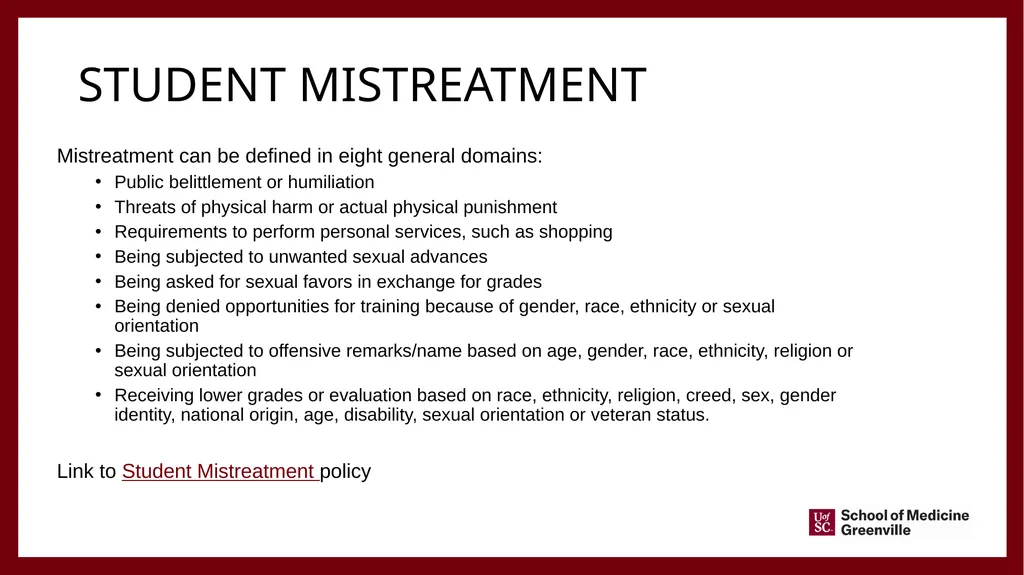
Student Mistreatment Mistreatment can be defined in eight general domains:
Public belittlement or humiliation
Threats of physical harm or actual physical punishment
Requirements to perform personal services, such as shopping
Being subjected to unwanted sexual advances
Being asked for sexual favors in exchange for grades
Being denied opportunities for training because of gender, race, ethnicity or sexual orientation
Being subjected to offensive remarks/name based on age, gender, race, ethnicity, religion or sexual orientation
Receiving lower grades or evaluation based on race, ethnicity, religion, creed, sex, gender identity, national origin, age, disability, sexual orientation or veteran status.
Link to Student Mistreatment policy<br>
Public belittlement or humiliation
Threats of physical harm or actual physical punishment
Requirements to perform personal services, such as shopping
Being subjected to unwanted sexual advances
Being asked for sexual favors in exchange for grades
Being denied opportunities for training because of gender, race, ethnicity or sexual orientation
Being subjected to offensive remarks/name based on age, gender, race, ethnicity, religion or sexual orientation
Receiving lower grades or evaluation based on race, ethnicity, religion, creed, sex, gender identity, national origin, age, disability, sexual orientation or veteran status.
Link to Student Mistreatment policy<br>
35
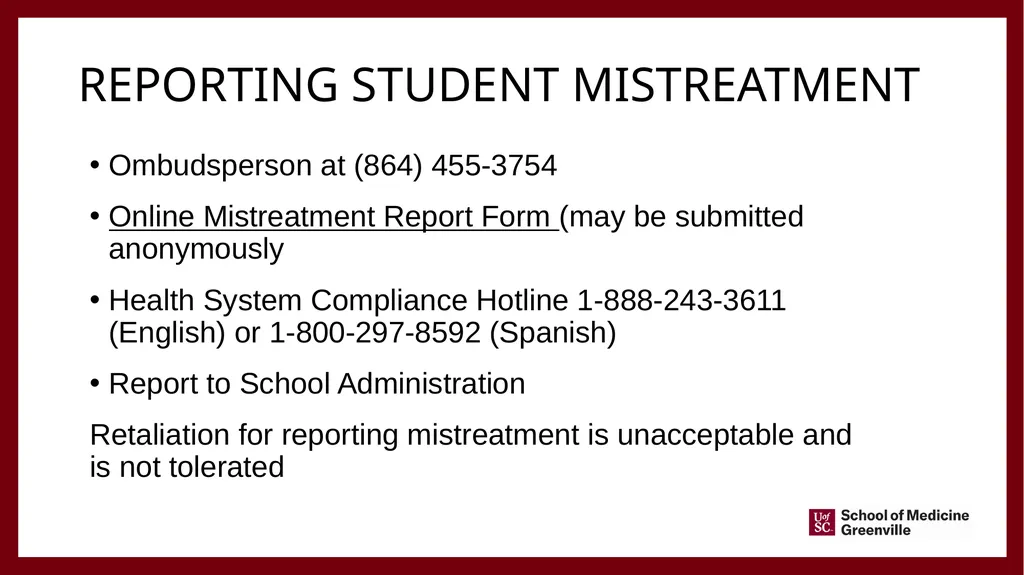
Reporting student Mistreatment Ombudsperson at (864) 455-3754
Online Mistreatment Report Form (may be submitted anonymously
Health System Compliance Hotline 1-888-243-3611 (English) or 1-800-297-8592 (Spanish)
Report to School Administration
Retaliation for reporting mistreatment is unacceptable and is not tolerated<br>
Online Mistreatment Report Form (may be submitted anonymously
Health System Compliance Hotline 1-888-243-3611 (English) or 1-800-297-8592 (Spanish)
Report to School Administration
Retaliation for reporting mistreatment is unacceptable and is not tolerated<br>
36
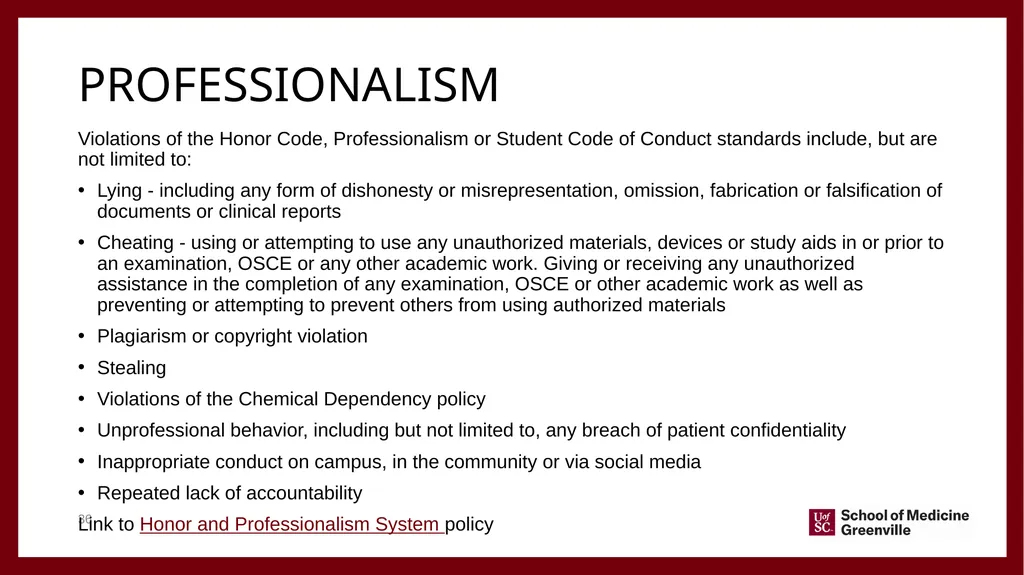
professionalism Violations of the Honor Code, Professionalism or Student Code of Conduct standards include, but are not limited to:
Lying - including any form of dishonesty or misrepresentation, omission, fabrication or falsification of documents or clinical reports
Cheating - using or attempting to use any unauthorized materials, devices or study aids in or prior to an examination, OSCE or any other academic work. Giving or receiving any unauthorized assistance in the completion of any examination, OSCE or other academic work as well as preventing or attempting to prevent others from using authorized materials
Plagiarism or copyright violation
Stealing
Violations of the Chemical Dependency policy
Unprofessional behavior, including but not limited to, any breach of patient confidentiality
Inappropriate conduct on campus, in the community or via social media
Repeated lack of accountability
Link to Honor and Professionalism System policy 36<br>
Lying - including any form of dishonesty or misrepresentation, omission, fabrication or falsification of documents or clinical reports
Cheating - using or attempting to use any unauthorized materials, devices or study aids in or prior to an examination, OSCE or any other academic work. Giving or receiving any unauthorized assistance in the completion of any examination, OSCE or other academic work as well as preventing or attempting to prevent others from using authorized materials
Plagiarism or copyright violation
Stealing
Violations of the Chemical Dependency policy
Unprofessional behavior, including but not limited to, any breach of patient confidentiality
Inappropriate conduct on campus, in the community or via social media
Repeated lack of accountability
Link to Honor and Professionalism System policy 36<br>
37
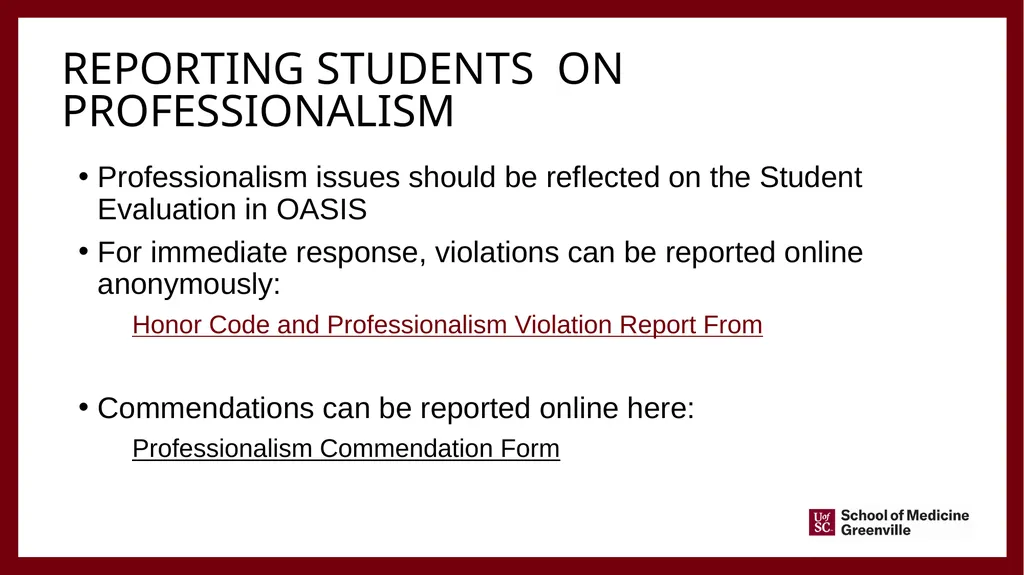
Reporting students on Professionalism Professionalism issues should be reflected on the Student Evaluation in OASIS
For immediate response, violations can be reported online anonymously:
Honor Code and Professionalism Violation Report From
Commendations can be reported online here:
Professionalism Commendation Form<br>
For immediate response, violations can be reported online anonymously:
Honor Code and Professionalism Violation Report From
Commendations can be reported online here:
Professionalism Commendation Form<br>
38
Supervision policy A supervising health professional, with a faculty appointment, is required to supervise medical students in clinical learning environments at a supervision level of “indirect supervision with direct supervision immediately available” or higher.
The supervising health professional is physically within the hospital or other site of patient care and is immediately available to provide direct supervision (Level 2).
Link to policy: https://www.sc.edu/study/colleges_schools/medicine_greenville/internal/_policydocuments/uscsomg_acaf308.pdf 38<br>
The supervising health professional is physically within the hospital or other site of patient care and is immediately available to provide direct supervision (Level 2).
Link to policy: https://www.sc.edu/study/colleges_schools/medicine_greenville/internal/_policydocuments/uscsomg_acaf308.pdf 38<br>
39
Exposure policies Exposure to Blood Borne Pathogens policy
In the event of an exposure, contact Greenville Memorial Hospital (GMH) Exposure Control Office (864-455-4209). Do not leave a voice message regarding exposures. Instead, page the Exposure Control Nurse, 864-345-6133. After hours exposures must be reported to Infection Prevention & Control pager number 864-345-6133 (the area code must be dialed to page the Infection Preventionist).
Radiation Safety policy
Outlines methods to reduce expose and distribution of monitoring devices
The Emergency Action Plan outlines responses for
Inclement weather, active shooter, medical and fire emergencies 39<br>
In the event of an exposure, contact Greenville Memorial Hospital (GMH) Exposure Control Office (864-455-4209). Do not leave a voice message regarding exposures. Instead, page the Exposure Control Nurse, 864-345-6133. After hours exposures must be reported to Infection Prevention & Control pager number 864-345-6133 (the area code must be dialed to page the Infection Preventionist).
Radiation Safety policy
Outlines methods to reduce expose and distribution of monitoring devices
The Emergency Action Plan outlines responses for
Inclement weather, active shooter, medical and fire emergencies 39<br>
40
The Family and Educational Rights and Privacy Act (FERPA) FERPA pertains to school records, including grades, student ID numbers, course schedule, records of disciplinary actions, and so forth. Exempt from FERPA regulations is information considered “directory information” by the University (e.g., name, email address, “Class of ___” status, photo, etc.).
Information maintained by an individual faculty member is not considered school records unless it overlaps with official school records (e.g., grades, disciplinary actions). So, records of personal observations or opinions that are not shared with others, as well as communications with students that do not include protected information, are not regulated by FERPA.
Unless the student provides written permission, access to FERPA-protected information is only allowed to those (employees) who have a “legitimate educational interest” in the specific information being shared.<br>
Information maintained by an individual faculty member is not considered school records unless it overlaps with official school records (e.g., grades, disciplinary actions). So, records of personal observations or opinions that are not shared with others, as well as communications with students that do not include protected information, are not regulated by FERPA.
Unless the student provides written permission, access to FERPA-protected information is only allowed to those (employees) who have a “legitimate educational interest” in the specific information being shared.<br>
41
Promotion, appeal and technical standards Students have the right to be graded in an equitable manner, free from arbitrary bias or capriciousness on the part of faculty members. The Grade Appeal policy was created to ensure a fair and equitable appeal process that allows a medical student to appeal a grade when they can demonstrate that the grade inaccurately reflects their performance in a module, clerkship, or elective.
The Student Evaluation, Remediation, Requirements for Promotion and Appeal policy outlines the conditions that constitute promotion, remediation of unsatisfactory academic progress and professional conduct, and dismissal.
The UofSC School of Medicine Greenville has adopted the following Technical Standards for Admission, Retention and Graduation 41<br>
The Student Evaluation, Remediation, Requirements for Promotion and Appeal policy outlines the conditions that constitute promotion, remediation of unsatisfactory academic progress and professional conduct, and dismissal.
The UofSC School of Medicine Greenville has adopted the following Technical Standards for Admission, Retention and Graduation 41<br>
42
All medical school Policies https://www.sc.edu/study/colleges_schools/medicine_greenville/internal/policies/index.php<br>
43
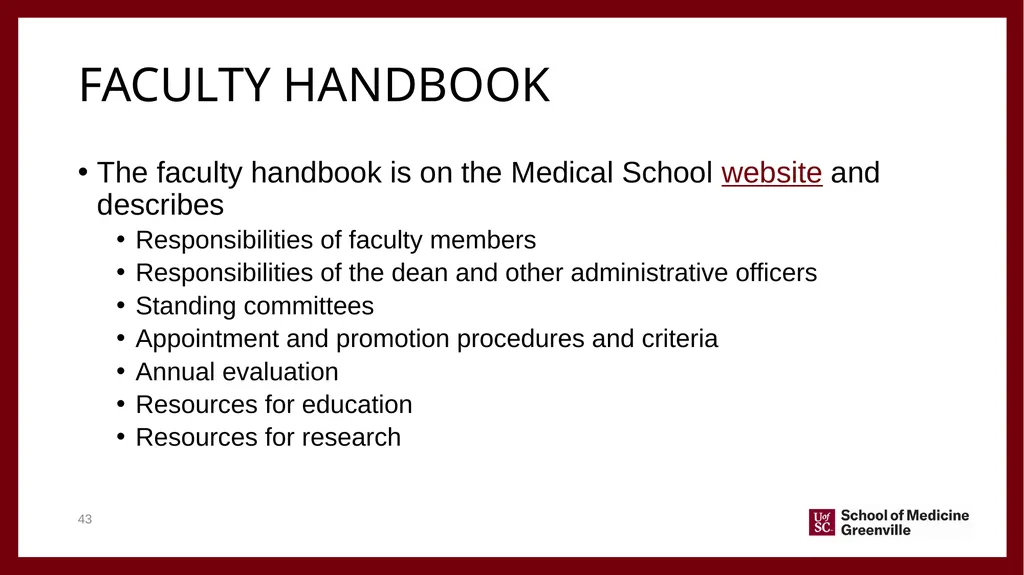
Faculty handbook The faculty handbook is on the Medical School website and describes
Responsibilities of faculty members
Responsibilities of the dean and other administrative officers
Standing committees
Appointment and promotion procedures and criteria
Annual evaluation
Resources for education
Resources for research 43<br>
Responsibilities of faculty members
Responsibilities of the dean and other administrative officers
Standing committees
Appointment and promotion procedures and criteria
Annual evaluation
Resources for education
Resources for research 43<br>
44
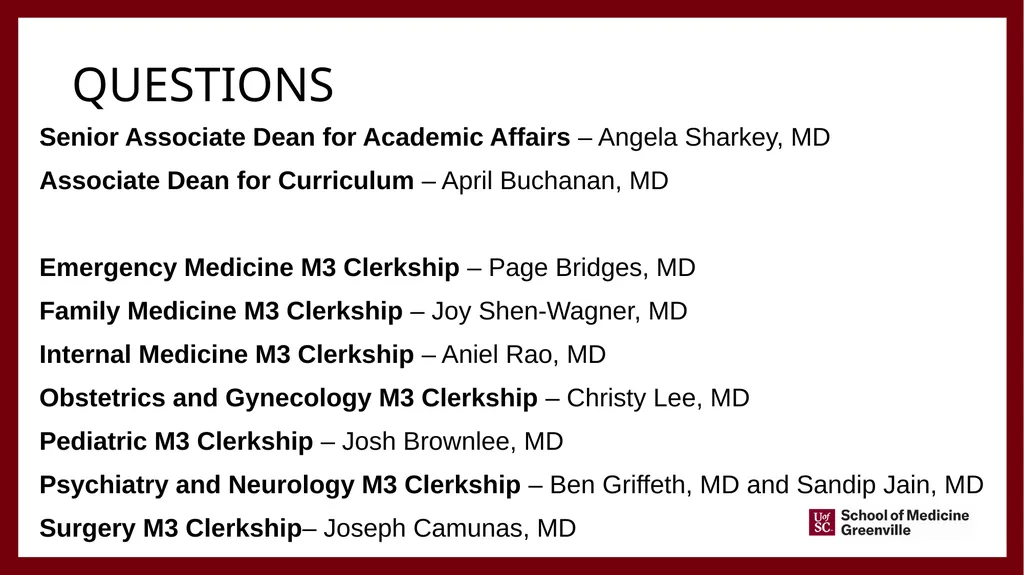
Senior Associate Dean for Academic Affairs – Angela Sharkey, MD
Associate Dean for Curriculum – April Buchanan, MD
Emergency Medicine M3 Clerkship – Page Bridges, MD
Family Medicine M3 Clerkship – Joy Shen-Wagner, MD
Internal Medicine M3 Clerkship – Aniel Rao, MD
Obstetrics and Gynecology M3 Clerkship – Christy Lee, MD
Pediatric M3 Clerkship – Josh Brownlee, MD
Psychiatry and Neurology M3 Clerkship – Ben Griffeth, MD and Sandip Jain, MD
Surgery M3 Clerkship– Joseph Camunas, MD questions<br>
Associate Dean for Curriculum – April Buchanan, MD
Emergency Medicine M3 Clerkship – Page Bridges, MD
Family Medicine M3 Clerkship – Joy Shen-Wagner, MD
Internal Medicine M3 Clerkship – Aniel Rao, MD
Obstetrics and Gynecology M3 Clerkship – Christy Lee, MD
Pediatric M3 Clerkship – Josh Brownlee, MD
Psychiatry and Neurology M3 Clerkship – Ben Griffeth, MD and Sandip Jain, MD
Surgery M3 Clerkship– Joseph Camunas, MD questions<br>
45
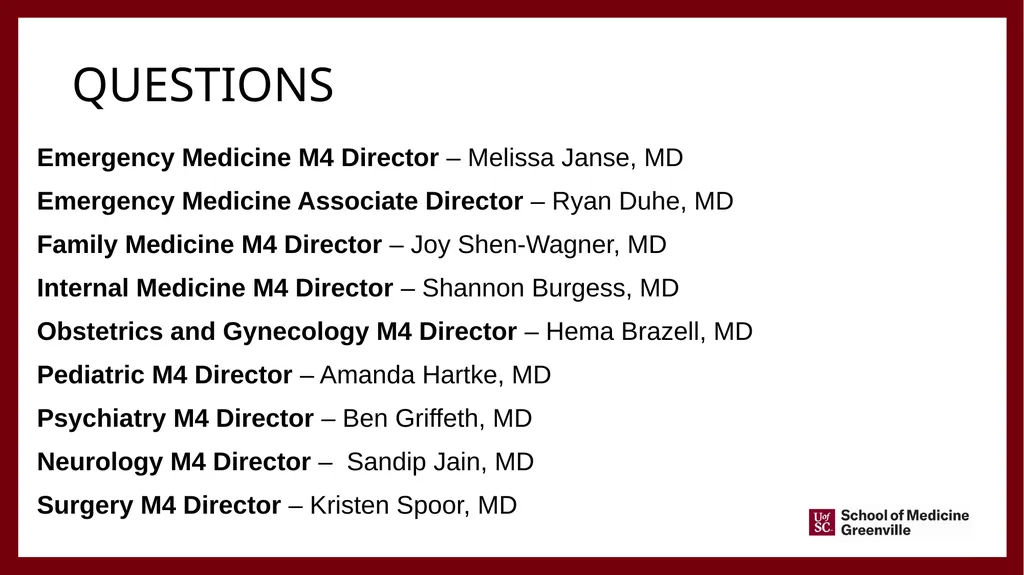
Emergency Medicine M4 Director – Melissa Janse, MD
Emergency Medicine Associate Director – Ryan Duhe, MD
Family Medicine M4 Director – Joy Shen-Wagner, MD
Internal Medicine M4 Director – Shannon Burgess, MD
Obstetrics and Gynecology M4 Director – Hema Brazell, MD
Pediatric M4 Director – Amanda Hartke, MD
Psychiatry M4 Director – Ben Griffeth, MD
Neurology M4 Director – Sandip Jain, MD
Surgery M4 Director – Kristen Spoor, MD questions<br>
Emergency Medicine Associate Director – Ryan Duhe, MD
Family Medicine M4 Director – Joy Shen-Wagner, MD
Internal Medicine M4 Director – Shannon Burgess, MD
Obstetrics and Gynecology M4 Director – Hema Brazell, MD
Pediatric M4 Director – Amanda Hartke, MD
Psychiatry M4 Director – Ben Griffeth, MD
Neurology M4 Director – Sandip Jain, MD
Surgery M4 Director – Kristen Spoor, MD questions<br>