
Impossibilities without impossibilia Bjørn
OM
Published · 34 slides · 0 views

1 / 1


Description
Impossibilities without impossibilia Bjørn Jespersen, Utrecht University, TU Ostrava Difference between reasoning about and from impossibilities: (i) getting clear about the premise(s) and conclusion of a derivation and (ii) getting clear
Related Topics
Share
Embed code
Download this presentation From Below
"Impossibilities without impossibilia Bjørn" is the property of its rightful owner. Permission is granted to download and print the materials on this website for personal, non-commercial use only, and to display it on your personal computer provided you do not modify the materials and that you retain all copyright notices contained in the materials. By downloading content from our website, you accept the terms of this agreement.
Presentation Transcript
01
Impossibilities without impossibilia Bjørn Jespersen, Utrecht University, TU Ostrava<br>
02
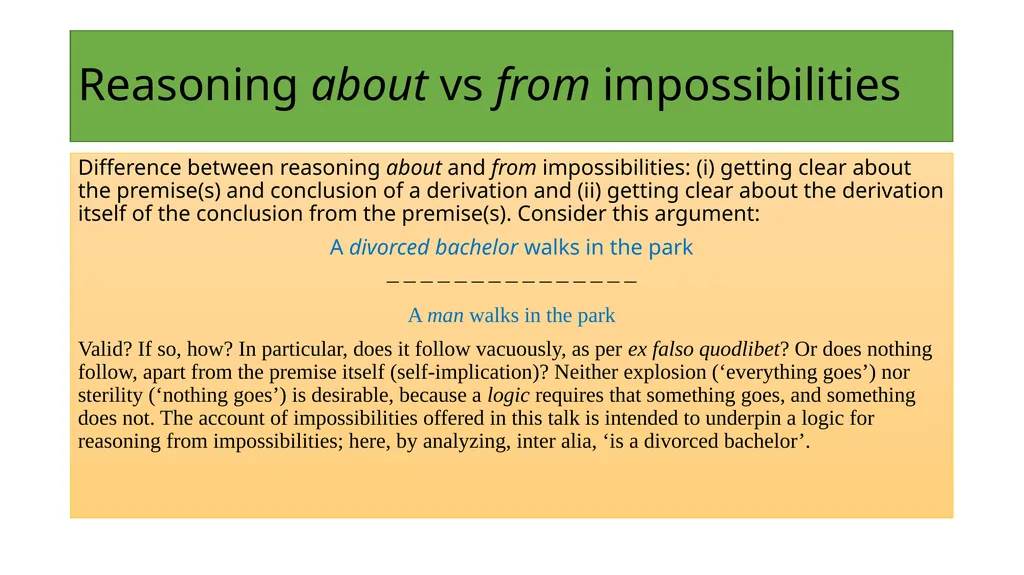
Difference between reasoning about and from impossibilities: (i) getting clear about the premise(s) and conclusion of a derivation and (ii) getting clear about the derivation itself of the conclusion from the premise(s). Consider this argument:
A divorced bachelor walks in the park
A man walks in the park
Valid? If so, how? In particular, does it follow vacuously, as per ex falso quodlibet? Or does nothing follow, apart from the premise itself (self-implication)? Neither explosion (‘everything goes’) nor sterility (‘nothing goes’) is desirable, because a logic requires that something goes, and something does not. The account of impossibilities offered in this talk is intended to underpin a logic for reasoning from impossibilities; here, by analyzing, inter alia, ‘is a divorced bachelor’. Reasoning about vs from impossibilities<br>
A divorced bachelor walks in the park
A man walks in the park
Valid? If so, how? In particular, does it follow vacuously, as per ex falso quodlibet? Or does nothing follow, apart from the premise itself (self-implication)? Neither explosion (‘everything goes’) nor sterility (‘nothing goes’) is desirable, because a logic requires that something goes, and something does not. The account of impossibilities offered in this talk is intended to underpin a logic for reasoning from impossibilities; here, by analyzing, inter alia, ‘is a divorced bachelor’. Reasoning about vs from impossibilities<br>
03
The semantics and logic of impossibility: (i) predication
(ii) inference. Today: (i).
Are there impossible entities (impossibilia)? No, there aren’t. So, what are impossibilities (if anything)?
Conceptual vs objectual
Condition vs satisfier
Procedure vs product Stage setting<br>
(ii) inference. Today: (i).
Are there impossible entities (impossibilia)? No, there aren’t. So, what are impossibilities (if anything)?
Conceptual vs objectual
Condition vs satisfier
Procedure vs product Stage setting<br>
04
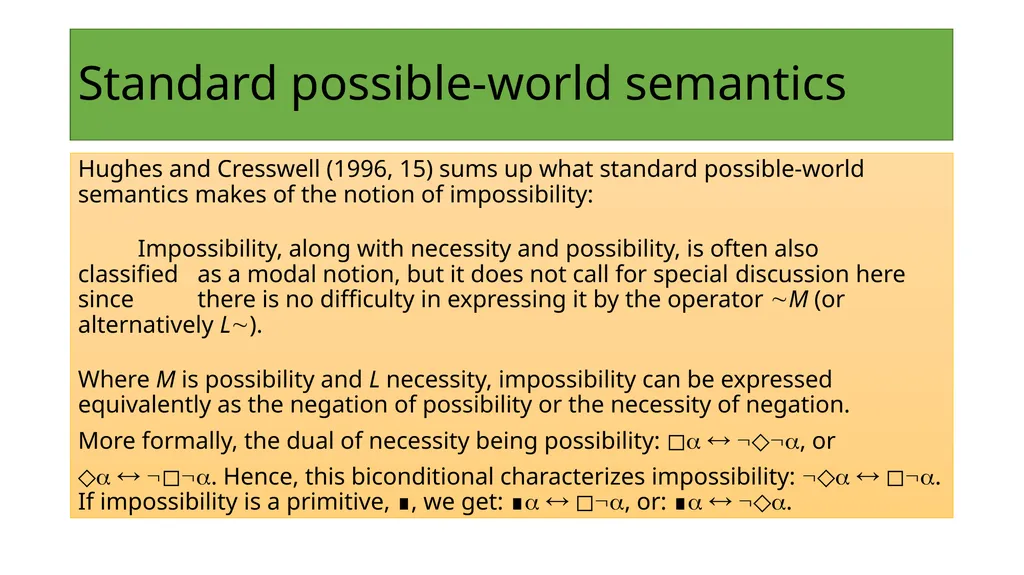
Standard possible-world semantics Hughes and Cresswell (1996, 15) sums up what standard possible-world semantics makes of the notion of impossibility:
Impossibility, along with necessity and possibility, is often also classified as a modal notion, but it does not call for special discussion here since there is no difficulty in expressing it by the operator M (or alternatively L).
Where M is possibility and L necessity, impossibility can be expressed equivalently as the negation of possibility or the necessity of negation.
More formally, the dual of necessity being possibility: ◻ ◇, or
◇ ◻. Hence, this biconditional characterizes impossibility: ◇ ◻. If impossibility is a primitive, ∎, we get: ∎ ◻, or: ∎ ◇.<br>
Impossibility, along with necessity and possibility, is often also classified as a modal notion, but it does not call for special discussion here since there is no difficulty in expressing it by the operator M (or alternatively L).
Where M is possibility and L necessity, impossibility can be expressed equivalently as the negation of possibility or the necessity of negation.
More formally, the dual of necessity being possibility: ◻ ◇, or
◇ ◻. Hence, this biconditional characterizes impossibility: ◇ ◻. If impossibility is a primitive, ∎, we get: ∎ ◻, or: ∎ ◇.<br>
05
Possibility vs impossibility One difference between possibility and impossibility is this difference in inferential behavior. This is a well-known fallacy:
◇, ◇
◇()
On the other hand, if ∎ is interpreted as w (w = Τ), equivalent to w (w = ), and ∎ as w (w = Τ), then it is obvious that there is no world at which ∎() is true. Hence, this inference is valid:
∎, ∎
I
∎()
Similarly, if ∎ is replaced by ◻.<br>
◇, ◇
◇()
On the other hand, if ∎ is interpreted as w (w = Τ), equivalent to w (w = ), and ∎ as w (w = Τ), then it is obvious that there is no world at which ∎() is true. Hence, this inference is valid:
∎, ∎
I
∎()
Similarly, if ∎ is replaced by ◻.<br>
06
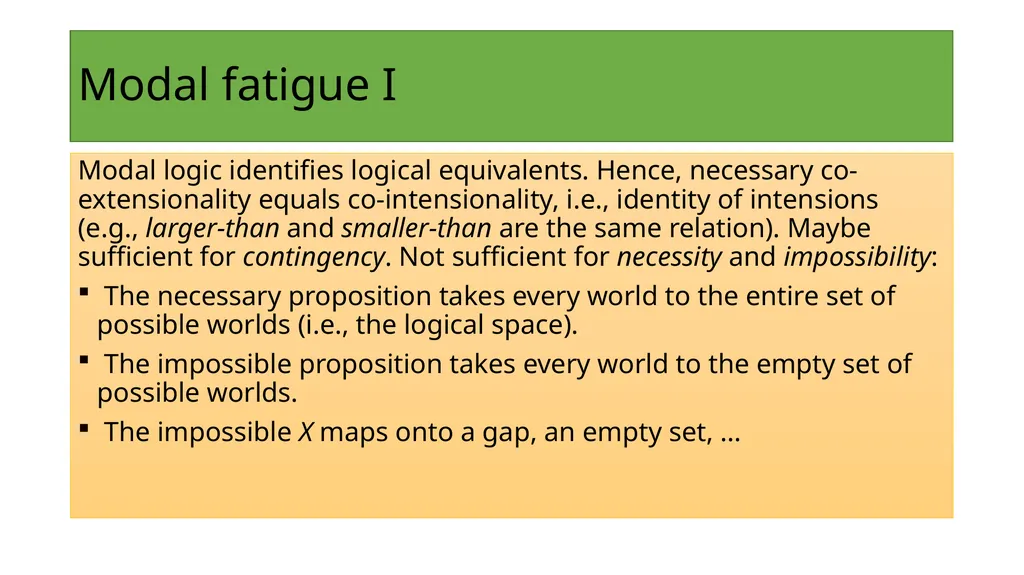
Modal fatigue I Modal logic identifies logical equivalents. Hence, necessary co-extensionality equals co-intensionality, i.e., identity of intensions (e.g., larger-than and smaller-than are the same relation). Maybe sufficient for contingency. Not sufficient for necessity and impossibility:
The necessary proposition takes every world to the entire set of possible worlds (i.e., the logical space).
The impossible proposition takes every world to the empty set of possible worlds.
The impossible X maps onto a gap, an empty set, …<br>
The necessary proposition takes every world to the entire set of possible worlds (i.e., the logical space).
The impossible proposition takes every world to the empty set of possible worlds.
The impossible X maps onto a gap, an empty set, …<br>
07
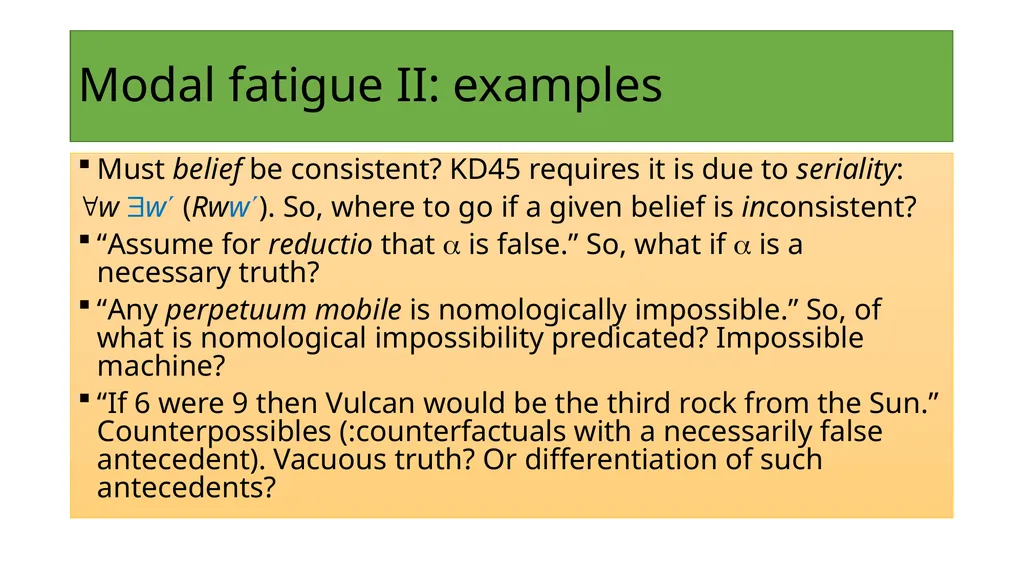
Modal fatigue II: examples Must belief be consistent? KD45 requires it is due to seriality:
w w (Rww). So, where to go if a given belief is inconsistent?
“Assume for reductio that is false.” So, what if is a necessary truth?
“Any perpetuum mobile is nomologically impossible.” So, of what is nomological impossibility predicated? Impossible machine?
“If 6 were 9 then Vulcan would be the third rock from the Sun.” Counterpossibles (:counterfactuals with a necessarily false antecedent). Vacuous truth? Or differentiation of such antecedents?<br>
w w (Rww). So, where to go if a given belief is inconsistent?
“Assume for reductio that is false.” So, what if is a necessary truth?
“Any perpetuum mobile is nomologically impossible.” So, of what is nomological impossibility predicated? Impossible machine?
“If 6 were 9 then Vulcan would be the third rock from the Sun.” Counterpossibles (:counterfactuals with a necessarily false antecedent). Vacuous truth? Or differentiation of such antecedents?<br>
08
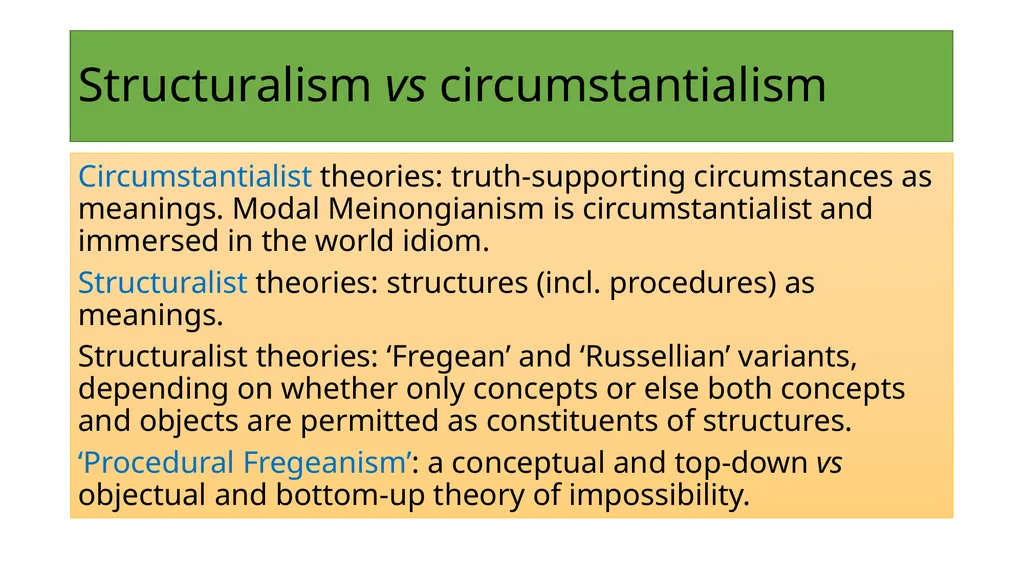
Structuralism vs circumstantialism Circumstantialist theories: truth-supporting circumstances as meanings. Modal Meinongianism is circumstantialist and immersed in the world idiom.
Structuralist theories: structures (incl. procedures) as meanings.
Structuralist theories: ‘Fregean’ and ‘Russellian’ variants, depending on whether only concepts or else both concepts and objects are permitted as constituents of structures.
‘Procedural Fregeanism’: a conceptual and top-down vs objectual and bottom-up theory of impossibility.<br>
Structuralist theories: structures (incl. procedures) as meanings.
Structuralist theories: ‘Fregean’ and ‘Russellian’ variants, depending on whether only concepts or else both concepts and objects are permitted as constituents of structures.
‘Procedural Fregeanism’: a conceptual and top-down vs objectual and bottom-up theory of impossibility.<br>
09
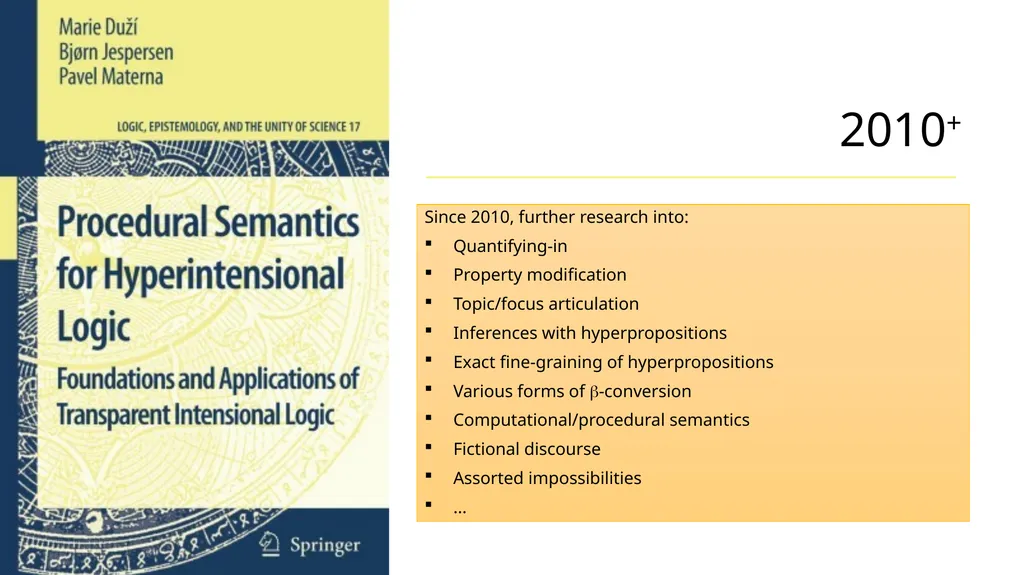
2010+ Since 2010, further research into:
Quantifying-in
Property modification
Topic/focus articulation
Inferences with hyperpropositions
Exact fine-graining of hyperpropositions
Various forms of -conversion
Computational/procedural semantics
Fictional discourse
Assorted impossibilities
…<br>
Quantifying-in
Property modification
Topic/focus articulation
Inferences with hyperpropositions
Exact fine-graining of hyperpropositions
Various forms of -conversion
Computational/procedural semantics
Fictional discourse
Assorted impossibilities
…<br>
10
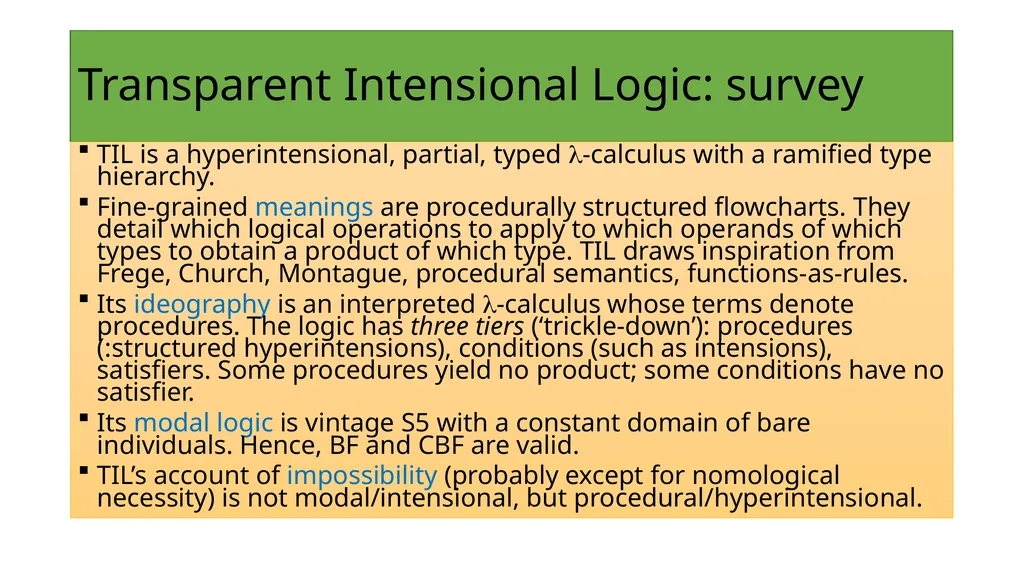
Transparent Intensional Logic: survey TIL is a hyperintensional, partial, typed -calculus with a ramified type hierarchy.
Fine-grained meanings are procedurally structured flowcharts. They detail which logical operations to apply to which operands of which types to obtain a product of which type. TIL draws inspiration from Frege, Church, Montague, procedural semantics, functions-as-rules.
Its ideography is an interpreted -calculus whose terms denote procedures. The logic has three tiers (‘trickle-down’): procedures (:structured hyperintensions), conditions (such as intensions), satisfiers. Some procedures yield no product; some conditions have no satisfier.
Its modal logic is vintage S5 with a constant domain of bare individuals. Hence, BF and CBF are valid.
TIL’s account of impossibility (probably except for nomological necessity) is not modal/intensional, but procedural/hyperintensional.<br>
Fine-grained meanings are procedurally structured flowcharts. They detail which logical operations to apply to which operands of which types to obtain a product of which type. TIL draws inspiration from Frege, Church, Montague, procedural semantics, functions-as-rules.
Its ideography is an interpreted -calculus whose terms denote procedures. The logic has three tiers (‘trickle-down’): procedures (:structured hyperintensions), conditions (such as intensions), satisfiers. Some procedures yield no product; some conditions have no satisfier.
Its modal logic is vintage S5 with a constant domain of bare individuals. Hence, BF and CBF are valid.
TIL’s account of impossibility (probably except for nomological necessity) is not modal/intensional, but procedural/hyperintensional.<br>
11
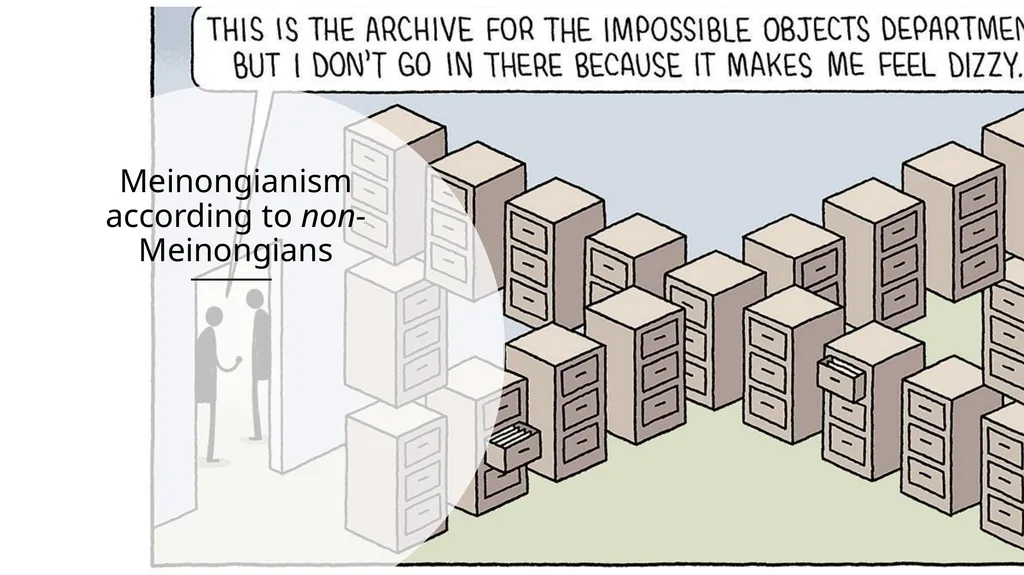
Meinongianism according to non-Meinongians<br>
12
Reasoning about impossibility: metaphysics Modal Meinongianism (Priest, Berto) expands logical space with impossible worlds as additional points of evaluation and adds to its constant domain impossible individuals as bearers of properties. Myriad impossibilia.
Zalta’s Meinongian Object Theory comes with two categories of objects: ordinary and abstract objects. Ordinary objects exemplify properties by instantiating them; abstract objects encode properties without instantiating them. No impossibilia.
TIL could make sense of ‘impossible world’ as a condition that no possible world could possibly satisfy, and ‘impossible individual’ as a condition that no individual could possibly satisfy. Hence, a so-called impossible X would not be an X, ‘impossible’ having a privative effect. TIL does not want to explain impossibility in terms of impossibilia. No impossibilia.<br>
Zalta’s Meinongian Object Theory comes with two categories of objects: ordinary and abstract objects. Ordinary objects exemplify properties by instantiating them; abstract objects encode properties without instantiating them. No impossibilia.
TIL could make sense of ‘impossible world’ as a condition that no possible world could possibly satisfy, and ‘impossible individual’ as a condition that no individual could possibly satisfy. Hence, a so-called impossible X would not be an X, ‘impossible’ having a privative effect. TIL does not want to explain impossibility in terms of impossibilia. No impossibilia.<br>
13
Reasoning about impossibility: objective The objective is not to find fault with impossibilia-embracing theories of impossibility such as modal Meinongianism and then come forward with a superior proposal.
The objective is to start out with an existing theory (TIL) and develop a theory of impossibility within it, a ‘procedural Fregeanism’. As a self-declared global theory of the logic of meaning, TIL owes an account of impossibility.
Therefore, what does a procedural (hence, structuralist) theory of impossibility look like?<br>
The objective is to start out with an existing theory (TIL) and develop a theory of impossibility within it, a ‘procedural Fregeanism’. As a self-declared global theory of the logic of meaning, TIL owes an account of impossibility.
Therefore, what does a procedural (hence, structuralist) theory of impossibility look like?<br>
14
ss ‘Impossible individuals as necessarily empty individual concepts’ (with M. Duží and D. Glavaničová), in: Logic in High Definition, Trends in Logic (Studia Logica Library), vol. 56 (2021), A. Giordani, J. Malinowski (eds.), 177-202.<br>
15
Reasoning about impossibility: TIL methodology A TIL analysis of a piece of language amounts to assigning a procedure (in accordance with the definition of procedure below) to it as its meaning; more specifically, assigning the logical structure of its meaning from which to draw inferences.
This procedure is structured to display a logical trajectory toward an entity of a particular type (in accordance with the definitions of ramified and simple types). The procedure produces this entity or else fails to produce anything. This type may be either the type of a condition (:function) or of a non-condition, i.e., an object that can satisfy a condition but is not itself one (formally, a medadic function).<br>
This procedure is structured to display a logical trajectory toward an entity of a particular type (in accordance with the definitions of ramified and simple types). The procedure produces this entity or else fails to produce anything. This type may be either the type of a condition (:function) or of a non-condition, i.e., an object that can satisfy a condition but is not itself one (formally, a medadic function).<br>
16
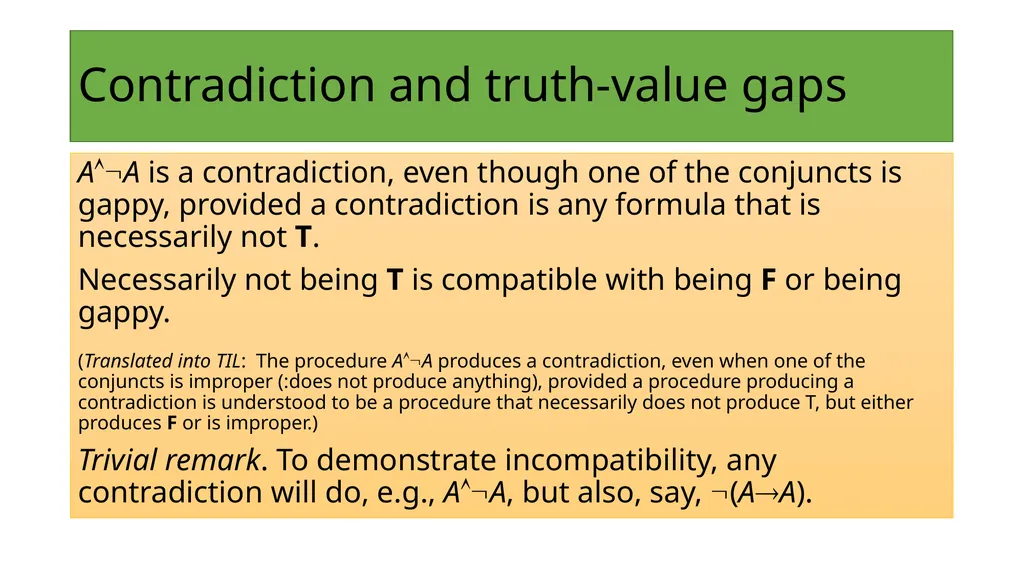
Contradiction and truth-value gaps AA is a contradiction, even though one of the conjuncts is gappy, provided a contradiction is any formula that is necessarily not T.
Necessarily not being T is compatible with being F or being gappy.
(Translated into TIL: The procedure AA produces a contradiction, even when one of the conjuncts is improper (:does not produce anything), provided a procedure producing a contradiction is understood to be a procedure that necessarily does not produce T, but either produces F or is improper.)
Trivial remark. To demonstrate incompatibility, any contradiction will do, e.g., AA, but also, say, (AA).<br>
Necessarily not being T is compatible with being F or being gappy.
(Translated into TIL: The procedure AA produces a contradiction, even when one of the conjuncts is improper (:does not produce anything), provided a procedure producing a contradiction is understood to be a procedure that necessarily does not produce T, but either produces F or is improper.)
Trivial remark. To demonstrate incompatibility, any contradiction will do, e.g., AA, but also, say, (AA).<br>
17
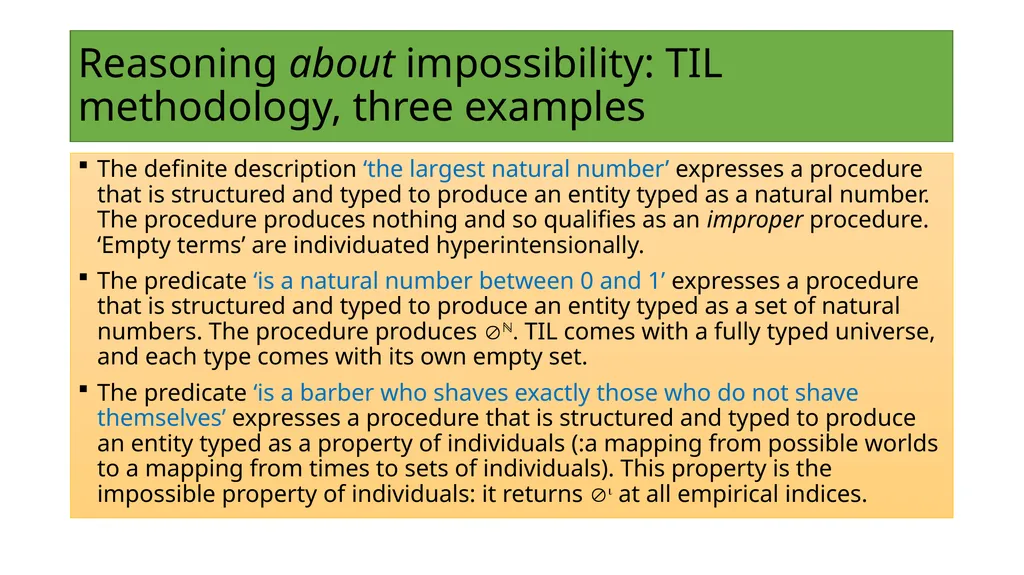
Reasoning about impossibility: TIL methodology, three examples The definite description ‘the largest natural number’ expresses a procedure that is structured and typed to produce an entity typed as a natural number. The procedure produces nothing and so qualifies as an improper procedure. ‘Empty terms’ are individuated hyperintensionally.
The predicate ‘is a natural number between 0 and 1’ expresses a procedure that is structured and typed to produce an entity typed as a set of natural numbers. The procedure produces ℕ. TIL comes with a fully typed universe, and each type comes with its own empty set.
The predicate ‘is a barber who shaves exactly those who do not shave themselves’ expresses a procedure that is structured and typed to produce an entity typed as a property of individuals (:a mapping from possible worlds to a mapping from times to sets of individuals). This property is the impossible property of individuals: it returns at all empirical indices.<br>
The predicate ‘is a natural number between 0 and 1’ expresses a procedure that is structured and typed to produce an entity typed as a set of natural numbers. The procedure produces ℕ. TIL comes with a fully typed universe, and each type comes with its own empty set.
The predicate ‘is a barber who shaves exactly those who do not shave themselves’ expresses a procedure that is structured and typed to produce an entity typed as a property of individuals (:a mapping from possible worlds to a mapping from times to sets of individuals). This property is the impossible property of individuals: it returns at all empirical indices.<br>
18
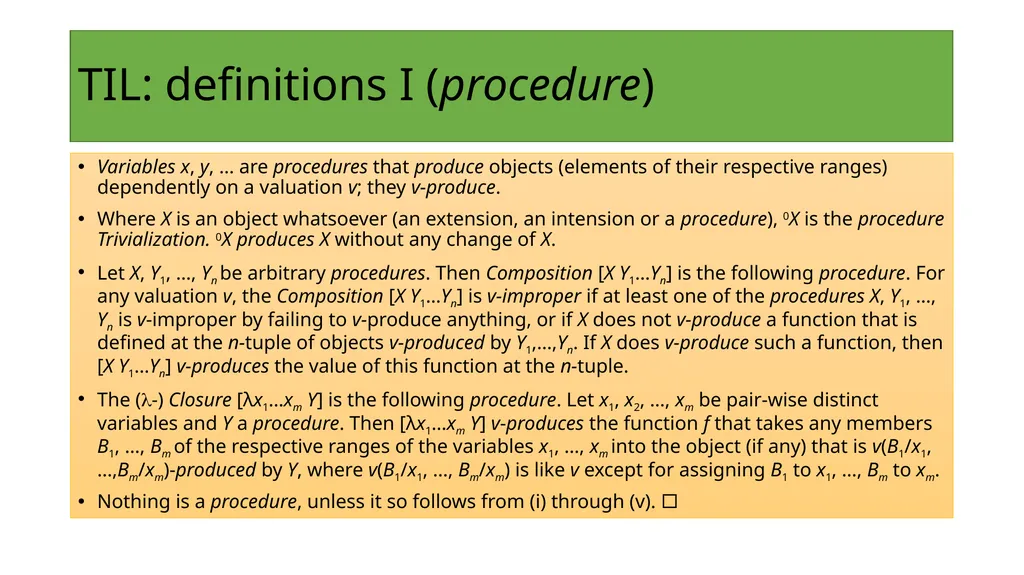
TIL: definitions I (procedure) Variables x, y, … are procedures that produce objects (elements of their respective ranges) dependently on a valuation v; they v-produce.
Where X is an object whatsoever (an extension, an intension or a procedure), 0X is the procedure Trivialization. 0X produces X without any change of X.
Let X, Y1, …, Yn be arbitrary procedures. Then Composition [X Y1…Yn] is the following procedure. For any valuation v, the Composition [X Y1…Yn] is v-improper if at least one of the procedures X, Y1, …, Yn is v-improper by failing to v-produce anything, or if X does not v-produce a function that is defined at the n-tuple of objects v-produced by Y1,…,Yn. If X does v-produce such a function, then [X Y1…Yn] v-produces the value of this function at the n-tuple.
The (-) Closure [λx1…xm Y] is the following procedure. Let x1, x2, …, xm be pair-wise distinct variables and Y a procedure. Then [λx1…xm Y] v-produces the function f that takes any members B1, …, Bm of the respective ranges of the variables x1, …, xm into the object (if any) that is v(B1/x1,…,Bm/xm)-produced by Y, where v(B1/x1, …, Bm/xm) is like v except for assigning B1 to x1, …, Bm to xm.
Nothing is a procedure, unless it so follows from (i) through (v). <br>
Where X is an object whatsoever (an extension, an intension or a procedure), 0X is the procedure Trivialization. 0X produces X without any change of X.
Let X, Y1, …, Yn be arbitrary procedures. Then Composition [X Y1…Yn] is the following procedure. For any valuation v, the Composition [X Y1…Yn] is v-improper if at least one of the procedures X, Y1, …, Yn is v-improper by failing to v-produce anything, or if X does not v-produce a function that is defined at the n-tuple of objects v-produced by Y1,…,Yn. If X does v-produce such a function, then [X Y1…Yn] v-produces the value of this function at the n-tuple.
The (-) Closure [λx1…xm Y] is the following procedure. Let x1, x2, …, xm be pair-wise distinct variables and Y a procedure. Then [λx1…xm Y] v-produces the function f that takes any members B1, …, Bm of the respective ranges of the variables x1, …, xm into the object (if any) that is v(B1/x1,…,Bm/xm)-produced by Y, where v(B1/x1, …, Bm/xm) is like v except for assigning B1 to x1, …, Bm to xm.
Nothing is a procedure, unless it so follows from (i) through (v). <br>
19
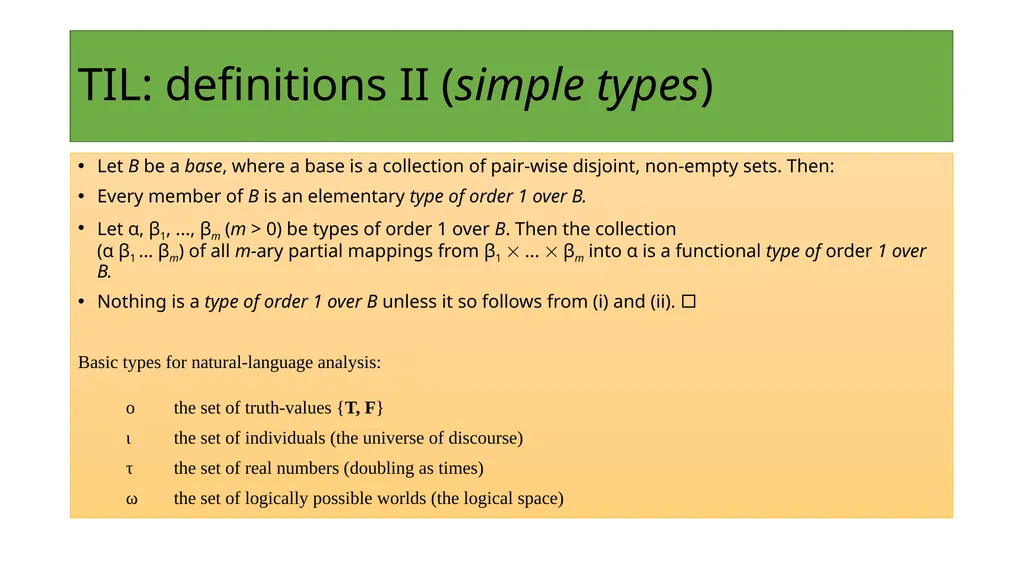
TIL: definitions II (simple types) Let B be a base, where a base is a collection of pair-wise disjoint, non-empty sets. Then:
Every member of B is an elementary type of order 1 over B.
Let α, β1, ..., βm (m > 0) be types of order 1 over B. Then the collection (α β1 ... βm) of all m-ary partial mappings from β1 ... βm into α is a functional type of order 1 over B.
Nothing is a type of order 1 over B unless it so follows from (i) and (ii).
Basic types for natural-language analysis:
ο the set of truth-values {T, F}
ι the set of individuals (the universe of discourse)
τ the set of real numbers (doubling as times)
ω the set of logically possible worlds (the logical space)<br>
Every member of B is an elementary type of order 1 over B.
Let α, β1, ..., βm (m > 0) be types of order 1 over B. Then the collection (α β1 ... βm) of all m-ary partial mappings from β1 ... βm into α is a functional type of order 1 over B.
Nothing is a type of order 1 over B unless it so follows from (i) and (ii).
Basic types for natural-language analysis:
ο the set of truth-values {T, F}
ι the set of individuals (the universe of discourse)
τ the set of real numbers (doubling as times)
ω the set of logically possible worlds (the logical space)<br>
20
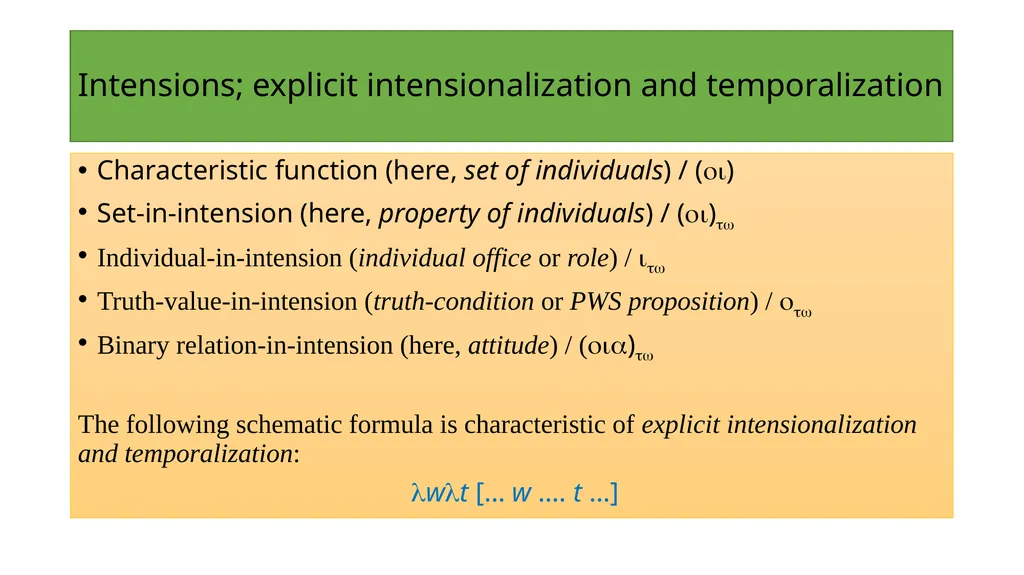
Intensions; explicit intensionalization and temporalization Characteristic function (here, set of individuals) / ()
Set-in-intension (here, property of individuals) / ()
Individual-in-intension (individual office or role) /
Truth-value-in-intension (truth-condition or PWS proposition) /
Binary relation-in-intension (here, attitude) / ()
The following schematic formula is characteristic of explicit intensionalization and temporalization:
wt [… w …. t …]<br>
Set-in-intension (here, property of individuals) / ()
Individual-in-intension (individual office or role) /
Truth-value-in-intension (truth-condition or PWS proposition) /
Binary relation-in-intension (here, attitude) / ()
The following schematic formula is characteristic of explicit intensionalization and temporalization:
wt [… w …. t …]<br>
21
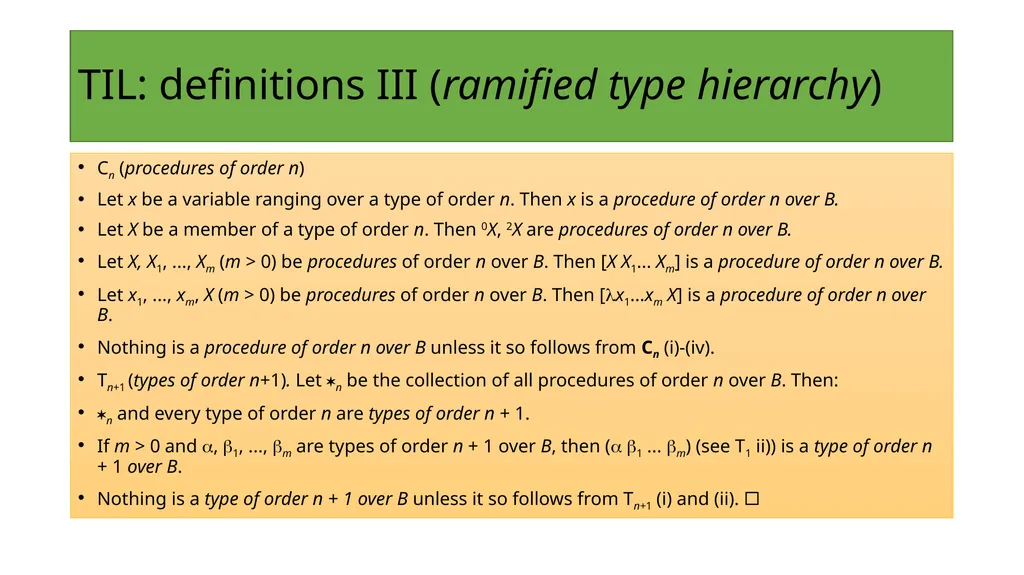
Cn (procedures of order n)
Let x be a variable ranging over a type of order n. Then x is a procedure of order n over B.
Let X be a member of a type of order n. Then 0X, 2X are procedures of order n over B.
Let X, X1, ..., Xm (m > 0) be procedures of order n over B. Then [X X1... Xm] is a procedure of order n over B.
Let x1, ..., xm, X (m > 0) be procedures of order n over B. Then [x1...xm X] is a procedure of order n over B.
Nothing is a procedure of order n over B unless it so follows from Cn (i)-(iv).
Tn+1 (types of order n+1). Let n be the collection of all procedures of order n over B. Then:
n and every type of order n are types of order n + 1.
If m > 0 and , 1, ..., m are types of order n + 1 over B, then ( 1 ... m) (see T1 ii)) is a type of order n + 1 over B.
Nothing is a type of order n + 1 over B unless it so follows from Tn+1 (i) and (ii). TIL: definitions III (ramified type hierarchy)<br>
Let x be a variable ranging over a type of order n. Then x is a procedure of order n over B.
Let X be a member of a type of order n. Then 0X, 2X are procedures of order n over B.
Let X, X1, ..., Xm (m > 0) be procedures of order n over B. Then [X X1... Xm] is a procedure of order n over B.
Let x1, ..., xm, X (m > 0) be procedures of order n over B. Then [x1...xm X] is a procedure of order n over B.
Nothing is a procedure of order n over B unless it so follows from Cn (i)-(iv).
Tn+1 (types of order n+1). Let n be the collection of all procedures of order n over B. Then:
n and every type of order n are types of order n + 1.
If m > 0 and , 1, ..., m are types of order n + 1 over B, then ( 1 ... m) (see T1 ii)) is a type of order n + 1 over B.
Nothing is a type of order n + 1 over B unless it so follows from Tn+1 (i) and (ii). TIL: definitions III (ramified type hierarchy)<br>
22
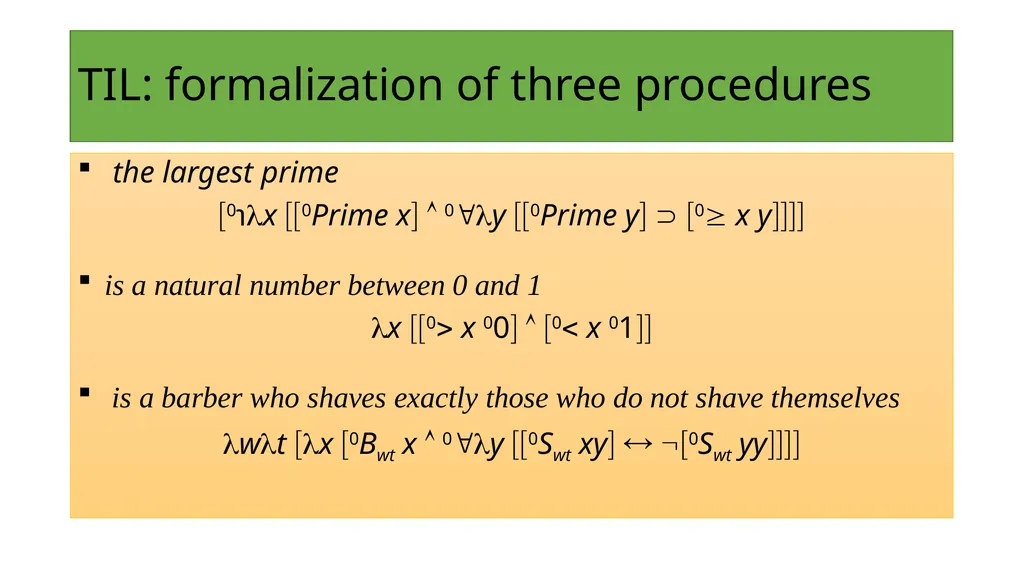
TIL: formalization of three procedures the largest prime
0℩x 0Prime x 0y 0Prime y 0 x y
is a natural number between 0 and 1
x 0 x 00 0 x 01
is a barber who shaves exactly those who do not shave themselves
wt x 0Bwt x 0y 0Swt xy 0Swt yy<br>
0℩x 0Prime x 0y 0Prime y 0 x y
is a natural number between 0 and 1
x 0 x 00 0 x 01
is a barber who shaves exactly those who do not shave themselves
wt x 0Bwt x 0y 0Swt xy 0Swt yy<br>
23
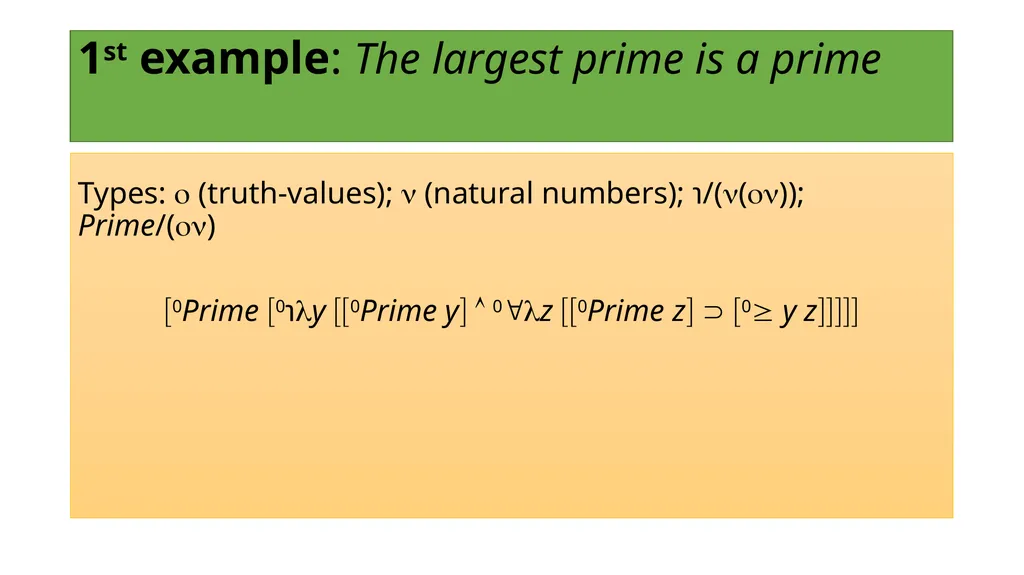
1st example: The largest prime is a prime Types: (truth-values); (natural numbers); ℩/(()); Prime/()
0Prime 0℩y 0Prime y 0z 0Prime z 0 y z<br>
0Prime 0℩y 0Prime y 0z 0Prime z 0 y z<br>
24
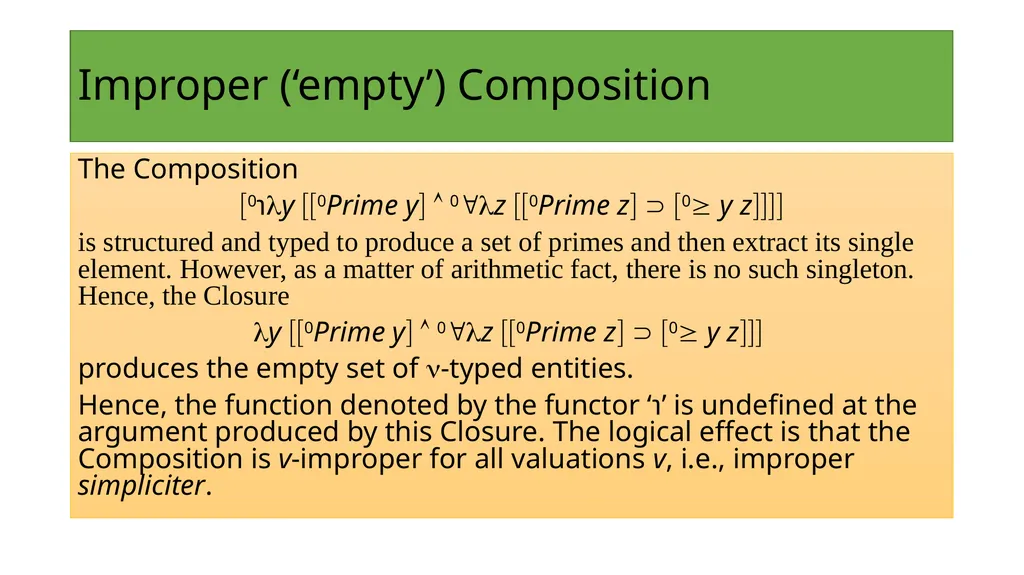
Improper (‘empty’) Composition The Composition
0℩y 0Prime y 0z 0Prime z 0 y z
is structured and typed to produce a set of primes and then extract its single element. However, as a matter of arithmetic fact, there is no such singleton. Hence, the Closure
y 0Prime y 0z 0Prime z 0 y z
produces the empty set of -typed entities.
Hence, the function denoted by the functor ‘℩’ is undefined at the argument produced by this Closure. The logical effect is that the Composition is v-improper for all valuations v, i.e., improper simpliciter.<br>
0℩y 0Prime y 0z 0Prime z 0 y z
is structured and typed to produce a set of primes and then extract its single element. However, as a matter of arithmetic fact, there is no such singleton. Hence, the Closure
y 0Prime y 0z 0Prime z 0 y z
produces the empty set of -typed entities.
Hence, the function denoted by the functor ‘℩’ is undefined at the argument produced by this Closure. The logical effect is that the Composition is v-improper for all valuations v, i.e., improper simpliciter.<br>
25
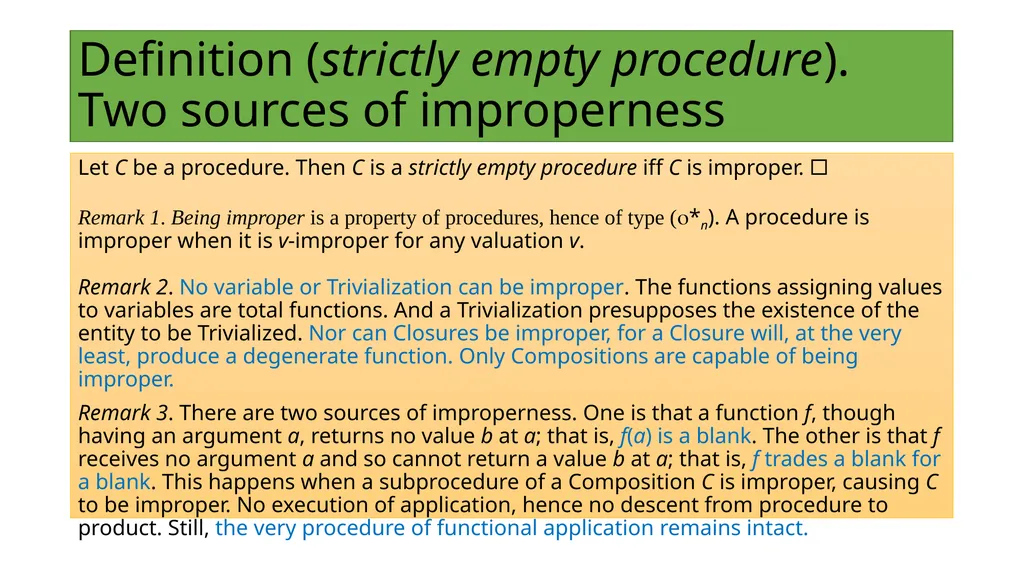
Definition (strictly empty procedure). Two sources of improperness Let C be a procedure. Then C is a strictly empty procedure iff C is improper.
Remark 1. Being improper is a property of procedures, hence of type (*n). A procedure is improper when it is v-improper for any valuation v.
Remark 2. No variable or Trivialization can be improper. The functions assigning values to variables are total functions. And a Trivialization presupposes the existence of the entity to be Trivialized. Nor can Closures be improper, for a Closure will, at the very least, produce a degenerate function. Only Compositions are capable of being improper.
Remark 3. There are two sources of improperness. One is that a function f, though having an argument a, returns no value b at a; that is, f(a) is a blank. The other is that f receives no argument a and so cannot return a value b at a; that is, f trades a blank for a blank. This happens when a subprocedure of a Composition C is improper, causing C to be improper. No execution of application, hence no descent from procedure to product. Still, the very procedure of functional application remains intact.<br>
Remark 1. Being improper is a property of procedures, hence of type (*n). A procedure is improper when it is v-improper for any valuation v.
Remark 2. No variable or Trivialization can be improper. The functions assigning values to variables are total functions. And a Trivialization presupposes the existence of the entity to be Trivialized. Nor can Closures be improper, for a Closure will, at the very least, produce a degenerate function. Only Compositions are capable of being improper.
Remark 3. There are two sources of improperness. One is that a function f, though having an argument a, returns no value b at a; that is, f(a) is a blank. The other is that f receives no argument a and so cannot return a value b at a; that is, f trades a blank for a blank. This happens when a subprocedure of a Composition C is improper, causing C to be improper. No execution of application, hence no descent from procedure to product. Still, the very procedure of functional application remains intact.<br>
26
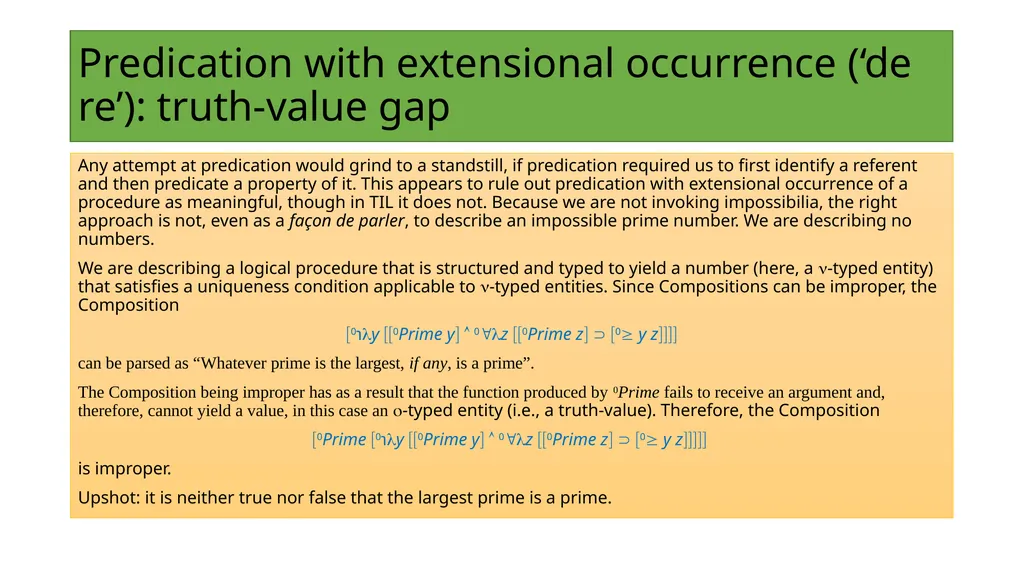
Predication with extensional occurrence (‘de re’): truth-value gap Any attempt at predication would grind to a standstill, if predication required us to first identify a referent and then predicate a property of it. This appears to rule out predication with extensional occurrence of a procedure as meaningful, though in TIL it does not. Because we are not invoking impossibilia, the right approach is not, even as a façon de parler, to describe an impossible prime number. We are describing no numbers.
We are describing a logical procedure that is structured and typed to yield a number (here, a -typed entity) that satisfies a uniqueness condition applicable to -typed entities. Since Compositions can be improper, the Composition
0℩y 0Prime y 0z 0Prime z 0 y z
can be parsed as “Whatever prime is the largest, if any, is a prime”.
The Composition being improper has as a result that the function produced by 0Prime fails to receive an argument and, therefore, cannot yield a value, in this case an -typed entity (i.e., a truth-value). Therefore, the Composition
0Prime 0℩y 0Prime y 0z 0Prime z 0 y z
is improper.
Upshot: it is neither true nor false that the largest prime is a prime.<br>
We are describing a logical procedure that is structured and typed to yield a number (here, a -typed entity) that satisfies a uniqueness condition applicable to -typed entities. Since Compositions can be improper, the Composition
0℩y 0Prime y 0z 0Prime z 0 y z
can be parsed as “Whatever prime is the largest, if any, is a prime”.
The Composition being improper has as a result that the function produced by 0Prime fails to receive an argument and, therefore, cannot yield a value, in this case an -typed entity (i.e., a truth-value). Therefore, the Composition
0Prime 0℩y 0Prime y 0z 0Prime z 0 y z
is improper.
Upshot: it is neither true nor false that the largest prime is a prime.<br>
27
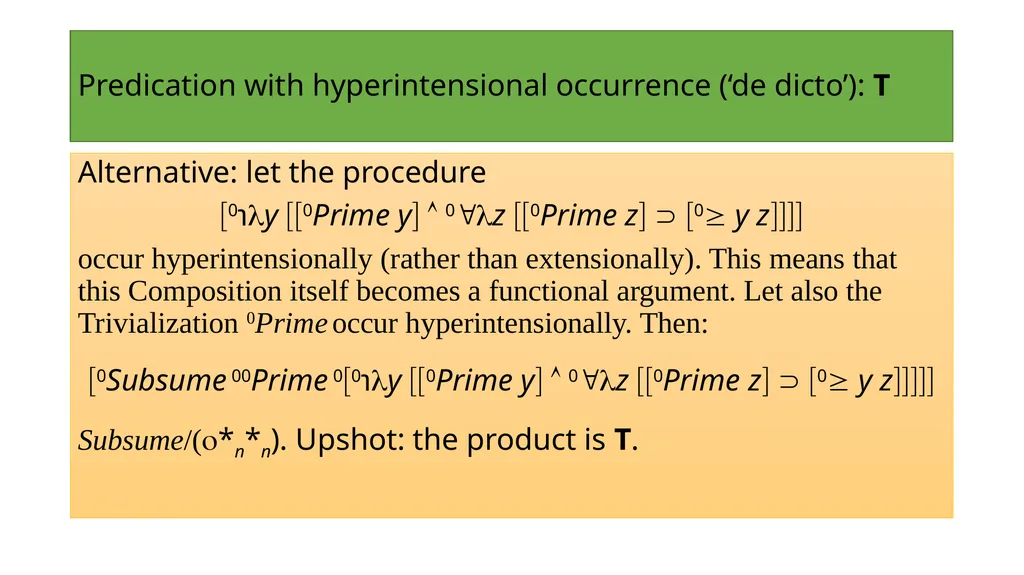
Predication with hyperintensional occurrence (‘de dicto’): T Alternative: let the procedure
0℩y 0Prime y 0z 0Prime z 0 y z
occur hyperintensionally (rather than extensionally). This means that this Composition itself becomes a functional argument. Let also the Trivialization 0Prime occur hyperintensionally. Then:
0Subsume 00Prime 00℩y 0Prime y 0z 0Prime z 0 y z
Subsume/(*n*n). Upshot: the product is T.<br>
0℩y 0Prime y 0z 0Prime z 0 y z
occur hyperintensionally (rather than extensionally). This means that this Composition itself becomes a functional argument. Let also the Trivialization 0Prime occur hyperintensionally. Then:
0Subsume 00Prime 00℩y 0Prime y 0z 0Prime z 0 y z
Subsume/(*n*n). Upshot: the product is T.<br>
28
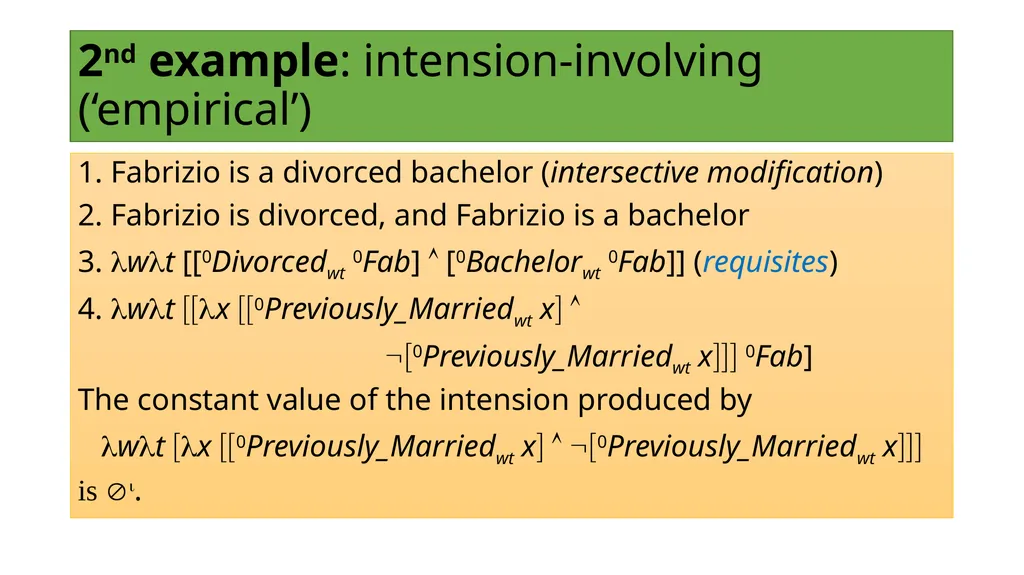
2nd example: intension-involving (‘empirical’) 1. Fabrizio is a divorced bachelor (intersective modification)
2. Fabrizio is divorced, and Fabrizio is a bachelor
3. wt [[0Divorcedwt 0Fab] [0Bachelorwt 0Fab]] (requisites)
4. wt x 0Previously_Marriedwt x
0Previously_Marriedwt x 0Fab]
The constant value of the intension produced by
wt x 0Previously_Marriedwt x 0Previously_Marriedwt x
is .<br>
2. Fabrizio is divorced, and Fabrizio is a bachelor
3. wt [[0Divorcedwt 0Fab] [0Bachelorwt 0Fab]] (requisites)
4. wt x 0Previously_Marriedwt x
0Previously_Marriedwt x 0Fab]
The constant value of the intension produced by
wt x 0Previously_Marriedwt x 0Previously_Marriedwt x
is .<br>
29
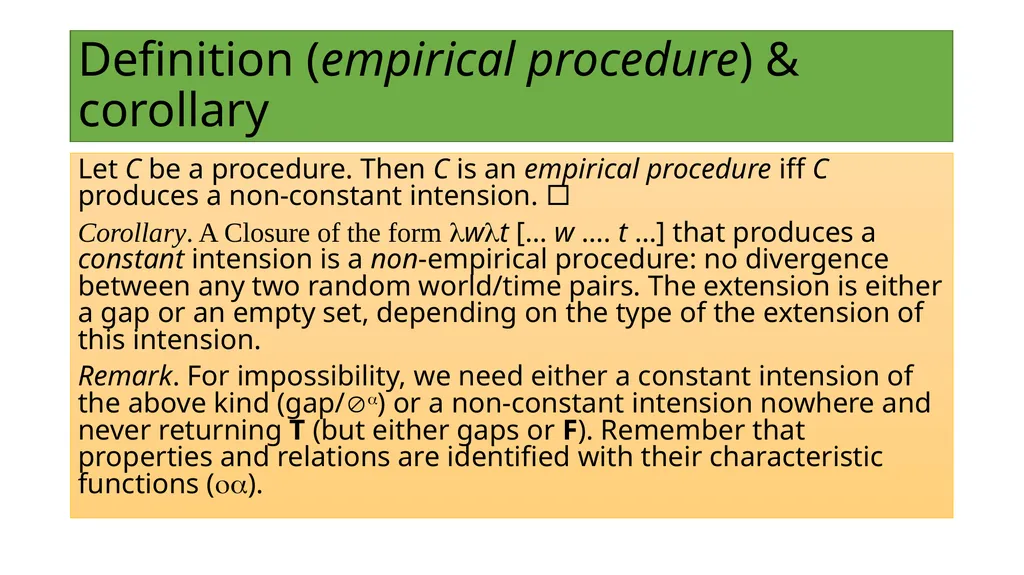
Definition (empirical procedure) & corollary Let C be a procedure. Then C is an empirical procedure iff C produces a non-constant intension.
Corollary. A Closure of the form wt [… w …. t …] that produces a constant intension is a non-empirical procedure: no divergence between any two random world/time pairs. The extension is either a gap or an empty set, depending on the type of the extension of this intension.
Remark. For impossibility, we need either a constant intension of the above kind (gap/) or a non-constant intension nowhere and never returning T (but either gaps or F). Remember that properties and relations are identified with their characteristic functions ().<br>
Corollary. A Closure of the form wt [… w …. t …] that produces a constant intension is a non-empirical procedure: no divergence between any two random world/time pairs. The extension is either a gap or an empty set, depending on the type of the extension of this intension.
Remark. For impossibility, we need either a constant intension of the above kind (gap/) or a non-constant intension nowhere and never returning T (but either gaps or F). Remember that properties and relations are identified with their characteristic functions ().<br>
30
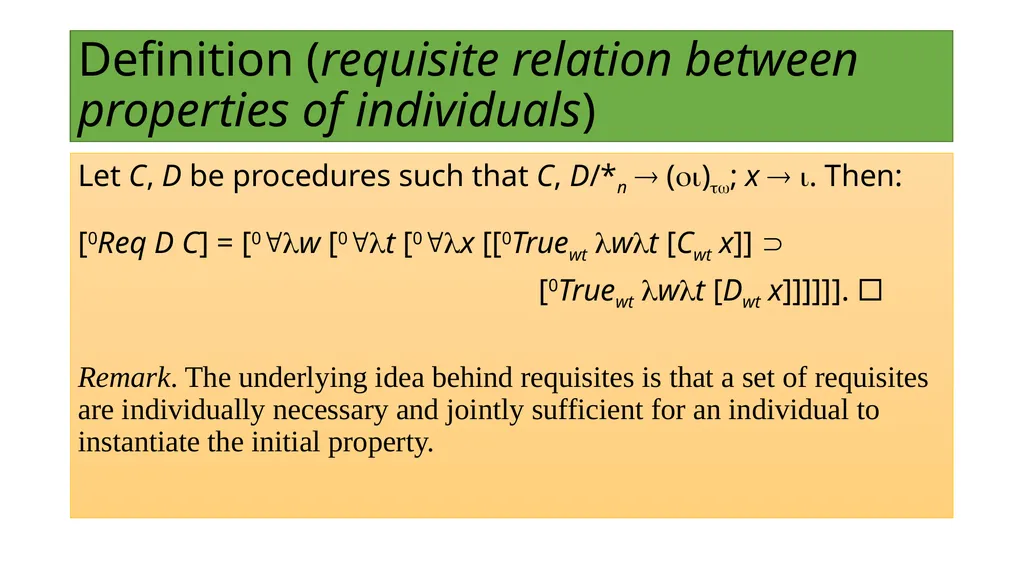
Definition (requisite relation between properties of individuals) Let C, D be procedures such that C, D/*n (); x . Then:
[0Req D C] = [0w [0t [0x [[0Truewt wt [Cwt x]]
[0Truewt wt [Dwt x]]]]]].
Remark. The underlying idea behind requisites is that a set of requisites are individually necessary and jointly sufficient for an individual to instantiate the initial property.<br>
[0Req D C] = [0w [0t [0x [[0Truewt wt [Cwt x]]
[0Truewt wt [Dwt x]]]]]].
Remark. The underlying idea behind requisites is that a set of requisites are individually necessary and jointly sufficient for an individual to instantiate the initial property.<br>
31
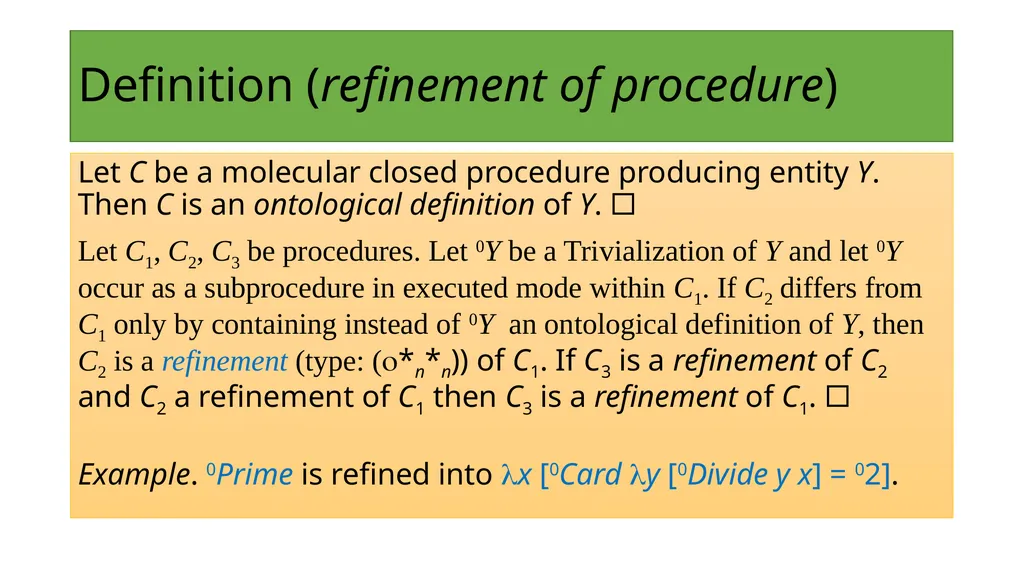
Definition (refinement of procedure) Let C be a molecular closed procedure producing entity Y. Then C is an ontological definition of Y.
Let C1, C2, C3 be procedures. Let 0Y be a Trivialization of Y and let 0Y occur as a subprocedure in executed mode within C1. If C2 differs from C1 only by containing instead of 0Y an ontological definition of Y, then C2 is a refinement (type: (*n*n)) of C1. If C3 is a refinement of C2 and C2 a refinement of C1 then C3 is a refinement of C1.
Example. 0Prime is refined into x [0Card y [0Divide y x] = 02].<br>
Let C1, C2, C3 be procedures. Let 0Y be a Trivialization of Y and let 0Y occur as a subprocedure in executed mode within C1. If C2 differs from C1 only by containing instead of 0Y an ontological definition of Y, then C2 is a refinement (type: (*n*n)) of C1. If C3 is a refinement of C2 and C2 a refinement of C1 then C3 is a refinement of C1.
Example. 0Prime is refined into x [0Card y [0Divide y x] = 02].<br>
32
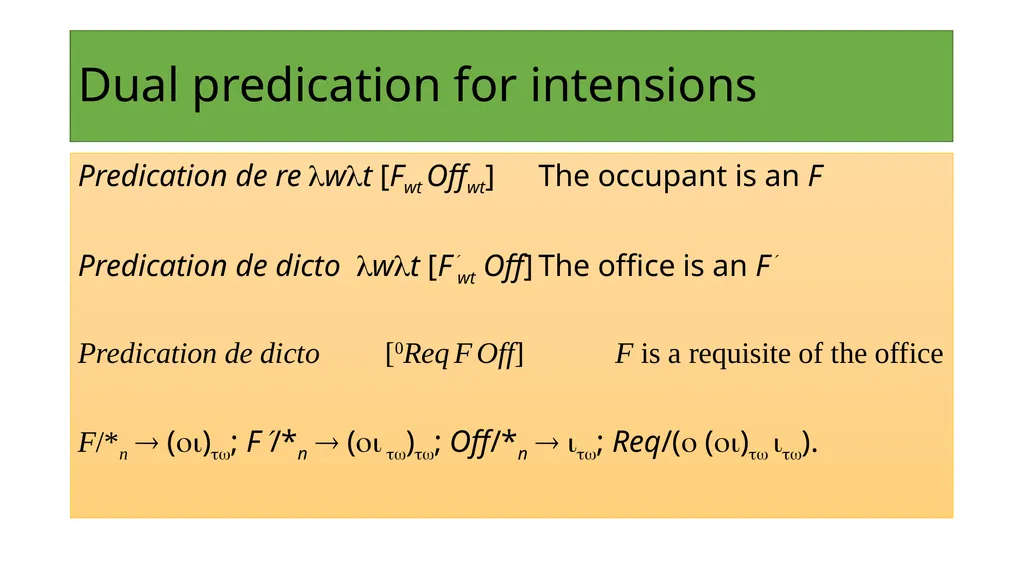
Dual predication for intensions Predication de re wt [Fwt Offwt] The occupant is an F
Predication de dicto wt [Fwt Off] The office is an F
Predication de dicto [0Req F Off] F is a requisite of the office
F/*n (); F/*n ( ); Off/*n ; Req/( () ).<br>
Predication de dicto wt [Fwt Off] The office is an F
Predication de dicto [0Req F Off] F is a requisite of the office
F/*n (); F/*n ( ); Off/*n ; Req/( () ).<br>
33
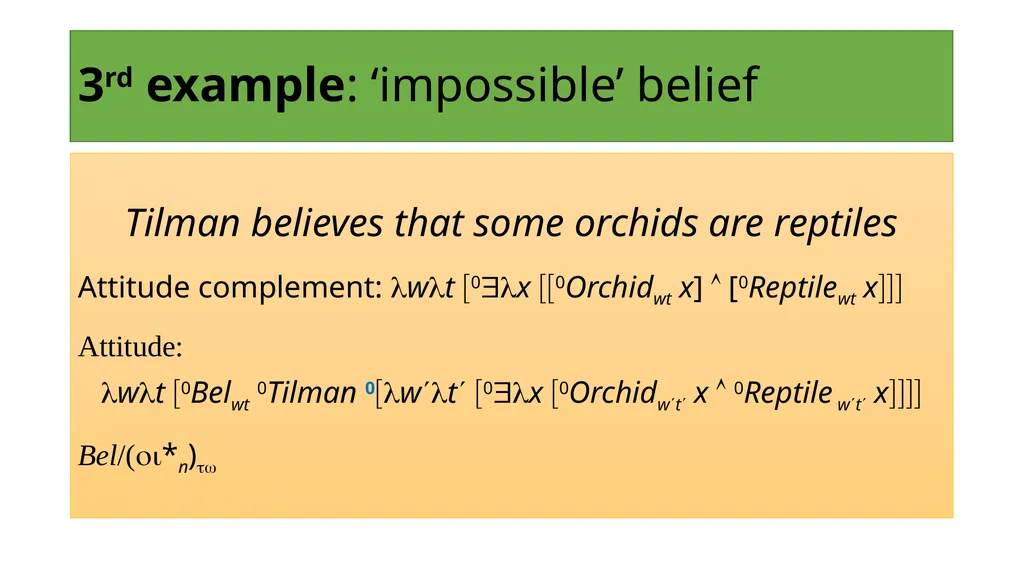
3rd example: ‘impossible’ belief Tilman believes that some orchids are reptiles
Attitude complement: wt 0x 0Orchidwt x] [0Reptilewt x
Attitude:
wt 0Belwt 0Tilman 0wt 0x 0Orchidwt x 0Reptile wt x
Bel/(*n)<br>
Attitude complement: wt 0x 0Orchidwt x] [0Reptilewt x
Attitude:
wt 0Belwt 0Tilman 0wt 0x 0Orchidwt x 0Reptile wt x
Bel/(*n)<br>
34
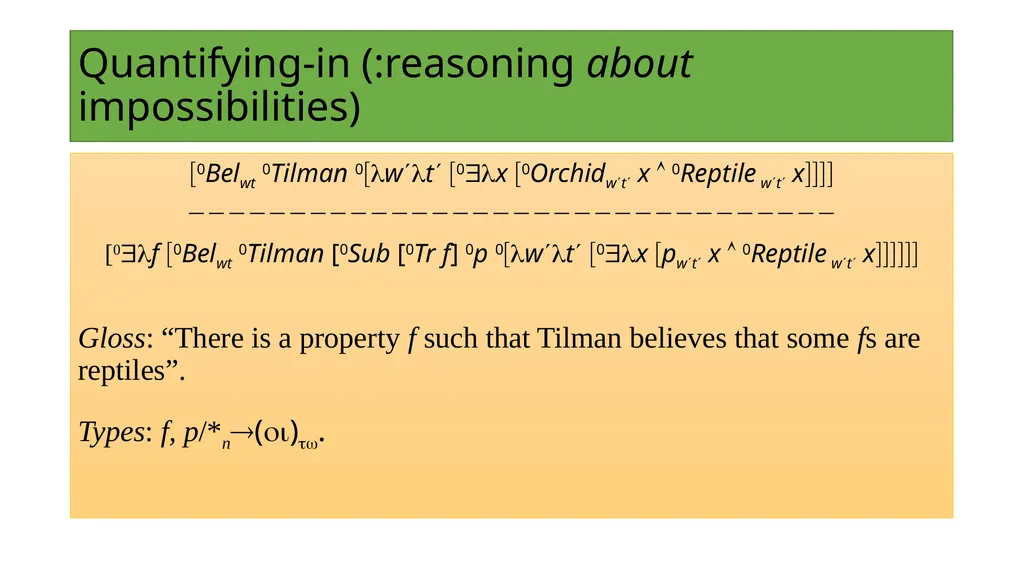
Quantifying-in (:reasoning about impossibilities) 0Belwt 0Tilman 0wt 0x 0Orchidwt x 0Reptile wt x
[0f 0Belwt 0Tilman [0Sub [0Tr f] 0p 0wt 0x pwt x 0Reptile wt x
Gloss: “There is a property f such that Tilman believes that some fs are reptiles”.
Types: f, p/*n().<br>
[0f 0Belwt 0Tilman [0Sub [0Tr f] 0p 0wt 0x pwt x 0Reptile wt x
Gloss: “There is a property f such that Tilman believes that some fs are reptiles”.
Types: f, p/*n().<br>
35
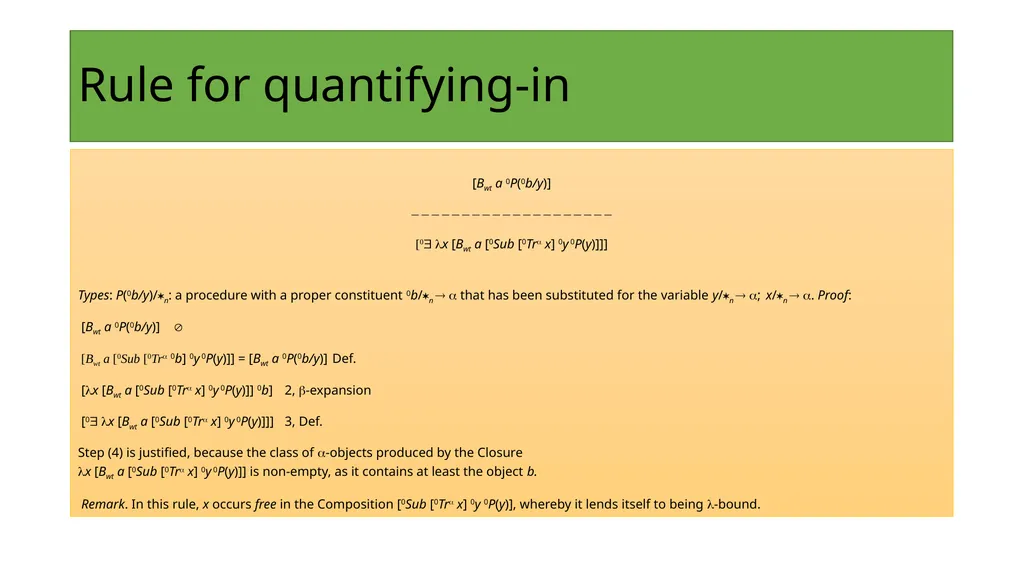
Rule for quantifying-in [Bwt a 0P(0b/y)]
[0 x [Bwt a [0Sub [0Tr x] 0y 0P(y)]]]
Types: P(0b/y)/n: a procedure with a proper constituent 0b/n that has been substituted for the variable y/n ; x/n . Proof:
[Bwt a 0P(0b/y)]
[Bwt a [0Sub [0Tr 0b] 0y 0P(y)]] = [Bwt a 0P(0b/y)] Def.
[x [Bwt a [0Sub [0Tr x] 0y 0P(y)]] 0b] 2, -expansion
[0 x [Bwt a [0Sub [0Tr x] 0y 0P(y)]]] 3, Def.
Step (4) is justified, because the class of -objects produced by the Closure x [Bwt a [0Sub [0Tr x] 0y 0P(y)]] is non-empty, as it contains at least the object b.
Remark. In this rule, x occurs free in the Composition [0Sub [0Tr x] 0y 0P(y)], whereby it lends itself to being -bound.<br>
[0 x [Bwt a [0Sub [0Tr x] 0y 0P(y)]]]
Types: P(0b/y)/n: a procedure with a proper constituent 0b/n that has been substituted for the variable y/n ; x/n . Proof:
[Bwt a 0P(0b/y)]
[Bwt a [0Sub [0Tr 0b] 0y 0P(y)]] = [Bwt a 0P(0b/y)] Def.
[x [Bwt a [0Sub [0Tr x] 0y 0P(y)]] 0b] 2, -expansion
[0 x [Bwt a [0Sub [0Tr x] 0y 0P(y)]]] 3, Def.
Step (4) is justified, because the class of -objects produced by the Closure x [Bwt a [0Sub [0Tr x] 0y 0P(y)]] is non-empty, as it contains at least the object b.
Remark. In this rule, x occurs free in the Composition [0Sub [0Tr x] 0y 0P(y)], whereby it lends itself to being -bound.<br>