
IMPOTENTIA GENERANDI Dr Alok Kumar Introduction
T
Published · 30 slides · 0 views
1 / 1




Description
IMPOTENTIA GENERANDI Dr Alok Kumar Introduction Inability or reduced ability to fertilize the ovum due to pathology of testis, epididymis and accessory sex glands is called as Impotentia Generandi. Fertility in male is the normal
Related Topics
Share
Embed code
Download this presentation From Below
"IMPOTENTIA GENERANDI Dr Alok Kumar Introduction" is the property of its rightful owner. Permission is granted to download and print the materials on this website for personal, non-commercial use only, and to display it on your personal computer provided you do not modify the materials and that you retain all copyright notices contained in the materials. By downloading content from our website, you accept the terms of this agreement.
Presentation Transcript
01
IMPOTENTIA GENERANDI Dr Alok Kumar<br>
02
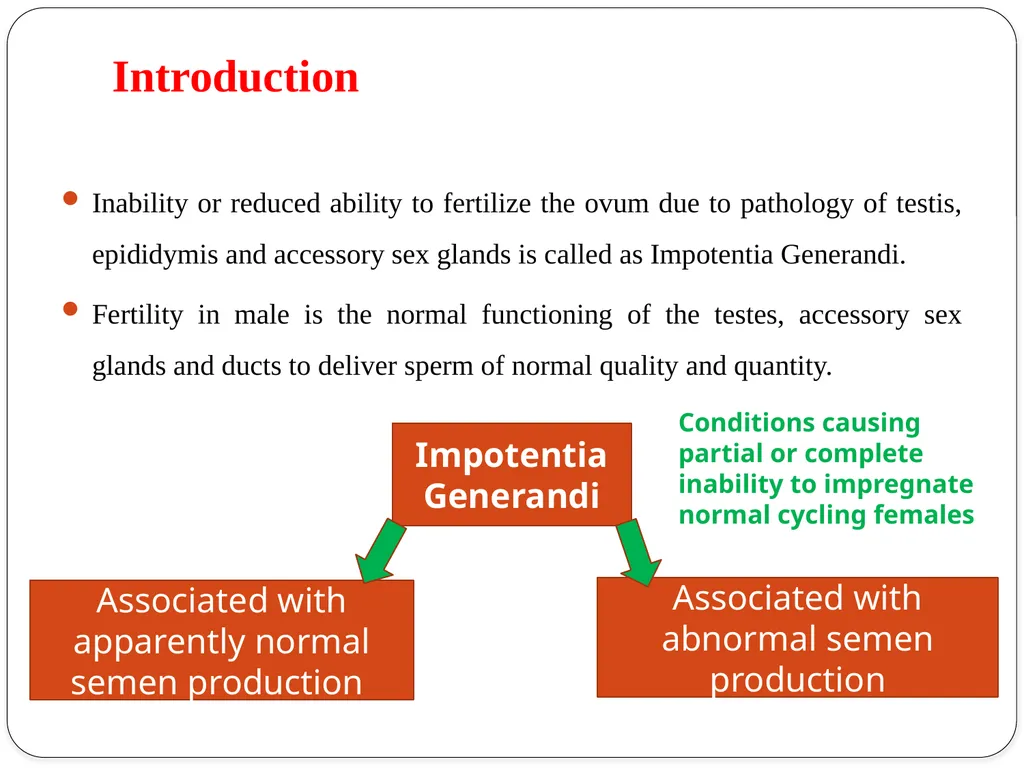
Introduction Inability or reduced ability to fertilize the ovum due to pathology of testis, epididymis and accessory sex glands is called as Impotentia Generandi.
Fertility in male is the normal functioning of the testes, accessory sex glands and ducts to deliver sperm of normal quality and quantity. Impotentia Generandi Associated with apparently normal semen production Associated with abnormal semen production Conditions causing partial or complete inability to impregnate normal cycling females<br>
Fertility in male is the normal functioning of the testes, accessory sex glands and ducts to deliver sperm of normal quality and quantity. Impotentia Generandi Associated with apparently normal semen production Associated with abnormal semen production Conditions causing partial or complete inability to impregnate normal cycling females<br>
03
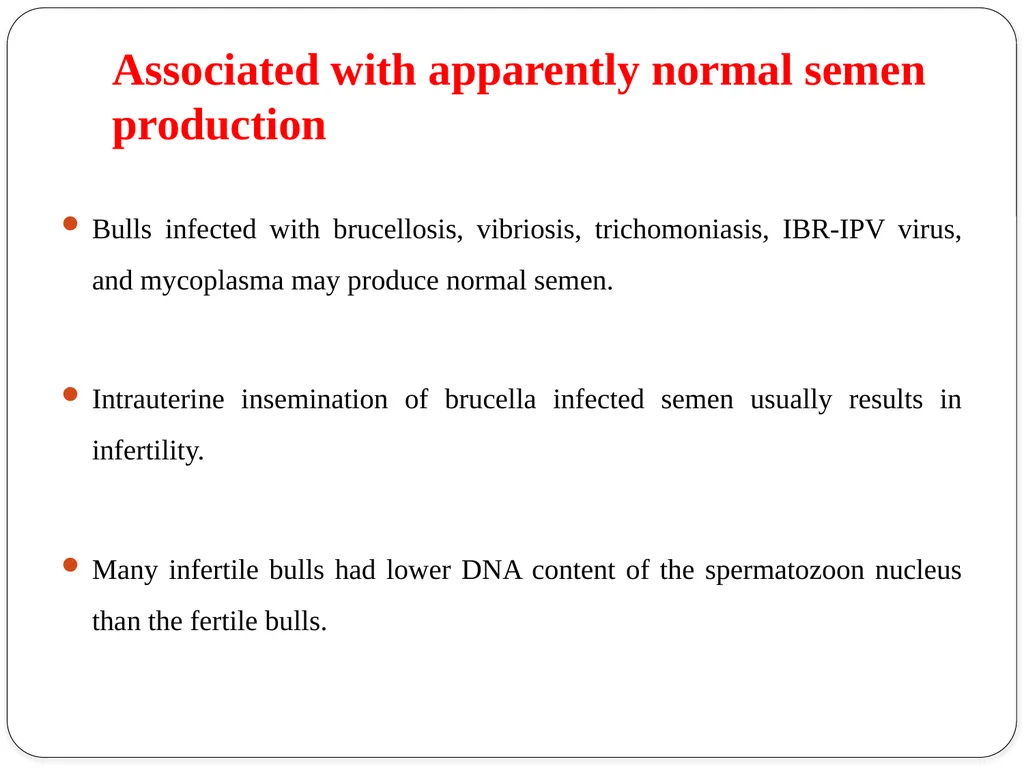
Associated with apparently normal semen production Bulls infected with brucellosis, vibriosis, trichomoniasis, IBR-IPV virus, and mycoplasma may produce normal semen.
Intrauterine insemination of brucella infected semen usually results in infertility.
Many infertile bulls had lower DNA content of the spermatozoon nucleus than the fertile bulls.<br>
Intrauterine insemination of brucella infected semen usually results in infertility.
Many infertile bulls had lower DNA content of the spermatozoon nucleus than the fertile bulls.<br>
04
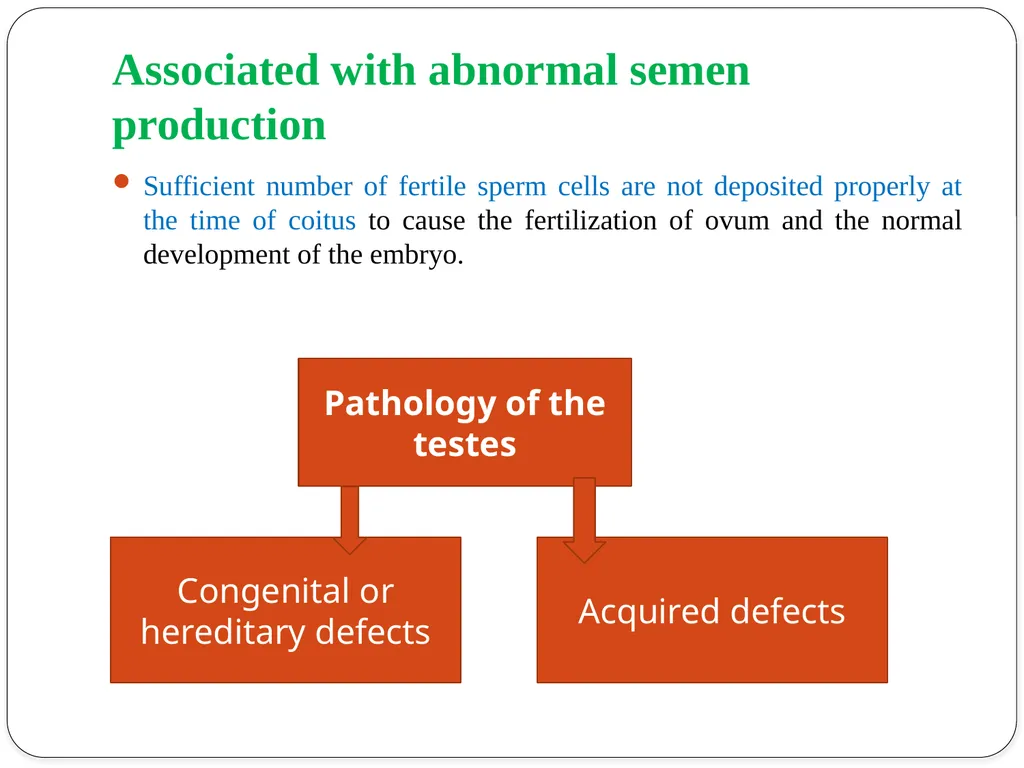
Associated with abnormal semen production Sufficient number of fertile sperm cells are not deposited properly at the time of coitus to cause the fertilization of ovum and the normal development of the embryo. Pathology of the testes Congenital or hereditary defects Acquired defects<br>
05
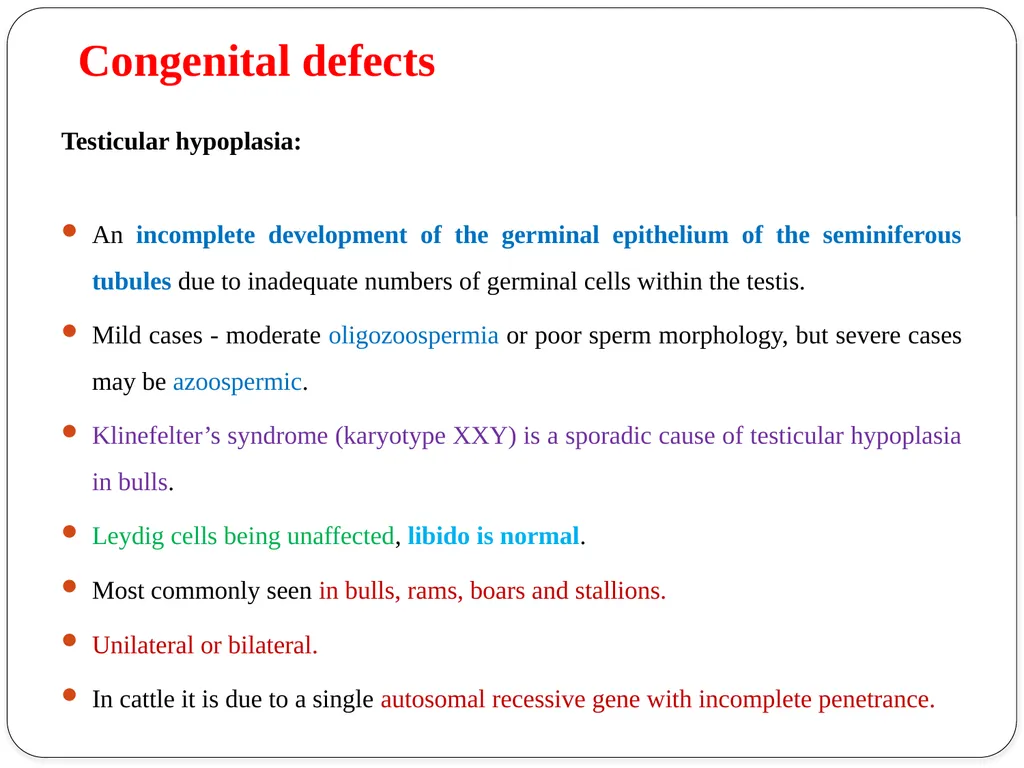
Congenital defects Testicular hypoplasia:
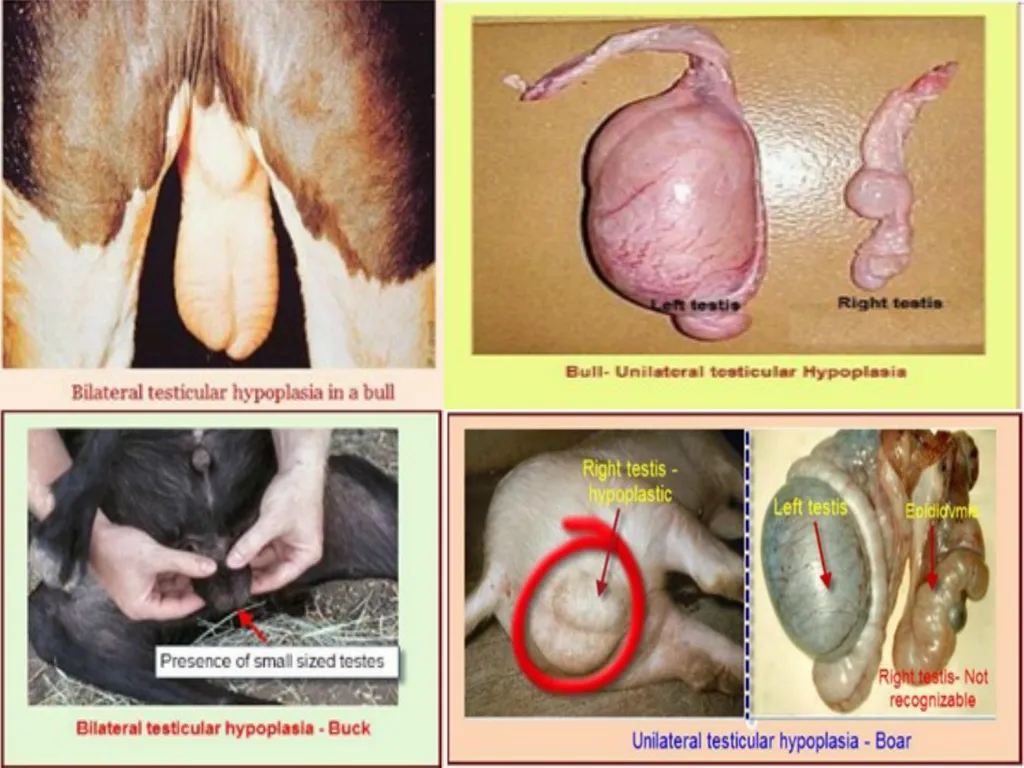
An incomplete development of the germinal epithelium of the seminiferous tubules due to inadequate numbers of germinal cells within the testis.
Mild cases - moderate oligozoospermia or poor sperm morphology, but severe cases may be azoospermic.
Klinefelter’s syndrome (karyotype XXY) is a sporadic cause of testicular hypoplasia in bulls.
Leydig cells being unaffected, libido is normal.
Most commonly seen in bulls, rams, boars and stallions.
Unilateral or bilateral.
In cattle it is due to a single autosomal recessive gene with incomplete penetrance.<br>
An incomplete development of the germinal epithelium of the seminiferous tubules due to inadequate numbers of germinal cells within the testis.
Mild cases - moderate oligozoospermia or poor sperm morphology, but severe cases may be azoospermic.
Klinefelter’s syndrome (karyotype XXY) is a sporadic cause of testicular hypoplasia in bulls.
Leydig cells being unaffected, libido is normal.
Most commonly seen in bulls, rams, boars and stallions.
Unilateral or bilateral.
In cattle it is due to a single autosomal recessive gene with incomplete penetrance.<br>
06
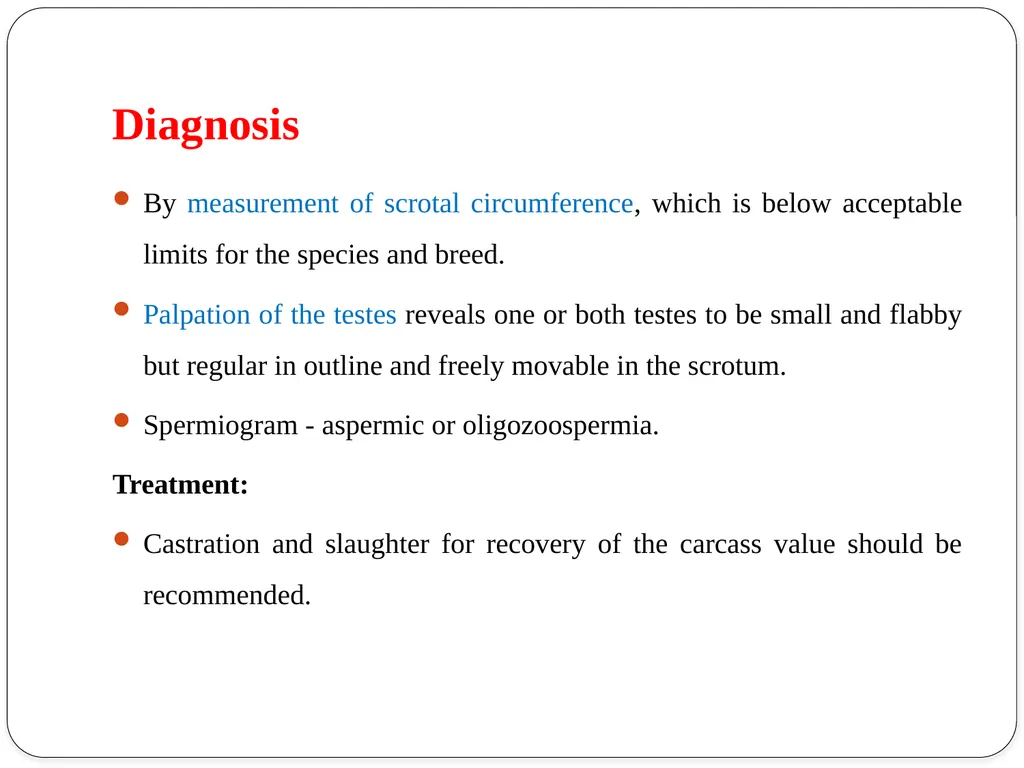
Diagnosis By measurement of scrotal circumference, which is below acceptable limits for the species and breed.
Palpation of the testes reveals one or both testes to be small and flabby but regular in outline and freely movable in the scrotum.
Spermiogram - aspermic or oligozoospermia.
Treatment:
Castration and slaughter for recovery of the carcass value should be recommended.<br>
Palpation of the testes reveals one or both testes to be small and flabby but regular in outline and freely movable in the scrotum.
Spermiogram - aspermic or oligozoospermia.
Treatment:
Castration and slaughter for recovery of the carcass value should be recommended.<br>
07
Cryptorchidism One or both testes fail to complete their descent into scrotum.
Spermatogenesis is markedly impaired or absent in testes that are not scrotal.
Testosterone secretion is unaffected by cryptorchidism so libido of affected animals is normal.
Most commonly occurs in the stallion, boar and some breeds of dogs.<br>
Spermatogenesis is markedly impaired or absent in testes that are not scrotal.
Testosterone secretion is unaffected by cryptorchidism so libido of affected animals is normal.
Most commonly occurs in the stallion, boar and some breeds of dogs.<br>
08
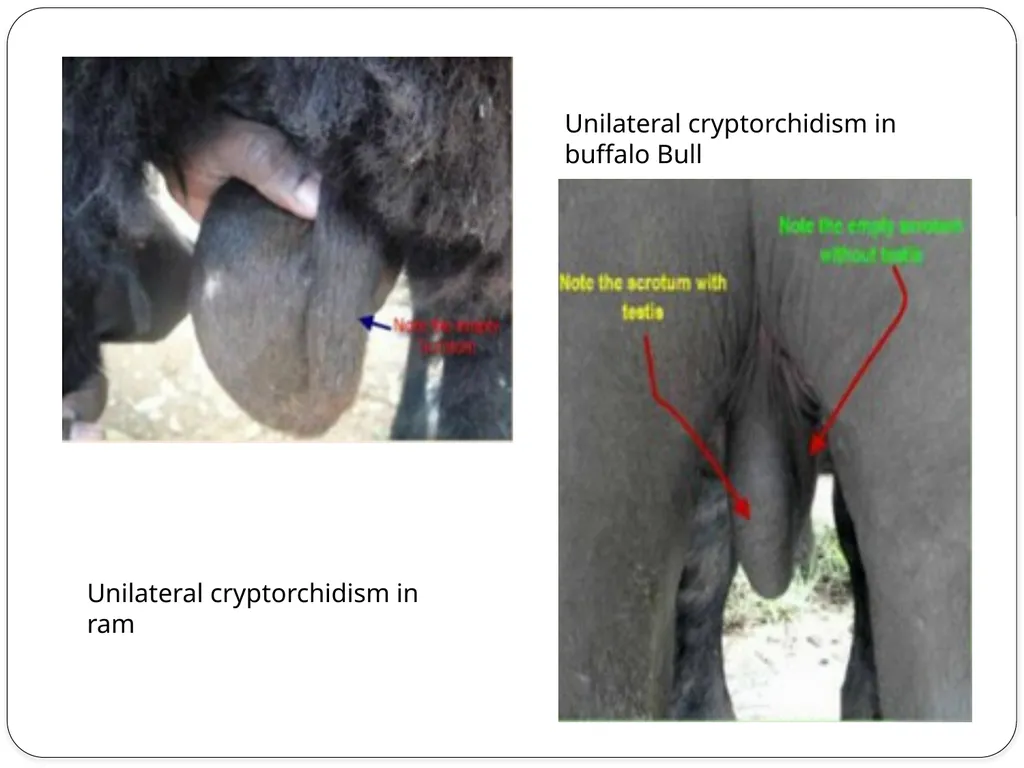
Unilateral cryptorchidism in ram Unilateral cryptorchidism in buffalo Bull<br>
09
Treatment: Removal of retained testes from the horse may be effected by initial surgical exploration of the inguinal canal.
Other abdominal testes can be withdrawn through a parapenile abdominal incision.<br>
Other abdominal testes can be withdrawn through a parapenile abdominal incision.<br>
10
Abnormalities of semen Semen examination:
To provide information about fertilizing potential of the ejaculate.
Sperm abnormalities :
Assessed according to 3 main criteria
Site on the sperm: head, midpiece and tail defects and sperm bearing protoplasmic droplet.
Site of origin (Blom, 1950):
Primary (defects of spermatogenesis; testis).
Secondary (epididymis).
Tertiary (post-ejaculation e.g. from inadequate temperature, pH or osmotic control during handling of semen).
3. Effects on fertility (Blom, 1983):<br>
To provide information about fertilizing potential of the ejaculate.
Sperm abnormalities :
Assessed according to 3 main criteria
Site on the sperm: head, midpiece and tail defects and sperm bearing protoplasmic droplet.
Site of origin (Blom, 1950):
Primary (defects of spermatogenesis; testis).
Secondary (epididymis).
Tertiary (post-ejaculation e.g. from inadequate temperature, pH or osmotic control during handling of semen).
3. Effects on fertility (Blom, 1983):<br>
11
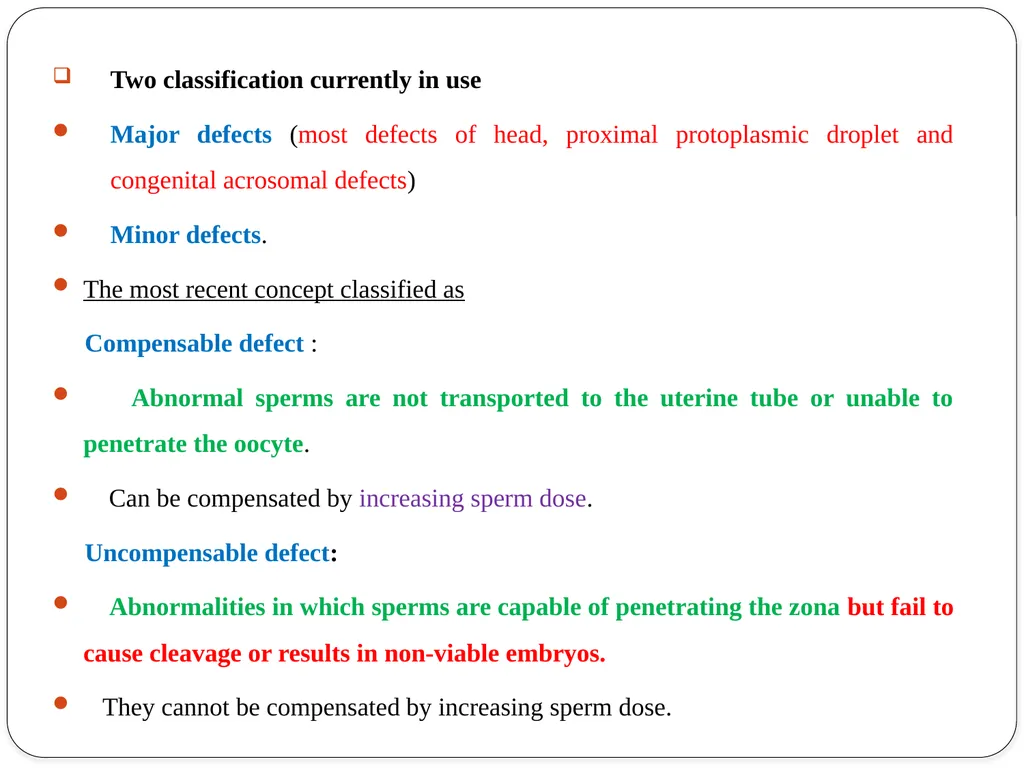
Two classification currently in use
Major defects (most defects of head, proximal protoplasmic droplet and congenital acrosomal defects)
Minor defects.
The most recent concept classified as
Compensable defect :
Abnormal sperms are not transported to the uterine tube or unable to penetrate the oocyte.
Can be compensated by increasing sperm dose.
Uncompensable defect:
Abnormalities in which sperms are capable of penetrating the zona but fail to cause cleavage or results in non-viable embryos.
They cannot be compensated by increasing sperm dose.<br>
Major defects (most defects of head, proximal protoplasmic droplet and congenital acrosomal defects)
Minor defects.
The most recent concept classified as
Compensable defect :
Abnormal sperms are not transported to the uterine tube or unable to penetrate the oocyte.
Can be compensated by increasing sperm dose.
Uncompensable defect:
Abnormalities in which sperms are capable of penetrating the zona but fail to cause cleavage or results in non-viable embryos.
They cannot be compensated by increasing sperm dose.<br>
12
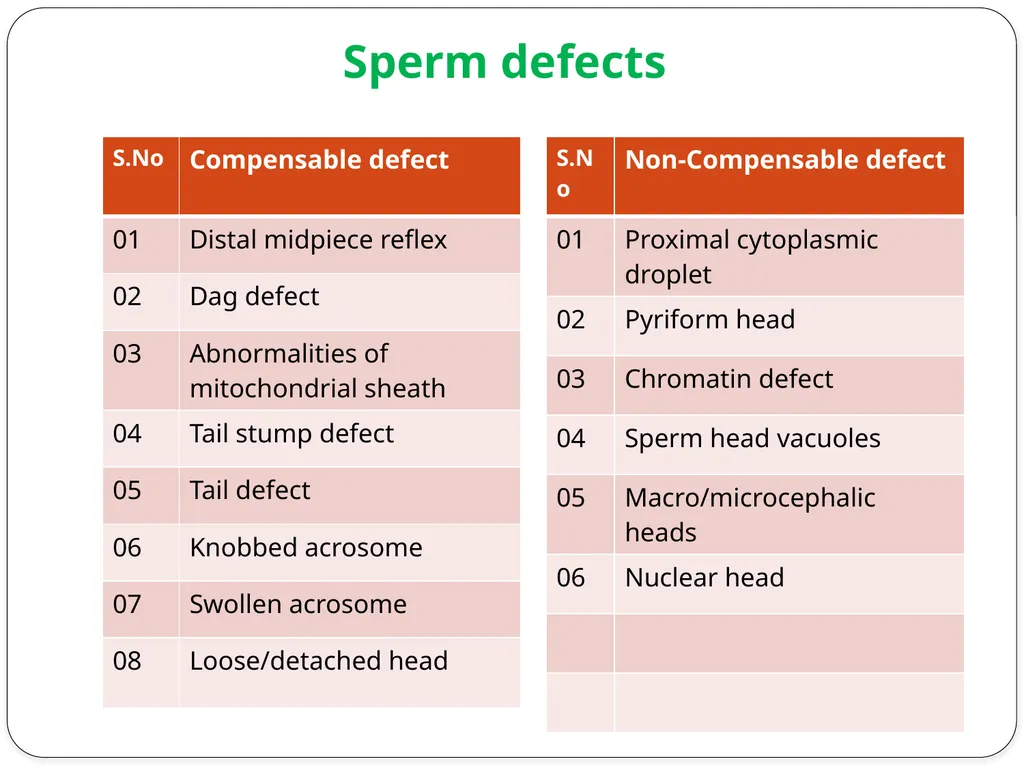
Sperm defects<br>
13
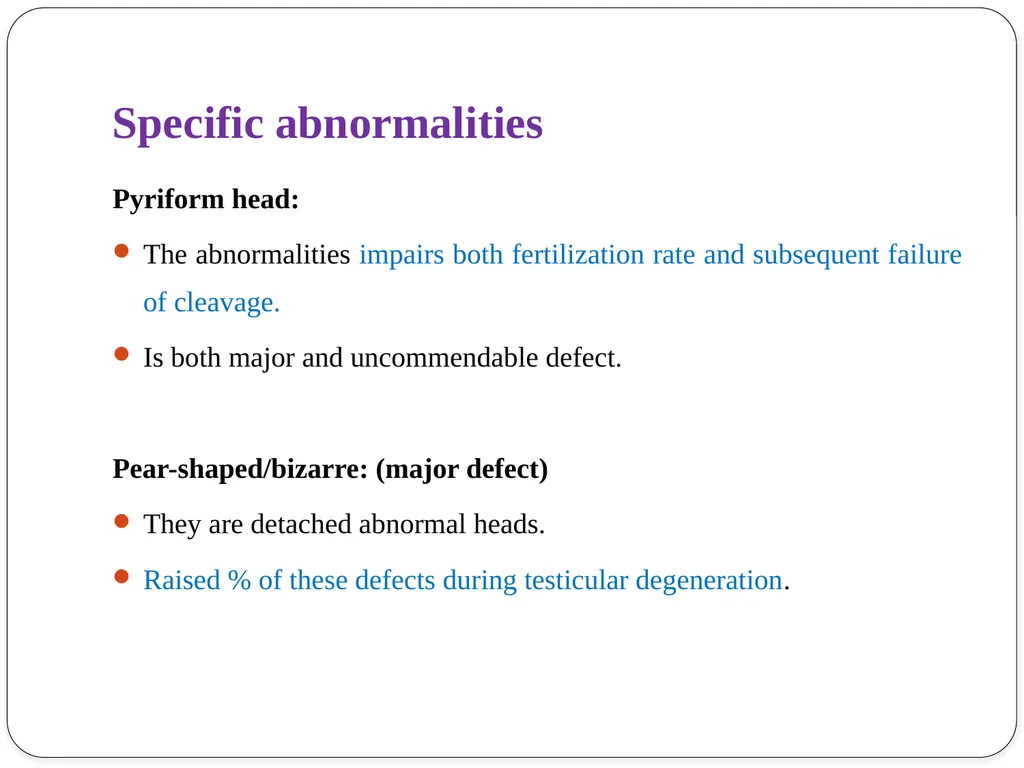
Specific abnormalities Pyriform head:
The abnormalities impairs both fertilization rate and subsequent failure of cleavage.
Is both major and uncommendable defect.
Pear-shaped/bizarre: (major defect)
They are detached abnormal heads.
Raised % of these defects during testicular degeneration.<br>
The abnormalities impairs both fertilization rate and subsequent failure of cleavage.
Is both major and uncommendable defect.
Pear-shaped/bizarre: (major defect)
They are detached abnormal heads.
Raised % of these defects during testicular degeneration.<br>
14
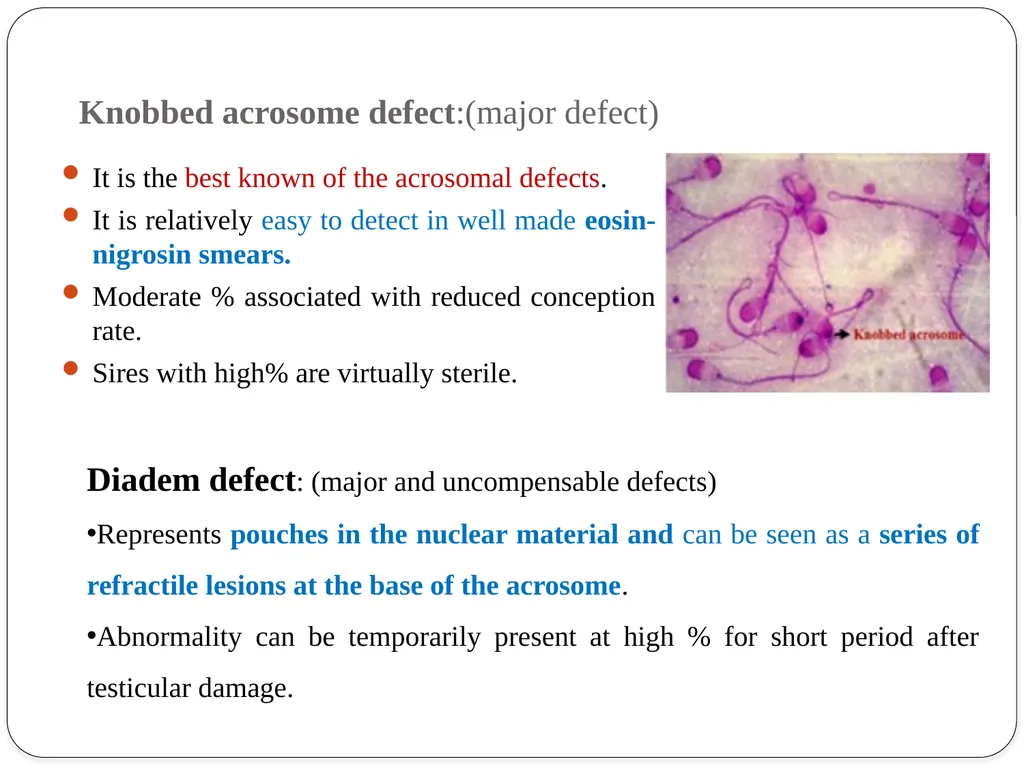
Knobbed acrosome defect:(major defect) It is the best known of the acrosomal defects.
It is relatively easy to detect in well made eosin-nigrosin smears.
Moderate % associated with reduced conception rate.
Sires with high% are virtually sterile. Diadem defect: (major and uncompensable defects)
Represents pouches in the nuclear material and can be seen as a series of refractile lesions at the base of the acrosome.
Abnormality can be temporarily present at high % for short period after testicular damage.<br>
It is relatively easy to detect in well made eosin-nigrosin smears.
Moderate % associated with reduced conception rate.
Sires with high% are virtually sterile. Diadem defect: (major and uncompensable defects)
Represents pouches in the nuclear material and can be seen as a series of refractile lesions at the base of the acrosome.
Abnormality can be temporarily present at high % for short period after testicular damage.<br>
15
Decapitated syndrome:
Inherited in Guernsey and Hereford bulls.
Most are decapitated and the detached tails are motile.
Semen exhibit apparently normal wave motion.
Tail-stump defect:
Inherited in several breeds of bull.
Morphologically normal heads are attached to a vestigial structure that appears like a protoplasmic droplet.
Affected bulls are sterile.<br>
Inherited in Guernsey and Hereford bulls.
Most are decapitated and the detached tails are motile.
Semen exhibit apparently normal wave motion.
Tail-stump defect:
Inherited in several breeds of bull.
Morphologically normal heads are attached to a vestigial structure that appears like a protoplasmic droplet.
Affected bulls are sterile.<br>
16
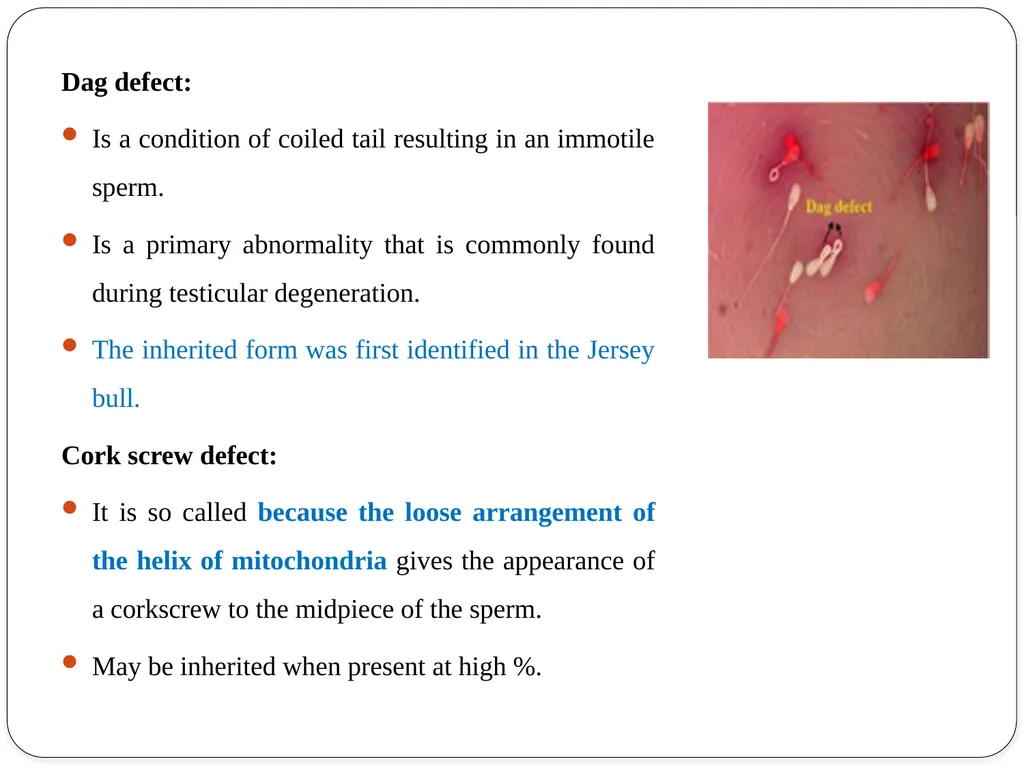
Dag defect:
Is a condition of coiled tail resulting in an immotile sperm.
Is a primary abnormality that is commonly found during testicular degeneration.
The inherited form was first identified in the Jersey bull.
Cork screw defect:
It is so called because the loose arrangement of the helix of mitochondria gives the appearance of a corkscrew to the midpiece of the sperm.
May be inherited when present at high %.<br>
Is a condition of coiled tail resulting in an immotile sperm.
Is a primary abnormality that is commonly found during testicular degeneration.
The inherited form was first identified in the Jersey bull.
Cork screw defect:
It is so called because the loose arrangement of the helix of mitochondria gives the appearance of a corkscrew to the midpiece of the sperm.
May be inherited when present at high %.<br>
17
Acquired defects Testicular degeneration:
The seminiferous epithelium of the testis is highly susceptible to damage with a wide variety of agents causing reversible or irreversible degeneration.
Causes
Raised intratesticular temperature
Toxins
Endocrine disturbances
Infection.
Infertility and oligozoospermia usually supervene 4-8 weeks after the onset of the cause of the degeneration.
Libido is normally unaffected.<br>
The seminiferous epithelium of the testis is highly susceptible to damage with a wide variety of agents causing reversible or irreversible degeneration.
Causes
Raised intratesticular temperature
Toxins
Endocrine disturbances
Infection.
Infertility and oligozoospermia usually supervene 4-8 weeks after the onset of the cause of the degeneration.
Libido is normally unaffected.<br>
18
Cont… Ejaculate volume is usually unaffected but the number and motility of spermatozoa fall, while proportion of sperm exhibiting abnormal morphology rises.
Depends on the degree of damage that is present in seminiferous tubules.
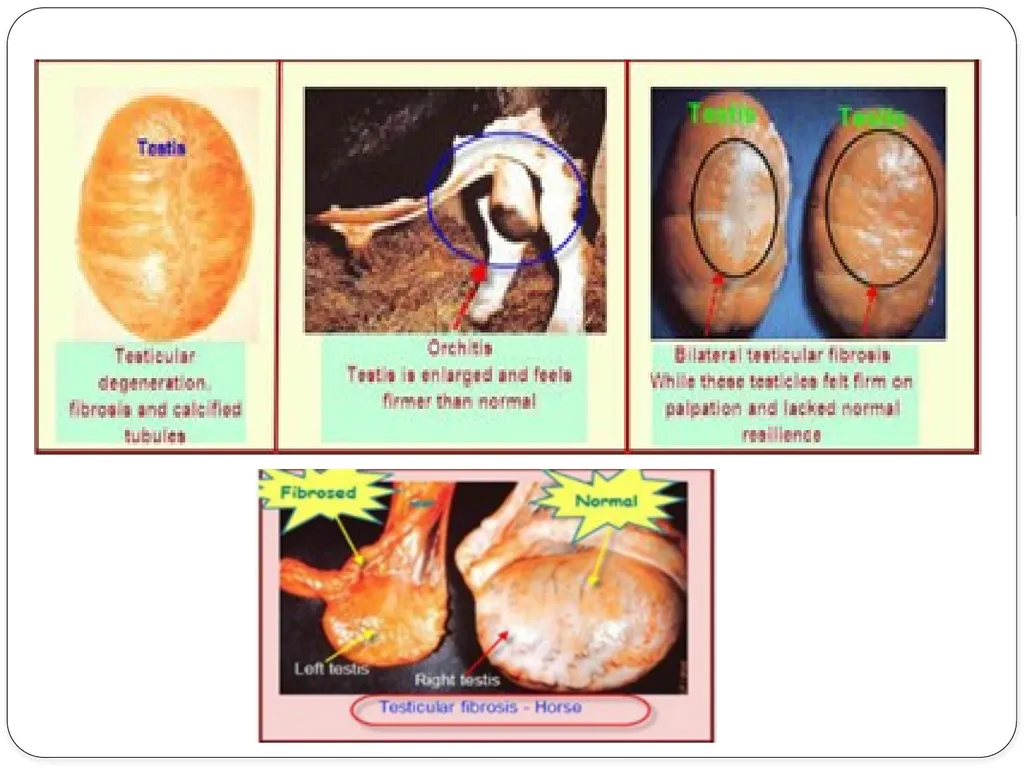
In more severe cases, permanent loss of seminiferous tubules occurs, with fibrosis and calcification of the testis following.
Prognosis
In the dog and stallion testicular biopsy is potentially useful for determining the prognosis for recovery.
Intact basement membranes of the seminiferous tubules, the presence of spermatogonia with in the tubules and the patency of the lumen of the tubules all indicate a good prognosis for restoration of fertility.
Recovery is demonstrated through repeated semen examination.<br>
Depends on the degree of damage that is present in seminiferous tubules.
In more severe cases, permanent loss of seminiferous tubules occurs, with fibrosis and calcification of the testis following.
Prognosis
In the dog and stallion testicular biopsy is potentially useful for determining the prognosis for recovery.
Intact basement membranes of the seminiferous tubules, the presence of spermatogonia with in the tubules and the patency of the lumen of the tubules all indicate a good prognosis for restoration of fertility.
Recovery is demonstrated through repeated semen examination.<br>
19
Testicular neoplasia Although common in dog, rarely represents a cause of infertility.
Interstitial cell tumour:
Most common tumour of the dog.
Usually occurs in scrotal testes of aged dogs but are usually too small to be palpated.
It may result in increased circulating concentrations of androgen and thereby, predispose to androgen-related disease.
Cause no clinical signs in bulls and no impairment to fertility.<br>
Interstitial cell tumour:
Most common tumour of the dog.
Usually occurs in scrotal testes of aged dogs but are usually too small to be palpated.
It may result in increased circulating concentrations of androgen and thereby, predispose to androgen-related disease.
Cause no clinical signs in bulls and no impairment to fertility.<br>
20
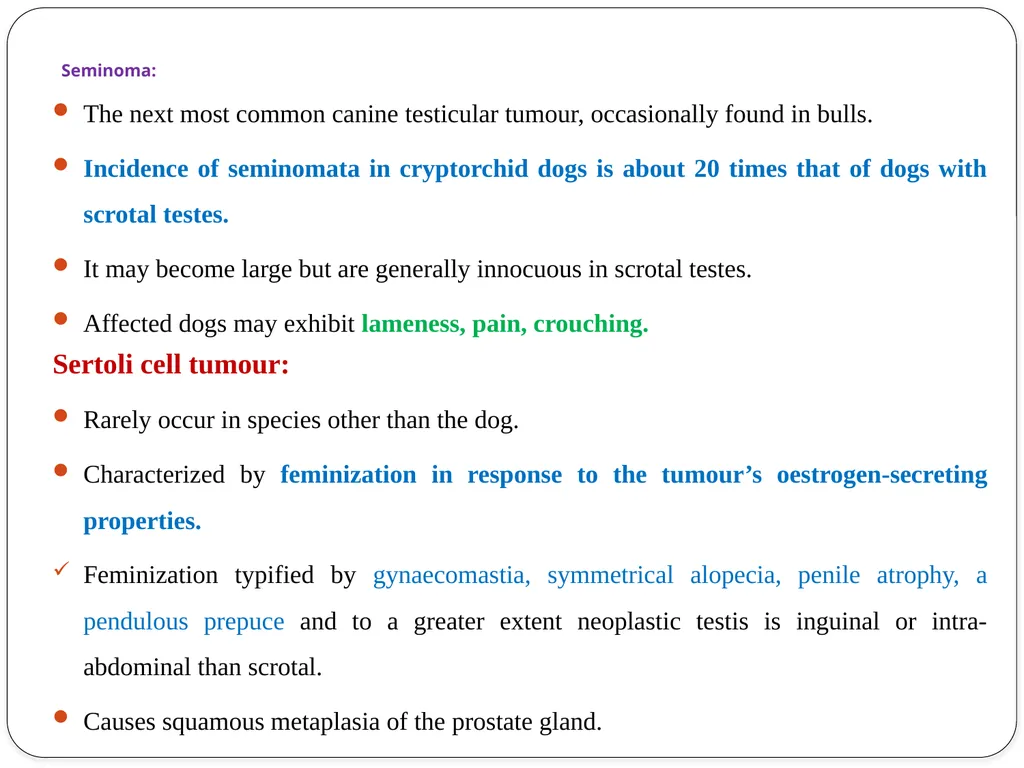
Seminoma: The next most common canine testicular tumour, occasionally found in bulls.
Incidence of seminomata in cryptorchid dogs is about 20 times that of dogs with scrotal testes.
It may become large but are generally innocuous in scrotal testes.
Affected dogs may exhibit lameness, pain, crouching.
Sertoli cell tumour:
Rarely occur in species other than the dog.
Characterized by feminization in response to the tumour’s oestrogen-secreting properties.
Feminization typified by gynaecomastia, symmetrical alopecia, penile atrophy, a pendulous prepuce and to a greater extent neoplastic testis is inguinal or intra-abdominal than scrotal.
Causes squamous metaplasia of the prostate gland.<br>
Incidence of seminomata in cryptorchid dogs is about 20 times that of dogs with scrotal testes.
It may become large but are generally innocuous in scrotal testes.
Affected dogs may exhibit lameness, pain, crouching.
Sertoli cell tumour:
Rarely occur in species other than the dog.
Characterized by feminization in response to the tumour’s oestrogen-secreting properties.
Feminization typified by gynaecomastia, symmetrical alopecia, penile atrophy, a pendulous prepuce and to a greater extent neoplastic testis is inguinal or intra-abdominal than scrotal.
Causes squamous metaplasia of the prostate gland.<br>
21
Teratoma: A benign growth that contain many different tissue types.
Most commonly found in cryptorchid testes, particularly draught horses.
Tumours of the undescended testes predispose the spermatic cord to undergo torsion, which results in gradual testicular infarction.
The susceptibility of undescended testes to tumour formation is therefore a strong justification for their removal.<br>
Most commonly found in cryptorchid testes, particularly draught horses.
Tumours of the undescended testes predispose the spermatic cord to undergo torsion, which results in gradual testicular infarction.
The susceptibility of undescended testes to tumour formation is therefore a strong justification for their removal.<br>
22
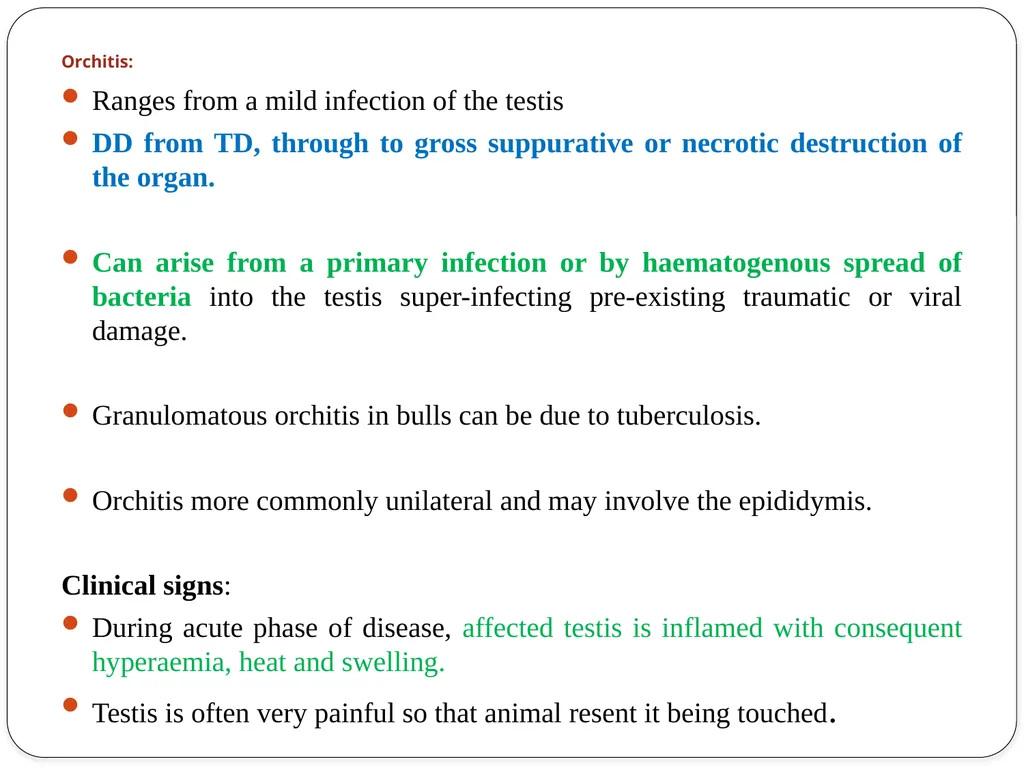
Orchitis: Ranges from a mild infection of the testis
DD from TD, through to gross suppurative or necrotic destruction of the organ.
Can arise from a primary infection or by haematogenous spread of bacteria into the testis super-infecting pre-existing traumatic or viral damage.
Granulomatous orchitis in bulls can be due to tuberculosis.
Orchitis more commonly unilateral and may involve the epididymis.
Clinical signs:
During acute phase of disease, affected testis is inflamed with consequent hyperaemia, heat and swelling.
Testis is often very painful so that animal resent it being touched.<br>
DD from TD, through to gross suppurative or necrotic destruction of the organ.
Can arise from a primary infection or by haematogenous spread of bacteria into the testis super-infecting pre-existing traumatic or viral damage.
Granulomatous orchitis in bulls can be due to tuberculosis.
Orchitis more commonly unilateral and may involve the epididymis.
Clinical signs:
During acute phase of disease, affected testis is inflamed with consequent hyperaemia, heat and swelling.
Testis is often very painful so that animal resent it being touched.<br>
23
The testis may become grossly enlarged upto 2 to 3 times its normal size.
Chronic case - the testis becomes shrunken, fibrotic and adherent to the tunic and scrotum.
Abscesses may break through scrotal skin
Prognosis:
Because of the degree of destruction that occurs, the prognosis for saving the affected testis is hopeless.
Treatment:
If it hoped to salvage an affected animal for breeding, removal of a unilaterally affected testis should be advocated at the early stage of disease.
In bilateral orchitis, prognosis for future breeding is hopeless and castration should be performed as soon as safe to do so.<br>
Chronic case - the testis becomes shrunken, fibrotic and adherent to the tunic and scrotum.
Abscesses may break through scrotal skin
Prognosis:
Because of the degree of destruction that occurs, the prognosis for saving the affected testis is hopeless.
Treatment:
If it hoped to salvage an affected animal for breeding, removal of a unilaterally affected testis should be advocated at the early stage of disease.
In bilateral orchitis, prognosis for future breeding is hopeless and castration should be performed as soon as safe to do so.<br>
24
Lesions of epididymis and mesonephric duct Epididymitis:
Unilateral epididymis therefore results in reduced fertility, whereas bilateral obstruction results in sterility.
Aplasia of mesonephric ducts:
Segmental aplasia of mesonephric ducts is most commonly manifested as an absence of parts of the epididymis.
Oligozoospermia occurs if one epididymis is aplastic; azoospermia if both are affected.<br>
Unilateral epididymis therefore results in reduced fertility, whereas bilateral obstruction results in sterility.
Aplasia of mesonephric ducts:
Segmental aplasia of mesonephric ducts is most commonly manifested as an absence of parts of the epididymis.
Oligozoospermia occurs if one epididymis is aplastic; azoospermia if both are affected.<br>
25
Lesions of the accessory glands Vesiculitis:
Primary causative organisms may include B. abortus, Chlamydophila sp. and epivag, entero and IBR/IPV viruses.
Seminal vesiculitis occurs most commonly in young bulls of less than 2 years old and in aged bulls.
Main consequence of infection of the vesicular gland is a decrease in semen quality.<br>
Primary causative organisms may include B. abortus, Chlamydophila sp. and epivag, entero and IBR/IPV viruses.
Seminal vesiculitis occurs most commonly in young bulls of less than 2 years old and in aged bulls.
Main consequence of infection of the vesicular gland is a decrease in semen quality.<br>
26
Vesiculitis: Diagnosis:
Confirmed by the rectal palpation of the vesicular glands, which are characteristically enlarged, tense and painful in acute phase
Loss of lobulation is characteristic
Fibrous and sometimes shrunken in the chronic phase.
Treatment:
In early stage of disease administration of large doses of bactericidal antibiotics.<br>
Confirmed by the rectal palpation of the vesicular glands, which are characteristically enlarged, tense and painful in acute phase
Loss of lobulation is characteristic
Fibrous and sometimes shrunken in the chronic phase.
Treatment:
In early stage of disease administration of large doses of bactericidal antibiotics.<br>
27
Prostatitis and prostatic hyperplasia:
Often occur together; the prostate undergoing a diffuse or local suppurative reaction, with a tendency to abscess formation.
Prostatitis is treatable with braoad-spectrum antibiotics.
Prostatic hyperplasia being androgen-dependent, is best treated by the administration of progestogens or by castration.
Ampullae:
Common disorder of the stallion is partial or complete blockage of the ampullae with sperm.
Treatment is by ampullary massage, oxytocin or maintaining a very high ejaculation frequency.<br>
Often occur together; the prostate undergoing a diffuse or local suppurative reaction, with a tendency to abscess formation.
Prostatitis is treatable with braoad-spectrum antibiotics.
Prostatic hyperplasia being androgen-dependent, is best treated by the administration of progestogens or by castration.
Ampullae:
Common disorder of the stallion is partial or complete blockage of the ampullae with sperm.
Treatment is by ampullary massage, oxytocin or maintaining a very high ejaculation frequency.<br>