Improving Argumentative Stance Prewriting and Organizational Strategy What is an argument? What is an academic argument? A means of discovering truth, negotiating differences, and solving problems An intellectual effort that is intended to
"Improving Argumentative Stance Prewriting and" is the property of its rightful owner. Permission is granted to
download and print the materials on this website for personal, non-commercial use only, and to display it
on your personal computer provided you do not modify the materials and that you retain all copyright
notices contained in the materials. By downloading content from our website, you accept the terms of this
agreement.
Presentation Transcript
01
Improving Argumentative Stance Prewriting and Organizational Strategy<br>
02
What is an argument?<br>
03
What is an academic argument? A means of discovering truth, negotiating differences, and solving problems
An intellectual effort that is intended to solve a problem by drawing people together<br>
04
Do’s and do not’s of academic argument Do look beyond surface and personal needs/ desires
Do NOT communicate personal associations or reactions to a controversy<br>
05
Academic Argumentative Writing Definition: writing that attempts to prove the validity of a point of view or an idea by presenting informed reasoned arguments.
Informed reasoned argument:
what you KNOW and
what you THINK
Academic argumentative writing engages others through language; it does not seek to “win.”<br>
06
Constructing an argument What do I know?
What are the key points your research brings out?
What are the answers to the five W’s + how?
Do any cultural or historical influences pertain?
Which points are most important? Which are least? Why do I think this?
What do I know that will help my reader understand my topic in a new way (vs. merely repeating source material)?
What don’t I know that I need to include?<br>
07
Moving from knowing to thinking Summarize what you know from each source
Evaluate what you read
What in my source material makes we evaluate it the way I do?
What is not in my source material that makes me evaluate it the way I do? Is that clouding my reasoning?<br>
08
Moving from knowing to thinking Analyze the parts that make up your topic
Break the whole into relative components
How do they relate to one another?
Allows you to see the topic differently and discover what you might say
Synthesize the ideas or parts
Bring ideas together to make connections
Consider whether disparate ideas actually do or can connect in some logical, reasonable way<br>
09
Choose a stance Reflect on what your source materials brought together will support
Choose a stance for which you have confidence in your defense
Choose a stance you can argue sincerely
Not taking a stance = Boring paper<br>
10
Argumentative Strategy/Structure Classical (Aristotle)
Introduction: warms up the audience, establishes goodwill and rapport with the readers, and communicates the thesis
Narration: summarizes relevant background material, provides any information the audience needs to know about the environment and circumstances that produce the argument, and sets up the stakes–what’s at risk in this question<br>
11
Classical Argument (Cont’d.) Proposition: presents the general argument you will be making and the lines the argument you will follow.
Confirmation: presents and argues your points/claims in a logical order (usually strongest to weakest or most obvious to most subtle) providing evidence for each claim (provides a chain of reasoning)<br>
12
Classical Argument (Cont’d.) Refutation and concession: looks at opposing viewpoints to the writer’s claims, anticipates objections from the audience, and allows as much of the opposing viewpoints as possible without weakening the thesis
Summation: provides a strong conclusion, amplifying the force of the argument, and showing the readers that this solution or viewpoint is the best for meeting the circumstances
Reminds the reader what’s at stake and the importance of the situation
Provides sense of closure vs. breaking off<br>
13
Variations on Classical Argument: Logical Order Climactic order
Introduce controversy ending with a thesis
Build from least powerful to most powerful argument
Rank sub-points in order from least to most powerful also
Based on the principle of primacy/recency<br>
14
Two sides of the controversy Introduce controversy ending with thesis
Present opposing view
Present your point of view
Show and connect evidence to support why your view is better<br>
15
Present and respond to counter arguments Introduce controversy ending with a thesis
Present main counter argument
Show its flaws
Present your argument
Show its strengths
A variation of the above is to concede the merits of the counter argument then show the greater merits of your argument<br>
16
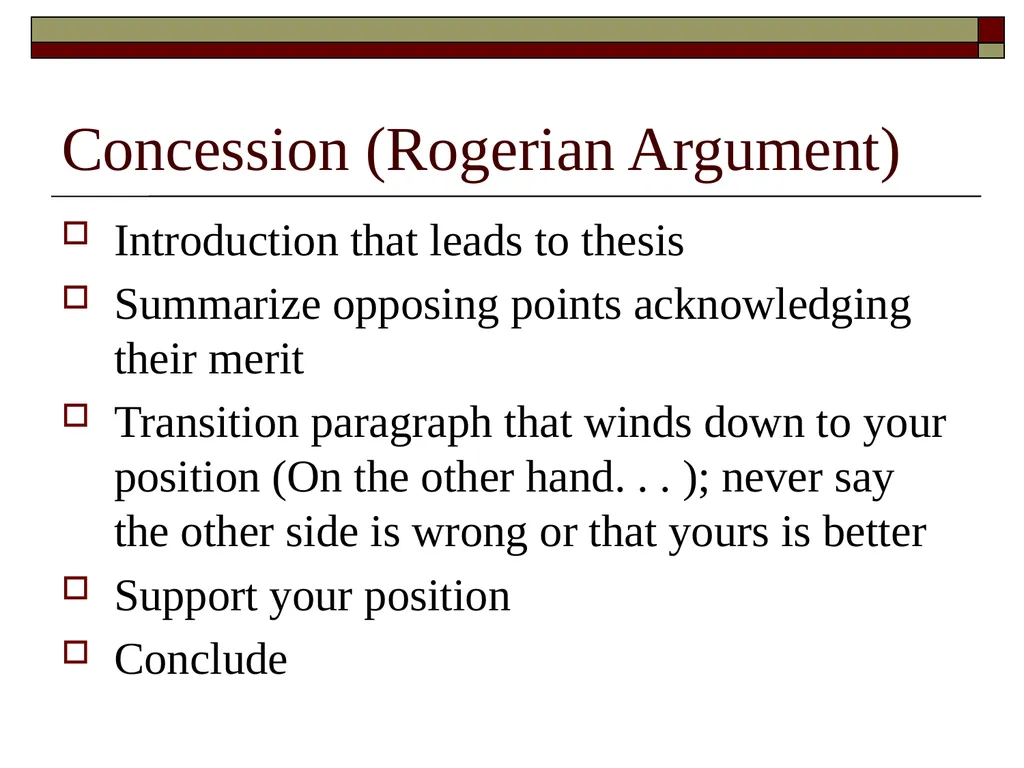
Concession (Rogerian Argument) Introduction that leads to thesis
Summarize opposing points acknowledging their merit
Transition paragraph that winds down to your position (On the other hand. . . ); never say the other side is wrong or that yours is better
Support your position
Conclude<br>
17
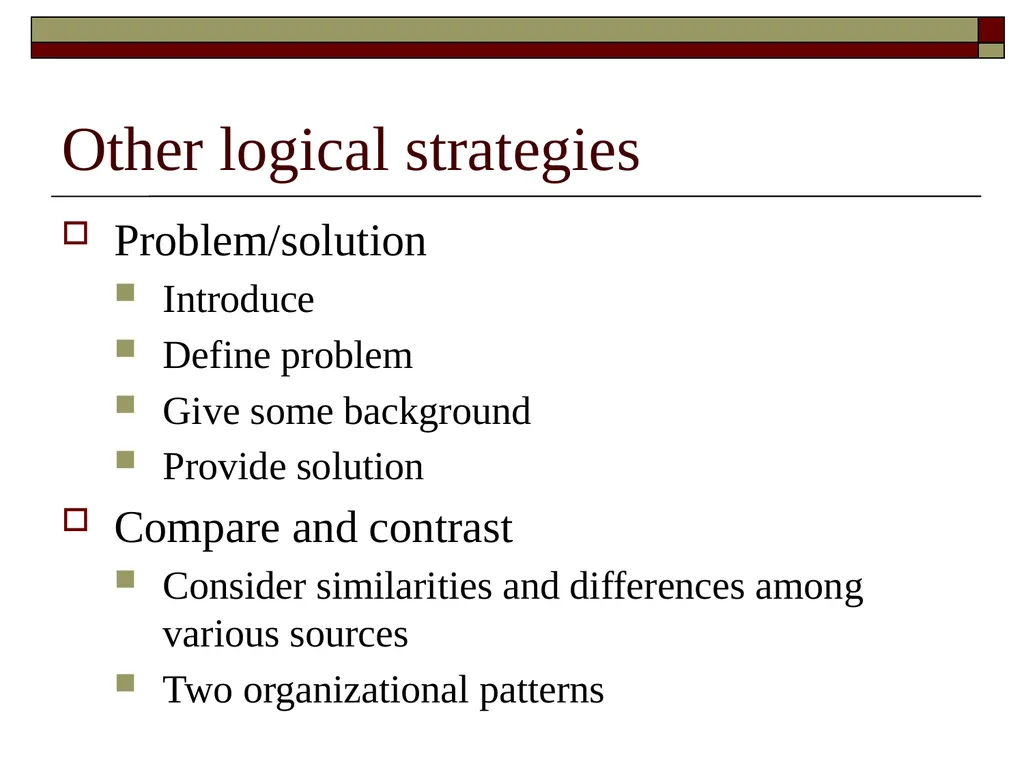
Other logical strategies Problem/solution
Introduce
Define problem
Give some background
Provide solution
Compare and contrast
Consider similarities and differences among various sources
Two organizational patterns<br>
18
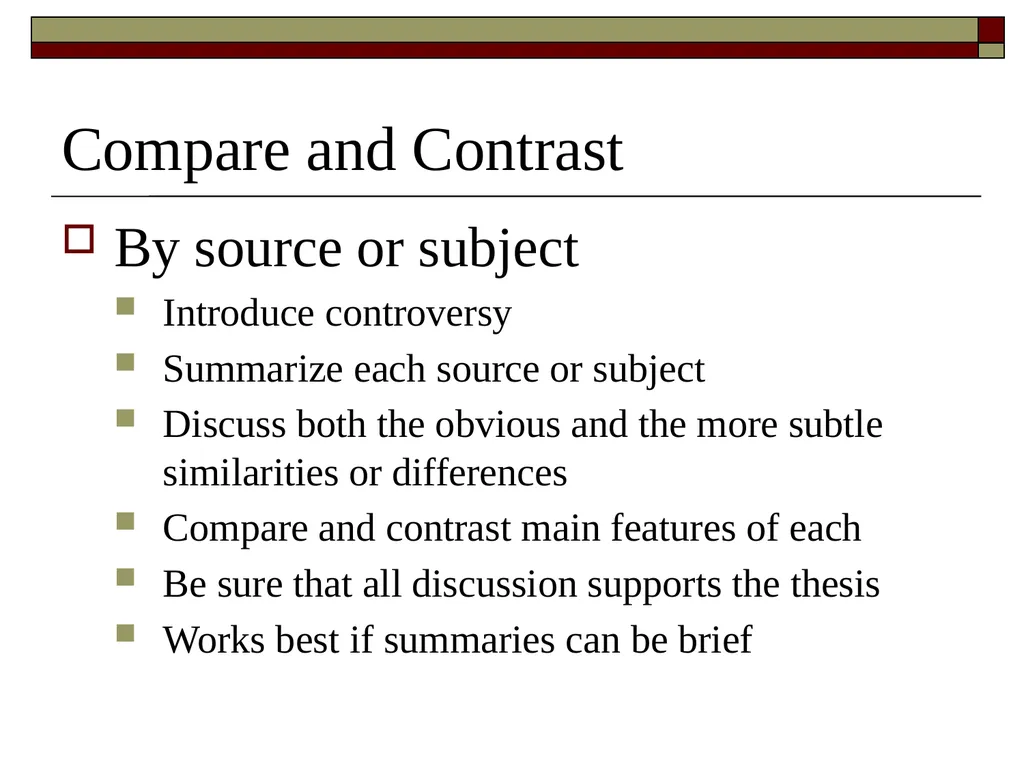
Compare and Contrast By source or subject
Introduce controversy
Summarize each source or subject
Discuss both the obvious and the more subtle similarities or differences
Compare and contrast main features of each
Be sure that all discussion supports the thesis
Works best if summaries can be brief<br>
19
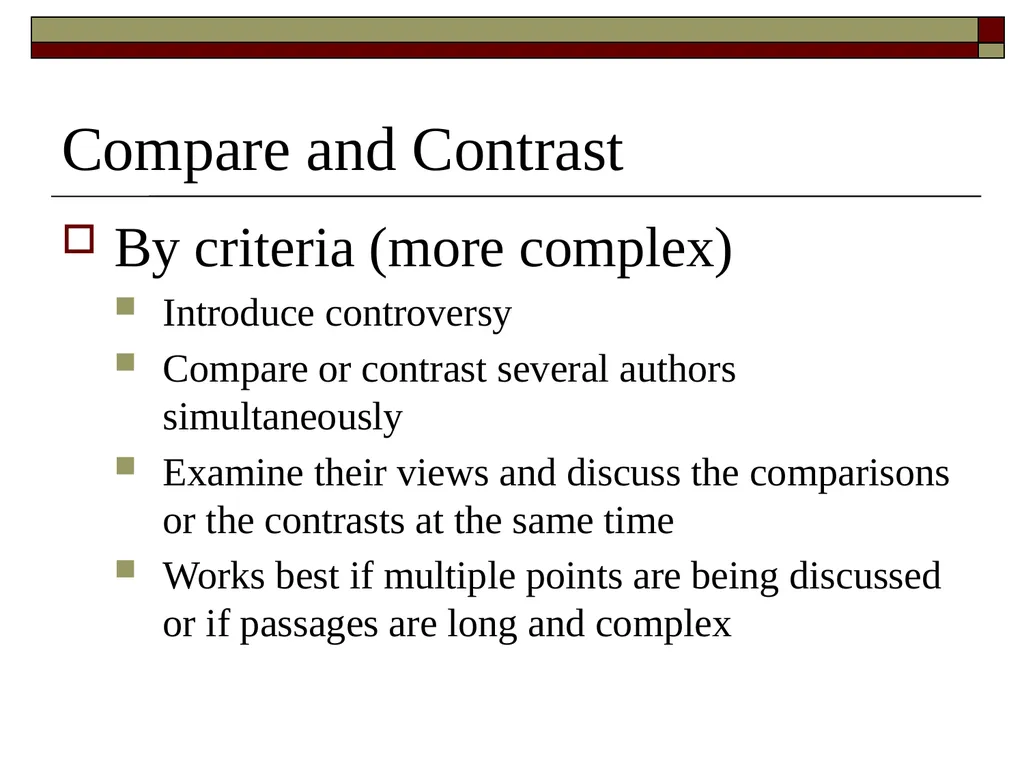
Compare and Contrast By criteria (more complex)
Introduce controversy
Compare or contrast several authors simultaneously
Examine their views and discuss the comparisons or the contrasts at the same time
Works best if multiple points are being discussed or if passages are long and complex<br>