
Improving Health Care Response to Obstetric
TG
Published · 70 slides · 0 views
1 / 1







Description
Improving Health Care Response to Obstetric Hemorrhage V3.0 A California Quality Improvement Toolkit April 2022 Terminology Throughout the Presentation The terms mother or maternal or she or her are used in reference to the birthing
Related Topics
Share
Embed code
Download this presentation From Below
"Improving Health Care Response to Obstetric" is the property of its rightful owner. Permission is granted to download and print the materials on this website for personal, non-commercial use only, and to display it on your personal computer provided you do not modify the materials and that you retain all copyright notices contained in the materials. By downloading content from our website, you accept the terms of this agreement.
Presentation Transcript
01
Improving Health Care
Response to
Obstetric Hemorrhage V3.0 A California Quality Improvement Toolkit
April 2022<br>
April 2022<br>
02
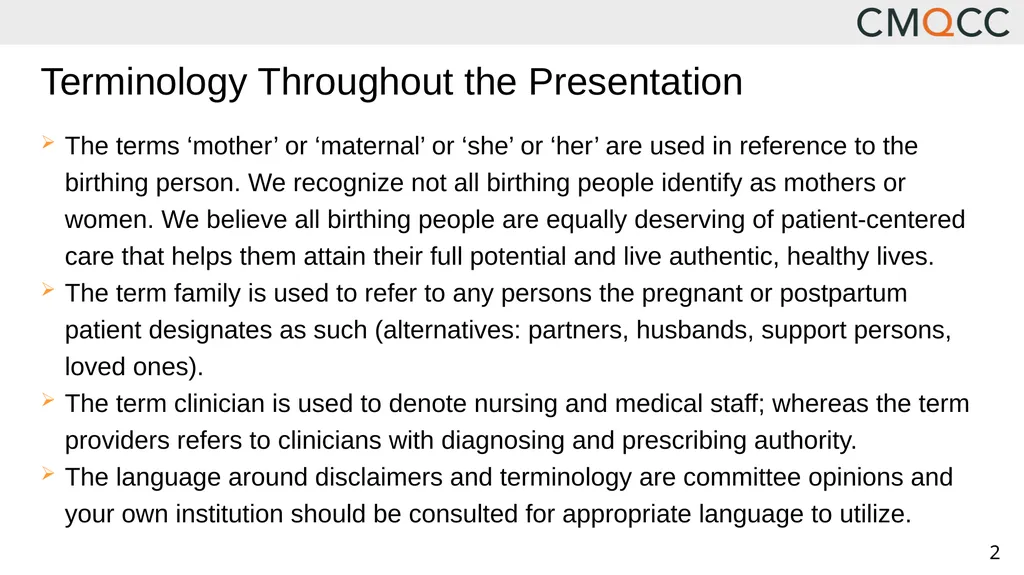
Terminology Throughout the Presentation The terms ‘mother’ or ‘maternal’ or ‘she’ or ‘her’ are used in reference to the birthing person. We recognize not all birthing people identify as mothers or women. We believe all birthing people are equally deserving of patient-centered care that helps them attain their full potential and live authentic, healthy lives.
The term family is used to refer to any persons the pregnant or postpartum patient designates as such (alternatives: partners, husbands, support persons, loved ones).
The term clinician is used to denote nursing and medical staff; whereas the term providers refers to clinicians with diagnosing and prescribing authority.
The language around disclaimers and terminology are committee opinions and your own institution should be consulted for appropriate language to utilize.<br>
The term family is used to refer to any persons the pregnant or postpartum patient designates as such (alternatives: partners, husbands, support persons, loved ones).
The term clinician is used to denote nursing and medical staff; whereas the term providers refers to clinicians with diagnosing and prescribing authority.
The language around disclaimers and terminology are committee opinions and your own institution should be consulted for appropriate language to utilize.<br>
03
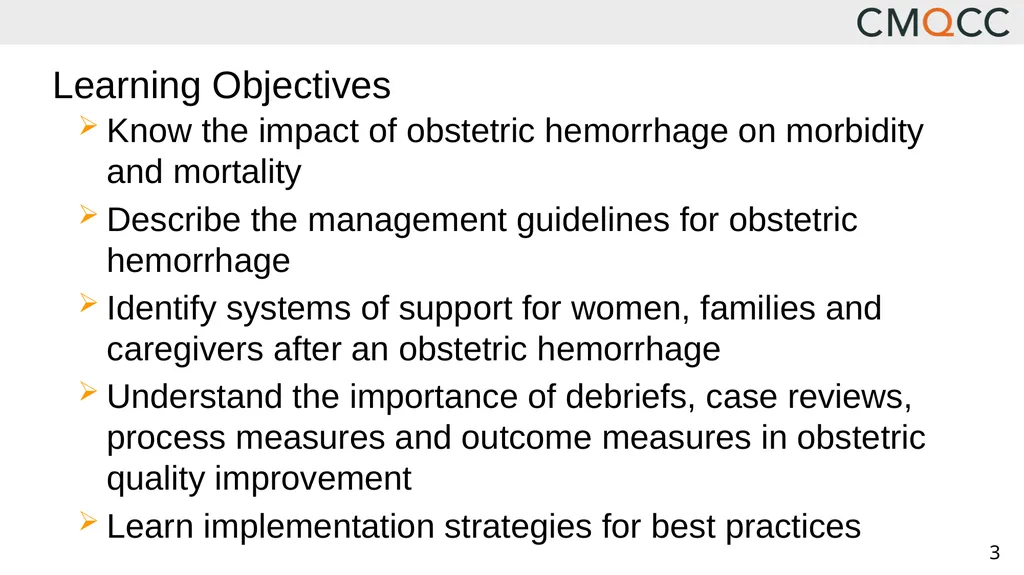
Learning Objectives Know the impact of obstetric hemorrhage on morbidity and mortality
Describe the management guidelines for obstetric hemorrhage
Identify systems of support for women, families and caregivers after an obstetric hemorrhage
Understand the importance of debriefs, case reviews, process measures and outcome measures in obstetric quality improvement
Learn implementation strategies for best practices<br>
Describe the management guidelines for obstetric hemorrhage
Identify systems of support for women, families and caregivers after an obstetric hemorrhage
Understand the importance of debriefs, case reviews, process measures and outcome measures in obstetric quality improvement
Learn implementation strategies for best practices<br>
04
Introduction
Elliott Main, MD
Stanford University School of Medicine
CMQCC Medical Director<br>
05
Multi-stakeholder collaborative founded in 2006, Celebrating 15 years!
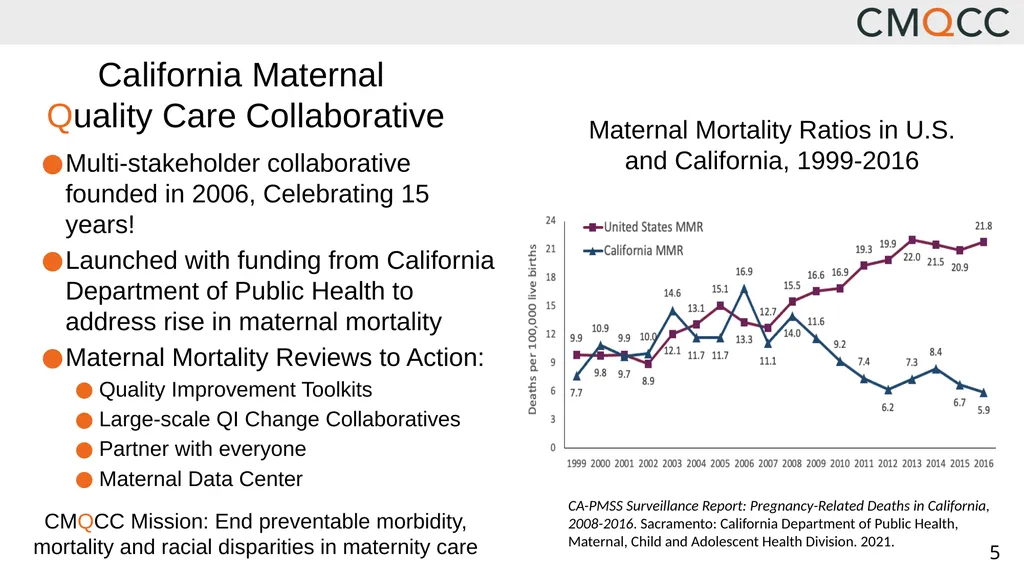
Launched with funding from California Department of Public Health to address rise in maternal mortality
Maternal Mortality Reviews to Action:
Quality Improvement Toolkits
Large-scale QI Change Collaboratives
Partner with everyone
Maternal Data Center California Maternal Quality Care Collaborative CMQCC Mission: End preventable morbidity, mortality and racial disparities in maternity care Maternal Mortality Ratios in U.S. and California, 1999-2016 CA-PMSS Surveillance Report: Pregnancy-Related Deaths in California, 2008-2016. Sacramento: California Department of Public Health, Maternal, Child and Adolescent Health Division. 2021.<br>
Launched with funding from California Department of Public Health to address rise in maternal mortality
Maternal Mortality Reviews to Action:
Quality Improvement Toolkits
Large-scale QI Change Collaboratives
Partner with everyone
Maternal Data Center California Maternal Quality Care Collaborative CMQCC Mission: End preventable morbidity, mortality and racial disparities in maternity care Maternal Mortality Ratios in U.S. and California, 1999-2016 CA-PMSS Surveillance Report: Pregnancy-Related Deaths in California, 2008-2016. Sacramento: California Department of Public Health, Maternal, Child and Adolescent Health Division. 2021.<br>
06
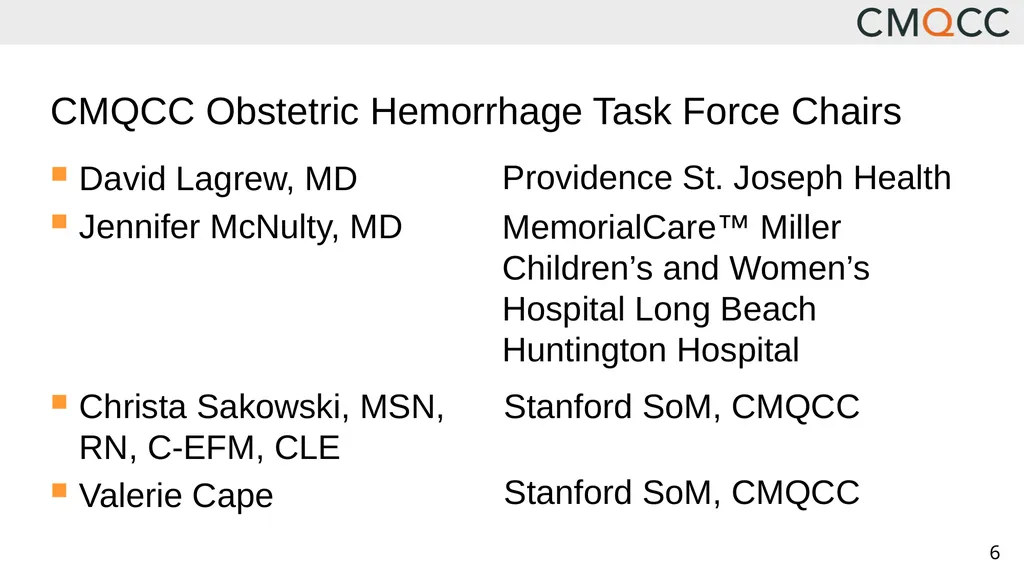
CMQCC Obstetric Hemorrhage Task Force Chairs David Lagrew, MD
Jennifer McNulty, MD Providence St. Joseph Health MemorialCare™ Miller Children’s and Women’s
Hospital Long Beach
Huntington Hospital Stanford SoM, CMQCC Stanford SoM, CMQCC Christa Sakowski, MSN, RN, C-EFM, CLE
Valerie Cape<br>
Jennifer McNulty, MD Providence St. Joseph Health MemorialCare™ Miller Children’s and Women’s
Hospital Long Beach
Huntington Hospital Stanford SoM, CMQCC Stanford SoM, CMQCC Christa Sakowski, MSN, RN, C-EFM, CLE
Valerie Cape<br>
07
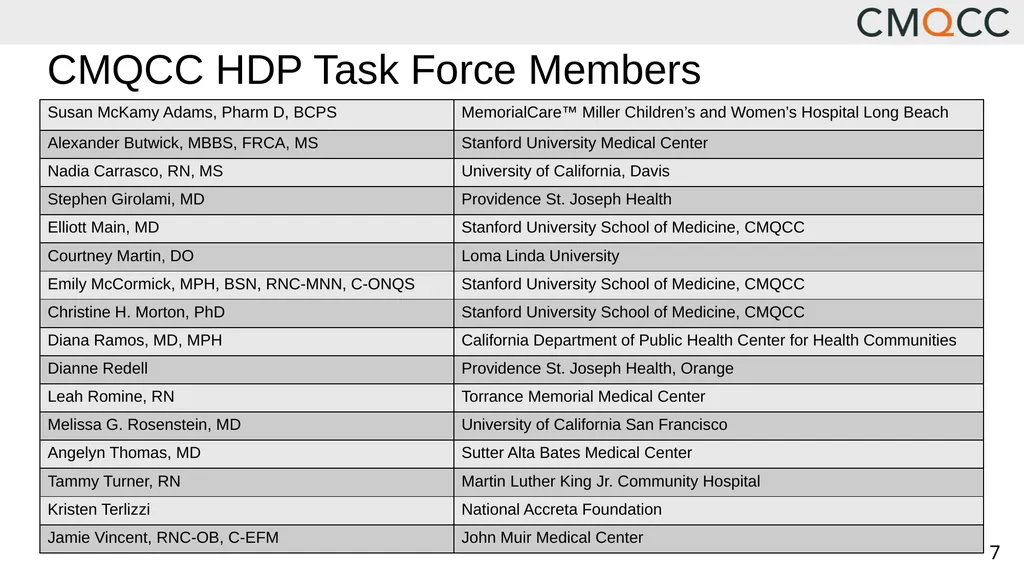
CMQCC HDP Task Force Members<br>
08
Obstetric Hemorrhage in the U.S. and California<br>
09
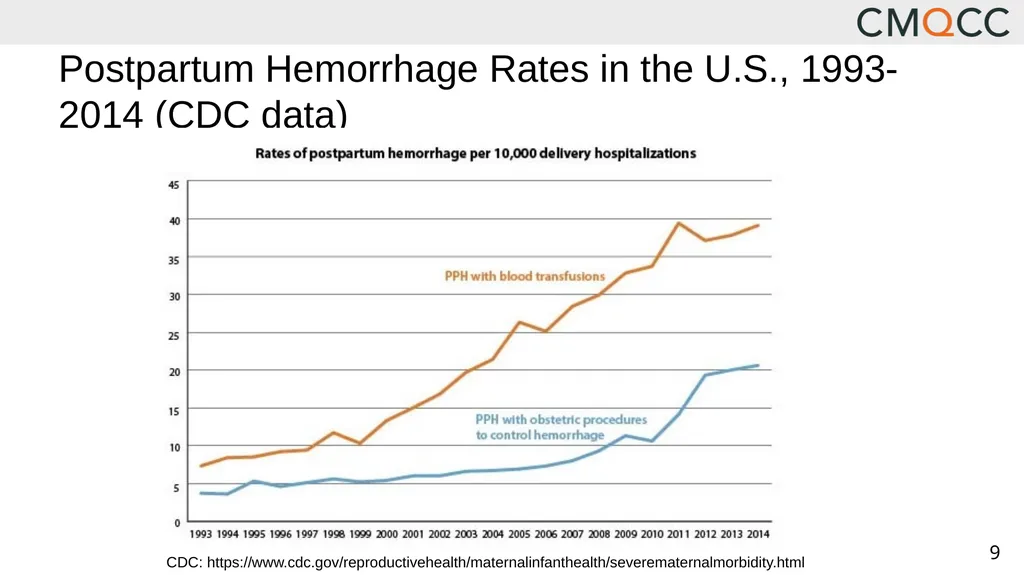
Postpartum Hemorrhage Rates in the U.S., 1993-2014 (CDC data) CDC: https://www.cdc.gov/reproductivehealth/maternalinfanthealth/severematernalmorbidity.html<br>
10
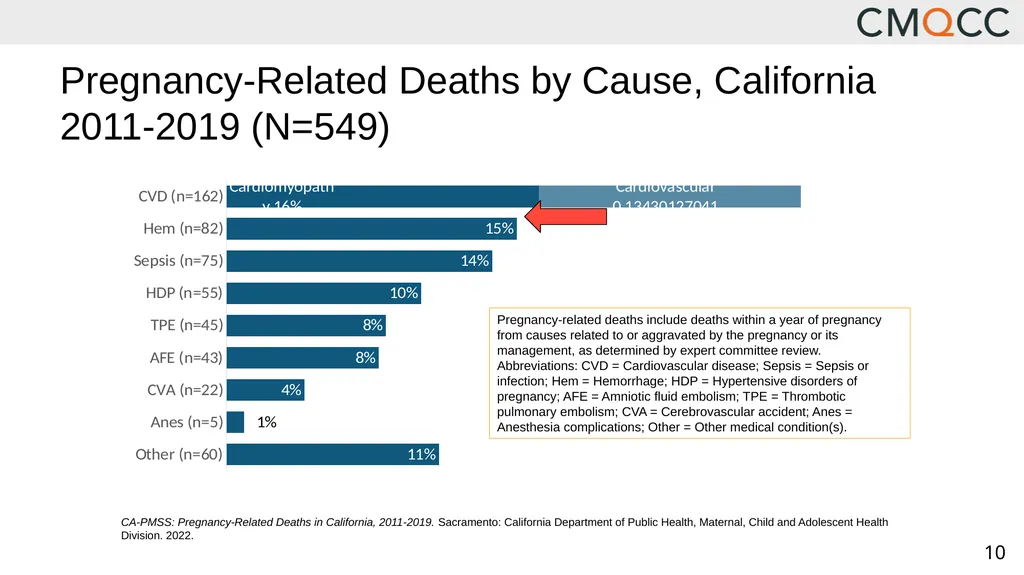
Pregnancy-Related Deaths by Cause, California
2011-2019 (N=549) Pregnancy-related deaths include deaths within a year of pregnancy from causes related to or aggravated by the pregnancy or its management, as determined by expert committee review.
Abbreviations: CVD = Cardiovascular disease; Sepsis = Sepsis or infection; Hem = Hemorrhage; HDP = Hypertensive disorders of pregnancy; AFE = Amniotic fluid embolism; TPE = Thrombotic pulmonary embolism; CVA = Cerebrovascular accident; Anes = Anesthesia complications; Other = Other medical condition(s). CA-PMSS: Pregnancy-Related Deaths in California, 2011-2019. Sacramento: California Department of Public Health, Maternal, Child and Adolescent Health Division. 2022.<br>
Abbreviations: CVD = Cardiovascular disease; Sepsis = Sepsis or infection; Hem = Hemorrhage; HDP = Hypertensive disorders of pregnancy; AFE = Amniotic fluid embolism; TPE = Thrombotic pulmonary embolism; CVA = Cerebrovascular accident; Anes = Anesthesia complications; Other = Other medical condition(s). CA-PMSS: Pregnancy-Related Deaths in California, 2011-2019. Sacramento: California Department of Public Health, Maternal, Child and Adolescent Health Division. 2022.<br>
11
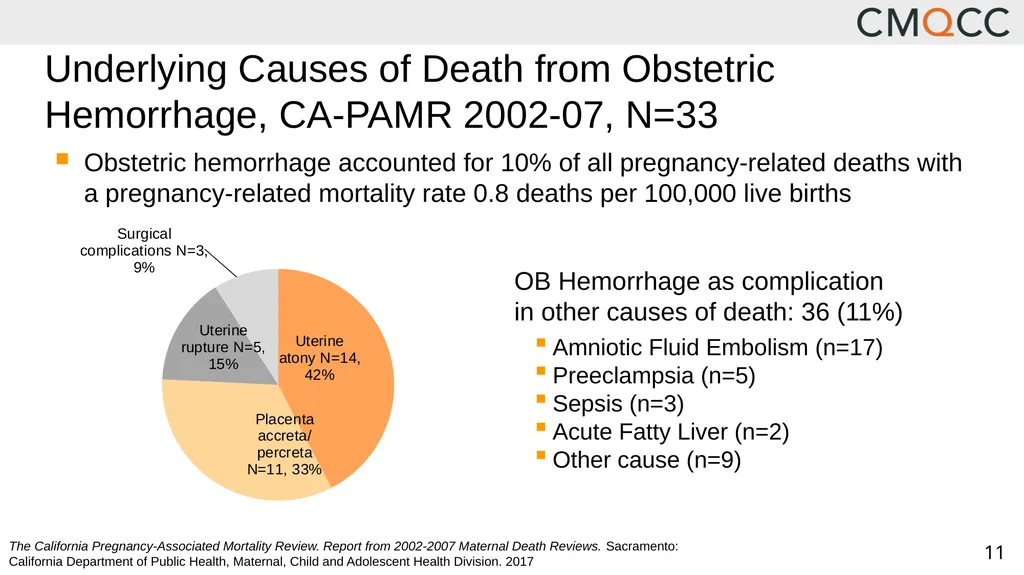
Underlying Causes of Death from Obstetric Hemorrhage, CA-PAMR 2002-07, N=33 Obstetric hemorrhage accounted for 10% of all pregnancy-related deaths with a pregnancy-related mortality rate 0.8 deaths per 100,000 live births The California Pregnancy-Associated Mortality Review. Report from 2002-2007 Maternal Death Reviews. Sacramento: California Department of Public Health, Maternal, Child and Adolescent Health Division. 2017 OB Hemorrhage as complication
in other causes of death: 36 (11%)
Amniotic Fluid Embolism (n=17)
Preeclampsia (n=5)
Sepsis (n=3)
Acute Fatty Liver (n=2)
Other cause (n=9)<br>
in other causes of death: 36 (11%)
Amniotic Fluid Embolism (n=17)
Preeclampsia (n=5)
Sepsis (n=3)
Acute Fatty Liver (n=2)
Other cause (n=9)<br>
12
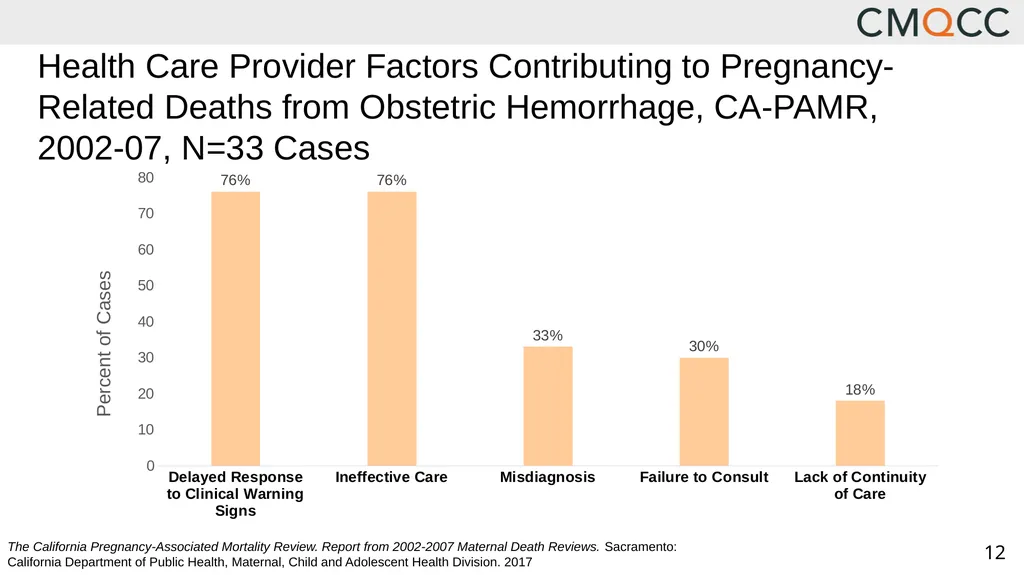
Health Care Provider Factors Contributing to Pregnancy-Related Deaths from Obstetric Hemorrhage, CA-PAMR, 2002-07, N=33 Cases The California Pregnancy-Associated Mortality Review. Report from 2002-2007 Maternal Death Reviews. Sacramento: California Department of Public Health, Maternal, Child and Adolescent Health Division. 2017<br>
13
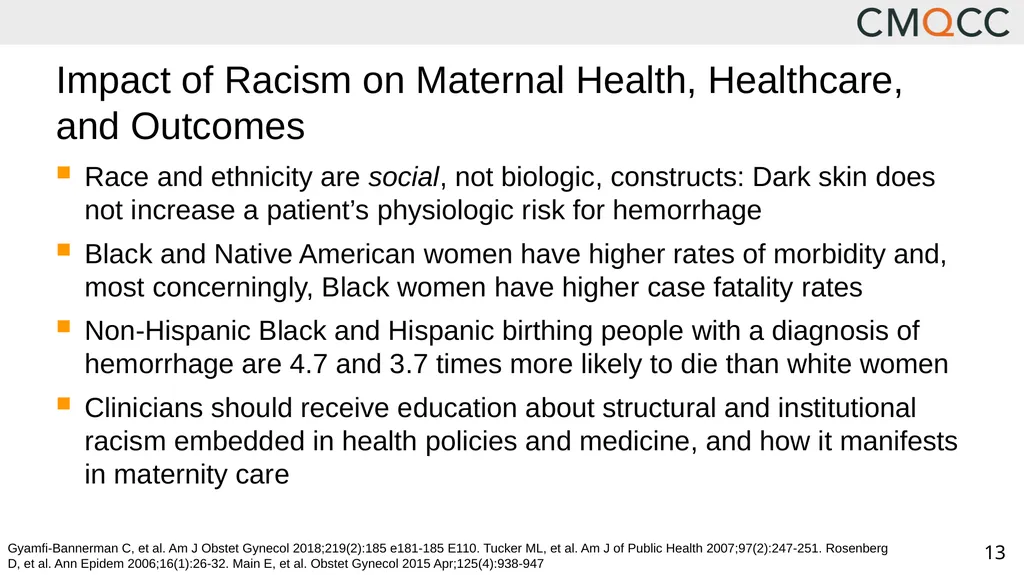
Impact of Racism on Maternal Health, Healthcare, and Outcomes Race and ethnicity are social, not biologic, constructs: Dark skin does not increase a patient’s physiologic risk for hemorrhage
Black and Native American women have higher rates of morbidity and, most concerningly, Black women have higher case fatality rates
Non-Hispanic Black and Hispanic birthing people with a diagnosis of hemorrhage are 4.7 and 3.7 times more likely to die than white women
Clinicians should receive education about structural and institutional racism embedded in health policies and medicine, and how it manifests in maternity care Gyamfi-Bannerman C, et al. Am J Obstet Gynecol 2018;219(2):185 e181-185 E110. Tucker ML, et al. Am J of Public Health 2007;97(2):247-251. Rosenberg D, et al. Ann Epidem 2006;16(1):26-32. Main E, et al. Obstet Gynecol 2015 Apr;125(4):938-947<br>
Black and Native American women have higher rates of morbidity and, most concerningly, Black women have higher case fatality rates
Non-Hispanic Black and Hispanic birthing people with a diagnosis of hemorrhage are 4.7 and 3.7 times more likely to die than white women
Clinicians should receive education about structural and institutional racism embedded in health policies and medicine, and how it manifests in maternity care Gyamfi-Bannerman C, et al. Am J Obstet Gynecol 2018;219(2):185 e181-185 E110. Tucker ML, et al. Am J of Public Health 2007;97(2):247-251. Rosenberg D, et al. Ann Epidem 2006;16(1):26-32. Main E, et al. Obstet Gynecol 2015 Apr;125(4):938-947<br>
14
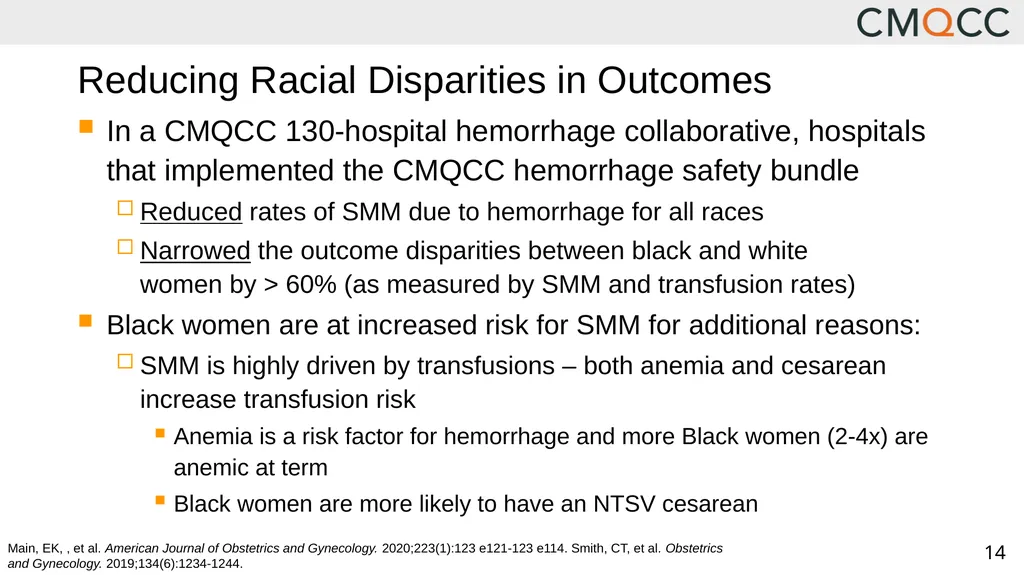
Reducing Racial Disparities in Outcomes In a CMQCC 130-hospital hemorrhage collaborative, hospitals that implemented the CMQCC hemorrhage safety bundle
Reduced rates of SMM due to hemorrhage for all races
Narrowed the outcome disparities between black and white women by > 60% (as measured by SMM and transfusion rates)
Black women are at increased risk for SMM for additional reasons:
SMM is highly driven by transfusions – both anemia and cesarean increase transfusion risk
Anemia is a risk factor for hemorrhage and more Black women (2-4x) are anemic at term
Black women are more likely to have an NTSV cesarean Main, EK, , et al. American Journal of Obstetrics and Gynecology. 2020;223(1):123 e121-123 e114. Smith, CT, et al. Obstetrics and Gynecology. 2019;134(6):1234-1244.<br>
Reduced rates of SMM due to hemorrhage for all races
Narrowed the outcome disparities between black and white women by > 60% (as measured by SMM and transfusion rates)
Black women are at increased risk for SMM for additional reasons:
SMM is highly driven by transfusions – both anemia and cesarean increase transfusion risk
Anemia is a risk factor for hemorrhage and more Black women (2-4x) are anemic at term
Black women are more likely to have an NTSV cesarean Main, EK, , et al. American Journal of Obstetrics and Gynecology. 2020;223(1):123 e121-123 e114. Smith, CT, et al. Obstetrics and Gynecology. 2019;134(6):1234-1244.<br>
15
Introducing the Toolkit Christa Sakowski, RN, MSN
CMQCC Clinical Lead<br>
16
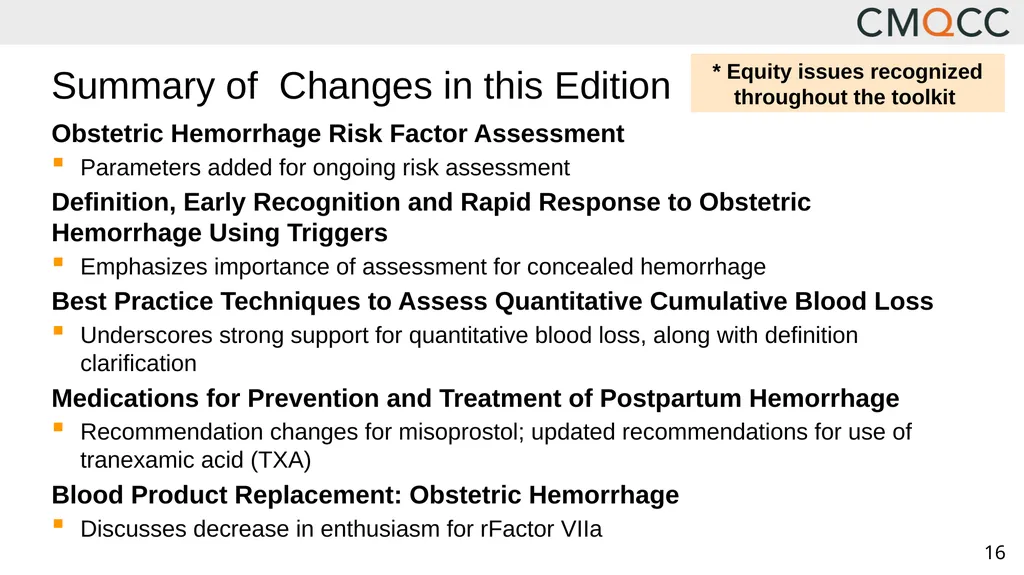
Summary of Changes in this Edition Obstetric Hemorrhage Risk Factor Assessment
Parameters added for ongoing risk assessment
Definition, Early Recognition and Rapid Response to Obstetric Hemorrhage Using Triggers
Emphasizes importance of assessment for concealed hemorrhage
Best Practice Techniques to Assess Quantitative Cumulative Blood Loss
Underscores strong support for quantitative blood loss, along with definition clarification
Medications for Prevention and Treatment of Postpartum Hemorrhage
Recommendation changes for misoprostol; updated recommendations for use of tranexamic acid (TXA)
Blood Product Replacement: Obstetric Hemorrhage
Discusses decrease in enthusiasm for rFactor VIIa * Equity issues recognized throughout the toolkit<br>
Parameters added for ongoing risk assessment
Definition, Early Recognition and Rapid Response to Obstetric Hemorrhage Using Triggers
Emphasizes importance of assessment for concealed hemorrhage
Best Practice Techniques to Assess Quantitative Cumulative Blood Loss
Underscores strong support for quantitative blood loss, along with definition clarification
Medications for Prevention and Treatment of Postpartum Hemorrhage
Recommendation changes for misoprostol; updated recommendations for use of tranexamic acid (TXA)
Blood Product Replacement: Obstetric Hemorrhage
Discusses decrease in enthusiasm for rFactor VIIa * Equity issues recognized throughout the toolkit<br>
17
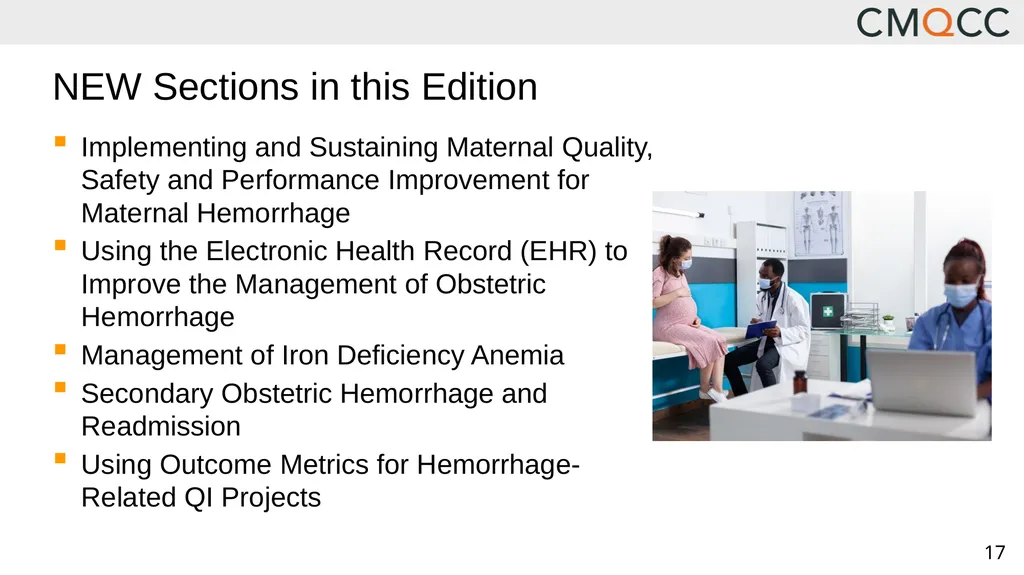
NEW Sections in this Edition Implementing and Sustaining Maternal Quality, Safety and Performance Improvement for Maternal Hemorrhage
Using the Electronic Health Record (EHR) to Improve the Management of Obstetric Hemorrhage
Management of Iron Deficiency Anemia
Secondary Obstetric Hemorrhage and Readmission
Using Outcome Metrics for Hemorrhage-Related QI Projects<br>
Using the Electronic Health Record (EHR) to Improve the Management of Obstetric Hemorrhage
Management of Iron Deficiency Anemia
Secondary Obstetric Hemorrhage and Readmission
Using Outcome Metrics for Hemorrhage-Related QI Projects<br>
18
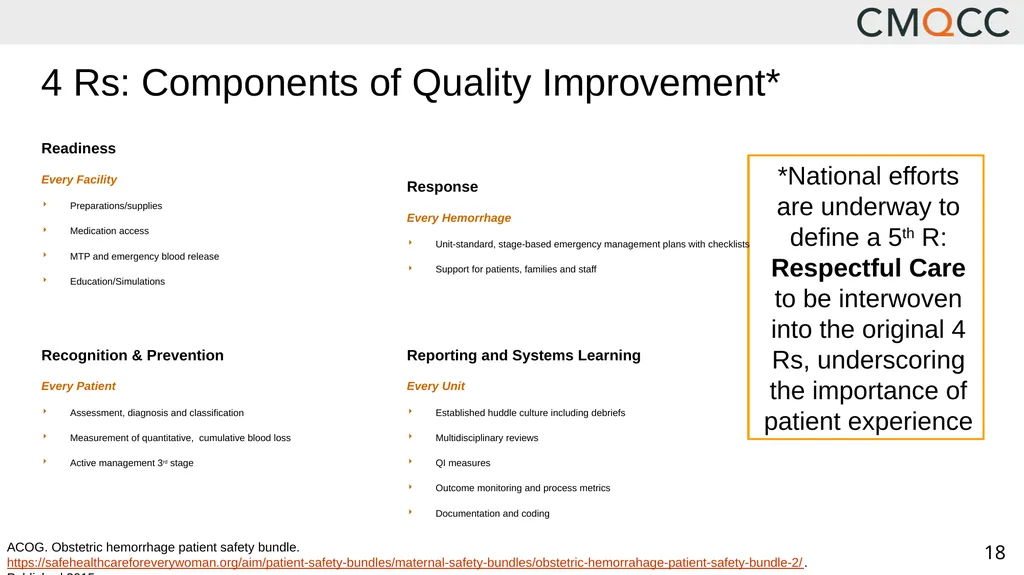
4 Rs: Components of Quality Improvement* *National efforts are underway to define a 5th R: Respectful Care to be interwoven into the original 4 Rs, underscoring the importance of patient experience Readiness
Every Facility
Preparations/supplies
Medication access
MTP and emergency blood release
Education/Simulations
Recognition & Prevention
Every Patient
Assessment, diagnosis and classification
Measurement of quantitative, cumulative blood loss
Active management 3rd stage
Response
Every Hemorrhage
Unit-standard, stage-based emergency management plans with checklists
Support for patients, families and staff
Reporting and Systems Learning
Every Unit
Established huddle culture including debriefs
Multidisciplinary reviews
QI measures
Outcome monitoring and process metrics
Documentation and coding ACOG. Obstetric hemorrhage patient safety bundle. https://safehealthcareforeverywoman.org/aim/patient-safety-bundles/maternal-safety-bundles/obstetric-hemorrahage-patient-safety-bundle-2/. Published 2015.<br>
Every Facility
Preparations/supplies
Medication access
MTP and emergency blood release
Education/Simulations
Recognition & Prevention
Every Patient
Assessment, diagnosis and classification
Measurement of quantitative, cumulative blood loss
Active management 3rd stage
Response
Every Hemorrhage
Unit-standard, stage-based emergency management plans with checklists
Support for patients, families and staff
Reporting and Systems Learning
Every Unit
Established huddle culture including debriefs
Multidisciplinary reviews
QI measures
Outcome monitoring and process metrics
Documentation and coding ACOG. Obstetric hemorrhage patient safety bundle. https://safehealthcareforeverywoman.org/aim/patient-safety-bundles/maternal-safety-bundles/obstetric-hemorrahage-patient-safety-bundle-2/. Published 2015.<br>
19
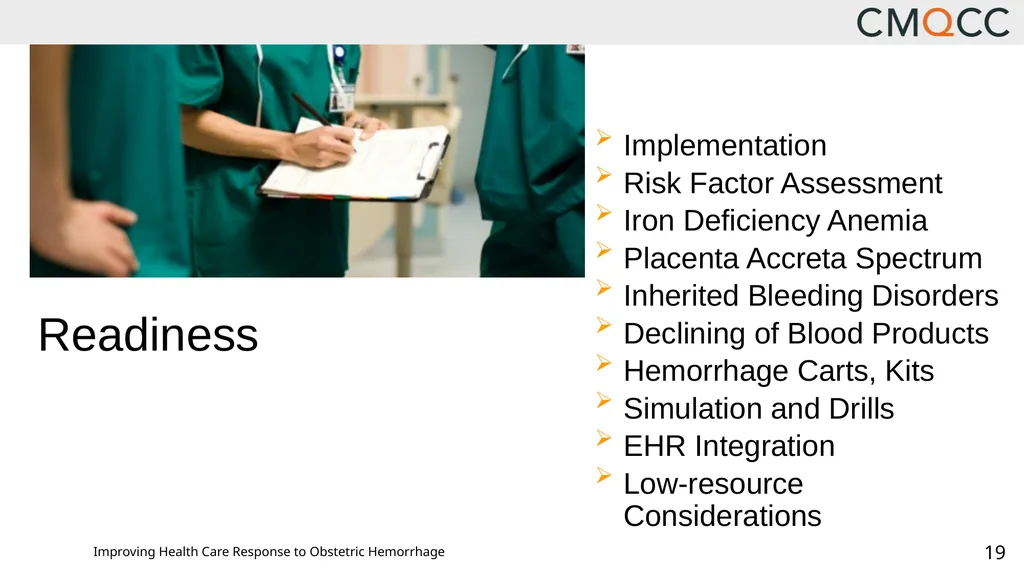
Readiness Implementation
Risk Factor Assessment
Iron Deficiency Anemia
Placenta Accreta Spectrum
Inherited Bleeding Disorders
Declining of Blood Products
Hemorrhage Carts, Kits
Simulation and Drills
EHR Integration
Low-resource Considerations<br>
Risk Factor Assessment
Iron Deficiency Anemia
Placenta Accreta Spectrum
Inherited Bleeding Disorders
Declining of Blood Products
Hemorrhage Carts, Kits
Simulation and Drills
EHR Integration
Low-resource Considerations<br>
20
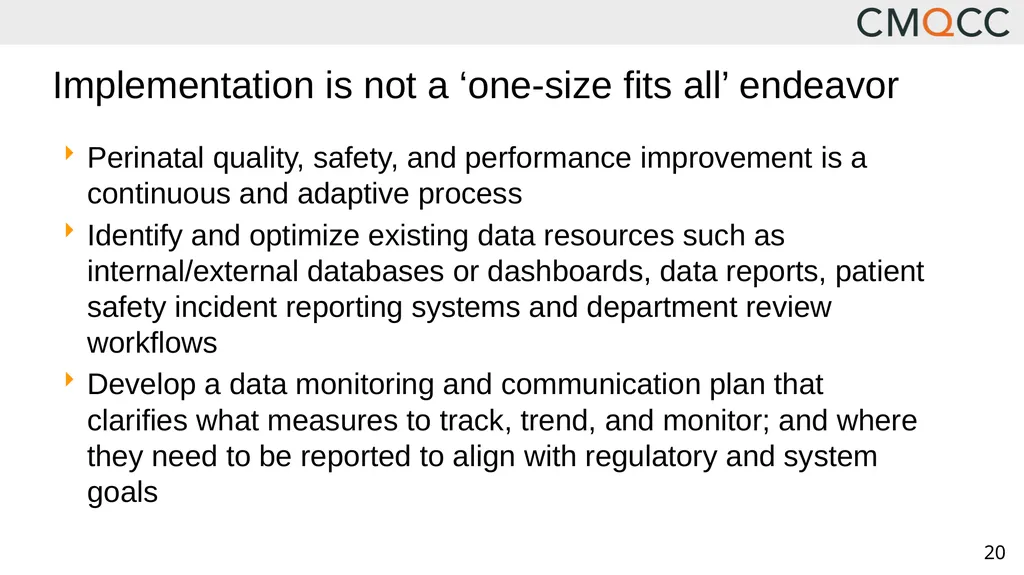
Implementation is not a ‘one-size fits all’ endeavor Perinatal quality, safety, and performance improvement is a continuous and adaptive process
Identify and optimize existing data resources such as internal/external databases or dashboards, data reports, patient safety incident reporting systems and department review workflows
Develop a data monitoring and communication plan that clarifies what measures to track, trend, and monitor; and where they need to be reported to align with regulatory and system goals<br>
Identify and optimize existing data resources such as internal/external databases or dashboards, data reports, patient safety incident reporting systems and department review workflows
Develop a data monitoring and communication plan that clarifies what measures to track, trend, and monitor; and where they need to be reported to align with regulatory and system goals<br>
21
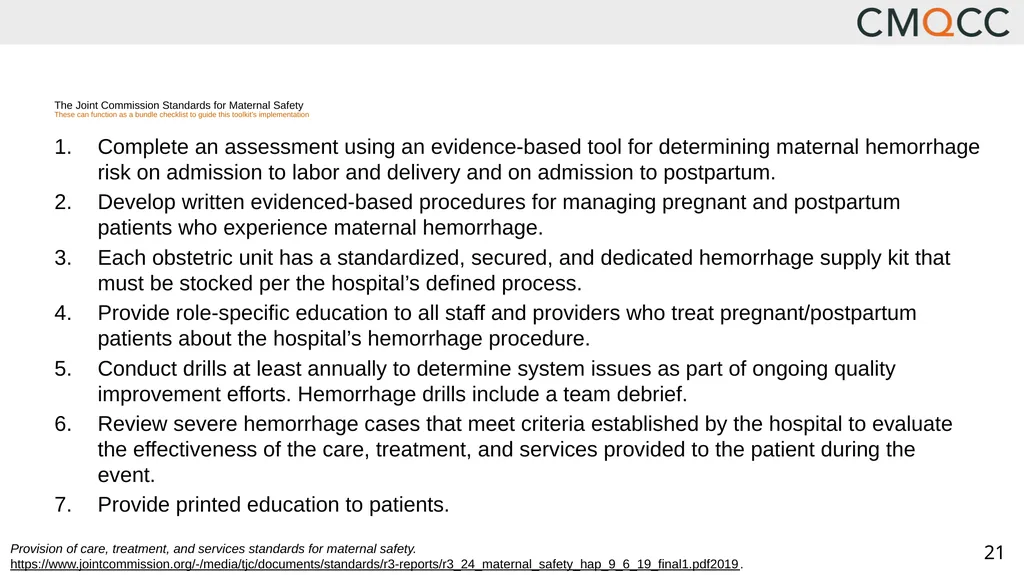
The Joint Commission Standards for Maternal Safety
These can function as a bundle checklist to guide this toolkit’s implementation Complete an assessment using an evidence-based tool for determining maternal hemorrhage risk on admission to labor and delivery and on admission to postpartum.
Develop written evidenced-based procedures for managing pregnant and postpartum patients who experience maternal hemorrhage.
Each obstetric unit has a standardized, secured, and dedicated hemorrhage supply kit that must be stocked per the hospital’s defined process.
Provide role-specific education to all staff and providers who treat pregnant/postpartum patients about the hospital’s hemorrhage procedure.
Conduct drills at least annually to determine system issues as part of ongoing quality improvement efforts. Hemorrhage drills include a team debrief.
Review severe hemorrhage cases that meet criteria established by the hospital to evaluate the effectiveness of the care, treatment, and services provided to the patient during the event.
Provide printed education to patients. Provision of care, treatment, and services standards for maternal safety.
https://www.jointcommission.org/-/media/tjc/documents/standards/r3-reports/r3_24_maternal_safety_hap_9_6_19_final1.pdf2019.<br>
Develop written evidenced-based procedures for managing pregnant and postpartum patients who experience maternal hemorrhage.
Each obstetric unit has a standardized, secured, and dedicated hemorrhage supply kit that must be stocked per the hospital’s defined process.
Provide role-specific education to all staff and providers who treat pregnant/postpartum patients about the hospital’s hemorrhage procedure.
Conduct drills at least annually to determine system issues as part of ongoing quality improvement efforts. Hemorrhage drills include a team debrief.
Review severe hemorrhage cases that meet criteria established by the hospital to evaluate the effectiveness of the care, treatment, and services provided to the patient during the event.
Provide printed education to patients. Provision of care, treatment, and services standards for maternal safety.
https://www.jointcommission.org/-/media/tjc/documents/standards/r3-reports/r3_24_maternal_safety_hap_9_6_19_final1.pdf2019.<br>
22
Ongoing Risk Factor Assessment All pregnant patients should have a prenatal evaluation for key risk factors associated with major obstetric hemorrhage, such as placenta accreta spectrum, placenta previa, coagulation disorders, anticoagulation medication(s), and anemia
All patients should undergo intrapartum obstetric hemorrhage risk assessment on admission, at the start of the second stage of labor, at transfer to postpartum care, and any time the patient’s condition changes
Up to 40% of patients who experience PPH have no identifiable risk factors1 Dilla AJW, et al. Obstet & Gynecol 2013;122(1):120-126. Ruppel HL, et al. Am J of Perinatol, 2020. Kawakita T, Obstetrics and Gynecology. 2019;134(6):1308-1316. Ende HB, et al. Obstetrics and Gynecology. 2021;137(2):305-323.<br>
All patients should undergo intrapartum obstetric hemorrhage risk assessment on admission, at the start of the second stage of labor, at transfer to postpartum care, and any time the patient’s condition changes
Up to 40% of patients who experience PPH have no identifiable risk factors1 Dilla AJW, et al. Obstet & Gynecol 2013;122(1):120-126. Ruppel HL, et al. Am J of Perinatol, 2020. Kawakita T, Obstetrics and Gynecology. 2019;134(6):1308-1316. Ende HB, et al. Obstetrics and Gynecology. 2021;137(2):305-323.<br>
23
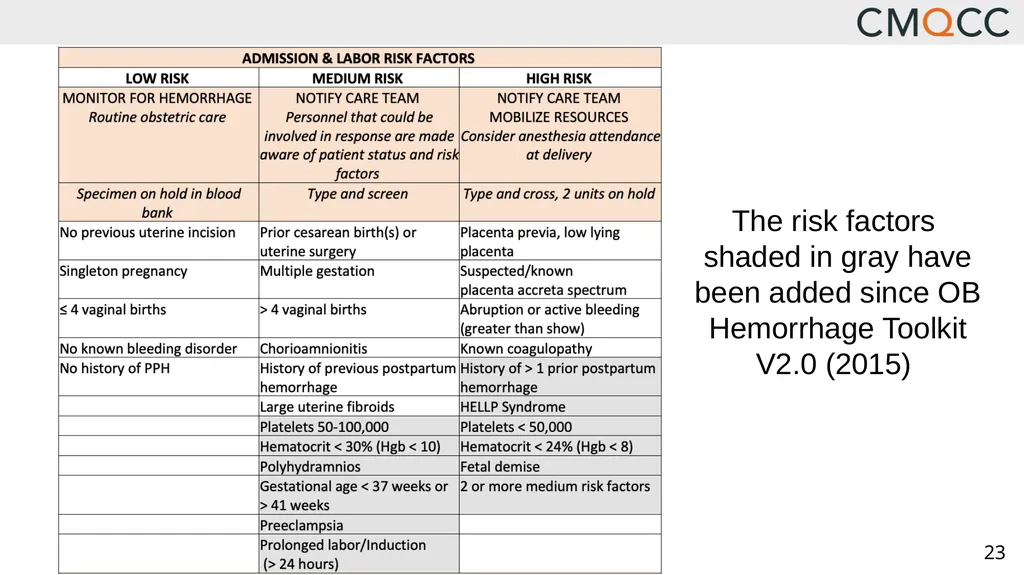
The risk factors
shaded in gray have been added since OB Hemorrhage Toolkit V2.0 (2015)<br>
shaded in gray have been added since OB Hemorrhage Toolkit V2.0 (2015)<br>
24
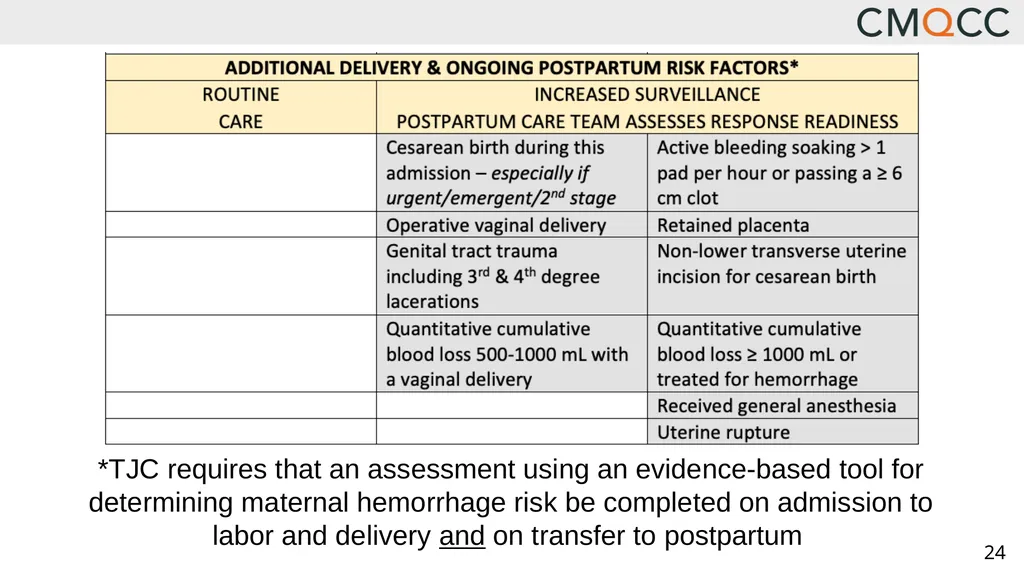
*TJC requires that an assessment using an evidence-based tool for determining maternal hemorrhage risk be completed on admission to labor and delivery and on transfer to postpartum<br>
25
What resources to mobilize based on risk? Hemorrhage cart outside of the room
Consideration of hemorrhage risk in staffing ratios
Ensure QBL equipment is available and present at delivery
Prepare for the possibility of emergency
Communication to affected team
Blood bank orders per hospital protocol
Room geographically close to the OR
Area cleared of obstructions
Consider potential use of rapid infuser or cell saver technology as applicable
Increase patient surveillance
Frequent rounding
Vital sign and fundal checks
Bleeding assessments
Psychosocial well-being of patient and family<br>
Consideration of hemorrhage risk in staffing ratios
Ensure QBL equipment is available and present at delivery
Prepare for the possibility of emergency
Communication to affected team
Blood bank orders per hospital protocol
Room geographically close to the OR
Area cleared of obstructions
Consider potential use of rapid infuser or cell saver technology as applicable
Increase patient surveillance
Frequent rounding
Vital sign and fundal checks
Bleeding assessments
Psychosocial well-being of patient and family<br>
26
Jennifer McNulty, MD
MemorialCare™
Miller Children’s and Women’s Hospital
Long Beach<br>
27
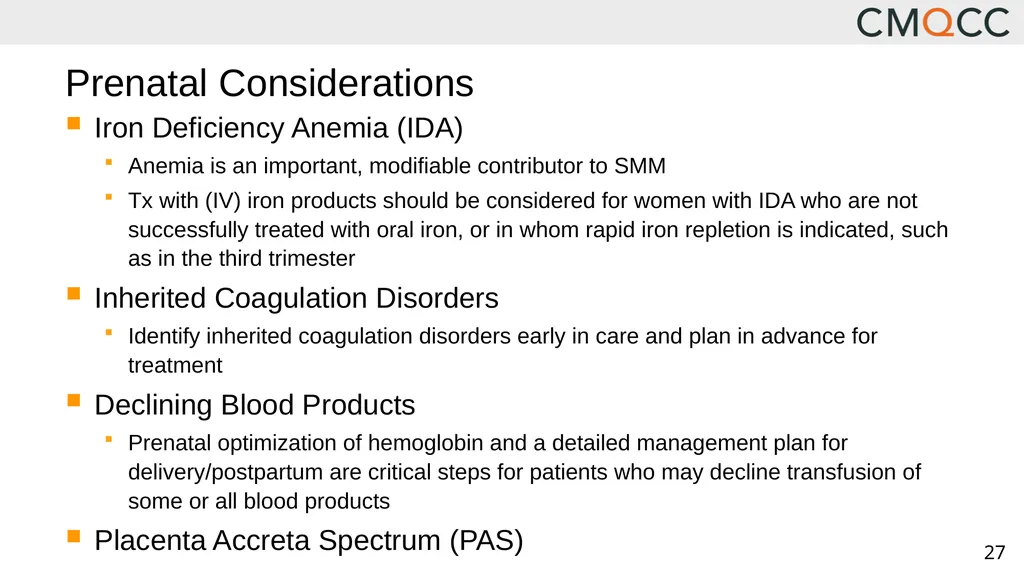
Prenatal Considerations Iron Deficiency Anemia (IDA)
Anemia is an important, modifiable contributor to SMM
Tx with (IV) iron products should be considered for women with IDA who are not successfully treated with oral iron, or in whom rapid iron repletion is indicated, such as in the third trimester
Inherited Coagulation Disorders
Identify inherited coagulation disorders early in care and plan in advance for treatment
Declining Blood Products
Prenatal optimization of hemoglobin and a detailed management plan for delivery/postpartum are critical steps for patients who may decline transfusion of some or all blood products
Placenta Accreta Spectrum (PAS)<br>
Anemia is an important, modifiable contributor to SMM
Tx with (IV) iron products should be considered for women with IDA who are not successfully treated with oral iron, or in whom rapid iron repletion is indicated, such as in the third trimester
Inherited Coagulation Disorders
Identify inherited coagulation disorders early in care and plan in advance for treatment
Declining Blood Products
Prenatal optimization of hemoglobin and a detailed management plan for delivery/postpartum are critical steps for patients who may decline transfusion of some or all blood products
Placenta Accreta Spectrum (PAS)<br>
28
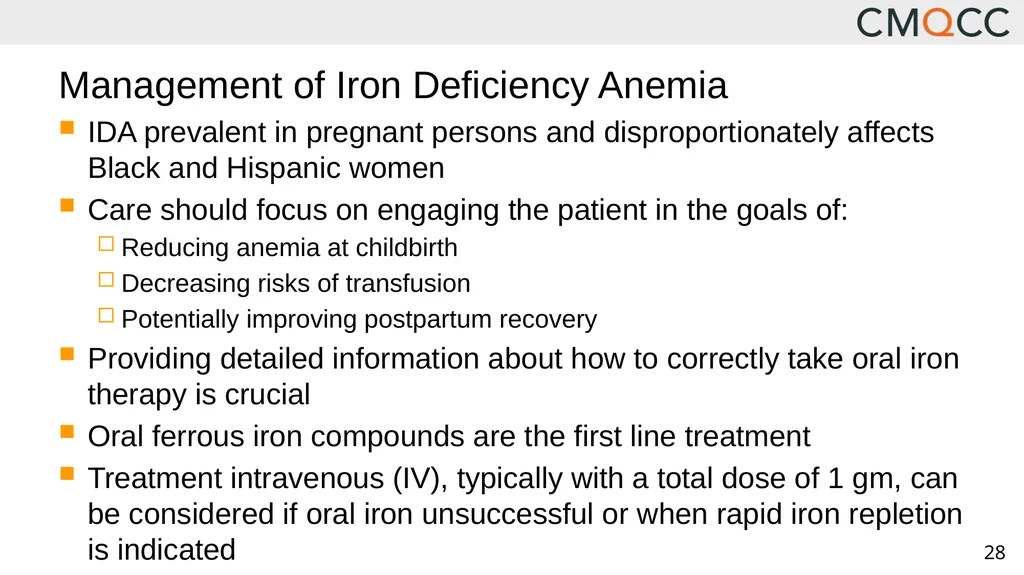
Management of Iron Deficiency Anemia IDA prevalent in pregnant persons and disproportionately affects Black and Hispanic women
Care should focus on engaging the patient in the goals of:
Reducing anemia at childbirth
Decreasing risks of transfusion
Potentially improving postpartum recovery
Providing detailed information about how to correctly take oral iron therapy is crucial
Oral ferrous iron compounds are the first line treatment
Treatment intravenous (IV), typically with a total dose of 1 gm, can be considered if oral iron unsuccessful or when rapid iron repletion is indicated<br>
Care should focus on engaging the patient in the goals of:
Reducing anemia at childbirth
Decreasing risks of transfusion
Potentially improving postpartum recovery
Providing detailed information about how to correctly take oral iron therapy is crucial
Oral ferrous iron compounds are the first line treatment
Treatment intravenous (IV), typically with a total dose of 1 gm, can be considered if oral iron unsuccessful or when rapid iron repletion is indicated<br>
29
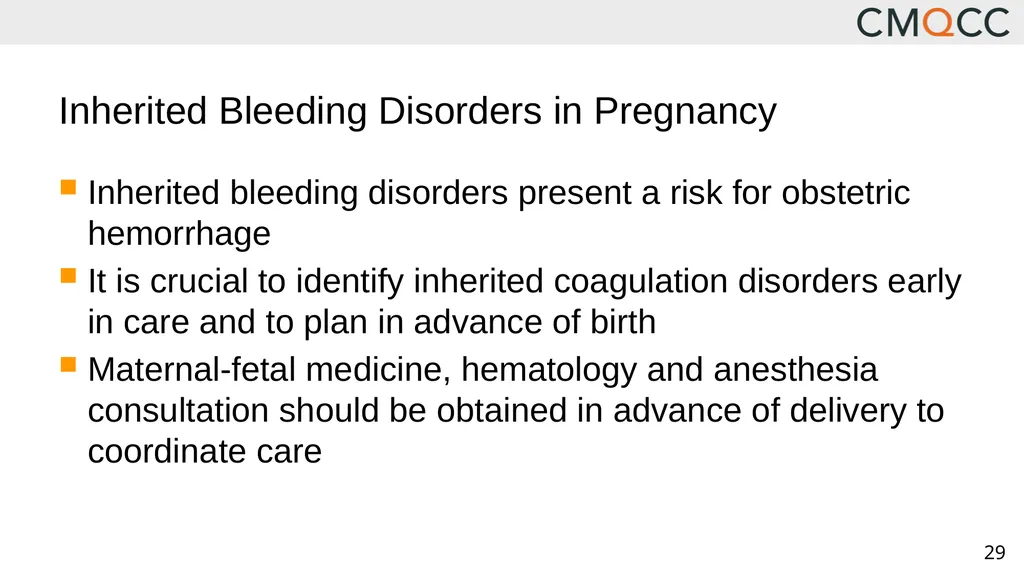
Inherited Bleeding Disorders in Pregnancy Inherited bleeding disorders present a risk for obstetric hemorrhage
It is crucial to identify inherited coagulation disorders early in care and to plan in advance of birth
Maternal-fetal medicine, hematology and anesthesia consultation should be obtained in advance of delivery to coordinate care<br>
It is crucial to identify inherited coagulation disorders early in care and to plan in advance of birth
Maternal-fetal medicine, hematology and anesthesia consultation should be obtained in advance of delivery to coordinate care<br>
30
Planning for Patients Who May Decline Blood
and Blood Products Assess patient attitudes toward blood products in advance of labor or planned surgery
Incorporate into standard anticipatory guidance and birth planning, ideally at the initiation of prenatal care
Facilitate care coordination and preparation for alternative interventions if blood products are not desired
Prenatal optimization of hemoglobin is a critical step
The Task Force recommends an optimal hemoglobin level of
> 12.0 gm/dL for a patient who refuses blood or blood products<br>
Incorporate into standard anticipatory guidance and birth planning, ideally at the initiation of prenatal care
Facilitate care coordination and preparation for alternative interventions if blood products are not desired
Prenatal optimization of hemoglobin is a critical step
The Task Force recommends an optimal hemoglobin level of
> 12.0 gm/dL for a patient who refuses blood or blood products<br>
31
Placenta Accreta Spectrum (PAS) The risk for PAS is highest in women with a history of prior CS and current placenta previa
PAS risk increases with each subsequent cesarean
Ultrasound is the preferred tool for diagnosis of PAS
Best outcomes occur with planning in a Level III or IV center experienced in the care of mothers with PAS
Counseling should be offered for those patients with PAS to help diminish trauma associated with their birth experience
Attempts to remove the placenta prior to initiation of the hysterectomy should be avoided when PAS is diagnosed antenatally or is clearly evident at the time of delivery ACOG; SMFM; Cahill AGB,et al. American College of Obstetricians and Gynecologists, Society for Maternal-Fetal Medicine. American Journal of Obstetrics and Gynecology. 2018;219(6):B2-B16. Martin JAH, et al. National Vital Statistics Reports. 2019;68(13):1-47.<br>
PAS risk increases with each subsequent cesarean
Ultrasound is the preferred tool for diagnosis of PAS
Best outcomes occur with planning in a Level III or IV center experienced in the care of mothers with PAS
Counseling should be offered for those patients with PAS to help diminish trauma associated with their birth experience
Attempts to remove the placenta prior to initiation of the hysterectomy should be avoided when PAS is diagnosed antenatally or is clearly evident at the time of delivery ACOG; SMFM; Cahill AGB,et al. American College of Obstetricians and Gynecologists, Society for Maternal-Fetal Medicine. American Journal of Obstetrics and Gynecology. 2018;219(6):B2-B16. Martin JAH, et al. National Vital Statistics Reports. 2019;68(13):1-47.<br>
32
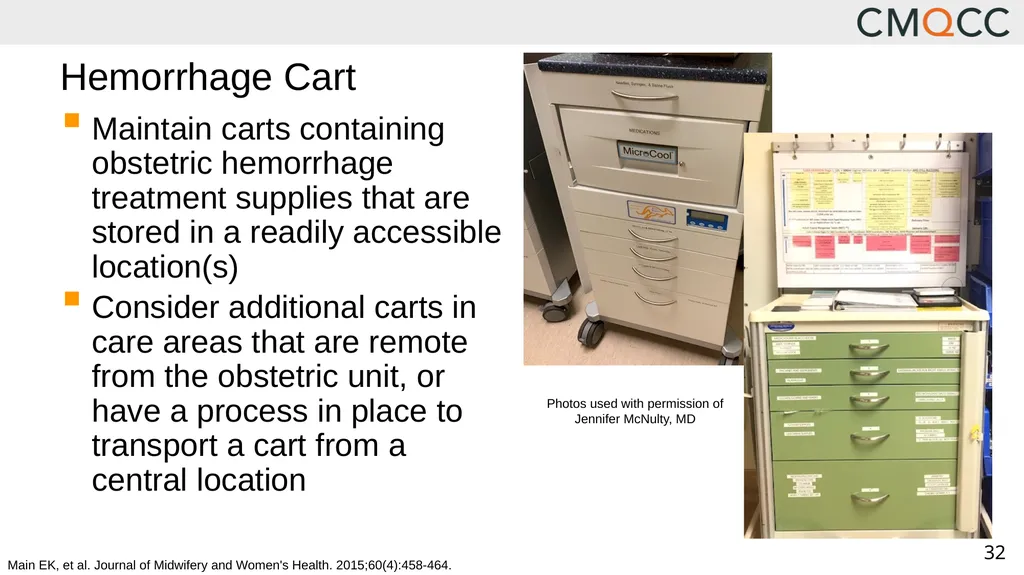
Hemorrhage Cart Maintain carts containing obstetric hemorrhage treatment supplies that are stored in a readily accessible location(s)
Consider additional carts in care areas that are remote from the obstetric unit, or have a process in place to transport a cart from a central location Main EK, et al. Journal of Midwifery and Women's Health. 2015;60(4):458-464. Photos used with permission of Jennifer McNulty, MD<br>
Consider additional carts in care areas that are remote from the obstetric unit, or have a process in place to transport a cart from a central location Main EK, et al. Journal of Midwifery and Women's Health. 2015;60(4):458-464. Photos used with permission of Jennifer McNulty, MD<br>
33
Simulation and Drills All team members who respond to obstetric emergencies should participate in multidisciplinary simulation/drill programs for effective response and debriefing of critical incidents
In situ drills are simulations that occur in the patient care area and can be a cost-effective way to maximize time and resources while improving the quality and safety of patient care
May improve ability to address systems issues and provides practice in one’s own hospital setting with familiar resources
Enables more team members to participate in simulation more frequently Lutgendorf MA, et al. Military Medicine 2017;182(3):e1762-e1766. Main EK, et al. Obstet Gynecol. 2015 Jul;126(1):155-62. Andreatta PB, et al. Clinical Obstetrics and Gynecology. 2010;53(3):532-544. ACOG. Obstetric Drill Program Manual Postpartum Hemorrhage. Published 2019. Accessed 2/18/2021.<br>
In situ drills are simulations that occur in the patient care area and can be a cost-effective way to maximize time and resources while improving the quality and safety of patient care
May improve ability to address systems issues and provides practice in one’s own hospital setting with familiar resources
Enables more team members to participate in simulation more frequently Lutgendorf MA, et al. Military Medicine 2017;182(3):e1762-e1766. Main EK, et al. Obstet Gynecol. 2015 Jul;126(1):155-62. Andreatta PB, et al. Clinical Obstetrics and Gynecology. 2010;53(3):532-544. ACOG. Obstetric Drill Program Manual Postpartum Hemorrhage. Published 2019. Accessed 2/18/2021.<br>
34
Implicit Bias Training Perinatal healthcare providers may benefit from participation in an implicit bias training designed to curtail the impact of bias on maternal health
While bias training alone will not lead to immediate improvements in disparities for birthing people of color, it can:
Improve patient-provider communication
Highlight behaviors that can be corrected
Begin the work of providing more equitable care for pregnancy-capable people
Staff Education Resources
Office of Minority Health (US HHS)
Diversity Sciences
March of Dimes<br>
While bias training alone will not lead to immediate improvements in disparities for birthing people of color, it can:
Improve patient-provider communication
Highlight behaviors that can be corrected
Begin the work of providing more equitable care for pregnancy-capable people
Staff Education Resources
Office of Minority Health (US HHS)
Diversity Sciences
March of Dimes<br>
35
David Lagrew, MD
Providence St. Joseph Health<br>
36
Electronic Health Record (EHR) to Improve Hemorrhage Management Electronic health records (EHR) can provide a safety infrastructure for common conditions by utilizing tools:
Documentation templates
Best practice advisories/alerts (BPAs)
Standardized order sets utilizing management algorithms
Communication tools
Reports communicating current status/evolving trends
EHR can automate vital sign assessment monitoring (early warning systems)
Care pathways and artificial intelligence associated with EHR have the potential to maximize and improve quality infrastructure in obstetric care, including hemorrhage ACOG. Committee Opinion no. 621 of the American College of Obstetricians and Gynecologists. 2015. Atallah F, et al. Risk Management and Healthcare Policy. 2020;13:35-42.<br>
Documentation templates
Best practice advisories/alerts (BPAs)
Standardized order sets utilizing management algorithms
Communication tools
Reports communicating current status/evolving trends
EHR can automate vital sign assessment monitoring (early warning systems)
Care pathways and artificial intelligence associated with EHR have the potential to maximize and improve quality infrastructure in obstetric care, including hemorrhage ACOG. Committee Opinion no. 621 of the American College of Obstetricians and Gynecologists. 2015. Atallah F, et al. Risk Management and Healthcare Policy. 2020;13:35-42.<br>
37
Hemorrhage Preparedness Considerations for
Small and Low-Resource Hospitals Consideration for birth at a hospital with a higher maternal level of care should be discussed for prenatal conditions at high risk for hemorrhage
Communication and collaboration between departments and disciplines is essential
All staff need a clear picture of response times, blood product availability and time to obtain blood products
Teams should be mobilized early<br>
Communication and collaboration between departments and disciplines is essential
All staff need a clear picture of response times, blood product availability and time to obtain blood products
Teams should be mobilized early<br>
38
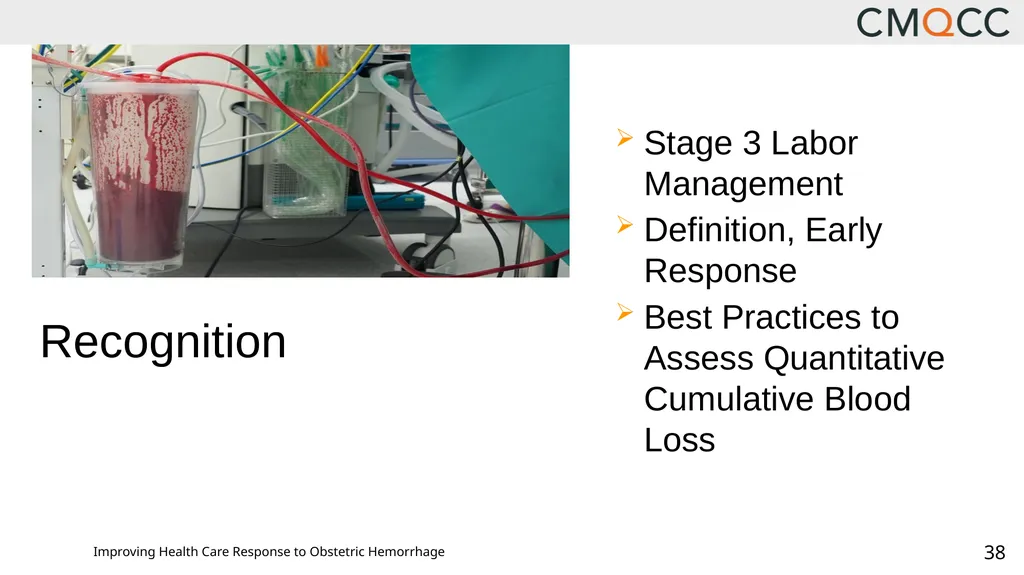
Recognition Stage 3 Labor Management
Definition, Early Response
Best Practices to Assess Quantitative Cumulative Blood Loss<br>
Definition, Early Response
Best Practices to Assess Quantitative Cumulative Blood Loss<br>
39
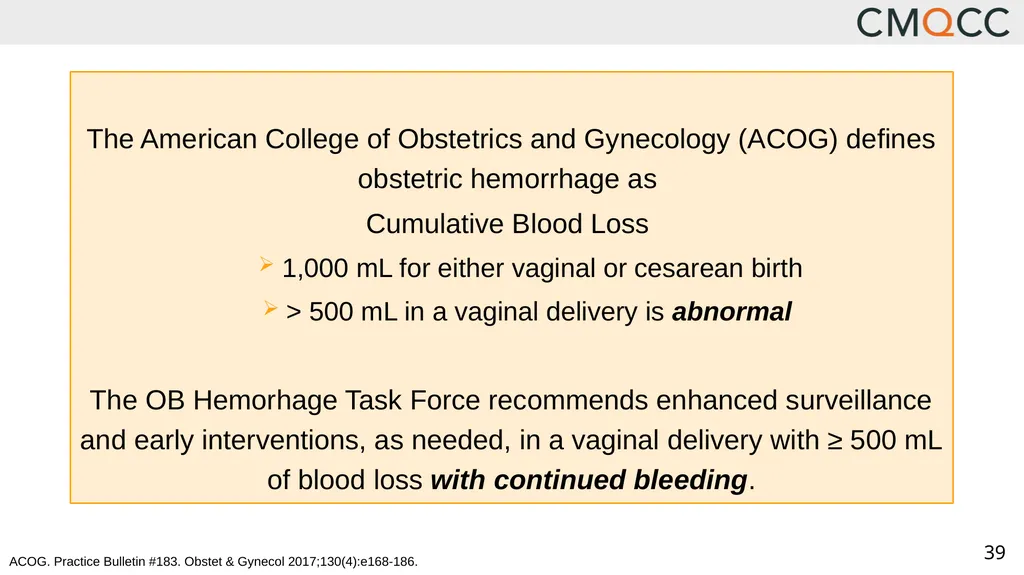
The American College of Obstetrics and Gynecology (ACOG) defines obstetric hemorrhage as
Cumulative Blood Loss
1,000 mL for either vaginal or cesarean birth
> 500 mL in a vaginal delivery is abnormal
The OB Hemorhage Task Force recommends enhanced surveillance and early interventions, as needed, in a vaginal delivery with ≥ 500 mL of blood loss with continued bleeding. ACOG. Practice Bulletin #183. Obstet & Gynecol 2017;130(4):e168-186.<br>
Cumulative Blood Loss
1,000 mL for either vaginal or cesarean birth
> 500 mL in a vaginal delivery is abnormal
The OB Hemorhage Task Force recommends enhanced surveillance and early interventions, as needed, in a vaginal delivery with ≥ 500 mL of blood loss with continued bleeding. ACOG. Practice Bulletin #183. Obstet & Gynecol 2017;130(4):e168-186.<br>
40
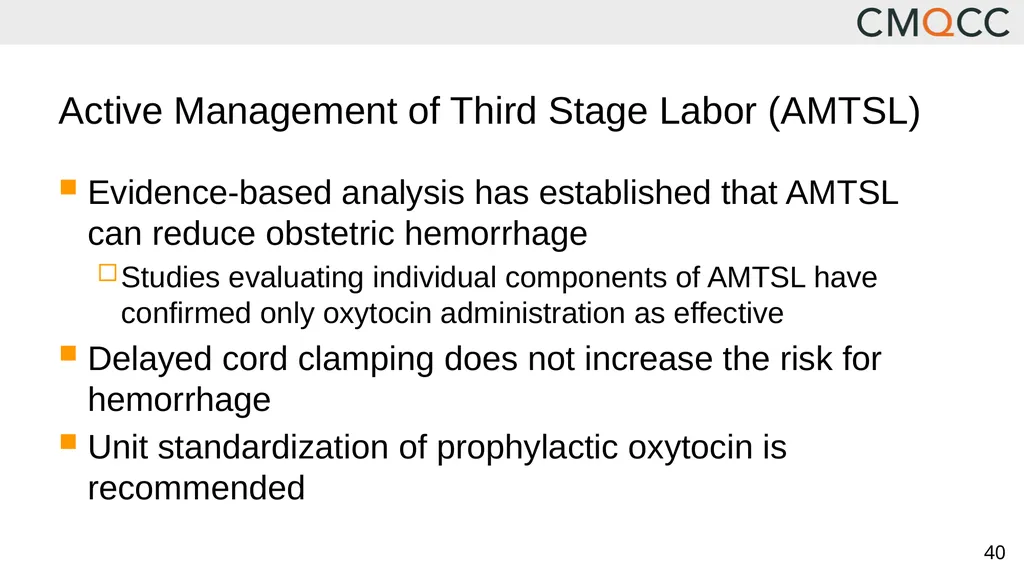
Active Management of Third Stage Labor (AMTSL) Evidence-based analysis has established that AMTSL can reduce obstetric hemorrhage
Studies evaluating individual components of AMTSL have confirmed only oxytocin administration as effective
Delayed cord clamping does not increase the risk for hemorrhage
Unit standardization of prophylactic oxytocin is recommended<br>
Studies evaluating individual components of AMTSL have confirmed only oxytocin administration as effective
Delayed cord clamping does not increase the risk for hemorrhage
Unit standardization of prophylactic oxytocin is recommended<br>
41
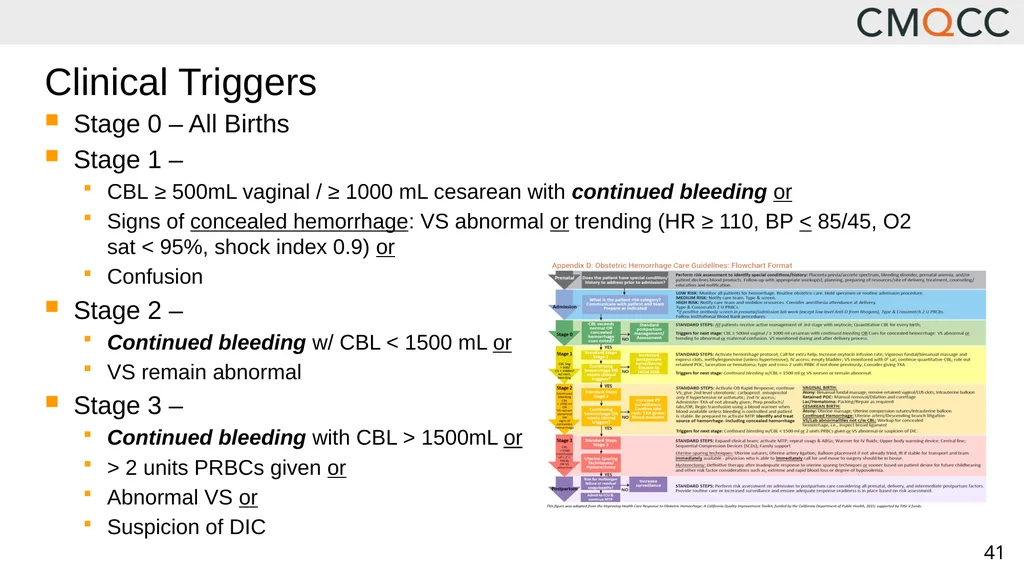
Clinical Triggers Stage 0 – All Births
Stage 1 –
CBL ≥ 500mL vaginal / ≥ 1000 mL cesarean with continued bleeding or
Signs of concealed hemorrhage: VS abnormal or trending (HR ≥ 110, BP < 85/45, O2 sat < 95%, shock index 0.9) or
Confusion
Stage 2 –
Continued bleeding w/ CBL < 1500 mL or
VS remain abnormal
Stage 3 –
Continued bleeding with CBL > 1500mL or
> 2 units PRBCs given or
Abnormal VS or
Suspicion of DIC<br>
Stage 1 –
CBL ≥ 500mL vaginal / ≥ 1000 mL cesarean with continued bleeding or
Signs of concealed hemorrhage: VS abnormal or trending (HR ≥ 110, BP < 85/45, O2 sat < 95%, shock index 0.9) or
Confusion
Stage 2 –
Continued bleeding w/ CBL < 1500 mL or
VS remain abnormal
Stage 3 –
Continued bleeding with CBL > 1500mL or
> 2 units PRBCs given or
Abnormal VS or
Suspicion of DIC<br>
42
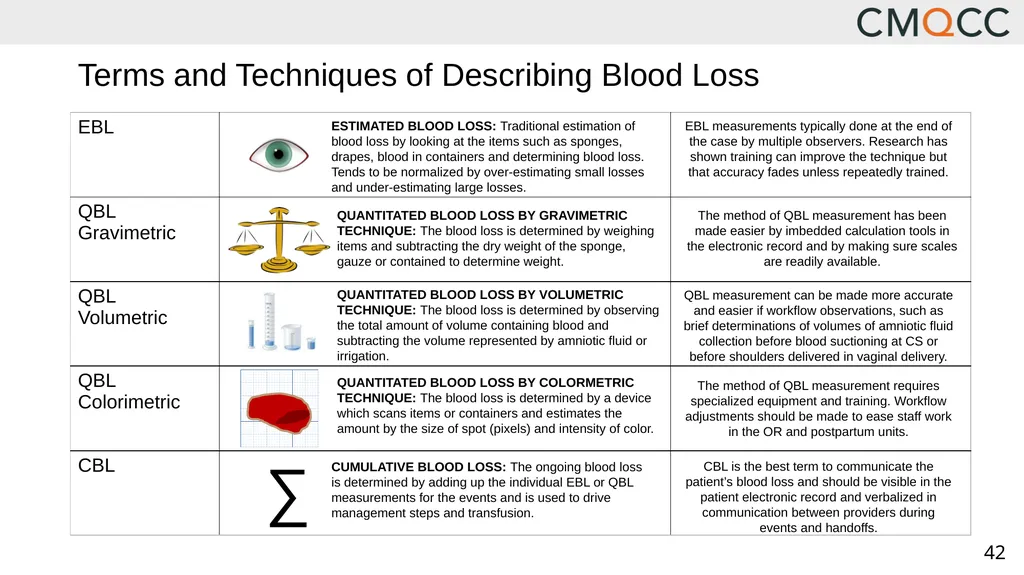
Terms and Techniques of Describing Blood Loss ∑ ESTIMATED BLOOD LOSS: Traditional estimation of blood loss by looking at the items such as sponges, drapes, blood in containers and determining blood loss. Tends to be normalized by over-estimating small losses and under-estimating large losses. QUANTITATED BLOOD LOSS BY GRAVIMETRIC TECHNIQUE: The blood loss is determined by weighing items and subtracting the dry weight of the sponge, gauze or contained to determine weight. QUANTITATED BLOOD LOSS BY VOLUMETRIC TECHNIQUE: The blood loss is determined by observing the total amount of volume containing blood and subtracting the volume represented by amniotic fluid or irrigation. QUANTITATED BLOOD LOSS BY COLORMETRIC TECHNIQUE: The blood loss is determined by a device which scans items or containers and estimates the amount by the size of spot (pixels) and intensity of color. CUMULATIVE BLOOD LOSS: The ongoing blood loss is determined by adding up the individual EBL or QBL measurements for the events and is used to drive management steps and transfusion. EBL measurements typically done at the end of the case by multiple observers. Research has shown training can improve the technique but that accuracy fades unless repeatedly trained. The method of QBL measurement has been made easier by imbedded calculation tools in the electronic record and by making sure scales are readily available. QBL measurement can be made more accurate and easier if workflow observations, such as brief determinations of volumes of amniotic fluid collection before blood suctioning at CS or before shoulders delivered in vaginal delivery. The method of QBL measurement requires specialized equipment and training. Workflow adjustments should be made to ease staff work in the OR and postpartum units. CBL is the best term to communicate the patient’s blood loss and should be visible in the patient electronic record and verbalized in communication between providers during events and handoffs.<br>
43
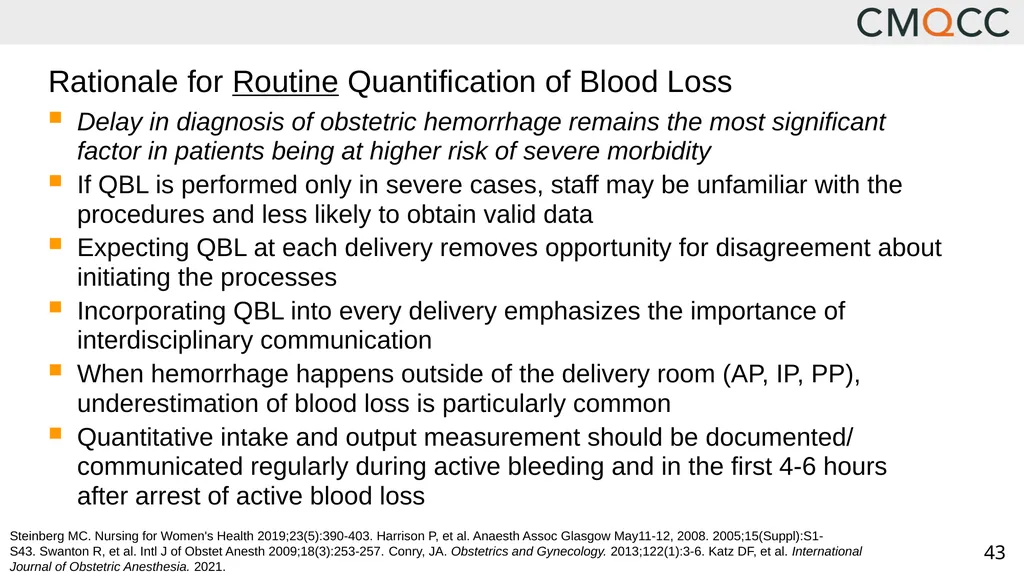
Rationale for Routine Quantification of Blood Loss Delay in diagnosis of obstetric hemorrhage remains the most significant factor in patients being at higher risk of severe morbidity
If QBL is performed only in severe cases, staff may be unfamiliar with the procedures and less likely to obtain valid data
Expecting QBL at each delivery removes opportunity for disagreement about initiating the processes
Incorporating QBL into every delivery emphasizes the importance of interdisciplinary communication
When hemorrhage happens outside of the delivery room (AP, IP, PP), underestimation of blood loss is particularly common
Quantitative intake and output measurement should be documented/ communicated regularly during active bleeding and in the first 4-6 hours after arrest of active blood loss Steinberg MC. Nursing for Women's Health 2019;23(5):390-403. Harrison P, et al. Anaesth Assoc Glasgow May11-12, 2008. 2005;15(Suppl):S1-S43. Swanton R, et al. Intl J of Obstet Anesth 2009;18(3):253-257. Conry, JA. Obstetrics and Gynecology. 2013;122(1):3-6. Katz DF, et al. International Journal of Obstetric Anesthesia. 2021.<br>
If QBL is performed only in severe cases, staff may be unfamiliar with the procedures and less likely to obtain valid data
Expecting QBL at each delivery removes opportunity for disagreement about initiating the processes
Incorporating QBL into every delivery emphasizes the importance of interdisciplinary communication
When hemorrhage happens outside of the delivery room (AP, IP, PP), underestimation of blood loss is particularly common
Quantitative intake and output measurement should be documented/ communicated regularly during active bleeding and in the first 4-6 hours after arrest of active blood loss Steinberg MC. Nursing for Women's Health 2019;23(5):390-403. Harrison P, et al. Anaesth Assoc Glasgow May11-12, 2008. 2005;15(Suppl):S1-S43. Swanton R, et al. Intl J of Obstet Anesth 2009;18(3):253-257. Conry, JA. Obstetrics and Gynecology. 2013;122(1):3-6. Katz DF, et al. International Journal of Obstetric Anesthesia. 2021.<br>
44
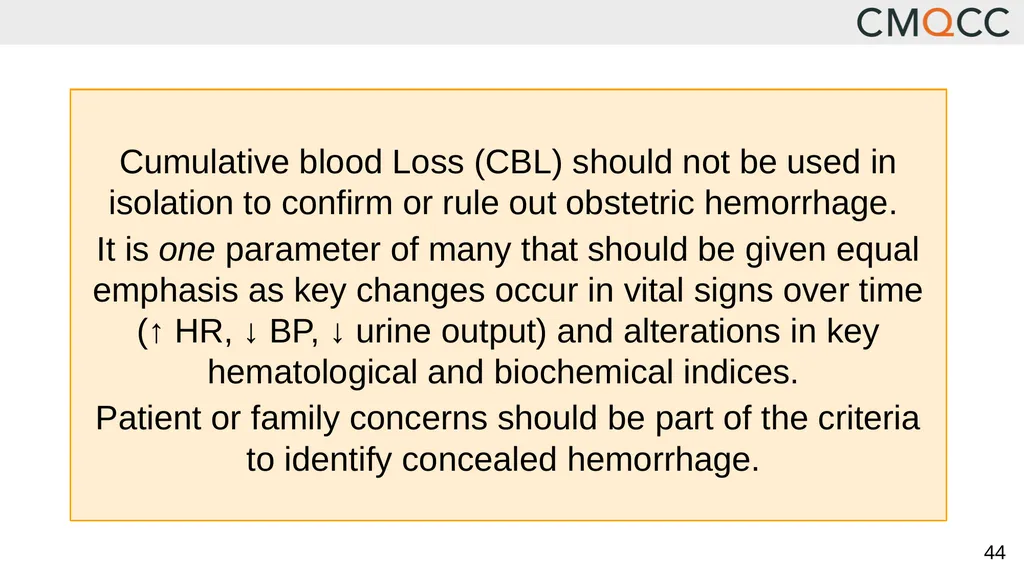
Cumulative blood Loss (CBL) should not be used in isolation to confirm or rule out obstetric hemorrhage.
It is one parameter of many that should be given equal emphasis as key changes occur in vital signs over time (↑ HR, ↓ BP, ↓ urine output) and alterations in key hematological and biochemical indices.
Patient or family concerns should be part of the criteria to identify concealed hemorrhage.<br>
It is one parameter of many that should be given equal emphasis as key changes occur in vital signs over time (↑ HR, ↓ BP, ↓ urine output) and alterations in key hematological and biochemical indices.
Patient or family concerns should be part of the criteria to identify concealed hemorrhage.<br>
45
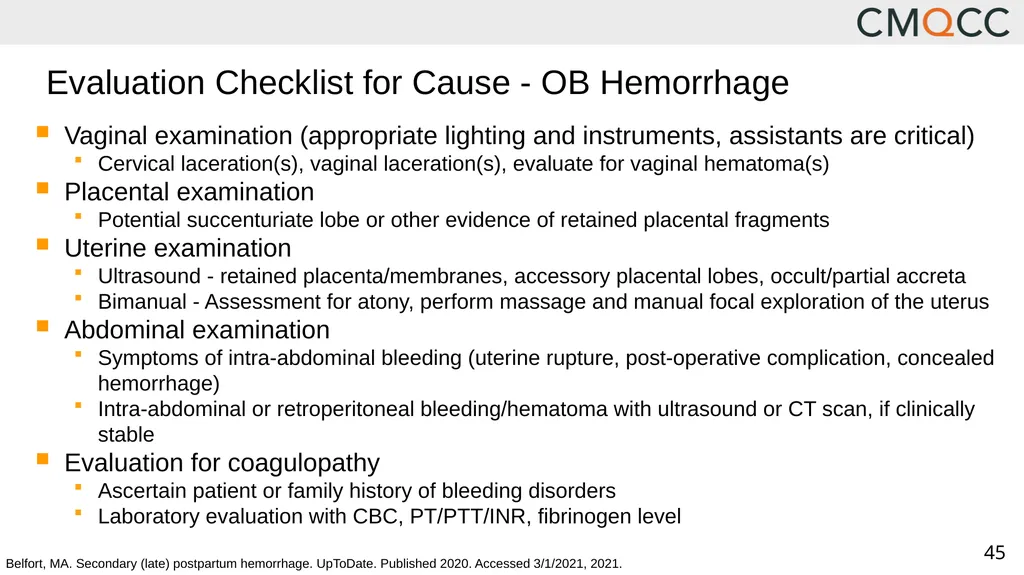
Evaluation Checklist for Cause - OB Hemorrhage Vaginal examination (appropriate lighting and instruments, assistants are critical)
Cervical laceration(s), vaginal laceration(s), evaluate for vaginal hematoma(s)
Placental examination
Potential succenturiate lobe or other evidence of retained placental fragments
Uterine examination
Ultrasound - retained placenta/membranes, accessory placental lobes, occult/partial accreta
Bimanual - Assessment for atony, perform massage and manual focal exploration of the uterus
Abdominal examination
Symptoms of intra-abdominal bleeding (uterine rupture, post-operative complication, concealed hemorrhage)
Intra-abdominal or retroperitoneal bleeding/hematoma with ultrasound or CT scan, if clinically stable
Evaluation for coagulopathy
Ascertain patient or family history of bleeding disorders
Laboratory evaluation with CBC, PT/PTT/INR, fibrinogen level Belfort, MA. Secondary (late) postpartum hemorrhage. UpToDate. Published 2020. Accessed 3/1/2021, 2021.<br>
Cervical laceration(s), vaginal laceration(s), evaluate for vaginal hematoma(s)
Placental examination
Potential succenturiate lobe or other evidence of retained placental fragments
Uterine examination
Ultrasound - retained placenta/membranes, accessory placental lobes, occult/partial accreta
Bimanual - Assessment for atony, perform massage and manual focal exploration of the uterus
Abdominal examination
Symptoms of intra-abdominal bleeding (uterine rupture, post-operative complication, concealed hemorrhage)
Intra-abdominal or retroperitoneal bleeding/hematoma with ultrasound or CT scan, if clinically stable
Evaluation for coagulopathy
Ascertain patient or family history of bleeding disorders
Laboratory evaluation with CBC, PT/PTT/INR, fibrinogen level Belfort, MA. Secondary (late) postpartum hemorrhage. UpToDate. Published 2020. Accessed 3/1/2021, 2021.<br>
46
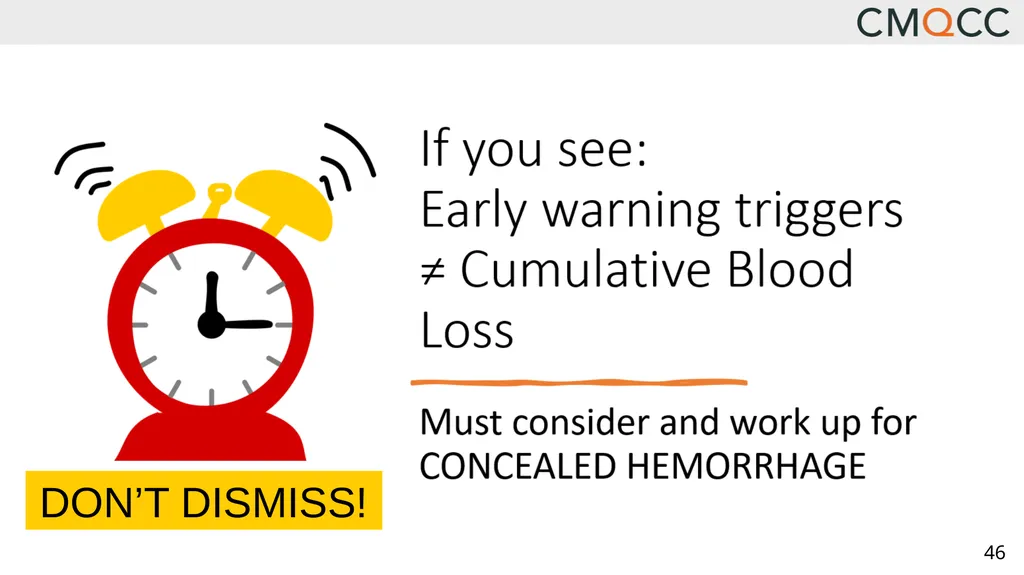
DON’T DISMISS!<br>
47
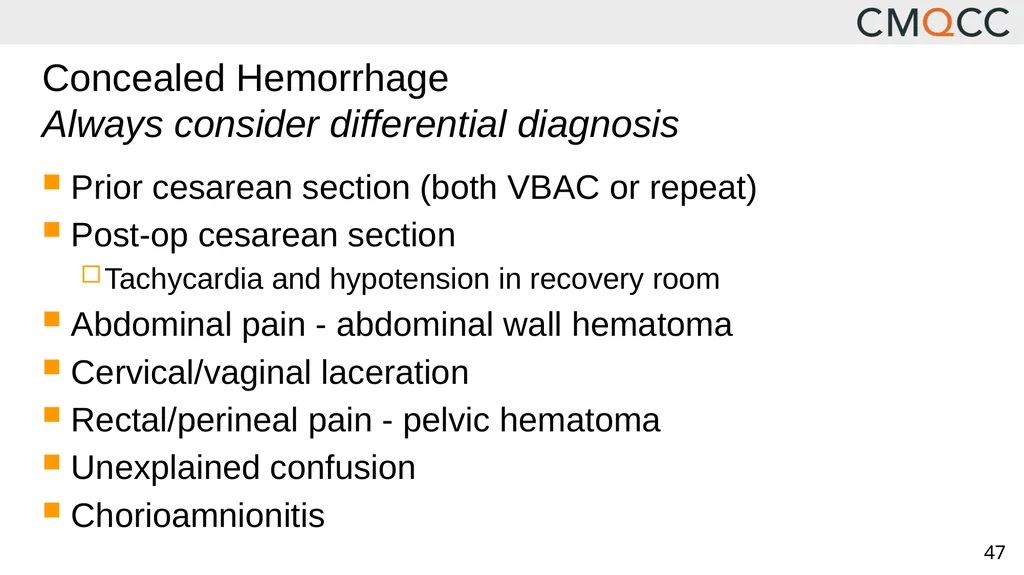
Concealed Hemorrhage
Always consider differential diagnosis Prior cesarean section (both VBAC or repeat)
Post-op cesarean section
Tachycardia and hypotension in recovery room
Abdominal pain - abdominal wall hematoma
Cervical/vaginal laceration
Rectal/perineal pain - pelvic hematoma
Unexplained confusion
Chorioamnionitis<br>
Post-op cesarean section
Tachycardia and hypotension in recovery room
Abdominal pain - abdominal wall hematoma
Cervical/vaginal laceration
Rectal/perineal pain - pelvic hematoma
Unexplained confusion
Chorioamnionitis<br>
48
Response Medications
Blood Product Replacement
Procedures
Women’s Experience
Secondary Hemorrhage Jennifer McNulty, MD MemorialCare™ Miller Children’s and Women’s Hospital Long Beach<br>
Blood Product Replacement
Procedures
Women’s Experience
Secondary Hemorrhage Jennifer McNulty, MD MemorialCare™ Miller Children’s and Women’s Hospital Long Beach<br>
49
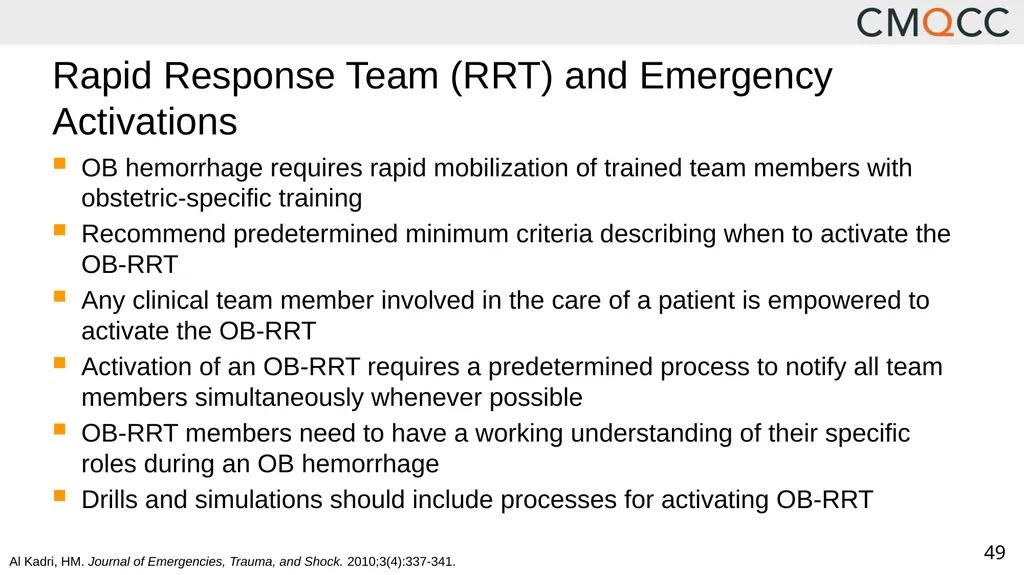
Rapid Response Team (RRT) and Emergency Activations OB hemorrhage requires rapid mobilization of trained team members with obstetric-specific training
Recommend predetermined minimum criteria describing when to activate the OB-RRT
Any clinical team member involved in the care of a patient is empowered to activate the OB-RRT
Activation of an OB-RRT requires a predetermined process to notify all team members simultaneously whenever possible
OB-RRT members need to have a working understanding of their specific roles during an OB hemorrhage
Drills and simulations should include processes for activating OB-RRT Al Kadri, HM. Journal of Emergencies, Trauma, and Shock. 2010;3(4):337-341.<br>
Recommend predetermined minimum criteria describing when to activate the OB-RRT
Any clinical team member involved in the care of a patient is empowered to activate the OB-RRT
Activation of an OB-RRT requires a predetermined process to notify all team members simultaneously whenever possible
OB-RRT members need to have a working understanding of their specific roles during an OB hemorrhage
Drills and simulations should include processes for activating OB-RRT Al Kadri, HM. Journal of Emergencies, Trauma, and Shock. 2010;3(4):337-341.<br>
50
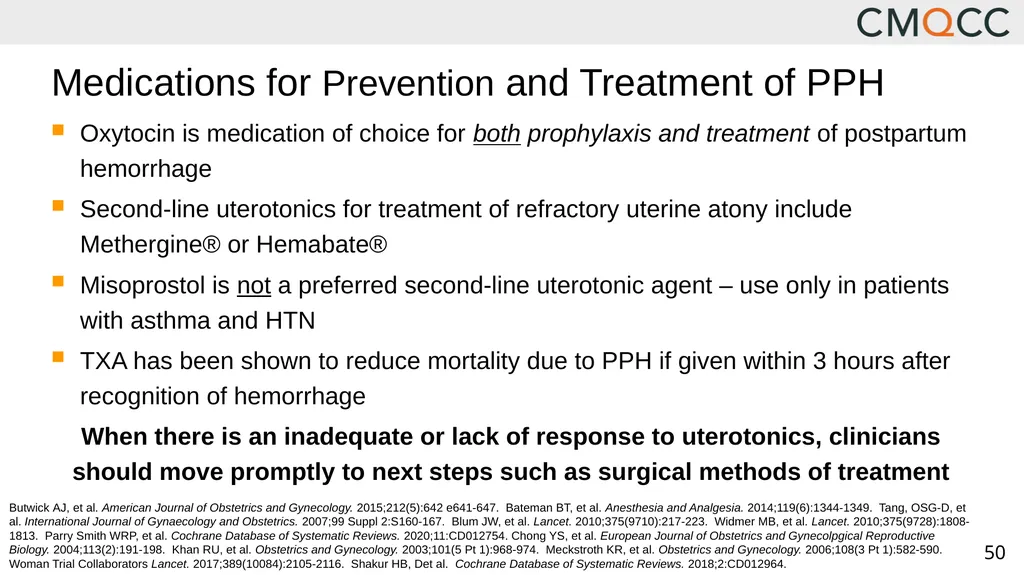
Medications for Prevention and Treatment of PPH Oxytocin is medication of choice for both prophylaxis and treatment of postpartum hemorrhage
Second-line uterotonics for treatment of refractory uterine atony include Methergine® or Hemabate®
Misoprostol is not a preferred second-line uterotonic agent – use only in patients with asthma and HTN
TXA has been shown to reduce mortality due to PPH if given within 3 hours after recognition of hemorrhage
When there is an inadequate or lack of response to uterotonics, clinicians should move promptly to next steps such as surgical methods of treatment Butwick AJ, et al. American Journal of Obstetrics and Gynecology. 2015;212(5):642 e641-647. Bateman BT, et al. Anesthesia and Analgesia. 2014;119(6):1344-1349. Tang, OSG-D, et al. International Journal of Gynaecology and Obstetrics. 2007;99 Suppl 2:S160-167. Blum JW, et al. Lancet. 2010;375(9710):217-223. Widmer MB, et al. Lancet. 2010;375(9728):1808-1813. Parry Smith WRP, et al. Cochrane Database of Systematic Reviews. 2020;11:CD012754. Chong YS, et al. European Journal of Obstetrics and Gynecolpgical Reproductive Biology. 2004;113(2):191-198. Khan RU, et al. Obstetrics and Gynecology. 2003;101(5 Pt 1):968-974. Meckstroth KR, et al. Obstetrics and Gynecology. 2006;108(3 Pt 1):582-590. Woman Trial Collaborators Lancet. 2017;389(10084):2105-2116. Shakur HB, Det al. Cochrane Database of Systematic Reviews. 2018;2:CD012964.<br>
Second-line uterotonics for treatment of refractory uterine atony include Methergine® or Hemabate®
Misoprostol is not a preferred second-line uterotonic agent – use only in patients with asthma and HTN
TXA has been shown to reduce mortality due to PPH if given within 3 hours after recognition of hemorrhage
When there is an inadequate or lack of response to uterotonics, clinicians should move promptly to next steps such as surgical methods of treatment Butwick AJ, et al. American Journal of Obstetrics and Gynecology. 2015;212(5):642 e641-647. Bateman BT, et al. Anesthesia and Analgesia. 2014;119(6):1344-1349. Tang, OSG-D, et al. International Journal of Gynaecology and Obstetrics. 2007;99 Suppl 2:S160-167. Blum JW, et al. Lancet. 2010;375(9710):217-223. Widmer MB, et al. Lancet. 2010;375(9728):1808-1813. Parry Smith WRP, et al. Cochrane Database of Systematic Reviews. 2020;11:CD012754. Chong YS, et al. European Journal of Obstetrics and Gynecolpgical Reproductive Biology. 2004;113(2):191-198. Khan RU, et al. Obstetrics and Gynecology. 2003;101(5 Pt 1):968-974. Meckstroth KR, et al. Obstetrics and Gynecology. 2006;108(3 Pt 1):582-590. Woman Trial Collaborators Lancet. 2017;389(10084):2105-2116. Shakur HB, Det al. Cochrane Database of Systematic Reviews. 2018;2:CD012964.<br>
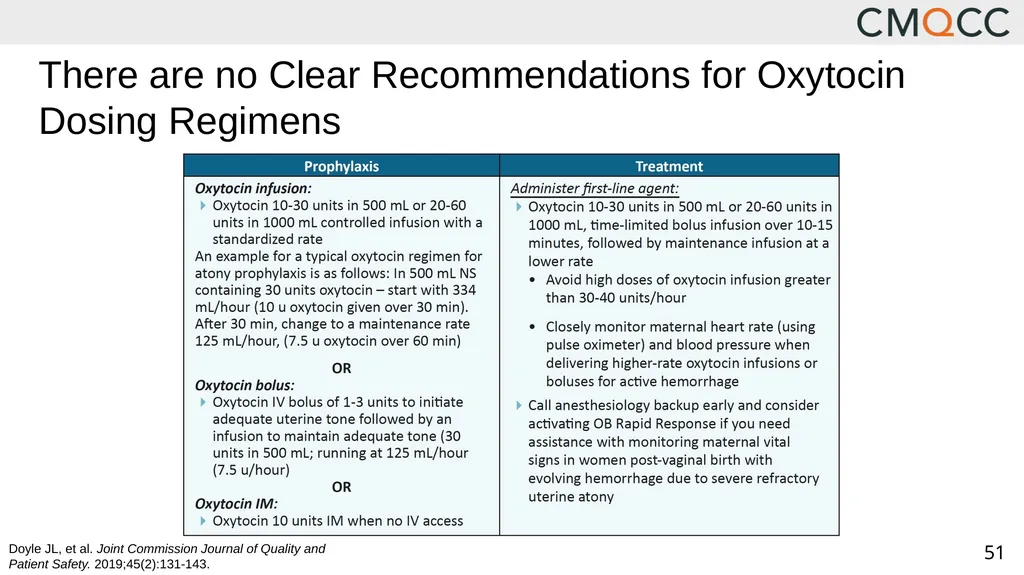
51
There are no Clear Recommendations for Oxytocin Dosing Regimens Doyle JL, et al. Joint Commission Journal of Quality and Patient Safety. 2019;45(2):131-143.<br>
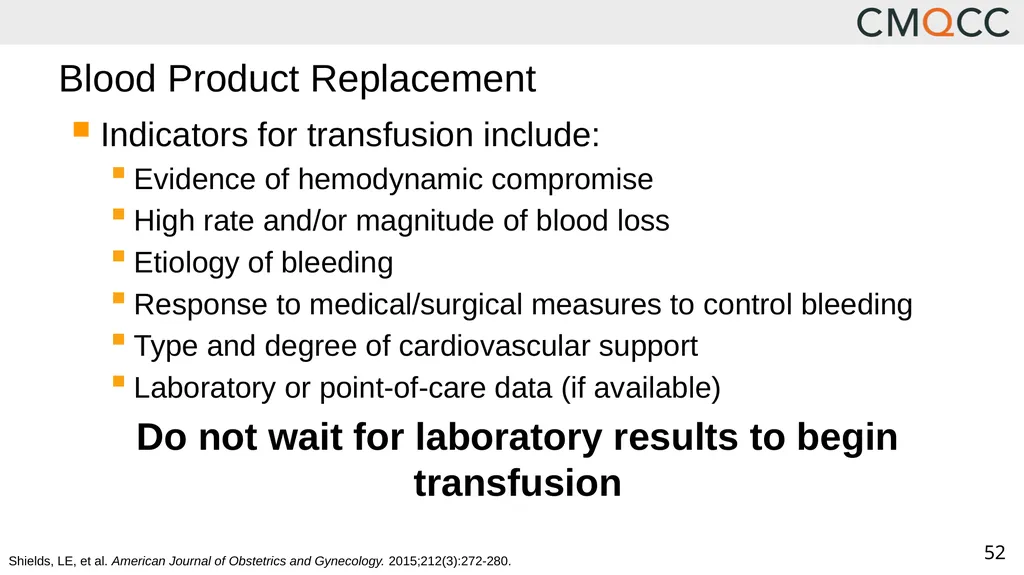
52
Blood Product Replacement Indicators for transfusion include:
Evidence of hemodynamic compromise
High rate and/or magnitude of blood loss
Etiology of bleeding
Response to medical/surgical measures to control bleeding
Type and degree of cardiovascular support
Laboratory or point-of-care data (if available)
Do not wait for laboratory results to begin transfusion Shields, LE, et al. American Journal of Obstetrics and Gynecology. 2015;212(3):272-280.<br>
Evidence of hemodynamic compromise
High rate and/or magnitude of blood loss
Etiology of bleeding
Response to medical/surgical measures to control bleeding
Type and degree of cardiovascular support
Laboratory or point-of-care data (if available)
Do not wait for laboratory results to begin transfusion Shields, LE, et al. American Journal of Obstetrics and Gynecology. 2015;212(3):272-280.<br>
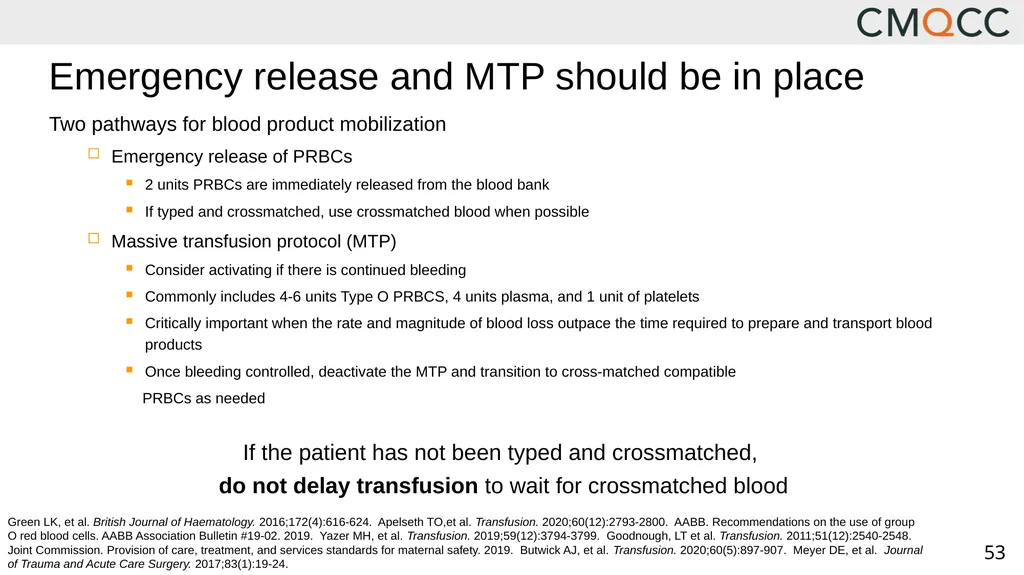
53
Emergency release and MTP should be in place Two pathways for blood product mobilization
Emergency release of PRBCs
2 units PRBCs are immediately released from the blood bank
If typed and crossmatched, use crossmatched blood when possible
Massive transfusion protocol (MTP)
Consider activating if there is continued bleeding
Commonly includes 4-6 units Type O PRBCS, 4 units plasma, and 1 unit of platelets
Critically important when the rate and magnitude of blood loss outpace the time required to prepare and transport blood products
Once bleeding controlled, deactivate the MTP and transition to cross-matched compatible
PRBCs as needed
If the patient has not been typed and crossmatched,
do not delay transfusion to wait for crossmatched blood Green LK, et al. British Journal of Haematology. 2016;172(4):616-624. Apelseth TO,et al. Transfusion. 2020;60(12):2793-2800. AABB. Recommendations on the use of group O red blood cells. AABB Association Bulletin #19-02. 2019. Yazer MH, et al. Transfusion. 2019;59(12):3794-3799. Goodnough, LT et al. Transfusion. 2011;51(12):2540-2548. Joint Commission. Provision of care, treatment, and services standards for maternal safety. 2019. Butwick AJ, et al. Transfusion. 2020;60(5):897-907. Meyer DE, et al. Journal of Trauma and Acute Care Surgery. 2017;83(1):19-24.<br>
Emergency release of PRBCs
2 units PRBCs are immediately released from the blood bank
If typed and crossmatched, use crossmatched blood when possible
Massive transfusion protocol (MTP)
Consider activating if there is continued bleeding
Commonly includes 4-6 units Type O PRBCS, 4 units plasma, and 1 unit of platelets
Critically important when the rate and magnitude of blood loss outpace the time required to prepare and transport blood products
Once bleeding controlled, deactivate the MTP and transition to cross-matched compatible
PRBCs as needed
If the patient has not been typed and crossmatched,
do not delay transfusion to wait for crossmatched blood Green LK, et al. British Journal of Haematology. 2016;172(4):616-624. Apelseth TO,et al. Transfusion. 2020;60(12):2793-2800. AABB. Recommendations on the use of group O red blood cells. AABB Association Bulletin #19-02. 2019. Yazer MH, et al. Transfusion. 2019;59(12):3794-3799. Goodnough, LT et al. Transfusion. 2011;51(12):2540-2548. Joint Commission. Provision of care, treatment, and services standards for maternal safety. 2019. Butwick AJ, et al. Transfusion. 2020;60(5):897-907. Meyer DE, et al. Journal of Trauma and Acute Care Surgery. 2017;83(1):19-24.<br>
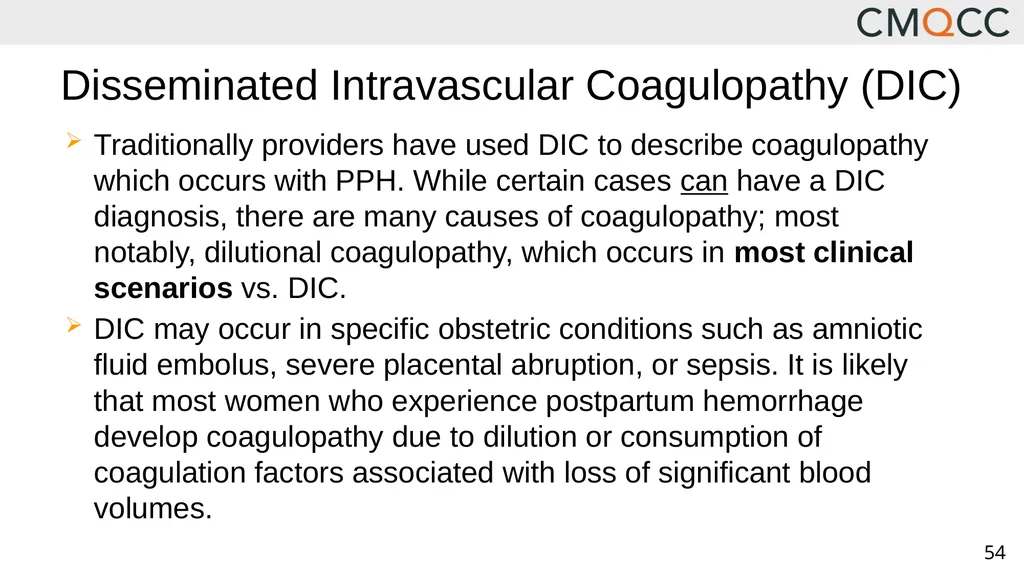
54
Traditionally providers have used DIC to describe coagulopathy which occurs with PPH. While certain cases can have a DIC diagnosis, there are many causes of coagulopathy; most notably, dilutional coagulopathy, which occurs in most clinical scenarios vs. DIC.
DIC may occur in specific obstetric conditions such as amniotic fluid embolus, severe placental abruption, or sepsis. It is likely that most women who experience postpartum hemorrhage develop coagulopathy due to dilution or consumption of coagulation factors associated with loss of significant blood volumes. Disseminated Intravascular Coagulopathy (DIC)<br>
DIC may occur in specific obstetric conditions such as amniotic fluid embolus, severe placental abruption, or sepsis. It is likely that most women who experience postpartum hemorrhage develop coagulopathy due to dilution or consumption of coagulation factors associated with loss of significant blood volumes. Disseminated Intravascular Coagulopathy (DIC)<br>
55
Uterine Balloon Tamponade Recommended for Tx of uterine atony-related hemorrhage in situations where uterotonics are contraindicated, ineffective, or unavailable
Plans should simultaneously be made for next steps, should placement be unsuccessful
Mobilizing additional personnel
Activating MTP
OR preparations for possible hysterectomy
Success rates range from 68%-88%
Placement with ultrasound guidance for placement and post placement monitoring may reduce complications and should be considered Aibar LA, et al. Acta Obstet et & Gynecol Scandinavica 2013;92(4):465-467. Gronvall MT, et al. Acta Obstet Et & Gynecol Scandinavica 2013;92*4):433-438. Kong MTC, et al. Hong Kong Med J 2013;19(6):484-490. Laas EB, et al. Am J Obstet & Gyn. 2012;207(4):281 e281-287. Olsen RR, et al. J of MFM & Neo Med 2013;26(17):1720-1723. Vitthala ST, et al. Aus & NZ J of Obstet & Gynaec 2009;49(2):191-194. Vrachnis NS, et al. Intl J of Gynaecol & Obstet 2013;122(3):265-266. Suarez SC, et al. American Journal of Obstetrics and Gynecology. 2020;222(4):293 e291-293 e252. Mezei, GC. Bakri balloon placement. Medscape. https://emedicine.medscape.com/article/2047283-overview. Published 2016. Accessed 3/10/2021.<br>
Plans should simultaneously be made for next steps, should placement be unsuccessful
Mobilizing additional personnel
Activating MTP
OR preparations for possible hysterectomy
Success rates range from 68%-88%
Placement with ultrasound guidance for placement and post placement monitoring may reduce complications and should be considered Aibar LA, et al. Acta Obstet et & Gynecol Scandinavica 2013;92(4):465-467. Gronvall MT, et al. Acta Obstet Et & Gynecol Scandinavica 2013;92*4):433-438. Kong MTC, et al. Hong Kong Med J 2013;19(6):484-490. Laas EB, et al. Am J Obstet & Gyn. 2012;207(4):281 e281-287. Olsen RR, et al. J of MFM & Neo Med 2013;26(17):1720-1723. Vitthala ST, et al. Aus & NZ J of Obstet & Gynaec 2009;49(2):191-194. Vrachnis NS, et al. Intl J of Gynaecol & Obstet 2013;122(3):265-266. Suarez SC, et al. American Journal of Obstetrics and Gynecology. 2020;222(4):293 e291-293 e252. Mezei, GC. Bakri balloon placement. Medscape. https://emedicine.medscape.com/article/2047283-overview. Published 2016. Accessed 3/10/2021.<br>
56
When intrauterine balloon placement is being considered, the OB Hemorrhage Task Force recommends considering mobilization of additional personnel via activation of an obstetric rapid response team (OB-RRT), activation of the massive transfusion protocol, transfer to OR and preparation for possible hysterectomy.<br>
57
Compression Sutures B-Lynch is the most commonly used and studied, followed by Cho Square and Hayman
Available evidence has not demonstrated whether a certain approach achieves better results than other methods or if a certain suture material is better than another
Protocols for the timing and method of placement of sutures (and balloons) should be added to institutional policies and procedures
Diagrams with the techniques may be helpful if posted in L&D and in large laminated size in an obstetric hemorrhage cart Matsubara SY, et al. Acta Obstet et Gynecol Scandinvacia 2013;92(4):378-385.<br>
Available evidence has not demonstrated whether a certain approach achieves better results than other methods or if a certain suture material is better than another
Protocols for the timing and method of placement of sutures (and balloons) should be added to institutional policies and procedures
Diagrams with the techniques may be helpful if posted in L&D and in large laminated size in an obstetric hemorrhage cart Matsubara SY, et al. Acta Obstet et Gynecol Scandinvacia 2013;92(4):378-385.<br>
58
Indications, complications and effectiveness of vaso-occlusive balloons and embolization techniques are not well established and therefore must be approached with caution.
If UAE for the treatment of PPH is utilized:
Patient must be stable for transport to IR and accompanied by a RN skilled in the assessment and treatment of hemorrhage
A physician who is able to immediately call for and move to laparotomy should be in house
Anesthesiology services must also be immediately available Coulange, LB, et al. Acta Obstetricia et and Gynecologica Scandinavica. 2009;88(2):238-240. Shrivastava, VN, et al. American Journal of Obstetrics and Gynecology. 2007;197(4):402.e401-405. Maassen, MSL, et al. BJOG: British Journal of Obstetrics and Gynaecology. 2009;116(1):55-61. Sadashivaiah, JW, et al. International Journal of Obstetric Anesthesia. 2011;20(4):282-287.<br>
If UAE for the treatment of PPH is utilized:
Patient must be stable for transport to IR and accompanied by a RN skilled in the assessment and treatment of hemorrhage
A physician who is able to immediately call for and move to laparotomy should be in house
Anesthesiology services must also be immediately available Coulange, LB, et al. Acta Obstetricia et and Gynecologica Scandinavica. 2009;88(2):238-240. Shrivastava, VN, et al. American Journal of Obstetrics and Gynecology. 2007;197(4):402.e401-405. Maassen, MSL, et al. BJOG: British Journal of Obstetrics and Gynaecology. 2009;116(1):55-61. Sadashivaiah, JW, et al. International Journal of Obstetric Anesthesia. 2011;20(4):282-287.<br>
59
Christa Sakowski, RN, MSN
CMQCC Clinical Lead<br>
60
Communicating with Patients After an Obstetric Hemorrhage Formal discussions about patient experience/prognosis should occur throughout the hospitalization and during PP visits
There is a significant and clinically relevant increased risk for women to develop post-traumatic stress disorder (PTSD) after experiencing severe postpartum hemorrhage
Ensure patients who experience hemorrhage receive a detailed discharge summary in writing
Prior to D/C, patients who experience hemorrhage should receive contact information of a resource person who can answer questions about care/ongoing concerns
Policies and guidelines addressing disclosure should be developed in accordance with state laws Elmir RS, et al. Midwifery. 2012;28(2):228-235.<br>
There is a significant and clinically relevant increased risk for women to develop post-traumatic stress disorder (PTSD) after experiencing severe postpartum hemorrhage
Ensure patients who experience hemorrhage receive a detailed discharge summary in writing
Prior to D/C, patients who experience hemorrhage should receive contact information of a resource person who can answer questions about care/ongoing concerns
Policies and guidelines addressing disclosure should be developed in accordance with state laws Elmir RS, et al. Midwifery. 2012;28(2):228-235.<br>
61
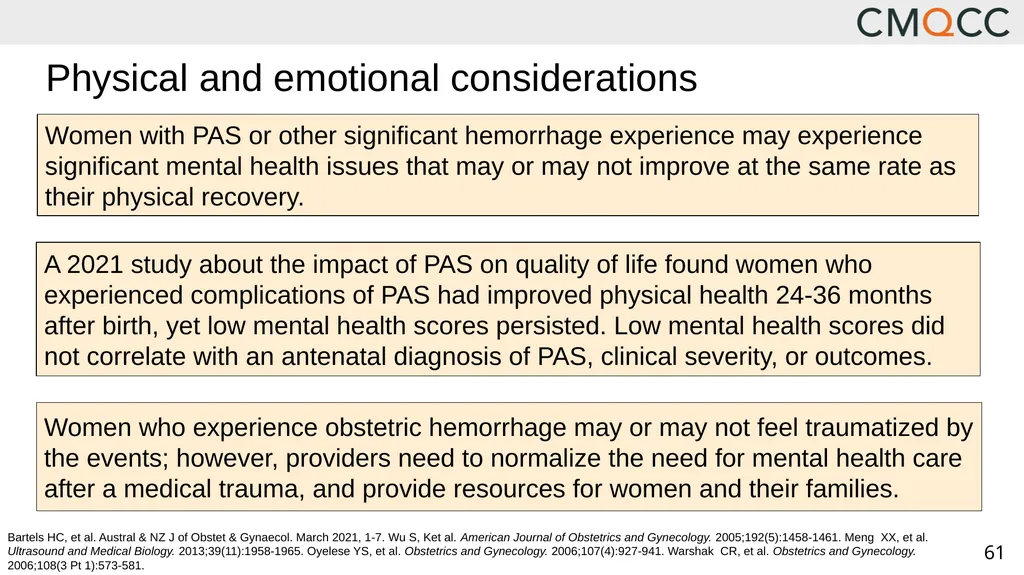
Women who experience obstetric hemorrhage may or may not feel traumatized by the events; however, providers need to normalize the need for mental health care after a medical trauma, and provide resources for women and their families. Physical and emotional considerations Women with PAS or other significant hemorrhage experience may experience significant mental health issues that may or may not improve at the same rate as their physical recovery. A 2021 study about the impact of PAS on quality of life found women who experienced complications of PAS had improved physical health 24-36 months after birth, yet low mental health scores persisted. Low mental health scores did not correlate with an antenatal diagnosis of PAS, clinical severity, or outcomes. Bartels HC, et al. Austral & NZ J of Obstet & Gynaecol. March 2021, 1-7. Wu S, Ket al. American Journal of Obstetrics and Gynecology. 2005;192(5):1458-1461. Meng XX, et al. Ultrasound and Medical Biology. 2013;39(11):1958-1965. Oyelese YS, et al. Obstetrics and Gynecology. 2006;107(4):927-941. Warshak CR, et al. Obstetrics and Gynecology. 2006;108(3 Pt 1):573-581.<br>
62
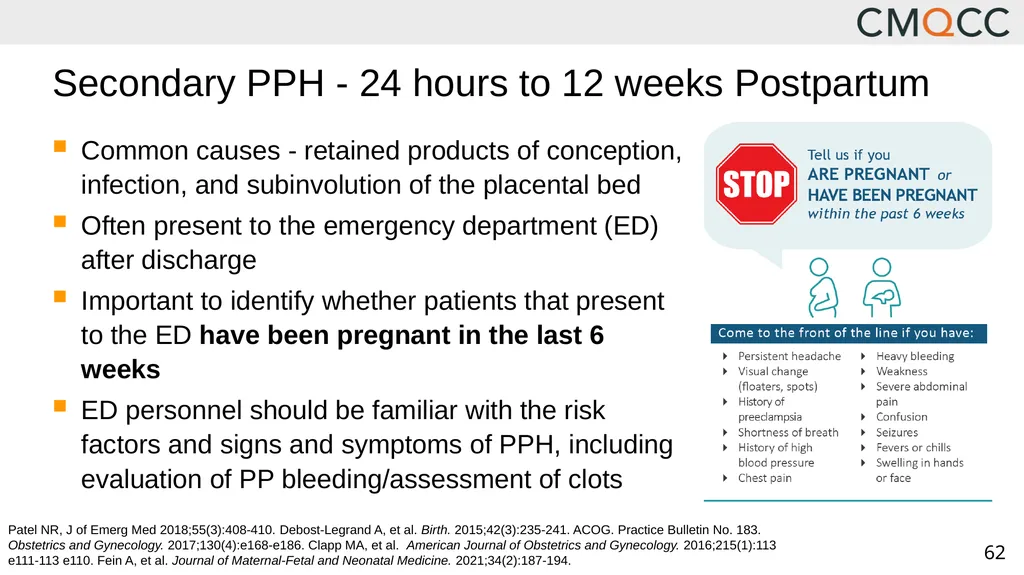
Secondary PPH - 24 hours to 12 weeks Postpartum Common causes - retained products of conception, infection, and subinvolution of the placental bed
Often present to the emergency department (ED) after discharge
Important to identify whether patients that present to the ED have been pregnant in the last 6 weeks
ED personnel should be familiar with the risk factors and signs and symptoms of PPH, including evaluation of PP bleeding/assessment of clots Patel NR, J of Emerg Med 2018;55(3):408-410. Debost-Legrand A, et al. Birth. 2015;42(3):235-241. ACOG. Practice Bulletin No. 183. Obstetrics and Gynecology. 2017;130(4):e168-e186. Clapp MA, et al. American Journal of Obstetrics and Gynecology. 2016;215(1):113 e111-113 e110. Fein A, et al. Journal of Maternal-Fetal and Neonatal Medicine. 2021;34(2):187-194.<br>
Often present to the emergency department (ED) after discharge
Important to identify whether patients that present to the ED have been pregnant in the last 6 weeks
ED personnel should be familiar with the risk factors and signs and symptoms of PPH, including evaluation of PP bleeding/assessment of clots Patel NR, J of Emerg Med 2018;55(3):408-410. Debost-Legrand A, et al. Birth. 2015;42(3):235-241. ACOG. Practice Bulletin No. 183. Obstetrics and Gynecology. 2017;130(4):e168-e186. Clapp MA, et al. American Journal of Obstetrics and Gynecology. 2016;215(1):113 e111-113 e110. Fein A, et al. Journal of Maternal-Fetal and Neonatal Medicine. 2021;34(2):187-194.<br>
63
Reporting Debriefs & Case Reviews
Outcome Metrics David Lagrew, MD Providence St. Joseph Health<br>
Outcome Metrics David Lagrew, MD Providence St. Joseph Health<br>
64
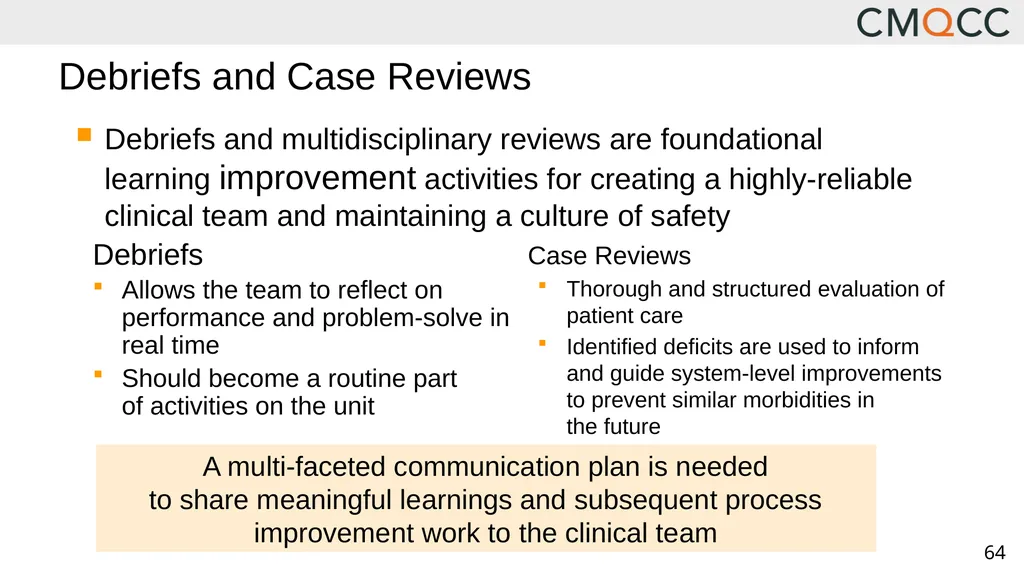
Debriefs and Case Reviews Debriefs and multidisciplinary reviews are foundational learning improvement activities for creating a highly-reliable clinical team and maintaining a culture of safety Debriefs
Allows the team to reflect on performance and problem-solve in real time
Should become a routine part of activities on the unit Case Reviews
Thorough and structured evaluation of patient care
Identified deficits are used to inform and guide system-level improvements to prevent similar morbidities in the future A multi-faceted communication plan is needed to share meaningful learnings and subsequent process improvement work to the clinical team<br>
Allows the team to reflect on performance and problem-solve in real time
Should become a routine part of activities on the unit Case Reviews
Thorough and structured evaluation of patient care
Identified deficits are used to inform and guide system-level improvements to prevent similar morbidities in the future A multi-faceted communication plan is needed to share meaningful learnings and subsequent process improvement work to the clinical team<br>
65
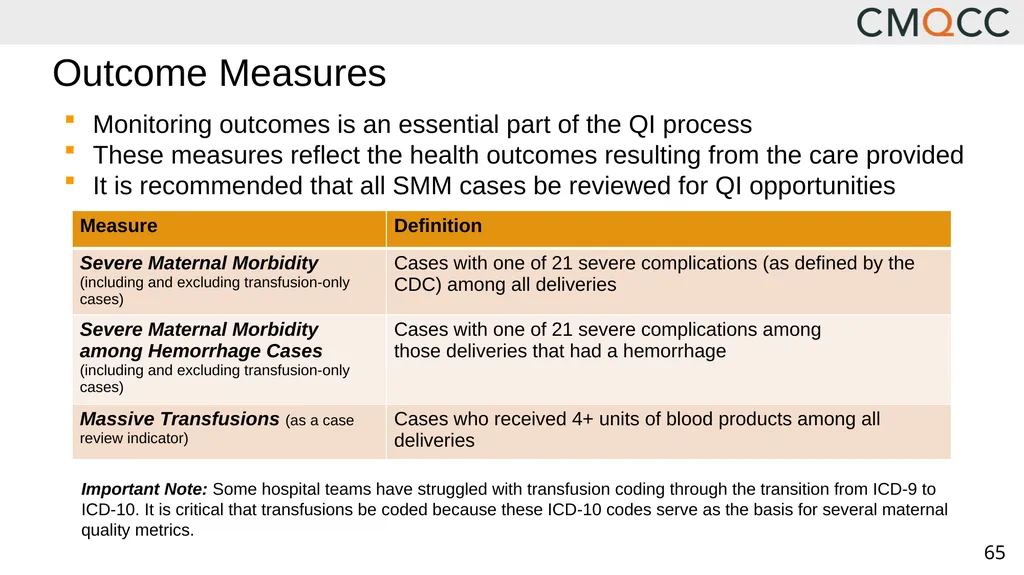
Outcome Measures Monitoring outcomes is an essential part of the QI process
These measures reflect the health outcomes resulting from the care provided
It is recommended that all SMM cases be reviewed for QI opportunities Important Note: Some hospital teams have struggled with transfusion coding through the transition from ICD-9 to ICD-10. It is critical that transfusions be coded because these ICD-10 codes serve as the basis for several maternal quality metrics.<br>
These measures reflect the health outcomes resulting from the care provided
It is recommended that all SMM cases be reviewed for QI opportunities Important Note: Some hospital teams have struggled with transfusion coding through the transition from ICD-9 to ICD-10. It is critical that transfusions be coded because these ICD-10 codes serve as the basis for several maternal quality metrics.<br>
66
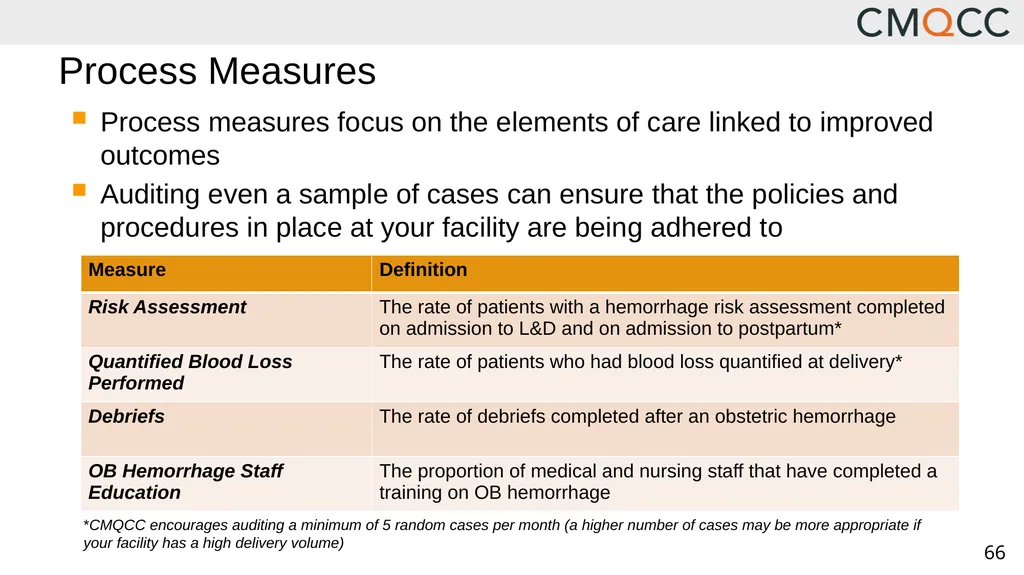
Process Measures Process measures focus on the elements of care linked to improved outcomes
Auditing even a sample of cases can ensure that the policies and procedures in place at your facility are being adhered to *CMQCC encourages auditing a minimum of 5 random cases per month (a higher number of cases may be more appropriate if your facility has a high delivery volume)<br>
Auditing even a sample of cases can ensure that the policies and procedures in place at your facility are being adhered to *CMQCC encourages auditing a minimum of 5 random cases per month (a higher number of cases may be more appropriate if your facility has a high delivery volume)<br>
67
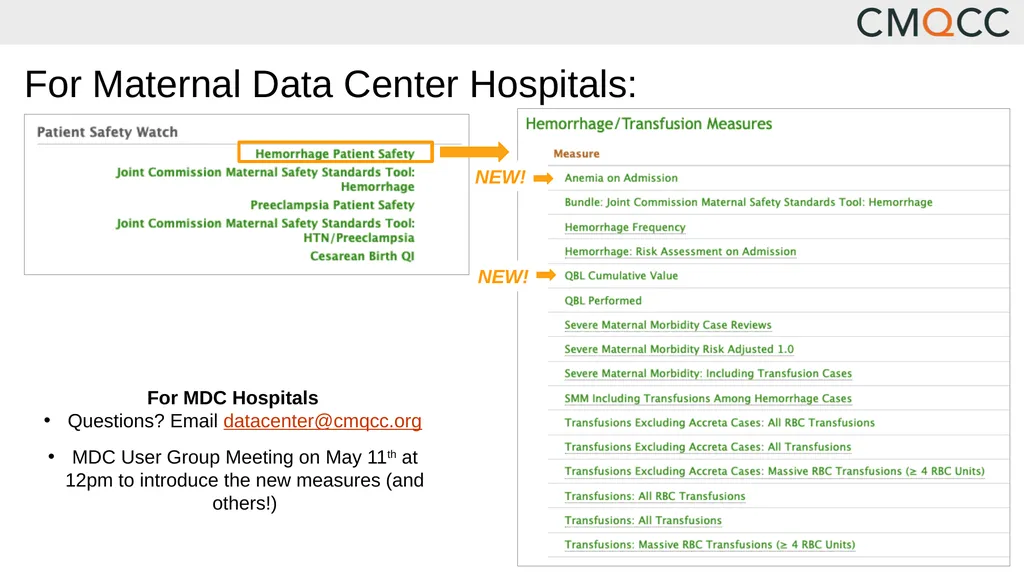
For Maternal Data Center Hospitals: NEW! NEW! For MDC Hospitals
Questions? Email datacenter@cmqcc.org
MDC User Group Meeting on May 11th at 12pm to introduce the new measures (and others!)<br>
Questions? Email datacenter@cmqcc.org
MDC User Group Meeting on May 11th at 12pm to introduce the new measures (and others!)<br>
68
Thank you! For More Information
and to Download the Toolkit www.CMQCC.org/toolkits Contact us:
info@cmqcc.org<br>
and to Download the Toolkit www.CMQCC.org/toolkits Contact us:
info@cmqcc.org<br>
69
Asian American, Native Hawaiian, and Pacific Islander (AANHPI)
Birth Equity Conference May 16th, 2022
ONLINE OR IN-PERSON
FREE TO ATTEND The goal of this conference is to convene researchers, clinicians and community groups to identify issues and generate solutions to disparities in quality of care for AANHPI mothers and babies identified in our data and through lived experience.
Together we hope to enhance mutual awareness and exchange knowledge about improvement in quality of care for all AANHPI mothers and babies through the development of a collaborative learning network.
Conference attendees will:
Exchange knowledge and experiences
Define research and improvement priorities
Engage with community leaders, clinicians, and researchers Scan for more information and registration link Hosted By #aanhpibirthequity REGISTRATION OPEN!<br>
ONLINE OR IN-PERSON
FREE TO ATTEND The goal of this conference is to convene researchers, clinicians and community groups to identify issues and generate solutions to disparities in quality of care for AANHPI mothers and babies identified in our data and through lived experience.
Together we hope to enhance mutual awareness and exchange knowledge about improvement in quality of care for all AANHPI mothers and babies through the development of a collaborative learning network.
Conference attendees will:
Exchange knowledge and experiences
Define research and improvement priorities
Engage with community leaders, clinicians, and researchers Scan for more information and registration link Hosted By #aanhpibirthequity REGISTRATION OPEN!<br>