
IMPROVING OPERATIONAL ACTIVITIES IN FIELD COMMANDS
Description: IMPROVING OPERATIONAL ACTIVITIES IN FIELD COMMANDS INTRODUCTION The FRSC establishment Act, 2007 section 10 provides for the Operational arm of the commission known as the Corps which is saddled with the onerous responsibility of control,
Related Topics
Download Presentation
"IMPROVING OPERATIONAL ACTIVITIES IN FIELD COMMANDS" is the property of its rightful owner. Permission is granted to download and print the materials on this website for personal, non-commercial use only, and to display it on your personal computer provided you do not modify the materials and that you retain all copyright notices contained in the materials. By downloading content from our website, you accept the terms of this agreement.
Presentation Transcript
slide1. IMPROVING OPERATIONAL ACTIVITIES IN FIELD COMMANDS<br>
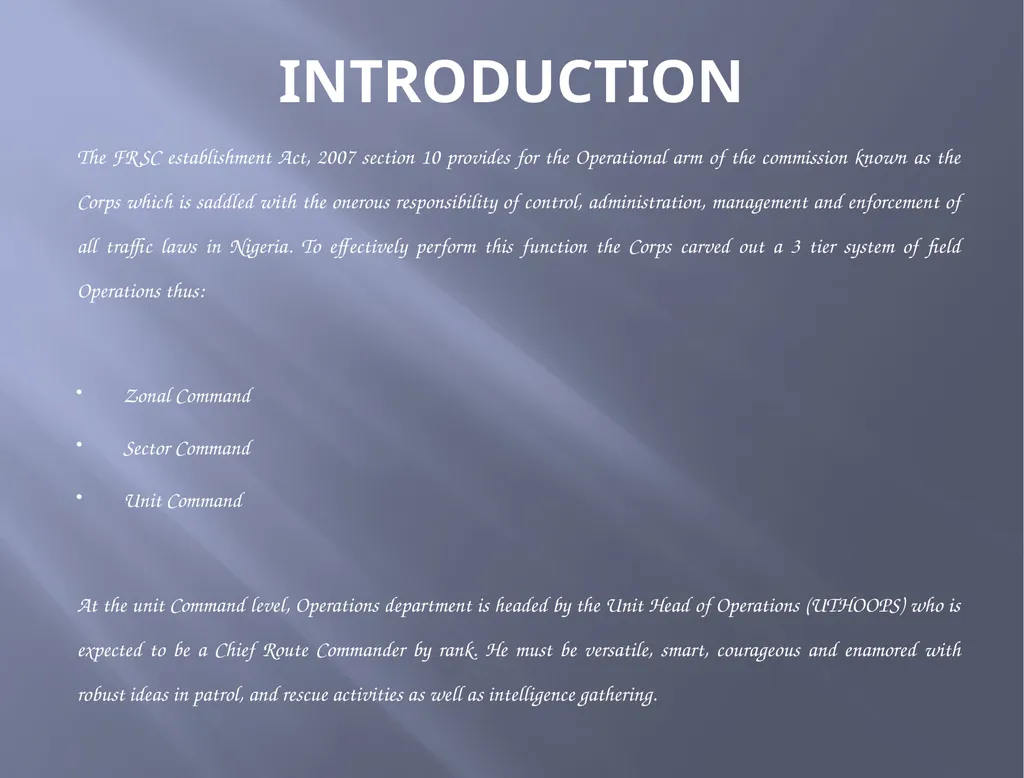
slide2. INTRODUCTION The FRSC establishment Act, 2007 section 10 provides for the Operational arm of the commission known as the Corps which is saddled with the onerous responsibility of control, administration, management and enforcement of all traffic laws in Nigeria. To effectively perform this function the Corps carved out a 3 tier system of field Operations thus:
Zonal Command
Sector Command
Unit Command
At the unit Command level, Operations department is headed by the Unit Head of Operations (UTHOOPS) who is expected to be a Chief Route Commander by rank. He must be versatile, smart, courageous and enamored with robust ideas in patrol, and rescue activities as well as intelligence gathering.<br>
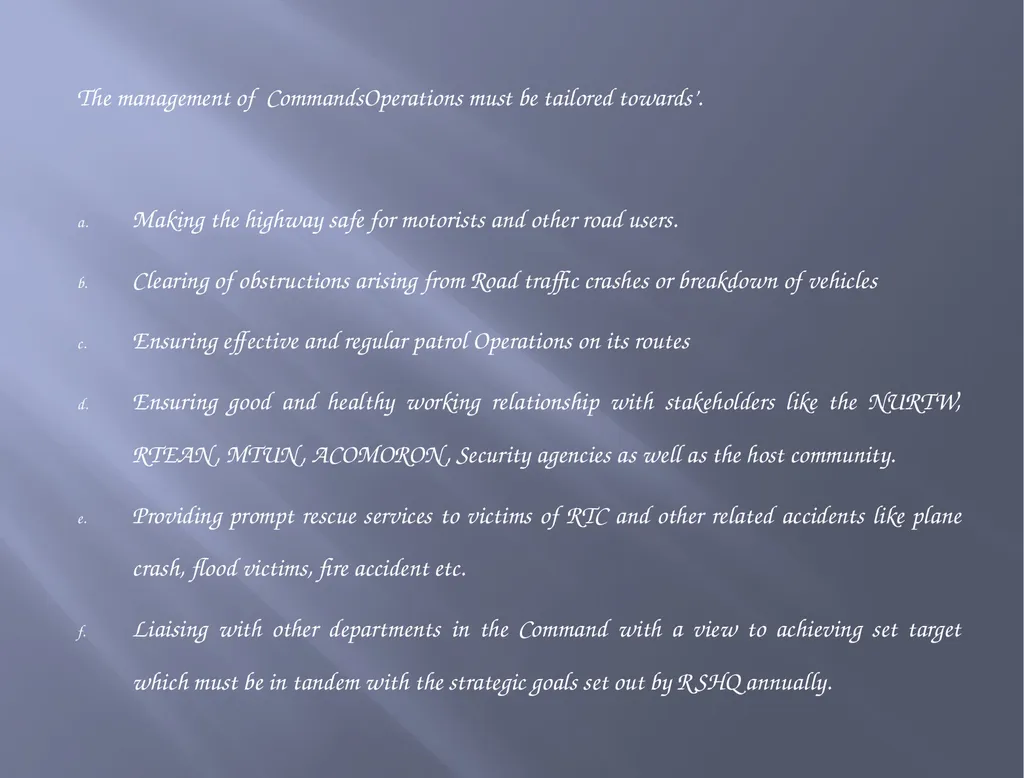
slide3. The management of CommandsOperations must be tailored towards’.
Making the highway safe for motorists and other road users.
Clearing of obstructions arising from Road traffic crashes or breakdown of vehicles
Ensuring effective and regular patrol Operations on its routes
Ensuring good and healthy working relationship with stakeholders like the NURTW, RTEAN, MTUN, ACOMORON, Security agencies as well as the host community.
Providing prompt rescue services to victims of RTC and other related accidents like plane crash, flood victims, fire accident etc.
Liaising with other departments in the Command with a view to achieving set target which must be in tandem with the strategic goals set out by RSHQ annually.<br>
slide4. AIM:
The aim of this lecture is to equip the participants with the requisite tools necessary for optimum performance operationally.
OBJECTIVES:
It is expected that this lecture will help the participants to
Identify the types of Operations.
Enumerate the types of Operational instruments.
Be able to plan an operation.
Be familiar with the mobilization and deployment of human and material resources.
List the steps taken to supervise operational activities at the Unit level.
Be conversant with operational report rendition.<br>
slide5. TYPES OF PATROL OPERATIONS: Patrol Operation is preventive enforcement technique aimed at making road users conform to traffic regulation. This activity involves detection, apprehension sun, adjudication and meting of punishment to any erring road user. Command operation at the Unit therefore is divided into two.
Routine Patrol: This refers to the regular patrol activities carried out by Command operatives on designated routes. It runs on 2 shift basis
Morning: 0600hrs- 1300hrs
Afternoon: 1300hrs- 1800hrs
This type of patrol includes:
Mobile speed control
Static speed control
Surveillance patrol
Rescue mission
Foot team patrol
Metropolitan bike patrol<br>
slide6. Special patrol: This type of patrol is usually carried out to specifically address some lingering or recurring problems, it’s a form of intervention to address or correct certain lapses noted. This type of patrol includes:
Mobile Court patrol
Operation good morning
Night patrol
Free vehicle check
Operation Zero (xmas and new year special patrols)
Eid-el-kabie and eid-el fitri (Sallah special patrol)
Easter special patrol
Independence Anniversary
Special events (ECOWAS Heads of state meeting, sporting activities e t c)<br>
slide7. TYPES OF OPERATIONAL INSTRUMENTS: To effectively manage the operational activities at the unit level the Head of Operations must be conversant with the following operational instruments among others.
National Road traffic regulation 2012
Road maps
Federal Road Safety (est.) Act, 2007
The Nigeria Highway code
The Nigeria constitution
Federal Road Safety regulations on the maintenance of discipline
The Federal Road safety strategic goals
The NRSS document
The DSSP policy
The School Bus document
The National driving school policy
The RTSSS document<br>
slide8. PLANNING OF AN OPERATION: It is often said that he who fails to plan, plans to fail, therefore planning of an operation requires a high degree of meticulousness. It is aimed at clearly spelling out duties and responsibilities of those to be detailed during and after the operations. A Template as designed by RSHQ will suffice.<br>
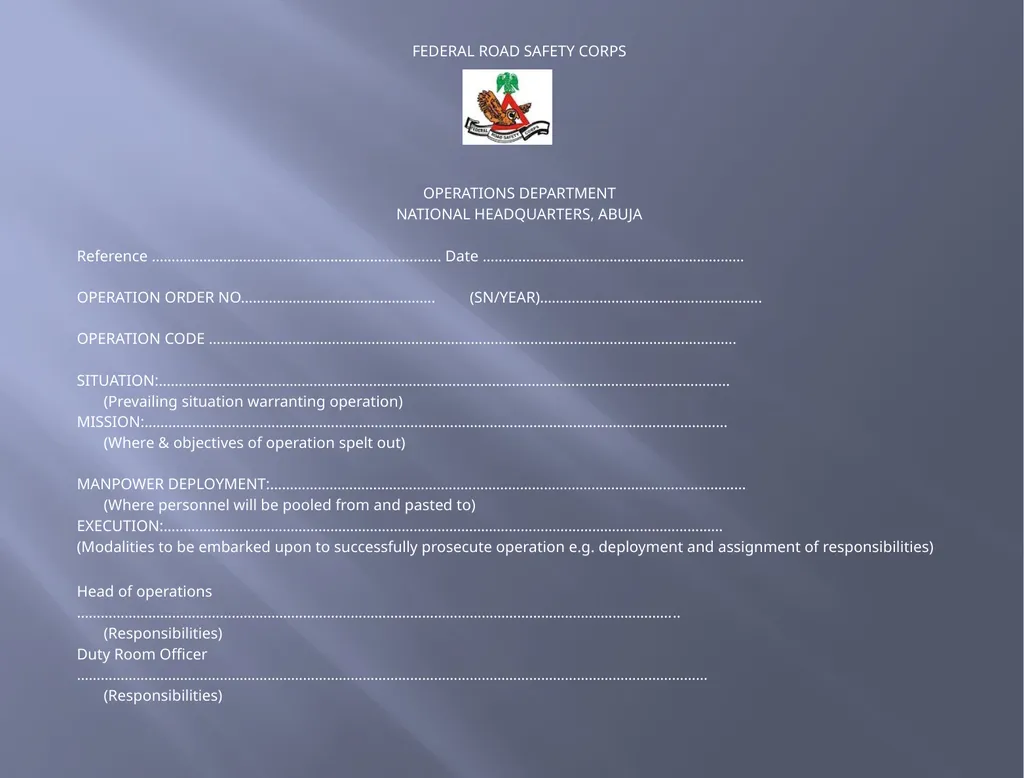
slide9. FEDERAL ROAD SAFETY CORPS
OPERATIONS DEPARTMENT
NATIONAL HEADQUARTERS, ABUJA
Reference ………………………………………………………………. Date …………………………………………………………
OPERATION ORDER NO…………………………………………. (SN/YEAR)………………………………………………..
OPERATION CODE …………………………………………………………………………………………………………………….
SITUATION:………………………………………………………………………………………………………………………………
(Prevailing situation warranting operation)
MISSION:…………………………………………………………………………………………………………………………………
(Where & objectives of operation spelt out)
MANPOWER DEPLOYMENT:…………………………………………………………………………………………………………
(Where personnel will be pooled from and pasted to)
EXECUTION:……………………………………………………………………………………………………………………………
(Modalities to be embarked upon to successfully prosecute operation e.g. deployment and assignment of responsibilities)
Head of operations
……………………………………………………………………………………………………………………………………..
(Responsibilities)
Duty Room Officer
……………………………………………………………………………………………………………………………………………
(Responsibilities)<br>
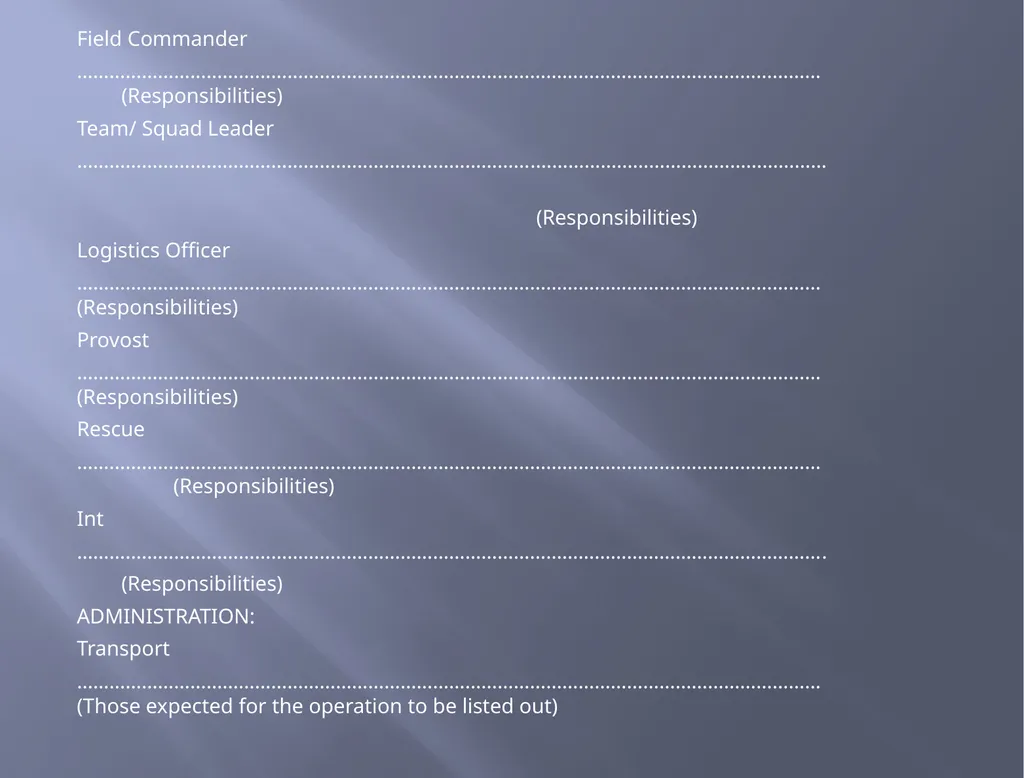
slide10. Field Commander
………………………………………………………………………………………………………………………… (Responsibilities)
Team/ Squad Leader
………………………………………………………………………….………………………………………………
(Responsibilities)
Logistics Officer
………………………………………………………………………………………………………………………… (Responsibilities)
Provost
………………………………………………………………………………………………………………………… (Responsibilities)
Rescue
………………………………………………………………………………………………………………………… (Responsibilities)
Int
………………………………………………………………………………………………………………………….
(Responsibilities)
ADMINISTRATION:
Transport
………………………………………………………………………………………………………………………… (Those expected for the operation to be listed out)<br>
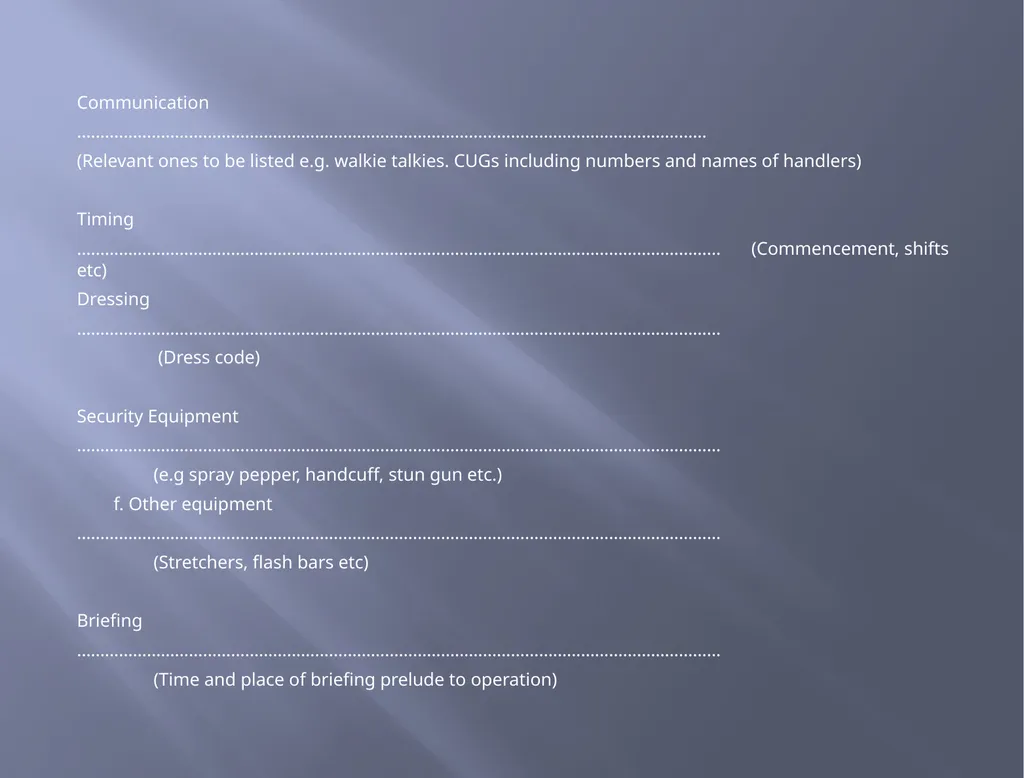
slide11. Communication
………………………………………………………………………………………………………………………
(Relevant ones to be listed e.g. walkie talkies. CUGs including numbers and names of handlers)
Timing
………………………………………………………………………………………………………………………… (Commencement, shifts etc)
Dressing
…………………………………………………………………………………………………………………………
(Dress code)
Security Equipment
…………………………………………………………………………………………………………………………
(e.g spray pepper, handcuff, stun gun etc.)
f. Other equipment
…………………………………………………………………………………………………………………………
(Stretchers, flash bars etc)
Briefing
…………………………………………………………………………………………………………………………
(Time and place of briefing prelude to operation)<br>
slide12. RULES OF ENGAGEMENT Friendly Forces
Military units reroute
The Police
NSCDC
Other system elements reroute
b. Dissidents
Armed Robbers
Saboteurs
Anti FRSC element<br>
slide13. COMMAND & CONTROL
Coordinator
……………………………………………………………………………………………… (Name of coordinator)
Operation Commander
……………………………………………………………………………………………… (Name of supervising Officer for the specific operation)
Grand Commander
………………………………………………………………………………………………
(Usually COMACE or highest Officer within)
Stand down Order
………………………………………………………………………………………………
(Will be at the instance of the Grand Commander)<br>
slide14. MOBILIZATION AND DEPLOYMENT OF HUMAN AND MATERIAL RESOURCES
Operational activity is the pivot of FRSC function, hence a successful operations depends largely on the effort and time put in to ensure adequate mobilization and deployment of human and material resources.
Personnel of every unit Command who are within the patrol bracket are usually engaged in such operations with additional support from adjoining Commands. In addition personnel from the NSCDC, Police, SSS, are also mobilized to beef up the number and provide security backup.
The following items must be made available to ensure smooth and hitch free operations.
Authority devices
Rescue devices
Protective devices
Auxiliary devices
Security devices
Stationeries
Communication devices<br>
slide15. SUPERVISION OF OPERATIONAL ACTIVITIES IN FIELD COMMANDS:
Supervision could be viewed from the perspectives of monitoring and regulating of processes or responsibilities.
A successful operation requires close supervision starting from the level of Unit Commander, UTHOOPS, Staff Ops, field officer down to the intelligence operatives. Therefore the Head of Operations is to ensure that;<br>
slide16. Patrol vehicles are mechanically fit for the operation
Personnel to be deployed are properly briefed and primed for the operation.
Operatives are smartly and neatly dressed with PIN /Name tag affixed.
The safety and security of the patrolmen is paramount.
All the necessary devices are in place and functional
Routine and surprise checks are carried out in the duty room by the UTHOOPS, Unit accountant or the UIO. Aggrieved customers are properly educated and enlightened by the PE, duty room or duty officers.
Report of patrol activities are properly documented in all the registers.
The Commander is adequately briefed on operational activities of the Command.<br>
slide17. METHOD OF SUPERVISION
Surprise checks
Use of informants
Phone calls<br>
slide18. OPERATIONAL REPORT RENDITION
Report rendition is a very critical requirement for assessment of operational activities in FRSC. This subhead is allocated about 20% in the criteria for Command ranking. Report rendition must be timely, precise and accurate with the following characteristics;
Should be based on facts, verifiable information with valid proofs
Clear and easily understandable
Assist in decision making
Result oriented
Well organized and structured
Must follow approved or recommended format.
In FRSC report rendition occupies a prime position and attracts penalty for in accurate, late or non-rendition.<br>
slide19. TYPES OF OPERATIONAL REPORTS: Patrol report
Daily situation report (SITREP)
Weekly executive summary
Special patrol reports
Operation eagle eye
Free safety vehicle check
Operation Zero
Monthly and quarterly reports
Mobile court reports
Patrol officers assessment report
Road traffic crash report<br>
slide20. CONCLUSION: Management of the Command operation is a topic which cannot be exhausted easily, however it must be emphasized that anybody that is assigned this responsibility should as a matter of necessity be one who has the field experience as a patrol operative, intelligent, result oriented officer, a Social worker, a research and above all a good human relations person with great passion for the job.<br>
slide2. INTRODUCTION The FRSC establishment Act, 2007 section 10 provides for the Operational arm of the commission known as the Corps which is saddled with the onerous responsibility of control, administration, management and enforcement of all traffic laws in Nigeria. To effectively perform this function the Corps carved out a 3 tier system of field Operations thus:
Zonal Command
Sector Command
Unit Command
At the unit Command level, Operations department is headed by the Unit Head of Operations (UTHOOPS) who is expected to be a Chief Route Commander by rank. He must be versatile, smart, courageous and enamored with robust ideas in patrol, and rescue activities as well as intelligence gathering.<br>
slide3. The management of CommandsOperations must be tailored towards’.
Making the highway safe for motorists and other road users.
Clearing of obstructions arising from Road traffic crashes or breakdown of vehicles
Ensuring effective and regular patrol Operations on its routes
Ensuring good and healthy working relationship with stakeholders like the NURTW, RTEAN, MTUN, ACOMORON, Security agencies as well as the host community.
Providing prompt rescue services to victims of RTC and other related accidents like plane crash, flood victims, fire accident etc.
Liaising with other departments in the Command with a view to achieving set target which must be in tandem with the strategic goals set out by RSHQ annually.<br>
slide4. AIM:
The aim of this lecture is to equip the participants with the requisite tools necessary for optimum performance operationally.
OBJECTIVES:
It is expected that this lecture will help the participants to
Identify the types of Operations.
Enumerate the types of Operational instruments.
Be able to plan an operation.
Be familiar with the mobilization and deployment of human and material resources.
List the steps taken to supervise operational activities at the Unit level.
Be conversant with operational report rendition.<br>
slide5. TYPES OF PATROL OPERATIONS: Patrol Operation is preventive enforcement technique aimed at making road users conform to traffic regulation. This activity involves detection, apprehension sun, adjudication and meting of punishment to any erring road user. Command operation at the Unit therefore is divided into two.
Routine Patrol: This refers to the regular patrol activities carried out by Command operatives on designated routes. It runs on 2 shift basis
Morning: 0600hrs- 1300hrs
Afternoon: 1300hrs- 1800hrs
This type of patrol includes:
Mobile speed control
Static speed control
Surveillance patrol
Rescue mission
Foot team patrol
Metropolitan bike patrol<br>
slide6. Special patrol: This type of patrol is usually carried out to specifically address some lingering or recurring problems, it’s a form of intervention to address or correct certain lapses noted. This type of patrol includes:
Mobile Court patrol
Operation good morning
Night patrol
Free vehicle check
Operation Zero (xmas and new year special patrols)
Eid-el-kabie and eid-el fitri (Sallah special patrol)
Easter special patrol
Independence Anniversary
Special events (ECOWAS Heads of state meeting, sporting activities e t c)<br>
slide7. TYPES OF OPERATIONAL INSTRUMENTS: To effectively manage the operational activities at the unit level the Head of Operations must be conversant with the following operational instruments among others.
National Road traffic regulation 2012
Road maps
Federal Road Safety (est.) Act, 2007
The Nigeria Highway code
The Nigeria constitution
Federal Road Safety regulations on the maintenance of discipline
The Federal Road safety strategic goals
The NRSS document
The DSSP policy
The School Bus document
The National driving school policy
The RTSSS document<br>
slide8. PLANNING OF AN OPERATION: It is often said that he who fails to plan, plans to fail, therefore planning of an operation requires a high degree of meticulousness. It is aimed at clearly spelling out duties and responsibilities of those to be detailed during and after the operations. A Template as designed by RSHQ will suffice.<br>
slide9. FEDERAL ROAD SAFETY CORPS
OPERATIONS DEPARTMENT
NATIONAL HEADQUARTERS, ABUJA
Reference ………………………………………………………………. Date …………………………………………………………
OPERATION ORDER NO…………………………………………. (SN/YEAR)………………………………………………..
OPERATION CODE …………………………………………………………………………………………………………………….
SITUATION:………………………………………………………………………………………………………………………………
(Prevailing situation warranting operation)
MISSION:…………………………………………………………………………………………………………………………………
(Where & objectives of operation spelt out)
MANPOWER DEPLOYMENT:…………………………………………………………………………………………………………
(Where personnel will be pooled from and pasted to)
EXECUTION:……………………………………………………………………………………………………………………………
(Modalities to be embarked upon to successfully prosecute operation e.g. deployment and assignment of responsibilities)
Head of operations
……………………………………………………………………………………………………………………………………..
(Responsibilities)
Duty Room Officer
……………………………………………………………………………………………………………………………………………
(Responsibilities)<br>
slide10. Field Commander
………………………………………………………………………………………………………………………… (Responsibilities)
Team/ Squad Leader
………………………………………………………………………….………………………………………………
(Responsibilities)
Logistics Officer
………………………………………………………………………………………………………………………… (Responsibilities)
Provost
………………………………………………………………………………………………………………………… (Responsibilities)
Rescue
………………………………………………………………………………………………………………………… (Responsibilities)
Int
………………………………………………………………………………………………………………………….
(Responsibilities)
ADMINISTRATION:
Transport
………………………………………………………………………………………………………………………… (Those expected for the operation to be listed out)<br>
slide11. Communication
………………………………………………………………………………………………………………………
(Relevant ones to be listed e.g. walkie talkies. CUGs including numbers and names of handlers)
Timing
………………………………………………………………………………………………………………………… (Commencement, shifts etc)
Dressing
…………………………………………………………………………………………………………………………
(Dress code)
Security Equipment
…………………………………………………………………………………………………………………………
(e.g spray pepper, handcuff, stun gun etc.)
f. Other equipment
…………………………………………………………………………………………………………………………
(Stretchers, flash bars etc)
Briefing
…………………………………………………………………………………………………………………………
(Time and place of briefing prelude to operation)<br>
slide12. RULES OF ENGAGEMENT Friendly Forces
Military units reroute
The Police
NSCDC
Other system elements reroute
b. Dissidents
Armed Robbers
Saboteurs
Anti FRSC element<br>
slide13. COMMAND & CONTROL
Coordinator
……………………………………………………………………………………………… (Name of coordinator)
Operation Commander
……………………………………………………………………………………………… (Name of supervising Officer for the specific operation)
Grand Commander
………………………………………………………………………………………………
(Usually COMACE or highest Officer within)
Stand down Order
………………………………………………………………………………………………
(Will be at the instance of the Grand Commander)<br>
slide14. MOBILIZATION AND DEPLOYMENT OF HUMAN AND MATERIAL RESOURCES
Operational activity is the pivot of FRSC function, hence a successful operations depends largely on the effort and time put in to ensure adequate mobilization and deployment of human and material resources.
Personnel of every unit Command who are within the patrol bracket are usually engaged in such operations with additional support from adjoining Commands. In addition personnel from the NSCDC, Police, SSS, are also mobilized to beef up the number and provide security backup.
The following items must be made available to ensure smooth and hitch free operations.
Authority devices
Rescue devices
Protective devices
Auxiliary devices
Security devices
Stationeries
Communication devices<br>
slide15. SUPERVISION OF OPERATIONAL ACTIVITIES IN FIELD COMMANDS:
Supervision could be viewed from the perspectives of monitoring and regulating of processes or responsibilities.
A successful operation requires close supervision starting from the level of Unit Commander, UTHOOPS, Staff Ops, field officer down to the intelligence operatives. Therefore the Head of Operations is to ensure that;<br>
slide16. Patrol vehicles are mechanically fit for the operation
Personnel to be deployed are properly briefed and primed for the operation.
Operatives are smartly and neatly dressed with PIN /Name tag affixed.
The safety and security of the patrolmen is paramount.
All the necessary devices are in place and functional
Routine and surprise checks are carried out in the duty room by the UTHOOPS, Unit accountant or the UIO. Aggrieved customers are properly educated and enlightened by the PE, duty room or duty officers.
Report of patrol activities are properly documented in all the registers.
The Commander is adequately briefed on operational activities of the Command.<br>
slide17. METHOD OF SUPERVISION
Surprise checks
Use of informants
Phone calls<br>
slide18. OPERATIONAL REPORT RENDITION
Report rendition is a very critical requirement for assessment of operational activities in FRSC. This subhead is allocated about 20% in the criteria for Command ranking. Report rendition must be timely, precise and accurate with the following characteristics;
Should be based on facts, verifiable information with valid proofs
Clear and easily understandable
Assist in decision making
Result oriented
Well organized and structured
Must follow approved or recommended format.
In FRSC report rendition occupies a prime position and attracts penalty for in accurate, late or non-rendition.<br>
slide19. TYPES OF OPERATIONAL REPORTS: Patrol report
Daily situation report (SITREP)
Weekly executive summary
Special patrol reports
Operation eagle eye
Free safety vehicle check
Operation Zero
Monthly and quarterly reports
Mobile court reports
Patrol officers assessment report
Road traffic crash report<br>
slide20. CONCLUSION: Management of the Command operation is a topic which cannot be exhausted easily, however it must be emphasized that anybody that is assigned this responsibility should as a matter of necessity be one who has the field experience as a patrol operative, intelligent, result oriented officer, a Social worker, a research and above all a good human relations person with great passion for the job.<br>