
Improving the Reporting and Reward for Risk Some
Description: Improving the Reporting and Reward for Risk Some less enlightened attitudes to risk and insurance: Some Principles for Establishing KPIs Define what is important to your organisation, your boss, and your function. Link your KPIs to the core
Related Topics
Download Presentation
"Improving the Reporting and Reward for Risk Some" is the property of its rightful owner. Permission is granted to download and print the materials on this website for personal, non-commercial use only, and to display it on your personal computer provided you do not modify the materials and that you retain all copyright notices contained in the materials. By downloading content from our website, you accept the terms of this agreement.
Presentation Transcript
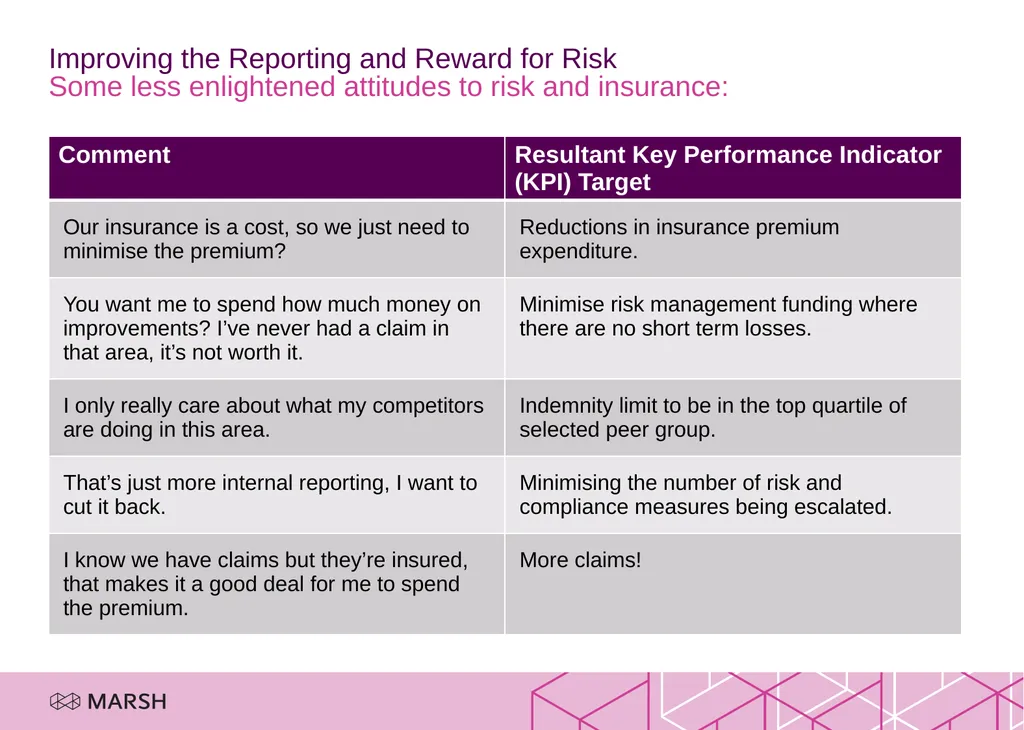
slide2. Improving the Reporting and Reward for Risk
Some less enlightened attitudes to risk and insurance:<br>
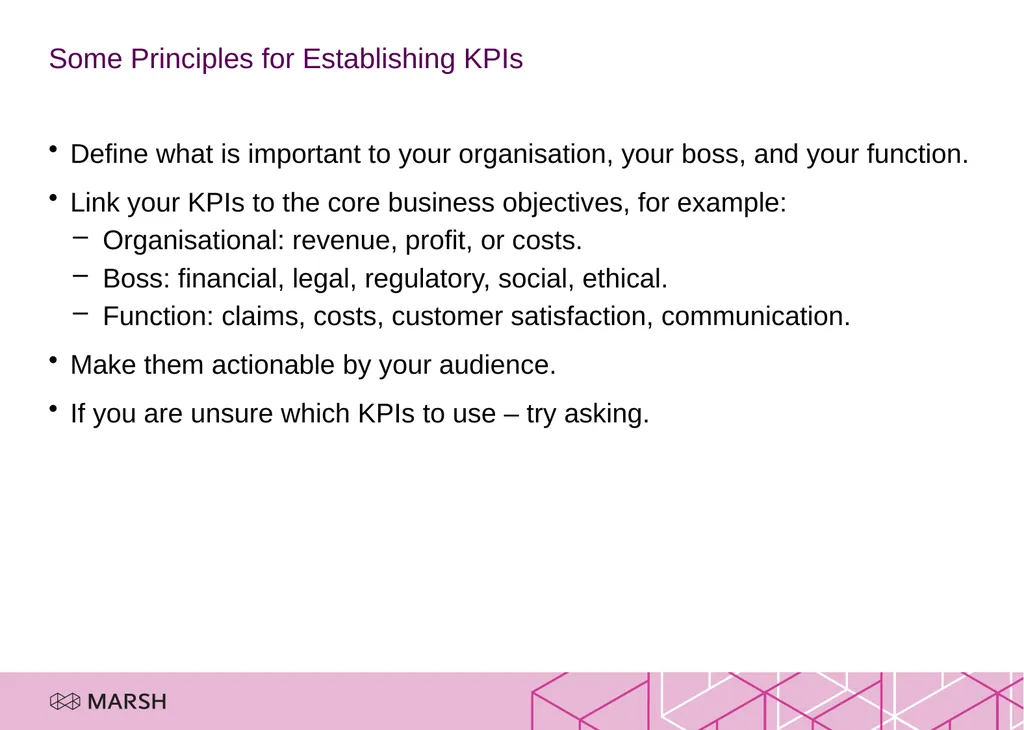
slide3. Some Principles for Establishing KPIs Define what is important to your organisation, your boss, and your function.
Link your KPIs to the core business objectives, for example:
Organisational: revenue, profit, or costs.
Boss: financial, legal, regulatory, social, ethical.
Function: claims, costs, customer satisfaction, communication.
Make them actionable by your audience.
If you are unsure which KPIs to use – try asking.<br>
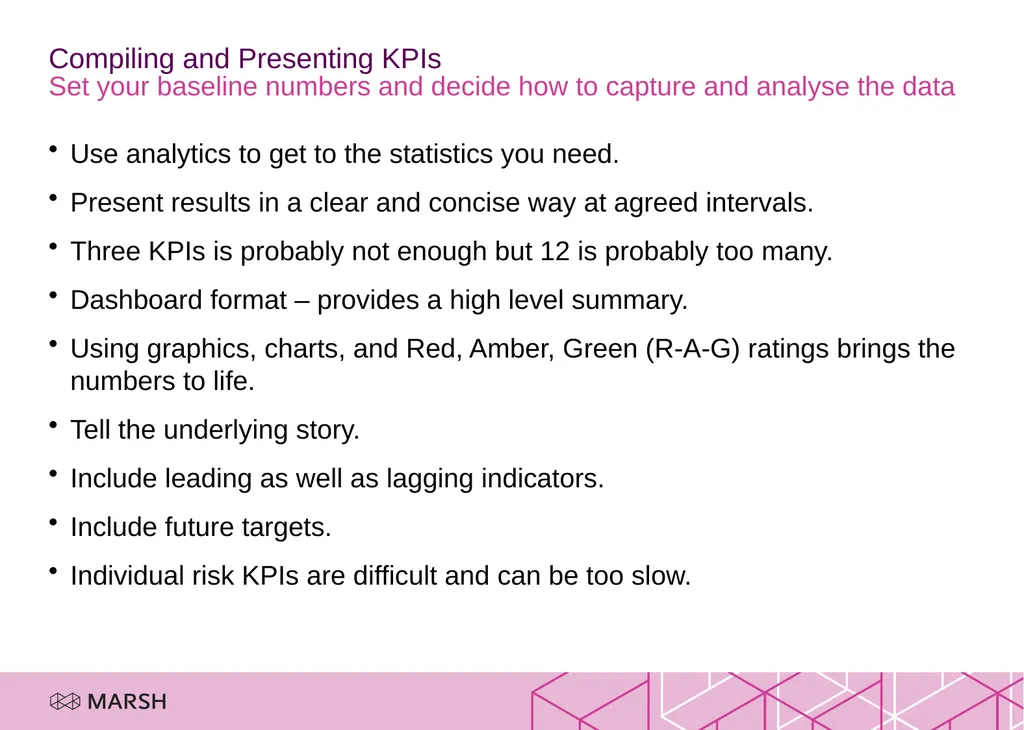
slide4. Compiling and Presenting KPIs Set your baseline numbers and decide how to capture and analyse the data Use analytics to get to the statistics you need.
Present results in a clear and concise way at agreed intervals.
Three KPIs is probably not enough but 12 is probably too many.
Dashboard format – provides a high level summary.
Using graphics, charts, and Red, Amber, Green (R-A-G) ratings brings the numbers to life.
Tell the underlying story.
Include leading as well as lagging indicators.
Include future targets.
Individual risk KPIs are difficult and can be too slow.<br>
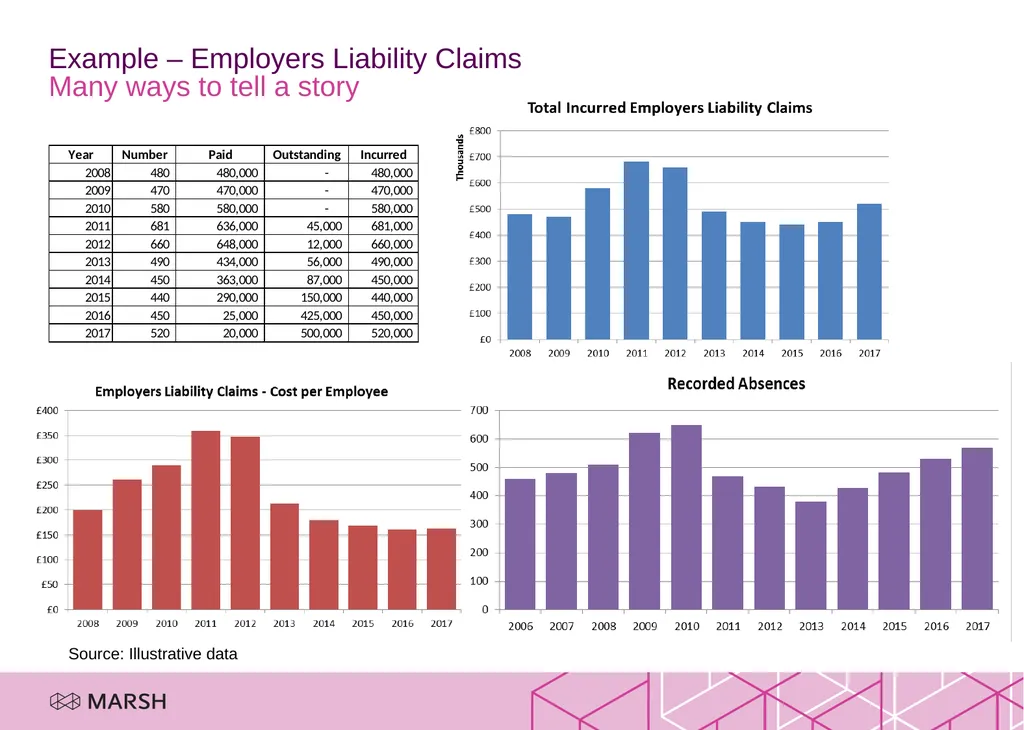
slide5. Example – Employers Liability Claims Many ways to tell a story Source: Illustrative data<br>
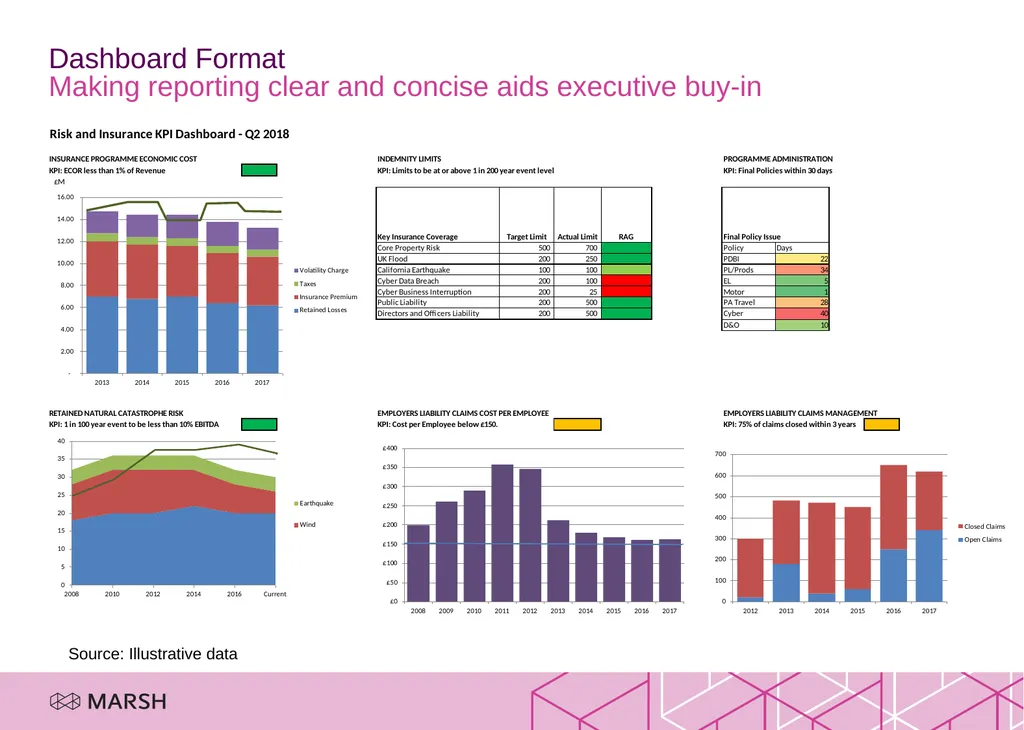
slide6. Dashboard Format Making reporting clear and concise aids executive buy-in Source: Illustrative data<br>
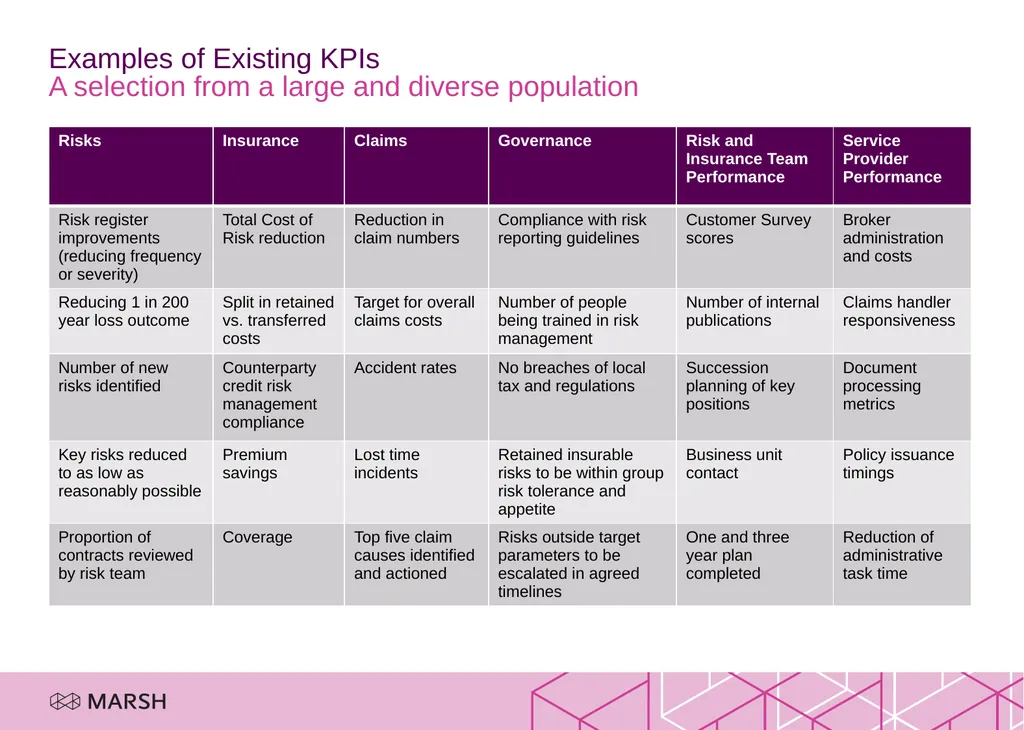
slide7. Examples of Existing KPIs A selection from a large and diverse population<br>
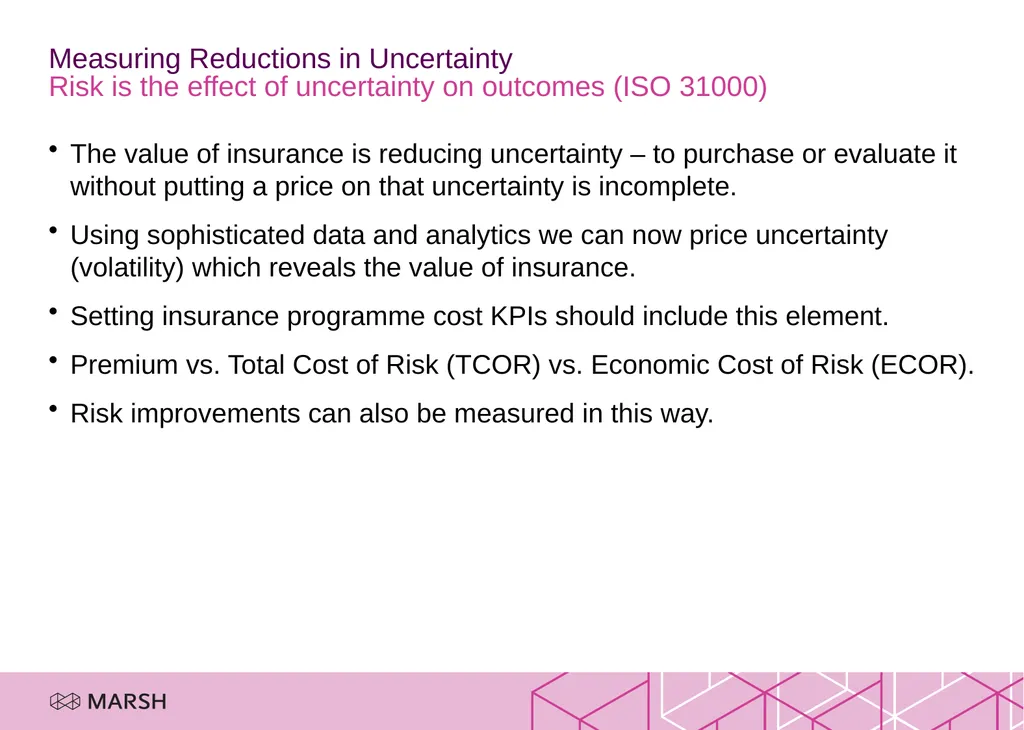
slide8. Measuring Reductions in Uncertainty Risk is the effect of uncertainty on outcomes (ISO 31000) The value of insurance is reducing uncertainty – to purchase or evaluate it without putting a price on that uncertainty is incomplete.
Using sophisticated data and analytics we can now price uncertainty (volatility) which reveals the value of insurance.
Setting insurance programme cost KPIs should include this element.
Premium vs. Total Cost of Risk (TCOR) vs. Economic Cost of Risk (ECOR).
Risk improvements can also be measured in this way.<br>
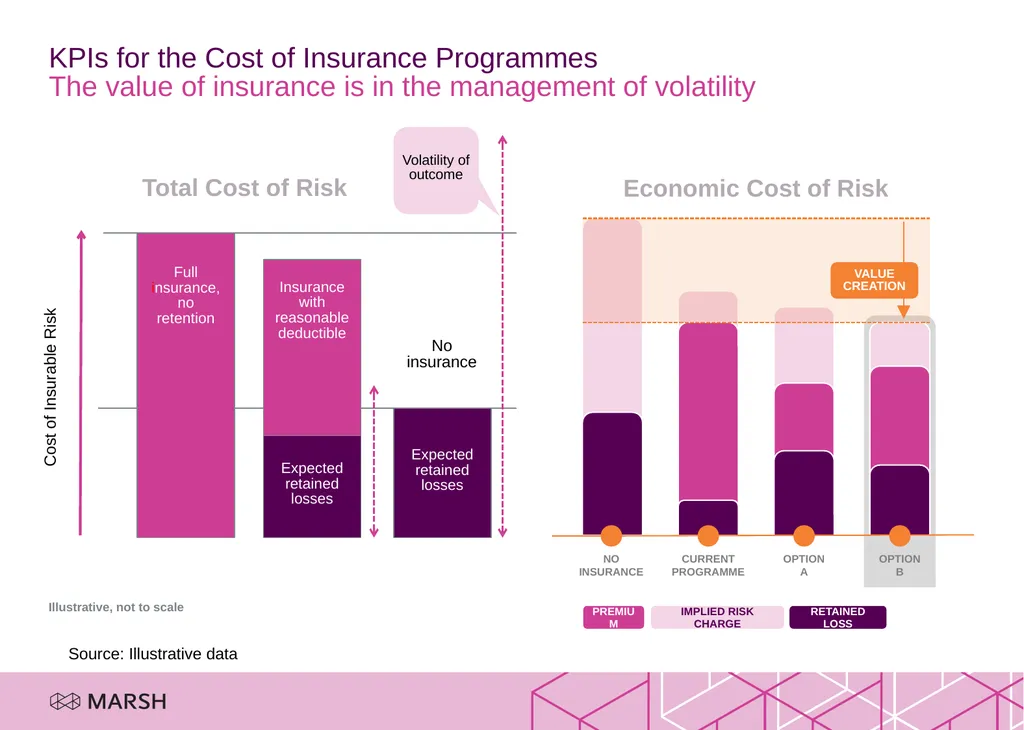
slide9. KPIs for the Cost of Insurance Programmes The value of insurance is in the management of volatility Source: Illustrative data<br>
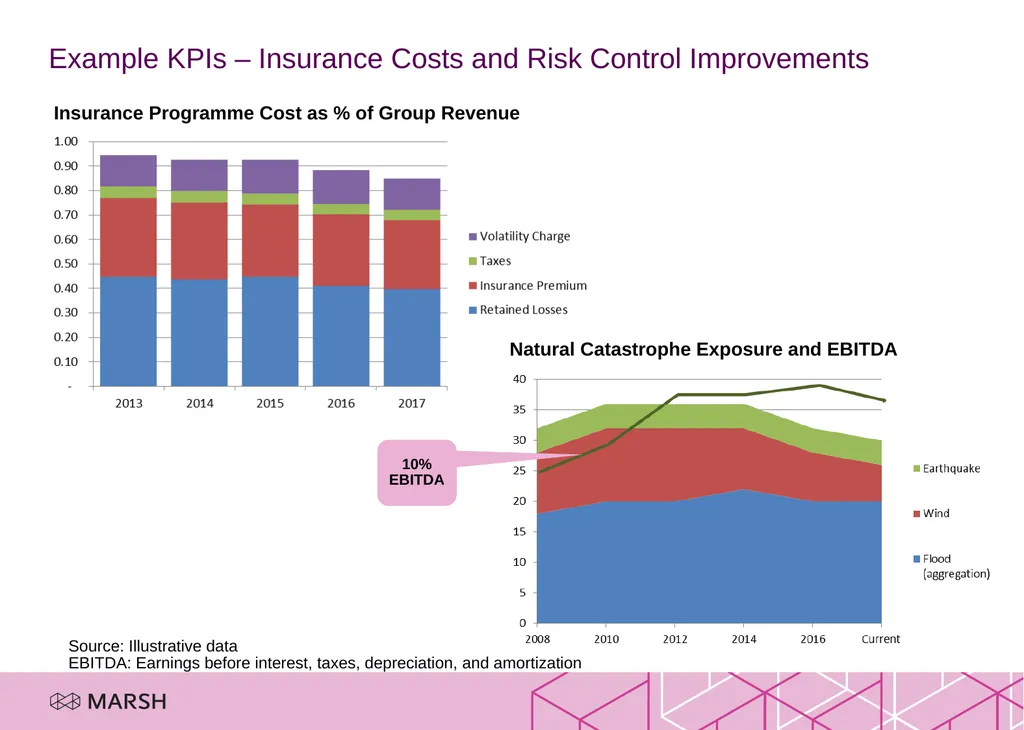
slide10. Example KPIs – Insurance Costs and Risk Control Improvements Insurance Programme Cost as % of Group Revenue Source: Illustrative data
EBITDA: Earnings before interest, taxes, depreciation, and amortization<br>
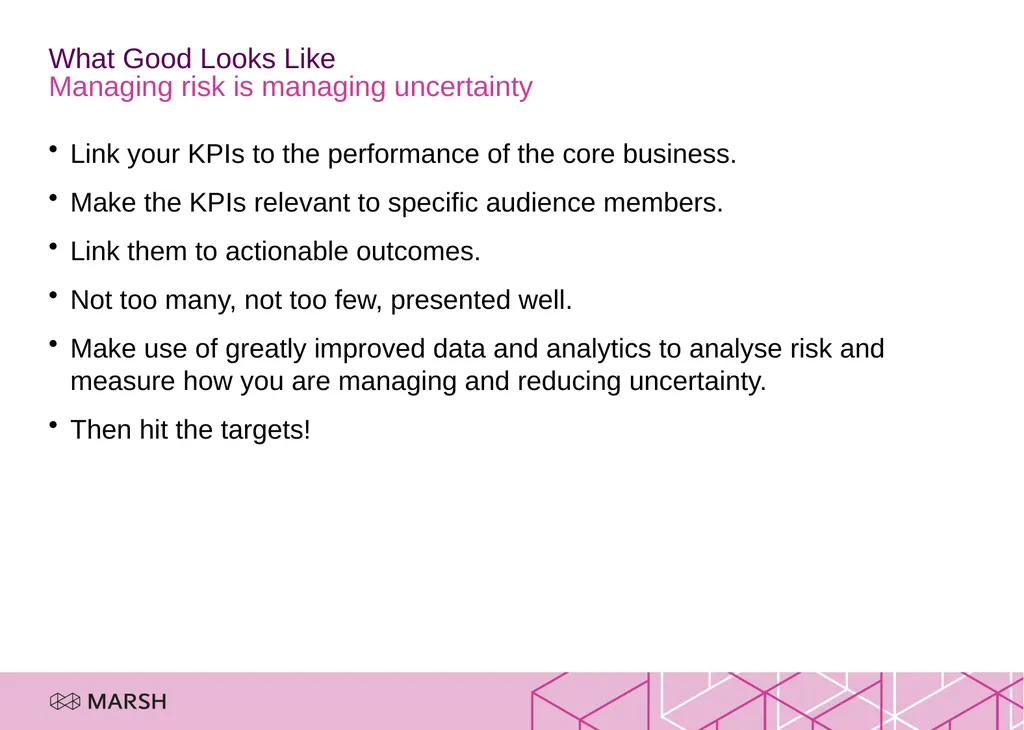
slide11. What Good Looks Like Managing risk is managing uncertainty Link your KPIs to the performance of the core business.
Make the KPIs relevant to specific audience members.
Link them to actionable outcomes.
Not too many, not too few, presented well.
Make use of greatly improved data and analytics to analyse risk and measure how you are managing and reducing uncertainty.
Then hit the targets!<br>
slide3. Some Principles for Establishing KPIs Define what is important to your organisation, your boss, and your function.
Link your KPIs to the core business objectives, for example:
Organisational: revenue, profit, or costs.
Boss: financial, legal, regulatory, social, ethical.
Function: claims, costs, customer satisfaction, communication.
Make them actionable by your audience.
If you are unsure which KPIs to use – try asking.<br>
slide4. Compiling and Presenting KPIs Set your baseline numbers and decide how to capture and analyse the data Use analytics to get to the statistics you need.
Present results in a clear and concise way at agreed intervals.
Three KPIs is probably not enough but 12 is probably too many.
Dashboard format – provides a high level summary.
Using graphics, charts, and Red, Amber, Green (R-A-G) ratings brings the numbers to life.
Tell the underlying story.
Include leading as well as lagging indicators.
Include future targets.
Individual risk KPIs are difficult and can be too slow.<br>
slide5. Example – Employers Liability Claims Many ways to tell a story Source: Illustrative data<br>
slide6. Dashboard Format Making reporting clear and concise aids executive buy-in Source: Illustrative data<br>
slide7. Examples of Existing KPIs A selection from a large and diverse population<br>
slide8. Measuring Reductions in Uncertainty Risk is the effect of uncertainty on outcomes (ISO 31000) The value of insurance is reducing uncertainty – to purchase or evaluate it without putting a price on that uncertainty is incomplete.
Using sophisticated data and analytics we can now price uncertainty (volatility) which reveals the value of insurance.
Setting insurance programme cost KPIs should include this element.
Premium vs. Total Cost of Risk (TCOR) vs. Economic Cost of Risk (ECOR).
Risk improvements can also be measured in this way.<br>
slide9. KPIs for the Cost of Insurance Programmes The value of insurance is in the management of volatility Source: Illustrative data<br>
slide10. Example KPIs – Insurance Costs and Risk Control Improvements Insurance Programme Cost as % of Group Revenue Source: Illustrative data
EBITDA: Earnings before interest, taxes, depreciation, and amortization<br>
slide11. What Good Looks Like Managing risk is managing uncertainty Link your KPIs to the performance of the core business.
Make the KPIs relevant to specific audience members.
Link them to actionable outcomes.
Not too many, not too few, presented well.
Make use of greatly improved data and analytics to analyse risk and measure how you are managing and reducing uncertainty.
Then hit the targets!<br>