
Inclusion, Wellbeing and Equalities Framework –
SN
Published · 28 slides · 0 views
1 / 1

Description
Inclusion, Wellbeing and Equalities Framework Rights and Equalities Develop Your Religious Literacy Part 2 Level Informed For Scotlands learners, with Scotlands educators Do luchd-ionnsachaidh na h-Alba, le luchd-foghlaim Alba
Related Topics
Share
Embed code
Download this presentation From Below
"Inclusion, Wellbeing and Equalities Framework –" is the property of its rightful owner. Permission is granted to download and print the materials on this website for personal, non-commercial use only, and to display it on your personal computer provided you do not modify the materials and that you retain all copyright notices contained in the materials. By downloading content from our website, you accept the terms of this agreement.
Presentation Transcript
01
Inclusion, Wellbeing and Equalities Framework – Rights and Equalities
Develop Your Religious Literacy Part 2 Level – Informed For Scotland's learners, with Scotland's educators
Do luchd-ionnsachaidh na h-Alba, le luchd-foghlaim Alba @ESInclusionTeam<br>
Develop Your Religious Literacy Part 2 Level – Informed For Scotland's learners, with Scotland's educators
Do luchd-ionnsachaidh na h-Alba, le luchd-foghlaim Alba @ESInclusionTeam<br>
02
Pause for Thought… How to use this resource These slides can be used to facilitate professional learning in a group or whole-setting, or as a self-directed learning activity as an individual.
Facilitation notes are included at the bottom of each slide
Please do not remove or change any of the slides included.
Facilitators are welcome to add slides or activities relevant to your own setting, to support discussion and exploration of the topic. Facilitators will know their participants’ needs best.
Anyone who works in an educational setting can be a facilitator and use these slides.
For reflection or discussion activities, it is important to establish a safe space which encourages respect and honesty to ensure that everyone is able to participate.<br>
Facilitation notes are included at the bottom of each slide
Please do not remove or change any of the slides included.
Facilitators are welcome to add slides or activities relevant to your own setting, to support discussion and exploration of the topic. Facilitators will know their participants’ needs best.
Anyone who works in an educational setting can be a facilitator and use these slides.
For reflection or discussion activities, it is important to establish a safe space which encourages respect and honesty to ensure that everyone is able to participate.<br>
03
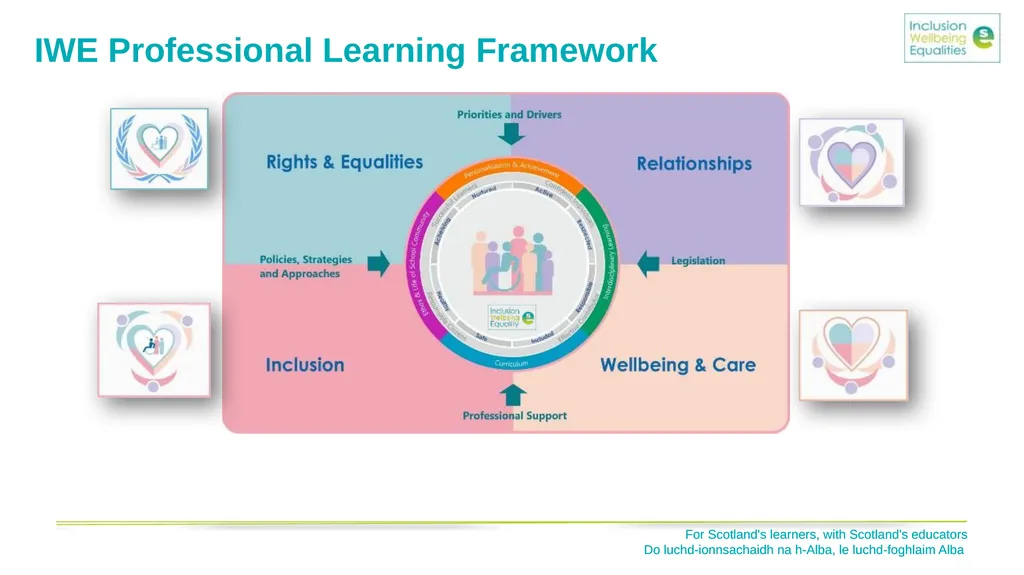
IWE Professional Learning Framework<br>
04
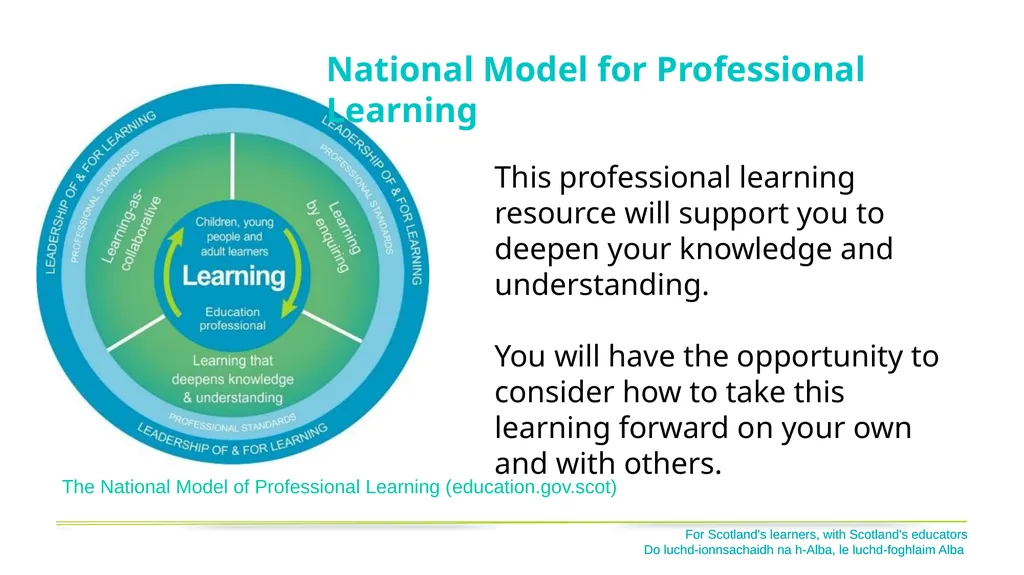
The National Model of Professional Learning (education.gov.scot) This professional learning resource will support you to deepen your knowledge and understanding.
You will have the opportunity to consider how to take this learning forward on your own and with others. National Model for Professional Learning<br>
You will have the opportunity to consider how to take this learning forward on your own and with others. National Model for Professional Learning<br>
05
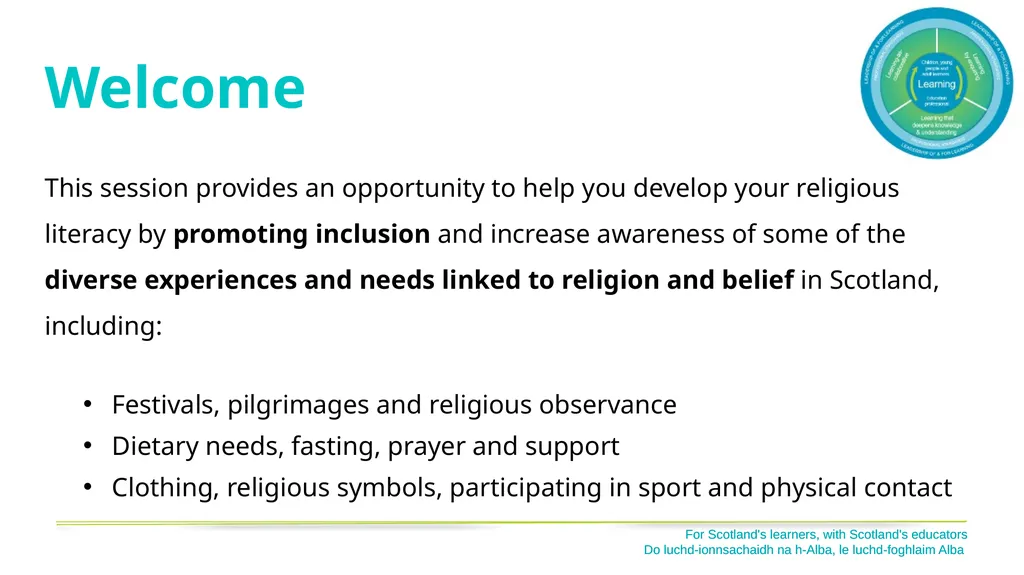
Pause for Thought… Welcome This session provides an opportunity to help you develop your religious literacy by promoting inclusion and increase awareness of some of the diverse experiences and needs linked to religion and belief in Scotland, including:
Festivals, pilgrimages and religious observance
Dietary needs, fasting, prayer and support
Clothing, religious symbols, participating in sport and physical contact<br>
Festivals, pilgrimages and religious observance
Dietary needs, fasting, prayer and support
Clothing, religious symbols, participating in sport and physical contact<br>
06
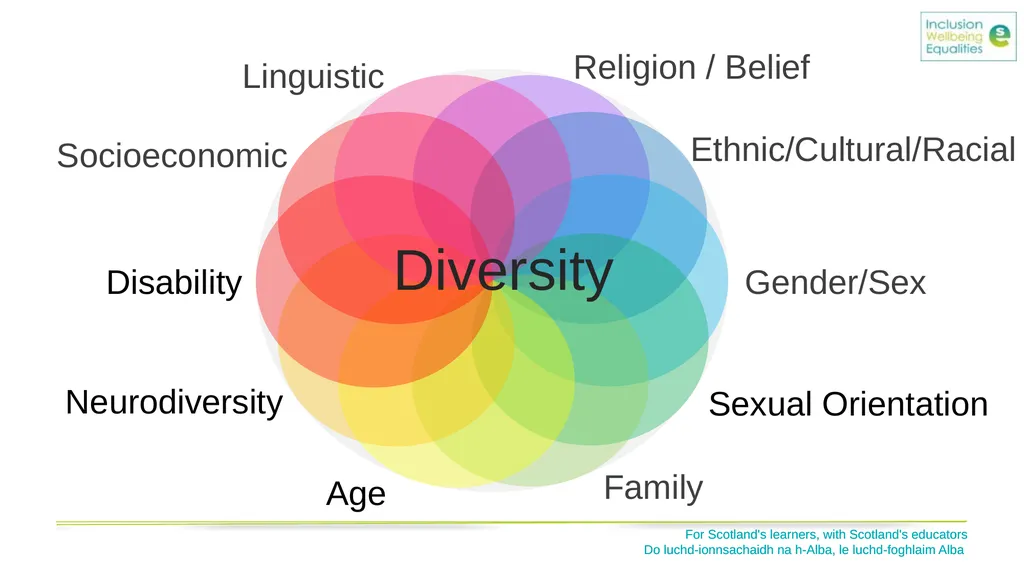
Pause for Thought… Disability Socioeconomic Linguistic Religion / Belief Gender/Sex Ethnic/Cultural/Racial Sexual Orientation Family Age Neurodiversity Diversity<br>
07
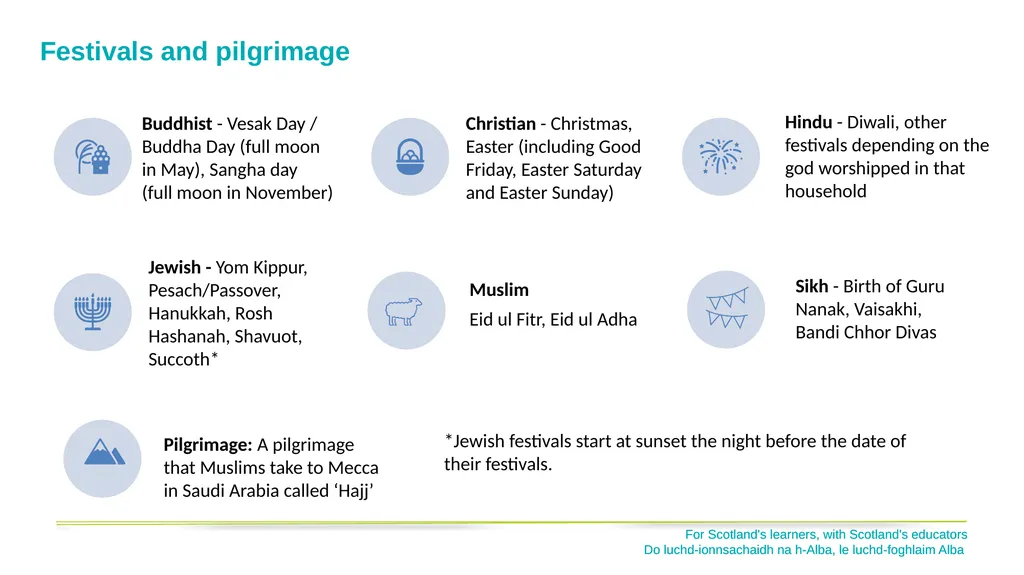
Festivals and pilgrimage *Jewish festivals start at sunset the night before the date of their festivals.<br>
08
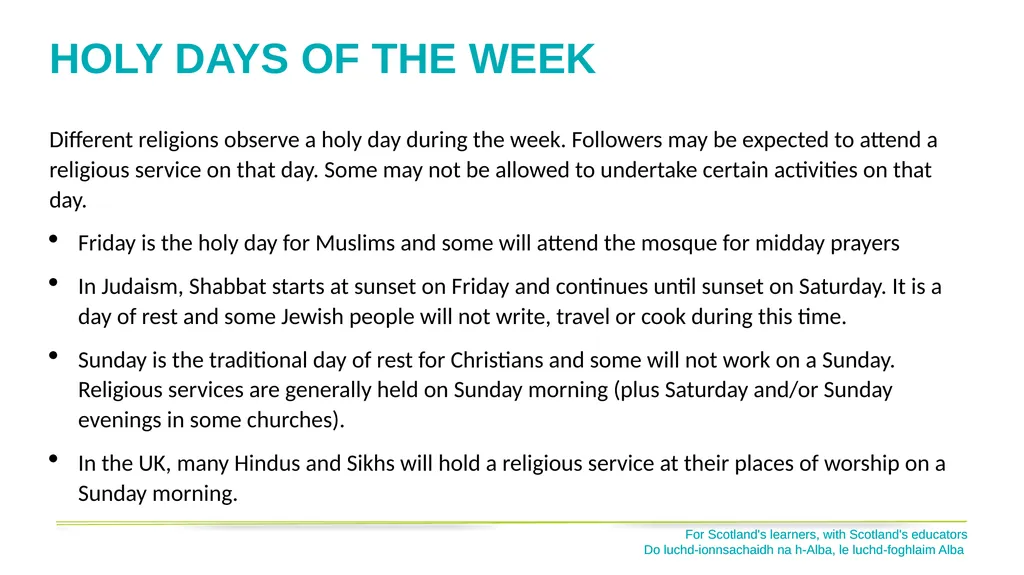
Holy days of the week Different religions observe a holy day during the week. Followers may be expected to attend a religious service on that day. Some may not be allowed to undertake certain activities on that day.
Friday is the holy day for Muslims and some will attend the mosque for midday prayers
In Judaism, Shabbat starts at sunset on Friday and continues until sunset on Saturday. It is a day of rest and some Jewish people will not write, travel or cook during this time.
Sunday is the traditional day of rest for Christians and some will not work on a Sunday. Religious services are generally held on Sunday morning (plus Saturday and/or Sunday evenings in some churches).
In the UK, many Hindus and Sikhs will hold a religious service at their places of worship on a Sunday morning.<br>
Friday is the holy day for Muslims and some will attend the mosque for midday prayers
In Judaism, Shabbat starts at sunset on Friday and continues until sunset on Saturday. It is a day of rest and some Jewish people will not write, travel or cook during this time.
Sunday is the traditional day of rest for Christians and some will not work on a Sunday. Religious services are generally held on Sunday morning (plus Saturday and/or Sunday evenings in some churches).
In the UK, many Hindus and Sikhs will hold a religious service at their places of worship on a Sunday morning.<br>
09
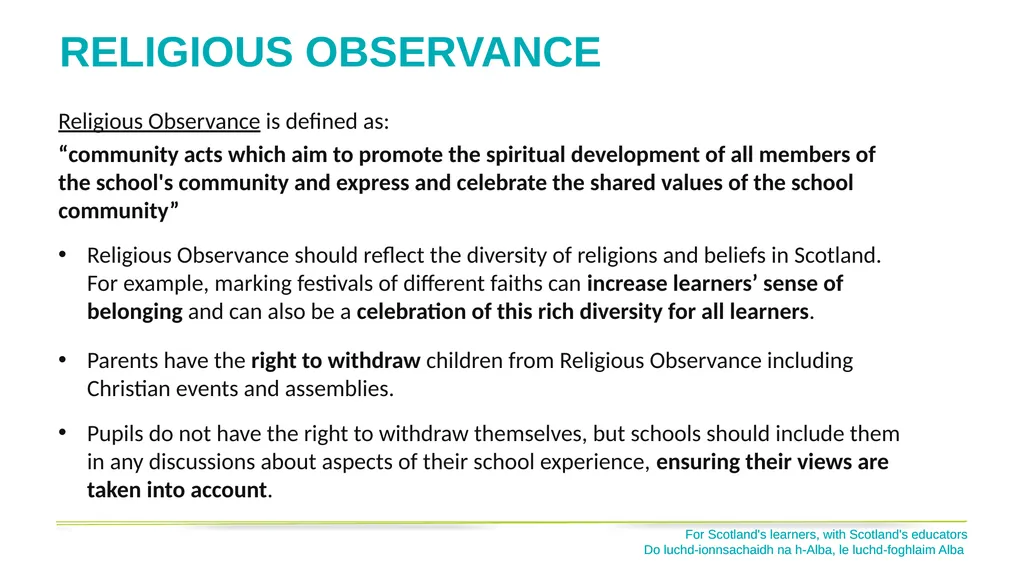
Religious observance Religious Observance is defined as:
“community acts which aim to promote the spiritual development of all members of the school's community and express and celebrate the shared values of the school community”
Religious Observance should reflect the diversity of religions and beliefs in Scotland. For example, marking festivals of different faiths can increase learners’ sense of belonging and can also be a celebration of this rich diversity for all learners.
Parents have the right to withdraw children from Religious Observance including Christian events and assemblies.
Pupils do not have the right to withdraw themselves, but schools should include them in any discussions about aspects of their school experience, ensuring their views are taken into account.<br>
“community acts which aim to promote the spiritual development of all members of the school's community and express and celebrate the shared values of the school community”
Religious Observance should reflect the diversity of religions and beliefs in Scotland. For example, marking festivals of different faiths can increase learners’ sense of belonging and can also be a celebration of this rich diversity for all learners.
Parents have the right to withdraw children from Religious Observance including Christian events and assemblies.
Pupils do not have the right to withdraw themselves, but schools should include them in any discussions about aspects of their school experience, ensuring their views are taken into account.<br>
10
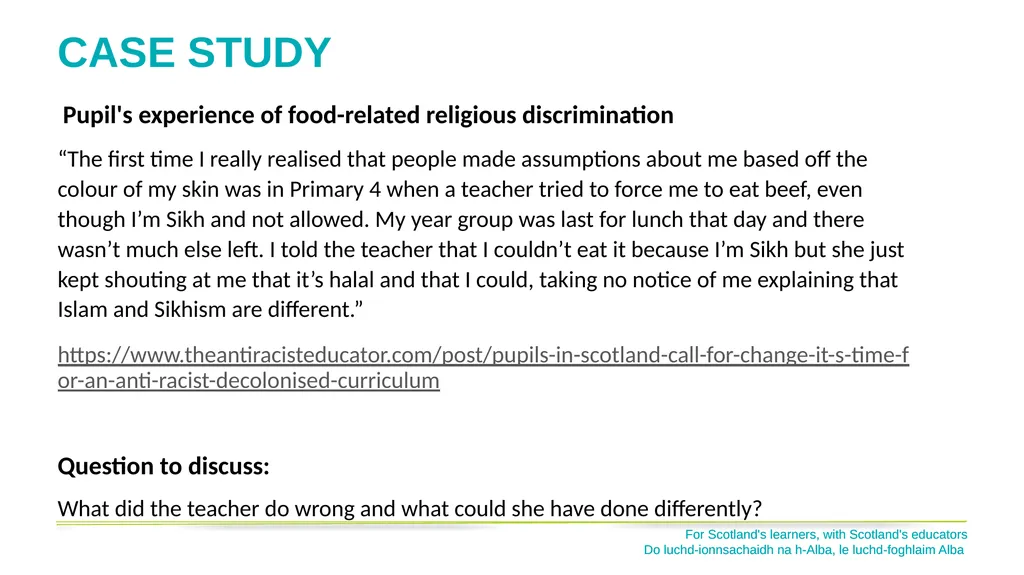
Case study Pupil's experience of food-related religious discrimination
“The first time I really realised that people made assumptions about me based off the colour of my skin was in Primary 4 when a teacher tried to force me to eat beef, even though I’m Sikh and not allowed. My year group was last for lunch that day and there wasn’t much else left. I told the teacher that I couldn’t eat it because I’m Sikh but she just kept shouting at me that it’s halal and that I could, taking no notice of me explaining that Islam and Sikhism are different.”
https://www.theantiracisteducator.com/post/pupils-in-scotland-call-for-change-it-s-time-for-an-anti-racist-decolonised-curriculum
Question to discuss:
What did the teacher do wrong and what could she have done differently?<br>
“The first time I really realised that people made assumptions about me based off the colour of my skin was in Primary 4 when a teacher tried to force me to eat beef, even though I’m Sikh and not allowed. My year group was last for lunch that day and there wasn’t much else left. I told the teacher that I couldn’t eat it because I’m Sikh but she just kept shouting at me that it’s halal and that I could, taking no notice of me explaining that Islam and Sikhism are different.”
https://www.theantiracisteducator.com/post/pupils-in-scotland-call-for-change-it-s-time-for-an-anti-racist-decolonised-curriculum
Question to discuss:
What did the teacher do wrong and what could she have done differently?<br>
11
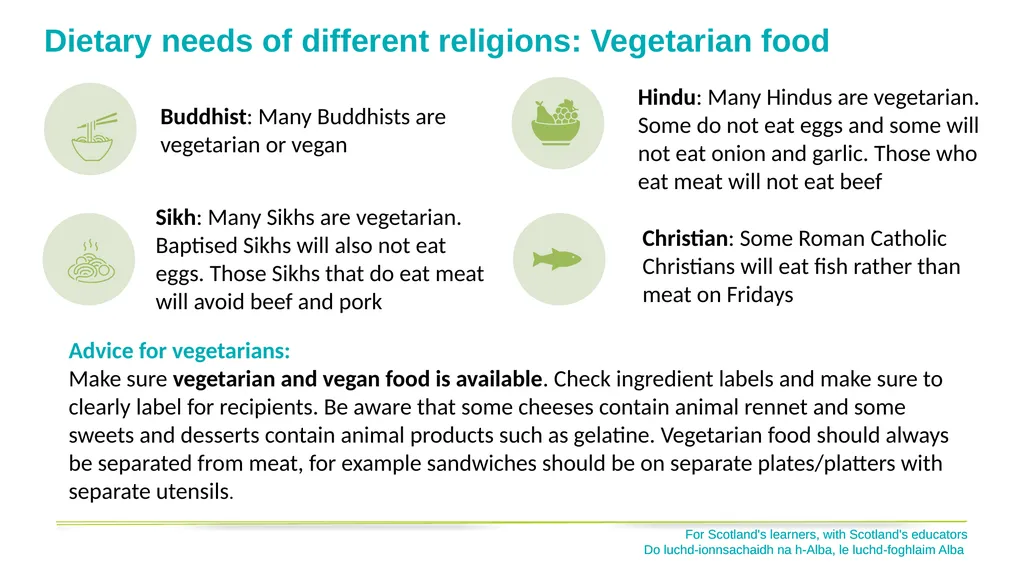
Dietary needs of different religions: Vegetarian food Advice for vegetarians:
Make sure vegetarian and vegan food is available. Check ingredient labels and make sure to clearly label for recipients. Be aware that some cheeses contain animal rennet and some sweets and desserts contain animal products such as gelatine. Vegetarian food should always be separated from meat, for example sandwiches should be on separate plates/platters with separate utensils.<br>
Make sure vegetarian and vegan food is available. Check ingredient labels and make sure to clearly label for recipients. Be aware that some cheeses contain animal rennet and some sweets and desserts contain animal products such as gelatine. Vegetarian food should always be separated from meat, for example sandwiches should be on separate plates/platters with separate utensils.<br>
12
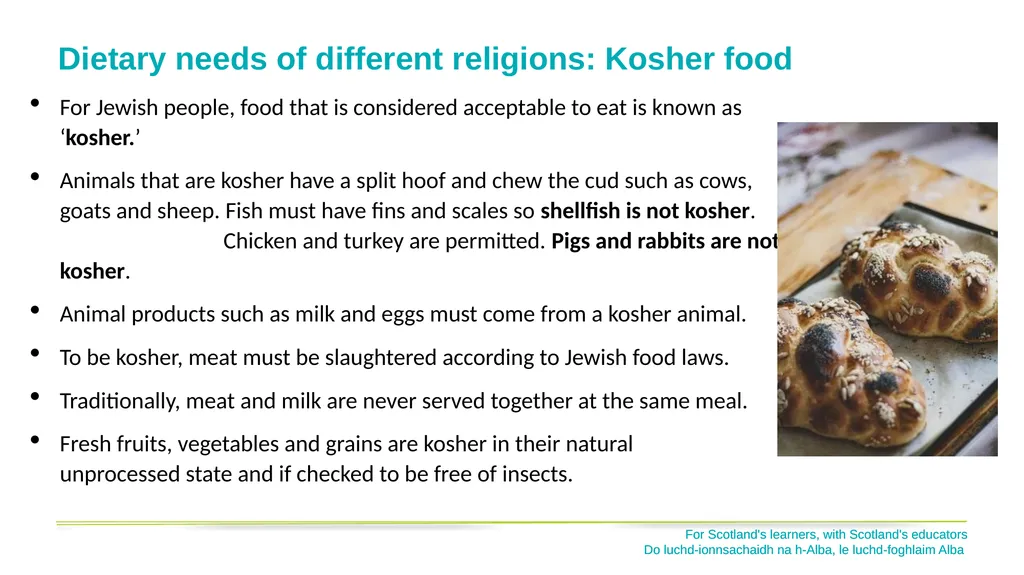
Dietary needs of different religions: Kosher food For Jewish people, food that is considered acceptable to eat is known as ‘kosher.’
Animals that are kosher have a split hoof and chew the cud such as cows, goats and sheep. Fish must have fins and scales so shellfish is not kosher. Chicken and turkey are permitted. Pigs and rabbits are not kosher.
Animal products such as milk and eggs must come from a kosher animal.
To be kosher, meat must be slaughtered according to Jewish food laws.
Traditionally, meat and milk are never served together at the same meal.
Fresh fruits, vegetables and grains are kosher in their natural unprocessed state and if checked to be free of insects.<br>
Animals that are kosher have a split hoof and chew the cud such as cows, goats and sheep. Fish must have fins and scales so shellfish is not kosher. Chicken and turkey are permitted. Pigs and rabbits are not kosher.
Animal products such as milk and eggs must come from a kosher animal.
To be kosher, meat must be slaughtered according to Jewish food laws.
Traditionally, meat and milk are never served together at the same meal.
Fresh fruits, vegetables and grains are kosher in their natural unprocessed state and if checked to be free of insects.<br>
13
Dietary needs of different religions: Catering for Jewish People Some Jewish people will eat vegetarian food served at an event.
Some Jewish people will only eat food that has been certified as kosher by a rabbi. However, fruit that can be peeled is generally acceptable.
Orthodox Jews will not use crockery or cutlery that has previously been used for serving food that is not kosher. Serve the kosher meal in its original wrapping, with disposable cutlery and plates.
There is only one kosher caterer in Scotland, based in Glasgow but will deliver across Scotland
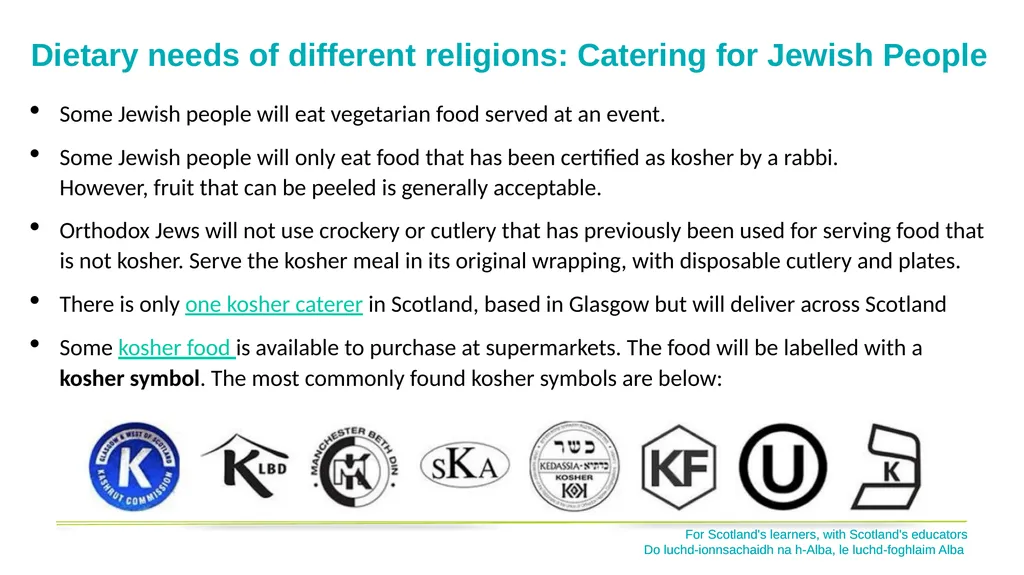
Some kosher food is available to purchase at supermarkets. The food will be labelled with a kosher symbol. The most commonly found kosher symbols are below:<br>
Some Jewish people will only eat food that has been certified as kosher by a rabbi. However, fruit that can be peeled is generally acceptable.
Orthodox Jews will not use crockery or cutlery that has previously been used for serving food that is not kosher. Serve the kosher meal in its original wrapping, with disposable cutlery and plates.
There is only one kosher caterer in Scotland, based in Glasgow but will deliver across Scotland
Some kosher food is available to purchase at supermarkets. The food will be labelled with a kosher symbol. The most commonly found kosher symbols are below:<br>
14
Dietary needs of different religions: Halal food ‘Halal’ food is that which is considered acceptable for Muslims to eat.
Halal meat is that which is slaughtered according to Islamic law.
Some Muslims will eat kosher meat if halal meat is not available.
Muslims are expected not to eat pork or carnivorous animals.
If meat is served, include some halal meat for Muslims.
Please be aware that some Sikhs who eat meat will not eat halal or kosher meat as it must be slaughtered according to their own rites known as jhatka.<br>
Halal meat is that which is slaughtered according to Islamic law.
Some Muslims will eat kosher meat if halal meat is not available.
Muslims are expected not to eat pork or carnivorous animals.
If meat is served, include some halal meat for Muslims.
Please be aware that some Sikhs who eat meat will not eat halal or kosher meat as it must be slaughtered according to their own rites known as jhatka.<br>
15
Dietary needs of different religions: Alcohol Muslims and Sikhs are expected never to drink alcohol.
Some Christians, Hindus and Buddhists will also choose not to drink alcohol.
Those who drink alcohol are expected to do so in moderation.
Non-alcoholic drinks should always be available at events.
Some religious people may find it unacceptable for any alcohol to be served at events and some will not enter a public space that serves alcohol.
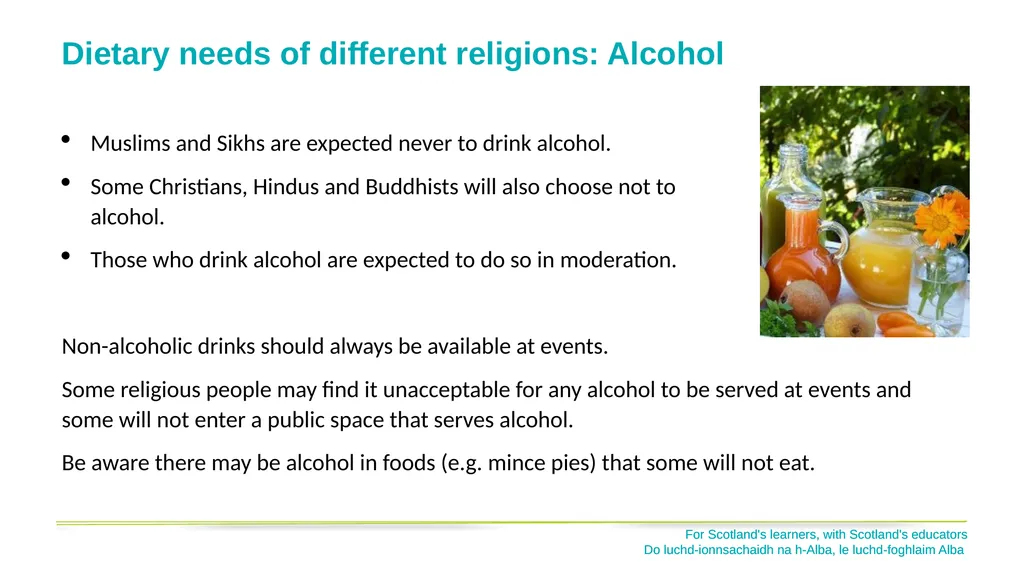
Be aware there may be alcohol in foods (e.g. mince pies) that some will not eat.<br>
Some Christians, Hindus and Buddhists will also choose not to drink alcohol.
Those who drink alcohol are expected to do so in moderation.
Non-alcoholic drinks should always be available at events.
Some religious people may find it unacceptable for any alcohol to be served at events and some will not enter a public space that serves alcohol.
Be aware there may be alcohol in foods (e.g. mince pies) that some will not eat.<br>
16
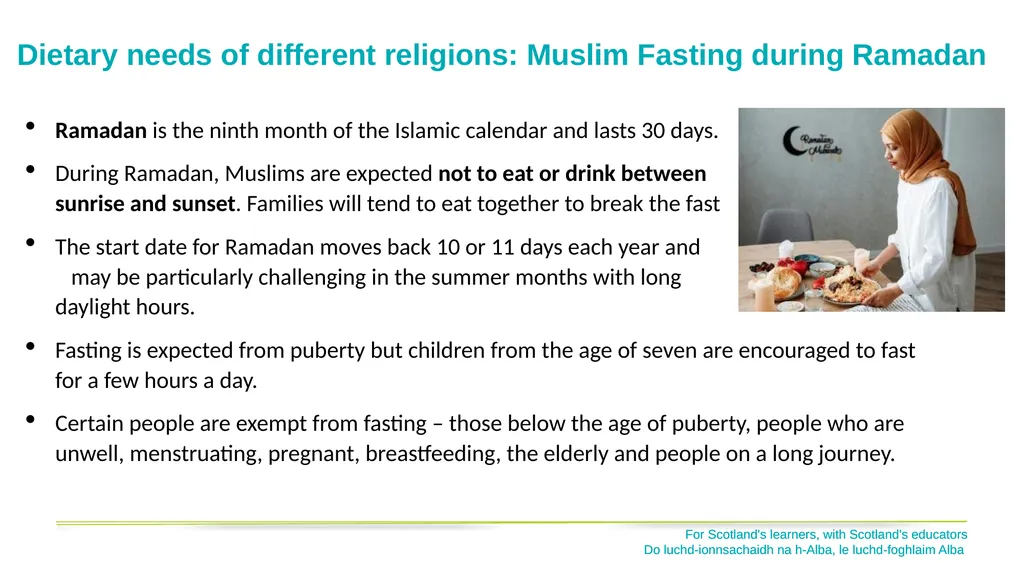
Dietary needs of different religions: Muslim Fasting during Ramadan Ramadan is the ninth month of the Islamic calendar and lasts 30 days.
During Ramadan, Muslims are expected not to eat or drink between sunrise and sunset. Families will tend to eat together to break the fast
The start date for Ramadan moves back 10 or 11 days each year and may be particularly challenging in the summer months with long daylight hours.
Fasting is expected from puberty but children from the age of seven are encouraged to fast for a few hours a day.
Certain people are exempt from fasting – those below the age of puberty, people who are unwell, menstruating, pregnant, breastfeeding, the elderly and people on a long journey.<br>
During Ramadan, Muslims are expected not to eat or drink between sunrise and sunset. Families will tend to eat together to break the fast
The start date for Ramadan moves back 10 or 11 days each year and may be particularly challenging in the summer months with long daylight hours.
Fasting is expected from puberty but children from the age of seven are encouraged to fast for a few hours a day.
Certain people are exempt from fasting – those below the age of puberty, people who are unwell, menstruating, pregnant, breastfeeding, the elderly and people on a long journey.<br>
17
Dietary needs of different religions: Fasting in other religions Jewish: On Yom Kippur, many Jewish people will observe a 25 hour fast beginning before sunset on the evening before and ending at nightfall. During Pesach, no leavened bread or cakes will be eaten for eight days.
Hindu: Some devout Hindus observe fasting on special occasions as a mark of respect to personal Gods or as part of their penance. Fasting is commonly practised on new moon days and during festivals such as Shivaratri, Saraswati Puja and Durga Puja. Some fasts may only require abstinence from certain foods.
Christian: Some Christians choose to fast during the 40 days of Lent before Easter Sunday. This is not a total abstinence from food or drink but may involve ‘giving something up’, such as meat or sweets.<br>
Hindu: Some devout Hindus observe fasting on special occasions as a mark of respect to personal Gods or as part of their penance. Fasting is commonly practised on new moon days and during festivals such as Shivaratri, Saraswati Puja and Durga Puja. Some fasts may only require abstinence from certain foods.
Christian: Some Christians choose to fast during the 40 days of Lent before Easter Sunday. This is not a total abstinence from food or drink but may involve ‘giving something up’, such as meat or sweets.<br>
18
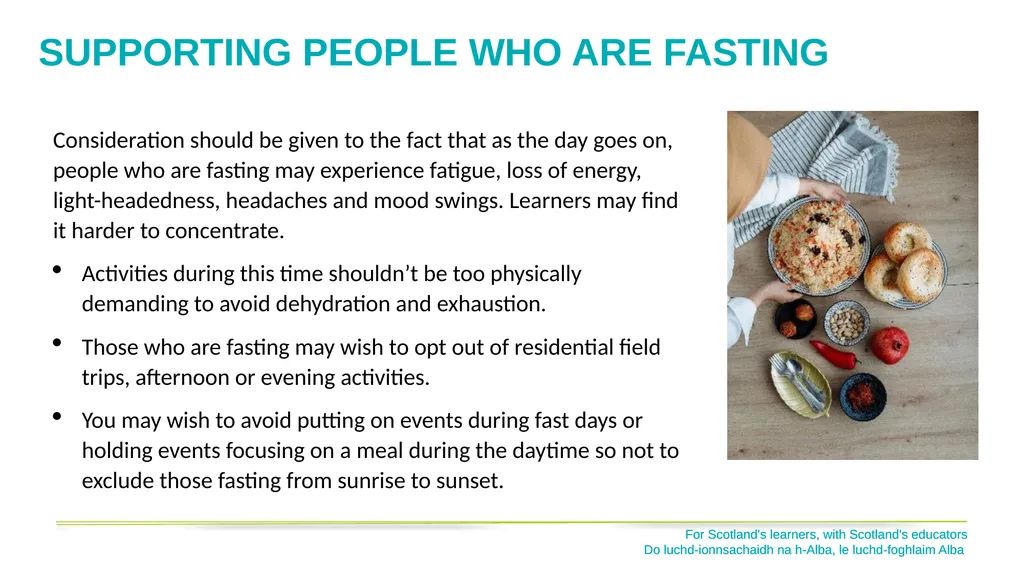
Supporting people who are fasting Consideration should be given to the fact that as the day goes on, people who are fasting may experience fatigue, loss of energy, light-headedness, headaches and mood swings. Learners may find it harder to concentrate.
Activities during this time shouldn’t be too physically demanding to avoid dehydration and exhaustion.
Those who are fasting may wish to opt out of residential field trips, afternoon or evening activities.
You may wish to avoid putting on events during fast days or holding events focusing on a meal during the daytime so not to exclude those fasting from sunrise to sunset.<br>
Activities during this time shouldn’t be too physically demanding to avoid dehydration and exhaustion.
Those who are fasting may wish to opt out of residential field trips, afternoon or evening activities.
You may wish to avoid putting on events during fast days or holding events focusing on a meal during the daytime so not to exclude those fasting from sunrise to sunset.<br>
19
MUSLIM PRAYER<br>
20
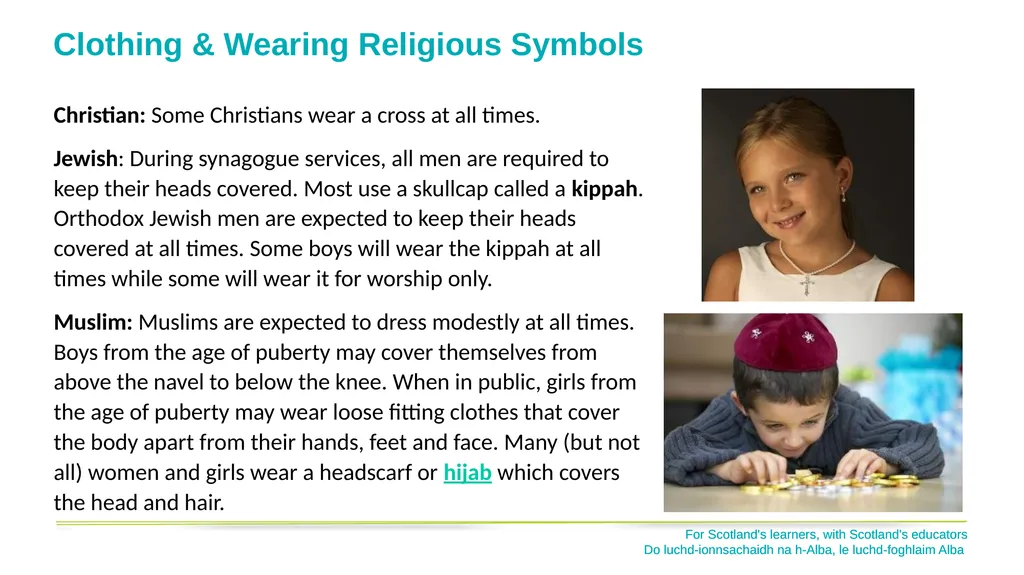
Clothing & Wearing Religious Symbols Christian: Some Christians wear a cross at all times.
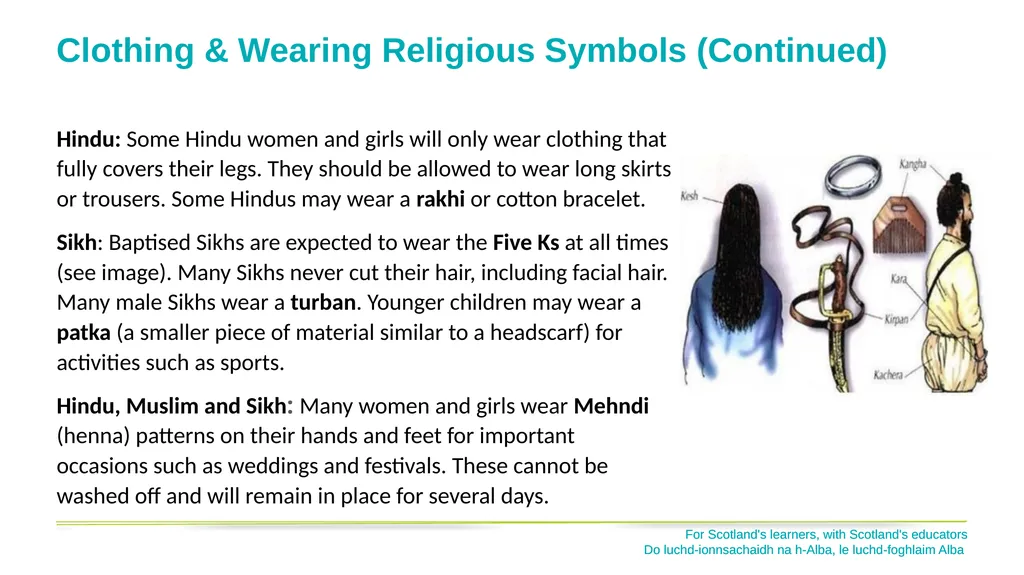
Jewish: During synagogue services, all men are required to keep their heads covered. Most use a skullcap called a kippah. Orthodox Jewish men are expected to keep their heads covered at all times. Some boys will wear the kippah at all times while some will wear it for worship only.
Muslim: Muslims are expected to dress modestly at all times. Boys from the age of puberty may cover themselves from above the navel to below the knee. When in public, girls from the age of puberty may wear loose fitting clothes that cover the body apart from their hands, feet and face. Many (but not all) women and girls wear a headscarf or hijab which covers the head and hair.<br>
Jewish: During synagogue services, all men are required to keep their heads covered. Most use a skullcap called a kippah. Orthodox Jewish men are expected to keep their heads covered at all times. Some boys will wear the kippah at all times while some will wear it for worship only.
Muslim: Muslims are expected to dress modestly at all times. Boys from the age of puberty may cover themselves from above the navel to below the knee. When in public, girls from the age of puberty may wear loose fitting clothes that cover the body apart from their hands, feet and face. Many (but not all) women and girls wear a headscarf or hijab which covers the head and hair.<br>
21
Clothing & Wearing Religious Symbols (Continued) Hindu: Some Hindu women and girls will only wear clothing that fully covers their legs. They should be allowed to wear long skirts or trousers. Some Hindus may wear a rakhi or cotton bracelet.
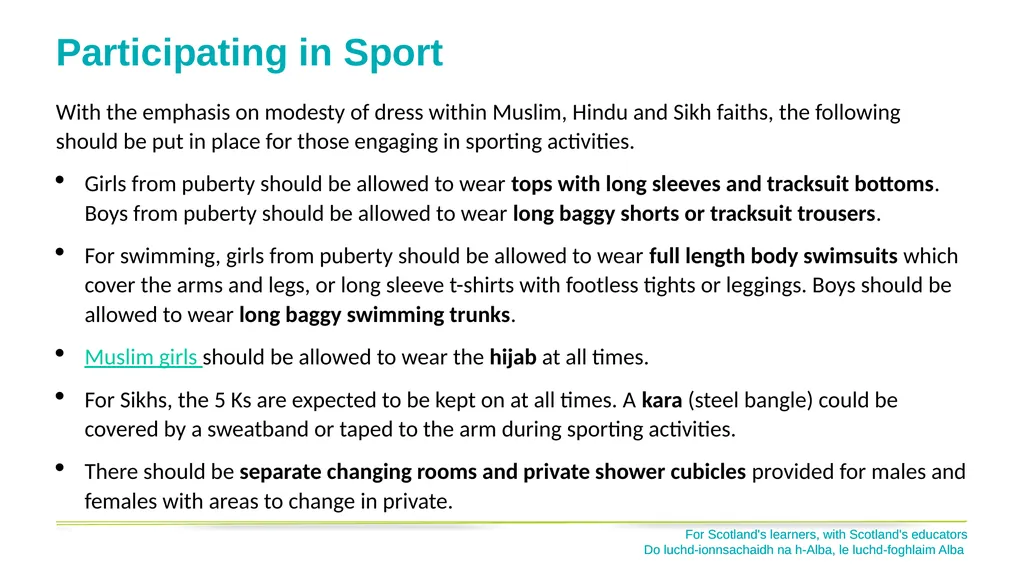
Sikh: Baptised Sikhs are expected to wear the Five Ks at all times (see image). Many Sikhs never cut their hair, including facial hair. Many male Sikhs wear a turban. Younger children may wear a patka (a smaller piece of material similar to a headscarf) for activities such as sports.
Hindu, Muslim and Sikh: Many women and girls wear Mehndi (henna) patterns on their hands and feet for important occasions such as weddings and festivals. These cannot be washed off and will remain in place for several days.<br>
Sikh: Baptised Sikhs are expected to wear the Five Ks at all times (see image). Many Sikhs never cut their hair, including facial hair. Many male Sikhs wear a turban. Younger children may wear a patka (a smaller piece of material similar to a headscarf) for activities such as sports.
Hindu, Muslim and Sikh: Many women and girls wear Mehndi (henna) patterns on their hands and feet for important occasions such as weddings and festivals. These cannot be washed off and will remain in place for several days.<br>
22
Participating in Sport With the emphasis on modesty of dress within Muslim, Hindu and Sikh faiths, the following should be put in place for those engaging in sporting activities.
Girls from puberty should be allowed to wear tops with long sleeves and tracksuit bottoms. Boys from puberty should be allowed to wear long baggy shorts or tracksuit trousers.
For swimming, girls from puberty should be allowed to wear full length body swimsuits which cover the arms and legs, or long sleeve t-shirts with footless tights or leggings. Boys should be allowed to wear long baggy swimming trunks.
Muslim girls should be allowed to wear the hijab at all times.
For Sikhs, the 5 Ks are expected to be kept on at all times. A kara (steel bangle) could be covered by a sweatband or taped to the arm during sporting activities.
There should be separate changing rooms and private shower cubicles provided for males and females with areas to change in private.<br>
Girls from puberty should be allowed to wear tops with long sleeves and tracksuit bottoms. Boys from puberty should be allowed to wear long baggy shorts or tracksuit trousers.
For swimming, girls from puberty should be allowed to wear full length body swimsuits which cover the arms and legs, or long sleeve t-shirts with footless tights or leggings. Boys should be allowed to wear long baggy swimming trunks.
Muslim girls should be allowed to wear the hijab at all times.
For Sikhs, the 5 Ks are expected to be kept on at all times. A kara (steel bangle) could be covered by a sweatband or taped to the arm during sporting activities.
There should be separate changing rooms and private shower cubicles provided for males and females with areas to change in private.<br>
23
Physical Contact Some Orthodox Jewish people, particularly the Ultra-Orthodox, and some Muslims will be expected not to have any physical contact with members of the opposite sex. This extends to shaking hands.
Activities involving physical contact between the sexes or where opposite sexes are going to be in close proximity can present significant difficulties for some children, young people and adult learners due to their religious beliefs. Options to participate in physical activities such as gymnastics, dance and swimming in same-sex groups may help meet their religious and cultural needs.<br>
Activities involving physical contact between the sexes or where opposite sexes are going to be in close proximity can present significant difficulties for some children, young people and adult learners due to their religious beliefs. Options to participate in physical activities such as gymnastics, dance and swimming in same-sex groups may help meet their religious and cultural needs.<br>
24
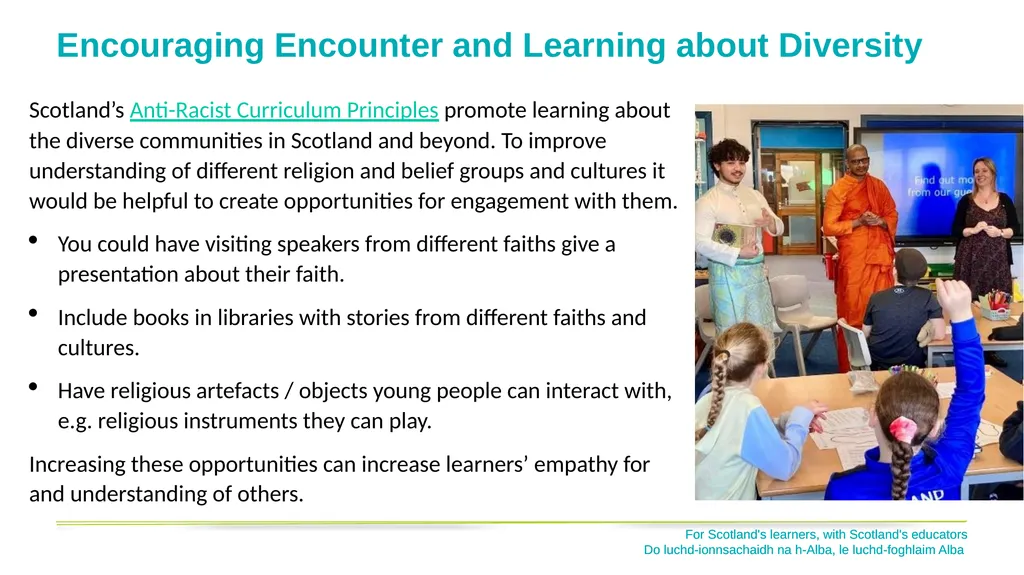
Encouraging Encounter and Learning about Diversity Scotland’s Anti-Racist Curriculum Principles promote learning about the diverse communities in Scotland and beyond. To improve understanding of different religion and belief groups and cultures it would be helpful to create opportunities for engagement with them.
You could have visiting speakers from different faiths give a presentation about their faith.
Include books in libraries with stories from different faiths and cultures.
Have religious artefacts / objects young people can interact with, e.g. religious instruments they can play.
Increasing these opportunities can increase learners’ empathy for and understanding of others.<br>
You could have visiting speakers from different faiths give a presentation about their faith.
Include books in libraries with stories from different faiths and cultures.
Have religious artefacts / objects young people can interact with, e.g. religious instruments they can play.
Increasing these opportunities can increase learners’ empathy for and understanding of others.<br>
25
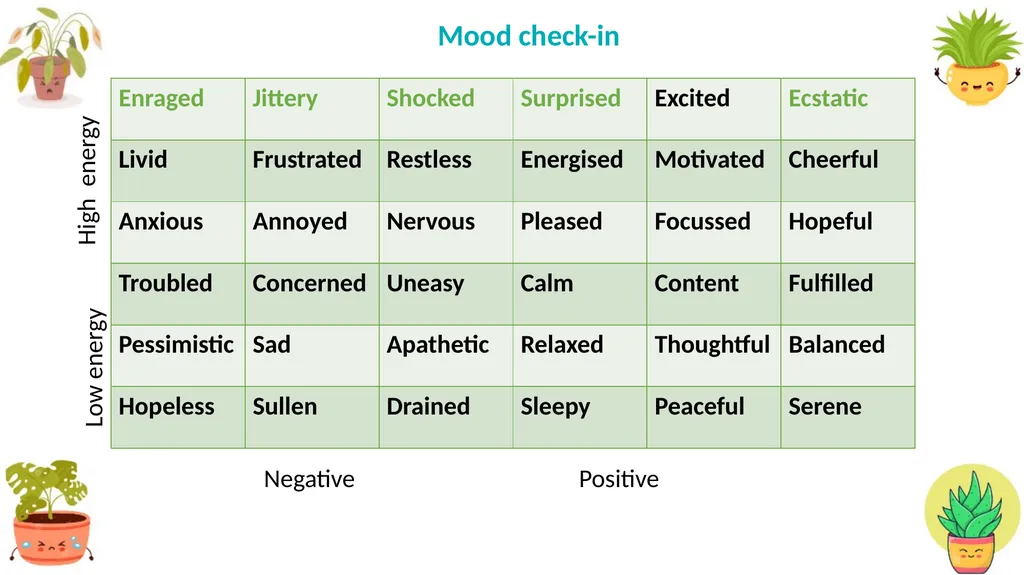
Mood check-in Low energy High energy Negative Positive<br>
26
Reflection From what you have learned so far, think about:
How has this made you feel?
What has this made you think about?
What one action would you like to take forward?
How can you link what you plan to do with others in your setting?
How you will know that this learning has made a difference?<br>
How has this made you feel?
What has this made you think about?
What one action would you like to take forward?
How can you link what you plan to do with others in your setting?
How you will know that this learning has made a difference?<br>
27
We value your feedback Education Scotland is taking feedback on these resources so that we can continue improving our professional learning resources.
Your feedback could help us improve this resource
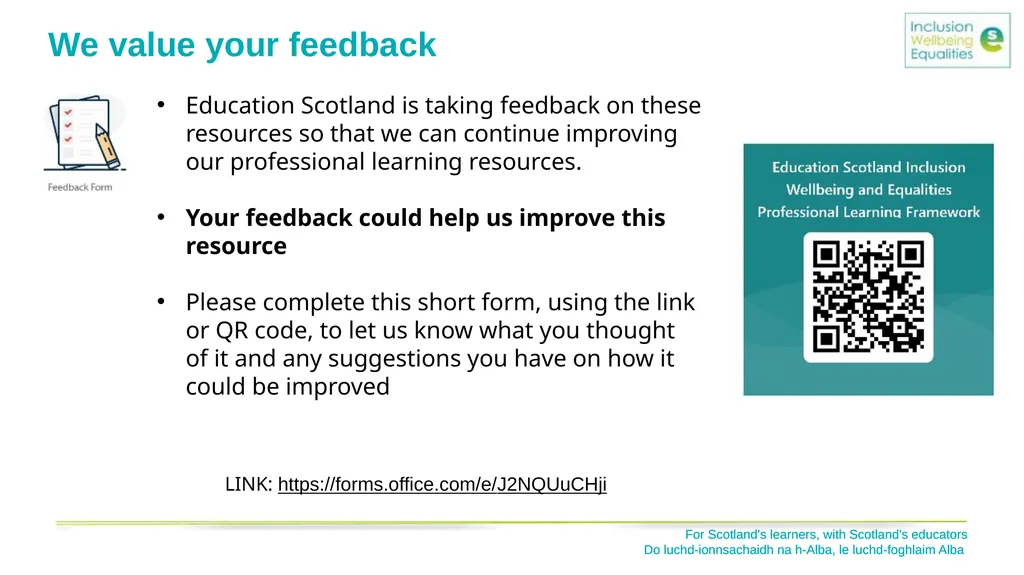
Please complete this short form, using the link or QR code, to let us know what you thought of it and any suggestions you have on how it could be improved LINK: https://forms.office.com/e/J2NQUuCHji<br>
Your feedback could help us improve this resource
Please complete this short form, using the link or QR code, to let us know what you thought of it and any suggestions you have on how it could be improved LINK: https://forms.office.com/e/J2NQUuCHji<br>
28
Education Scotland
Denholm House
Almondvale Business Park
Almondvale Way
Livingston EH54 6GA
T +44 (0)131 244 5000
E enquiries@educationscotland.gsi.gov.uk For Scotland's learners, with Scotland's educators
Do luchd-ionnsachaidh na h-Alba, le luchd-foghlaim Alba<br>
Denholm House
Almondvale Business Park
Almondvale Way
Livingston EH54 6GA
T +44 (0)131 244 5000
E enquiries@educationscotland.gsi.gov.uk For Scotland's learners, with Scotland's educators
Do luchd-ionnsachaidh na h-Alba, le luchd-foghlaim Alba<br>