
Inclusion Wellbeing & Equalities Professional

Description: Inclusion Wellbeing Equalities Professional Learning Framework Attunement being aware and responsive to emotions Level Informed ESInclusionTeam For Scotlands learners, with Scotlands educators Do luchd-ionnsachaidh na h-Alba, le
Related Topics
Download Presentation
"Inclusion Wellbeing & Equalities Professional" is the property of its rightful owner. Permission is granted to download and print the materials on this website for personal, non-commercial use only, and to display it on your personal computer provided you do not modify the materials and that you retain all copyright notices contained in the materials. By downloading content from our website, you accept the terms of this agreement.
Presentation Transcript
slide1. Inclusion Wellbeing & Equalities Professional Learning Framework
Attunement – being aware and responsive to emotions
Level – Informed @ESInclusionTeam For Scotland's learners, with Scotland's educators
Do luchd-ionnsachaidh na h-Alba, le luchd-foghlaim Alba<br>
slide3. Pause for Thought… How to use this resource These slides can be used to facilitate professional learning in a group or
whole setting, or as a self-directed learning activity as an individual.
Facilitation notes are included at the bottom of each slide
Please do not remove or change any of the slides included.
Facilitators are welcome to add slides or activities relevant to your own setting, to support discussion and exploration of the topic. Facilitators will know their participants’ needs best.
Anyone who works in an educational setting can be a facilitator and use these slides.
For reflection or discussion activities, it is important to establish a safe space which encourages respect and honesty to ensure that everyone is able to participate.<br>
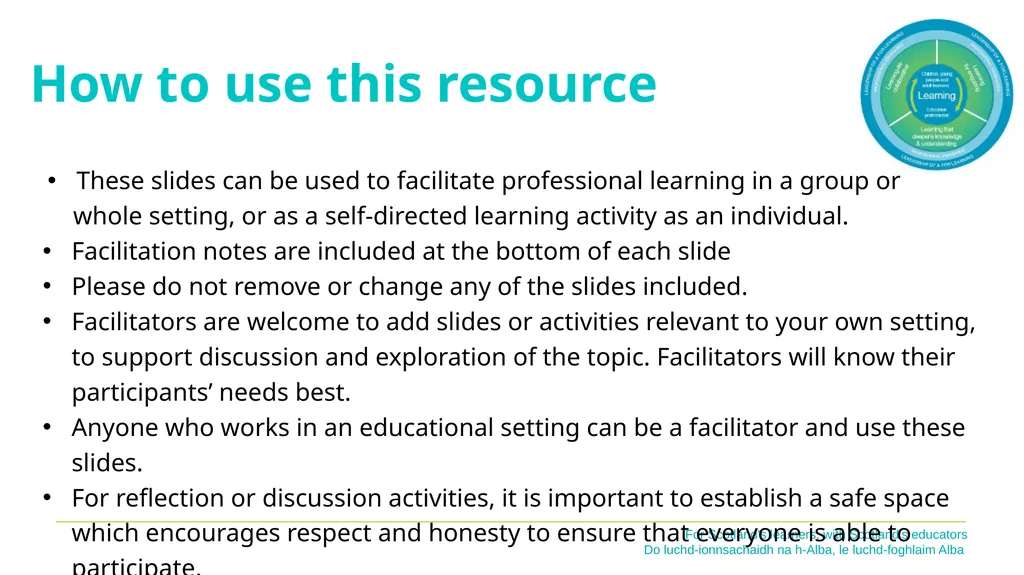
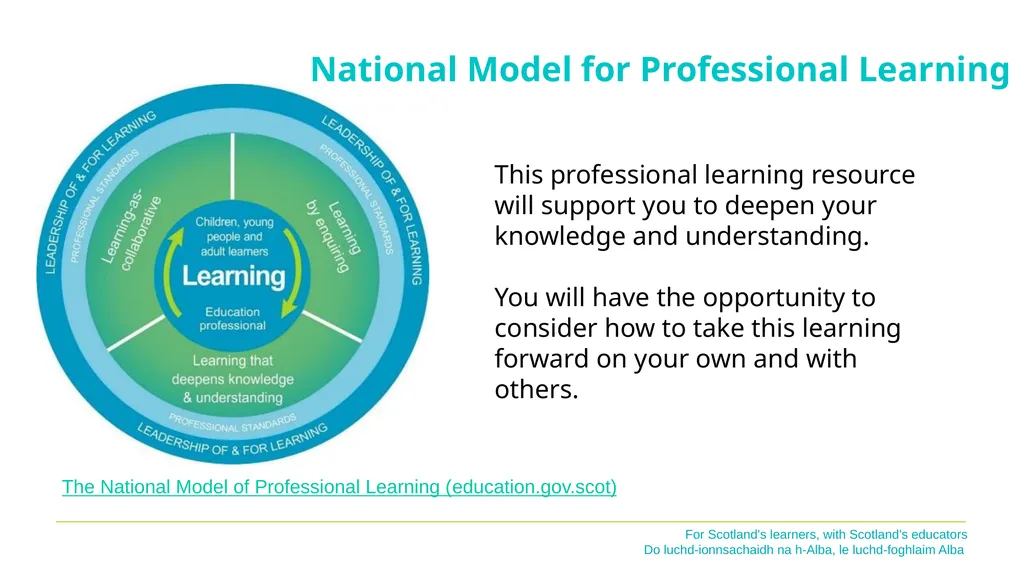
slide4. The National Model of Professional Learning (education.gov.scot) This professional learning resource will support you to deepen your knowledge and understanding.
You will have the opportunity to consider how to take this learning forward on your own and with others. National Model for Professional Learning<br>
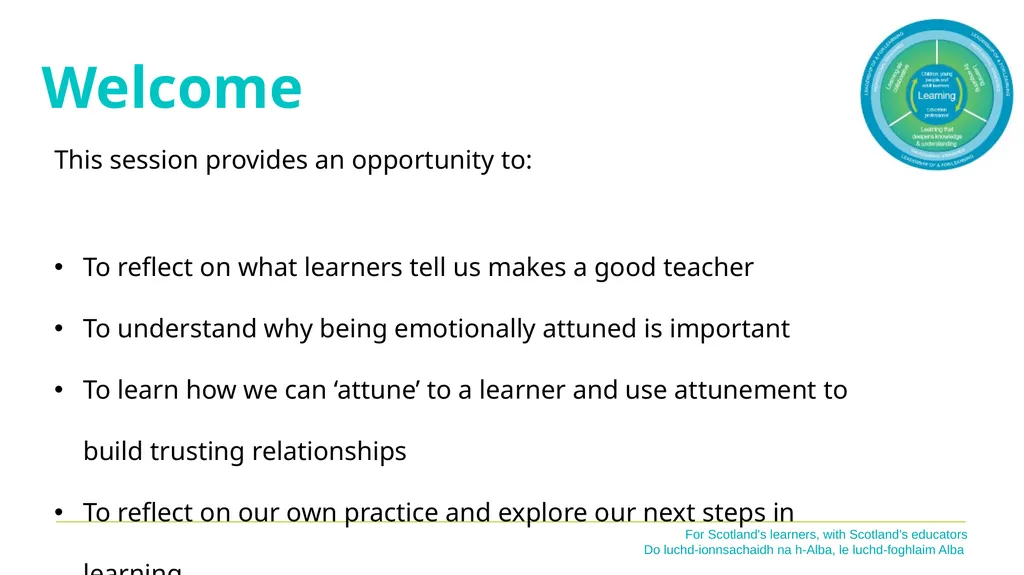
slide5. Pause for Thought… Welcome This session provides an opportunity to:
To reflect on what learners tell us makes a good teacher
To understand why being emotionally attuned is important
To learn how we can ‘attune’ to a learner and use attunement to build trusting relationships
To reflect on our own practice and explore our next steps in learning<br>
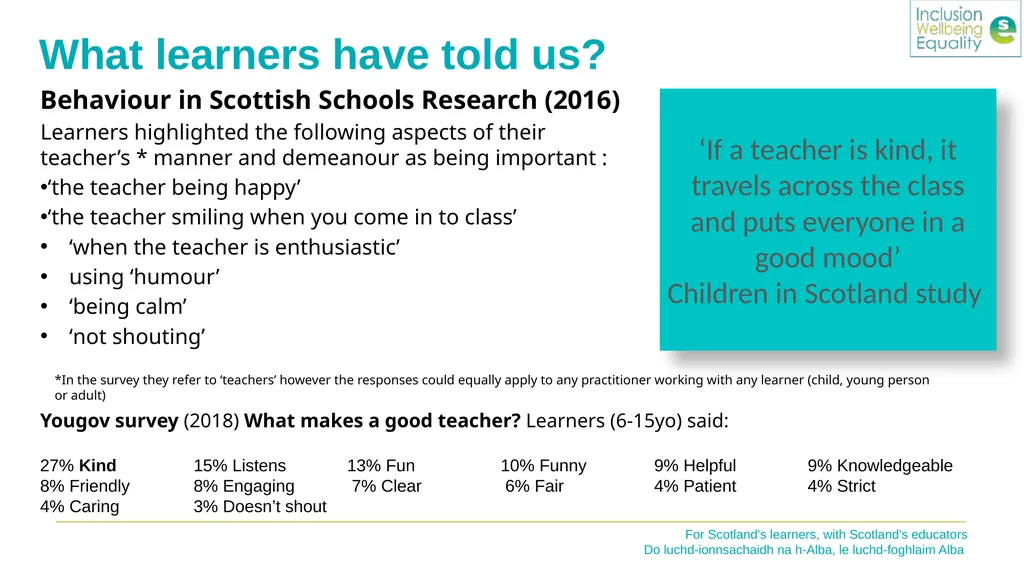
slide6. What learners have told us? Behaviour in Scottish Schools Research (2016)
Learners highlighted the following aspects of their teacher’s * manner and demeanour as being important :
‘the teacher being happy’
‘the teacher smiling when you come in to class’
‘when the teacher is enthusiastic’
using ‘humour’
‘being calm’
‘not shouting’ ‘If a teacher is kind, it travels across the class and puts everyone in a good mood’
Children in Scotland study *In the survey they refer to ‘teachers’ however the responses could equally apply to any practitioner working with any learner (child, young person or adult) Yougov survey (2018) What makes a good teacher? Learners (6-15yo) said:
27% Kind 15% Listens 13% Fun 10% Funny 9% Helpful 9% Knowledgeable
8% Friendly 8% Engaging 7% Clear 6% Fair 4% Patient 4% Strict
4% Caring 3% Doesn’t shout<br>
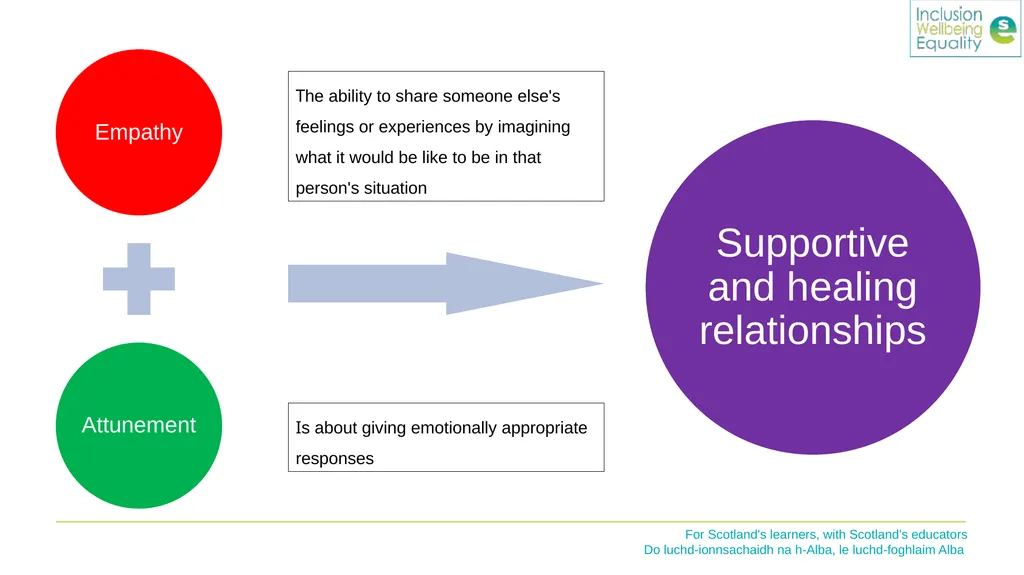
slide7. Empathy Attunement Supportive and healing relationships Is about giving emotionally appropriate responses The ability to share someone else's feelings or experiences by imagining what it would be like to be in that person's situation<br>
slide8. Attunement:
describes how we recognise and respond to another person's emotional needs and moods
is the process by which we form relationships Dr. Dan Siegel says, "Children need attunement to feel secure and to develop well, and throughout our lives we need attunement to feel close and connected.” When working with others (learners, colleagues, parents/carers,..), attunement comes across as:
genuinely caring about them
truly listening to them and caring about their response
noticing: when a they are in a mood, when they’re unusually quiet, when they’re struggling, …. Attunement – being aware and responsive to emotions<br>
slide9. The Power of Connection – Dr Bruce Perry 7.03 min
From
The Neurosequential Network If viewing as a PDF please click this link to watch the film https://youtu.be/oElS6AGwuxU<br>
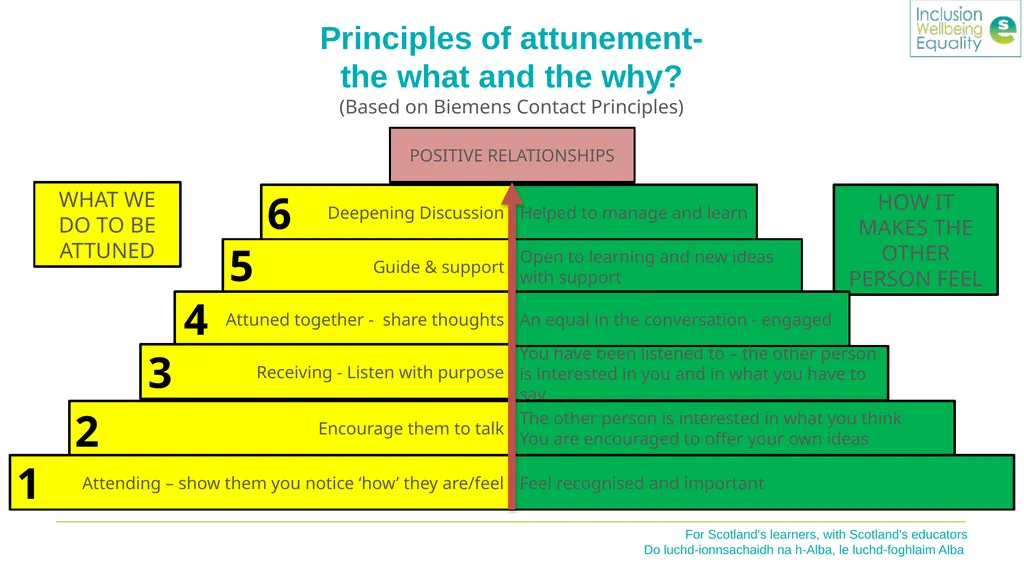
slide10. (Based on Biemens Contact Principles) Principles of attunement- the what and the why?<br>
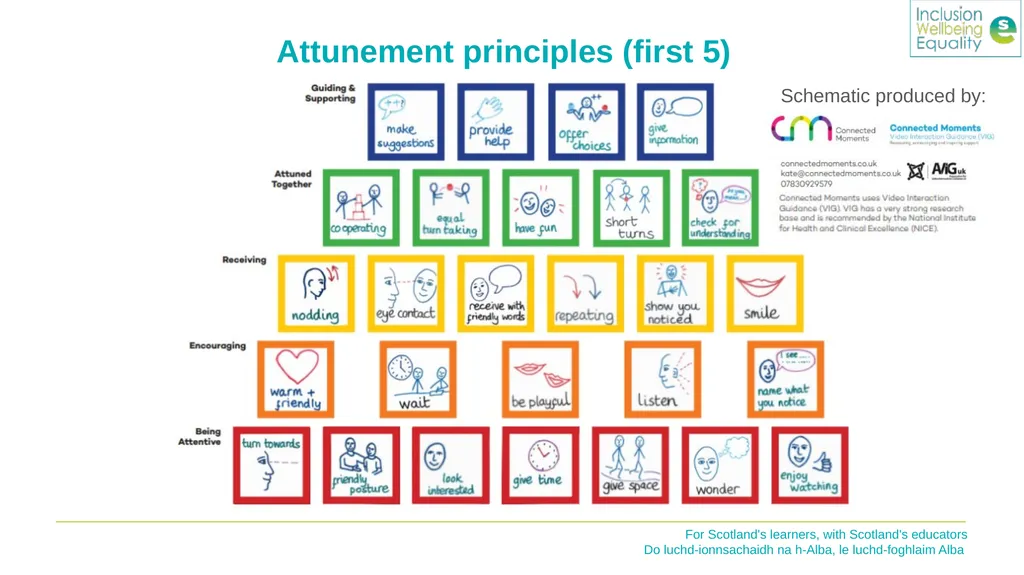
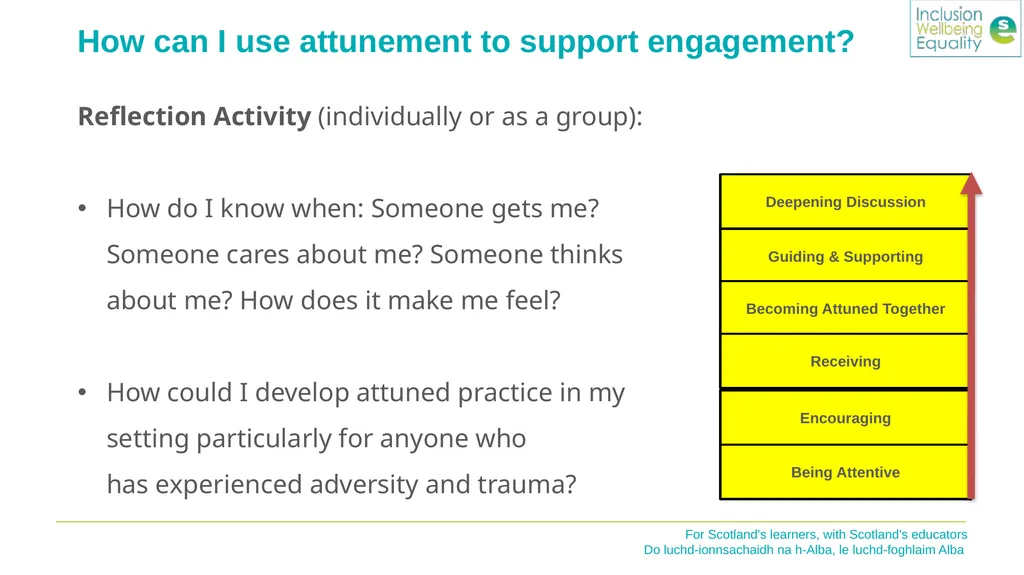
slide11. Attunement principles (first 5)<br>
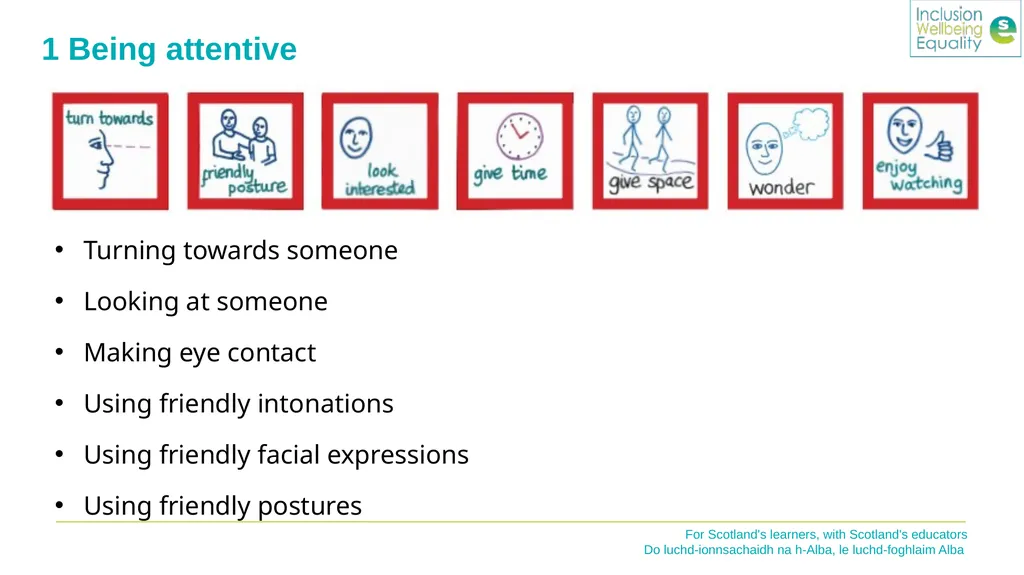
slide12. 1 Being attentive Turning towards someone
Looking at someone
Making eye contact
Using friendly intonations
Using friendly facial expressions
Using friendly postures<br>
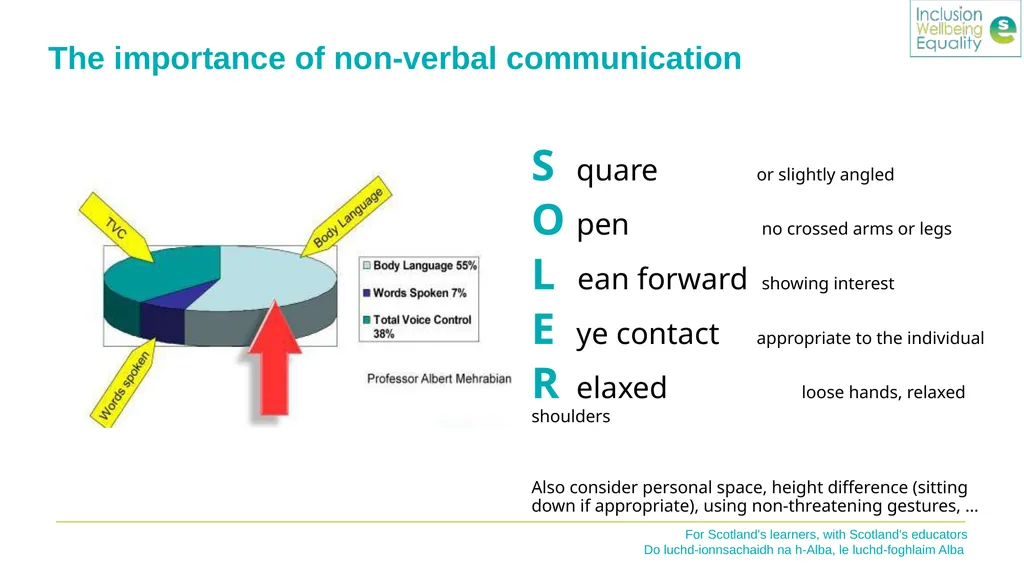
slide13. The importance of non-verbal communication S quare or slightly angled
O pen no crossed arms or legs
L ean forward showing interest
E ye contact appropriate to the individual
R elaxed loose hands, relaxed shoulders
Also consider personal space, height difference (sitting down if appropriate), using non-threatening gestures, …<br>
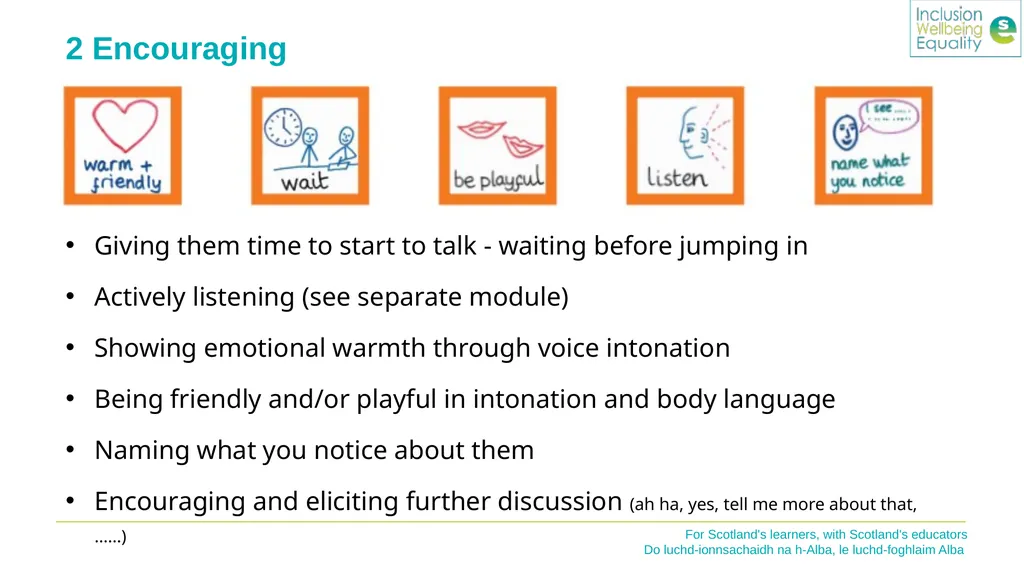
slide14. 2 Encouraging Giving them time to start to talk - waiting before jumping in
Actively listening (see separate module)
Showing emotional warmth through voice intonation
Being friendly and/or playful in intonation and body language
Naming what you notice about them
Encouraging and eliciting further discussion (ah ha, yes, tell me more about that, ……)<br>
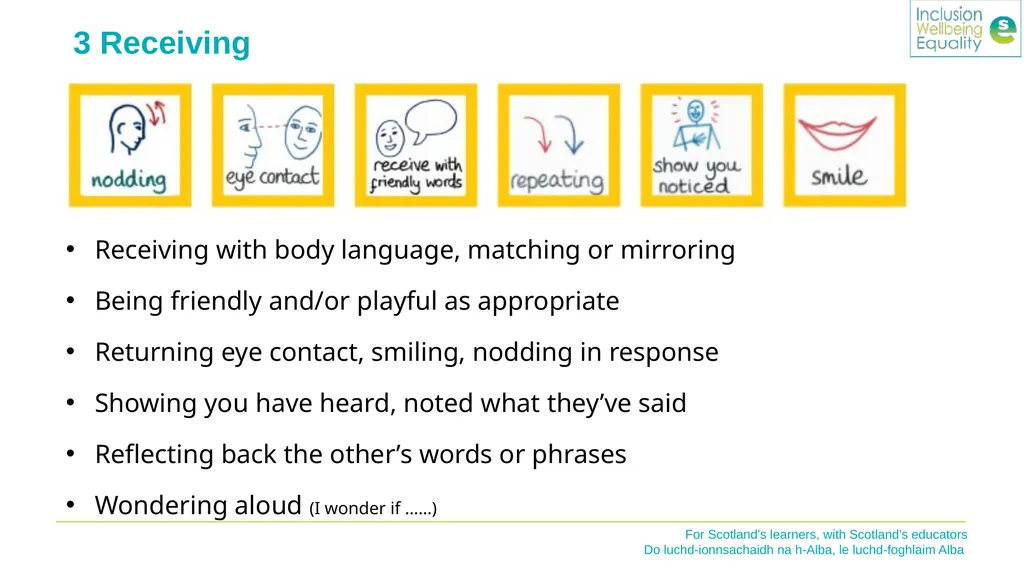
slide15. 3 Receiving Receiving with body language, matching or mirroring
Being friendly and/or playful as appropriate
Returning eye contact, smiling, nodding in response
Showing you have heard, noted what they’ve said
Reflecting back the other’s words or phrases
Wondering aloud (I wonder if ……)<br>
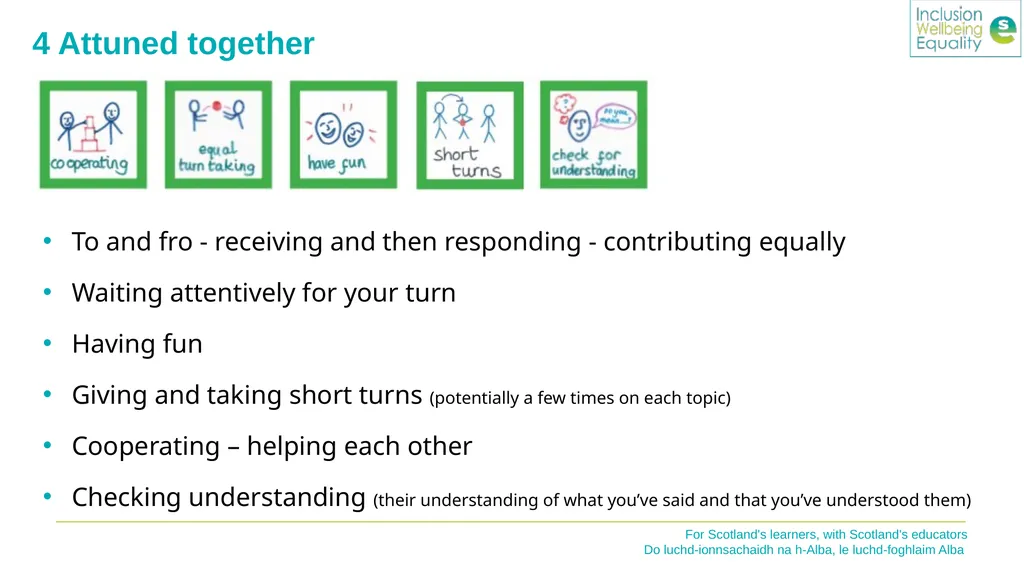
slide16. 4 Attuned together To and fro - receiving and then responding - contributing equally
Waiting attentively for your turn
Having fun
Giving and taking short turns (potentially a few times on each topic)
Cooperating – helping each other
Checking understanding (their understanding of what you’ve said and that you’ve understood them)<br>
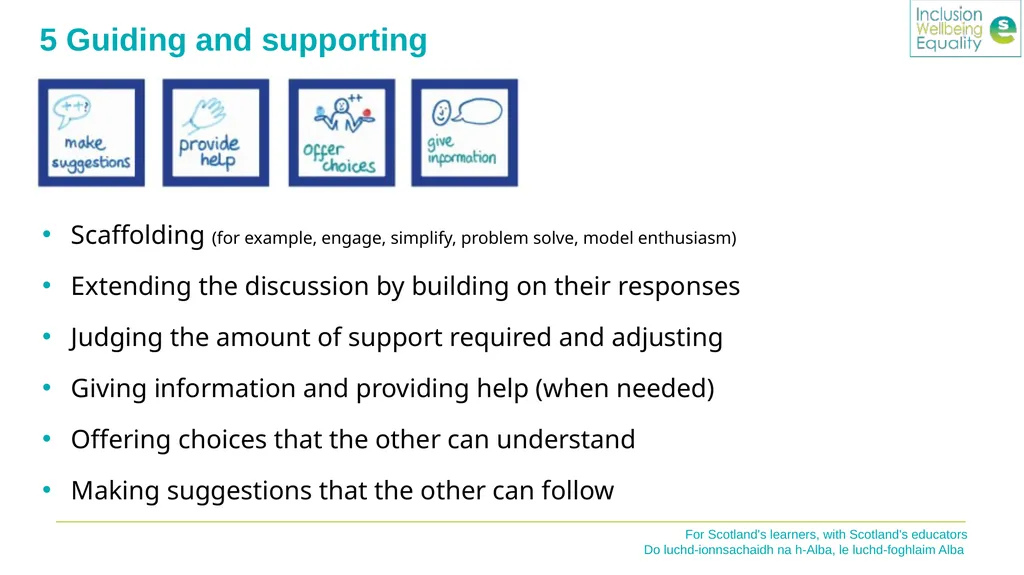
slide17. 5 Guiding and supporting Scaffolding (for example, engage, simplify, problem solve, model enthusiasm)
Extending the discussion by building on their responses
Judging the amount of support required and adjusting
Giving information and providing help (when needed)
Offering choices that the other can understand
Making suggestions that the other can follow<br>
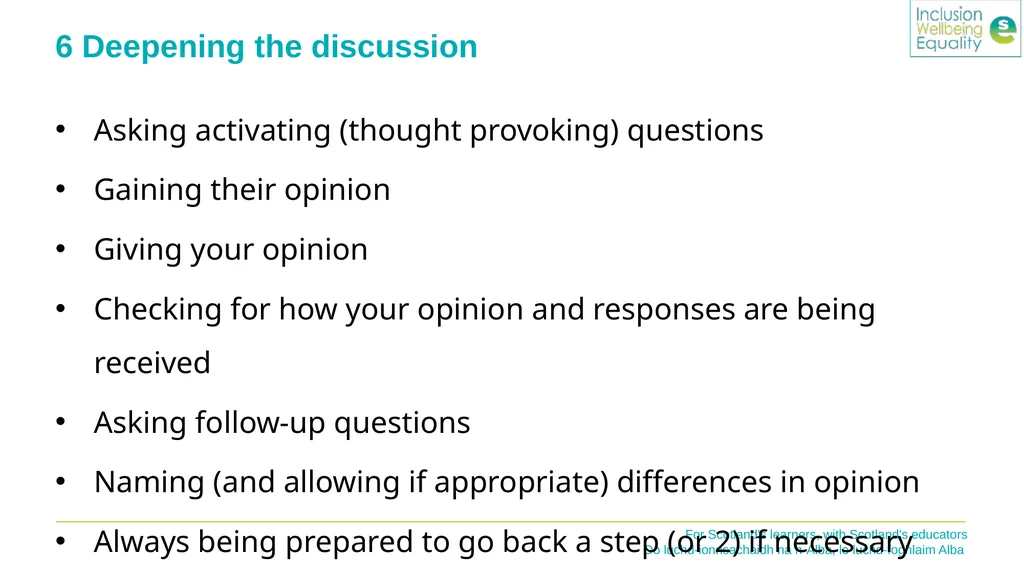
slide18. 6 Deepening the discussion Asking activating (thought provoking) questions
Gaining their opinion
Giving your opinion
Checking for how your opinion and responses are being received
Asking follow-up questions
Naming (and allowing if appropriate) differences in opinion
Always being prepared to go back a step (or 2) if necessary<br>
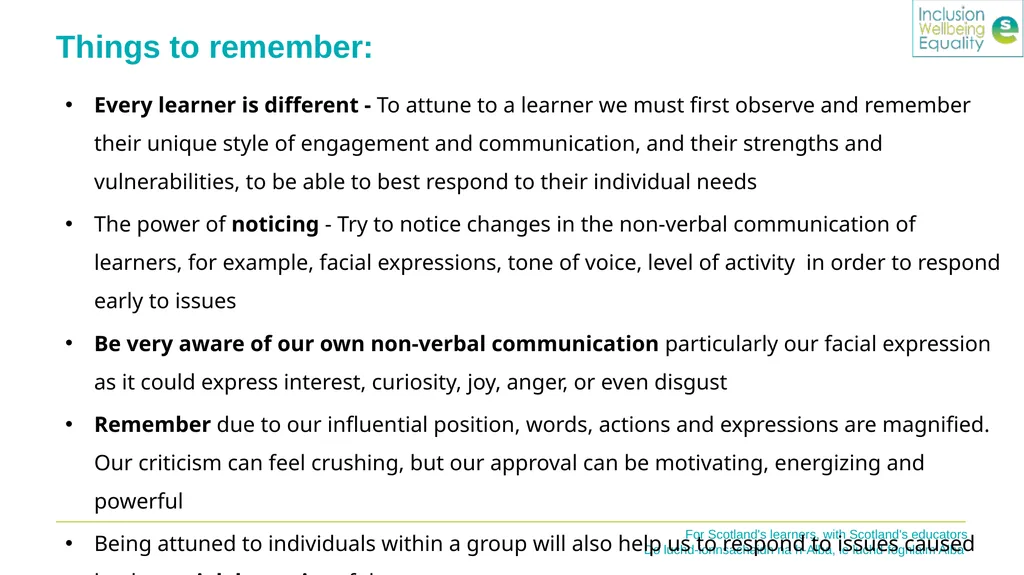
slide19. Things to remember: Every learner is different - To attune to a learner we must first observe and remember their unique style of engagement and communication, and their strengths and vulnerabilities, to be able to best respond to their individual needs
The power of noticing - Try to notice changes in the non-verbal communication of learners, for example, facial expressions, tone of voice, level of activity in order to respond early to issues
Be very aware of our own non-verbal communication particularly our facial expression as it could express interest, curiosity, joy, anger, or even disgust
Remember due to our influential position, words, actions and expressions are magnified. Our criticism can feel crushing, but our approval can be motivating, energizing and powerful
Being attuned to individuals within a group will also help us to respond to issues caused by the social dynamics of that group<br>
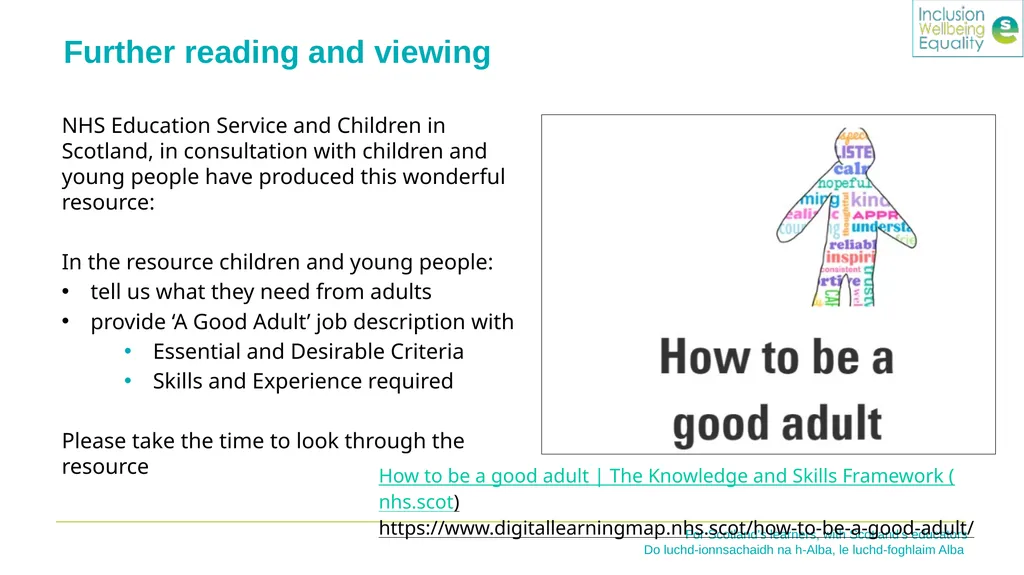
slide20. Further reading and viewing NHS Education Service and Children in Scotland, in consultation with children and young people have produced this wonderful resource:
In the resource children and young people:
tell us what they need from adults
provide ‘A Good Adult’ job description with
Essential and Desirable Criteria
Skills and Experience required
Please take the time to look through the resource How to be a good adult | The Knowledge and Skills Framework (nhs.scot)
https://www.digitallearningmap.nhs.scot/how-to-be-a-good-adult/<br>
slide21. How can I use attunement to support engagement? Reflection Activity (individually or as a group):
How do I know when: Someone gets me? Someone cares about me? Someone thinks about me? How does it make me feel?
How could I develop attuned practice in my setting particularly for anyone who has experienced adversity and trauma?<br>
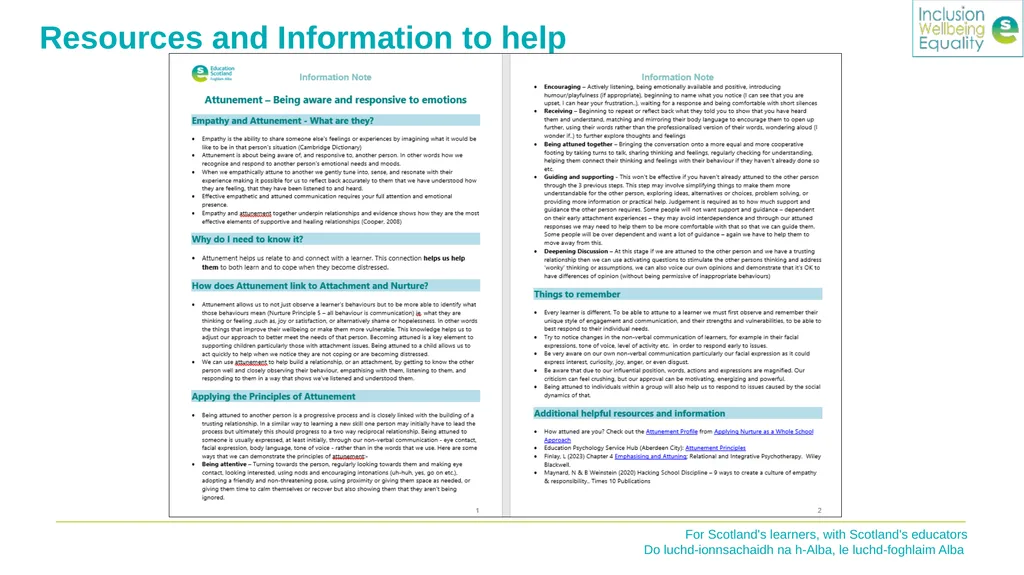
slide22. Resources and Information to help<br>
slide23. Reflection From what you have learned so far, think about:
How has this made you feel?
What has this made you think about?
What one action would you like to take forward?
How can you link what you plan to do with others in your setting?
How you will know that this learning has made a difference?<br>
slide24. We value your feedback From now until March 2024 we will be taking feedback on these resources so that we can make changes in advance of a formal launch of the Professional Learning Framework in June 2024
Your feedback could help us improve this resource
Please complete this short form, using the link or QR code, to let us know what you thought of it and any suggestions you have on how it could be improved LINK: https://forms.office.com/e/b5PCpJJJ3P<br>
slide25. Education Scotland
Denholm House
Almondvale Business Park
Almondvale Way
Livingston EH54 6GA
T +44 (0)131 244 5000
E enquiries@educationscotland.gsi.gov.uk For Scotland's learners, with Scotland's educators
Do luchd-ionnsachaidh na h-Alba, le luchd-foghlaim Alba<br>
Attunement – being aware and responsive to emotions
Level – Informed @ESInclusionTeam For Scotland's learners, with Scotland's educators
Do luchd-ionnsachaidh na h-Alba, le luchd-foghlaim Alba<br>
slide3. Pause for Thought… How to use this resource These slides can be used to facilitate professional learning in a group or
whole setting, or as a self-directed learning activity as an individual.
Facilitation notes are included at the bottom of each slide
Please do not remove or change any of the slides included.
Facilitators are welcome to add slides or activities relevant to your own setting, to support discussion and exploration of the topic. Facilitators will know their participants’ needs best.
Anyone who works in an educational setting can be a facilitator and use these slides.
For reflection or discussion activities, it is important to establish a safe space which encourages respect and honesty to ensure that everyone is able to participate.<br>
slide4. The National Model of Professional Learning (education.gov.scot) This professional learning resource will support you to deepen your knowledge and understanding.
You will have the opportunity to consider how to take this learning forward on your own and with others. National Model for Professional Learning<br>
slide5. Pause for Thought… Welcome This session provides an opportunity to:
To reflect on what learners tell us makes a good teacher
To understand why being emotionally attuned is important
To learn how we can ‘attune’ to a learner and use attunement to build trusting relationships
To reflect on our own practice and explore our next steps in learning<br>
slide6. What learners have told us? Behaviour in Scottish Schools Research (2016)
Learners highlighted the following aspects of their teacher’s * manner and demeanour as being important :
‘the teacher being happy’
‘the teacher smiling when you come in to class’
‘when the teacher is enthusiastic’
using ‘humour’
‘being calm’
‘not shouting’ ‘If a teacher is kind, it travels across the class and puts everyone in a good mood’
Children in Scotland study *In the survey they refer to ‘teachers’ however the responses could equally apply to any practitioner working with any learner (child, young person or adult) Yougov survey (2018) What makes a good teacher? Learners (6-15yo) said:
27% Kind 15% Listens 13% Fun 10% Funny 9% Helpful 9% Knowledgeable
8% Friendly 8% Engaging 7% Clear 6% Fair 4% Patient 4% Strict
4% Caring 3% Doesn’t shout<br>
slide7. Empathy Attunement Supportive and healing relationships Is about giving emotionally appropriate responses The ability to share someone else's feelings or experiences by imagining what it would be like to be in that person's situation<br>
slide8. Attunement:
describes how we recognise and respond to another person's emotional needs and moods
is the process by which we form relationships Dr. Dan Siegel says, "Children need attunement to feel secure and to develop well, and throughout our lives we need attunement to feel close and connected.” When working with others (learners, colleagues, parents/carers,..), attunement comes across as:
genuinely caring about them
truly listening to them and caring about their response
noticing: when a they are in a mood, when they’re unusually quiet, when they’re struggling, …. Attunement – being aware and responsive to emotions<br>
slide9. The Power of Connection – Dr Bruce Perry 7.03 min
From
The Neurosequential Network If viewing as a PDF please click this link to watch the film https://youtu.be/oElS6AGwuxU<br>
slide10. (Based on Biemens Contact Principles) Principles of attunement- the what and the why?<br>
slide11. Attunement principles (first 5)<br>
slide12. 1 Being attentive Turning towards someone
Looking at someone
Making eye contact
Using friendly intonations
Using friendly facial expressions
Using friendly postures<br>
slide13. The importance of non-verbal communication S quare or slightly angled
O pen no crossed arms or legs
L ean forward showing interest
E ye contact appropriate to the individual
R elaxed loose hands, relaxed shoulders
Also consider personal space, height difference (sitting down if appropriate), using non-threatening gestures, …<br>
slide14. 2 Encouraging Giving them time to start to talk - waiting before jumping in
Actively listening (see separate module)
Showing emotional warmth through voice intonation
Being friendly and/or playful in intonation and body language
Naming what you notice about them
Encouraging and eliciting further discussion (ah ha, yes, tell me more about that, ……)<br>
slide15. 3 Receiving Receiving with body language, matching or mirroring
Being friendly and/or playful as appropriate
Returning eye contact, smiling, nodding in response
Showing you have heard, noted what they’ve said
Reflecting back the other’s words or phrases
Wondering aloud (I wonder if ……)<br>
slide16. 4 Attuned together To and fro - receiving and then responding - contributing equally
Waiting attentively for your turn
Having fun
Giving and taking short turns (potentially a few times on each topic)
Cooperating – helping each other
Checking understanding (their understanding of what you’ve said and that you’ve understood them)<br>
slide17. 5 Guiding and supporting Scaffolding (for example, engage, simplify, problem solve, model enthusiasm)
Extending the discussion by building on their responses
Judging the amount of support required and adjusting
Giving information and providing help (when needed)
Offering choices that the other can understand
Making suggestions that the other can follow<br>
slide18. 6 Deepening the discussion Asking activating (thought provoking) questions
Gaining their opinion
Giving your opinion
Checking for how your opinion and responses are being received
Asking follow-up questions
Naming (and allowing if appropriate) differences in opinion
Always being prepared to go back a step (or 2) if necessary<br>
slide19. Things to remember: Every learner is different - To attune to a learner we must first observe and remember their unique style of engagement and communication, and their strengths and vulnerabilities, to be able to best respond to their individual needs
The power of noticing - Try to notice changes in the non-verbal communication of learners, for example, facial expressions, tone of voice, level of activity in order to respond early to issues
Be very aware of our own non-verbal communication particularly our facial expression as it could express interest, curiosity, joy, anger, or even disgust
Remember due to our influential position, words, actions and expressions are magnified. Our criticism can feel crushing, but our approval can be motivating, energizing and powerful
Being attuned to individuals within a group will also help us to respond to issues caused by the social dynamics of that group<br>
slide20. Further reading and viewing NHS Education Service and Children in Scotland, in consultation with children and young people have produced this wonderful resource:
In the resource children and young people:
tell us what they need from adults
provide ‘A Good Adult’ job description with
Essential and Desirable Criteria
Skills and Experience required
Please take the time to look through the resource How to be a good adult | The Knowledge and Skills Framework (nhs.scot)
https://www.digitallearningmap.nhs.scot/how-to-be-a-good-adult/<br>
slide21. How can I use attunement to support engagement? Reflection Activity (individually or as a group):
How do I know when: Someone gets me? Someone cares about me? Someone thinks about me? How does it make me feel?
How could I develop attuned practice in my setting particularly for anyone who has experienced adversity and trauma?<br>
slide22. Resources and Information to help<br>
slide23. Reflection From what you have learned so far, think about:
How has this made you feel?
What has this made you think about?
What one action would you like to take forward?
How can you link what you plan to do with others in your setting?
How you will know that this learning has made a difference?<br>
slide24. We value your feedback From now until March 2024 we will be taking feedback on these resources so that we can make changes in advance of a formal launch of the Professional Learning Framework in June 2024
Your feedback could help us improve this resource
Please complete this short form, using the link or QR code, to let us know what you thought of it and any suggestions you have on how it could be improved LINK: https://forms.office.com/e/b5PCpJJJ3P<br>
slide25. Education Scotland
Denholm House
Almondvale Business Park
Almondvale Way
Livingston EH54 6GA
T +44 (0)131 244 5000
E enquiries@educationscotland.gsi.gov.uk For Scotland's learners, with Scotland's educators
Do luchd-ionnsachaidh na h-Alba, le luchd-foghlaim Alba<br>