Incredible Journey – Part 2: Algonquin’s
Description: Incredible Journey Part 2: Algonquins Transition to Responsibility Center Management CiCan Conference 2016 Incredible Journey Todays Presentation CiCan Conference 2016 Background Stakeholder engagement Allocations why and how Impact
Related Topics
Download Presentation
"Incredible Journey – Part 2: Algonquin’s" is the property of its rightful owner. Permission is granted to download and print the materials on this website for personal, non-commercial use only, and to display it on your personal computer provided you do not modify the materials and that you retain all copyright notices contained in the materials. By downloading content from our website, you accept the terms of this agreement.
Presentation Transcript
slide1. Incredible Journey – Part 2:
Algonquin’s Transition to
Responsibility Center Management CiCan Conference 2016<br>
slide2. Incredible Journey – Today’s Presentation CiCan Conference 2016 Background
Stakeholder engagement
Allocations – why and how
Impact to Date
Next Steps<br>
slide3. background 3<br>
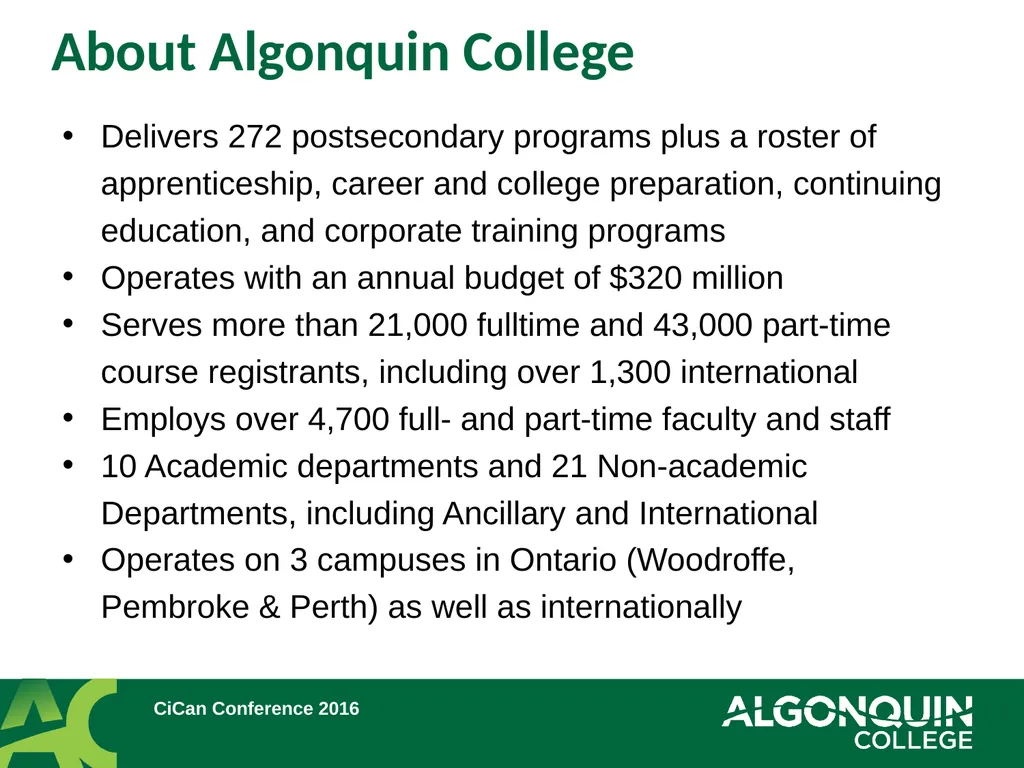
slide4. About Algonquin College Delivers 272 postsecondary programs plus a roster of apprenticeship, career and college preparation, continuing education, and corporate training programs
Operates with an annual budget of $320 million
Serves more than 21,000 fulltime and 43,000 part-time course registrants, including over 1,300 international
Employs over 4,700 full- and part-time faculty and staff
10 Academic departments and 21 Non-academic Departments, including Ancillary and International
Operates on 3 campuses in Ontario (Woodroffe, Pembroke & Perth) as well as internationally CiCan Conference 2016<br>
slide5. “Made at Algonquin” approach Define Audiences
Decide on Fundamentals
Allocation Methodology
Measurement
Timelines CiCan Conference 2016<br>
slide6. RCM and Algonquin CiCan Conference 2016 RCM is just a tool – one promoting transparency and accountability
We were looking to change the “norm” and share responsibility for fiscal sustainability
We did internal & external feasibility studies and examined the risks
Had wide internal stakeholder participation
Built internal principles of Fair, Transparent and Data informed decision making
Have a robust, cross-college leadership team
Took small, informed steps and kept exploring options and communicating<br>
slide7. Timelines Feasibility studies - 2013
Project for “made in Algonquin” model 2014-15
Stakeholder engagement - 2014-2015
First year effective April 1, 2015
Budgeted using RCM principles for FY 2016-17
First Customer Survey against SLA’s Fall 2016
Currently planning for Budget FY 2017-18 in full RCM model
Implementing formal budget feedback process CiCan Conference 2016<br>
slide8. Stakeholder Engagement 8<br>
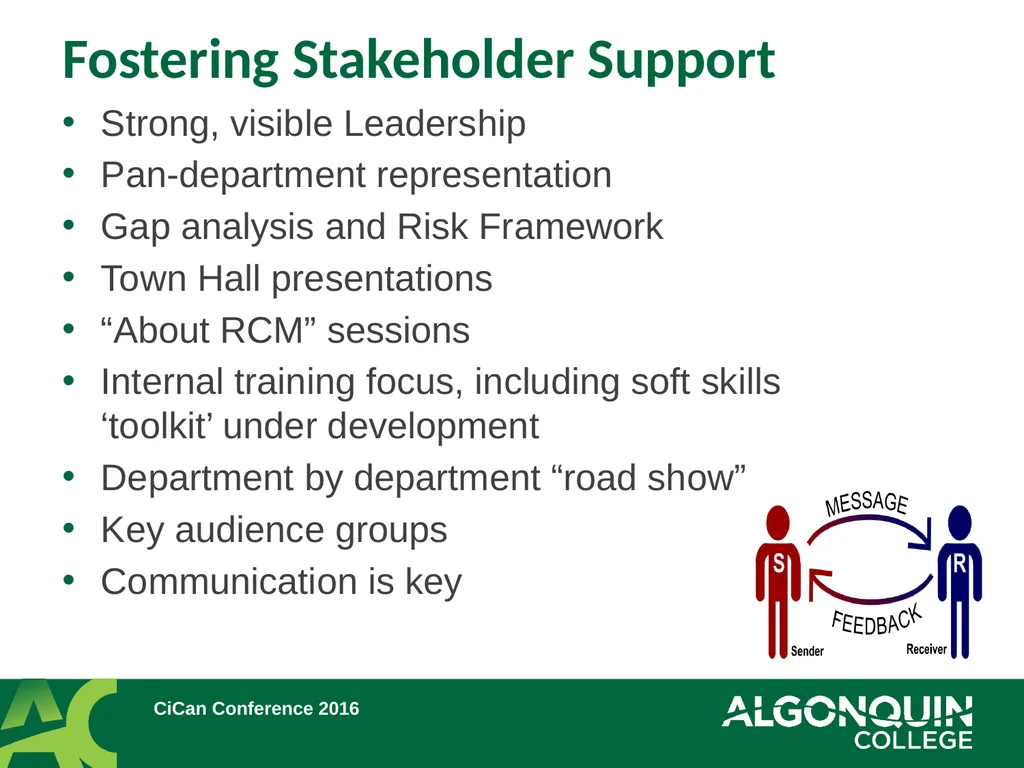
slide9. Fostering Stakeholder Support Strong, visible Leadership
Pan-department representation
Gap analysis and Risk Framework
Town Hall presentations
“About RCM” sessions
Internal training focus, including soft skills ‘toolkit’ under development
Department by department “road show”
Key audience groups
Communication is key CiCan Conference 2016<br>
slide10. Principles 10<br>
slide11. RCM Operating Principles The College operates under provincial regulations & laws.
RCM will be fair, transparent and data informed.
Common institutional practices will prevail
Common purpose & core values are KEY
College wide projects must still go forward and be supported.
College strives for 70/30 split in academic to non-academic expenses
All Departments use the central or corporate administration functions CiCan Conference 2016<br>
slide12. Accountability goals in RCM project charter: Assign financial responsibility to decision makers
Enhance authority of the Dean/Director level
Provide incentives for effective resource management & cost control
Create a budgetary structure that ties resources to performance
Improve budget forecasting and planning
Bring together responsibility, authority and accountability at the Dean/Director level
Decentralized decision making CiCan Conference 2016<br>
slide13. Accountability Framework Accountability Framework must reflect what a Dean or Director is accountable for
We chose Contribution Margin
Surpluses achieved are shared with the Department to incent budget success
Deficits realized will be required to be paid back by Deans and Directors
In both situations, final results will be adjusted to reflect non-controllable expenses CiCan Conference 2016<br>
slide14. Allocations 14<br>
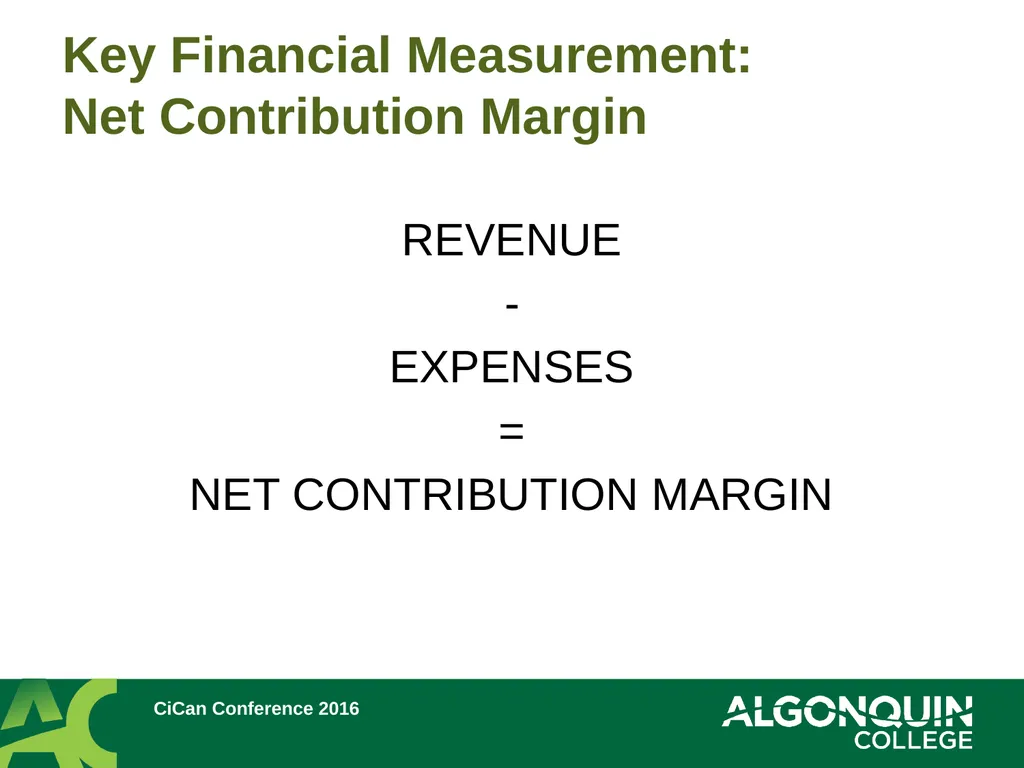
slide15. Key Financial Measurement: Net Contribution Margin REVENUE
-
EXPENSES
=
NET CONTRIBUTION MARGIN CiCan Conference 2016<br>
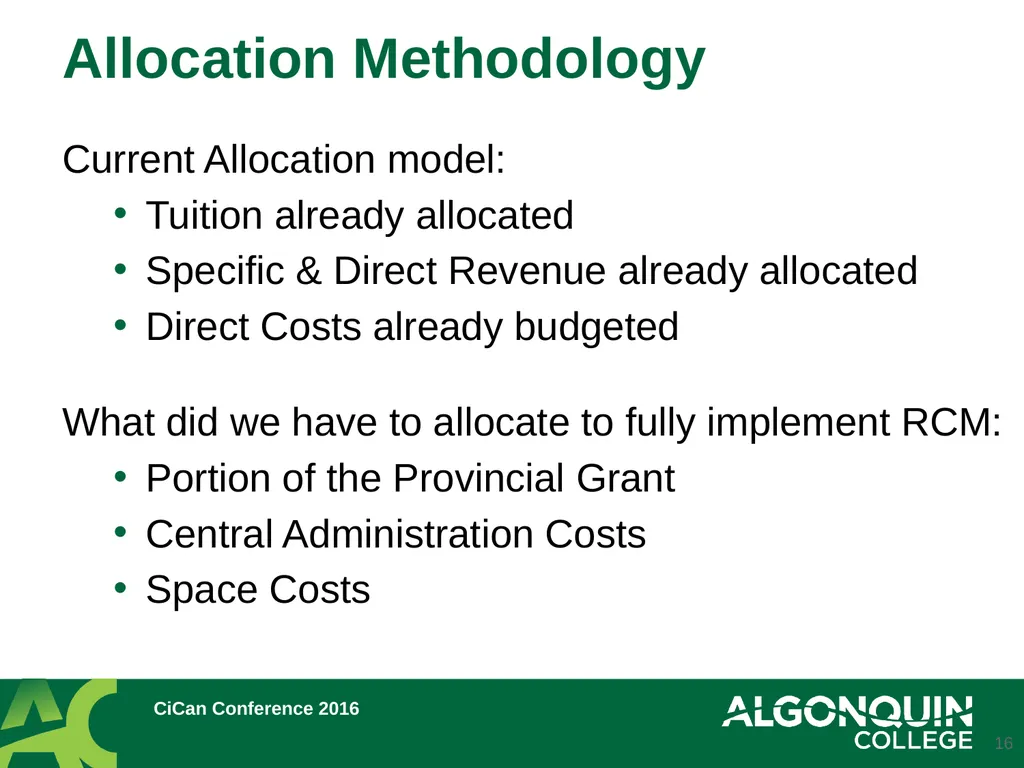
slide16. Allocation Methodology Current Allocation model:
Tuition already allocated
Specific & Direct Revenue already allocated
Direct Costs already budgeted
What did we have to allocate to fully implement RCM:
Portion of the Provincial Grant
Central Administration Costs
Space Costs CiCan Conference 2016 16<br>
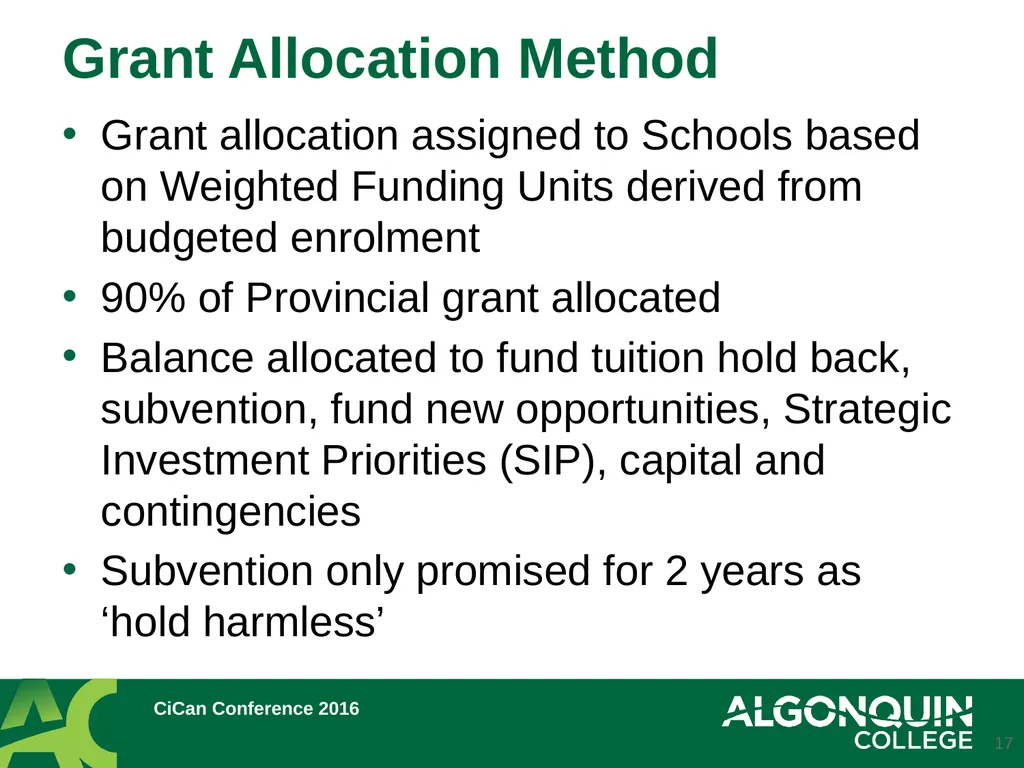
slide17. Grant Allocation Method Grant allocation assigned to Schools based on Weighted Funding Units derived from budgeted enrolment
90% of Provincial grant allocated
Balance allocated to fund tuition hold back, subvention, fund new opportunities, Strategic Investment Priorities (SIP), capital and contingencies
Subvention only promised for 2 years as ‘hold harmless’ CiCan Conference 2016 17<br>
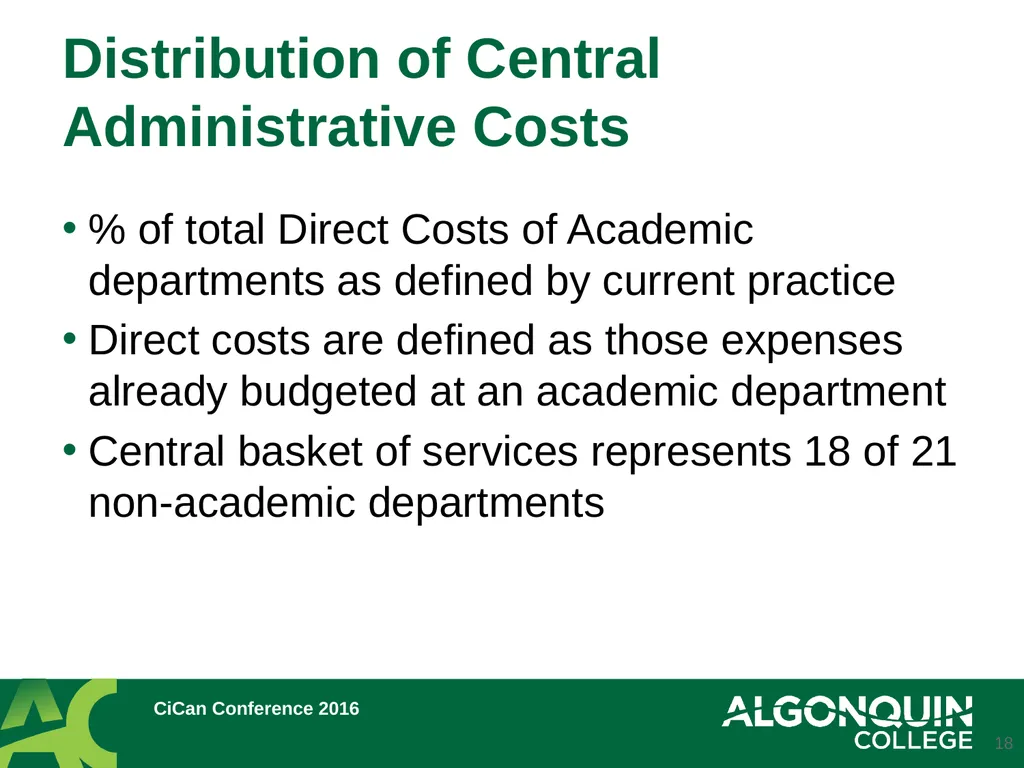
slide18. Distribution of Central Administrative Costs % of total Direct Costs of Academic departments as defined by current practice
Direct costs are defined as those expenses already budgeted at an academic department
Central basket of services represents 18 of 21 non-academic departments 18 CiCan Conference 2016<br>
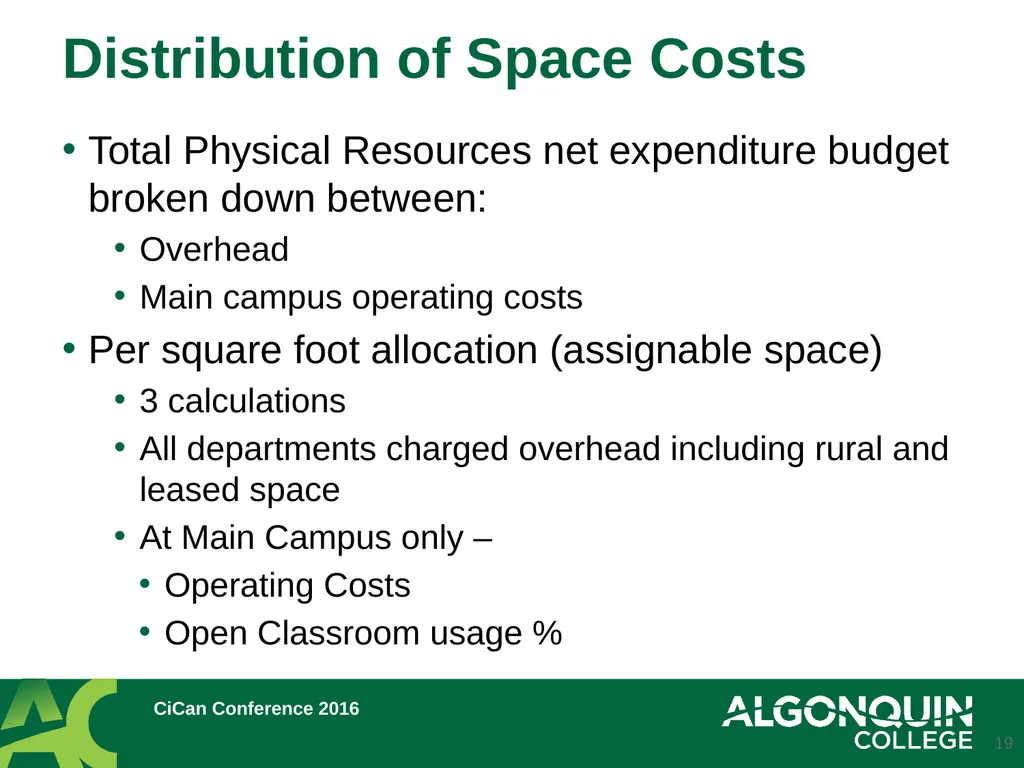
slide19. Distribution of Space Costs Total Physical Resources net expenditure budget broken down between:
Overhead
Main campus operating costs
Per square foot allocation (assignable space)
3 calculations
All departments charged overhead including rural and leased space
At Main Campus only –
Operating Costs
Open Classroom usage % CiCan Conference 2016 19<br>
slide20. Impact to date 20<br>
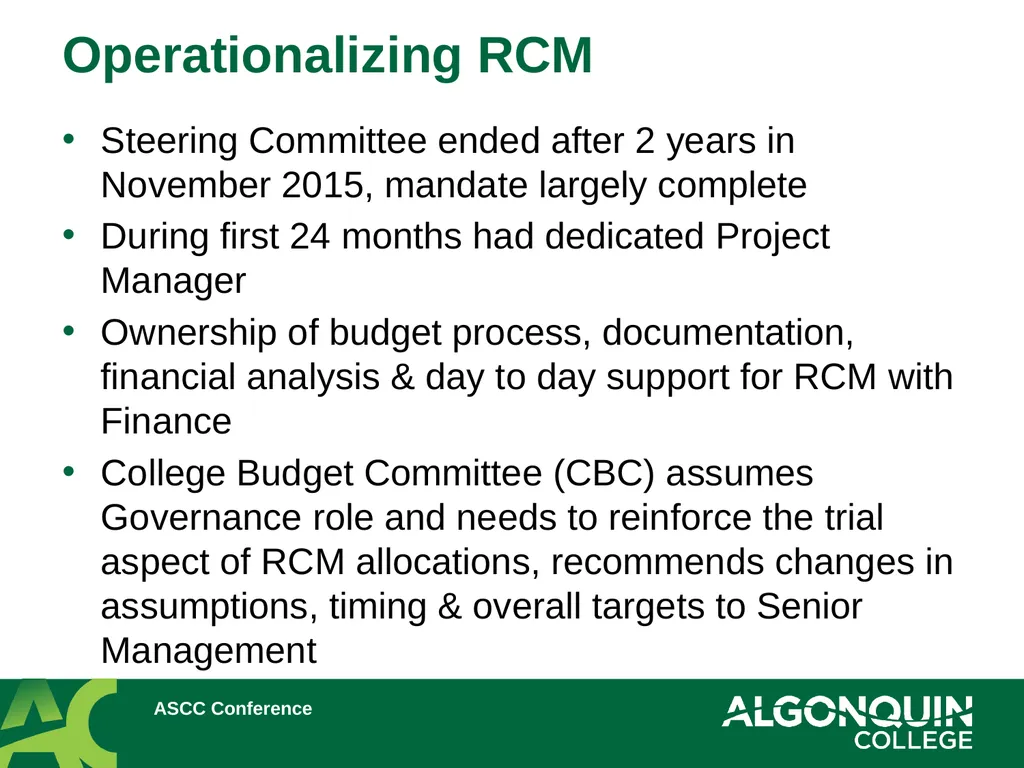
slide21. Operationalizing RCM Steering Committee ended after 2 years in November 2015, mandate largely complete
During first 24 months had dedicated Project Manager
Ownership of budget process, documentation, financial analysis & day to day support for RCM with Finance
College Budget Committee (CBC) assumes Governance role and needs to reinforce the trial aspect of RCM allocations, recommends changes in assumptions, timing & overall targets to Senior Management ASCC Conference<br>
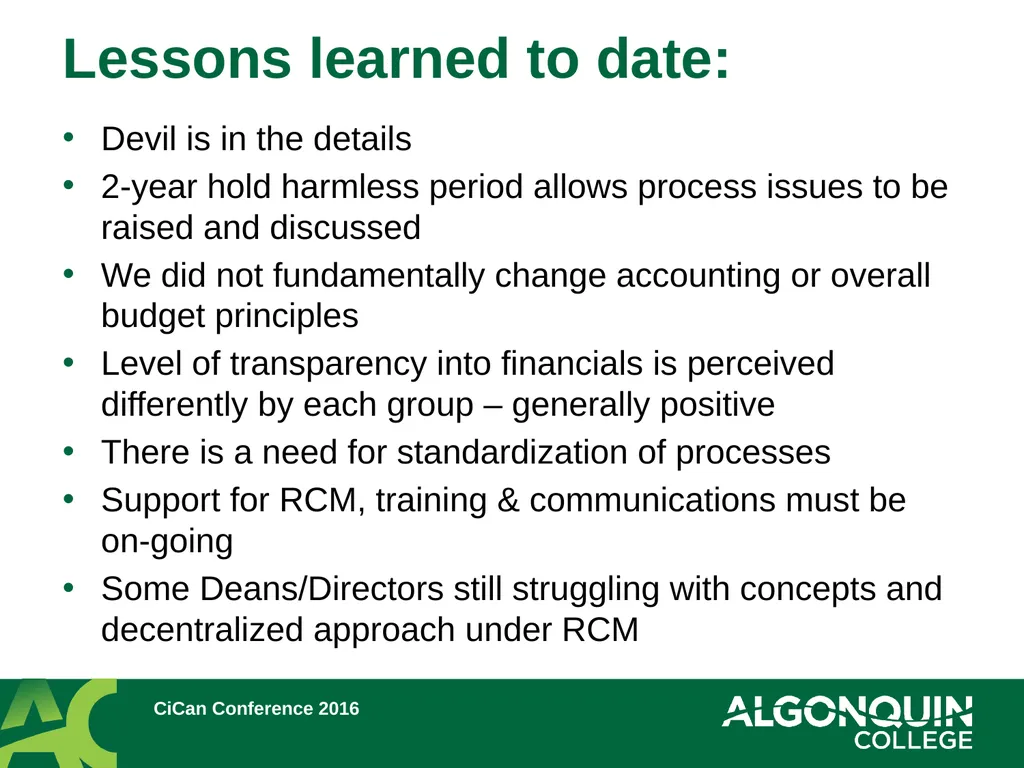
slide22. Lessons learned to date: Devil is in the details
2-year hold harmless period allows process issues to be raised and discussed
We did not fundamentally change accounting or overall budget principles
Level of transparency into financials is perceived differently by each group – generally positive
There is a need for standardization of processes
Support for RCM, training & communications must be on-going
Some Deans/Directors still struggling with concepts and decentralized approach under RCM CiCan Conference 2016<br>
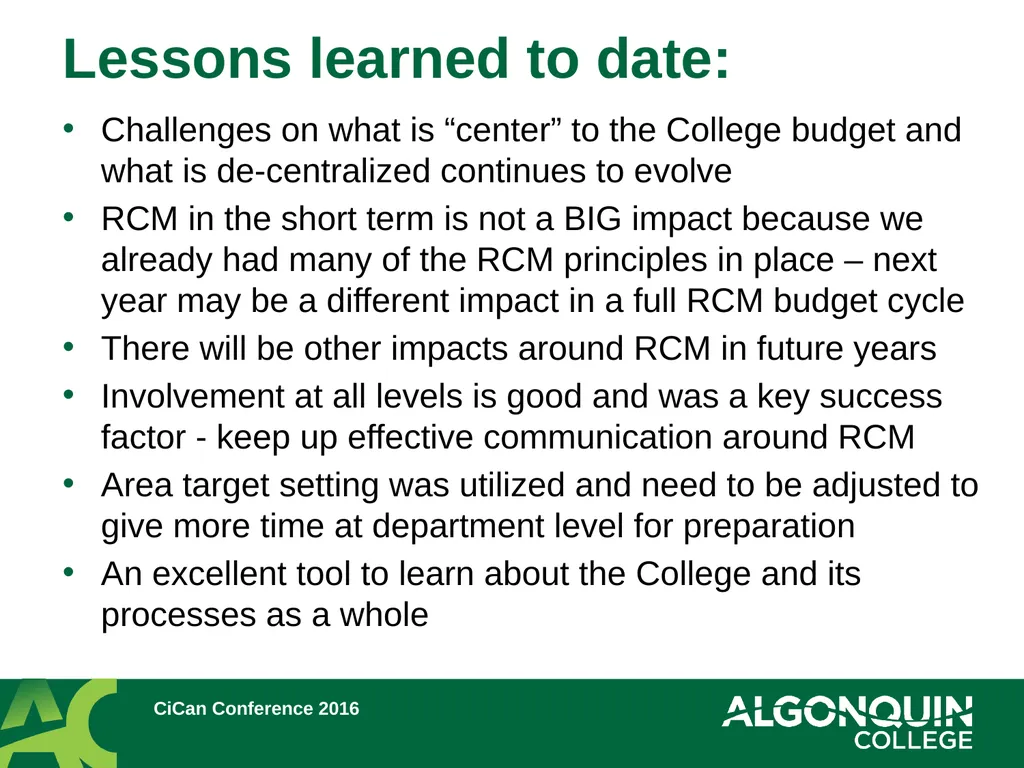
slide23. Lessons learned to date: Challenges on what is “center” to the College budget and what is de-centralized continues to evolve
RCM in the short term is not a BIG impact because we already had many of the RCM principles in place – next year may be a different impact in a full RCM budget cycle
There will be other impacts around RCM in future years
Involvement at all levels is good and was a key success factor - keep up effective communication around RCM
Area target setting was utilized and need to be adjusted to give more time at department level for preparation
An excellent tool to learn about the College and its processes as a whole CiCan Conference 2016<br>
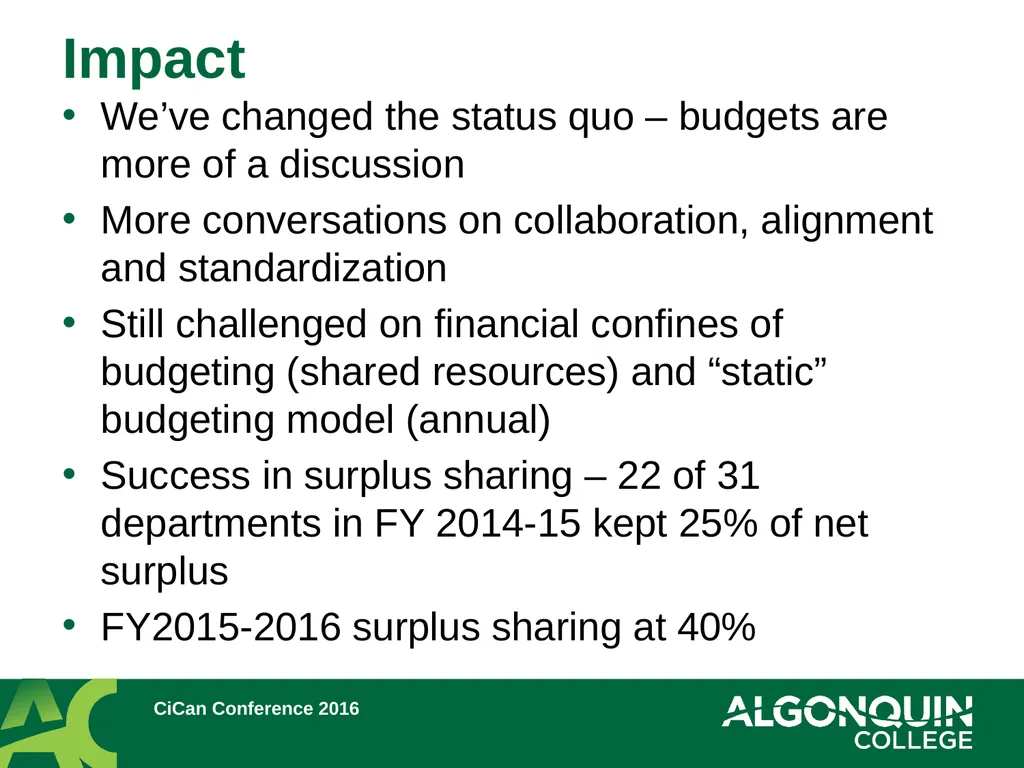
slide24. Impact We’ve changed the status quo – budgets are more of a discussion
More conversations on collaboration, alignment and standardization
Still challenged on financial confines of budgeting (shared resources) and “static” budgeting model (annual)
Success in surplus sharing – 22 of 31 departments in FY 2014-15 kept 25% of net surplus
FY2015-2016 surplus sharing at 40% CiCan Conference 2016<br>
slide25. Next Steps 25<br>
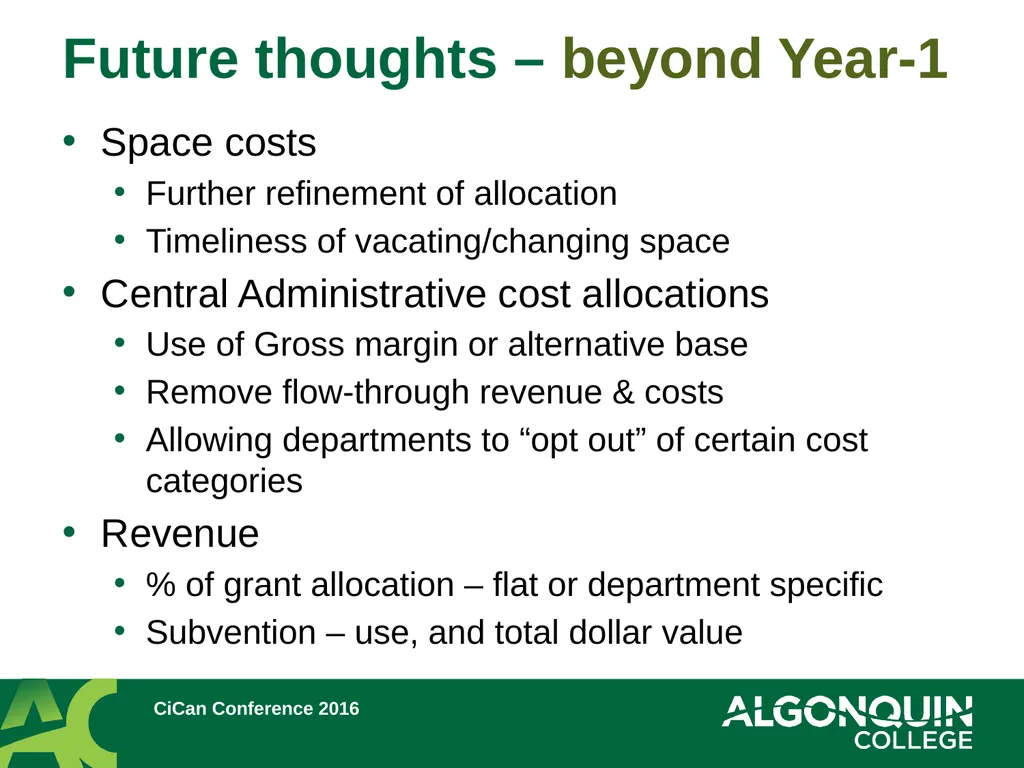
slide26. Future thoughts – beyond Year-1 Space costs
Further refinement of allocation
Timeliness of vacating/changing space
Central Administrative cost allocations
Use of Gross margin or alternative base
Remove flow-through revenue & costs
Allowing departments to “opt out” of certain cost categories
Revenue
% of grant allocation – flat or department specific
Subvention – use, and total dollar value CiCan Conference 2016<br>
slide27. CiCan Conference 2016 Stay tuned! Further updates next year!
Comments and Questions<br>

Algonquin’s Transition to
Responsibility Center Management CiCan Conference 2016<br>
slide2. Incredible Journey – Today’s Presentation CiCan Conference 2016 Background
Stakeholder engagement
Allocations – why and how
Impact to Date
Next Steps<br>
slide3. background 3<br>
slide4. About Algonquin College Delivers 272 postsecondary programs plus a roster of apprenticeship, career and college preparation, continuing education, and corporate training programs
Operates with an annual budget of $320 million
Serves more than 21,000 fulltime and 43,000 part-time course registrants, including over 1,300 international
Employs over 4,700 full- and part-time faculty and staff
10 Academic departments and 21 Non-academic Departments, including Ancillary and International
Operates on 3 campuses in Ontario (Woodroffe, Pembroke & Perth) as well as internationally CiCan Conference 2016<br>
slide5. “Made at Algonquin” approach Define Audiences
Decide on Fundamentals
Allocation Methodology
Measurement
Timelines CiCan Conference 2016<br>
slide6. RCM and Algonquin CiCan Conference 2016 RCM is just a tool – one promoting transparency and accountability
We were looking to change the “norm” and share responsibility for fiscal sustainability
We did internal & external feasibility studies and examined the risks
Had wide internal stakeholder participation
Built internal principles of Fair, Transparent and Data informed decision making
Have a robust, cross-college leadership team
Took small, informed steps and kept exploring options and communicating<br>
slide7. Timelines Feasibility studies - 2013
Project for “made in Algonquin” model 2014-15
Stakeholder engagement - 2014-2015
First year effective April 1, 2015
Budgeted using RCM principles for FY 2016-17
First Customer Survey against SLA’s Fall 2016
Currently planning for Budget FY 2017-18 in full RCM model
Implementing formal budget feedback process CiCan Conference 2016<br>
slide8. Stakeholder Engagement 8<br>
slide9. Fostering Stakeholder Support Strong, visible Leadership
Pan-department representation
Gap analysis and Risk Framework
Town Hall presentations
“About RCM” sessions
Internal training focus, including soft skills ‘toolkit’ under development
Department by department “road show”
Key audience groups
Communication is key CiCan Conference 2016<br>
slide10. Principles 10<br>
slide11. RCM Operating Principles The College operates under provincial regulations & laws.
RCM will be fair, transparent and data informed.
Common institutional practices will prevail
Common purpose & core values are KEY
College wide projects must still go forward and be supported.
College strives for 70/30 split in academic to non-academic expenses
All Departments use the central or corporate administration functions CiCan Conference 2016<br>
slide12. Accountability goals in RCM project charter: Assign financial responsibility to decision makers
Enhance authority of the Dean/Director level
Provide incentives for effective resource management & cost control
Create a budgetary structure that ties resources to performance
Improve budget forecasting and planning
Bring together responsibility, authority and accountability at the Dean/Director level
Decentralized decision making CiCan Conference 2016<br>
slide13. Accountability Framework Accountability Framework must reflect what a Dean or Director is accountable for
We chose Contribution Margin
Surpluses achieved are shared with the Department to incent budget success
Deficits realized will be required to be paid back by Deans and Directors
In both situations, final results will be adjusted to reflect non-controllable expenses CiCan Conference 2016<br>
slide14. Allocations 14<br>
slide15. Key Financial Measurement: Net Contribution Margin REVENUE
-
EXPENSES
=
NET CONTRIBUTION MARGIN CiCan Conference 2016<br>
slide16. Allocation Methodology Current Allocation model:
Tuition already allocated
Specific & Direct Revenue already allocated
Direct Costs already budgeted
What did we have to allocate to fully implement RCM:
Portion of the Provincial Grant
Central Administration Costs
Space Costs CiCan Conference 2016 16<br>
slide17. Grant Allocation Method Grant allocation assigned to Schools based on Weighted Funding Units derived from budgeted enrolment
90% of Provincial grant allocated
Balance allocated to fund tuition hold back, subvention, fund new opportunities, Strategic Investment Priorities (SIP), capital and contingencies
Subvention only promised for 2 years as ‘hold harmless’ CiCan Conference 2016 17<br>
slide18. Distribution of Central Administrative Costs % of total Direct Costs of Academic departments as defined by current practice
Direct costs are defined as those expenses already budgeted at an academic department
Central basket of services represents 18 of 21 non-academic departments 18 CiCan Conference 2016<br>
slide19. Distribution of Space Costs Total Physical Resources net expenditure budget broken down between:
Overhead
Main campus operating costs
Per square foot allocation (assignable space)
3 calculations
All departments charged overhead including rural and leased space
At Main Campus only –
Operating Costs
Open Classroom usage % CiCan Conference 2016 19<br>
slide20. Impact to date 20<br>
slide21. Operationalizing RCM Steering Committee ended after 2 years in November 2015, mandate largely complete
During first 24 months had dedicated Project Manager
Ownership of budget process, documentation, financial analysis & day to day support for RCM with Finance
College Budget Committee (CBC) assumes Governance role and needs to reinforce the trial aspect of RCM allocations, recommends changes in assumptions, timing & overall targets to Senior Management ASCC Conference<br>
slide22. Lessons learned to date: Devil is in the details
2-year hold harmless period allows process issues to be raised and discussed
We did not fundamentally change accounting or overall budget principles
Level of transparency into financials is perceived differently by each group – generally positive
There is a need for standardization of processes
Support for RCM, training & communications must be on-going
Some Deans/Directors still struggling with concepts and decentralized approach under RCM CiCan Conference 2016<br>
slide23. Lessons learned to date: Challenges on what is “center” to the College budget and what is de-centralized continues to evolve
RCM in the short term is not a BIG impact because we already had many of the RCM principles in place – next year may be a different impact in a full RCM budget cycle
There will be other impacts around RCM in future years
Involvement at all levels is good and was a key success factor - keep up effective communication around RCM
Area target setting was utilized and need to be adjusted to give more time at department level for preparation
An excellent tool to learn about the College and its processes as a whole CiCan Conference 2016<br>
slide24. Impact We’ve changed the status quo – budgets are more of a discussion
More conversations on collaboration, alignment and standardization
Still challenged on financial confines of budgeting (shared resources) and “static” budgeting model (annual)
Success in surplus sharing – 22 of 31 departments in FY 2014-15 kept 25% of net surplus
FY2015-2016 surplus sharing at 40% CiCan Conference 2016<br>
slide25. Next Steps 25<br>
slide26. Future thoughts – beyond Year-1 Space costs
Further refinement of allocation
Timeliness of vacating/changing space
Central Administrative cost allocations
Use of Gross margin or alternative base
Remove flow-through revenue & costs
Allowing departments to “opt out” of certain cost categories
Revenue
% of grant allocation – flat or department specific
Subvention – use, and total dollar value CiCan Conference 2016<br>
slide27. CiCan Conference 2016 Stay tuned! Further updates next year!
Comments and Questions<br>