
Indicator 5: Education Environments for Students

Description: Indicator 5: Education Environments for Students with IEPs Ages 5 (enrolled in kindergarten) 21 1 Legal Requirement IDEA (2004) says that all children with disabilities, as much as possible, must be educated with children who are not
Related Topics
Download Presentation
"Indicator 5: Education Environments for Students" is the property of its rightful owner. Permission is granted to download and print the materials on this website for personal, non-commercial use only, and to display it on your personal computer provided you do not modify the materials and that you retain all copyright notices contained in the materials. By downloading content from our website, you accept the terms of this agreement.
Presentation Transcript
slide1. Indicator 5:
Education Environments for
Students with IEPs
Ages 5 (enrolled in kindergarten) – 21 1<br>
slide2. Legal Requirement IDEA (2004) says that all children with disabilities,
as much as possible, must be educated with children who are not disabled. 2<br>
slide3. Least Restrictive Environment (LRE) What educational environments are students with disabilities a part of, and do they have meaningful access to the general curriculum and the life of the school? 3<br>
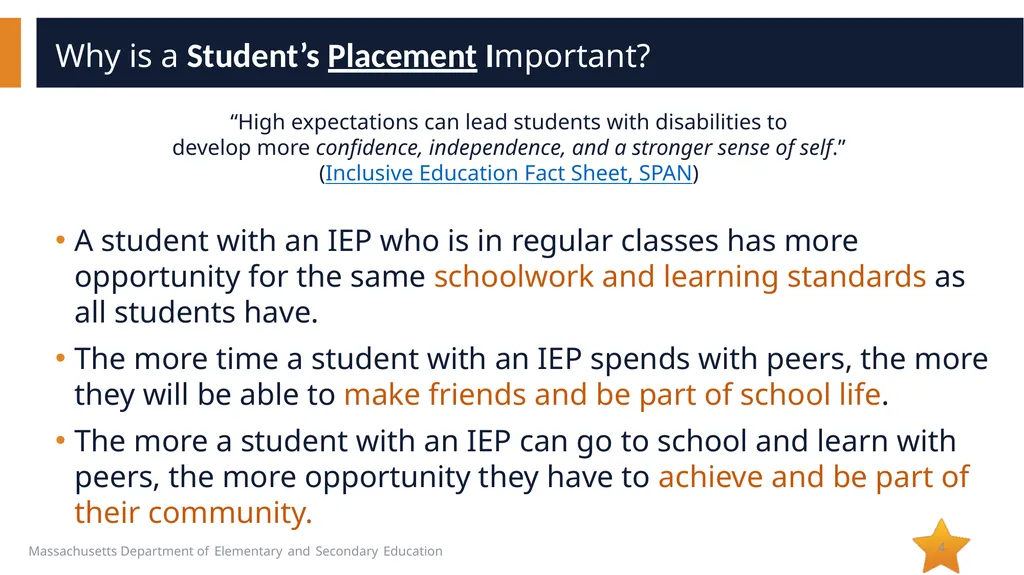
slide4. Why is a Student’s Placement Important? “High expectations can lead students with disabilities to develop more confidence, independence, and a stronger sense of self.” (Inclusive Education Fact Sheet, SPAN) A student with an IEP who is in regular classes has more opportunity for the same schoolwork and learning standards as all students have.
The more time a student with an IEP spends with peers, the more they will be able to make friends and be part of school life.
The more a student with an IEP can go to school and learn with peers, the more opportunity they have to achieve and be part of their community. 4<br>
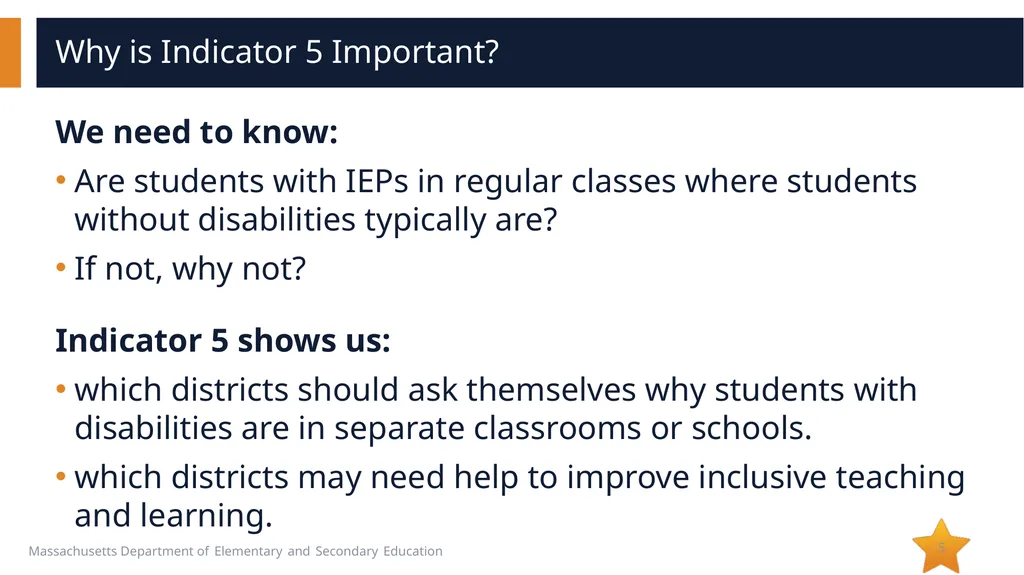
slide5. Why is Indicator 5 Important? We need to know:
Are students with IEPs in regular classes where students without disabilities typically are?
If not, why not?
Indicator 5 shows us:
which districts should ask themselves why students with disabilities are in separate classrooms or schools.
which districts may need help to improve inclusive teaching and learning. 5<br>
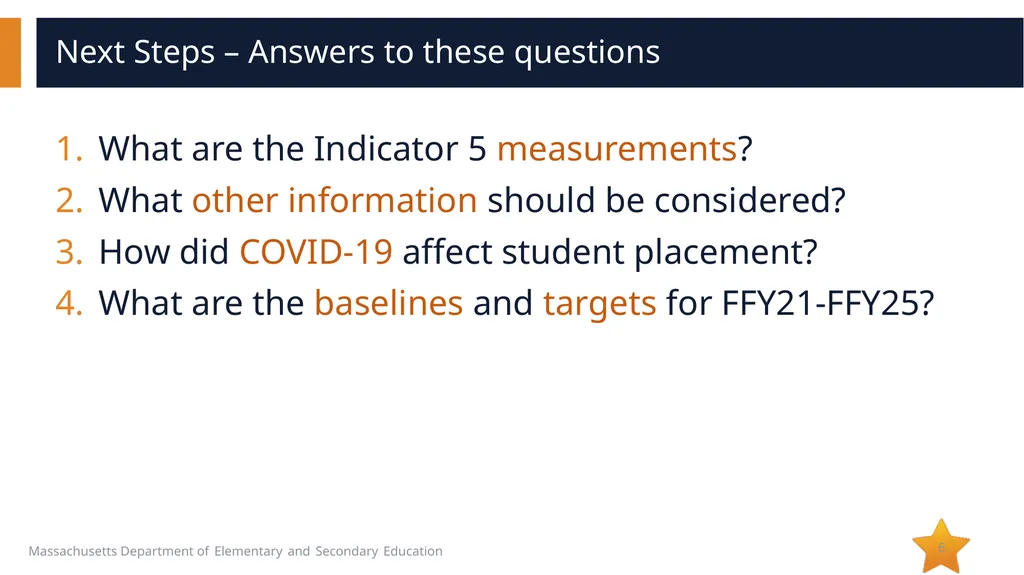
slide6. Next Steps – Answers to these questions What are the Indicator 5 measurements?
What other information should be considered?
How did COVID-19 affect student placement?
What are the baselines and targets for FFY21-FFY25? 6<br>
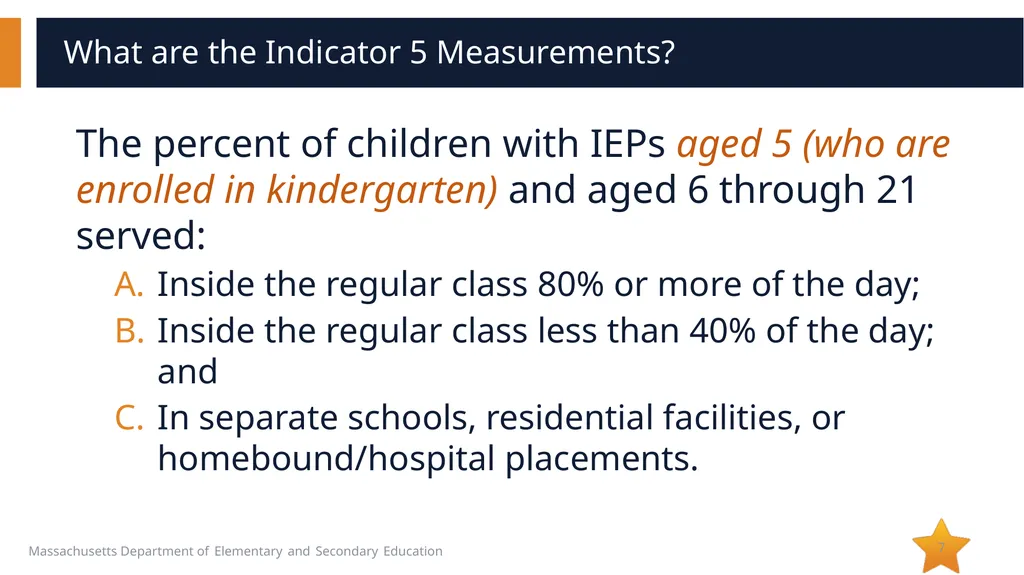
slide7. What are the Indicator 5 Measurements? 7 The percent of children with IEPs aged 5 (who are enrolled in kindergarten) and aged 6 through 21 served:
Inside the regular class 80% or more of the day;
Inside the regular class less than 40% of the day; and
In separate schools, residential facilities, or homebound/hospital placements.<br>
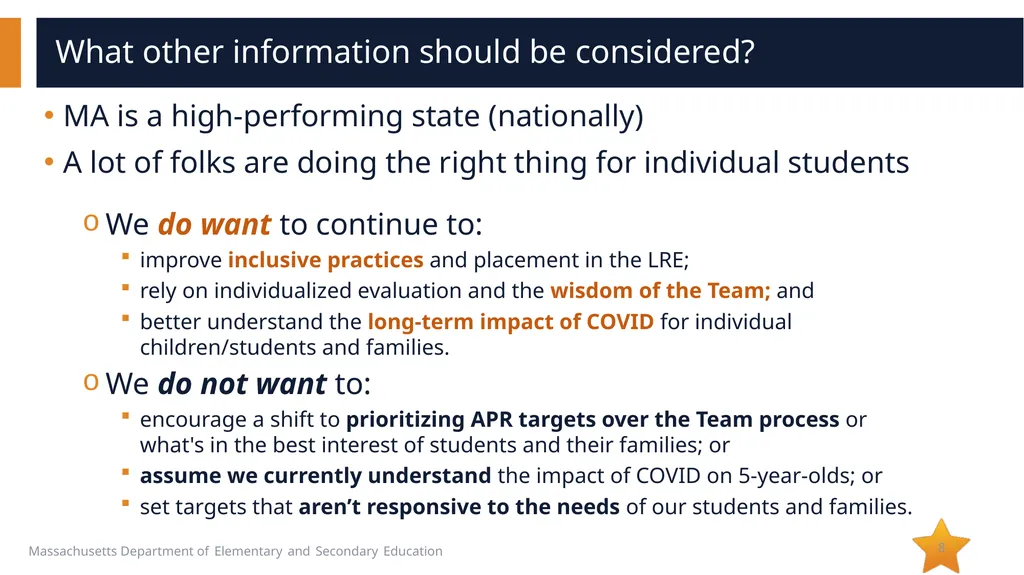
slide8. What other information should be considered? MA is a high-performing state (nationally)
A lot of folks are doing the right thing for individual students
We do want to continue to:
improve inclusive practices and placement in the LRE;
rely on individualized evaluation and the wisdom of the Team; and
better understand the long-term impact of COVID for individual children/students and families.
We do not want to:
encourage a shift to prioritizing APR targets over the Team process or what's in the best interest of students and their families; or
assume we currently understand the impact of COVID on 5-year-olds; or
set targets that aren’t responsive to the needs of our students and families. 8<br>
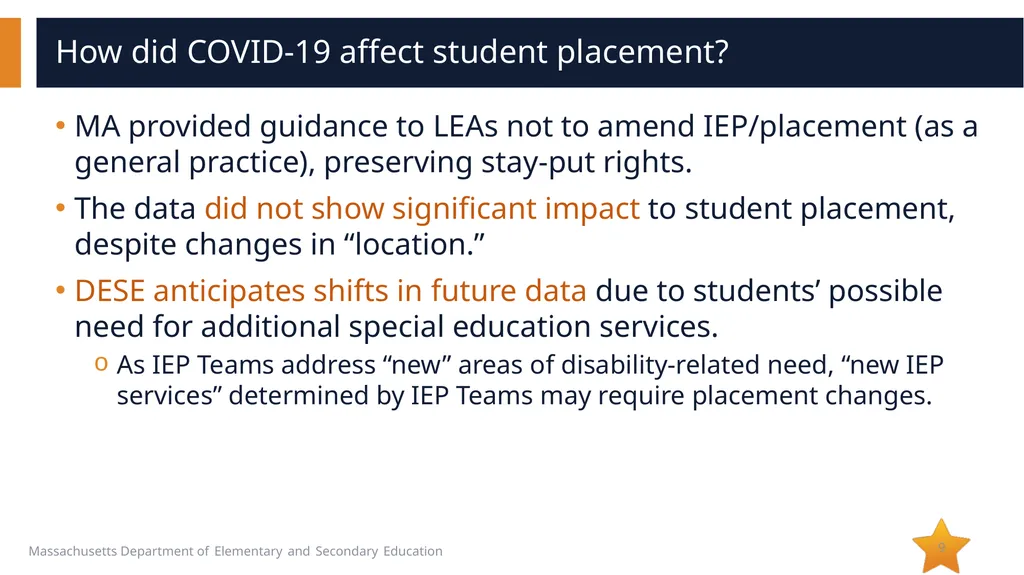
slide9. How did COVID-19 affect student placement? MA provided guidance to LEAs not to amend IEP/placement (as a general practice), preserving stay-put rights.
The data did not show significant impact to student placement, despite changes in “location.”
DESE anticipates shifts in future data due to students’ possible need for additional special education services.
As IEP Teams address “new” areas of disability-related need, “new IEP services” determined by IEP Teams may require placement changes. 9<br>
slide10. What are the Baseline and Targets? Baseline: A starting place used to compare new data and measure progress in future years.
Targets: Goals for improvement and “flags” for self-assessment. 10<br>
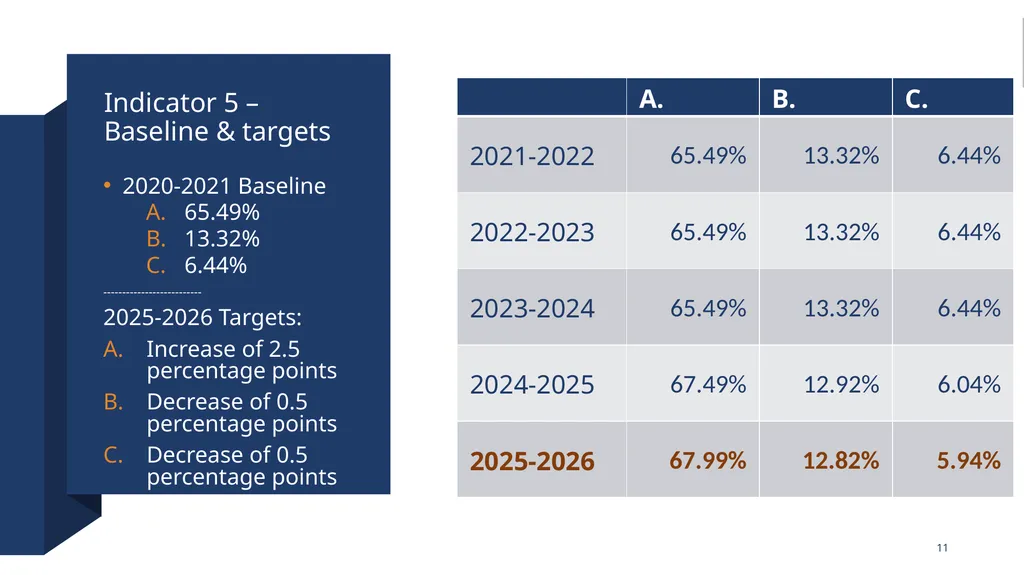
slide11. Indicator 5 – Baseline & targets 2020-2021 Baseline
65.49%
13.32%
6.44%
--------------------------
2025-2026 Targets:
Increase of 2.5 percentage points
Decrease of 0.5 percentage points
Decrease of 0.5 percentage points 11<br>
slide2. Legal Requirement IDEA (2004) says that all children with disabilities,
as much as possible, must be educated with children who are not disabled. 2<br>
slide3. Least Restrictive Environment (LRE) What educational environments are students with disabilities a part of, and do they have meaningful access to the general curriculum and the life of the school? 3<br>
slide4. Why is a Student’s Placement Important? “High expectations can lead students with disabilities to develop more confidence, independence, and a stronger sense of self.” (Inclusive Education Fact Sheet, SPAN) A student with an IEP who is in regular classes has more opportunity for the same schoolwork and learning standards as all students have.
The more time a student with an IEP spends with peers, the more they will be able to make friends and be part of school life.
The more a student with an IEP can go to school and learn with peers, the more opportunity they have to achieve and be part of their community. 4<br>
slide5. Why is Indicator 5 Important? We need to know:
Are students with IEPs in regular classes where students without disabilities typically are?
If not, why not?
Indicator 5 shows us:
which districts should ask themselves why students with disabilities are in separate classrooms or schools.
which districts may need help to improve inclusive teaching and learning. 5<br>
slide6. Next Steps – Answers to these questions What are the Indicator 5 measurements?
What other information should be considered?
How did COVID-19 affect student placement?
What are the baselines and targets for FFY21-FFY25? 6<br>
slide7. What are the Indicator 5 Measurements? 7 The percent of children with IEPs aged 5 (who are enrolled in kindergarten) and aged 6 through 21 served:
Inside the regular class 80% or more of the day;
Inside the regular class less than 40% of the day; and
In separate schools, residential facilities, or homebound/hospital placements.<br>
slide8. What other information should be considered? MA is a high-performing state (nationally)
A lot of folks are doing the right thing for individual students
We do want to continue to:
improve inclusive practices and placement in the LRE;
rely on individualized evaluation and the wisdom of the Team; and
better understand the long-term impact of COVID for individual children/students and families.
We do not want to:
encourage a shift to prioritizing APR targets over the Team process or what's in the best interest of students and their families; or
assume we currently understand the impact of COVID on 5-year-olds; or
set targets that aren’t responsive to the needs of our students and families. 8<br>
slide9. How did COVID-19 affect student placement? MA provided guidance to LEAs not to amend IEP/placement (as a general practice), preserving stay-put rights.
The data did not show significant impact to student placement, despite changes in “location.”
DESE anticipates shifts in future data due to students’ possible need for additional special education services.
As IEP Teams address “new” areas of disability-related need, “new IEP services” determined by IEP Teams may require placement changes. 9<br>
slide10. What are the Baseline and Targets? Baseline: A starting place used to compare new data and measure progress in future years.
Targets: Goals for improvement and “flags” for self-assessment. 10<br>
slide11. Indicator 5 – Baseline & targets 2020-2021 Baseline
65.49%
13.32%
6.44%
--------------------------
2025-2026 Targets:
Increase of 2.5 percentage points
Decrease of 0.5 percentage points
Decrease of 0.5 percentage points 11<br>