Indirect Costs Mark W. Stout, MBA Branch Chief Indirect Cost Services Division (ICSD) Interior Business Center (IBC) U.S. Department of Interior (DOI) Agenda General Principles Uniform Guidance Direct, Indirect, Unallowable, Exclusions
Related Topics
Share
Embed code
Download this presentation From Below
"Indirect Costs Mark W. Stout, MBA Branch Chief" is the property of its rightful owner. Permission is granted to
download and print the materials on this website for personal, non-commercial use only, and to display it
on your personal computer provided you do not modify the materials and that you retain all copyright
notices contained in the materials. By downloading content from our website, you accept the terms of this
agreement.
Presentation Transcript
01
Indirect Costs Mark W. Stout, MBA Branch Chief Indirect Cost Services Division (ICSD)
Interior Business Center (IBC)
U.S. Department of Interior (DOI)<br>
02
Agenda General Principles
Uniform Guidance
Direct, Indirect, Unallowable, Exclusions
Distribution Base
Types of Rates
Indirect Cost Rate Computation
Fixed Carryforward Rates
Indirect Cost Rate Proposal Submission
Web Site References<br>
03
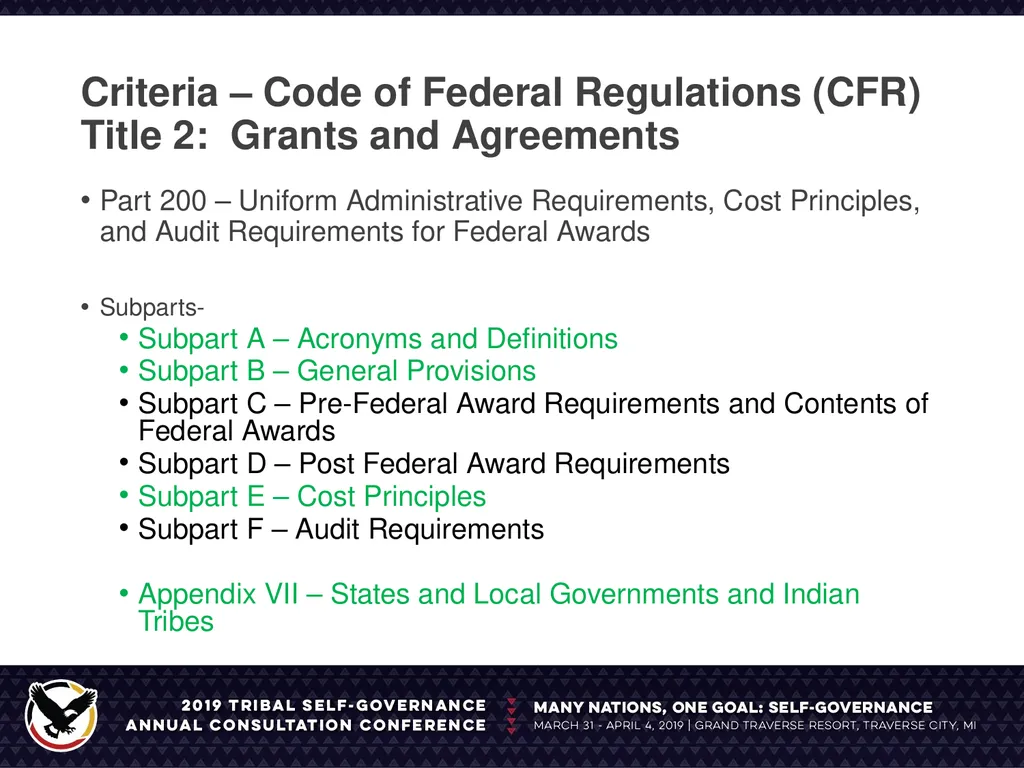
Criteria – Code of Federal Regulations (CFR) Title 2: Grants and Agreements Part 200 – Uniform Administrative Requirements, Cost Principles, and Audit Requirements for Federal Awards
Subparts-
Subpart A – Acronyms and Definitions
Subpart B – General Provisions
Subpart C – Pre-Federal Award Requirements and Contents of Federal Awards
Subpart D – Post Federal Award Requirements
Subpart E – Cost Principles
Subpart F – Audit Requirements
Appendix VII – States and Local Governments and Indian Tribes<br>
04
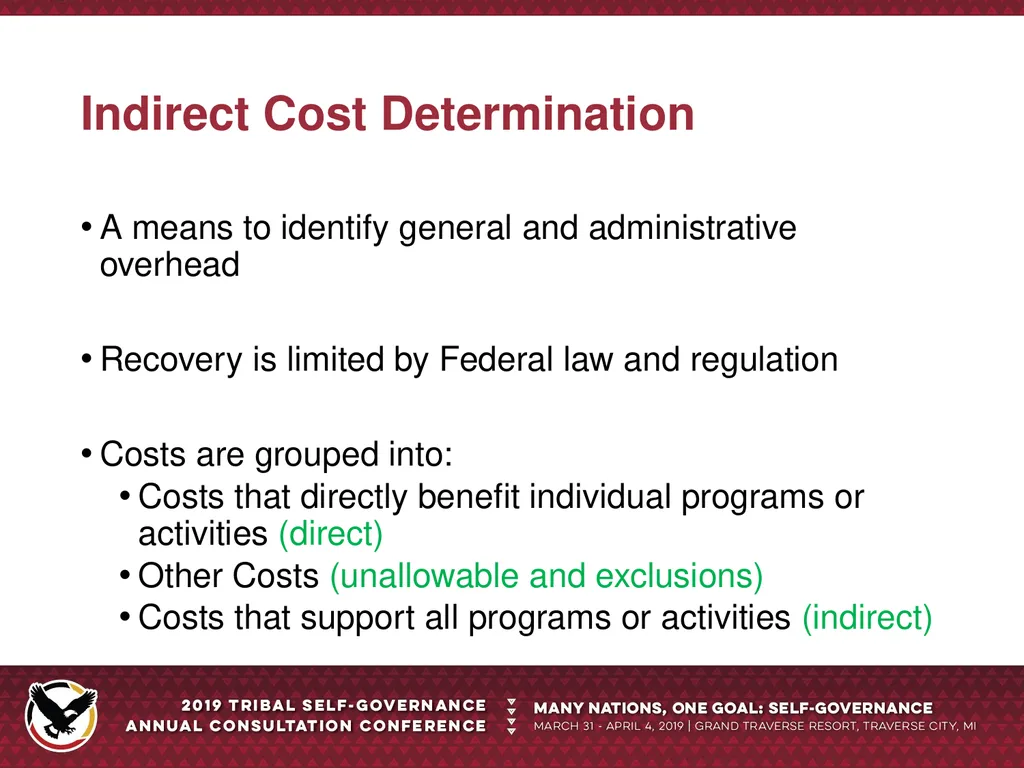
Indirect Cost Determination A means to identify general and administrative overhead
Recovery is limited by Federal law and regulation
Costs are grouped into:
Costs that directly benefit individual programs or activities (direct)
Other Costs (unallowable and exclusions)
Costs that support all programs or activities (indirect)<br>
05
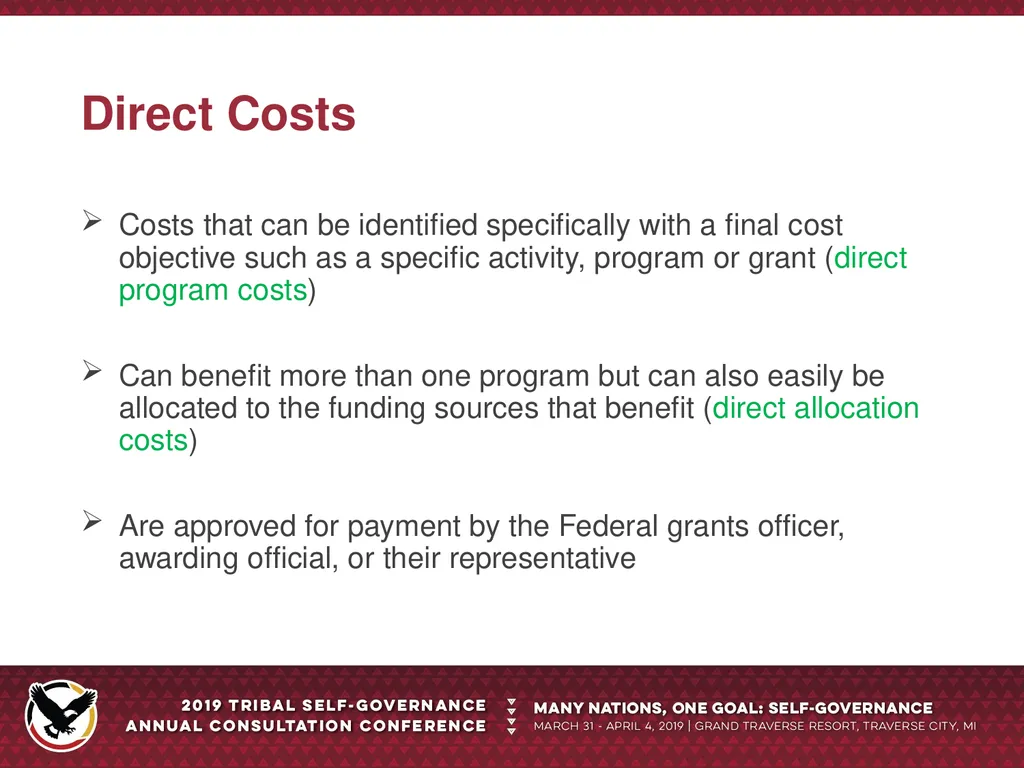
Direct Costs Costs that can be identified specifically with a final cost objective such as a specific activity, program or grant (direct program costs)
Can benefit more than one program but can also easily be allocated to the funding sources that benefit (direct allocation costs)
Are approved for payment by the Federal grants officer, awarding official, or their representative<br>
06
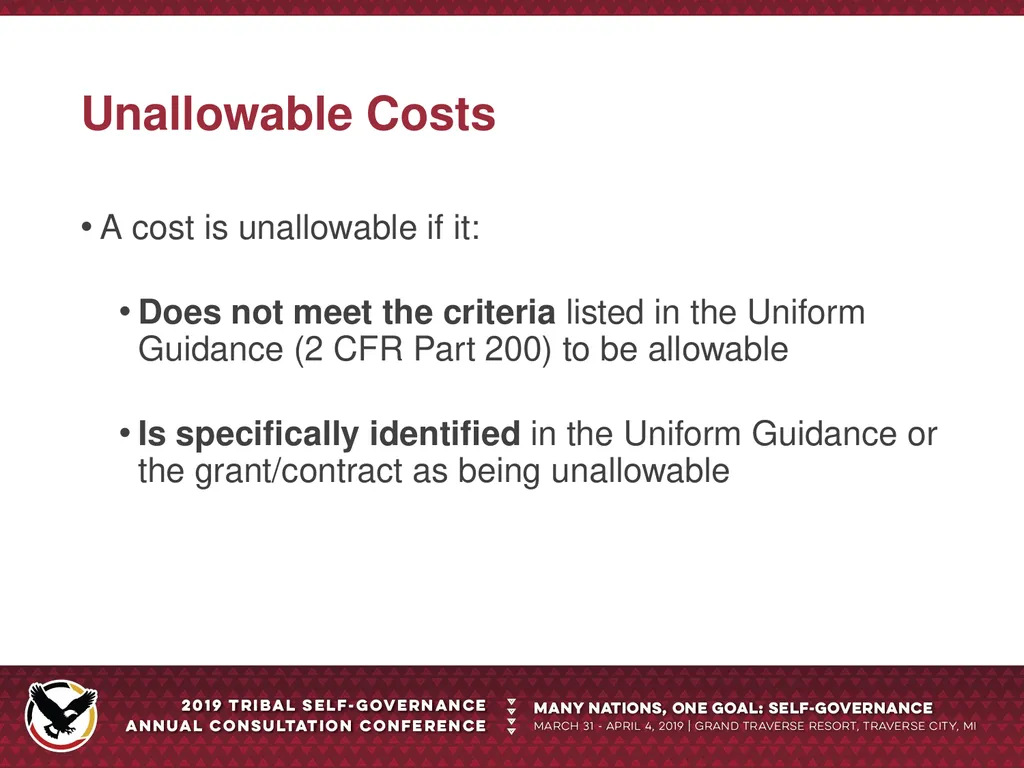
Unallowable Costs A cost is unallowable if it:
Does not meet the criteria listed in the Uniform Guidance (2 CFR Part 200) to be allowable
Is specifically identified in the Uniform Guidance or the grant/contract as being unallowable<br>
07
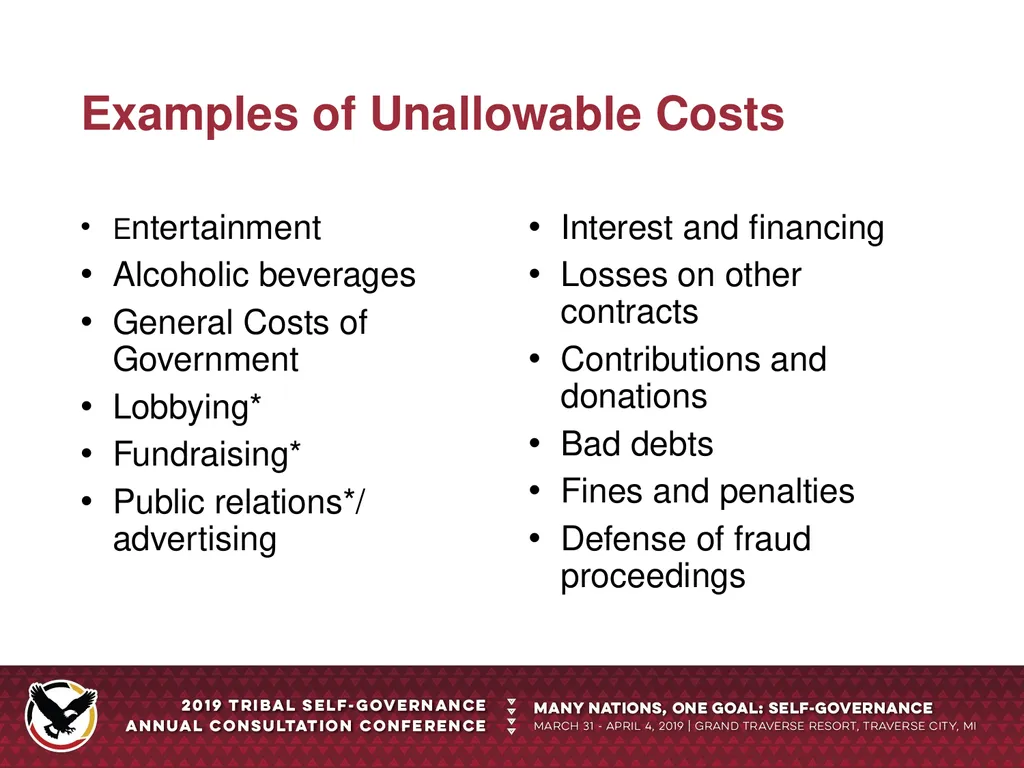
Examples of Unallowable Costs Entertainment
Alcoholic beverages
General Costs of Government
Lobbying*
Fundraising*
Public relations*/ advertising Interest and financing
Losses on other contracts
Contributions and donations
Bad debts
Fines and penalties
Defense of fraud proceedings<br>
08
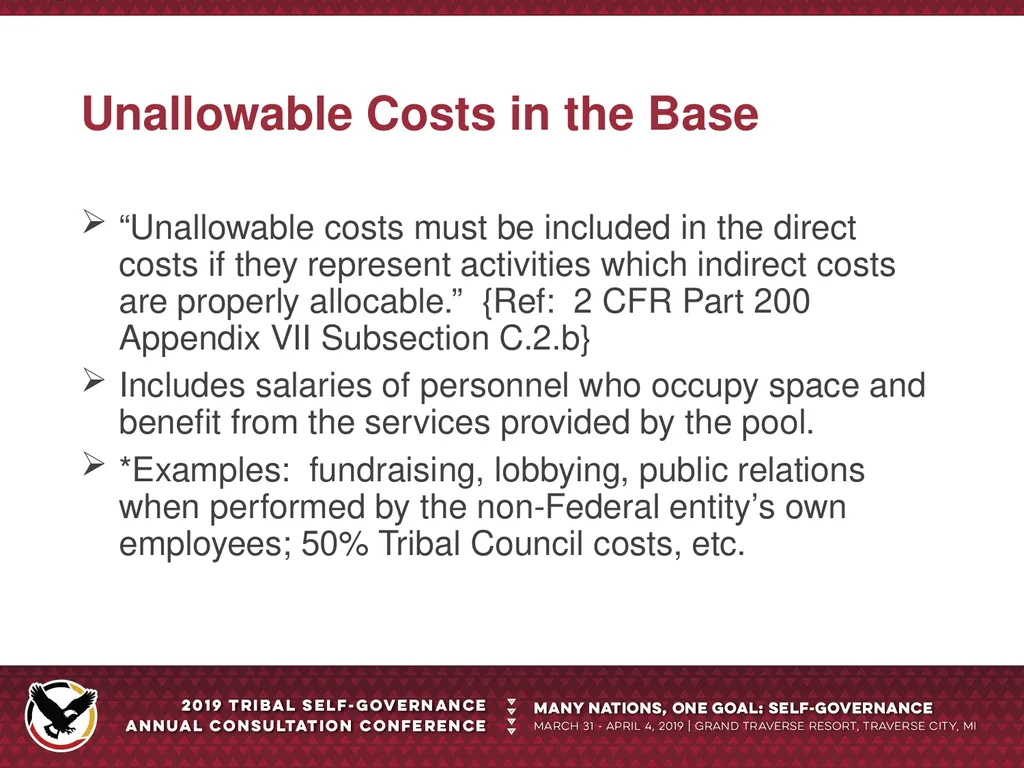
Unallowable Costs in the Base “Unallowable costs must be included in the direct costs if they represent activities which indirect costs are properly allocable.” {Ref: 2 CFR Part 200 Appendix VII Subsection C.2.b}
Includes salaries of personnel who occupy space and benefit from the services provided by the pool.
*Examples: fundraising, lobbying, public relations when performed by the non-Federal entity’s own employees; 50% Tribal Council costs, etc.<br>
09
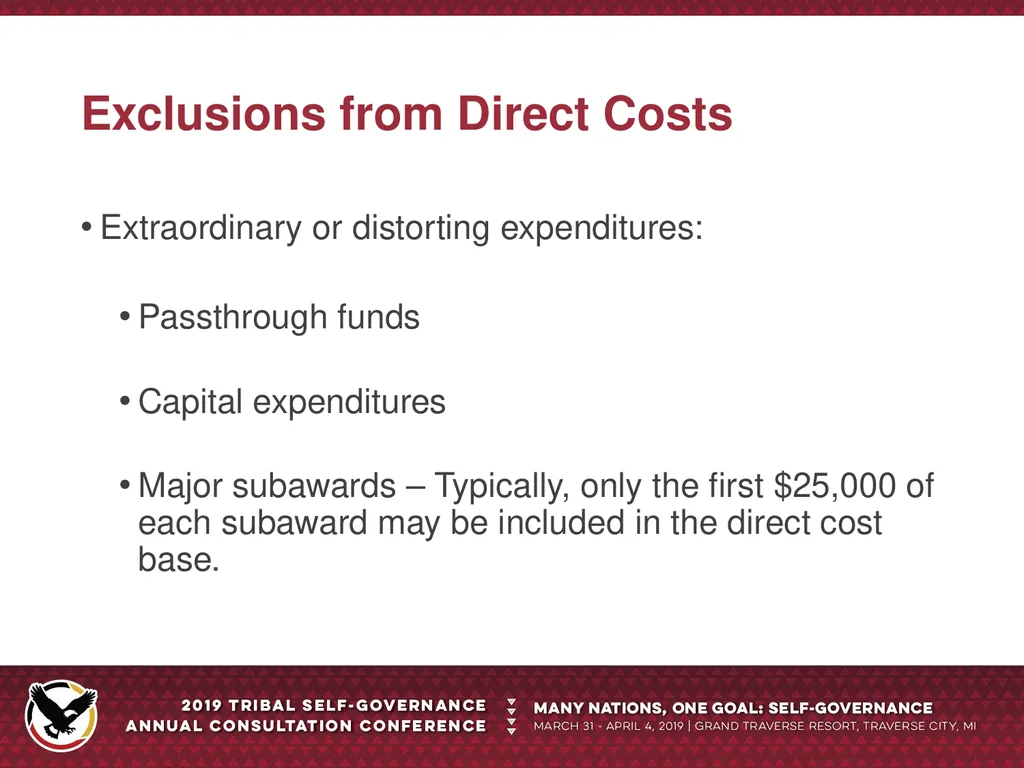
Exclusions from Direct Costs Extraordinary or distorting expenditures:
Passthrough funds
Capital expenditures
Major subawards – Typically, only the first $25,000 of each subaward may be included in the direct cost base.<br>
10
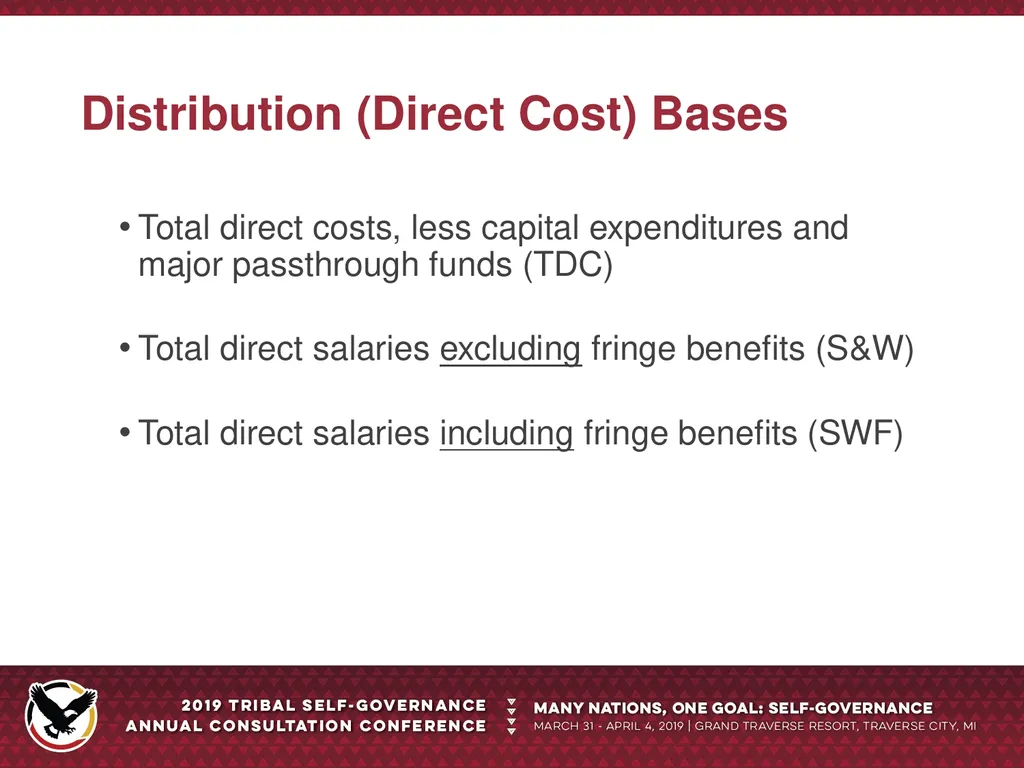
Distribution (Direct Cost) Bases Total direct costs, less capital expenditures and major passthrough funds (TDC)
Total direct salaries excluding fringe benefits (S&W)
Total direct salaries including fringe benefits (SWF)<br>
11
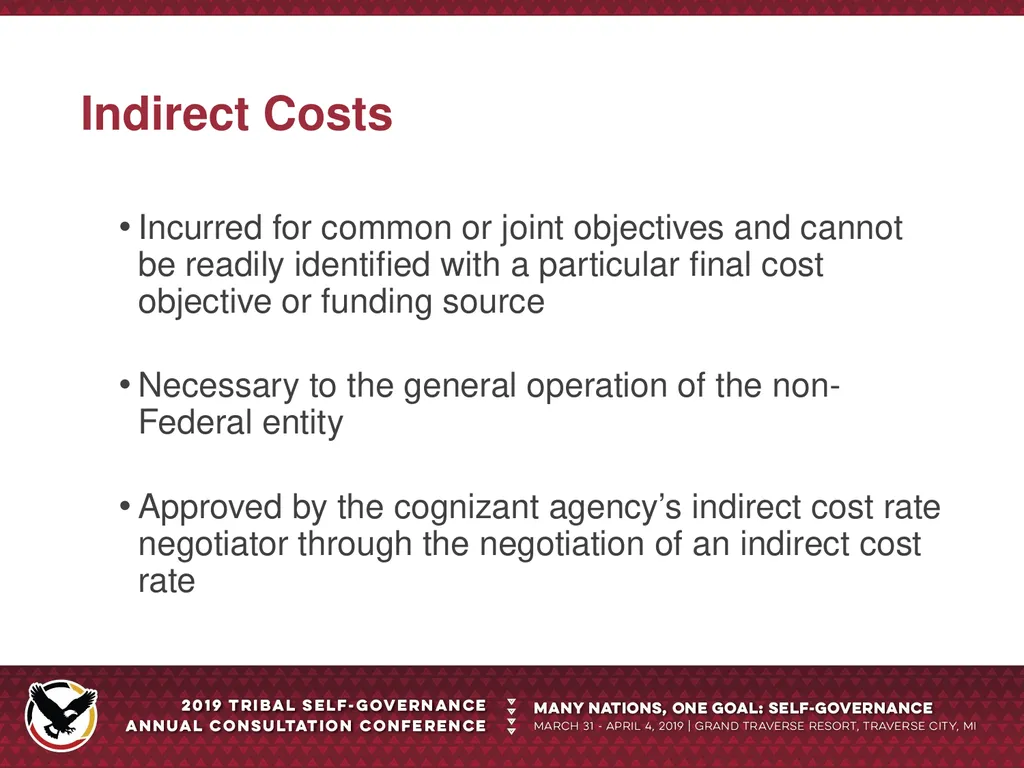
Indirect Costs Incurred for common or joint objectives and cannot be readily identified with a particular final cost objective or funding source
Necessary to the general operation of the non-Federal entity
Approved by the cognizant agency’s indirect cost rate negotiator through the negotiation of an indirect cost rate<br>
12
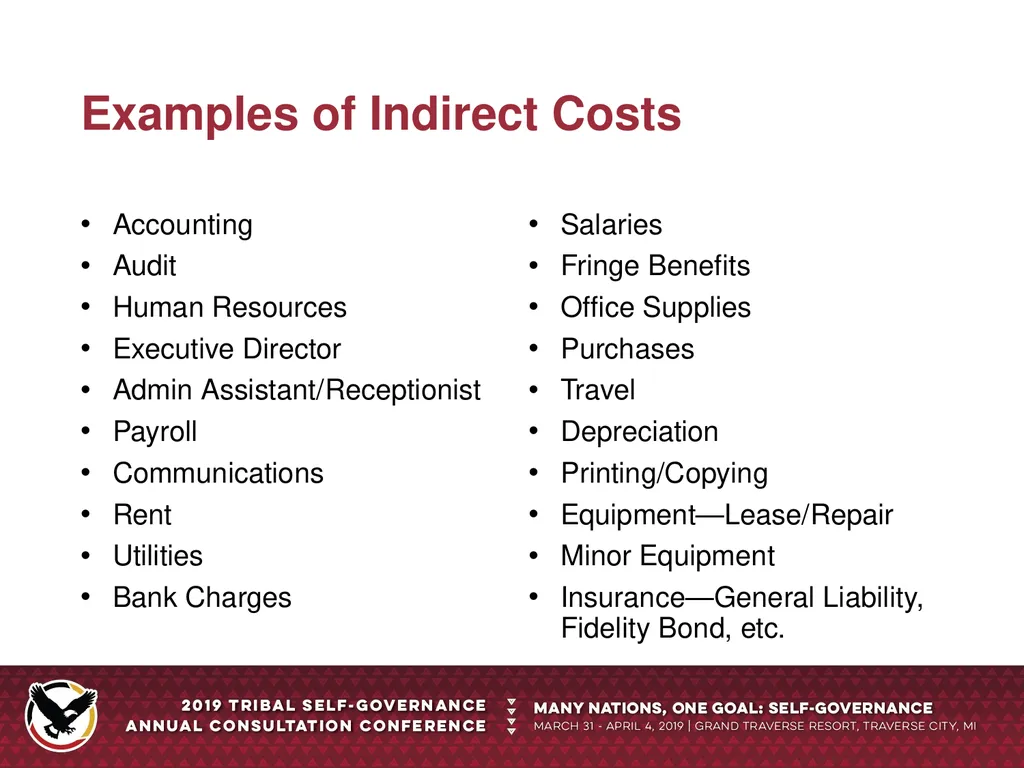
Examples of Indirect Costs Accounting
Audit
Human Resources
Executive Director
Admin Assistant/Receptionist
Payroll
Communications
Rent
Utilities
Bank Charges Salaries
Fringe Benefits
Office Supplies
Purchases
Travel
Depreciation
Printing/Copying
Equipment—Lease/Repair
Minor Equipment
Insurance—General Liability, Fidelity Bond, etc.<br>
13
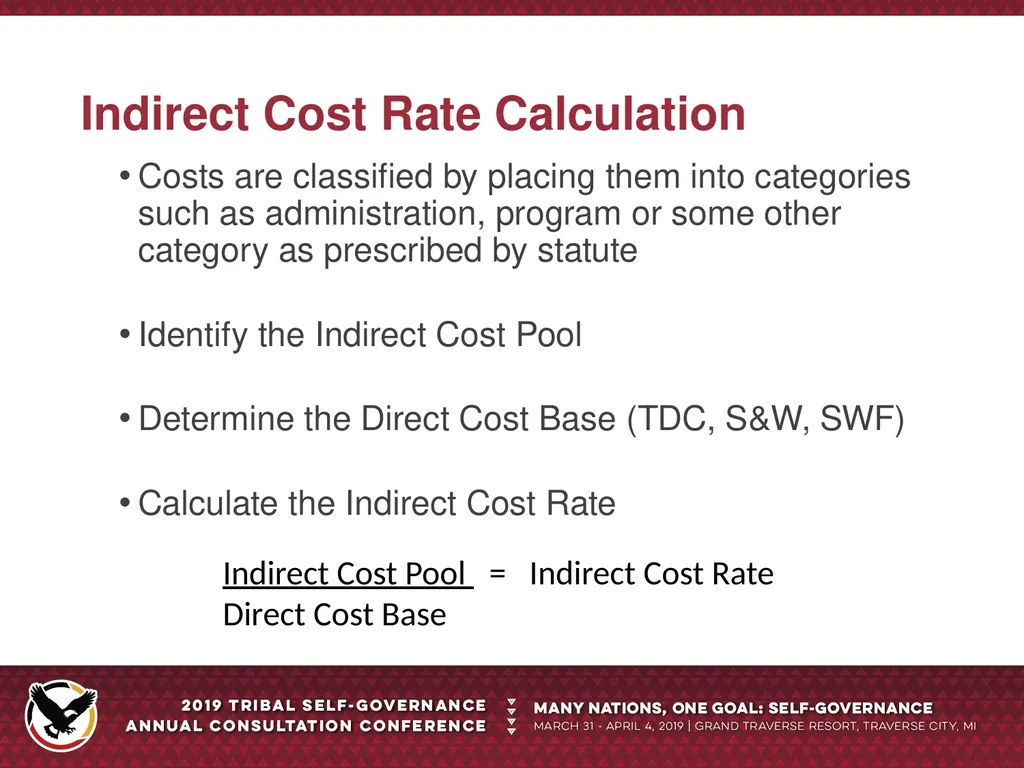
Indirect Cost Rate Calculation Costs are classified by placing them into categories such as administration, program or some other category as prescribed by statute
Identify the Indirect Cost Pool
Determine the Direct Cost Base (TDC, S&W, SWF)
Calculate the Indirect Cost Rate Indirect Cost Pool = Indirect Cost Rate
Direct Cost Base<br>
14
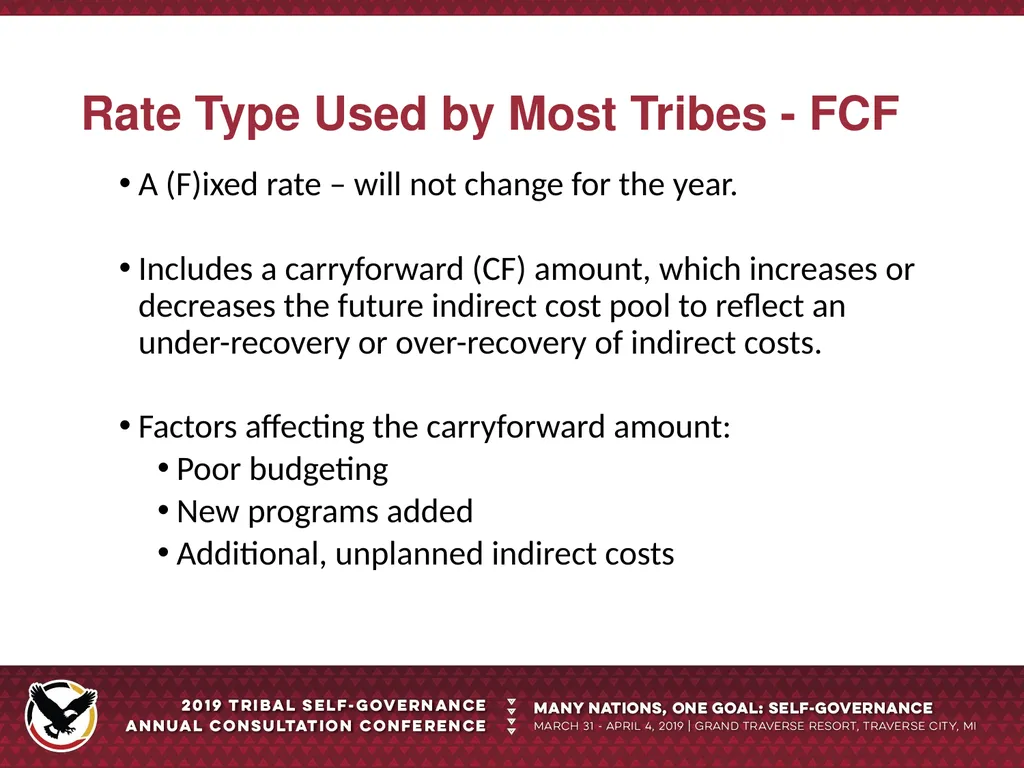
Rate Type Used by Most Tribes - FCF A (F)ixed rate – will not change for the year.
Includes a carryforward (CF) amount, which increases or decreases the future indirect cost pool to reflect an under-recovery or over-recovery of indirect costs.
Factors affecting the carryforward amount:
Poor budgeting
New programs added
Additional, unplanned indirect costs<br>
15
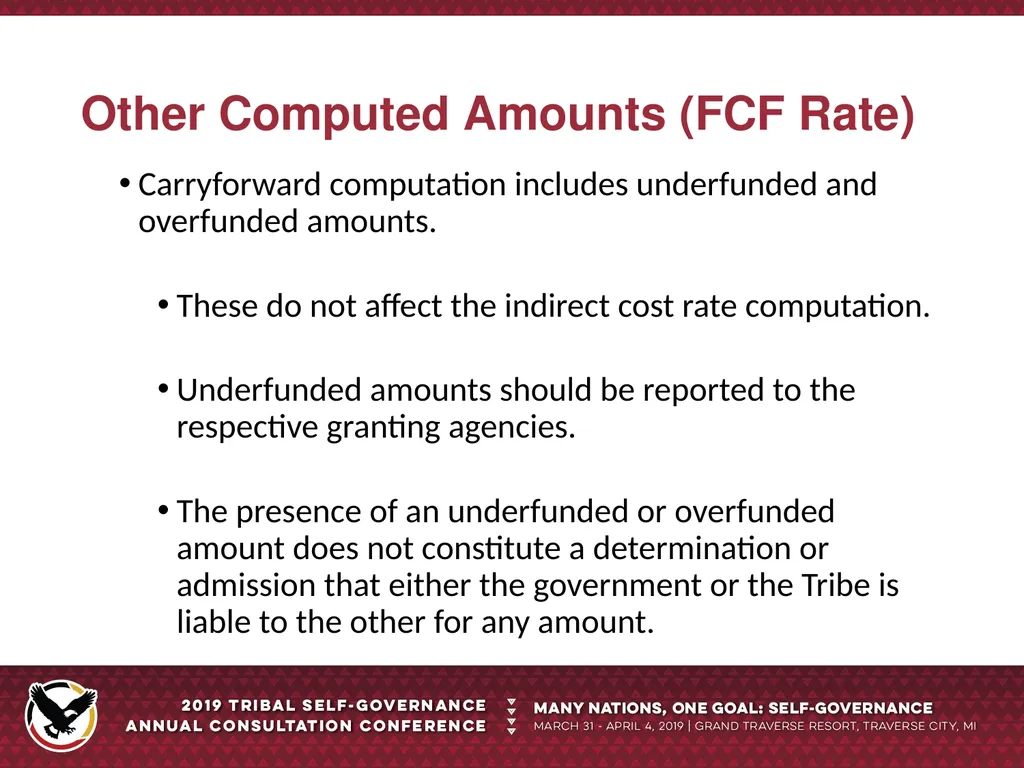
Other Computed Amounts (FCF Rate) Carryforward computation includes underfunded and overfunded amounts.
These do not affect the indirect cost rate computation.
Underfunded amounts should be reported to the respective granting agencies.
The presence of an underfunded or overfunded amount does not constitute a determination or admission that either the government or the Tribe is liable to the other for any amount.<br>
16
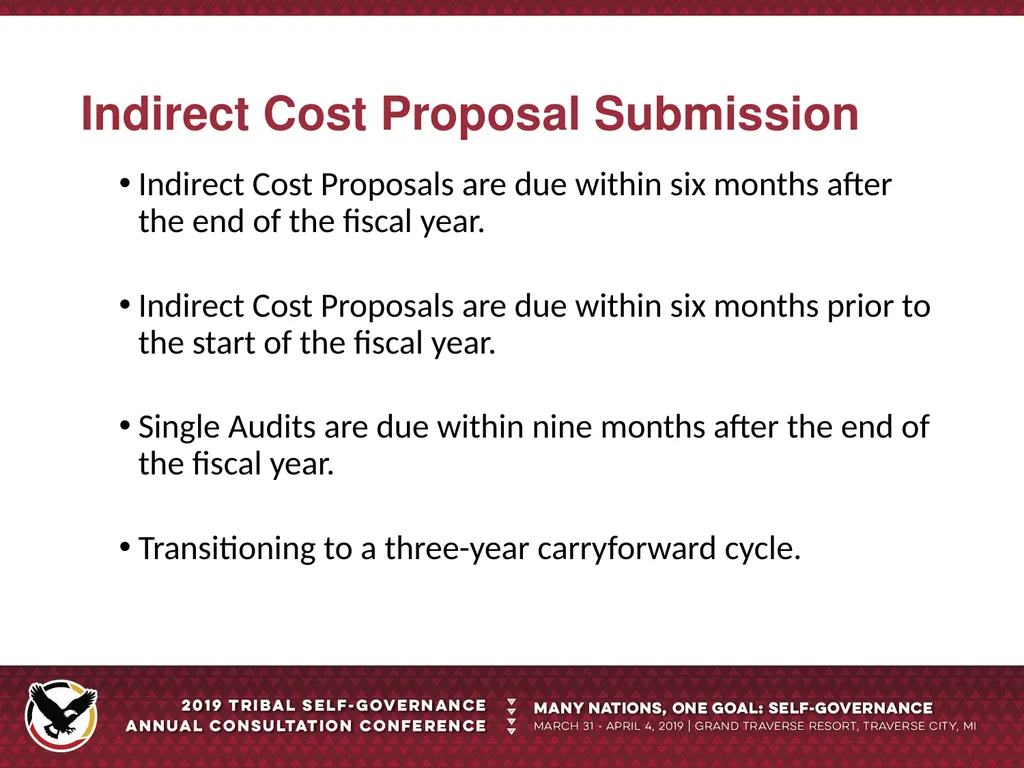
Indirect Cost Proposal Submission Indirect Cost Proposals are due within six months after the end of the fiscal year.
Indirect Cost Proposals are due within six months prior to the start of the fiscal year.
Single Audits are due within nine months after the end of the fiscal year.
Transitioning to a three-year carryforward cycle.<br>
17
Resources - Websites Uniform Guidance
Council on Financial Assistance Reform (COFAR) FAQs
Indirect Cost Services Division<br>
18
Questions? Mark W. Stout, MBA, Branch Chief
Indirect Cost Services Division
Tel: (916) 930-3830
Email: Mark_W_Stout@ibc.doi.gov<br>