
Infant Feeding: Human Milk and Formula Infant
PM
Published · 95 slides · 0 views

1 / 1





Description
Infant Feeding: Human Milk and Formula Infant Feeding: History and Perspective Human Milk Human Milk Substitutes Science, Medicine and Industry Feeding the Infant Considerations Infant (needs, tolerance, acceptance, safety) Family
Related Topics
Share
Embed code
Download this presentation From Below
"Infant Feeding: Human Milk and Formula Infant" is the property of its rightful owner. Permission is granted to download and print the materials on this website for personal, non-commercial use only, and to display it on your personal computer provided you do not modify the materials and that you retain all copyright notices contained in the materials. By downloading content from our website, you accept the terms of this agreement.
Presentation Transcript
01
Infant Feeding: Human Milk and Formula<br>
02
Infant Feeding: History and Perspective Human Milk
Human Milk Substitutes
Science, Medicine and Industry<br>
Human Milk Substitutes
Science, Medicine and Industry<br>
03
Feeding the Infant Considerations
Infant (needs, tolerance, acceptance, safety)
Family preferences
Cost and availability
Prevention, health, development, and programming<br>
Infant (needs, tolerance, acceptance, safety)
Family preferences
Cost and availability
Prevention, health, development, and programming<br>
04
Feeding the Infant Choices:
Human Milk
Standard Infant Formula (Cow, Soy)
Hypoallergenic (hydrolysates vs. amino acid based
Other specialty formulas
Beikost/solids/table foods<br>
Human Milk
Standard Infant Formula (Cow, Soy)
Hypoallergenic (hydrolysates vs. amino acid based
Other specialty formulas
Beikost/solids/table foods<br>
05
History Human milk substitutes
Health and welfare Programs
Formula Industry<br>
Health and welfare Programs
Formula Industry<br>
06
Human Milk Substitutes Early evidence of artificial feeding
Majority of infants received breast milk
Maternal BF
Wet nurses
Wealthy women
Orphans, abandoned, “illegitimate”
Prematurity or congenital deformities<br>
Majority of infants received breast milk
Maternal BF
Wet nurses
Wealthy women
Orphans, abandoned, “illegitimate”
Prematurity or congenital deformities<br>
07
Wet Nurses Work demands, societal needs, vanity, health requirements, social diversion
Proper selection: Questionable character-- Infant would suck in her vices
Wet Nurse Industry: emerging infant mortality/abuse
Impact of industrial revolution: Wet nurses made better money in factories<br>
Proper selection: Questionable character-- Infant would suck in her vices
Wet Nurse Industry: emerging infant mortality/abuse
Impact of industrial revolution: Wet nurses made better money in factories<br>
08
Human Milk Substitutes: Infant Mortality Artificial feeding in first weeks of life associated with 100% mortality
19th century infant mortality with “hand feeding” was 88%
Foundlings: 80%
In Dublin Foundling hospital 1775-96: 99.6%<br>
19th century infant mortality with “hand feeding” was 88%
Foundlings: 80%
In Dublin Foundling hospital 1775-96: 99.6%<br>
09
Science, Medicine, and Industry Growth of child Health and welfare in early 20th century<br>
10
Science, Medicine, and Industry Infant Morbidity and Mortality
Recognition of association with human milk substitutes, and infection
Industrial development
Storage
Safety
Food industry<br>
Recognition of association with human milk substitutes, and infection
Industrial development
Storage
Safety
Food industry<br>
11
Human Milk Substitutes 1920-1950’s: evaporated or fresh cow’s milk, water and added CHO (prepared at home)
1950’s to present commercially prepared infant formulas have replaced home recipes<br>
1950’s to present commercially prepared infant formulas have replaced home recipes<br>
12
Infant Formulas - History Cow’s milk is high in protein, low in CHO, results in large initial curd formation in gut if not heated before feeding
Early Formulas
from 1920-1950 majority of non-breastfed infants received evaporated milk formulas boiled or evaporated milk solved curd formation problems
cho provided by corn syrup or other cho to decrease relative protein kcals<br>
Early Formulas
from 1920-1950 majority of non-breastfed infants received evaporated milk formulas boiled or evaporated milk solved curd formation problems
cho provided by corn syrup or other cho to decrease relative protein kcals<br>
13
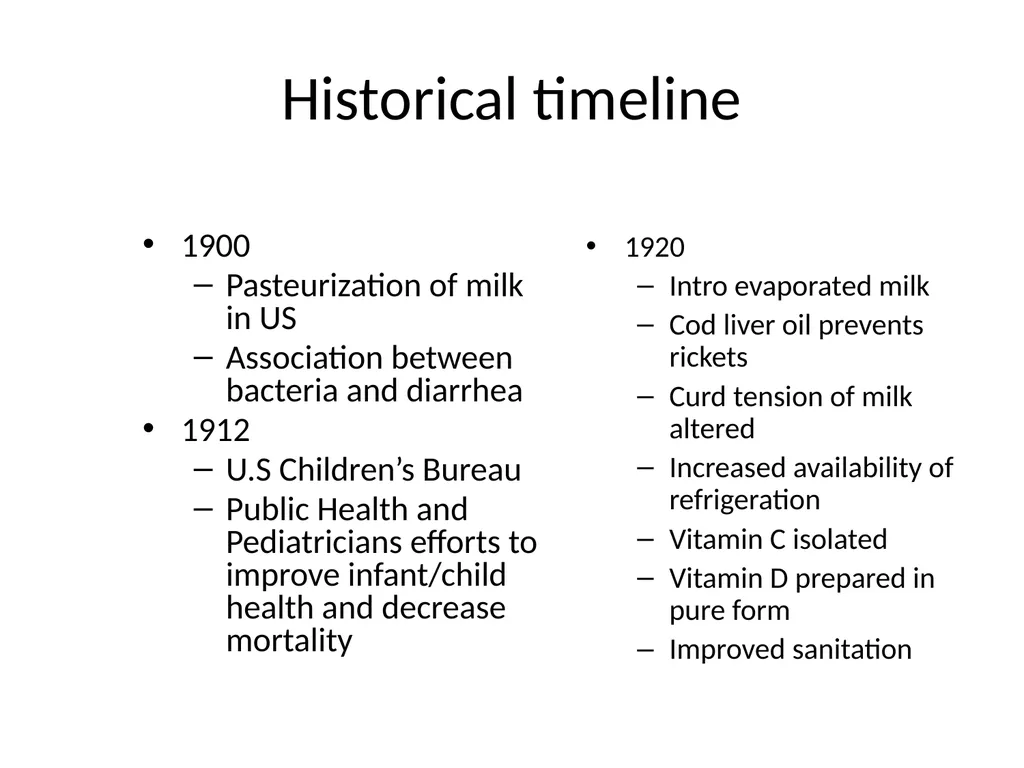
Historical timeline 1900
Pasteurization of milk in US
Association between bacteria and diarrhea
1912
U.S Children’s Bureau
Public Health and Pediatricians efforts to improve infant/child health and decrease mortality 1920
Intro evaporated milk
Cod liver oil prevents rickets
Curd tension of milk altered
Increased availability of refrigeration
Vitamin C isolated
Vitamin D prepared in pure form
Improved sanitation<br>
14
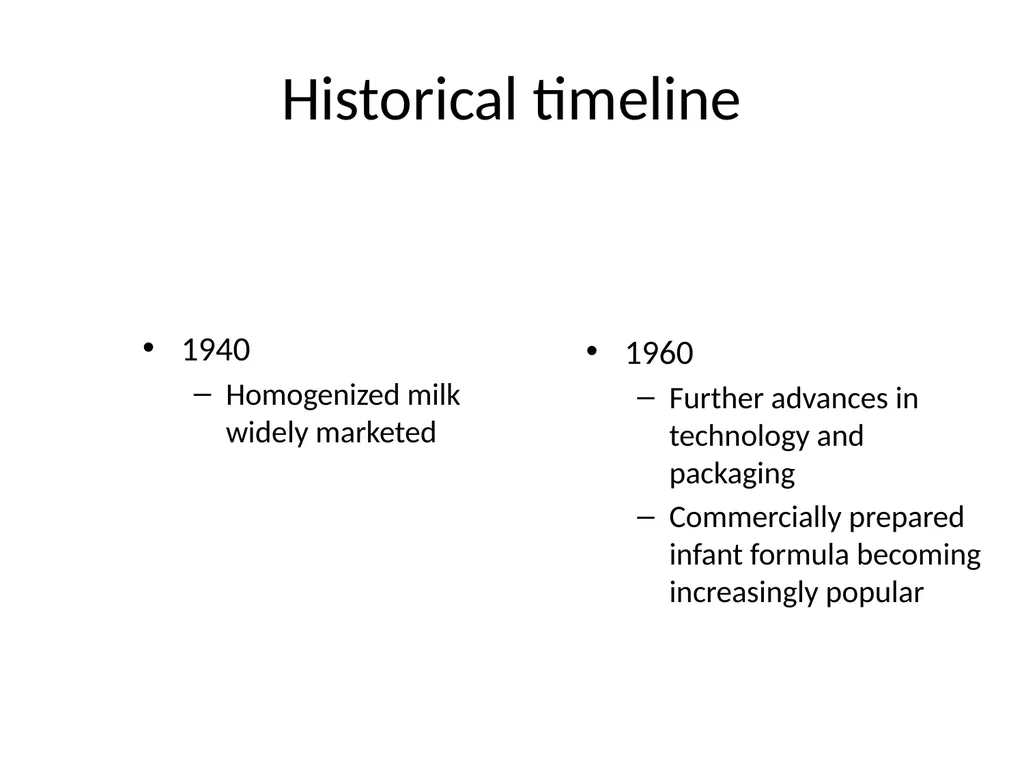
Historical timeline 1940
Homogenized milk widely marketed 1960
Further advances in technology and packaging
Commercially prepared infant formula becoming increasingly popular<br>
Homogenized milk widely marketed 1960
Further advances in technology and packaging
Commercially prepared infant formula becoming increasingly popular<br>
15
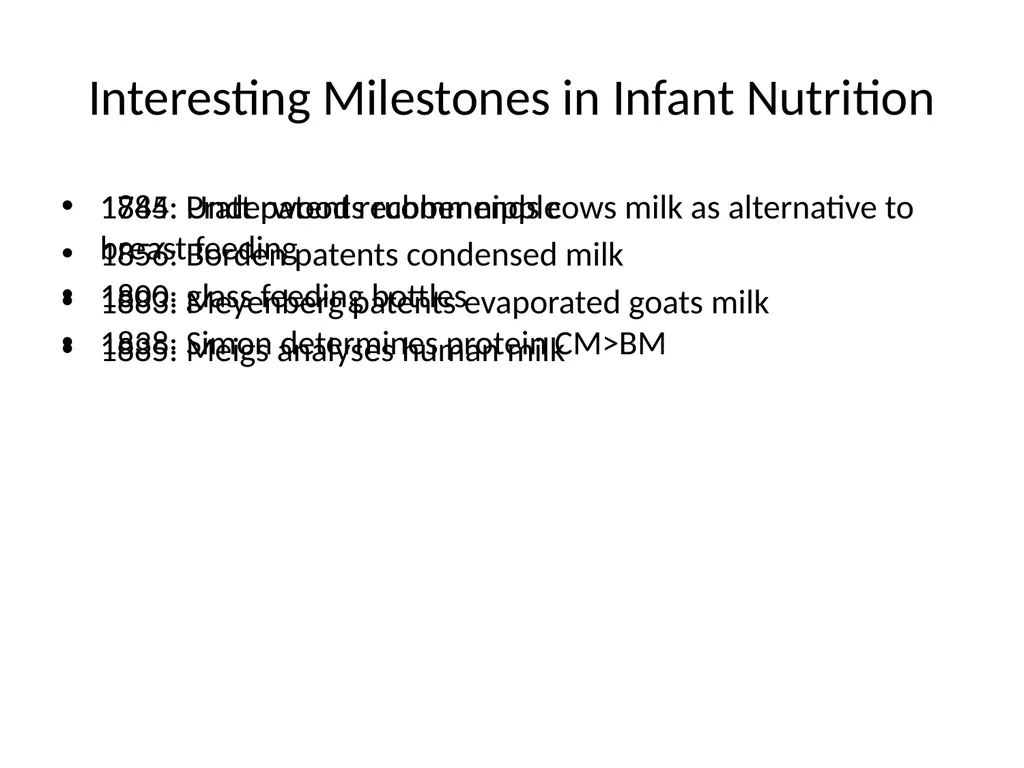
Interesting Milestones in Infant Nutrition 1784: Underwood recommends cows milk as alternative to breast feeding
1800: glass feeding bottles
1838: Simon determines protein CM>BM 1845: Pratt patents rubber nipple
1856: Borden patents condensed milk
1883: Meyenberg patents evaporated goats milk
1885: Meigs analyses human milk<br>
1800: glass feeding bottles
1838: Simon determines protein CM>BM 1845: Pratt patents rubber nipple
1856: Borden patents condensed milk
1883: Meyenberg patents evaporated goats milk
1885: Meigs analyses human milk<br>
16
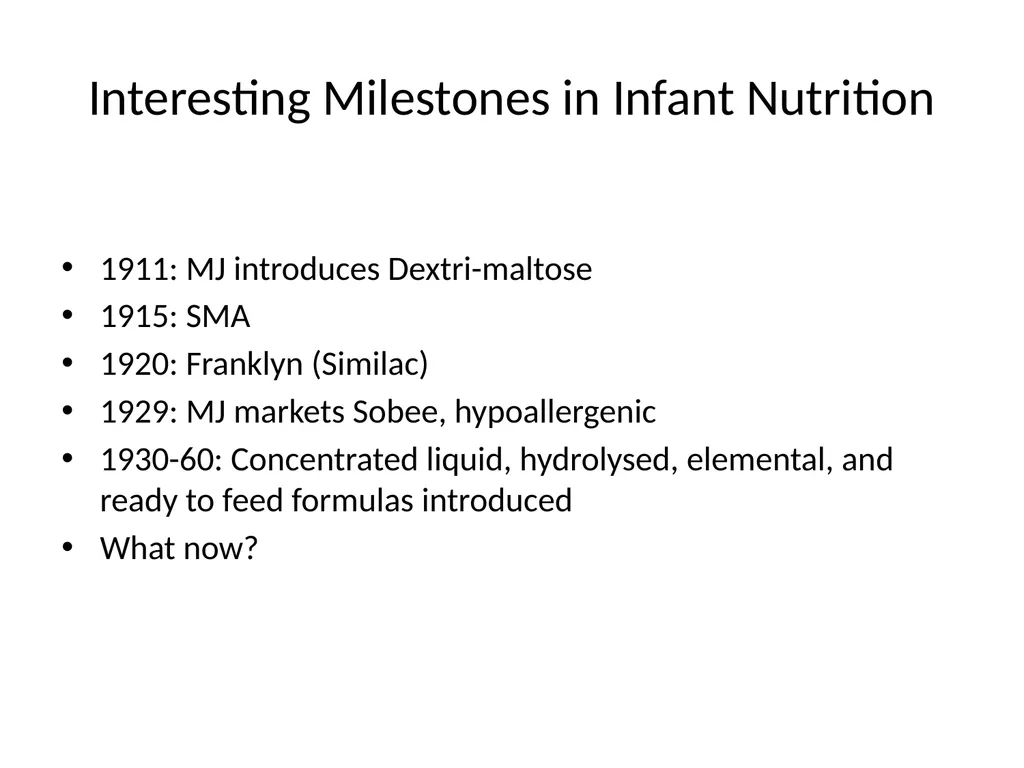
Interesting Milestones in Infant Nutrition 1911: MJ introduces Dextri-maltose
1915: SMA
1920: Franklyn (Similac)
1929: MJ markets Sobee, hypoallergenic
1930-60: Concentrated liquid, hydrolysed, elemental, and ready to feed formulas introduced
What now?<br>
1915: SMA
1920: Franklyn (Similac)
1929: MJ markets Sobee, hypoallergenic
1930-60: Concentrated liquid, hydrolysed, elemental, and ready to feed formulas introduced
What now?<br>
17
Interesting Milestones in Infant Nutrition 1911: MJ introduces Dextri-maltose
1915: SMA
1920: Franklyn (Similac)
1929: MJ markets Sobee, hypoallergenic
1930-60: Concentrated liquid, hydrolysed, elemental, and ready to feed formulas introduced
What now?<br>
1915: SMA
1920: Franklyn (Similac)
1929: MJ markets Sobee, hypoallergenic
1930-60: Concentrated liquid, hydrolysed, elemental, and ready to feed formulas introduced
What now?<br>
18
Infant Formula - History, cont. 50s and 60s commercial formulas replaced home preparation
1959: iron fortification introduced, but in 1971 only 25% of infants were fed Fe fortified formula
Cow’s milk feedings started in middle of first year between 1950-1970s. In 1970 almost 70% of infants were receiving cow’s milk.<br>
1959: iron fortification introduced, but in 1971 only 25% of infants were fed Fe fortified formula
Cow’s milk feedings started in middle of first year between 1950-1970s. In 1970 almost 70% of infants were receiving cow’s milk.<br>
19
“No two hemispheres of any learned professor’s brain are equal to two healthy mammary glands in the production of a satisfactory food for infants”
- Oliver Wendell Holmes<br>
- Oliver Wendell Holmes<br>
20
Human Milk Complements infant Immaturity
Promotes maturation
Epithelial growth factors and hormones
Digestive enzymes - lipases and amylase<br>
Promotes maturation
Epithelial growth factors and hormones
Digestive enzymes - lipases and amylase<br>
21
Characteristics and Advantages of Human Milk Low renal solute load
Immunologic, growth and trophic factors
Decrease illness, infection, allergy
Improved digestion and absorption
Nutrient Composition: CHO, Protein, Fatty Acid, etc
Cost
Other<br>
Immunologic, growth and trophic factors
Decrease illness, infection, allergy
Improved digestion and absorption
Nutrient Composition: CHO, Protein, Fatty Acid, etc
Cost
Other<br>
22
Human Milk Colostrum
Higher concentration of protein and antibodies
Transitions around days 3-5
Mature by day 10<br>
Higher concentration of protein and antibodies
Transitions around days 3-5
Mature by day 10<br>
23
Human Milk Nutrient composition of human milk is remarkable for its variability, as the content of some of the nutrients change during lactation, throughout the day, or differ among women, while the content of some nutrients remain relatively constant throughout lactation.<br>
24
Role of Human Milk Components in GI Development: Current Knowledge and Future Needs: Donovan J Pediatr 2006:149:S49-S61 “ existing clinical and epidemiological studies support a developmental advantage for breastfeeding. However, our understanding of the mechanisms by which HM components exert their actions within the human infant are limited by the large number of bioactive compounds in milk and the complexity of the potential interactions among the components and with the developing intestine”<br>
25
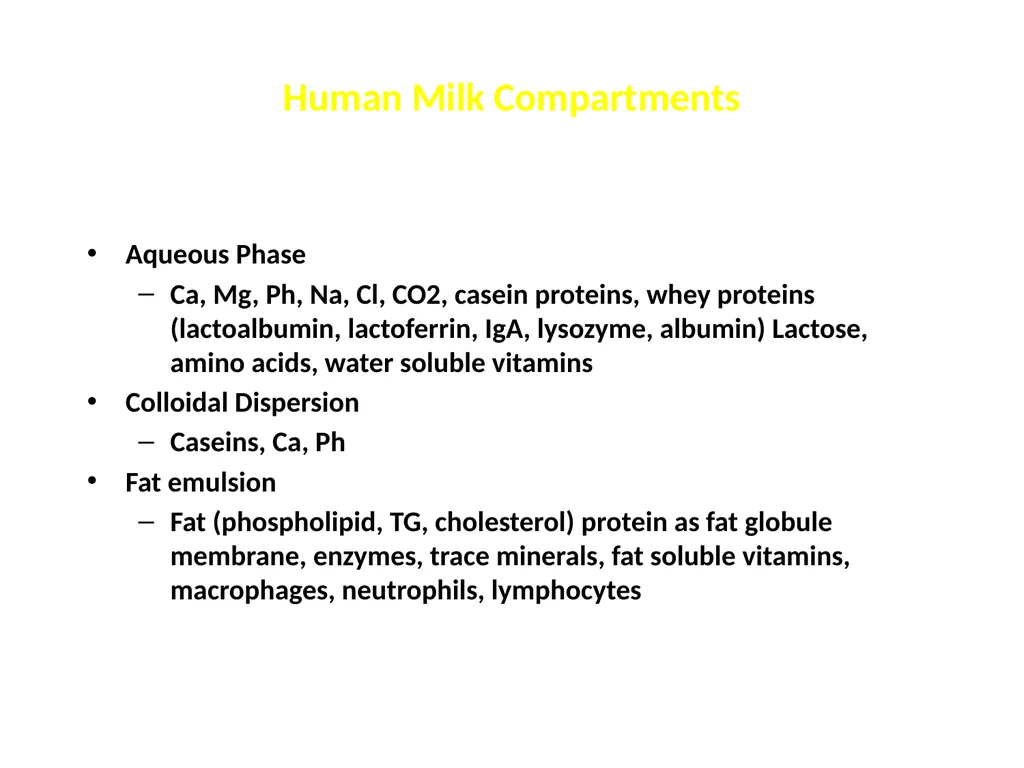
Human Milk Compartments Aqueous Phase
Ca, Mg, Ph, Na, Cl, CO2, casein proteins, whey proteins (lactoalbumin, lactoferrin, IgA, lysozyme, albumin) Lactose, amino acids, water soluble vitamins
Colloidal Dispersion
Caseins, Ca, Ph
Fat emulsion
Fat (phospholipid, TG, cholesterol) protein as fat globule membrane, enzymes, trace minerals, fat soluble vitamins, macrophages, neutrophils, lymphocytes<br>
26
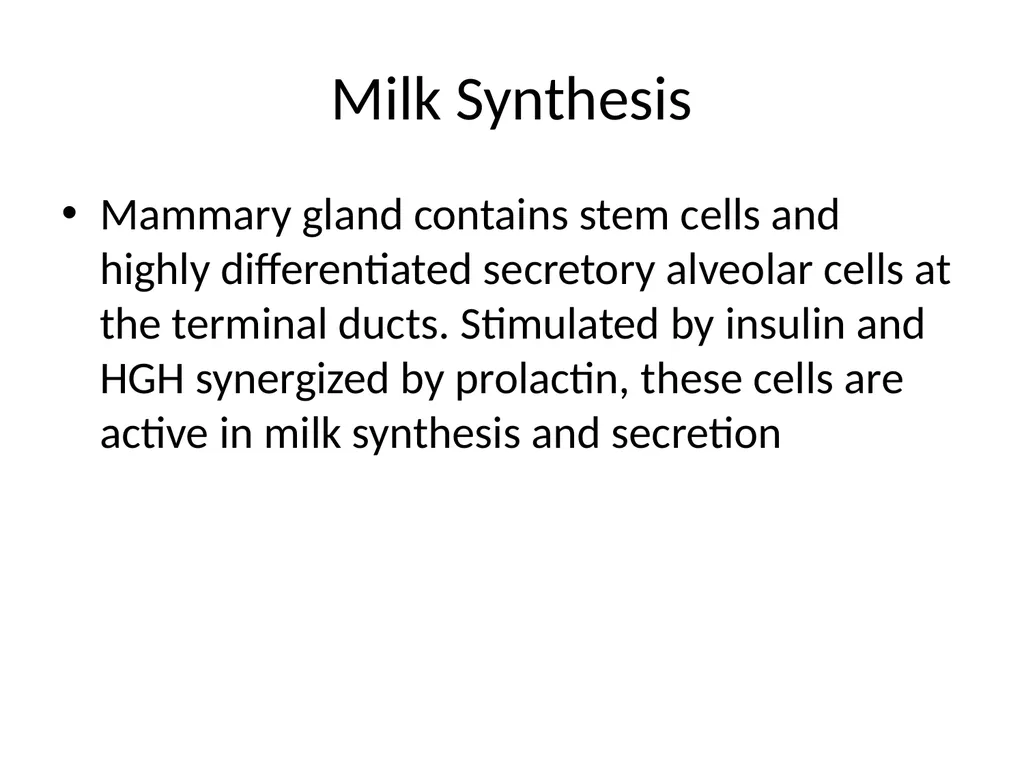
Milk Synthesis Mammary gland contains stem cells and highly differentiated secretory alveolar cells at the terminal ducts. Stimulated by insulin and HGH synergized by prolactin, these cells are active in milk synthesis and secretion<br>
27
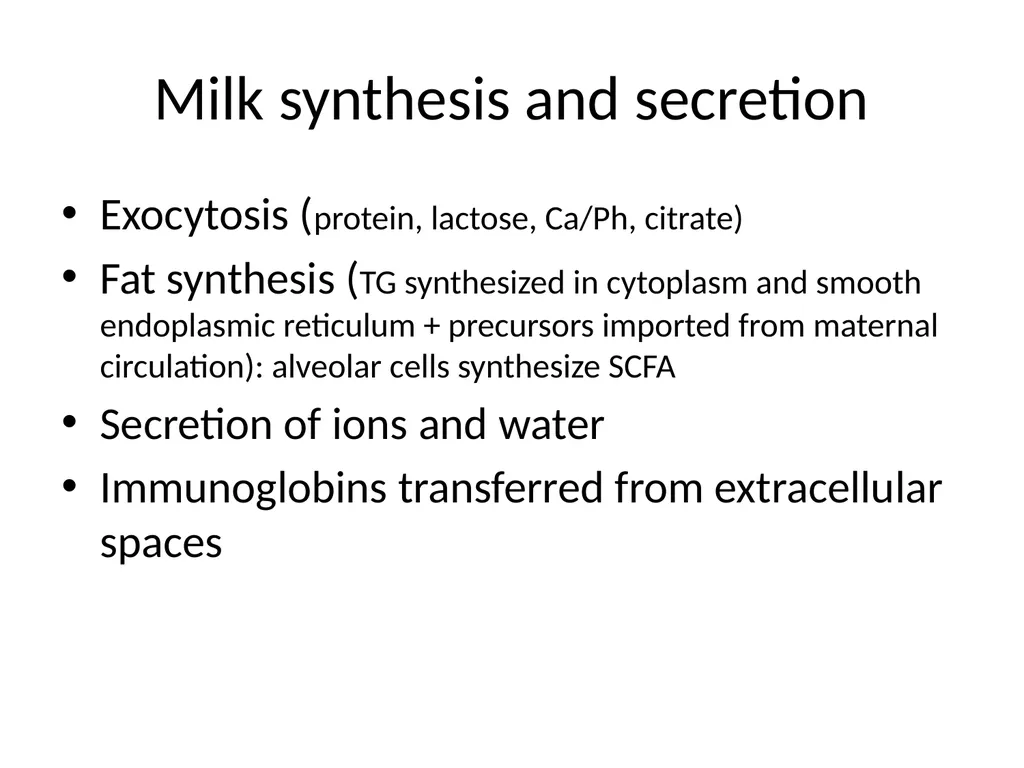
Milk synthesis and secretion Exocytosis (protein, lactose, Ca/Ph, citrate)
Fat synthesis (TG synthesized in cytoplasm and smooth endoplasmic reticulum + precursors imported from maternal circulation): alveolar cells synthesize SCFA
Secretion of ions and water
Immunoglobins transferred from extracellular spaces<br>
Fat synthesis (TG synthesized in cytoplasm and smooth endoplasmic reticulum + precursors imported from maternal circulation): alveolar cells synthesize SCFA
Secretion of ions and water
Immunoglobins transferred from extracellular spaces<br>
28
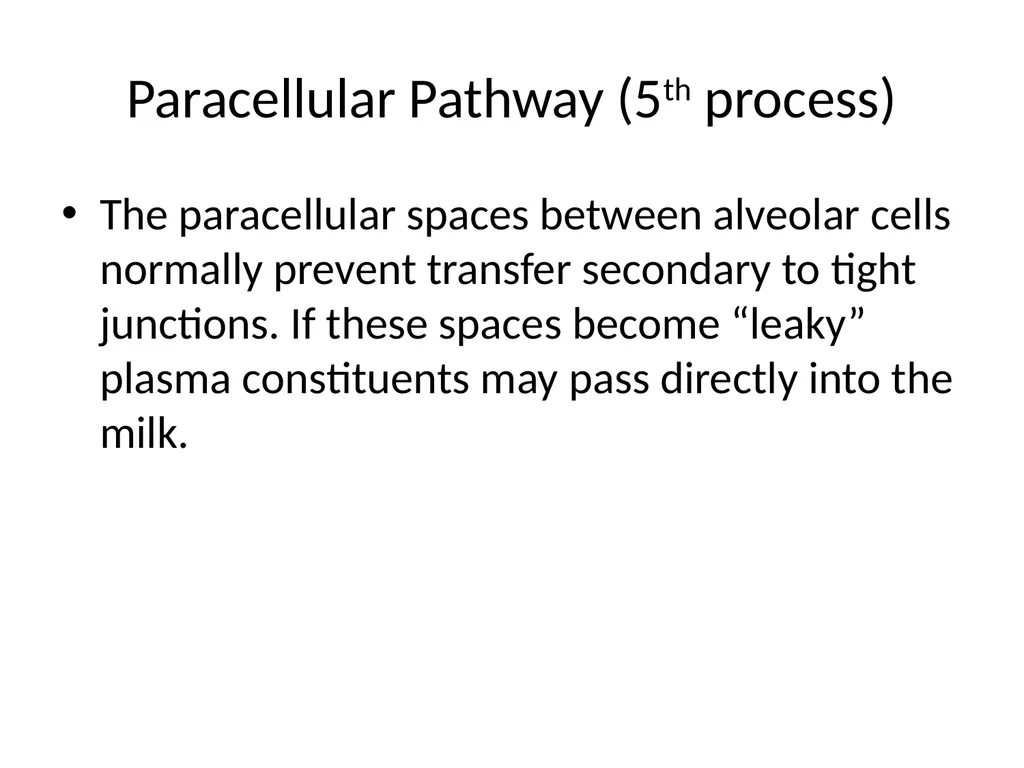
Paracellular Pathway (5th process) The paracellular spaces between alveolar cells normally prevent transfer secondary to tight junctions. If these spaces become “leaky” plasma constituents may pass directly into the milk.<br>
29
Milk Synthesis and secretion Under neuroendocrine control that varies with timing and stage of lactation
Prolactin
Lactogens
Estrogen
Thyroxine
Growth hormone
ACTH
other
Stimulus: infant suckling<br>
Prolactin
Lactogens
Estrogen
Thyroxine
Growth hormone
ACTH
other
Stimulus: infant suckling<br>
30
Milk synthesis Protein: vast majority of proteins present in human milk are specific to mammary secretions and not identified in any quantity elsewhere in nature:
Immunoglobins transferred from plasma in early stages of lactation
De novo protein synthesis by mammary gland<br>
Immunoglobins transferred from plasma in early stages of lactation
De novo protein synthesis by mammary gland<br>
31
Diet, milk production, and milk composition There is a great variation in milk composition during a feed, from feed to feed, and even between breasts.
The impact of dietary variation and milk composition is unclear. Overall milk composition remains relatively unaffected by diet variations although there are reports to the contrary:
DHA and ARA supplementation, vegan diet, drugs and environmental contaminants,…..<br>
The impact of dietary variation and milk composition is unclear. Overall milk composition remains relatively unaffected by diet variations although there are reports to the contrary:
DHA and ARA supplementation, vegan diet, drugs and environmental contaminants,…..<br>
32
Breast milk composition and Diet DHA levels of breast milk vary with diet. Increased amounts of DHA have been found in the breast milk of mothers consuming fish or fish oil, and with supplementation.
Water soluble vitamins may vary with diet. Diets inadequate in B12 or thiamin have been associated with case reports of deficiency in infants. High intakes of Vitamin C, however, does not appear to change the content of breast milk.
Supplementation of fat soluble vitamins do not appear to alter the content of breast milk
Iron supplementation does not appear to alter the iron content of breast milk<br>
33
Influence of diet on milk composition Protein-energy malnutrition impacts milk volume. Composition remains relatively unaffected
Water soluble vitamins move readily from serum to milk thus dietary fluctuations are more apparent
B12 vegan, case report of beriberi…..
Fat soluble vitamin content not improved with supplementation
Fatty acid composition (DHA and ARA) altered by maternal diet and supplementation<br>
Water soluble vitamins move readily from serum to milk thus dietary fluctuations are more apparent
B12 vegan, case report of beriberi…..
Fat soluble vitamin content not improved with supplementation
Fatty acid composition (DHA and ARA) altered by maternal diet and supplementation<br>
34
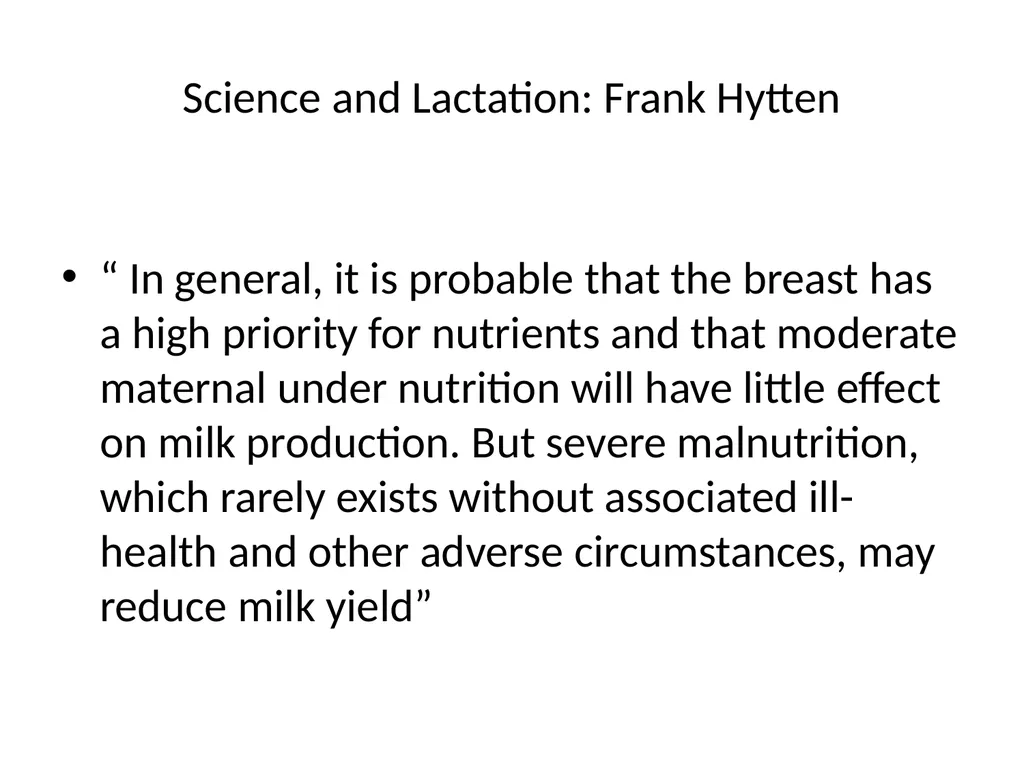
Science and Lactation: Frank Hytten “ In general, it is probable that the breast has a high priority for nutrients and that moderate maternal under nutrition will have little effect on milk production. But severe malnutrition, which rarely exists without associated ill-health and other adverse circumstances, may reduce milk yield”<br>
35
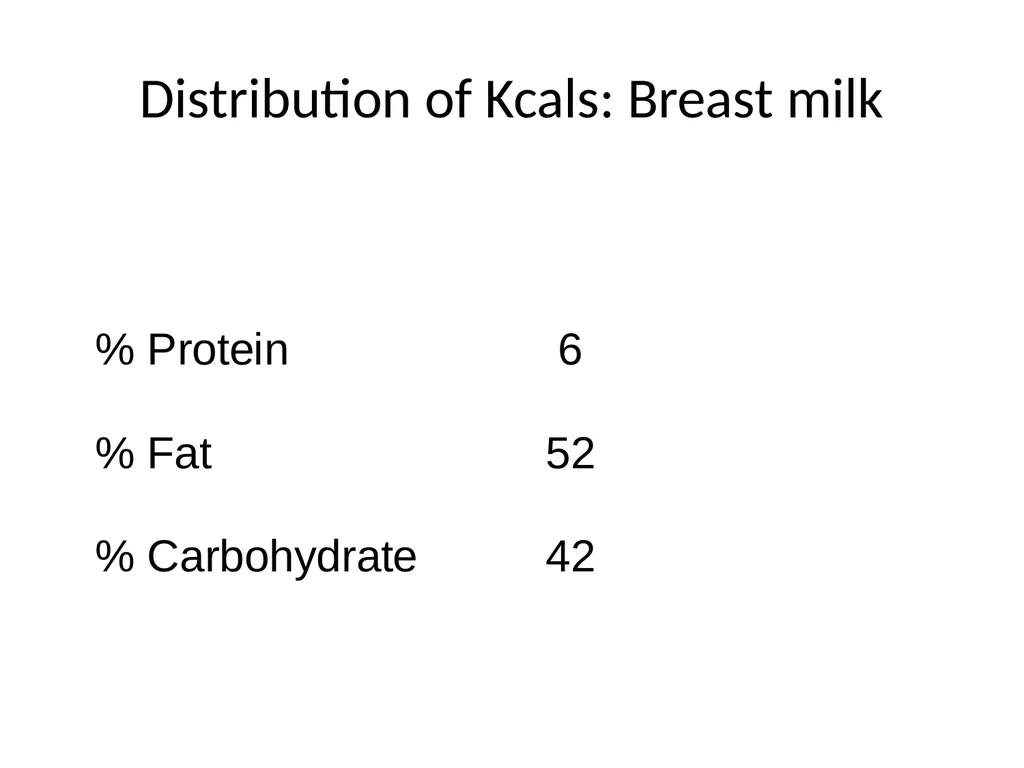
Distribution of Kcals: Breast milk<br>
36
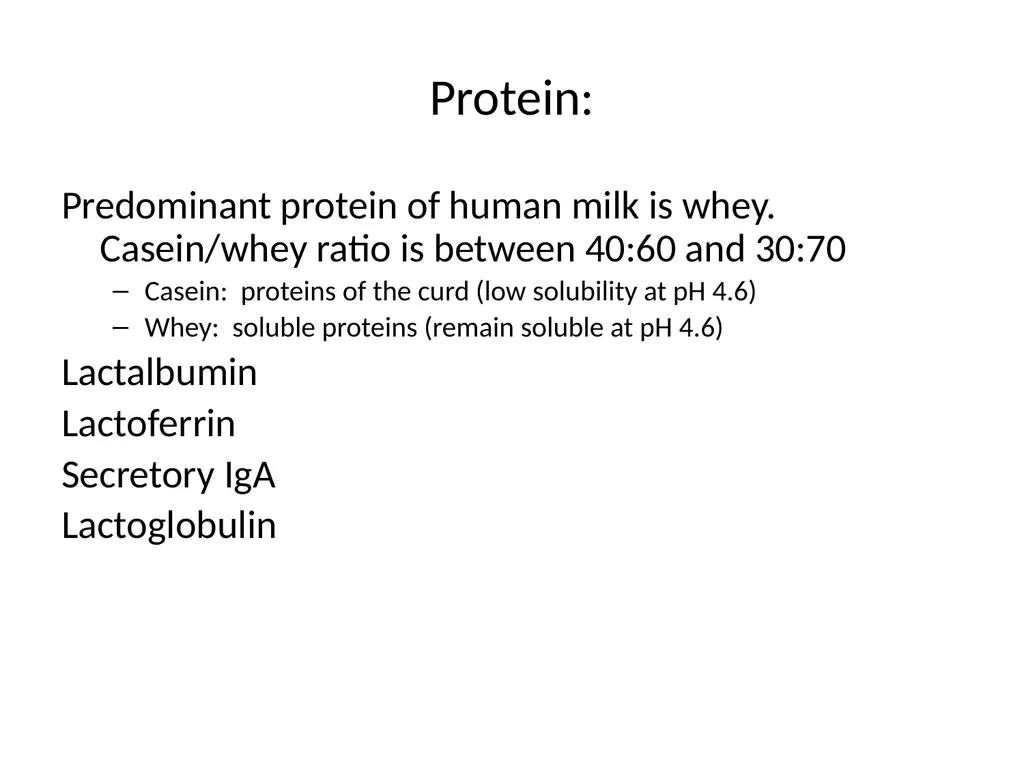
Protein: Predominant protein of human milk is whey. Casein/whey ratio is between 40:60 and 30:70
Casein: proteins of the curd (low solubility at pH 4.6)
Whey: soluble proteins (remain soluble at pH 4.6)
Lactalbumin
Lactoferrin
Secretory IgA
Lactoglobulin<br>
Casein: proteins of the curd (low solubility at pH 4.6)
Whey: soluble proteins (remain soluble at pH 4.6)
Lactalbumin
Lactoferrin
Secretory IgA
Lactoglobulin<br>
37
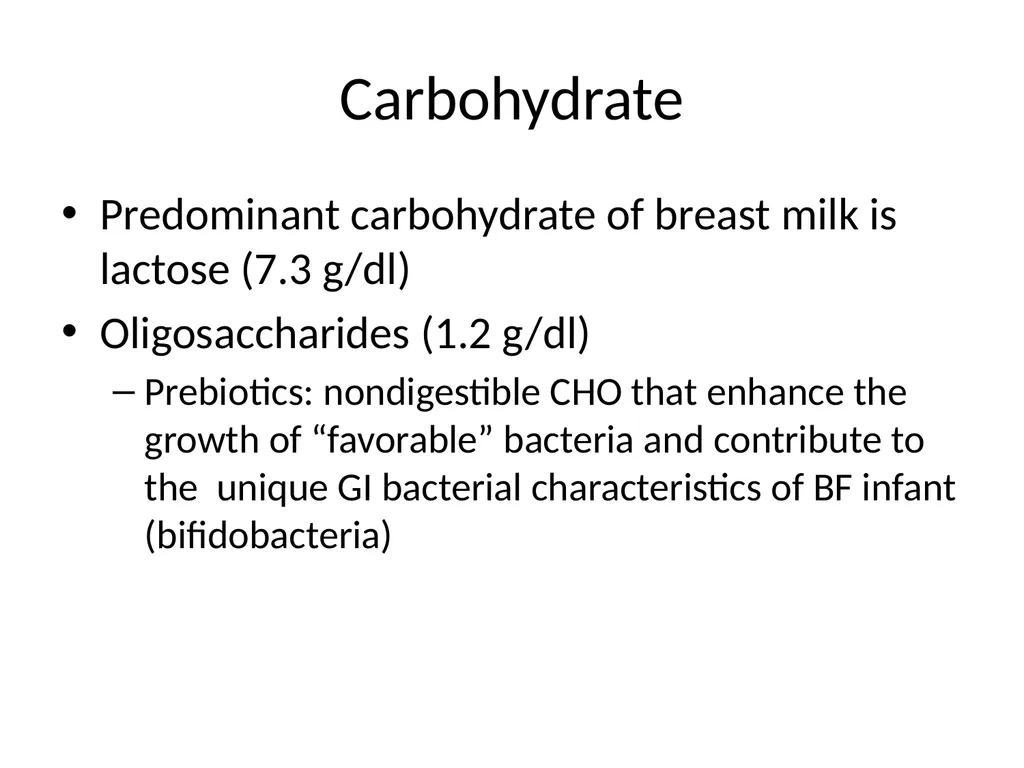
Carbohydrate Predominant carbohydrate of breast milk is lactose (7.3 g/dl)
Oligosaccharides (1.2 g/dl)
Prebiotics: nondigestible CHO that enhance the growth of “favorable” bacteria and contribute to the unique GI bacterial characteristics of BF infant (bifidobacteria)<br>
Oligosaccharides (1.2 g/dl)
Prebiotics: nondigestible CHO that enhance the growth of “favorable” bacteria and contribute to the unique GI bacterial characteristics of BF infant (bifidobacteria)<br>
38
Fat 2.5- 4.5% Fat (provides approx 50% of calories)
Contained in membrane enclosed milk fat globules
Core: TG (98-99%of total milk fat)
Membrane: phospholipids, cholesterol, protein
DHA/ARA: wide variations<br>
Contained in membrane enclosed milk fat globules
Core: TG (98-99%of total milk fat)
Membrane: phospholipids, cholesterol, protein
DHA/ARA: wide variations<br>
39
DHA/ARA concentration variation in human milk DHA: 0.1-1.4%
ARA: 0.31- 0.71%
DHA lowest in populations with high meat intake and highest in populations with high fish intake<br>
ARA: 0.31- 0.71%
DHA lowest in populations with high meat intake and highest in populations with high fish intake<br>
40
Breast milk and establishment of core microbiome Definition: Full collection of microbes that naturally exist within the body.
Alterations or disruptions in core microbiome associated with chronic illness: Crohns disease, increased susceptibility to infection, allergy, NEC, etc<br>
Alterations or disruptions in core microbiome associated with chronic illness: Crohns disease, increased susceptibility to infection, allergy, NEC, etc<br>
41
Microbiome Beneficial effect for the host:
Nutrient metabolism
Tissue development
Resistance to colonization with pathogens
Maintenance of intestinal homeostasis
Immunological activation and protection of GI integrity<br>
Nutrient metabolism
Tissue development
Resistance to colonization with pathogens
Maintenance of intestinal homeostasis
Immunological activation and protection of GI integrity<br>
42
Human milk and microbiome Core microbiome established soon after birth
Core microbiome of breastfeeding infant similar to core microbiome of lactating mother
Components of breast milk supporting establishment of microbiome
Prebiotics,probiotics<br>
Core microbiome of breastfeeding infant similar to core microbiome of lactating mother
Components of breast milk supporting establishment of microbiome
Prebiotics,probiotics<br>
43
AAP Policy Statement: Breastfeeding and the use of human milk AAP statement includes 15 recommendations on Breastfeeding healthy term infants including:
Establish peripartum policies and practices supporting breastfeeding
Place infant skin to skin after delivery until first feeding is accomplished<br>
Establish peripartum policies and practices supporting breastfeeding
Place infant skin to skin after delivery until first feeding is accomplished<br>
44
AAP Policy Statement:Recommendations continued Supplements (water, glucose water, formula) should not be given unless medically indicated
Avoid pacifier during initiation (? Recent OHSU report)
8-12 feedings at the breast every 24 hours during early weeks
All newborn breastfeeding infants should be seen by HCP at 3-5 days and again at 2-3 weeks of age
All breast feeding infants should receive 200 (changed to 400) IU Vitamin D<br>
Avoid pacifier during initiation (? Recent OHSU report)
8-12 feedings at the breast every 24 hours during early weeks
All newborn breastfeeding infants should be seen by HCP at 3-5 days and again at 2-3 weeks of age
All breast feeding infants should receive 200 (changed to 400) IU Vitamin D<br>
45
AAP Policy Statement: Breastfeeding and the use of human milk: Pediatrics 115 #2 2005 Human milk is species specific and uniquely superior for infant feeding
Exclusive breastfeeding is the reference or normative model against which all alternative methods must be measured in regards to growth, development and health
Research provides strong evidence that human milk feeding decreases the incidence and/or severity of a number of infectious diseases (meningitis, Otitis media, UTIs, Respiratory tract infections, NEC, diarrhea)<br>
46
AAP Policy Statement: Breastfeeding and the use of human milk: Contraindications to breastfeeding
Galactosemia
Maternal use/exposure to certain radioactive or chemotherapeutic agents
Maternal abuse of “street drugs”
Active HSV lesions of breast
Maternal HIV (in USA)<br>
Galactosemia
Maternal use/exposure to certain radioactive or chemotherapeutic agents
Maternal abuse of “street drugs”
Active HSV lesions of breast
Maternal HIV (in USA)<br>
47
AAP Policy Statement: Breastfeeding and the use of human milk: Some studies suggest decreased incidence of SIDS, diabetes (type 1 and 2), leukemia, obesity, hypercholesterolemia, and allergy (asthma and atopy)
Breastfeeding has been associated with slightly enhanced performance on tests of cognitive development.<br>
Breastfeeding has been associated with slightly enhanced performance on tests of cognitive development.<br>
48
Newborn Visit: Breastfeeding Maternal care
rest
fluids
relieving breast engorgement
caring for nipples
eating properly
Follow-up support from the health professional by telephone, home visit, nurse visit, or early office visit.<br>
rest
fluids
relieving breast engorgement
caring for nipples
eating properly
Follow-up support from the health professional by telephone, home visit, nurse visit, or early office visit.<br>
49
Cautionary Tales Cooper et al. Pediatrics 1995. Increased incidence of severe breastfeeding malnutrition and hypernatremia in a metropolitan area.
Rolf et al. ACTA Paediatrica 2009. A nationwide study on hospital admissions due to dehydration in exclusively breastfed infants in the Netherlands:its incidence, clinical characteristics, treatment and outcome
Lozoff et al. J Pediatrics 2009 Higher Infant Blood Levels with Longer Duration of Breastfeeding<br>
50
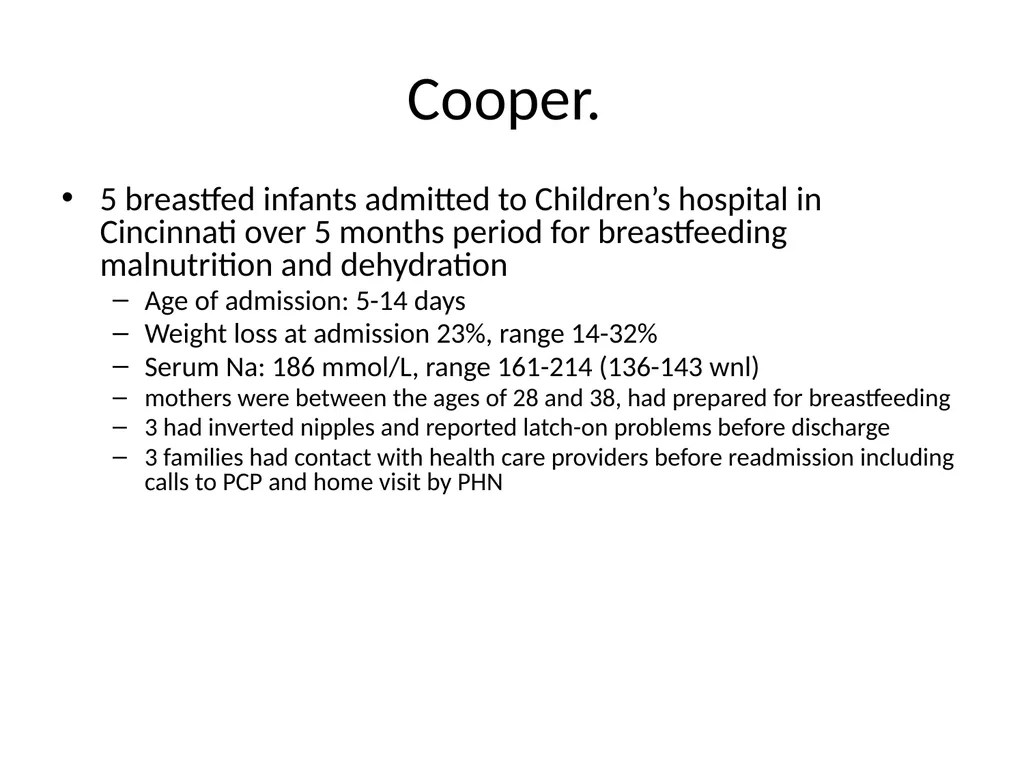
Cooper. 5 breastfed infants admitted to Children’s hospital in Cincinnati over 5 months period for breastfeeding malnutrition and dehydration
Age of admission: 5-14 days
Weight loss at admission 23%, range 14-32%
Serum Na: 186 mmol/L, range 161-214 (136-143 wnl)
mothers were between the ages of 28 and 38, had prepared for breastfeeding
3 had inverted nipples and reported latch-on problems before discharge
3 families had contact with health care providers before readmission including calls to PCP and home visit by PHN<br>
51
Rolf Survey to determine incidence and characteristics of hospital admission due to dehydration
Dutch Paediatric Surveillance Unit 2003-2005 of all hospital admissions during 1st 3 months in fully breast fed infants
250 reported cases.
N= 158 (excluded cases with incomplete information or co-existing medical conditions accounting for hospitalization<br>
Dutch Paediatric Surveillance Unit 2003-2005 of all hospital admissions during 1st 3 months in fully breast fed infants
250 reported cases.
N= 158 (excluded cases with incomplete information or co-existing medical conditions accounting for hospitalization<br>
52
Lozoff Our findings support the conclusions… “that this phenomenon constitutes a potential public health problem in areas where environmental lead exposure is continuing as well as where environmental lead exposure has recently declined”… Our findings do not detract from the many known benefits of breastfeeding. Rather, they suggest that monitoring lead concentrations in breastfed infants should be considered….<br>
53
Formula Composition Breast Milk as “gold standard”
Attempt to duplicate composition of breastmilk
? Bioactivity, relationship, function of all factors present in breast milk
? Measure outcome: growth, composition, functional indices<br>
Attempt to duplicate composition of breastmilk
? Bioactivity, relationship, function of all factors present in breast milk
? Measure outcome: growth, composition, functional indices<br>
54
Formula Categories Standard
Cows milk base
Soy base
Elemental
Hydrolysates
Amino acid pased
Other Specialty Products
Metabolics
PM 60/40
Low fat/MCT
Premature feeding products<br>
Cows milk base
Soy base
Elemental
Hydrolysates
Amino acid pased
Other Specialty Products
Metabolics
PM 60/40
Low fat/MCT
Premature feeding products<br>
55
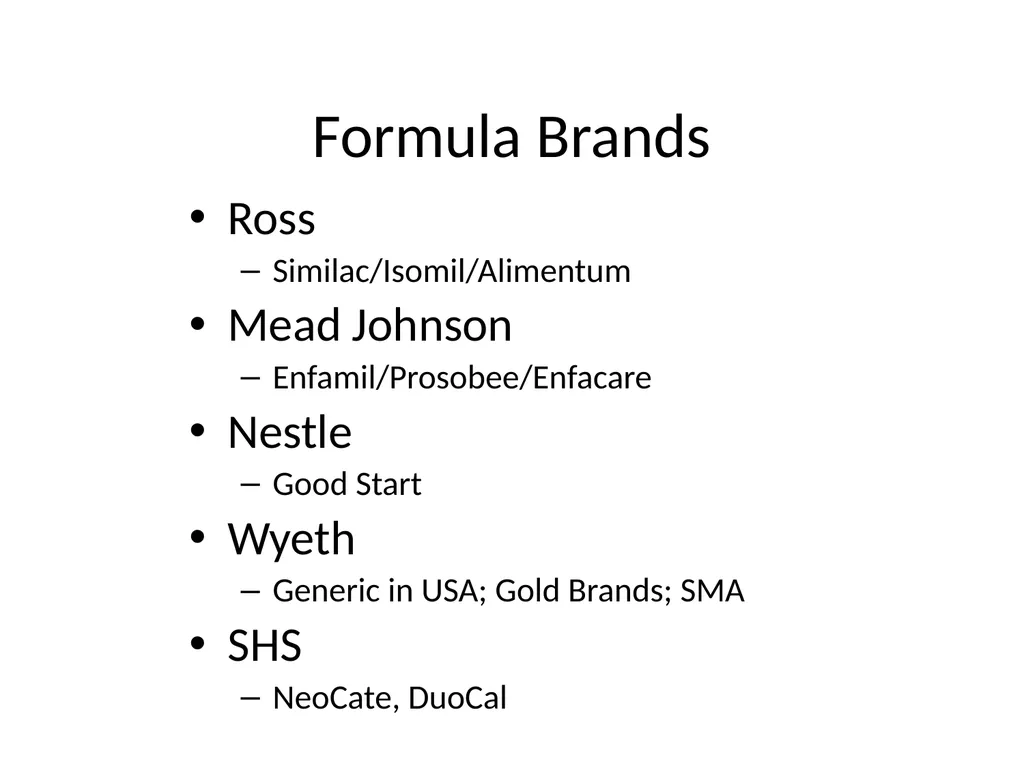
Formula Brands Ross
Similac/Isomil/Alimentum
Mead Johnson
Enfamil/Prosobee/Enfacare
Nestle
Good Start
Wyeth
Generic in USA; Gold Brands; SMA
SHS
NeoCate, DuoCal<br>
Similac/Isomil/Alimentum
Mead Johnson
Enfamil/Prosobee/Enfacare
Nestle
Good Start
Wyeth
Generic in USA; Gold Brands; SMA
SHS
NeoCate, DuoCal<br>
56
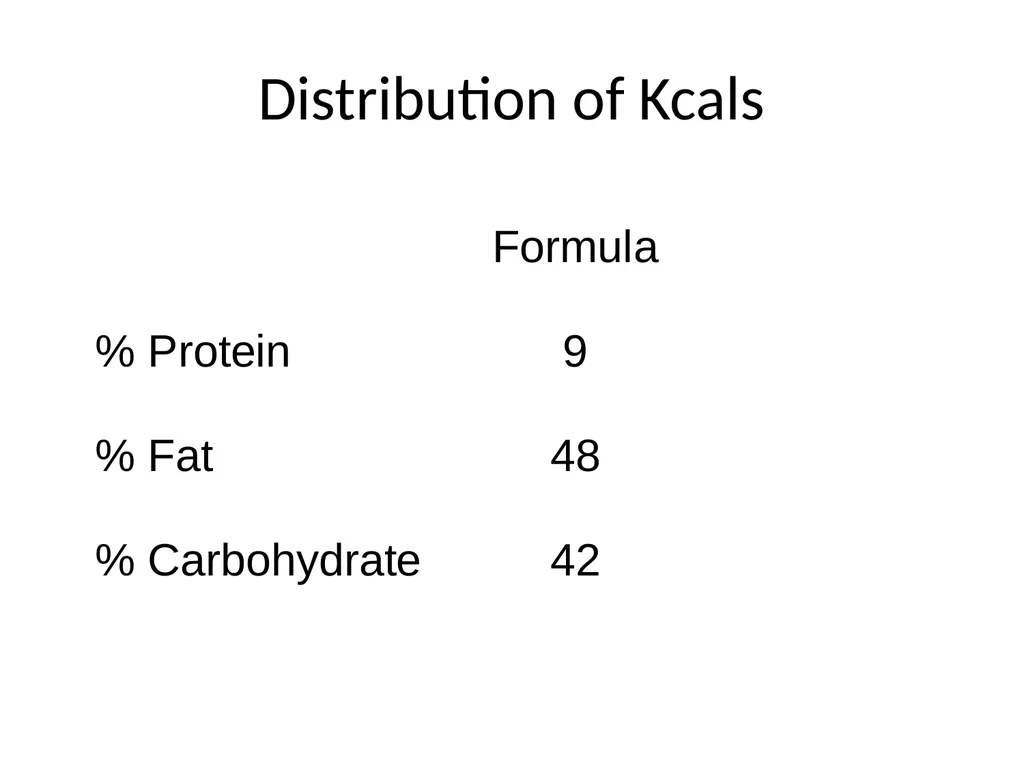
Distribution of Kcals<br>
57
Vitamin and Mineral content NAS/FDA
Meet levels at typical volumes ingested by infants (@ 24-32 ounces)
i.e. RDA/DRI<br>
Meet levels at typical volumes ingested by infants (@ 24-32 ounces)
i.e. RDA/DRI<br>
58
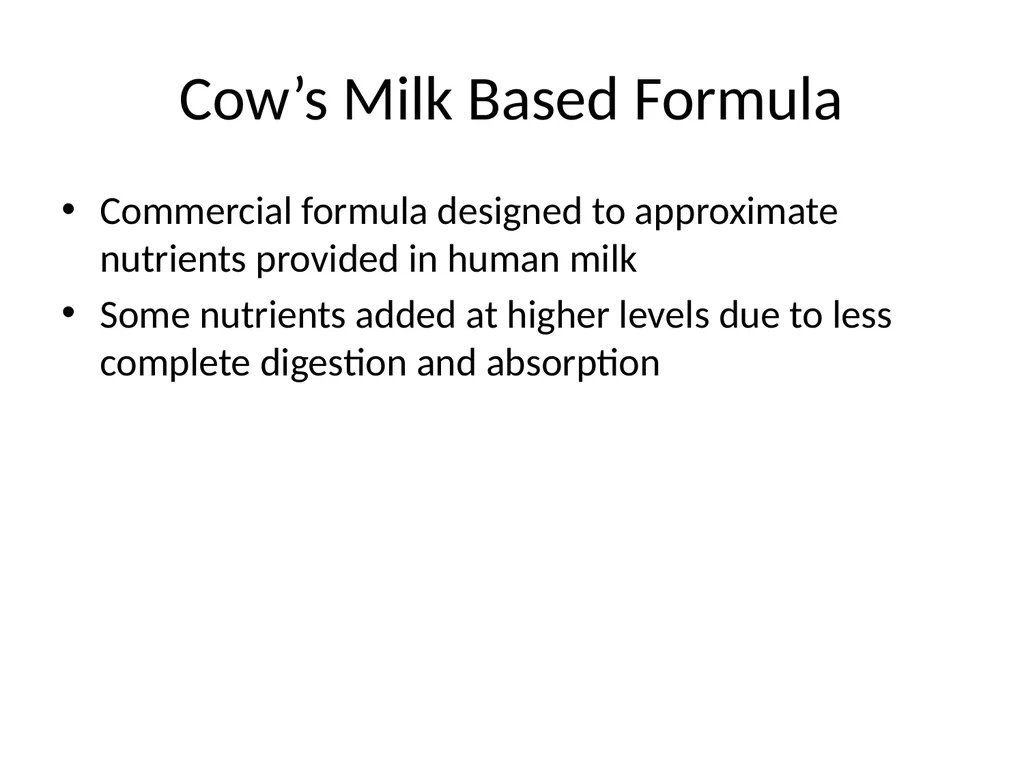
Cow’s Milk Based Formula Commercial formula designed to approximate nutrients provided in human milk
Some nutrients added at higher levels due to less complete digestion and absorption<br>
Some nutrients added at higher levels due to less complete digestion and absorption<br>
59
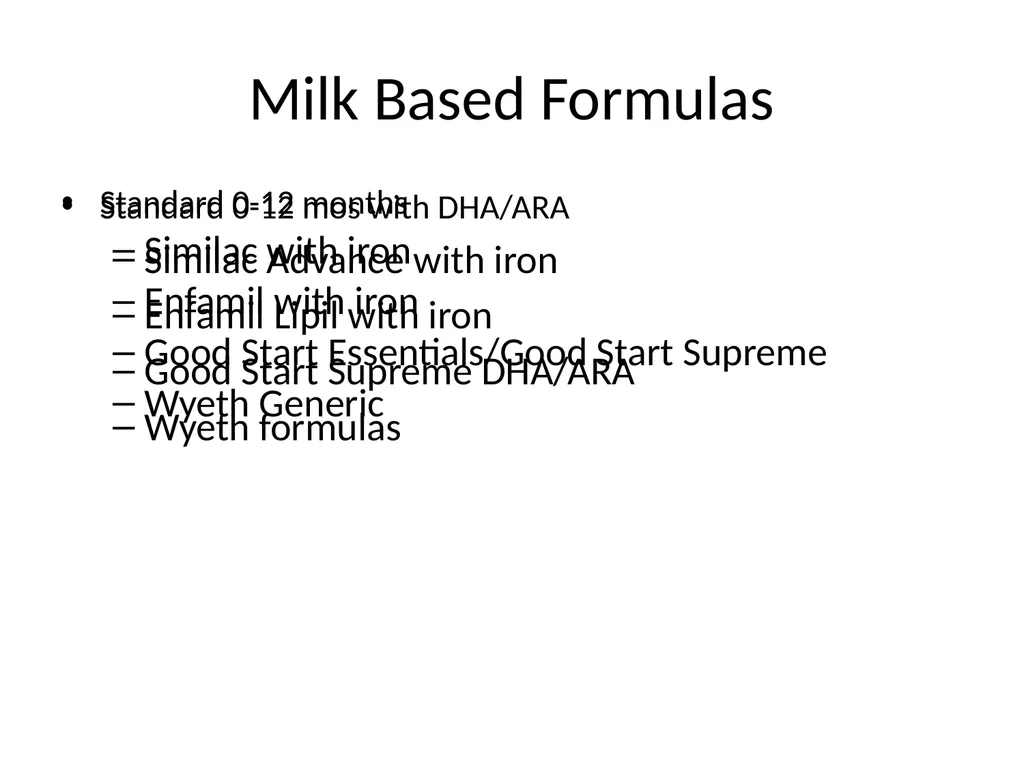
Milk Based Formulas Standard 0-12 months
Similac with iron
Enfamil with iron
Good Start Essentials/Good Start Supreme
Wyeth Generic Standard 0-12 mos with DHA/ARA
Similac Advance with iron
Enfamil Lipil with iron
Good Start Supreme DHA/ARA
Wyeth formulas<br>
Similac with iron
Enfamil with iron
Good Start Essentials/Good Start Supreme
Wyeth Generic Standard 0-12 mos with DHA/ARA
Similac Advance with iron
Enfamil Lipil with iron
Good Start Supreme DHA/ARA
Wyeth formulas<br>
60
Protein Blend of whey and casein proteins
8.2-9.6% total calories whey proteins of human and cow’s milk are different and have different amino acid profiles.
Major whey proteins of human milk are lactalbumin (high levels of essential aa) , immunoglobulins, and lactoferrin( enhances iron transportation)
Cow’s milk has low levels of these proteins and high levels of b lactoglobulin<br>
61
Cow’s Milk Based Formula: Fat & CHO Fat: butterfat of cow’s milk is replaced with vegetable fat sources to make the fatty acid profile of cow’s milk formulas more like those of human milk and to increase the proportion of essential fatty acids
CHO: Lactose is the major carbohydrate in most cows’ milk based formulas.
Meets needs of healthy infants<br>
CHO: Lactose is the major carbohydrate in most cows’ milk based formulas.
Meets needs of healthy infants<br>
62
Milk Based Pre and Probiotic Supplemented Marketed to promote digestive health and support healthy immune fx
Probiotic
Bifidus BL
Gerber Good start Protect Plus
Lactobacillus rhamosus
Nutramigen Lipil with Enflora
Prebiotic
Galactooligosaccarides (GOS)
Similac Advance Early Shield (Triple Shield), Enfamil Premium, Generic Brands<br>
Probiotic
Bifidus BL
Gerber Good start Protect Plus
Lactobacillus rhamosus
Nutramigen Lipil with Enflora
Prebiotic
Galactooligosaccarides (GOS)
Similac Advance Early Shield (Triple Shield), Enfamil Premium, Generic Brands<br>
63
Infant Formulas: AAP Cow’s milk based formula is recommended for the first 12 months if breast milk is not available<br>
64
Soy Formulas First developed in 1930s with soy flour
Early formulas produced diarrhea and excessive gas
Now use soy protein isolate with added methionine<br>
Early formulas produced diarrhea and excessive gas
Now use soy protein isolate with added methionine<br>
65
Soy Formulas Isomil/Isomil DF /Isomil Advance/Isomil Advance 2
Prosobee/Prosobee Lipil/Next Step Prosobee
Good Start Essentials Soy/Good Start 2 Essentials Soy
Wyeth All iron fortified<br>
Prosobee/Prosobee Lipil/Next Step Prosobee
Good Start Essentials Soy/Good Start 2 Essentials Soy
Wyeth All iron fortified<br>
66
Soy Formulas Protein: soy protein isolate with added methionine
Fat: vegetables oils
CHO: usually corn based products<br>
Fat: vegetables oils
CHO: usually corn based products<br>
67
Soy Formulas
Characteristics compared to Milk Based Higher protein (lower quality)
Higher sodium, calcium, and phosphorus
Carbohydrate: Corn syrup solids, sucrose, and/or maltodextrin; lactose free
Fats: Long chain
Meet needs of healthy infants<br>
Higher sodium, calcium, and phosphorus
Carbohydrate: Corn syrup solids, sucrose, and/or maltodextrin; lactose free
Fats: Long chain
Meet needs of healthy infants<br>
68
American Academy of Pediatrics Committee on Nutrition. Soy Protein-based Formulas: Recommendations for Use in Infant Feeding. Pediatrics 1998;101:148-153. Soy formulas given to 25% of infants but needed by very few
Offers no advantage over cow milk protein based formula as a supplement for breastfed infants
Provides appropriate nutrition for normal growth and development
Indicated primarily in the case of vegetarian families and for the very small number of infants with galactosemia and hereditary lactase deficiency<br>
69
Possible Concerns about Soy Formulas: AAP 60% of infants with cowmilk protein induced enterocolitis will also be sensitive to soy protein - damaged mucosa allows increased uptake of antigen.
Contains phytates and fiber oligosacharides so will inhibit absorption of minerals (additional Ca is added)
Higher levels of osteopenia in preterm infants given soy formulas
Phytoestrogens at levels that demonstrate physiologic activity in rodent models
Higher aluminum levels<br>
Contains phytates and fiber oligosacharides so will inhibit absorption of minerals (additional Ca is added)
Higher levels of osteopenia in preterm infants given soy formulas
Phytoestrogens at levels that demonstrate physiologic activity in rodent models
Higher aluminum levels<br>
70
Health Consequences of Early Soy Consumption. Badger et al. J Nutr. 2002 US soy formulas made with soy protein isolate (SPI+)
SPI+ has several phytochemicals, including isoflavones
Isoflavones are referred to as phytoestrogens
Phytoestrogens bind to estrogen receptors & act as estrogen agonists, antagonists, or selective estrogen receptor modulators depending on tissue, cell type, hormonal status, age, etc.<br>
SPI+ has several phytochemicals, including isoflavones
Isoflavones are referred to as phytoestrogens
Phytoestrogens bind to estrogen receptors & act as estrogen agonists, antagonists, or selective estrogen receptor modulators depending on tissue, cell type, hormonal status, age, etc.<br>
71
Should we be Concerned? - Badger et al. No human data support toxicity of soyfoods
Soyfoods have a long history in Asia
Millions of American infants have been fed soy formula over the past 3 decades
Rat studies indicate a potential protective effect of soy in infancy for cancer<br>
Soyfoods have a long history in Asia
Millions of American infants have been fed soy formula over the past 3 decades
Rat studies indicate a potential protective effect of soy in infancy for cancer<br>
72
Contraindications to Soy Formula: AAP preterm infants due to increased risk of inadequate bone mineralization
infants with cow milk protein-induced enteropathy or enterocolitis
most previously well infants with acute gastroenteritis
prevention of colic or allergy.<br>
infants with cow milk protein-induced enteropathy or enterocolitis
most previously well infants with acute gastroenteritis
prevention of colic or allergy.<br>
73
Elemental Formulas Hydrolysates
Amino Acid Based<br>
Amino Acid Based<br>
74
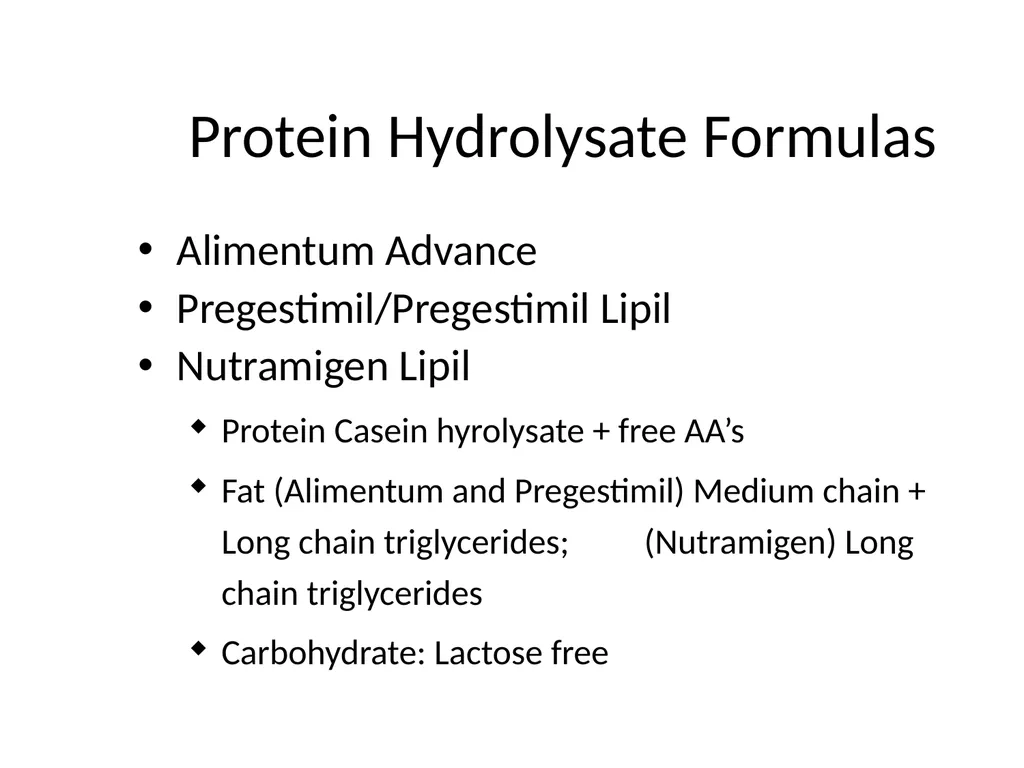
Protein Hydrolysate Formulas Alimentum Advance
Pregestimil/Pregestimil Lipil
Nutramigen Lipil
Protein Casein hyrolysate + free AA’s
Fat (Alimentum and Pregestimil) Medium chain + Long chain triglycerides; (Nutramigen) Long chain triglycerides
Carbohydrate: Lactose free<br>
Pregestimil/Pregestimil Lipil
Nutramigen Lipil
Protein Casein hyrolysate + free AA’s
Fat (Alimentum and Pregestimil) Medium chain + Long chain triglycerides; (Nutramigen) Long chain triglycerides
Carbohydrate: Lactose free<br>
75
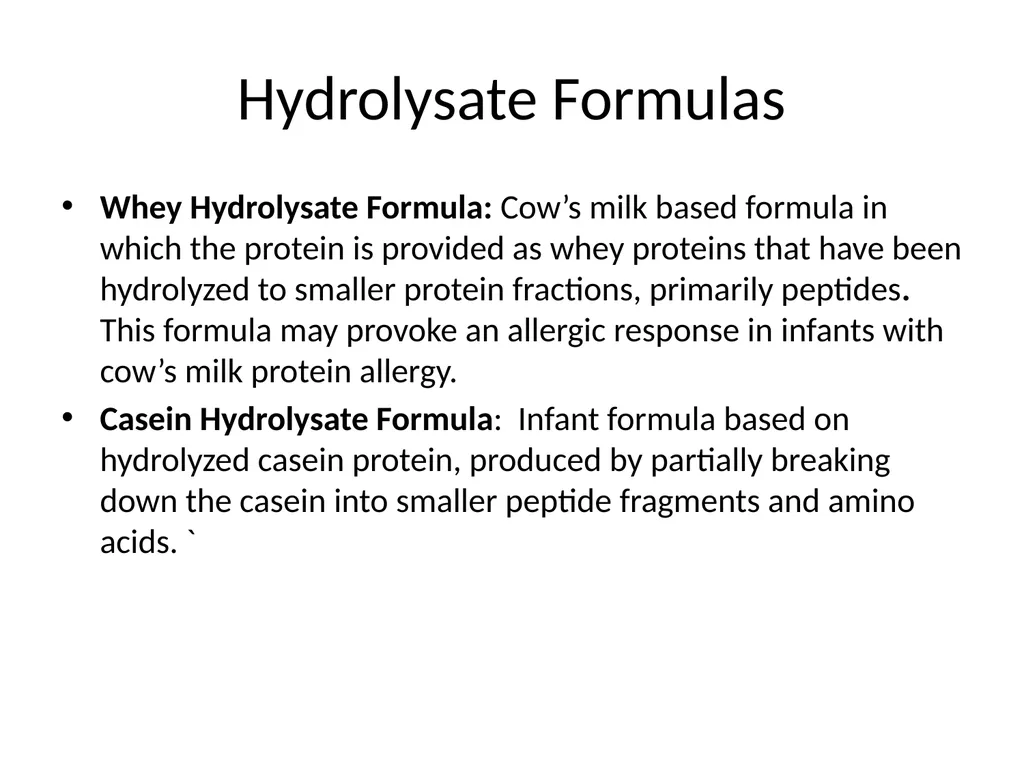
Hydrolysate Formulas Whey Hydrolysate Formula: Cow’s milk based formula in which the protein is provided as whey proteins that have been hydrolyzed to smaller protein fractions, primarily peptides. This formula may provoke an allergic response in infants with cow’s milk protein allergy.
Casein Hydrolysate Formula: Infant formula based on hydrolyzed casein protein, produced by partially breaking down the casein into smaller peptide fragments and amino acids. `<br>
Casein Hydrolysate Formula: Infant formula based on hydrolyzed casein protein, produced by partially breaking down the casein into smaller peptide fragments and amino acids. `<br>
76
AAP Policy Statement Re: Hypoallergenic Infant Formulas (August, 2000) Recommendations<br>
77
AAP Policy Statement Re: Hypoallergenic Infant Formulas (August, 2000) Currently available, partially hydrolyzed formulas are not hypoallergenic.<br>
78
2.Formula-fed infants with confirmed cow's milk allergy may benefit from the use of a hypoallergenic or soy formula as described for the breastfed infant.<br>
79
Amino Acid Based<br>
80
Amino Acid Based Formulas Elecare, Neocate, Nutramigen AA
Protein: Free Amino Acids
Fat: Long chain and medium chain
Elecare (33% MCT), Neocate (5% MCT)
Carbohydrate: corn syrup solids, Lactose and sucrose free
Indications for use: Food Allergy or intolerance to peptides or whole protein<br>
Protein: Free Amino Acids
Fat: Long chain and medium chain
Elecare (33% MCT), Neocate (5% MCT)
Carbohydrate: corn syrup solids, Lactose and sucrose free
Indications for use: Food Allergy or intolerance to peptides or whole protein<br>
81
Elemental Infant Formula NeoCate (SHS)
Protein: Free Amino Acids
Fat: Long chain
Carbohydrate: Lactose Free
Indications for use: Food Allergy or intolerance to peptides or whole protein<br>
Protein: Free Amino Acids
Fat: Long chain
Carbohydrate: Lactose Free
Indications for use: Food Allergy or intolerance to peptides or whole protein<br>
82
Other Specialty Formulas Similac PM 60/40 (Ross)
Low in Ca, P, K+ and NA; 2:1 Ca:P ratio
Used for infants with Renal Failure
Formulas for Metabolic Disorders
Preterm Products
Low fat high MCT<br>
Low in Ca, P, K+ and NA; 2:1 Ca:P ratio
Used for infants with Renal Failure
Formulas for Metabolic Disorders
Preterm Products
Low fat high MCT<br>
83
Indications Cow’s milk based
Health term infant
Soy
Vegetarian
Galactosemia
Protein Hydrolysates
Protein intolerance/allergy
other
Preterm Formulas
Post-discharge Preterm formulas
Other Specialty Formulas
Specific medical, metabolic indications<br>
Health term infant
Soy
Vegetarian
Galactosemia
Protein Hydrolysates
Protein intolerance/allergy
other
Preterm Formulas
Post-discharge Preterm formulas
Other Specialty Formulas
Specific medical, metabolic indications<br>
84
Know What You Are Feeding Caloric density, protein, fat and carbohydrate vitamin and mineral content.
Osmolality:
Renal Solute Load: Evaluate RSL in context of solute intake, fluid intake and output.
Evidence Based
Rationale
Cost and availability<br>
Osmolality:
Renal Solute Load: Evaluate RSL in context of solute intake, fluid intake and output.
Evidence Based
Rationale
Cost and availability<br>
85
Finding Up to Date Information www.ross.com Similac products
www.meadjohnson.com Enfamil products
www.verybestbaby.com Nestle products
www.wyethnutritionals.com generic products
www.brightbeginnings.com lower cost formulas made by Wyeth
www.shsna.com/html/Hypoallergenic.htm
Neocate formulas<br>
www.meadjohnson.com Enfamil products
www.verybestbaby.com Nestle products
www.wyethnutritionals.com generic products
www.brightbeginnings.com lower cost formulas made by Wyeth
www.shsna.com/html/Hypoallergenic.htm
Neocate formulas<br>
86
Regulation of Infant Formula FDA
Infant Formula Act
Manufacturers
Voluntary monitoring
AAP, National Academy of Sciences, other professional organizations
Guidelines for composition and intake: (e.g. DRI’s)
Guidelines for preparation and handling of formula/human milk in health care facilities<br>
Infant Formula Act
Manufacturers
Voluntary monitoring
AAP, National Academy of Sciences, other professional organizations
Guidelines for composition and intake: (e.g. DRI’s)
Guidelines for preparation and handling of formula/human milk in health care facilities<br>
87
Regulation of Infant Formulas Infant Formula Act:
Manufacturing regulations
Quality control
Non specific testing requirements, case by case basis, growth outcomes
Recall Proceedures
Nutrient content and labeling
Panel convened 1998 and 2002 (recommended revisions including exemptions)<br>
Manufacturing regulations
Quality control
Non specific testing requirements, case by case basis, growth outcomes
Recall Proceedures
Nutrient content and labeling
Panel convened 1998 and 2002 (recommended revisions including exemptions)<br>
88
Regulation of Infant Formulas Infant Formula Act: The purpose of the infant formula act (1980) is to ensure the safety and nutrition of infant formulas – including minimum and in some cases maximum levels of specified nutrients. The act authorizes the FDA to establish appropriate regulations for 1) new formulas, 2) formulas entering the U.S. market, 3) major changes, revisions, or substitutions of macronutrients 4) formulas manufactured in new plants or processing lines, 5) addition of new constituents 6) use of new equipment or technology 7) packaging changes<br>
89
Formula Regulation Regulation is by the Infant Formula Act of 1980, under FDA authority
Nutrient composition guidelines for 29 nutrients established by AAP Committee on Nutrition and adopted as regs by FDA
Nutrient Requirements for Infant Formulas. Federal Register 36, 23553-23556. 1985. 21 CFR Part 107.<br>
Nutrient composition guidelines for 29 nutrients established by AAP Committee on Nutrition and adopted as regs by FDA
Nutrient Requirements for Infant Formulas. Federal Register 36, 23553-23556. 1985. 21 CFR Part 107.<br>
90
Infant Formula Act Institute of Medicine Food and Nutrition Board 3/2004
“Although the federal regulatory processes for evaluating the safety of food ingredients have worked well for conventional substances, they were not designed to ensure the needs and vulnerabilities of infants and are insufficient to ensure the safety of new types of ingredients proposed for infant formulas<br>
“Although the federal regulatory processes for evaluating the safety of food ingredients have worked well for conventional substances, they were not designed to ensure the needs and vulnerabilities of infants and are insufficient to ensure the safety of new types of ingredients proposed for infant formulas<br>
91
Infant Formula Act “The current regulatory processed do not fully address the unique role of formula as a food source. Formula is the only infants’ food if they are not being breastfed. The processes used to regulate the safety of any new additions of formula should be tailored to these products distict role and the special needs and susceptibilities of infants”<br>
92
Infant Formula Act Key limitation: lack of explicit guideleines for determining when and what safety data is needed…..(GRAS)
Clarification is crucial given the increasing number of bioactive peptides and enzymens generated from unconventional sources or new technologies<br>
Clarification is crucial given the increasing number of bioactive peptides and enzymens generated from unconventional sources or new technologies<br>
93
Infant Formula Act: Points for discussion Addition of DHA and ARA to formulas
Addition of prebiotics to formula
Present in BM
GRAS
Vitamin/mineral content conforms to regulation
? testing<br>
Addition of prebiotics to formula
Present in BM
GRAS
Vitamin/mineral content conforms to regulation
? testing<br>
94
Formula safety FDA recall list 2005-2006<br>
95
Cows milk and goats milk Protein
RSL
Folic acid, iron, vitamin D
pasteurization<br>
RSL
Folic acid, iron, vitamin D
pasteurization<br>