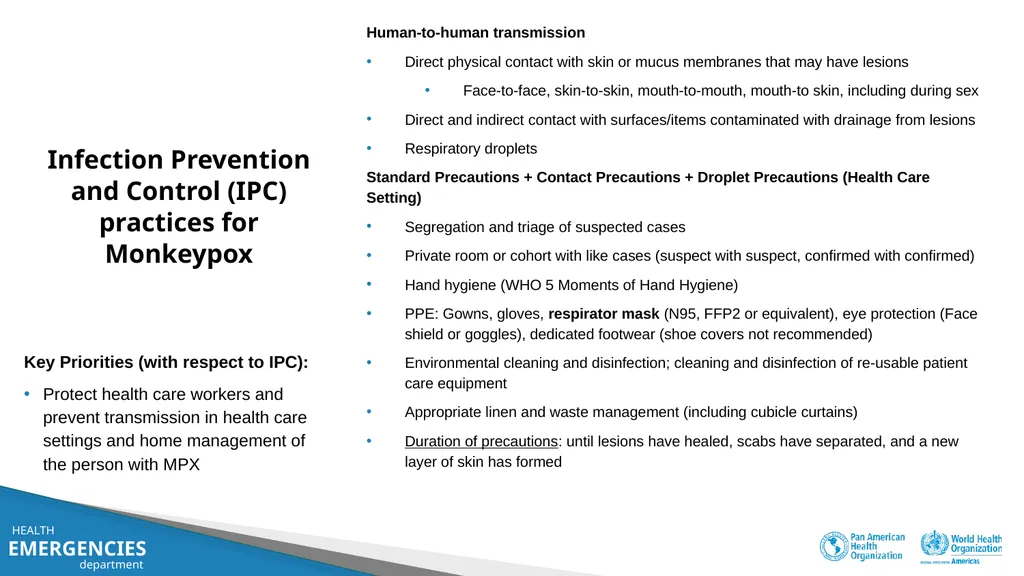
Infection Prevention and Control (IPC) practices for Monkeypox Human-to-human transmission Direct physical contact with skin or mucus membranes that may have lesions Face-to-face, skin-to-skin, mouth-to-mouth, mouth-to skin, including
"Infection Prevention and Control (IPC) practices" is the property of its rightful owner. Permission is granted to
download and print the materials on this website for personal, non-commercial use only, and to display it
on your personal computer provided you do not modify the materials and that you retain all copyright
notices contained in the materials. By downloading content from our website, you accept the terms of this
agreement.
Presentation Transcript
01
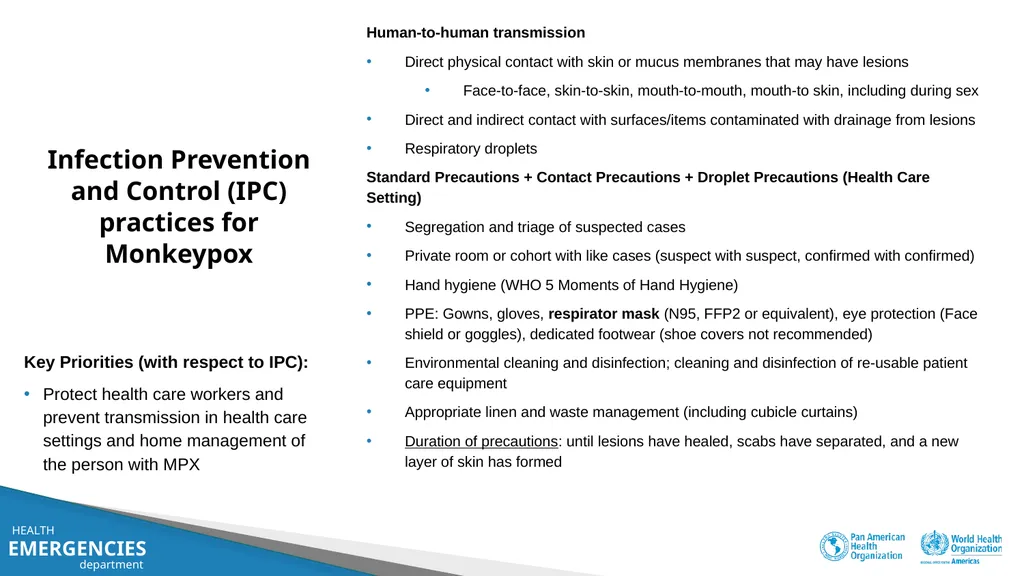
Infection Prevention and Control (IPC) practices for Monkeypox Human-to-human transmission
Direct physical contact with skin or mucus membranes that may have lesions
Face-to-face, skin-to-skin, mouth-to-mouth, mouth-to skin, including during sex
Direct and indirect contact with surfaces/items contaminated with drainage from lesions
Respiratory droplets
Standard Precautions + Contact Precautions + Droplet Precautions (Health Care Setting)
Segregation and triage of suspected cases
Private room or cohort with like cases (suspect with suspect, confirmed with confirmed)
Hand hygiene (WHO 5 Moments of Hand Hygiene)
PPE: Gowns, gloves, respirator mask (N95, FFP2 or equivalent), eye protection (Face shield or goggles), dedicated footwear (shoe covers not recommended)
Environmental cleaning and disinfection; cleaning and disinfection of re-usable patient care equipment
Appropriate linen and waste management (including cubicle curtains)
Duration of precautions: until lesions have healed, scabs have separated, and a new layer of skin has formed Key Priorities (with respect to IPC):
Protect health care workers and prevent transmission in health care settings and home management of the person with MPX<br>
02
Assessment of the home situation must be conducted prior to isolation at home to determine if the infection prevention and control (IPC) conditions can be fulfilled in the home setting.
The person with MPX should stay in a dedicated, well-ventilated room (e.g. with windows that can be opened frequently) separate from others in the household.
Items such as eating utensils, linens, towels, electronic devices or beds should be dedicated to the person with MPX. Avoid sharing personal items.
Appropriate management of contaminated linen
Appropriate management of infectious waste The patient with MPX should wear a well-fitting medical mask and cover lesions when in close proximity of others, and when moving outside of the designated isolation area (e.g. to use the toilet).
If the designated person that is facilitating self-care needs to enter the isolation area, they should maintain a distance of at least 1 m from patient.
When distance cannot be maintained, the designated person is to wear a well-fitting medical mask and disposable gloves.
They should clean their hands with either soap and water or an alcohol-based hand sanitizer, before and after contact with the patient or surrounding environment and
Perform hand hygiene before putting on and after removing their gloves.
Recommended duration of precautions: until lesions have healed, scabs have separated, and a new layer of skin has formed Infection Prevention and Control (IPC) in the Home Care Setting<br>
03
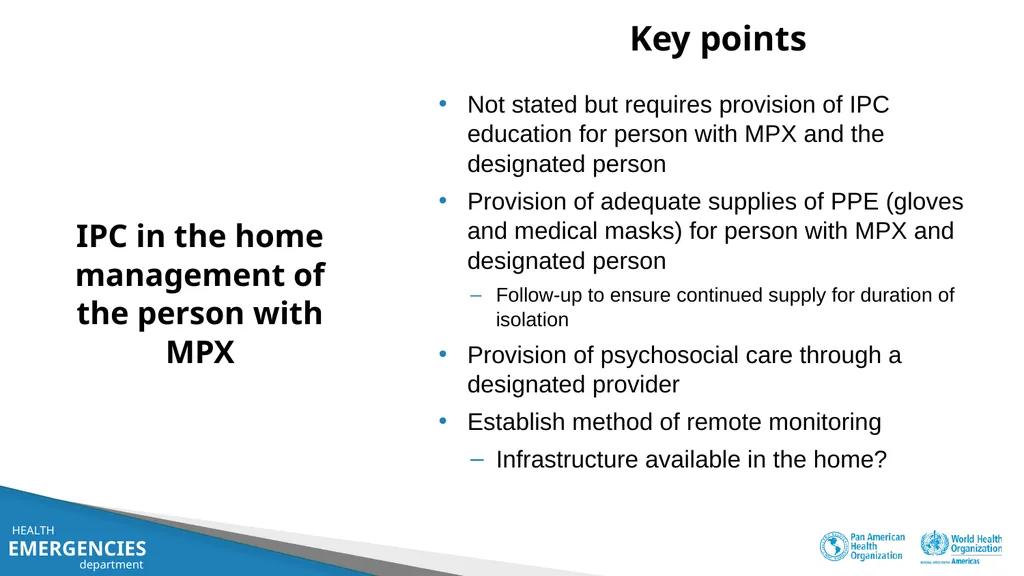
IPC in the home management of the person with MPX Not stated but requires provision of IPC education for person with MPX and the designated person
Provision of adequate supplies of PPE (gloves and medical masks) for person with MPX and designated person
Follow-up to ensure continued supply for duration of isolation
Provision of psychosocial care through a designated provider
Establish method of remote monitoring
Infrastructure available in the home? Key points<br>
04
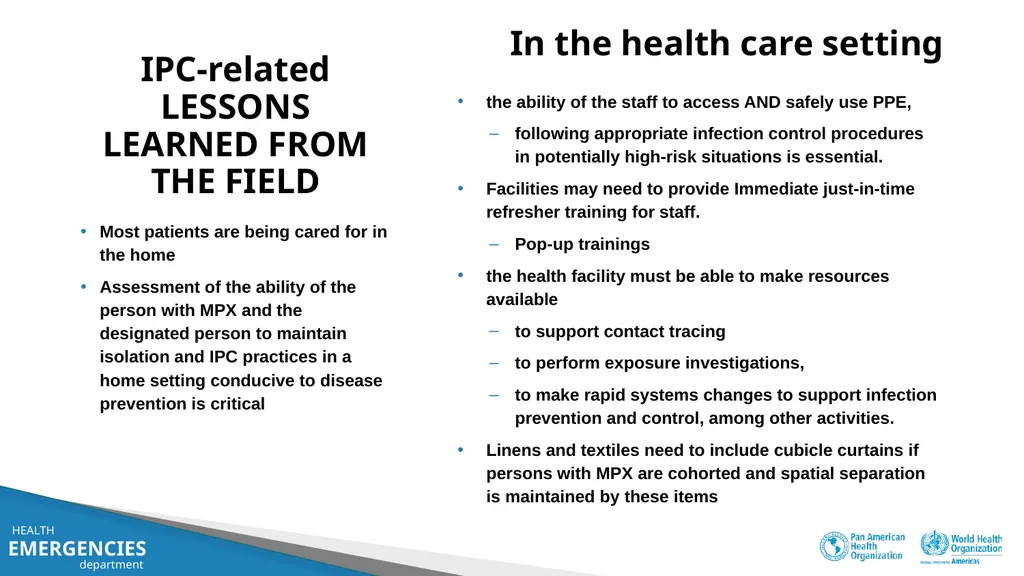
the ability of the staff to access AND safely use PPE,
following appropriate infection control procedures in potentially high-risk situations is essential.
Facilities may need to provide Immediate just-in-time refresher training for staff.
Pop-up trainings
the health facility must be able to make resources available
to support contact tracing
to perform exposure investigations,
to make rapid systems changes to support infection prevention and control, among other activities.
Linens and textiles need to include cubicle curtains if persons with MPX are cohorted and spatial separation is maintained by these items Most patients are being cared for in the home
Assessment of the ability of the person with MPX and the designated person to maintain isolation and IPC practices in a home setting conducive to disease prevention is critical IPC-related LESSONS LEARNED FROM THE FIELD In the health care setting<br>