Infinitives Gerunds Infinitives can be defined as uninflected forms of the verbs. They can be bare infinitives or infinitives with to. Split infinitive is an infinitive with an adverb between to and the verb( e.g., to boldly go )
"Infinitives & Gerunds Infinitives can be defined" is the property of its rightful owner. Permission is granted to
download and print the materials on this website for personal, non-commercial use only, and to display it
on your personal computer provided you do not modify the materials and that you retain all copyright
notices contained in the materials. By downloading content from our website, you accept the terms of this
agreement.
Presentation Transcript
01
Infinitives & Gerunds Infinitives can be defined as uninflected forms of the verbs. They can be bare infinitives or infinitives with ‘to’.
Split infinitive is an infinitive with an adverb between ‘to’ and the verb( e.g., ‘ to boldly go’ )<br>
02
Major Uses of simple Infinitives 1. After certain verbs: They decide to go home.
2. After adjectives: She is sad to leave early.
3. After nouns: I gave a promise to help them.
4. After indefinite pronouns: There was someone to clean the garage.
5. After wh-words: I understand what to do .
,,,,,,,,,,,,,,,,,,,,,,,,,,,,,,,,,,,,,,,,,,,,,,,,,,,,,,,,,,,,,,,,,,,,,,<br>
03
Bare Infinitives:( Base Forms of Verbs) We use bare infinitives after :
1. Modals: ( will,would, shall, should, must, ought to, dare to, need to, can , could, may might) :
Can they play tennis well?
2. After perception verbs with objects ( hear, see , …… ) : She didn’t hear the teacher come.
3. After certain verbs: ( make, let ): Let her go.<br>
04
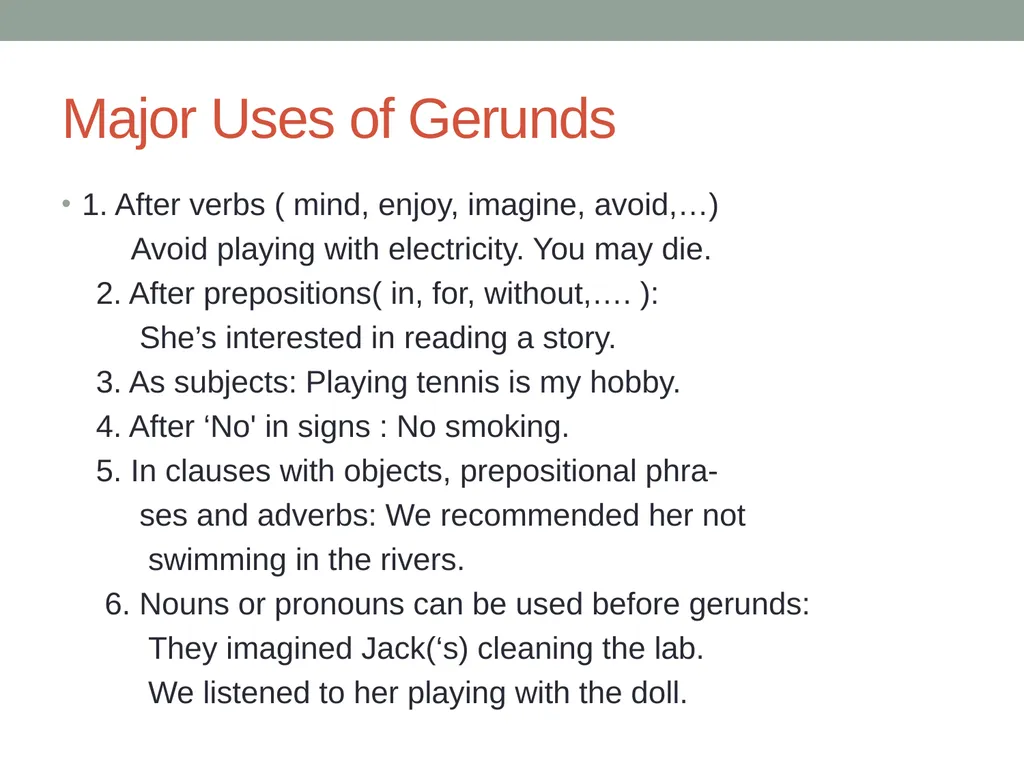
Major Uses of Gerunds 1. After verbs ( mind, enjoy, imagine, avoid,…)
Avoid playing with electricity. You may die.
2. After prepositions( in, for, without,…. ):
She’s interested in reading a story.
3. As subjects: Playing tennis is my hobby.
4. After ‘No' in signs : No smoking.
5. In clauses with objects, prepositional phra-
ses and adverbs: We recommended her not
swimming in the rivers.
6. Nouns or pronouns can be used before gerunds:
They imagined Jack(‘s) cleaning the lab.
We listened to her playing with the doll.<br>
05
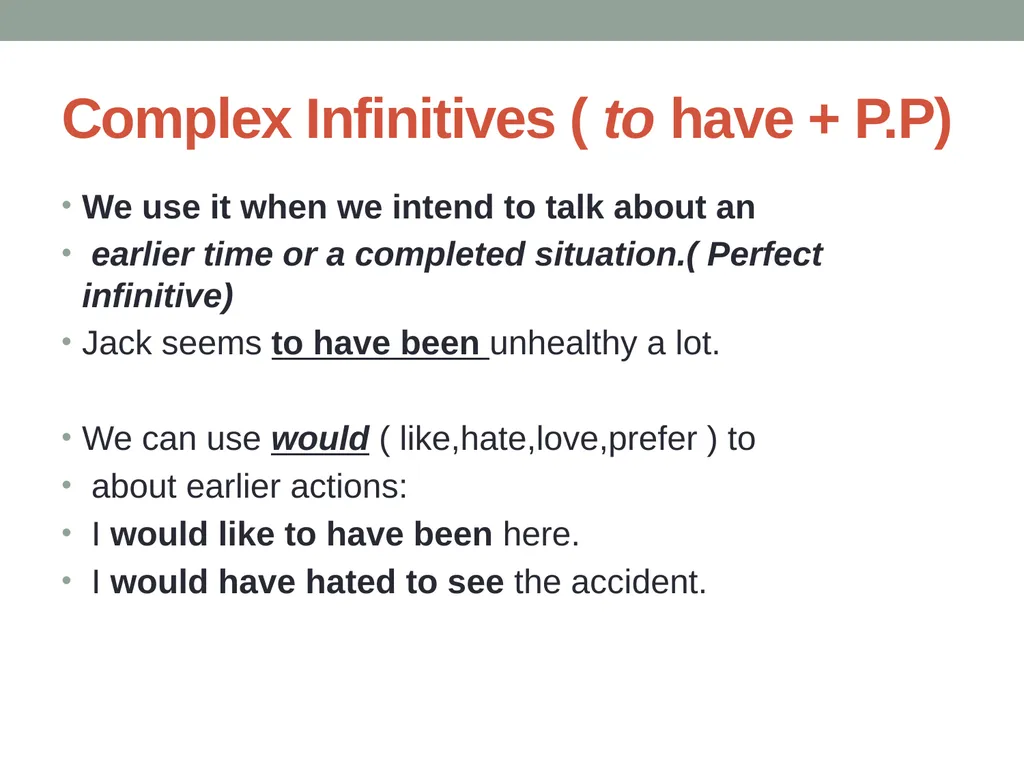
Complex Infinitives ( to have + P.P) We use it when we intend to talk about an
earlier time or a completed situation.( Perfect infinitive)
Jack seems to have been unhealthy a lot.
We can use would ( like,hate,love,prefer ) to
about earlier actions:
I would like to have been here.
I would have hated to see the accident.<br>
06
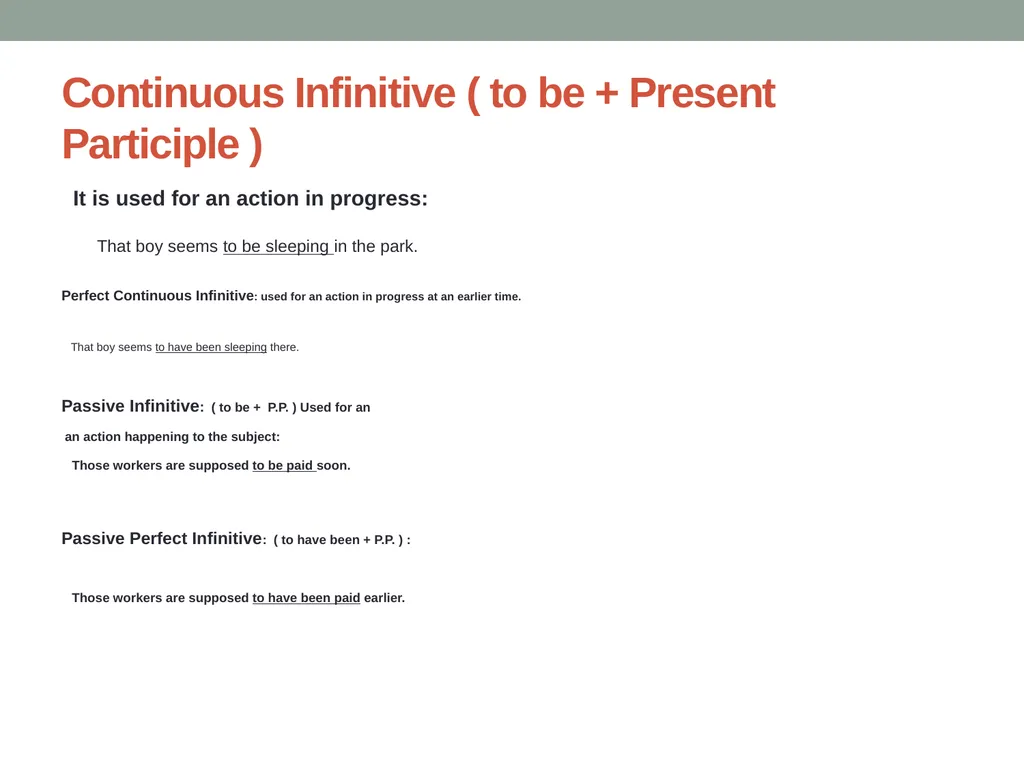
Continuous Infinitive ( to be + Present Participle ) It is used for an action in progress:
That boy seems to be sleeping in the park.
Perfect Continuous Infinitive: used for an action in progress at an earlier time.
That boy seems to have been sleeping there.
Passive Infinitive: ( to be + P.P. ) Used for an
an action happening to the subject:
Those workers are supposed to be paid soon.
Passive Perfect Infinitive: ( to have been + P.P. ) :
Those workers are supposed to have been paid earlier.<br>
07
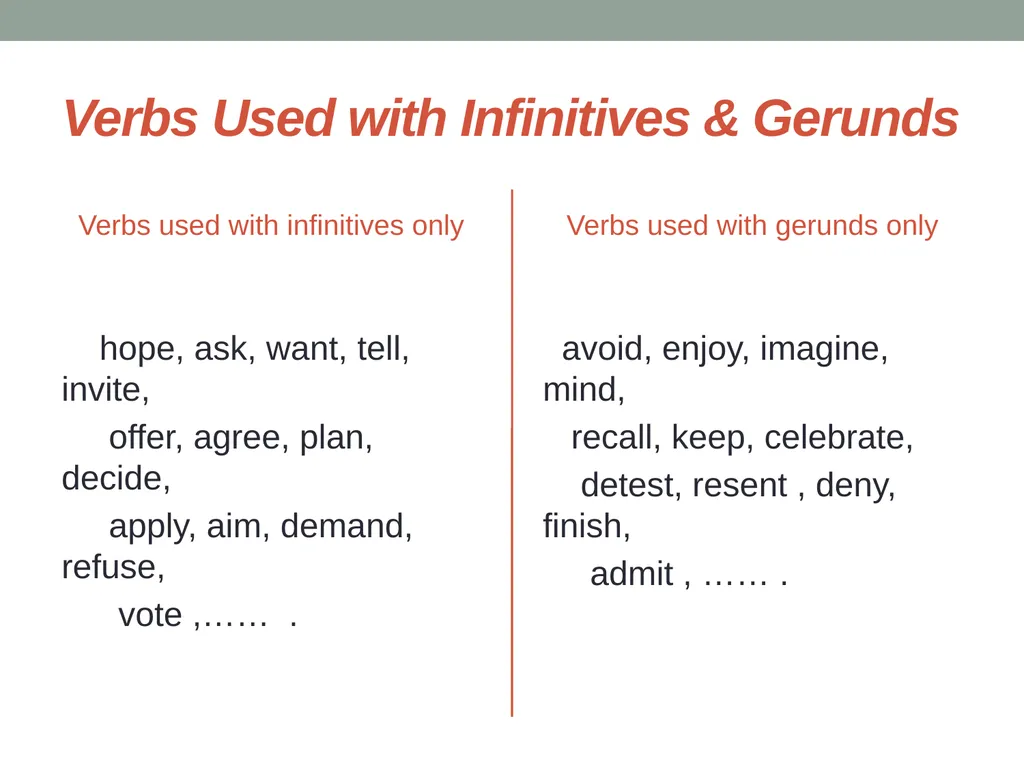
Verbs Used with Infinitives & Gerunds Verbs used with infinitives only hope, ask, want, tell, invite,
offer, agree, plan, decide,
apply, aim, demand, refuse,
vote ,…… . Verbs used with gerunds only avoid, enjoy, imagine, mind,
recall, keep, celebrate,
detest, resent , deny, finish,
admit , …… .<br>
08
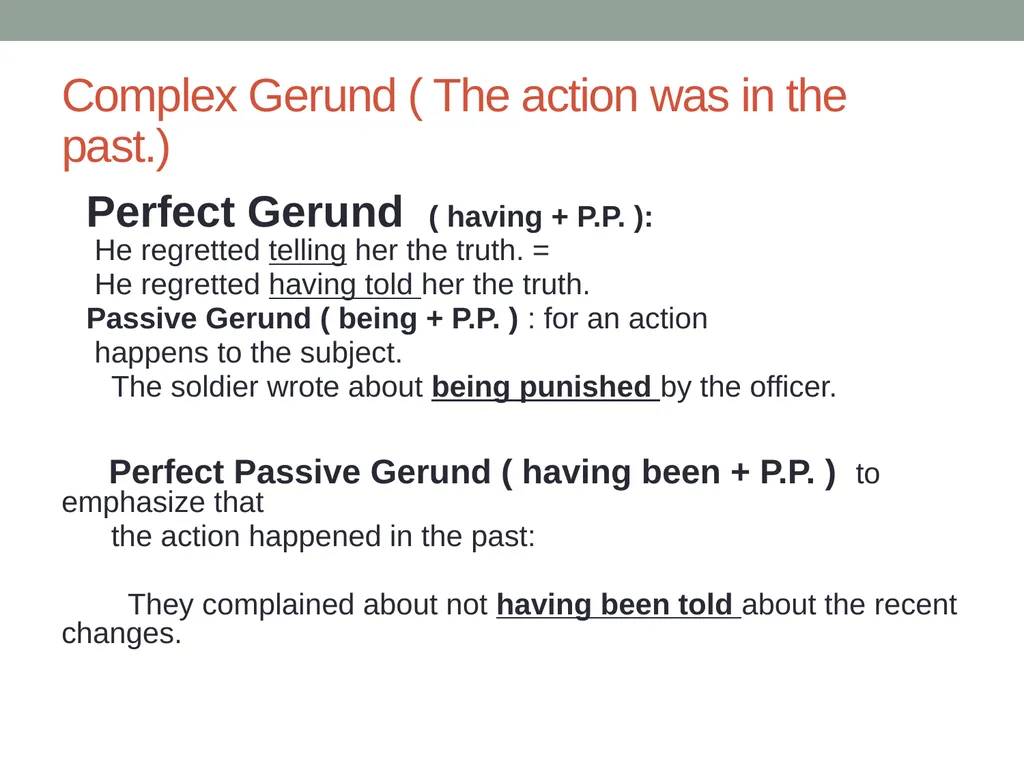
Complex Gerund ( The action was in the past.) Perfect Gerund ( having + P.P. ):
He regretted telling her the truth. =
He regretted having told her the truth.
Passive Gerund ( being + P.P. ) : for an action
happens to the subject.
The soldier wrote about being punished by the officer.
Perfect Passive Gerund ( having been + P.P. ) to emphasize that
the action happened in the past:
They complained about not having been told about the recent changes.<br>
09
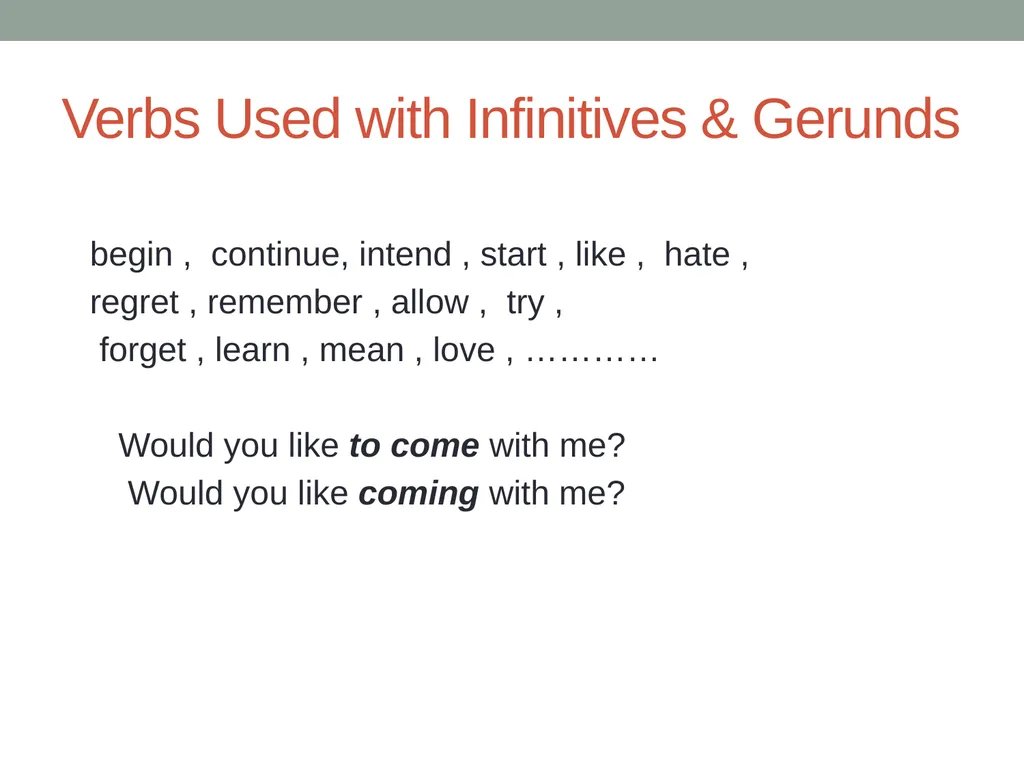
Verbs Used with Infinitives & Gerunds begin , continue, intend , start , like , hate ,
regret , remember , allow , try ,
forget , learn , mean , love , …………
Would you like to come with me?
Would you like coming with me?<br>
10
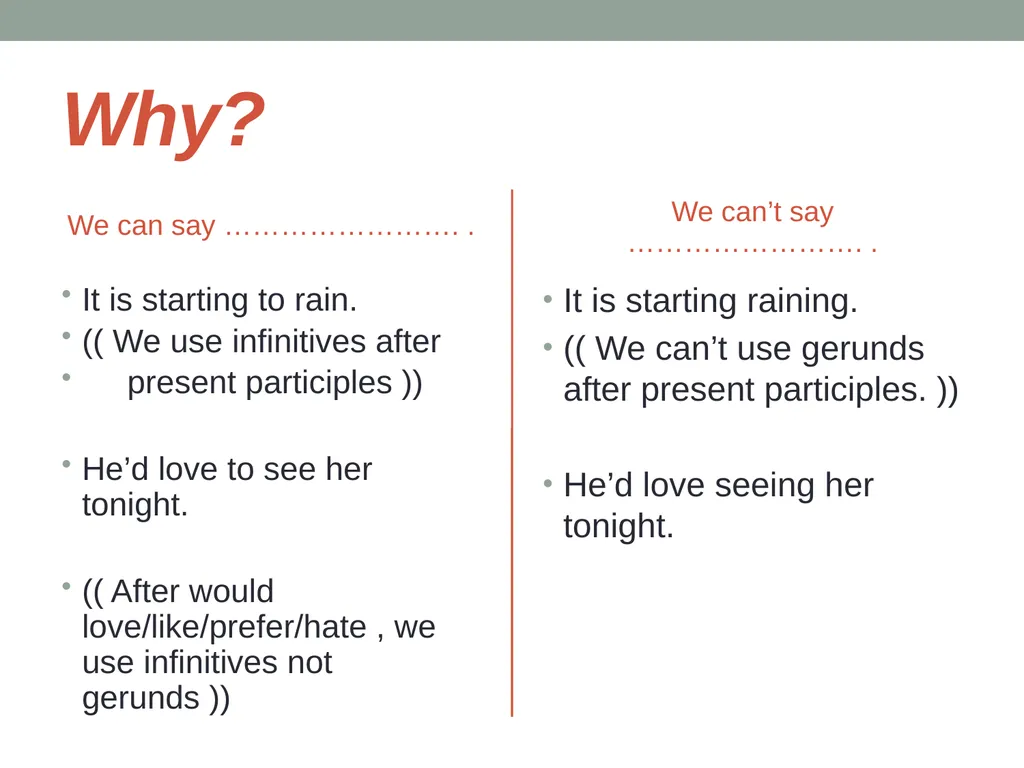
Why? We can say ……………………. . It is starting to rain.
(( We use infinitives after
present participles ))
He’d love to see her tonight.
(( After would love/like/prefer/hate , we use infinitives not gerunds )) We can’t say ……………………. . It is starting raining.
(( We can’t use gerunds after present participles. ))
He’d love seeing her tonight.<br>
11
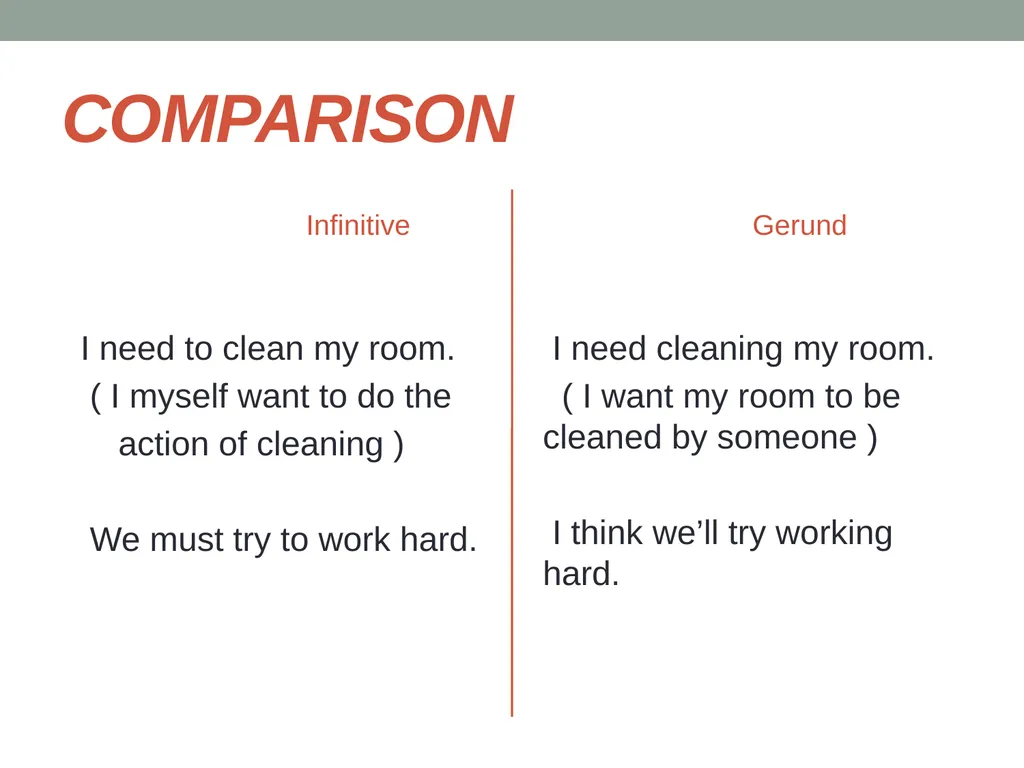
COMPARISON Infinitive I need to clean my room.
( I myself want to do the
action of cleaning )
We must try to work hard. Gerund I need cleaning my room.
( I want my room to be cleaned by someone )
I think we’ll try working hard.<br>
12
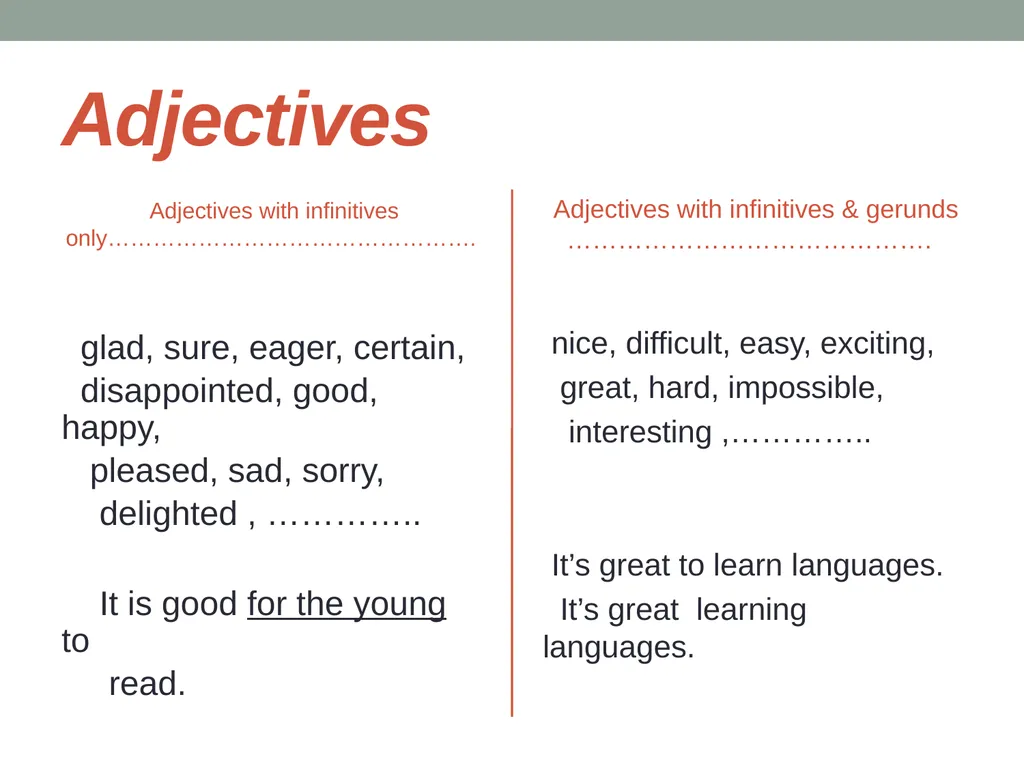
Adjectives Adjectives with infinitives only…………………………………………. glad, sure, eager, certain,
disappointed, good, happy,
pleased, sad, sorry,
delighted , …………..
It is good for the young to
read. Adjectives with infinitives & gerunds ……………………………………. nice, difficult, easy, exciting,
great, hard, impossible,
interesting ,…………..
It’s great to learn languages.
It’s great learning languages.<br>
13
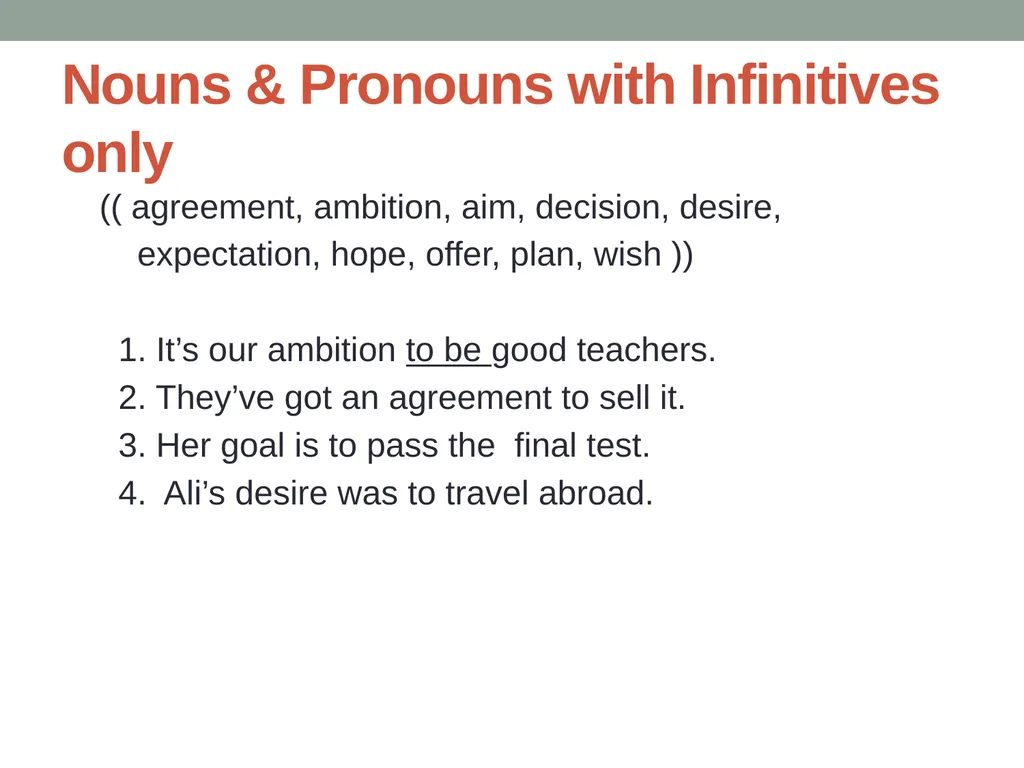
Nouns & Pronouns with Infinitives only (( agreement, ambition, aim, decision, desire,
expectation, hope, offer, plan, wish ))
1. It’s our ambition to be good teachers.
2. They’ve got an agreement to sell it.
3. Her goal is to pass the final test.
4. Ali’s desire was to travel abroad.<br>
14
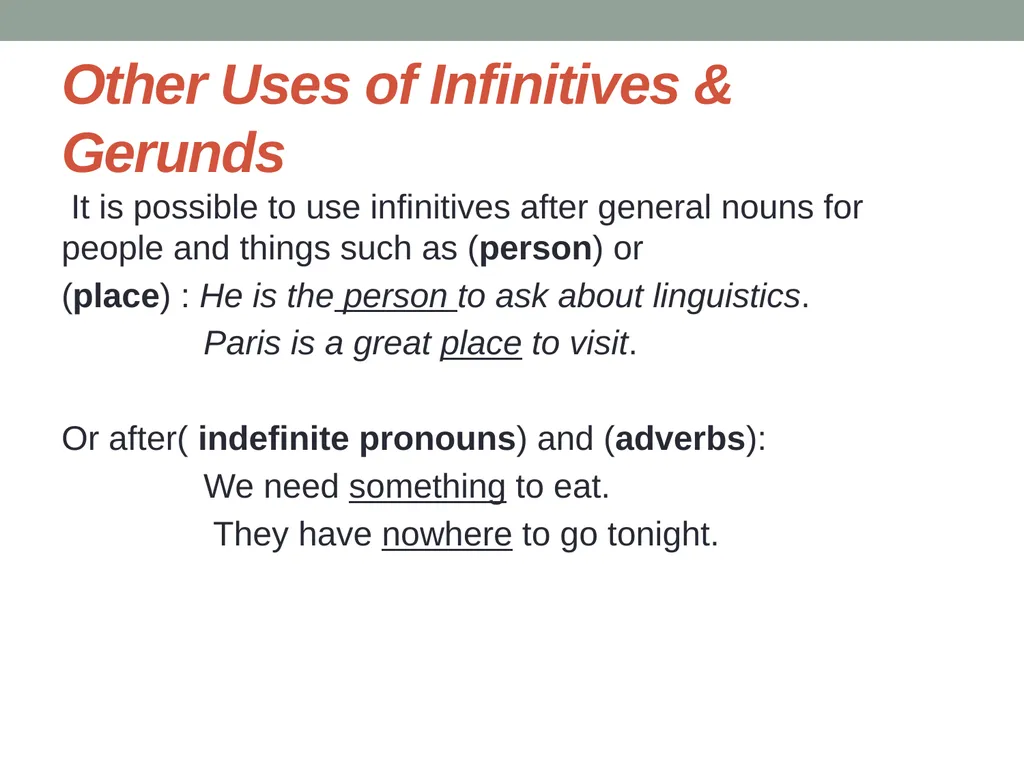
Other Uses of Infinitives & Gerunds It is possible to use infinitives after general nouns for people and things such as (person) or
(place) : He is the person to ask about linguistics.
Paris is a great place to visit.
Or after( indefinite pronouns) and (adverbs):
We need something to eat.
They have nowhere to go tonight.<br>
15
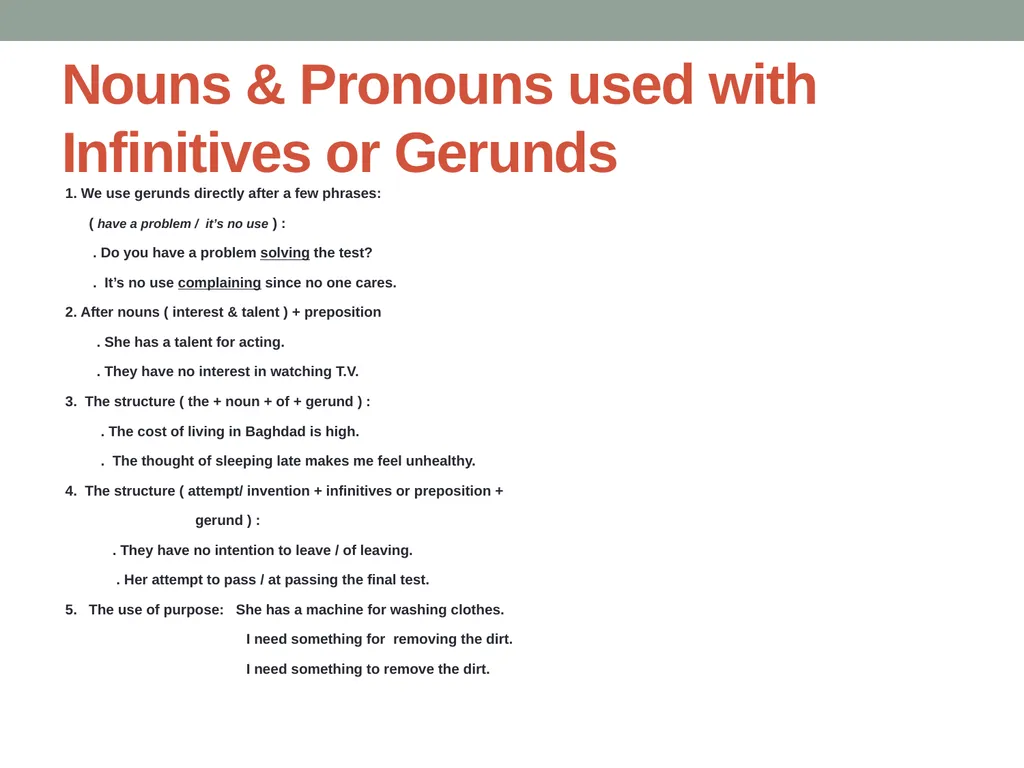
Nouns & Pronouns used with Infinitives or Gerunds 1. We use gerunds directly after a few phrases:
( have a problem / it’s no use ) :
. Do you have a problem solving the test?
. It’s no use complaining since no one cares.
2. After nouns ( interest & talent ) + preposition
. She has a talent for acting.
. They have no interest in watching T.V.
3. The structure ( the + noun + of + gerund ) :
. The cost of living in Baghdad is high.
. The thought of sleeping late makes me feel unhealthy.
4. The structure ( attempt/ invention + infinitives or preposition +
gerund ) :
. They have no intention to leave / of leaving.
. Her attempt to pass / at passing the final test.
5. The use of purpose: She has a machine for washing clothes.
I need something for removing the dirt.
I need something to remove the dirt.<br>