
Information Governance and Customer Contact New
MJ
Published · 47 slides · 0 views

1 / 1
Description
Information Governance and Customer Contact New Members briefing 2022 Riaghlachas Fiosrachaidh agus Conaltradh Luchd-cleachdaidh Miles Watters Freedom of Information Data Protection Manager miles.wattershighland.gov.uk Angela Morrison
Related Topics
Download this presentation From Below
"Information Governance and Customer Contact New" is the property of its rightful owner. Permission is granted to download and print the materials on this website for personal, non-commercial use only, and to display it on your personal computer provided you do not modify the materials and that you retain all copyright notices contained in the materials. By downloading content from our website, you accept the terms of this agreement.
Share
Embed code
Presentation Transcript
01
Information Governance and
Customer Contact New Members’ briefing 2022 Riaghlachas Fiosrachaidh
agus
Conaltradh Luchd-cleachdaidh<br>
agus
Conaltradh Luchd-cleachdaidh<br>
02
Miles Watters
Freedom of Information & Data Protection Manager
miles.watters@highland.gov.uk
Angela Morrison
Customer Resolution and Improvement Team Leader
Angela.Morrison@highland.gov.uk<br>
Freedom of Information & Data Protection Manager
miles.watters@highland.gov.uk
Angela Morrison
Customer Resolution and Improvement Team Leader
Angela.Morrison@highland.gov.uk<br>
03
Information Management
Strategy, Policy and Practice
Information Law
Data Protection, Data Sharing and Freedom of Information
Customer Resolution & Improvement Team
Complaints handling and SPSO
Requests for information
Signposting Session Outline<br>
Strategy, Policy and Practice
Information Law
Data Protection, Data Sharing and Freedom of Information
Customer Resolution & Improvement Team
Complaints handling and SPSO
Requests for information
Signposting Session Outline<br>
04
Information Management Strategy, Policy and Practice Stiùireadh Fiosrachaidh<br>
05
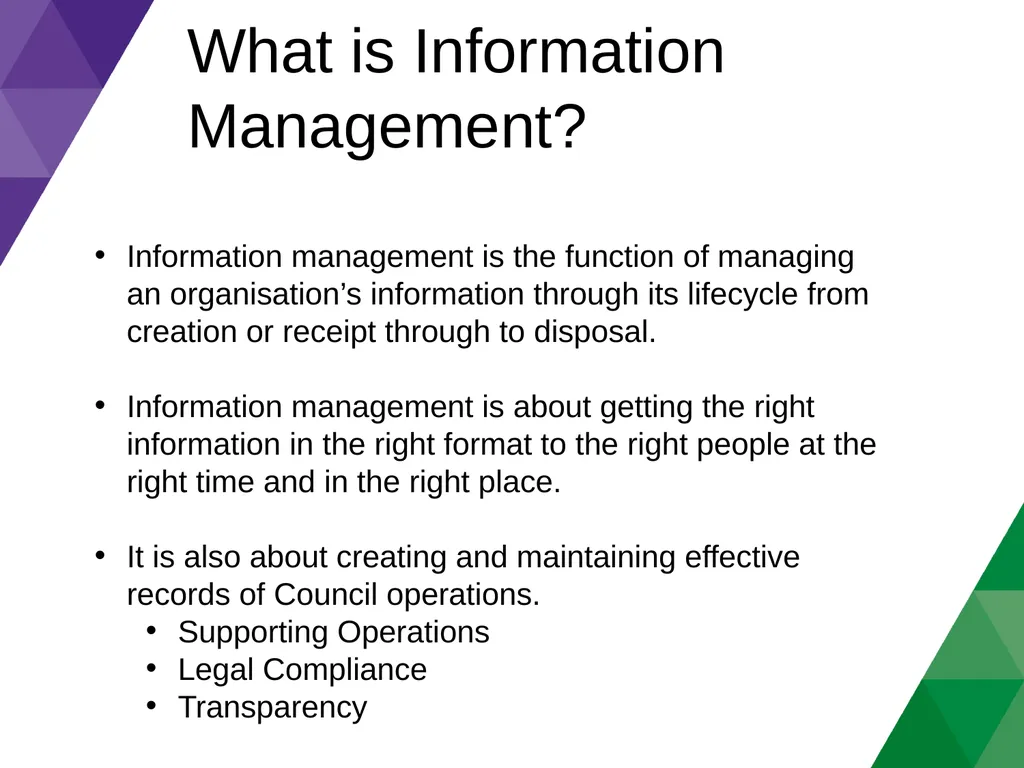
What is Information Management? Information management is the function of managing an organisation’s information through its lifecycle from creation or receipt through to disposal.
Information management is about getting the right information in the right format to the right people at the right time and in the right place.
It is also about creating and maintaining effective records of Council operations.
Supporting Operations
Legal Compliance
Transparency<br>
Information management is about getting the right information in the right format to the right people at the right time and in the right place.
It is also about creating and maintaining effective records of Council operations.
Supporting Operations
Legal Compliance
Transparency<br>
06
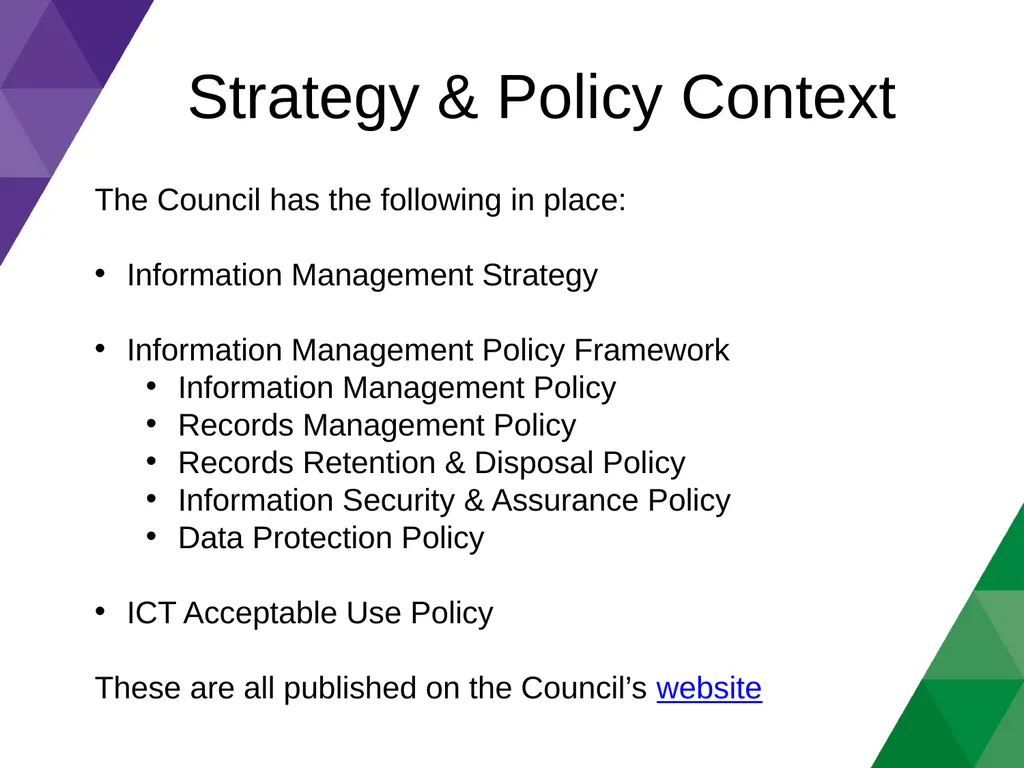
Strategy & Policy Context The Council has the following in place:
Information Management Strategy
Information Management Policy Framework
Information Management Policy
Records Management Policy
Records Retention & Disposal Policy
Information Security & Assurance Policy
Data Protection Policy
ICT Acceptable Use Policy
These are all published on the Council’s website<br>
Information Management Strategy
Information Management Policy Framework
Information Management Policy
Records Management Policy
Records Retention & Disposal Policy
Information Security & Assurance Policy
Data Protection Policy
ICT Acceptable Use Policy
These are all published on the Council’s website<br>
07
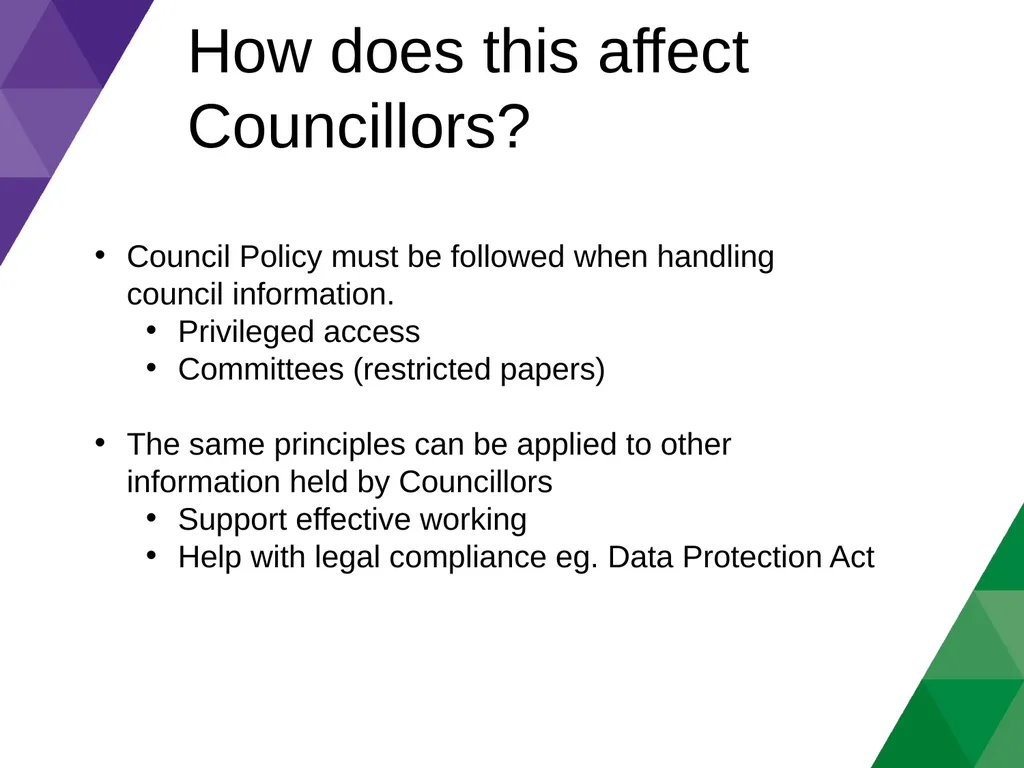
How does this affect Councillors? Council Policy must be followed when handling council information.
Privileged access
Committees (restricted papers)
The same principles can be applied to other information held by Councillors
Support effective working
Help with legal compliance eg. Data Protection Act<br>
Privileged access
Committees (restricted papers)
The same principles can be applied to other information held by Councillors
Support effective working
Help with legal compliance eg. Data Protection Act<br>
08
Summary of IM Strategy The Strategy sets out the council’s aims and vision for the management of its information holdings.
The Council’s Information Management Strategy is currently being updated.
Corporate Resources Committee reviews and approves changes to this.
The current strategy sets out 7 Information Management Principles that the council strives to achieve.<br>
The Council’s Information Management Strategy is currently being updated.
Corporate Resources Committee reviews and approves changes to this.
The current strategy sets out 7 Information Management Principles that the council strives to achieve.<br>
09
Information Management Principles Highland Council information is a corporate asset.
Information management is everybody’s responsibility.
We will manage information throughout its lifecycle to ensure compliance with statutory and regulatory requirements, good practice and the Records Management Policy.
The right Information will be made available in the right place at the right time, accessible to those who need it.
We will ensure that information is accurate and fit for purpose.
Information is re-used and shared where appropriate.
Our ICT supports effective Information Management.<br>
Information management is everybody’s responsibility.
We will manage information throughout its lifecycle to ensure compliance with statutory and regulatory requirements, good practice and the Records Management Policy.
The right Information will be made available in the right place at the right time, accessible to those who need it.
We will ensure that information is accurate and fit for purpose.
Information is re-used and shared where appropriate.
Our ICT supports effective Information Management.<br>
10
Summary of IM Policy The IM Policy Framework policies aim to:
Protect the Confidentiality, Integrity and Availability of information
Support achievement of the IM Strategy
The IM Policies set out the approach and rules that must be followed by all who handle council information.
Secure handling of information
ICT security controls
Retention & disposal of records
Legal compliance<br>
Protect the Confidentiality, Integrity and Availability of information
Support achievement of the IM Strategy
The IM Policies set out the approach and rules that must be followed by all who handle council information.
Secure handling of information
ICT security controls
Retention & disposal of records
Legal compliance<br>
11
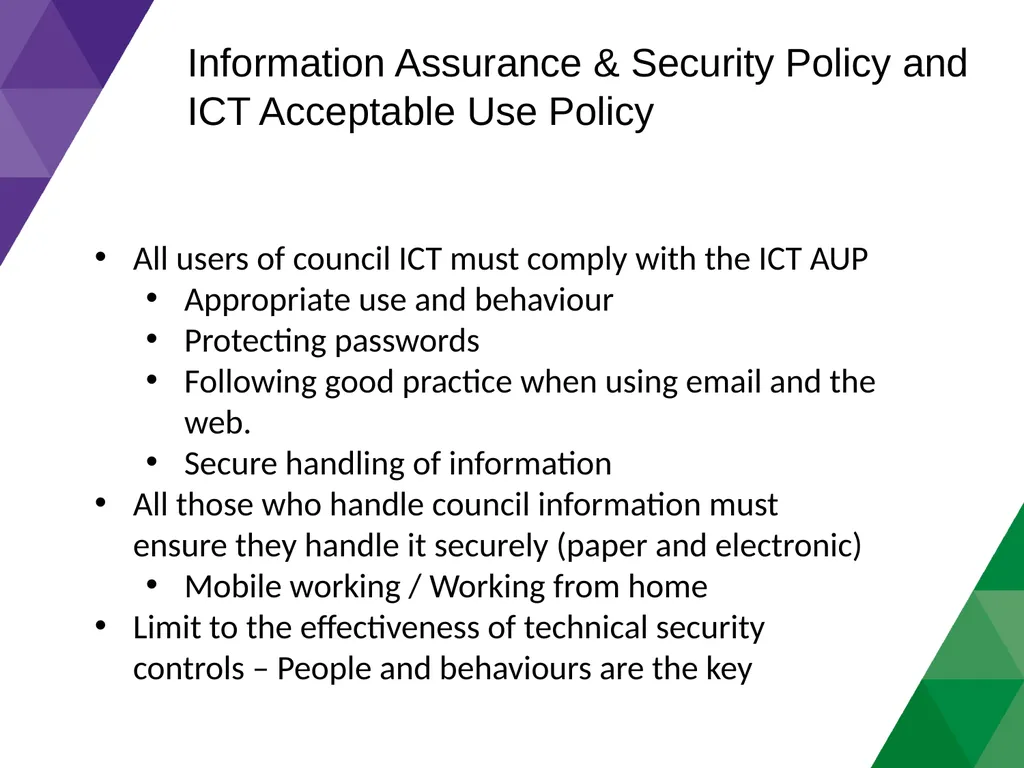
Information Assurance & Security Policy and ICT Acceptable Use Policy All users of council ICT must comply with the ICT AUP
Appropriate use and behaviour
Protecting passwords
Following good practice when using email and the web.
Secure handling of information
All those who handle council information must ensure they handle it securely (paper and electronic)
Mobile working / Working from home
Limit to the effectiveness of technical security controls – People and behaviours are the key<br>
Appropriate use and behaviour
Protecting passwords
Following good practice when using email and the web.
Secure handling of information
All those who handle council information must ensure they handle it securely (paper and electronic)
Mobile working / Working from home
Limit to the effectiveness of technical security controls – People and behaviours are the key<br>
12
Information Law Data Protection, Data Sharing and Freedom of Information Lagh Fiosrachaidh<br>
13
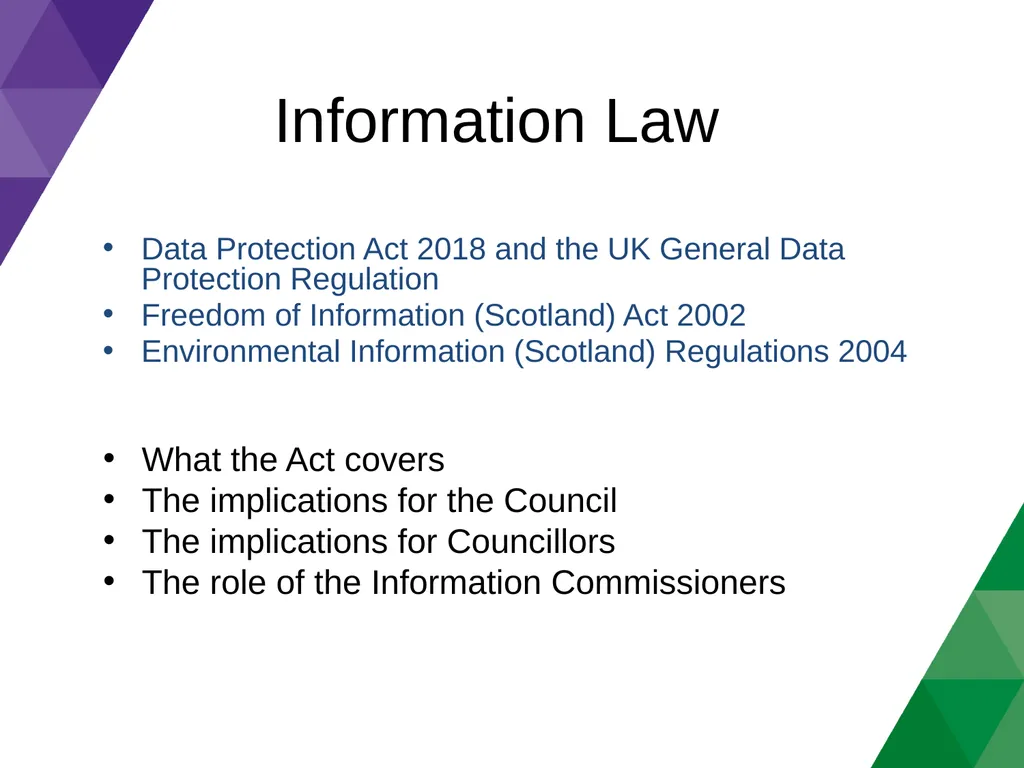
Information Law Data Protection Act 2018 and the UK General Data Protection Regulation
Freedom of Information (Scotland) Act 2002
Environmental Information (Scotland) Regulations 2004 What the Act covers
The implications for the Council
The implications for Councillors
The role of the Information Commissioners<br>
Freedom of Information (Scotland) Act 2002
Environmental Information (Scotland) Regulations 2004 What the Act covers
The implications for the Council
The implications for Councillors
The role of the Information Commissioners<br>
14
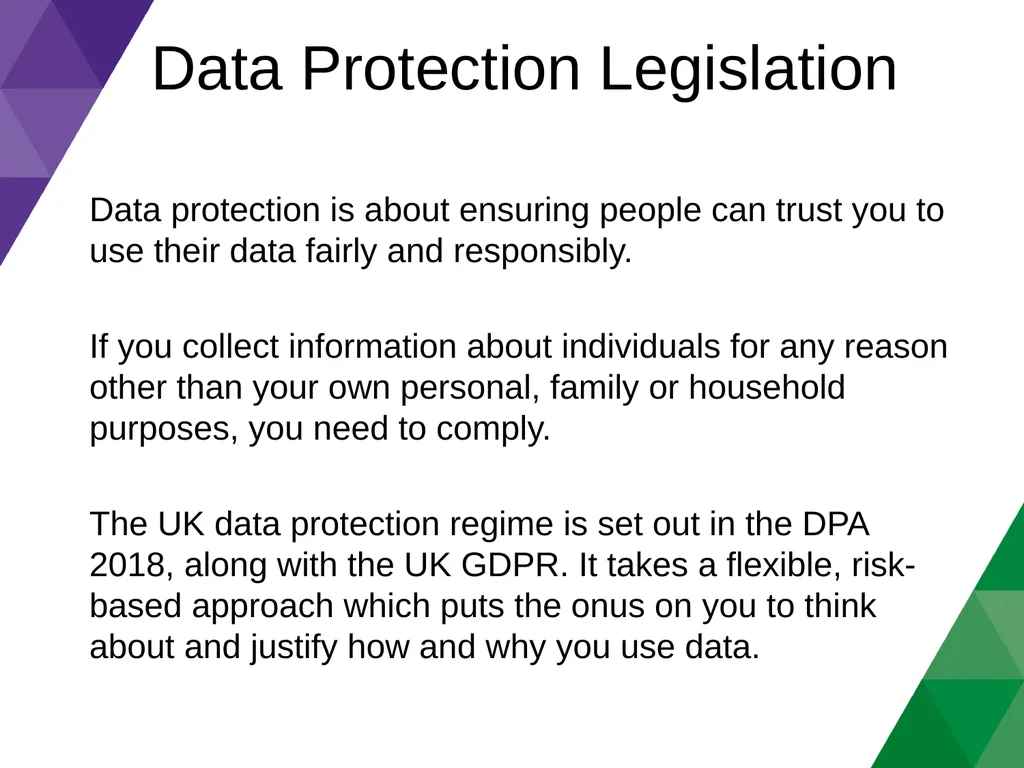
Data Protection Legislation Data protection is about ensuring people can trust you to use their data fairly and responsibly.
If you collect information about individuals for any reason other than your own personal, family or household purposes, you need to comply.
The UK data protection regime is set out in the DPA 2018, along with the UK GDPR. It takes a flexible, risk-based approach which puts the onus on you to think about and justify how and why you use data.<br>
If you collect information about individuals for any reason other than your own personal, family or household purposes, you need to comply.
The UK data protection regime is set out in the DPA 2018, along with the UK GDPR. It takes a flexible, risk-based approach which puts the onus on you to think about and justify how and why you use data.<br>
15
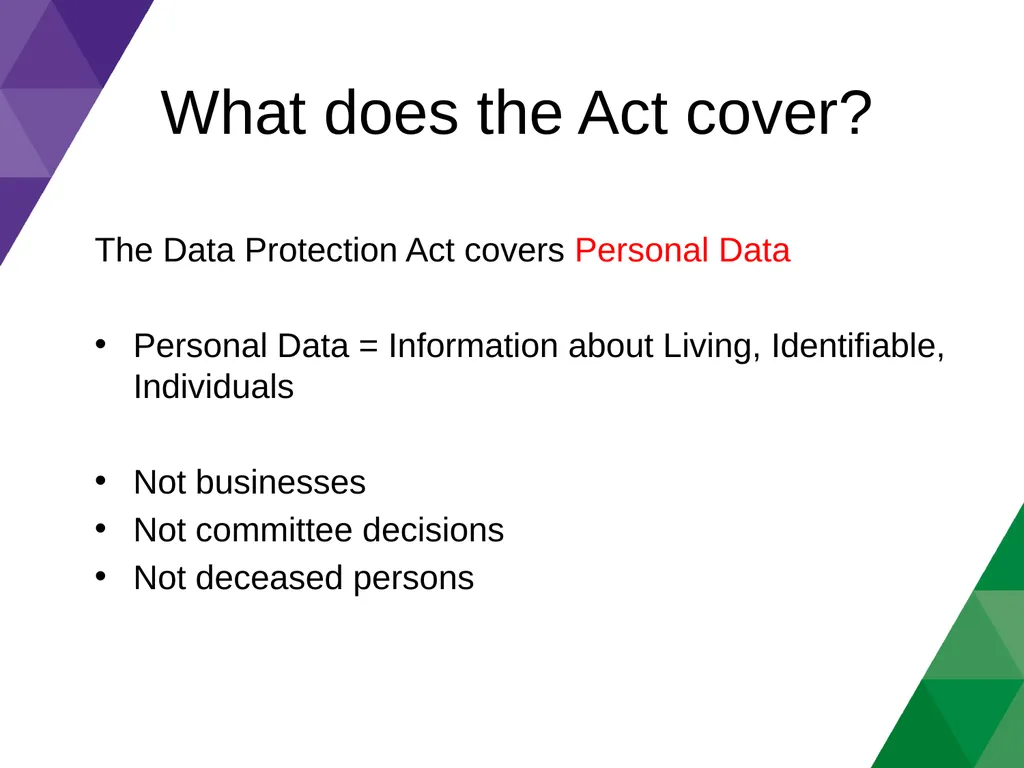
What does the Act cover? The Data Protection Act covers Personal Data
Personal Data = Information about Living, Identifiable, Individuals
Not businesses
Not committee decisions
Not deceased persons<br>
Personal Data = Information about Living, Identifiable, Individuals
Not businesses
Not committee decisions
Not deceased persons<br>
16
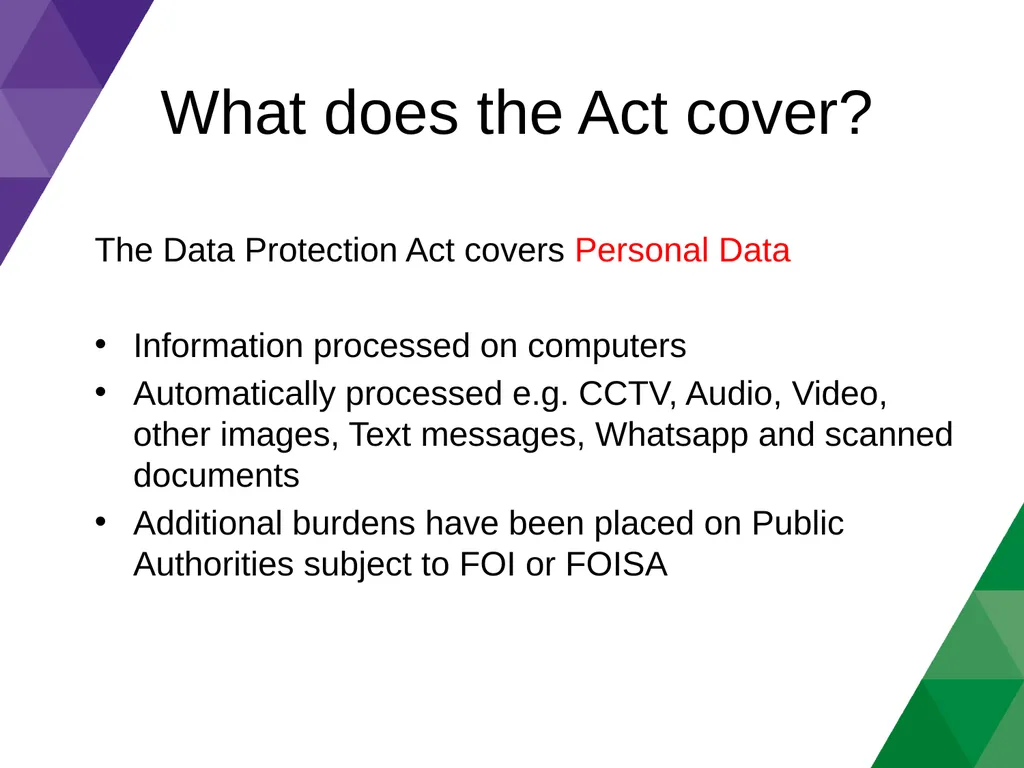
What does the Act cover? The Data Protection Act covers Personal Data
Information processed on computers
Automatically processed e.g. CCTV, Audio, Video, other images, Text messages, Whatsapp and scanned documents
Additional burdens have been placed on Public Authorities subject to FOI or FOISA<br>
Information processed on computers
Automatically processed e.g. CCTV, Audio, Video, other images, Text messages, Whatsapp and scanned documents
Additional burdens have been placed on Public Authorities subject to FOI or FOISA<br>
17
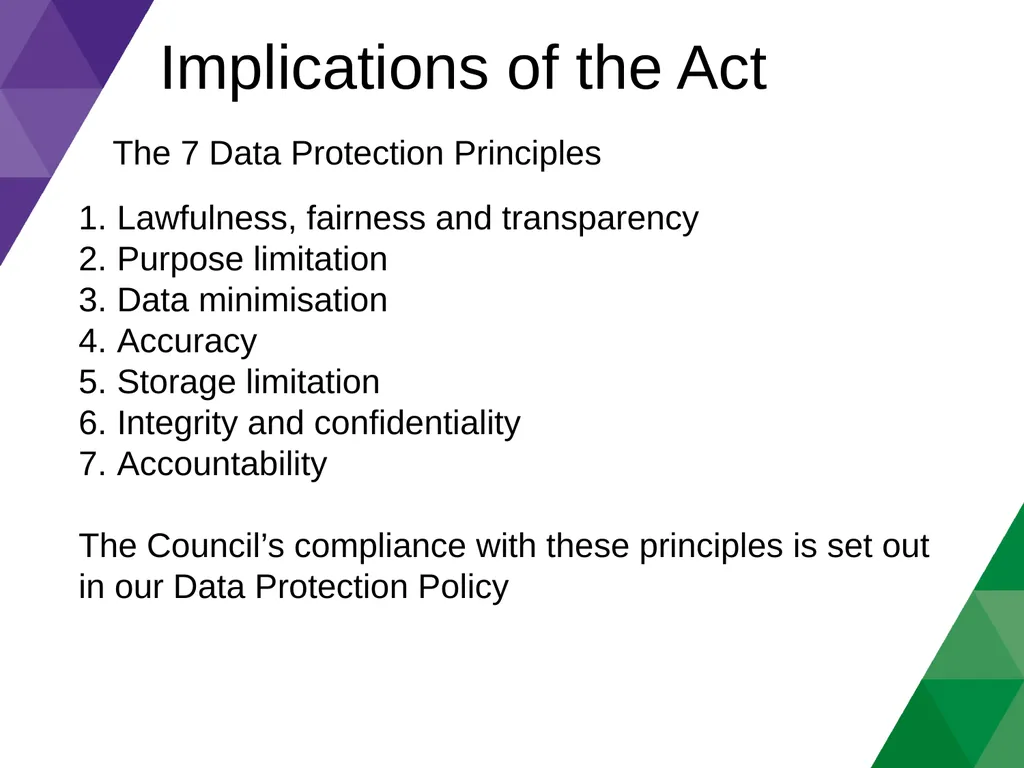
Implications of the Act The 7 Data Protection Principles Lawfulness, fairness and transparency
Purpose limitation
Data minimisation
Accuracy
Storage limitation
Integrity and confidentiality
Accountability
The Council’s compliance with these principles is set out in our Data Protection Policy<br>
Purpose limitation
Data minimisation
Accuracy
Storage limitation
Integrity and confidentiality
Accountability
The Council’s compliance with these principles is set out in our Data Protection Policy<br>
18
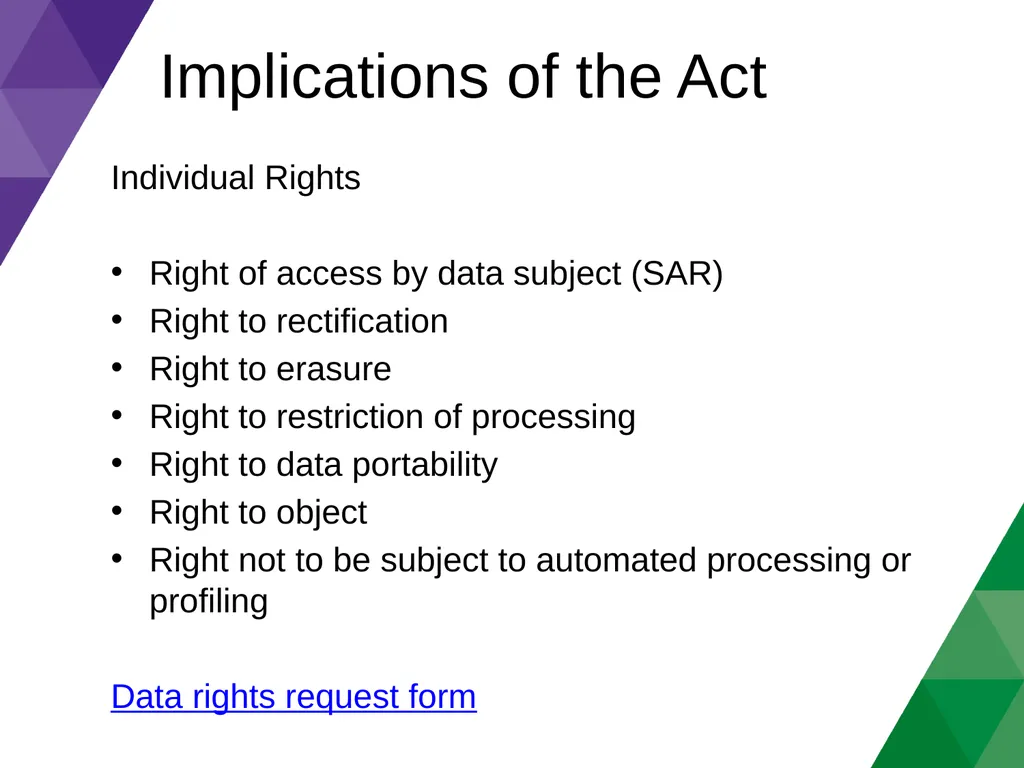
Implications of the Act Individual Rights
Right of access by data subject (SAR)
Right to rectification
Right to erasure
Right to restriction of processing
Right to data portability
Right to object
Right not to be subject to automated processing or profiling
Data rights request form<br>
Right of access by data subject (SAR)
Right to rectification
Right to erasure
Right to restriction of processing
Right to data portability
Right to object
Right not to be subject to automated processing or profiling
Data rights request form<br>
19
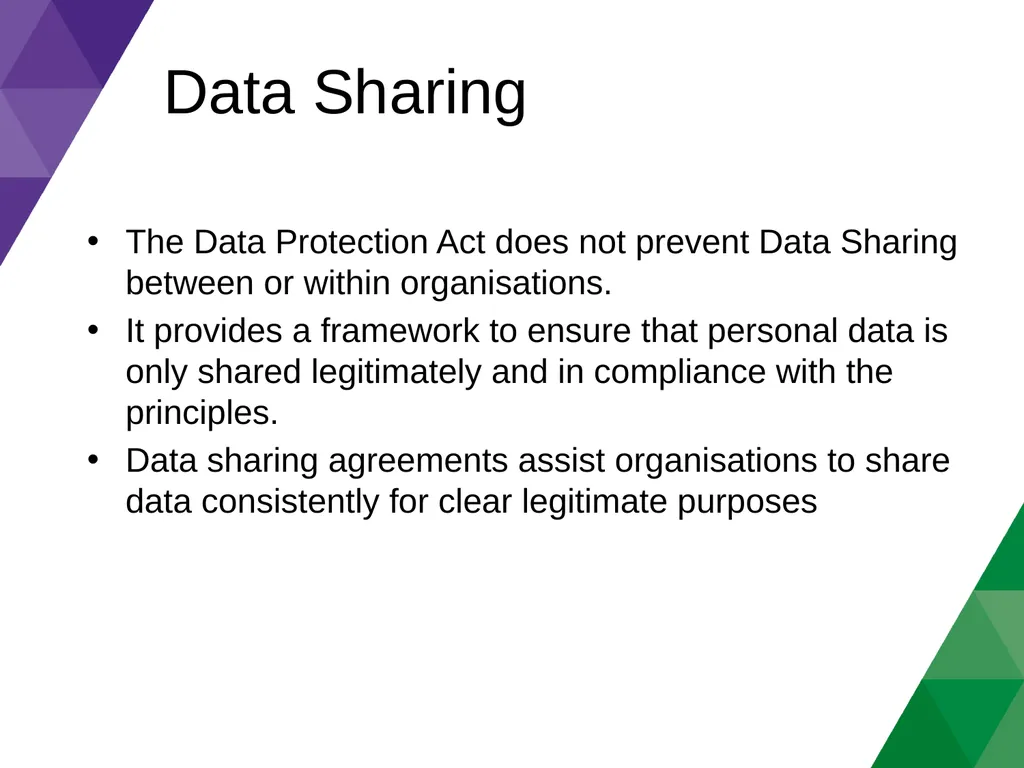
Data Sharing The Data Protection Act does not prevent Data Sharing between or within organisations.
It provides a framework to ensure that personal data is only shared legitimately and in compliance with the principles.
Data sharing agreements assist organisations to share data consistently for clear legitimate purposes<br>
It provides a framework to ensure that personal data is only shared legitimately and in compliance with the principles.
Data sharing agreements assist organisations to share data consistently for clear legitimate purposes<br>
20
Impact on Councillors Each Councillor is considered a separate “organisation” or Data Controller under the legislation
If Councillors process personal data about their constituents on a computer that processing must comply with the data protection principles
A Councillor must respond to data rights requests
Let your constituents know what you’ll do with their information
A privacy notice as been created for Councillors to use:
Contacting your Councillor privacy notice<br>
If Councillors process personal data about their constituents on a computer that processing must comply with the data protection principles
A Councillor must respond to data rights requests
Let your constituents know what you’ll do with their information
A privacy notice as been created for Councillors to use:
Contacting your Councillor privacy notice<br>
21
Impact on Councillors Accessing personal data held by the Council
Councillors do not have an automatic right to access personal data held by the Council
Councillors may receive personal data about constituents they represent but they must provide evidence to Council staff that they have been asked to intercede by the constituent.
The Council may agree to share personal data with a Councillor but the purposes that the Councillor can use the data for will be limited<br>
Councillors do not have an automatic right to access personal data held by the Council
Councillors may receive personal data about constituents they represent but they must provide evidence to Council staff that they have been asked to intercede by the constituent.
The Council may agree to share personal data with a Councillor but the purposes that the Councillor can use the data for will be limited<br>
22
Role of the Information Commissioner The UK Information Commissioner (ICO)
Enforces Data Protection within the whole of the UK
Promotion of good practice
Request for assessment
Information Notice
Enforcement Notice
Prosecution
Compliance assessment
Now has the power to fine impose substantial fines for breaches<br>
Enforces Data Protection within the whole of the UK
Promotion of good practice
Request for assessment
Information Notice
Enforcement Notice
Prosecution
Compliance assessment
Now has the power to fine impose substantial fines for breaches<br>
23
The Freedom of Information (Scotland) Act 2002 Section 1 General Entitlement
A person who requests information from a Scottish public authority which holds it is entitled to be given it by the authority.
The Freedom of Information (Scotland) Act 2002 provides a right to access information held in Scottish public authorities.
This should:
lead to increased accountability
lead to the breakdown of a culture of secrecy and
ensure that public bodies look outward to the communities they serve<br>
A person who requests information from a Scottish public authority which holds it is entitled to be given it by the authority.
The Freedom of Information (Scotland) Act 2002 provides a right to access information held in Scottish public authorities.
This should:
lead to increased accountability
lead to the breakdown of a culture of secrecy and
ensure that public bodies look outward to the communities they serve<br>
24
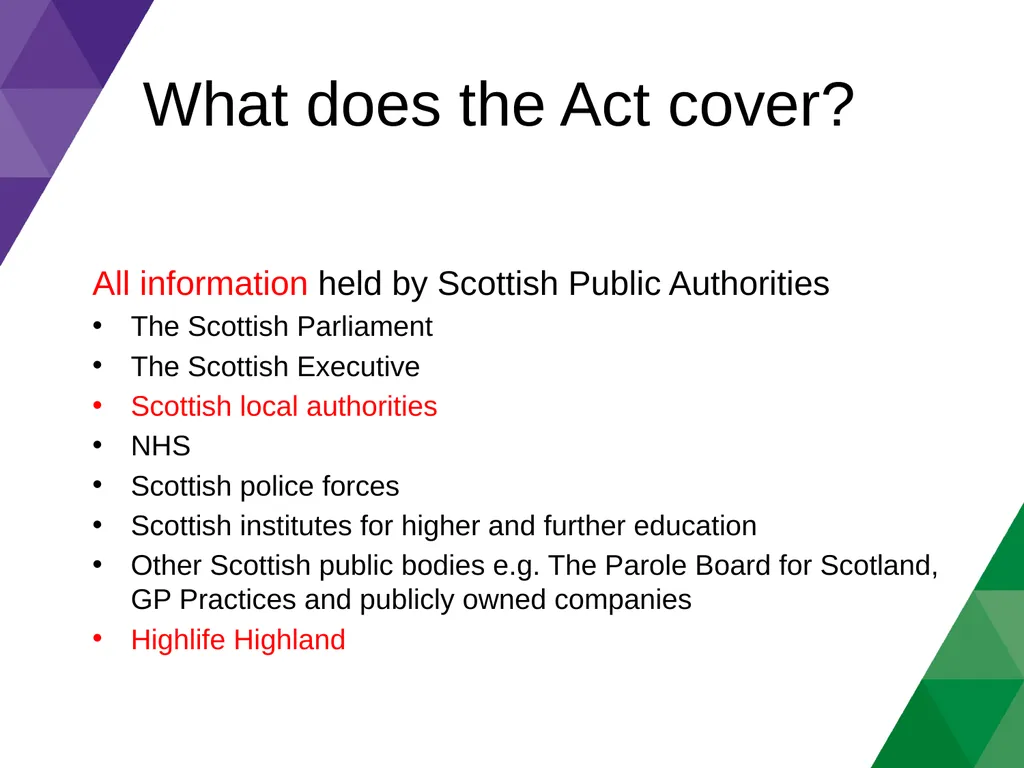
What does the Act cover? All information held by Scottish Public Authorities
The Scottish Parliament
The Scottish Executive
Scottish local authorities
NHS
Scottish police forces
Scottish institutes for higher and further education
Other Scottish public bodies e.g. The Parole Board for Scotland, GP Practices and publicly owned companies
Highlife Highland<br>
The Scottish Parliament
The Scottish Executive
Scottish local authorities
NHS
Scottish police forces
Scottish institutes for higher and further education
Other Scottish public bodies e.g. The Parole Board for Scotland, GP Practices and publicly owned companies
Highlife Highland<br>
25
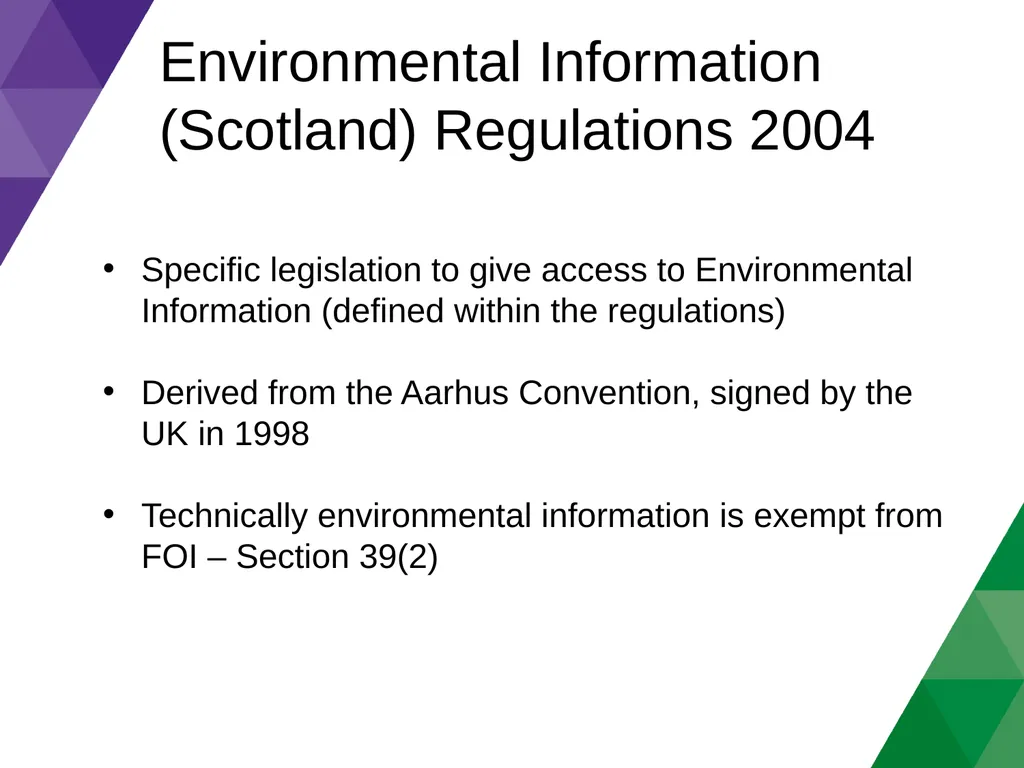
Environmental Information
(Scotland) Regulations 2004 Specific legislation to give access to Environmental Information (defined within the regulations)
Derived from the Aarhus Convention, signed by the UK in 1998
Technically environmental information is exempt from FOI – Section 39(2)<br>
Derived from the Aarhus Convention, signed by the UK in 1998
Technically environmental information is exempt from FOI – Section 39(2)<br>
26
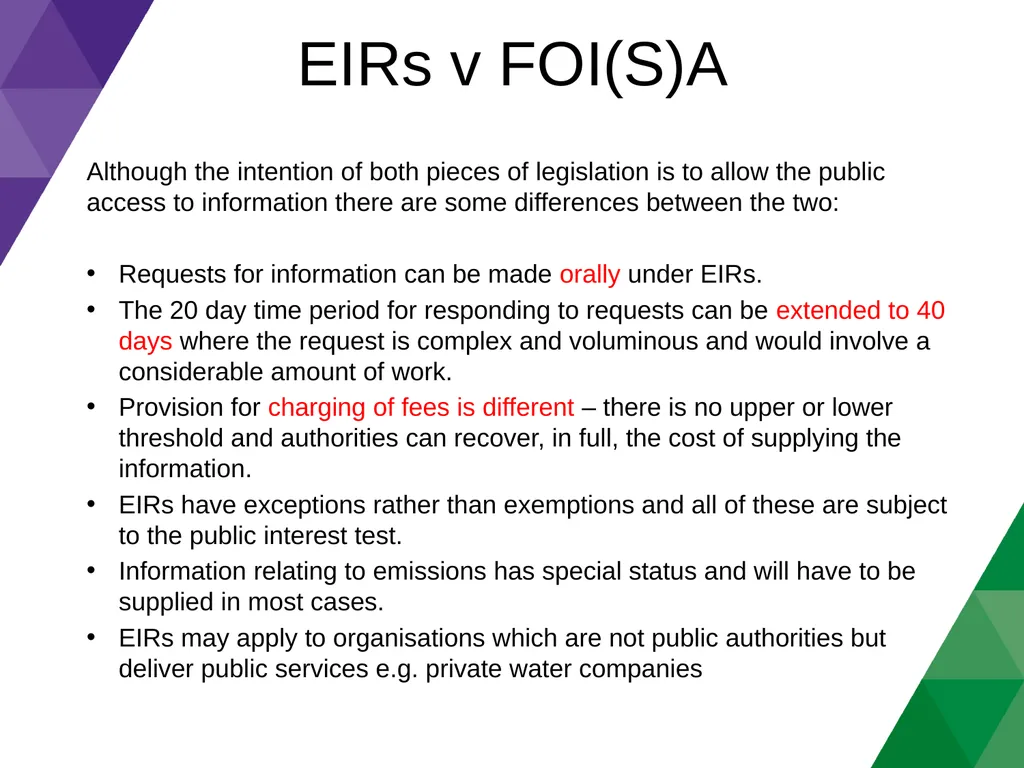
EIRs v FOI(S)A Although the intention of both pieces of legislation is to allow the public access to information there are some differences between the two:
Requests for information can be made orally under EIRs.
The 20 day time period for responding to requests can be extended to 40 days where the request is complex and voluminous and would involve a considerable amount of work.
Provision for charging of fees is different – there is no upper or lower threshold and authorities can recover, in full, the cost of supplying the information.
EIRs have exceptions rather than exemptions and all of these are subject to the public interest test.
Information relating to emissions has special status and will have to be supplied in most cases.
EIRs may apply to organisations which are not public authorities but deliver public services e.g. private water companies<br>
Requests for information can be made orally under EIRs.
The 20 day time period for responding to requests can be extended to 40 days where the request is complex and voluminous and would involve a considerable amount of work.
Provision for charging of fees is different – there is no upper or lower threshold and authorities can recover, in full, the cost of supplying the information.
EIRs have exceptions rather than exemptions and all of these are subject to the public interest test.
Information relating to emissions has special status and will have to be supplied in most cases.
EIRs may apply to organisations which are not public authorities but deliver public services e.g. private water companies<br>
27
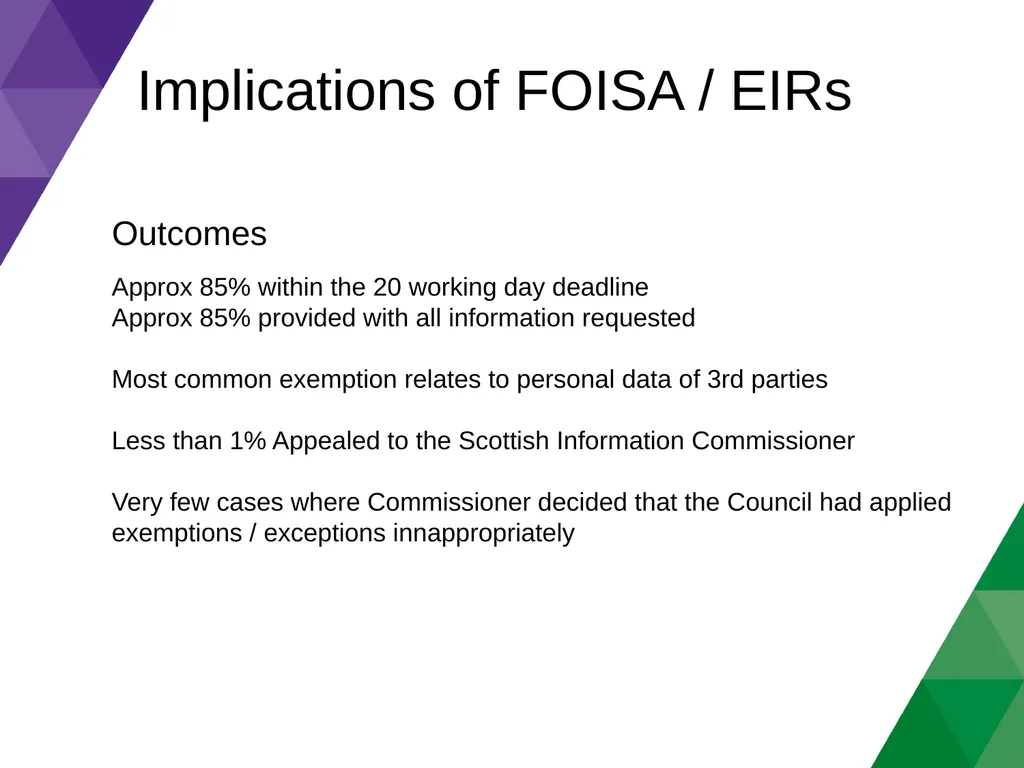
Implications of FOISA / EIRs Outcomes Approx 85% within the 20 working day deadline
Approx 85% provided with all information requested
Most common exemption relates to personal data of 3rd parties
Less than 1% Appealed to the Scottish Information Commissioner
Very few cases where Commissioner decided that the Council had applied exemptions / exceptions innappropriately<br>
Approx 85% provided with all information requested
Most common exemption relates to personal data of 3rd parties
Less than 1% Appealed to the Scottish Information Commissioner
Very few cases where Commissioner decided that the Council had applied exemptions / exceptions innappropriately<br>
28
Examples Staff qualifications
School statistics
Draft reports
Planning correspondence
Redundancy payments
Expenses
Councillors & Council Tax
Tenders / Contracts
Loch Ness Monster<br>
School statistics
Draft reports
Planning correspondence
Redundancy payments
Expenses
Councillors & Council Tax
Tenders / Contracts
Loch Ness Monster<br>
29
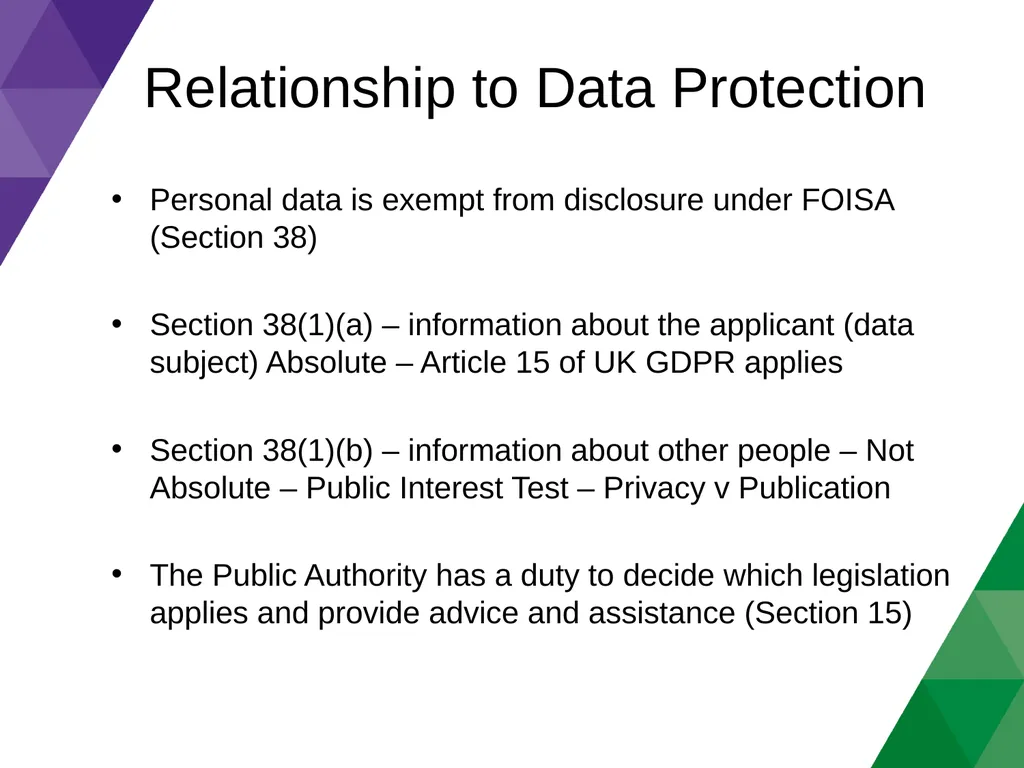
Relationship to Data Protection Personal data is exempt from disclosure under FOISA (Section 38)
Section 38(1)(a) – information about the applicant (data subject) Absolute – Article 15 of UK GDPR applies
Section 38(1)(b) – information about other people – Not Absolute – Public Interest Test – Privacy v Publication
The Public Authority has a duty to decide which legislation applies and provide advice and assistance (Section 15)<br>
Section 38(1)(a) – information about the applicant (data subject) Absolute – Article 15 of UK GDPR applies
Section 38(1)(b) – information about other people – Not Absolute – Public Interest Test – Privacy v Publication
The Public Authority has a duty to decide which legislation applies and provide advice and assistance (Section 15)<br>
30
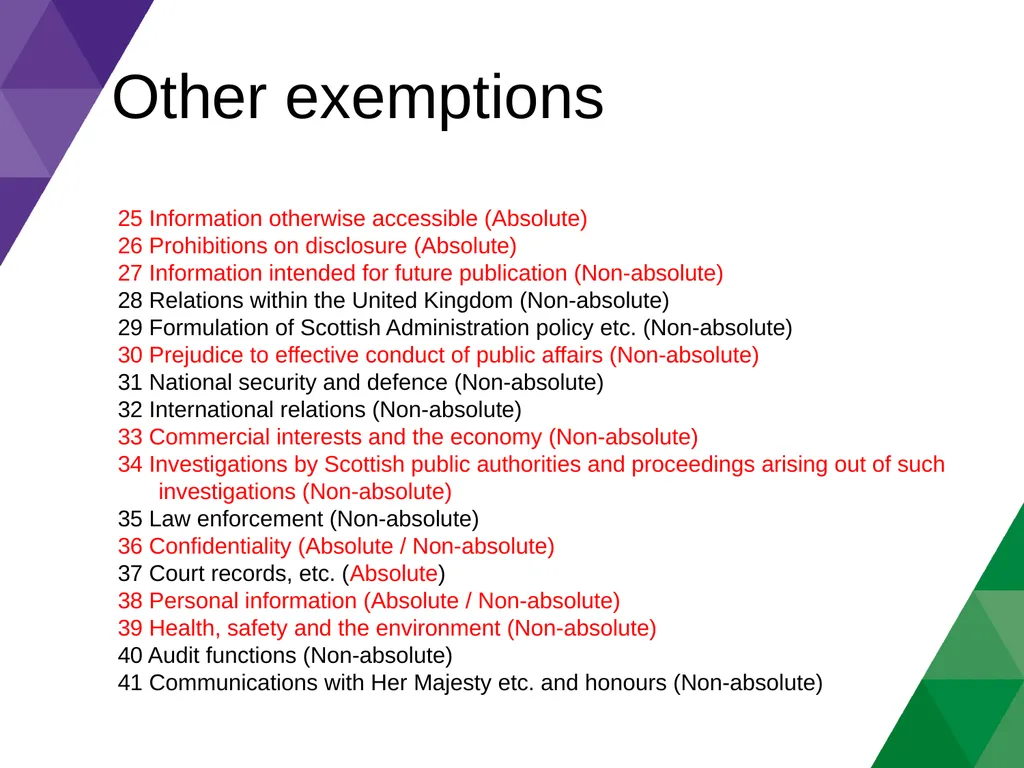
Other exemptions 25 Information otherwise accessible (Absolute)
26 Prohibitions on disclosure (Absolute)
27 Information intended for future publication (Non-absolute)
28 Relations within the United Kingdom (Non-absolute)
29 Formulation of Scottish Administration policy etc. (Non-absolute)
30 Prejudice to effective conduct of public affairs (Non-absolute)
31 National security and defence (Non-absolute)
32 International relations (Non-absolute)
33 Commercial interests and the economy (Non-absolute)
34 Investigations by Scottish public authorities and proceedings arising out of such investigations (Non-absolute)
35 Law enforcement (Non-absolute)
36 Confidentiality (Absolute / Non-absolute)
37 Court records, etc. (Absolute)
38 Personal information (Absolute / Non-absolute)
39 Health, safety and the environment (Non-absolute)
40 Audit functions (Non-absolute)
41 Communications with Her Majesty etc. and honours (Non-absolute)<br>
26 Prohibitions on disclosure (Absolute)
27 Information intended for future publication (Non-absolute)
28 Relations within the United Kingdom (Non-absolute)
29 Formulation of Scottish Administration policy etc. (Non-absolute)
30 Prejudice to effective conduct of public affairs (Non-absolute)
31 National security and defence (Non-absolute)
32 International relations (Non-absolute)
33 Commercial interests and the economy (Non-absolute)
34 Investigations by Scottish public authorities and proceedings arising out of such investigations (Non-absolute)
35 Law enforcement (Non-absolute)
36 Confidentiality (Absolute / Non-absolute)
37 Court records, etc. (Absolute)
38 Personal information (Absolute / Non-absolute)
39 Health, safety and the environment (Non-absolute)
40 Audit functions (Non-absolute)
41 Communications with Her Majesty etc. and honours (Non-absolute)<br>
31
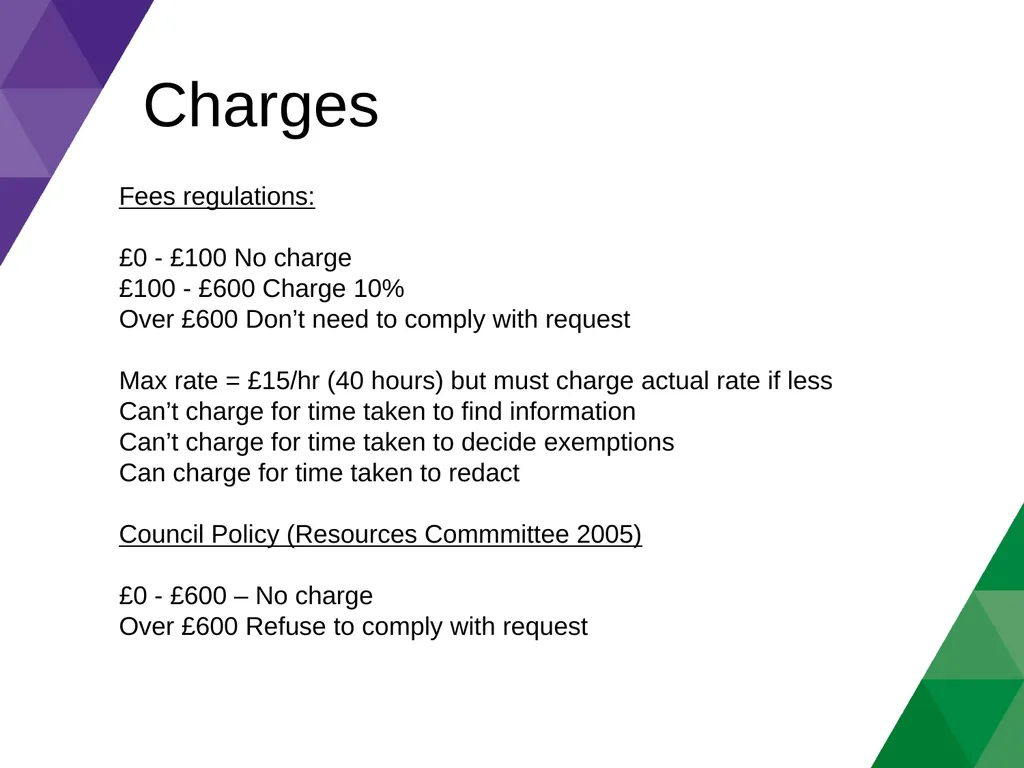
Charges Fees regulations:
£0 - £100 No charge
£100 - £600 Charge 10%
Over £600 Don’t need to comply with request
Max rate = £15/hr (40 hours) but must charge actual rate if less
Can’t charge for time taken to find information
Can’t charge for time taken to decide exemptions
Can charge for time taken to redact
Council Policy (Resources Commmittee 2005)
£0 - £600 – No charge
Over £600 Refuse to comply with request<br>
£0 - £100 No charge
£100 - £600 Charge 10%
Over £600 Don’t need to comply with request
Max rate = £15/hr (40 hours) but must charge actual rate if less
Can’t charge for time taken to find information
Can’t charge for time taken to decide exemptions
Can charge for time taken to redact
Council Policy (Resources Commmittee 2005)
£0 - £600 – No charge
Over £600 Refuse to comply with request<br>
32
Requirement for review An applicant who is not satisfied with the response of an authority to an access request may, within 40 days, require the authority to review the decision
The authority must do so within 20 working days
If the applicant remains dissatisfied they may appeal to the Scottish Information Commissioner with in 6 months.<br>
The authority must do so within 20 working days
If the applicant remains dissatisfied they may appeal to the Scottish Information Commissioner with in 6 months.<br>
33
Role of the Scottish Information Commissioner Promote
Information on website
Electronic newsletter
Briefings on exemptions
Guide to the Act
Advertising campaign
Advice
Training and support Enforce
Investigate appeals
Information notices
Decision notices
Enforcement notices
Powers of entry and inspection
Reports to Parliament<br>
Information on website
Electronic newsletter
Briefings on exemptions
Guide to the Act
Advertising campaign
Advice
Training and support Enforce
Investigate appeals
Information notices
Decision notices
Enforcement notices
Powers of entry and inspection
Reports to Parliament<br>
34
Freedom of Information is a devolved matter – enforced by Scottish Information Commissioner
Data Protection is not devolved – enforced by UK Information Commissioner
UK Information Commissioner also enforces FOI in England, Wales and Northern Ireland. Role of the Scottish Information Commissioner<br>
Data Protection is not devolved – enforced by UK Information Commissioner
UK Information Commissioner also enforces FOI in England, Wales and Northern Ireland. Role of the Scottish Information Commissioner<br>
35
Impact on Councillors Councillors are not subject to FOISA/EIRs
Councillors’ email is not subject to FOISA/EIRs
Information provided to Council Officers (in any format) by Councillors is subject to FOISA (although exemptions may apply)
Councillors may submit requests on their own or constituents’ behalf<br>
Councillors’ email is not subject to FOISA/EIRs
Information provided to Council Officers (in any format) by Councillors is subject to FOISA (although exemptions may apply)
Councillors may submit requests on their own or constituents’ behalf<br>
36
Impact on Councillors FOISA versus Code of Conduct
Councillors are entitled to Council information by virtue of being a Councillor e.g. Pink papers
Further disclosure of such information is subject to sections 3.21 to 3.22 of the Councillors’ Code of Conduct
Where a Councillor seeks information via a formal Freedom of Information request, they have the assurance that they can provide the information disclosed to any person or organisation<br>
Councillors are entitled to Council information by virtue of being a Councillor e.g. Pink papers
Further disclosure of such information is subject to sections 3.21 to 3.22 of the Councillors’ Code of Conduct
Where a Councillor seeks information via a formal Freedom of Information request, they have the assurance that they can provide the information disclosed to any person or organisation<br>
37
Customer Resolution & Improvement Team Sgioba Fuasglaidh is Leasachaidh Luchd-ceannaich<br>
38
Who are we? Manage and progress all incoming Freedom of Information requests, complaints, MSP/MP, Data Rights Requests, and Senior Management Correspondence
Whole Highland area – all Wards
Every Service & Function
Part of the Communities & Place Service reporting to the Customer Services Delivery Manager, as part of the wider Customer Services team<br>
Whole Highland area – all Wards
Every Service & Function
Part of the Communities & Place Service reporting to the Customer Services Delivery Manager, as part of the wider Customer Services team<br>
39
Delivery Model Experts in complaints and FOI handling
Frontline cases answered at first point of contact
Work with, and support Services, to investigate and respond
Build resilience, improve performance, quality and outcomes for customers
Identify lessons learnt and report to our customers, staff and members<br>
Frontline cases answered at first point of contact
Work with, and support Services, to investigate and respond
Build resilience, improve performance, quality and outcomes for customers
Identify lessons learnt and report to our customers, staff and members<br>
40
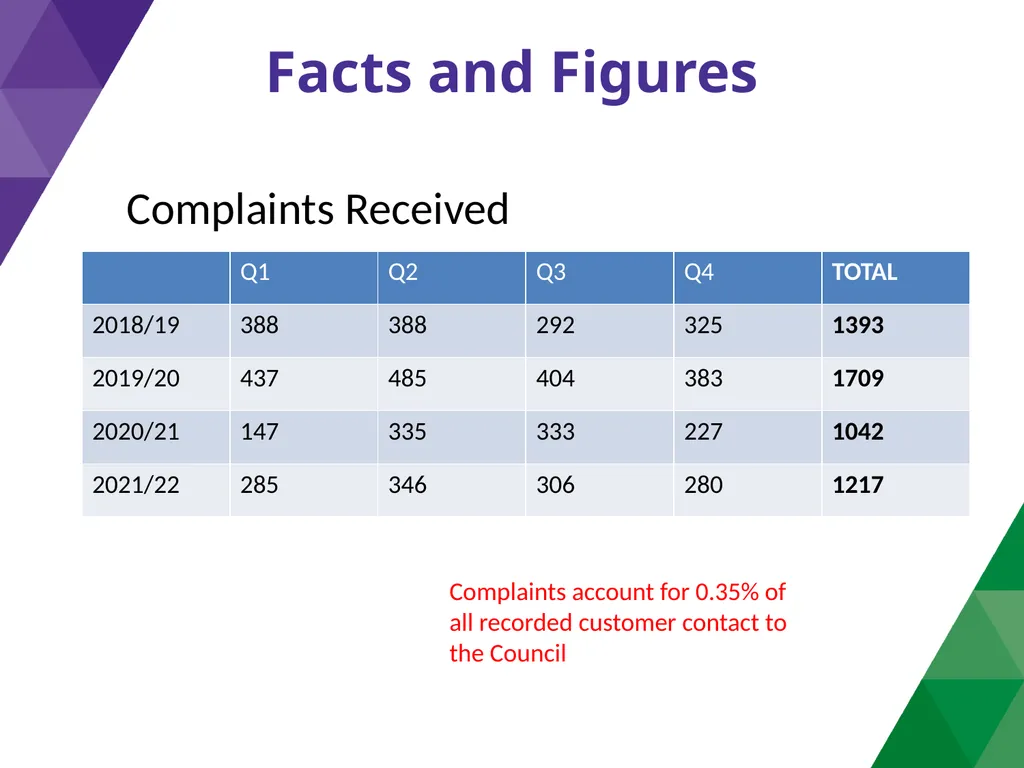
Facts and Figures Complaints Received Complaints account for 0.35% of all recorded customer contact to the Council<br>
41
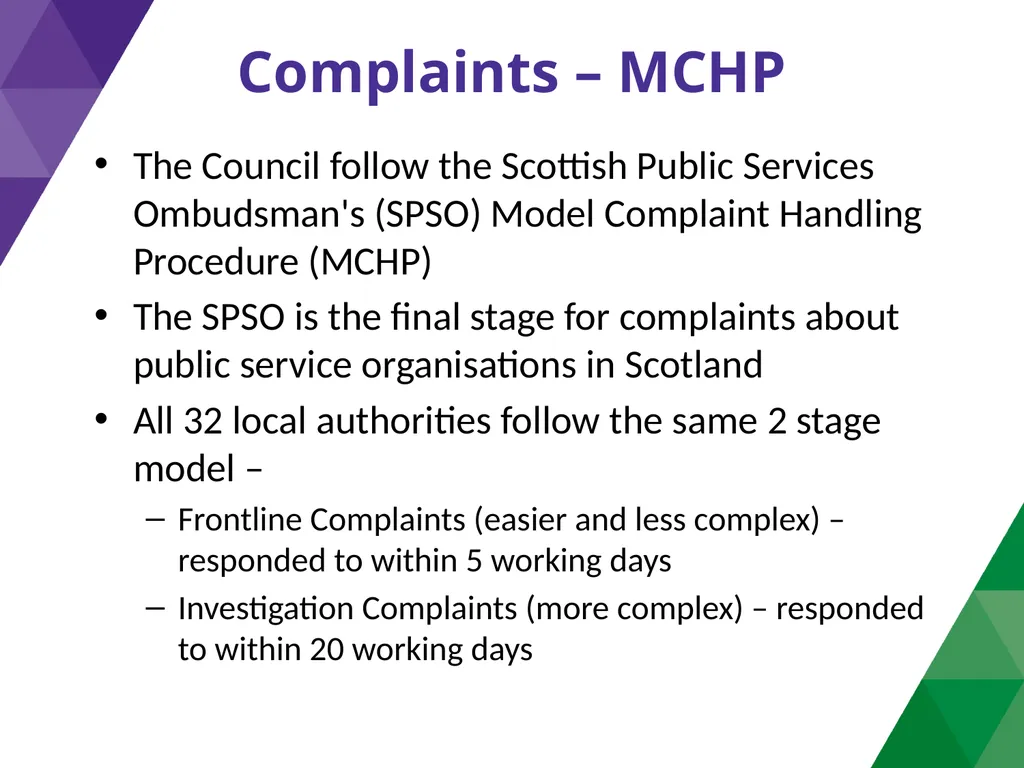
Complaints – MCHP The Council follow the Scottish Public Services Ombudsman's (SPSO) Model Complaint Handling Procedure (MCHP)
The SPSO is the final stage for complaints about public service organisations in Scotland
All 32 local authorities follow the same 2 stage model –
Frontline Complaints (easier and less complex) – responded to within 5 working days
Investigation Complaints (more complex) – responded to within 20 working days<br>
The SPSO is the final stage for complaints about public service organisations in Scotland
All 32 local authorities follow the same 2 stage model –
Frontline Complaints (easier and less complex) – responded to within 5 working days
Investigation Complaints (more complex) – responded to within 20 working days<br>
42
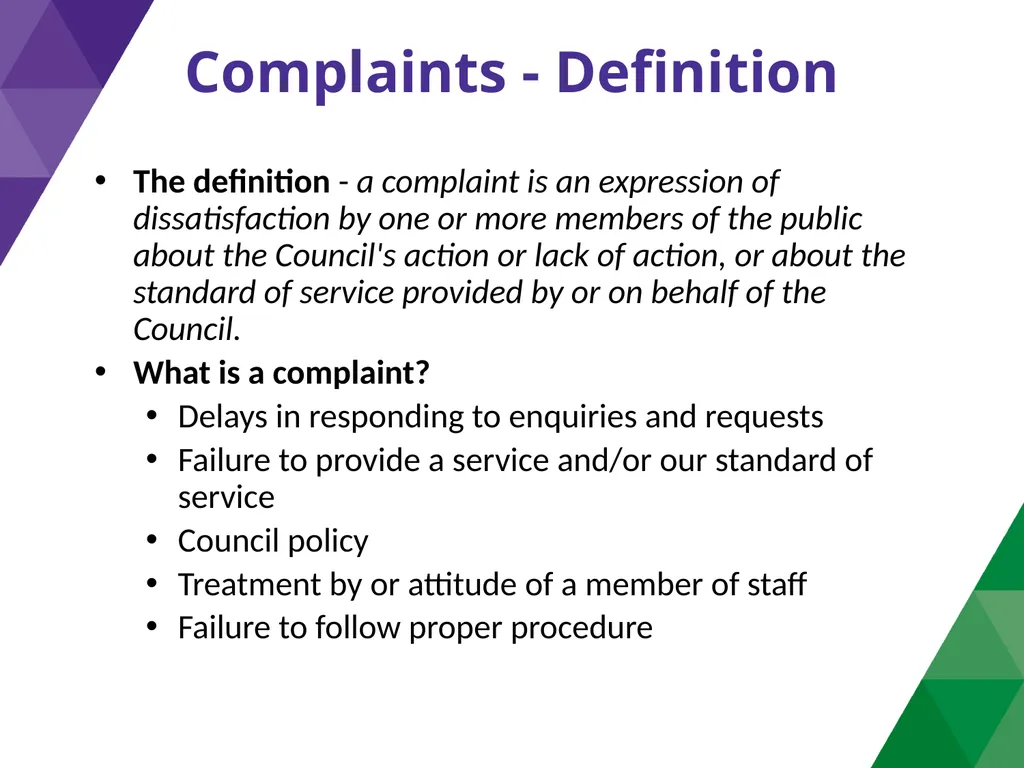
Complaints - Definition The definition - a complaint is an expression of dissatisfaction by one or more members of the public about the Council's action or lack of action, or about the standard of service provided by or on behalf of the Council.
What is a complaint?
Delays in responding to enquiries and requests
Failure to provide a service and/or our standard of service
Council policy
Treatment by or attitude of a member of staff
Failure to follow proper procedure<br>
What is a complaint?
Delays in responding to enquiries and requests
Failure to provide a service and/or our standard of service
Council policy
Treatment by or attitude of a member of staff
Failure to follow proper procedure<br>
43
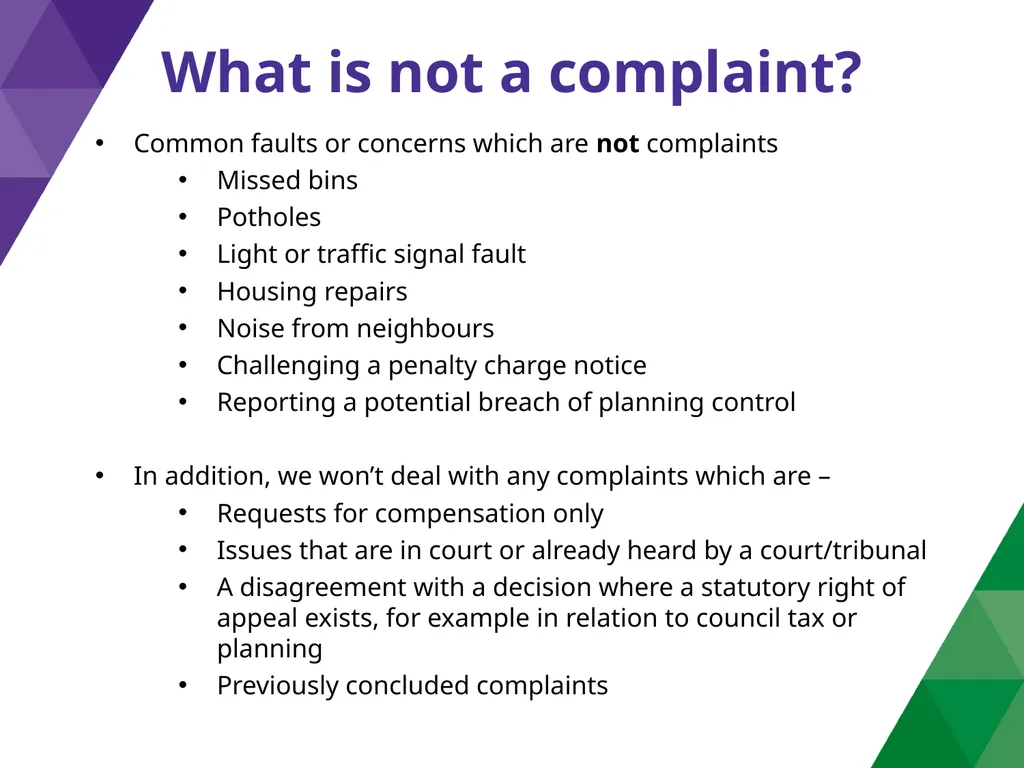
What is not a complaint? Common faults or concerns which are not complaints
Missed bins
Potholes
Light or traffic signal fault
Housing repairs
Noise from neighbours
Challenging a penalty charge notice
Reporting a potential breach of planning control
In addition, we won’t deal with any complaints which are –
Requests for compensation only
Issues that are in court or already heard by a court/tribunal
A disagreement with a decision where a statutory right of appeal exists, for example in relation to council tax or planning
Previously concluded complaints<br>
Missed bins
Potholes
Light or traffic signal fault
Housing repairs
Noise from neighbours
Challenging a penalty charge notice
Reporting a potential breach of planning control
In addition, we won’t deal with any complaints which are –
Requests for compensation only
Issues that are in court or already heard by a court/tribunal
A disagreement with a decision where a statutory right of appeal exists, for example in relation to council tax or planning
Previously concluded complaints<br>
44
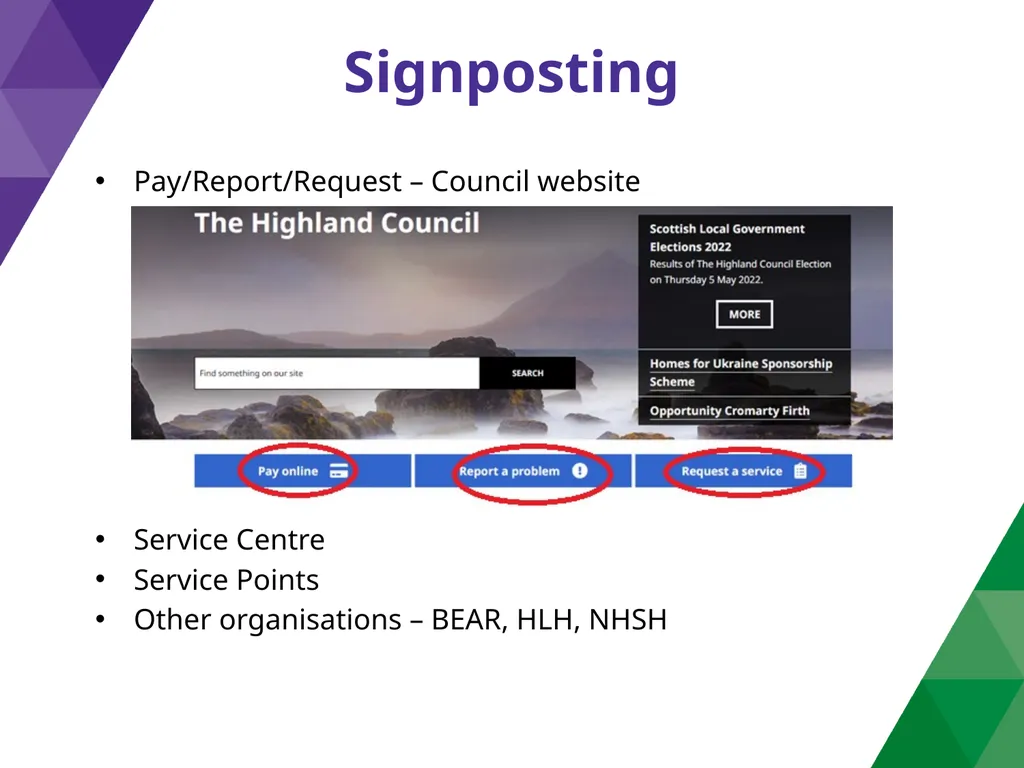
Signposting Pay/Report/Request – Council website
Service Centre
Service Points
Other organisations – BEAR, HLH, NHSH<br>
Service Centre
Service Points
Other organisations – BEAR, HLH, NHSH<br>
45
How to make a complaint Make a complaint via the online form
Visit a Service Point
Contact a Councillor
By phone – contact us
In Writing – Customer Resolution & Improvement Team, The Highland Council, Glenurquhart Road, Inverness, IV3 5NX
Email complaints@highland.gov.uk
We understand that customers may be unable, or reluctant, to make a complaint themselves. We can accept complaints from a friend, relative, or an advocate, if we have written consent to do so.<br>
Visit a Service Point
Contact a Councillor
By phone – contact us
In Writing – Customer Resolution & Improvement Team, The Highland Council, Glenurquhart Road, Inverness, IV3 5NX
Email complaints@highland.gov.uk
We understand that customers may be unable, or reluctant, to make a complaint themselves. We can accept complaints from a friend, relative, or an advocate, if we have written consent to do so.<br>
46
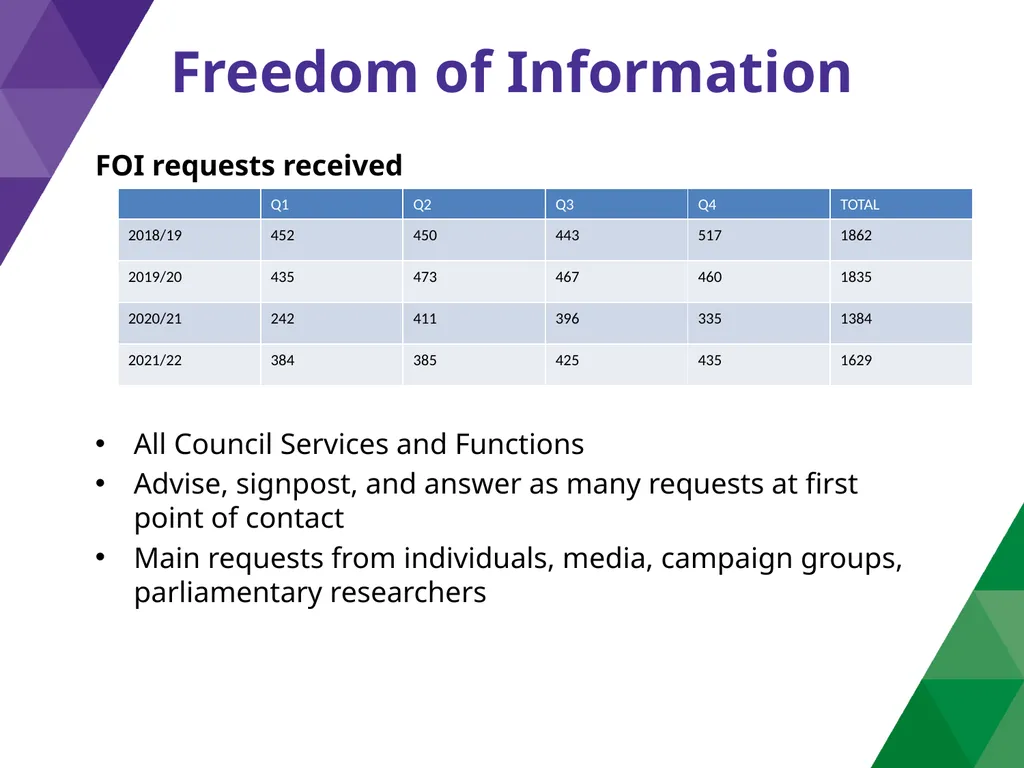
Freedom of Information FOI requests received
All Council Services and Functions
Advise, signpost, and answer as many requests at first point of contact
Main requests from individuals, media, campaign groups, parliamentary researchers<br>
All Council Services and Functions
Advise, signpost, and answer as many requests at first point of contact
Main requests from individuals, media, campaign groups, parliamentary researchers<br>
47
Reporting Complaints
Audit & Scrutiny – Complaints Performance Data
Scottish Public Services Ombudsman (SPSO)
Freedom of Information
Scottish Information Commissioner
SPSO Cases
Audit & Scrutiny Annual Statistics & Specific Cases<br>
Audit & Scrutiny – Complaints Performance Data
Scottish Public Services Ombudsman (SPSO)
Freedom of Information
Scottish Information Commissioner
SPSO Cases
Audit & Scrutiny Annual Statistics & Specific Cases<br>
48
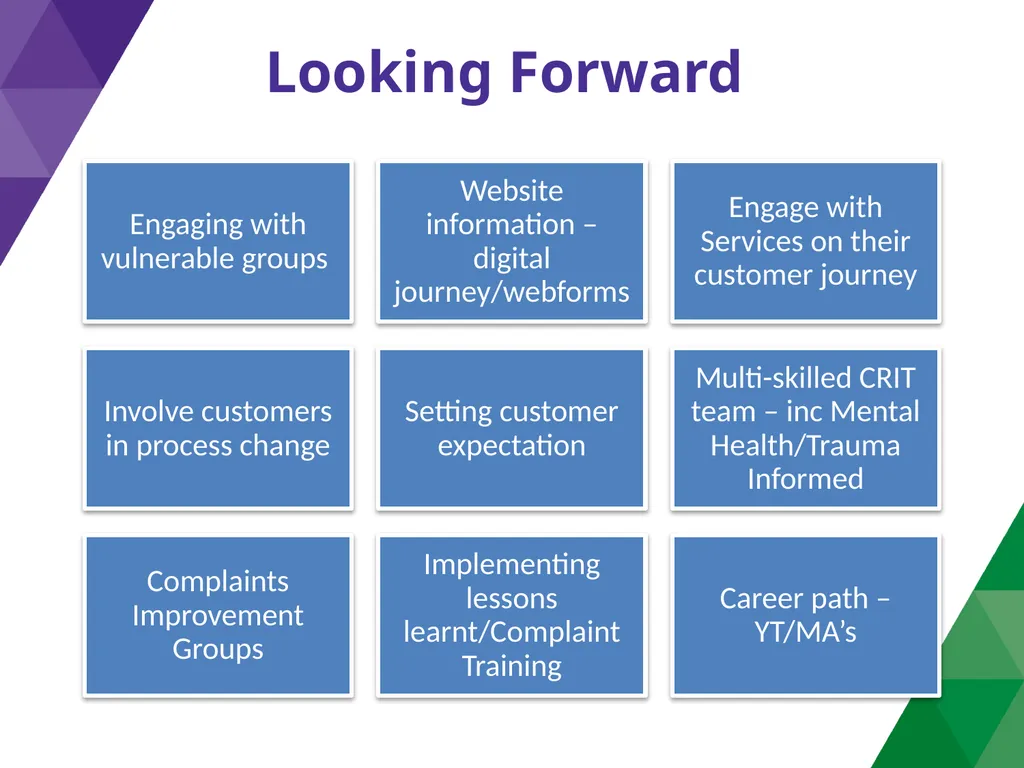
Looking Forward<br>
49
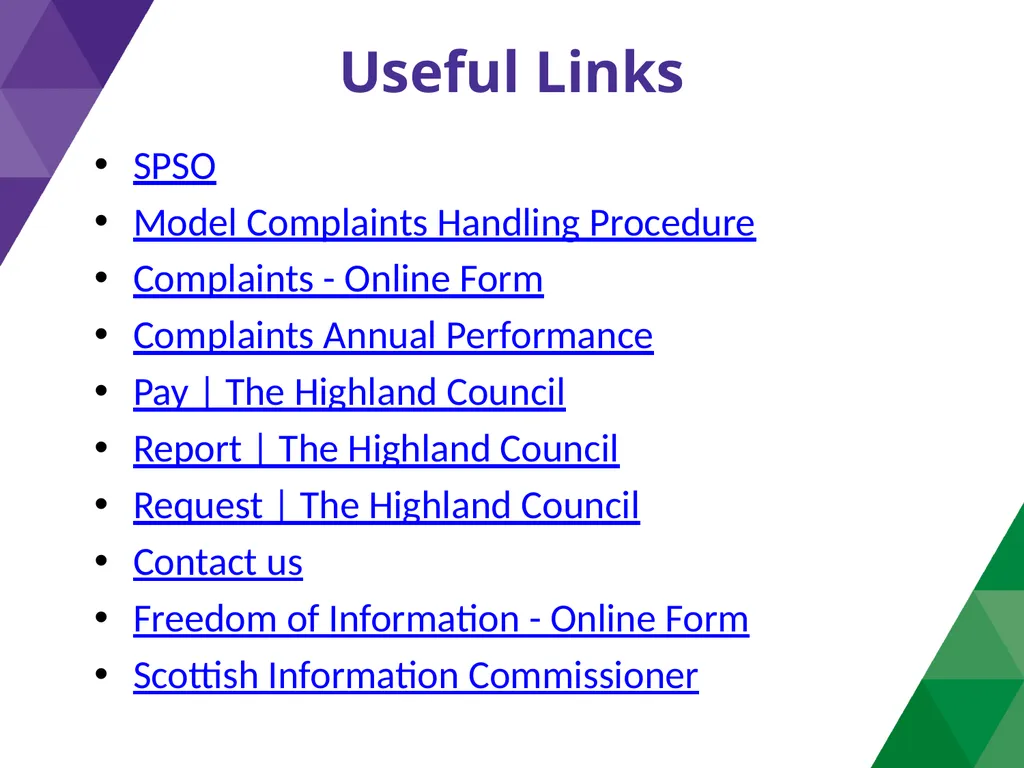
Useful Links SPSO
Model Complaints Handling Procedure
Complaints - Online Form
Complaints Annual Performance
Pay | The Highland Council
Report | The Highland Council
Request | The Highland Council
Contact us
Freedom of Information - Online Form
Scottish Information Commissioner<br>
Model Complaints Handling Procedure
Complaints - Online Form
Complaints Annual Performance
Pay | The Highland Council
Report | The Highland Council
Request | The Highland Council
Contact us
Freedom of Information - Online Form
Scottish Information Commissioner<br>
50
Any questions<br>