
Information Session for School Boards and External
PM
Published · 90 slides · 0 views
1 / 1


Description
Information Session for School Boards and External Auditors Financial Analysis and Accountability Branch Fall 2014 EFIS 2.0 OnSIS 2 Overview The Ministry had informed school boards in Memorandum 2014: SB17 that the previous Enrolment Review
Related Topics
Share
Embed code
Download this presentation From Below
"Information Session for School Boards and External" is the property of its rightful owner. Permission is granted to download and print the materials on this website for personal, non-commercial use only, and to display it on your personal computer provided you do not modify the materials and that you retain all copyright notices contained in the materials. By downloading content from our website, you accept the terms of this agreement.
Presentation Transcript
01
Information Session for School Boards and External Auditors
Financial Analysis and Accountability Branch
Fall 2014<br>
Financial Analysis and Accountability Branch
Fall 2014<br>
02
EFIS 2.0
OnSIS 2<br>
OnSIS 2<br>
03
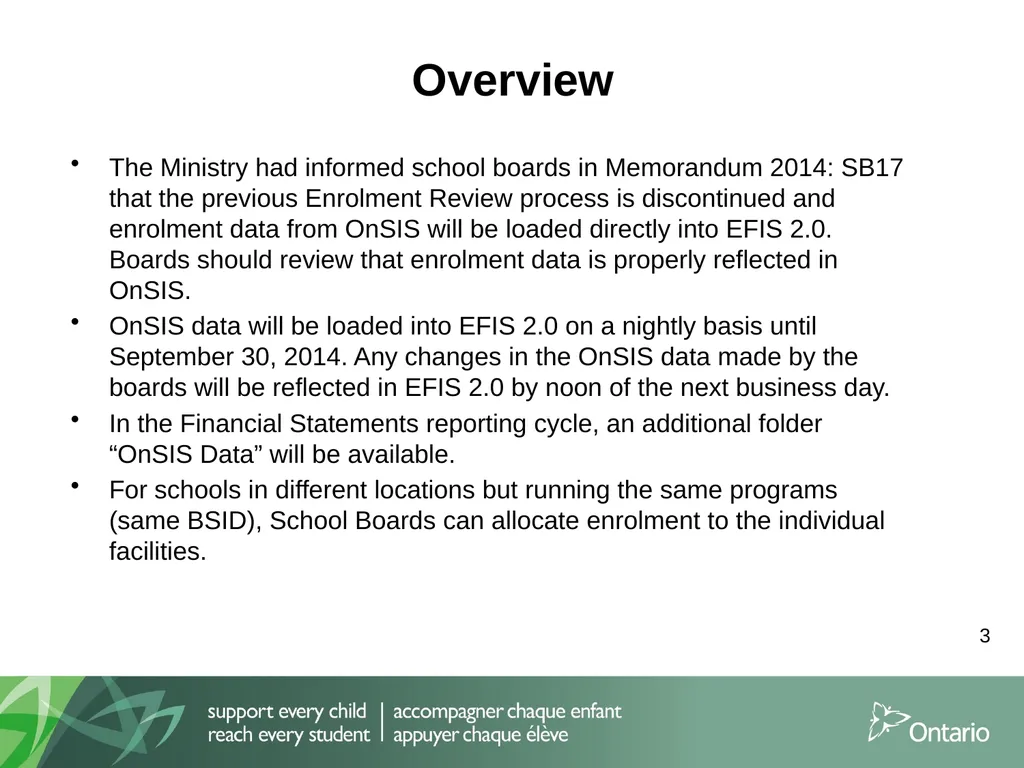
Overview The Ministry had informed school boards in Memorandum 2014: SB17 that the previous Enrolment Review process is discontinued and enrolment data from OnSIS will be loaded directly into EFIS 2.0. Boards should review that enrolment data is properly reflected in OnSIS.
OnSIS data will be loaded into EFIS 2.0 on a nightly basis until September 30, 2014. Any changes in the OnSIS data made by the boards will be reflected in EFIS 2.0 by noon of the next business day.
In the Financial Statements reporting cycle, an additional folder “OnSIS Data” will be available.
For schools in different locations but running the same programs (same BSID), School Boards can allocate enrolment to the individual facilities. 3<br>
OnSIS data will be loaded into EFIS 2.0 on a nightly basis until September 30, 2014. Any changes in the OnSIS data made by the boards will be reflected in EFIS 2.0 by noon of the next business day.
In the Financial Statements reporting cycle, an additional folder “OnSIS Data” will be available.
For schools in different locations but running the same programs (same BSID), School Boards can allocate enrolment to the individual facilities. 3<br>
04
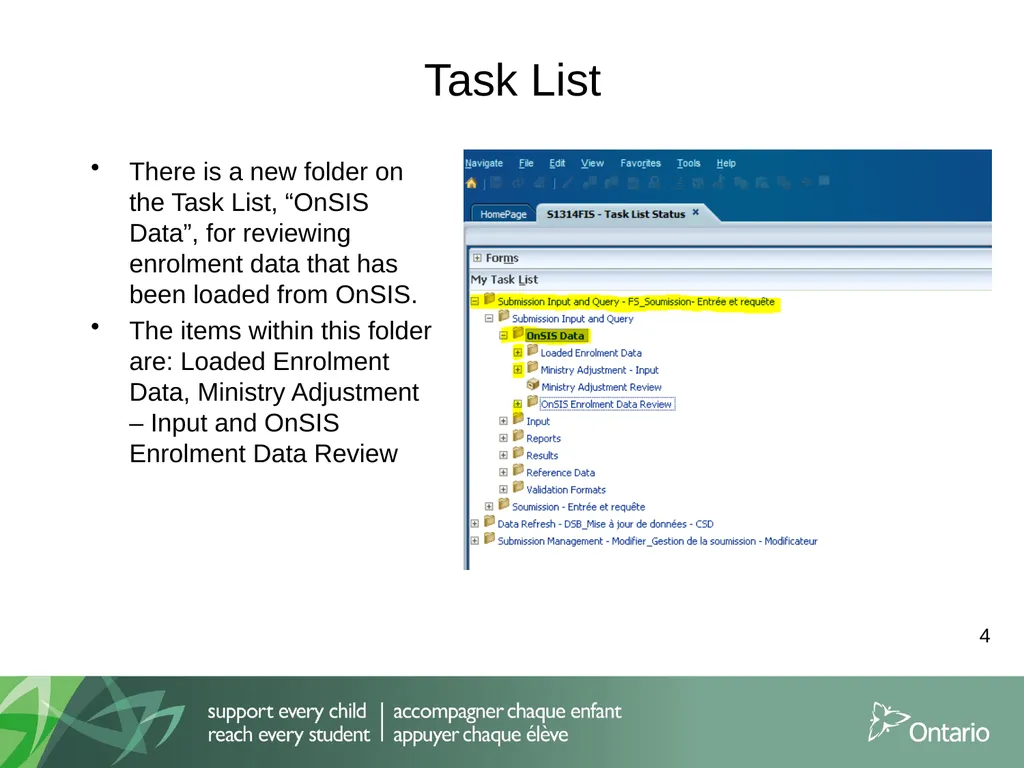
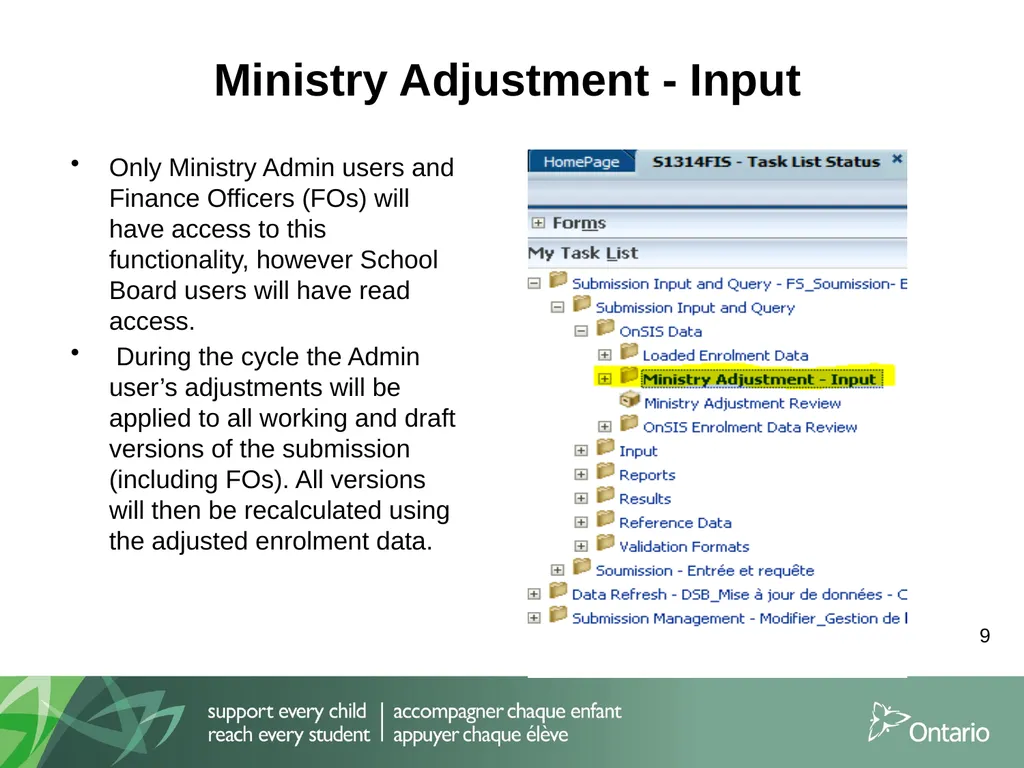
Task List 4 There is a new folder on the Task List, “OnSIS Data”, for reviewing enrolment data that has been loaded from OnSIS.
The items within this folder are: Loaded Enrolment Data, Ministry Adjustment – Input and OnSIS Enrolment Data Review<br>
The items within this folder are: Loaded Enrolment Data, Ministry Adjustment – Input and OnSIS Enrolment Data Review<br>
05
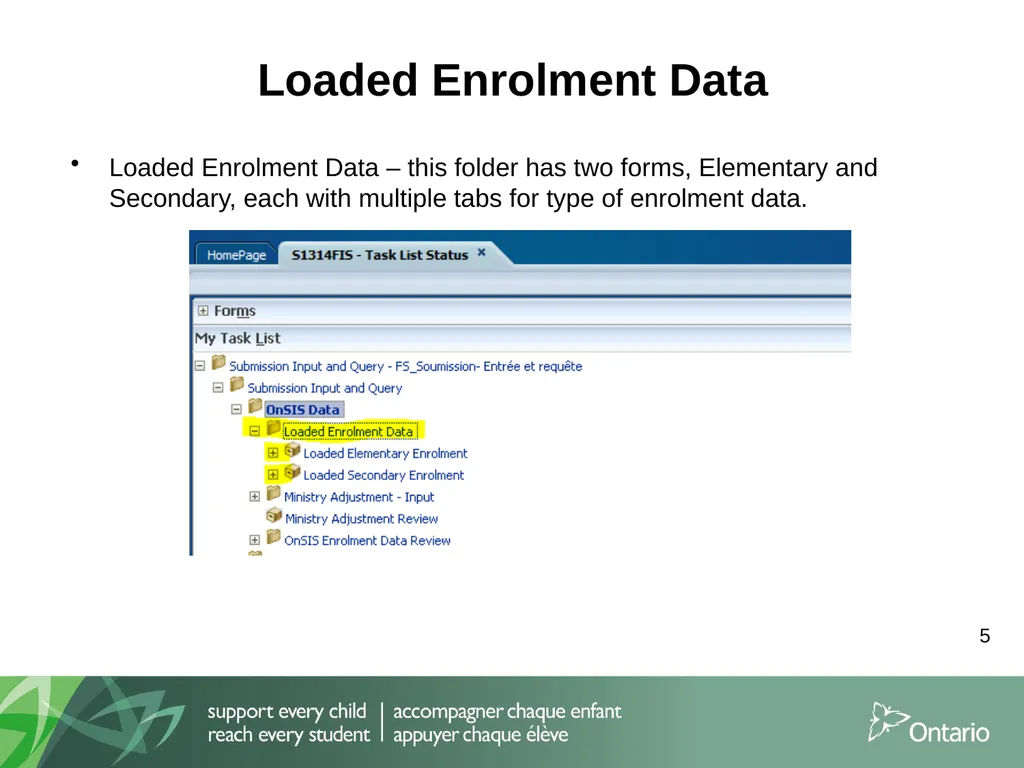
Loaded Enrolment Data Loaded Enrolment Data – this folder has two forms, Elementary and Secondary, each with multiple tabs for type of enrolment data. 5<br>
06
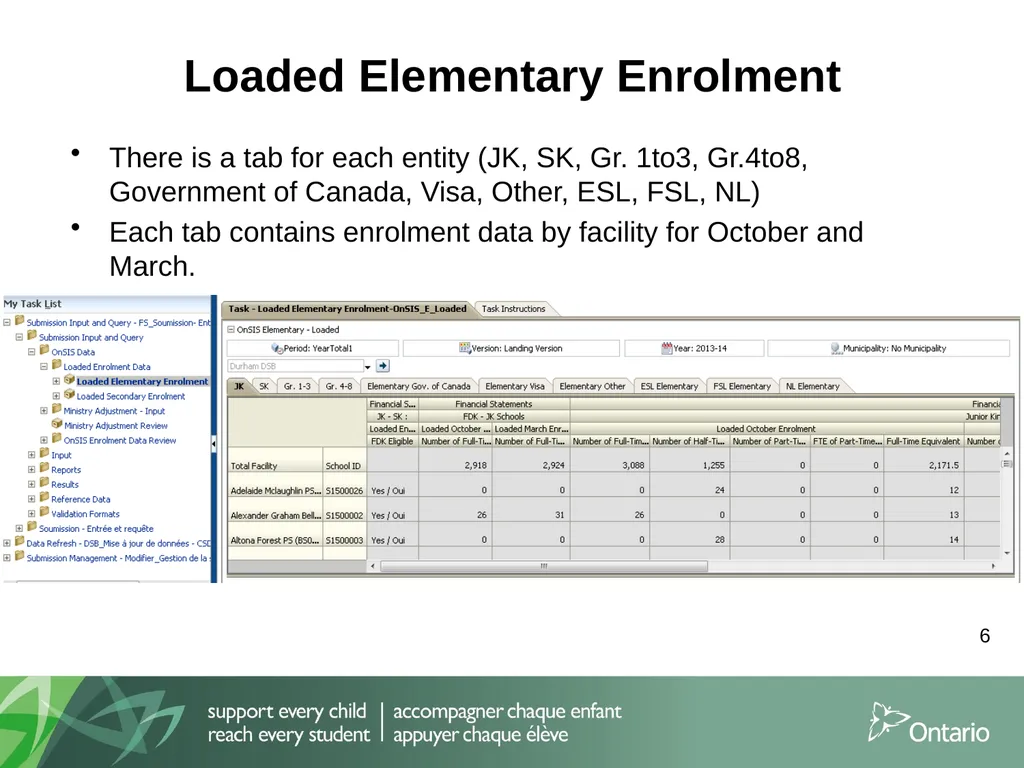
Loaded Elementary Enrolment There is a tab for each entity (JK, SK, Gr. 1to3, Gr.4to8, Government of Canada, Visa, Other, ESL, FSL, NL)
Each tab contains enrolment data by facility for October and March. 6<br>
Each tab contains enrolment data by facility for October and March. 6<br>
07
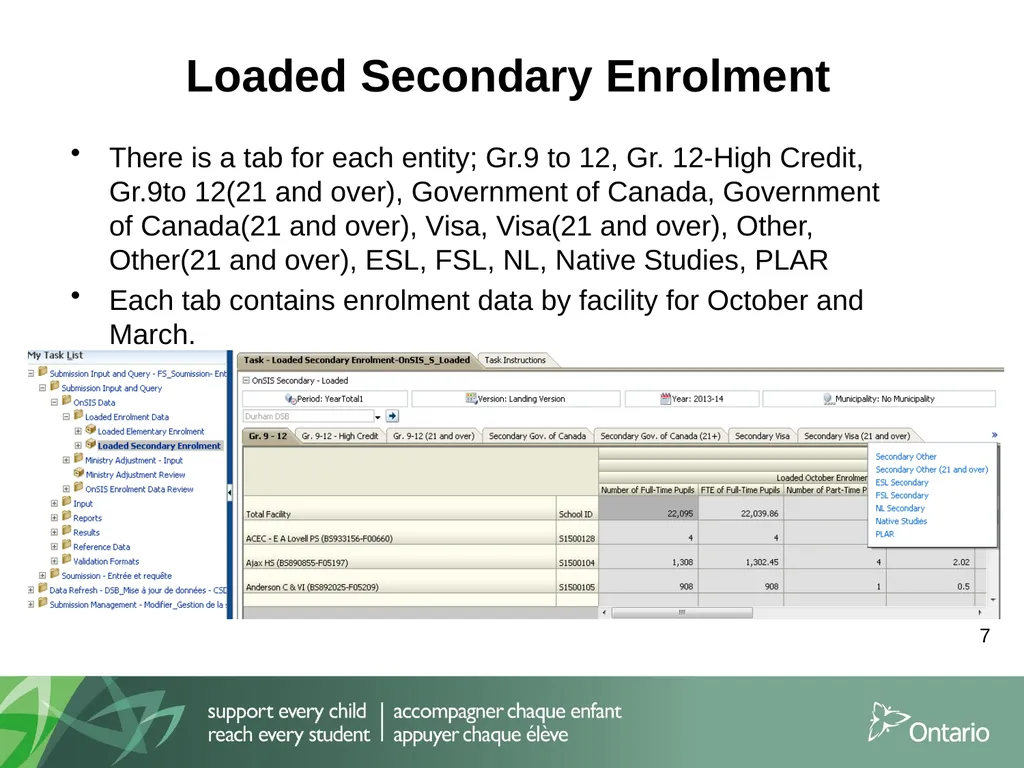
Loaded Secondary Enrolment There is a tab for each entity; Gr.9 to 12, Gr. 12-High Credit, Gr.9to 12(21 and over), Government of Canada, Government of Canada(21 and over), Visa, Visa(21 and over), Other, Other(21 and over), ESL, FSL, NL, Native Studies, PLAR
Each tab contains enrolment data by facility for October and March. 7<br>
Each tab contains enrolment data by facility for October and March. 7<br>
08
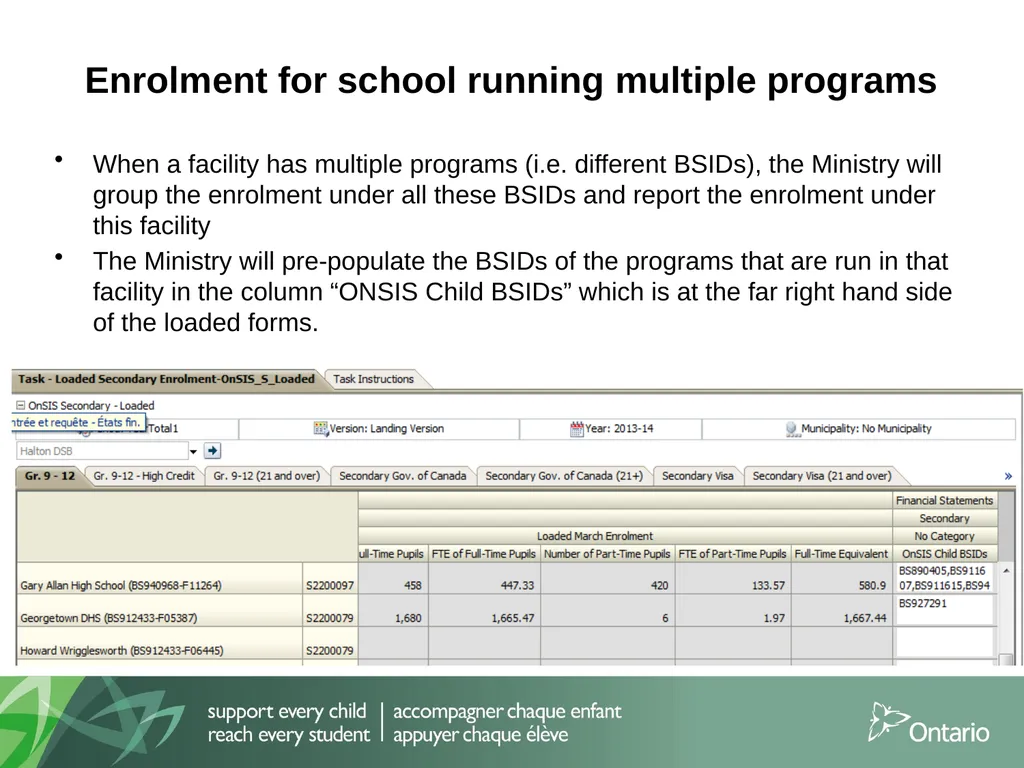
Enrolment for school running multiple programs When a facility has multiple programs (i.e. different BSIDs), the Ministry will group the enrolment under all these BSIDs and report the enrolment under this facility
The Ministry will pre-populate the BSIDs of the programs that are run in that facility in the column “ONSIS Child BSIDs” which is at the far right hand side of the loaded forms. 8<br>
The Ministry will pre-populate the BSIDs of the programs that are run in that facility in the column “ONSIS Child BSIDs” which is at the far right hand side of the loaded forms. 8<br>
09
Ministry Adjustment - Input Only Ministry Admin users and Finance Officers (FOs) will have access to this functionality, however School Board users will have read access.
During the cycle the Admin user’s adjustments will be applied to all working and draft versions of the submission (including FOs). All versions will then be recalculated using the adjusted enrolment data. 9<br>
During the cycle the Admin user’s adjustments will be applied to all working and draft versions of the submission (including FOs). All versions will then be recalculated using the adjusted enrolment data. 9<br>
10
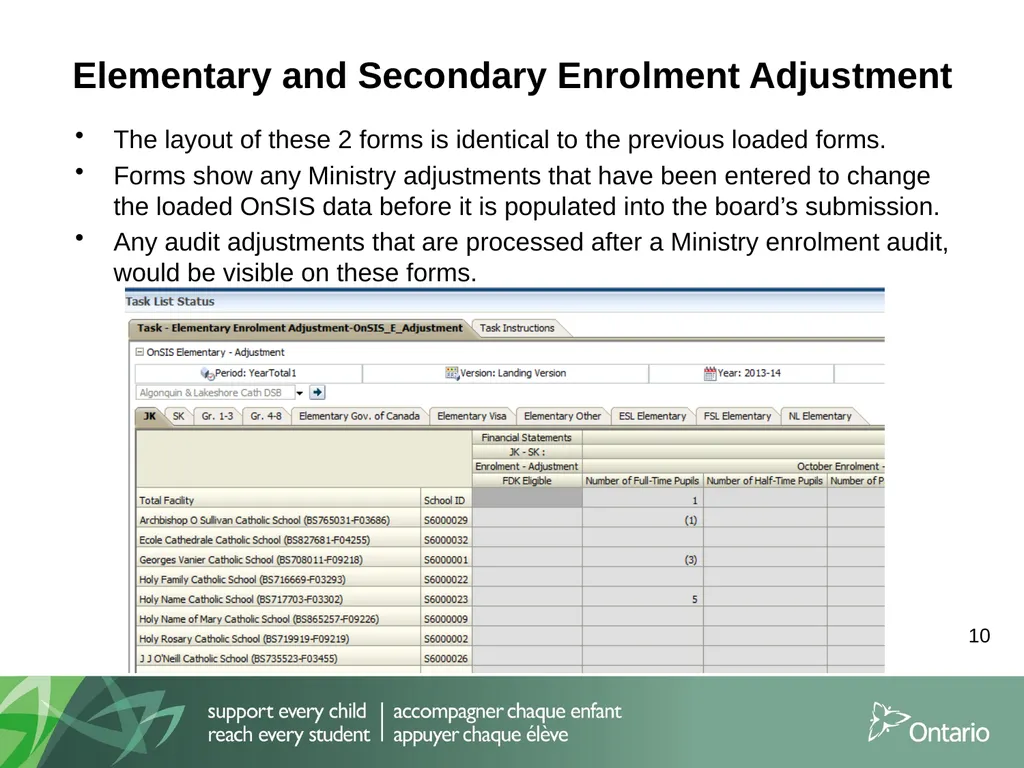
Elementary and Secondary Enrolment Adjustment The layout of these 2 forms is identical to the previous loaded forms.
Forms show any Ministry adjustments that have been entered to change the loaded OnSIS data before it is populated into the board’s submission.
Any audit adjustments that are processed after a Ministry enrolment audit, would be visible on these forms. 10<br>
Forms show any Ministry adjustments that have been entered to change the loaded OnSIS data before it is populated into the board’s submission.
Any audit adjustments that are processed after a Ministry enrolment audit, would be visible on these forms. 10<br>
11
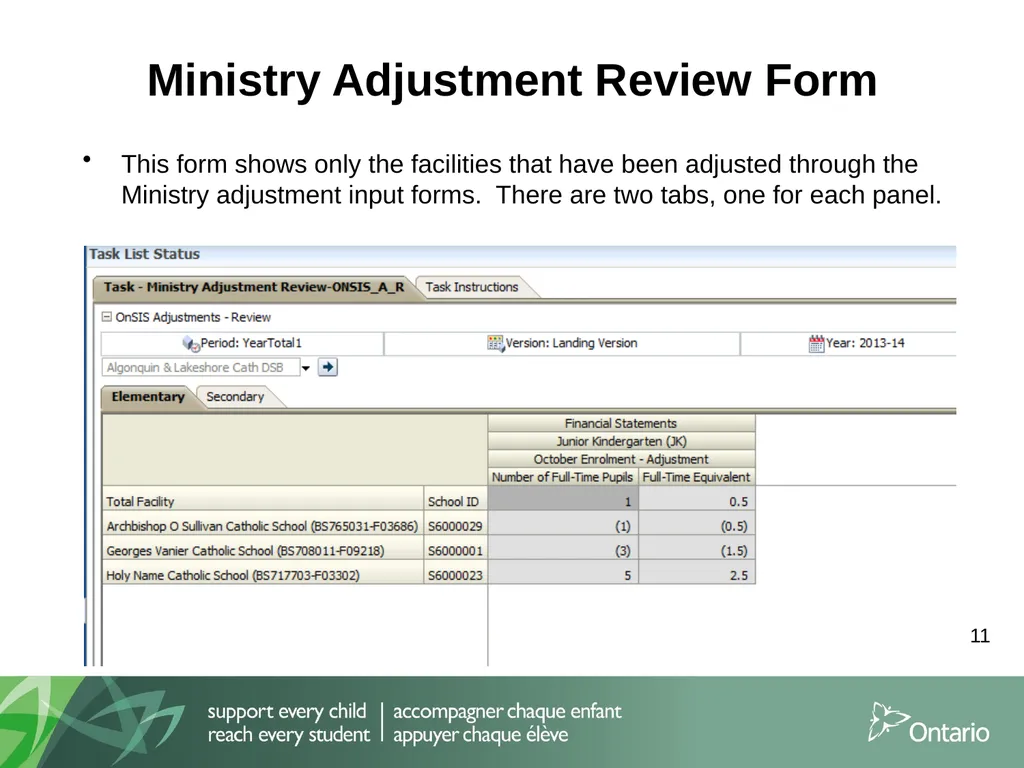
Ministry Adjustment Review Form This form shows only the facilities that have been adjusted through the Ministry adjustment input forms. There are two tabs, one for each panel. 11<br>
12
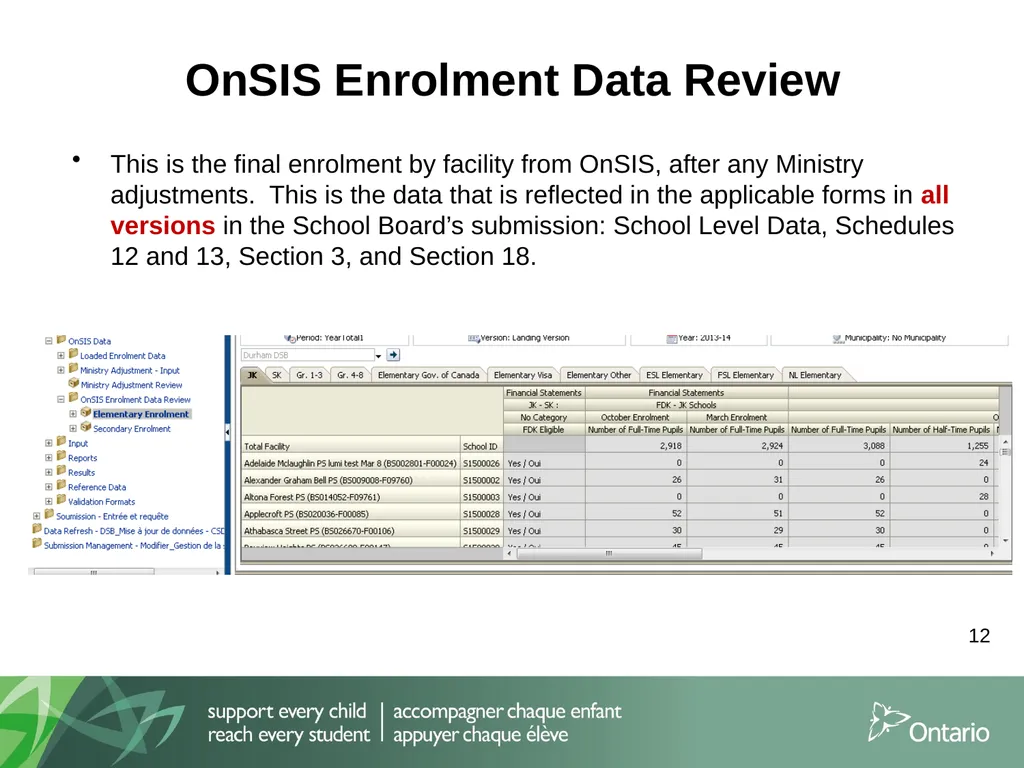
OnSIS Enrolment Data Review This is the final enrolment by facility from OnSIS, after any Ministry adjustments. This is the data that is reflected in the applicable forms in all versions in the School Board’s submission: School Level Data, Schedules 12 and 13, Section 3, and Section 18. 12<br>
13
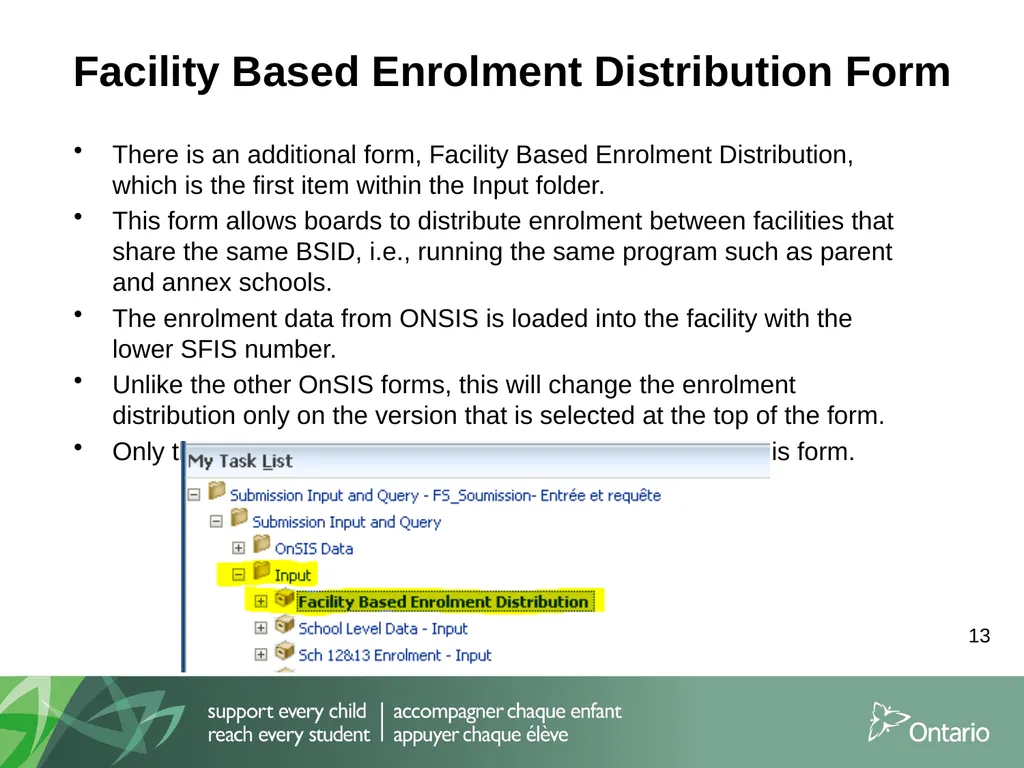
Facility Based Enrolment Distribution Form There is an additional form, Facility Based Enrolment Distribution, which is the first item within the Input folder.
This form allows boards to distribute enrolment between facilities that share the same BSID, i.e., running the same program such as parent and annex schools.
The enrolment data from ONSIS is loaded into the facility with the lower SFIS number.
Unlike the other OnSIS forms, this will change the enrolment distribution only on the version that is selected at the top of the form.
Only the facilities that share a BSID will be displayed on this form. 13<br>
This form allows boards to distribute enrolment between facilities that share the same BSID, i.e., running the same program such as parent and annex schools.
The enrolment data from ONSIS is loaded into the facility with the lower SFIS number.
Unlike the other OnSIS forms, this will change the enrolment distribution only on the version that is selected at the top of the form.
Only the facilities that share a BSID will be displayed on this form. 13<br>
14
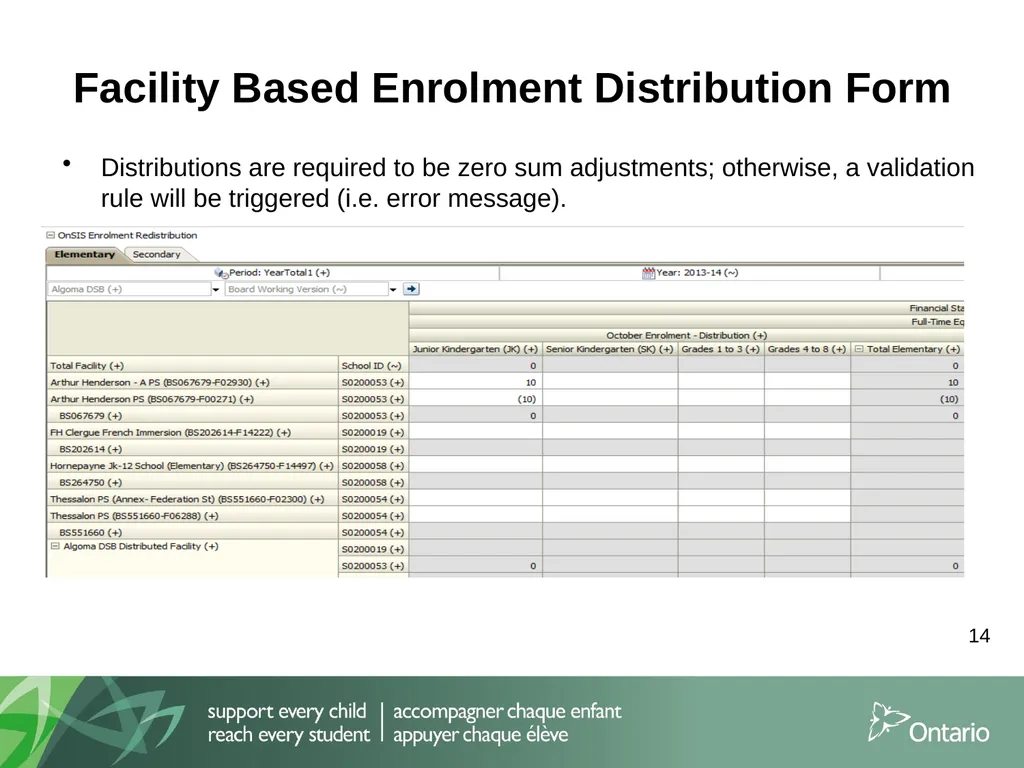
Facility Based Enrolment Distribution Form Distributions are required to be zero sum adjustments; otherwise, a validation rule will be triggered (i.e. error message). 14<br>
15
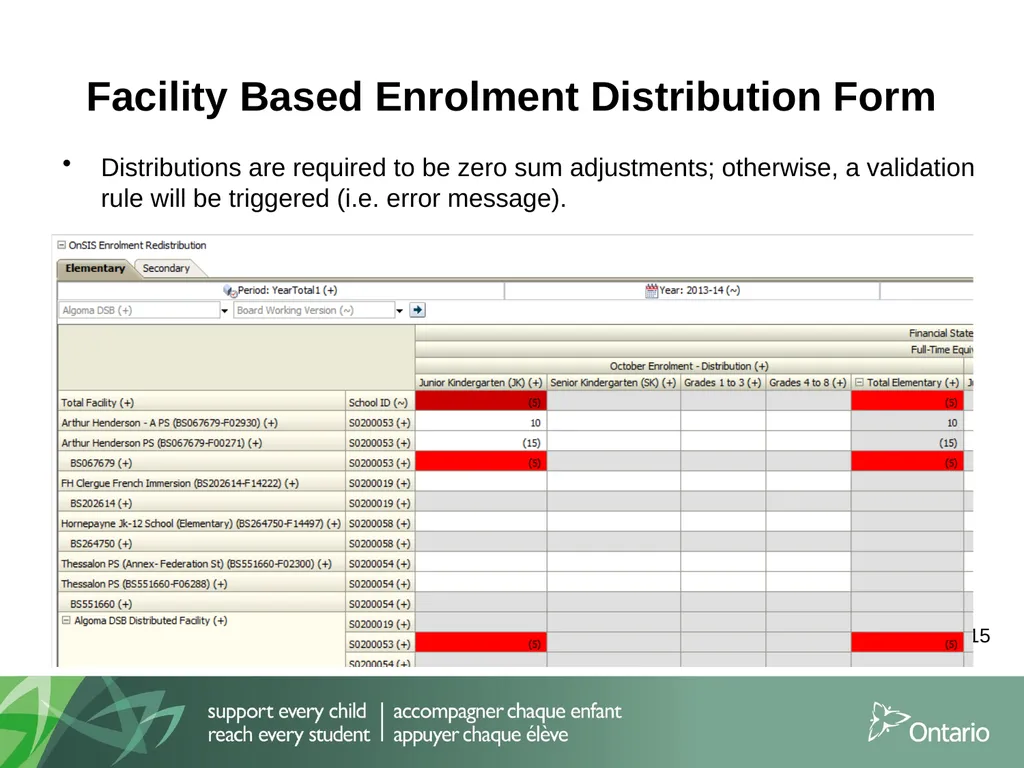
Facility Based Enrolment Distribution Form 15 Distributions are required to be zero sum adjustments; otherwise, a validation rule will be triggered (i.e. error message).<br>
16
EFIS 2.0
Transfer Payment 16<br>
Transfer Payment 16<br>
17
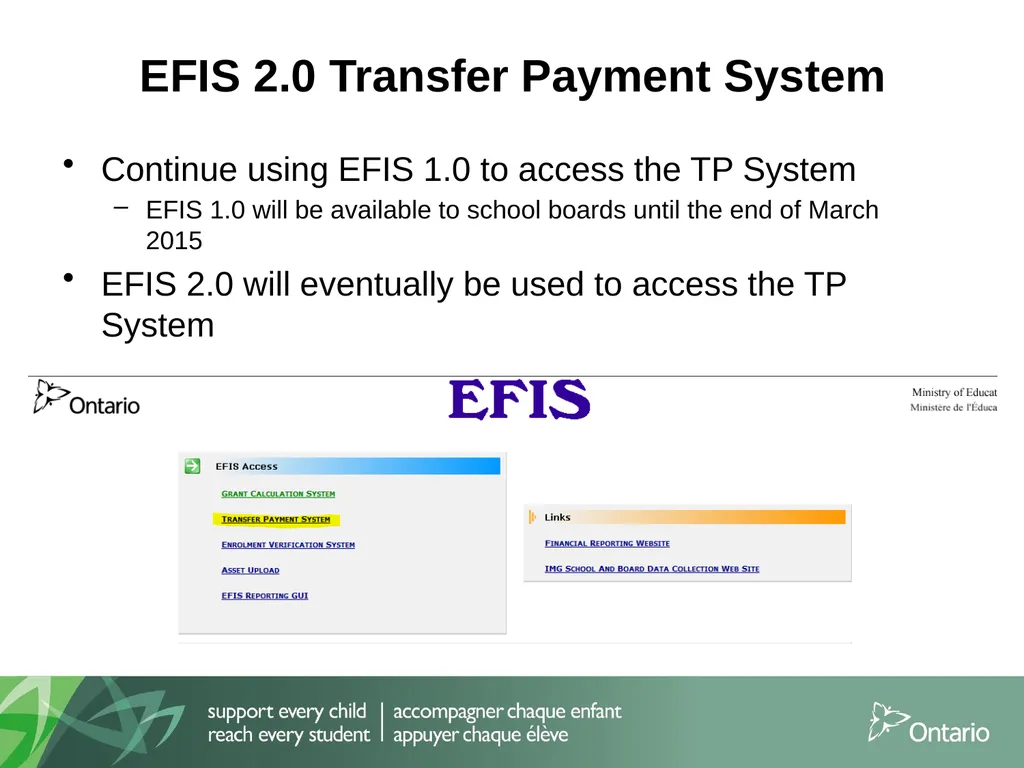
EFIS 2.0 Transfer Payment System Continue using EFIS 1.0 to access the TP System
EFIS 1.0 will be available to school boards until the end of March 2015
EFIS 2.0 will eventually be used to access the TP System 17<br>
EFIS 1.0 will be available to school boards until the end of March 2015
EFIS 2.0 will eventually be used to access the TP System 17<br>
18
EFIS 2.0
TCA Reporting 18<br>
TCA Reporting 18<br>
19
TCA Reporting – Overview 19 Schedule 3C is now separated into three sub-schedules in EFIS 2.0 (2013-14 F/S)
Schedule 3C – Tangible Capital Assets – Detail Data – Input
Schedule 3C – Tangible Capital Assets – Detail Data – Validation
Schedule 3C – Tangible Capital Asset Continuity Schedule – Input<br>
Schedule 3C – Tangible Capital Assets – Detail Data – Input
Schedule 3C – Tangible Capital Assets – Detail Data – Validation
Schedule 3C – Tangible Capital Asset Continuity Schedule – Input<br>
20
TCA - Detail Data - Input 20 Schedule 3C – Tangible Capital Assets – Detail Data – Input
Land, Buildings and Land Improvements (including CIP and Pre- Acquisition) are to be reported on the asset by asset basis using the Schedule 3C - Detail Data – Input form
This replaces previous asset upload process using the pipe delimited file
Information reported in the Detail Data Input schedule will be summarized into the Schedule 3C – Tangible Capital Assets Continuity Schedule - Input<br>
Land, Buildings and Land Improvements (including CIP and Pre- Acquisition) are to be reported on the asset by asset basis using the Schedule 3C - Detail Data – Input form
This replaces previous asset upload process using the pipe delimited file
Information reported in the Detail Data Input schedule will be summarized into the Schedule 3C – Tangible Capital Assets Continuity Schedule - Input<br>
21
TCA – Detail Data Input 21 Each individual asset will be reported on a separate row on the detail data sheet
50 blank rows are provided to add new assets acquired during the period
Each row contains 52 columns which are be broken down into the following sections:
Asset Information (Asset Name, Serial Number, Type, Status, SFIS Number and Address)
Remaining Service Life
Cost Information (Gross Book Value Details)
Accumulated Amortization Details
Net Book Value Opening and Closing Calculations
Disposals and Proceeds of Disposition Information
Construction-In-Progress
Pre-acquisitions
Transferred Asset Information<br>
50 blank rows are provided to add new assets acquired during the period
Each row contains 52 columns which are be broken down into the following sections:
Asset Information (Asset Name, Serial Number, Type, Status, SFIS Number and Address)
Remaining Service Life
Cost Information (Gross Book Value Details)
Accumulated Amortization Details
Net Book Value Opening and Closing Calculations
Disposals and Proceeds of Disposition Information
Construction-In-Progress
Pre-acquisitions
Transferred Asset Information<br>
22
TCA – Detail Data Input – Con’t Asset information is pre-loaded but editable. Boards need to verify the information and make necessary changes
Opening balances are pre-loaded and not editable. *** Boards are requested to verify the pre-populated balances on their respective forms to ensure the correct closing balances from the previous year have been brought forward *** Ministry staff should be notified in case of any errors
Closing balances are calculated. Note: the calculation for each closing balance is a sum of all the previous columns. Thus, fields that are meant to reduce the balances are to be entered as negative numbers
Two columns are deleted - School year ID and Doc Set ID
Some columns have been re-ordered 22<br>
Opening balances are pre-loaded and not editable. *** Boards are requested to verify the pre-populated balances on their respective forms to ensure the correct closing balances from the previous year have been brought forward *** Ministry staff should be notified in case of any errors
Closing balances are calculated. Note: the calculation for each closing balance is a sum of all the previous columns. Thus, fields that are meant to reduce the balances are to be entered as negative numbers
Two columns are deleted - School year ID and Doc Set ID
Some columns have been re-ordered 22<br>
23
Detail Data Input – New Columns 23 Ministry Asset ID – An unique identifier for each asset across the ministry. It includes the Board ID + Asset Serial ID
Closing Balances – Calculated on an asset level once data is entered and saved/submitted
Transfer Between Asset Classes
boards need to create a new asset with new asset ID and report the transfer on asset by asset basis in the Detail Data Input form.
Transfer to Financial Assets
boards need to create a new AHFS asset with new asset ID and report the transfer on asset by asset basis in the Detail Data Input form<br>
Closing Balances – Calculated on an asset level once data is entered and saved/submitted
Transfer Between Asset Classes
boards need to create a new asset with new asset ID and report the transfer on asset by asset basis in the Detail Data Input form.
Transfer to Financial Assets
boards need to create a new AHFS asset with new asset ID and report the transfer on asset by asset basis in the Detail Data Input form<br>
24
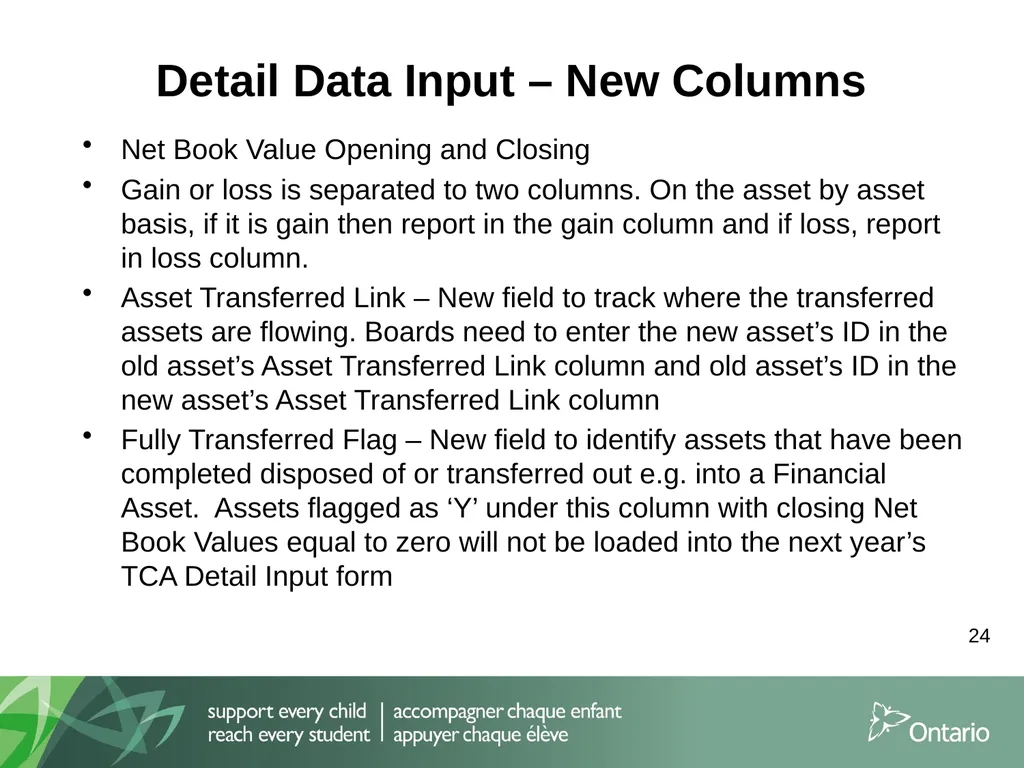
Detail Data Input – New Columns Net Book Value Opening and Closing
Gain or loss is separated to two columns. On the asset by asset basis, if it is gain then report in the gain column and if loss, report in loss column.
Asset Transferred Link – New field to track where the transferred assets are flowing. Boards need to enter the new asset’s ID in the old asset’s Asset Transferred Link column and old asset’s ID in the new asset’s Asset Transferred Link column
Fully Transferred Flag – New field to identify assets that have been completed disposed of or transferred out e.g. into a Financial Asset. Assets flagged as ‘Y’ under this column with closing Net Book Values equal to zero will not be loaded into the next year’s TCA Detail Input form 24<br>
Gain or loss is separated to two columns. On the asset by asset basis, if it is gain then report in the gain column and if loss, report in loss column.
Asset Transferred Link – New field to track where the transferred assets are flowing. Boards need to enter the new asset’s ID in the old asset’s Asset Transferred Link column and old asset’s ID in the new asset’s Asset Transferred Link column
Fully Transferred Flag – New field to identify assets that have been completed disposed of or transferred out e.g. into a Financial Asset. Assets flagged as ‘Y’ under this column with closing Net Book Values equal to zero will not be loaded into the next year’s TCA Detail Input form 24<br>
25
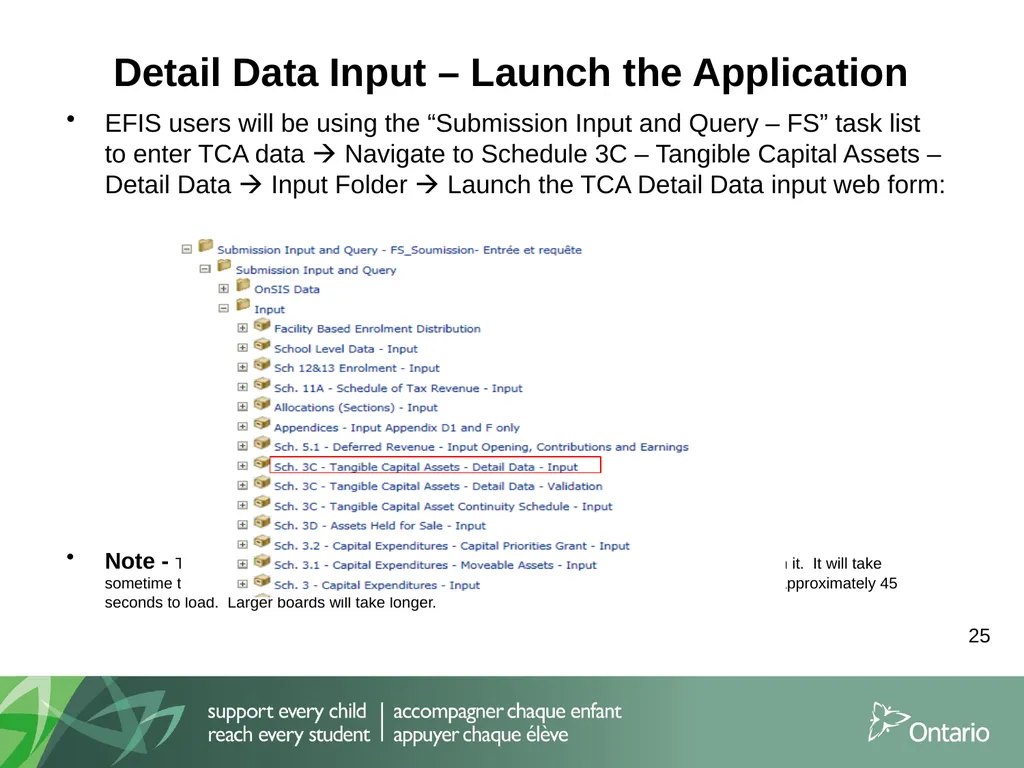
Detail Data Input – Launch the Application 25 EFIS users will be using the “Submission Input and Query – FS” task list to enter TCA data Navigate to Schedule 3C – Tangible Capital Assets – Detail Data Input Folder Launch the TCA Detail Data input web form:
Note - The form capturing the detail asset data has a very large amount of data associated with it. It will take sometime to load, especially for larger boards to calculate and save. A mid-sized board may take approximately 45 seconds to load. Larger boards will take longer.<br>
Note - The form capturing the detail asset data has a very large amount of data associated with it. It will take sometime to load, especially for larger boards to calculate and save. A mid-sized board may take approximately 45 seconds to load. Larger boards will take longer.<br>
26
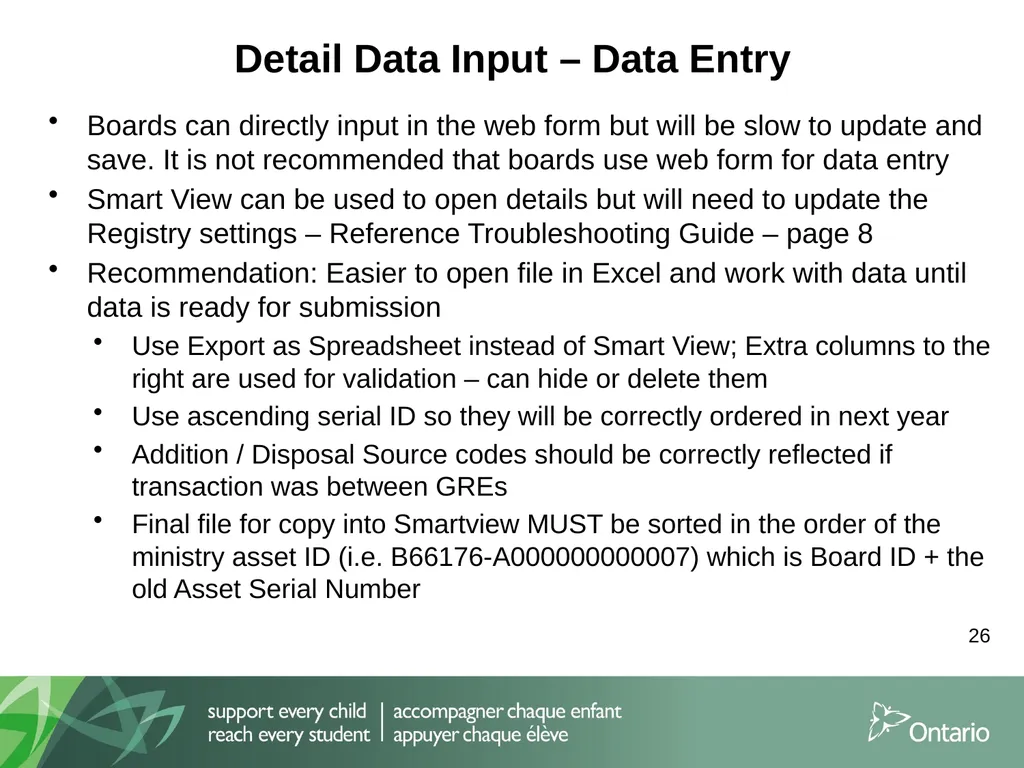
Detail Data Input – Data Entry Boards can directly input in the web form but will be slow to update and save. It is not recommended that boards use web form for data entry
Smart View can be used to open details but will need to update the Registry settings – Reference Troubleshooting Guide – page 8
Recommendation: Easier to open file in Excel and work with data until data is ready for submission
Use Export as Spreadsheet instead of Smart View; Extra columns to the right are used for validation – can hide or delete them
Use ascending serial ID so they will be correctly ordered in next year
Addition / Disposal Source codes should be correctly reflected if transaction was between GREs
Final file for copy into Smartview MUST be sorted in the order of the ministry asset ID (i.e. B66176-A000000000007) which is Board ID + the old Asset Serial Number 26<br>
Smart View can be used to open details but will need to update the Registry settings – Reference Troubleshooting Guide – page 8
Recommendation: Easier to open file in Excel and work with data until data is ready for submission
Use Export as Spreadsheet instead of Smart View; Extra columns to the right are used for validation – can hide or delete them
Use ascending serial ID so they will be correctly ordered in next year
Addition / Disposal Source codes should be correctly reflected if transaction was between GREs
Final file for copy into Smartview MUST be sorted in the order of the ministry asset ID (i.e. B66176-A000000000007) which is Board ID + the old Asset Serial Number 26<br>
27
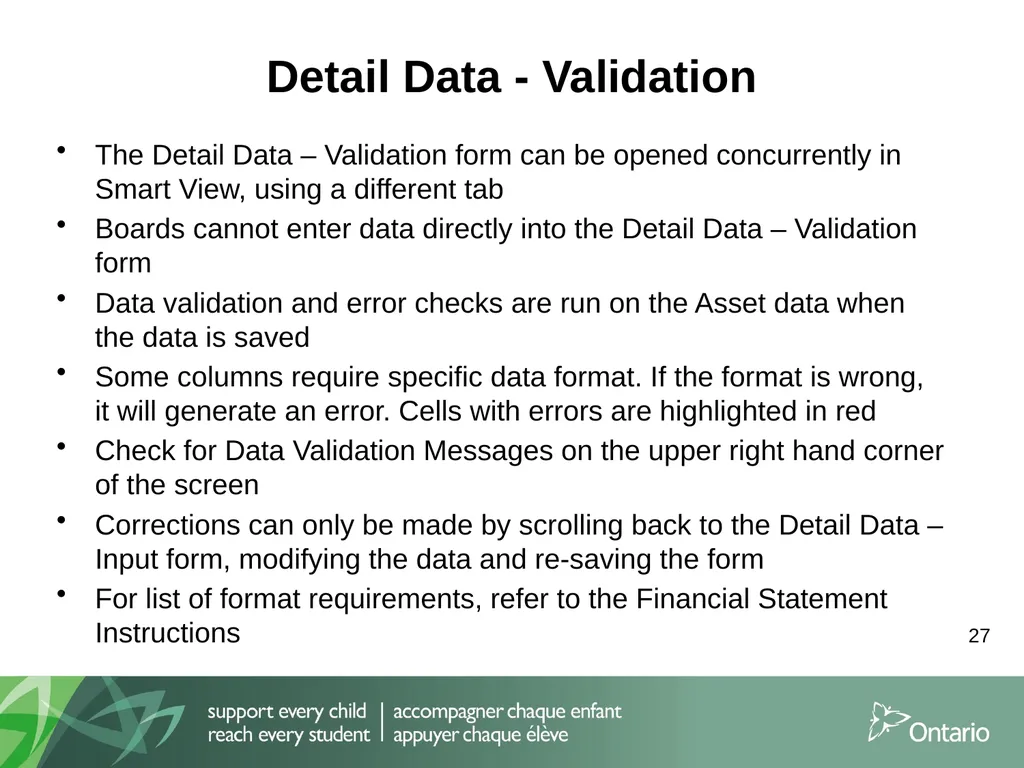
Detail Data - Validation The Detail Data – Validation form can be opened concurrently in Smart View, using a different tab
Boards cannot enter data directly into the Detail Data – Validation form
Data validation and error checks are run on the Asset data when the data is saved
Some columns require specific data format. If the format is wrong, it will generate an error. Cells with errors are highlighted in red
Check for Data Validation Messages on the upper right hand corner of the screen
Corrections can only be made by scrolling back to the Detail Data – Input form, modifying the data and re-saving the form
For list of format requirements, refer to the Financial Statement Instructions 27<br>
Boards cannot enter data directly into the Detail Data – Validation form
Data validation and error checks are run on the Asset data when the data is saved
Some columns require specific data format. If the format is wrong, it will generate an error. Cells with errors are highlighted in red
Check for Data Validation Messages on the upper right hand corner of the screen
Corrections can only be made by scrolling back to the Detail Data – Input form, modifying the data and re-saving the form
For list of format requirements, refer to the Financial Statement Instructions 27<br>
28
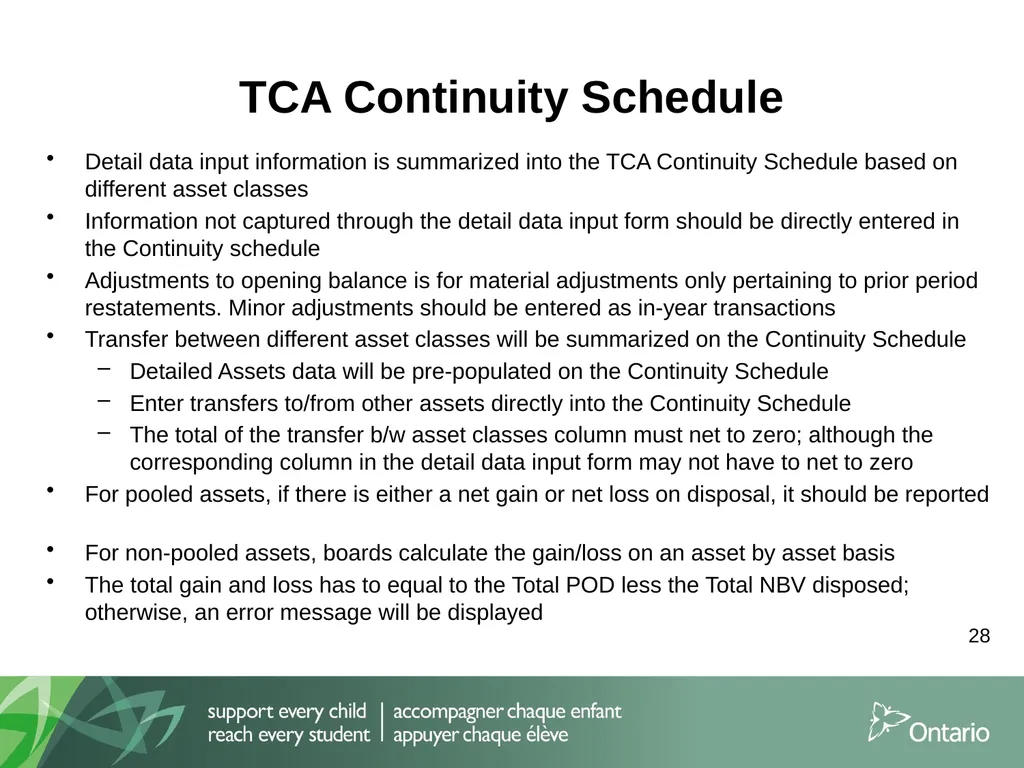
TCA Continuity Schedule Detail data input information is summarized into the TCA Continuity Schedule based on different asset classes
Information not captured through the detail data input form should be directly entered in the Continuity schedule
Adjustments to opening balance is for material adjustments only pertaining to prior period restatements. Minor adjustments should be entered as in-year transactions
Transfer between different asset classes will be summarized on the Continuity Schedule
Detailed Assets data will be pre-populated on the Continuity Schedule
Enter transfers to/from other assets directly into the Continuity Schedule
The total of the transfer b/w asset classes column must net to zero; although the corresponding column in the detail data input form may not have to net to zero
For pooled assets, if there is either a net gain or net loss on disposal, it should be reported
For non-pooled assets, boards calculate the gain/loss on an asset by asset basis
The total gain and loss has to equal to the Total POD less the Total NBV disposed; otherwise, an error message will be displayed 28<br>
Information not captured through the detail data input form should be directly entered in the Continuity schedule
Adjustments to opening balance is for material adjustments only pertaining to prior period restatements. Minor adjustments should be entered as in-year transactions
Transfer between different asset classes will be summarized on the Continuity Schedule
Detailed Assets data will be pre-populated on the Continuity Schedule
Enter transfers to/from other assets directly into the Continuity Schedule
The total of the transfer b/w asset classes column must net to zero; although the corresponding column in the detail data input form may not have to net to zero
For pooled assets, if there is either a net gain or net loss on disposal, it should be reported
For non-pooled assets, boards calculate the gain/loss on an asset by asset basis
The total gain and loss has to equal to the Total POD less the Total NBV disposed; otherwise, an error message will be displayed 28<br>
29
EFIS 2.0
AHFS Reporting<br>
AHFS Reporting<br>
30
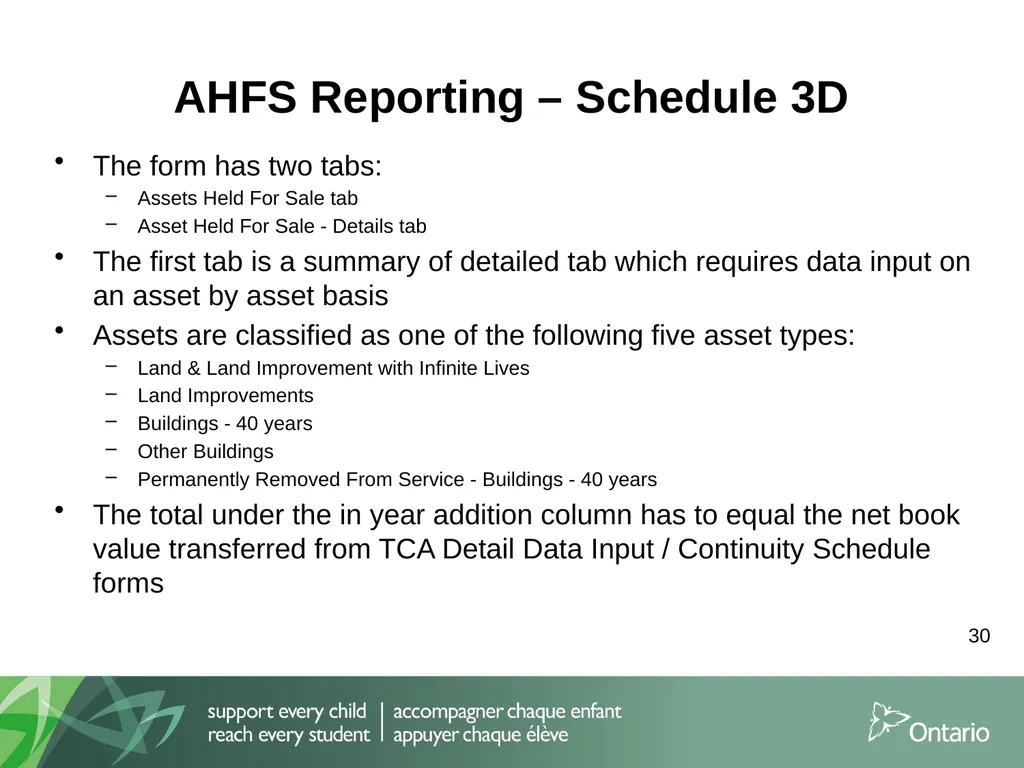
AHFS Reporting – Schedule 3D The form has two tabs:
Assets Held For Sale tab
Asset Held For Sale - Details tab
The first tab is a summary of detailed tab which requires data input on an asset by asset basis
Assets are classified as one of the following five asset types:
Land & Land Improvement with Infinite Lives
Land Improvements
Buildings - 40 years
Other Buildings
Permanently Removed From Service - Buildings - 40 years
The total under the in year addition column has to equal the net book value transferred from TCA Detail Data Input / Continuity Schedule forms 30<br>
Assets Held For Sale tab
Asset Held For Sale - Details tab
The first tab is a summary of detailed tab which requires data input on an asset by asset basis
Assets are classified as one of the following five asset types:
Land & Land Improvement with Infinite Lives
Land Improvements
Buildings - 40 years
Other Buildings
Permanently Removed From Service - Buildings - 40 years
The total under the in year addition column has to equal the net book value transferred from TCA Detail Data Input / Continuity Schedule forms 30<br>
31
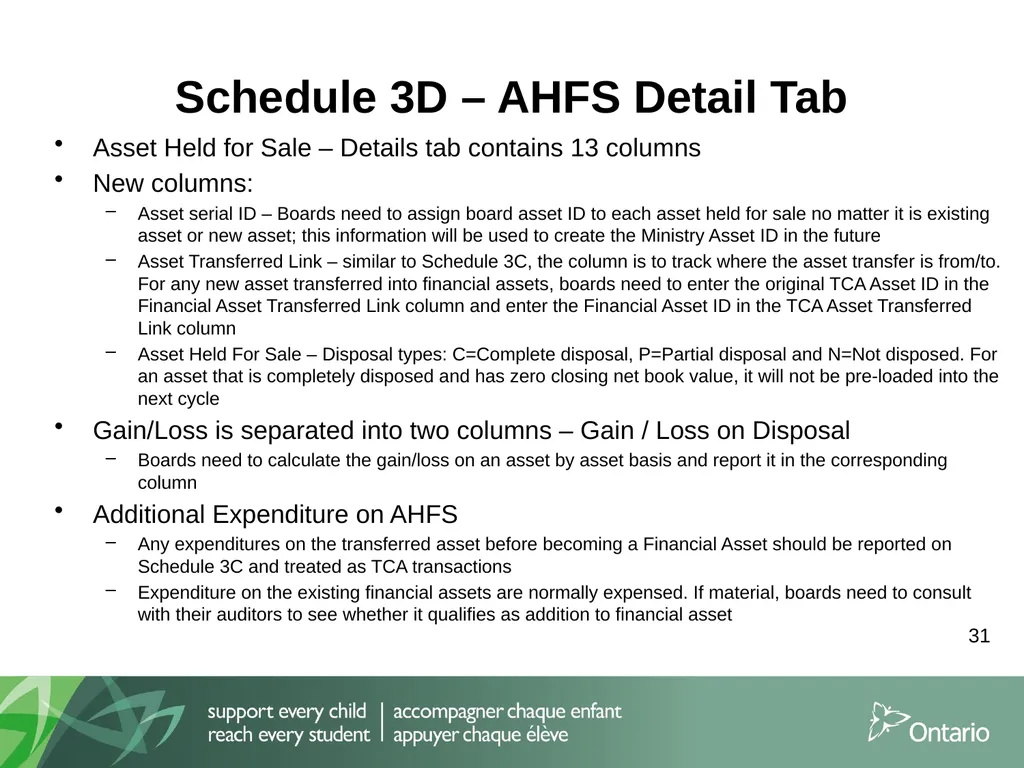
Schedule 3D – AHFS Detail Tab Asset Held for Sale – Details tab contains 13 columns
New columns:
Asset serial ID – Boards need to assign board asset ID to each asset held for sale no matter it is existing asset or new asset; this information will be used to create the Ministry Asset ID in the future
Asset Transferred Link – similar to Schedule 3C, the column is to track where the asset transfer is from/to. For any new asset transferred into financial assets, boards need to enter the original TCA Asset ID in the Financial Asset Transferred Link column and enter the Financial Asset ID in the TCA Asset Transferred Link column
Asset Held For Sale – Disposal types: C=Complete disposal, P=Partial disposal and N=Not disposed. For an asset that is completely disposed and has zero closing net book value, it will not be pre-loaded into the next cycle
Gain/Loss is separated into two columns – Gain / Loss on Disposal
Boards need to calculate the gain/loss on an asset by asset basis and report it in the corresponding column
Additional Expenditure on AHFS
Any expenditures on the transferred asset before becoming a Financial Asset should be reported on Schedule 3C and treated as TCA transactions
Expenditure on the existing financial assets are normally expensed. If material, boards need to consult with their auditors to see whether it qualifies as addition to financial asset 31<br>
New columns:
Asset serial ID – Boards need to assign board asset ID to each asset held for sale no matter it is existing asset or new asset; this information will be used to create the Ministry Asset ID in the future
Asset Transferred Link – similar to Schedule 3C, the column is to track where the asset transfer is from/to. For any new asset transferred into financial assets, boards need to enter the original TCA Asset ID in the Financial Asset Transferred Link column and enter the Financial Asset ID in the TCA Asset Transferred Link column
Asset Held For Sale – Disposal types: C=Complete disposal, P=Partial disposal and N=Not disposed. For an asset that is completely disposed and has zero closing net book value, it will not be pre-loaded into the next cycle
Gain/Loss is separated into two columns – Gain / Loss on Disposal
Boards need to calculate the gain/loss on an asset by asset basis and report it in the corresponding column
Additional Expenditure on AHFS
Any expenditures on the transferred asset before becoming a Financial Asset should be reported on Schedule 3C and treated as TCA transactions
Expenditure on the existing financial assets are normally expensed. If material, boards need to consult with their auditors to see whether it qualifies as addition to financial asset 31<br>
32
32 Questions?<br>
33
EFIS 2.0
Tips and Tricks<br>
Tips and Tricks<br>
34
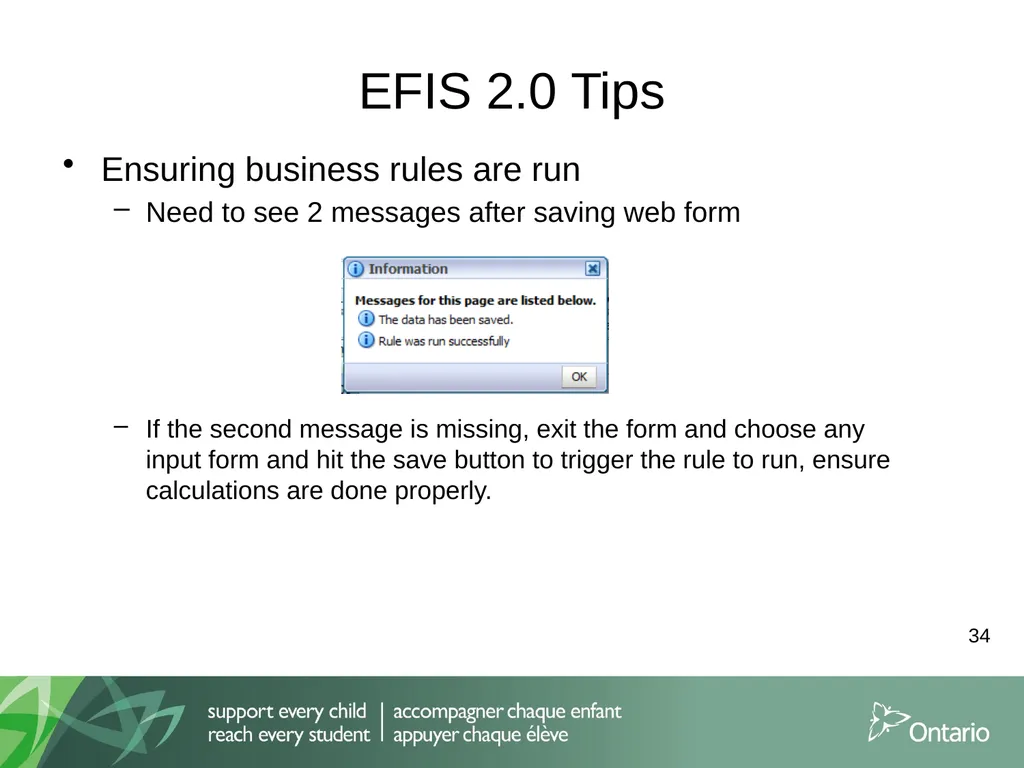
EFIS 2.0 Tips Ensuring business rules are run
Need to see 2 messages after saving web form
If the second message is missing, exit the form and choose any input form and hit the save button to trigger the rule to run, ensure calculations are done properly. 34<br>
Need to see 2 messages after saving web form
If the second message is missing, exit the form and choose any input form and hit the save button to trigger the rule to run, ensure calculations are done properly. 34<br>
35
EFIS 2.0 Tips Saving error on long web forms
On long web forms, sometimes clicking the save button does not seem to initiate anything
Need to scroll down to the bottom of the form, then back up to the top, and then hit save
i.e. Schedule 9, Data Form B, Data Form C
Smart View time-out error while opening or saving large data intensive forms (e.g. TCA Details input)
Follow the EFIS 2.0 Troubleshooting Guide, page 8, to make the Registry change to your computer to increase the timeout period 35<br>
On long web forms, sometimes clicking the save button does not seem to initiate anything
Need to scroll down to the bottom of the form, then back up to the top, and then hit save
i.e. Schedule 9, Data Form B, Data Form C
Smart View time-out error while opening or saving large data intensive forms (e.g. TCA Details input)
Follow the EFIS 2.0 Troubleshooting Guide, page 8, to make the Registry change to your computer to increase the timeout period 35<br>
36
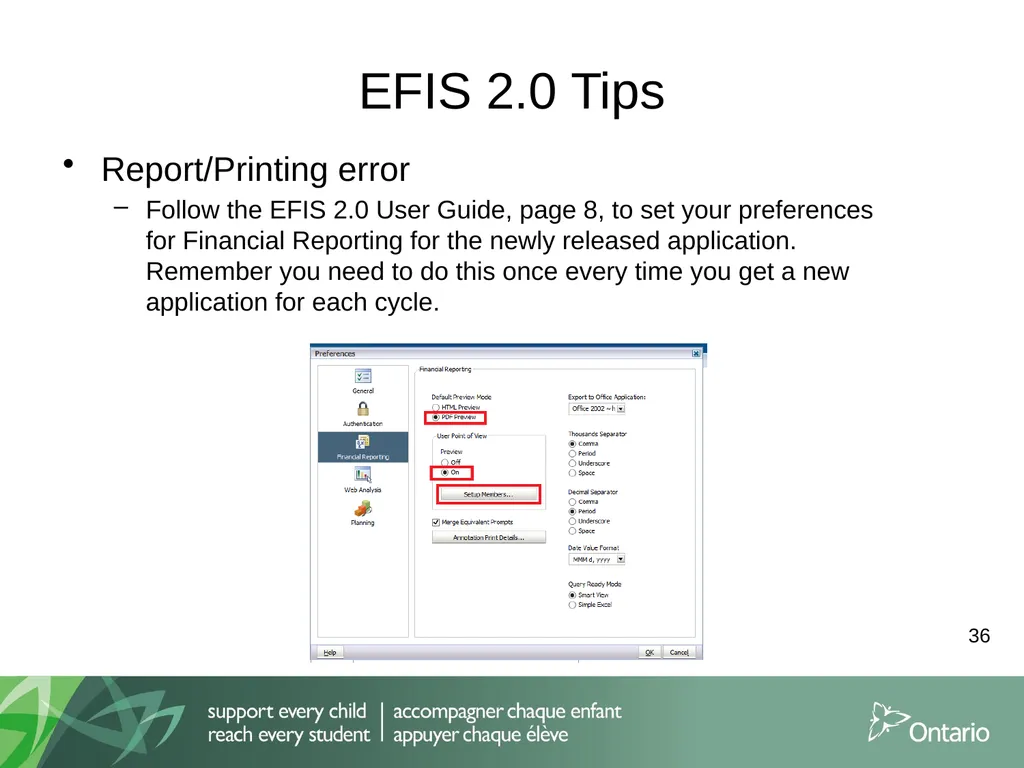
EFIS 2.0 Tips Report/Printing error
Follow the EFIS 2.0 User Guide, page 8, to set your preferences for Financial Reporting for the newly released application. Remember you need to do this once every time you get a new application for each cycle. 36<br>
Follow the EFIS 2.0 User Guide, page 8, to set your preferences for Financial Reporting for the newly released application. Remember you need to do this once every time you get a new application for each cycle. 36<br>
37
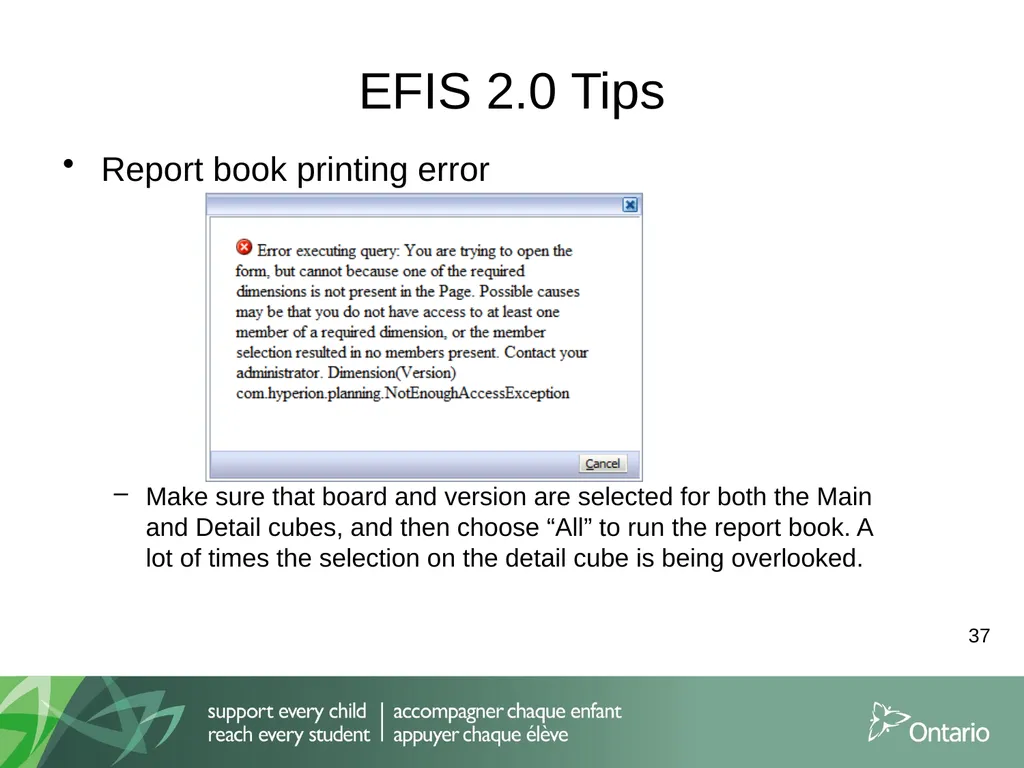
EFIS 2.0 Tips Report book printing error
Make sure that board and version are selected for both the Main and Detail cubes, and then choose “All” to run the report book. A lot of times the selection on the detail cube is being overlooked. 37<br>
Make sure that board and version are selected for both the Main and Detail cubes, and then choose “All” to run the report book. A lot of times the selection on the detail cube is being overlooked. 37<br>
38
EFIS 2.0 Tips Excel
If you just want a form in Excel but not connected to the database through Smart View, in the Planning form use “Tools – Export as Spreadsheet – Open with Microsoft Excel”.
This will give you an excel workbook in the same format as the planning form and the Smart View form.
You can then work in this Excel workbook and copy to Smart View when you are happy with the data.
When exporting input forms, you will likely see a number of columns that do not contain useful data. Any columns which contain members starting with “Cur” can be ignored 38<br>
If you just want a form in Excel but not connected to the database through Smart View, in the Planning form use “Tools – Export as Spreadsheet – Open with Microsoft Excel”.
This will give you an excel workbook in the same format as the planning form and the Smart View form.
You can then work in this Excel workbook and copy to Smart View when you are happy with the data.
When exporting input forms, you will likely see a number of columns that do not contain useful data. Any columns which contain members starting with “Cur” can be ignored 38<br>
39
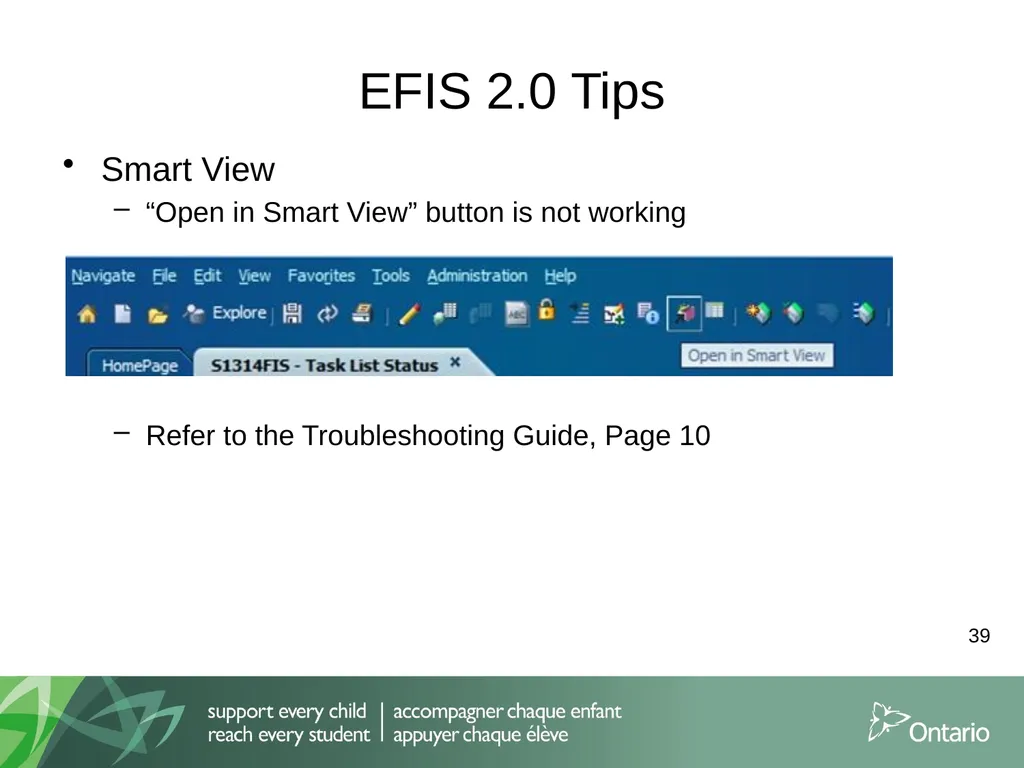
EFIS 2.0 Tips Smart View
“Open in Smart View” button is not working
Refer to the Troubleshooting Guide, Page 10 39<br>
“Open in Smart View” button is not working
Refer to the Troubleshooting Guide, Page 10 39<br>
40
EFIS 2.0 Tips Smart View
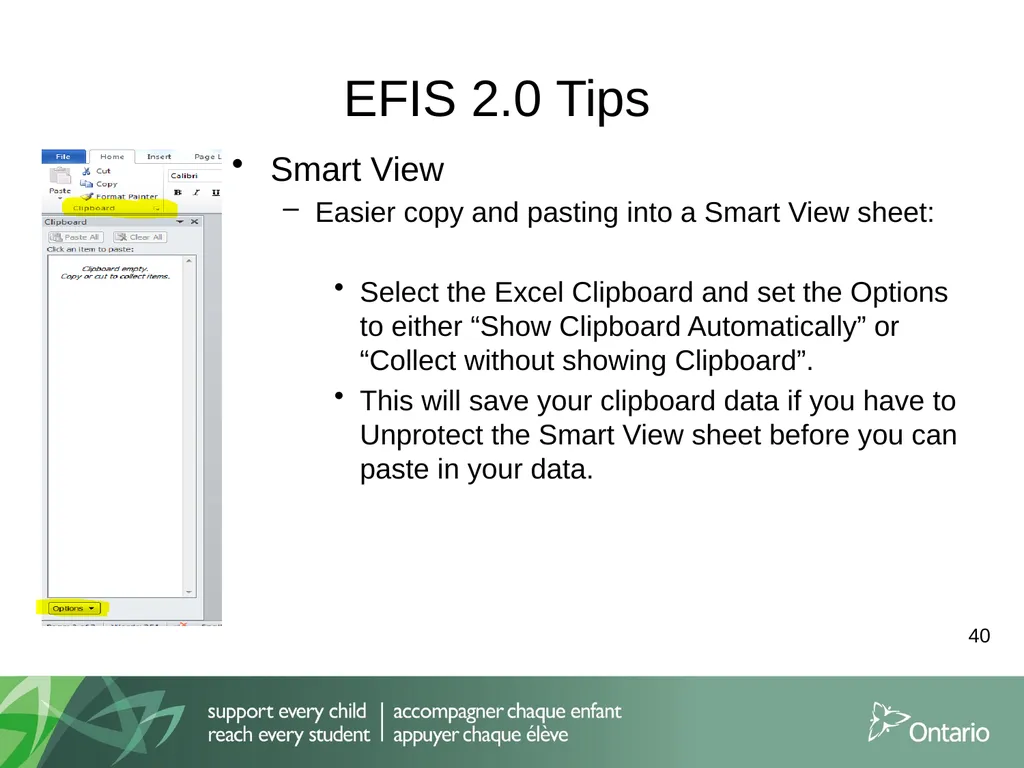
Easier copy and pasting into a Smart View sheet:
Select the Excel Clipboard and set the Options to either “Show Clipboard Automatically” or “Collect without showing Clipboard”.
This will save your clipboard data if you have to Unprotect the Smart View sheet before you can paste in your data. 40<br>
Easier copy and pasting into a Smart View sheet:
Select the Excel Clipboard and set the Options to either “Show Clipboard Automatically” or “Collect without showing Clipboard”.
This will save your clipboard data if you have to Unprotect the Smart View sheet before you can paste in your data. 40<br>
41
EFIS 2.0 Tips How to use two screens:
For each option, if you input data on one screen, you will need to refresh data on the other screen to see the result.
Option 1 – If you have 2 different browsers (e.g. Firefox, Internet Explorer 9), log in under different browsers. 41<br>
For each option, if you input data on one screen, you will need to refresh data on the other screen to see the result.
Option 1 – If you have 2 different browsers (e.g. Firefox, Internet Explorer 9), log in under different browsers. 41<br>
42
EFIS 2.0 Tips How to use two screens:
Option 2 – If you only have one browser, open another browser session:
In IE, select File > New session from the menu, then go to EFIS website and log in
In Firefox, we are looking into a solution.
Option 3 – Use Smart View for input and use the web browser to view result and report 42<br>
Option 2 – If you only have one browser, open another browser session:
In IE, select File > New session from the menu, then go to EFIS website and log in
In Firefox, we are looking into a solution.
Option 3 – Use Smart View for input and use the web browser to view result and report 42<br>
43
EFIS 2.0 Tips The following documents are all accessible through the FAAB Website:
EFIS 2.0 User Guide
EFIS 2.0 Troubleshooting Guide
EFIS 2.0 System Setup Instructions
EFIS 2.0 User Registration Instructions
http://faab.edu.gov.on.ca/Financial_Statements.htm 43<br>
EFIS 2.0 User Guide
EFIS 2.0 Troubleshooting Guide
EFIS 2.0 System Setup Instructions
EFIS 2.0 User Registration Instructions
http://faab.edu.gov.on.ca/Financial_Statements.htm 43<br>
44
2013-14 Financial
Statements Changes 44<br>
Statements Changes 44<br>
45
Summary of Changes Schedule 5.5
Transfer of Accumulated Surplus amounts to Committed Sinking Fund Interest
Schedule 5.1
EPO line added
Deferred Revenue Adjustment column added
Assets Held for Sale – cell opened for transfer to revenue
Schedule 9
All EPO grants included on “Other Ministry of Education Grants” line
Schedule 12
PLAR now loaded from OnSIS
Section 17
Attendance Recognition 45<br>
Transfer of Accumulated Surplus amounts to Committed Sinking Fund Interest
Schedule 5.1
EPO line added
Deferred Revenue Adjustment column added
Assets Held for Sale – cell opened for transfer to revenue
Schedule 9
All EPO grants included on “Other Ministry of Education Grants” line
Schedule 12
PLAR now loaded from OnSIS
Section 17
Attendance Recognition 45<br>
46
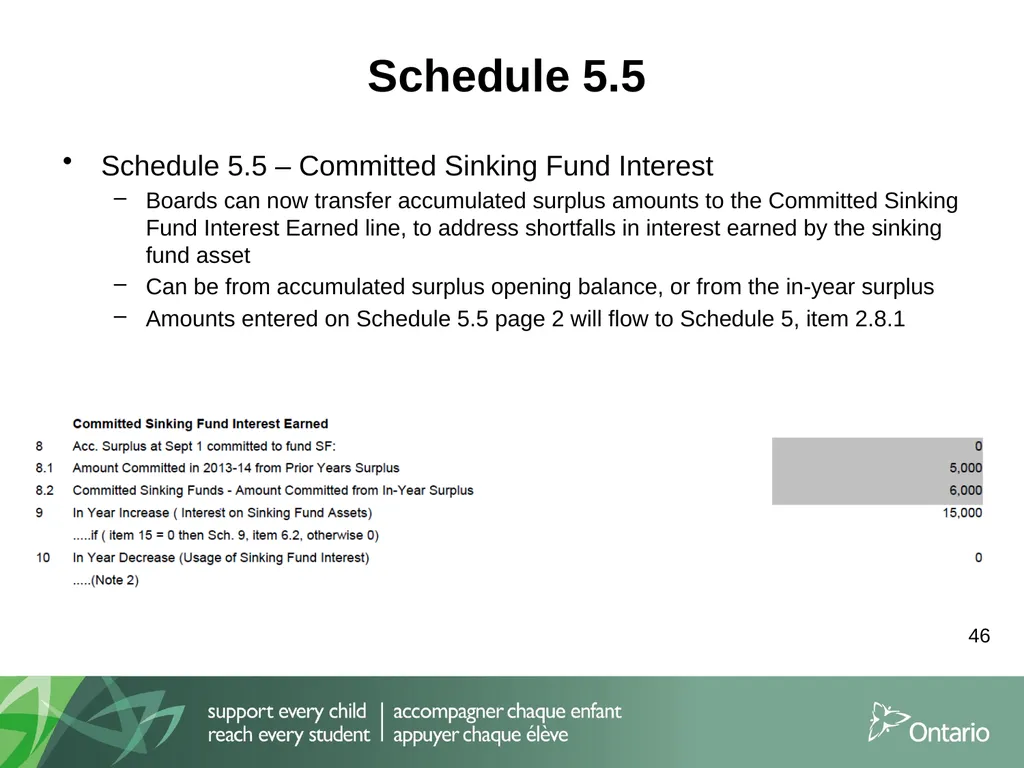
Schedule 5.5 Schedule 5.5 – Committed Sinking Fund Interest
Boards can now transfer accumulated surplus amounts to the Committed Sinking Fund Interest Earned line, to address shortfalls in interest earned by the sinking fund asset
Can be from accumulated surplus opening balance, or from the in-year surplus
Amounts entered on Schedule 5.5 page 2 will flow to Schedule 5, item 2.8.1 46<br>
Boards can now transfer accumulated surplus amounts to the Committed Sinking Fund Interest Earned line, to address shortfalls in interest earned by the sinking fund asset
Can be from accumulated surplus opening balance, or from the in-year surplus
Amounts entered on Schedule 5.5 page 2 will flow to Schedule 5, item 2.8.1 46<br>
47
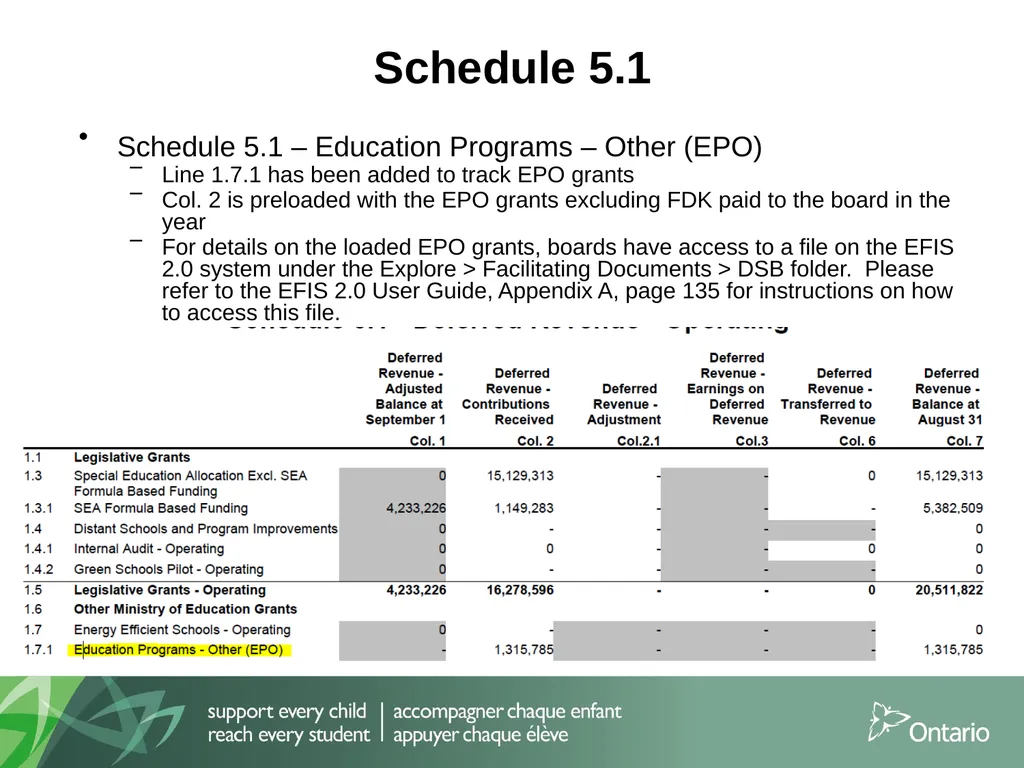
Schedule 5.1 Schedule 5.1 – Education Programs – Other (EPO)
Line 1.7.1 has been added to track EPO grants
Col. 2 is preloaded with the EPO grants excluding FDK paid to the board in the year
For details on the loaded EPO grants, boards have access to a file on the EFIS 2.0 system under the Explore > Facilitating Documents > DSB folder. Please refer to the EFIS 2.0 User Guide, Appendix A, page 135 for instructions on how to access this file. 47<br>
Line 1.7.1 has been added to track EPO grants
Col. 2 is preloaded with the EPO grants excluding FDK paid to the board in the year
For details on the loaded EPO grants, boards have access to a file on the EFIS 2.0 system under the Explore > Facilitating Documents > DSB folder. Please refer to the EFIS 2.0 User Guide, Appendix A, page 135 for instructions on how to access this file. 47<br>
48
Schedule 5.1 – Con’t Schedule 5.1 – Deferred Revenue - Adjustment
A new column is added to report adjustment to deferred revenues
It should be used when:
Board had accrued deferred revenues in previous school year which was flowed in this school year, hence the pre-loaded contribution needed to be adjusted
There are underspending in EPO grants which were not re-profiled to next school year, the amount should be reclassified as payable to the Ministry using this adjustment.
Schedule 5.1 – Deferred Revenue – Asset held for sale
The transfer to revenue cell under Asset held for sale is now opened for input in the case of the sale ended up with a loss, board can transfer part of the deferred revenues to cover the loss.
Please refer to page 81 of the Fall 2011 Training materials on Financial Statements changes for more details and accounting entries example. 48<br>
A new column is added to report adjustment to deferred revenues
It should be used when:
Board had accrued deferred revenues in previous school year which was flowed in this school year, hence the pre-loaded contribution needed to be adjusted
There are underspending in EPO grants which were not re-profiled to next school year, the amount should be reclassified as payable to the Ministry using this adjustment.
Schedule 5.1 – Deferred Revenue – Asset held for sale
The transfer to revenue cell under Asset held for sale is now opened for input in the case of the sale ended up with a loss, board can transfer part of the deferred revenues to cover the loss.
Please refer to page 81 of the Fall 2011 Training materials on Financial Statements changes for more details and accounting entries example. 48<br>
49
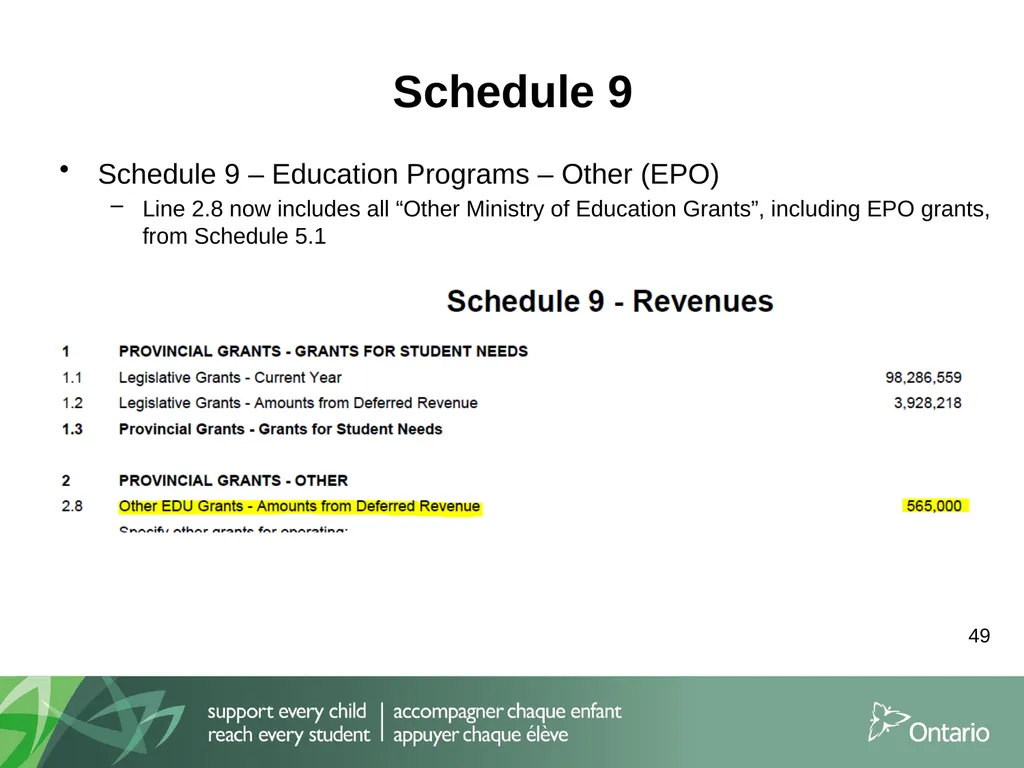
Schedule 9 Schedule 9 – Education Programs – Other (EPO)
Line 2.8 now includes all “Other Ministry of Education Grants”, including EPO grants, from Schedule 5.1 49<br>
Line 2.8 now includes all “Other Ministry of Education Grants”, including EPO grants, from Schedule 5.1 49<br>
50
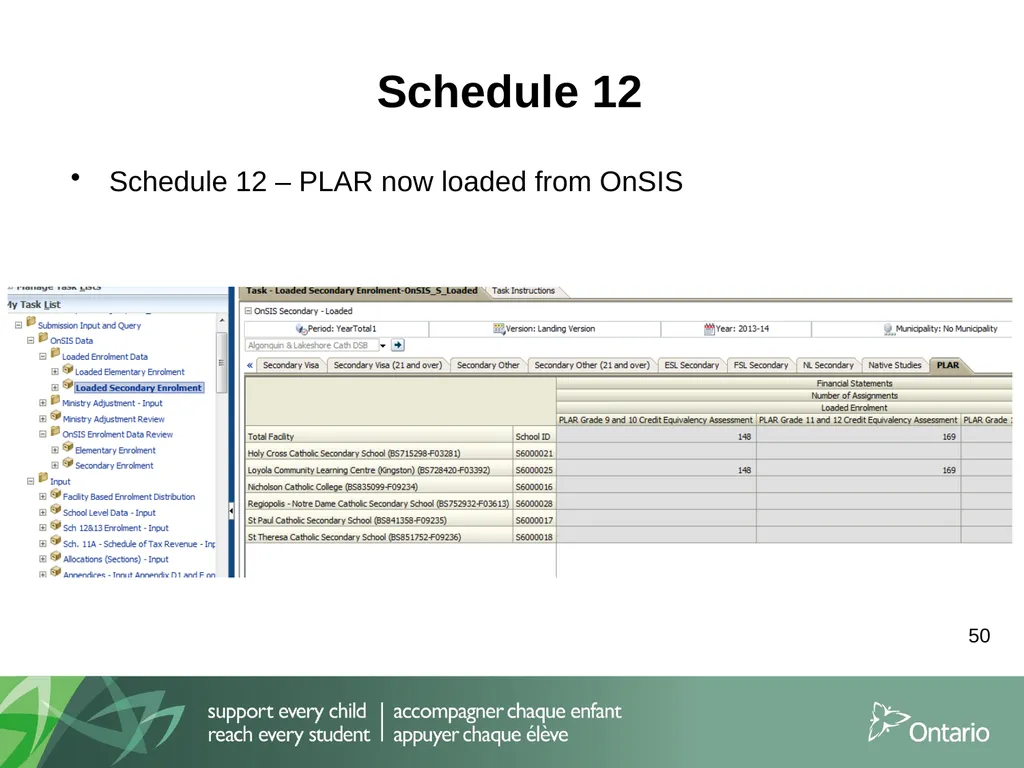
Schedule 12 Schedule 12 – PLAR now loaded from OnSIS 50<br>
51
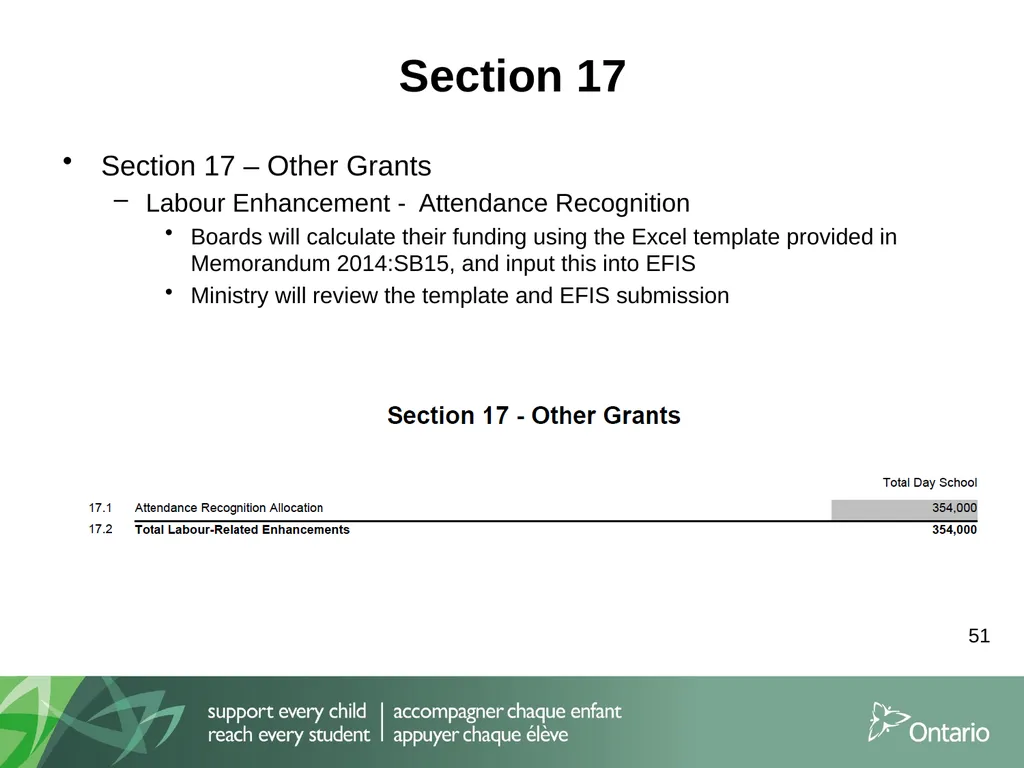
Section 17 Section 17 – Other Grants
Labour Enhancement - Attendance Recognition
Boards will calculate their funding using the Excel template provided in Memorandum 2014:SB15, and input this into EFIS
Ministry will review the template and EFIS submission 51<br>
Labour Enhancement - Attendance Recognition
Boards will calculate their funding using the Excel template provided in Memorandum 2014:SB15, and input this into EFIS
Ministry will review the template and EFIS submission 51<br>
52
Boards are not required to seek another actuarial valuation for their 2013-14 sick bank top-up liability, but are required to update the sick bank template
A sick bank top-up liability template was sent to boards as part of the financial statement instruction package for 2013-14 . This template is the same template that was used in the prior year.
This liability will be reported on schedule 10G under “Compensated absences”.
The boards will be required to update the shaded grey areas of the template. This includes updating the number of employees who have taken sick days (update column 1 of the template) and the average daily salary (column 3).
The probability of using any banked sick days (column 4) and the average number of banked days taken (column 5) would remain the same as in prior year and the boards should refer to their prior year’s submitted template, or ask their actuary, to obtain the information for the current year.
These templates should be submitted to the following email along with school board’s financial statements: financials.edu@ontario.ca Sick Bank Liability<br>
A sick bank top-up liability template was sent to boards as part of the financial statement instruction package for 2013-14 . This template is the same template that was used in the prior year.
This liability will be reported on schedule 10G under “Compensated absences”.
The boards will be required to update the shaded grey areas of the template. This includes updating the number of employees who have taken sick days (update column 1 of the template) and the average daily salary (column 3).
The probability of using any banked sick days (column 4) and the average number of banked days taken (column 5) would remain the same as in prior year and the boards should refer to their prior year’s submitted template, or ask their actuary, to obtain the information for the current year.
These templates should be submitted to the following email along with school board’s financial statements: financials.edu@ontario.ca Sick Bank Liability<br>
53
Accounting For Contaminated Sites 53<br>
54
Accounting for Contaminated Sites 54 New PSAB accounting standard on Liability for Contaminated Sites (PS 3260).
Memoranda 2014:B07 and 2014:SB13 sent May 2014.
Liability recorded if a government (school board) has a contaminated site that meets certain criteria.<br>
Memoranda 2014:B07 and 2014:SB13 sent May 2014.
Liability recorded if a government (school board) has a contaminated site that meets certain criteria.<br>
55
Recognition Criteria 55 A liability for remediation of contaminated sites should be recognized when, as at the financial reporting date:
(a) an environmental standard exists;
(b) contamination exceeds the environmental standard;
(c) the government is directly responsible or accepts responsibility;
(d) it is expected that future economic benefits will be given up; and
(e) a reasonable estimate can be made.<br>
(a) an environmental standard exists;
(b) contamination exceeds the environmental standard;
(c) the government is directly responsible or accepts responsibility;
(d) it is expected that future economic benefits will be given up; and
(e) a reasonable estimate can be made.<br>
56
Definition of Contamination 56 Contamination - introduction into air, soil, water or sediment of a chemical, organic or radioactive material or live organism that exceeds an environmental standard.
Contaminated site - substances occur in concentrations that exceed the maximum acceptable amounts under an environmental standard.
Does not include airborne contamination or contaminants in the earth's atmosphere unless such contaminants have been introduced into soil, water bodies or sediment.<br>
Contaminated site - substances occur in concentrations that exceed the maximum acceptable amounts under an environmental standard.
Does not include airborne contamination or contaminants in the earth's atmosphere unless such contaminants have been introduced into soil, water bodies or sediment.<br>
57
Environmental Standard 57 Generally a statute, regulation, by-law, order, permit, contract or agreement.
legally enforceable and binding.
compliance is mandatory.
breaches enforceable through prosecution, fines, jail, order, loss of permit or through administrative proceedings.
May be created by internal government policy or by guidelines developed by organizations external to the government.
voluntary compliance create a liability.
requires professional judgment.<br>
legally enforceable and binding.
compliance is mandatory.
breaches enforceable through prosecution, fines, jail, order, loss of permit or through administrative proceedings.
May be created by internal government policy or by guidelines developed by organizations external to the government.
voluntary compliance create a liability.
requires professional judgment.<br>
58
Scope 58 A liability for remediation normally results from either:
an operation that is no longer in productive use.
Ex. unused auto shop
from an unexpected event resulting in contamination.
Ex. chemical spill or natural disaster
It is not expected that boards investigate each site.
Investigate where it is known or there is a likelihood of contamination.
Consider especially sites that are closed.<br>
an operation that is no longer in productive use.
Ex. unused auto shop
from an unexpected event resulting in contamination.
Ex. chemical spill or natural disaster
It is not expected that boards investigate each site.
Investigate where it is known or there is a likelihood of contamination.
Consider especially sites that are closed.<br>
59
PS 3200 - Liabilities 59 Boards can have a contaminated site without having a liability under the PS 3260 contaminated sites liabilities standard.
Boards should still consider if they have a liability under the PS 3200 liabilities standard.
If so, it should have already been accrued (ex. the board was ordered to clean up an environmental contamination).
PSAB working on Asset Retirement Obligation (ARO) standard for assets in productive use.
Proposal is that liability be included in the cost of the assets and amortized over its useful life.
Currently, the cost would be recorded as an expense or in opening surplus.<br>
Boards should still consider if they have a liability under the PS 3200 liabilities standard.
If so, it should have already been accrued (ex. the board was ordered to clean up an environmental contamination).
PSAB working on Asset Retirement Obligation (ARO) standard for assets in productive use.
Proposal is that liability be included in the cost of the assets and amortized over its useful life.
Currently, the cost would be recorded as an expense or in opening surplus.<br>
60
Example 60 A board may have a school that contains asbestos.
If this asbestos is contained, there is no requirement to remediate; therefore, a liability would not need to be booked.
If the asbestos is not contained, the board would need to consider whether PS 3260, PS 3200 or neither apply to their individual situation.<br>
If this asbestos is contained, there is no requirement to remediate; therefore, a liability would not need to be booked.
If the asbestos is not contained, the board would need to consider whether PS 3260, PS 3200 or neither apply to their individual situation.<br>
61
Relevant Dates 61 Applicable for fiscal years beginning on or after April 1, 2014 (i.e. the 2014-15 school year).
The initial liability for contaminated sites will be applied retroactively without restatement.
i.e. recorded as an adjustment to the opening accumulated surplus as at September 1, 2014.<br>
The initial liability for contaminated sites will be applied retroactively without restatement.
i.e. recorded as an adjustment to the opening accumulated surplus as at September 1, 2014.<br>
62
Impact on Budget Compliance 62 The opening balance adjustment will not impact the in-year expense nor budget compliance for the 2014-15 year.
To minimize impact on compliance, boards are encouraged to early identify any potential liabilities.
O. Reg. 488/10 (Determination of Boards’ Surpluses and Deficits) excludes the opening accumulated surplus adjustment from compliance.
multi-year plan required for addressing within compliance.
After the opening balance adjustment at September 1, 2014, any liabilities for new contaminated sites or changes in liabilities for existing contaminated sites will impact the in-year expense and budget compliance.<br>
To minimize impact on compliance, boards are encouraged to early identify any potential liabilities.
O. Reg. 488/10 (Determination of Boards’ Surpluses and Deficits) excludes the opening accumulated surplus adjustment from compliance.
multi-year plan required for addressing within compliance.
After the opening balance adjustment at September 1, 2014, any liabilities for new contaminated sites or changes in liabilities for existing contaminated sites will impact the in-year expense and budget compliance.<br>
63
Reporting Requirements 63 Since the Province consolidates the school boards’ financial statements for its March 31st year end, the Ministry requires boards to provide information on liabilities for contaminated sites for the March 2015 report.
Boards will also record any liabilities for contaminated sites in their 2014-15 financial statements, as required by the standard.
The 2014-15 Revised Estimates will have a line on Schedule 5 (Accumulated Surplus).
If information is known, boards are encouraged to report it.<br>
Boards will also record any liabilities for contaminated sites in their 2014-15 financial statements, as required by the standard.
The 2014-15 Revised Estimates will have a line on Schedule 5 (Accumulated Surplus).
If information is known, boards are encouraged to report it.<br>
64
Process 64 Discuss with your external auditors risk areas and possible disclosures that may be required.
Determine if any site owned by the board meets the recognition criteria.
specialists may need to be engaged.
check with senior/long serving staff if aware of past contaminates.
If any sites meet the criteria, remediation costs will need to be estimated.
Share implementation risks and potential impact with your Ministry contact prior to data submission in March 2015.<br>
Determine if any site owned by the board meets the recognition criteria.
specialists may need to be engaged.
check with senior/long serving staff if aware of past contaminates.
If any sites meet the criteria, remediation costs will need to be estimated.
Share implementation risks and potential impact with your Ministry contact prior to data submission in March 2015.<br>
65
Financial Statement Disclosure 65 The following information should be disclosed:
Nature and source of liability.
Basis for estimate.
If net present value technique is used, the estimated undiscounted expenditures and discount rate.
Reasons for not recognizing a liability.
Estimated recoveries, if any.
Regarding the level of disclosure, consider:
Board statements are highly aggregated so grouping items together may be useful.
Usefulness of information in assessing nature and extent of liability for remediation.
Sensitivity of information.<br>
Nature and source of liability.
Basis for estimate.
If net present value technique is used, the estimated undiscounted expenditures and discount rate.
Reasons for not recognizing a liability.
Estimated recoveries, if any.
Regarding the level of disclosure, consider:
Board statements are highly aggregated so grouping items together may be useful.
Usefulness of information in assessing nature and extent of liability for remediation.
Sensitivity of information.<br>
66
66 Questions?<br>
67
EPO Reporting – March Report<br>
68
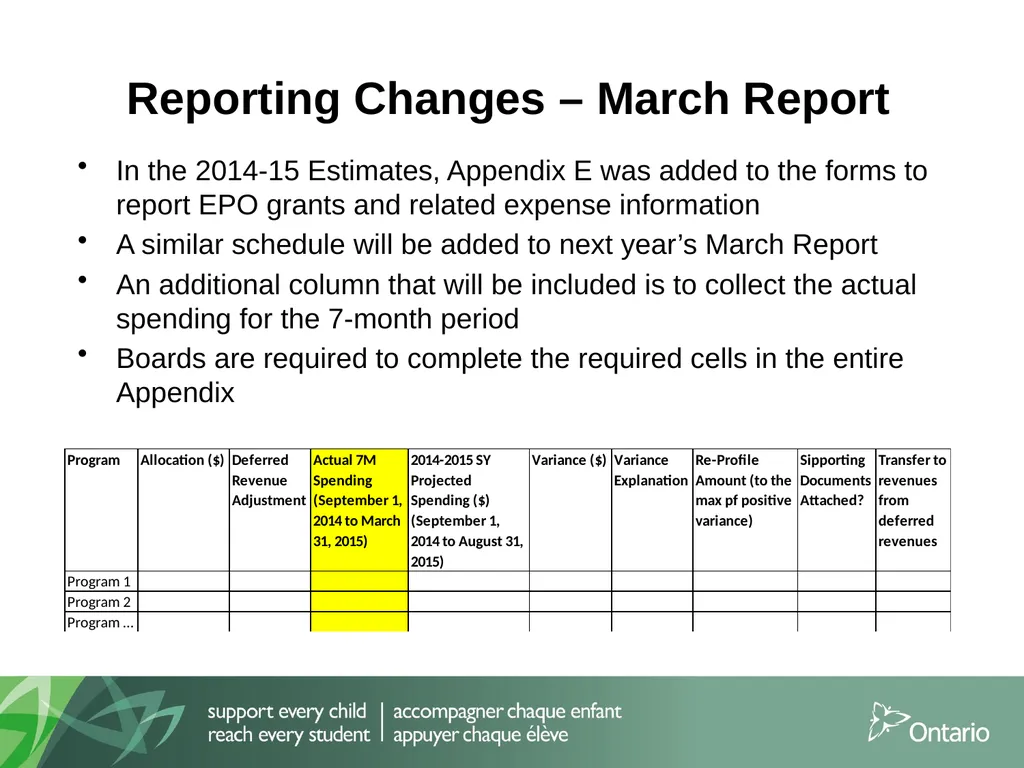
Reporting Changes – March Report In the 2014-15 Estimates, Appendix E was added to the forms to report EPO grants and related expense information
A similar schedule will be added to next year’s March Report
An additional column that will be included is to collect the actual spending for the 7-month period
Boards are required to complete the required cells in the entire Appendix<br>
A similar schedule will be added to next year’s March Report
An additional column that will be included is to collect the actual spending for the 7-month period
Boards are required to complete the required cells in the entire Appendix<br>
69
Common Reporting Issues 69<br>
70
Consistency in Reporting Boards should to ensure that there is consistency in reporting year over year
In the Financial Statement and March Report forms, different lines are mapped into different accounts during the consolidation of Public Accounts. Reporting data on different lines at different periods will result in expenses/liabilities not being comparable period over period
Examples include:
Other Accrued Payables and Liability in one cycle; and under Other Liabilities in another
Supply and Services Expenses in one year and Other Expenses in another period
Rental Revenues versus Other Third Party Revenues<br>
In the Financial Statement and March Report forms, different lines are mapped into different accounts during the consolidation of Public Accounts. Reporting data on different lines at different periods will result in expenses/liabilities not being comparable period over period
Examples include:
Other Accrued Payables and Liability in one cycle; and under Other Liabilities in another
Supply and Services Expenses in one year and Other Expenses in another period
Rental Revenues versus Other Third Party Revenues<br>
71
Supplementary Taxes and Tax Write-Offs Schedule 20 in the March Report is similar to the Schedule 9 in the financial statement
Boards to ensure the same reporting approach in the Financial Statement is used and report consistently in the March report
In previous years some boards included two calendar years’ supplementary and tax write off in line 3.1 71<br>
Boards to ensure the same reporting approach in the Financial Statement is used and report consistently in the March report
In previous years some boards included two calendar years’ supplementary and tax write off in line 3.1 71<br>
72
Supplementary Taxes and Tax Write-Offs In 2014-15 March report:
The following two items should be included in the line 3.1 or line 3.2 for the 2014 supplementary taxes and tax write-offs
2014 calendar year supplementary taxes net of the write off
Subtract the amount reported in the 2013-14 financial statement line 3.4
Line 3.4 – Tax Supplementary and Tax Write Off Adjustment – Accrual re: 2015 Amounts will only be used when the 2015 amount is significantly different from previous years and the information is available. It is expected that this cell will have limited use and will only be used in extraordinary circumstances
Ministry will update the March Report Instructions accordingly 72<br>
The following two items should be included in the line 3.1 or line 3.2 for the 2014 supplementary taxes and tax write-offs
2014 calendar year supplementary taxes net of the write off
Subtract the amount reported in the 2013-14 financial statement line 3.4
Line 3.4 – Tax Supplementary and Tax Write Off Adjustment – Accrual re: 2015 Amounts will only be used when the 2015 amount is significantly different from previous years and the information is available. It is expected that this cell will have limited use and will only be used in extraordinary circumstances
Ministry will update the March Report Instructions accordingly 72<br>
73
Schedule 20 SUP – March Report 73 This schedule captures the Notes to the Financial Statements as of March 31st of the current year
Default reporting is what was reported on the last Audited Financial Statements
Boards should not leave Schedule 20 SUP blank if any of the four types of notes were disclosed in last year’s financial statements
In the F/S, if the format used was different, adopt the input to the Schedule 20 SUP format based on substance
Encourage boards to review last year’s training slides to determine whether the notes needs to be updated since F/S
The Notes in the March Report includes the following categories:
Contractual Obligations
Loans Guarantees
Lawsuits and Claims
Other Contingent Liabilities
Boards to select the correct type of notes based on their circumstances<br>
Default reporting is what was reported on the last Audited Financial Statements
Boards should not leave Schedule 20 SUP blank if any of the four types of notes were disclosed in last year’s financial statements
In the F/S, if the format used was different, adopt the input to the Schedule 20 SUP format based on substance
Encourage boards to review last year’s training slides to determine whether the notes needs to be updated since F/S
The Notes in the March Report includes the following categories:
Contractual Obligations
Loans Guarantees
Lawsuits and Claims
Other Contingent Liabilities
Boards to select the correct type of notes based on their circumstances<br>
74
Schedule 20 SUP-Cont’d Contractual Obligation
A description with meaningful details of the obligation. This should reflect what Obligation Type the note fits in (1-Construction Contracts /2-Operating Leases /3-Other/4-Transfer Payments/5-Ontario Power/6-Alternative Financing and Procurement (AFP))
Identify the Obligation Type as close as possible to the nature of the note. In the past, most notes have been coded either as Construction Contracts or Other
The total estimated cost to be broken down to identify the obligation amounts by year if applicable
Loan Guarantees
Both the Amount Guaranteed by BPS and Maximum Amount Authorized need to be reported
The Maximum Amount Authorized is the amount up to which a loan can be guaranteed; this is either equal or greater than the amount guaranteed 74<br>
A description with meaningful details of the obligation. This should reflect what Obligation Type the note fits in (1-Construction Contracts /2-Operating Leases /3-Other/4-Transfer Payments/5-Ontario Power/6-Alternative Financing and Procurement (AFP))
Identify the Obligation Type as close as possible to the nature of the note. In the past, most notes have been coded either as Construction Contracts or Other
The total estimated cost to be broken down to identify the obligation amounts by year if applicable
Loan Guarantees
Both the Amount Guaranteed by BPS and Maximum Amount Authorized need to be reported
The Maximum Amount Authorized is the amount up to which a loan can be guaranteed; this is either equal or greater than the amount guaranteed 74<br>
75
Schedule 10F & 10G Reconciliation – FS 75 Refer to PSA Handbook Section 3250 and 3255 for terminologies used in Schedules 10 F and 10G
As of the 2013-14 Financial Statements, Life Insurance / Long-Term Disability is broken down on Schedule 10F into two separate columns: Long-Term Disability and Life Insurance
Emphasis should be made to ensure the different benefit categories on Schedule 10F and 10G are reported accurately; amounts from these schedules are used for provincial reporting purposes at consolidation
For the following benefit categories, total expense reported in Schedule 10F should equal column 2 of Schedule 10G, under the respective benefit category:
Retirement Gratuity Plans and Early Retirement Incentive Plans (ERIP)
Retirement Health, Dental, Life Insurance Plans, etc.
Compensated Absences
Long-Term Disability Plans
Workers’ Compensation Benefits
Termination Benefits
OPSEU Pension Plans
Other Pension Plans
Warning messages have been added to assist boards in ensuring both schedules agree to one another<br>
As of the 2013-14 Financial Statements, Life Insurance / Long-Term Disability is broken down on Schedule 10F into two separate columns: Long-Term Disability and Life Insurance
Emphasis should be made to ensure the different benefit categories on Schedule 10F and 10G are reported accurately; amounts from these schedules are used for provincial reporting purposes at consolidation
For the following benefit categories, total expense reported in Schedule 10F should equal column 2 of Schedule 10G, under the respective benefit category:
Retirement Gratuity Plans and Early Retirement Incentive Plans (ERIP)
Retirement Health, Dental, Life Insurance Plans, etc.
Compensated Absences
Long-Term Disability Plans
Workers’ Compensation Benefits
Termination Benefits
OPSEU Pension Plans
Other Pension Plans
Warning messages have been added to assist boards in ensuring both schedules agree to one another<br>
76
Other Reporting Issues – FS Course Lists
Boards are required to submit the Continuing Ed Course List each year
Schedule 5.6 – EDC Revenues
The breakdown between EDC and non-EDC revenues is not always provided
Section 11 – School Operations Allocations for S.23 Programs
FTE count reported on Line 11.12.2 do not reconcile to approved files sent to Field Services
Section 11 – Allocation for Short Term Notional Interest
Boards do not always enter required amount on Line 11.30.8
Section 12 – Not Permanently Financed (NPF) – New Capital Programs
Closing balance on Line 12.17 should agree with Schedule 5.2, Lines 1.3-1.5 76<br>
Boards are required to submit the Continuing Ed Course List each year
Schedule 5.6 – EDC Revenues
The breakdown between EDC and non-EDC revenues is not always provided
Section 11 – School Operations Allocations for S.23 Programs
FTE count reported on Line 11.12.2 do not reconcile to approved files sent to Field Services
Section 11 – Allocation for Short Term Notional Interest
Boards do not always enter required amount on Line 11.30.8
Section 12 – Not Permanently Financed (NPF) – New Capital Programs
Closing balance on Line 12.17 should agree with Schedule 5.2, Lines 1.3-1.5 76<br>
77
77 Questions?<br>
78
Remaining Service Life
Reporting 78<br>
Reporting 78<br>
79
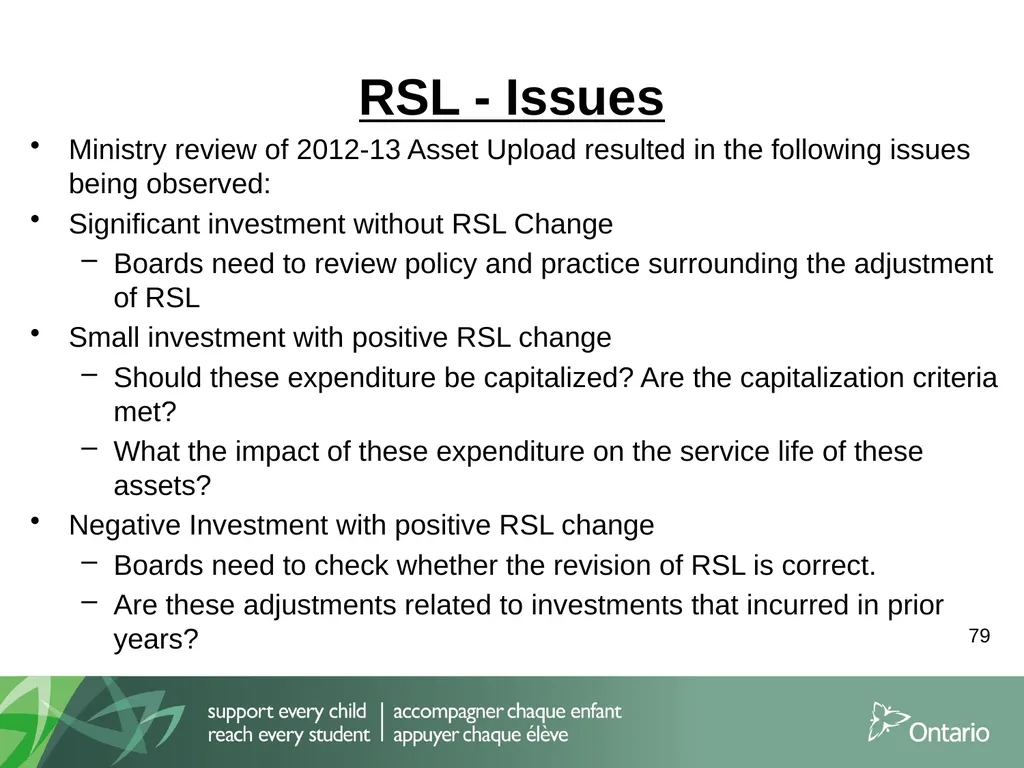
RSL - Issues Ministry review of 2012-13 Asset Upload resulted in the following issues being observed:
Significant investment without RSL Change
Boards need to review policy and practice surrounding the adjustment of RSL
Small investment with positive RSL change
Should these expenditure be capitalized? Are the capitalization criteria met?
What the impact of these expenditure on the service life of these assets?
Negative Investment with positive RSL change
Boards need to check whether the revision of RSL is correct.
Are these adjustments related to investments that incurred in prior years? 79<br>
Significant investment without RSL Change
Boards need to review policy and practice surrounding the adjustment of RSL
Small investment with positive RSL change
Should these expenditure be capitalized? Are the capitalization criteria met?
What the impact of these expenditure on the service life of these assets?
Negative Investment with positive RSL change
Boards need to check whether the revision of RSL is correct.
Are these adjustments related to investments that incurred in prior years? 79<br>
80
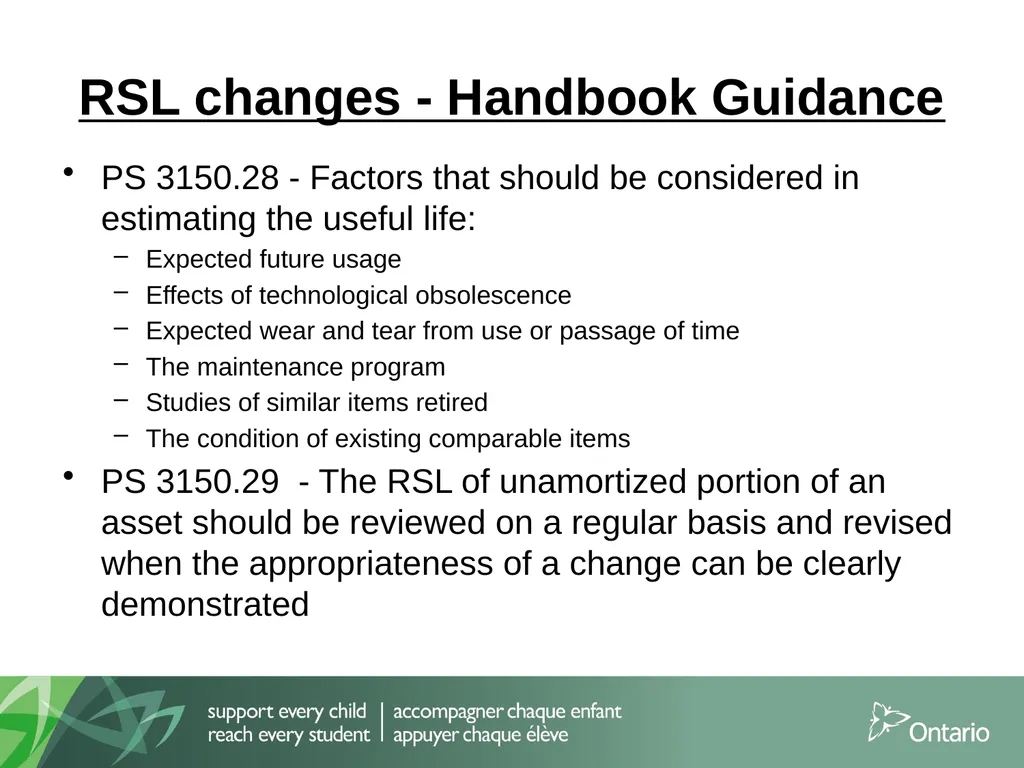
RSL changes - Handbook Guidance PS 3150.28 - Factors that should be considered in estimating the useful life:
Expected future usage
Effects of technological obsolescence
Expected wear and tear from use or passage of time
The maintenance program
Studies of similar items retired
The condition of existing comparable items
PS 3150.29 - The RSL of unamortized portion of an asset should be reviewed on a regular basis and revised when the appropriateness of a change can be clearly demonstrated<br>
Expected future usage
Effects of technological obsolescence
Expected wear and tear from use or passage of time
The maintenance program
Studies of similar items retired
The condition of existing comparable items
PS 3150.29 - The RSL of unamortized portion of an asset should be reviewed on a regular basis and revised when the appropriateness of a change can be clearly demonstrated<br>
81
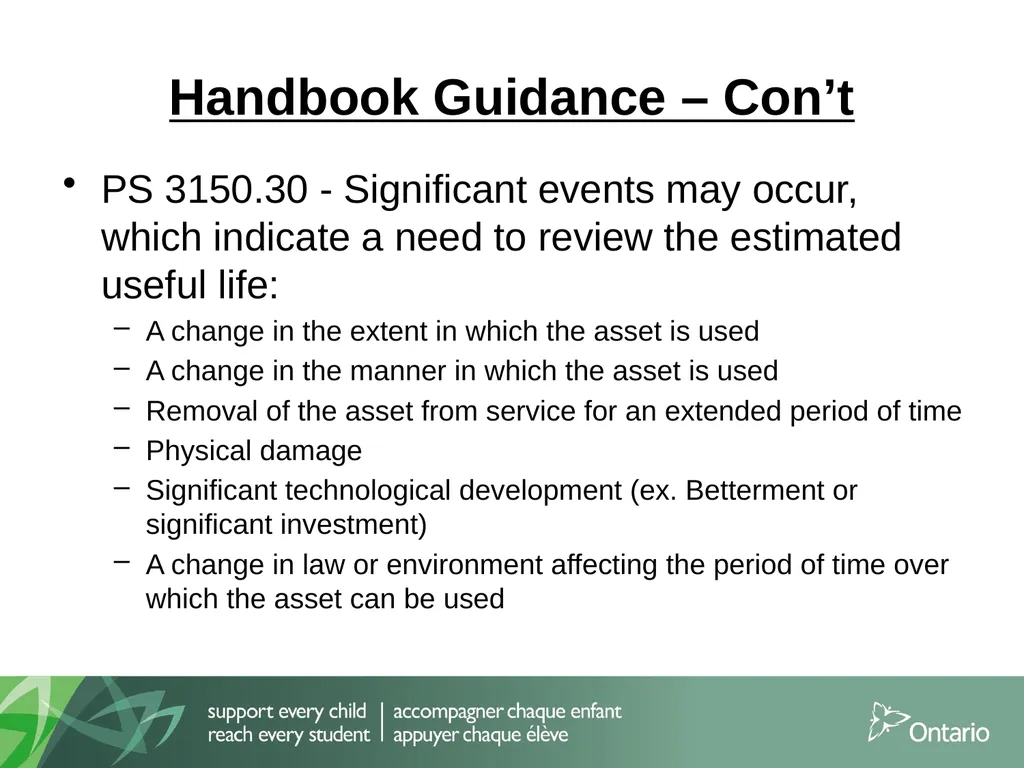
Handbook Guidance – Con’t PS 3150.30 - Significant events may occur, which indicate a need to review the estimated useful life:
A change in the extent in which the asset is used
A change in the manner in which the asset is used
Removal of the asset from service for an extended period of time
Physical damage
Significant technological development (ex. Betterment or significant investment)
A change in law or environment affecting the period of time over which the asset can be used<br>
A change in the extent in which the asset is used
A change in the manner in which the asset is used
Removal of the asset from service for an extended period of time
Physical damage
Significant technological development (ex. Betterment or significant investment)
A change in law or environment affecting the period of time over which the asset can be used<br>
82
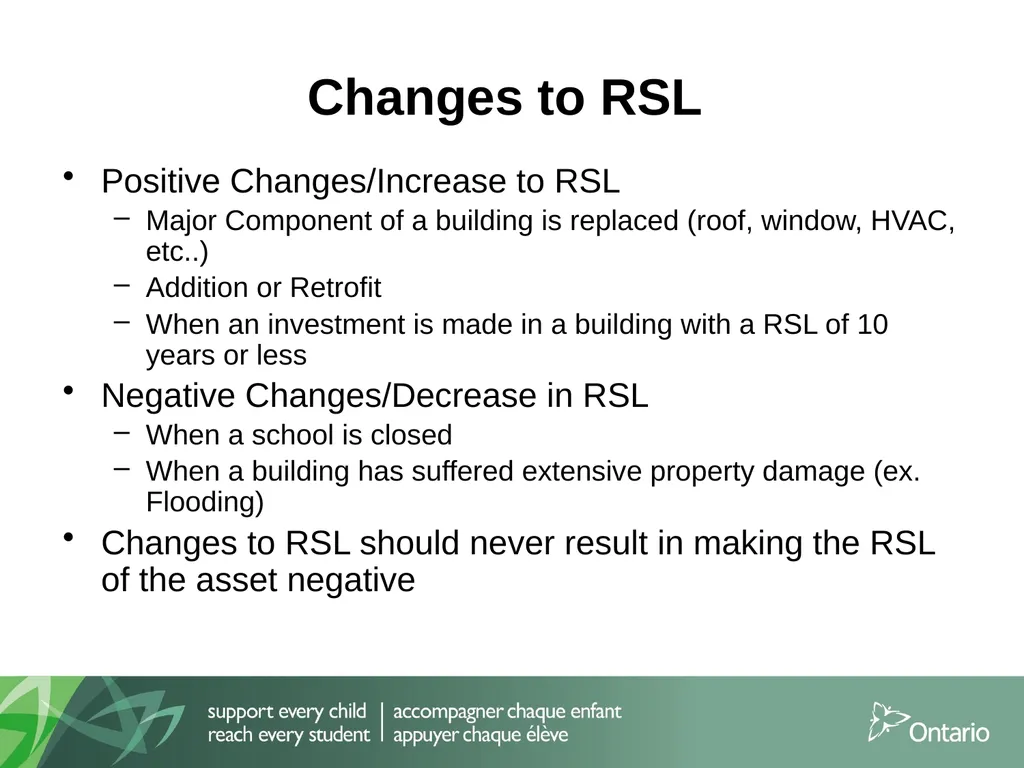
Changes to RSL Positive Changes/Increase to RSL
Major Component of a building is replaced (roof, window, HVAC, etc..)
Addition or Retrofit
When an investment is made in a building with a RSL of 10 years or less
Negative Changes/Decrease in RSL
When a school is closed
When a building has suffered extensive property damage (ex. Flooding)
Changes to RSL should never result in making the RSL of the asset negative<br>
Major Component of a building is replaced (roof, window, HVAC, etc..)
Addition or Retrofit
When an investment is made in a building with a RSL of 10 years or less
Negative Changes/Decrease in RSL
When a school is closed
When a building has suffered extensive property damage (ex. Flooding)
Changes to RSL should never result in making the RSL of the asset negative<br>
83
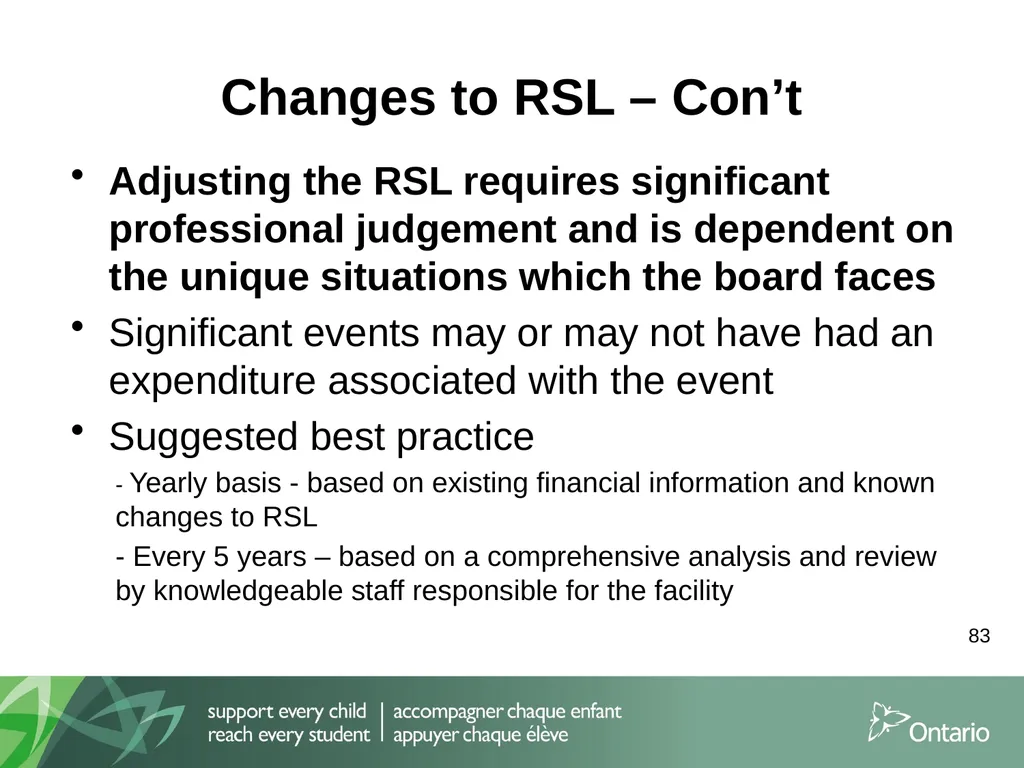
Changes to RSL – Con’t Adjusting the RSL requires significant professional judgement and is dependent on the unique situations which the board faces
Significant events may or may not have had an expenditure associated with the event
Suggested best practice
- Yearly basis - based on existing financial information and known changes to RSL
- Every 5 years – based on a comprehensive analysis and review by knowledgeable staff responsible for the facility 83<br>
Significant events may or may not have had an expenditure associated with the event
Suggested best practice
- Yearly basis - based on existing financial information and known changes to RSL
- Every 5 years – based on a comprehensive analysis and review by knowledgeable staff responsible for the facility 83<br>
84
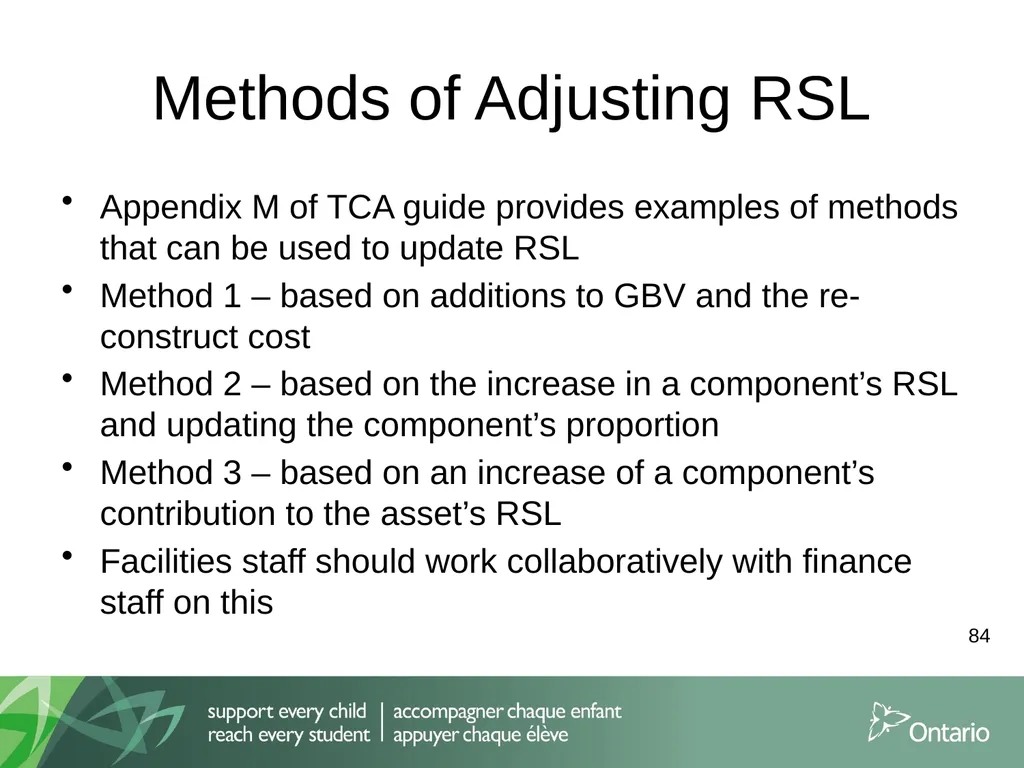
Methods of Adjusting RSL Appendix M of TCA guide provides examples of methods that can be used to update RSL
Method 1 – based on additions to GBV and the re-construct cost
Method 2 – based on the increase in a component’s RSL and updating the component’s proportion
Method 3 – based on an increase of a component’s contribution to the asset’s RSL
Facilities staff should work collaboratively with finance staff on this 84<br>
Method 1 – based on additions to GBV and the re-construct cost
Method 2 – based on the increase in a component’s RSL and updating the component’s proportion
Method 3 – based on an increase of a component’s contribution to the asset’s RSL
Facilities staff should work collaboratively with finance staff on this 84<br>
85
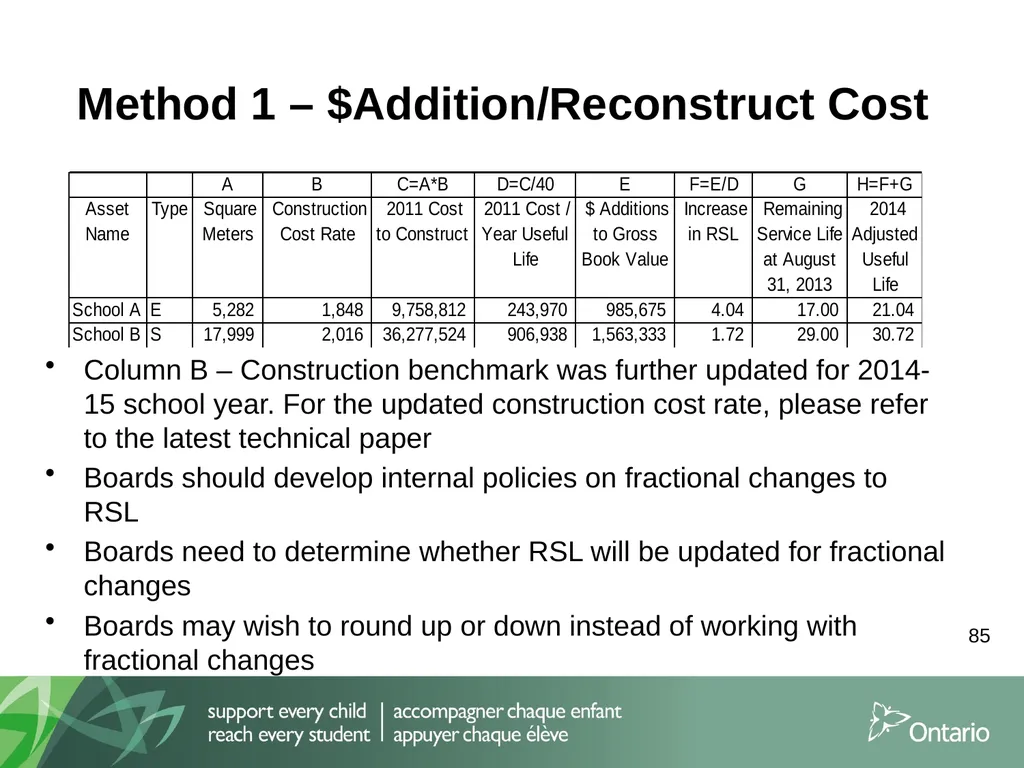
Method 1 – $Addition/Reconstruct Cost 85 Column B – Construction benchmark was further updated for 2014-15 school year. For the updated construction cost rate, please refer to the latest technical paper
Boards should develop internal policies on fractional changes to RSL
Boards need to determine whether RSL will be updated for fractional changes
Boards may wish to round up or down instead of working with fractional changes<br>
Boards should develop internal policies on fractional changes to RSL
Boards need to determine whether RSL will be updated for fractional changes
Boards may wish to round up or down instead of working with fractional changes<br>
86
Method 2 86 This method uses the RSL Means proportion to estimate RSL
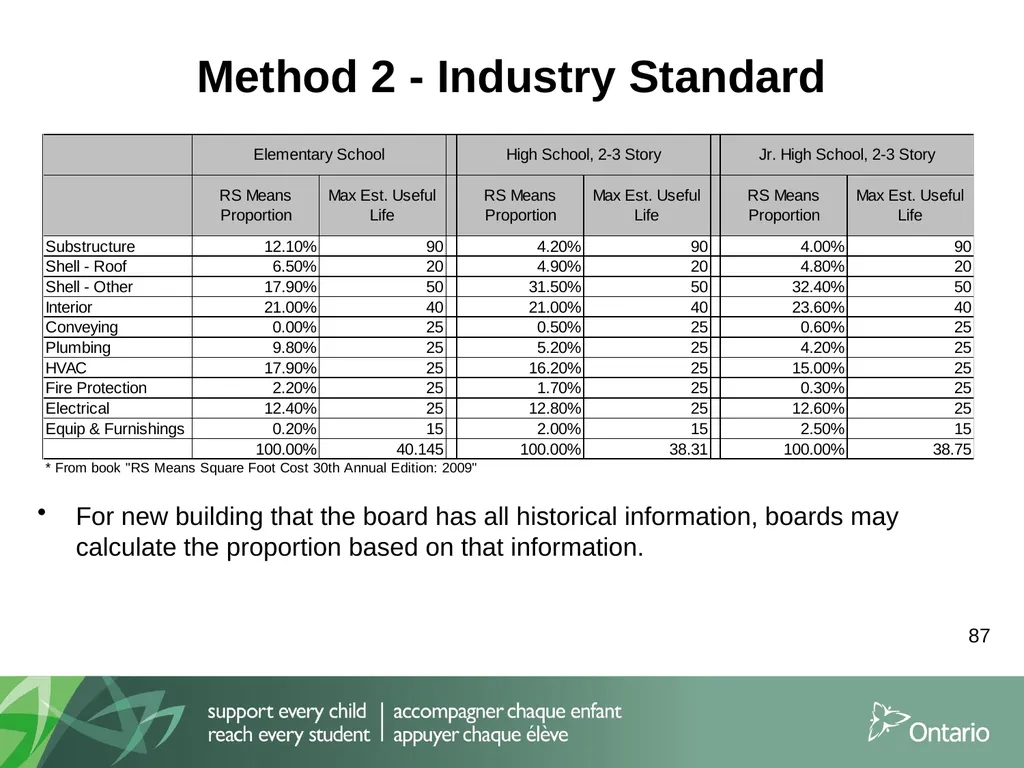
The book “RS Means Square Foot Cost 30th Annual Edition: 2009” provides a standard to estimate the proportion and useful life of each component
The betterment to a component extends the useful life of that component and as a result changes the RSL of the whole asset<br>
The book “RS Means Square Foot Cost 30th Annual Edition: 2009” provides a standard to estimate the proportion and useful life of each component
The betterment to a component extends the useful life of that component and as a result changes the RSL of the whole asset<br>
87
Method 2 - Industry Standard For new building that the board has all historical information, boards may calculate the proportion based on that information. 87<br>
88
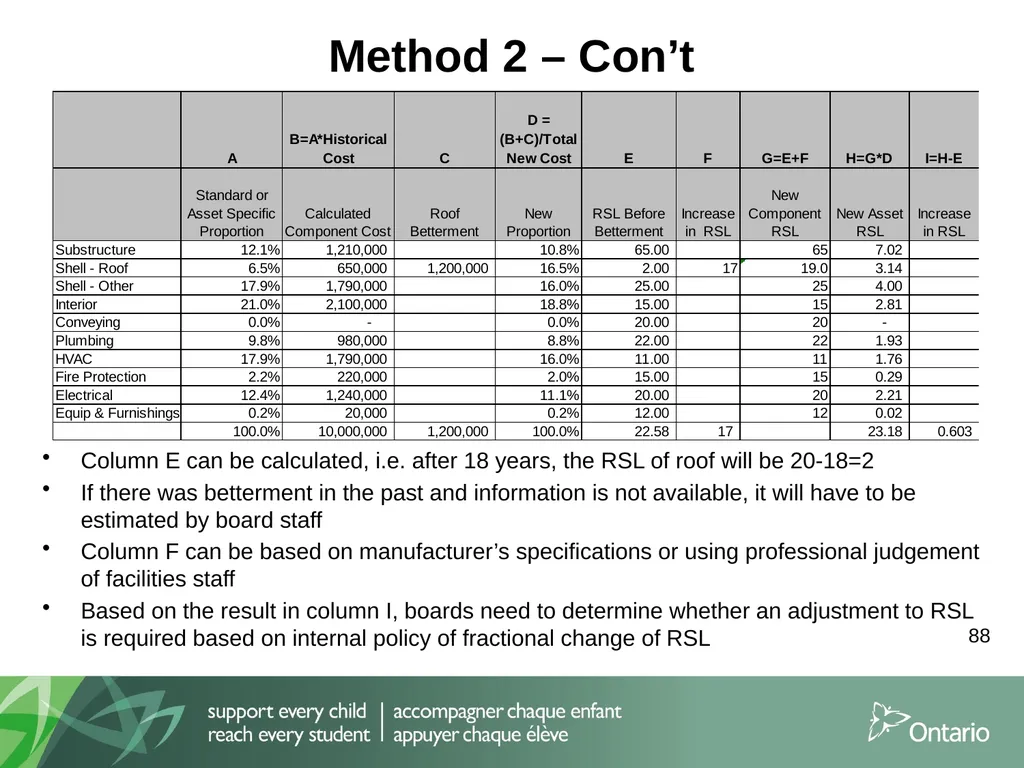
Method 2 – Con’t Column E can be calculated, i.e. after 18 years, the RSL of roof will be 20-18=2
If there was betterment in the past and information is not available, it will have to be estimated by board staff
Column F can be based on manufacturer’s specifications or using professional judgement of facilities staff
Based on the result in column I, boards need to determine whether an adjustment to RSL is required based on internal policy of fractional change of RSL 88<br>
If there was betterment in the past and information is not available, it will have to be estimated by board staff
Column F can be based on manufacturer’s specifications or using professional judgement of facilities staff
Based on the result in column I, boards need to determine whether an adjustment to RSL is required based on internal policy of fractional change of RSL 88<br>
89
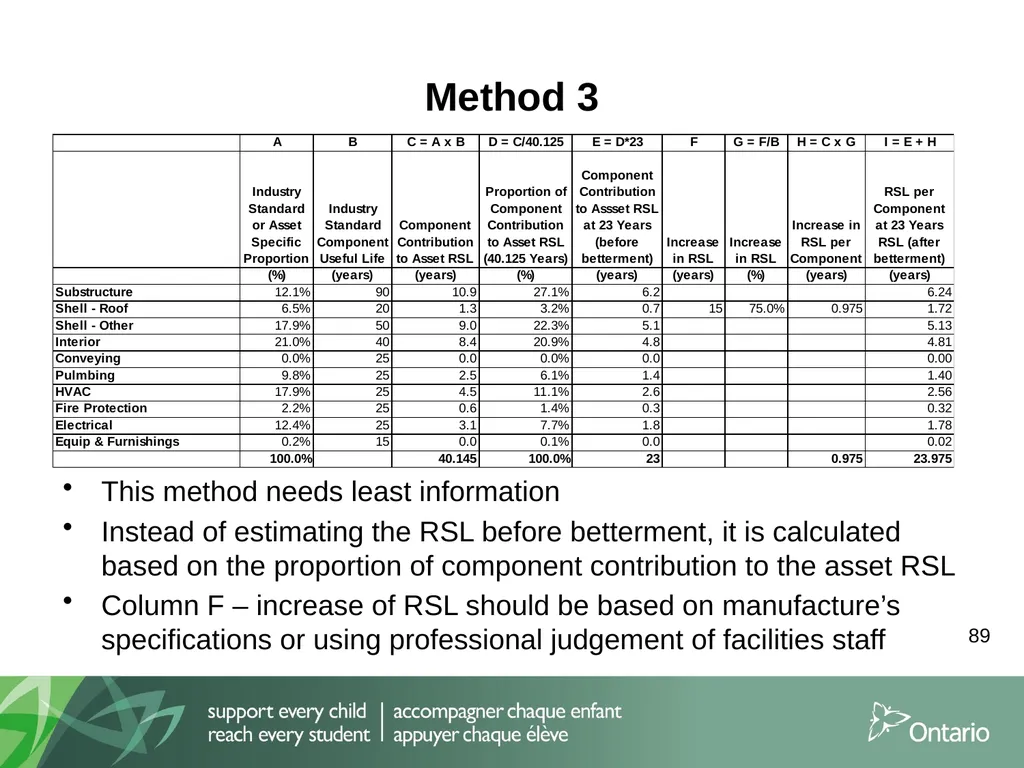
Method 3 89 This method needs least information
Instead of estimating the RSL before betterment, it is calculated based on the proportion of component contribution to the asset RSL
Column F – increase of RSL should be based on manufacture’s specifications or using professional judgement of facilities staff<br>
Instead of estimating the RSL before betterment, it is calculated based on the proportion of component contribution to the asset RSL
Column F – increase of RSL should be based on manufacture’s specifications or using professional judgement of facilities staff<br>
90
QUESTIONS Sangita Forodi
(416) 325-8584
sangita.forodi@ontario.ca 90<br>
(416) 325-8584
sangita.forodi@ontario.ca 90<br>