Inhaler Technique Training for Respiratory Ward
Description: Inhaler Technique Training for Respiratory Ward Staff Author: Jill Leyshon Asthma COPD Specialist Nurse Why Does Inhaler Technique Matter? COPD Asthma are controlled with Inhaled Medication Inhaled drugs reduce exacerbations and
Related Topics
Download Presentation
"Inhaler Technique Training for Respiratory Ward" is the property of its rightful owner. Permission is granted to download and print the materials on this website for personal, non-commercial use only, and to display it on your personal computer provided you do not modify the materials and that you retain all copyright notices contained in the materials. By downloading content from our website, you accept the terms of this agreement.
Presentation Transcript
slide1. Inhaler Technique Training for Respiratory Ward Staff Author: Jill Leyshon
Asthma & COPD Specialist Nurse<br>
slide2. Why Does Inhaler Technique Matter? COPD & Asthma are controlled with Inhaled Medication
Inhaled drugs reduce exacerbations and improves symptoms (such as breathlessness) and quality of life
Poor technique can mean the drug is not delivered to the lung and will not have an effect
Poor technique is associated with increased symptoms, exacerbations & hospitalisations
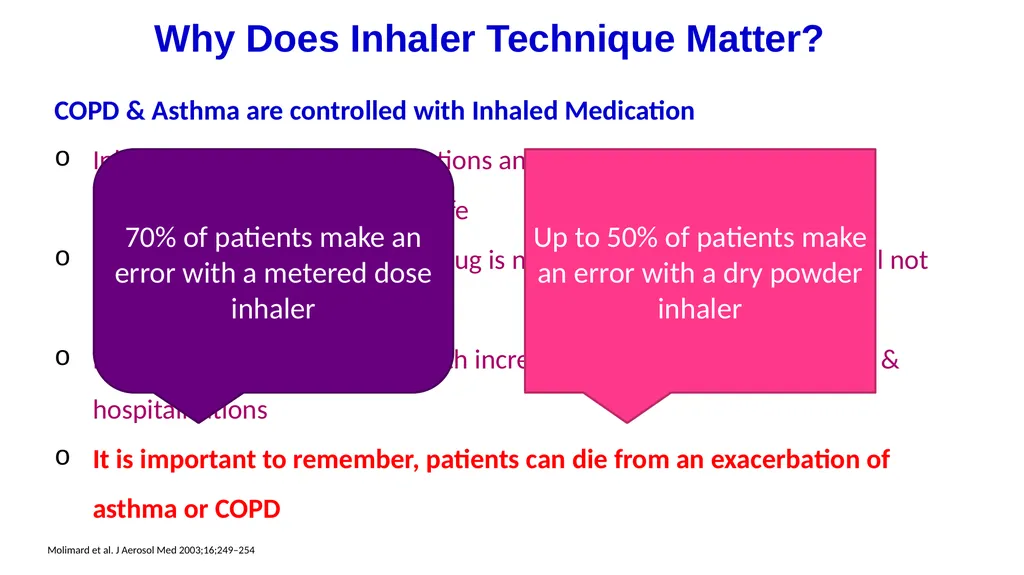
It is important to remember, patients can die from an exacerbation of asthma or COPD Up to 50% of patients make an error with a dry powder inhaler 70% of patients make an error with a metered dose inhaler Molimard et al. J Aerosol Med 2003;16;249–254<br>
slide3. Preventing a ‘lung attack’ with inhaled therapy is equally as important as preventing a heart attack with cardiac medication
We carefully administer tablets and IV drugs
We also need to observe the delivery of inhaled medication and correct any errors in technique<br>
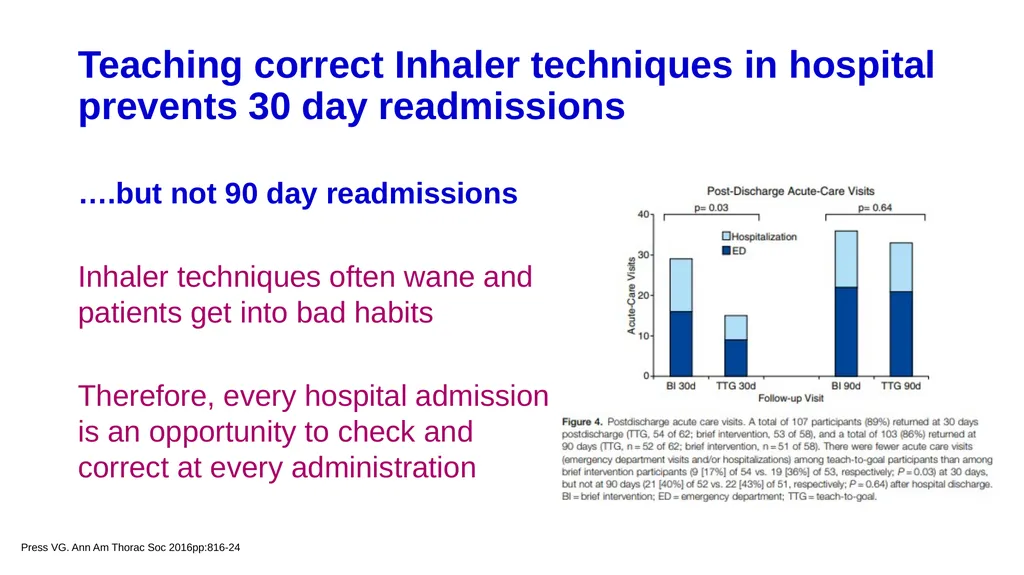
slide4. Teaching correct Inhaler techniques in hospital prevents 30 day readmissions ….but not 90 day readmissions
Inhaler techniques often wane and patients get into bad habits
Therefore, every hospital admission is an opportunity to check and correct at every administration Press VG. Ann Am Thorac Soc 2016pp:816-24<br>
slide5. When administering inhalers, observe the patient using it
Identify poor technique
Coach the patient as needed
Highlight if you think the patient needs a device change
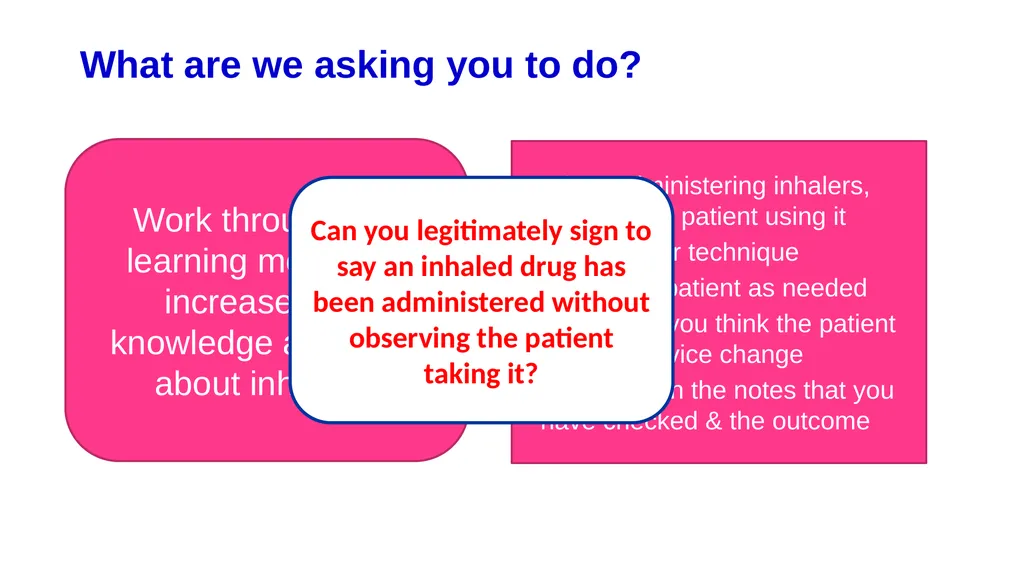
Document in the notes that you have checked & the outcome What are we asking you to do? Work through this learning module to increase your knowledge and skills about inhalers Can you legitimately sign to say an inhaled drug has been administered without observing the patient taking it?<br>
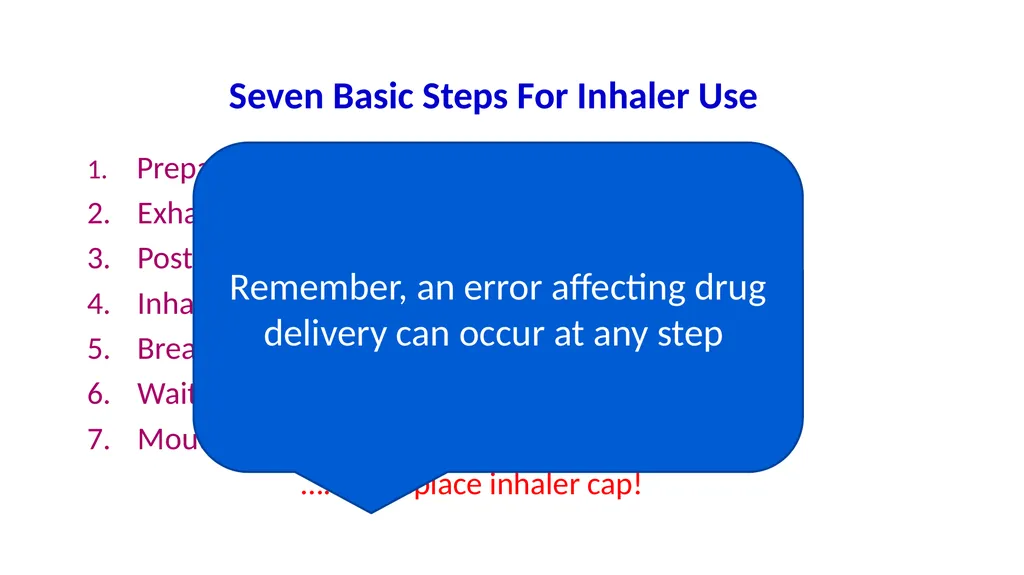
slide6. Seven Basic Steps For Inhaler Use Prepare
Exhale (away from mouthpiece)
Posture
Inhale – Flow Rate
Breath Hold
Wait, then repeat if necessary
Mouth Rinse – if administering an inhaled steroid
….and replace inhaler cap! Remember, an error affecting drug delivery can occur at any step<br>
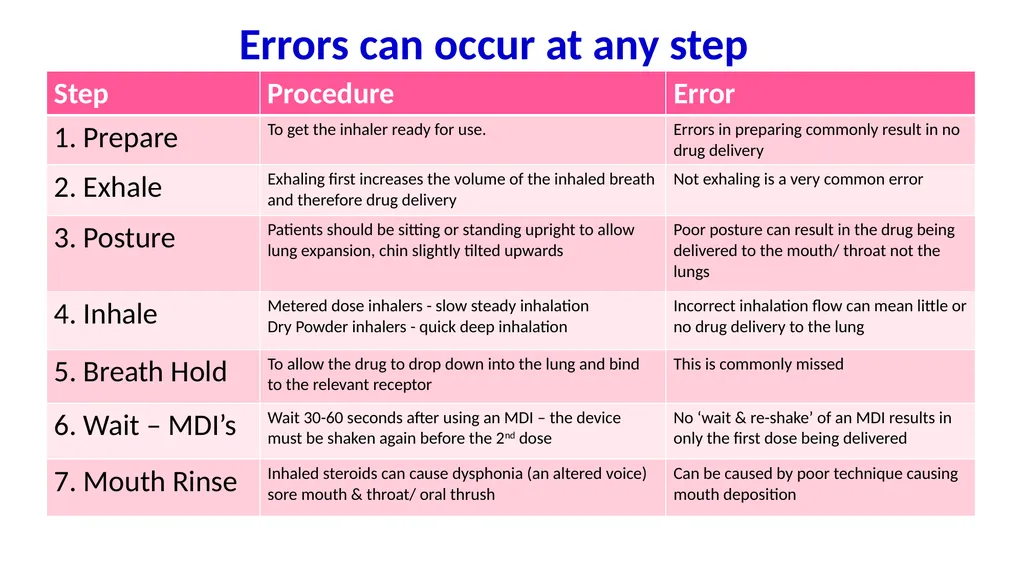
slide7. Errors can occur at any step<br>
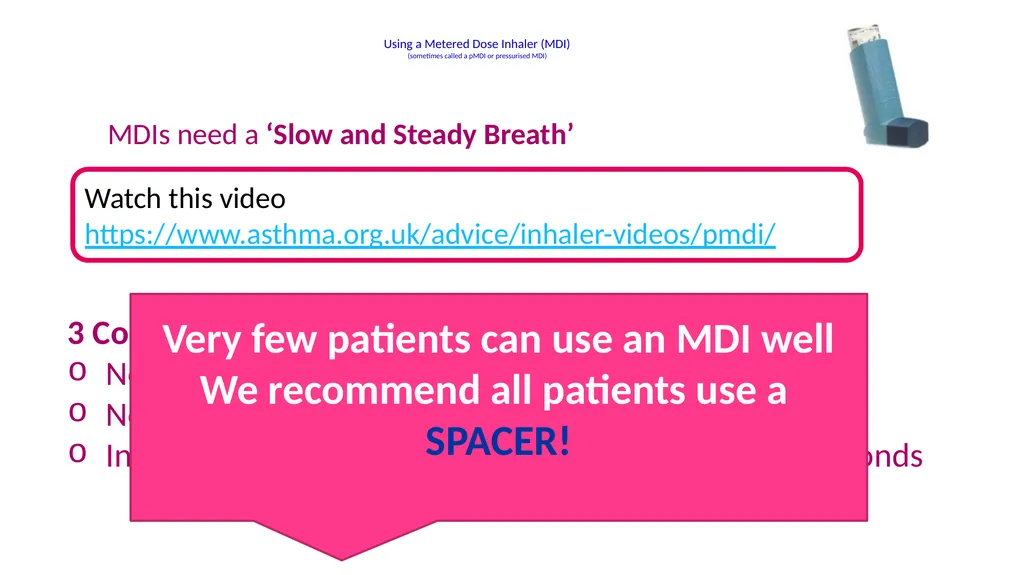
slide8. Using a Metered Dose Inhaler (MDI)(sometimes called a pMDI or pressurised MDI) 3 Common Errors
Not shaking
Not waiting and shaking again before 2nd puff
Inhaling too quickly – inhalation should last for 4-5 seconds Very few patients can use an MDI well
We recommend all patients use a
SPACER! MDIs need a ‘Slow and Steady Breath’ Watch this video
https://www.asthma.org.uk/advice/inhaler-videos/pmdi/<br>
slide9. Using an MDI with Spacer Watch these videos
https://www.asthma.org.uk/advice/inhaler-videos/single-breath-and-hold/
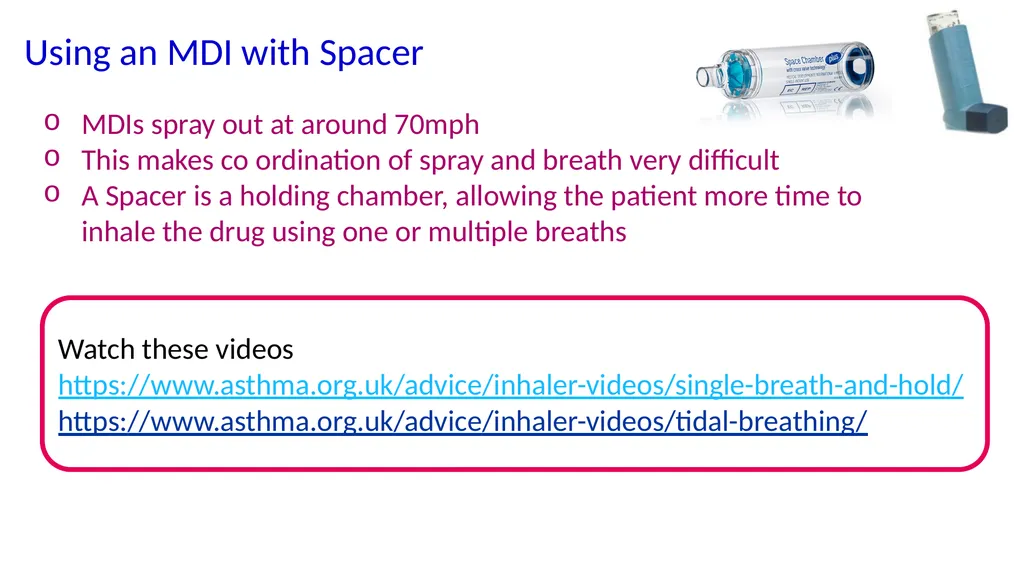
https://www.asthma.org.uk/advice/inhaler-videos/tidal-breathing/ MDIs spray out at around 70mph
This makes co ordination of spray and breath very difficult
A Spacer is a holding chamber, allowing the patient more time to inhale the drug using one or multiple breaths<br>
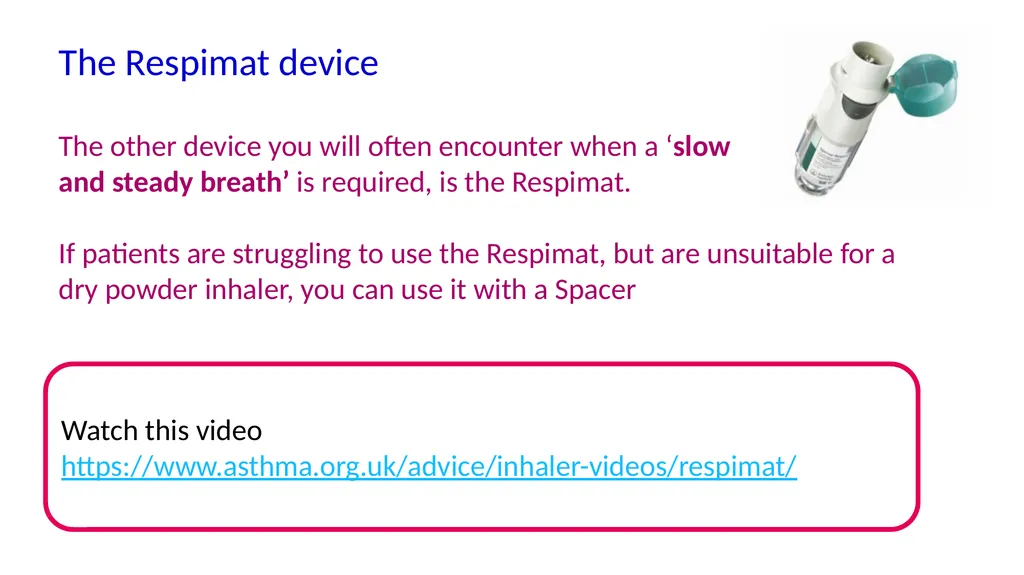
slide10. The Respimat device Watch this video
https://www.asthma.org.uk/advice/inhaler-videos/respimat/ The other device you will often encounter when a ‘slow
and steady breath’ is required, is the Respimat.
If patients are struggling to use the Respimat, but are unsuitable for a dry powder inhaler, you can use it with a Spacer<br>
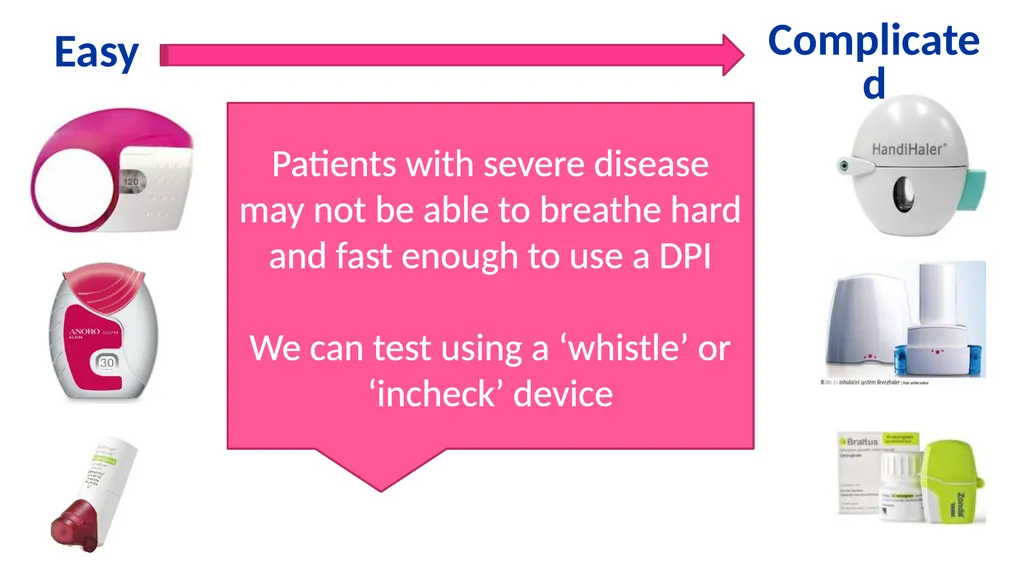
slide11. Dry Powder Inhalers (DPIs) In the UK we are starting to use more DPIs, reserving MDIs for patients who are unable to use a DPI
They are often easier to use
They have a much lower carbon footprint than MDIs
DPIs require a ‘fast and deep inhalation’ for 2-3 seconds
The breath pulls the drug out of the inhaler
Some DPIs need a stronger inhalation than others
Some DPIs are very simple to use, however, others are complicated and require good manual dexterity
Preparation varies and is specific to each device type – In Cornwall we are encouraging the use of the easiest devices<br>
slide12. Easy Complicated Patients with severe disease may not be able to breathe hard and fast enough to use a DPI
We can test using a ‘whistle’ or ‘incheck’ device<br>
slide13. Using Dry Powder Inhalers Watch these videos
https://www.asthma.org.uk/advice/inhaler-videos/nexthaler/
https://www.asthma.org.uk/advice/inhaler-videos/ellipta/
https://www.asthma.org.uk/advice/inhaler-videos/easyhaler/<br>
slide14. Asthma UK
https://www.asthma.org.uk/advice/inhaler-videos/
You can also share these videos with patients
Rightbreathe
https://www.rightbreathe.com
This site, for healthcare professionals, has a wealth of information about inhalers, including videos
There is also a free smart phone App How can I find out how to use other inhalers?<br>
slide15. I have identified poor technique but feel out of my depth in finding a solution Identifying poor technique is a great first step
If it’s a simple error (i.e. exhaling) retrain the patient
Ask for help from your Ward Pharmacist or Asthma & COPD Specialist Nurse
Look to observe what the Ward Pharmacist or Asthma & COPD Specialist Nurse do - build your confidence and experience
Remember, Inhalers are easy when you know how!<br>
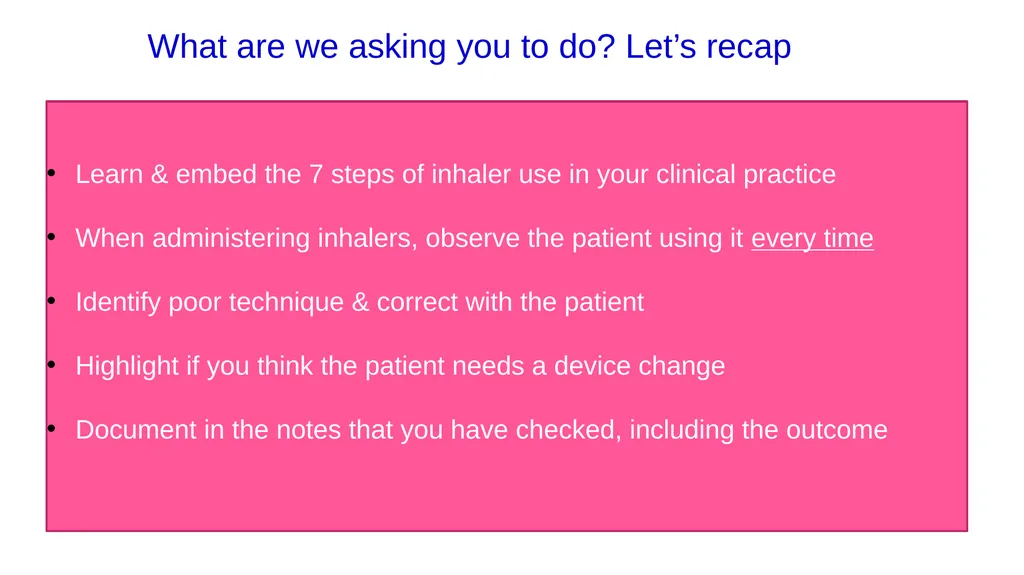
slide16. Learn & embed the 7 steps of inhaler use in your clinical practice
When administering inhalers, observe the patient using it every time
Identify poor technique & correct with the patient
Highlight if you think the patient needs a device change
Document in the notes that you have checked, including the outcome What are we asking you to do? Let’s recap<br>
slide17. Disposal of Used or Unwanted Inhalers Greenhouse gases have far-reaching environmental and health effects. They cause climate change by trapping heat and also contribute to
respiratory disease from smog and air pollution.
The propellants in commonly used MDI inhalers contain powerful greenhouse gases
Even after the MDI inhaler has been used, significant amounts of these damaging gases remain in the canister
Landfill disposal of MDI inhalers is extremely harmful to the environment due to the residual gas from canisters being released in to the atmosphere as greenhouse gases
Plastics take 100s of years to decompose and even then, only if they are exposed to sun, moisture and air. Burying plastic inhalers in landfill blocks any exposure to those elements and prevents discomposure completely.<br>
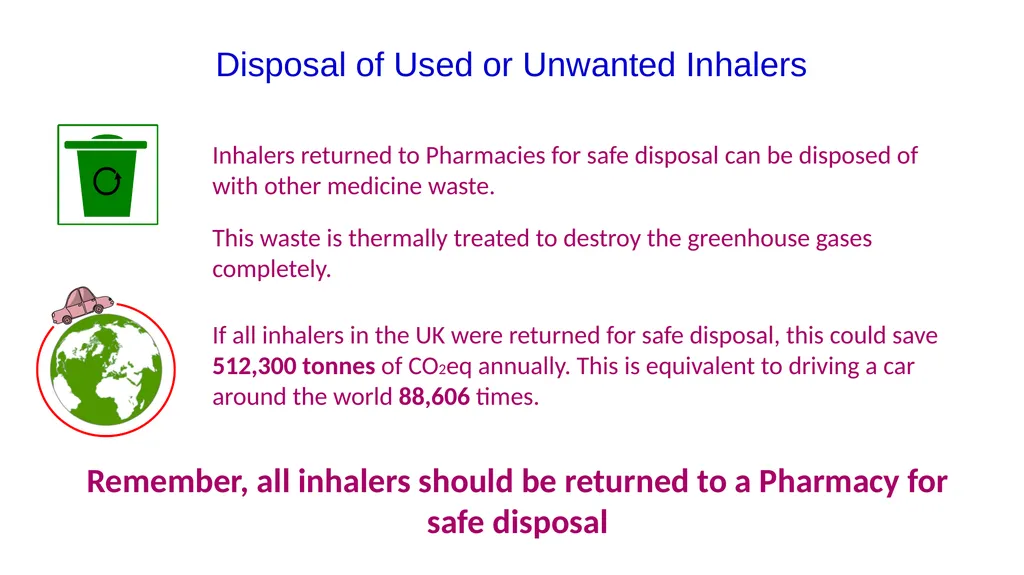
slide18. Disposal of Used or Unwanted Inhalers Inhalers returned to Pharmacies for safe disposal can be disposed of with other medicine waste.
This waste is thermally treated to destroy the greenhouse gases completely.
If all inhalers in the UK were returned for safe disposal, this could save 512,300 tonnes of CO2eq annually. This is equivalent to driving a car around the world 88,606 times. Remember, all inhalers should be returned to a Pharmacy for safe disposal<br>

Asthma & COPD Specialist Nurse<br>
slide2. Why Does Inhaler Technique Matter? COPD & Asthma are controlled with Inhaled Medication
Inhaled drugs reduce exacerbations and improves symptoms (such as breathlessness) and quality of life
Poor technique can mean the drug is not delivered to the lung and will not have an effect
Poor technique is associated with increased symptoms, exacerbations & hospitalisations
It is important to remember, patients can die from an exacerbation of asthma or COPD Up to 50% of patients make an error with a dry powder inhaler 70% of patients make an error with a metered dose inhaler Molimard et al. J Aerosol Med 2003;16;249–254<br>
slide3. Preventing a ‘lung attack’ with inhaled therapy is equally as important as preventing a heart attack with cardiac medication
We carefully administer tablets and IV drugs
We also need to observe the delivery of inhaled medication and correct any errors in technique<br>
slide4. Teaching correct Inhaler techniques in hospital prevents 30 day readmissions ….but not 90 day readmissions
Inhaler techniques often wane and patients get into bad habits
Therefore, every hospital admission is an opportunity to check and correct at every administration Press VG. Ann Am Thorac Soc 2016pp:816-24<br>
slide5. When administering inhalers, observe the patient using it
Identify poor technique
Coach the patient as needed
Highlight if you think the patient needs a device change
Document in the notes that you have checked & the outcome What are we asking you to do? Work through this learning module to increase your knowledge and skills about inhalers Can you legitimately sign to say an inhaled drug has been administered without observing the patient taking it?<br>
slide6. Seven Basic Steps For Inhaler Use Prepare
Exhale (away from mouthpiece)
Posture
Inhale – Flow Rate
Breath Hold
Wait, then repeat if necessary
Mouth Rinse – if administering an inhaled steroid
….and replace inhaler cap! Remember, an error affecting drug delivery can occur at any step<br>
slide7. Errors can occur at any step<br>
slide8. Using a Metered Dose Inhaler (MDI)(sometimes called a pMDI or pressurised MDI) 3 Common Errors
Not shaking
Not waiting and shaking again before 2nd puff
Inhaling too quickly – inhalation should last for 4-5 seconds Very few patients can use an MDI well
We recommend all patients use a
SPACER! MDIs need a ‘Slow and Steady Breath’ Watch this video
https://www.asthma.org.uk/advice/inhaler-videos/pmdi/<br>
slide9. Using an MDI with Spacer Watch these videos
https://www.asthma.org.uk/advice/inhaler-videos/single-breath-and-hold/
https://www.asthma.org.uk/advice/inhaler-videos/tidal-breathing/ MDIs spray out at around 70mph
This makes co ordination of spray and breath very difficult
A Spacer is a holding chamber, allowing the patient more time to inhale the drug using one or multiple breaths<br>
slide10. The Respimat device Watch this video
https://www.asthma.org.uk/advice/inhaler-videos/respimat/ The other device you will often encounter when a ‘slow
and steady breath’ is required, is the Respimat.
If patients are struggling to use the Respimat, but are unsuitable for a dry powder inhaler, you can use it with a Spacer<br>
slide11. Dry Powder Inhalers (DPIs) In the UK we are starting to use more DPIs, reserving MDIs for patients who are unable to use a DPI
They are often easier to use
They have a much lower carbon footprint than MDIs
DPIs require a ‘fast and deep inhalation’ for 2-3 seconds
The breath pulls the drug out of the inhaler
Some DPIs need a stronger inhalation than others
Some DPIs are very simple to use, however, others are complicated and require good manual dexterity
Preparation varies and is specific to each device type – In Cornwall we are encouraging the use of the easiest devices<br>
slide12. Easy Complicated Patients with severe disease may not be able to breathe hard and fast enough to use a DPI
We can test using a ‘whistle’ or ‘incheck’ device<br>
slide13. Using Dry Powder Inhalers Watch these videos
https://www.asthma.org.uk/advice/inhaler-videos/nexthaler/
https://www.asthma.org.uk/advice/inhaler-videos/ellipta/
https://www.asthma.org.uk/advice/inhaler-videos/easyhaler/<br>
slide14. Asthma UK
https://www.asthma.org.uk/advice/inhaler-videos/
You can also share these videos with patients
Rightbreathe
https://www.rightbreathe.com
This site, for healthcare professionals, has a wealth of information about inhalers, including videos
There is also a free smart phone App How can I find out how to use other inhalers?<br>
slide15. I have identified poor technique but feel out of my depth in finding a solution Identifying poor technique is a great first step
If it’s a simple error (i.e. exhaling) retrain the patient
Ask for help from your Ward Pharmacist or Asthma & COPD Specialist Nurse
Look to observe what the Ward Pharmacist or Asthma & COPD Specialist Nurse do - build your confidence and experience
Remember, Inhalers are easy when you know how!<br>
slide16. Learn & embed the 7 steps of inhaler use in your clinical practice
When administering inhalers, observe the patient using it every time
Identify poor technique & correct with the patient
Highlight if you think the patient needs a device change
Document in the notes that you have checked, including the outcome What are we asking you to do? Let’s recap<br>
slide17. Disposal of Used or Unwanted Inhalers Greenhouse gases have far-reaching environmental and health effects. They cause climate change by trapping heat and also contribute to
respiratory disease from smog and air pollution.
The propellants in commonly used MDI inhalers contain powerful greenhouse gases
Even after the MDI inhaler has been used, significant amounts of these damaging gases remain in the canister
Landfill disposal of MDI inhalers is extremely harmful to the environment due to the residual gas from canisters being released in to the atmosphere as greenhouse gases
Plastics take 100s of years to decompose and even then, only if they are exposed to sun, moisture and air. Burying plastic inhalers in landfill blocks any exposure to those elements and prevents discomposure completely.<br>
slide18. Disposal of Used or Unwanted Inhalers Inhalers returned to Pharmacies for safe disposal can be disposed of with other medicine waste.
This waste is thermally treated to destroy the greenhouse gases completely.
If all inhalers in the UK were returned for safe disposal, this could save 512,300 tonnes of CO2eq annually. This is equivalent to driving a car around the world 88,606 times. Remember, all inhalers should be returned to a Pharmacy for safe disposal<br>