Inorganic Semi micro Qualitative analysis Dr. B. Kavitha Assistant Professor PG and Research Department of Chemistry C.P.A. College, Bodinayakanur Semi micro qualitative analysis of inorganic salt mixture containing two anions (interfering)
"Inorganic Semi micro Qualitative analysis Dr. B." is the property of its rightful owner. Permission is granted to
download and print the materials on this website for personal, non-commercial use only, and to display it
on your personal computer provided you do not modify the materials and that you retain all copyright
notices contained in the materials. By downloading content from our website, you accept the terms of this
agreement.
Presentation Transcript
01
Inorganic Semi micro Qualitative analysis Dr. B. Kavitha
Assistant Professor
PG and Research Department of Chemistry
C.P.A. College, Bodinayakanur<br>
02
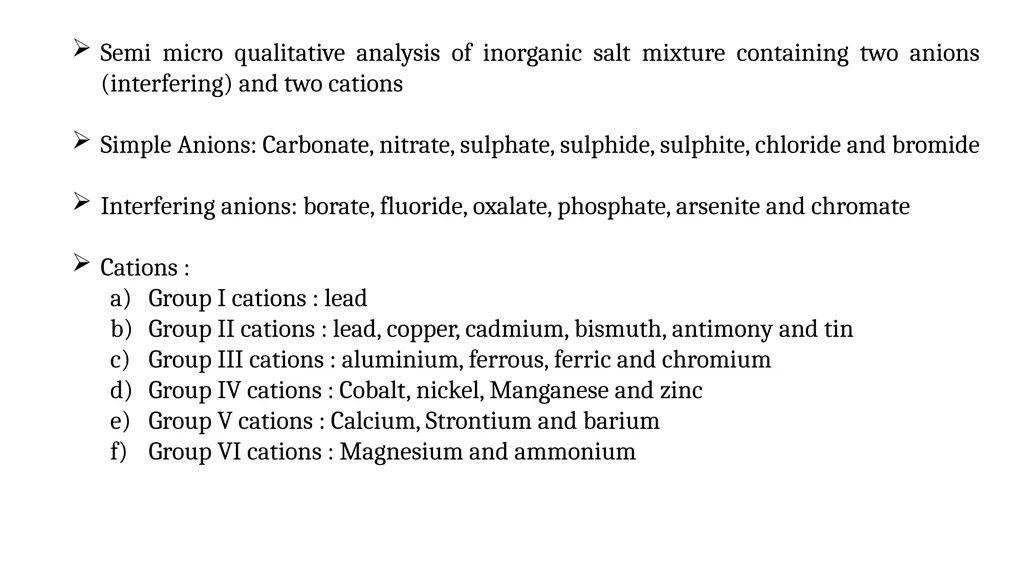
Semi micro qualitative analysis of inorganic salt mixture containing two anions (interfering) and two cations
Simple Anions: Carbonate, nitrate, sulphate, sulphide, sulphite, chloride and bromide
Interfering anions: borate, fluoride, oxalate, phosphate, arsenite and chromate
Cations :
Group I cations : lead
Group II cations : lead, copper, cadmium, bismuth, antimony and tin
Group III cations : aluminium, ferrous, ferric and chromium
Group IV cations : Cobalt, nickel, Manganese and zinc
Group V cations : Calcium, Strontium and barium
Group VI cations : Magnesium and ammonium<br>
03
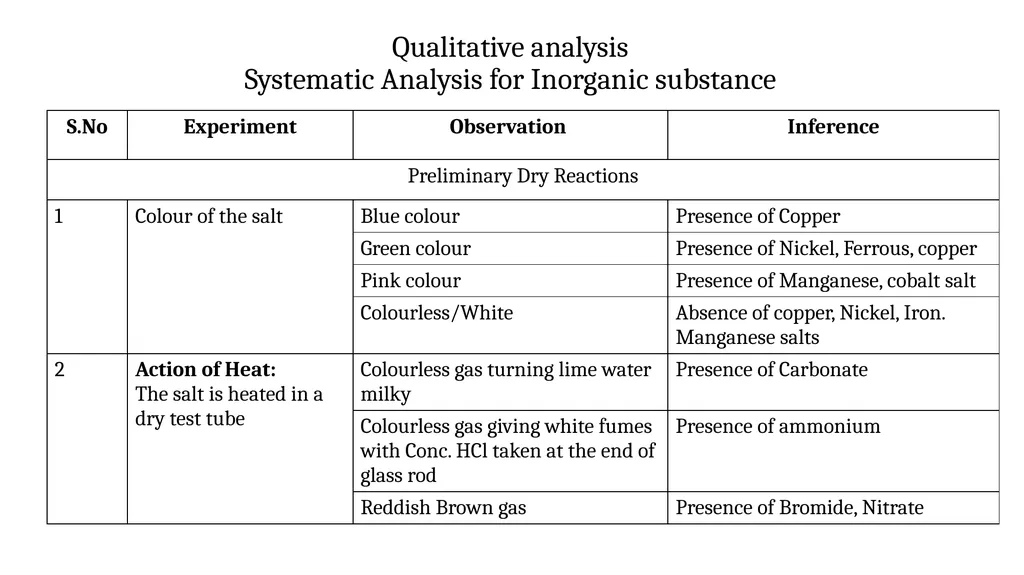
Qualitative analysis Systematic Analysis for Inorganic substance<br>
04
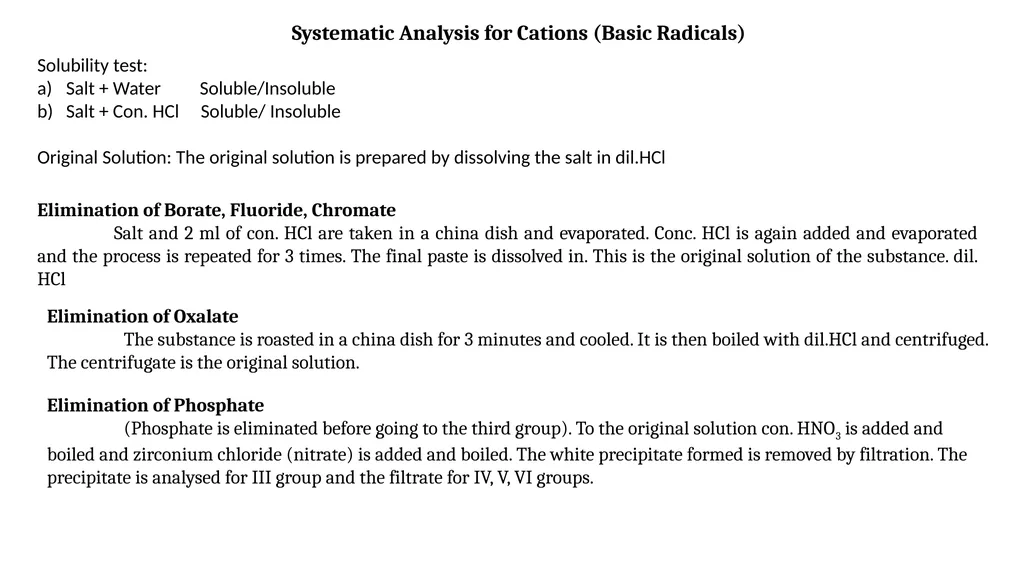
Systematic Analysis for Cations (Basic Radicals) Solubility test:
Salt + Water Soluble/Insoluble
Salt + Con. HCl Soluble/ Insoluble
Original Solution: The original solution is prepared by dissolving the salt in dil.HCl Elimination of Borate, Fluoride, Chromate
Salt and 2 ml of con. HCl are taken in a china dish and evaporated. Conc. HCl is again added and evaporated and the process is repeated for 3 times. The final paste is dissolved in. This is the original solution of the substance. dil. HCl Elimination of Oxalate
The substance is roasted in a china dish for 3 minutes and cooled. It is then boiled with dil.HCl and centrifuged. The centrifugate is the original solution. Elimination of Phosphate
(Phosphate is eliminated before going to the third group). To the original solution con. HNO3 is added and boiled and zirconium chloride (nitrate) is added and boiled. The white precipitate formed is removed by filtration. The precipitate is analysed for III group and the filtrate for IV, V, VI groups.<br>
05
Elimination of Arsenite
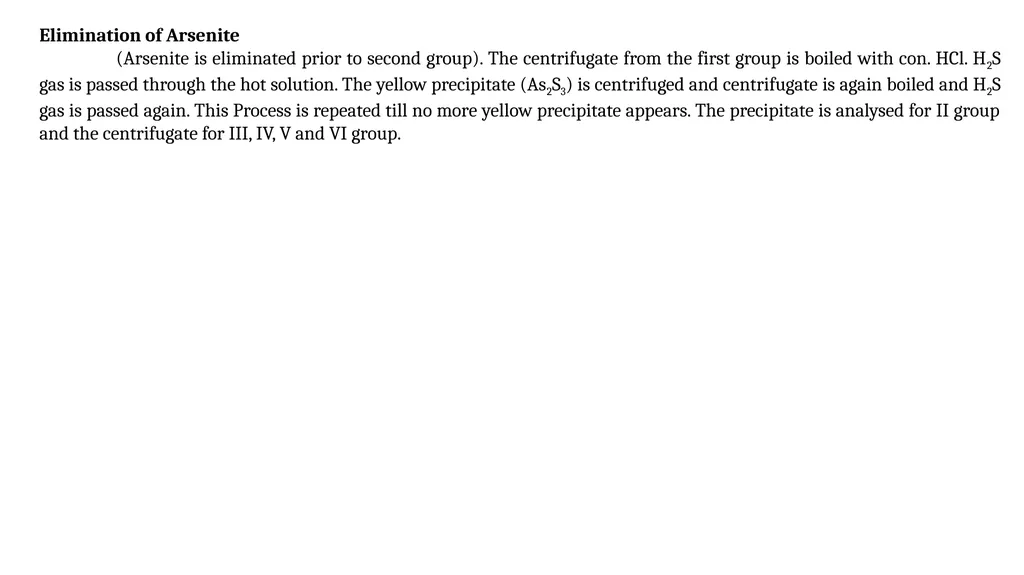
(Arsenite is eliminated prior to second group). The centrifugate from the first group is boiled with con. HCl. H2S gas is passed through the hot solution. The yellow precipitate (As2S3) is centrifuged and centrifugate is again boiled and H2S gas is passed again. This Process is repeated till no more yellow precipitate appears. The precipitate is analysed for II group and the centrifugate for III, IV, V and VI group.<br>
06
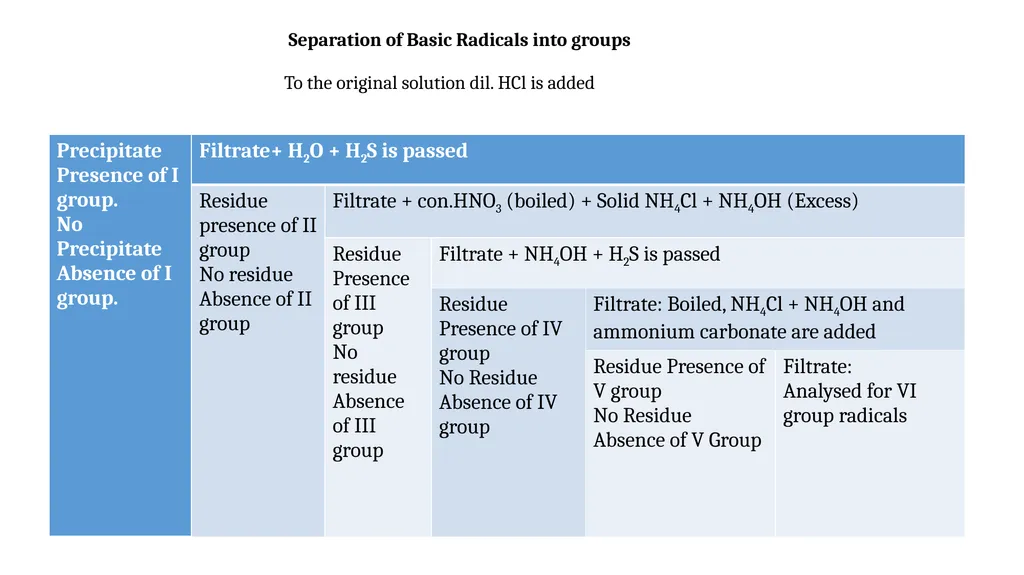
Separation of Basic Radicals into groups To the original solution dil. HCl is added<br>
07
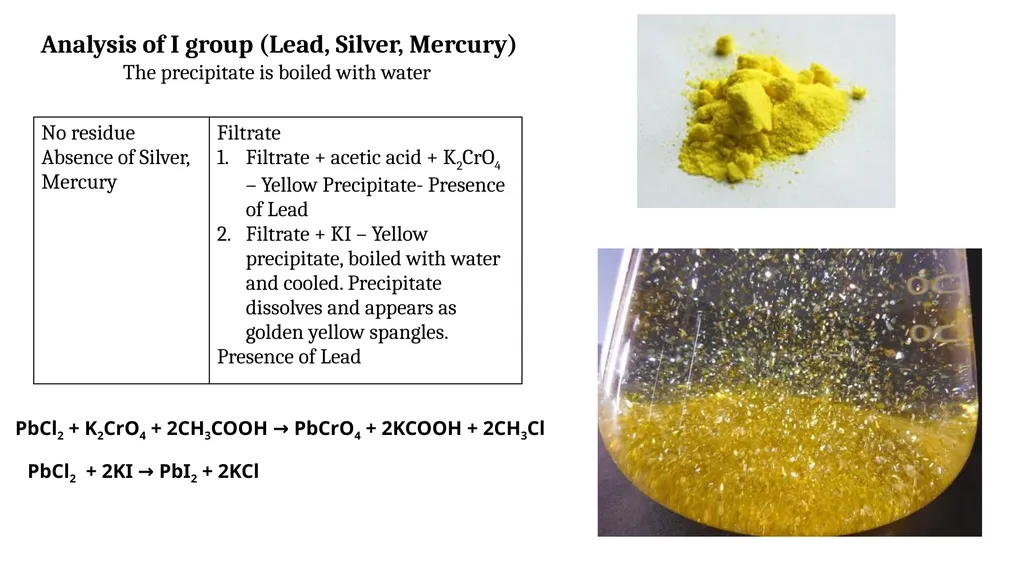
Analysis of I group (Lead, Silver, Mercury)
The precipitate is boiled with water PbCl2 + K2CrO4 + 2CH3COOH → PbCrO4 + 2KCOOH + 2CH3Cl PbCl2 + 2KI → PbI2 + 2KCl<br>
08
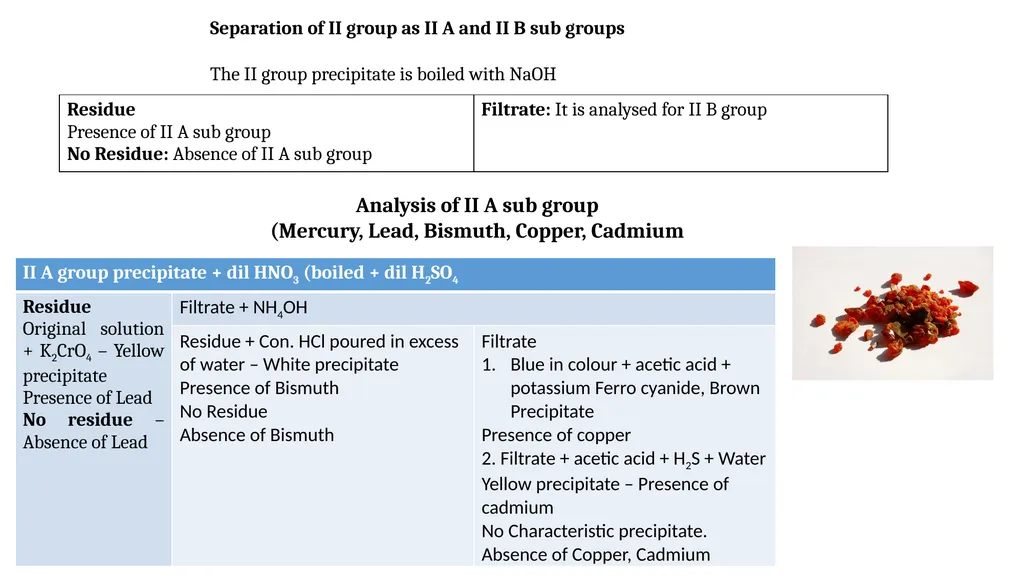
Separation of II group as II A and II B sub groups
The II group precipitate is boiled with NaOH Analysis of II A sub group
(Mercury, Lead, Bismuth, Copper, Cadmium<br>
09
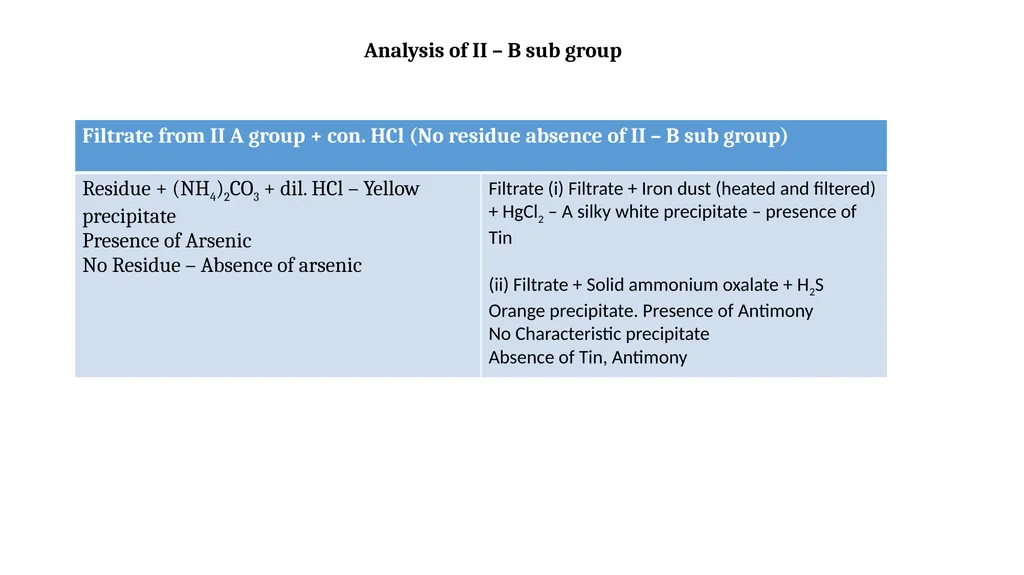
Analysis of II – B sub group<br>
10
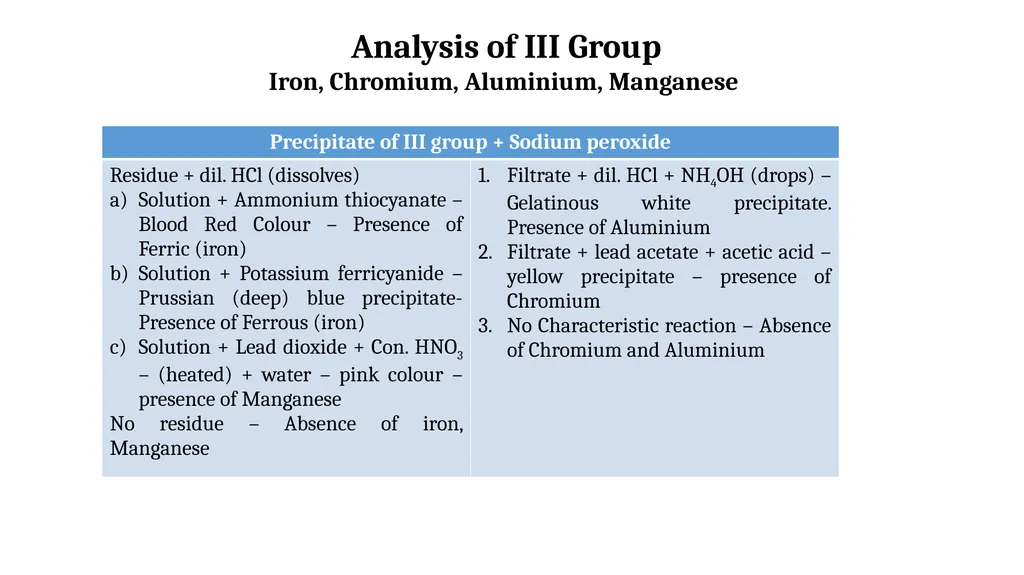
Analysis of III Group
Iron, Chromium, Aluminium, Manganese<br>
11
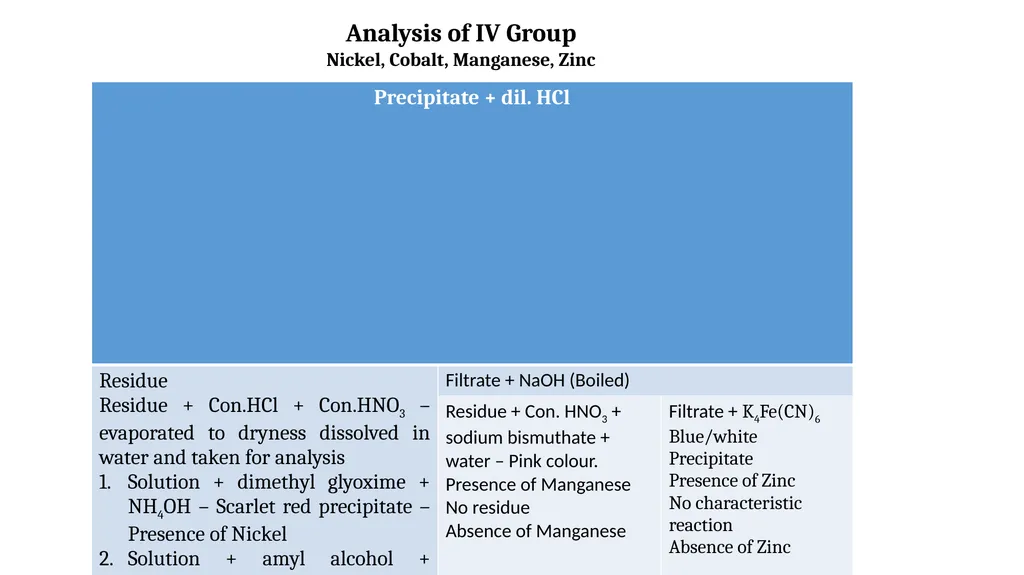
Analysis of IV Group
Nickel, Cobalt, Manganese, Zinc<br>
12
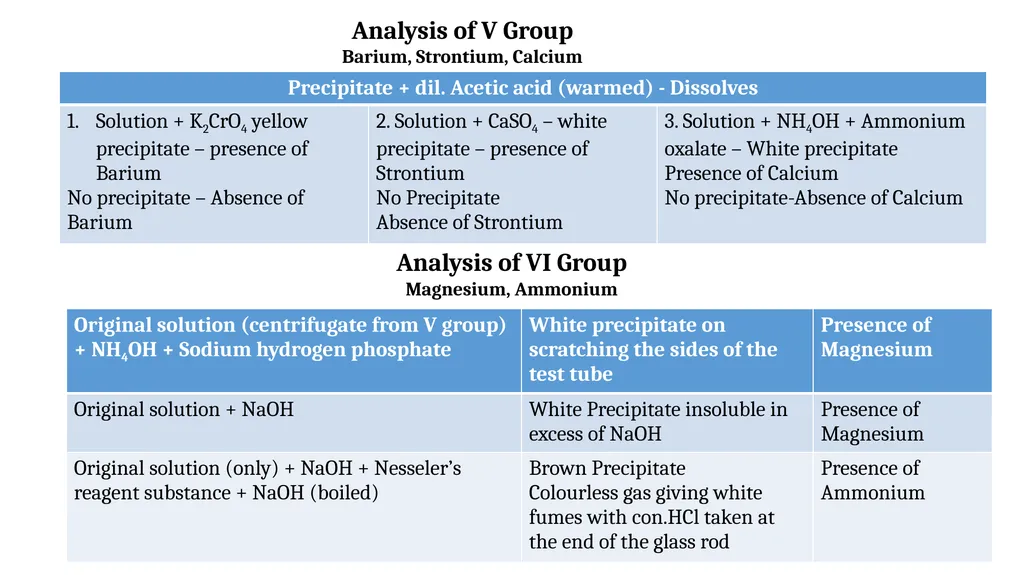
Analysis of V Group
Barium, Strontium, Calcium Analysis of VI Group
Magnesium, Ammonium<br>