
Institutional Management: Governance, Human

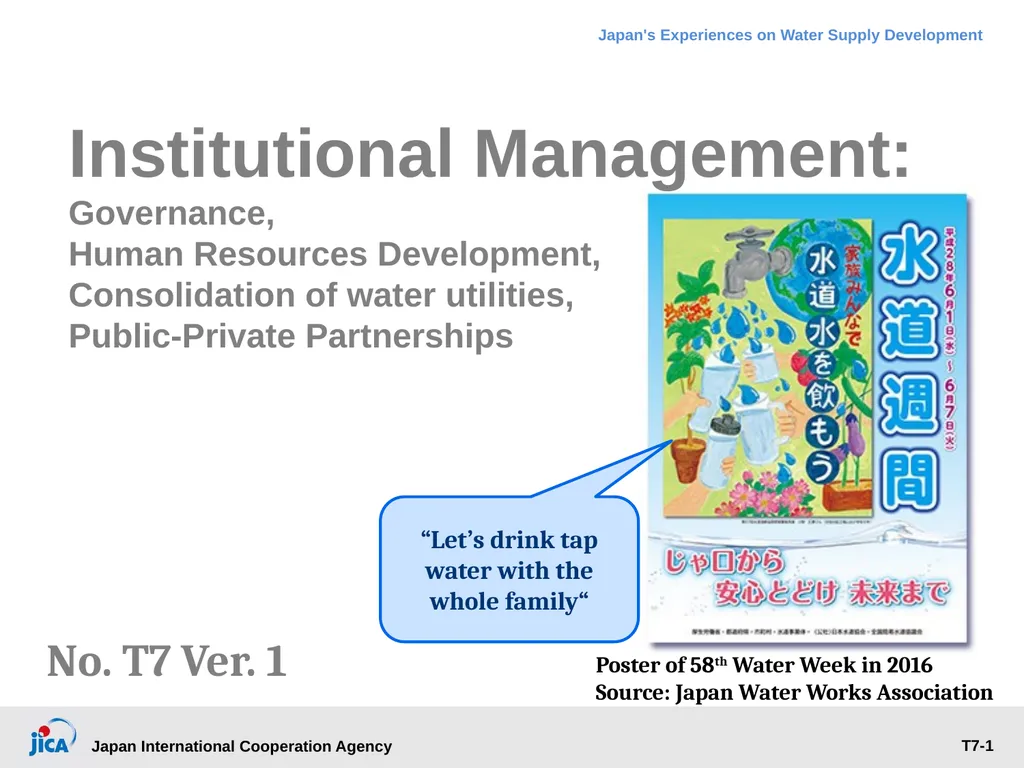






Description: Institutional Management: Governance, Human Resources Development, Consolidation of water utilities, Public-Private Partnerships No. T7 Ver. 1 Poster of 58th Water Week in 2016 Source: Japan Water Works Association Lets drink tap water
Related Topics
Download Presentation
"Institutional Management: Governance, Human" is the property of its rightful owner. Permission is granted to download and print the materials on this website for personal, non-commercial use only, and to display it on your personal computer provided you do not modify the materials and that you retain all copyright notices contained in the materials. By downloading content from our website, you accept the terms of this agreement.
Presentation Transcript
slide1. Institutional Management:
Governance,
Human Resources Development,
Consolidation of water utilities,
Public-Private Partnerships No. T7 Ver. 1 Poster of 58th Water Week in 2016
Source: Japan Water Works Association “Let’s drink tap water with the whole family“<br>
slide2. Contents Introduction
Governance
Business Plan and PDCA (Plan, Do, Check, Act) Cycle
Human Resources Development
Management of Small and Medium Scale Utilities
Public - Private Partnerships
Lessons Learned<br>
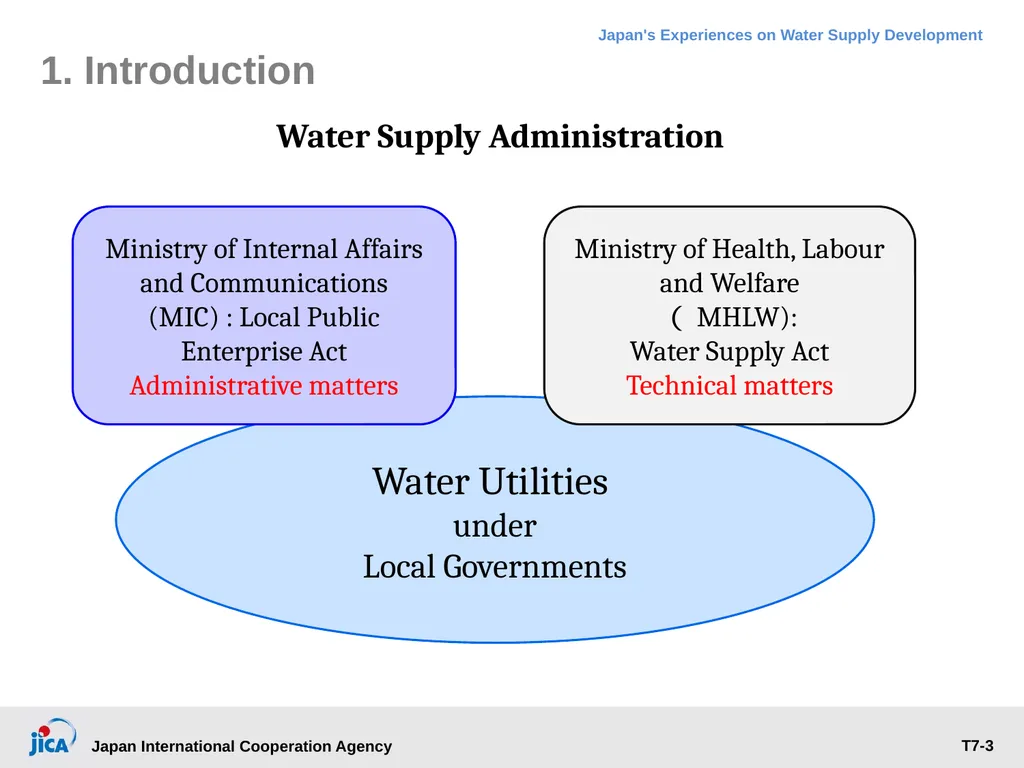
slide3. 1. Introduction Water Utilities
under
Local Governments Ministry of Internal Affairs and Communications
(MIC) : Local Public Enterprise Act
Administrative matters Ministry of Health, Labour and Welfare
(MHLW):
Water Supply Act
Technical matters Water Supply Administration<br>
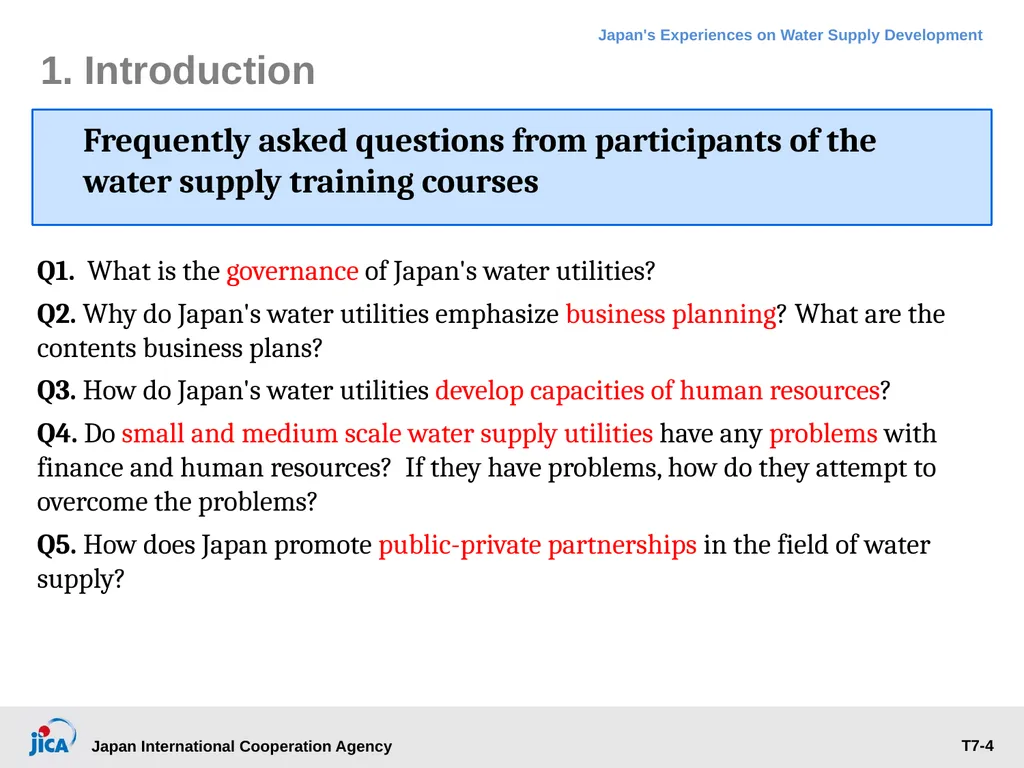
slide4. 1. Introduction Q1. What is the governance of Japan's water utilities?
Q2. Why do Japan's water utilities emphasize business planning? What are the contents business plans?
Q3. How do Japan's water utilities develop capacities of human resources?
Q4. Do small and medium scale water supply utilities have any problems with finance and human resources? If they have problems, how do they attempt to overcome the problems?
Q5. How does Japan promote public-private partnerships in the field of water supply? Frequently asked questions from participants of the water supply training courses<br>
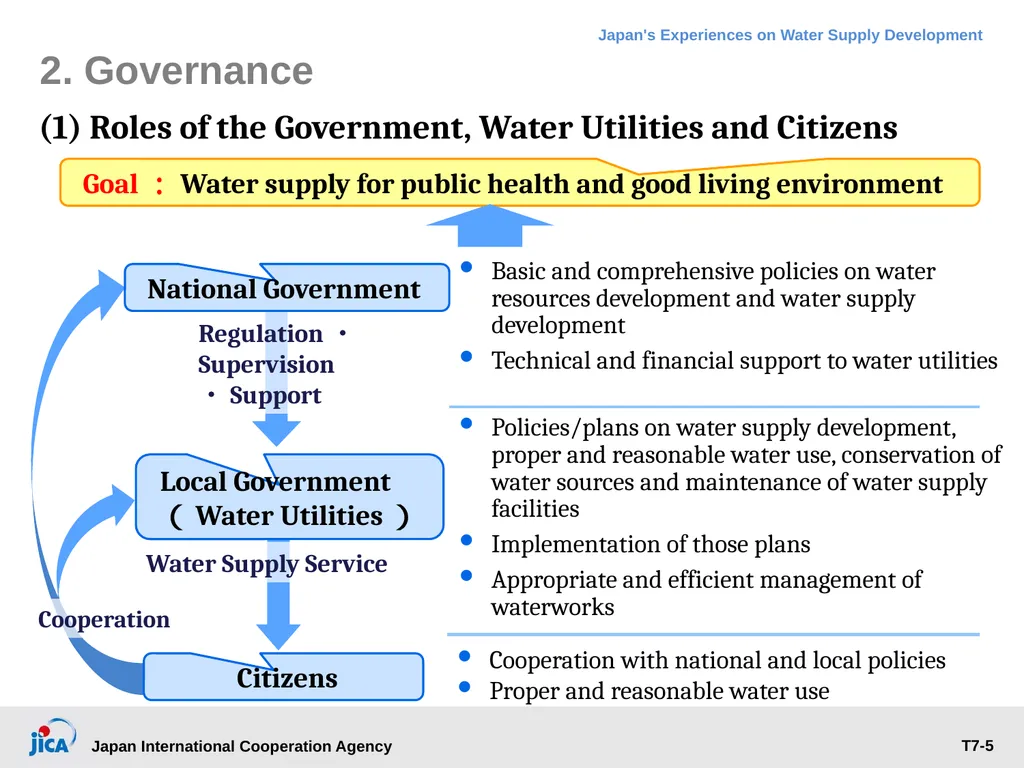
slide5. Basic and comprehensive policies on water resources development and water supply development
Technical and financial support to water utilities Policies/plans on water supply development, proper and reasonable water use, conservation of water sources and maintenance of water supply facilities
Implementation of those plans
Appropriate and efficient management of waterworks Regulation・Supervision・Support Water Supply Service Cooperation 2. Governance Cooperation with national and local policies
Proper and reasonable water use Goal:Water supply for public health and good living environment Citizens Local Government
(Water Utilities) National Government (1) Roles of the Government, Water Utilities and Citizens<br>
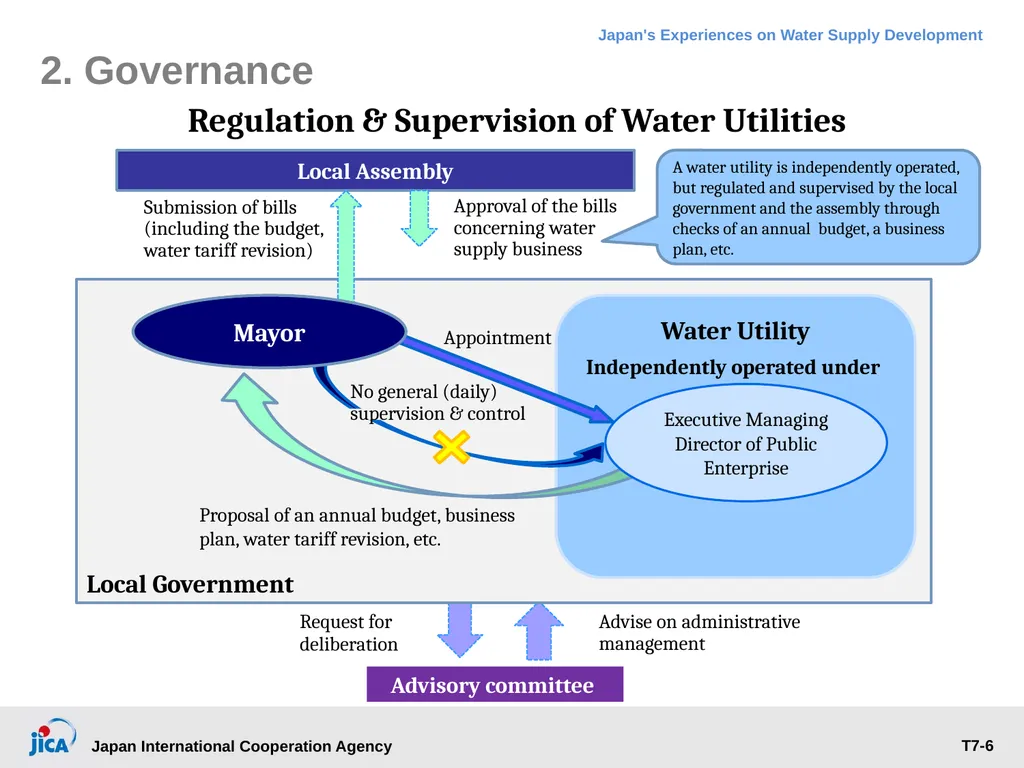
slide6. Request for deliberation 2. Governance Advisory committee Advise on administrative management Regulation & Supervision of Water Utilities Local Government Water Utility
Independently operated under Local Assembly Appointment Mayor Submission of bills (including the budget, water tariff revision) No general (daily) supervision & control Executive Managing Director of Public Enterprise Proposal of an annual budget, business plan, water tariff revision, etc. Approval of the bills concerning water supply business A water utility is independently operated, but regulated and supervised by the local government and the assembly through checks of an annual budget, a business plan, etc.<br>
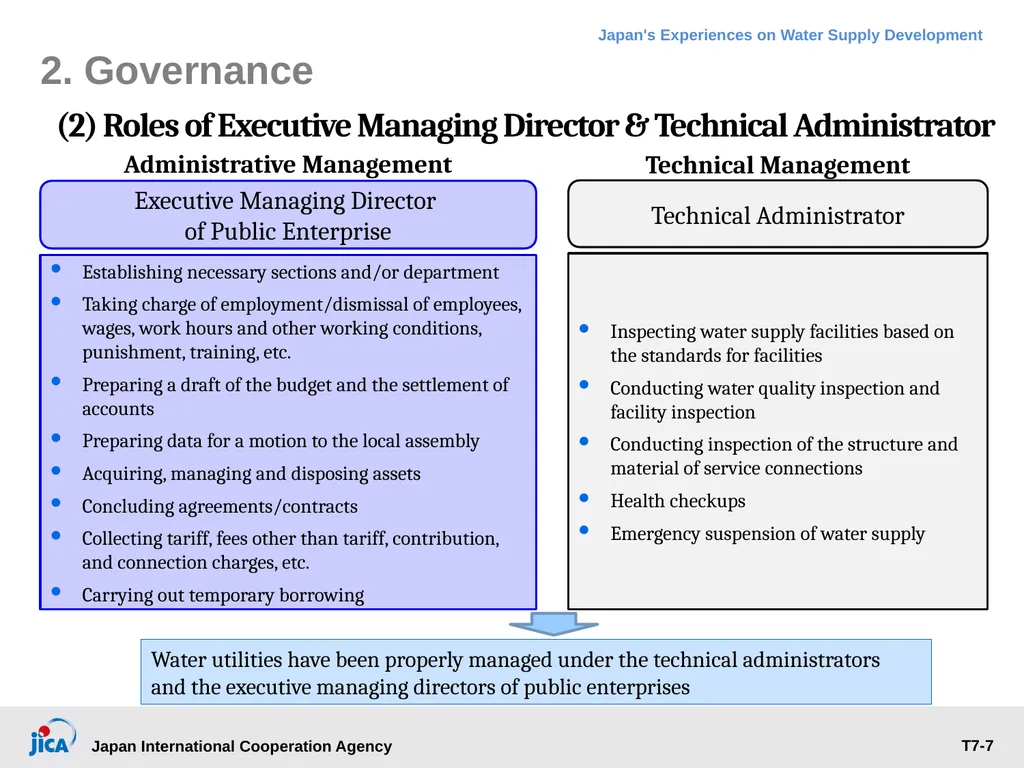
slide7. 2. Governance Executive Managing Director
of Public Enterprise Technical Administrator Administrative Management Technical Management Establishing necessary sections and/or department
Taking charge of employment/dismissal of employees, wages, work hours and other working conditions, punishment, training, etc.
Preparing a draft of the budget and the settlement of accounts
Preparing data for a motion to the local assembly
Acquiring, managing and disposing assets
Concluding agreements/contracts
Collecting tariff, fees other than tariff, contribution, and connection charges, etc.
Carrying out temporary borrowing Inspecting water supply facilities based on the standards for facilities
Conducting water quality inspection and facility inspection
Conducting inspection of the structure and material of service connections
Health checkups
Emergency suspension of water supply (2) Roles of Executive Managing Director & Technical Administrator Water utilities have been properly managed under the technical administrators and the executive managing directors of public enterprises<br>
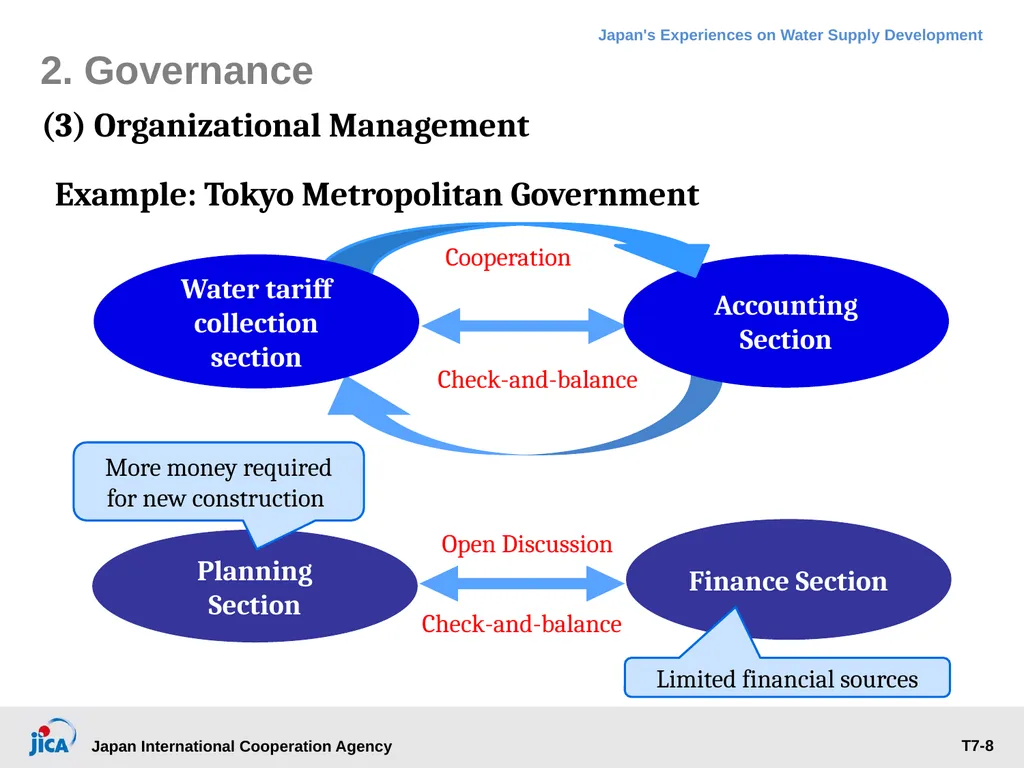
slide8. 2. Governance Planning Section Finance Section Check-and-balance Cooperation More money required for new construction Limited financial sources Check-and-balance Open Discussion Example: Tokyo Metropolitan Government Accounting Section (3) Organizational Management Water tariff collection section<br>
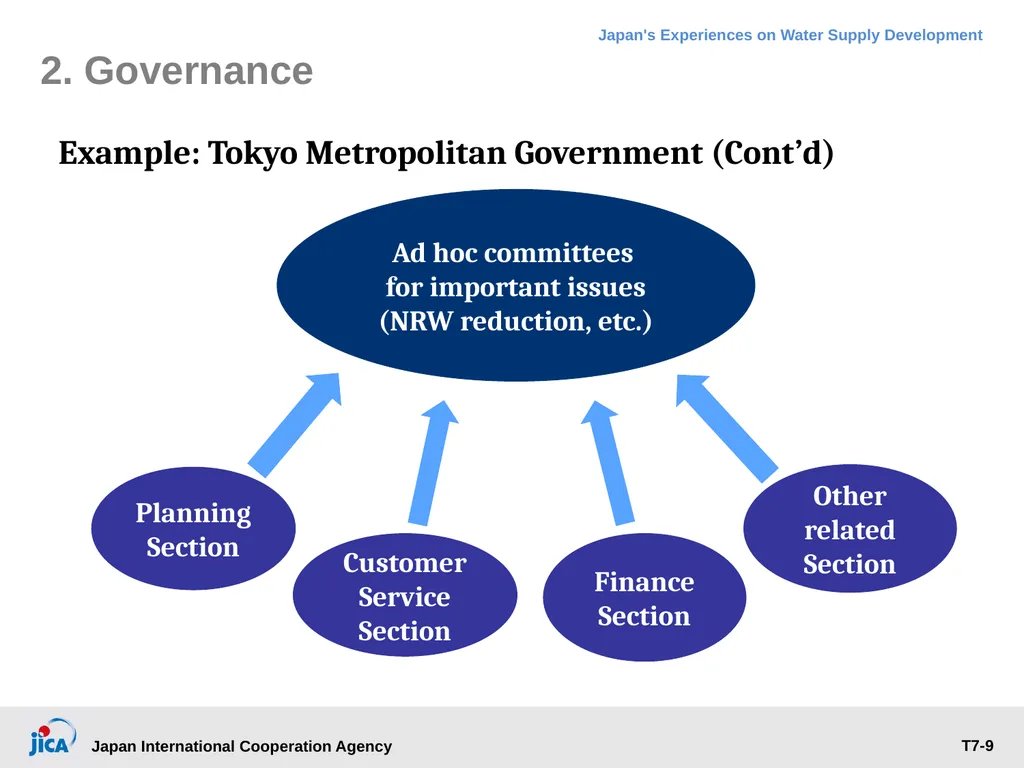
slide9. 2. Governance Planning Section Other related Section Ad hoc committees
for important issues (NRW reduction, etc.) Customer Service Section Example: Tokyo Metropolitan Government (Cont’d) Finance Section<br>
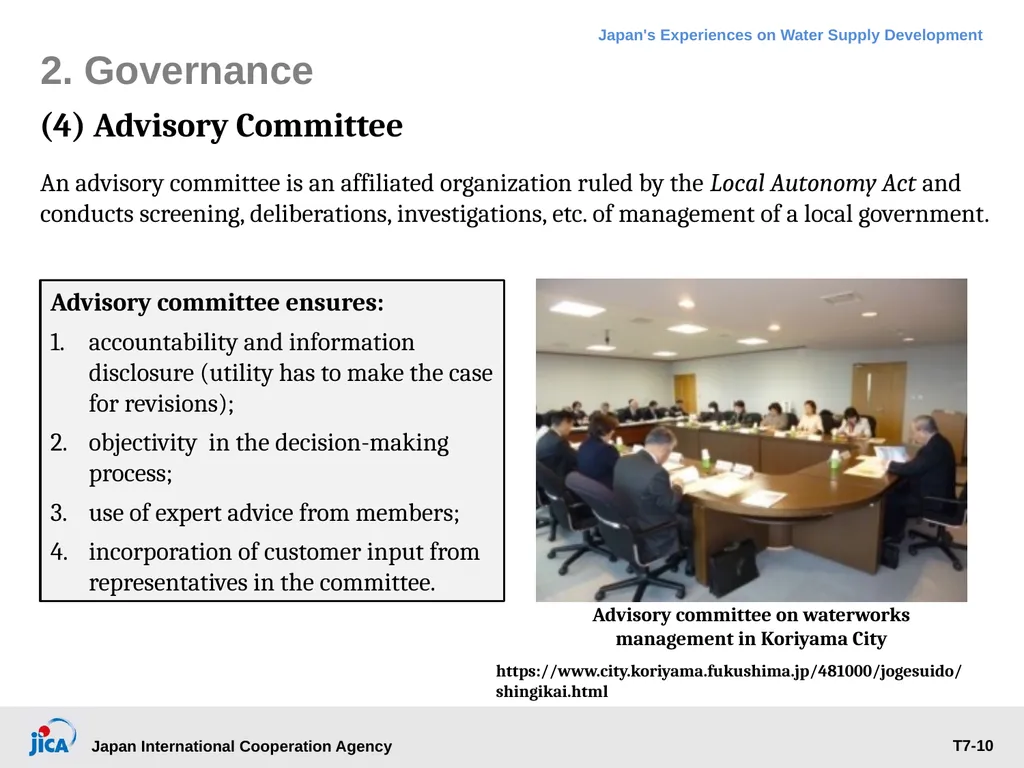
slide10. 2. Governance Advisory committee ensures:
accountability and information disclosure (utility has to make the case for revisions);
objectivity in the decision-making process;
use of expert advice from members;
incorporation of customer input from representatives in the committee. An advisory committee is an affiliated organization ruled by the Local Autonomy Act and conducts screening, deliberations, investigations, etc. of management of a local government. (4) Advisory Committee Advisory committee on waterworks management in Koriyama City https://www.city.koriyama.fukushima.jp/481000/jogesuido/shingikai.html<br>
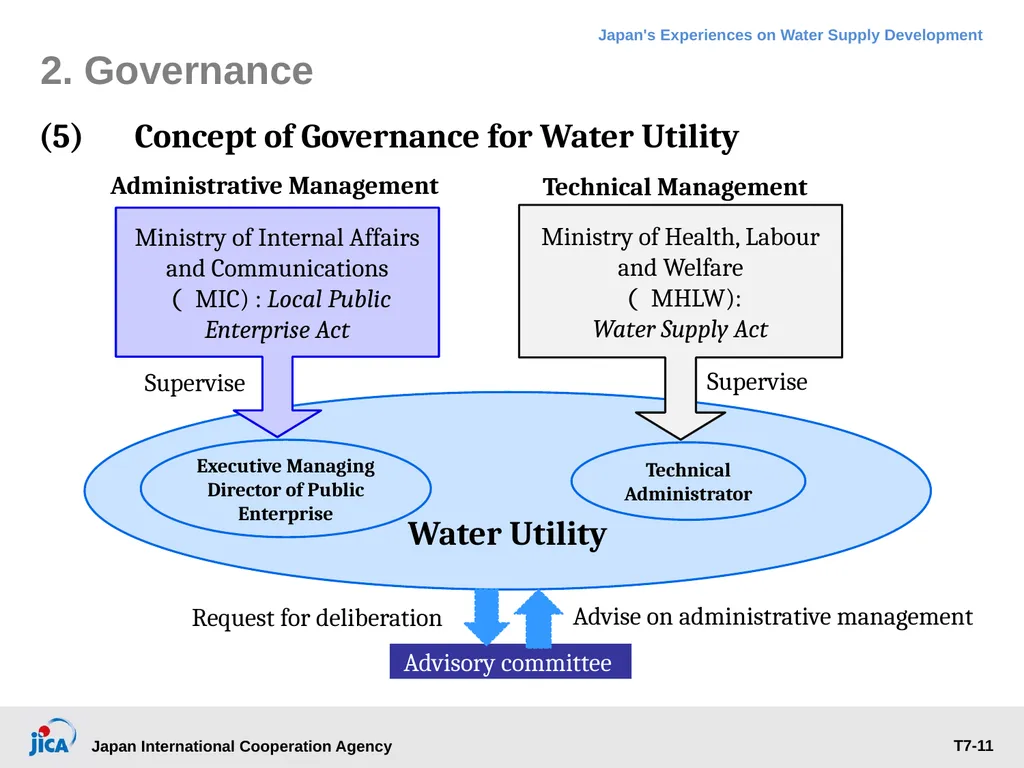
slide11. Request for deliberation 2. Governance Water Utility Advisory committee Administrative Management Technical Management Executive Managing Director of Public Enterprise Technical Administrator Supervise Supervise Advise on administrative management (5) Concept of Governance for Water Utility Ministry of Internal Affairs and Communications
(MIC) : Local Public Enterprise Act Ministry of Health, Labour and Welfare
(MHLW):
Water Supply Act<br>
slide12. 3. Business Plan and PDCA Cycle Water Supply Development based on Plans<br>
slide13. 3. Business Plan and PDCA Basic Policy and Integrated Master Plan of Kyoto City Water Supply Master Plan (2001~2025) Sewerage
Master Plan (2001~2025) Kyoto City’s Water Vision
(2008~2017) Goals and issues to be solved Mid- Term Business Plan
(2008-2012)&(2013-2017) Vision & Plan of Waterworks Bureau Management Strategy (Business Plan) of Waterworks Bureau Example: Kyoto City<br>
slide14. 3. Business Plan and PDCA Cycle Vision of Kyoto City Waterworks Bureau Plan Act Do Check Customers Information Disclosure Progress review & Management Example: Kyoto City (Cont’d)<br>
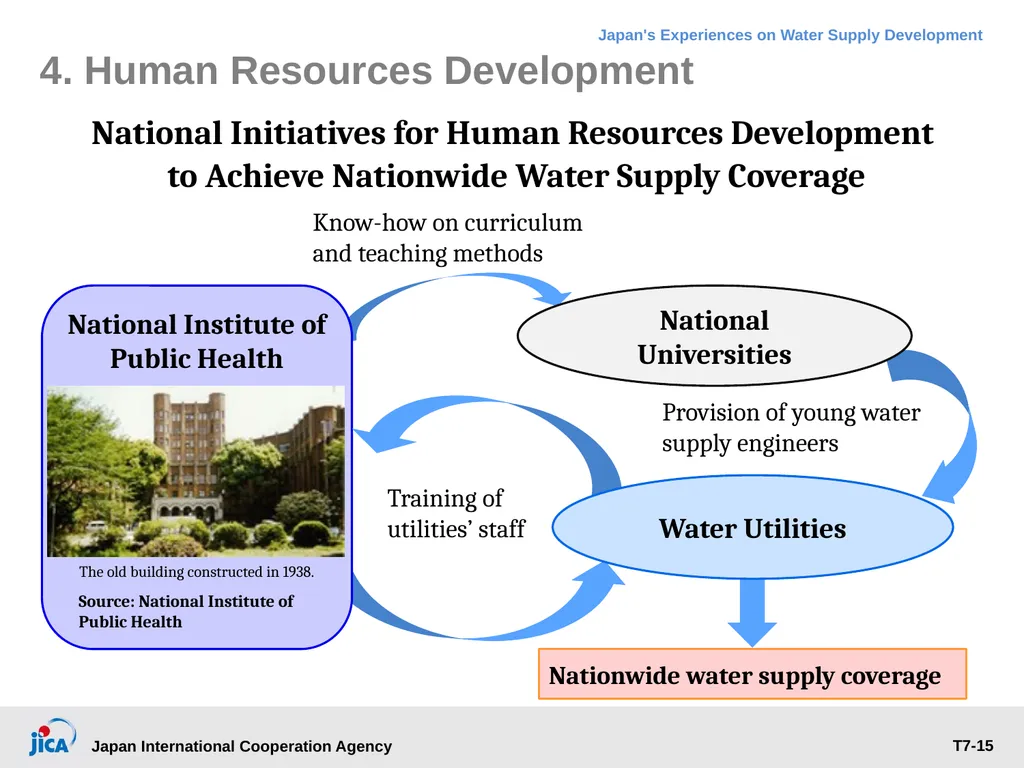
slide15. 4. Human Resources Development National Institute of Public Health
The old building constructed in 1938. Know-how on curriculum and teaching methods Training of utilities’ staff Provision of young water supply engineers Source: National Institute of Public Health Nationwide water supply coverage National Initiatives for Human Resources Development
to Achieve Nationwide Water Supply Coverage Water Utilities National Universities<br>
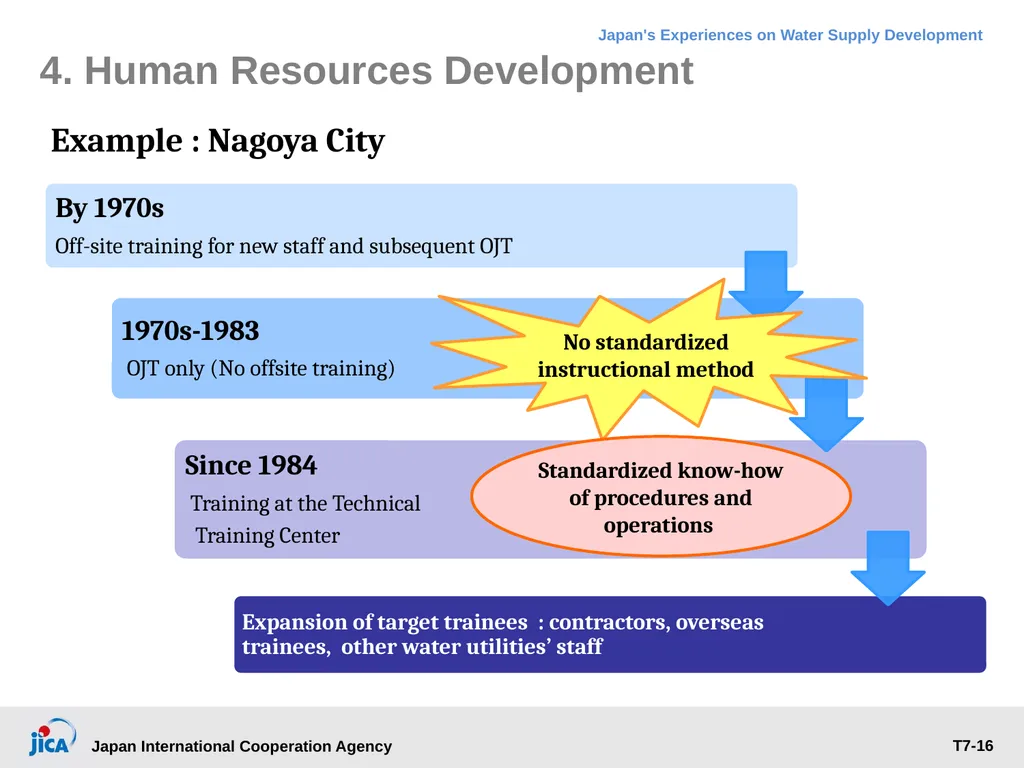
slide16. 4. Human Resources Development No standardized instructional method Standardized know-how of procedures and operations Example : Nagoya City<br>
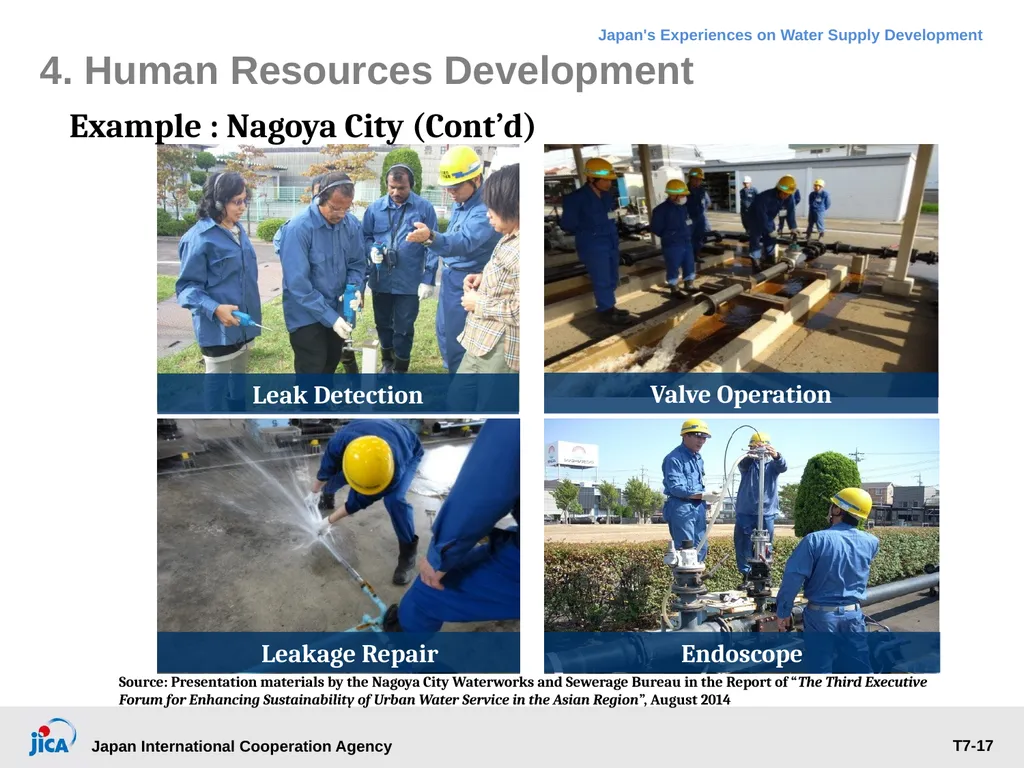
slide17. 4. Human Resources Development Leak Detection Valve Operation Endoscope Leakage Repair Source: Presentation materials by the Nagoya City Waterworks and Sewerage Bureau in the Report of “The Third Executive Forum for Enhancing Sustainability of Urban Water Service in the Asian Region”, August 2014 Example : Nagoya City (Cont’d)<br>
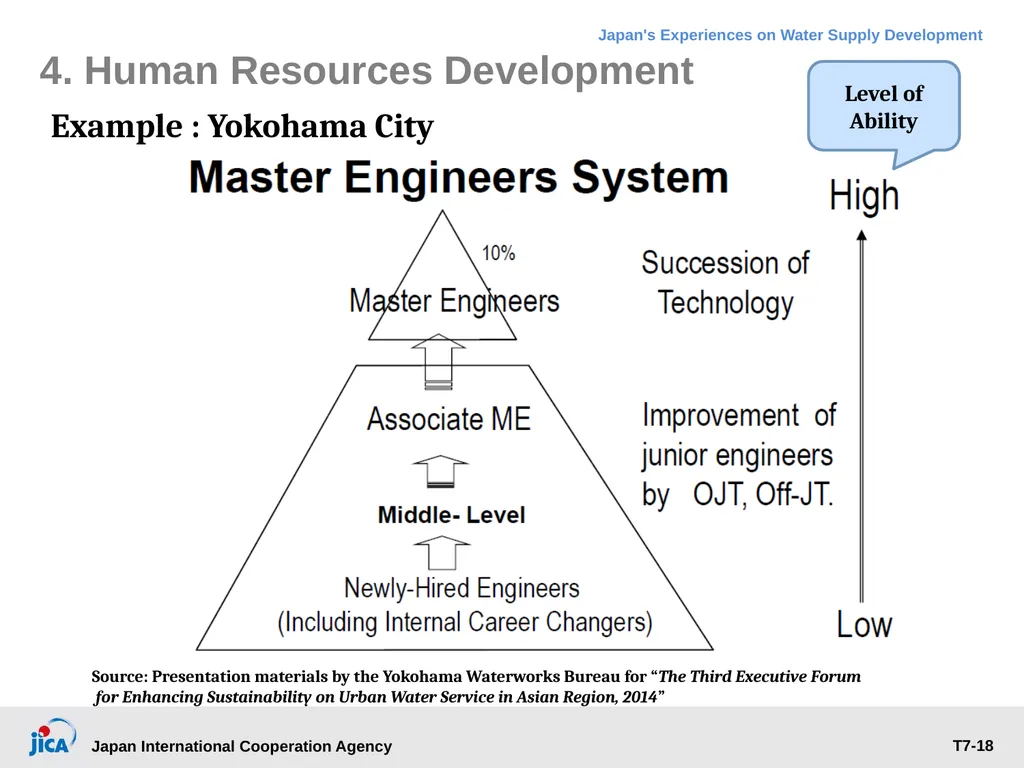
slide18. 4. Human Resources Development Source: Presentation materials by the Yokohama Waterworks Bureau for “The Third Executive Forum
for Enhancing Sustainability on Urban Water Service in Asian Region, 2014” Example : Yokohama City Level of Ability<br>
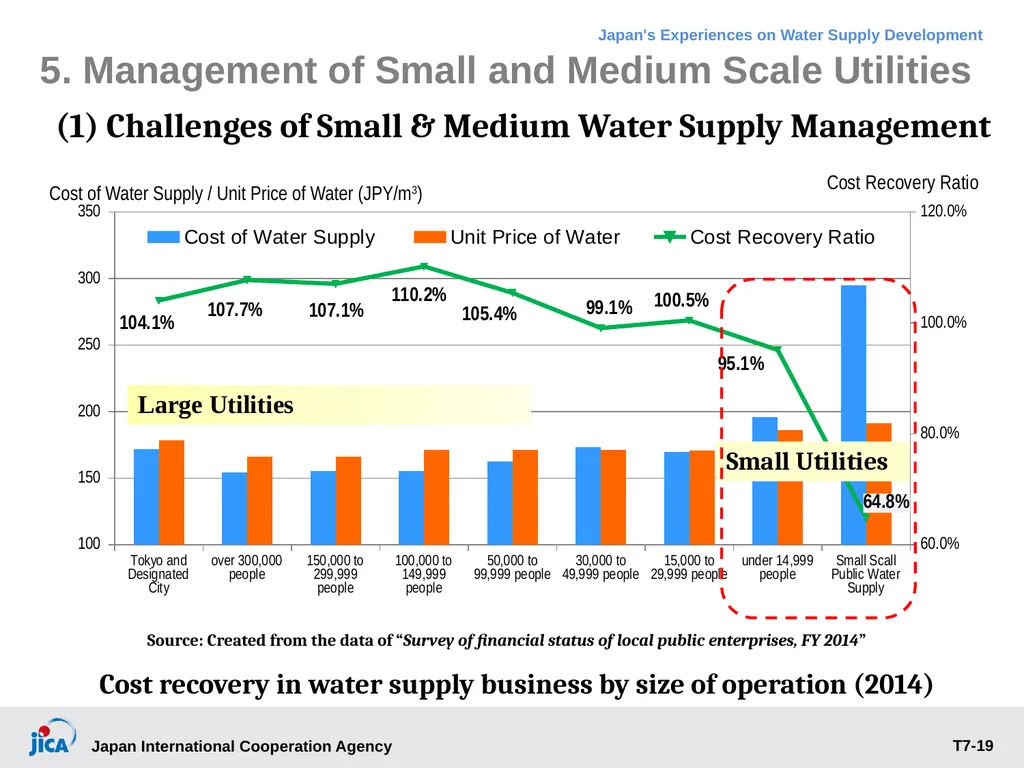
slide19. 5. Management of Small and Medium Scale Utilities Source: Created from the data of “Survey of financial status of local public enterprises, FY 2014” (1) Challenges of Small & Medium Water Supply Management Cost of Water Supply / Unit Price of Water (JPY/m3) Cost recovery in water supply business by size of operation (2014)<br>
slide20. Water tariffs are affected by local conditions, type of water source, degree of urbanization, composition of customer groups, etc. Source: JWWA, Comfortable Life with Water Supply and Transition of Water Supply Volume, http://www.jwwa.or.jp/shiryou/water/water.html Tariff Differential among Water Utilities 5. Management of Small and Medium Scale Utilities Water tariff for domestic use(JPY/20m3/month)<br>
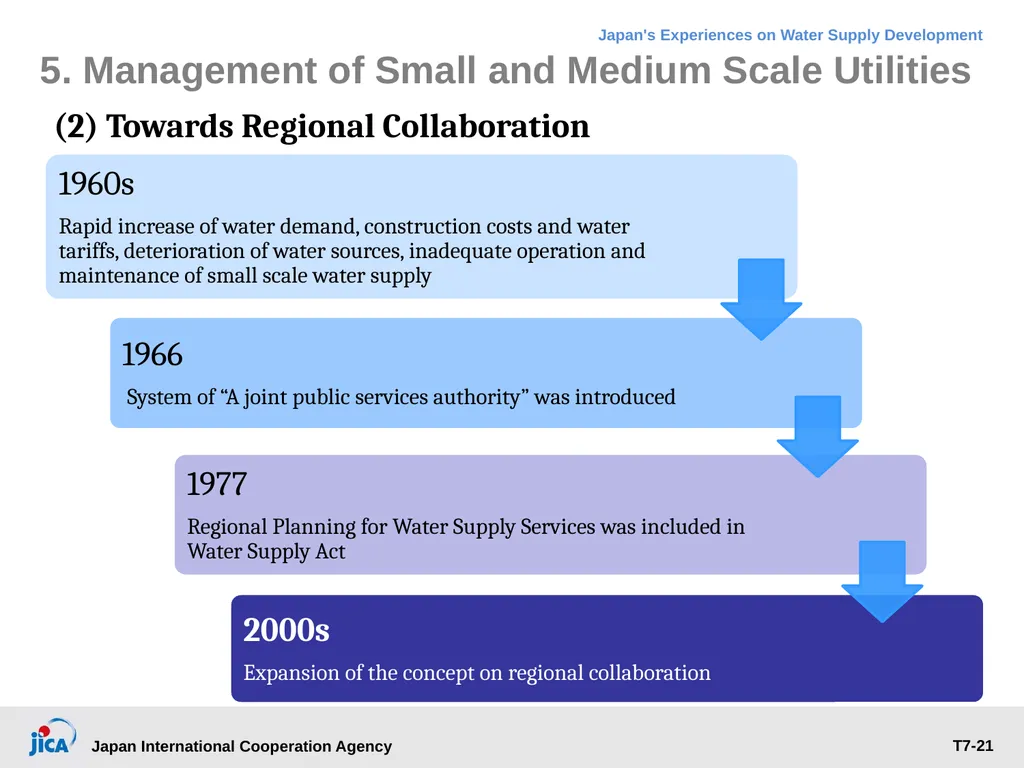
slide21. 5. Management of Small and Medium Scale Utilities (2) Towards Regional Collaboration<br>
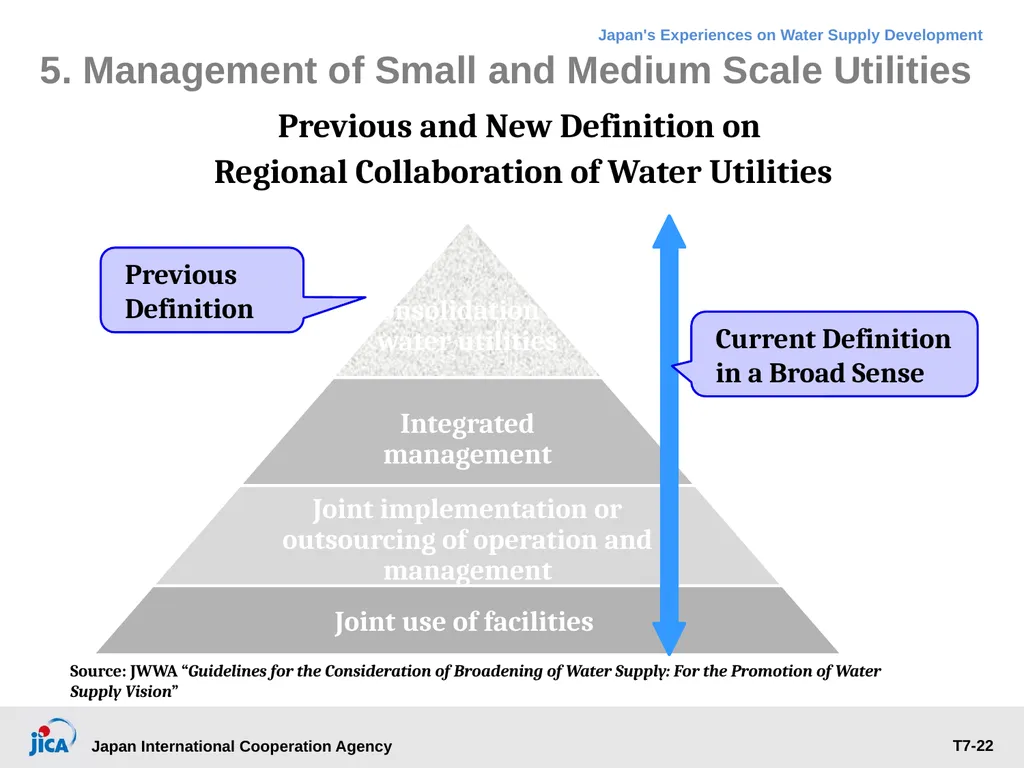
slide22. Source: JWWA “Guidelines for the Consideration of Broadening of Water Supply: For the Promotion of Water Supply Vision” Previous and New Definition on
Regional Collaboration of Water Utilities Current Definition in a Broad Sense Previous Definition 5. Management of Small and Medium Scale Utilities<br>
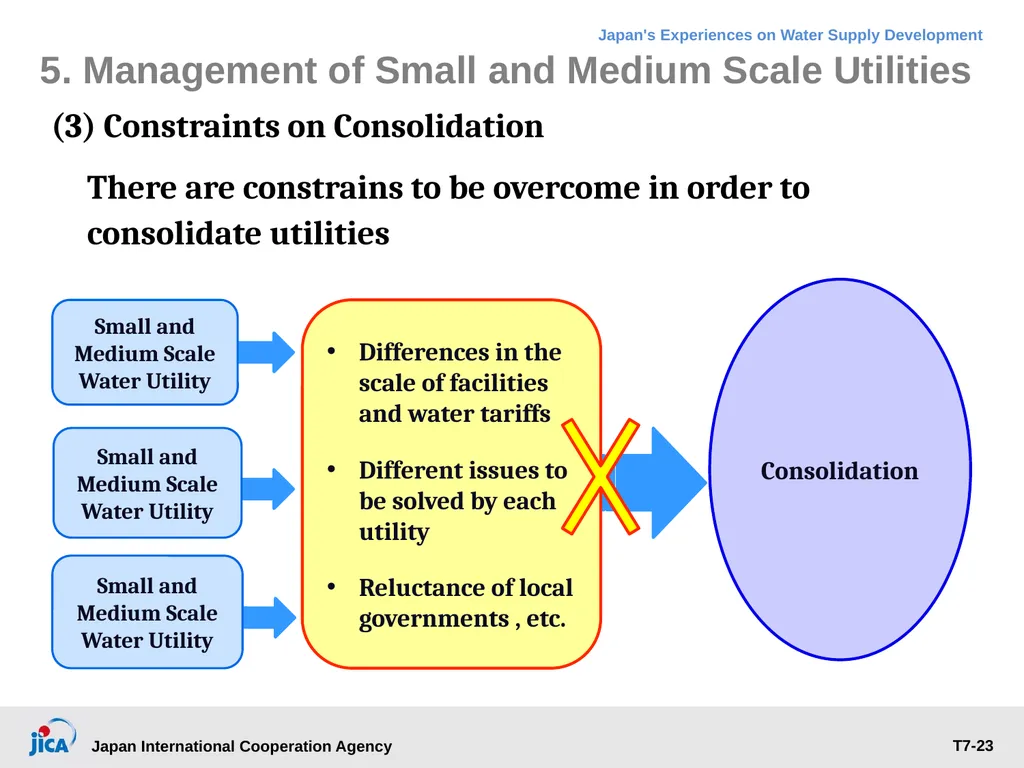
slide23. Small and Medium Scale Water Utility Small and Medium Scale Water Utility Small and Medium Scale Water Utility Consolidation 5. Management of Small and Medium Scale Utilities (3) Constraints on Consolidation Differences in the scale of facilities and water tariffs
Different issues to be solved by each utility
Reluctance of local governments , etc. There are constrains to be overcome in order to consolidate utilities<br>
slide24. 6. Public and Private Partnerships (1) Increasing Roles of Private Sector Design, Construction, O&M
・ Private Finance Initiative (PFI)<br>
slide25. Ministry or Prefecture Contractor (for water supply management service) Supervision Report A technical administrator from the contractor manages technical works of operation
Responsibility stipulated in the Water Supply Act is imposed on the contractor within the scope of works Supervision Consign technical works of operation based on consignment criteria Contract Supervision Preparation of work plan
Preparation of supply rules
Fulfillment of obligation of 24 hours water supply Management by a technical administrator Management of water supply facilities (operation, maintenance and inspection)
Management of water quality Customers Obligation of water supply based on agreements (Clarification of scope of works and sharing of responsibility stipulated in Water Supply Act ) 6. Public-Private Partnerships Source: Ministry of Health, Labour and Welfare, Third-Party Consignment for Water Supply Water Utility (2) System for Delegation to a Third Party<br>
slide26. Swing Corporation
(Business Partner) Shareholders Agreement Mizu Mirai Hiroshima Corporation (Public and Private Joint Venture) Works for Management and Operation of
Water Supply Facilities Works related to
Water Supply Management and operation of prefectural water supply facilities Management and operation of municipal water supply facilities Survey, Research, Development
Capacity development, Training Financing Companies
(Financial Agency) Contract Service
Delivery Charge for Service Service
Delivery Service Delivery Consignment
Contract Consignment
Fee Financing
Agreement Loan Refund Service Delivery Charge for
designated administration Designation of
designated administrator Investment (65%)
Dispatch of
Employee Dividend Dividend Investment (35%)
Dispatch of Official 6. Public-Private Partnerships Source: Mizu Mirai Hiroshima Corporation “Joint efforts of citizens in Mizu Mirai Hiroshima”, Water Technology Journal, October 2014 Example : Mizu Mirai Hiroshima Municipalities
(Water Utilities) Customers
(Municipalities, Companies) Hiroshima Prefectural Waterworks Bureau Companies in the Prefecture
(Public and Private Joint Venture requests consignment works and repairing works to companies in the Prefecture) (3) Designated Administrator System<br>
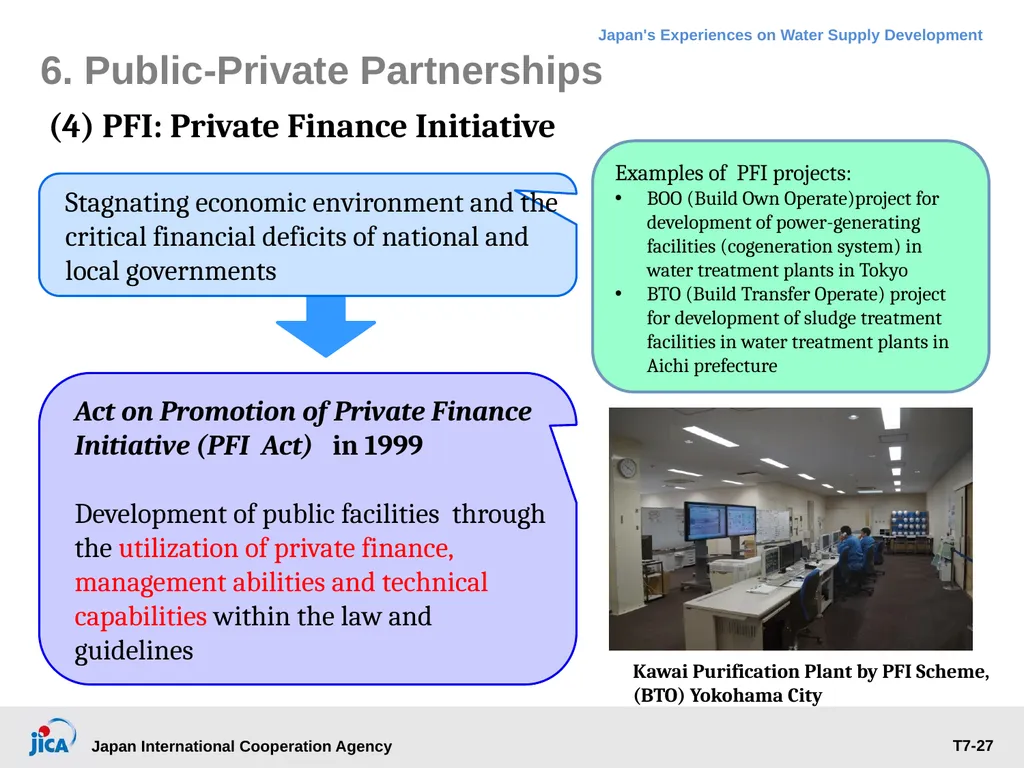
slide27. Kawai Purification Plant by PFI Scheme, (BTO) Yokohama City 6. Public-Private Partnerships Stagnating economic environment and the critical financial deficits of national and local governments Act on Promotion of Private Finance Initiative (PFI Act) in 1999
Development of public facilities through the utilization of private finance, management abilities and technical capabilities within the law and guidelines (4) PFI: Private Finance Initiative Examples of PFI projects:
BOO (Build Own Operate)project for development of power-generating facilities (cogeneration system) in water treatment plants in Tokyo
BTO (Build Transfer Operate) project for development of sludge treatment facilities in water treatment plants in Aichi prefecture<br>
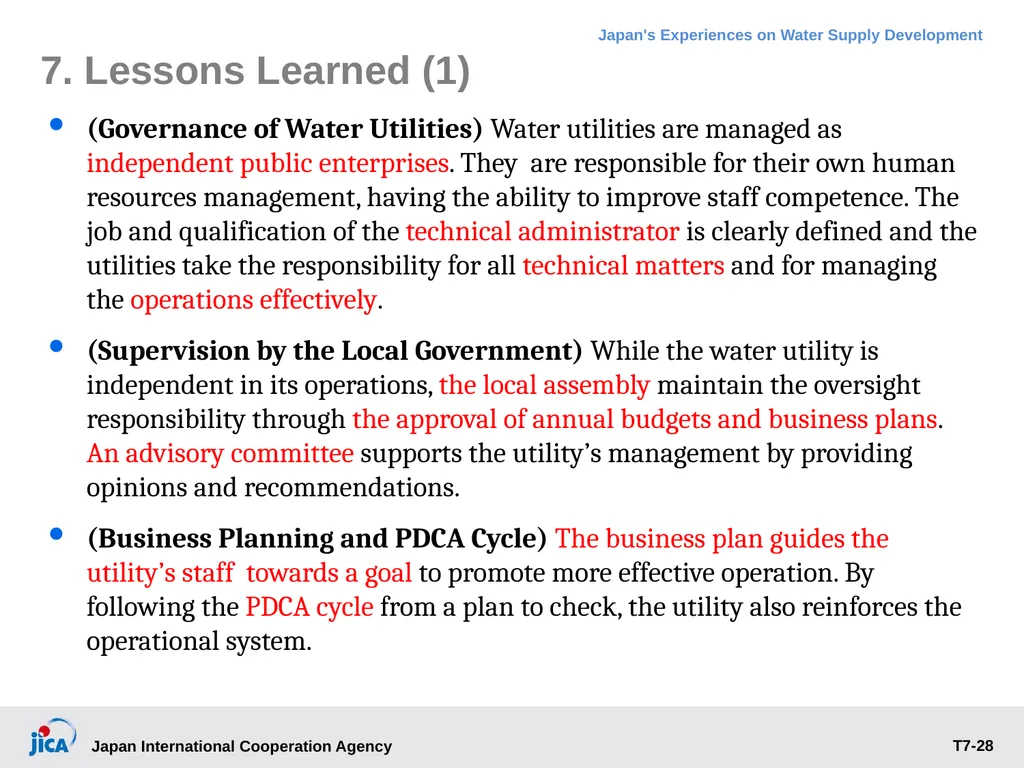
slide28. (Governance of Water Utilities) Water utilities are managed as independent public enterprises. They are responsible for their own human resources management, having the ability to improve staff competence. The job and qualification of the technical administrator is clearly defined and the utilities take the responsibility for all technical matters and for managing the operations effectively.
(Supervision by the Local Government) While the water utility is independent in its operations, the local assembly maintain the oversight responsibility through the approval of annual budgets and business plans. An advisory committee supports the utility’s management by providing opinions and recommendations.
(Business Planning and PDCA Cycle) The business plan guides the utility’s staff towards a goal to promote more effective operation. By following the PDCA cycle from a plan to check, the utility also reinforces the operational system. 7. Lessons Learned (1)<br>
slide29. (Training) In addition to subsidies and the development of technical guidelines/ standards, human resources development has been essential to the establishment and operation of water supply systems across the country. Research institutions and universities provide formal training to develop the required expertise. It is necessary for utilities to establish internal training systems and utilize external training programs for sustainable human resources management.
(Regional Collaboration) When constructing water supply systems, sustainability of operation and management after construction needs to be considered. Small-scale utilities built during the implementation of nationwide water supply coverage generally face difficulties with cost recovery and staff shortage. Consolidation and collaboration of operations across a region are the ways to improve the economies of scale and are promoted utilizing the national subsidies. 7. Lessons Learned (2)<br>
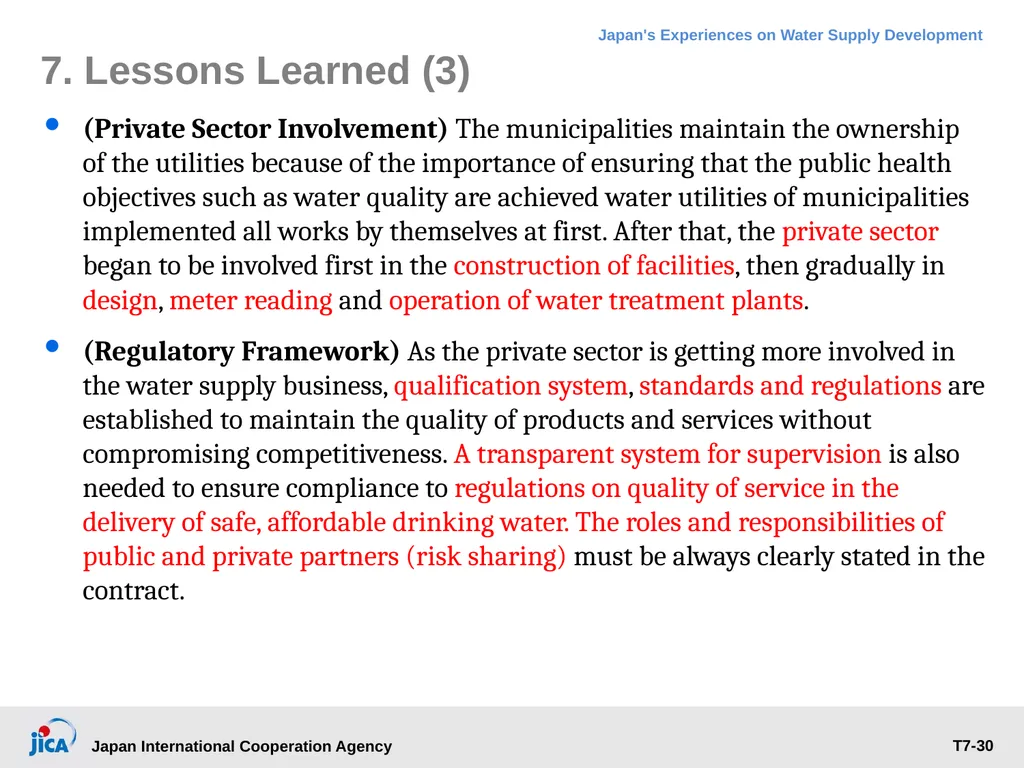
slide30. (Private Sector Involvement) The municipalities maintain the ownership of the utilities because of the importance of ensuring that the public health objectives such as water quality are achieved water utilities of municipalities implemented all works by themselves at first. After that, the private sector began to be involved first in the construction of facilities, then gradually in design, meter reading and operation of water treatment plants.
(Regulatory Framework) As the private sector is getting more involved in the water supply business, qualification system, standards and regulations are established to maintain the quality of products and services without compromising competitiveness. A transparent system for supervision is also needed to ensure compliance to regulations on quality of service in the delivery of safe, affordable drinking water. The roles and responsibilities of public and private partners (risk sharing) must be always clearly stated in the contract. 7. Lessons Learned (3)<br>
Source: Japan Water Works Association “Let’s drink tap water with the whole family“<br>
slide2. Contents Introduction
Governance
Business Plan and PDCA (Plan, Do, Check, Act) Cycle
Human Resources Development
Management of Small and Medium Scale Utilities
Public - Private Partnerships
Lessons Learned<br>
slide3. 1. Introduction Water Utilities
under
Local Governments Ministry of Internal Affairs and Communications
(MIC) : Local Public Enterprise Act
Administrative matters Ministry of Health, Labour and Welfare
(MHLW):
Water Supply Act
Technical matters Water Supply Administration<br>
slide4. 1. Introduction Q1. What is the governance of Japan's water utilities?
Q2. Why do Japan's water utilities emphasize business planning? What are the contents business plans?
Q3. How do Japan's water utilities develop capacities of human resources?
Q4. Do small and medium scale water supply utilities have any problems with finance and human resources? If they have problems, how do they attempt to overcome the problems?
Q5. How does Japan promote public-private partnerships in the field of water supply? Frequently asked questions from participants of the water supply training courses<br>
slide5. Basic and comprehensive policies on water resources development and water supply development
Technical and financial support to water utilities Policies/plans on water supply development, proper and reasonable water use, conservation of water sources and maintenance of water supply facilities
Implementation of those plans
Appropriate and efficient management of waterworks Regulation・Supervision・Support Water Supply Service Cooperation 2. Governance Cooperation with national and local policies
Proper and reasonable water use Goal:Water supply for public health and good living environment Citizens Local Government
(Water Utilities) National Government (1) Roles of the Government, Water Utilities and Citizens<br>
slide6. Request for deliberation 2. Governance Advisory committee Advise on administrative management Regulation & Supervision of Water Utilities Local Government Water Utility
Independently operated under Local Assembly Appointment Mayor Submission of bills (including the budget, water tariff revision) No general (daily) supervision & control Executive Managing Director of Public Enterprise Proposal of an annual budget, business plan, water tariff revision, etc. Approval of the bills concerning water supply business A water utility is independently operated, but regulated and supervised by the local government and the assembly through checks of an annual budget, a business plan, etc.<br>
slide7. 2. Governance Executive Managing Director
of Public Enterprise Technical Administrator Administrative Management Technical Management Establishing necessary sections and/or department
Taking charge of employment/dismissal of employees, wages, work hours and other working conditions, punishment, training, etc.
Preparing a draft of the budget and the settlement of accounts
Preparing data for a motion to the local assembly
Acquiring, managing and disposing assets
Concluding agreements/contracts
Collecting tariff, fees other than tariff, contribution, and connection charges, etc.
Carrying out temporary borrowing Inspecting water supply facilities based on the standards for facilities
Conducting water quality inspection and facility inspection
Conducting inspection of the structure and material of service connections
Health checkups
Emergency suspension of water supply (2) Roles of Executive Managing Director & Technical Administrator Water utilities have been properly managed under the technical administrators and the executive managing directors of public enterprises<br>
slide8. 2. Governance Planning Section Finance Section Check-and-balance Cooperation More money required for new construction Limited financial sources Check-and-balance Open Discussion Example: Tokyo Metropolitan Government Accounting Section (3) Organizational Management Water tariff collection section<br>
slide9. 2. Governance Planning Section Other related Section Ad hoc committees
for important issues (NRW reduction, etc.) Customer Service Section Example: Tokyo Metropolitan Government (Cont’d) Finance Section<br>
slide10. 2. Governance Advisory committee ensures:
accountability and information disclosure (utility has to make the case for revisions);
objectivity in the decision-making process;
use of expert advice from members;
incorporation of customer input from representatives in the committee. An advisory committee is an affiliated organization ruled by the Local Autonomy Act and conducts screening, deliberations, investigations, etc. of management of a local government. (4) Advisory Committee Advisory committee on waterworks management in Koriyama City https://www.city.koriyama.fukushima.jp/481000/jogesuido/shingikai.html<br>
slide11. Request for deliberation 2. Governance Water Utility Advisory committee Administrative Management Technical Management Executive Managing Director of Public Enterprise Technical Administrator Supervise Supervise Advise on administrative management (5) Concept of Governance for Water Utility Ministry of Internal Affairs and Communications
(MIC) : Local Public Enterprise Act Ministry of Health, Labour and Welfare
(MHLW):
Water Supply Act<br>
slide12. 3. Business Plan and PDCA Cycle Water Supply Development based on Plans<br>
slide13. 3. Business Plan and PDCA Basic Policy and Integrated Master Plan of Kyoto City Water Supply Master Plan (2001~2025) Sewerage
Master Plan (2001~2025) Kyoto City’s Water Vision
(2008~2017) Goals and issues to be solved Mid- Term Business Plan
(2008-2012)&(2013-2017) Vision & Plan of Waterworks Bureau Management Strategy (Business Plan) of Waterworks Bureau Example: Kyoto City<br>
slide14. 3. Business Plan and PDCA Cycle Vision of Kyoto City Waterworks Bureau Plan Act Do Check Customers Information Disclosure Progress review & Management Example: Kyoto City (Cont’d)<br>
slide15. 4. Human Resources Development National Institute of Public Health
The old building constructed in 1938. Know-how on curriculum and teaching methods Training of utilities’ staff Provision of young water supply engineers Source: National Institute of Public Health Nationwide water supply coverage National Initiatives for Human Resources Development
to Achieve Nationwide Water Supply Coverage Water Utilities National Universities<br>
slide16. 4. Human Resources Development No standardized instructional method Standardized know-how of procedures and operations Example : Nagoya City<br>
slide17. 4. Human Resources Development Leak Detection Valve Operation Endoscope Leakage Repair Source: Presentation materials by the Nagoya City Waterworks and Sewerage Bureau in the Report of “The Third Executive Forum for Enhancing Sustainability of Urban Water Service in the Asian Region”, August 2014 Example : Nagoya City (Cont’d)<br>
slide18. 4. Human Resources Development Source: Presentation materials by the Yokohama Waterworks Bureau for “The Third Executive Forum
for Enhancing Sustainability on Urban Water Service in Asian Region, 2014” Example : Yokohama City Level of Ability<br>
slide19. 5. Management of Small and Medium Scale Utilities Source: Created from the data of “Survey of financial status of local public enterprises, FY 2014” (1) Challenges of Small & Medium Water Supply Management Cost of Water Supply / Unit Price of Water (JPY/m3) Cost recovery in water supply business by size of operation (2014)<br>
slide20. Water tariffs are affected by local conditions, type of water source, degree of urbanization, composition of customer groups, etc. Source: JWWA, Comfortable Life with Water Supply and Transition of Water Supply Volume, http://www.jwwa.or.jp/shiryou/water/water.html Tariff Differential among Water Utilities 5. Management of Small and Medium Scale Utilities Water tariff for domestic use(JPY/20m3/month)<br>
slide21. 5. Management of Small and Medium Scale Utilities (2) Towards Regional Collaboration<br>
slide22. Source: JWWA “Guidelines for the Consideration of Broadening of Water Supply: For the Promotion of Water Supply Vision” Previous and New Definition on
Regional Collaboration of Water Utilities Current Definition in a Broad Sense Previous Definition 5. Management of Small and Medium Scale Utilities<br>
slide23. Small and Medium Scale Water Utility Small and Medium Scale Water Utility Small and Medium Scale Water Utility Consolidation 5. Management of Small and Medium Scale Utilities (3) Constraints on Consolidation Differences in the scale of facilities and water tariffs
Different issues to be solved by each utility
Reluctance of local governments , etc. There are constrains to be overcome in order to consolidate utilities<br>
slide24. 6. Public and Private Partnerships (1) Increasing Roles of Private Sector Design, Construction, O&M
・ Private Finance Initiative (PFI)<br>
slide25. Ministry or Prefecture Contractor (for water supply management service) Supervision Report A technical administrator from the contractor manages technical works of operation
Responsibility stipulated in the Water Supply Act is imposed on the contractor within the scope of works Supervision Consign technical works of operation based on consignment criteria Contract Supervision Preparation of work plan
Preparation of supply rules
Fulfillment of obligation of 24 hours water supply Management by a technical administrator Management of water supply facilities (operation, maintenance and inspection)
Management of water quality Customers Obligation of water supply based on agreements (Clarification of scope of works and sharing of responsibility stipulated in Water Supply Act ) 6. Public-Private Partnerships Source: Ministry of Health, Labour and Welfare, Third-Party Consignment for Water Supply Water Utility (2) System for Delegation to a Third Party<br>
slide26. Swing Corporation
(Business Partner) Shareholders Agreement Mizu Mirai Hiroshima Corporation (Public and Private Joint Venture) Works for Management and Operation of
Water Supply Facilities Works related to
Water Supply Management and operation of prefectural water supply facilities Management and operation of municipal water supply facilities Survey, Research, Development
Capacity development, Training Financing Companies
(Financial Agency) Contract Service
Delivery Charge for Service Service
Delivery Service Delivery Consignment
Contract Consignment
Fee Financing
Agreement Loan Refund Service Delivery Charge for
designated administration Designation of
designated administrator Investment (65%)
Dispatch of
Employee Dividend Dividend Investment (35%)
Dispatch of Official 6. Public-Private Partnerships Source: Mizu Mirai Hiroshima Corporation “Joint efforts of citizens in Mizu Mirai Hiroshima”, Water Technology Journal, October 2014 Example : Mizu Mirai Hiroshima Municipalities
(Water Utilities) Customers
(Municipalities, Companies) Hiroshima Prefectural Waterworks Bureau Companies in the Prefecture
(Public and Private Joint Venture requests consignment works and repairing works to companies in the Prefecture) (3) Designated Administrator System<br>
slide27. Kawai Purification Plant by PFI Scheme, (BTO) Yokohama City 6. Public-Private Partnerships Stagnating economic environment and the critical financial deficits of national and local governments Act on Promotion of Private Finance Initiative (PFI Act) in 1999
Development of public facilities through the utilization of private finance, management abilities and technical capabilities within the law and guidelines (4) PFI: Private Finance Initiative Examples of PFI projects:
BOO (Build Own Operate)project for development of power-generating facilities (cogeneration system) in water treatment plants in Tokyo
BTO (Build Transfer Operate) project for development of sludge treatment facilities in water treatment plants in Aichi prefecture<br>
slide28. (Governance of Water Utilities) Water utilities are managed as independent public enterprises. They are responsible for their own human resources management, having the ability to improve staff competence. The job and qualification of the technical administrator is clearly defined and the utilities take the responsibility for all technical matters and for managing the operations effectively.
(Supervision by the Local Government) While the water utility is independent in its operations, the local assembly maintain the oversight responsibility through the approval of annual budgets and business plans. An advisory committee supports the utility’s management by providing opinions and recommendations.
(Business Planning and PDCA Cycle) The business plan guides the utility’s staff towards a goal to promote more effective operation. By following the PDCA cycle from a plan to check, the utility also reinforces the operational system. 7. Lessons Learned (1)<br>
slide29. (Training) In addition to subsidies and the development of technical guidelines/ standards, human resources development has been essential to the establishment and operation of water supply systems across the country. Research institutions and universities provide formal training to develop the required expertise. It is necessary for utilities to establish internal training systems and utilize external training programs for sustainable human resources management.
(Regional Collaboration) When constructing water supply systems, sustainability of operation and management after construction needs to be considered. Small-scale utilities built during the implementation of nationwide water supply coverage generally face difficulties with cost recovery and staff shortage. Consolidation and collaboration of operations across a region are the ways to improve the economies of scale and are promoted utilizing the national subsidies. 7. Lessons Learned (2)<br>
slide30. (Private Sector Involvement) The municipalities maintain the ownership of the utilities because of the importance of ensuring that the public health objectives such as water quality are achieved water utilities of municipalities implemented all works by themselves at first. After that, the private sector began to be involved first in the construction of facilities, then gradually in design, meter reading and operation of water treatment plants.
(Regulatory Framework) As the private sector is getting more involved in the water supply business, qualification system, standards and regulations are established to maintain the quality of products and services without compromising competitiveness. A transparent system for supervision is also needed to ensure compliance to regulations on quality of service in the delivery of safe, affordable drinking water. The roles and responsibilities of public and private partners (risk sharing) must be always clearly stated in the contract. 7. Lessons Learned (3)<br>