
Instructions for use Instructions for the teacher
MT
Published · 27 slides · 0 views
1 / 1
Description
Instructions for use Instructions for the teacher This resource is not a teaching and learning program. . It should be used in conjunction with 12.4 The craft of writing English Advanced program available on the English Advanced page of
Related Topics
Share
Embed code
Download this presentation From Below
"Instructions for use Instructions for the teacher" is the property of its rightful owner. Permission is granted to download and print the materials on this website for personal, non-commercial use only, and to display it on your personal computer provided you do not modify the materials and that you retain all copyright notices contained in the materials. By downloading content from our website, you accept the terms of this agreement.
Presentation Transcript
01
Instructions for use Instructions for the teacher This resource is not a teaching and learning program. . It should be used in conjunction with 12.4 – ‘The craft of writing’ English Advanced program available on the English Advanced page of Planning programming and assessing English 11–12.
Classroom teachers are encouraged to add and adapt slides as required to meet the needs of their students.
Save a copy of the file to make changes to the slide deck. Go to File > Download a Copy (this downloads a copy to the computer to edit in the PowerPoint app).
To convert the PowerPoint to Google Slides:
Upload the file into Google Drive and open it.
Go to File > Save as Google Slides.
(Note – conversion may cause formatting changes in the slides.) 1<br>
Classroom teachers are encouraged to add and adapt slides as required to meet the needs of their students.
Save a copy of the file to make changes to the slide deck. Go to File > Download a Copy (this downloads a copy to the computer to edit in the PowerPoint app).
To convert the PowerPoint to Google Slides:
Upload the file into Google Drive and open it.
Go to File > Save as Google Slides.
(Note – conversion may cause formatting changes in the slides.) 1<br>
02
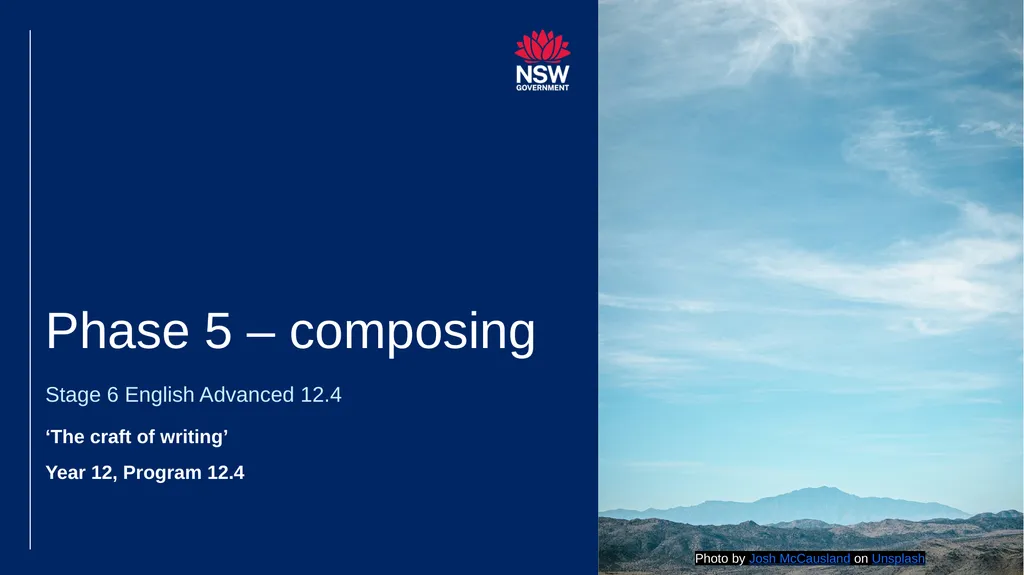
Phase 5 – composing Stage 6 English Advanced 12.4 ‘The craft of writing’ Year 12, Program 12.4 Photo by Josh McCausland on Unsplash<br>
03
Text complexity details Core text 2 – The Yield by Tara June Winch This Australian print text by an Aboriginal author is a contemporary literary novel that experiments with structure, voice and mode. It interweaves a realist narrative with archival style documents and a glossary of Wiradjuri language entries, requiring readers to synthesise meaning across sections and perspective. The writing contains lyrical imagery, tonal shifts, extended multi-clause sentences and fragmentation that invites inference and layered meaning. These features align with the complex and highly complex levels of the Text Complexity scale which can be downloaded on the General capabilities downloads page of the Australian Curriculum webpage. 3<br>
04
Licence agreement details Core text 2 – The Yield by Tara June Winch Winch T J (2021) The Yield, Penguin Random House Australia, Sydney. ISBN: 978-1760896883.
Reproduced and made available for copying and communication by NSW Department of Education for its educational purposes with the permission of The Penguin Random House Australia Pty Ltd. This resource is licenced up until April 2031. 4<br>
Reproduced and made available for copying and communication by NSW Department of Education for its educational purposes with the permission of The Penguin Random House Australia Pty Ltd. This resource is licenced up until April 2031. 4<br>
05
The Yield extracts Instructions for teacher References in activities to Core text 2, extracts 1, 2 and 3 from The Yield refer to the 3 extracts provided in the core text booklet. The opening words of each excerpt used from the extract are included in the title to support identification. 5<br>
06
Working with Aboriginal and Torres Strait Islander Histories and Cultures Aboriginal and Torres Strait Islander principles and protocols Some consistent principles associated with the teaching of Aboriginal and Torres Strait Islander Histories and Cultures include:
respect for, and protection of, the knowledge and cultural expressions of Aboriginal and Torres Strait Islander Peoples
ongoing consultation with Aboriginal and Torres Strait Islander knowledge holders and keepers, custodians and stakeholders
reciprocity between education providers and communities
recognition of Indigenous Cultural and Intellectual Property 6<br>
respect for, and protection of, the knowledge and cultural expressions of Aboriginal and Torres Strait Islander Peoples
ongoing consultation with Aboriginal and Torres Strait Islander knowledge holders and keepers, custodians and stakeholders
reciprocity between education providers and communities
recognition of Indigenous Cultural and Intellectual Property 6<br>
07
Connection with community and elders NSW Aboriginal Education Consultative Group Connection with community and Elders would help with the learning and understanding of this text. This could happen through connection with your local NSW Aboriginal Education Consultative Group (AEGC) NSW AECG Inc. and/or Aboriginal communities.
Note
‘The NSW AECG is a non for profit (sic) Aboriginal organisation that provides advice on all matters relevant to education and training with the mandate that this advice represents the Aboriginal community viewpoint.
The NSW AECG Inc. promotes respect, empowerment and self-determination and believes the process of collaborative consultation is integral to equal partnership and is fundamental to the achievement of equality.’ (AECG, n.d.) 7<br>
Note
‘The NSW AECG is a non for profit (sic) Aboriginal organisation that provides advice on all matters relevant to education and training with the mandate that this advice represents the Aboriginal community viewpoint.
The NSW AECG Inc. promotes respect, empowerment and self-determination and believes the process of collaborative consultation is integral to equal partnership and is fundamental to the achievement of equality.’ (AECG, n.d.) 7<br>
08
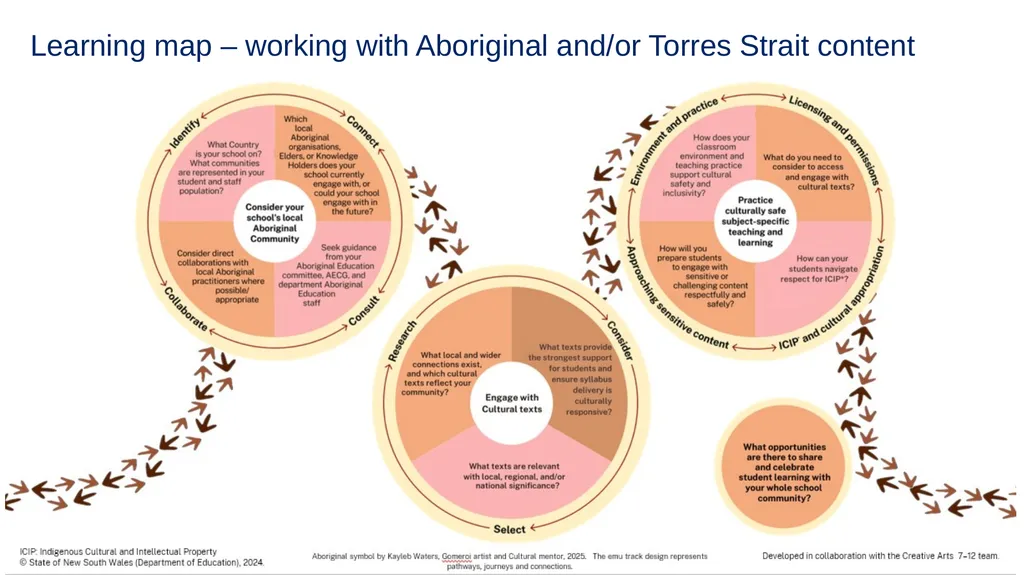
Learning map – working with Aboriginal and/or Torres Strait content<br>
09
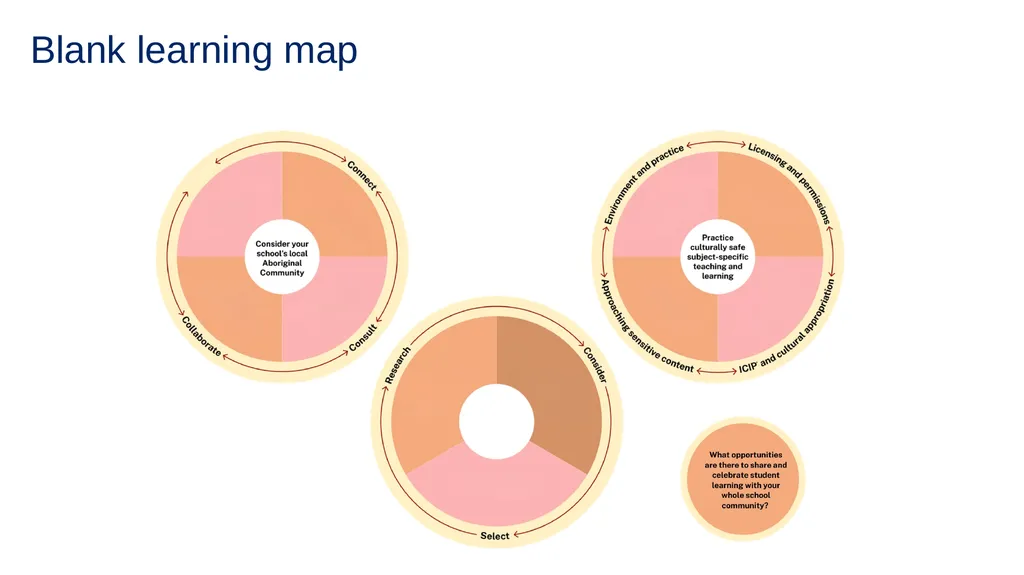
Blank learning map 9<br>
10
Promoting culturally inclusive classrooms How to use the English core texts Many texts by Aboriginal and/or Torres Strait Islander authors that are valuable teaching tools for the classroom, explore the ongoing impacts of colonisation. Due to the potentially sensitive nature of some of the content, it is essential that teachers create a safe space for students and help develop mutual respect and understanding between members of the classroom community.
Be aware of cultural load
Know your students' backgrounds
Prepare students for the topic
Safe and respectful discussions 10<br>
Be aware of cultural load
Know your students' backgrounds
Prepare students for the topic
Safe and respectful discussions 10<br>
11
Text sensitivity warning Core text 2 – The Yield When teaching about the experiences of Aboriginal and Torres Strait Islander peoples, it is essential to approach the content with care, cultural respect and professional sensitivity. The Yield explores themes that require both teachers and students to be aware of the emotional and cultural weight of the issues represented. The novel includes references to sexual abuse, violence, cultural dispossession and the ongoing effects of intergenerational trauma, including its impact on wellbeing and community life. These themes should be acknowledged thoughtfully, with consideration given to how they may affect students in different ways.
It is important to establish a classroom environment where students feel safe, respected and supported when engaging in discussions connected to these ideas. Aboriginal and Torres Strait Islander students, in particular, should be supported in ways that respect their agency and wellbeing, without placing expectations on them to share personal perspectives or experiences. 11<br>
It is important to establish a classroom environment where students feel safe, respected and supported when engaging in discussions connected to these ideas. Aboriginal and Torres Strait Islander students, in particular, should be supported in ways that respect their agency and wellbeing, without placing expectations on them to share personal perspectives or experiences. 11<br>
12
Sharing learning intentions and success criteria<br>
13
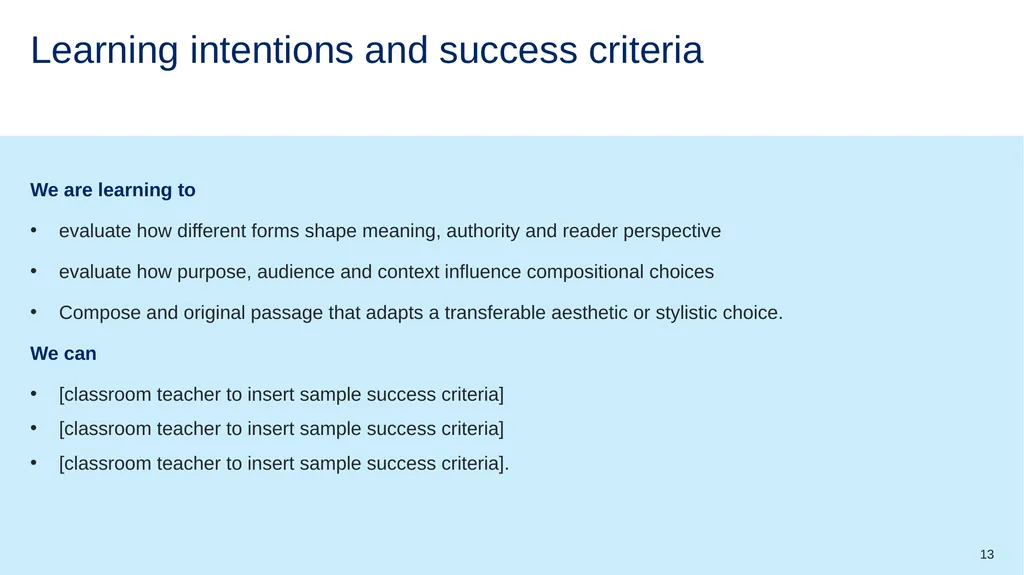
13 Learning intentions and success criteria We are learning to
evaluate how different forms shape meaning, authority and reader perspective
evaluate how purpose, audience and context influence compositional choices
Compose and original passage that adapts a transferable aesthetic or stylistic choice.
We can
[classroom teacher to insert sample success criteria]
[classroom teacher to insert sample success criteria]
[classroom teacher to insert sample success criteria].<br>
evaluate how different forms shape meaning, authority and reader perspective
evaluate how purpose, audience and context influence compositional choices
Compose and original passage that adapts a transferable aesthetic or stylistic choice.
We can
[classroom teacher to insert sample success criteria]
[classroom teacher to insert sample success criteria]
[classroom teacher to insert sample success criteria].<br>
14
Gradual release of responsibility<br>
15
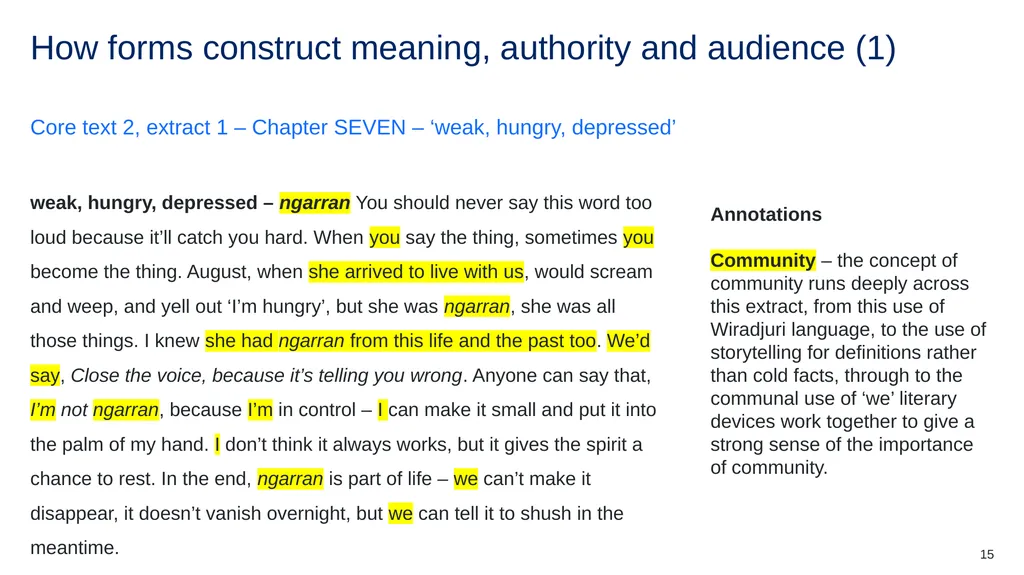
How forms construct meaning, authority and audience (1) Core text 2, extract 1 – Chapter SEVEN – ‘weak, hungry, depressed’ weak, hungry, depressed – ngarran You should never say this word too loud because it’ll catch you hard. When you say the thing, sometimes you become the thing. August, when she arrived to live with us, would scream and weep, and yell out ‘I’m hungry’, but she was ngarran, she was all those things. I knew she had ngarran from this life and the past too. We’d say, Close the voice, because it’s telling you wrong. Anyone can say that, I’m not ngarran, because I’m in control – I can make it small and put it into the palm of my hand. I don’t think it always works, but it gives the spirit a chance to rest. In the end, ngarran is part of life – we can’t make it disappear, it doesn’t vanish overnight, but we can tell it to shush in the meantime. Annotations
Community – the concept of community runs deeply across this extract, from this use of Wiradjuri language, to the use of storytelling for definitions rather than cold facts, through to the communal use of ‘we’ literary devices work together to give a strong sense of the importance of community. 15<br>
Community – the concept of community runs deeply across this extract, from this use of Wiradjuri language, to the use of storytelling for definitions rather than cold facts, through to the communal use of ‘we’ literary devices work together to give a strong sense of the importance of community. 15<br>
16
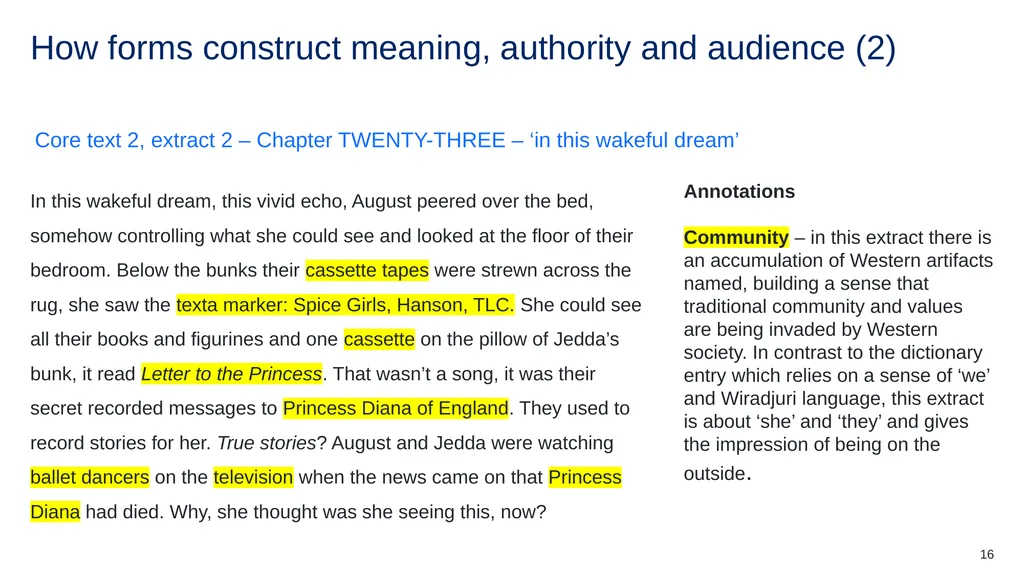
How forms construct meaning, authority and audience (2) Core text 2, extract 2 – Chapter TWENTY-THREE – ‘in this wakeful dream’ In this wakeful dream, this vivid echo, August peered over the bed, somehow controlling what she could see and looked at the floor of their bedroom. Below the bunks their cassette tapes were strewn across the rug, she saw the texta marker: Spice Girls, Hanson, TLC. She could see all their books and figurines and one cassette on the pillow of Jedda’s bunk, it read Letter to the Princess. That wasn’t a song, it was their secret recorded messages to Princess Diana of England. They used to record stories for her. True stories? August and Jedda were watching ballet dancers on the television when the news came on that Princess Diana had died. Why, she thought was she seeing this, now? Annotations
Community – in this extract there is an accumulation of Western artifacts named, building a sense that traditional community and values are being invaded by Western society. In contrast to the dictionary entry which relies on a sense of ‘we’ and Wiradjuri language, this extract is about ‘she’ and ‘they’ and gives the impression of being on the outside. 16<br>
Community – in this extract there is an accumulation of Western artifacts named, building a sense that traditional community and values are being invaded by Western society. In contrast to the dictionary entry which relies on a sense of ‘we’ and Wiradjuri language, this extract is about ‘she’ and ‘they’ and gives the impression of being on the outside. 16<br>
17
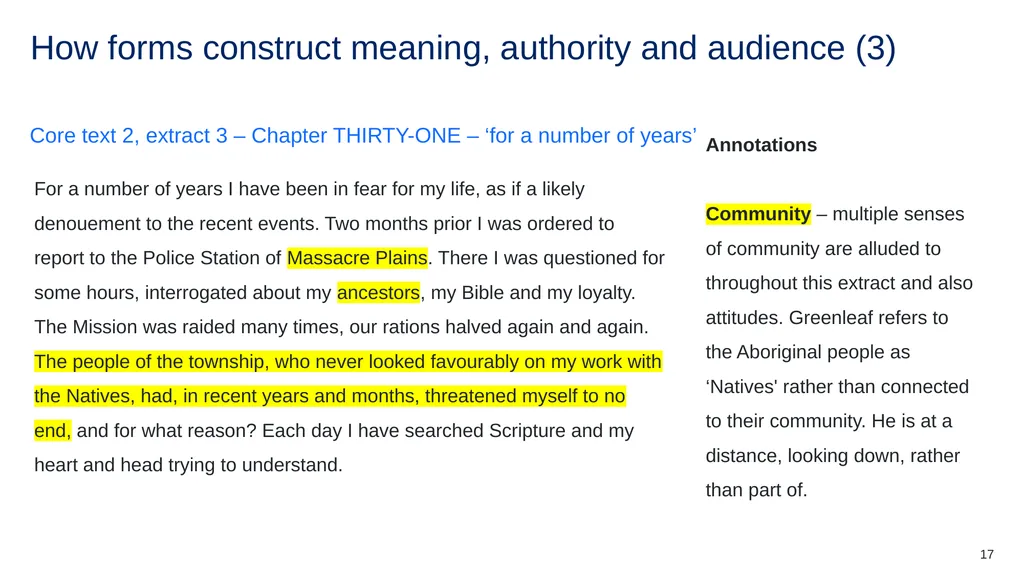
How forms construct meaning, authority and audience (3) Core text 2, extract 3 – Chapter THIRTY-ONE – ‘for a number of years’ For a number of years I have been in fear for my life, as if a likely denouement to the recent events. Two months prior I was ordered to report to the Police Station of Massacre Plains. There I was questioned for some hours, interrogated about my ancestors, my Bible and my loyalty. The Mission was raided many times, our rations halved again and again. The people of the township, who never looked favourably on my work with the Natives, had, in recent years and months, threatened myself to no end, and for what reason? Each day I have searched Scripture and my heart and head trying to understand. Annotations
Community – multiple senses of community are alluded to throughout this extract and also attitudes. Greenleaf refers to the Aboriginal people as ‘Natives' rather than connected to their community. He is at a distance, looking down, rather than part of. 17<br>
Community – multiple senses of community are alluded to throughout this extract and also attitudes. Greenleaf refers to the Aboriginal people as ‘Natives' rather than connected to their community. He is at a distance, looking down, rather than part of. 17<br>
18
Phase 5 – composing – teacher modelled responses Stage 6 English Advanced 12.4 ‘The craft of writing’ Year 12, Program 12.4 Illustration by Round Icons on Unsplash<br>
19
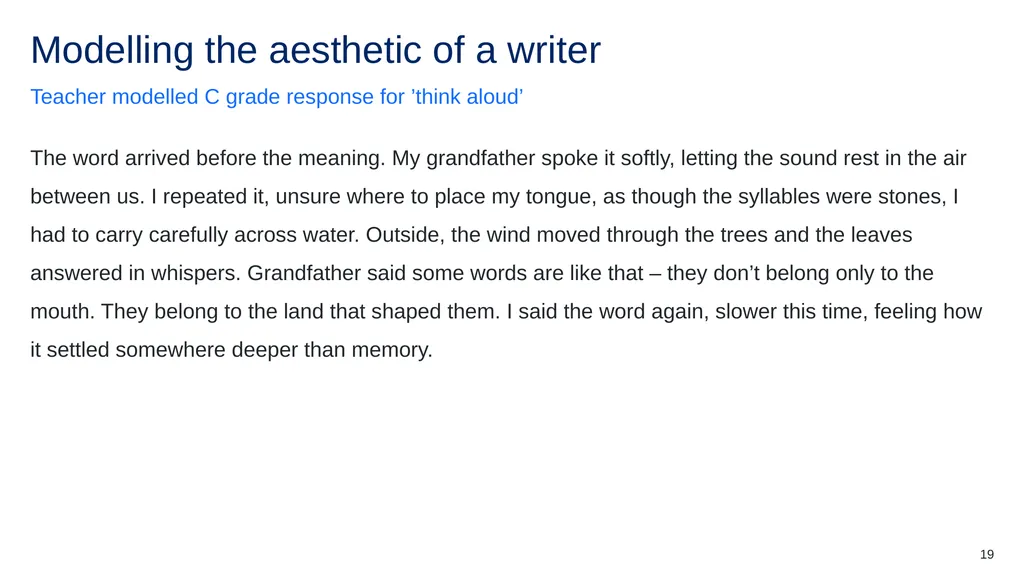
Modelling the aesthetic of a writer Teacher modelled C grade response for ’think aloud’ The word arrived before the meaning. My grandfather spoke it softly, letting the sound rest in the air between us. I repeated it, unsure where to place my tongue, as though the syllables were stones, I had to carry carefully across water. Outside, the wind moved through the trees and the leaves answered in whispers. Grandfather said some words are like that – they don’t belong only to the mouth. They belong to the land that shaped them. I said the word again, slower this time, feeling how it settled somewhere deeper than memory. 19<br>
20
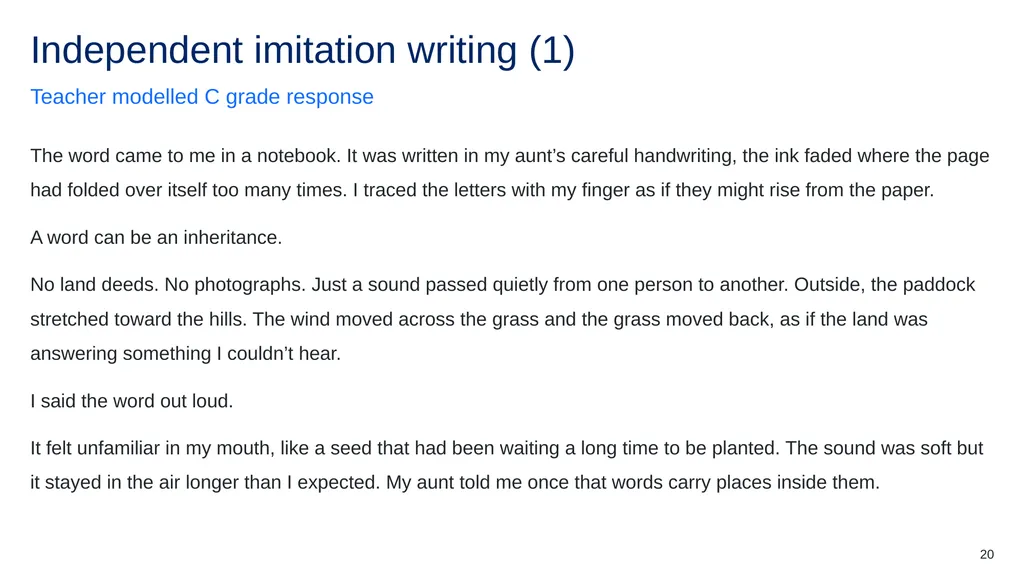
Independent imitation writing (1) Teacher modelled C grade response The word came to me in a notebook. It was written in my aunt’s careful handwriting, the ink faded where the page had folded over itself too many times. I traced the letters with my finger as if they might rise from the paper.
A word can be an inheritance.
No land deeds. No photographs. Just a sound passed quietly from one person to another. Outside, the paddock stretched toward the hills. The wind moved across the grass and the grass moved back, as if the land was answering something I couldn’t hear.
I said the word out loud.
It felt unfamiliar in my mouth, like a seed that had been waiting a long time to be planted. The sound was soft but it stayed in the air longer than I expected. My aunt told me once that words carry places inside them. 20<br>
A word can be an inheritance.
No land deeds. No photographs. Just a sound passed quietly from one person to another. Outside, the paddock stretched toward the hills. The wind moved across the grass and the grass moved back, as if the land was answering something I couldn’t hear.
I said the word out loud.
It felt unfamiliar in my mouth, like a seed that had been waiting a long time to be planted. The sound was soft but it stayed in the air longer than I expected. My aunt told me once that words carry places inside them. 20<br>
21
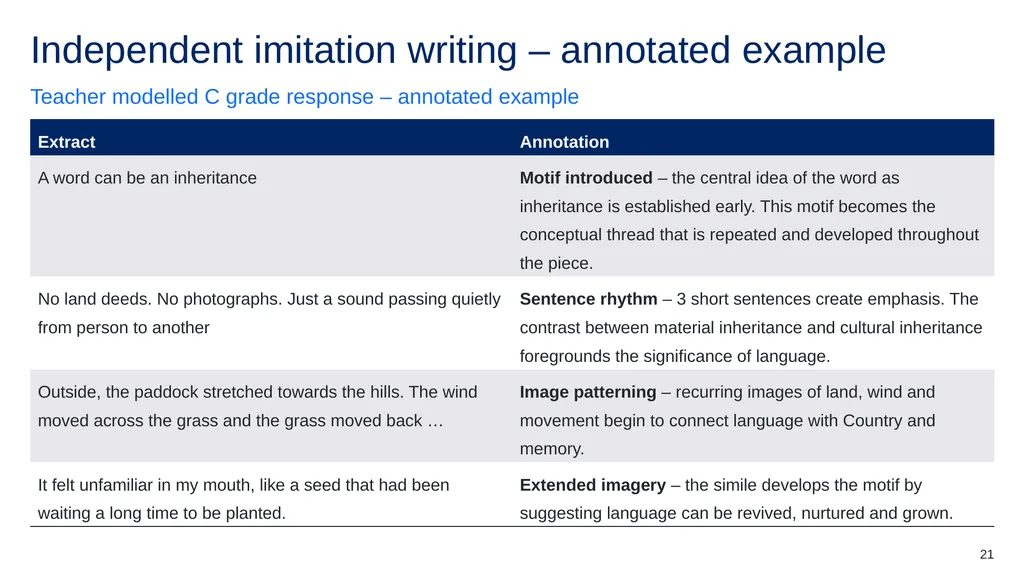
Independent imitation writing – annotated example Teacher modelled C grade response – annotated example 21<br>
22
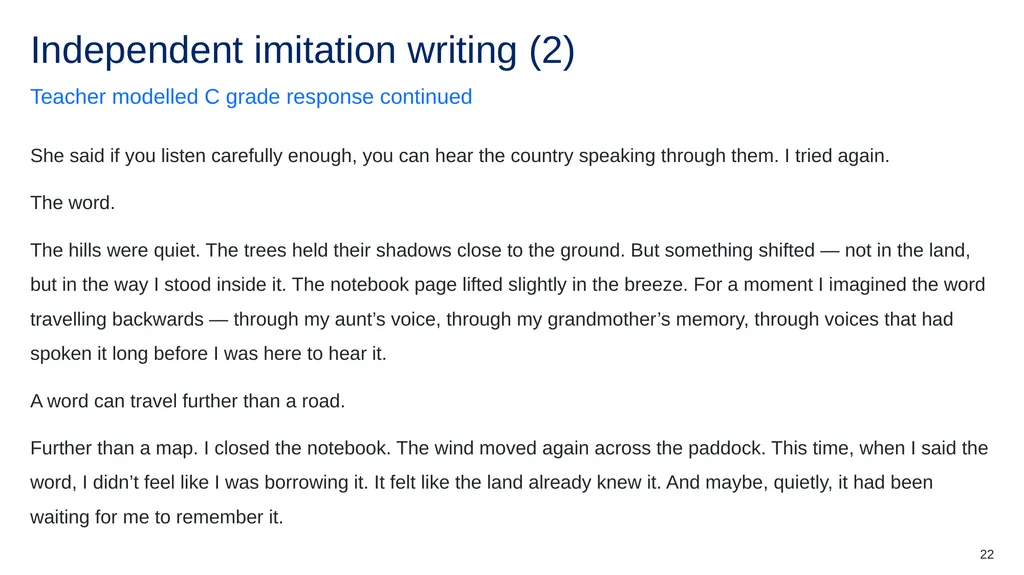
Independent imitation writing (2) Teacher modelled C grade response continued She said if you listen carefully enough, you can hear the country speaking through them. I tried again.
The word.
The hills were quiet. The trees held their shadows close to the ground. But something shifted — not in the land, but in the way I stood inside it. The notebook page lifted slightly in the breeze. For a moment I imagined the word travelling backwards — through my aunt’s voice, through my grandmother’s memory, through voices that had spoken it long before I was here to hear it.
A word can travel further than a road.
Further than a map. I closed the notebook. The wind moved again across the paddock. This time, when I said the word, I didn’t feel like I was borrowing it. It felt like the land already knew it. And maybe, quietly, it had been waiting for me to remember it. 22<br>
The word.
The hills were quiet. The trees held their shadows close to the ground. But something shifted — not in the land, but in the way I stood inside it. The notebook page lifted slightly in the breeze. For a moment I imagined the word travelling backwards — through my aunt’s voice, through my grandmother’s memory, through voices that had spoken it long before I was here to hear it.
A word can travel further than a road.
Further than a map. I closed the notebook. The wind moved again across the paddock. This time, when I said the word, I didn’t feel like I was borrowing it. It felt like the land already knew it. And maybe, quietly, it had been waiting for me to remember it. 22<br>
23
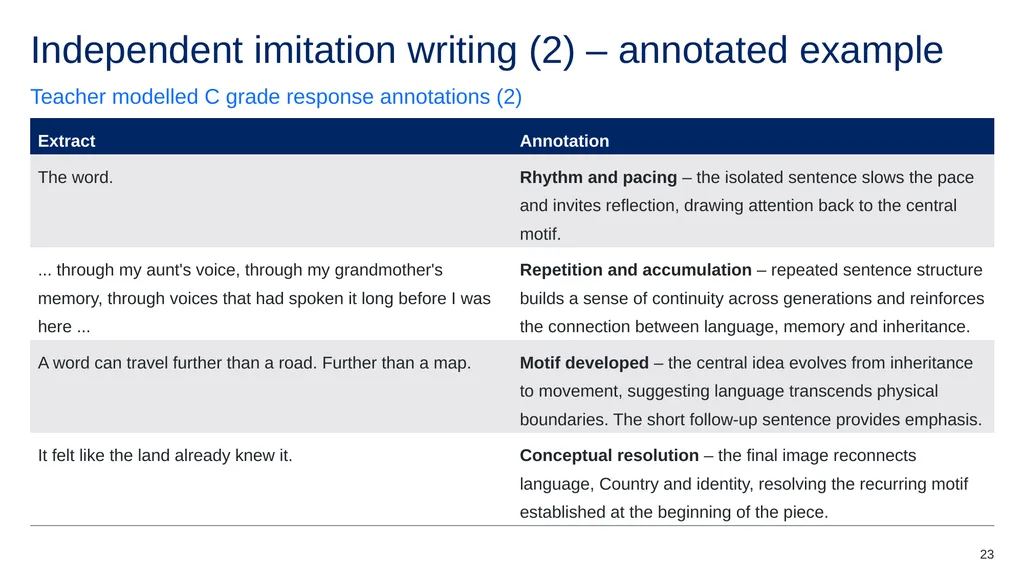
Independent imitation writing (2) – annotated example Teacher modelled C grade response annotations (2) 23<br>
24
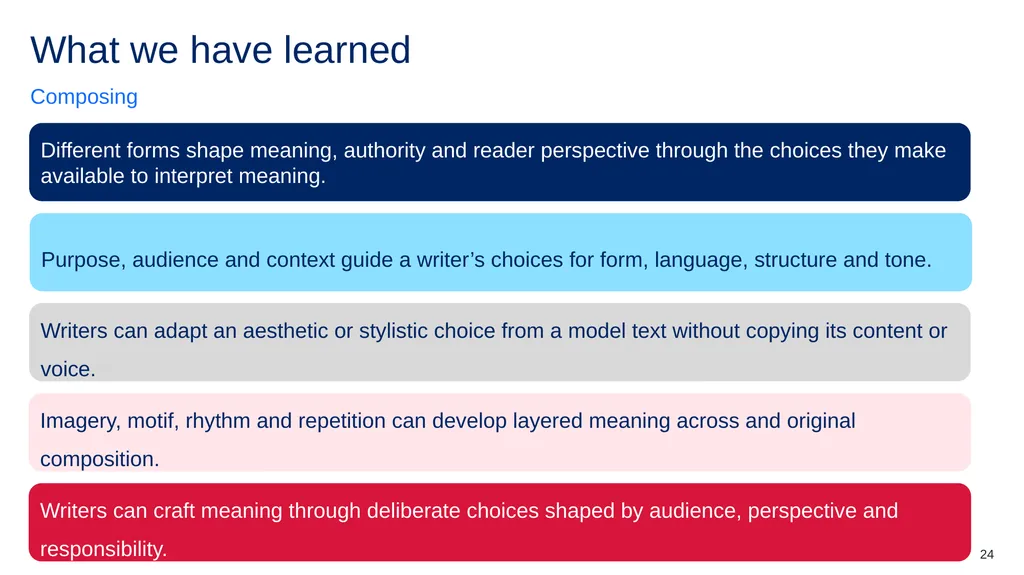
What we have learned Composing Different forms shape meaning, authority and reader perspective through the choices they make available to interpret meaning. Purpose, audience and context guide a writer’s choices for form, language, structure and tone. Writers can adapt an aesthetic or stylistic choice from a model text without copying its content or voice. Imagery, motif, rhythm and repetition can develop layered meaning across and original composition. Writers can craft meaning through deliberate choices shaped by audience, perspective and responsibility. 24<br>
25
References (1) This presentation contains NSW Curriculum and syllabus content. The NSW Curriculum is developed by the NSW Education Standards Authority. This content is prepared by NESA for and on behalf of the Crown in the right of the State of New South Wales. The material is protected by Crown copyright.
Please refer to the NESA Copyright for more information.
NESA holds the only official and up-to-date versions of the NSW Curriculum and syllabus documents. Please visit the NSW Education Standards Authority (NESA) website https://educationstandards.nsw.edu.au/wps/portal/nesa/home and the NSW Curriculum website https://curriculum.nsw.edu.au. English Advanced 11–12 Syllabus (2024) © NSW Education Standards Authority (NESA) for and on behalf of the Crown in right of the State of New South Wales, 2024.
Australian Education Research Organisation (AERO) (2024a) Explain learning objectives, AERO, accessed 13 April 2026.
AERO (Australian Education Research Organisation) (2024b) Why explicit instruction works, AERO website, accessed 13 April 2026.
Australian Curriculum, Assessment and Reporting Authority (ACARA) (2026) General capabilities downloads, accessed 13 April 2026.
Black P and Wiliam D (2018) ‘Classroom assessment and pedagogy’, Assessment in Education Principles Policy and Practice, 25(1):1–25, accessed 13 April 2026.
CESE (Centre for Education Statistics and Evaluation) (2017) Cognitive load theory: Research that teachers really need to understand, NSW Department of Education, accessed 13 April 2026.. 25<br>
Please refer to the NESA Copyright for more information.
NESA holds the only official and up-to-date versions of the NSW Curriculum and syllabus documents. Please visit the NSW Education Standards Authority (NESA) website https://educationstandards.nsw.edu.au/wps/portal/nesa/home and the NSW Curriculum website https://curriculum.nsw.edu.au. English Advanced 11–12 Syllabus (2024) © NSW Education Standards Authority (NESA) for and on behalf of the Crown in right of the State of New South Wales, 2024.
Australian Education Research Organisation (AERO) (2024a) Explain learning objectives, AERO, accessed 13 April 2026.
AERO (Australian Education Research Organisation) (2024b) Why explicit instruction works, AERO website, accessed 13 April 2026.
Australian Curriculum, Assessment and Reporting Authority (ACARA) (2026) General capabilities downloads, accessed 13 April 2026.
Black P and Wiliam D (2018) ‘Classroom assessment and pedagogy’, Assessment in Education Principles Policy and Practice, 25(1):1–25, accessed 13 April 2026.
CESE (Centre for Education Statistics and Evaluation) (2017) Cognitive load theory: Research that teachers really need to understand, NSW Department of Education, accessed 13 April 2026.. 25<br>
26
26 References (2) Clarke S (2014) Outstanding formative assessment: culture and practice, Hodder Education, Great Britain.
Clarke S, Timperley H, Hattie J (2003) Unlocking formative assessment: Practical strategies for enhancing students’ learning in the primary and intermediate classroom, Hodder Moa Beckett, Auckland NZ, 2003.
Griffin P (2018) Assessment for teaching, Cambridge University Press, Melbourne.
McCausland J (November 2021) desert [image] Unsplash website, accessed 13 April 2026.
NESA (NSW Education Standards Authority) (n.d.) Collaborative curriculum planning, NESA website, accessed 13 April 2026.
Round Icons (February 2025) A man standing in front of a blackboard next to a group of people [illustration] Unsplash website, accessed 13 April 2026.
Saunders M (2022) ‘Overture’, in Saunders M (ed), This All Come Back Now, University of Queensland Press, St Lucia. Reproduced and made available for copying and communication by NSW Department of Education for its educational purposes with the permission of Mykaela Saunders. This resource is licensed until 31 July 2030.
State of New South Wales (Department of Education) (n.d.) Explicit teaching strategies, NSW Department of Education website, accessed 13 April 2026.
——(n.d.) Explicit teaching – Driving learning and engagement, Centre for Education Statistics and Evaluation website, accessed 13 April 2026.
——(n.d.) Digital Learning Selector, NSW Department of Education website, accessed 13 April 2026.
Wiliam D (2014) ‘The right questions, the right way ’, Educational Leadership, 71(6).
Winch T J (2021) The Yield, Penguin Random House Australia, Sydney. Reproduced and made available for copying and communication by NSW Department of Education for its educational purposes with the permission of The Penguin Random House Australia Pty Ltd. This resource is licenced up until April 2031.<br>
Clarke S, Timperley H, Hattie J (2003) Unlocking formative assessment: Practical strategies for enhancing students’ learning in the primary and intermediate classroom, Hodder Moa Beckett, Auckland NZ, 2003.
Griffin P (2018) Assessment for teaching, Cambridge University Press, Melbourne.
McCausland J (November 2021) desert [image] Unsplash website, accessed 13 April 2026.
NESA (NSW Education Standards Authority) (n.d.) Collaborative curriculum planning, NESA website, accessed 13 April 2026.
Round Icons (February 2025) A man standing in front of a blackboard next to a group of people [illustration] Unsplash website, accessed 13 April 2026.
Saunders M (2022) ‘Overture’, in Saunders M (ed), This All Come Back Now, University of Queensland Press, St Lucia. Reproduced and made available for copying and communication by NSW Department of Education for its educational purposes with the permission of Mykaela Saunders. This resource is licensed until 31 July 2030.
State of New South Wales (Department of Education) (n.d.) Explicit teaching strategies, NSW Department of Education website, accessed 13 April 2026.
——(n.d.) Explicit teaching – Driving learning and engagement, Centre for Education Statistics and Evaluation website, accessed 13 April 2026.
——(n.d.) Digital Learning Selector, NSW Department of Education website, accessed 13 April 2026.
Wiliam D (2014) ‘The right questions, the right way ’, Educational Leadership, 71(6).
Winch T J (2021) The Yield, Penguin Random House Australia, Sydney. Reproduced and made available for copying and communication by NSW Department of Education for its educational purposes with the permission of The Penguin Random House Australia Pty Ltd. This resource is licenced up until April 2031.<br>
27
Copyright © State of New South Wales (Department of Education), 2026 The copyright material published in this resource is subject to the Copyright Act 1968 (Cth) and is owned by the NSW Department of Education or, where indicated, by a party other than the NSW Department of Education (third-party material).
Copyright material available in this resource and owned by the NSW Department of Education is licensed under a Creative Commons Attribution 4.0 International (CC BY 4.0) license.
This license allows you to share and adapt the material for any purpose, even commercially.
Attribution should be given to © State of New South Wales (Department of Education), 2026.
Material in this resource not available under a Creative Commons license:
the NSW Department of Education logo, other logos and trademark-protected material
Material owned by a third party that has been reproduced with permission. You will need to obtain permission from the third party to reuse its material.
Links to third-party material and websites
Please note that the provided (reading/viewing material/list/links/texts) are a suggestion only and implies no endorsement, by the New South Wales Department of Education, of any author, publisher, or book title. School principals and teachers are best placed to assess the suitability of resources that would complement the curriculum and reflect the needs and interests of their students.
If you use the links provided in this document to access a third-party’s website, you acknowledge that the terms of use, including licence terms set out on the third-party’s website apply to the use which may be made of the materials on that third-party website or where permitted by the Copyright Act 1968 (Cth). The department accepts no responsibility for content on third-party websites.<br>
Copyright material available in this resource and owned by the NSW Department of Education is licensed under a Creative Commons Attribution 4.0 International (CC BY 4.0) license.
This license allows you to share and adapt the material for any purpose, even commercially.
Attribution should be given to © State of New South Wales (Department of Education), 2026.
Material in this resource not available under a Creative Commons license:
the NSW Department of Education logo, other logos and trademark-protected material
Material owned by a third party that has been reproduced with permission. You will need to obtain permission from the third party to reuse its material.
Links to third-party material and websites
Please note that the provided (reading/viewing material/list/links/texts) are a suggestion only and implies no endorsement, by the New South Wales Department of Education, of any author, publisher, or book title. School principals and teachers are best placed to assess the suitability of resources that would complement the curriculum and reflect the needs and interests of their students.
If you use the links provided in this document to access a third-party’s website, you acknowledge that the terms of use, including licence terms set out on the third-party’s website apply to the use which may be made of the materials on that third-party website or where permitted by the Copyright Act 1968 (Cth). The department accepts no responsibility for content on third-party websites.<br>