
Instructions for use This resource is not a
DJ
Published · 34 slides · 0 views
1 / 1
Description
Instructions for use This resource is not a teaching and learning program. It should be used in conjunction with Reading to Write Transition to English EALD Year 11, Term 1. Classroom teachers are encouraged to add and adapt slides
Related Topics
Share
Embed code
Download this presentation From Below
"Instructions for use This resource is not a" is the property of its rightful owner. Permission is granted to download and print the materials on this website for personal, non-commercial use only, and to display it on your personal computer provided you do not modify the materials and that you retain all copyright notices contained in the materials. By downloading content from our website, you accept the terms of this agreement.
Presentation Transcript
01
Instructions for use This resource is not a teaching and learning program. It should be used in conjunction with ‘Reading to Write – Transition to English EAL/D’ – Year 11, Term 1.
Classroom teachers are encouraged to add and adapt slides as required to meet the needs of their students.
Save a copy of the file to make changes to the slide deck. Go to File > Download a Copy (this downloads a copy to the computer to edit in the PowerPoint app).
To convert the PowerPoint to Google Slides:
Upload the file into Google Drive and open it.
Go to File > Save as Google Slides.
(Note – conversion may cause formatting changes in the slides.) 1<br>
Classroom teachers are encouraged to add and adapt slides as required to meet the needs of their students.
Save a copy of the file to make changes to the slide deck. Go to File > Download a Copy (this downloads a copy to the computer to edit in the PowerPoint app).
To convert the PowerPoint to Google Slides:
Upload the file into Google Drive and open it.
Go to File > Save as Google Slides.
(Note – conversion may cause formatting changes in the slides.) 1<br>
02
Phase 2 –
reflective writing Stage 6 EAL/D – 11.1 ‘Reading to write: Transition to English EAL/D’ – Year 11, Term 1 Taking notes with a pencil by Thought Catalog on Unsplash<br>
03
Phase 2, sequence 3 – developing understanding and use of form and structure Taking notes with a pencil by Thought Catalog on Unsplash<br>
04
Sharing learning intentions and success criteria 4<br>
05
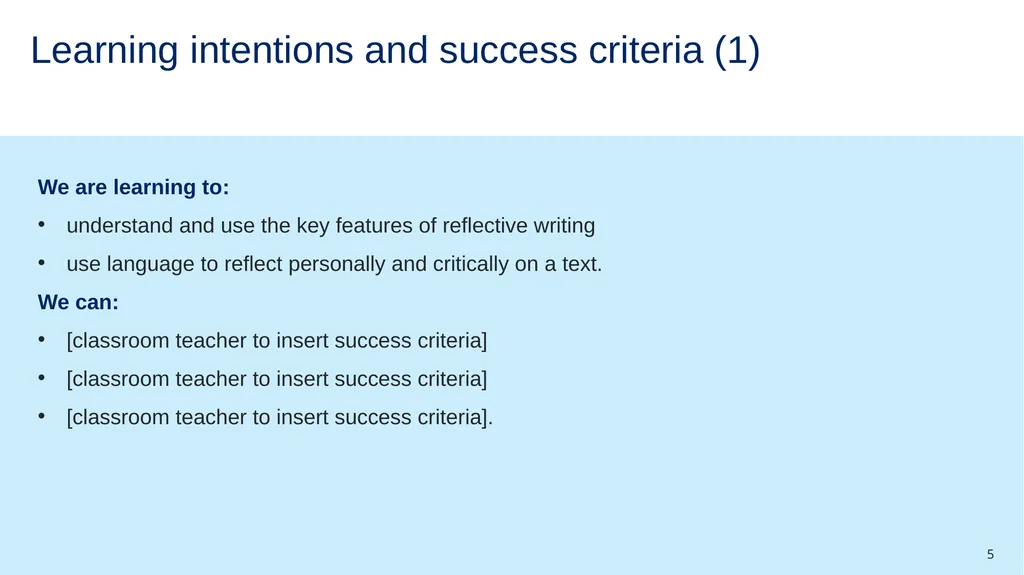
Learning intentions and success criteria (1) We are learning to:
understand and use the key features of reflective writing
use language to reflect personally and critically on a text.
We can:
[classroom teacher to insert success criteria]
[classroom teacher to insert success criteria]
[classroom teacher to insert success criteria]. 5<br>
understand and use the key features of reflective writing
use language to reflect personally and critically on a text.
We can:
[classroom teacher to insert success criteria]
[classroom teacher to insert success criteria]
[classroom teacher to insert success criteria]. 5<br>
06
Gradual release of responsibility - definitions, modelled practice and experimenting<br>
07
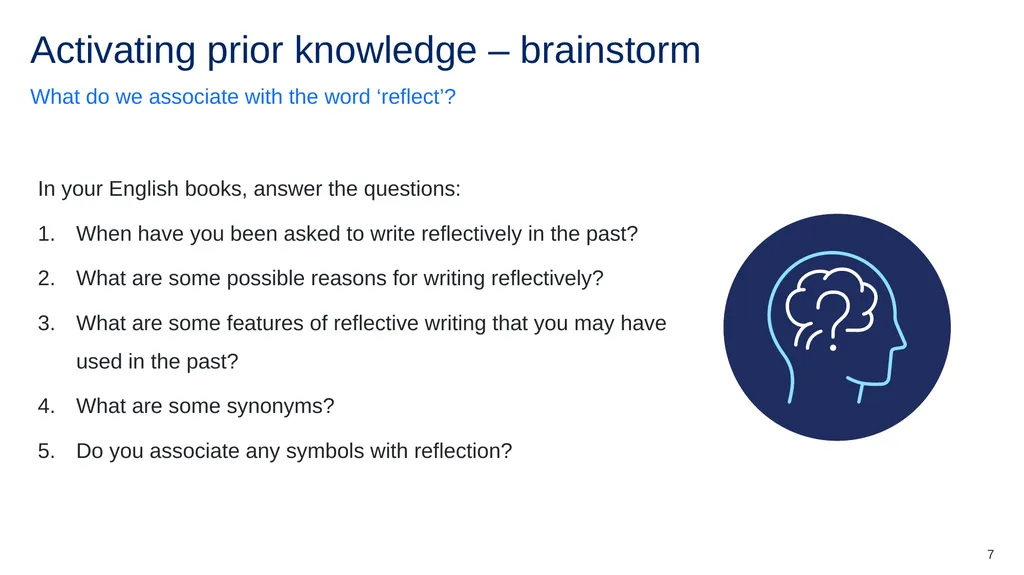
Activating prior knowledge – brainstorm What do we associate with the word ‘reflect’? In your English books, answer the questions:
When have you been asked to write reflectively in the past?
What are some possible reasons for writing reflectively?
What are some features of reflective writing that you may have used in the past?
What are some synonyms?
Do you associate any symbols with reflection? 7<br>
When have you been asked to write reflectively in the past?
What are some possible reasons for writing reflectively?
What are some features of reflective writing that you may have used in the past?
What are some synonyms?
Do you associate any symbols with reflection? 7<br>
08
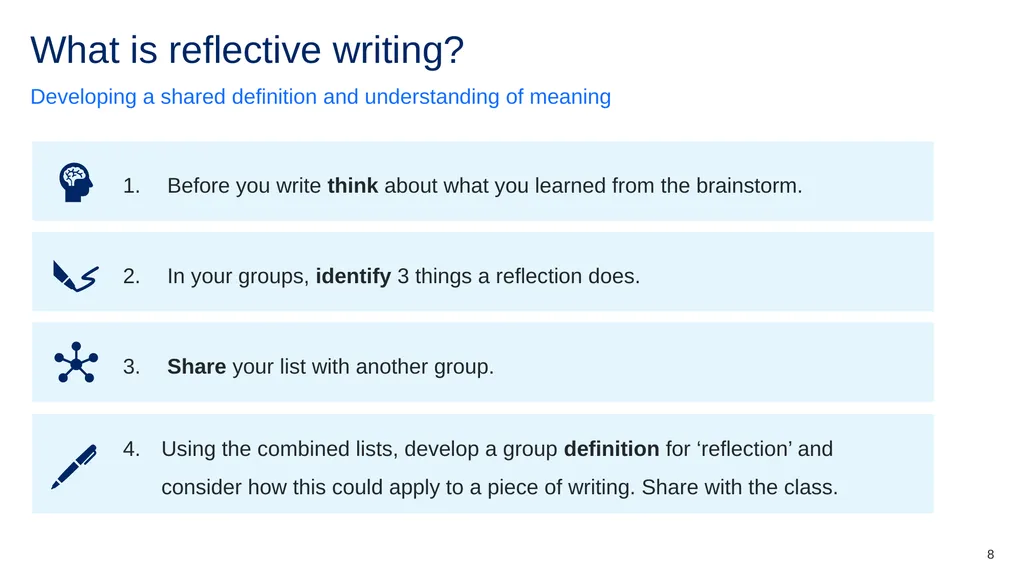
What is reflective writing? Developing a shared definition and understanding of meaning Before you write think about what you learned from the brainstorm. In your groups, identify 3 things a reflection does. Share your list with another group. Using the combined lists, develop a group definition for ‘reflection’ and consider how this could apply to a piece of writing. Share with the class. 8<br>
09
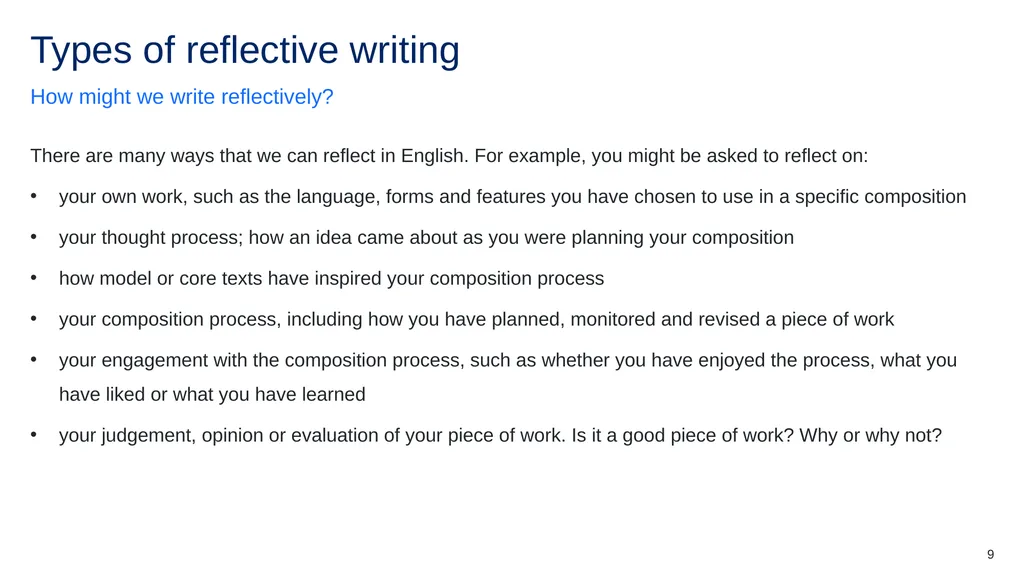
Types of reflective writing How might we write reflectively? There are many ways that we can reflect in English. For example, you might be asked to reflect on:
your own work, such as the language, forms and features you have chosen to use in a specific composition
your thought process; how an idea came about as you were planning your composition
how model or core texts have inspired your composition process
your composition process, including how you have planned, monitored and revised a piece of work
your engagement with the composition process, such as whether you have enjoyed the process, what you have liked or what you have learned
your judgement, opinion or evaluation of your piece of work. Is it a good piece of work? Why or why not? 9<br>
your own work, such as the language, forms and features you have chosen to use in a specific composition
your thought process; how an idea came about as you were planning your composition
how model or core texts have inspired your composition process
your composition process, including how you have planned, monitored and revised a piece of work
your engagement with the composition process, such as whether you have enjoyed the process, what you have liked or what you have learned
your judgement, opinion or evaluation of your piece of work. Is it a good piece of work? Why or why not? 9<br>
10
What are the features of reflective writing?<br>
11
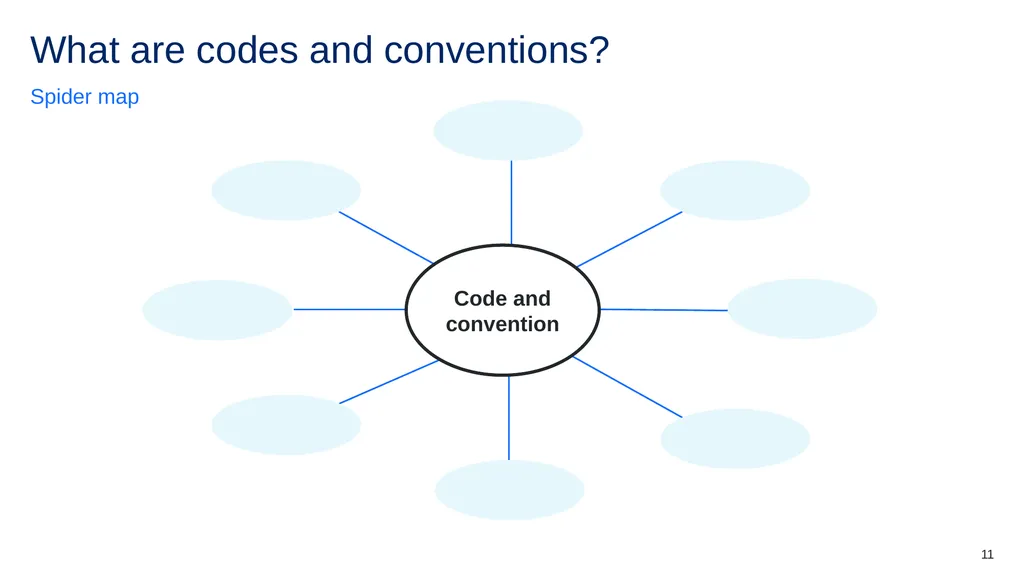
What are codes and conventions? Spider map 11<br>
12
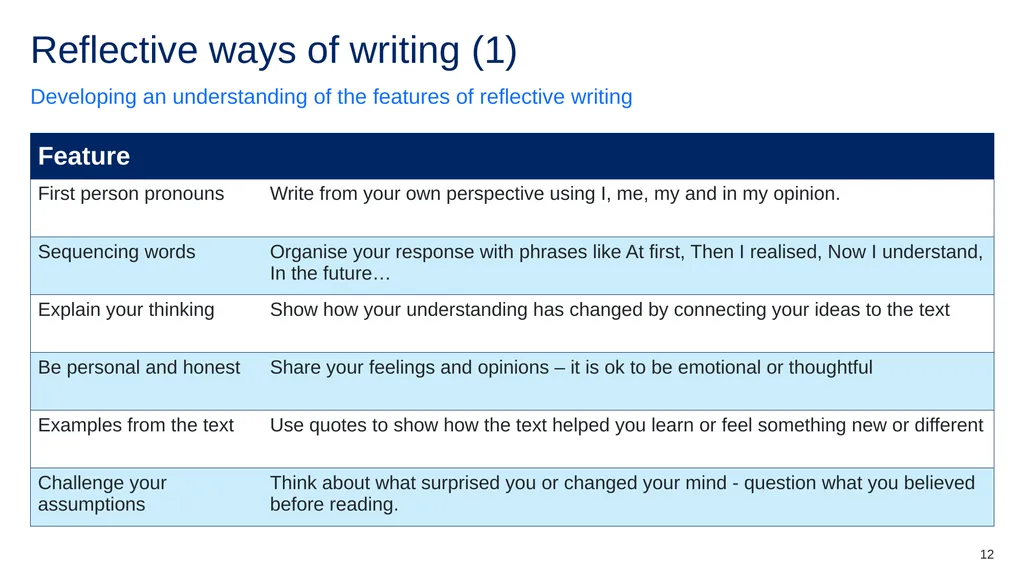
Reflective ways of writing (1) Developing an understanding of the features of reflective writing 12<br>
13
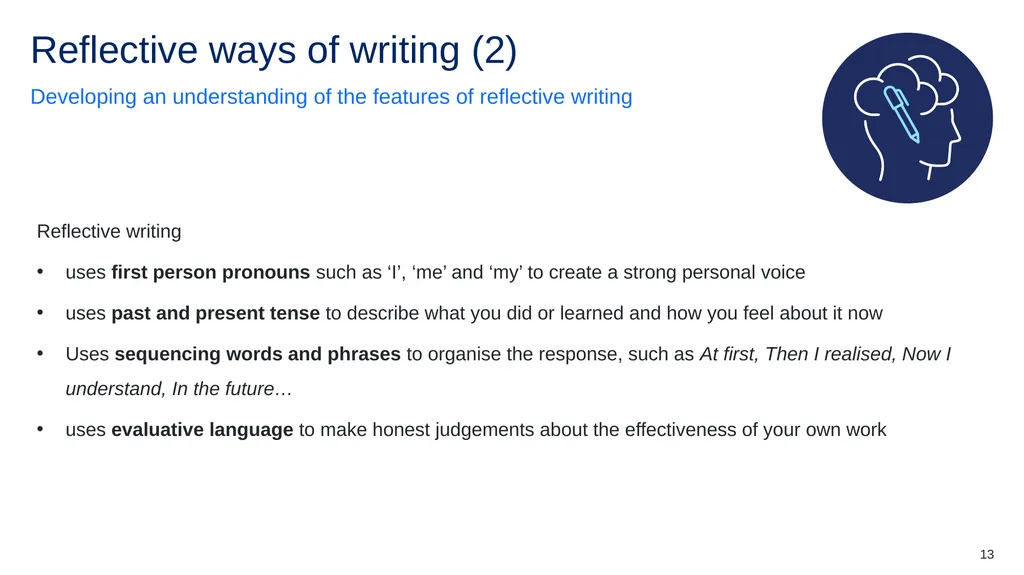
Reflective ways of writing (2) Developing an understanding of the features of reflective writing Reflective writing
uses first person pronouns such as ‘I’, ‘me’ and ‘my’ to create a strong personal voice
uses past and present tense to describe what you did or learned and how you feel about it now
Uses sequencing words and phrases to organise the response, such as At first, Then I realised, Now I understand, In the future…
uses evaluative language to make honest judgements about the effectiveness of your own work 13<br>
uses first person pronouns such as ‘I’, ‘me’ and ‘my’ to create a strong personal voice
uses past and present tense to describe what you did or learned and how you feel about it now
Uses sequencing words and phrases to organise the response, such as At first, Then I realised, Now I understand, In the future…
uses evaluative language to make honest judgements about the effectiveness of your own work 13<br>
14
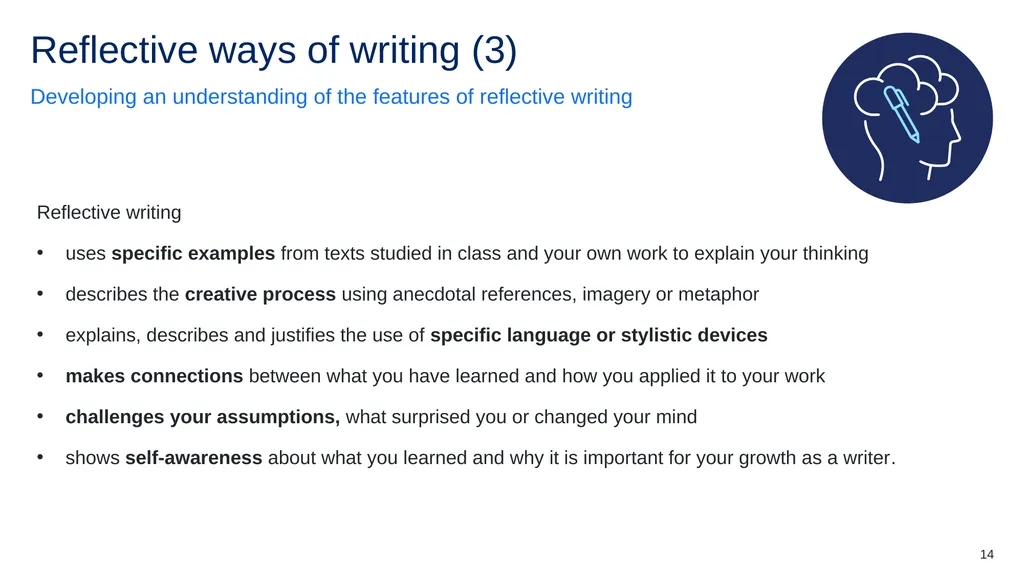
Reflective ways of writing (3) Developing an understanding of the features of reflective writing Reflective writing
uses specific examples from texts studied in class and your own work to explain your thinking
describes the creative process using anecdotal references, imagery or metaphor
explains, describes and justifies the use of specific language or stylistic devices
makes connections between what you have learned and how you applied it to your work
challenges your assumptions, what surprised you or changed your mind
shows self-awareness about what you learned and why it is important for your growth as a writer. 14<br>
uses specific examples from texts studied in class and your own work to explain your thinking
describes the creative process using anecdotal references, imagery or metaphor
explains, describes and justifies the use of specific language or stylistic devices
makes connections between what you have learned and how you applied it to your work
challenges your assumptions, what surprised you or changed your mind
shows self-awareness about what you learned and why it is important for your growth as a writer. 14<br>
15
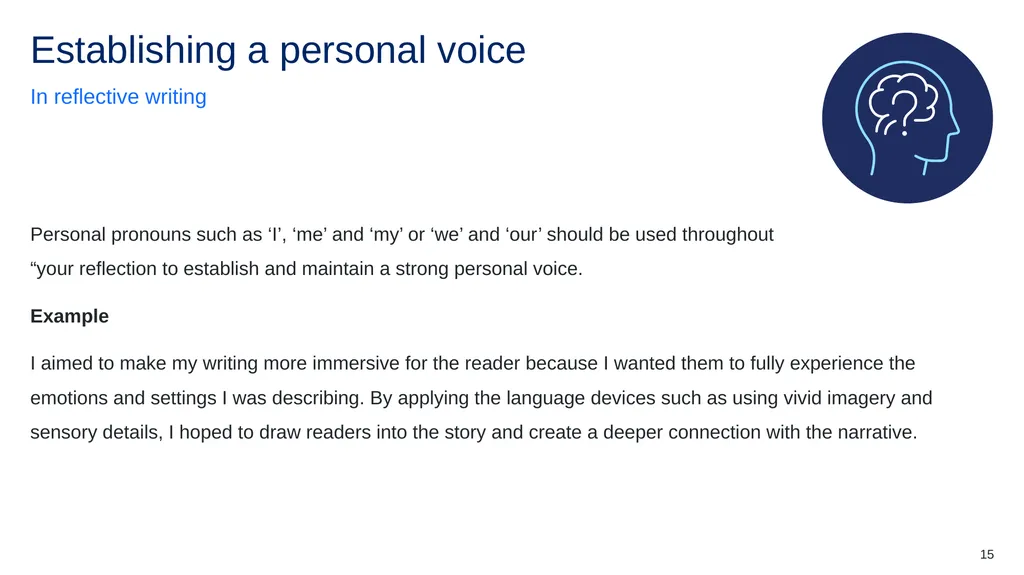
Establishing a personal voice In reflective writing Personal pronouns such as ‘I’, ‘me’ and ‘my’ or ‘we’ and ‘our’ should be used throughout
“your reflection to establish and maintain a strong personal voice.
Example
I aimed to make my writing more immersive for the reader because I wanted them to fully experience the emotions and settings I was describing. By applying the language devices such as using vivid imagery and sensory details, I hoped to draw readers into the story and create a deeper connection with the narrative. 15<br>
Example
I aimed to make my writing more immersive for the reader because I wanted them to fully experience the emotions and settings I was describing. By applying the language devices such as using vivid imagery and sensory details, I hoped to draw readers into the story and create a deeper connection with the narrative. 15<br>
16
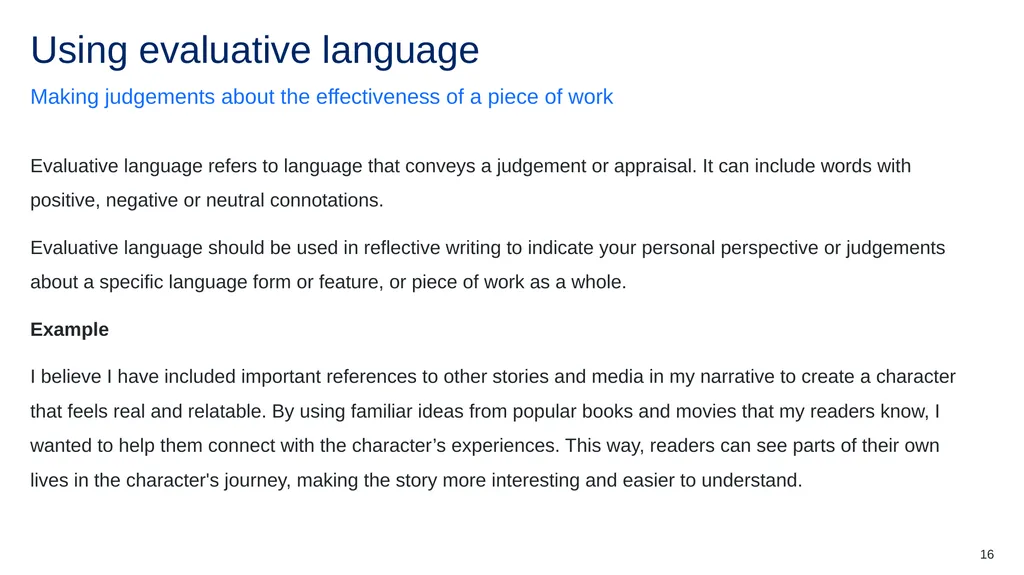
Using evaluative language Making judgements about the effectiveness of a piece of work Evaluative language refers to language that conveys a judgement or appraisal. It can include words with positive, negative or neutral connotations.
Evaluative language should be used in reflective writing to indicate your personal perspective or judgements about a specific language form or feature, or piece of work as a whole.
Example
I believe I have included important references to other stories and media in my narrative to create a character that feels real and relatable. By using familiar ideas from popular books and movies that my readers know, I wanted to help them connect with the character’s experiences. This way, readers can see parts of their own lives in the character's journey, making the story more interesting and easier to understand. 16<br>
Evaluative language should be used in reflective writing to indicate your personal perspective or judgements about a specific language form or feature, or piece of work as a whole.
Example
I believe I have included important references to other stories and media in my narrative to create a character that feels real and relatable. By using familiar ideas from popular books and movies that my readers know, I wanted to help them connect with the character’s experiences. This way, readers can see parts of their own lives in the character's journey, making the story more interesting and easier to understand. 16<br>
17
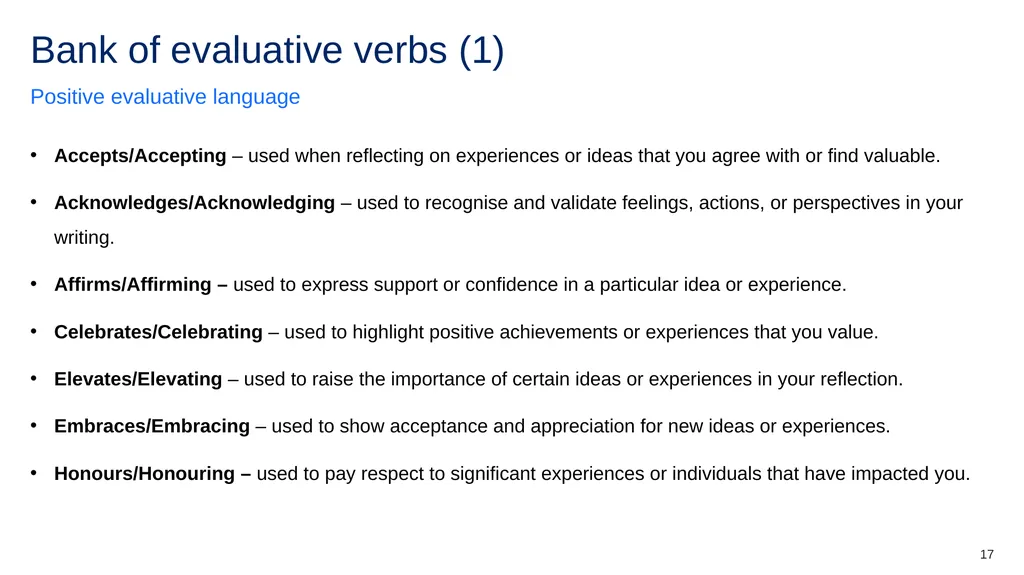
Bank of evaluative verbs (1) Positive evaluative language Accepts/Accepting – used when reflecting on experiences or ideas that you agree with or find valuable.
Acknowledges/Acknowledging – used to recognise and validate feelings, actions, or perspectives in your writing.
Affirms/Affirming – used to express support or confidence in a particular idea or experience.
Celebrates/Celebrating – used to highlight positive achievements or experiences that you value.
Elevates/Elevating – used to raise the importance of certain ideas or experiences in your reflection.
Embraces/Embracing – used to show acceptance and appreciation for new ideas or experiences.
Honours/Honouring – used to pay respect to significant experiences or individuals that have impacted you. 17<br>
Acknowledges/Acknowledging – used to recognise and validate feelings, actions, or perspectives in your writing.
Affirms/Affirming – used to express support or confidence in a particular idea or experience.
Celebrates/Celebrating – used to highlight positive achievements or experiences that you value.
Elevates/Elevating – used to raise the importance of certain ideas or experiences in your reflection.
Embraces/Embracing – used to show acceptance and appreciation for new ideas or experiences.
Honours/Honouring – used to pay respect to significant experiences or individuals that have impacted you. 17<br>
18
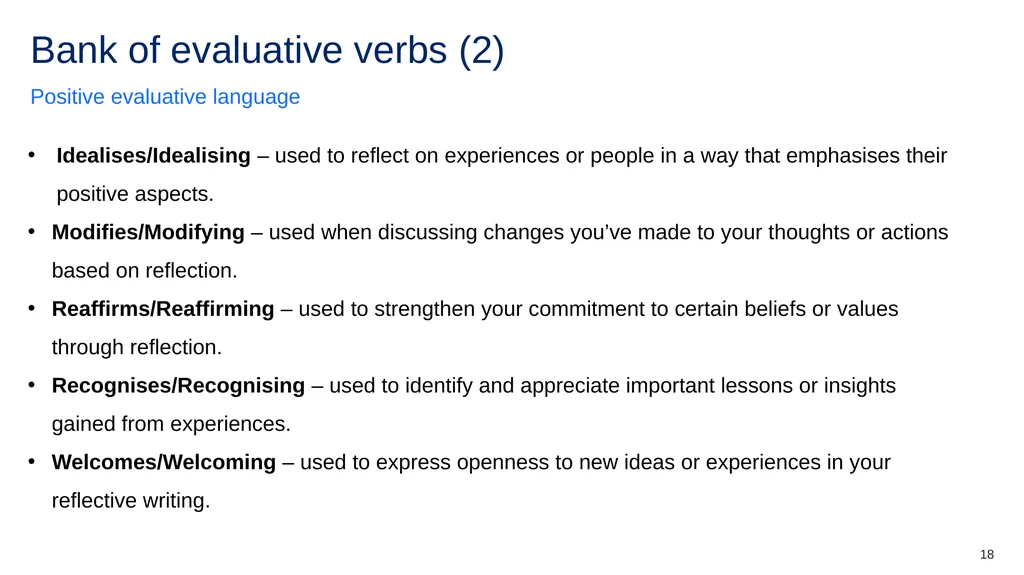
Bank of evaluative verbs (2) Positive evaluative language Idealises/Idealising – used to reflect on experiences or people in a way that emphasises their positive aspects.
Modifies/Modifying – used when discussing changes you’ve made to your thoughts or actions based on reflection.
Reaffirms/Reaffirming – used to strengthen your commitment to certain beliefs or values through reflection.
Recognises/Recognising – used to identify and appreciate important lessons or insights gained from experiences.
Welcomes/Welcoming – used to express openness to new ideas or experiences in your reflective writing. 18<br>
Modifies/Modifying – used when discussing changes you’ve made to your thoughts or actions based on reflection.
Reaffirms/Reaffirming – used to strengthen your commitment to certain beliefs or values through reflection.
Recognises/Recognising – used to identify and appreciate important lessons or insights gained from experiences.
Welcomes/Welcoming – used to express openness to new ideas or experiences in your reflective writing. 18<br>
19
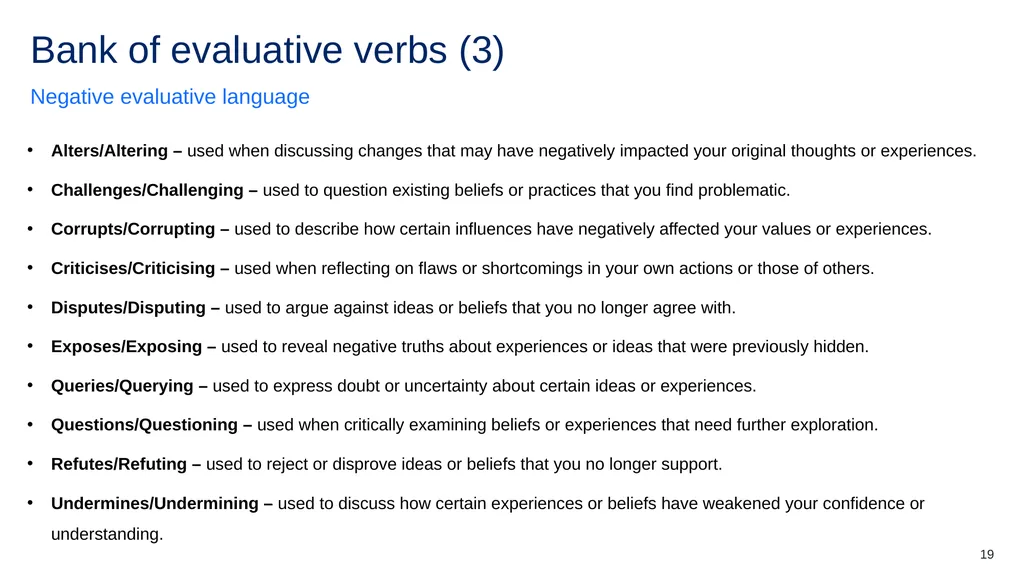
Bank of evaluative verbs (3) Negative evaluative language Alters/Altering – used when discussing changes that may have negatively impacted your original thoughts or experiences.
Challenges/Challenging – used to question existing beliefs or practices that you find problematic.
Corrupts/Corrupting – used to describe how certain influences have negatively affected your values or experiences.
Criticises/Criticising – used when reflecting on flaws or shortcomings in your own actions or those of others.
Disputes/Disputing – used to argue against ideas or beliefs that you no longer agree with.
Exposes/Exposing – used to reveal negative truths about experiences or ideas that were previously hidden.
Queries/Querying – used to express doubt or uncertainty about certain ideas or experiences.
Questions/Questioning – used when critically examining beliefs or experiences that need further exploration.
Refutes/Refuting – used to reject or disprove ideas or beliefs that you no longer support.
Undermines/Undermining – used to discuss how certain experiences or beliefs have weakened your confidence or understanding. 19<br>
Challenges/Challenging – used to question existing beliefs or practices that you find problematic.
Corrupts/Corrupting – used to describe how certain influences have negatively affected your values or experiences.
Criticises/Criticising – used when reflecting on flaws or shortcomings in your own actions or those of others.
Disputes/Disputing – used to argue against ideas or beliefs that you no longer agree with.
Exposes/Exposing – used to reveal negative truths about experiences or ideas that were previously hidden.
Queries/Querying – used to express doubt or uncertainty about certain ideas or experiences.
Questions/Questioning – used when critically examining beliefs or experiences that need further exploration.
Refutes/Refuting – used to reject or disprove ideas or beliefs that you no longer support.
Undermines/Undermining – used to discuss how certain experiences or beliefs have weakened your confidence or understanding. 19<br>
20
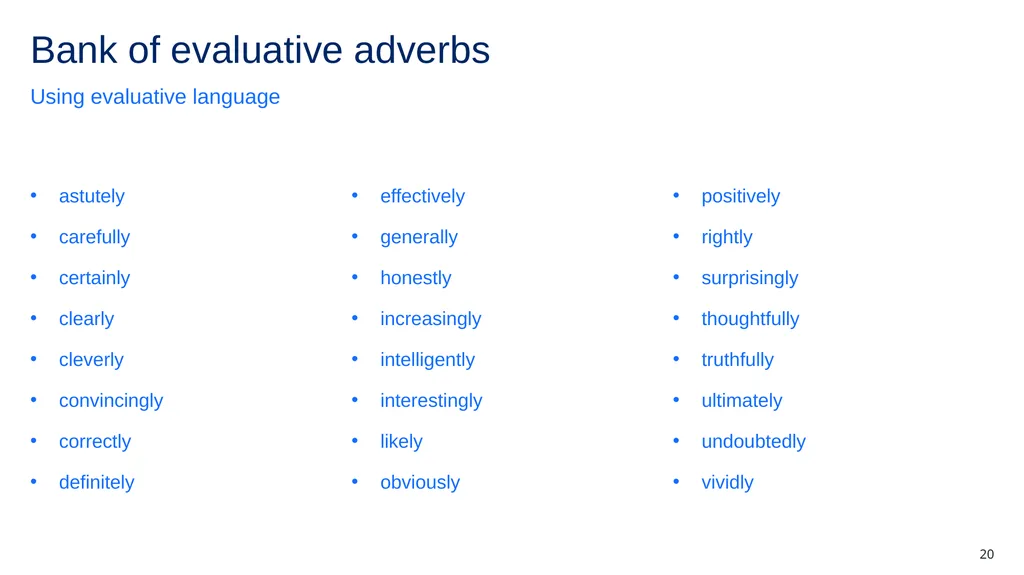
Bank of evaluative adverbs Using evaluative language astutely
carefully
certainly
clearly
cleverly
convincingly
correctly
definitely
effectively
generally
honestly
increasingly
intelligently
interestingly
likely
obviously
positively
rightly
surprisingly
thoughtfully
truthfully
ultimately
undoubtedly
vividly 20<br>
carefully
certainly
clearly
cleverly
convincingly
correctly
definitely
effectively
generally
honestly
increasingly
intelligently
interestingly
likely
obviously
positively
rightly
surprisingly
thoughtfully
truthfully
ultimately
undoubtedly
vividly 20<br>
21
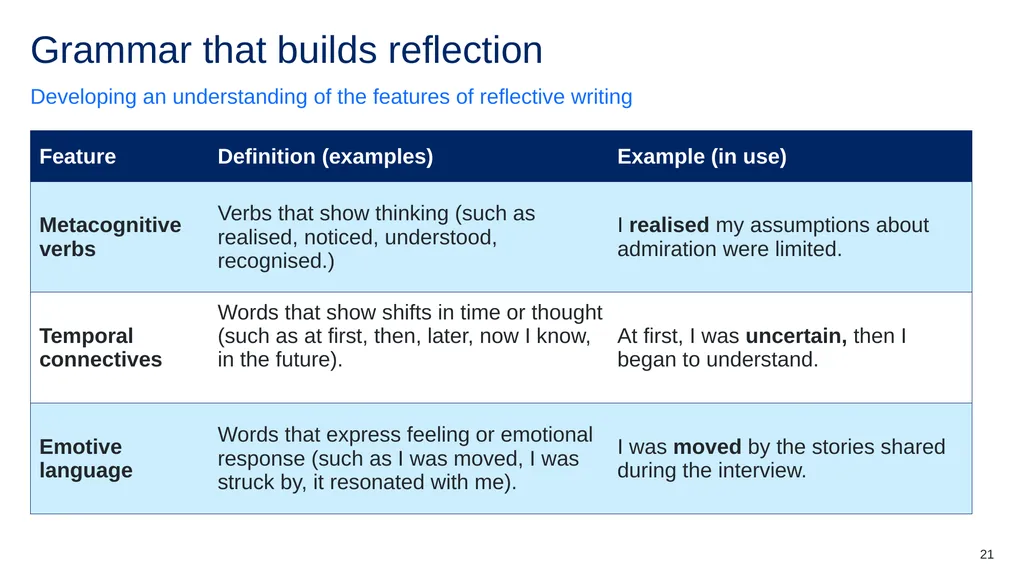
Grammar that builds reflection Developing an understanding of the features of reflective writing 21<br>
22
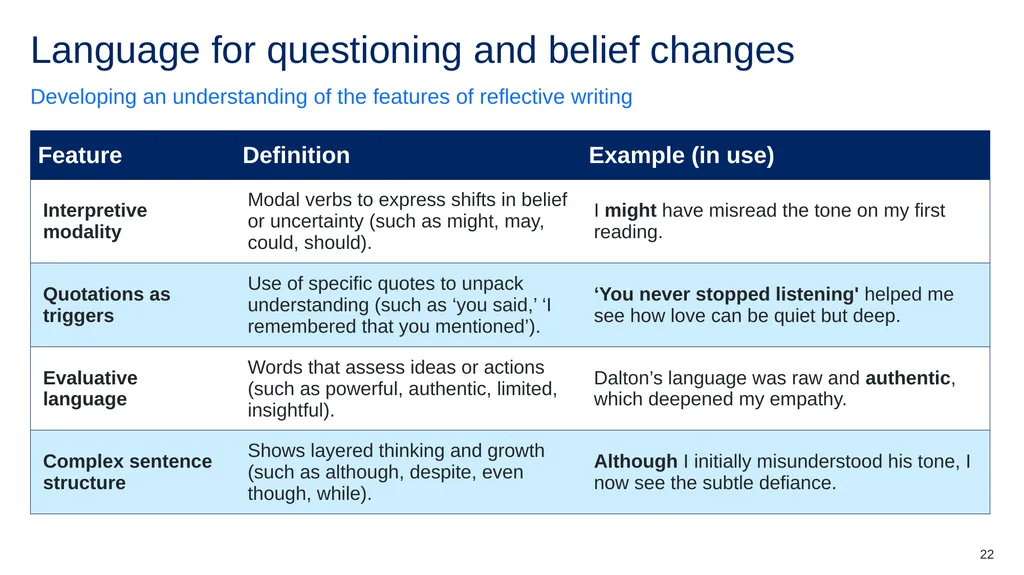
Language for questioning and belief changes Developing an understanding of the features of reflective writing 22<br>
23
Phase 3a, sequence 1 – building the field for core text 1 Taking notes with a pencil by Thought Catalog on Unsplash<br>
24
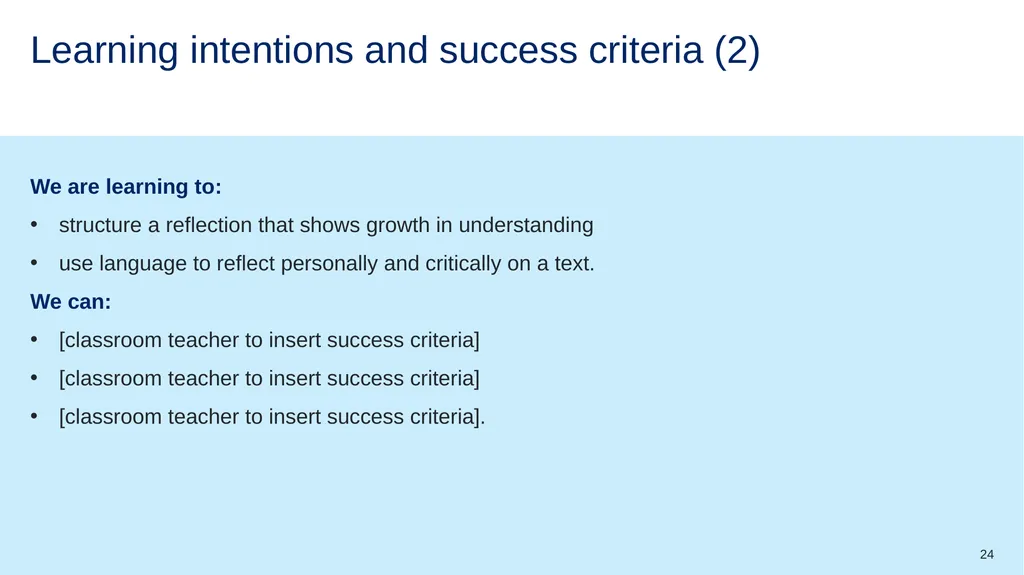
Learning intentions and success criteria (2) We are learning to:
structure a reflection that shows growth in understanding
use language to reflect personally and critically on a text.
We can:
[classroom teacher to insert success criteria]
[classroom teacher to insert success criteria]
[classroom teacher to insert success criteria]. 24<br>
structure a reflection that shows growth in understanding
use language to reflect personally and critically on a text.
We can:
[classroom teacher to insert success criteria]
[classroom teacher to insert success criteria]
[classroom teacher to insert success criteria]. 24<br>
25
Annotated sample<br>
26
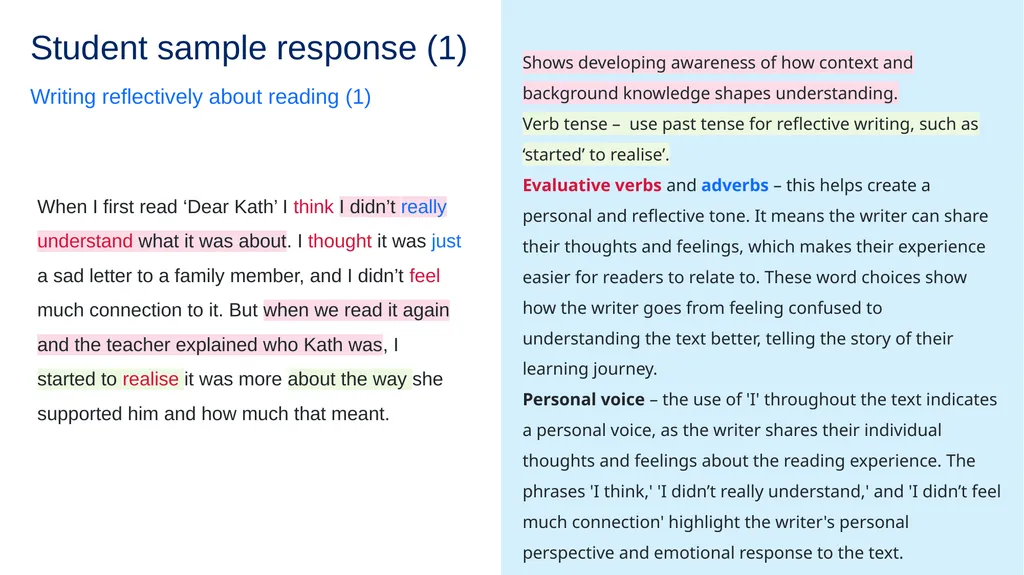
Student sample response (1) Writing reflectively about reading (1) When I first read ‘Dear Kath’ I think I didn’t really understand what it was about. I thought it was just a sad letter to a family member, and I didn’t feel much connection to it. But when we read it again and the teacher explained who Kath was, I started to realise it was more about the way she supported him and how much that meant. Shows developing awareness of how context and background knowledge shapes understanding.
Verb tense – use past tense for reflective writing, such as ‘started’ to realise’.
Evaluative verbs and adverbs – this helps create a personal and reflective tone. It means the writer can share their thoughts and feelings, which makes their experience easier for readers to relate to. These word choices show how the writer goes from feeling confused to understanding the text better, telling the story of their learning journey.
Personal voice – the use of 'I' throughout the text indicates a personal voice, as the writer shares their individual thoughts and feelings about the reading experience. The phrases 'I think,' 'I didn’t really understand,' and 'I didn’t feel much connection' highlight the writer's personal perspective and emotional response to the text.<br>
Verb tense – use past tense for reflective writing, such as ‘started’ to realise’.
Evaluative verbs and adverbs – this helps create a personal and reflective tone. It means the writer can share their thoughts and feelings, which makes their experience easier for readers to relate to. These word choices show how the writer goes from feeling confused to understanding the text better, telling the story of their learning journey.
Personal voice – the use of 'I' throughout the text indicates a personal voice, as the writer shares their individual thoughts and feelings about the reading experience. The phrases 'I think,' 'I didn’t really understand,' and 'I didn’t feel much connection' highlight the writer's personal perspective and emotional response to the text.<br>
27
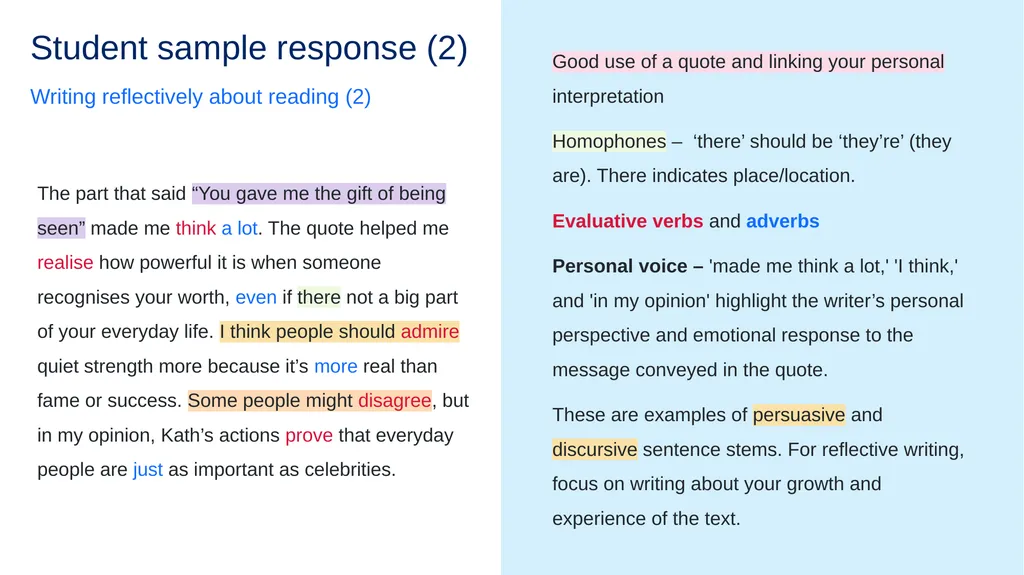
Student sample response (2) Writing reflectively about reading (2) The part that said “You gave me the gift of being seen” made me think a lot. The quote helped me realise how powerful it is when someone recognises your worth, even if there not a big part of your everyday life. I think people should admire quiet strength more because it’s more real than fame or success. Some people might disagree, but in my opinion, Kath’s actions prove that everyday people are just as important as celebrities. Good use of a quote and linking your personal interpretation
Homophones – ‘there’ should be ‘they’re’ (they are). There indicates place/location.
Evaluative verbs and adverbs
Personal voice – 'made me think a lot,' 'I think,' and 'in my opinion' highlight the writer’s personal perspective and emotional response to the message conveyed in the quote.
These are examples of persuasive and discursive sentence stems. For reflective writing, focus on writing about your growth and experience of the text.<br>
Homophones – ‘there’ should be ‘they’re’ (they are). There indicates place/location.
Evaluative verbs and adverbs
Personal voice – 'made me think a lot,' 'I think,' and 'in my opinion' highlight the writer’s personal perspective and emotional response to the message conveyed in the quote.
These are examples of persuasive and discursive sentence stems. For reflective writing, focus on writing about your growth and experience of the text.<br>
28
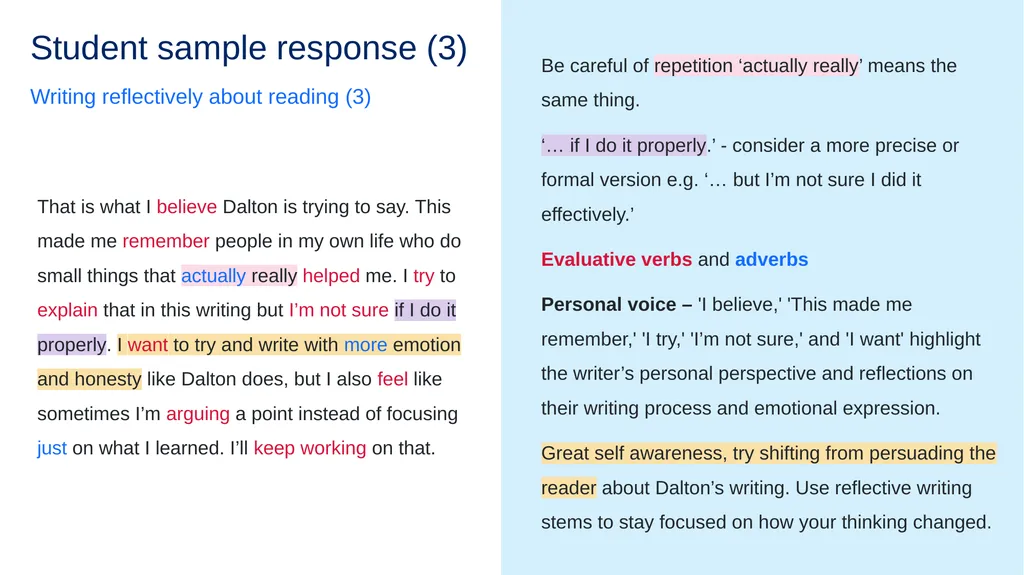
Student sample response (3) Writing reflectively about reading (3) That is what I believe Dalton is trying to say. This made me remember people in my own life who do small things that actually really helped me. I try to explain that in this writing but I’m not sure if I do it properly. I want to try and write with more emotion and honesty like Dalton does, but I also feel like sometimes I’m arguing a point instead of focusing just on what I learned. I’ll keep working on that. Be careful of repetition ‘actually really’ means the same thing.
‘… if I do it properly.’ - consider a more precise or formal version e.g. ‘… but I’m not sure I did it effectively.’
Evaluative verbs and adverbs
Personal voice – 'I believe,' 'This made me remember,' 'I try,' 'I’m not sure,' and 'I want' highlight the writer’s personal perspective and reflections on their writing process and emotional expression.
Great self awareness, try shifting from persuading the reader about Dalton’s writing. Use reflective writing stems to stay focused on how your thinking changed.<br>
‘… if I do it properly.’ - consider a more precise or formal version e.g. ‘… but I’m not sure I did it effectively.’
Evaluative verbs and adverbs
Personal voice – 'I believe,' 'This made me remember,' 'I try,' 'I’m not sure,' and 'I want' highlight the writer’s personal perspective and reflections on their writing process and emotional expression.
Great self awareness, try shifting from persuading the reader about Dalton’s writing. Use reflective writing stems to stay focused on how your thinking changed.<br>
29
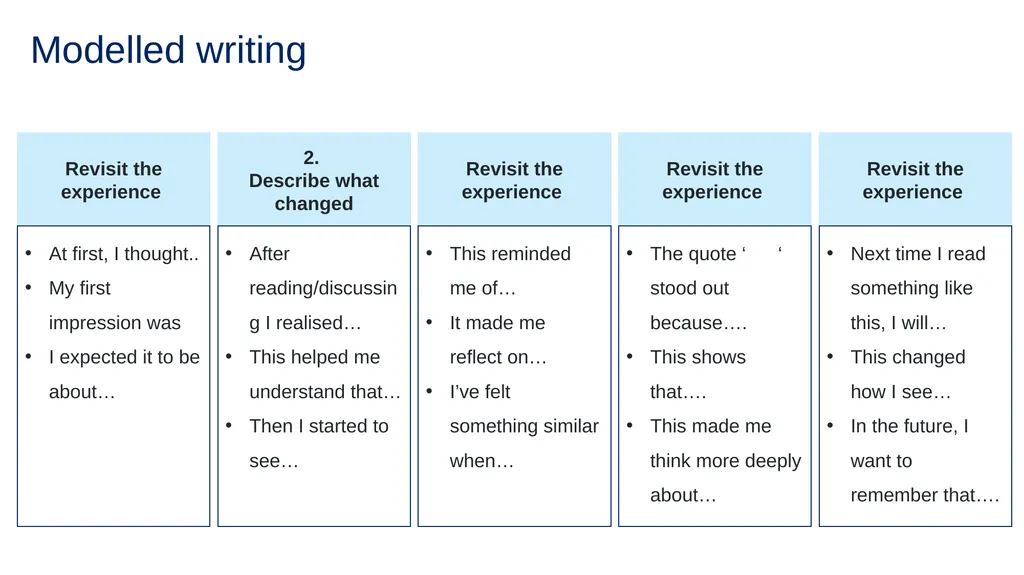
Modelled writing Revisit the experience At first, I thought..
My first impression was
I expected it to be about… 2. Describe what changed After reading/discussing I realised…
This helped me understand that…
Then I started to see… Revisit the experience This reminded me of…
It made me reflect on…
I’ve felt something similar when… Revisit the experience The quote ‘ ‘ stood out because….
This shows that….
This made me think more deeply about… Revisit the experience Next time I read something like this, I will…
This changed how I see…
In the future, I want to remember that….<br>
My first impression was
I expected it to be about… 2. Describe what changed After reading/discussing I realised…
This helped me understand that…
Then I started to see… Revisit the experience This reminded me of…
It made me reflect on…
I’ve felt something similar when… Revisit the experience The quote ‘ ‘ stood out because….
This shows that….
This made me think more deeply about… Revisit the experience Next time I read something like this, I will…
This changed how I see…
In the future, I want to remember that….<br>
30
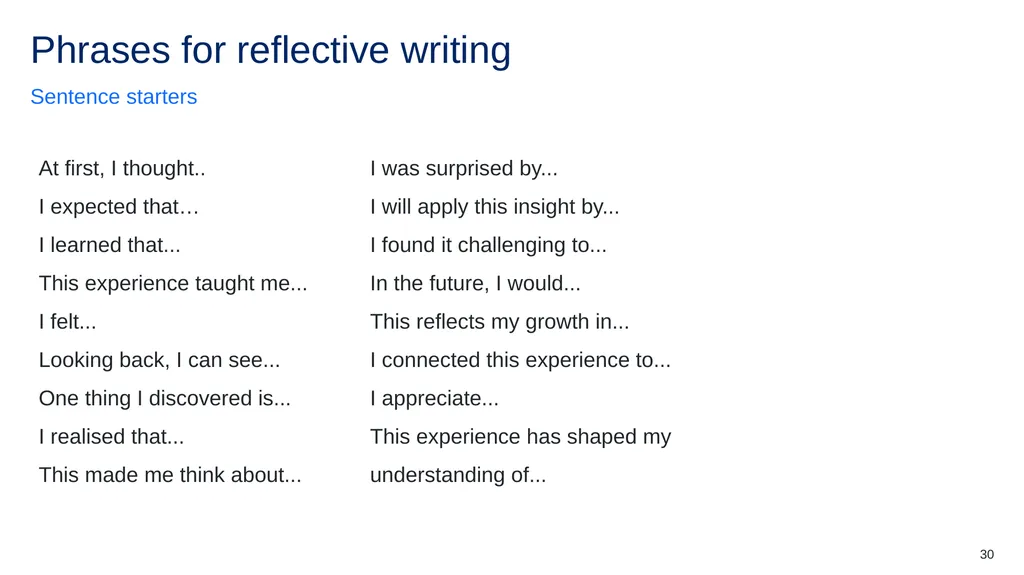
Phrases for reflective writing Sentence starters At first, I thought..
I expected that…
I learned that...
This experience taught me...
I felt...
Looking back, I can see...
One thing I discovered is...
I realised that...
This made me think about... I was surprised by...
I will apply this insight by...
I found it challenging to...
In the future, I would...
This reflects my growth in...
I connected this experience to...
I appreciate...
This experience has shaped my understanding of... 30<br>
I expected that…
I learned that...
This experience taught me...
I felt...
Looking back, I can see...
One thing I discovered is...
I realised that...
This made me think about... I was surprised by...
I will apply this insight by...
I found it challenging to...
In the future, I would...
This reflects my growth in...
I connected this experience to...
I appreciate...
This experience has shaped my understanding of... 30<br>
31
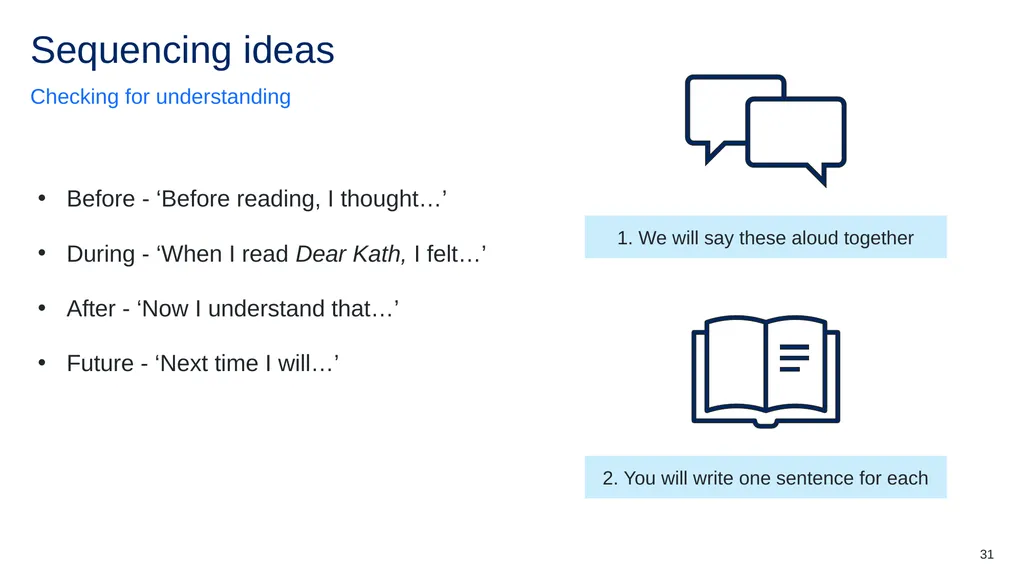
Sequencing ideas Checking for understanding Before - ‘Before reading, I thought…’
During - ‘When I read Dear Kath, I felt…’
After - ‘Now I understand that…’
Future - ‘Next time I will…’ 1. We will say these aloud together 2. You will write one sentence for each 31<br>
During - ‘When I read Dear Kath, I felt…’
After - ‘Now I understand that…’
Future - ‘Next time I will…’ 1. We will say these aloud together 2. You will write one sentence for each 31<br>
32
References (1) This presentation contains NSW Curriculum and syllabus content. The NSW Curriculum is developed by the NSW Education Standards Authority. This content is prepared by NESA for and on behalf of the Crown in the right of the State of New South Wales. The material is protected by Crown copyright.
Please refer to the NESA Copyright Disclaimer for more information https://educationstandards.nsw.edu.au/wps/portal/nesa/mini-footer/copyright.
NESA holds the only official and up-to-date versions of the NSW Curriculum and syllabus documents. Please visit the NSW Education Standards Authority (NESA) website https://educationstandards.nsw.edu.au/wps/portal/nesa/home and the NSW Curriculum website https://curriculum.nsw.edu.au. English EAL/D 11-12 Syllabus © NSW Education Standards Authority (NESA) for and on behalf of the Crown in right of the State of New South Wales, 2024.
Australian Education Research Organisation (AERO) (2024a) Explain learning objectives, AERO, accessed 6 June 2025.
AERO (Australian Education Research Organisation) (2024b) Why explicit instruction works, AERO website, accessed 6 June 2025.
Black P and Wiliam D (2018) ‘Classroom assessment and pedagogy’, Assessment in Education Principles Policy and Practice, 25(1):1–25.
CESE (Centre for Education Statistics and Evaluation) (2017) Cognitive load theory: Research that teachers really need to understand, NSW Department of Education, accessed 6 June 2025.
Clarke S (2014) Outstanding formative assessment: culture and practice, Hodder Education, Great Britain.
Clarke S, Timperley H, Hattie J (2003) Unlocking formative assessment: Practical strategies for enhancing students’ learning in the primary and intermediate classroom, Hodder Moa Beckett, Auckland NZ, 2003.
Dalton T (2021) Love Stories, HarperCollins Publishers, Sydney. This has been made possible as permission has been granted by HarperCollins Publishers Pty Ltd. The extracts contained in this resource are licensed up until March 2029. 32<br>
Please refer to the NESA Copyright Disclaimer for more information https://educationstandards.nsw.edu.au/wps/portal/nesa/mini-footer/copyright.
NESA holds the only official and up-to-date versions of the NSW Curriculum and syllabus documents. Please visit the NSW Education Standards Authority (NESA) website https://educationstandards.nsw.edu.au/wps/portal/nesa/home and the NSW Curriculum website https://curriculum.nsw.edu.au. English EAL/D 11-12 Syllabus © NSW Education Standards Authority (NESA) for and on behalf of the Crown in right of the State of New South Wales, 2024.
Australian Education Research Organisation (AERO) (2024a) Explain learning objectives, AERO, accessed 6 June 2025.
AERO (Australian Education Research Organisation) (2024b) Why explicit instruction works, AERO website, accessed 6 June 2025.
Black P and Wiliam D (2018) ‘Classroom assessment and pedagogy’, Assessment in Education Principles Policy and Practice, 25(1):1–25.
CESE (Centre for Education Statistics and Evaluation) (2017) Cognitive load theory: Research that teachers really need to understand, NSW Department of Education, accessed 6 June 2025.
Clarke S (2014) Outstanding formative assessment: culture and practice, Hodder Education, Great Britain.
Clarke S, Timperley H, Hattie J (2003) Unlocking formative assessment: Practical strategies for enhancing students’ learning in the primary and intermediate classroom, Hodder Moa Beckett, Auckland NZ, 2003.
Dalton T (2021) Love Stories, HarperCollins Publishers, Sydney. This has been made possible as permission has been granted by HarperCollins Publishers Pty Ltd. The extracts contained in this resource are licensed up until March 2029. 32<br>
33
References (2) This presentation contains NSW Curriculum and syllabus content. The NSW Curriculum is developed by the NSW Education Standards Authority. This content is prepared by NESA for and on behalf of the Crown in the right of the State of New South Wales. The material is protected by Crown copyright.
Please refer to the NESA Copyright Disclaimer for more information https://educationstandards.nsw.edu.au/wps/portal/nesa/mini-footer/copyright.
NESA holds the only official and up-to-date versions of the NSW Curriculum and syllabus documents. Please visit the NSW Education Standards Authority (NESA) website https://educationstandards.nsw.edu.au/wps/portal/nesa/home and the NSW Curriculum website https://curriculum.nsw.edu.au. Griffin P (2018) Assessment for teaching, Cambridge University Press.
State of New South Wales (Department of Education) (2024.) Explicit teaching strategies, NSW Department of Education website, accessed 5 June 2025.
State of New South Wales (Department of Education) (2024) the Explicit teaching – Driving learning and engagement, Centre for Education Statistics and Evaluation website, accessed 5 June 2025.
State of New South Wales (Department of Education) (n.d.) Digital Learning Selector, NSW Department of Education website, accessed 5 June 2025.
——(2024) Seeing through a text – Year 7, Term 2 Planning programming and assessing English 7–12, NSW Department of Education website, accessed 5 May 2025.
——(2024) Powerful youth voices – Year 7, Term 1 Planning, programming and assessing English 7–12, NSW Department of Education website, accessed 5 May 2025.
——(2024) Transport me to the ‘real' – Year 8, Term 2 Planning, programming and assessing English 7–12, NSW Department of Education website, accessed 5 May 2025.
——(2023) ‘Textual concepts’, NSW Department of Education website, accessed 15 May 2024.
Thought Catalog (2017) Taking notes with a pencil, [image], Unsplash website, accessed 2 May 2025.
Wiliam D (2014) ‘The right questions, the right way ’, Educational Leadership, 71(6). 33<br>
Please refer to the NESA Copyright Disclaimer for more information https://educationstandards.nsw.edu.au/wps/portal/nesa/mini-footer/copyright.
NESA holds the only official and up-to-date versions of the NSW Curriculum and syllabus documents. Please visit the NSW Education Standards Authority (NESA) website https://educationstandards.nsw.edu.au/wps/portal/nesa/home and the NSW Curriculum website https://curriculum.nsw.edu.au. Griffin P (2018) Assessment for teaching, Cambridge University Press.
State of New South Wales (Department of Education) (2024.) Explicit teaching strategies, NSW Department of Education website, accessed 5 June 2025.
State of New South Wales (Department of Education) (2024) the Explicit teaching – Driving learning and engagement, Centre for Education Statistics and Evaluation website, accessed 5 June 2025.
State of New South Wales (Department of Education) (n.d.) Digital Learning Selector, NSW Department of Education website, accessed 5 June 2025.
——(2024) Seeing through a text – Year 7, Term 2 Planning programming and assessing English 7–12, NSW Department of Education website, accessed 5 May 2025.
——(2024) Powerful youth voices – Year 7, Term 1 Planning, programming and assessing English 7–12, NSW Department of Education website, accessed 5 May 2025.
——(2024) Transport me to the ‘real' – Year 8, Term 2 Planning, programming and assessing English 7–12, NSW Department of Education website, accessed 5 May 2025.
——(2023) ‘Textual concepts’, NSW Department of Education website, accessed 15 May 2024.
Thought Catalog (2017) Taking notes with a pencil, [image], Unsplash website, accessed 2 May 2025.
Wiliam D (2014) ‘The right questions, the right way ’, Educational Leadership, 71(6). 33<br>
34
Copyright © State of New South Wales (Department of Education), 2025 The copyright material published in this resource is subject to the Copyright Act 1968 (Cth) and is owned by the NSW Department of Education or, where indicated, by a party other than the NSW Department of Education (third-party material).
Copyright material available in this resource and owned by the NSW Department of Education is licensed under a Creative Commons Attribution 4.0 International (CC BY 4.0) licence.
This licence allows you to share and adapt the material for any purpose, even commercially.
Attribution should be given to © State of New South Wales (Department of Education), 2025.
Material in this resource not available under a Creative Commons licence:
the NSW Department of Education logo, other logos and trademark-protected material
Material owned by a third party that has been reproduced with permission. You will need to obtain permission from the third party to reuse its material.
Links to third-party material and websites
Please note that the provided (reading/viewing material/list/links/texts) are a suggestion only and implies no endorsement, by the New South Wales Department of Education, of any author, publisher, or book title. School principals and teachers are best placed to assess the suitability of resources that would complement the curriculum and reflect the needs and interests of their students.
If you use the links provided in this document to access a third party’s website, you acknowledge that the terms of use, including licence terms set out on the third-party’s website apply to the use which may be made of the materials on that third-party website or where permitted by the Copyright Act 1968 (Cth). The department accepts no responsibility for content on third-party websites. 34<br>
Copyright material available in this resource and owned by the NSW Department of Education is licensed under a Creative Commons Attribution 4.0 International (CC BY 4.0) licence.
This licence allows you to share and adapt the material for any purpose, even commercially.
Attribution should be given to © State of New South Wales (Department of Education), 2025.
Material in this resource not available under a Creative Commons licence:
the NSW Department of Education logo, other logos and trademark-protected material
Material owned by a third party that has been reproduced with permission. You will need to obtain permission from the third party to reuse its material.
Links to third-party material and websites
Please note that the provided (reading/viewing material/list/links/texts) are a suggestion only and implies no endorsement, by the New South Wales Department of Education, of any author, publisher, or book title. School principals and teachers are best placed to assess the suitability of resources that would complement the curriculum and reflect the needs and interests of their students.
If you use the links provided in this document to access a third party’s website, you acknowledge that the terms of use, including licence terms set out on the third-party’s website apply to the use which may be made of the materials on that third-party website or where permitted by the Copyright Act 1968 (Cth). The department accepts no responsibility for content on third-party websites. 34<br>