
Insulin Prescribing Frequently Asked Questions


Description: Insulin Prescribing Frequently Asked Questions Ailsa Bruce (Clinical Fellow) Hyperglycaemia Check capillary ketones in any patient unwell patient with diabetes or in a well patient with diabetes where capillary blood glucose (CBG) is 18
Related Topics
Download Presentation
"Insulin Prescribing Frequently Asked Questions" is the property of its rightful owner. Permission is granted to download and print the materials on this website for personal, non-commercial use only, and to display it on your personal computer provided you do not modify the materials and that you retain all copyright notices contained in the materials. By downloading content from our website, you accept the terms of this agreement.
Presentation Transcript
slide1. Insulin Prescribing Frequently Asked Questions Ailsa Bruce (Clinical Fellow)<br>
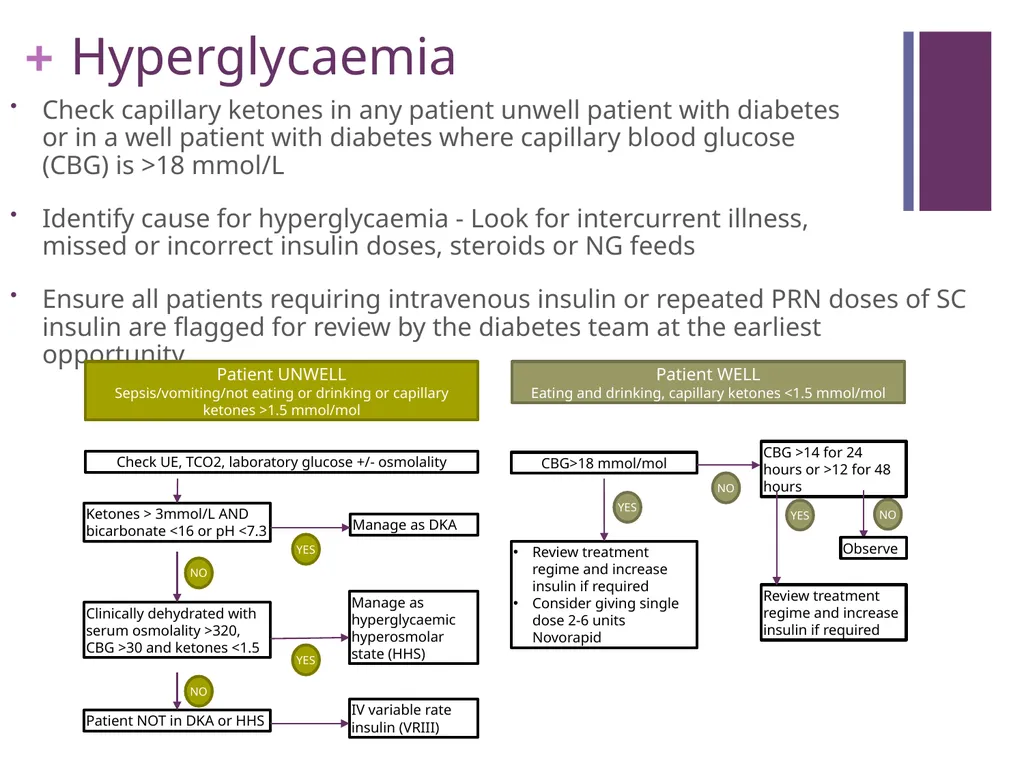
slide4. Hyperglycaemia Check capillary ketones in any patient unwell patient with diabetes or in a well patient with diabetes where capillary blood glucose (CBG) is >18 mmol/L
Identify cause for hyperglycaemia - Look for intercurrent illness, missed or incorrect insulin doses, steroids or NG feeds
Ensure all patients requiring intravenous insulin or repeated PRN doses of SC insulin are flagged for review by the diabetes team at the earliest opportunity<br>
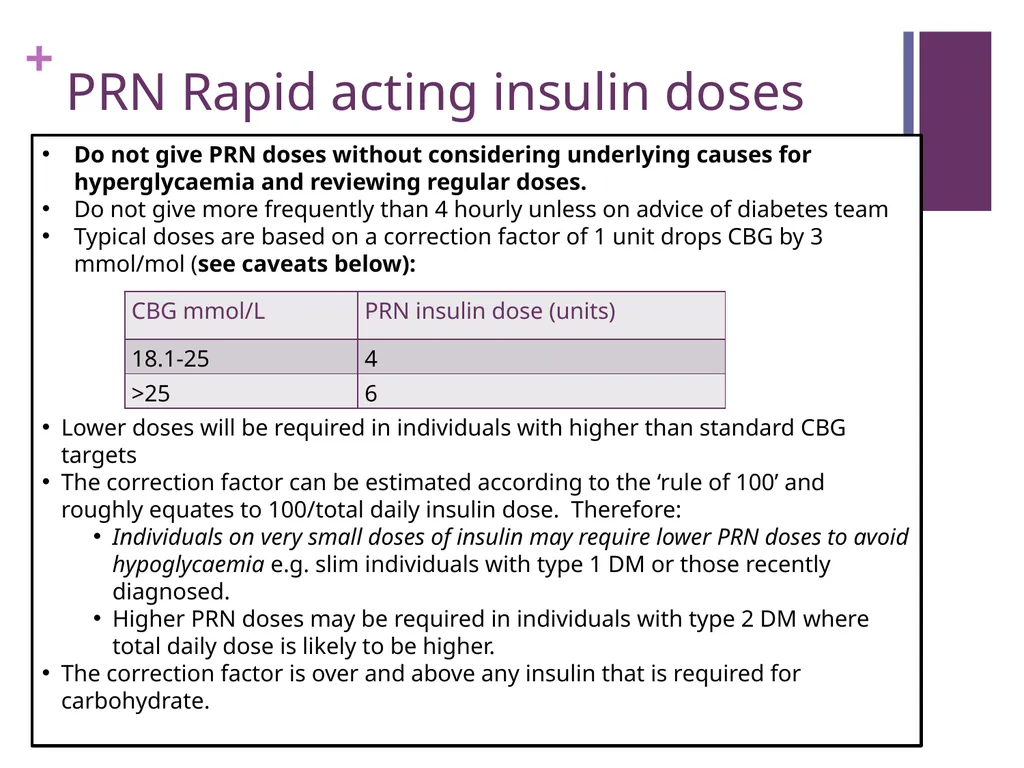
slide5. PRN Rapid acting insulin doses Do not give PRN doses without considering underlying causes for hyperglycaemia and reviewing regular doses.
Do not give more frequently than 4 hourly unless on advice of diabetes team
Typical doses are based on a correction factor of 1 unit drops CBG by 3 mmol/mol (see caveats below):
Lower doses will be required in individuals with higher than standard CBG targets
The correction factor can be estimated according to the ‘rule of 100’ and roughly equates to 100/total daily insulin dose. Therefore:
Individuals on very small doses of insulin may require lower PRN doses to avoid hypoglycaemia e.g. slim individuals with type 1 DM or those recently diagnosed.
Higher PRN doses may be required in individuals with type 2 DM where total daily dose is likely to be higher.
The correction factor is over and above any insulin that is required for carbohydrate.<br>
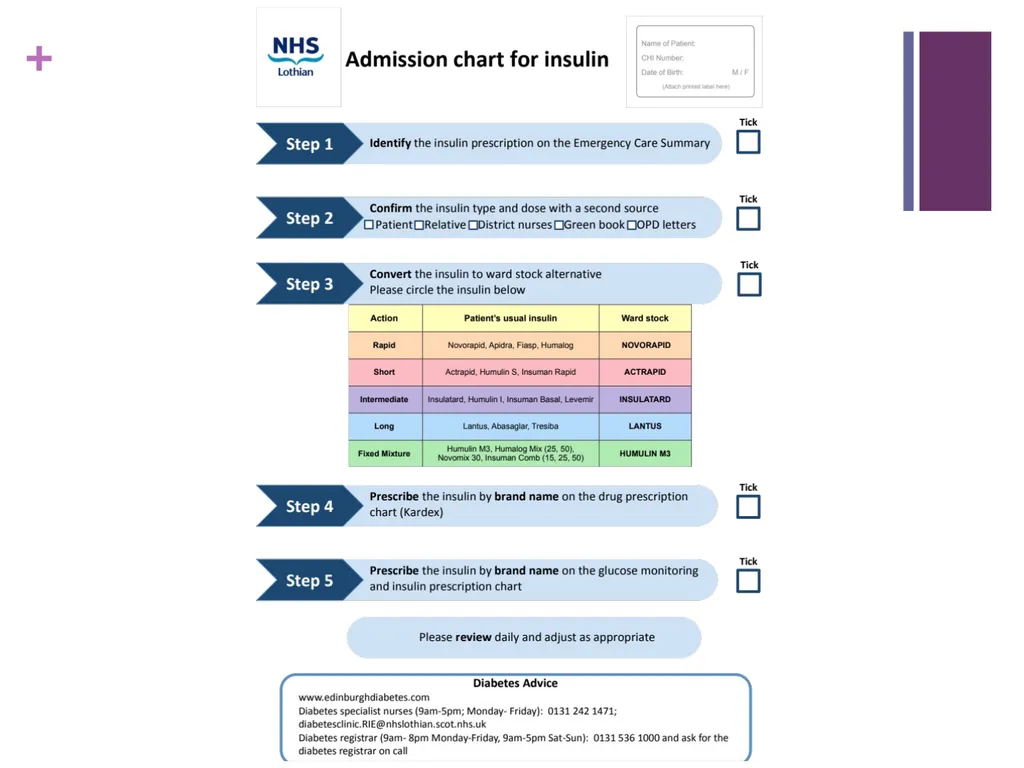
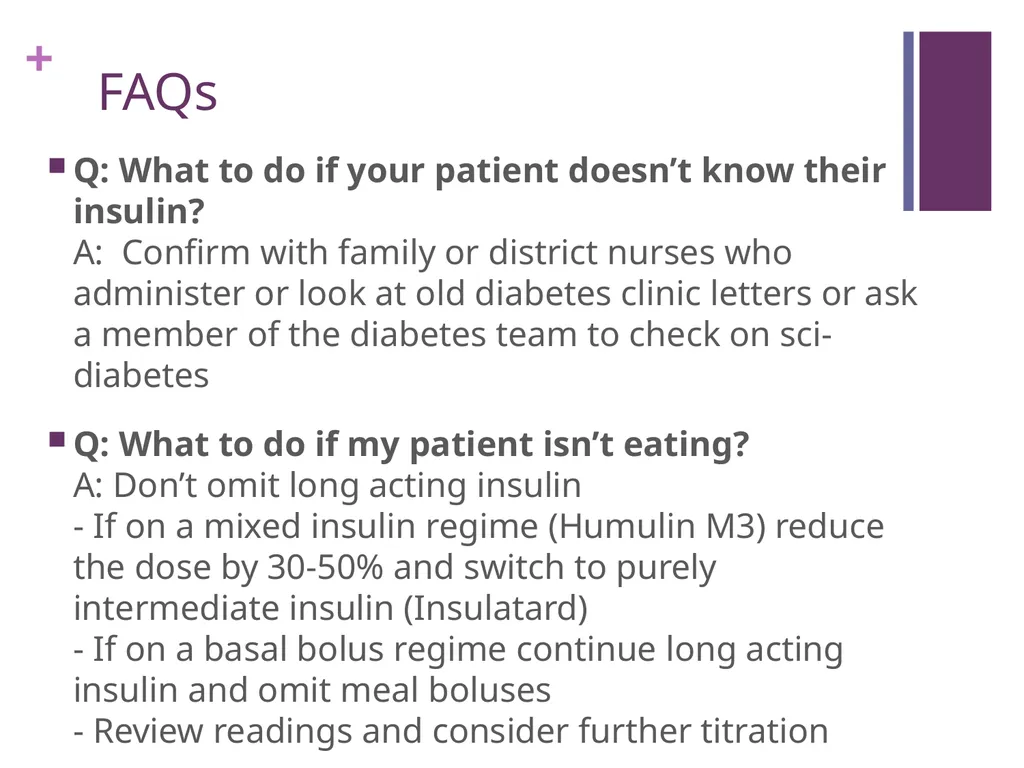
slide6. FAQs Q: What to do if your patient doesn’t know their insulin? A: Confirm with family or district nurses who administer or look at old diabetes clinic letters or ask a member of the diabetes team to check on sci-diabetes
Q: What to do if my patient isn’t eating? A: Don’t omit long acting insulin - If on a mixed insulin regime (Humulin M3) reduce the dose by 30-50% and switch to purely intermediate insulin (Insulatard) - If on a basal bolus regime continue long acting insulin and omit meal boluses - Review readings and consider further titration<br>
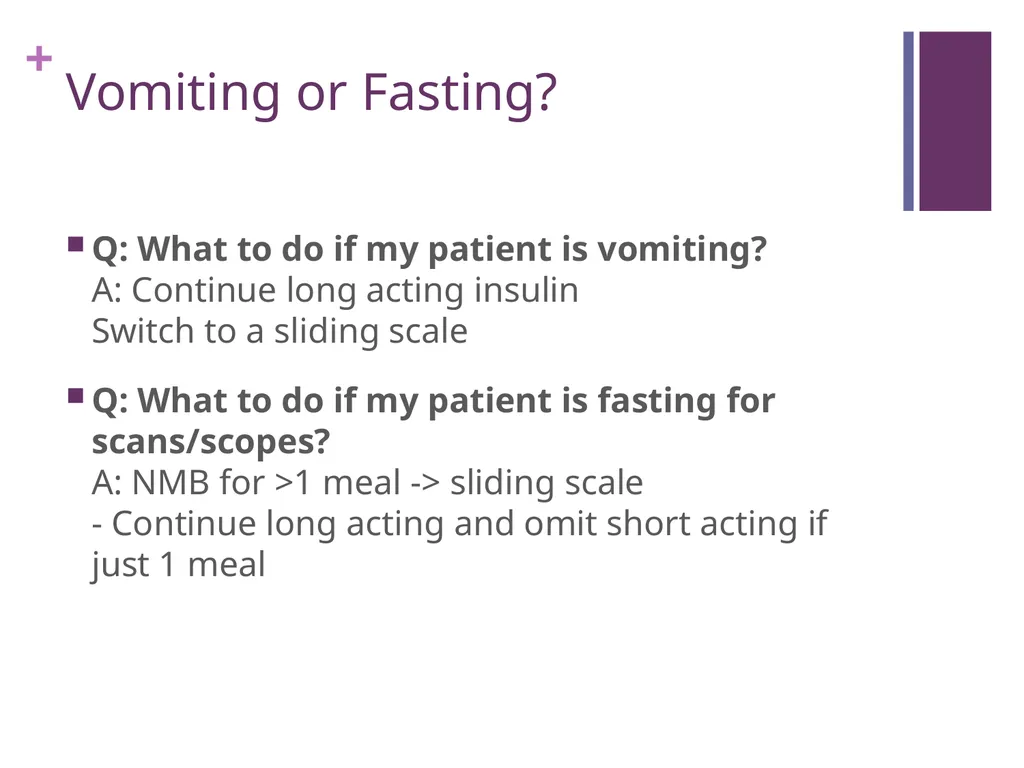
slide7. Vomiting or Fasting? Q: What to do if my patient is vomiting? A: Continue long acting insulin Switch to a sliding scale
Q: What to do if my patient is fasting for scans/scopes? A: NMB for >1 meal -> sliding scale - Continue long acting and omit short acting if just 1 meal<br>
slide8. Prescription Adjustments - Basal Bolus Q: What to do if before breakfast readings are consistently (more than 3 consecutive) >12 or <6? A: Increase or decrease basal by 10%
Q: What to do if lunch or dinner pre meal readings are consistently (more than 3 consecutive) >12 or <6? A: Increase or decrease the dose for the preceding meal by 10%<br>
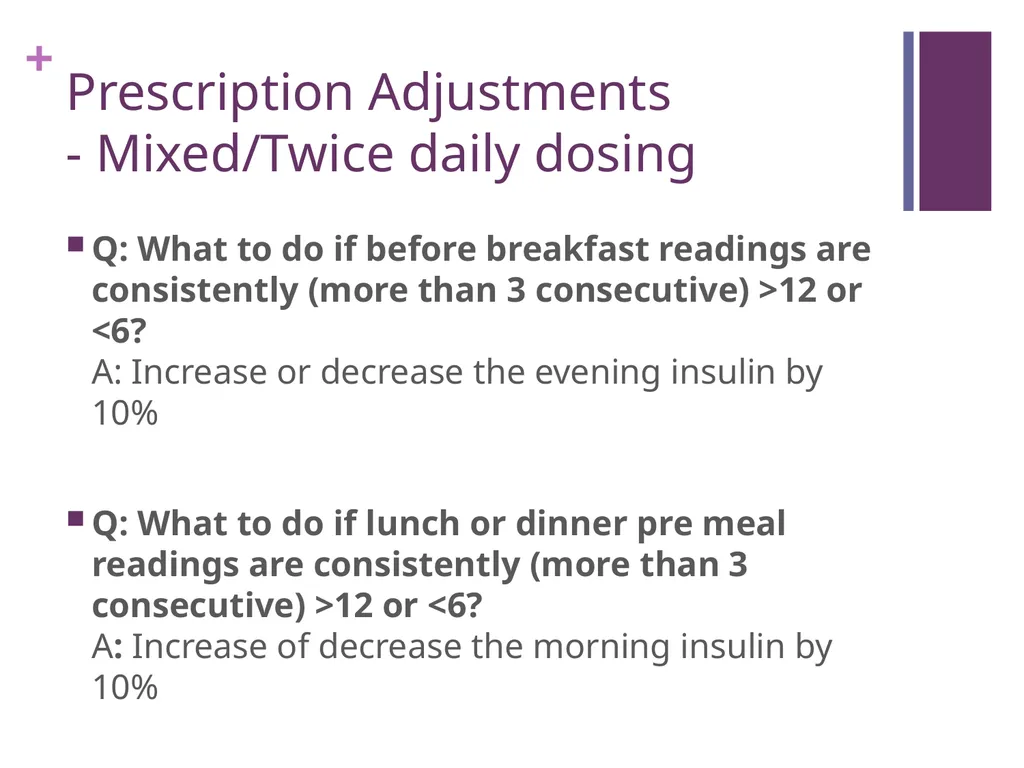
slide9. Prescription Adjustments - Mixed/Twice daily dosing Q: What to do if before breakfast readings are consistently (more than 3 consecutive) >12 or <6? A: Increase or decrease the evening insulin by 10%
Q: What to do if lunch or dinner pre meal readings are consistently (more than 3 consecutive) >12 or <6? A: Increase of decrease the morning insulin by 10%<br>
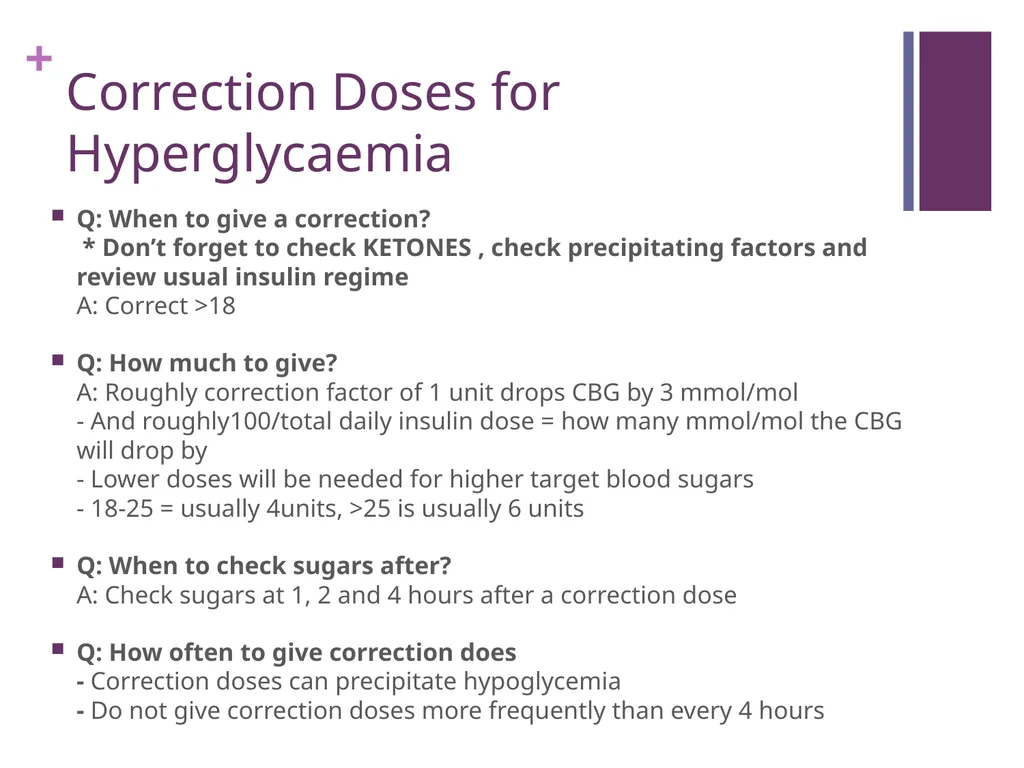
slide10. Correction Doses for Hyperglycaemia Q: When to give a correction? * Don’t forget to check KETONES , check precipitating factors and review usual insulin regime A: Correct >18
Q: How much to give? A: Roughly correction factor of 1 unit drops CBG by 3 mmol/mol - And roughly100/total daily insulin dose = how many mmol/mol the CBG will drop by - Lower doses will be needed for higher target blood sugars - 18-25 = usually 4units, >25 is usually 6 units
Q: When to check sugars after? A: Check sugars at 1, 2 and 4 hours after a correction dose
Q: How often to give correction does - Correction doses can precipitate hypoglycemia - Do not give correction doses more frequently than every 4 hours<br>
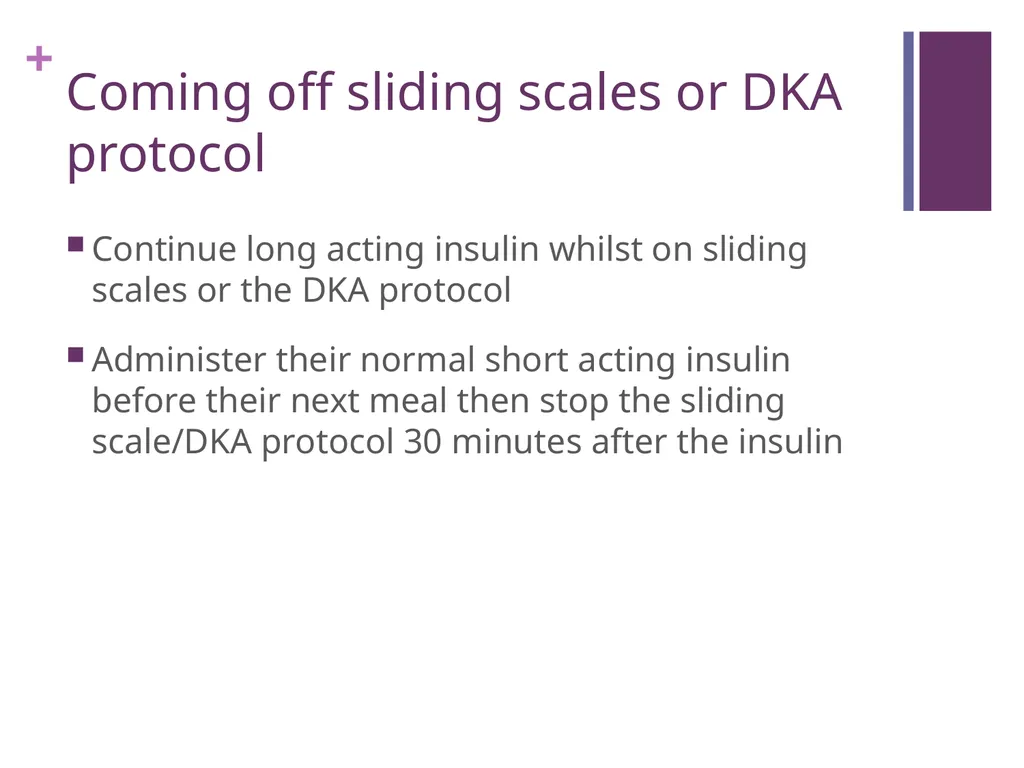
slide11. Coming off sliding scales or DKA protocol Continue long acting insulin whilst on sliding scales or the DKA protocol
Administer their normal short acting insulin before their next meal then stop the sliding scale/DKA protocol 30 minutes after the insulin<br>
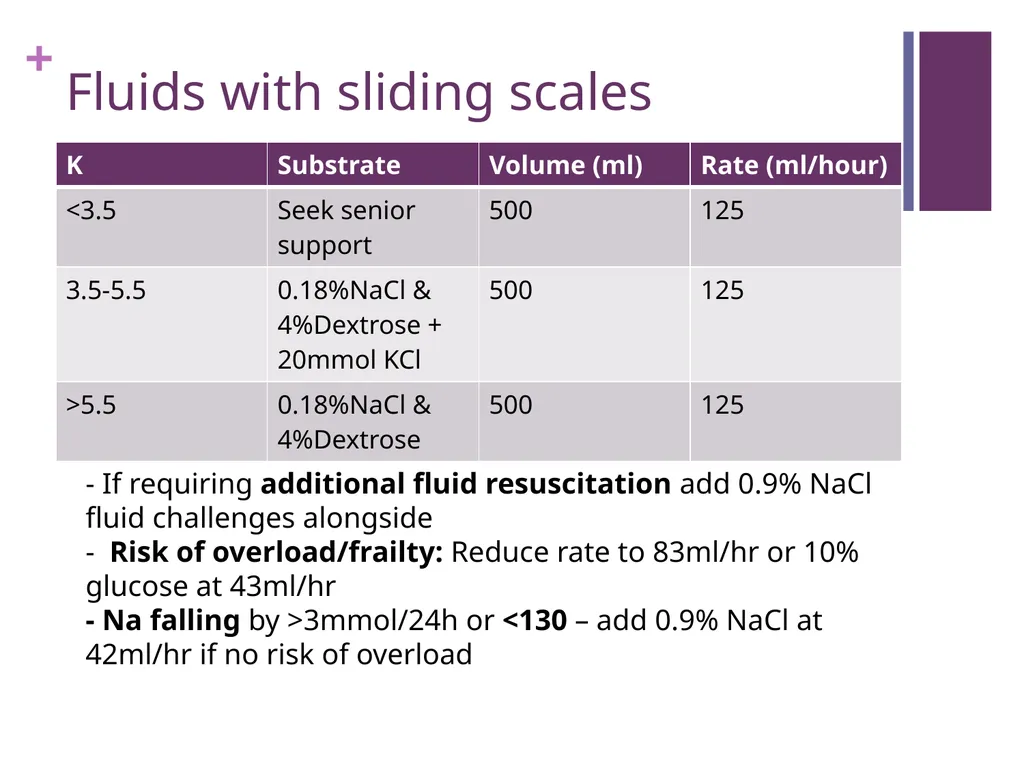
slide12. Fluids with sliding scales - If requiring additional fluid resuscitation add 0.9% NaCl fluid challenges alongside - Risk of overload/frailty: Reduce rate to 83ml/hr or 10% glucose at 43ml/hr
- Na falling by >3mmol/24h or <130 – add 0.9% NaCl at 42ml/hr if no risk of overload<br>
slide13. Diabetes Advice www.edinburghdiabetes.com Diabetes specialist nurses (9am-5pm; Monday- Friday): 0131 242 1471; diabetesclinic.RIE@nhslothian.scot.nhs.uk Diabetes registrar (9am- 8pm Monday-Friday, 9am-5pm Sat-Sun): 0131 536 1000 and ask for the diabetes registrar on call<br>
slide4. Hyperglycaemia Check capillary ketones in any patient unwell patient with diabetes or in a well patient with diabetes where capillary blood glucose (CBG) is >18 mmol/L
Identify cause for hyperglycaemia - Look for intercurrent illness, missed or incorrect insulin doses, steroids or NG feeds
Ensure all patients requiring intravenous insulin or repeated PRN doses of SC insulin are flagged for review by the diabetes team at the earliest opportunity<br>
slide5. PRN Rapid acting insulin doses Do not give PRN doses without considering underlying causes for hyperglycaemia and reviewing regular doses.
Do not give more frequently than 4 hourly unless on advice of diabetes team
Typical doses are based on a correction factor of 1 unit drops CBG by 3 mmol/mol (see caveats below):
Lower doses will be required in individuals with higher than standard CBG targets
The correction factor can be estimated according to the ‘rule of 100’ and roughly equates to 100/total daily insulin dose. Therefore:
Individuals on very small doses of insulin may require lower PRN doses to avoid hypoglycaemia e.g. slim individuals with type 1 DM or those recently diagnosed.
Higher PRN doses may be required in individuals with type 2 DM where total daily dose is likely to be higher.
The correction factor is over and above any insulin that is required for carbohydrate.<br>
slide6. FAQs Q: What to do if your patient doesn’t know their insulin? A: Confirm with family or district nurses who administer or look at old diabetes clinic letters or ask a member of the diabetes team to check on sci-diabetes
Q: What to do if my patient isn’t eating? A: Don’t omit long acting insulin - If on a mixed insulin regime (Humulin M3) reduce the dose by 30-50% and switch to purely intermediate insulin (Insulatard) - If on a basal bolus regime continue long acting insulin and omit meal boluses - Review readings and consider further titration<br>
slide7. Vomiting or Fasting? Q: What to do if my patient is vomiting? A: Continue long acting insulin Switch to a sliding scale
Q: What to do if my patient is fasting for scans/scopes? A: NMB for >1 meal -> sliding scale - Continue long acting and omit short acting if just 1 meal<br>
slide8. Prescription Adjustments - Basal Bolus Q: What to do if before breakfast readings are consistently (more than 3 consecutive) >12 or <6? A: Increase or decrease basal by 10%
Q: What to do if lunch or dinner pre meal readings are consistently (more than 3 consecutive) >12 or <6? A: Increase or decrease the dose for the preceding meal by 10%<br>
slide9. Prescription Adjustments - Mixed/Twice daily dosing Q: What to do if before breakfast readings are consistently (more than 3 consecutive) >12 or <6? A: Increase or decrease the evening insulin by 10%
Q: What to do if lunch or dinner pre meal readings are consistently (more than 3 consecutive) >12 or <6? A: Increase of decrease the morning insulin by 10%<br>
slide10. Correction Doses for Hyperglycaemia Q: When to give a correction? * Don’t forget to check KETONES , check precipitating factors and review usual insulin regime A: Correct >18
Q: How much to give? A: Roughly correction factor of 1 unit drops CBG by 3 mmol/mol - And roughly100/total daily insulin dose = how many mmol/mol the CBG will drop by - Lower doses will be needed for higher target blood sugars - 18-25 = usually 4units, >25 is usually 6 units
Q: When to check sugars after? A: Check sugars at 1, 2 and 4 hours after a correction dose
Q: How often to give correction does - Correction doses can precipitate hypoglycemia - Do not give correction doses more frequently than every 4 hours<br>
slide11. Coming off sliding scales or DKA protocol Continue long acting insulin whilst on sliding scales or the DKA protocol
Administer their normal short acting insulin before their next meal then stop the sliding scale/DKA protocol 30 minutes after the insulin<br>
slide12. Fluids with sliding scales - If requiring additional fluid resuscitation add 0.9% NaCl fluid challenges alongside - Risk of overload/frailty: Reduce rate to 83ml/hr or 10% glucose at 43ml/hr
- Na falling by >3mmol/24h or <130 – add 0.9% NaCl at 42ml/hr if no risk of overload<br>
slide13. Diabetes Advice www.edinburghdiabetes.com Diabetes specialist nurses (9am-5pm; Monday- Friday): 0131 242 1471; diabetesclinic.RIE@nhslothian.scot.nhs.uk Diabetes registrar (9am- 8pm Monday-Friday, 9am-5pm Sat-Sun): 0131 536 1000 and ask for the diabetes registrar on call<br>