INTEGRALS CONTENT What Integration is. Geometrical Interpretation Properties Basic Formula Methods of Integration Integration By Parts Practice Questions . Definite Integrals Areas of Curves What Integral is ? Integration is the inverse
"INTEGRALS CONTENT What Integration is. Geometrical" is the property of its rightful owner. Permission is granted to
download and print the materials on this website for personal, non-commercial use only, and to display it
on your personal computer provided you do not modify the materials and that you retain all copyright
notices contained in the materials. By downloading content from our website, you accept the terms of this
agreement.
Presentation Transcript
01
INTEGRALS CONTENT
What Integration is.
Geometrical Interpretation
Properties
Basic Formula
Methods of Integration
Integration By Parts
Practice Questions .
Definite Integrals
Areas of Curves<br>
02
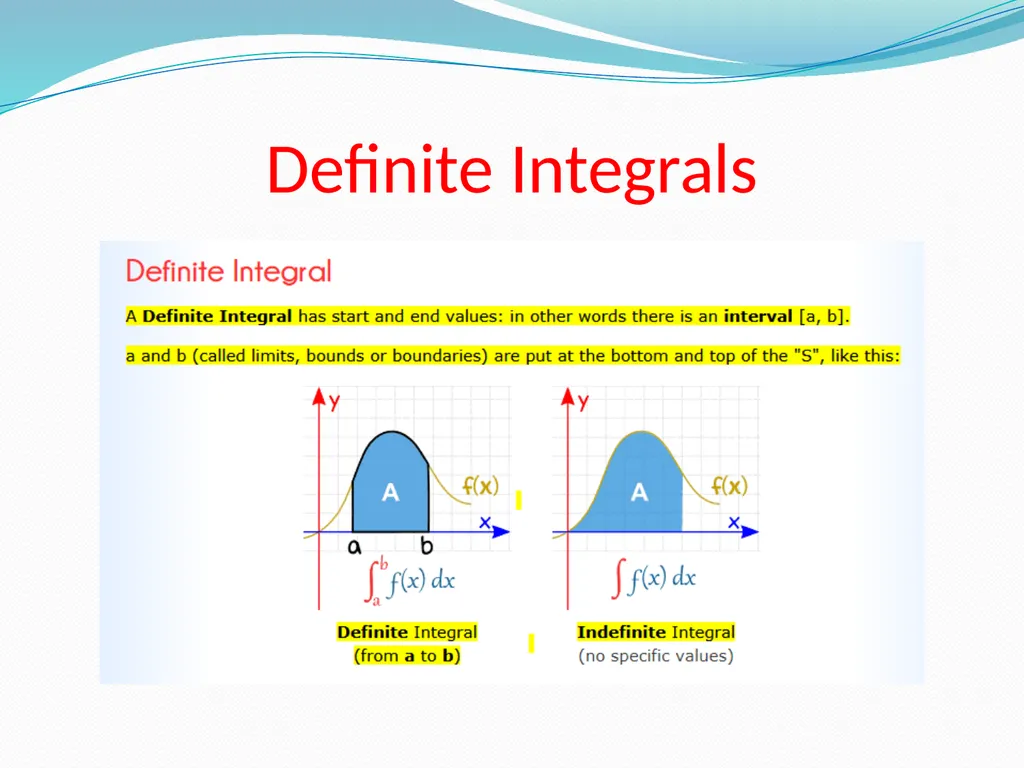
What Integral is ? Integration is the inverse process of differentiation. In the differential calculus, we are given a function and we have to find the derivative or differential of this function, but in the integral calculus, we are to find a function whose differential is given. Thus, integration is a process which is the inverse of differentiation. Then, ∫f(x) dx = F(x) + C, these integrals are called indefinite integrals or general integrals. C is an arbitrary constant by varying which one gets different anti-derivatives of the given function. Note: Derivative of a function is unique but a function can have infinite anti-derivatives or integrals.<br>
03
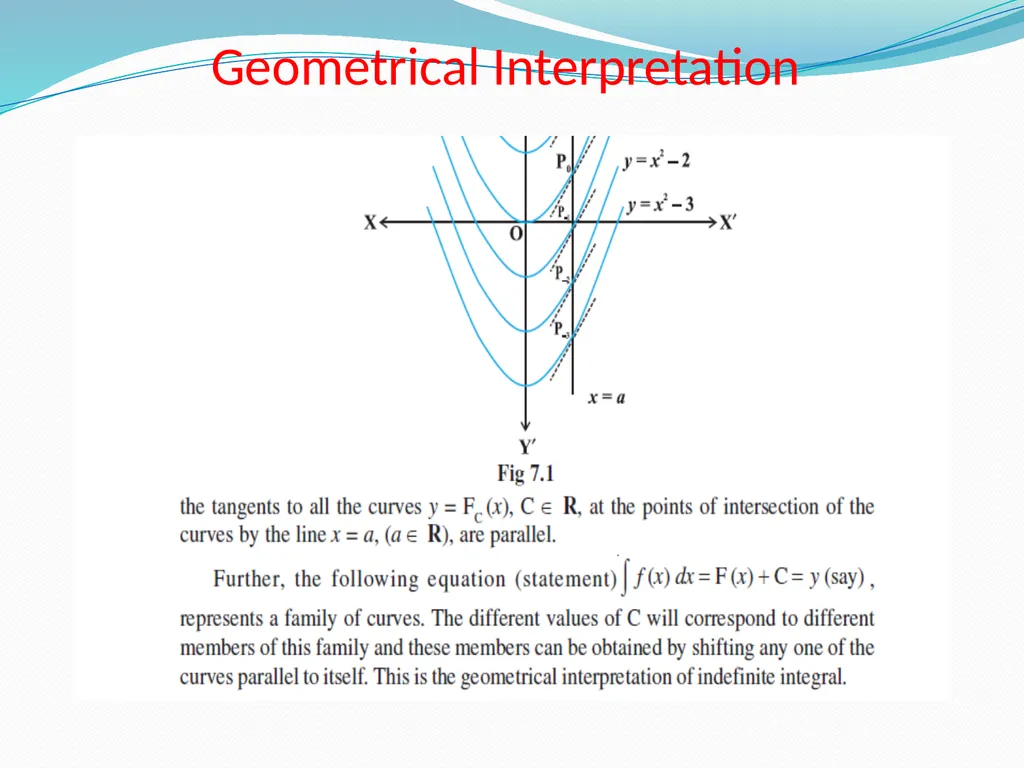
Geometrical Interpretation<br>
04
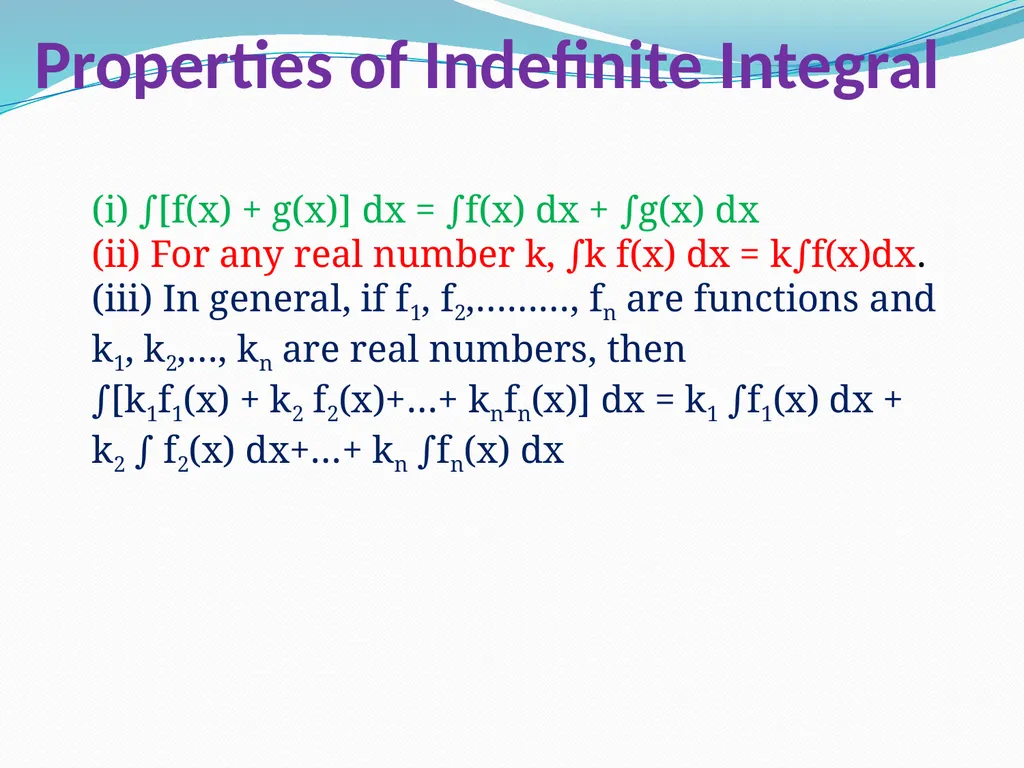
Properties of Indefinite Integral (i) ∫[f(x) + g(x)] dx = ∫f(x) dx + ∫g(x) dx (ii) For any real number k, ∫k f(x) dx = k∫f(x)dx. (iii) In general, if f1, f2,………, fn are functions and k1, k2,…, kn are real numbers, then ∫[k1f1(x) + k2 f2(x)+…+ knfn(x)] dx = k1 ∫f1(x) dx + k2 ∫ f2(x) dx+…+ kn ∫fn(x) dx<br>
05
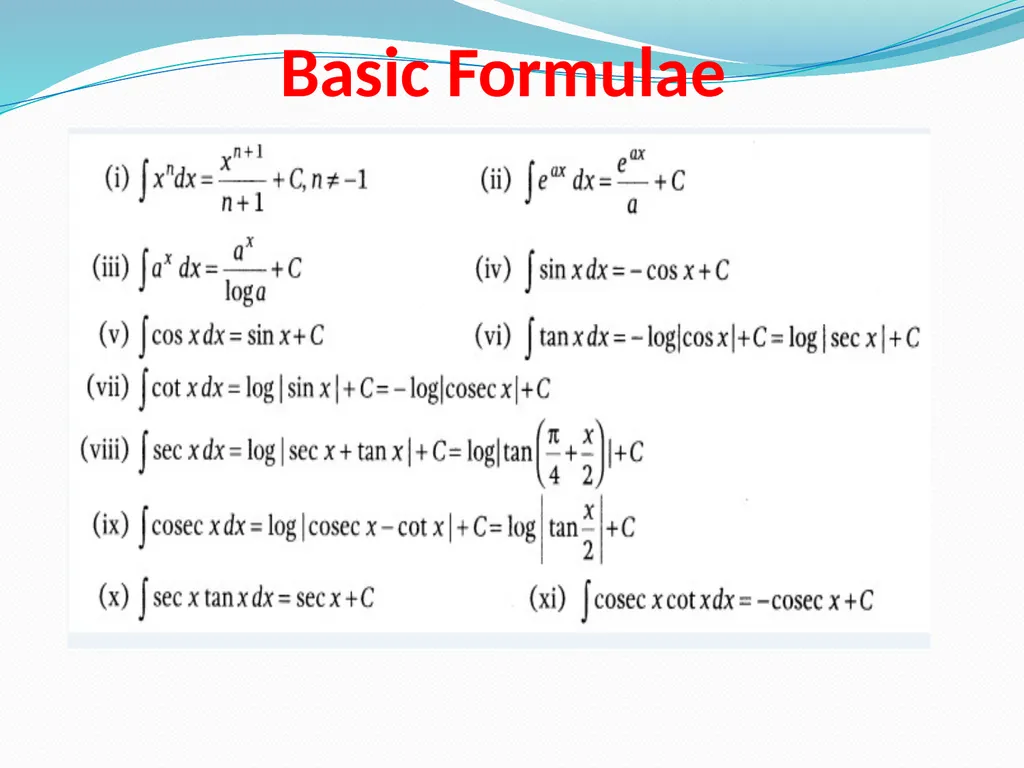
Basic Formulae<br>
06
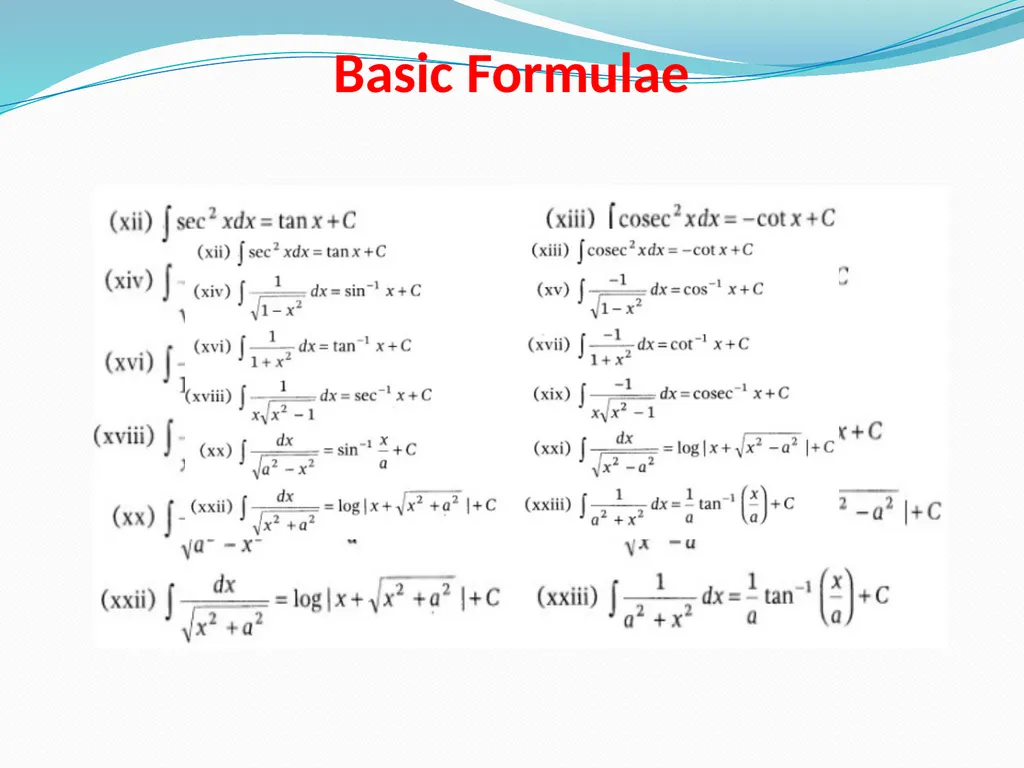
Basic Formulae<br>
07
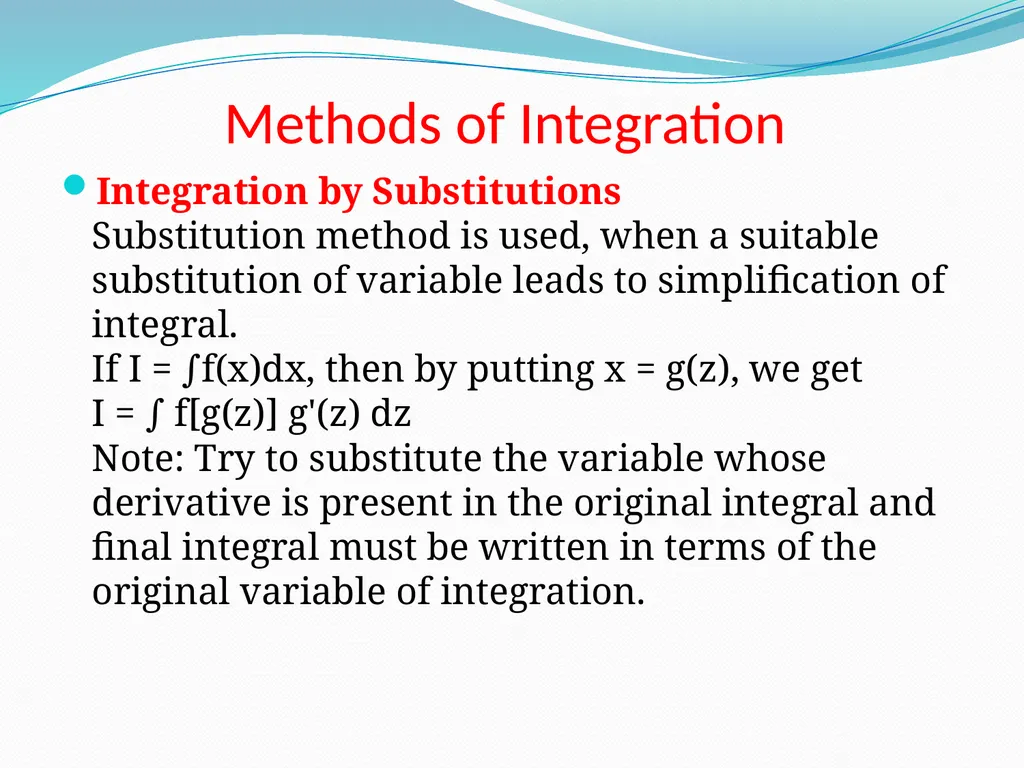
Methods of Integration Integration by Substitutions Substitution method is used, when a suitable substitution of variable leads to simplification of integral. If I = ∫f(x)dx, then by putting x = g(z), we get I = ∫ f[g(z)] g'(z) dz Note: Try to substitute the variable whose derivative is present in the original integral and final integral must be written in terms of the original variable of integration.<br>
08
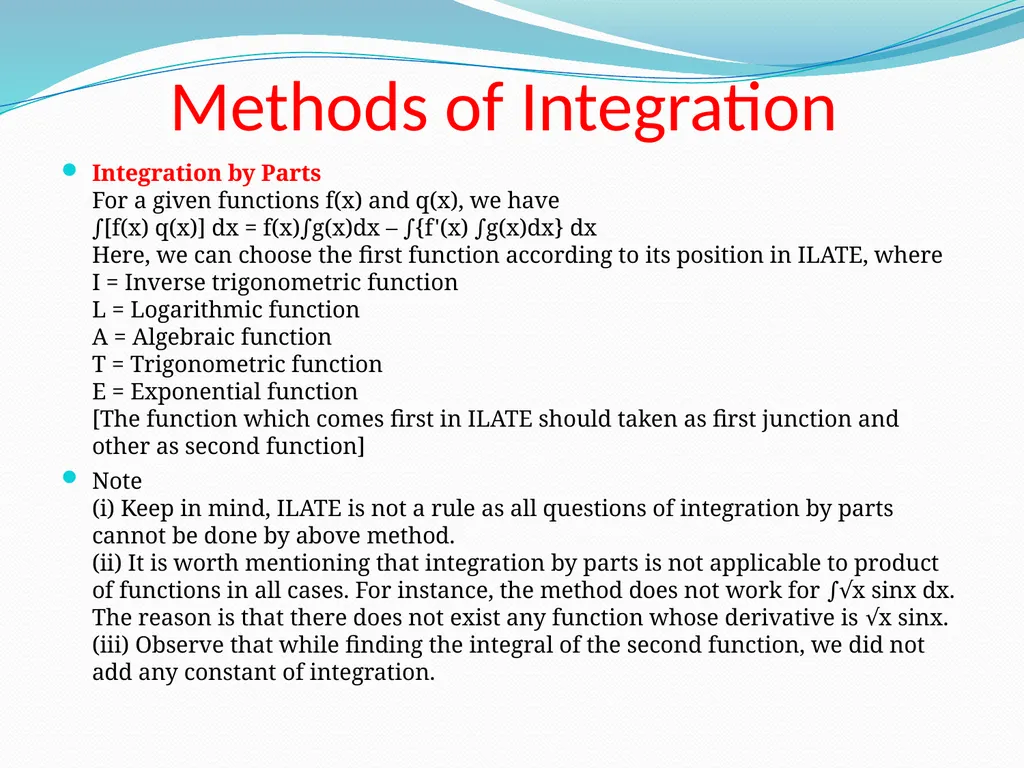
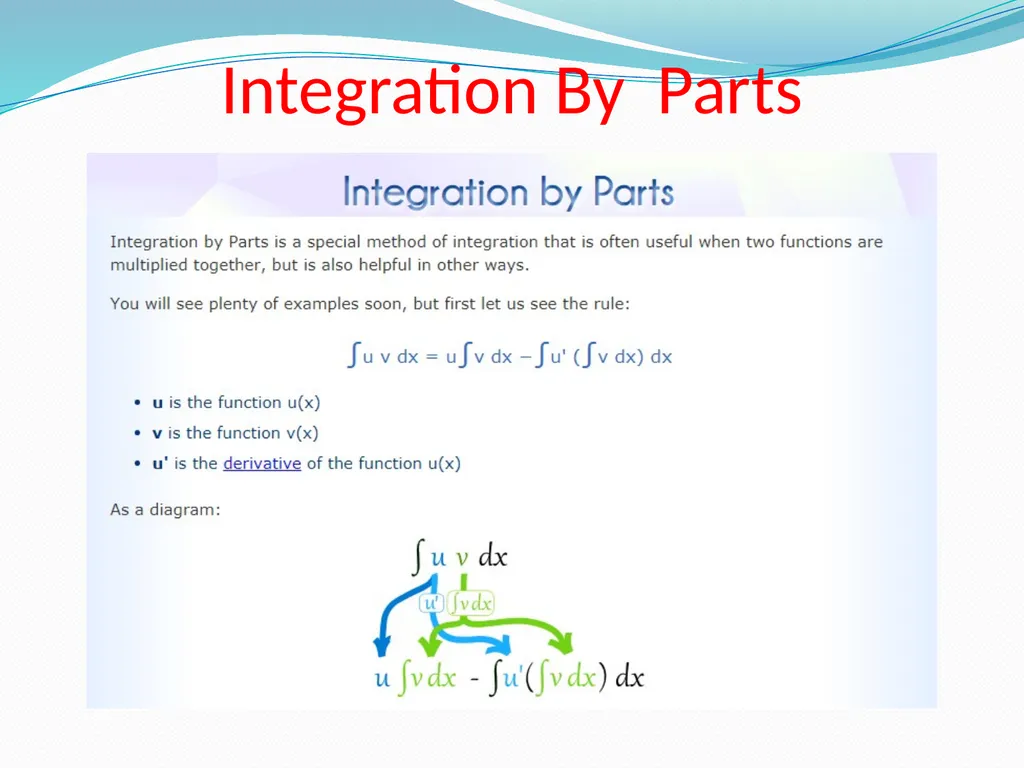
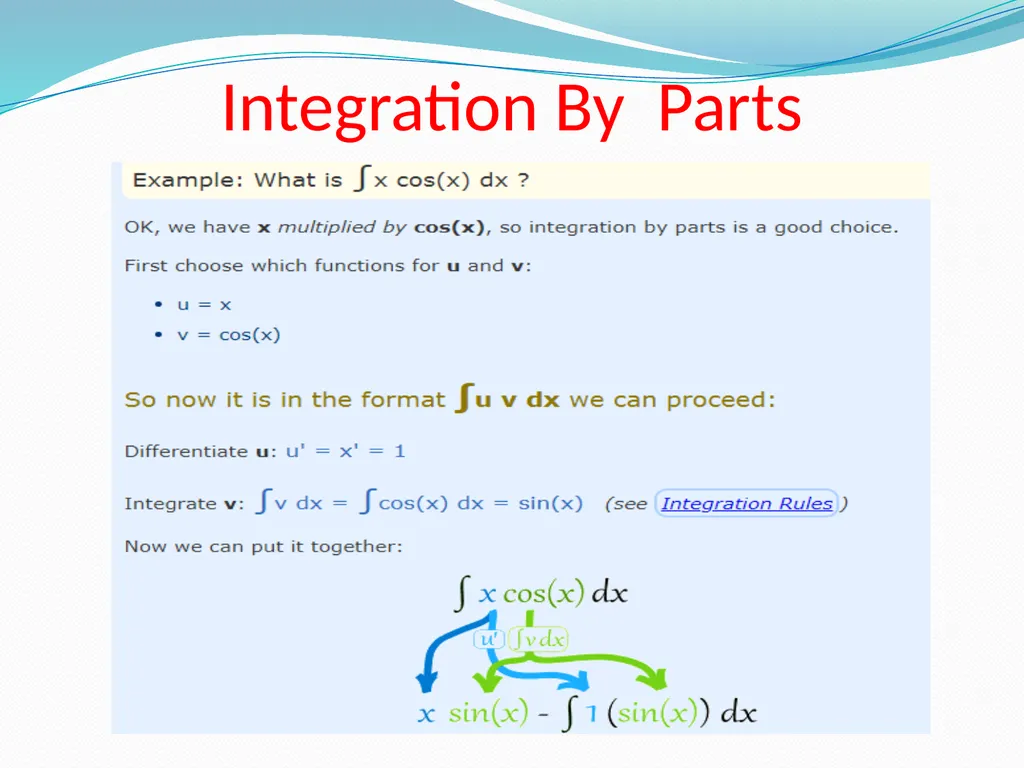
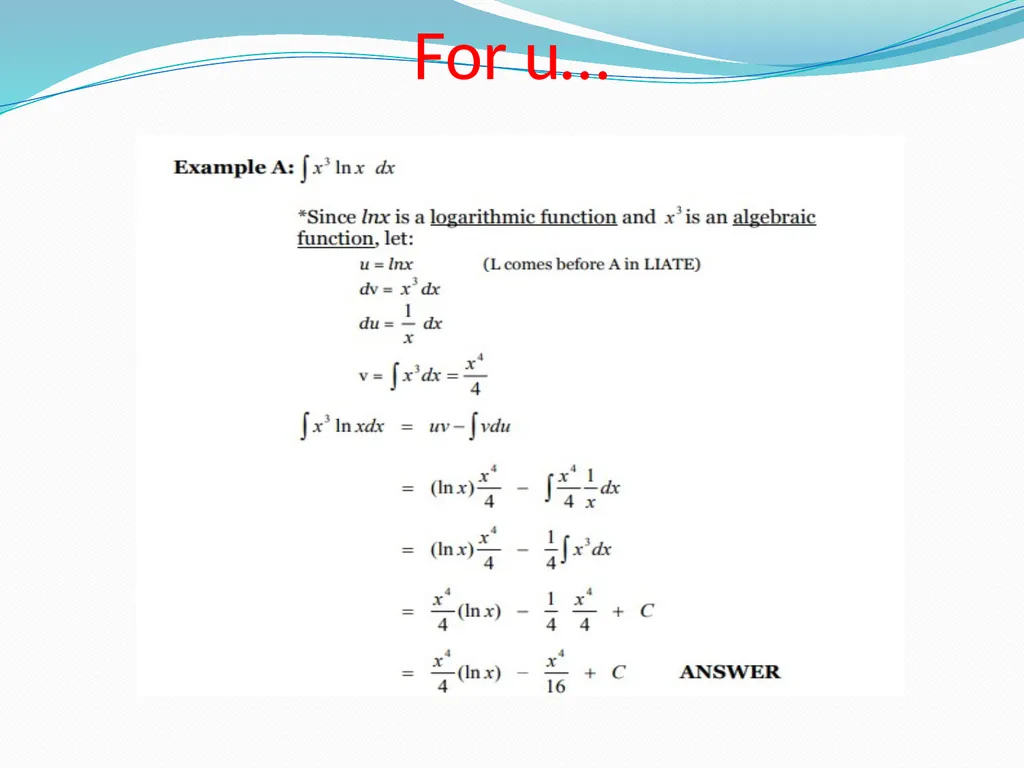
Methods of Integration Integration by Parts For a given functions f(x) and q(x), we have ∫[f(x) q(x)] dx = f(x)∫g(x)dx – ∫{f'(x) ∫g(x)dx} dx Here, we can choose the first function according to its position in ILATE, where I = Inverse trigonometric function L = Logarithmic function A = Algebraic function T = Trigonometric function E = Exponential function [The function which comes first in ILATE should taken as first junction and other as second function]
Note (i) Keep in mind, ILATE is not a rule as all questions of integration by parts cannot be done by above method. (ii) It is worth mentioning that integration by parts is not applicable to product of functions in all cases. For instance, the method does not work for ∫√x sinx dx. The reason is that there does not exist any function whose derivative is √x sinx. (iii) Observe that while finding the integral of the second function, we did not add any constant of integration.<br>
09
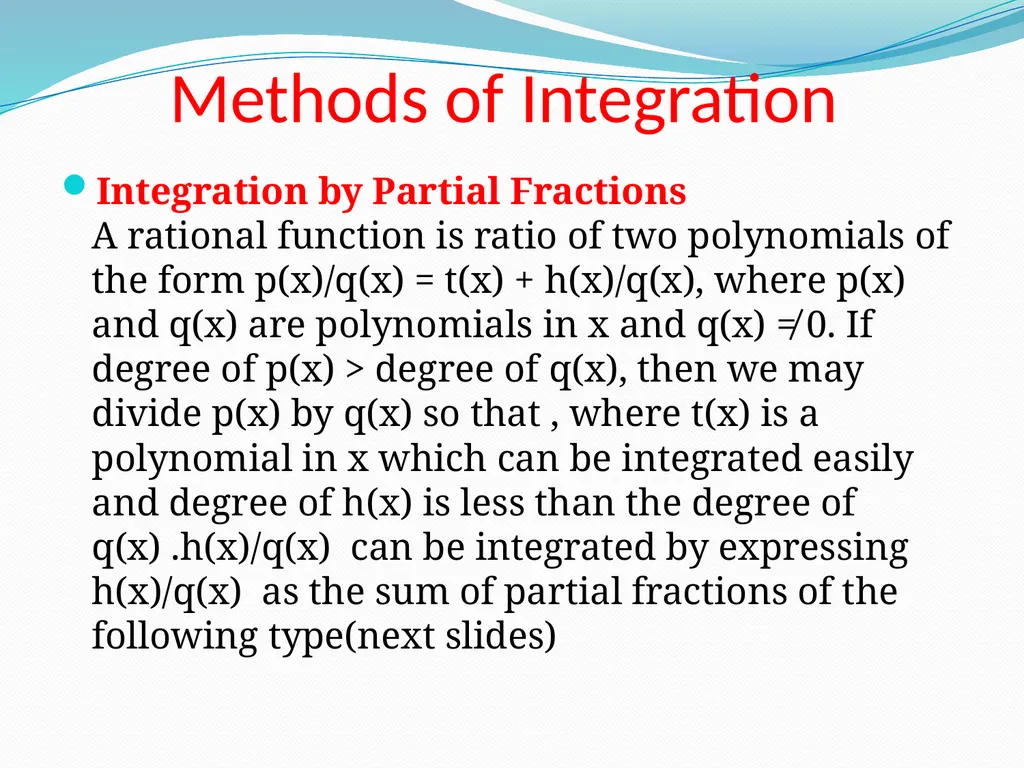
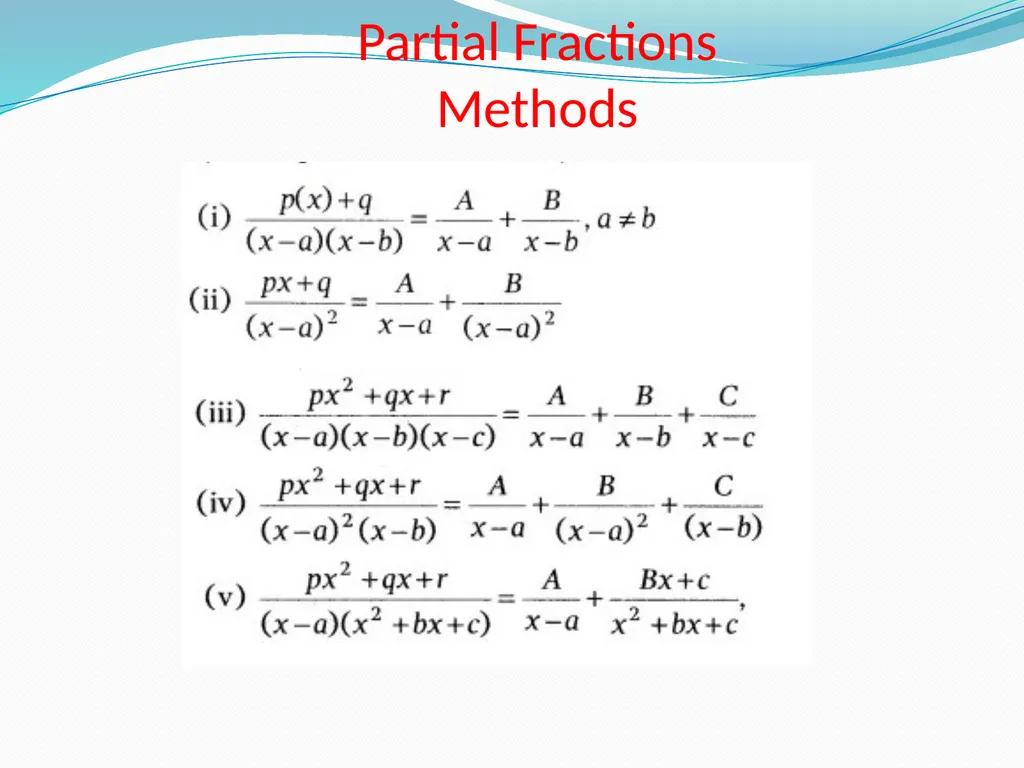
Methods of Integration Integration by Partial Fractions A rational function is ratio of two polynomials of the form p(x)/q(x) = t(x) + h(x)/q(x), where p(x) and q(x) are polynomials in x and q(x) ≠ 0. If degree of p(x) > degree of q(x), then we may divide p(x) by q(x) so that , where t(x) is a polynomial in x which can be integrated easily and degree of h(x) is less than the degree of q(x) .h(x)/q(x) can be integrated by expressing h(x)/q(x) as the sum of partial fractions of the following type(next slides)<br>
10
Partial Fractions Methods<br>
11
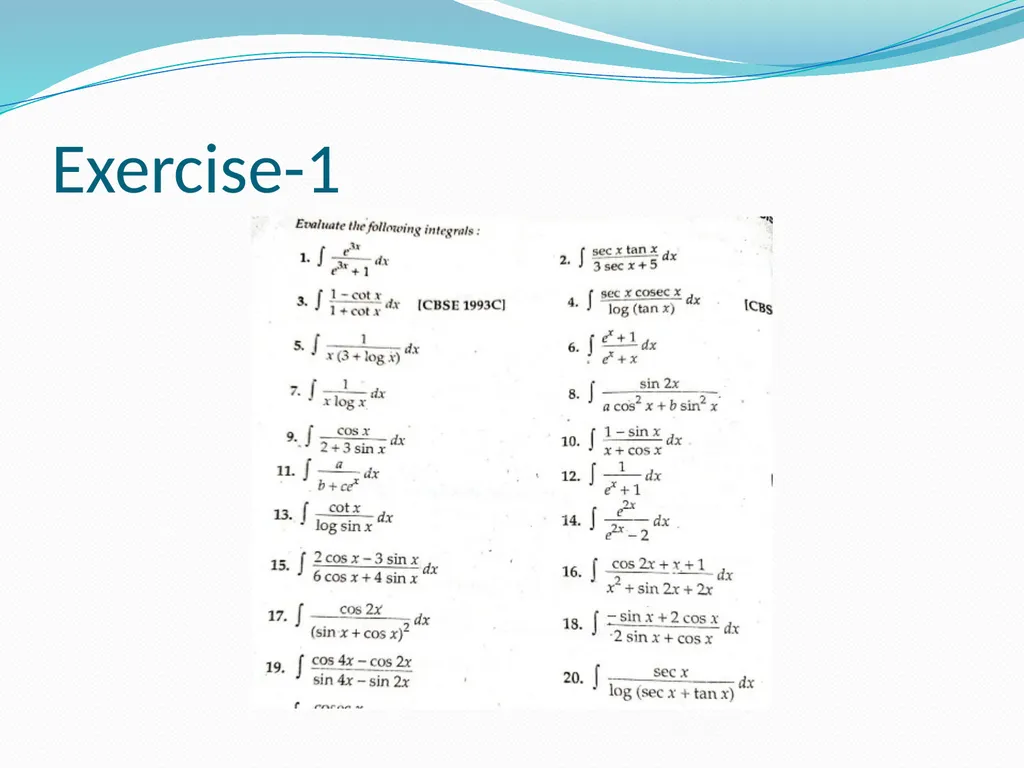
Exercise-1<br>
12
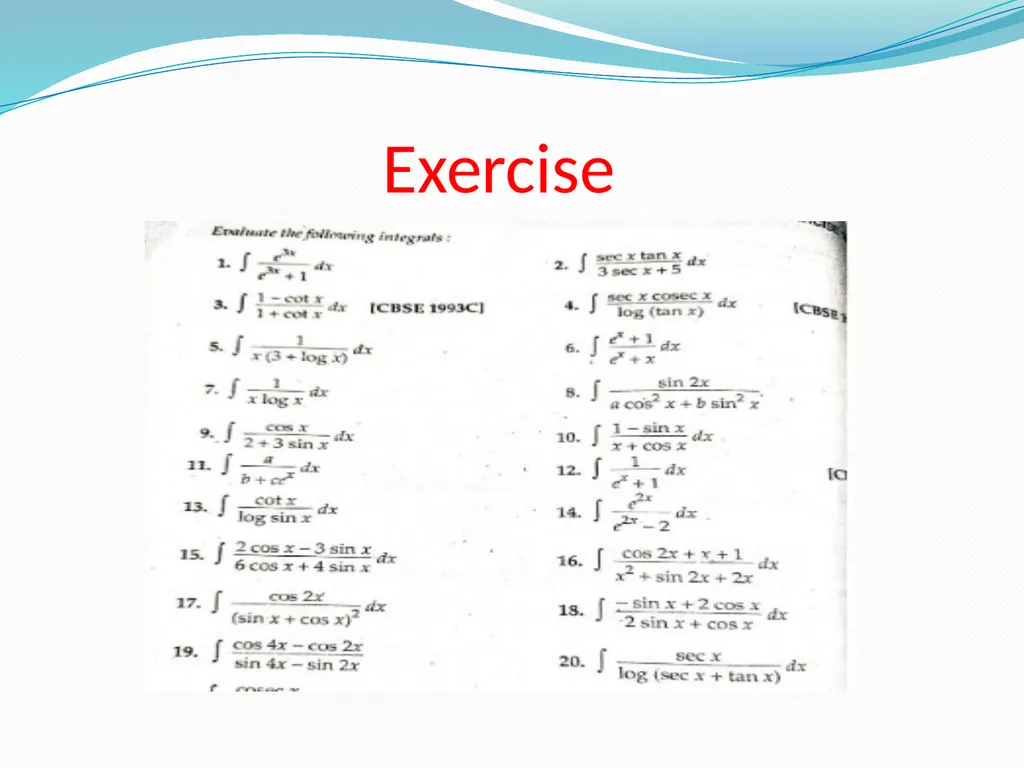
Exercise<br>
13
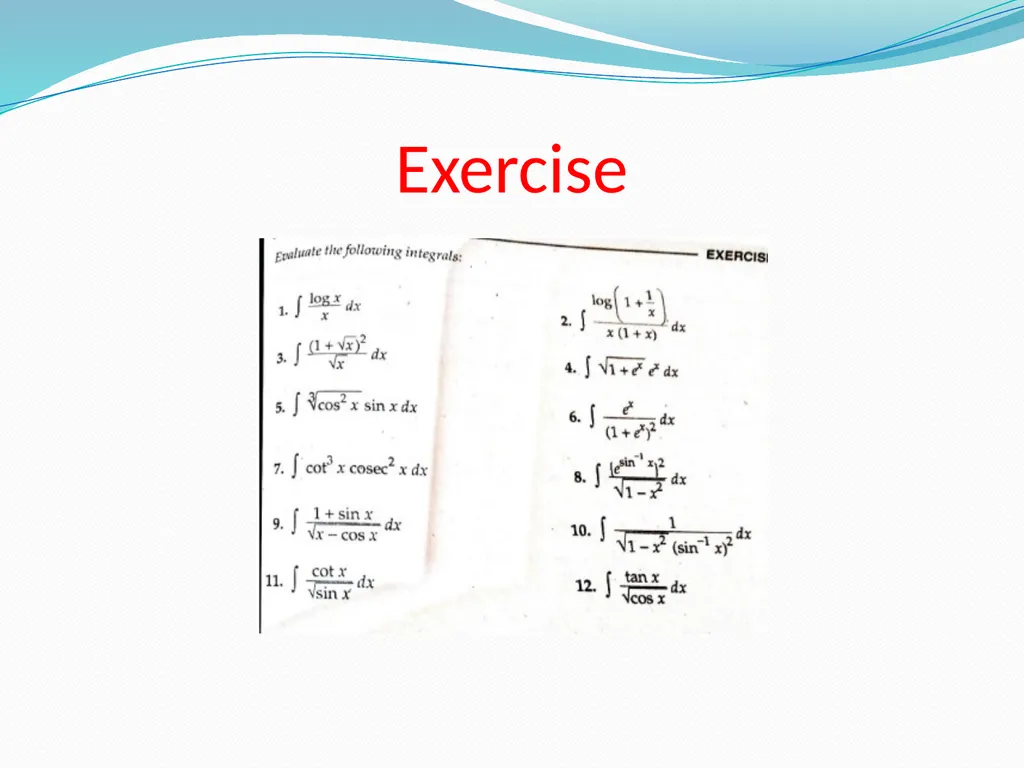
Exercise<br>
14
Integration By Parts<br>
15
Integration By Parts<br>
16
For u…<br>
17
Examples<br>
18
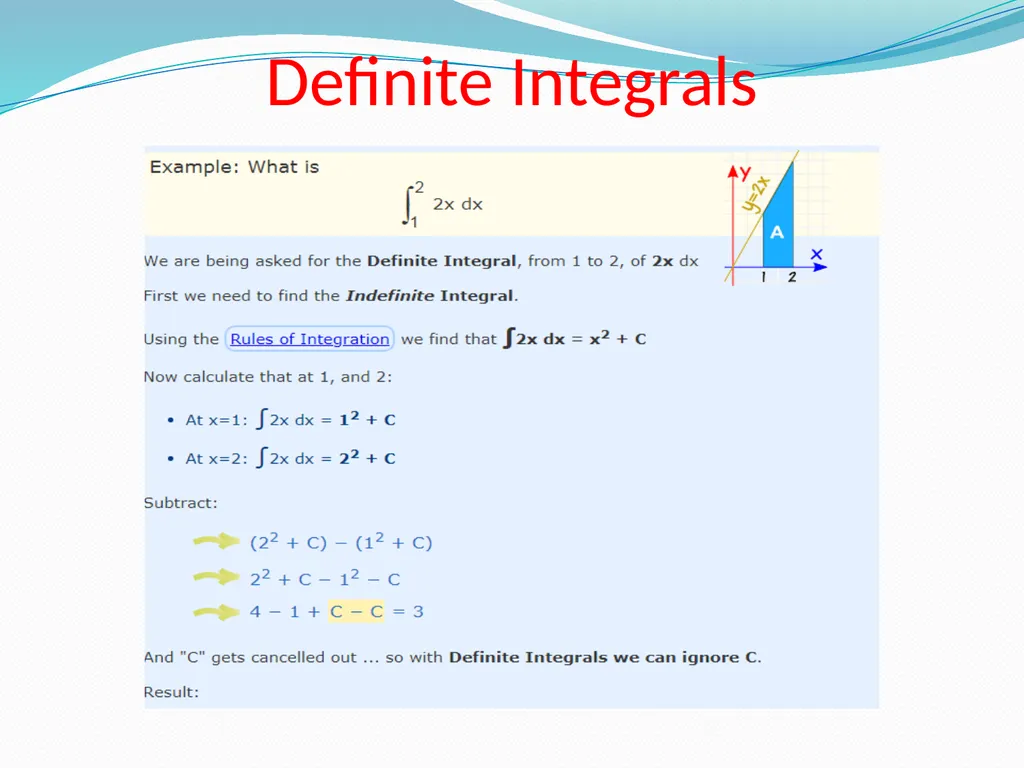
Definite Integrals<br>
19
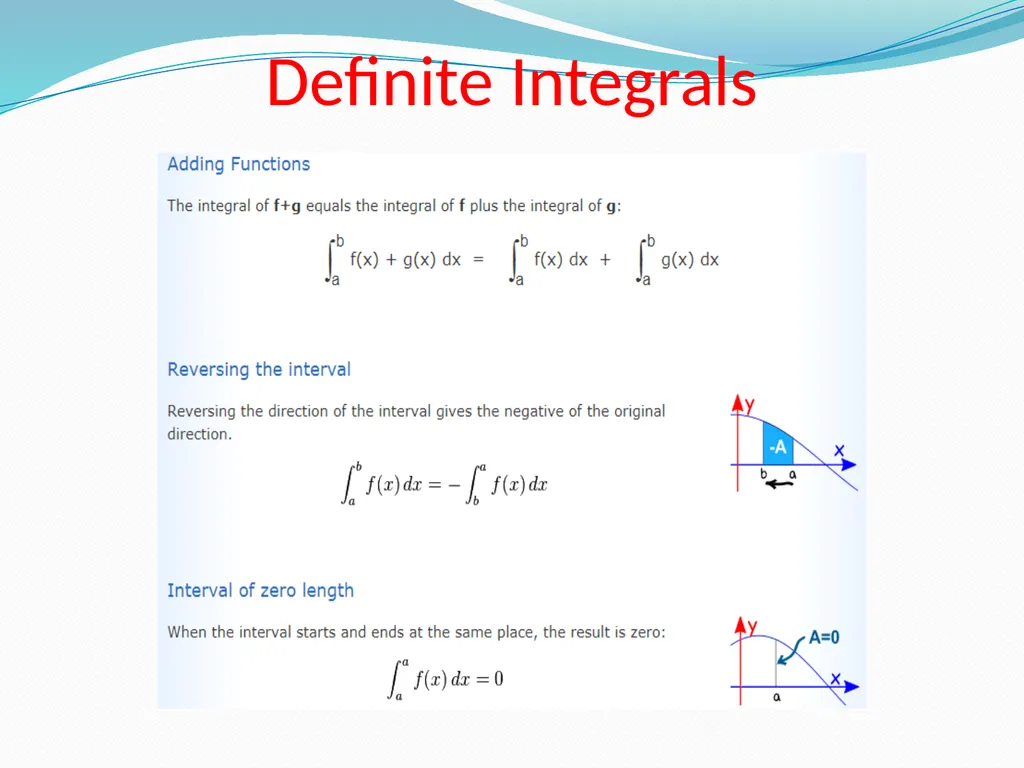
Definite Integrals<br>
20
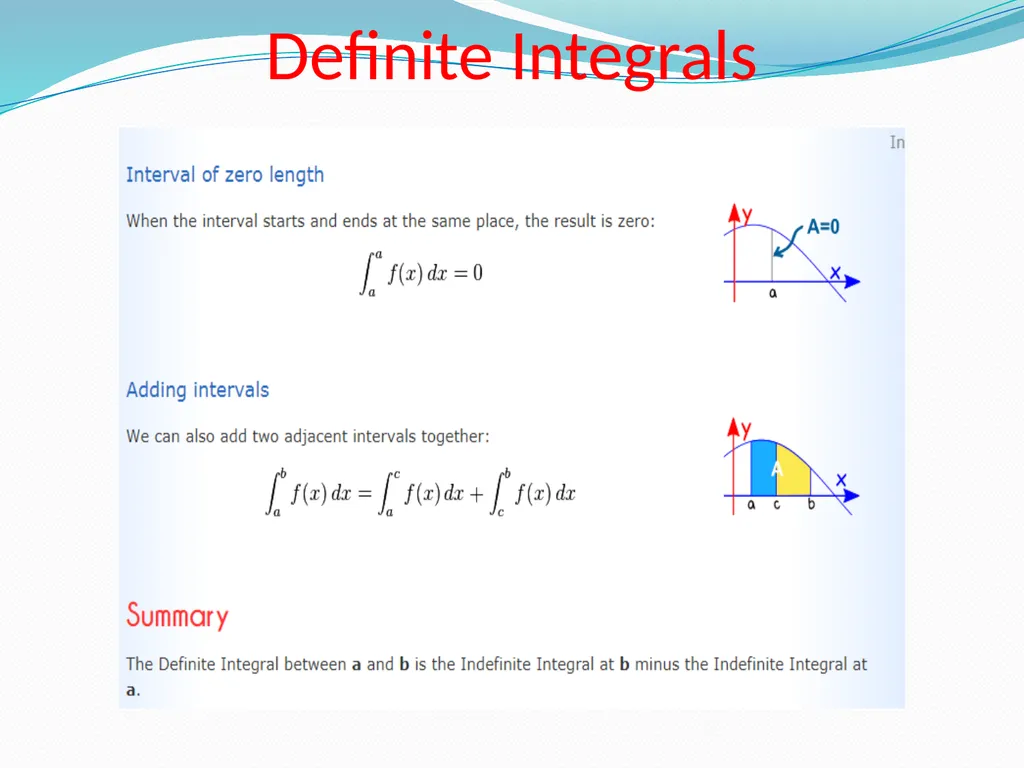
Definite Integrals<br>
21
Definite Integrals<br>
22
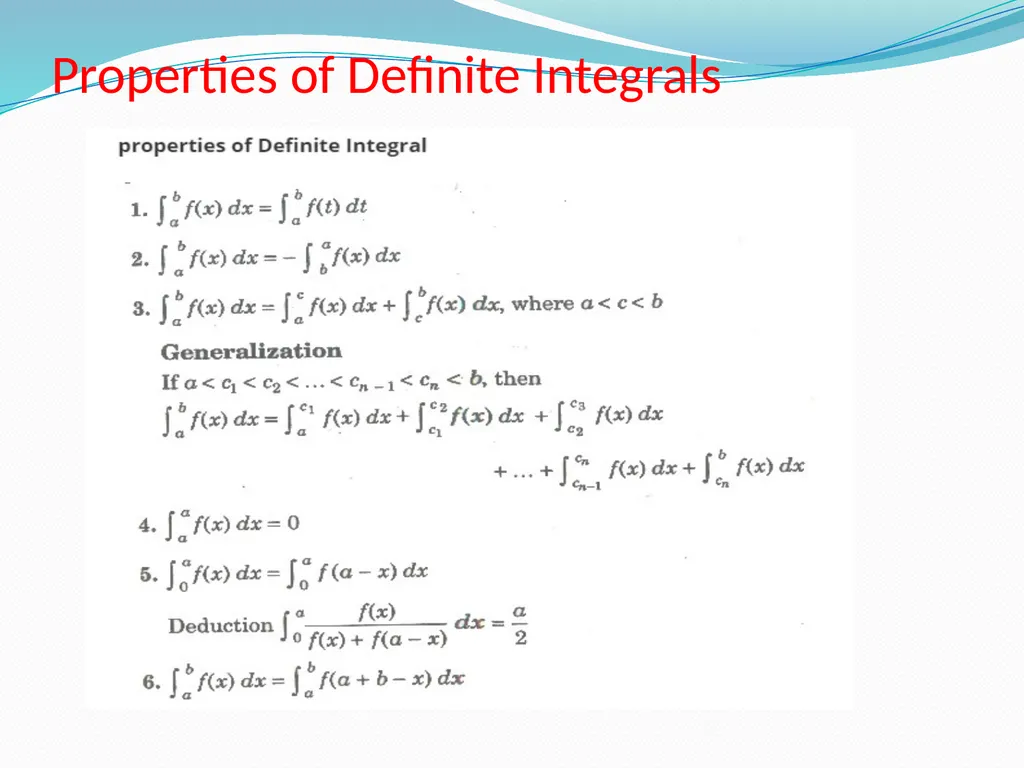
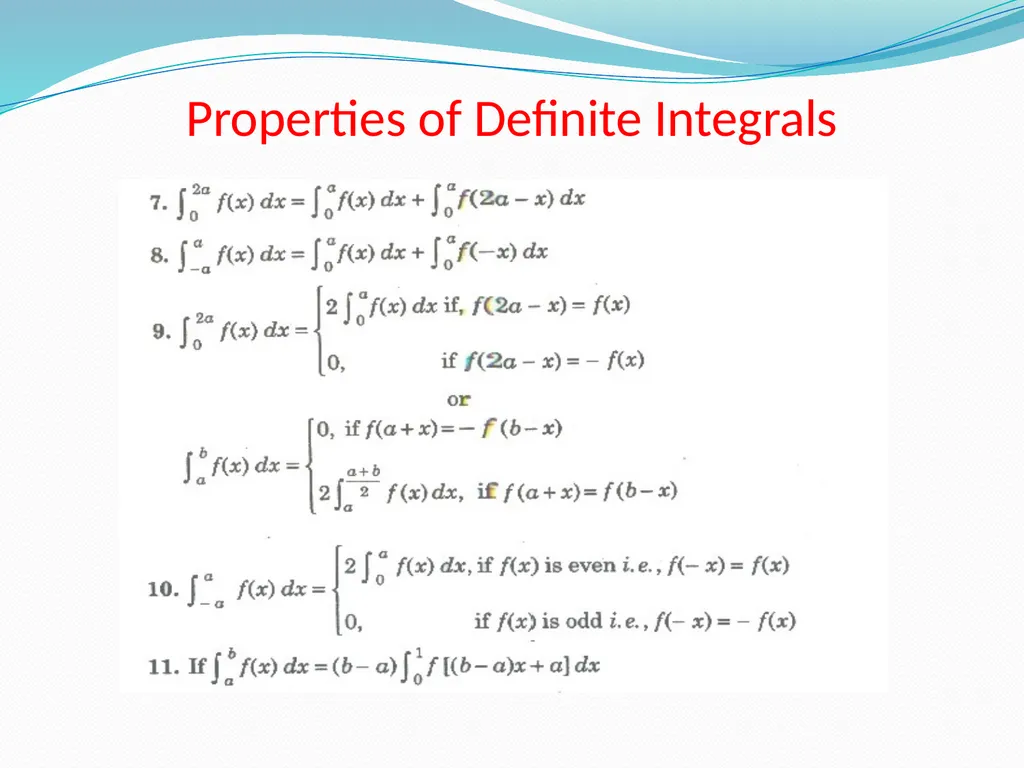
Properties of Definite Integrals<br>
23
Properties of Definite Integrals<br>
24
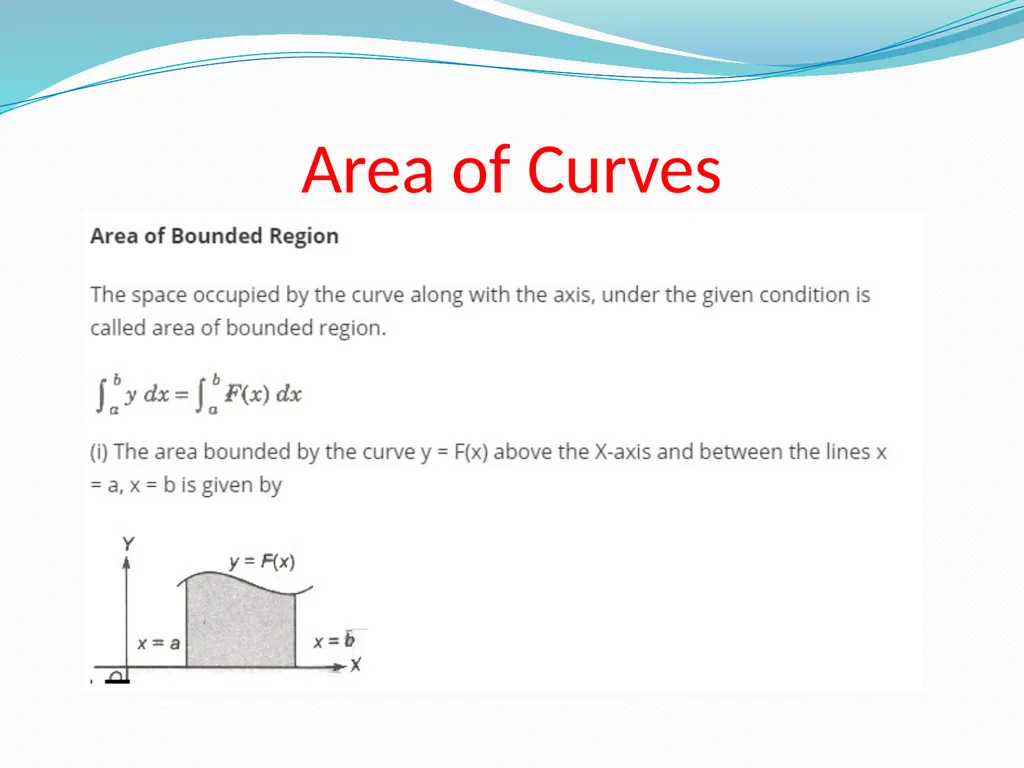
Area of Curves<br>
25
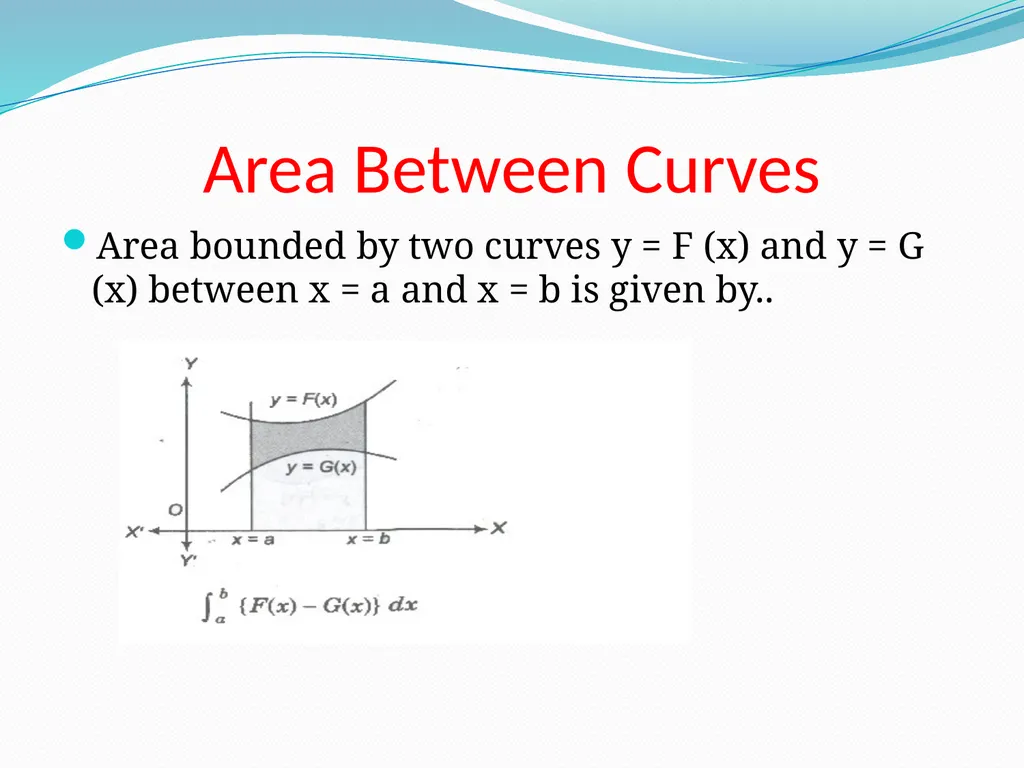
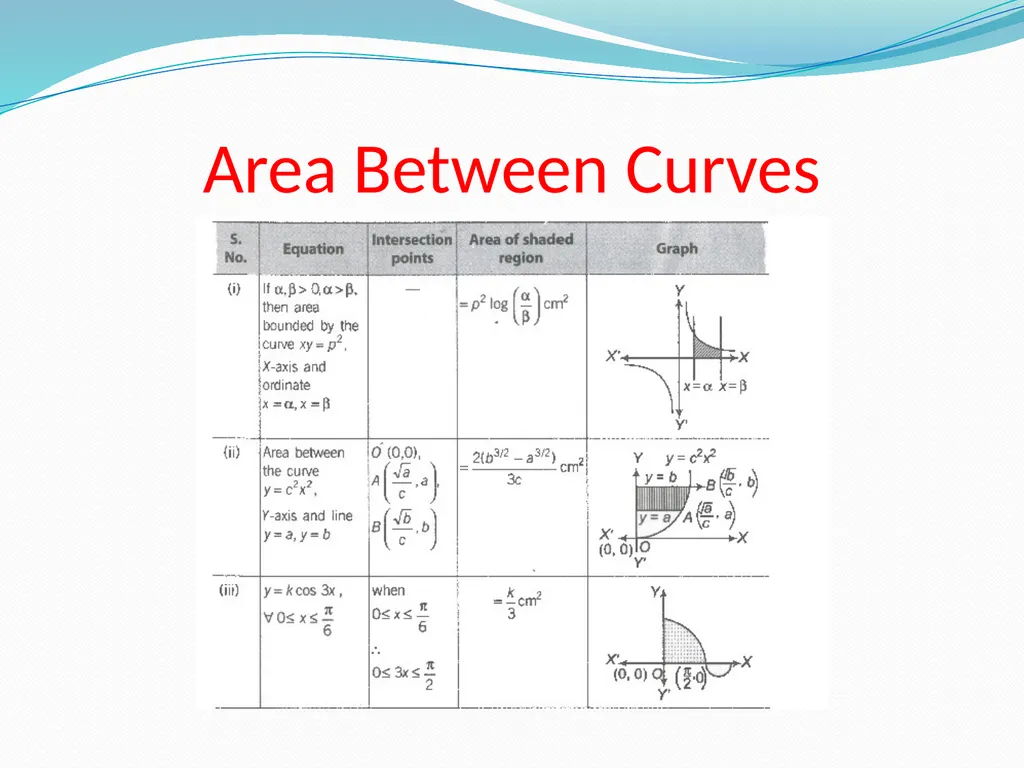
Area Between Curves Area bounded by two curves y = F (x) and y = G (x) between x = a and x = b is given by..<br>
26
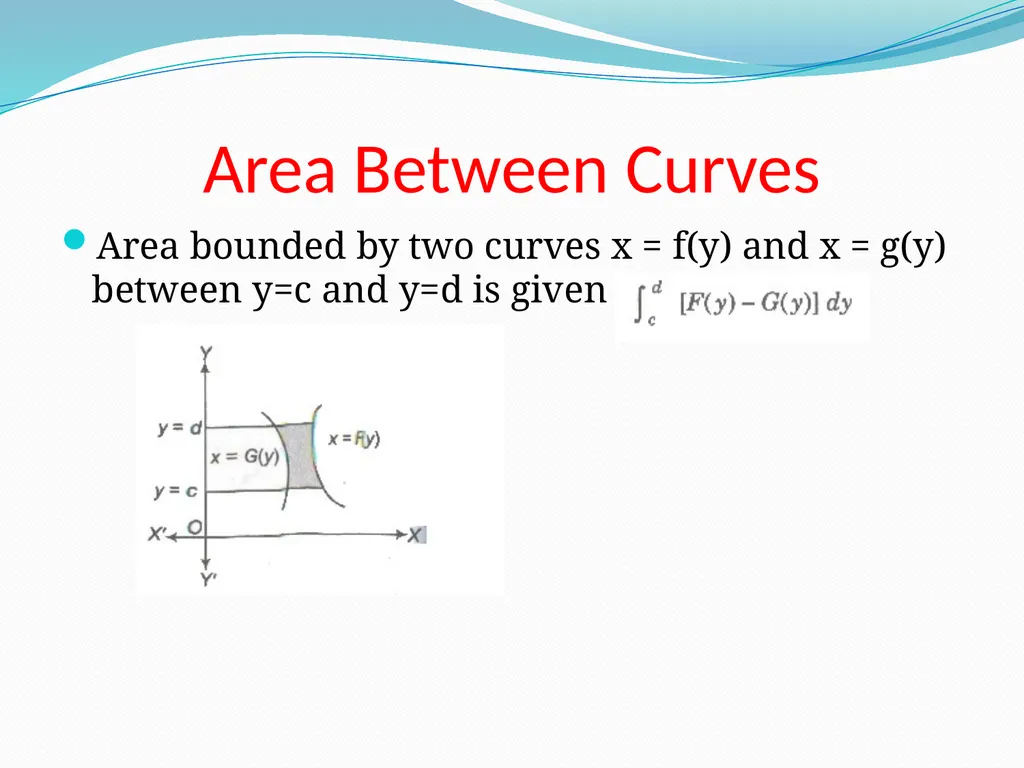
Area Between Curves Area bounded by two curves x = f(y) and x = g(y) between y=c and y=d is given by<br>