
Integrated Pest Management The new IPM law

Description: Integrated Pest Management The new IPM law protects students, staff and visitors in our buildings by minimizing pests and pesticides. What is Integrated Pest Management? The goals of the IPM plan are to: Reduce pests in and around schools
Related Topics
Download Presentation
"Integrated Pest Management The new IPM law" is the property of its rightful owner. Permission is granted to download and print the materials on this website for personal, non-commercial use only, and to display it on your personal computer provided you do not modify the materials and that you retain all copyright notices contained in the materials. By downloading content from our website, you accept the terms of this agreement.
Presentation Transcript
slide1. Integrated Pest Management The new IPM law protects students, staff and visitors in our buildings by minimizing pests and pesticides.<br>
slide2. What is Integrated Pest Management? The goals of the IPM plan are to:
Reduce pests in and around schools by addressing environmental issues that attract pests
Establish acceptable thresholds
Educate our staff and community
Use pesticides as a last resort
Do not spray or poison! All pesticides and herbicides must be applied by maintenance staff.<br>
slide3. Why do we need a pest management plan? Pests can carry disease.
Pesticides can be very hazardous to our health.
Learn how to reduce or eliminate pests by eliminating pest habitats in our work spaces.
Learn how you can help reduce pests in our buildings.<br>
slide4. Components of Oregon’s IPM Law Education about IPM requirements
Explanation of thresholds, pest conducive conditions, etc.
Assistance to staff members who repeatedly refuse to reduce clutter and other pest-conducive conditions in their classrooms or workspaces
Confiscation of any unapproved pesticides, such as aerosol spray cans<br>
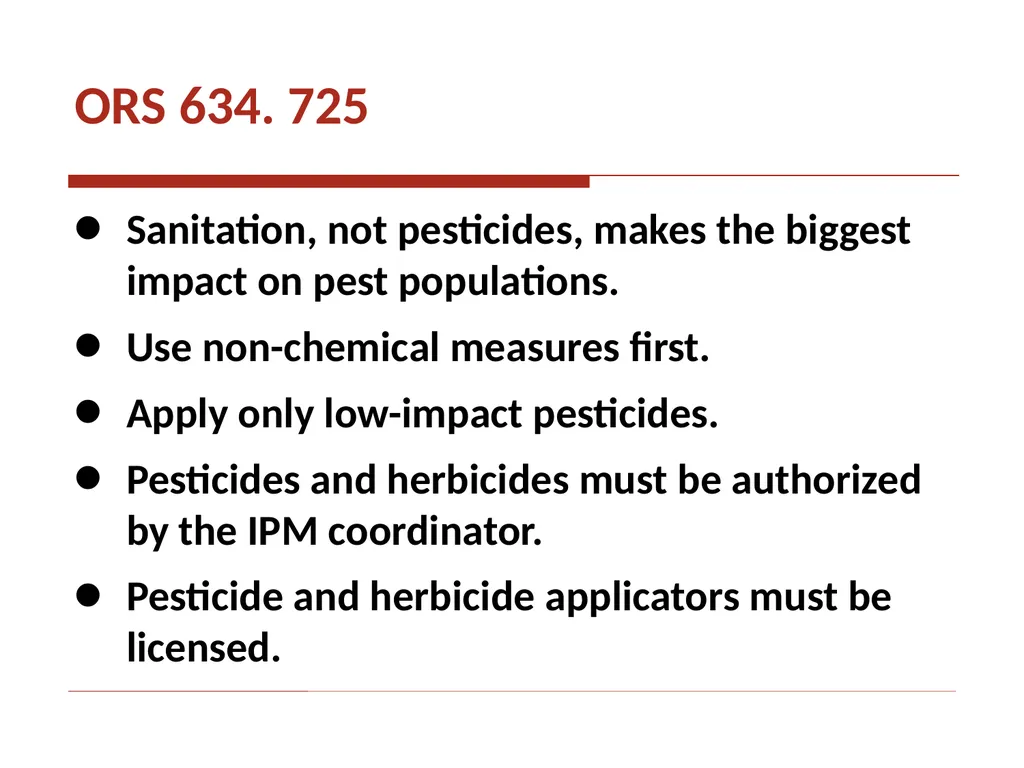
slide5. ORS 634. 725 Sanitation, not pesticides, makes the biggest impact on pest populations.
Use non-chemical measures first.
Apply only low-impact pesticides.
Pesticides and herbicides must be authorized by the IPM coordinator.
Pesticide and herbicide applicators must be licensed.<br>
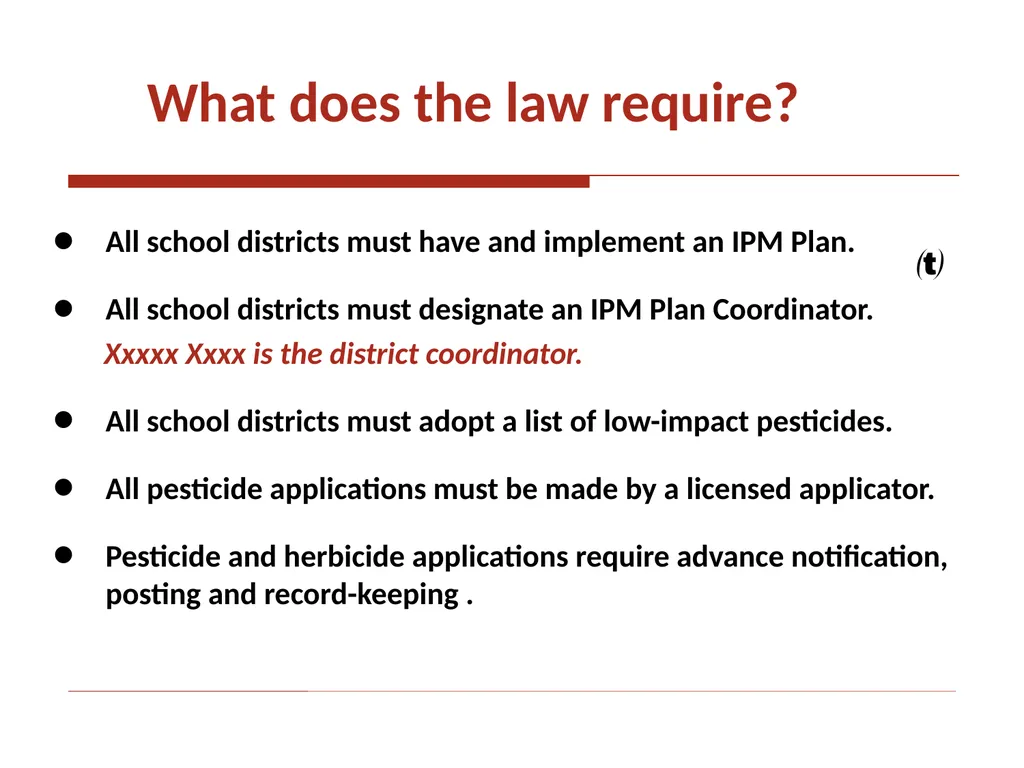
slide6. What does the law require? All school districts must have and implement an IPM Plan.
All school districts must designate an IPM Plan Coordinator.
Xxxxx Xxxx is the district coordinator.
All school districts must adopt a list of low-impact pesticides.
All pesticide applications must be made by a licensed applicator.
Pesticide and herbicide applications require advance notification, posting and record-keeping . <br>
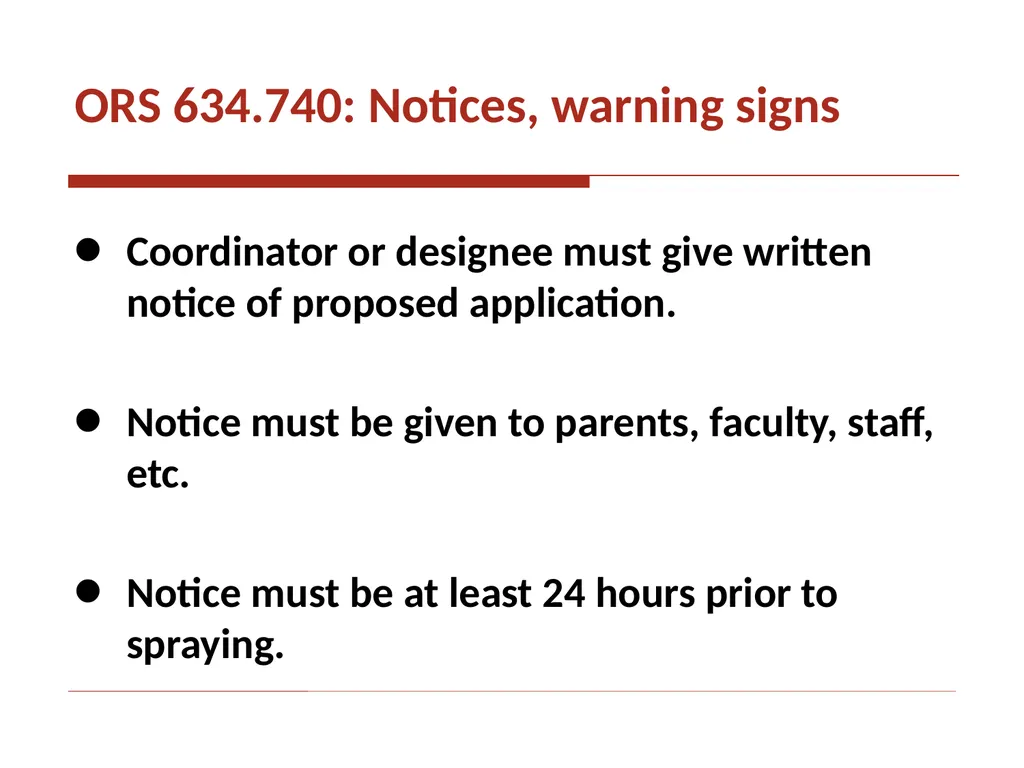
slide7. ORS 634.740: Notices, warning signs Coordinator or designee must give written notice of proposed application.
Notice must be given to parents, faculty, staff, etc.
Notice must be at least 24 hours prior to spraying.<br>
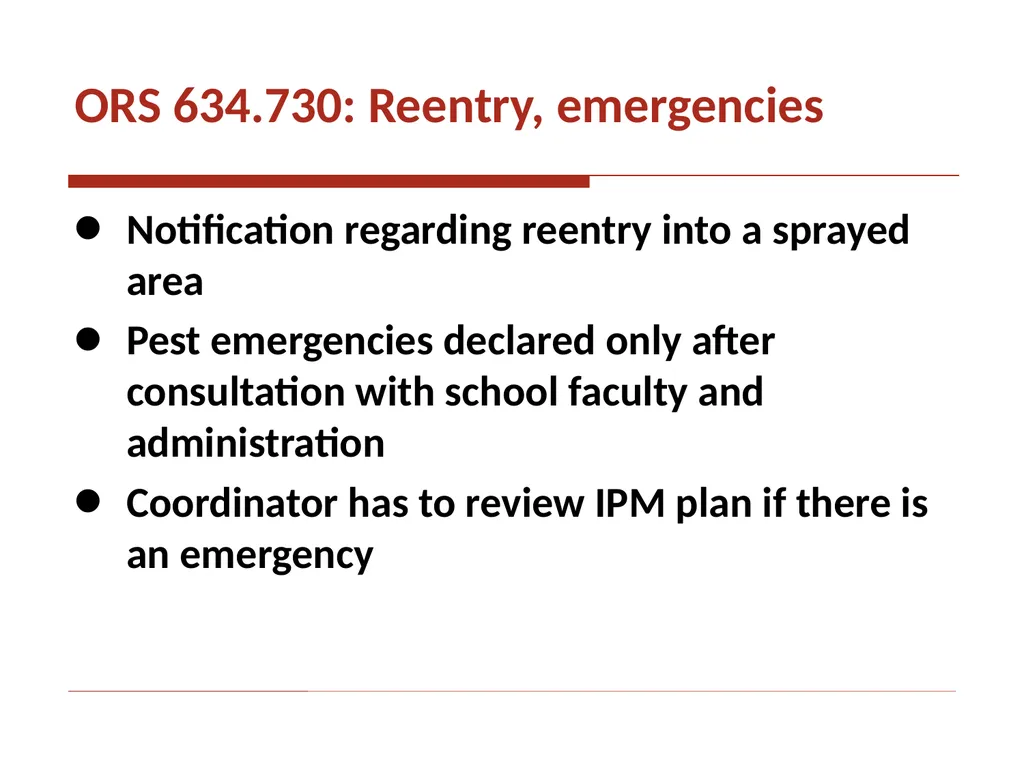
slide8. ORS 634.730: Reentry, emergencies Notification regarding reentry into a sprayed area
Pest emergencies declared only after consultation with school faculty and administration
Coordinator has to review IPM plan if there is an emergency<br>
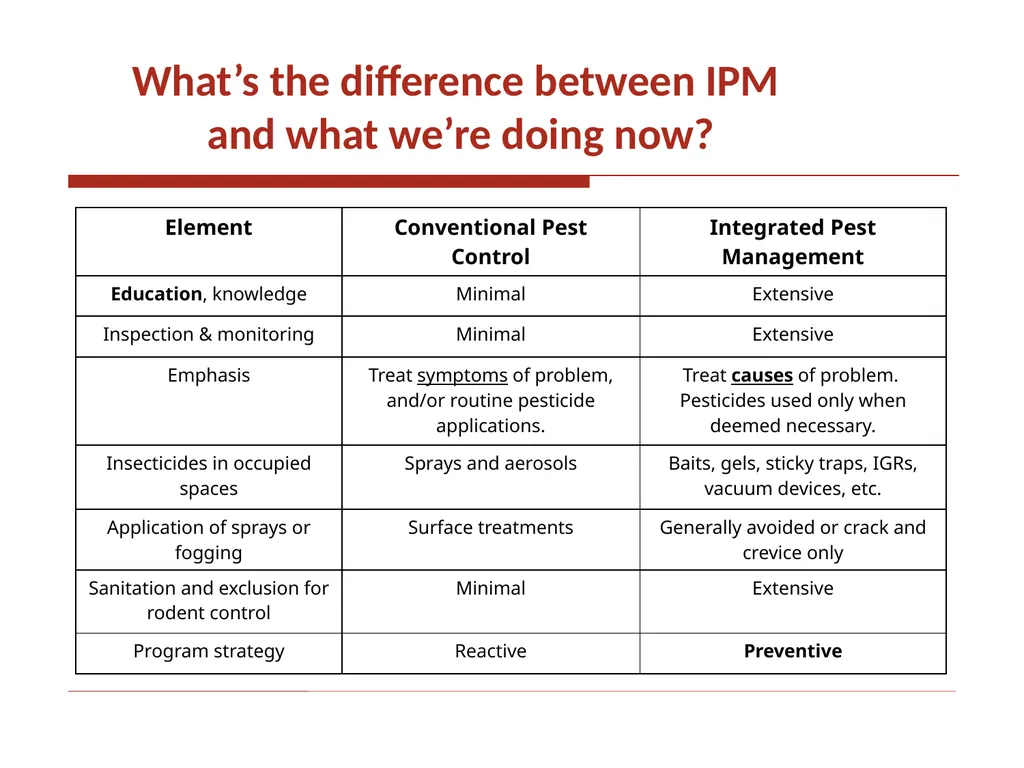
slide9. What’s the difference between IPM and what we’re doing now?<br>
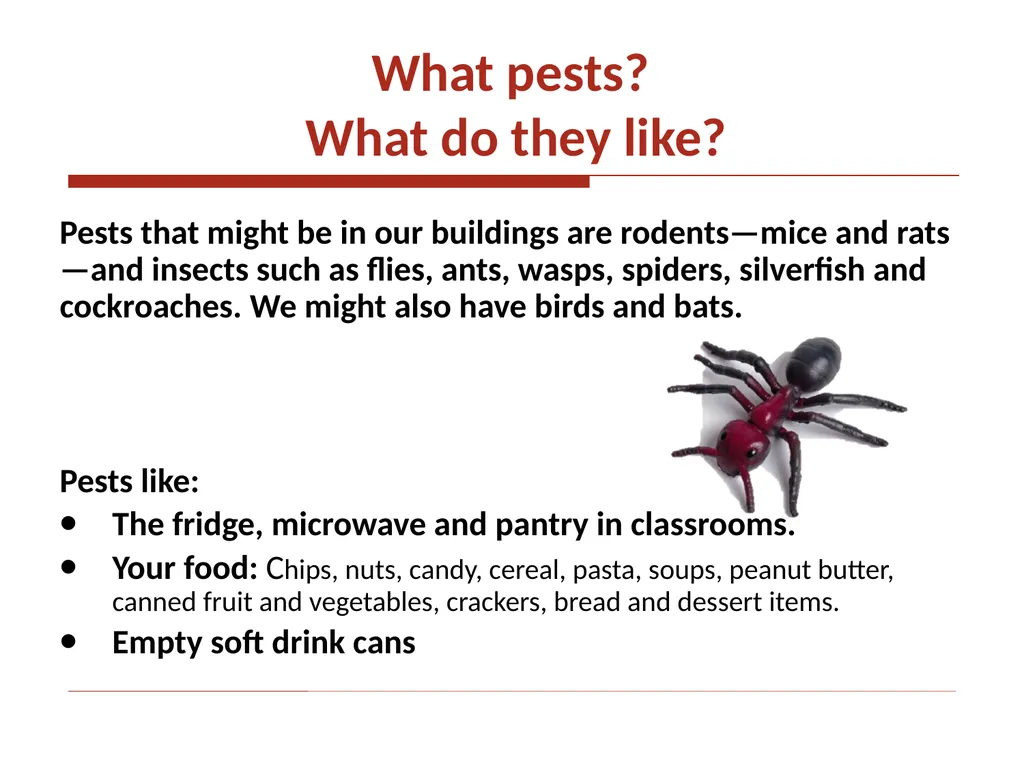
slide10. Pests that might be in our buildings are rodents—mice and rats—and insects such as flies, ants, wasps, spiders, silverfish and cockroaches. We might also have birds and bats.
Pests like:
The fridge, microwave and pantry in classrooms.
Your food: Chips, nuts, candy, cereal, pasta, soups, peanut butter, canned fruit and vegetables, crackers, bread and dessert items.
Empty soft drink cans What pests? What do they like?<br>
slide11. What does IPM mean to you? IPM requires dealing with pests in the safest way possible with the least risk to people and the environment.
Keep your space clean and clear of food.
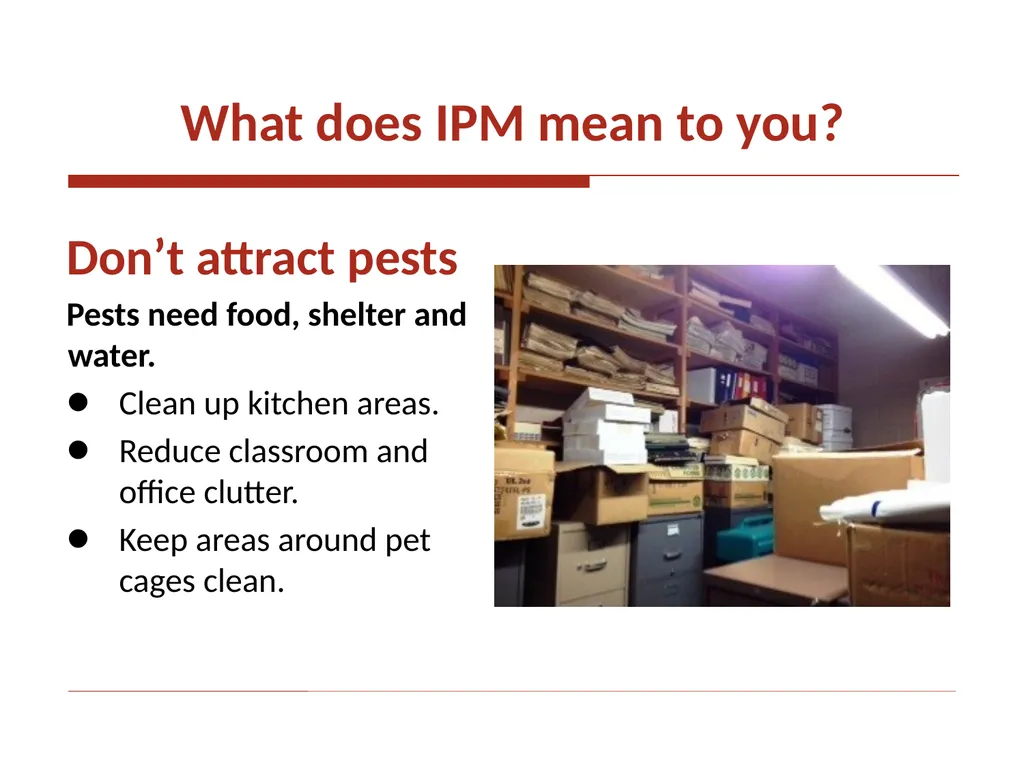
De-clutter your classroom or workspace. Do not leave piles of paper or boxes where pests could hide.
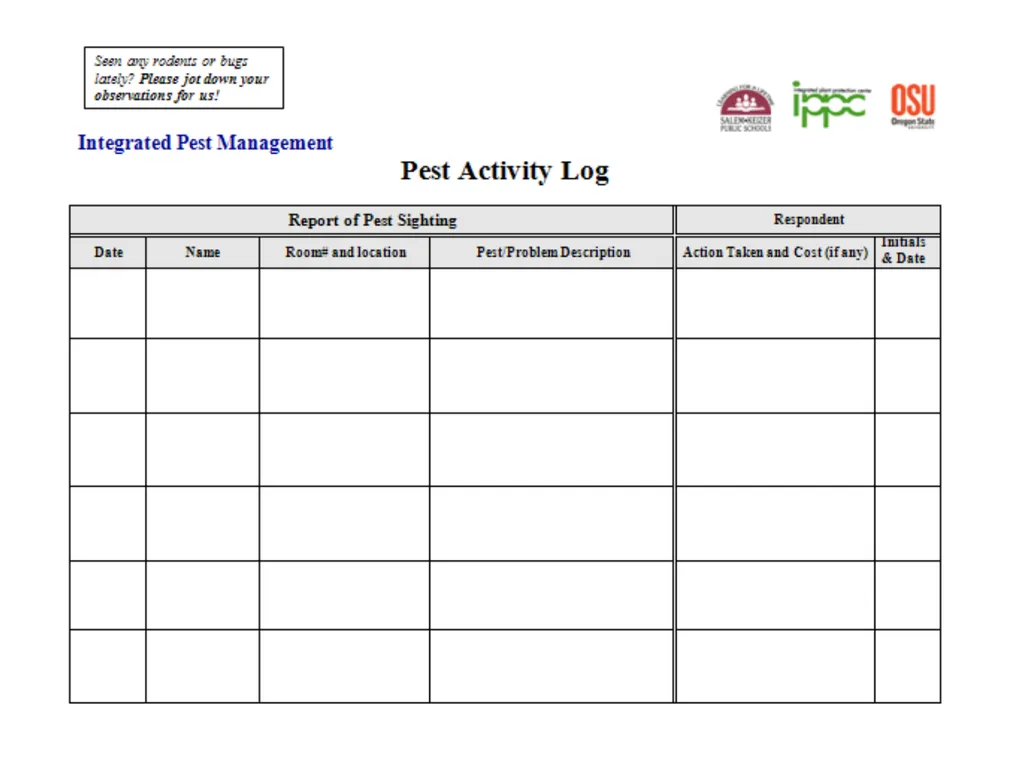
When you see signs of pests, note the location on the pest log in your facility.<br>
slide12. What does IPM mean to you? Don’t attract pests
Pests need food, shelter and water.
Clean up kitchen areas.
Reduce classroom and office clutter.
Keep areas around pet cages clean.<br>
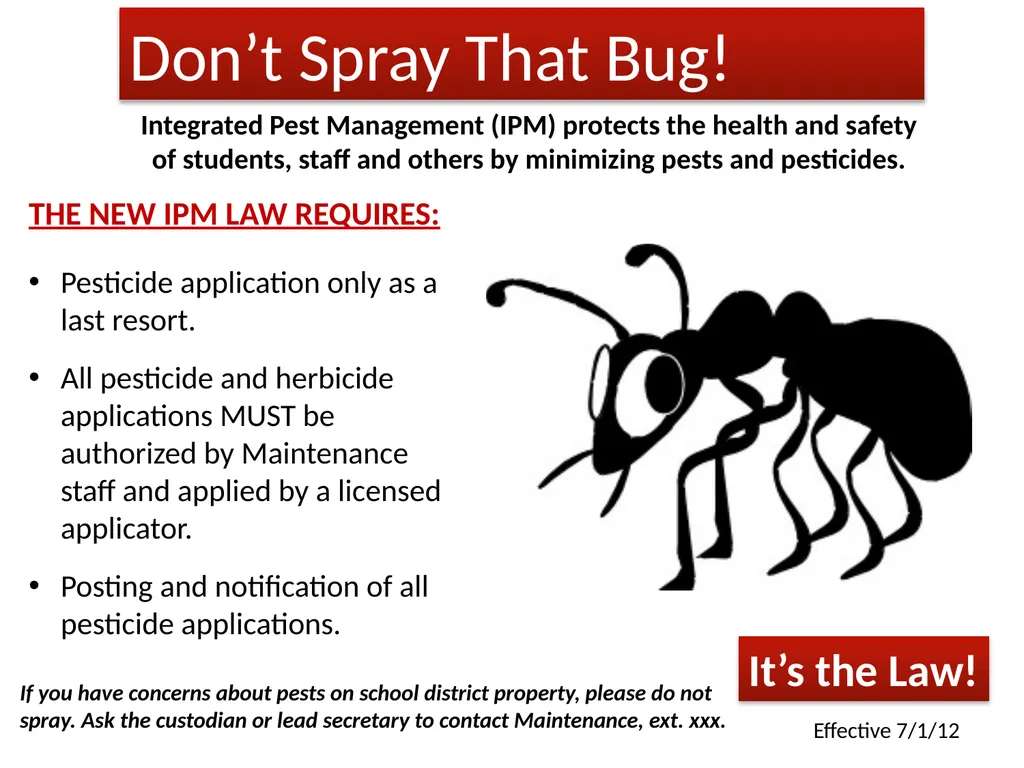
slide14. Don’t Spray That Bug! Effective 7/1/12 Integrated Pest Management (IPM) protects the health and safety of students, staff and others by minimizing pests and pesticides. If you have concerns about pests on school district property, please do not spray. Ask the custodian or lead secretary to contact Maintenance, ext. xxx. THE NEW IPM LAW REQUIRES:
Pesticide application only as a last resort.
All pesticide and herbicide applications MUST be authorized by Maintenance staff and applied by a licensed applicator.
Posting and notification of all pesticide applications. It’s the Law!<br>
slide2. What is Integrated Pest Management? The goals of the IPM plan are to:
Reduce pests in and around schools by addressing environmental issues that attract pests
Establish acceptable thresholds
Educate our staff and community
Use pesticides as a last resort
Do not spray or poison! All pesticides and herbicides must be applied by maintenance staff.<br>
slide3. Why do we need a pest management plan? Pests can carry disease.
Pesticides can be very hazardous to our health.
Learn how to reduce or eliminate pests by eliminating pest habitats in our work spaces.
Learn how you can help reduce pests in our buildings.<br>
slide4. Components of Oregon’s IPM Law Education about IPM requirements
Explanation of thresholds, pest conducive conditions, etc.
Assistance to staff members who repeatedly refuse to reduce clutter and other pest-conducive conditions in their classrooms or workspaces
Confiscation of any unapproved pesticides, such as aerosol spray cans<br>
slide5. ORS 634. 725 Sanitation, not pesticides, makes the biggest impact on pest populations.
Use non-chemical measures first.
Apply only low-impact pesticides.
Pesticides and herbicides must be authorized by the IPM coordinator.
Pesticide and herbicide applicators must be licensed.<br>
slide6. What does the law require? All school districts must have and implement an IPM Plan.
All school districts must designate an IPM Plan Coordinator.
Xxxxx Xxxx is the district coordinator.
All school districts must adopt a list of low-impact pesticides.
All pesticide applications must be made by a licensed applicator.
Pesticide and herbicide applications require advance notification, posting and record-keeping . <br>
slide7. ORS 634.740: Notices, warning signs Coordinator or designee must give written notice of proposed application.
Notice must be given to parents, faculty, staff, etc.
Notice must be at least 24 hours prior to spraying.<br>
slide8. ORS 634.730: Reentry, emergencies Notification regarding reentry into a sprayed area
Pest emergencies declared only after consultation with school faculty and administration
Coordinator has to review IPM plan if there is an emergency<br>
slide9. What’s the difference between IPM and what we’re doing now?<br>
slide10. Pests that might be in our buildings are rodents—mice and rats—and insects such as flies, ants, wasps, spiders, silverfish and cockroaches. We might also have birds and bats.
Pests like:
The fridge, microwave and pantry in classrooms.
Your food: Chips, nuts, candy, cereal, pasta, soups, peanut butter, canned fruit and vegetables, crackers, bread and dessert items.
Empty soft drink cans What pests? What do they like?<br>
slide11. What does IPM mean to you? IPM requires dealing with pests in the safest way possible with the least risk to people and the environment.
Keep your space clean and clear of food.
De-clutter your classroom or workspace. Do not leave piles of paper or boxes where pests could hide.
When you see signs of pests, note the location on the pest log in your facility.<br>
slide12. What does IPM mean to you? Don’t attract pests
Pests need food, shelter and water.
Clean up kitchen areas.
Reduce classroom and office clutter.
Keep areas around pet cages clean.<br>
slide14. Don’t Spray That Bug! Effective 7/1/12 Integrated Pest Management (IPM) protects the health and safety of students, staff and others by minimizing pests and pesticides. If you have concerns about pests on school district property, please do not spray. Ask the custodian or lead secretary to contact Maintenance, ext. xxx. THE NEW IPM LAW REQUIRES:
Pesticide application only as a last resort.
All pesticide and herbicide applications MUST be authorized by Maintenance staff and applied by a licensed applicator.
Posting and notification of all pesticide applications. It’s the Law!<br>