
Integrating the Age Friendly 4Ms into the Care of
MY
Published · 53 slides · 0 views

1 / 1

Description
Integrating the Age Friendly 4Ms into the Care of Older Adults Mary Tinetti, MD 31st Maine Geriatrics Conference May, 2024 Patientprioritiescare.org Today I will Describe what the Age Friendly Health System initiative is and why it matters
Related Topics
Share
Embed code
Download this presentation From Below
"Integrating the Age Friendly 4Ms into the Care of" is the property of its rightful owner. Permission is granted to download and print the materials on this website for personal, non-commercial use only, and to display it on your personal computer provided you do not modify the materials and that you retain all copyright notices contained in the materials. By downloading content from our website, you accept the terms of this agreement.
Presentation Transcript
01
Integrating the Age Friendly 4Ms into the Care of Older Adults Mary Tinetti, MD
31st Maine Geriatrics Conference
May, 2024
Patientprioritiescare.org<br>
31st Maine Geriatrics Conference
May, 2024
Patientprioritiescare.org<br>
02
Today I will… Describe what the Age Friendly Health System initiative is and why it matters - particularly for persons with multiple chronic conditions (MCCs), care partners, & health professionals
Present the what, why, and how of the 4Ms
Discuss how the 4Ms work in practice
Suggest how to get started<br>
Present the what, why, and how of the 4Ms
Discuss how the 4Ms work in practice
Suggest how to get started<br>
03
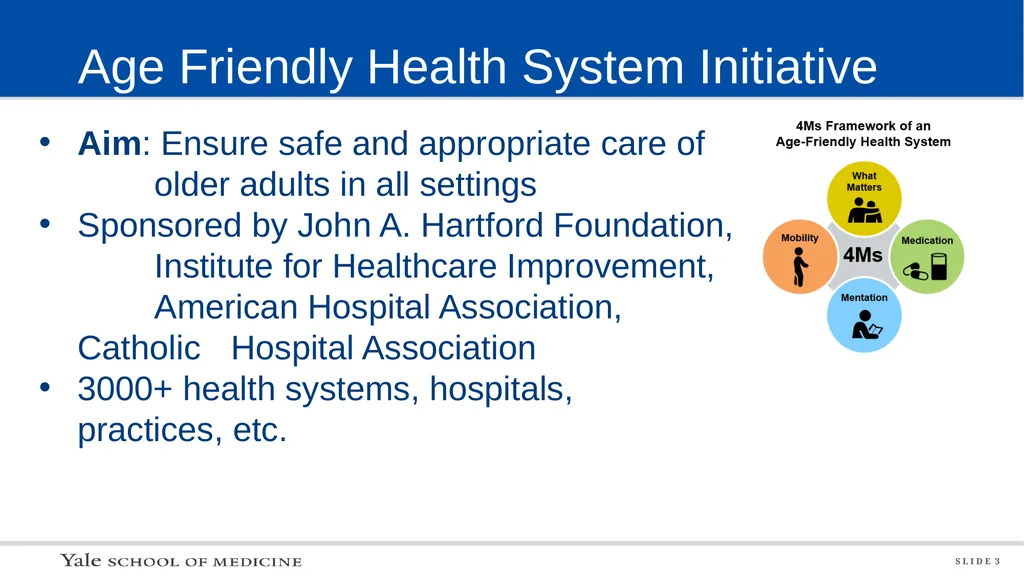
Age Friendly Health System Initiative Aim: Ensure safe and appropriate care of older adults in all settings
Sponsored by John A. Hartford Foundation, Institute for Healthcare Improvement, American Hospital Association, Catholic Hospital Association
3000+ health systems, hospitals, practices, etc.<br>
Sponsored by John A. Hartford Foundation, Institute for Healthcare Improvement, American Hospital Association, Catholic Hospital Association
3000+ health systems, hospitals, practices, etc.<br>
04
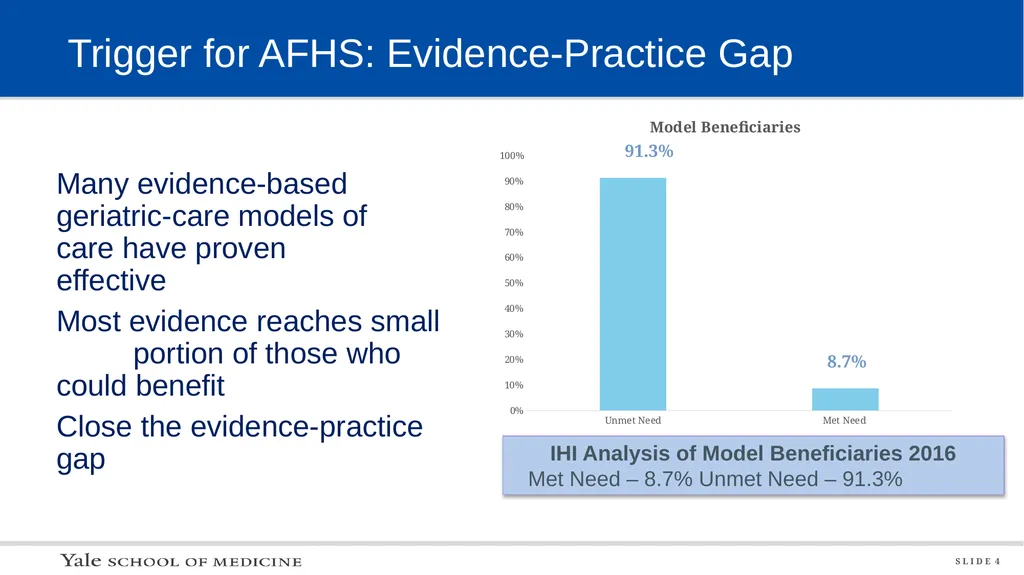
Trigger for AFHS: Evidence-Practice Gap Many evidence-based geriatric-care models of care have proven effective
Most evidence reaches small portion of those who could benefit
Close the evidence-practice gap IHI Analysis of Model Beneficiaries 2016
Met Need – 8.7% Unmet Need – 91.3%<br>
Most evidence reaches small portion of those who could benefit
Close the evidence-practice gap IHI Analysis of Model Beneficiaries 2016
Met Need – 8.7% Unmet Need – 91.3%<br>
05
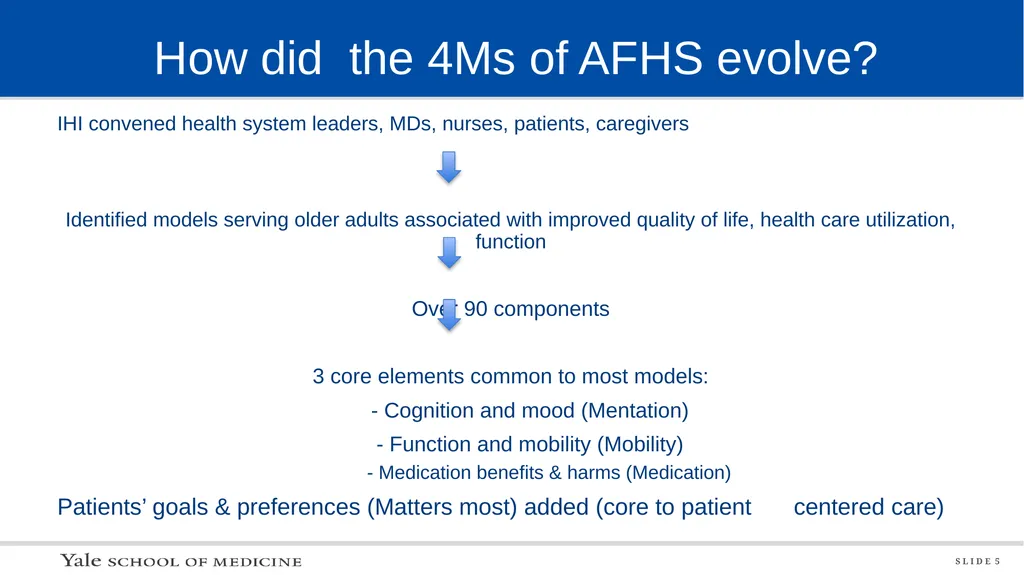
How did the 4Ms of AFHS evolve? IHI convened health system leaders, MDs, nurses, patients, caregivers
Identified models serving older adults associated with improved quality of life, health care utilization, function
Over 90 components
3 core elements common to most models:
- Cognition and mood (Mentation)
- Function and mobility (Mobility)
- Medication benefits & harms (Medication)
Patients’ goals & preferences (Matters most) added (core to patient centered care)<br>
Identified models serving older adults associated with improved quality of life, health care utilization, function
Over 90 components
3 core elements common to most models:
- Cognition and mood (Mentation)
- Function and mobility (Mobility)
- Medication benefits & harms (Medication)
Patients’ goals & preferences (Matters most) added (core to patient centered care)<br>
06
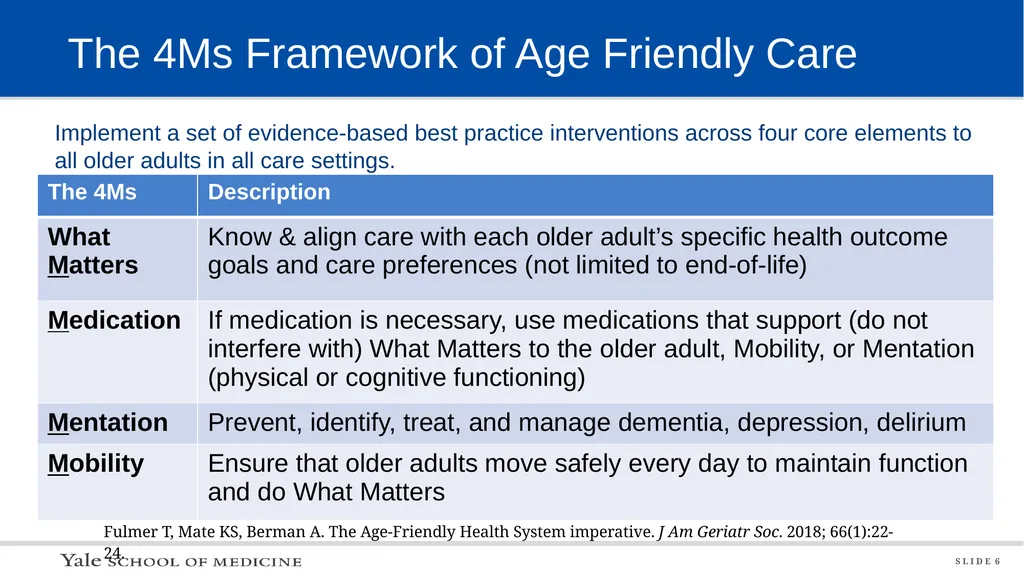
The 4Ms Framework of Age Friendly Care 6 Implement a set of evidence-based best practice interventions across four core elements to all older adults in all care settings. Fulmer T, Mate KS, Berman A. The Age-Friendly Health System imperative. J Am Geriatr Soc. 2018; 66(1):22-24.<br>
07
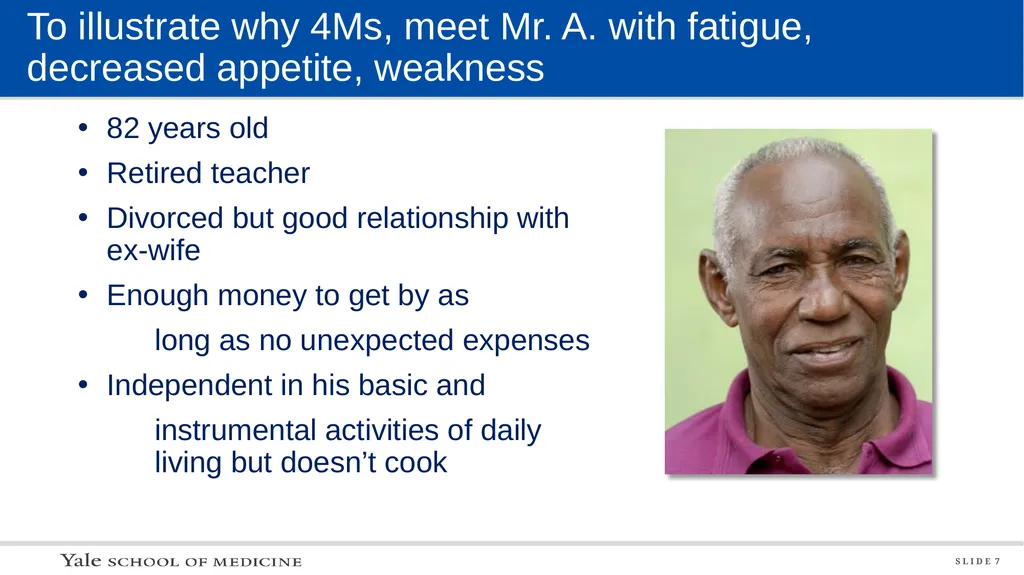
To illustrate why 4Ms, meet Mr. A. with fatigue, decreased appetite, weakness 82 years old
Retired teacher
Divorced but good relationship with ex-wife
Enough money to get by as
long as no unexpected expenses
Independent in his basic and
instrumental activities of daily living but doesn’t cook<br>
Retired teacher
Divorced but good relationship with ex-wife
Enough money to get by as
long as no unexpected expenses
Independent in his basic and
instrumental activities of daily living but doesn’t cook<br>
08
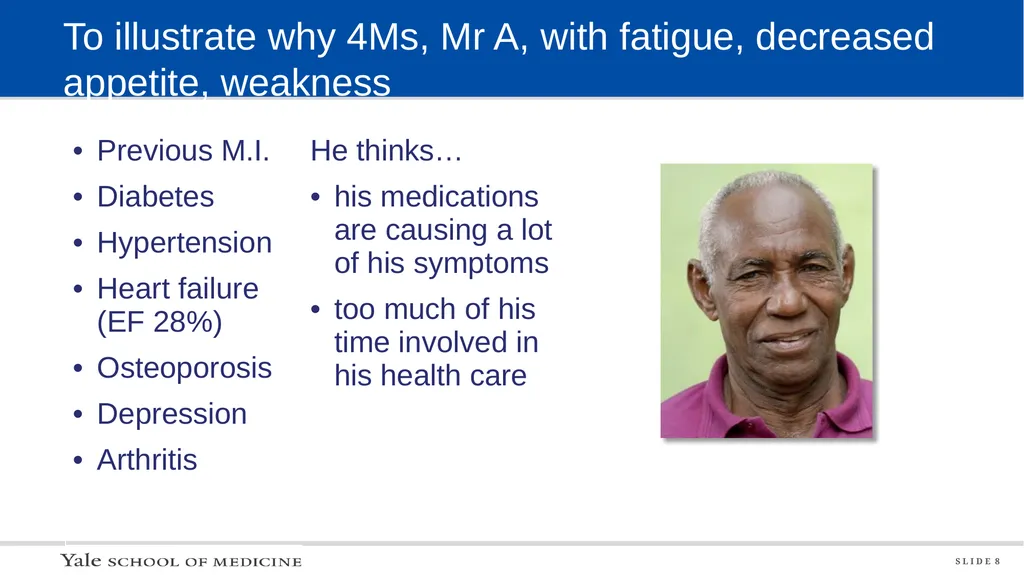
To illustrate why 4Ms, Mr A, with fatigue, decreased appetite, weakness<br>
09
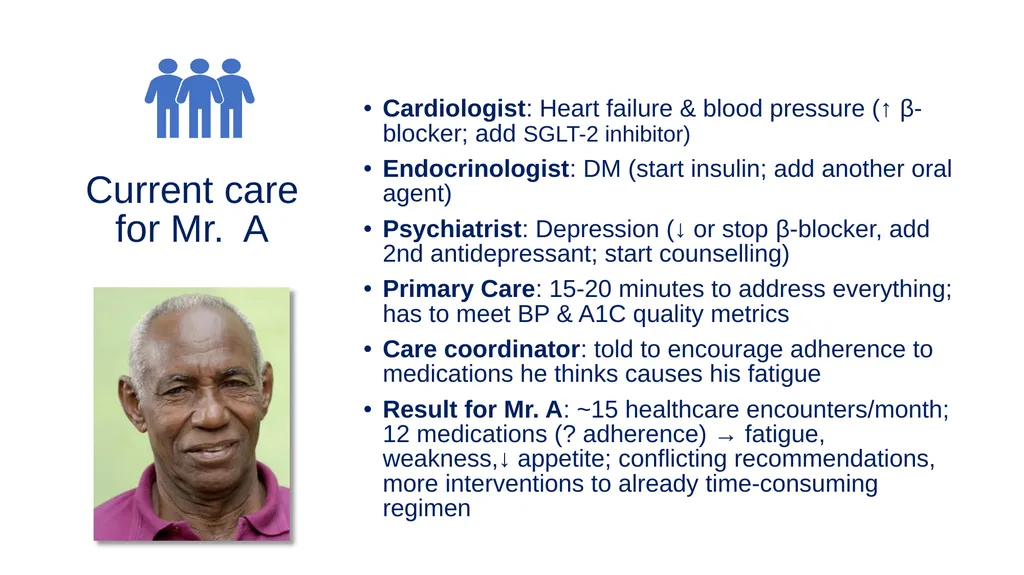
Current care for Mr. A Cardiologist: Heart failure & blood pressure (↑ β-blocker; add SGLT-2 inhibitor)
Endocrinologist: DM (start insulin; add another oral agent)
Psychiatrist: Depression (↓ or stop β-blocker, add 2nd antidepressant; start counselling)
Primary Care: 15-20 minutes to address everything; has to meet BP & A1C quality metrics
Care coordinator: told to encourage adherence to medications he thinks causes his fatigue
Result for Mr. A: ~15 healthcare encounters/month; 12 medications (? adherence) → fatigue, weakness,↓ appetite; conflicting recommendations, more interventions to already time-consuming regimen<br>
Endocrinologist: DM (start insulin; add another oral agent)
Psychiatrist: Depression (↓ or stop β-blocker, add 2nd antidepressant; start counselling)
Primary Care: 15-20 minutes to address everything; has to meet BP & A1C quality metrics
Care coordinator: told to encourage adherence to medications he thinks causes his fatigue
Result for Mr. A: ~15 healthcare encounters/month; 12 medications (? adherence) → fatigue, weakness,↓ appetite; conflicting recommendations, more interventions to already time-consuming regimen<br>
10
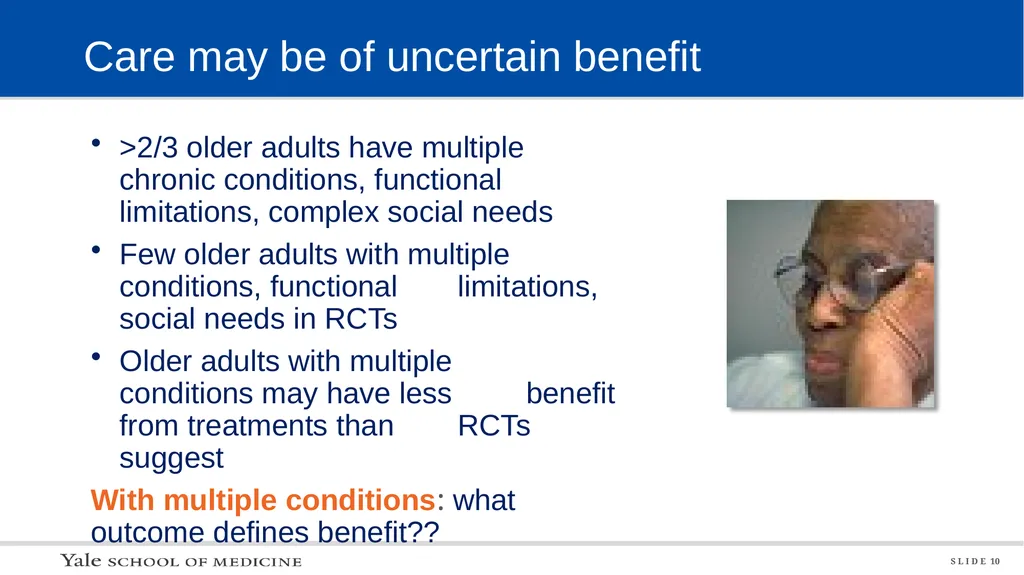
Care may be of uncertain benefit >2/3 older adults have multiple chronic conditions, functional limitations, complex social needs
Few older adults with multiple conditions, functional limitations, social needs in RCTs
Older adults with multiple conditions may have less benefit from treatments than RCTs suggest
With multiple conditions: what outcome defines benefit??<br>
Few older adults with multiple conditions, functional limitations, social needs in RCTs
Older adults with multiple conditions may have less benefit from treatments than RCTs suggest
With multiple conditions: what outcome defines benefit??<br>
11
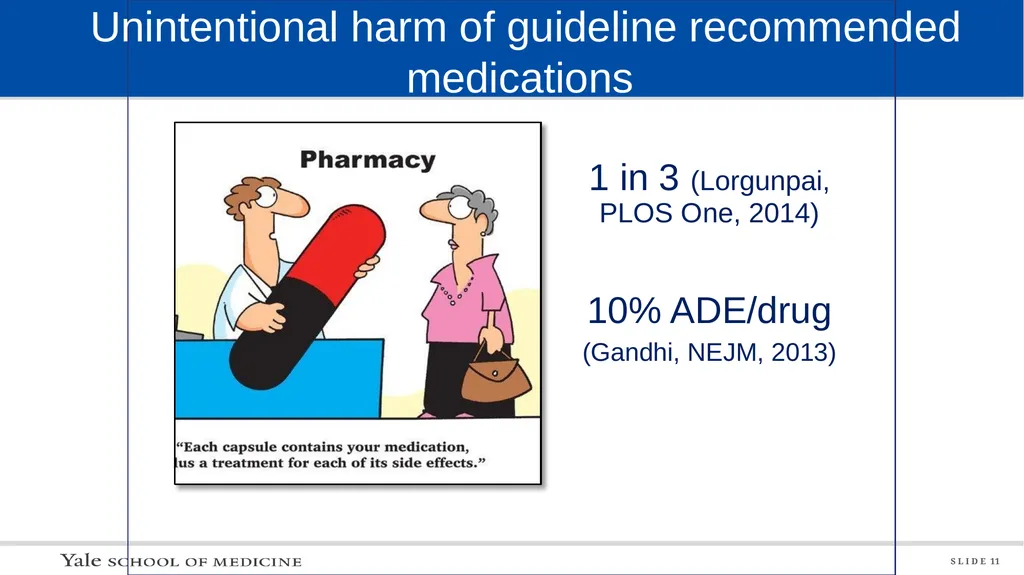
Unintentional harm of guideline recommended medications 1 in 3 (Lorgunpai, PLOS One, 2014)
10% ADE/drug
(Gandhi, NEJM, 2013)<br>
10% ADE/drug
(Gandhi, NEJM, 2013)<br>
12
Managing chronic conditions often burdensome 2 hours per day self-management tasks
½ day per visit
Full day per procedures
“Caring for my chronic conditions is more burdensome than the conditions” (Montori; Boyd)<br>
½ day per visit
Full day per procedures
“Caring for my chronic conditions is more burdensome than the conditions” (Montori; Boyd)<br>
13
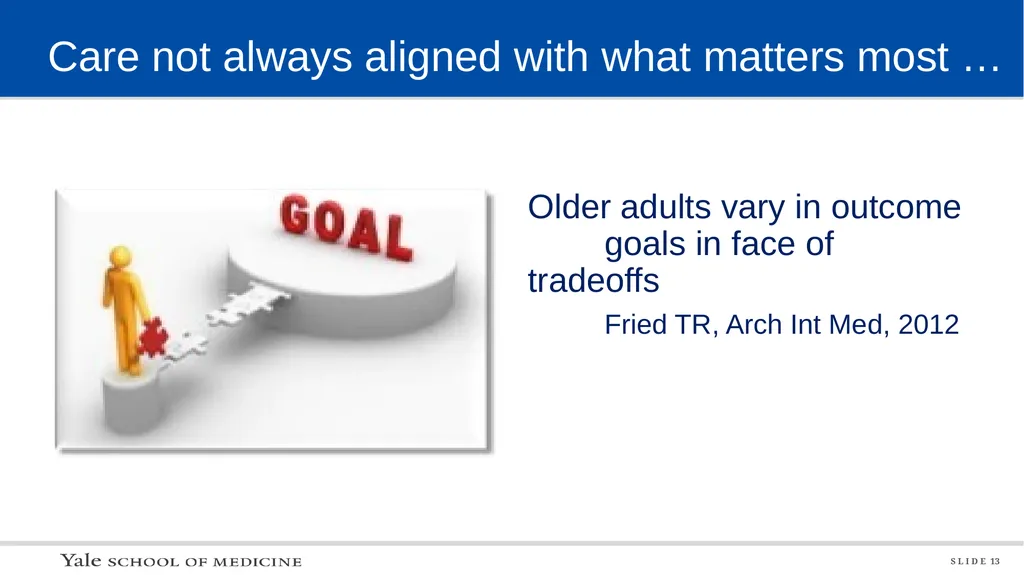
Care not always aligned with what matters most … Older adults vary in outcome goals in face of tradeoffs
Fried TR, Arch Int Med, 2012<br>
Fried TR, Arch Int Med, 2012<br>
14
Challenges in healthcare for older adults Uncertain benefits & harms
Fragmented, conflicting
Burdensome
May not focus on what matters most to the person<br>
Fragmented, conflicting
Burdensome
May not focus on what matters most to the person<br>
15
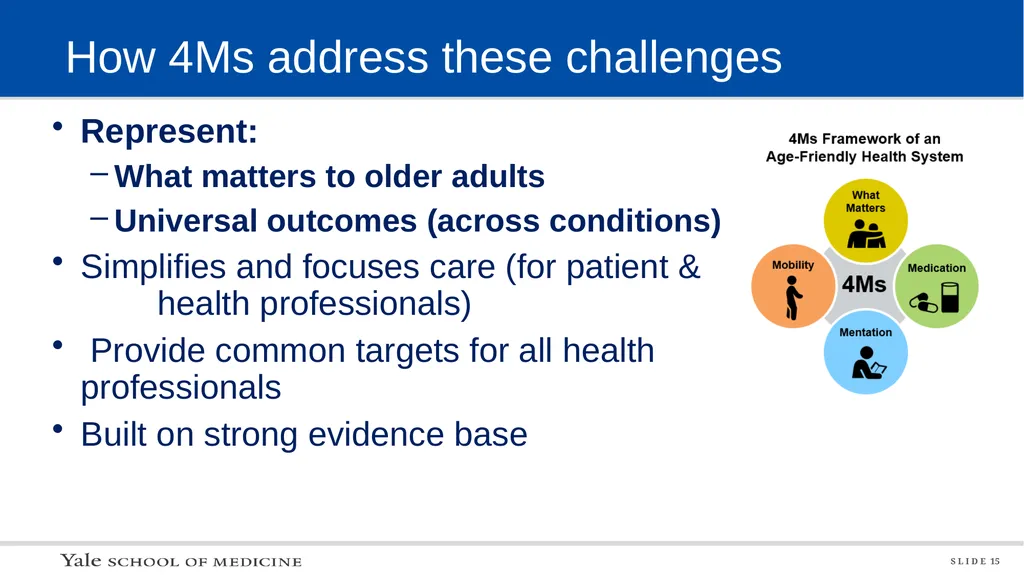
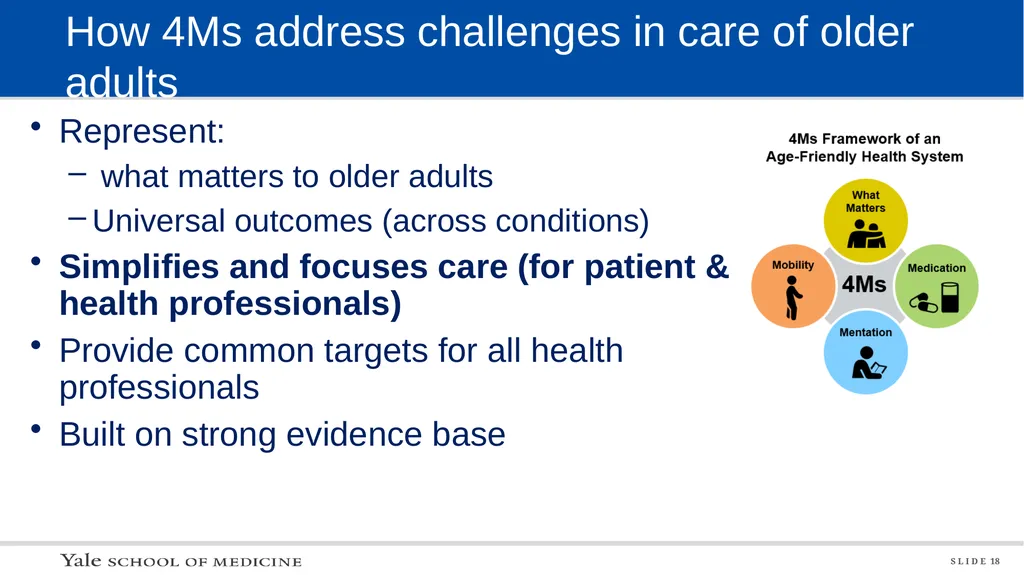
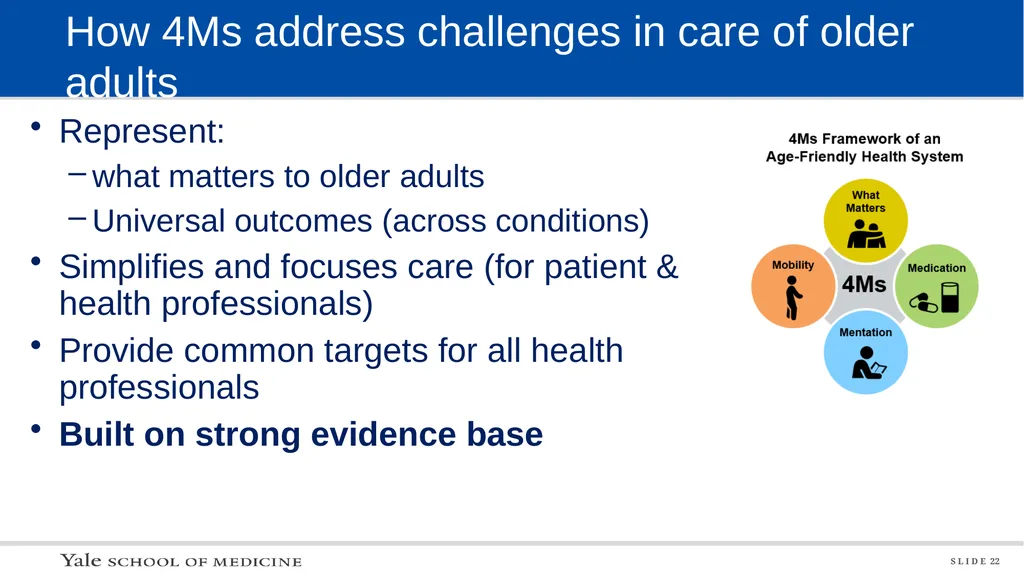
How 4Ms address these challenges Represent:
What matters to older adults
Universal outcomes (across conditions)
Simplifies and focuses care (for patient & health professionals)
Provide common targets for all health professionals
Built on strong evidence base<br>
What matters to older adults
Universal outcomes (across conditions)
Simplifies and focuses care (for patient & health professionals)
Provide common targets for all health professionals
Built on strong evidence base<br>
16
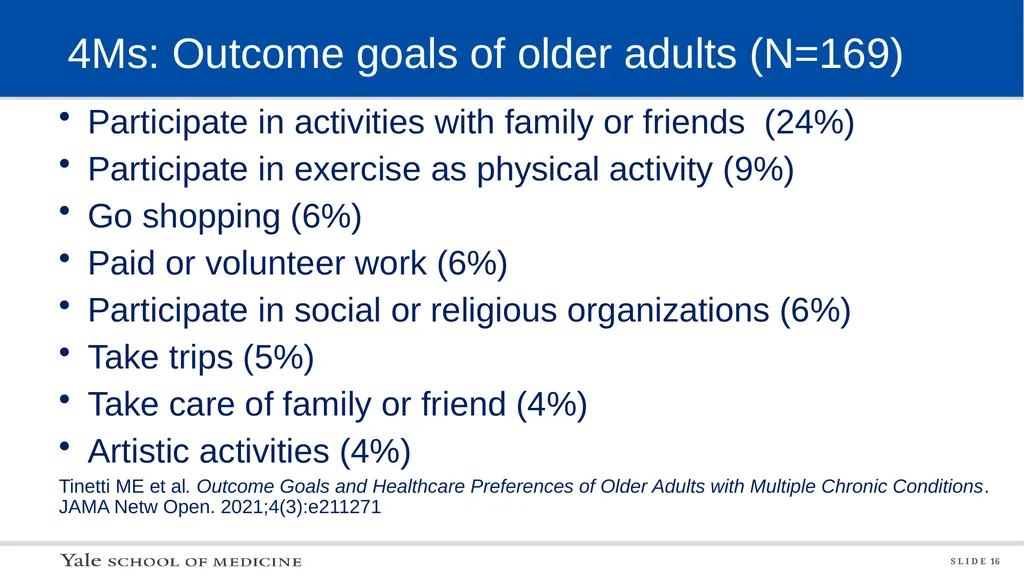
4Ms: Outcome goals of older adults (N=169) Participate in activities with family or friends (24%)
Participate in exercise as physical activity (9%)
Go shopping (6%)
Paid or volunteer work (6%)
Participate in social or religious organizations (6%)
Take trips (5%)
Take care of family or friend (4%)
Artistic activities (4%)
Tinetti ME et al. Outcome Goals and Healthcare Preferences of Older Adults with Multiple Chronic Conditions. JAMA Netw Open. 2021;4(3):e211271<br>
Participate in exercise as physical activity (9%)
Go shopping (6%)
Paid or volunteer work (6%)
Participate in social or religious organizations (6%)
Take trips (5%)
Take care of family or friend (4%)
Artistic activities (4%)
Tinetti ME et al. Outcome Goals and Healthcare Preferences of Older Adults with Multiple Chronic Conditions. JAMA Netw Open. 2021;4(3):e211271<br>
17
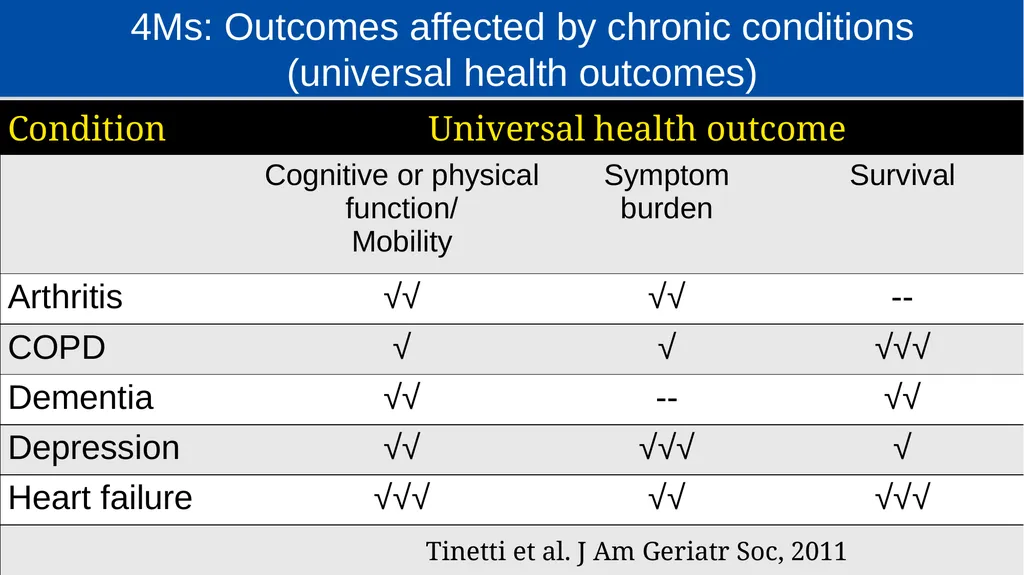
4Ms: Outcomes affected by chronic conditions (universal health outcomes)<br>
18
How 4Ms address challenges in care of older adults Represent:
what matters to older adults
Universal outcomes (across conditions)
Simplifies and focuses care (for patient & health professionals)
Provide common targets for all health professionals
Built on strong evidence base<br>
what matters to older adults
Universal outcomes (across conditions)
Simplifies and focuses care (for patient & health professionals)
Provide common targets for all health professionals
Built on strong evidence base<br>
19
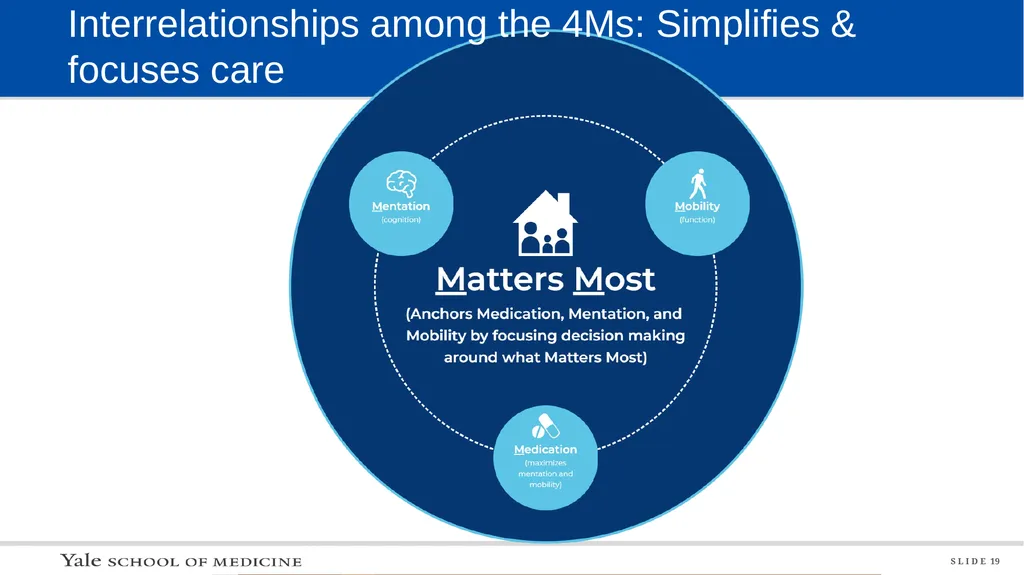
Interrelationships among the 4Ms: Simplifies & focuses care<br>
20
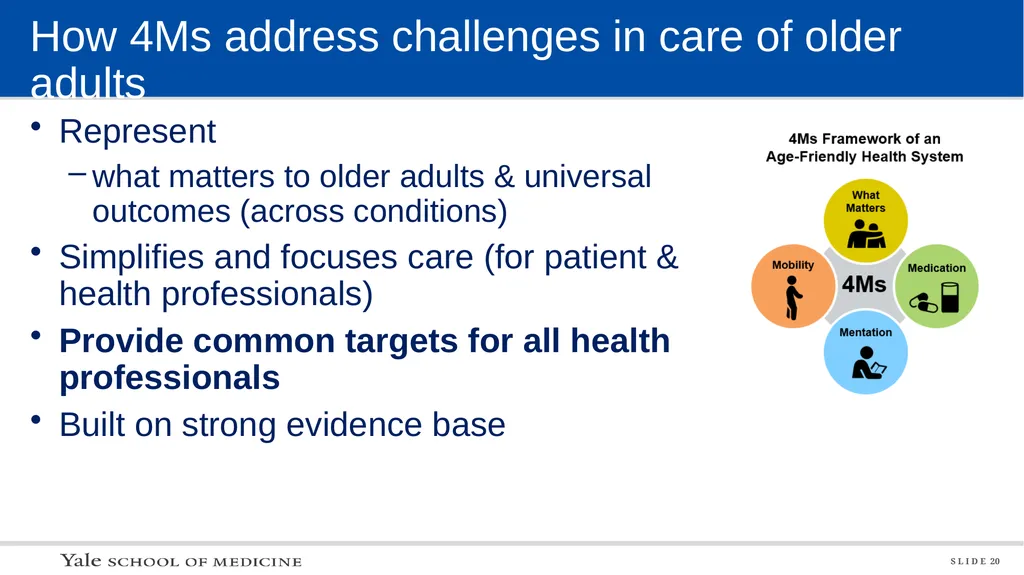
How 4Ms address challenges in care of older adults Represent
what matters to older adults & universal outcomes (across conditions)
Simplifies and focuses care (for patient & health professionals)
Provide common targets for all health professionals
Built on strong evidence base<br>
what matters to older adults & universal outcomes (across conditions)
Simplifies and focuses care (for patient & health professionals)
Provide common targets for all health professionals
Built on strong evidence base<br>
21
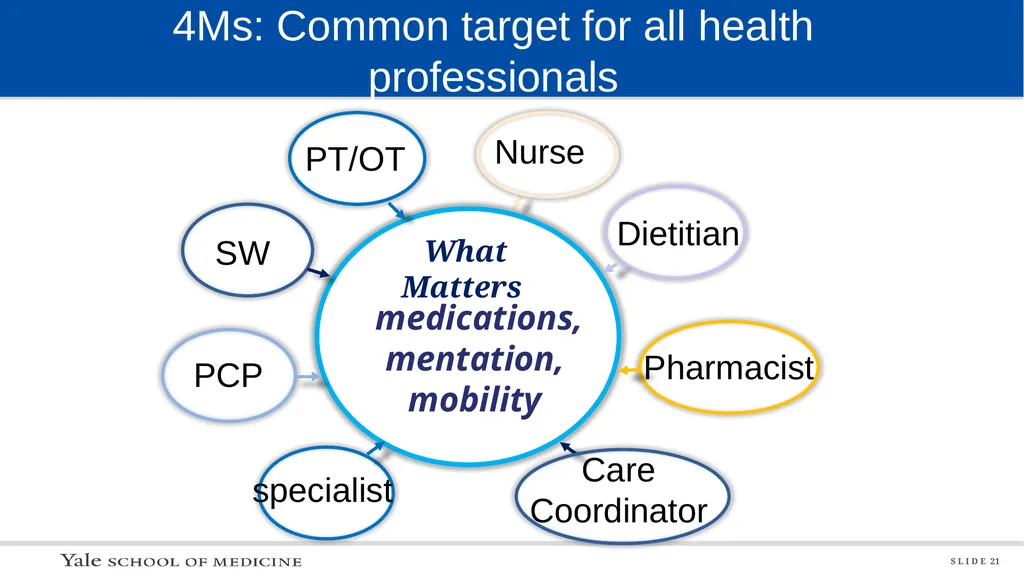
4Ms: Common target for all health professionals What Matters specialist medications, mentation,
mobility<br>
mobility<br>
22
How 4Ms address challenges in care of older adults Represent:
what matters to older adults
Universal outcomes (across conditions)
Simplifies and focuses care (for patient & health professionals)
Provide common targets for all health professionals
Built on strong evidence base<br>
what matters to older adults
Universal outcomes (across conditions)
Simplifies and focuses care (for patient & health professionals)
Provide common targets for all health professionals
Built on strong evidence base<br>
23
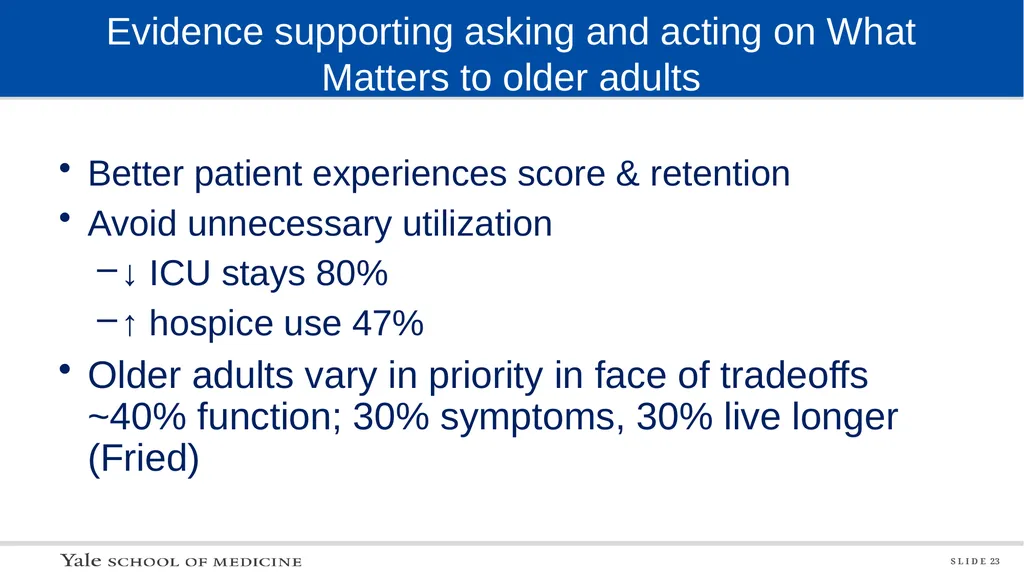
Evidence supporting asking and acting on What Matters to older adults Better patient experiences score & retention
Avoid unnecessary utilization
↓ ICU stays 80%
↑ hospice use 47%
Older adults vary in priority in face of tradeoffs ~40% function; 30% symptoms, 30% live longer (Fried)<br>
Avoid unnecessary utilization
↓ ICU stays 80%
↑ hospice use 47%
Older adults vary in priority in face of tradeoffs ~40% function; 30% symptoms, 30% live longer (Fried)<br>
24
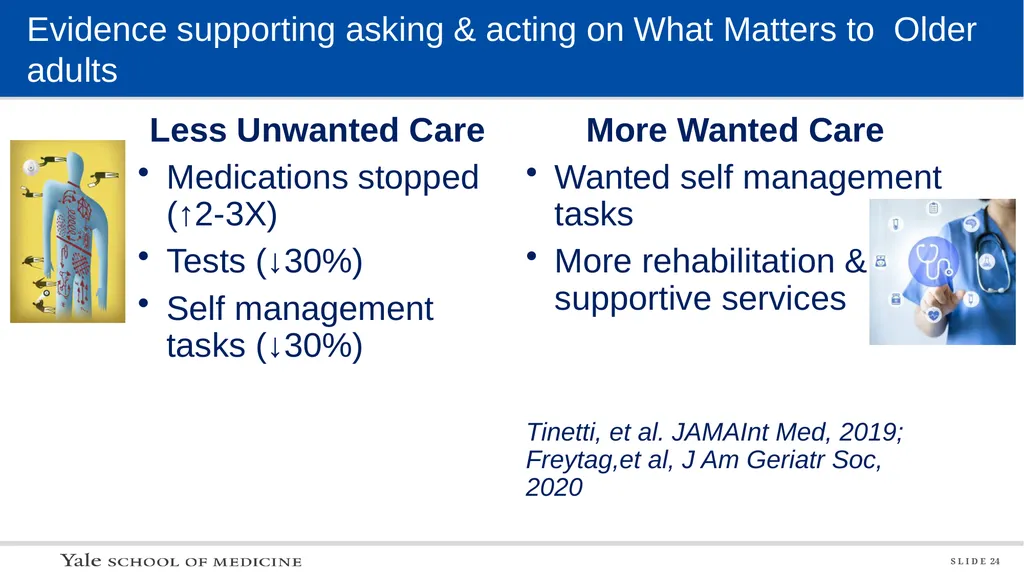
Evidence supporting asking & acting on What Matters to Older adults Less Unwanted Care
Medications stopped (↑2-3X)
Tests (↓30%)
Self management tasks (↓30%) More Wanted Care
Wanted self management tasks
More rehabilitation & supportive services
Tinetti, et al. JAMAInt Med, 2019; Freytag,et al, J Am Geriatr Soc, 2020<br>
Medications stopped (↑2-3X)
Tests (↓30%)
Self management tasks (↓30%) More Wanted Care
Wanted self management tasks
More rehabilitation & supportive services
Tinetti, et al. JAMAInt Med, 2019; Freytag,et al, J Am Geriatr Soc, 2020<br>
25
Evidence supporting asking & acting on What Matters to older adults: Clinicians “It did help to focus the conversation better. Normally, we just go over the list of problems they've had and try and work through each one in isolation.”
“I think that the individual goals I like. […] kind of gives us something to shoot for—and it’s a way for us to kind of motivate patients as well.”
Ouellet G, et al. J Am Geriatric Soc, 2020 25<br>
“I think that the individual goals I like. […] kind of gives us something to shoot for—and it’s a way for us to kind of motivate patients as well.”
Ouellet G, et al. J Am Geriatric Soc, 2020 25<br>
26
Evidence supporting asking & acting on What Matters to older adults: Older adults “He [PCP] said it’s very important to him to find the questions that you might have that you didn’t ask me or a treatment that you think might have helped. In other words, help him [help me]”
“Well, it got me to realize that the doctor’s office and my own doctor are truly interested in my health.”
“It helped me sit down and really think about things, versus just kind of reacting day-to-day. It helped me refocus my thoughts and really kind of verbalize my priorities.”
Feder, et al. J Am Geriatric Soc; 2019 26<br>
“Well, it got me to realize that the doctor’s office and my own doctor are truly interested in my health.”
“It helped me sit down and really think about things, versus just kind of reacting day-to-day. It helped me refocus my thoughts and really kind of verbalize my priorities.”
Feder, et al. J Am Geriatric Soc; 2019 26<br>
27
Evidence supporting safe mobility in hospital: Adverse effects of immobility Spend 95% of time in bed or chair Brown, JAGS 2009; Brown CJ, 2004
↓ muscle mass & strength → deconditioning
Linked to pressure ulcers, venous stasis
Major risk factor for falls<br>
↓ muscle mass & strength → deconditioning
Linked to pressure ulcers, venous stasis
Major risk factor for falls<br>
28
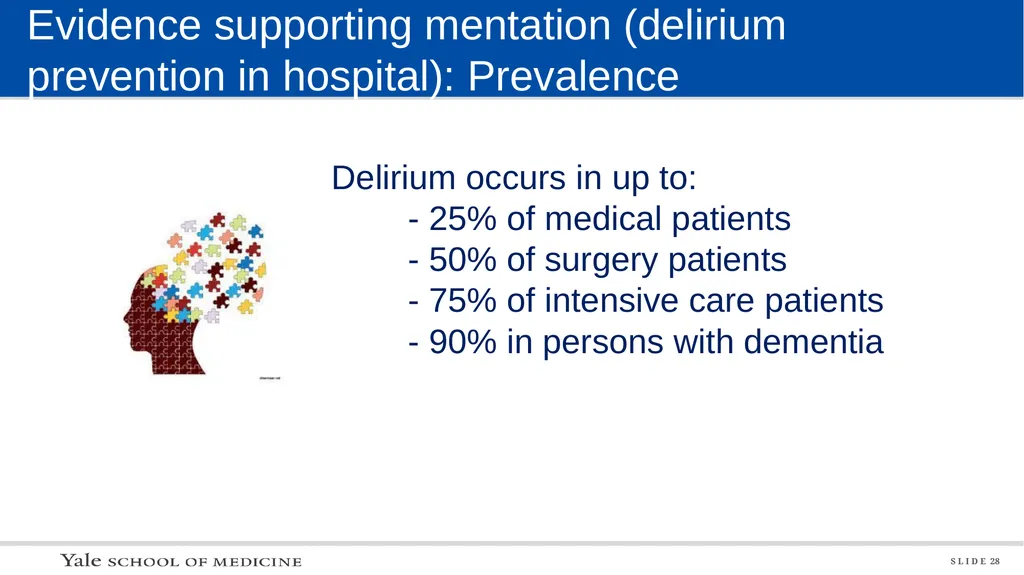
Evidence supporting mentation (delirium prevention in hospital): Prevalence Delirium occurs in up to:
- 25% of medical patients
- 50% of surgery patients
- 75% of intensive care patients
- 90% in persons with dementia<br>
- 90% in persons with dementia<br>
29
Evidence supporting safe mobility & mentation (delirium prevention) in hospital Immobility and delirium:
Most common causes of delay in discharge
↓ ADLs and ↑ nursing home admission adjusting for illness severity
Common cause of early readmission<br>
Most common causes of delay in discharge
↓ ADLs and ↑ nursing home admission adjusting for illness severity
Common cause of early readmission<br>
30
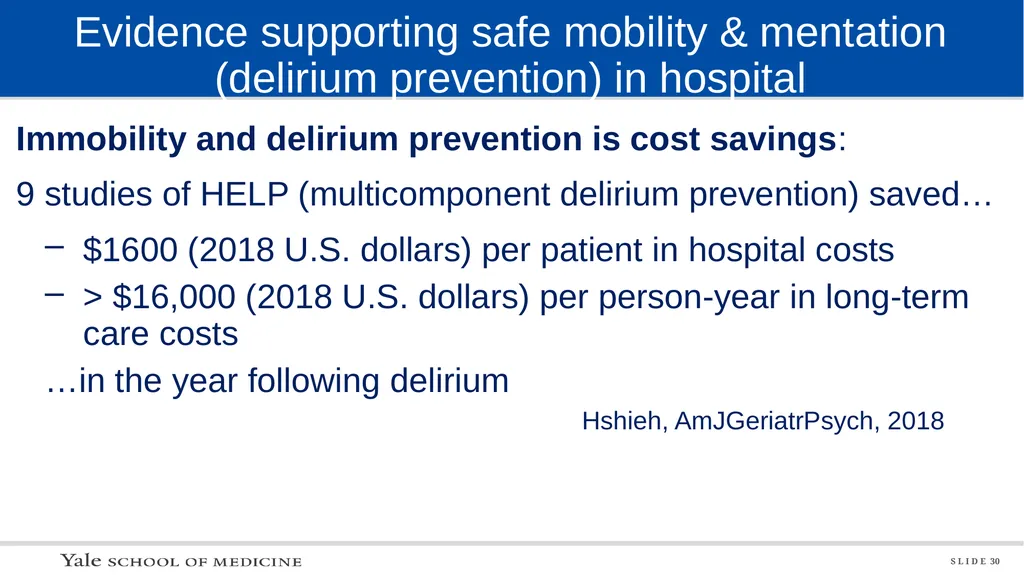
Evidence supporting safe mobility & mentation (delirium prevention) in hospital Immobility and delirium prevention is cost savings:
9 studies of HELP (multicomponent delirium prevention) saved…
$1600 (2018 U.S. dollars) per patient in hospital costs
> $16,000 (2018 U.S. dollars) per person-year in long-term care costs
…in the year following delirium
Hshieh, AmJGeriatrPsych, 2018<br>
9 studies of HELP (multicomponent delirium prevention) saved…
$1600 (2018 U.S. dollars) per patient in hospital costs
> $16,000 (2018 U.S. dollars) per person-year in long-term care costs
…in the year following delirium
Hshieh, AmJGeriatrPsych, 2018<br>
31
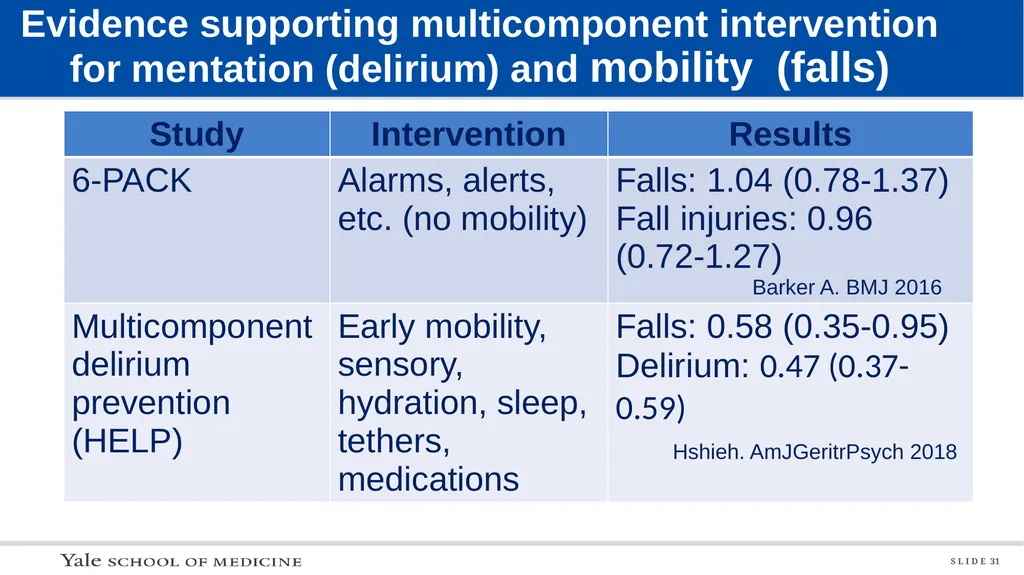
Evidence supporting multicomponent intervention for mentation (delirium) and mobility (falls)<br>
32
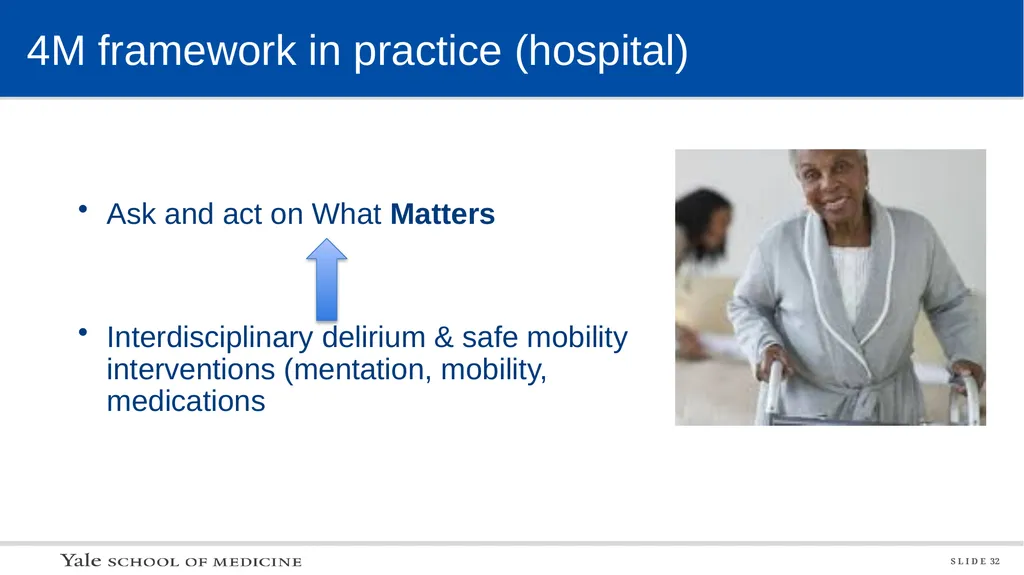
4M framework in practice (hospital) Ask and act on What Matters
Interdisciplinary delirium & safe mobility interventions (mentation, mobility, medications<br>
Interdisciplinary delirium & safe mobility interventions (mentation, mobility, medications<br>
33
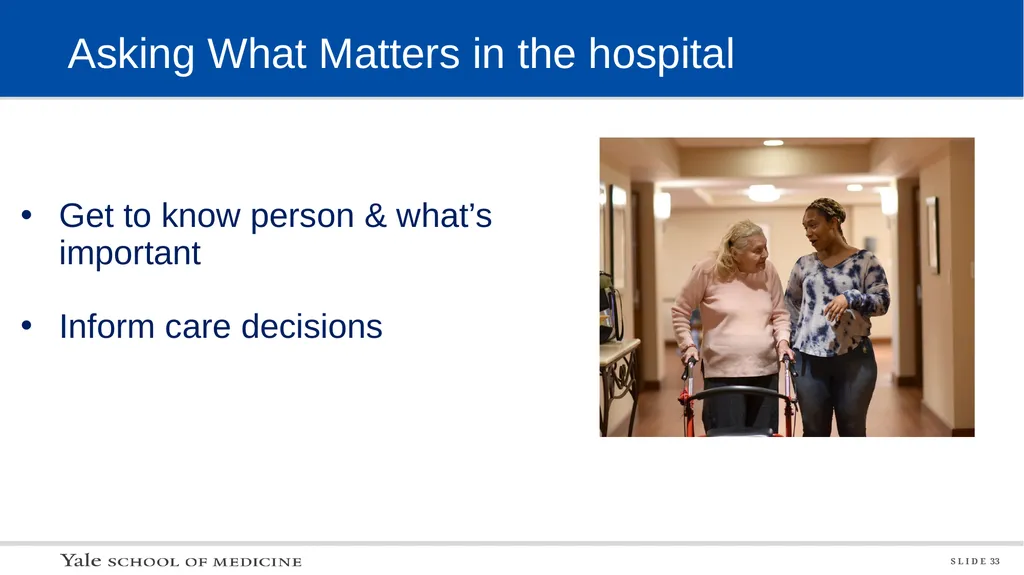
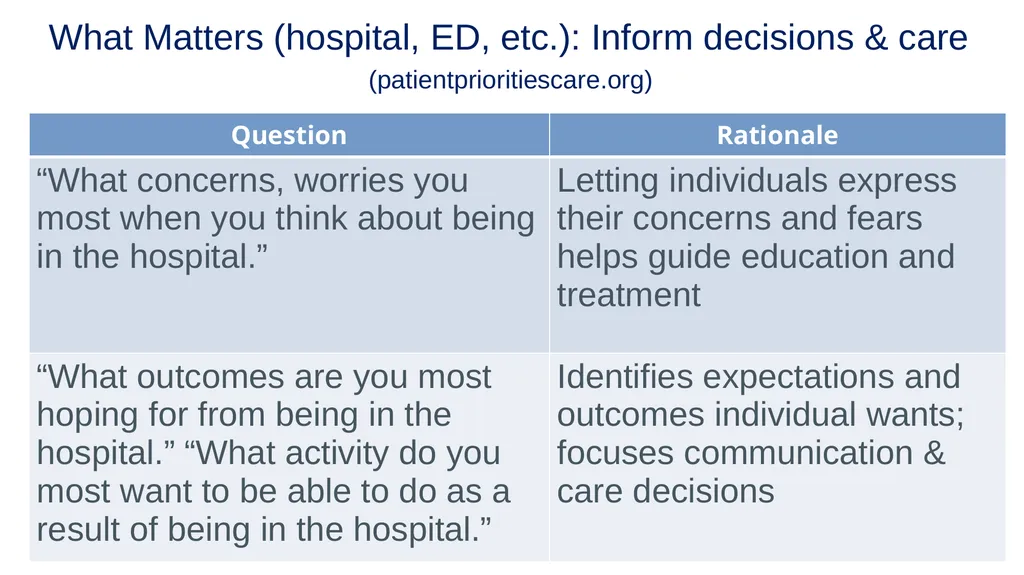
Asking What Matters in the hospital Get to know person & what’s important
Inform care decisions<br>
Inform care decisions<br>
34
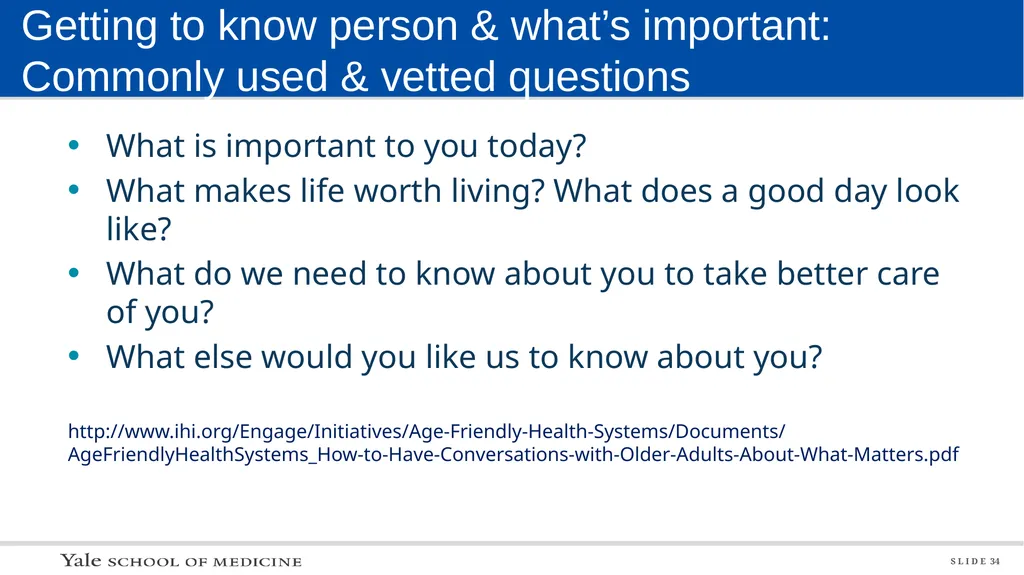
What is important to you today?
What makes life worth living? What does a good day look like?
What do we need to know about you to take better care of you?
What else would you like us to know about you?
http://www.ihi.org/Engage/Initiatives/Age-Friendly-Health-Systems/Documents/AgeFriendlyHealthSystems_How-to-Have-Conversations-with-Older-Adults-About-What-Matters.pdf Getting to know person & what’s important: Commonly used & vetted questions<br>
What makes life worth living? What does a good day look like?
What do we need to know about you to take better care of you?
What else would you like us to know about you?
http://www.ihi.org/Engage/Initiatives/Age-Friendly-Health-Systems/Documents/AgeFriendlyHealthSystems_How-to-Have-Conversations-with-Older-Adults-About-What-Matters.pdf Getting to know person & what’s important: Commonly used & vetted questions<br>
35
What Matters (hospital, ED, etc.): Inform decisions & care (patientprioritiescare.org)<br>
36
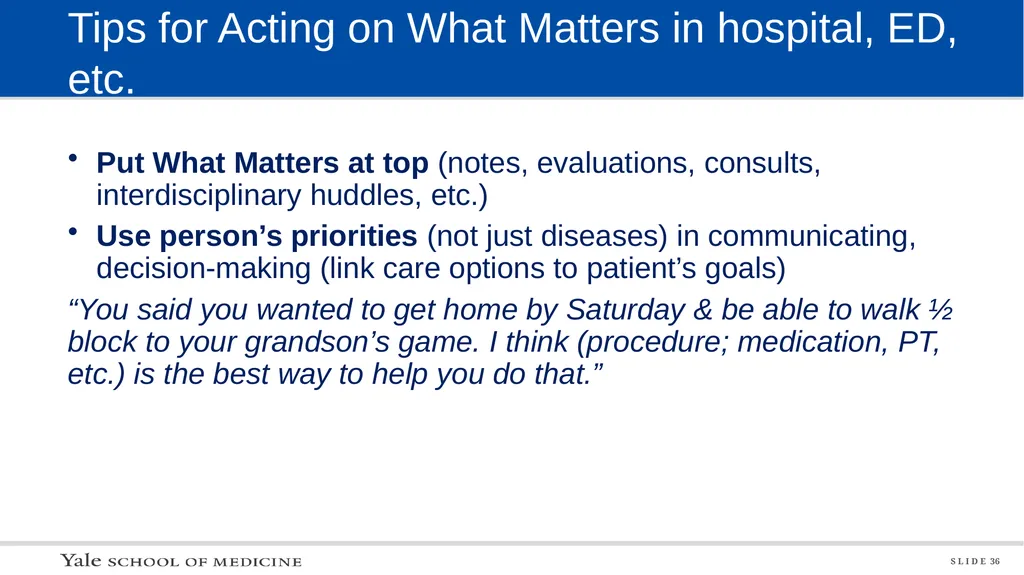
Tips for Acting on What Matters in hospital, ED, etc. Put What Matters at top (notes, evaluations, consults, interdisciplinary huddles, etc.)
Use person’s priorities (not just diseases) in communicating, decision-making (link care options to patient’s goals)
“You said you wanted to get home by Saturday & be able to walk ½ block to your grandson’s game. I think (procedure; medication, PT, etc.) is the best way to help you do that.”<br>
Use person’s priorities (not just diseases) in communicating, decision-making (link care options to patient’s goals)
“You said you wanted to get home by Saturday & be able to walk ½ block to your grandson’s game. I think (procedure; medication, PT, etc.) is the best way to help you do that.”<br>
37
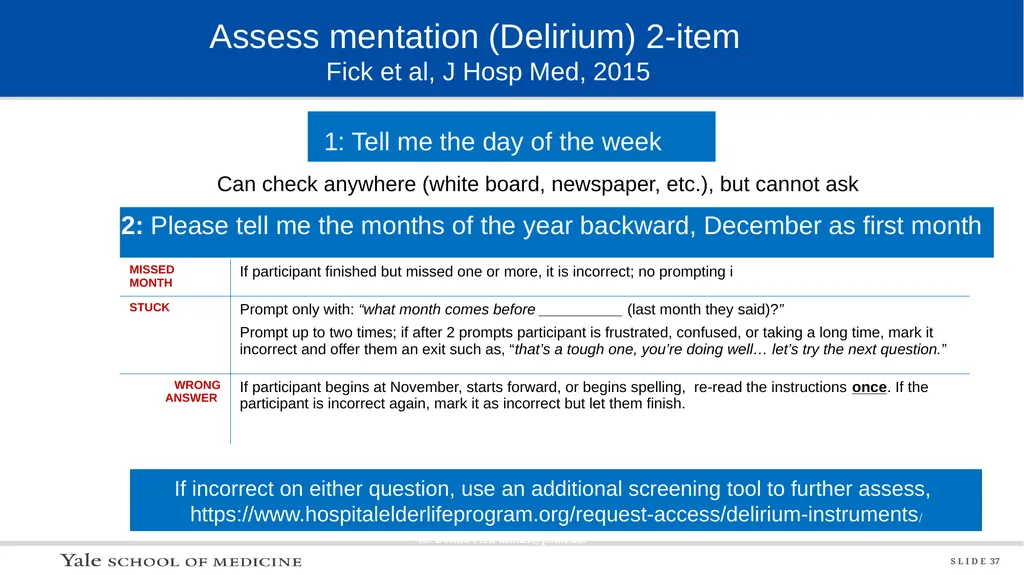
Assess mentation (Delirium) 2-item
Fick et al, J Hosp Med, 2015 1: Tell me the day of the week 2: Please tell me the months of the year backward, December as first month Can check anywhere (white board, newspaper, etc.), but cannot ask Remember to avoid correcting or helping the older adult; Inquiries to: Donna Fick dmf21@psu.edu.
(Please cite Fick et al, Journal of Hospital Medicine, 2015) Not to be reproduced without permission. See disclaimer on back. If incorrect on either question, use an additional screening tool to further assess, https://www.hospitalelderlifeprogram.org/request-access/delirium-instruments/<br>
Fick et al, J Hosp Med, 2015 1: Tell me the day of the week 2: Please tell me the months of the year backward, December as first month Can check anywhere (white board, newspaper, etc.), but cannot ask Remember to avoid correcting or helping the older adult; Inquiries to: Donna Fick dmf21@psu.edu.
(Please cite Fick et al, Journal of Hospital Medicine, 2015) Not to be reproduced without permission. See disclaimer on back. If incorrect on either question, use an additional screening tool to further assess, https://www.hospitalelderlifeprogram.org/request-access/delirium-instruments/<br>
38
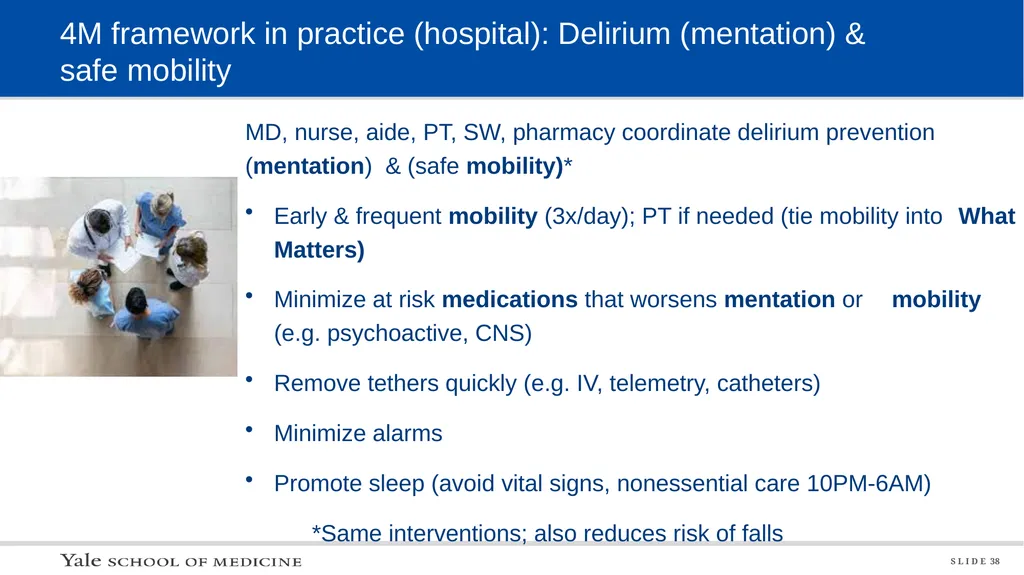
4M framework in practice (hospital): Delirium (mentation) & safe mobility MD, nurse, aide, PT, SW, pharmacy coordinate delirium prevention (mentation) & (safe mobility)*
Early & frequent mobility (3x/day); PT if needed (tie mobility into What Matters)
Minimize at risk medications that worsens mentation or mobility (e.g. psychoactive, CNS)
Remove tethers quickly (e.g. IV, telemetry, catheters)
Minimize alarms
Promote sleep (avoid vital signs, nonessential care 10PM-6AM)
*Same interventions; also reduces risk of falls<br>
Early & frequent mobility (3x/day); PT if needed (tie mobility into What Matters)
Minimize at risk medications that worsens mentation or mobility (e.g. psychoactive, CNS)
Remove tethers quickly (e.g. IV, telemetry, catheters)
Minimize alarms
Promote sleep (avoid vital signs, nonessential care 10PM-6AM)
*Same interventions; also reduces risk of falls<br>
39
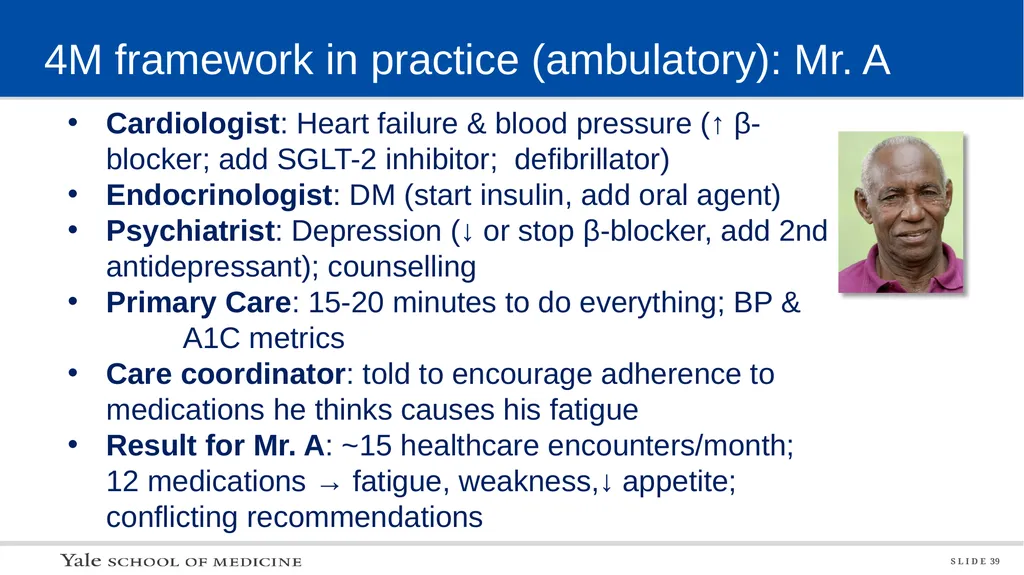
4M framework in practice (ambulatory): Mr. A Cardiologist: Heart failure & blood pressure (↑ β-blocker; add SGLT-2 inhibitor; defibrillator)
Endocrinologist: DM (start insulin, add oral agent)
Psychiatrist: Depression (↓ or stop β-blocker, add 2nd antidepressant); counselling
Primary Care: 15-20 minutes to do everything; BP & A1C metrics
Care coordinator: told to encourage adherence to medications he thinks causes his fatigue
Result for Mr. A: ~15 healthcare encounters/month; 12 medications → fatigue, weakness,↓ appetite; conflicting recommendations<br>
Endocrinologist: DM (start insulin, add oral agent)
Psychiatrist: Depression (↓ or stop β-blocker, add 2nd antidepressant); counselling
Primary Care: 15-20 minutes to do everything; BP & A1C metrics
Care coordinator: told to encourage adherence to medications he thinks causes his fatigue
Result for Mr. A: ~15 healthcare encounters/month; 12 medications → fatigue, weakness,↓ appetite; conflicting recommendations<br>
40
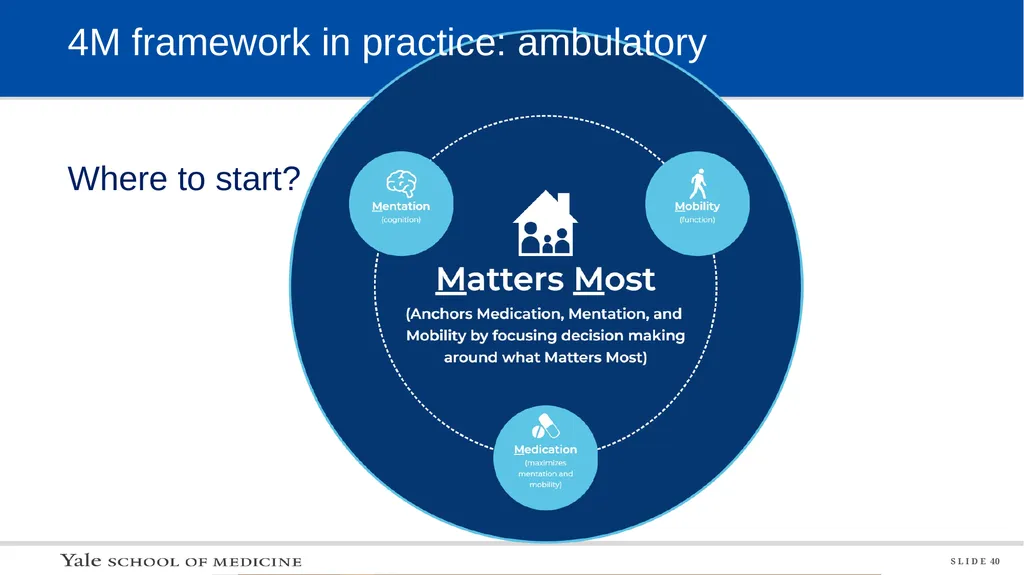
4M framework in practice: ambulatory Where to start?<br>
41
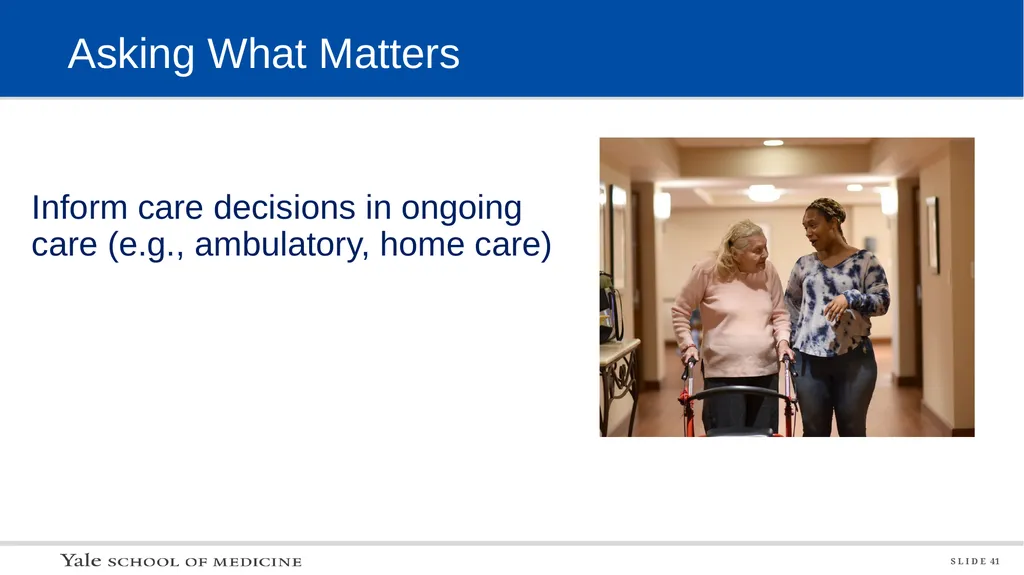
Asking What Matters Inform care decisions in ongoing care (e.g., ambulatory, home care)<br>
42
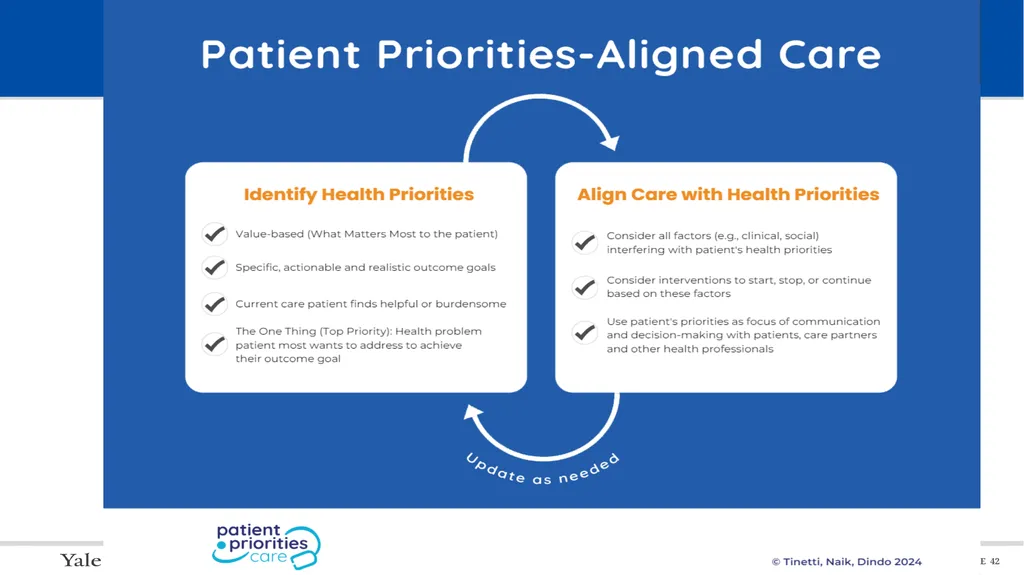
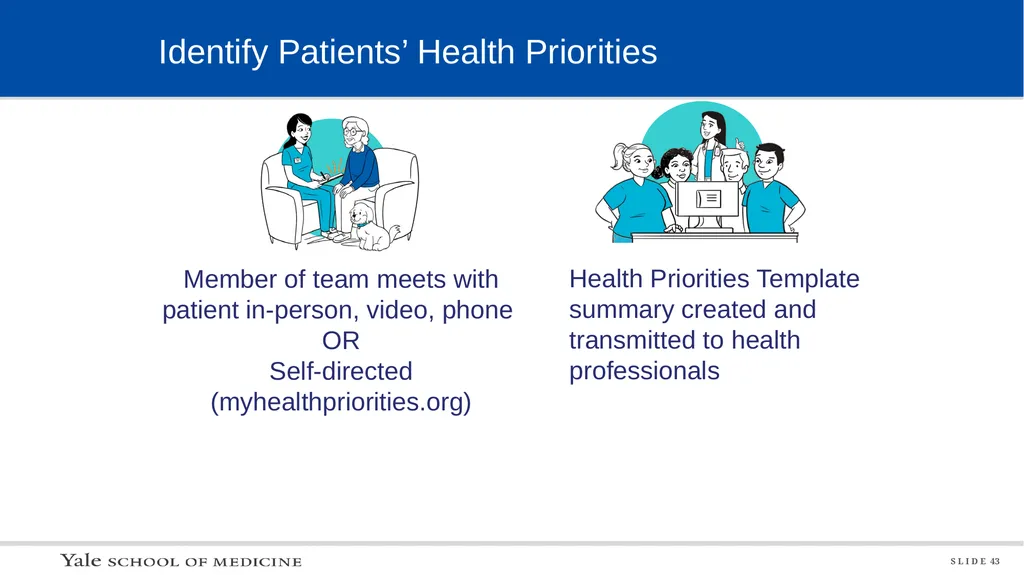
Identify Patients’ Health Priorities<br>
43
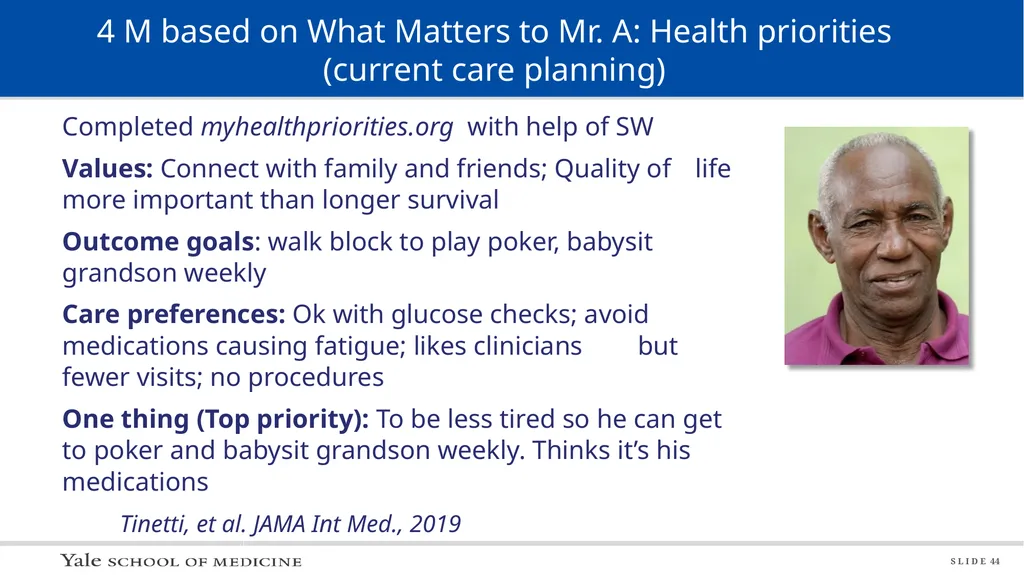
4 M based on What Matters to Mr. A: Health priorities (current care planning) Completed myhealthpriorities.org with help of SW
Values: Connect with family and friends; Quality of life more important than longer survival
Outcome goals: walk block to play poker, babysit grandson weekly
Care preferences: Ok with glucose checks; avoid medications causing fatigue; likes clinicians but fewer visits; no procedures
One thing (Top priority): To be less tired so he can get to poker and babysit grandson weekly. Thinks it’s his medications
Tinetti, et al. JAMA Int Med., 2019<br>
Values: Connect with family and friends; Quality of life more important than longer survival
Outcome goals: walk block to play poker, babysit grandson weekly
Care preferences: Ok with glucose checks; avoid medications causing fatigue; likes clinicians but fewer visits; no procedures
One thing (Top priority): To be less tired so he can get to poker and babysit grandson weekly. Thinks it’s his medications
Tinetti, et al. JAMA Int Med., 2019<br>
44
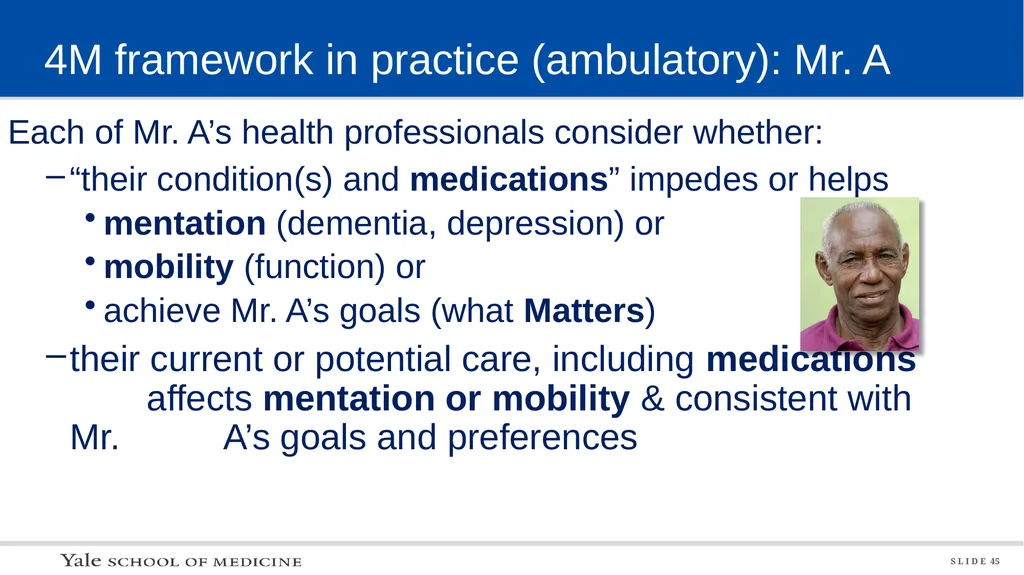
4M framework in practice (ambulatory): Mr. A Each of Mr. A’s health professionals consider whether:
“their condition(s) and medications” impedes or helps
mentation (dementia, depression) or
mobility (function) or
achieve Mr. A’s goals (what Matters)
their current or potential care, including medications affects mentation or mobility & consistent with Mr. A’s goals and preferences<br>
“their condition(s) and medications” impedes or helps
mentation (dementia, depression) or
mobility (function) or
achieve Mr. A’s goals (what Matters)
their current or potential care, including medications affects mentation or mobility & consistent with Mr. A’s goals and preferences<br>
45
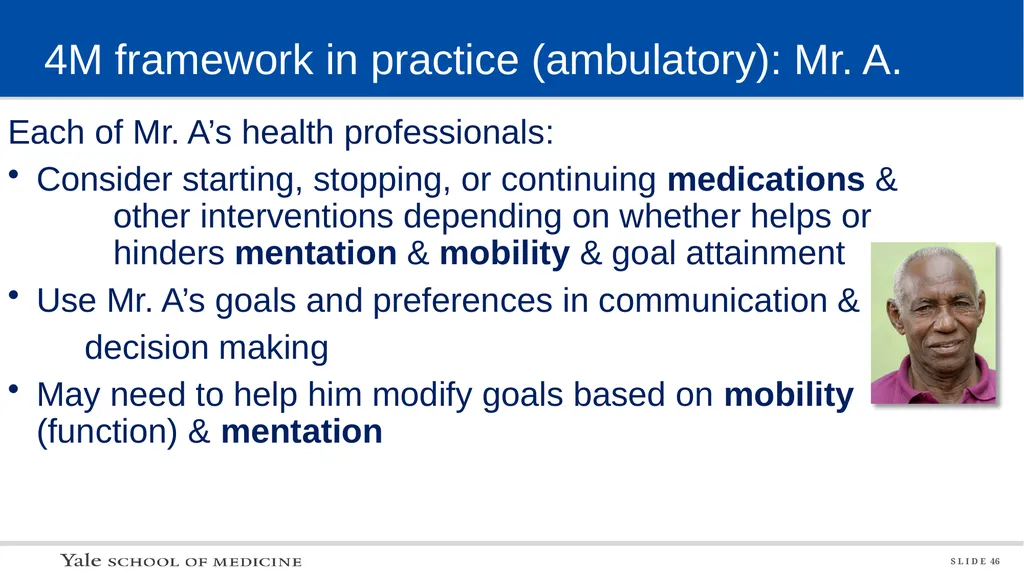
4M framework in practice (ambulatory): Mr. A. Each of Mr. A’s health professionals:
Consider starting, stopping, or continuing medications & other interventions depending on whether helps or hinders mentation & mobility & goal attainment
Use Mr. A’s goals and preferences in communication &
decision making
May need to help him modify goals based on mobility (function) & mentation<br>
Consider starting, stopping, or continuing medications & other interventions depending on whether helps or hinders mentation & mobility & goal attainment
Use Mr. A’s goals and preferences in communication &
decision making
May need to help him modify goals based on mobility (function) & mentation<br>
46
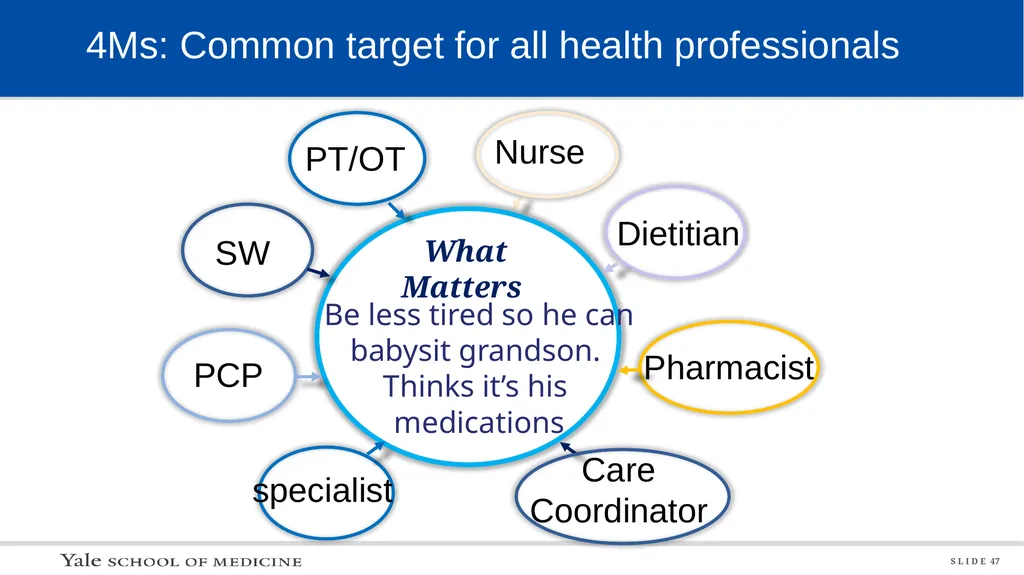
4Ms: Common target for all health professionals What Matters specialist Be less tired so he can
babysit grandson.
Thinks it’s his
medications<br>
babysit grandson.
Thinks it’s his
medications<br>
47
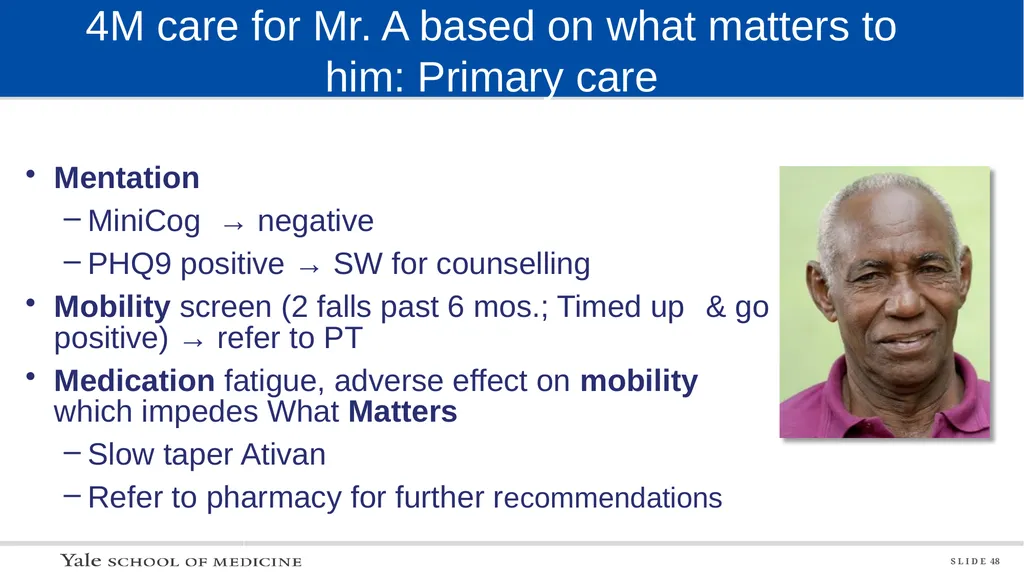
4M care for Mr. A based on what matters to him: Primary care Mentation
MiniCog → negative
PHQ9 positive → SW for counselling
Mobility screen (2 falls past 6 mos.; Timed up & go positive) → refer to PT
Medication fatigue, adverse effect on mobility which impedes What Matters
Slow taper Ativan
Refer to pharmacy for further recommendations<br>
MiniCog → negative
PHQ9 positive → SW for counselling
Mobility screen (2 falls past 6 mos.; Timed up & go positive) → refer to PT
Medication fatigue, adverse effect on mobility which impedes What Matters
Slow taper Ativan
Refer to pharmacy for further recommendations<br>
48
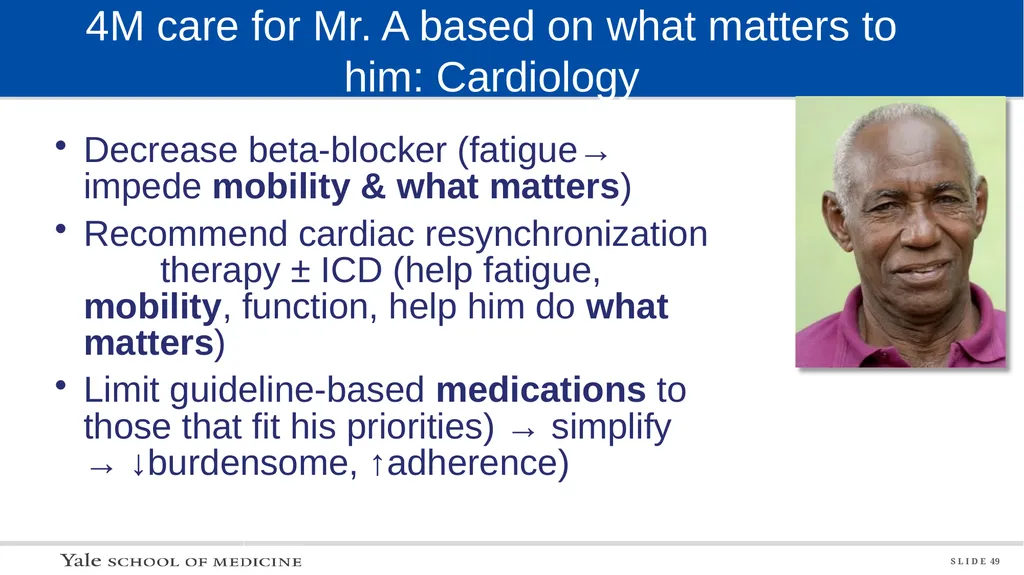
4M care for Mr. A based on what matters to him: Cardiology Decrease beta-blocker (fatigue→ impede mobility & what matters)
Recommend cardiac resynchronization therapy ± ICD (help fatigue, mobility, function, help him do what matters)
Limit guideline-based medications to those that fit his priorities) → simplify → ↓burdensome, ↑adherence)<br>
Recommend cardiac resynchronization therapy ± ICD (help fatigue, mobility, function, help him do what matters)
Limit guideline-based medications to those that fit his priorities) → simplify → ↓burdensome, ↑adherence)<br>
49
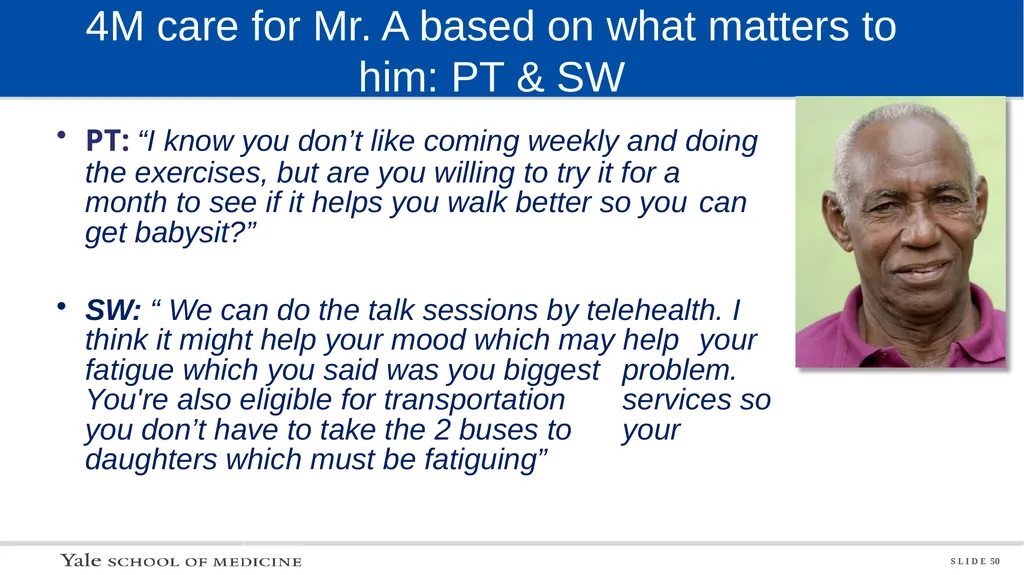
4M care for Mr. A based on what matters to him: PT & SW PT: “I know you don’t like coming weekly and doing the exercises, but are you willing to try it for a month to see if it helps you walk better so you can get babysit?”
SW: “ We can do the talk sessions by telehealth. I think it might help your mood which may help your fatigue which you said was you biggest problem. You're also eligible for transportation services so you don’t have to take the 2 buses to your daughters which must be fatiguing”<br>
SW: “ We can do the talk sessions by telehealth. I think it might help your mood which may help your fatigue which you said was you biggest problem. You're also eligible for transportation services so you don’t have to take the 2 buses to your daughters which must be fatiguing”<br>
50
Age Friendly 4M-Based Care: Getting started Identify champion
Start with a few disciplines (e.g., primary care,1-2 specialties, Geriatrics, SW, PT pharmacy, nursing)
Select population or setting to pilot (one unit or practice)
Integrate into existing activity (e.g. interdisciplinary huddles)
Try with one person<br>
Start with a few disciplines (e.g., primary care,1-2 specialties, Geriatrics, SW, PT pharmacy, nursing)
Select population or setting to pilot (one unit or practice)
Integrate into existing activity (e.g. interdisciplinary huddles)
Try with one person<br>
51
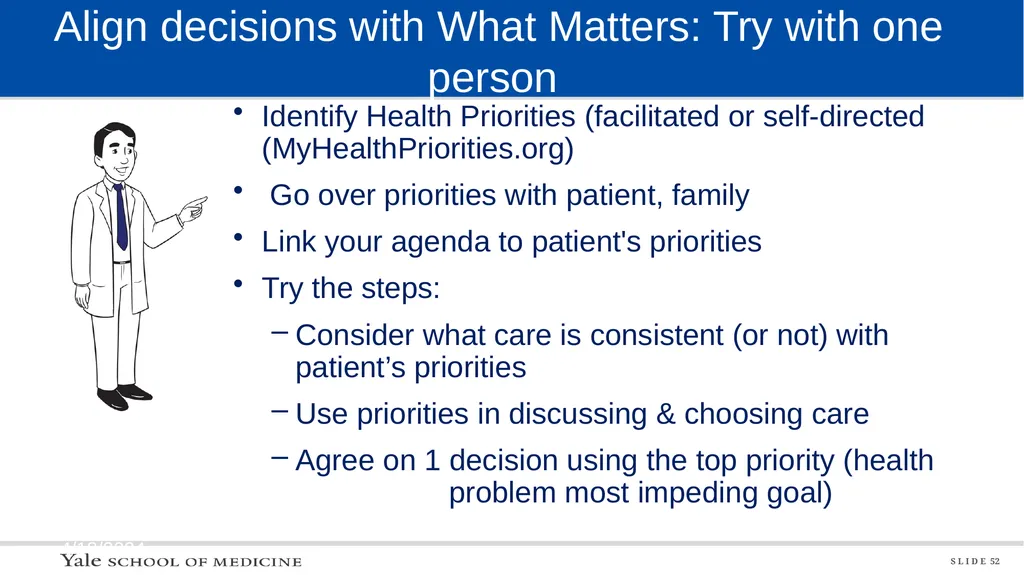
Align decisions with What Matters: Try with one person Identify Health Priorities (facilitated or self-directed (MyHealthPriorities.org)
Go over priorities with patient, family
Link your agenda to patient's priorities
Try the steps:
Consider what care is consistent (or not) with patient’s priorities
Use priorities in discussing & choosing care
Agree on 1 decision using the top priority (health problem most impeding goal) 4/18/2024<br>
Go over priorities with patient, family
Link your agenda to patient's priorities
Try the steps:
Consider what care is consistent (or not) with patient’s priorities
Use priorities in discussing & choosing care
Agree on 1 decision using the top priority (health problem most impeding goal) 4/18/2024<br>
52
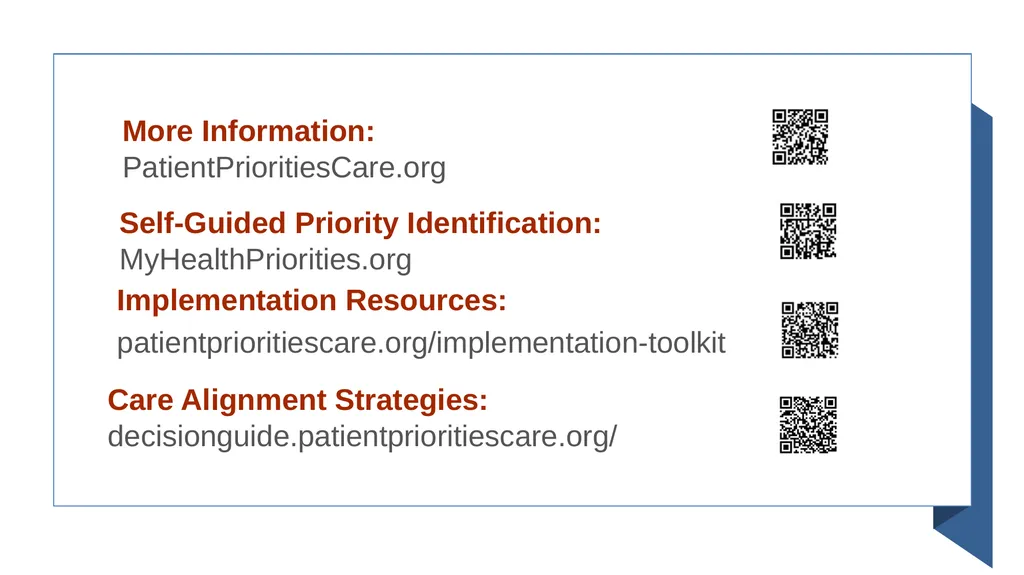
More Information:
PatientPrioritiesCare.org Self-Guided Priority Identification:
MyHealthPriorities.org Implementation Resources:
patientprioritiescare.org/implementation-toolkit Care Alignment Strategies:
decisionguide.patientprioritiescare.org/<br>
PatientPrioritiesCare.org Self-Guided Priority Identification:
MyHealthPriorities.org Implementation Resources:
patientprioritiescare.org/implementation-toolkit Care Alignment Strategies:
decisionguide.patientprioritiescare.org/<br>