Intellectual Property in International Business –
Description: Intellectual Property in International Business The Strategic Role for Companies Meeting of Expert Group for Defining the Scope and the Methodology for National Surveys Studies on Intellectual Property and SMEs Geneva, 1718th of
Related Topics
Download Presentation
"Intellectual Property in International Business –" is the property of its rightful owner. Permission is granted to download and print the materials on this website for personal, non-commercial use only, and to display it on your personal computer provided you do not modify the materials and that you retain all copyright notices contained in the materials. By downloading content from our website, you accept the terms of this agreement.
Presentation Transcript
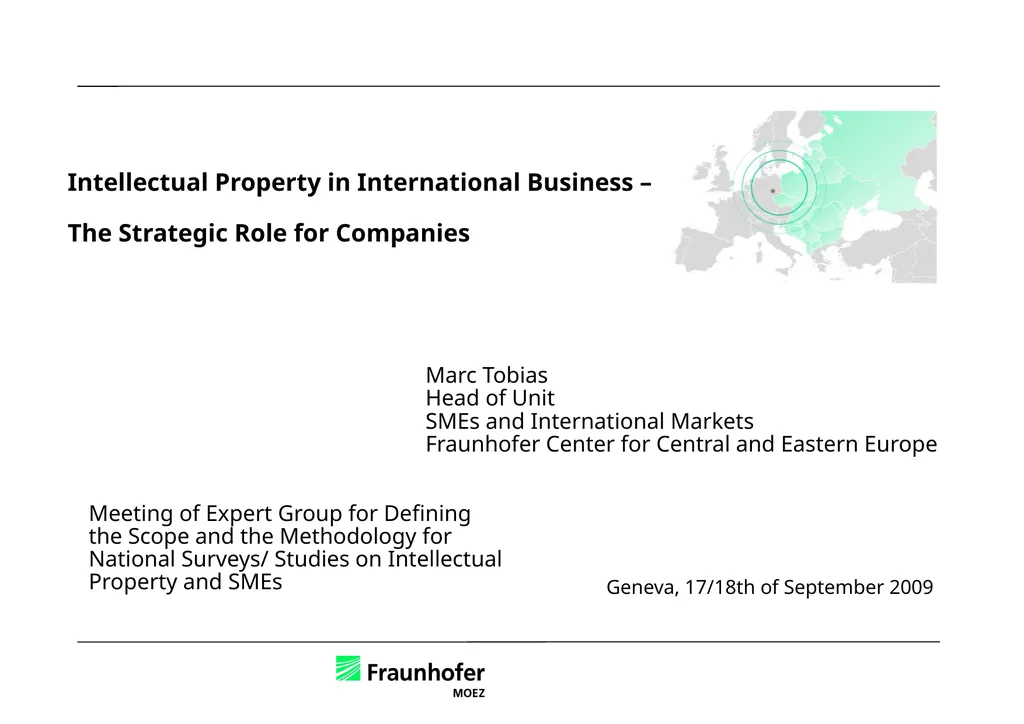
slide1. Intellectual Property in International Business –
The Strategic Role for Companies Meeting of Expert Group for Defining
the Scope and the Methodology for
National Surveys/ Studies on Intellectual
Property and SMEs Geneva, 17/18th of September 2009 Marc Tobias
Head of Unit
SMEs and International Markets
Fraunhofer Center for Central and Eastern Europe<br>
slide2. The Fraunhofer MOEZ is a research institute within the Fraunhofer-Gesellschaft with a link to universities in accordance with the Fraunhofer model.
The core competencies of applied and international-oriented research at the MOEZ lie in the areas of economics, politics and social sciences, as well as on innovation research on European Level. The Fraunhofer Center for Central and Eastern Europe (MOEZ)<br>
slide3. The Structure of the Fraunhofer MOEZ Business Fields<br>
slide4. The Structure of the Fraunhofer MOEZ Business Fields 8<br>
slide5. Innovative Transfer Systems Contribution to the Sustainable Growth of Competiveness of Firms and Regions
How can systemic and spatial transfers be described qualitatively and quantitatively and transfer results be measured?
What relationship exists between transfer systems and the competitiveness of economic and innovation areas?
How can systemic and spatial transfer processes be modeled and so be designed for greater effectiveness and efficiency (transfer design)?
How can European and German policy employ incentives to influence and steer in a targeted manner the transfer of knowledge, technology and/or innovations? 9<br>
slide6. Transfer objects:
Ideas
Codified knowledge
Experiential knowledge
Intellectual property
(licenses, patents)
Researcher/scientists
Raw materials
Innovative products and
services
Free-standing technologies
Embedded technologies Innovative Transfer Systems 10<br>
slide7. The Structure of the Fraunhofer MOEZ Business Fields 8<br>
slide8. Trans-European R&D Cooperations Initiation, conception and coordination of trans-European project cooperations in science and education.
Initiation, conception, and coordination of trans-European project cooperations in research and the economy.
Evaluation and monitoring of R&D cooperations. Positioning 11<br>
slide9. Bologna process (at the level
of individual institutions)
Cooperation between
individual institutions
International science
management
Design of international study
courses
Knowledge transfer Cooperations within clusters
and networks
Internationalization of and
cooperation between
clusters/networks Concrete project evaluations
Project monitoring
Scientific analysis of
monitoring and evaluation
instruments Wissenschaftliche Kenntnisse zu den nationalen und europäischen Forschungssystemen und
Forschungspolitiken sind grundlegende Voraussetzung für die Arbeit in GF II Trans-European R&D Cooperation Scientific knowledge of national and European research systems and research policies
are essential elements of Business Field II Thematic Areas Cooperations in Science and Education Cooperations in
Research and Economy Monitoring & Evaluation 12<br>
slide10. Trans-European R&D Cooperation Key Questions
Scientific Analysis of current cooperation and networking strategies in the ERA
Steering of the integration process in the ERA
Why do R&D cooperations exist?
Where are R&D cooperations to be found?
How are R&D cooperations structured?
Who structures R&D cooperations?
Who implements the framework requirements for R&D cooperations?
What are the success criteria for R&D cooperations? 13<br>
slide11. Trans-European R&D Cooperation Projects and Partners (Selection)
COACH BioEnergy
Fraunhofer MOEZ coordinates EU project with 18 partners from 7 CEE countries.
Objective: to cover up-to-date information on bio-energy technologies in CEE countries.
Measures: Development of a trans-national advisory network as well as an easy-to-use
„visual network” with processed information on sustainable bio-mass production and
provision.
Partners: Research institutes, regional energy agencies, NGOs.
Climate for Culture
Fraunhofer MOEZ assumes management of EU project with 27 partners from 16 countries.
Objective: climatically appropriate natural heritage protection.
Measures: Measurement of climate influences on cultural heritage sites in Europe and North
Africa.
Project acquisition in close collaboration with Fraunhofer IBP and ISC. 14<br>
slide12. Trans-European R&D Cooperation Projects (Selection):
“The sun rises in the east! Spatial energy concept for eastern Leipzig“
Country-specific studies on “Renewable energies“ (Poland, Czech Republic,
Slovakia, Hungary, and Rumania; Estonia, Latvia, Lithuania, Slovenia as
”Spotlights“)
“Implementation of marketing measures in Central-, Eastern-,
and South-Eastern Europe for R&D networks and research clusters”.
Event „Sustainable Building Construction – Challenges and Perspectives in Central and Eastern Europe”, 24-25 November 2009 in Leipzig
“Bauportal Zukunft” 15<br>
slide13. The Structure of the Fraunhofer MOEZ Business Fields 8<br>
slide14. SMEs and International Markets Main Research Areas 16 Policy Advise and Research on Institutional Implications<br>
slide15. SMEs and International Markets General Issues in Innovativeness and Competitiveness of SMEs
Innovations must be developed according to customer needs, efficiently produced and successfully marketed worldwide.
What knowhow and national or European framework conditions are
necessary, especially in high-tech industries?
What human and financial resources are necessary to improve
innovativeness?
How are these linked internally to own knowhow and resources and turned
through an efficient innovation process into marketable innovations and
strategies?
How are the resulting products (services) successfully marketed nationally and
internationally, in particular in CEE countries? 17<br>
slide16. SMEs and International Markets Key Questions “Innovation in Organisations“
How can innovative know-how, new processes and resources be efficiently managed in organisations at European level?
How can the innovative capacity and hence international competitiveness be increased, and innovative products generated, by improving these aspects?
What factors influence the absorptive capacity of firms for innovation and how can these factors be influenced? 18<br>
slide17. SMEs and International Markets Key Questions “International Management”
How can firms, especially high-tech Companies, successfully sell their innovative products abroad?
What should successful internationalisation strategies look like in terms of timing of market entry, international marketing strategy and selection of organisational entry form?
How can we support the informational, human capital and financial needs of Companies? 19<br>
slide18. SMEs and International Markets General Issues in Entrepreneurship
Entrepreneurship is needed to generate innovations, because inventions
are not automatically turned into innovations. A great number of ideas
emerging in companies or research institutes is not commercialized.
Entrepreneurs are needed to recognize opportunities and to create new value.
Research shows that there is a link between entrepreneurship activities
and economic growth and employment creation. But entrepreneurship
activities vary across countries and regions.<br>
slide19. Research Topics in Entrepreneurship
Knowledge-based entrepreneurship
How to bridge the innovation gap (high investments in new knowledge, low economic returns)
How to facilitate the commercialization of new economic knowledge created in companies and research institutions
Promoting knowledge-based start-ups
Promoting an entrepreneurial culture
Policy and social dimensions of entrepreneurship
Entrepreneurship in changing / challenging institutional environments
Analysing entrepreneurial activities in CEE-countries
Promoting entrepreneurship in developing economies SMEs and International Markets<br>
slide20. SMEs and International Markets Partners Universities and Research Institutes in Germany, EU and CEEs countries
(i.e. University of Leipzig, Schumpeter School for Economics Wuppertal, IPREG Network, University of Zagreb, Kviev School of Economics, Lithuanian Innovation Center, Albanian Socio Economic Think Tank, Max-Planck-Institute of Economics …) Consulting and Development Firms
(i.e. GOPA, Danish Technology Institute, GTZ, Accenture, GFA, Pohl Consulting, Crimson Capital … ) Public Authorities and Ministries
(i.e. EC DG Enterprise and Industry, German Ministry of Science and Education (BMBF), German Ministry of Economics and Technology (BMWI), Embassies and Ministries for Education, Science and Economy of CEE-Countries, Worldbank, EBRD ) SMEs and large Companies
(i.e. Public Services Leipzig, KPMG, Siemens AG, Kirchhoff Group, ECOVIS GmbH, Tyco Electronics … ) 20<br>
slide21. SMEs and International Markets Current Projects and Proposals (Selection)
EuropeAid: Supporting SMEs in Albania
Worldbank: Knowledge Economy Forum 2010 Berlin
Intereg IV C Central Europe–SUCCESS:
Strengthening the innovation capacity of SMEs
BMBF: Enhancing Productivity in Services
BMBF: Spillover-Effects of the EUREKA Support Program
BMBF: Comparison of SME Support Programs in the EU, USA, China and Japan
EU-7th FP (Research for SME):
IT-Supported Innovation and Knowledge-Management in High-Tech Companies
… and different applied research projects for private companies 21<br>
slide22. The Structure of the Fraunhofer MOEZ Business Fields 8<br>
slide23. International Research and Innovation Analysis Main Research Areas 22<br>
slide24. Objectives
Appraisal of national innovation performance, lessons for Fraunhofer lead markets and key technologies
Identification of promising opportunities for converting R&D results into applications
Information on national and European funding programmes, use of new financing opportunities for Fraunhofer activities.
Development of a reliable advisory and information base for Fraunhofer as well as for economic and political actors and decision-makers. International Research and Innovation Analysis 23<br>
slide25. (1) National Innovation Systems and Innovation Processes in CEE countries
How can the innovative capacity of the CEE countries be compared internationally using an indicator-based analytical framework?
How are the macroeconomic, economic policy, legal (IPR) and socio-cultural framework conditions framed? How do the national discourses on R&I processes take place?
How can the national development trajectories of the NIS and he institutional specificities in the CEE countries be characterised? What national innovation cultures can be identified? International Research and Innovation Analysis 24<br>
slide26. (2) R&I Relevant Incentive Schemes, Stakeholders and Structures in CEE countries
What R&I incentive schemes are established and what is their impact?
What national innovation strategies exist and how are R&I policies framed?
What are the main national R&I priorities? Who are the key public and private stakeholders? International Research and Innovation Analysis 25<br>
slide27. (3) Competitiveness, Economic Structures, Locational Competition
What R&I-relevant structures exist and how do the actors relate to one another?
What contextual and market conditions are present? What are the national and regional locational comparative advantages?
What regional clusters and networks are established? What institutional comparative advantages exist? International Research and Innovation Analysis 26<br>
slide28. … to become a renowned think tank with a politically and economically strategic orientation within the Fraunhofer-Gesellschaft
… as experts for internationalization, to promote and advance relevant research and consultancy for the economy, politics and science at national and European level
... to translate scientific understanding into relevant questions in the fields of internationalization, innovation, innovation transfer, support for SMEs etc. Our objective is …… 27<br>
slide29. Intellectual Property in International Business –
The Strategic Role for Companies Meeting of Expert Group for Defining
the Scope and the Methodology for
National Surveys/ Studies on Intellectual
Property and SMEs Geneva, 17/18th of September 2009 Marc Tobias
Head of Unit
SMEs and International Markets
Fraunhofer Center for Central and Eastern Europe<br>
slide30. Some Statements about Intellectual Property (IP) in Business 2 IP should be one of the most important components in the strategy of a SME
In reality - it is one of the less used by its managers Approximately 85 % of S&P 500´s Value is based on intangible assets
– intellectual property comprises the largest part of those intellectual
assets. (Financial Times; CIO Online)
IP is still more an issue for the legal department, rather than for management
(Anand/Galetovic 2004)
Patents are one of the most important rating instruments for us.
(A consultant from a venture capital company)
Entrepreneurs should not only concentrate on the protection of IP – they should focus
more on the use of IP in its marketing strategy.
(A CEO of a German „Born Global“ in Biotechnology)<br>
slide31. CONTENTS
IP in Small and Medium Companies – A Managerial Perspective
Relevance of IP for the Branding Strategy
Role of IP in Companies` Functional Organization and Product Life Cycle
Importance in International Markets
Empirical Evidence The Strategic Role for B2B – Companies 3<br>
slide32. IP in Small and Medium Companies – A Managerial Perspective 4 What is IP?
IP refers to creations of the mind: inventions, literary and artistic works, and symbols, names, images, and designs used in commerce. (WIPO)
What means IP?
IP is one of the main factors for companies´competitiveness
IP is only a result of a successful innovation process<br>
slide33. CONTENTS
IP in Small and Medium Companies – A Managerial Perspective
Relevance of IP for the Branding Strategy
Role of IP in Companies` Functional Organization and Product Life Cycle
Importance in International Markets
Empirical Evidence 5 The Strategic Role for B2B – Companies<br>
slide34. Brand Management – How to typologize branding strategies Relevance of IP for the Branding Strategy 6 Bruhns (1995) Branding depends mainly on the creation of intellectual property –
with growing importance in B2B<br>
slide35. Relevance of IP for Companies Brands 7 Two Dimensions of IP: 1) Industrial Property and 2) Copyrights
1) Forms of industrial property include
Patents
Especially the marketing related
forms of IP enable the
Trademarks establishment of a strong
Trade names international brand recognition
Industrial design
Geographical indications
2) Copyrights relate mostly to artistic creations, such as poems, novels, music,
paintings, and cinematographic works Legal
focus Marketing
focus<br>
slide36. CONTENTS
IP in Small and Medium Companies – A Managerial Perspective
Relevance of IP for the Branding Strategy
Role of IP in Companies` Functional Organization and Product Life Cycle
Importance in International Markets
Empirical Evidence 8 The Strategic Role for B2B – Companies<br>
slide37. IPs` Role in a Product Life Cycle (PLC) 9 Introduction Growth Maturity Decline PLC
Sales Time IP Form
Importance Product life cycle
Patents
Trademarks/Trade names
Industrial design
Geographical indication Patents are of great importance from the
beginning
The importance of trademarks and
geographical indication increases with a
companies´ internationalization The establishment of marketing-related IP-forms can lead the PLC IP-forms are playing a crucial role in the development of a dominant design<br>
slide38. IPs` Role related to Company Functions 10 Effects of IP from a functional organisation perspective IP forms:
are of relevance in different parts of an organisation
have a strong influence from an outward perspective<br>
slide39. CONTENTS
IP in Small and Medium Companies – A Managerial Perspective
Relevance of IP for the Branding Strategy
Role of IP in Companies` Functional Organization and Product Life Cycle
Importance in International Markets
Empirical Evidence 11 The Strategic Role for B2B – Companies<br>
slide40. Importance of IP in International Markets 12 IP forms play a diverse and decisive role in international marketing strategies support the positioning of a company / build the USP
enable international standardization => cost reduction
reduce informational asymmetry between buyer and seller IP forms:<br>
slide41. Importance of IP in International Markets 13 Economic Factors:
Rapid economic growth (+)
Technological Factors:
Poor infrastructure (-)
Fragmented channels (-) Legal-Political Factors:
Political instability (-)
Low IPR protection (-)
Investment restriction (-)
Trade agreements (+)
Liberalization (+) Market Factors:
Low-tech competition (+)
Socio-culturalFactors:
Cultural Fragmentation (-)
Scarcity of personnel (-) Forms of IP
Patents
Trademarks/ Trade names
Industrial
Design
Geo.graphical
Identification Business
Performance Technological Factors:
Poor infrastructure (-)
Fragmented channels (-)
Legal-Political Factors:
Low IPR protection (-)
Political instability (-)
Privatization (+)
Investment restriction (-)
Trade agreements (+)
Liberalization (+)
Competition/ Market Factors
Low quality goods (+)
Socio-cultural Factors:
Personal ties in business (-)
Scarcity of personnel (-) Technological Factors:
Low technological capabilties (+)
Legal-Political Factors:
Low IPR protection (-)
Liberalization (+)
Competition/ Market Factors
Low quality goods (+)
Missing dominant design Legal-Political Factors:
Liberalization (+)
Competition/ Market Factors
Low marketing sophistication (+)
Socio-cultural Factors:
Personalties in business (-)
Cultural differentiation (+) Factors influencing the linkage between forms of IP and business performance<br>
slide42. CONTENTS
IP in Small and Medium Companies – A Managerial Perspective
Relevance of IP for the Branding Strategy
Role of IP in Companies` Functional Organization and Product Life Cycle
Importance in International Markets
Empirical Evidence 14 The Strategic Role for B2B – Companies<br>
slide43. Empirical Evidence – Key Facts of the study 15 Topic: Marketing Strategies of SMEs in Emerging Markets
Methods: Empirical study with survey and expert interviews
Statistics: Structural Equation Modelling, Regression Analysis
Scope: 250 German high-growth companies with international activities
in Emerging Markets<br>
slide44. Empirical Evidence – Branding Strategy in Emerging Markets 16 Key Findings:
What are the value proposition/ the reputation of the brand?
=> Almost 80 % of the SME are focussing on a high quality image.
Did the company adapt its value proposition in the emerging market?
=> Only 24 % changed it
To which extent is the country image supporting the strategic positioning?
=> 57 % exspected a positive and strong influence of the German
country reputation
What impact can be seen from a strong brand reputation?
A stronger focus on quality leaded to higher market share
The adaptation of a companies` image had a negativ influence
Companies using the country of origin in their marketing-strategy
penetrated faster the emerging market<br>
slide45. Empirical Evidence 17 Key Findings:
Percentage of SMEs using IP-Forms actively in their marketing-strategy: 28 %
Awareness of strategic possibilities based on IP-Forms: 46 %
Incorporation of
IP-Forms in the
regarded product?<br>
slide46. Conclusions I/II 18 IP is one main driver for the competitiveness of SMEs The relevance of IP differ with respect to the market and industry Forms of IP play important roles in the functional organisation of a company The use of forms of IP influence positively the brand development BUT:
IP forms are not used effectively as a strategic part of marketing-instruments in SMEs<br>
slide47. Conclusions II/II 18 Categorization Approach to Future Scope of Research on SME and IP
1) Regional Perspective
a) National vs. EU/Asian/American/African vs. Global level
b) Developed vs. Emerging vs. Least developed countries
2) Stakeholder Perspective
3) Motivation Perspective
Protection of IPR vs. IP Management (IP=Business Model vs. IP = Strategic instrument)
for Competitiveness Assessment
4) Futher Related Issues
IP and Innovation
IP and Cluster
Makro vs. Mikro-Studies<br>
slide48. Marc Tobias
Head of Unit
SMEs and International Markets
Fraunhofer Center for Central and Eastern European Countries
Tel.: +49 (0)341 231039-136
Email: marc.tobias@moez.fraunhofer.de 9 Thank You !<br>
The Strategic Role for Companies Meeting of Expert Group for Defining
the Scope and the Methodology for
National Surveys/ Studies on Intellectual
Property and SMEs Geneva, 17/18th of September 2009 Marc Tobias
Head of Unit
SMEs and International Markets
Fraunhofer Center for Central and Eastern Europe<br>
slide2. The Fraunhofer MOEZ is a research institute within the Fraunhofer-Gesellschaft with a link to universities in accordance with the Fraunhofer model.
The core competencies of applied and international-oriented research at the MOEZ lie in the areas of economics, politics and social sciences, as well as on innovation research on European Level. The Fraunhofer Center for Central and Eastern Europe (MOEZ)<br>
slide3. The Structure of the Fraunhofer MOEZ Business Fields<br>
slide4. The Structure of the Fraunhofer MOEZ Business Fields 8<br>
slide5. Innovative Transfer Systems Contribution to the Sustainable Growth of Competiveness of Firms and Regions
How can systemic and spatial transfers be described qualitatively and quantitatively and transfer results be measured?
What relationship exists between transfer systems and the competitiveness of economic and innovation areas?
How can systemic and spatial transfer processes be modeled and so be designed for greater effectiveness and efficiency (transfer design)?
How can European and German policy employ incentives to influence and steer in a targeted manner the transfer of knowledge, technology and/or innovations? 9<br>
slide6. Transfer objects:
Ideas
Codified knowledge
Experiential knowledge
Intellectual property
(licenses, patents)
Researcher/scientists
Raw materials
Innovative products and
services
Free-standing technologies
Embedded technologies Innovative Transfer Systems 10<br>
slide7. The Structure of the Fraunhofer MOEZ Business Fields 8<br>
slide8. Trans-European R&D Cooperations Initiation, conception and coordination of trans-European project cooperations in science and education.
Initiation, conception, and coordination of trans-European project cooperations in research and the economy.
Evaluation and monitoring of R&D cooperations. Positioning 11<br>
slide9. Bologna process (at the level
of individual institutions)
Cooperation between
individual institutions
International science
management
Design of international study
courses
Knowledge transfer Cooperations within clusters
and networks
Internationalization of and
cooperation between
clusters/networks Concrete project evaluations
Project monitoring
Scientific analysis of
monitoring and evaluation
instruments Wissenschaftliche Kenntnisse zu den nationalen und europäischen Forschungssystemen und
Forschungspolitiken sind grundlegende Voraussetzung für die Arbeit in GF II Trans-European R&D Cooperation Scientific knowledge of national and European research systems and research policies
are essential elements of Business Field II Thematic Areas Cooperations in Science and Education Cooperations in
Research and Economy Monitoring & Evaluation 12<br>
slide10. Trans-European R&D Cooperation Key Questions
Scientific Analysis of current cooperation and networking strategies in the ERA
Steering of the integration process in the ERA
Why do R&D cooperations exist?
Where are R&D cooperations to be found?
How are R&D cooperations structured?
Who structures R&D cooperations?
Who implements the framework requirements for R&D cooperations?
What are the success criteria for R&D cooperations? 13<br>
slide11. Trans-European R&D Cooperation Projects and Partners (Selection)
COACH BioEnergy
Fraunhofer MOEZ coordinates EU project with 18 partners from 7 CEE countries.
Objective: to cover up-to-date information on bio-energy technologies in CEE countries.
Measures: Development of a trans-national advisory network as well as an easy-to-use
„visual network” with processed information on sustainable bio-mass production and
provision.
Partners: Research institutes, regional energy agencies, NGOs.
Climate for Culture
Fraunhofer MOEZ assumes management of EU project with 27 partners from 16 countries.
Objective: climatically appropriate natural heritage protection.
Measures: Measurement of climate influences on cultural heritage sites in Europe and North
Africa.
Project acquisition in close collaboration with Fraunhofer IBP and ISC. 14<br>
slide12. Trans-European R&D Cooperation Projects (Selection):
“The sun rises in the east! Spatial energy concept for eastern Leipzig“
Country-specific studies on “Renewable energies“ (Poland, Czech Republic,
Slovakia, Hungary, and Rumania; Estonia, Latvia, Lithuania, Slovenia as
”Spotlights“)
“Implementation of marketing measures in Central-, Eastern-,
and South-Eastern Europe for R&D networks and research clusters”.
Event „Sustainable Building Construction – Challenges and Perspectives in Central and Eastern Europe”, 24-25 November 2009 in Leipzig
“Bauportal Zukunft” 15<br>
slide13. The Structure of the Fraunhofer MOEZ Business Fields 8<br>
slide14. SMEs and International Markets Main Research Areas 16 Policy Advise and Research on Institutional Implications<br>
slide15. SMEs and International Markets General Issues in Innovativeness and Competitiveness of SMEs
Innovations must be developed according to customer needs, efficiently produced and successfully marketed worldwide.
What knowhow and national or European framework conditions are
necessary, especially in high-tech industries?
What human and financial resources are necessary to improve
innovativeness?
How are these linked internally to own knowhow and resources and turned
through an efficient innovation process into marketable innovations and
strategies?
How are the resulting products (services) successfully marketed nationally and
internationally, in particular in CEE countries? 17<br>
slide16. SMEs and International Markets Key Questions “Innovation in Organisations“
How can innovative know-how, new processes and resources be efficiently managed in organisations at European level?
How can the innovative capacity and hence international competitiveness be increased, and innovative products generated, by improving these aspects?
What factors influence the absorptive capacity of firms for innovation and how can these factors be influenced? 18<br>
slide17. SMEs and International Markets Key Questions “International Management”
How can firms, especially high-tech Companies, successfully sell their innovative products abroad?
What should successful internationalisation strategies look like in terms of timing of market entry, international marketing strategy and selection of organisational entry form?
How can we support the informational, human capital and financial needs of Companies? 19<br>
slide18. SMEs and International Markets General Issues in Entrepreneurship
Entrepreneurship is needed to generate innovations, because inventions
are not automatically turned into innovations. A great number of ideas
emerging in companies or research institutes is not commercialized.
Entrepreneurs are needed to recognize opportunities and to create new value.
Research shows that there is a link between entrepreneurship activities
and economic growth and employment creation. But entrepreneurship
activities vary across countries and regions.<br>
slide19. Research Topics in Entrepreneurship
Knowledge-based entrepreneurship
How to bridge the innovation gap (high investments in new knowledge, low economic returns)
How to facilitate the commercialization of new economic knowledge created in companies and research institutions
Promoting knowledge-based start-ups
Promoting an entrepreneurial culture
Policy and social dimensions of entrepreneurship
Entrepreneurship in changing / challenging institutional environments
Analysing entrepreneurial activities in CEE-countries
Promoting entrepreneurship in developing economies SMEs and International Markets<br>
slide20. SMEs and International Markets Partners Universities and Research Institutes in Germany, EU and CEEs countries
(i.e. University of Leipzig, Schumpeter School for Economics Wuppertal, IPREG Network, University of Zagreb, Kviev School of Economics, Lithuanian Innovation Center, Albanian Socio Economic Think Tank, Max-Planck-Institute of Economics …) Consulting and Development Firms
(i.e. GOPA, Danish Technology Institute, GTZ, Accenture, GFA, Pohl Consulting, Crimson Capital … ) Public Authorities and Ministries
(i.e. EC DG Enterprise and Industry, German Ministry of Science and Education (BMBF), German Ministry of Economics and Technology (BMWI), Embassies and Ministries for Education, Science and Economy of CEE-Countries, Worldbank, EBRD ) SMEs and large Companies
(i.e. Public Services Leipzig, KPMG, Siemens AG, Kirchhoff Group, ECOVIS GmbH, Tyco Electronics … ) 20<br>
slide21. SMEs and International Markets Current Projects and Proposals (Selection)
EuropeAid: Supporting SMEs in Albania
Worldbank: Knowledge Economy Forum 2010 Berlin
Intereg IV C Central Europe–SUCCESS:
Strengthening the innovation capacity of SMEs
BMBF: Enhancing Productivity in Services
BMBF: Spillover-Effects of the EUREKA Support Program
BMBF: Comparison of SME Support Programs in the EU, USA, China and Japan
EU-7th FP (Research for SME):
IT-Supported Innovation and Knowledge-Management in High-Tech Companies
… and different applied research projects for private companies 21<br>
slide22. The Structure of the Fraunhofer MOEZ Business Fields 8<br>
slide23. International Research and Innovation Analysis Main Research Areas 22<br>
slide24. Objectives
Appraisal of national innovation performance, lessons for Fraunhofer lead markets and key technologies
Identification of promising opportunities for converting R&D results into applications
Information on national and European funding programmes, use of new financing opportunities for Fraunhofer activities.
Development of a reliable advisory and information base for Fraunhofer as well as for economic and political actors and decision-makers. International Research and Innovation Analysis 23<br>
slide25. (1) National Innovation Systems and Innovation Processes in CEE countries
How can the innovative capacity of the CEE countries be compared internationally using an indicator-based analytical framework?
How are the macroeconomic, economic policy, legal (IPR) and socio-cultural framework conditions framed? How do the national discourses on R&I processes take place?
How can the national development trajectories of the NIS and he institutional specificities in the CEE countries be characterised? What national innovation cultures can be identified? International Research and Innovation Analysis 24<br>
slide26. (2) R&I Relevant Incentive Schemes, Stakeholders and Structures in CEE countries
What R&I incentive schemes are established and what is their impact?
What national innovation strategies exist and how are R&I policies framed?
What are the main national R&I priorities? Who are the key public and private stakeholders? International Research and Innovation Analysis 25<br>
slide27. (3) Competitiveness, Economic Structures, Locational Competition
What R&I-relevant structures exist and how do the actors relate to one another?
What contextual and market conditions are present? What are the national and regional locational comparative advantages?
What regional clusters and networks are established? What institutional comparative advantages exist? International Research and Innovation Analysis 26<br>
slide28. … to become a renowned think tank with a politically and economically strategic orientation within the Fraunhofer-Gesellschaft
… as experts for internationalization, to promote and advance relevant research and consultancy for the economy, politics and science at national and European level
... to translate scientific understanding into relevant questions in the fields of internationalization, innovation, innovation transfer, support for SMEs etc. Our objective is …… 27<br>
slide29. Intellectual Property in International Business –
The Strategic Role for Companies Meeting of Expert Group for Defining
the Scope and the Methodology for
National Surveys/ Studies on Intellectual
Property and SMEs Geneva, 17/18th of September 2009 Marc Tobias
Head of Unit
SMEs and International Markets
Fraunhofer Center for Central and Eastern Europe<br>
slide30. Some Statements about Intellectual Property (IP) in Business 2 IP should be one of the most important components in the strategy of a SME
In reality - it is one of the less used by its managers Approximately 85 % of S&P 500´s Value is based on intangible assets
– intellectual property comprises the largest part of those intellectual
assets. (Financial Times; CIO Online)
IP is still more an issue for the legal department, rather than for management
(Anand/Galetovic 2004)
Patents are one of the most important rating instruments for us.
(A consultant from a venture capital company)
Entrepreneurs should not only concentrate on the protection of IP – they should focus
more on the use of IP in its marketing strategy.
(A CEO of a German „Born Global“ in Biotechnology)<br>
slide31. CONTENTS
IP in Small and Medium Companies – A Managerial Perspective
Relevance of IP for the Branding Strategy
Role of IP in Companies` Functional Organization and Product Life Cycle
Importance in International Markets
Empirical Evidence The Strategic Role for B2B – Companies 3<br>
slide32. IP in Small and Medium Companies – A Managerial Perspective 4 What is IP?
IP refers to creations of the mind: inventions, literary and artistic works, and symbols, names, images, and designs used in commerce. (WIPO)
What means IP?
IP is one of the main factors for companies´competitiveness
IP is only a result of a successful innovation process<br>
slide33. CONTENTS
IP in Small and Medium Companies – A Managerial Perspective
Relevance of IP for the Branding Strategy
Role of IP in Companies` Functional Organization and Product Life Cycle
Importance in International Markets
Empirical Evidence 5 The Strategic Role for B2B – Companies<br>
slide34. Brand Management – How to typologize branding strategies Relevance of IP for the Branding Strategy 6 Bruhns (1995) Branding depends mainly on the creation of intellectual property –
with growing importance in B2B<br>
slide35. Relevance of IP for Companies Brands 7 Two Dimensions of IP: 1) Industrial Property and 2) Copyrights
1) Forms of industrial property include
Patents
Especially the marketing related
forms of IP enable the
Trademarks establishment of a strong
Trade names international brand recognition
Industrial design
Geographical indications
2) Copyrights relate mostly to artistic creations, such as poems, novels, music,
paintings, and cinematographic works Legal
focus Marketing
focus<br>
slide36. CONTENTS
IP in Small and Medium Companies – A Managerial Perspective
Relevance of IP for the Branding Strategy
Role of IP in Companies` Functional Organization and Product Life Cycle
Importance in International Markets
Empirical Evidence 8 The Strategic Role for B2B – Companies<br>
slide37. IPs` Role in a Product Life Cycle (PLC) 9 Introduction Growth Maturity Decline PLC
Sales Time IP Form
Importance Product life cycle
Patents
Trademarks/Trade names
Industrial design
Geographical indication Patents are of great importance from the
beginning
The importance of trademarks and
geographical indication increases with a
companies´ internationalization The establishment of marketing-related IP-forms can lead the PLC IP-forms are playing a crucial role in the development of a dominant design<br>
slide38. IPs` Role related to Company Functions 10 Effects of IP from a functional organisation perspective IP forms:
are of relevance in different parts of an organisation
have a strong influence from an outward perspective<br>
slide39. CONTENTS
IP in Small and Medium Companies – A Managerial Perspective
Relevance of IP for the Branding Strategy
Role of IP in Companies` Functional Organization and Product Life Cycle
Importance in International Markets
Empirical Evidence 11 The Strategic Role for B2B – Companies<br>
slide40. Importance of IP in International Markets 12 IP forms play a diverse and decisive role in international marketing strategies support the positioning of a company / build the USP
enable international standardization => cost reduction
reduce informational asymmetry between buyer and seller IP forms:<br>
slide41. Importance of IP in International Markets 13 Economic Factors:
Rapid economic growth (+)
Technological Factors:
Poor infrastructure (-)
Fragmented channels (-) Legal-Political Factors:
Political instability (-)
Low IPR protection (-)
Investment restriction (-)
Trade agreements (+)
Liberalization (+) Market Factors:
Low-tech competition (+)
Socio-culturalFactors:
Cultural Fragmentation (-)
Scarcity of personnel (-) Forms of IP
Patents
Trademarks/ Trade names
Industrial
Design
Geo.graphical
Identification Business
Performance Technological Factors:
Poor infrastructure (-)
Fragmented channels (-)
Legal-Political Factors:
Low IPR protection (-)
Political instability (-)
Privatization (+)
Investment restriction (-)
Trade agreements (+)
Liberalization (+)
Competition/ Market Factors
Low quality goods (+)
Socio-cultural Factors:
Personal ties in business (-)
Scarcity of personnel (-) Technological Factors:
Low technological capabilties (+)
Legal-Political Factors:
Low IPR protection (-)
Liberalization (+)
Competition/ Market Factors
Low quality goods (+)
Missing dominant design Legal-Political Factors:
Liberalization (+)
Competition/ Market Factors
Low marketing sophistication (+)
Socio-cultural Factors:
Personalties in business (-)
Cultural differentiation (+) Factors influencing the linkage between forms of IP and business performance<br>
slide42. CONTENTS
IP in Small and Medium Companies – A Managerial Perspective
Relevance of IP for the Branding Strategy
Role of IP in Companies` Functional Organization and Product Life Cycle
Importance in International Markets
Empirical Evidence 14 The Strategic Role for B2B – Companies<br>
slide43. Empirical Evidence – Key Facts of the study 15 Topic: Marketing Strategies of SMEs in Emerging Markets
Methods: Empirical study with survey and expert interviews
Statistics: Structural Equation Modelling, Regression Analysis
Scope: 250 German high-growth companies with international activities
in Emerging Markets<br>
slide44. Empirical Evidence – Branding Strategy in Emerging Markets 16 Key Findings:
What are the value proposition/ the reputation of the brand?
=> Almost 80 % of the SME are focussing on a high quality image.
Did the company adapt its value proposition in the emerging market?
=> Only 24 % changed it
To which extent is the country image supporting the strategic positioning?
=> 57 % exspected a positive and strong influence of the German
country reputation
What impact can be seen from a strong brand reputation?
A stronger focus on quality leaded to higher market share
The adaptation of a companies` image had a negativ influence
Companies using the country of origin in their marketing-strategy
penetrated faster the emerging market<br>
slide45. Empirical Evidence 17 Key Findings:
Percentage of SMEs using IP-Forms actively in their marketing-strategy: 28 %
Awareness of strategic possibilities based on IP-Forms: 46 %
Incorporation of
IP-Forms in the
regarded product?<br>
slide46. Conclusions I/II 18 IP is one main driver for the competitiveness of SMEs The relevance of IP differ with respect to the market and industry Forms of IP play important roles in the functional organisation of a company The use of forms of IP influence positively the brand development BUT:
IP forms are not used effectively as a strategic part of marketing-instruments in SMEs<br>
slide47. Conclusions II/II 18 Categorization Approach to Future Scope of Research on SME and IP
1) Regional Perspective
a) National vs. EU/Asian/American/African vs. Global level
b) Developed vs. Emerging vs. Least developed countries
2) Stakeholder Perspective
3) Motivation Perspective
Protection of IPR vs. IP Management (IP=Business Model vs. IP = Strategic instrument)
for Competitiveness Assessment
4) Futher Related Issues
IP and Innovation
IP and Cluster
Makro vs. Mikro-Studies<br>
slide48. Marc Tobias
Head of Unit
SMEs and International Markets
Fraunhofer Center for Central and Eastern European Countries
Tel.: +49 (0)341 231039-136
Email: marc.tobias@moez.fraunhofer.de 9 Thank You !<br>