
Interfacial Phenomena MARTIN’S PHYSICAL PHARMACY
MT
Published · 66 slides · 0 views

1 / 1









Description
Interfacial Phenomena MARTINS PHYSICAL PHARMACY AND PHARMACEUTICAL SCIENCES chapter 15 lecturer Methaq Hamad Several types of interface can exist, depending on whether the two adjacent phases are in the solid, liquid, or gaseous state. For
Related Topics
Share
Embed code
Download this presentation From Below
"Interfacial Phenomena MARTIN’S PHYSICAL PHARMACY" is the property of its rightful owner. Permission is granted to download and print the materials on this website for personal, non-commercial use only, and to display it on your personal computer provided you do not modify the materials and that you retain all copyright notices contained in the materials. By downloading content from our website, you accept the terms of this agreement.
Presentation Transcript
01
Interfacial Phenomena
MARTIN’S PHYSICAL PHARMACY
AND PHARMACEUTICAL SCIENCES
chapter 15
lecturer Methaq Hamad<br>
02
Several types of interface can exist, depending on whether the two adjacent phases are in the solid, liquid, or gaseous state. For convenience, these various combinations are divided into two groups, namely, liquid interfaces and solid interfaces.<br>
03
Interfaces
When phases exist together, the boundary between two of them is termed an interface.
The properties of the molecules forming the interface are often sufficiently different from those in the bulk of each phase that they are referred to as forming an interfacial phase.<br>
When phases exist together, the boundary between two of them is termed an interface.
The properties of the molecules forming the interface are often sufficiently different from those in the bulk of each phase that they are referred to as forming an interfacial phase.<br>
04
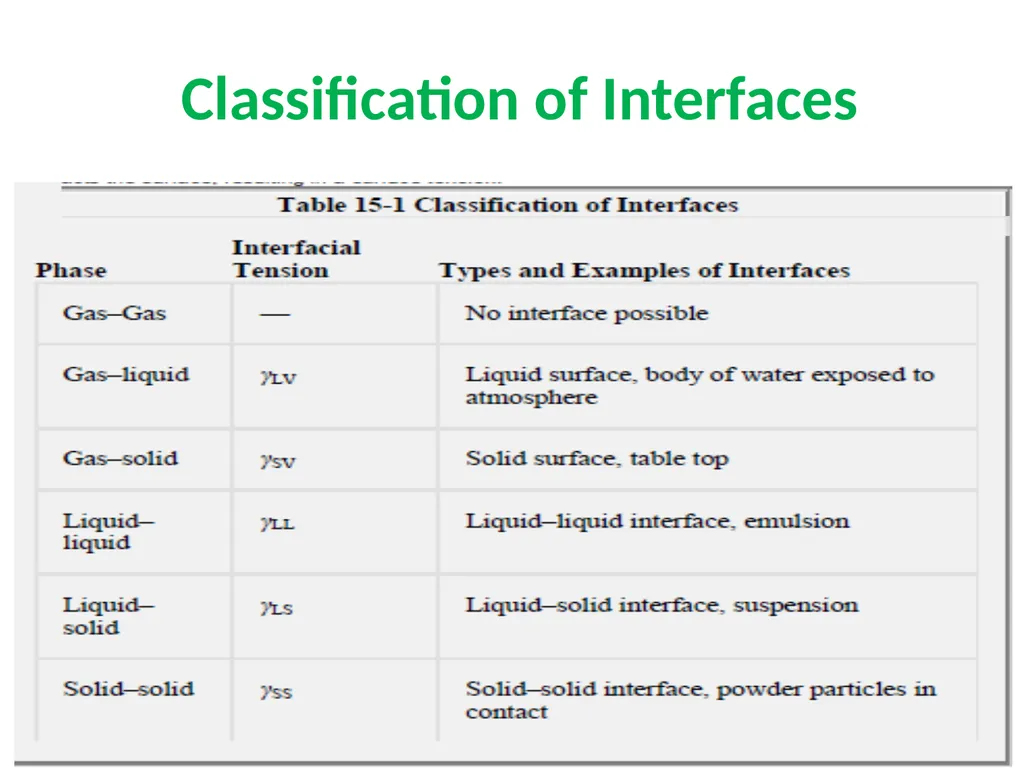
Classification of Interfaces<br>
05
Liquid Interfaces
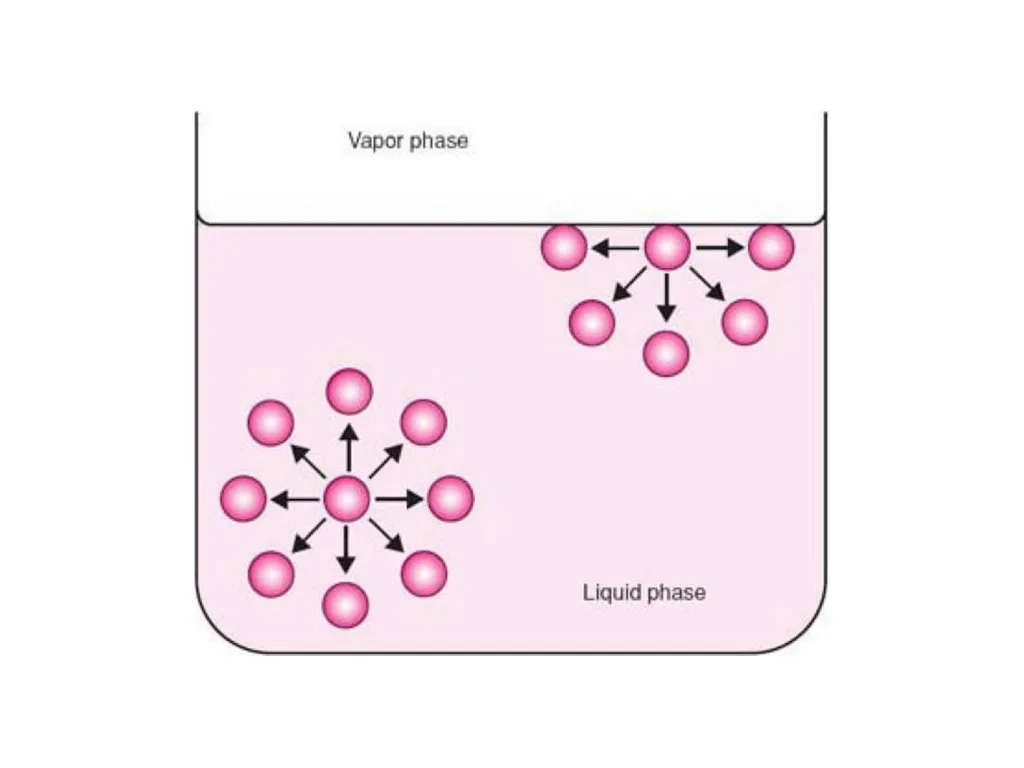
Surface and Interfacial Tensions In the liquid state, the cohesive forces between adjacent molecules are well developed. Molecules in the bulk liquid are surrounded in all directions by other molecules for which they have an equal attraction, as shown in the following Figure<br>
06
The molecules at the surface (i.e., at the liquid–air interface) can only develop attractive cohesive forces with other liquid molecules that are situated below and adjacent to them. They can develop adhesive forces of attraction with the molecules constituting the other phase involved in the interface, although, in the case of the liquid–gas interface, this adhesive force of attraction is small. The net effect is that the molecules at the surface of the liquid experience an inward force toward the bulk, as shown in previous Figure Such a force pulls the molecules of the interface together and, as a result, contracts the surface, resulting in a surface tension.<br>
07
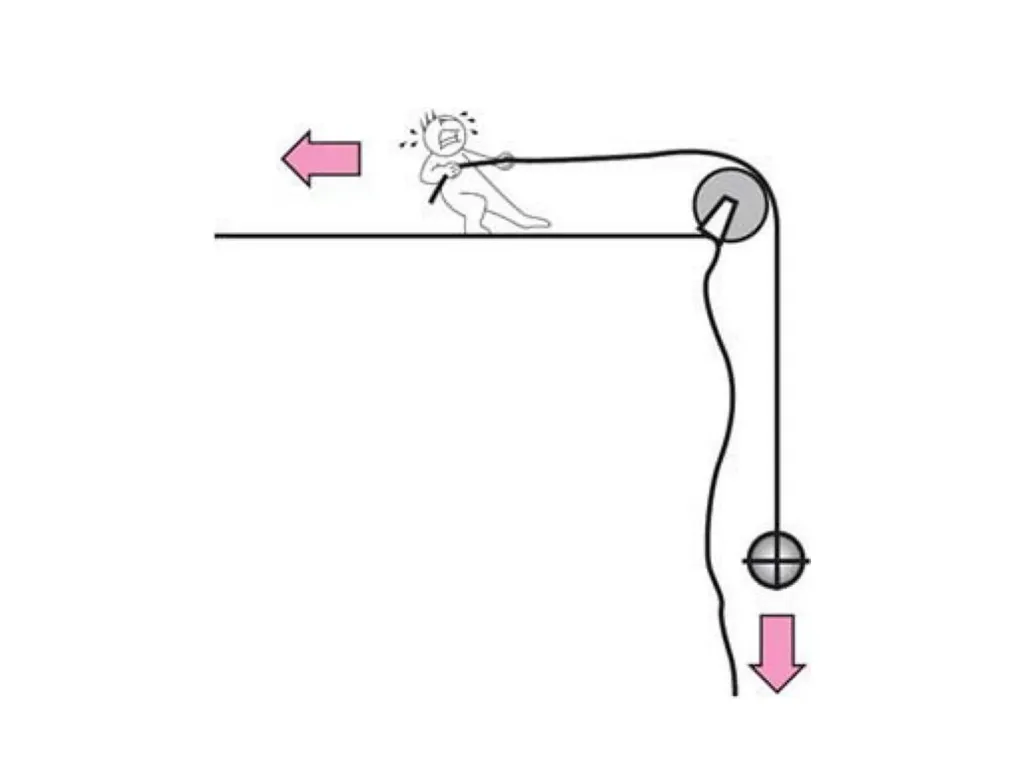
It is similar to the situation that exists when an object dangling over the edge of a cliff on a length of rope is pulled upward by a man holding the rope and walking away from the edge of the top of the cliff. This analogy to surface tension is sketched in the following Figure<br>
08
Surface tension
a force pulling the molecules of the interface together resulting in a contracted surface.
It is a force per unit length applied parallel to the surface . Unit in dynes/cm or N/m<br>
a force pulling the molecules of the interface together resulting in a contracted surface.
It is a force per unit length applied parallel to the surface . Unit in dynes/cm or N/m<br>
09
Interfacial tension is the force per unit length existing at the interface between two immiscible liquid phases and, like surface tension, has the units of dynes/cm. Although, in the general sense, all tensions may be referred to as interfacial tensions, this term is most often used for the attractive force between immiscible liquids. Later, we will use the term interfacial tension for the force between two liquids, γLL, between two solids, γSS, and at a liquid–solid interface,γLS<br>
10
The term surface tension is reserved for
liquid–vapor γLV, and solid–vapor, γSV, tensions. These are often written simply as γL and γS, respectively.
interfacial tensions are less than surface tensions because the adhesive forces between two liquid phases forming an interface are greater than when a liquid and a gas phase exist together. It follows that if two liquids are completely miscible, no interfacial tension exists between them.<br>
liquid–vapor γLV, and solid–vapor, γSV, tensions. These are often written simply as γL and γS, respectively.
interfacial tensions are less than surface tensions because the adhesive forces between two liquid phases forming an interface are greater than when a liquid and a gas phase exist together. It follows that if two liquids are completely miscible, no interfacial tension exists between them.<br>
11
Surface Free Energy To move a molecule from the inner layers to the surface , work must be done against the force of surface tension .In other words , each molecule near the surface of liquid of possesses a certain excess of potential energy as compared to the molecules in the bulk of the liquid . The higher the surface of the liquid, the more molecules have this excessive potential energy<br>
12
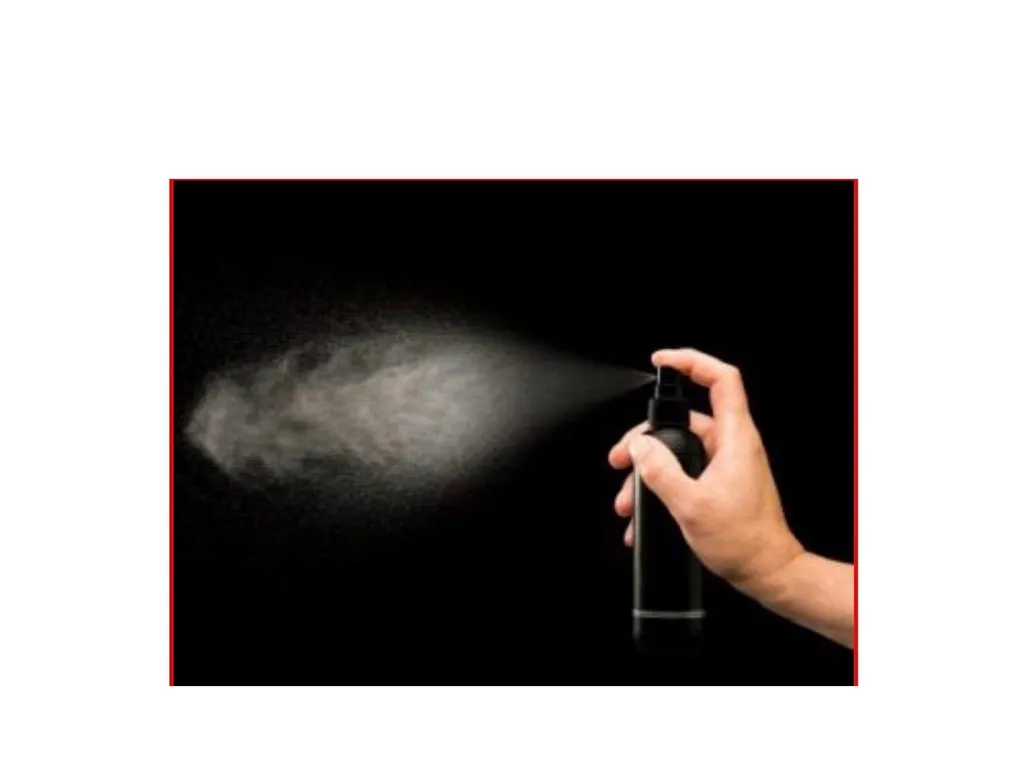
Therefore , if the surface of the liquid increases , e.g. when water is broken into a fine spray), the energy of the liquid also increases. Because this energy is proportional to the size of the free surface, it is called a surface free energy.<br>
13
Each molecule of the liquid has a tendency to move inside the liquid from the surface ; therefore the liquid takes form with minimal free surface and with minimal surface energy . for example , liquid droplets tend to assume a spherical shape because a sphere has the smallest surface area per unit volume.<br>
14
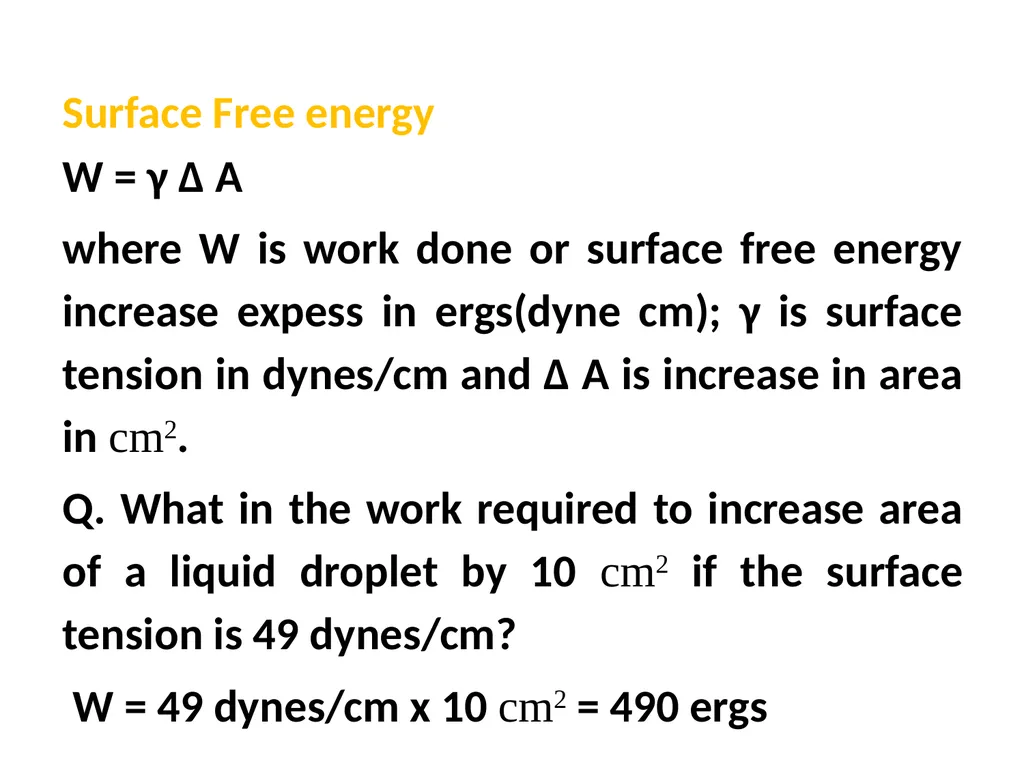
Surface Free energy
W = γ Δ A
where W is work done or surface free energy increase expess in ergs(dyne cm); γ is surface tension in dynes/cm and Δ A is increase in area in cm2.
Q. What in the work required to increase area of a liquid droplet by 10 cm2 if the surface tension is 49 dynes/cm?
W = 49 dynes/cm x 10 cm2 = 490 ergs<br>
W = γ Δ A
where W is work done or surface free energy increase expess in ergs(dyne cm); γ is surface tension in dynes/cm and Δ A is increase in area in cm2.
Q. What in the work required to increase area of a liquid droplet by 10 cm2 if the surface tension is 49 dynes/cm?
W = 49 dynes/cm x 10 cm2 = 490 ergs<br>
15
Spreading Coefficient When oleic acid is placed on the surface of a water , a film will be formed if the force of adhesion between oleic acid molecules and water molecules is greater than the cohesive forces between the oleic acid molecules themselves.<br>
16
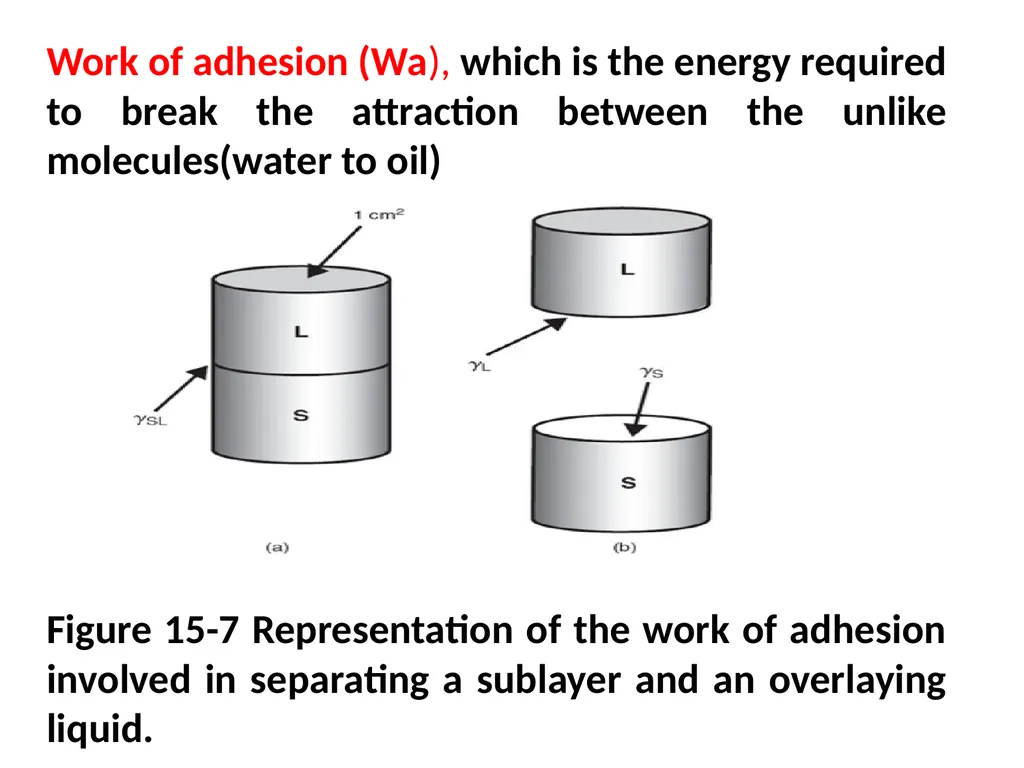
Work of adhesion (Wa), which is the energy required to break the attraction between the unlike molecules(water to oil)
Figure 15-7 Representation of the work of adhesion involved in separating a sublayer and an overlaying liquid.<br>
Figure 15-7 Representation of the work of adhesion involved in separating a sublayer and an overlaying liquid.<br>
17
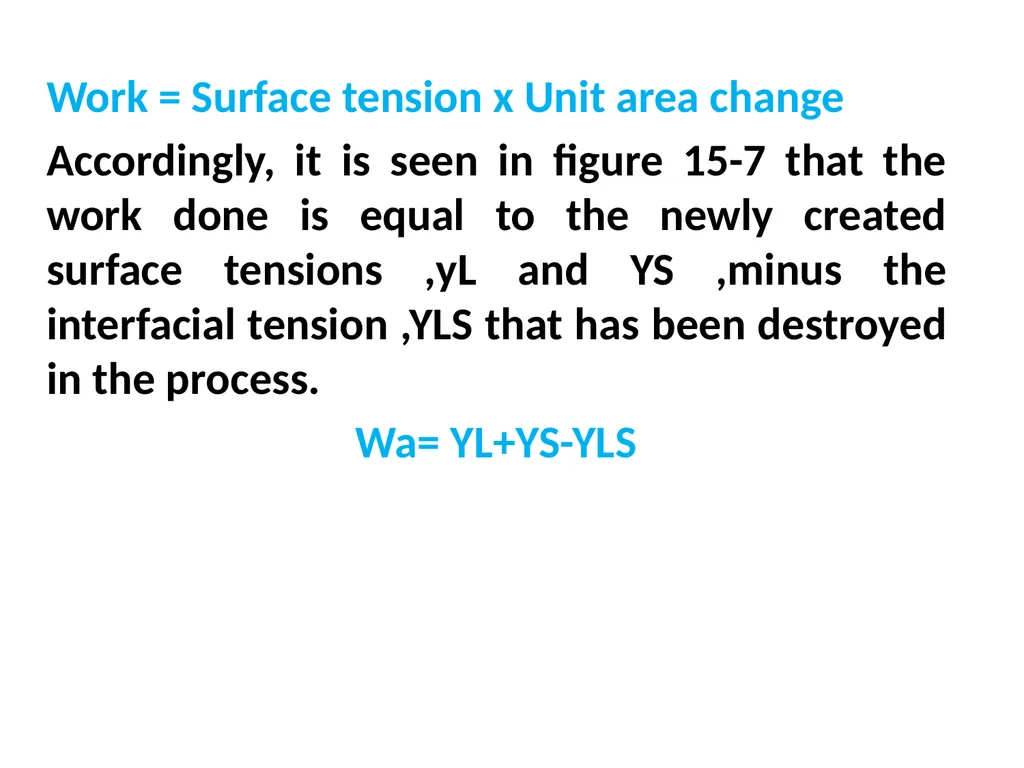
Work = Surface tension x Unit area change
Accordingly, it is seen in figure 15-7 that the work done is equal to the newly created surface tensions ,yL and YS ,minus the interfacial tension ,YLS that has been destroyed in the process.
Wa= YL+YS-YLS<br>
Accordingly, it is seen in figure 15-7 that the work done is equal to the newly created surface tensions ,yL and YS ,minus the interfacial tension ,YLS that has been destroyed in the process.
Wa= YL+YS-YLS<br>
18
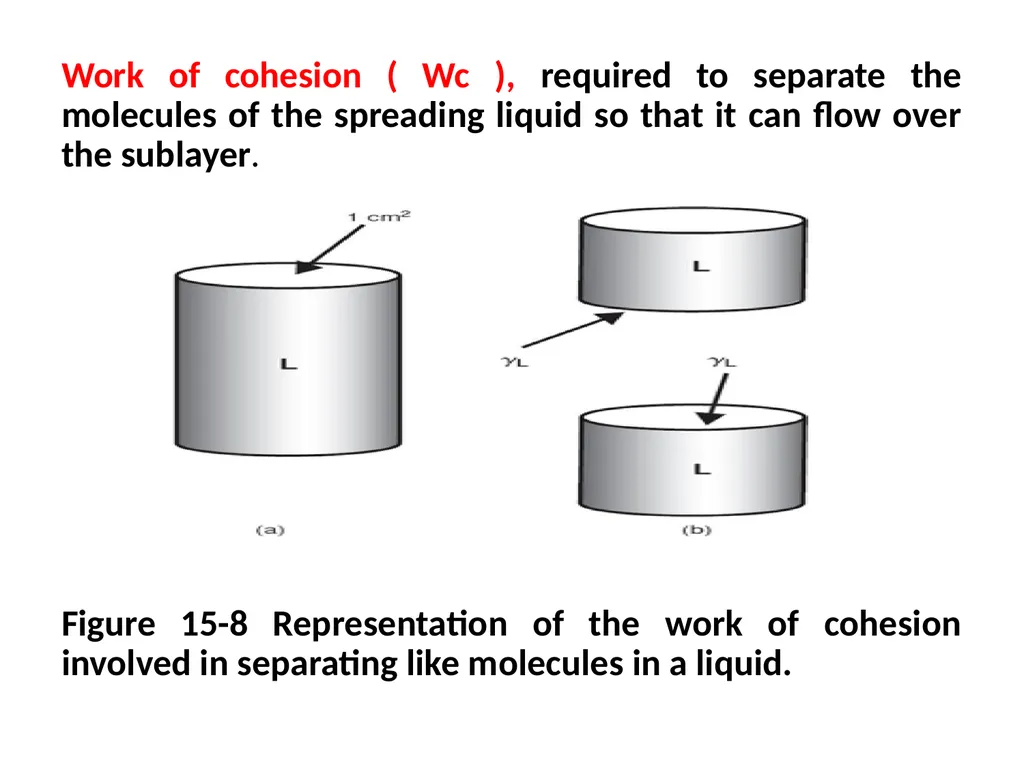
Work of cohesion ( Wc ), required to separate the molecules of the spreading liquid so that it can flow over the sublayer.
Figure 15-8 Representation of the work of cohesion involved in separating like molecules in a liquid.<br>
Figure 15-8 Representation of the work of cohesion involved in separating like molecules in a liquid.<br>
19
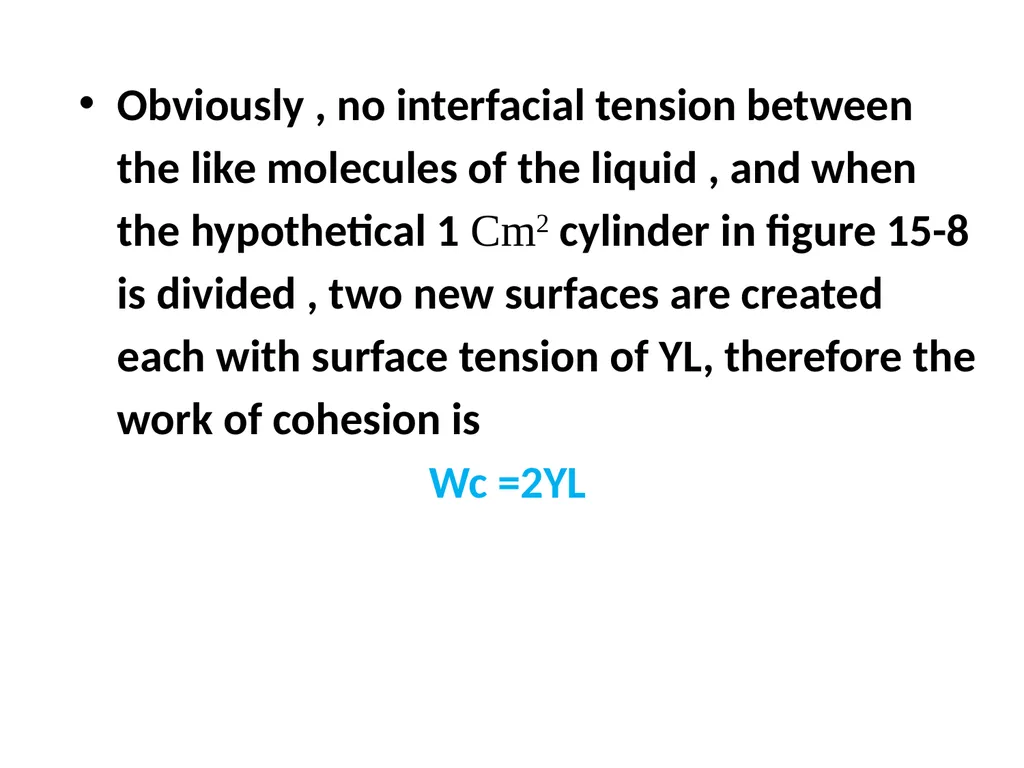
Obviously , no interfacial tension between the like molecules of the liquid , and when the hypothetical 1 Cm2 cylinder in figure 15-8 is divided , two new surfaces are created each with surface tension of YL, therefore the work of cohesion is
Wc =2YL<br>
Wc =2YL<br>
20
•Spreading of oil to water occurs if the work of adhesion (a measure of the force of attraction between the oil and the water) is greater than the work of cohesion.
•The term (Wa-Wc) is known as the Spreading coefficient(S)
If it is Positive – the oil will spread over a water surface.
S=(YL+YS-YLS) -2YL
rearrangement :
S= Ys-YL-YLS
Or S= Ys – (YL+YLS)<br>
•The term (Wa-Wc) is known as the Spreading coefficient(S)
If it is Positive – the oil will spread over a water surface.
S=(YL+YS-YLS) -2YL
rearrangement :
S= Ys-YL-YLS
Or S= Ys – (YL+YLS)<br>
21
Figure 15-9 shows a lens of material placed on a liquid surface (e.g., oleic acid on water), one sees that spreading occurs (S is positive) when the surface tension of the sublayer liquid is greater than the sum of the surface tension of the spreading liquid and the interfacial tension between the sublayer and the spreading liquid. If (γL + γLS) is larger than γS, the substance forms globules or a floating lens and fails to spread over the surface. An example of such a case is mineral oil on water.<br>
22
Example 15-7
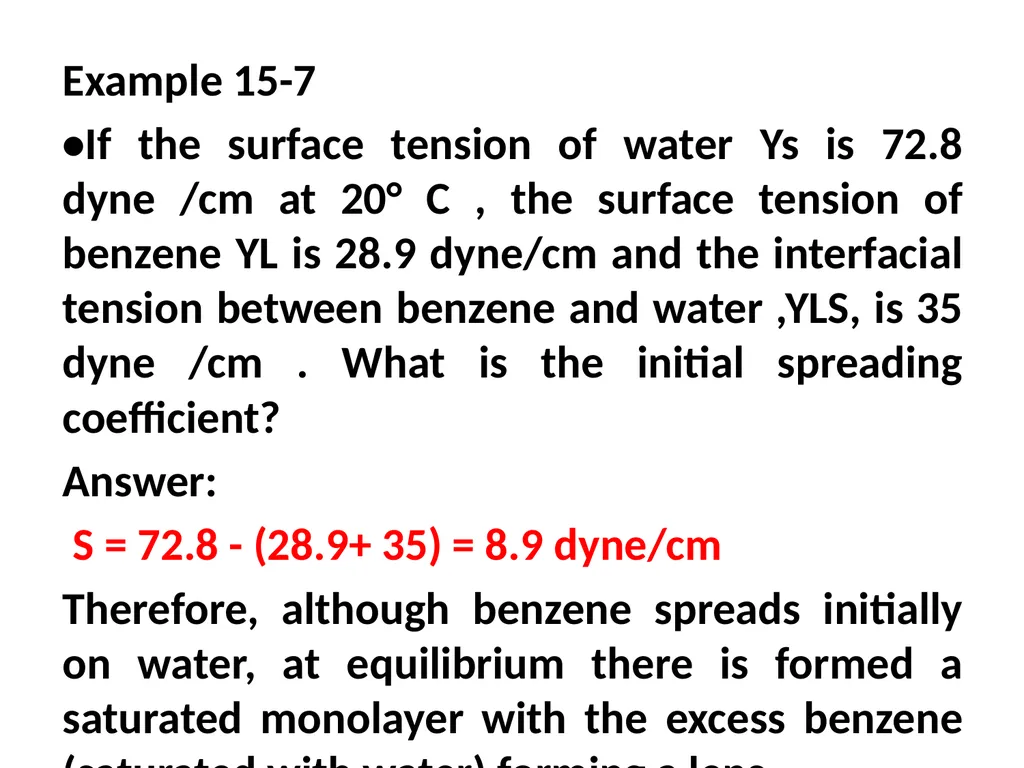
•If the surface tension of water Ys is 72.8 dyne /cm at 20° C , the surface tension of benzene YL is 28.9 dyne/cm and the interfacial tension between benzene and water ,YLS, is 35 dyne /cm . What is the initial spreading coefficient?
Answer:
S = 72.8 - (28.9+ 35) = 8.9 dyne/cm
Therefore, although benzene spreads initially on water, at equilibrium there is formed a saturated monolayer with the excess benzene (saturated with water) forming a lens.<br>
•If the surface tension of water Ys is 72.8 dyne /cm at 20° C , the surface tension of benzene YL is 28.9 dyne/cm and the interfacial tension between benzene and water ,YLS, is 35 dyne /cm . What is the initial spreading coefficient?
Answer:
S = 72.8 - (28.9+ 35) = 8.9 dyne/cm
Therefore, although benzene spreads initially on water, at equilibrium there is formed a saturated monolayer with the excess benzene (saturated with water) forming a lens.<br>
23
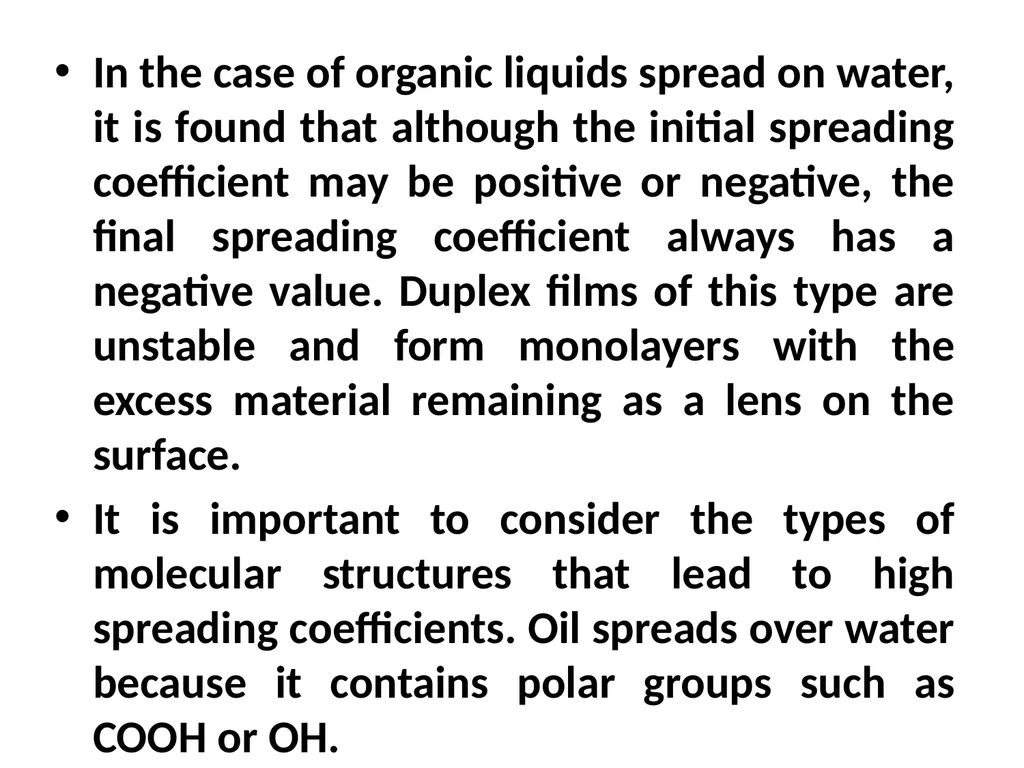
In the case of organic liquids spread on water, it is found that although the initial spreading coefficient may be positive or negative, the final spreading coefficient always has a negative value. Duplex films of this type are unstable and form monolayers with the excess material remaining as a lens on the surface.
It is important to consider the types of molecular structures that lead to high spreading coefficients. Oil spreads over water because it contains polar groups such as COOH or OH.<br>
It is important to consider the types of molecular structures that lead to high spreading coefficients. Oil spreads over water because it contains polar groups such as COOH or OH.<br>
24
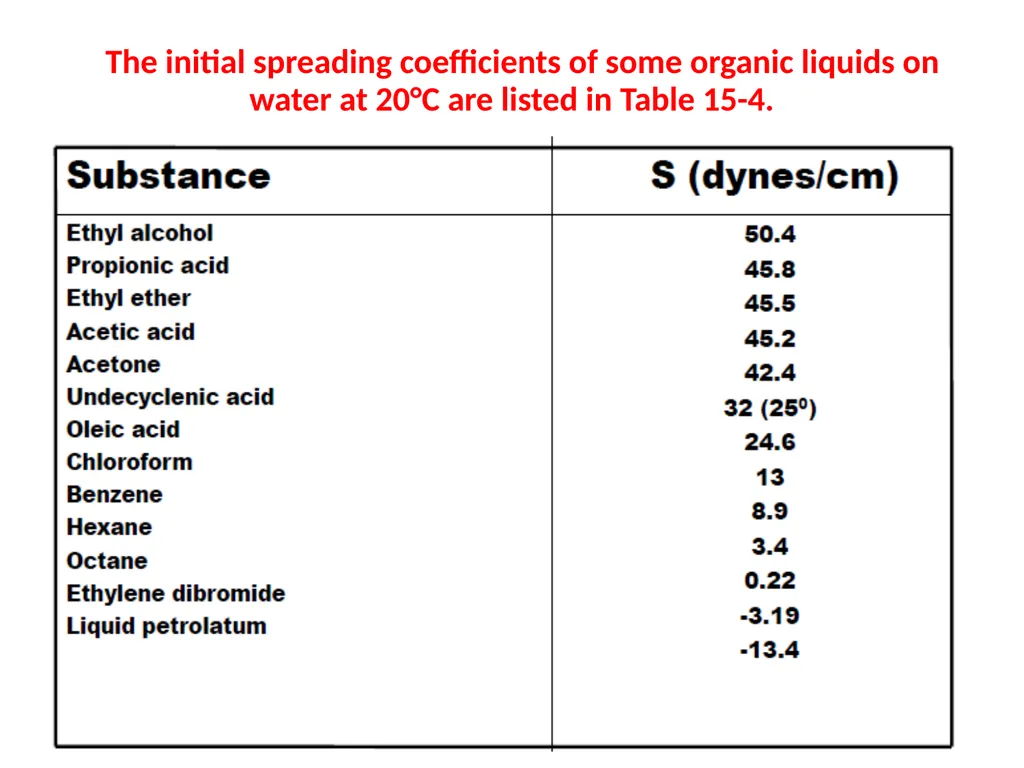
The initial spreading coefficients of some organic liquids on water at 20°C are listed in Table 15-4.<br>
25
propionic acid and ethyl alcohol should have high values of S, as seen in Table 15-4. As the
carbon chain of an acid, oleic acid, for example, increases, the ratio of polar–nonpolar character
decreases and the spreading coefficient on water decreases. Many nonpolar substances, such as liquid petrolatum (S = -13.4), fail to spread on water. Benzene spreads on water not because it is polar but because the cohesive forces between its molecules are much weaker than the adhesion for water.<br>
carbon chain of an acid, oleic acid, for example, increases, the ratio of polar–nonpolar character
decreases and the spreading coefficient on water decreases. Many nonpolar substances, such as liquid petrolatum (S = -13.4), fail to spread on water. Benzene spreads on water not because it is polar but because the cohesive forces between its molecules are much weaker than the adhesion for water.<br>
26
Adsorption at Liquid Interfaces Surface free energy was defined previously as the work that must be done to increase the surface by unit area. As a result of such an expansion, more molecules must be brought from the bulk to the interface. The more work that has to be expended to achieve this, the greater is the surface free energy. Certain molecules and ions, when dispersed in the liquid, move of their own accord to the interface.<br>
27
Their concentration at the interface then exceeds their concentration in the bulk of the liquid. the surface free energy and the surface tension of the system are automatically reduced. Such a phenomenon, where the added molecules are partitioned in favor of the interface, is termed adsorption, or, more correctly, positive adsorption Other materials (e.g., inorganic electrolytes) are partitioned in favor of the bulk, leading to negative adsorption and a corresponding increase in surface free energy and surface tension. Adsorption, as will be seen later, can also occur at solid interfaces.<br>
28
Adsorption should not be confused with absorption. The former is solely a surface effect, whereas in absorption, the liquid or gas being absorbed penetrates into the capillary spaces of the absorbing medium. The taking up of water by a sponge is absorption; the concentrating of alkaloid molecules on the surface of clay is adsorption.<br>
29
The applications of spreading coefficients in pharmacy should be fairly evident. The surface of the skin is bathed in an aqueous–oily layer having a polar–nonpolar character similar to that of a mixture of fatty acids. For a lotion with a mineral oil base to spread freely and evenly on the skin, its polarity and hence its spreading coefficient should be increased by the addition of a surfactant.<br>
30
Surface-Active Agents It is the amphiphilic nature of surface-active agents that causes them to be adsorbed at interfaces, whether these are liquid–gas or liquid–liquid interfaces. Thus, in an aqueous dispersion of amyl alcohol, the polar alcoholic group is able to associate with the water molecules. The nonpolar portion is rejected, however, because the adhesive forces it can develop with water are small in comparison to the cohesive forces between adjacent water molecules<br>
31
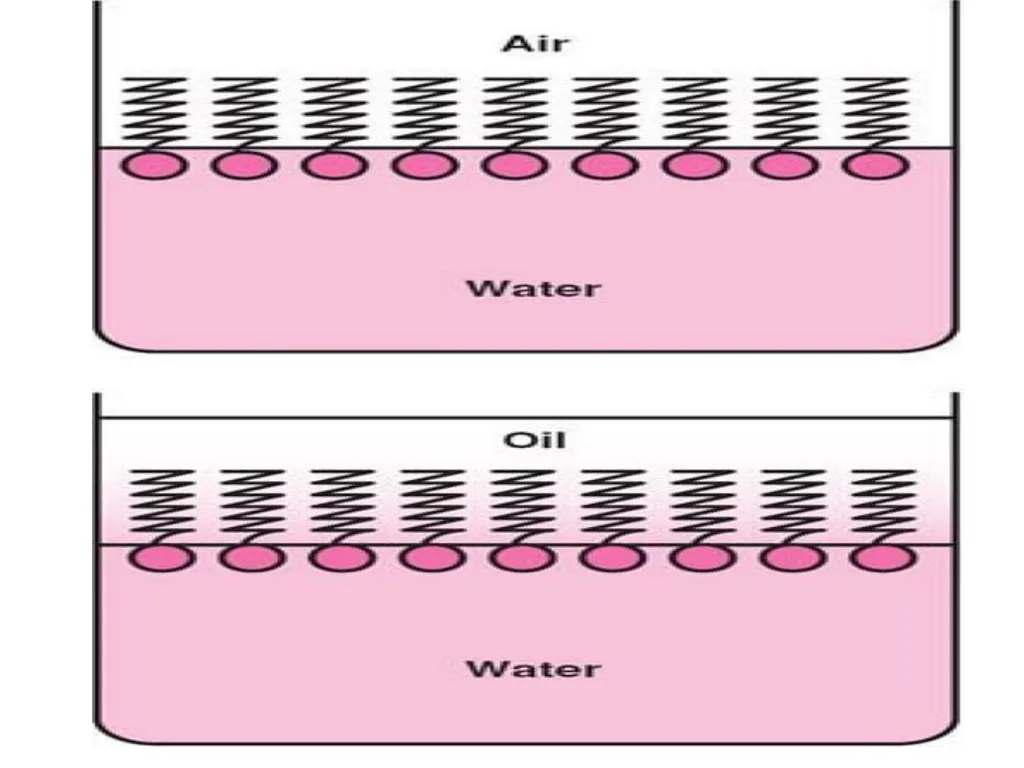
As a result, the amphiphile is adsorbed at the interface. The situation for a fatty acid at the air–water and oil–water interface is shown in Figure 15-10. At the air– water interface, the lipophilic chains are directed upward into the air; at the oil–water interface, they are associated with the oil phase.<br>
32
For the amphiphile to be concentrated at the interface, it must be balanced with the proper amount of water- and oil-soluble groups. If the molecule is too hydrophilic, it remains within the body of the aqueous phase and exerts no effect at the interface. Likewise, if it is too lipophilic, it dissolves completely in the oil phase and little appears at the interface.<br>
33
Reduction of surface and interfacial tension
The reason for the reduction in the surface tension, When surfactant molecules adsorb at the water surface is that the surfactant molecules replace some of the water molecules in the surface and the forces of attraction between surfactant and water molecules are less than those between two water molecules, hence the contraction force is reduced.<br>
The reason for the reduction in the surface tension, When surfactant molecules adsorb at the water surface is that the surfactant molecules replace some of the water molecules in the surface and the forces of attraction between surfactant and water molecules are less than those between two water molecules, hence the contraction force is reduced.<br>
34
Surfactants are classified as:
•Anionic Sodium Dodecylsulphate:
CH3(CH2)11SO4-Na+
•Cationic Dodecylaminehydrochloride:
CH3(CH2)11NH3+Cl
•Non-ionic Polyethylene Oxides:
e.g. CH3(CH2)11(O-CH2-CH2)nOH
Spans (sorbitanesters)
Tweens (polyoxyethylenesorbitanesters)
•Ampholytic Dodecyl betaine:
C12H25N+(CH3)2(CH2COO<br>
•Anionic Sodium Dodecylsulphate:
CH3(CH2)11SO4-Na+
•Cationic Dodecylaminehydrochloride:
CH3(CH2)11NH3+Cl
•Non-ionic Polyethylene Oxides:
e.g. CH3(CH2)11(O-CH2-CH2)nOH
Spans (sorbitanesters)
Tweens (polyoxyethylenesorbitanesters)
•Ampholytic Dodecyl betaine:
C12H25N+(CH3)2(CH2COO<br>
35
Hydrophilic-Lipophilic Balance(HLB)
It is an arbitrary scale from 0 to 20 serve as a measure of the Hydrophilic/Lipophilic balance of a surfactant.
•Products with low HLB are more oil soluble.
•High HLB represents good water solubility.
•The oil phase of the oil–water (o/w) emulsion requires a specific HLB, called the required hydrophilic–lipophilic balance (RHLB).
•A different RHLB is required to form a water-in oil emulsion (w/o )from the same oil phase.<br>
It is an arbitrary scale from 0 to 20 serve as a measure of the Hydrophilic/Lipophilic balance of a surfactant.
•Products with low HLB are more oil soluble.
•High HLB represents good water solubility.
•The oil phase of the oil–water (o/w) emulsion requires a specific HLB, called the required hydrophilic–lipophilic balance (RHLB).
•A different RHLB is required to form a water-in oil emulsion (w/o )from the same oil phase.<br>
36
Fig. 15-11. A scale showing surfactant function on the basis of hydrophilic–lipophilic balance (HLB) values. Key: O/W = oil in water.<br>
37
Micelles
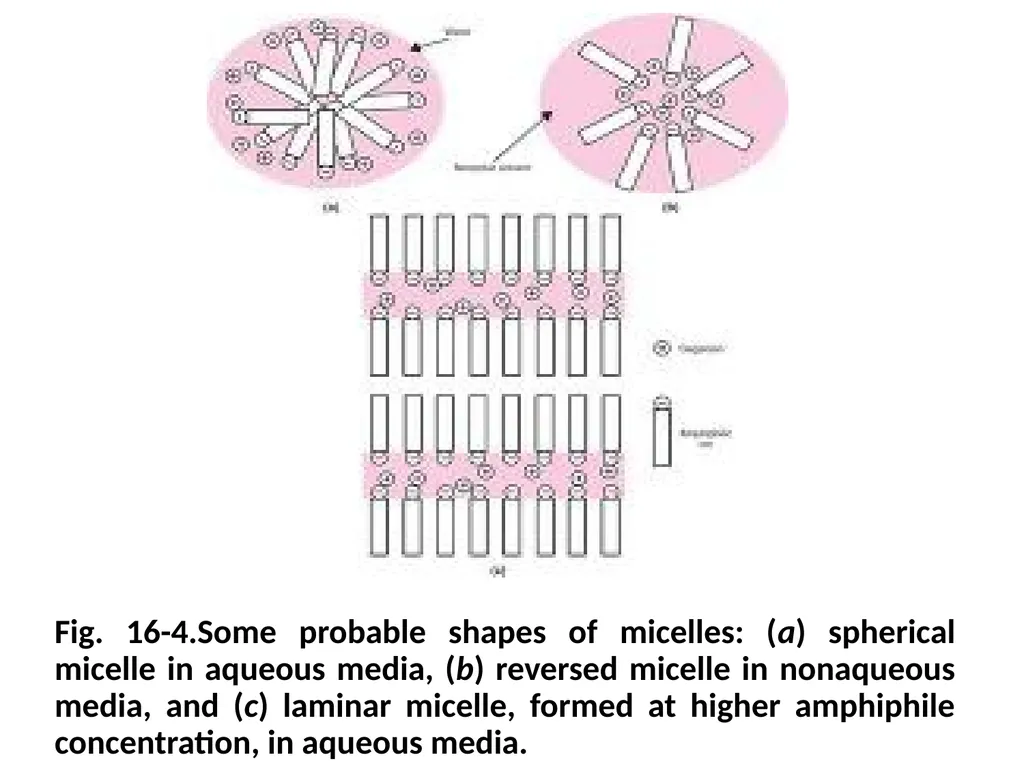
Surfactants molecules aggregate in aqueous solution to form micelles at certain concentrations and temperature (Fig. 23-16). Surfactants have a hydrophilic polar head group attached to a long-chain lipophilic (nonpolar) tail.<br>
Surfactants molecules aggregate in aqueous solution to form micelles at certain concentrations and temperature (Fig. 23-16). Surfactants have a hydrophilic polar head group attached to a long-chain lipophilic (nonpolar) tail.<br>
38
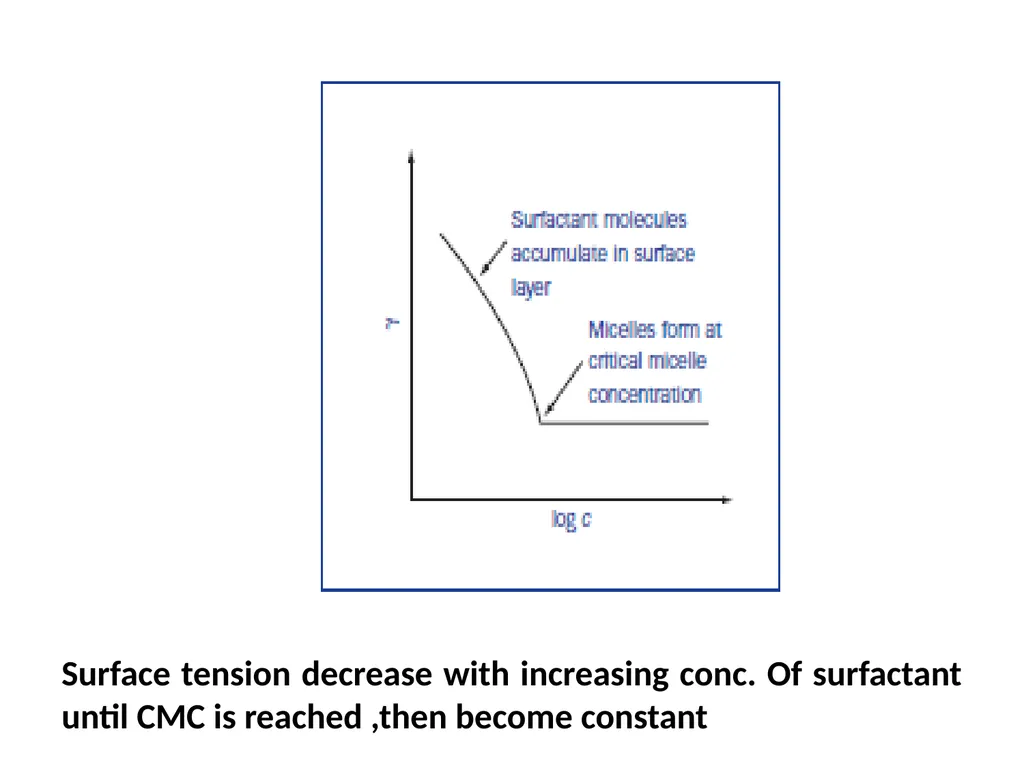
The surface tension of a surfactant solution decreases progressively with increase of concentration as more surfactant molecules enter the surface or interfacial layer. However ,at acertain concentration this layer becomes saturated and an alternative means of shielding the hydrophobic group of the surfactant from the aqueous environment occurs through the formation of aggregates (usually spherical) of colloidal dimensions,called micelles.<br>
39
Micelles are formed only when surfactants are present above a certain concentration, known as critical micelle concentration (CMC), which is characteristic for each surfactant. There is also a critical temperature requirement for micelle formation.<br>
40
Fig. 16-4.Some probable shapes of micelles: (a) spherical micelle in aqueous media, (b) reversed micelle in nonaqueous media, and (c) laminar micelle, formed at higher amphiphile concentration, in aqueous media.<br>
41
Surface tension decrease with increasing conc. Of surfactant until CMC is reached ,then become constant<br>
42
•The CMC decreases with an increase in the length of the hydrophobic chain.
•The addition of electrolytes to ionic surfactants decreases the CMC and increases the micellar size.
•The effect is simply explained in terms of a reduction in the magnitude of the forces of repulsion between the charged head groups in the micelle, allowing the micelles to grow and also reducing the work required for their formation.<br>
•The addition of electrolytes to ionic surfactants decreases the CMC and increases the micellar size.
•The effect is simply explained in terms of a reduction in the magnitude of the forces of repulsion between the charged head groups in the micelle, allowing the micelles to grow and also reducing the work required for their formation.<br>
43
Micellar Solubilization
An important property of association colloids in solution is the ability of the micelles to increase the solubility of materials that are normally insoluble, or only slightly soluble, in the dispersion medium used . This phenomenon, known as solubilization.
The location of the molecule undergoing solubilization in a micelle is related to the balance between the polar and nonpolar properties of the molecule<br>
An important property of association colloids in solution is the ability of the micelles to increase the solubility of materials that are normally insoluble, or only slightly soluble, in the dispersion medium used . This phenomenon, known as solubilization.
The location of the molecule undergoing solubilization in a micelle is related to the balance between the polar and nonpolar properties of the molecule<br>
44
nonpolar molecules in aqueous systems of ionic surface-active agents would be located in the hydrocarbon core of the micelle,
Polar solubilizates would tend to be adsorbed onto the micelle surface.
Polar–nonpolar molecules would tend to align themselves in an intermediate position within the surfactant molecules forming the micelle.<br>
Polar solubilizates would tend to be adsorbed onto the micelle surface.
Polar–nonpolar molecules would tend to align themselves in an intermediate position within the surfactant molecules forming the micelle.<br>
45
Adsorption at Solid Interfaces
Adsorption of material at solid interfaces can take place from either an adjacent liquid or gas phase. The study of adsorption of gases arises in such diverse applications as the removal of objectionable odors from rooms.
The principles of solid–liquid adsorption are used in decolorizing solutions, adsorption
chromatography, detergency, and wetting.<br>
Adsorption of material at solid interfaces can take place from either an adjacent liquid or gas phase. The study of adsorption of gases arises in such diverse applications as the removal of objectionable odors from rooms.
The principles of solid–liquid adsorption are used in decolorizing solutions, adsorption
chromatography, detergency, and wetting.<br>
46
The Solid–Gas Interface
The degree of adsorption of a gas by a solid depends on
the chemical nature of the adsorbent (the material used to adsorb the gas) and the adsorbate (the substance being adsorbed),
the surface area of the adsorbent,
the temperature
the partial pressure of the adsorbed gas.<br>
The degree of adsorption of a gas by a solid depends on
the chemical nature of the adsorbent (the material used to adsorb the gas) and the adsorbate (the substance being adsorbed),
the surface area of the adsorbent,
the temperature
the partial pressure of the adsorbed gas.<br>
47
Types of adsorption
physical or van der Waals adsorption
chemical adsorption or chemisorption.
Physical adsorption, associated with van der Waals forces, is reversible, the removal of the adsorbate from the adsorbent being known as desorption. A physically adsorbed gas can be desorbed from a solid by increasing the temperature and reducing the pressure.
Chemisorption, in which the adsorbate is attached to the adsorbent by primary chemical bonds, is irreversible unless the bonds are broken.<br>
physical or van der Waals adsorption
chemical adsorption or chemisorption.
Physical adsorption, associated with van der Waals forces, is reversible, the removal of the adsorbate from the adsorbent being known as desorption. A physically adsorbed gas can be desorbed from a solid by increasing the temperature and reducing the pressure.
Chemisorption, in which the adsorbate is attached to the adsorbent by primary chemical bonds, is irreversible unless the bonds are broken.<br>
48
Wetting
Adsorption at solid surfaces is involved in the phenomena of wetting and detergency.
When a liquid comes into contact with the solid, the forces of attraction between the liquid and the solid phases begin to play a significant role. In this case, the behavior of the liquid will depend on the balance between the forces of attraction of molecules in the liquid and the forces of attraction between the liquid and the solid phases.
In the case of mercury and glass, attractive forces between molecules of mercury and glass are much smaller than the forces of attraction between molecules of mercury themselves. As a result, mercury will come together as a single spherical drop.<br>
Adsorption at solid surfaces is involved in the phenomena of wetting and detergency.
When a liquid comes into contact with the solid, the forces of attraction between the liquid and the solid phases begin to play a significant role. In this case, the behavior of the liquid will depend on the balance between the forces of attraction of molecules in the liquid and the forces of attraction between the liquid and the solid phases.
In the case of mercury and glass, attractive forces between molecules of mercury and glass are much smaller than the forces of attraction between molecules of mercury themselves. As a result, mercury will come together as a single spherical drop.<br>
49
In contrast, for water and glass attractive forces between the solid and liquid molecules are greater than the forces between molecules of liquid themselves, and so the liquid is able to wet the surface of the glass.
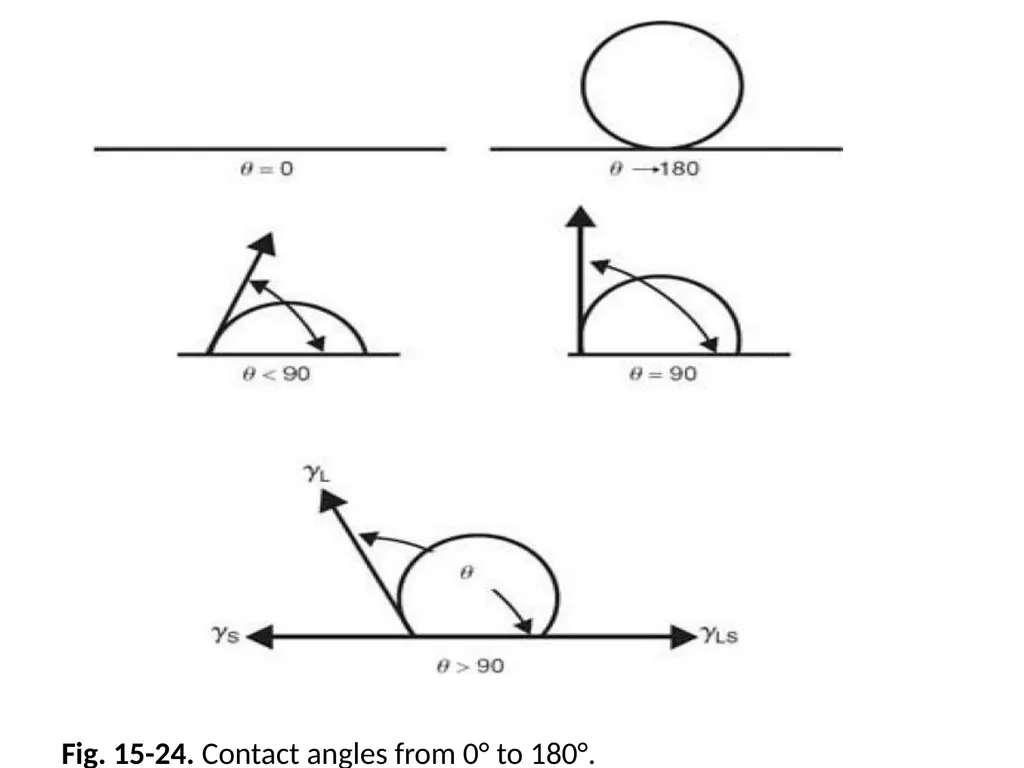
The most important action of a wetting agent is to lower the contact angle between the surface and the wetting liquid. The contact angle is the angle between a liquid droplet and the surface over which it spreads. As shown in Figure 15-24, the contact angle between a liquid and a solid may be 0°, signifying complete wetting, or may approach 180°, at which wetting is insignificant. The contact angle may also have any value between these limits<br>
The most important action of a wetting agent is to lower the contact angle between the surface and the wetting liquid. The contact angle is the angle between a liquid droplet and the surface over which it spreads. As shown in Figure 15-24, the contact angle between a liquid and a solid may be 0°, signifying complete wetting, or may approach 180°, at which wetting is insignificant. The contact angle may also have any value between these limits<br>
50
Fig. 15-24. Contact angles from 0° to 180°.<br>
51
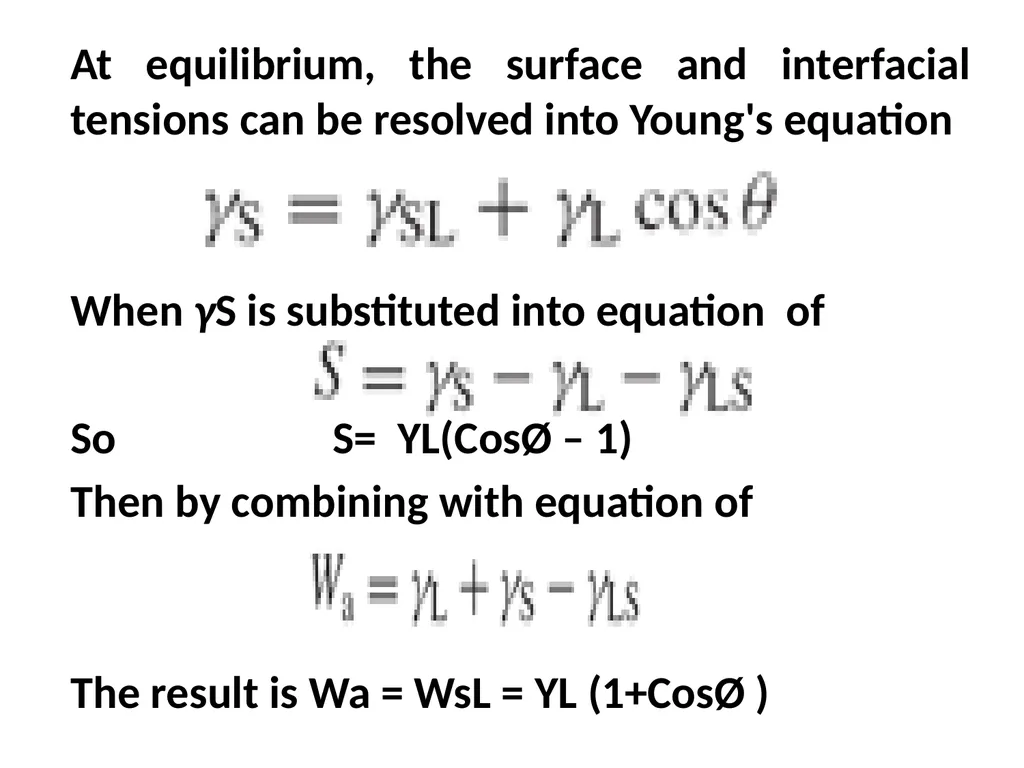
At equilibrium, the surface and interfacial tensions can be resolved into Young's equation
When γS is substituted into equation of
So S= YL(CosØ – 1)
Then by combining with equation of
The result is Wa = WsL = YL (1+CosØ )<br>
When γS is substituted into equation of
So S= YL(CosØ – 1)
Then by combining with equation of
The result is Wa = WsL = YL (1+CosØ )<br>
52
•A contact angle is lower than 90° ,the solid is called wettable
•A contact angle is wider than 90°, the solid is named non-wettable.
•A contact angle equal to zero indicates complete wettability.<br>
•A contact angle is wider than 90°, the solid is named non-wettable.
•A contact angle equal to zero indicates complete wettability.<br>
53
Wetting Agent
A wetting agent is a surfactant that, when dissolved in water, lowers the advancing contact angle, aids in displacing an air phase at the surface, and replaces it with a liquid phase.
Examples of the application of wetting to pharmacy and medicine include the displacement of air from the surface of sulfur, charcoal, and other powders for the purpose of dispersing these drugs in liquid vehicles; the displacement of air from the matrix of cotton pads and bandages so that medicinal solutions can be absorbed for application to various body areas; the displacement of dirt and debris by the use of detergents in the washing of wounds; and the application of medicinal lotions and sprays to the surface of the skin and mucous membranes.<br>
A wetting agent is a surfactant that, when dissolved in water, lowers the advancing contact angle, aids in displacing an air phase at the surface, and replaces it with a liquid phase.
Examples of the application of wetting to pharmacy and medicine include the displacement of air from the surface of sulfur, charcoal, and other powders for the purpose of dispersing these drugs in liquid vehicles; the displacement of air from the matrix of cotton pads and bandages so that medicinal solutions can be absorbed for application to various body areas; the displacement of dirt and debris by the use of detergents in the washing of wounds; and the application of medicinal lotions and sprays to the surface of the skin and mucous membranes.<br>
54
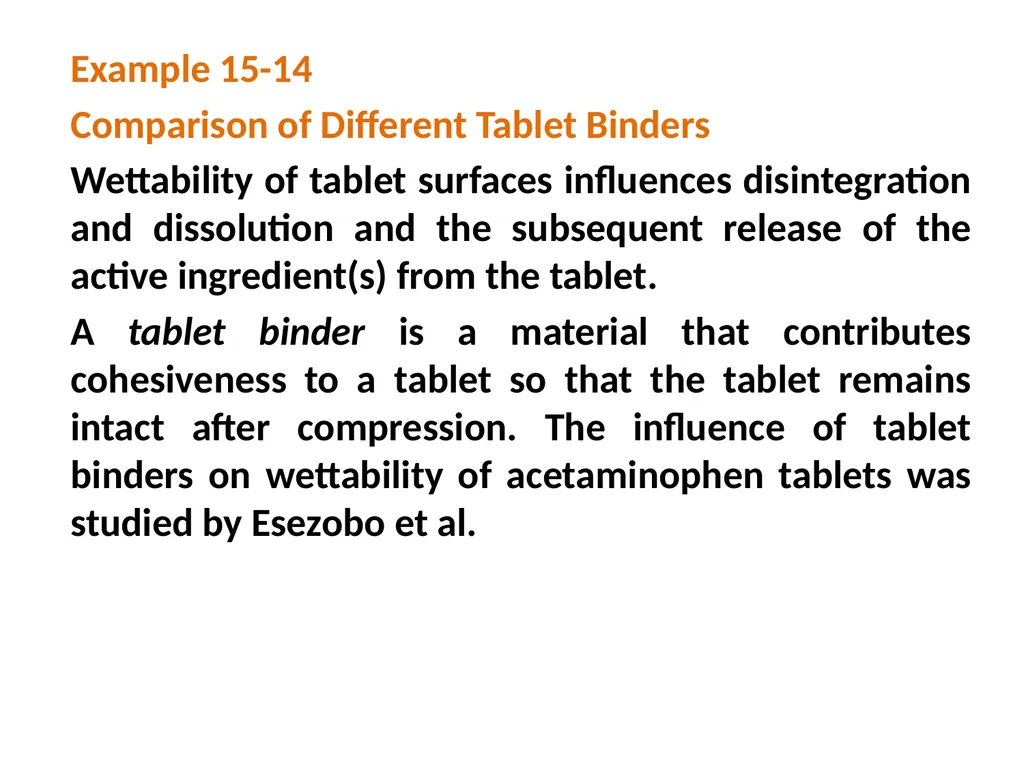
Example 15-14
Comparison of Different Tablet Binders
Wettability of tablet surfaces influences disintegration and dissolution and the subsequent release of the active ingredient(s) from the tablet.
A tablet binder is a material that contributes cohesiveness to a tablet so that the tablet remains intact after compression. The influence of tablet binders on wettability of acetaminophen tablets was studied by Esezobo et al.<br>
Comparison of Different Tablet Binders
Wettability of tablet surfaces influences disintegration and dissolution and the subsequent release of the active ingredient(s) from the tablet.
A tablet binder is a material that contributes cohesiveness to a tablet so that the tablet remains intact after compression. The influence of tablet binders on wettability of acetaminophen tablets was studied by Esezobo et al.<br>
55
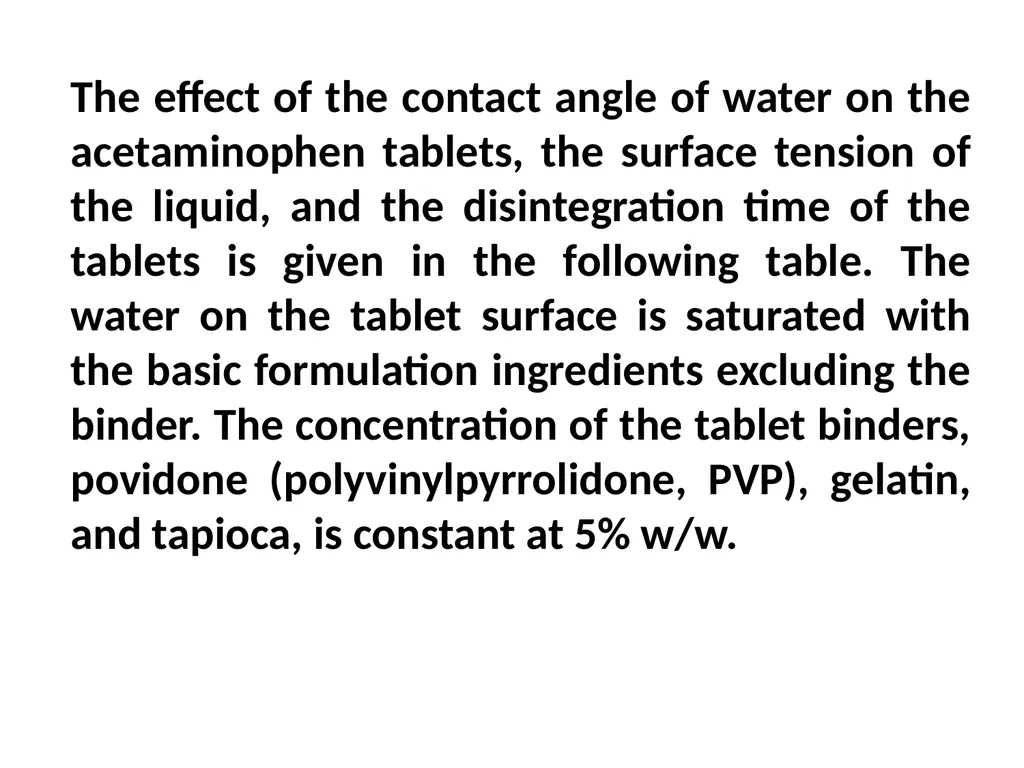
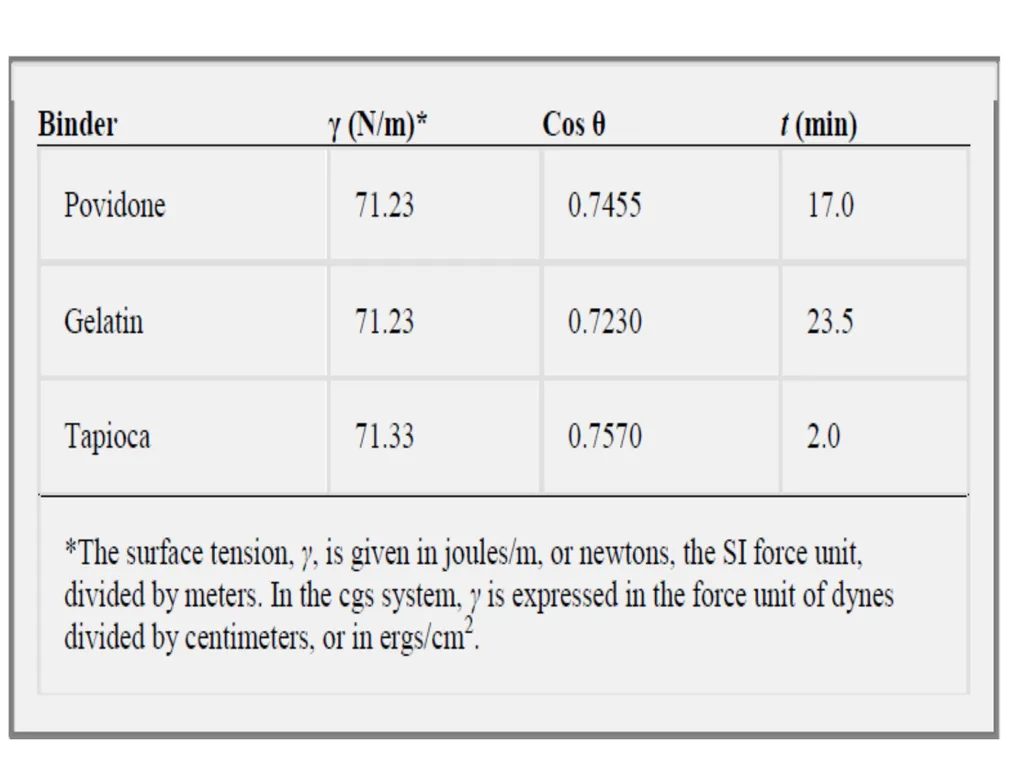
The effect of the contact angle of water on the acetaminophen tablets, the surface tension of the liquid, and the disintegration time of the tablets is given in the following table. The water on the tablet surface is saturated with the basic formulation ingredients excluding the binder. The concentration of the tablet binders, povidone (polyvinylpyrrolidone, PVP), gelatin, and tapioca, is constant at 5% w/w.<br>
56
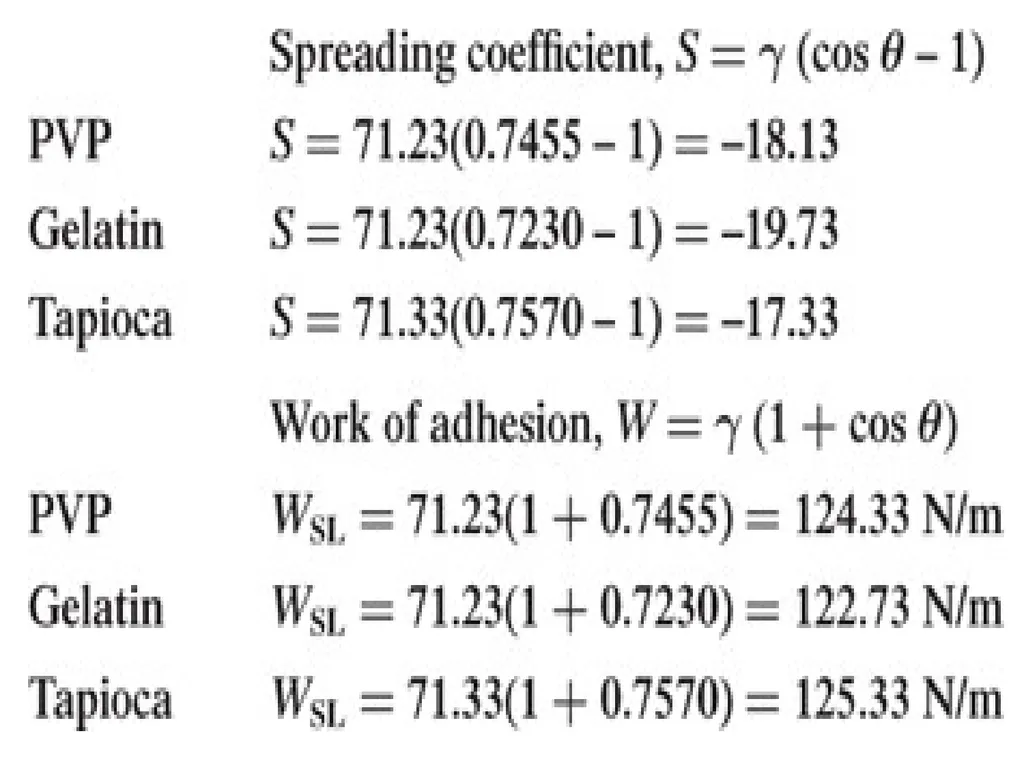
The spreading coefficient is negative, but the values are small. Tapioca shows the smallest negative value, S = -17.33, followed by PVP and finally gelatin. These results agree with the work of adhesion, tapioca > PVP > gelatin. When the work of adhesion is higher, the bond
between water and tablet surface is stronger, and the better is the wetting.
From the table, we observe the tablet disintegration times to be on the order
tapioca < PVP < gelatin,<br>
between water and tablet surface is stronger, and the better is the wetting.
From the table, we observe the tablet disintegration times to be on the order
tapioca < PVP < gelatin,<br>
57
which agrees qualitatively with the S and WSL values. That is, the better the wetting, reflected in a larger work of adhesion and a smaller negative spreading coefficient, the shorter is the tablet disintegration time. Other factors, such as tablet porosity, that were not considered in the study cause the relationship to be only qualitative.<br>
58
Detergents are surfactants that are used for the removal of dirt. Detergency is a complex process involving the removal of foreign matter from surfaces. The process includes many of the actions characteristic of specific surfactants:
initial wetting of the dirt and of the surface to be cleaned
deflocculation and suspension; emulsification or solubilization of the dirt particles; and
sometimes foaming of the agent for entrainment and washing away of the particles.<br>
initial wetting of the dirt and of the surface to be cleaned
deflocculation and suspension; emulsification or solubilization of the dirt particles; and
sometimes foaming of the agent for entrainment and washing away of the particles.<br>
59
Mechanism of detergent action
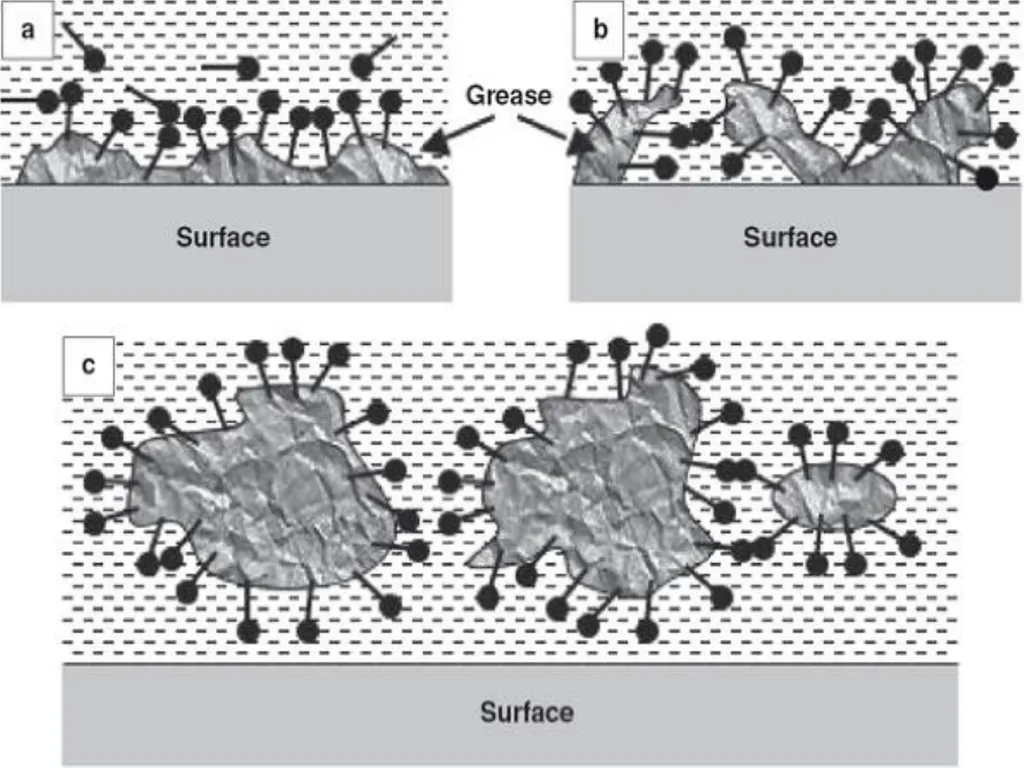
(a) The hydrocarbon tails of the detergent anions dissolve in the grease.
(b) the grease spot gradually breaks up and becomes pincushioned by the detergent anions.
(c) small bits of grease are held in colloidal suspension by the detergent.<br>
(a) The hydrocarbon tails of the detergent anions dissolve in the grease.
(b) the grease spot gradually breaks up and becomes pincushioned by the detergent anions.
(c) small bits of grease are held in colloidal suspension by the detergent.<br>