
International banking (IB) Banks acts as
TD
Published · 27 slides · 0 views

1 / 1
Description
International banking (IB) Banks acts as intermediaries This process of intermediation reduces risk of both the borrowers the lenders Banking transactions crossing national boundaries is called as IB Features of IB Currency risk
Related Topics
Share
Embed code
Download this presentation From Below
"International banking (IB) Banks acts as" is the property of its rightful owner. Permission is granted to download and print the materials on this website for personal, non-commercial use only, and to display it on your personal computer provided you do not modify the materials and that you retain all copyright notices contained in the materials. By downloading content from our website, you accept the terms of this agreement.
Presentation Transcript
01
International banking (IB) Banks acts as intermediaries
This process of intermediation reduces risk of both the borrowers & the lenders
Banking transactions crossing national boundaries is called as IB<br>
This process of intermediation reduces risk of both the borrowers & the lenders
Banking transactions crossing national boundaries is called as IB<br>
02
Features of IB Currency risk
Complexity of credit risk
Intense competition in the global market
Difficulty in dealing with country specific factors
Tedious & crucial risk management activities<br>
Complexity of credit risk
Intense competition in the global market
Difficulty in dealing with country specific factors
Tedious & crucial risk management activities<br>
03
Why banks started trying new markets… Motives for internationalization of banks
Migration of enterprise
Economies of Scale & Optimum utilization of resources
Optimization of cost of capital
Diversification of funds
Regulatory avoidance
Interdependency of Nations<br>
Migration of enterprise
Economies of Scale & Optimum utilization of resources
Optimization of cost of capital
Diversification of funds
Regulatory avoidance
Interdependency of Nations<br>
04
Evolution of IB Formation of BIS:
Origin of BIS: it happened to deal with the issue of repatriation of payments imposed on Germany
But soon this motive was faded & cooperation came in to being
The mission of the Bank for International Settlements (BIS) is to serve central banks in their pursuit of monetary and financial stability, to foster international cooperation in those areas and to act as a bank for central banks.<br>
05
Crucial events that effected IB 1973 Energy Oil Crisis: The 1973 oil crisis started in October 1973, when the members of Organization of Arab Petroleum Exporting Countries or the OAPEC proclaimed an oil embargo
The oil crisis, or "shock", caused many global short-term and long-term economic and political effects.
Yom Kippur War<br>
The oil crisis, or "shock", caused many global short-term and long-term economic and political effects.
Yom Kippur War<br>
06
On October 6, 1973, Syria and Egypt, with support of other Arab nations, launched a surprise attack on Israel on the holiest day of the Jewish calendar.
Because of which oil prices increased
Developed countries were forcing to keep prices of oil low to fund their energy requirements
This offended OPEC nations
Embrago was formed : partial or complete prohibition of country<br>
Because of which oil prices increased
Developed countries were forcing to keep prices of oil low to fund their energy requirements
This offended OPEC nations
Embrago was formed : partial or complete prohibition of country<br>
07
1982 international banking debt crisis Debt crisis a country has a current account deficit when its payments abroad are greater than those it receives.
A government that finances rather than adjusts to its deficits must borrow from external credit sources and/or decrease its foreign exchange reserves. If the government continues to borrow, it may be burdened with growing foreign debts.
Temporary can be solved by taking additional loans
Solvency problems in this a debtor regain its credit worthiness only if creditor will reduce interest or principle payments on its debt<br>
08
Most lending to Latin America in the 1920s occurred through the bond markets
Most lending to middle-income LDCs in the 1970s was private bank lending
17 highly indebted states amounting to 194 percent of the banks’ capital and reserves, and a major debt default would have affected the core of the banking system.<br>
Most lending to middle-income LDCs in the 1970s was private bank lending
17 highly indebted states amounting to 194 percent of the banks’ capital and reserves, and a major debt default would have affected the core of the banking system.<br>
09
The bakers plan The Baker Plan was launched in October 1985 at the International Monetary Fund/World Bank meeting in Seoul, by James Baker, United States Secretary of the Treasury, as a way to combat the international debt crisis.
The Plan was designed to help highly indebted middle-income countries, i.e., those countries that are not incredibly poor but nevertheless owe a large amount of money. Fifteen countries were mentioned, and ten of those were in Central and Latin America.<br>
The Plan was designed to help highly indebted middle-income countries, i.e., those countries that are not incredibly poor but nevertheless owe a large amount of money. Fifteen countries were mentioned, and ten of those were in Central and Latin America.<br>
10
Brady Plan The only way to address the sovereign debt crisis was to encourage the banks to engage in “voluntary” debt-reduction schemes.<br>
11
Asian Financial Crisis: Credit bubbles and fixed currency exchange rates The Asian financial crisis was a period of financial crisis that gripped much of East Asia beginning in July 1997 and raised fears of a worldwide economic meltdown due to financial contagion.
The crisis started in Thailand with the financial collapse of the Thai baht after the Thai government was forced to float the baht due to lack of foreign currency to support its fixed exchange rate, cutting its peg to the USD
Indonesia, South Korea and Thailand were the countries most affected by the crisis. Hong Kong, Malaysia, Laos and the Philippines were also hurt by the slump.
China, Taiwan, Singapore, Brunei and Vietnam were less affected, although all suffered from a loss of demand and confidence throughout the region.<br>
12
Asian Financial Crisis Foreign debt-to-GDP ratios rose from 100% to 167% in the four large Association of Southeast Asian Nations (ASEAN) economies in 1993–96, then shot up beyond 180% during the worst of the crisis
the International Monetary Fund (IMF) stepped in to initiate a $40 billion program to stabilize the currencies of economies particularly hard hit by the crisis<br>
the International Monetary Fund (IMF) stepped in to initiate a $40 billion program to stabilize the currencies of economies particularly hard hit by the crisis<br>
13
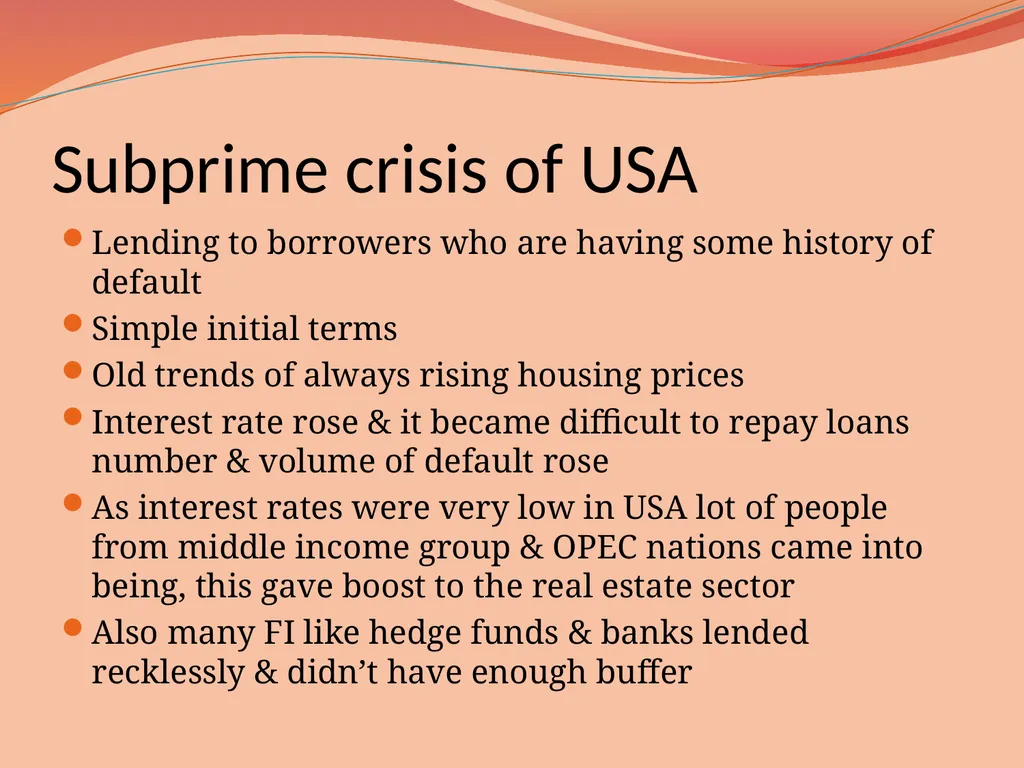
Subprime crisis of USA Lending to borrowers who are having some history of default
Simple initial terms
Old trends of always rising housing prices
Interest rate rose & it became difficult to repay loans number & volume of default rose
As interest rates were very low in USA lot of people from middle income group & OPEC nations came into being, this gave boost to the real estate sector
Also many FI like hedge funds & banks lended recklessly & didn’t have enough buffer<br>
14
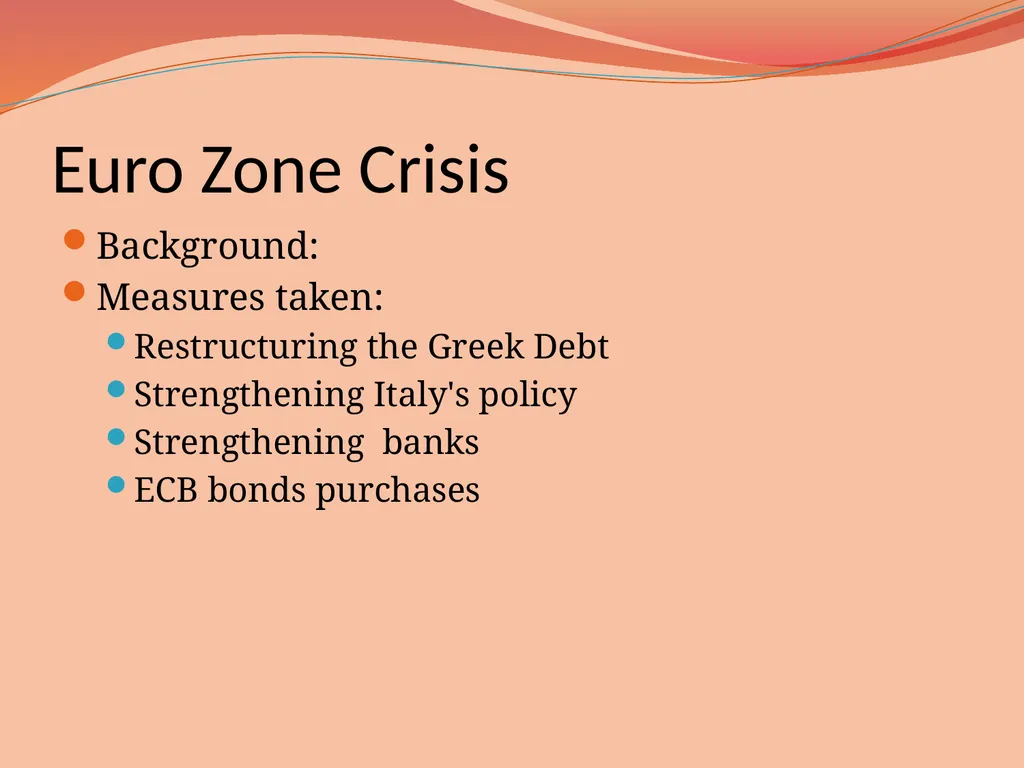
Euro Zone Crisis Background:
Measures taken:
Restructuring the Greek Debt
Strengthening Italy's policy
Strengthening banks
ECB bonds purchases<br>
Measures taken:
Restructuring the Greek Debt
Strengthening Italy's policy
Strengthening banks
ECB bonds purchases<br>
15
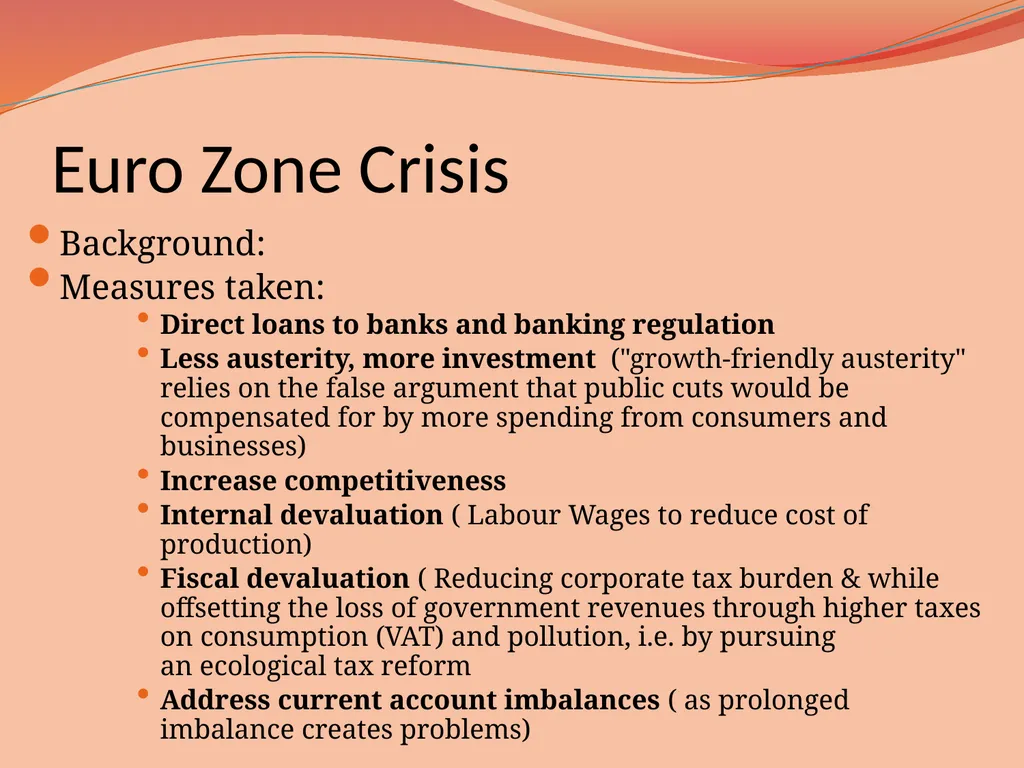
Euro Zone Crisis Background:
Measures taken:
Direct loans to banks and banking regulation
Less austerity, more investment ("growth-friendly austerity" relies on the false argument that public cuts would be compensated for by more spending from consumers and businesses)
Increase competitiveness
Internal devaluation ( Labour Wages to reduce cost of production)
Fiscal devaluation ( Reducing corporate tax burden & while offsetting the loss of government revenues through higher taxes on consumption (VAT) and pollution, i.e. by pursuing an ecological tax reform
Address current account imbalances ( as prolonged imbalance creates problems)<br>
16
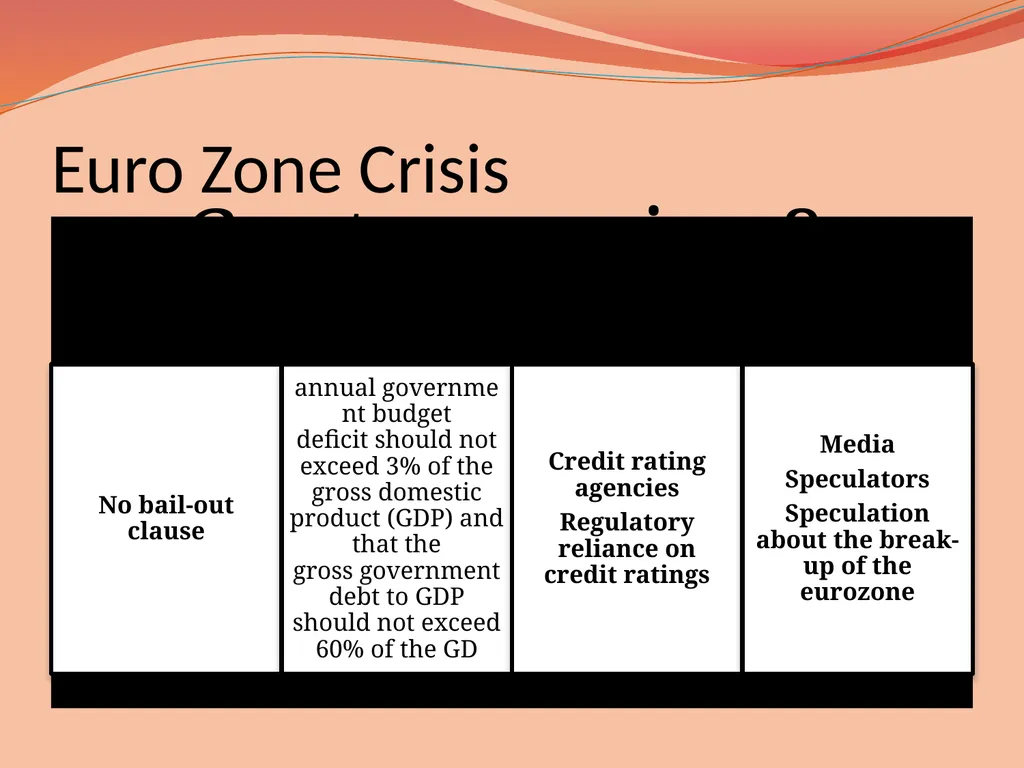
Euro Zone Crisis<br>
17
Basel I norms This accord (agreement) represents the set of I’nal banking regulations put forth by Basel committee
This committee set out rules for minimum capital requirement to reduce risk
Minimum Capital to risk weighted assets is 8%
Asset classification system was created
Assets were classified in to five different classes & each one was given a specific risk weights<br>
This committee set out rules for minimum capital requirement to reduce risk
Minimum Capital to risk weighted assets is 8%
Asset classification system was created
Assets were classified in to five different classes & each one was given a specific risk weights<br>
18
Basel II norms This accord represents an integration of Basel I norms with the domestic regulations
Basel II accords has more comprehensive measures & minimum standards
It provided for convergence in measurement mgmt & supervision of operational risk
Building up of capital buffers in good times that can be used in periods of stress
Identifying & mitigating risk that arises from newer forms of investment options<br>
19
Basel II norms Pillar I – deals with holding minimum capital requirements
Standardized approach: use external credit rating agencies
Internal rating based (IRB) approach: use of internal risk assessment systems
Advanced IRB: used advanced techniques<br>
Standardized approach: use external credit rating agencies
Internal rating based (IRB) approach: use of internal risk assessment systems
Advanced IRB: used advanced techniques<br>
20
Basel II norms Pillar II – deals with supervisory review process to be followed by the central bank
There are three main type of risks credit, market, operational
Credit
Market
Operational
Principles of pillar II includes banks should develop process for assessing overall capital adequacy, Supervisors should review & evaluate CAR , its assessment system, encourage banks to operate above CAR, prevent capital from falling below the minimum levels required to support the assessed risk<br>
21
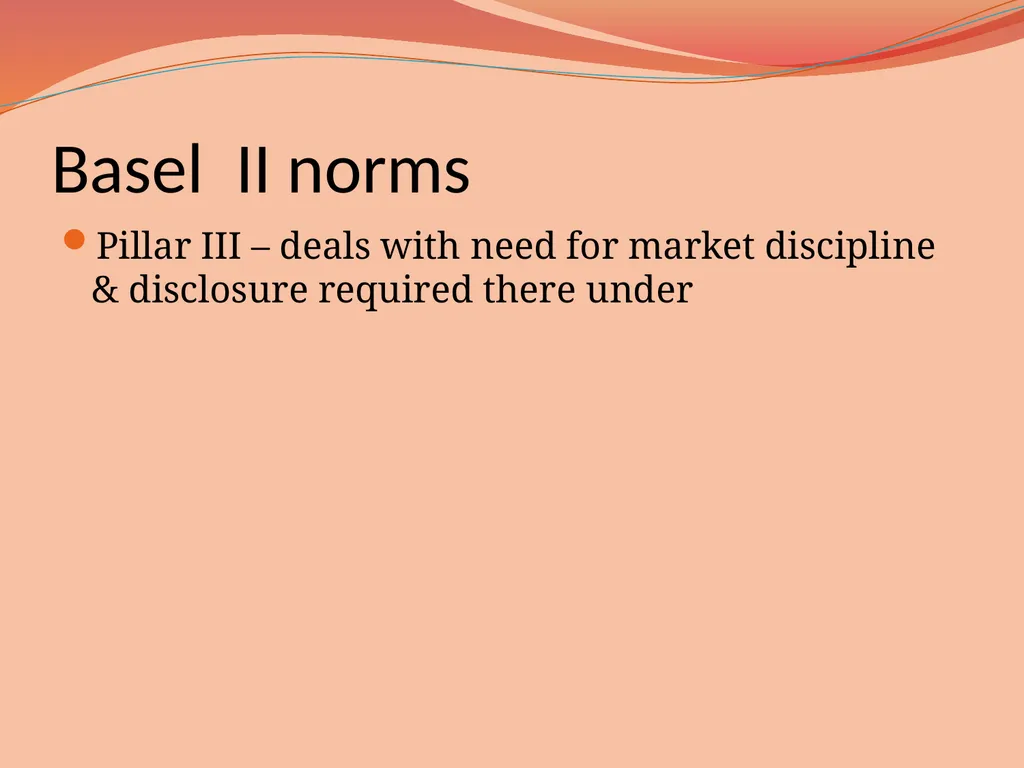
Basel II norms Pillar III – deals with need for market discipline & disclosure required there under<br>
22
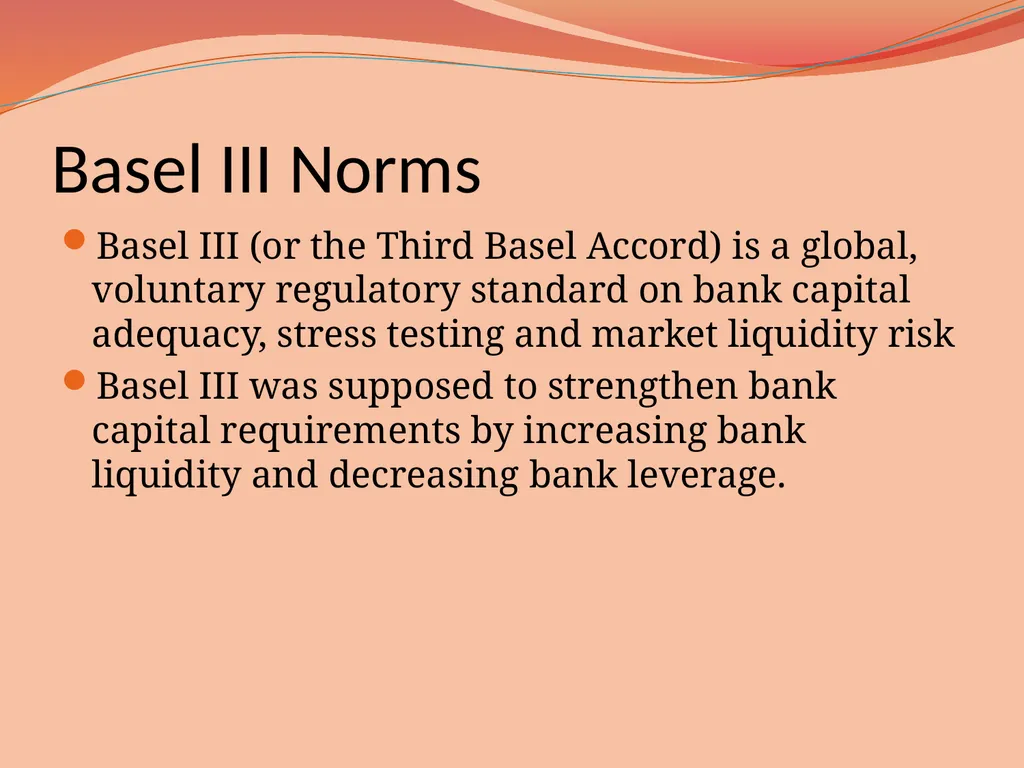
Basel III Norms Basel III (or the Third Basel Accord) is a global, voluntary regulatory standard on bank capital adequacy, stress testing and market liquidity risk
Basel III was supposed to strengthen bank capital requirements by increasing bank liquidity and decreasing bank leverage.<br>
Basel III was supposed to strengthen bank capital requirements by increasing bank liquidity and decreasing bank leverage.<br>
23
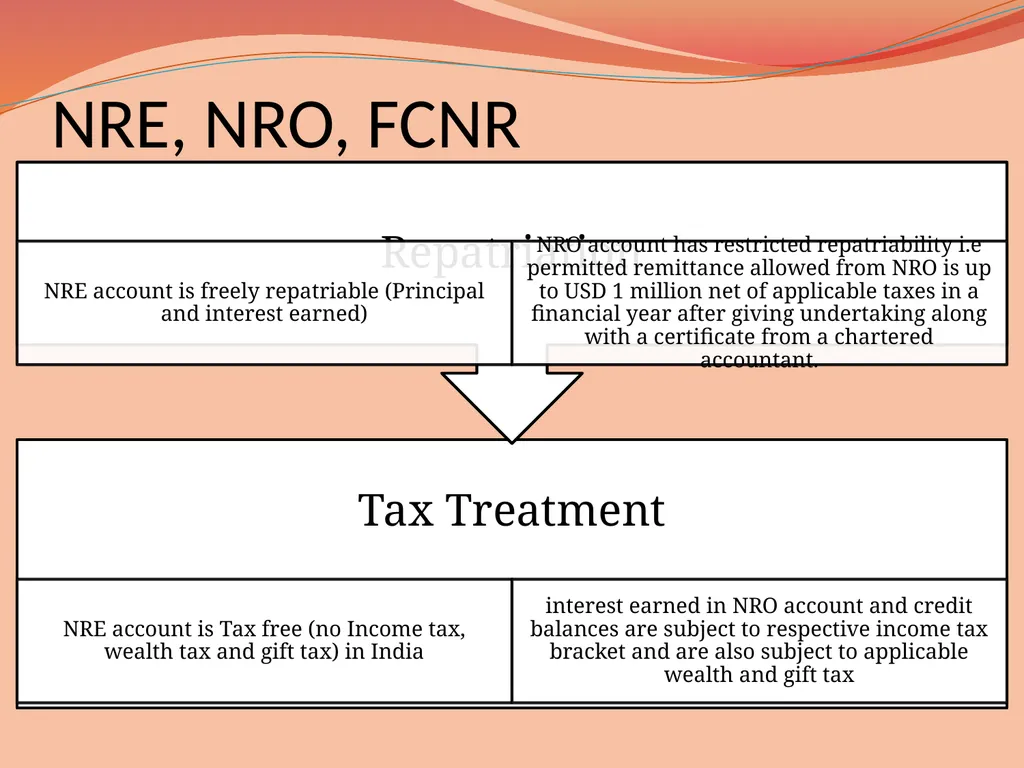
NRE, NRO, FCNR<br>
24
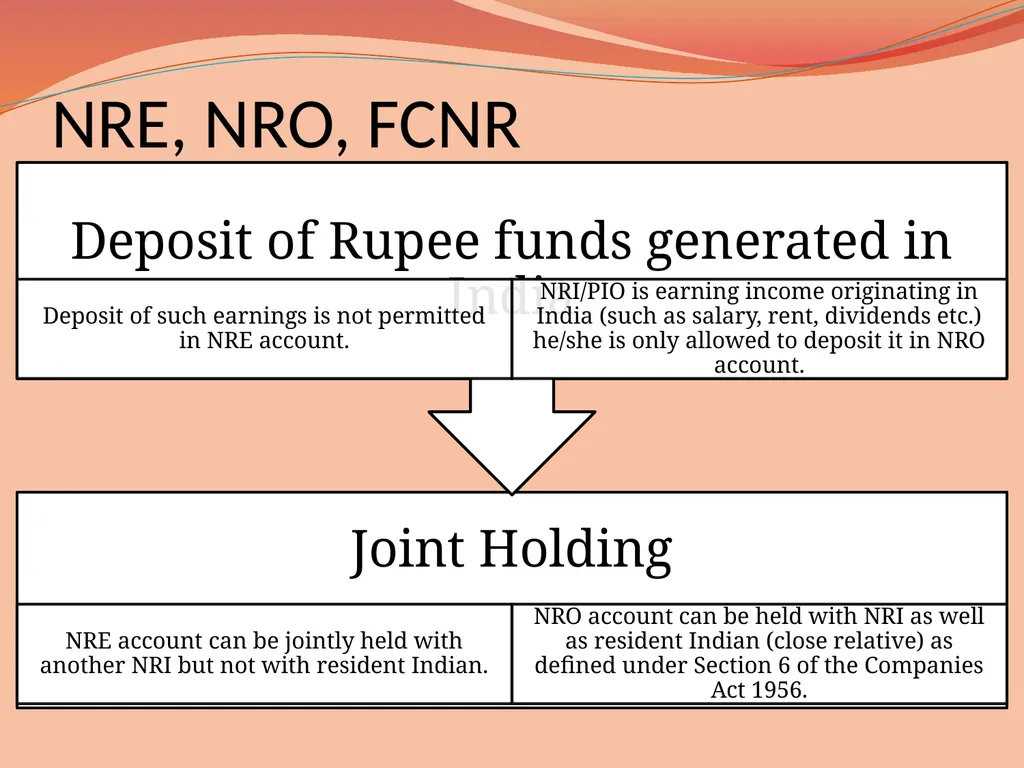
NRE, NRO, FCNR<br>
25
Foreign Currency Non Resident (B) Account [ FCNR(B)]
Are governed by the provisions of [Foreign Exchange Management (Deposit) Regulations, 2000.] A Foreign Currency Non Resident (B) Account FCNR account can be opened and maintained by a citizen of India or a person of Indian origin residing outside India as also Overseas Corporate Bodies (OCBs).
The accounts are convertible / repatriable and are maintained in the form of savings, current and recurring or fixed deposit accounts.<br>
26
Importance of IB in India (Discussion)<br>
27
Role of central banks in IB and business Risk Assessment
Monetary policy
Revamping prudential regulations
Strengthening the provisions of banking services<br>
Monetary policy
Revamping prudential regulations
Strengthening the provisions of banking services<br>