International Data Encryption Algorithm (IDEA) Prof. Neeraj Bhargava Pramod Singh Rathore Department of Computer Science School of Engineering System Sciences, MDS University Ajmer, Rajasthan, India International Data Encryption Algorithm
"International Data Encryption Algorithm (IDEA)" is the property of its rightful owner. Permission is granted to
download and print the materials on this website for personal, non-commercial use only, and to display it
on your personal computer provided you do not modify the materials and that you retain all copyright
notices contained in the materials. By downloading content from our website, you accept the terms of this
agreement.
Presentation Transcript
01
International Data Encryption Algorithm (IDEA)
Prof. Neeraj Bhargava
Pramod Singh Rathore
Department of Computer Science
School of Engineering & System Sciences,
MDS University Ajmer, Rajasthan, India<br>
02
International Data Encryption Algorithm (IDEA) In cryptography, the International Data Encryption Algorithm (IDEA), originally called Improved Proposed Encryption Standard (IPES), is a symmetric-key block cipher designed by James Massey of ETH Zurich and Xuejia Lai and was first described in 1991. The algorithm was intended as a replacement for the Data Encryption Standard (DES). IDEA is a minor revision of an earlier cipher Proposed Encryption Standard (PES).
The cipher was designed under a research contract with the Hasler Foundation, which became part of Ascom-Tech AG. The cipher was patented in a number of countries but was freely available for non-commercial use. The name "IDEA" is also a trademark. The last patents expired in 2012, and IDEA is now patent-free and thus completely free for all uses.
IDEA was used in Pretty Good Privacy (PGP) v2.0 and was incorporated after the original cipher used in v1.0, BassOmatic, was found to be insecure. IDEA is an optional algorithm in the OpenPGP standard.<br>
03
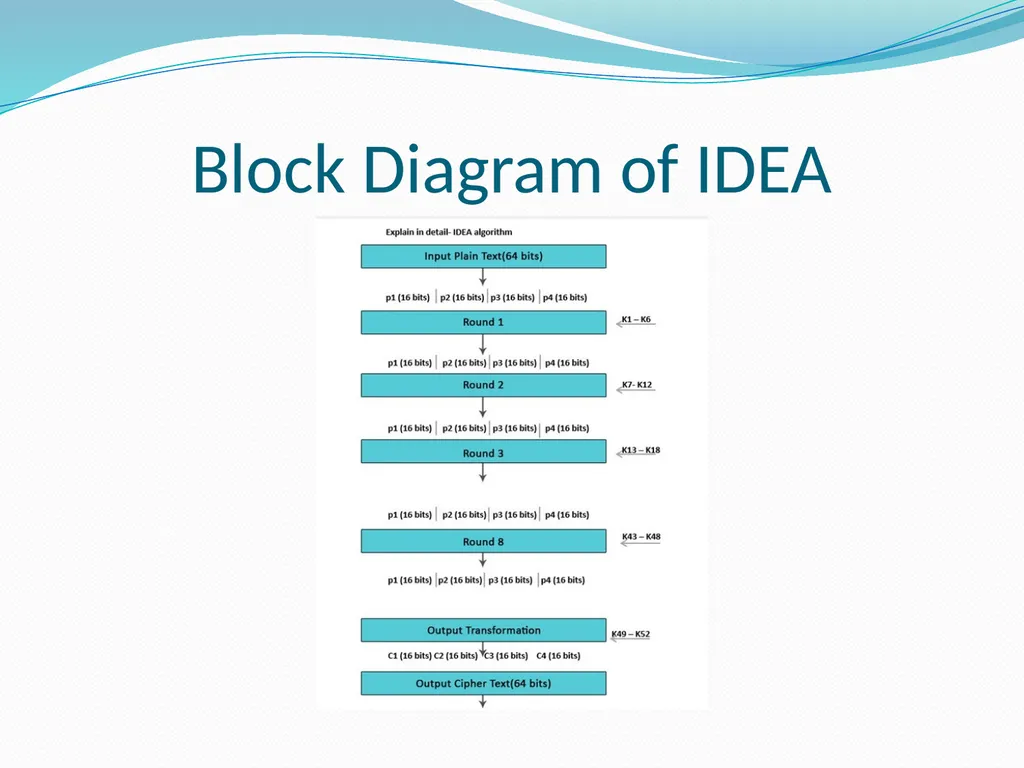
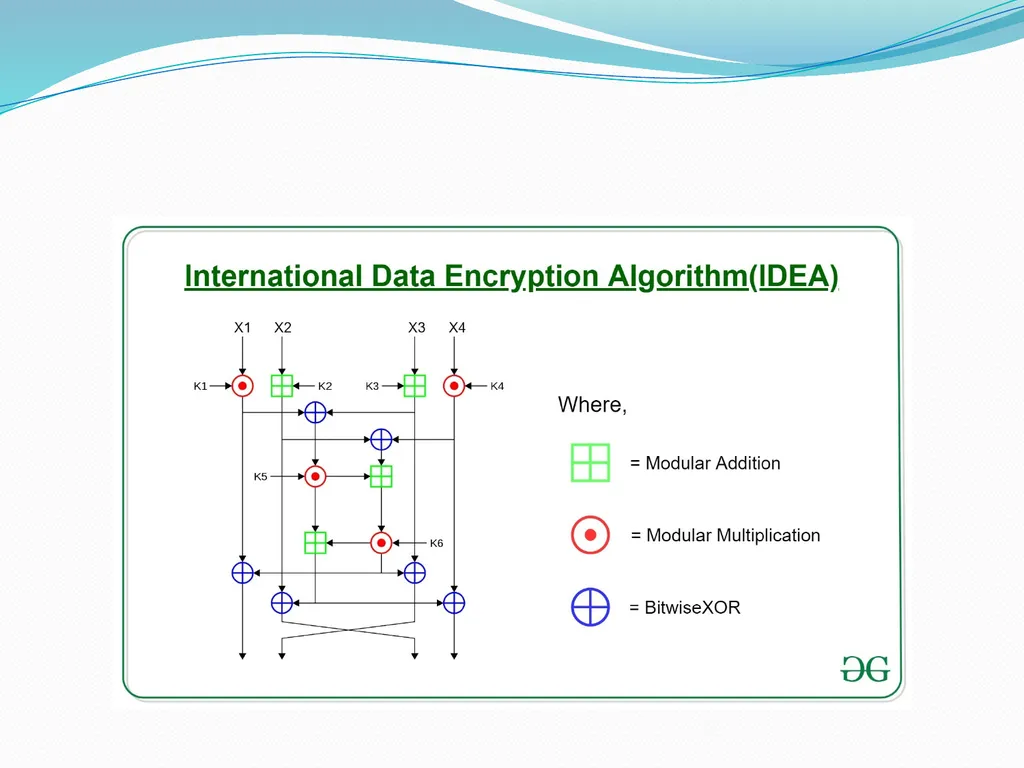
Basics of IDEA IDEA operates on 64-bit blocks using a 128-bit key and consists of a series of 8 identical transformations (a round, see the illustration) and an output transformation (the half-round). The processes for encryption and decryption are similar. IDEA derives much of its security by interleaving operations from different groups — modular addition and multiplication, and bitwise eXclusive OR (XOR) — which are algebraically "incompatible" in some sense. In more detail, these operators, which all deal with 16-bit quantities, are:
Bitwise XOR (exclusive OR) (denoted with a blue circled plus ⊕).
Addition modulo 216 (denoted with a green boxed plus ⊞).
Multiplication modulo 216 + 1, where the all-zero word (0x0000) in inputs is interpreted as 216, and 216 in output is interpreted as the all-zero word (0x0000) (denoted by a red circled dot ⊙).<br>
04
Block Diagram of IDEA<br>
05
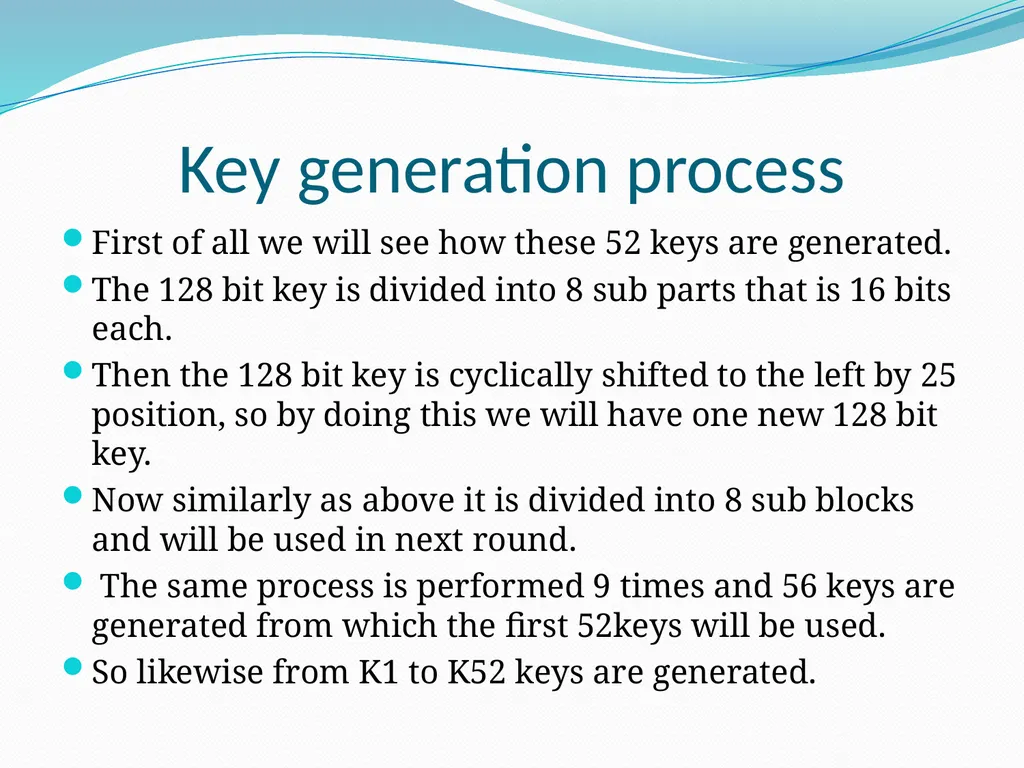
Key generation process First of all we will see how these 52 keys are generated.
The 128 bit key is divided into 8 sub parts that is 16 bits each.
Then the 128 bit key is cyclically shifted to the left by 25 position, so by doing this we will have one new 128 bit key.
Now similarly as above it is divided into 8 sub blocks and will be used in next round.
The same process is performed 9 times and 56 keys are generated from which the first 52keys will be used.
So likewise from K1 to K52 keys are generated.<br>
06
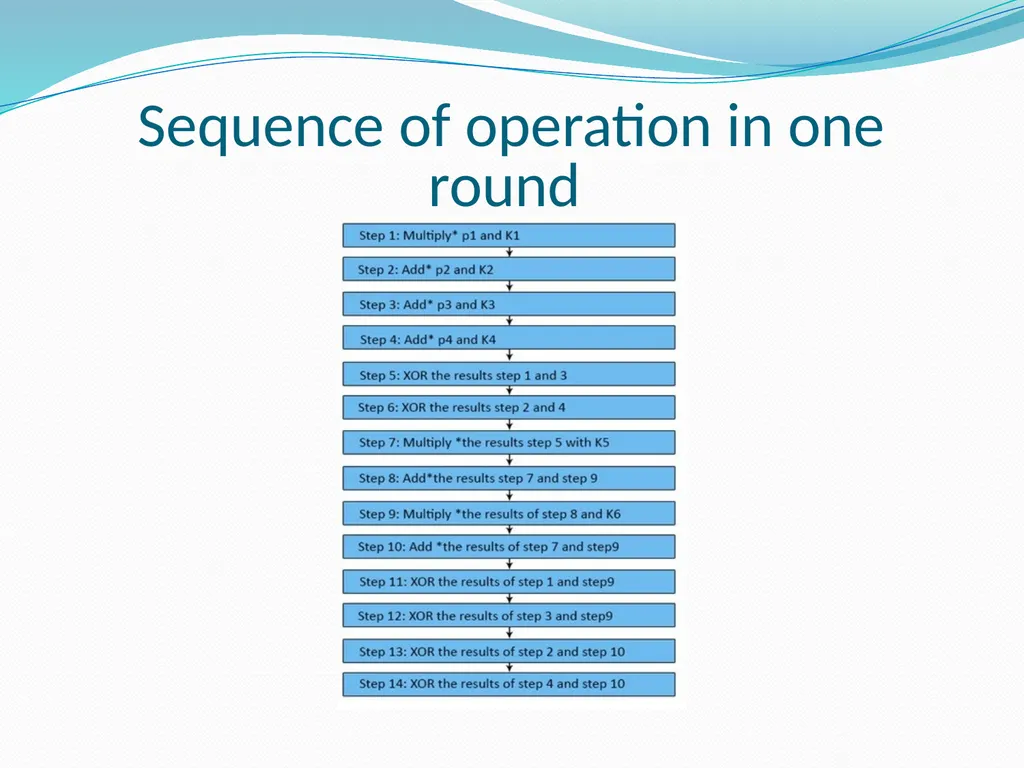
Sequence of operation in one round<br>
07
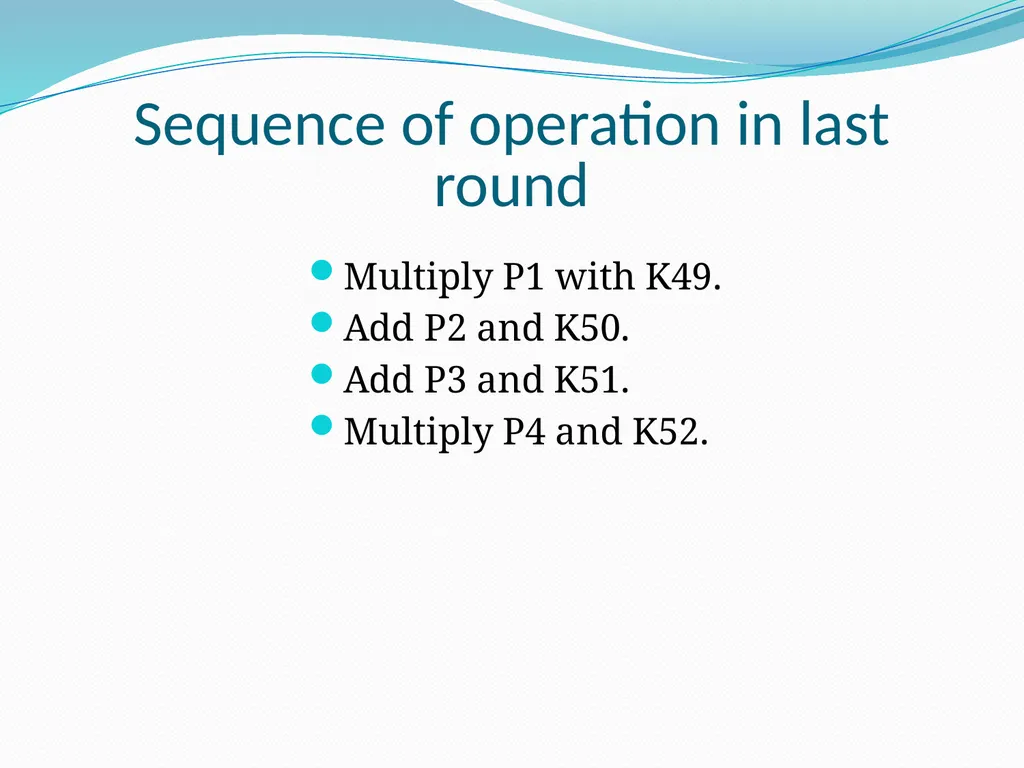
Sequence of operation in last round Multiply P1 with K49.
Add P2 and K50.
Add P3 and K51.
Multiply P4 and K52.<br>
08
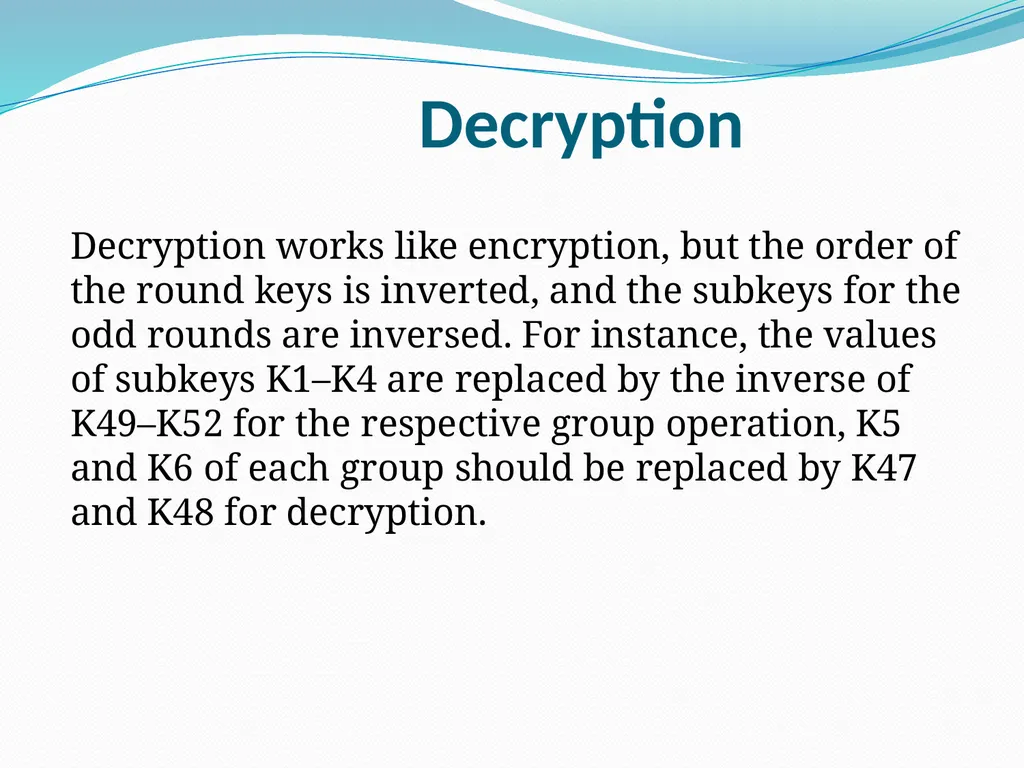
Decryption Decryption works like encryption, but the order of the round keys is inverted, and the subkeys for the odd rounds are inversed. For instance, the values of subkeys K1–K4 are replaced by the inverse of K49–K52 for the respective group operation, K5 and K6 of each group should be replaced by K47 and K48 for decryption.<br>
09
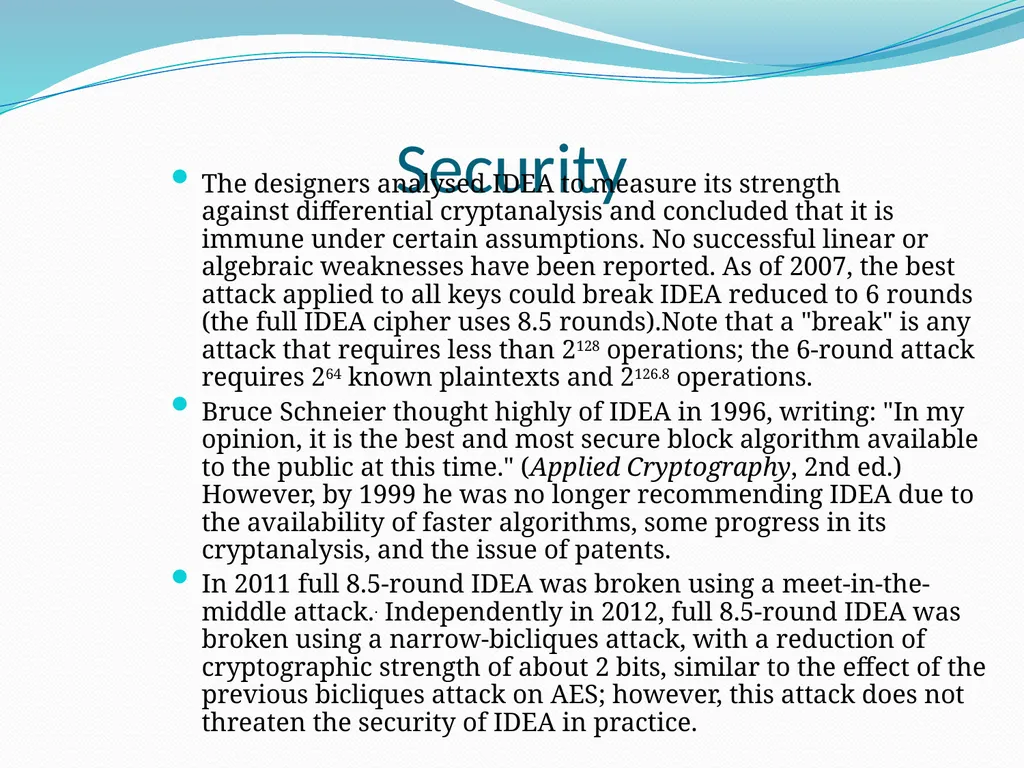
Security The designers analysed IDEA to measure its strength against differential cryptanalysis and concluded that it is immune under certain assumptions. No successful linear or algebraic weaknesses have been reported. As of 2007, the best attack applied to all keys could break IDEA reduced to 6 rounds (the full IDEA cipher uses 8.5 rounds).Note that a "break" is any attack that requires less than 2128 operations; the 6-round attack requires 264 known plaintexts and 2126.8 operations.
Bruce Schneier thought highly of IDEA in 1996, writing: "In my opinion, it is the best and most secure block algorithm available to the public at this time." (Applied Cryptography, 2nd ed.) However, by 1999 he was no longer recommending IDEA due to the availability of faster algorithms, some progress in its cryptanalysis, and the issue of patents.
In 2011 full 8.5-round IDEA was broken using a meet-in-the-middle attack.. Independently in 2012, full 8.5-round IDEA was broken using a narrow-bicliques attack, with a reduction of cryptographic strength of about 2 bits, similar to the effect of the previous bicliques attack on AES; however, this attack does not threaten the security of IDEA in practice.<br>