03
IOT makes life easier Connect electronics, software, sensors, etc and allow them to communicate with each other to produce a better experience.
Example an iphone has gyroscope, compass, gps, contact list, addresses, search engines, cameras, locks, parking, face identification, etc. Things that took hours now are on your fingertip saving great deal of time.
Remote medicine, prescriptions, automated driving, drone fighters, etc. iWatch has saved lives.
We are dependent more on more on things.
IOT interconnects, analyzes, and integrates things.<br>
04
Goal of IoT smart homes, smart cities, smart hospitals, Manufacturing, Retail, Security, etc.
unification of technologies: cloud computing, big-data, machine learning
Applications: smart parking and traffic, smart lighting and air flow, smart grid, smart roads, health industry, safety, smart manufacturing, distribution and sales, etc.
Two examples next slides<br>
05
IOT standardizes connectivity, analysis and integration Adds virtual layers to connection to the cloud is standardized.
High speed stream processing, storage of intermediate data points.
Analysis of data points real time.
Commands (signals) can be sent to integrated devices.<br>
06
Functional Blocks of IoT Devices: Sensing, Actuation, Control, Monitoring
Wearable, smart watches, phones, automobiles, Industrial machines
Devices equipped with embedded systems, processor, communication, etc
Low powered RFID, Nanodevices, Sensors, smart networks
Exchange information: wired and wireless communication using data link, network, transport and application layers
Local or cloud storage
Process: locally or in the IoT infrastructure<br>
07
Basic Architecture Application Layer
Where we can develop IOT applications
Network Layer
Connecting things together using some sort of virtualization
Perception Layer
Sensors, actuators, environment<br>
08
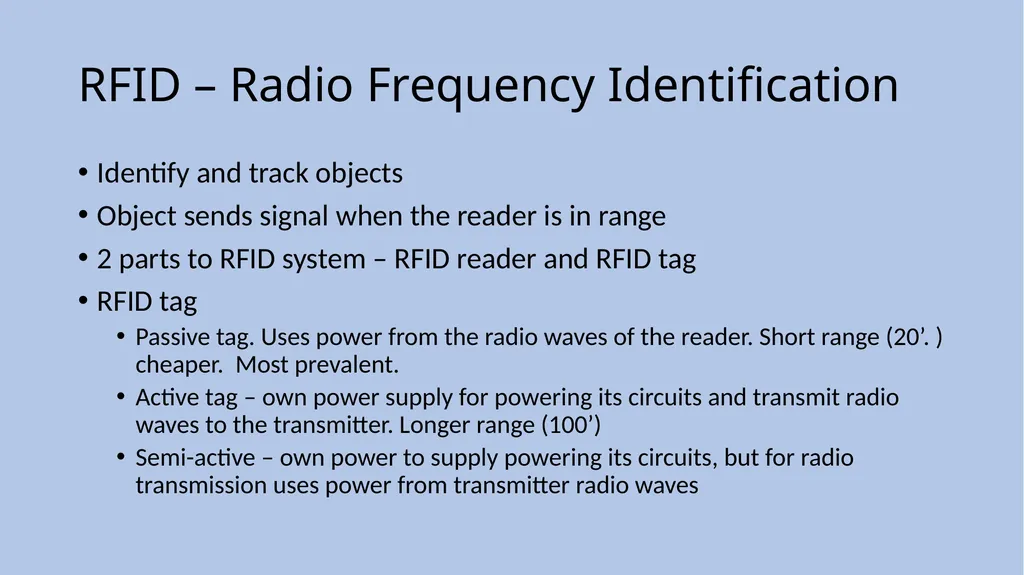
RFID – Radio Frequency Identification Identify and track objects
Object sends signal when the reader is in range
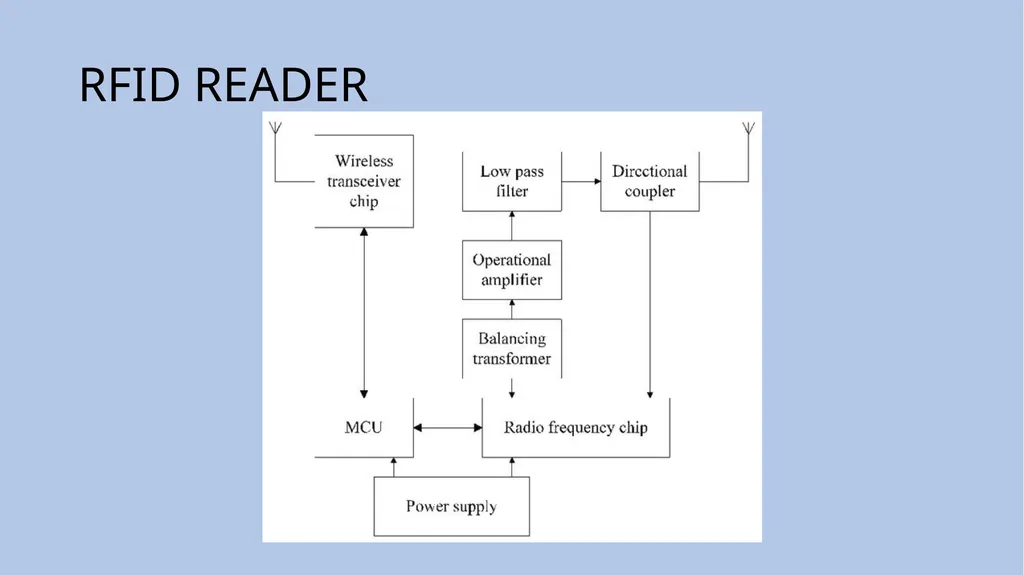
2 parts to RFID system – RFID reader and RFID tag
RFID tag
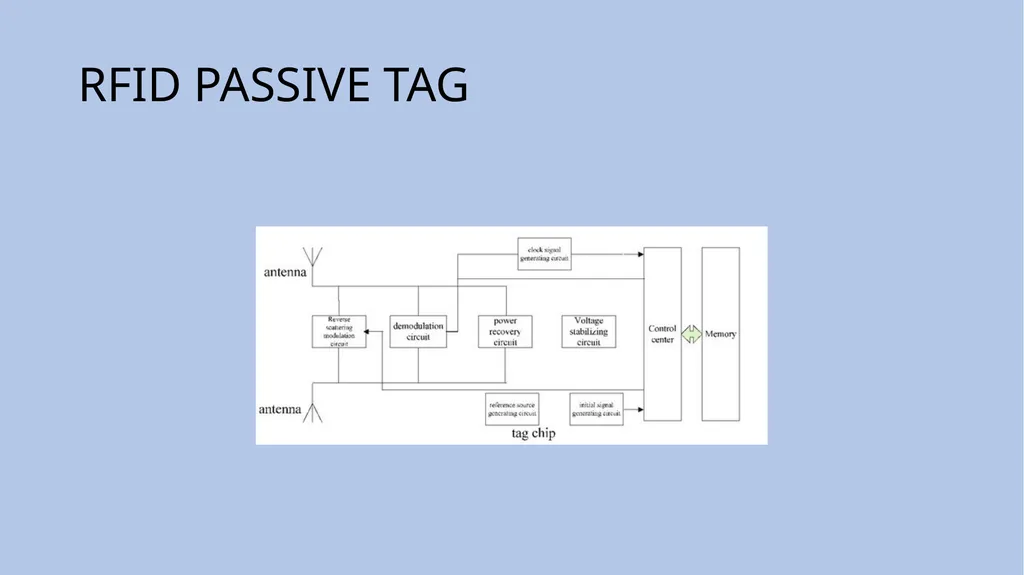
Passive tag. Uses power from the radio waves of the reader. Short range (20’. ) cheaper. Most prevalent.
Active tag – own power supply for powering its circuits and transmit radio waves to the transmitter. Longer range (100’)
Semi-active – own power to supply powering its circuits, but for radio transmission uses power from transmitter radio waves<br>
11
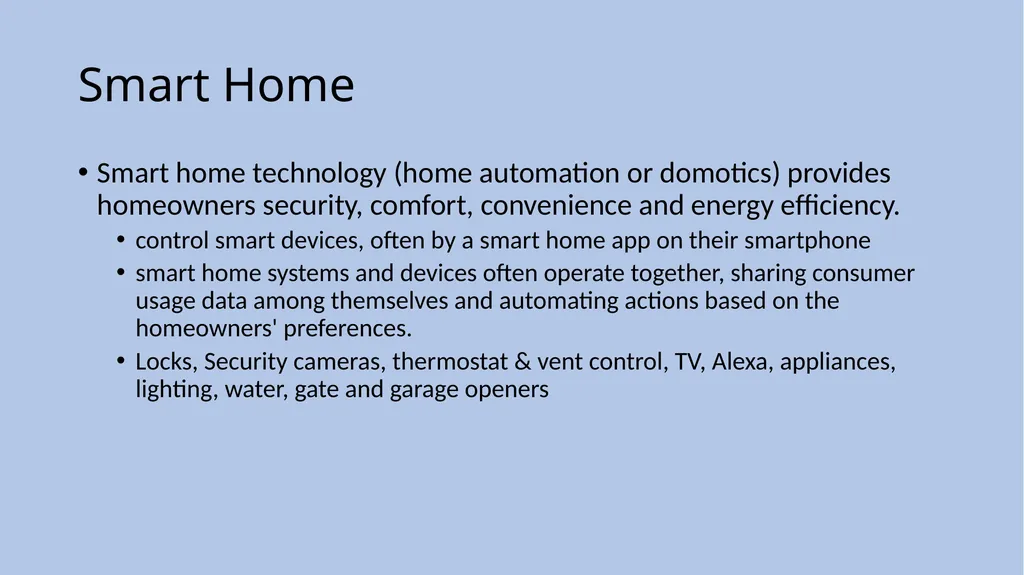
Smart Home Smart home technology (home automation or domotics) provides homeowners security, comfort, convenience and energy efficiency.
control smart devices, often by a smart home app on their smartphone
smart home systems and devices often operate together, sharing consumer usage data among themselves and automating actions based on the homeowners' preferences.
Locks, Security cameras, thermostat & vent control, TV, Alexa, appliances, lighting, water, gate and garage openers<br>
12
Smart city – Automation Street and traffic lights- road sensors and cameras feed through a centralized computer system
Transportation – Bicycles anyone can use, electric car sharing program
Parking - wireless sensors to detect parking-space occupancy in metered spaces
Infrastructure and maintenance
Waste management (including waste water) -smart waste and recycling system
Air quality – City environmental sensors. Block by block sensing of temperature, humidity, light, air quality, wind, and precipitation
Crime
Architecture
Energy usage and distribution - sensors to save electricity by intuitively adjusting the brightness of street lights, based on the presence of automobiles and pedestriansTraffic flow
Pedestrian and bicycle needs<br>
13
IoT Specific Architecture (evolving) No standardized architecture exists as of 2019, but many proposals.
At the minimum we have 4 layers
Network of Things –Smart devices: sensors, gps, RFID,, smart phones, cameras, cars etc. Devices and sensors work in Edge.
Gathering physical world (analog) and converting to digital data
These devices can communicate with each other and to the upper layer
Wired or wireless network: Ethernet, Wifi, PAN, etc.
Routers other gateway devices connecting WAN. Edge and CLOUD connected by Gateway
Centralized Data collection service
CLOUD services with many servers, large memory and storage
Decision making and application of specified services
Management Service layer
Device controllers: lock opening, giving out cash, applying fertilizers, etc.
User layer<br>
14
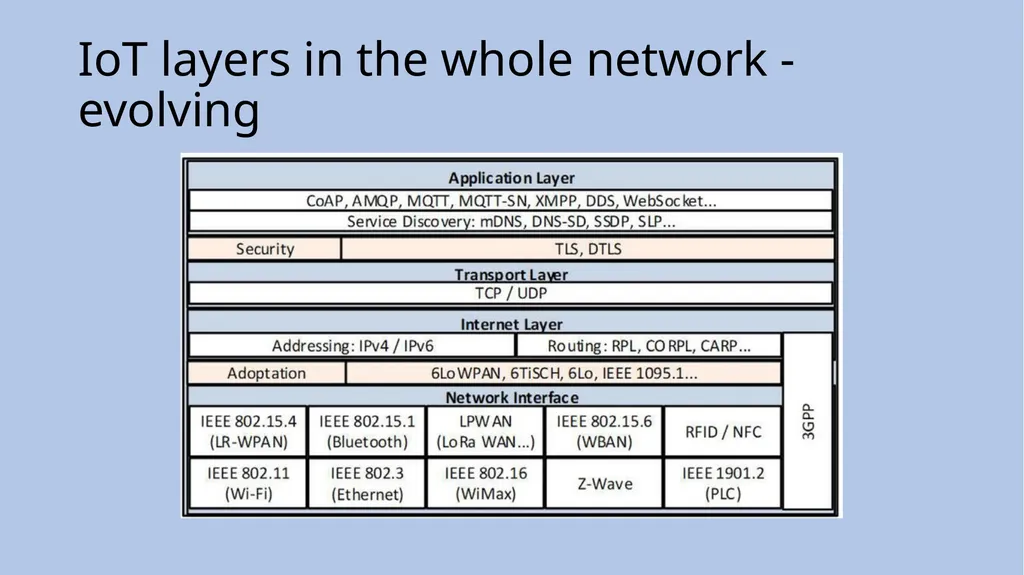
IoT layers in the whole network - evolving<br>
15
Specific IoT Data protocols Much of the work needs to be done in the Edge rather than the Cloud, because of the latency involved in Cloud. So D2D (device to device, D2C (device to cloud) and C2C communication should be possible.
MQTT (Message Queuing Telemetry Transport) protocol. Mostly for Device to Cloud communication
CoAP (Constrained Application Protocol). Lightweight fast HTTP. There is a Proxy between the HTTP client and CoAP server. Can be installed in very small devices. GET/POST/PUT/DELETE. Content type: XML, JSON, etc.)<br>
16
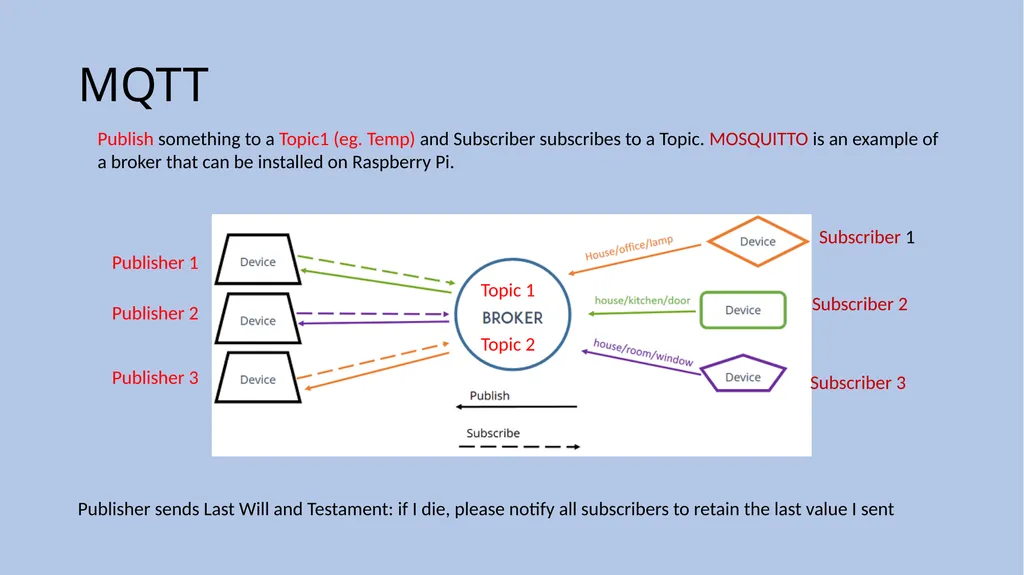
MQTT Publisher 1 Publisher 2 Publisher 3 Topic 1 Topic 2 Subscriber 1 Subscriber 2 Subscriber 3 Publish something to a Topic1 (eg. Temp) and Subscriber subscribes to a Topic. MOSQUITTO is an example of a broker that can be installed on Raspberry Pi. Publisher sends Last Will and Testament: if I die, please notify all subscribers to retain the last value I sent<br>
17
CoAP – designed for devices with constraints. HTTP has no constraints or restrictions Lightweight fast HTTP. Can be installed in very small devices. 1-to-1 communication.
Developed to enable smart devices to connect to Internet
Get and Observe – when state changes it can push a message.
Discovery – it can discover sensors around.
There is a Proxy between the HTTP client and CoAP server.
GET/POST/PUT/DELETE. Content type: XML, JSON, etc.). CoAP runs over UDP<br>
18
Industry applications Fieldbus – mainly used in manufacturing assembly lines, process control, etc. Connects instruments in shop-floor. Old days they were connected using serial RS232. Now Modbus TCP (ethernet). Programmable Fieldbus Controllers now available.
IO-Link device. For communication with sensors and actuators.<br>
19
Cloud – AWS, Azure, Rackspace .. Azure – cloud computing: a platform that gives computing resources
Machine learning and data analysis, data storage and backup, streaming media, etc.
Many categories of services, including IoT
Azure IoT hub – establish bi-directional communication with IoT devices. SDKs
You can create a free account and create an IOT hub.<br>
20
Amazon Web Services and Big Data Social Media
eCommerce
Genetics
Weather
Hadoop. I have given seminar courses in this topic.<br>
21
Practical stuff Windows 10 core for IoT and Raspberry Pi
http://windowsondevices.com
We can install several operating systems on Pi, mostly Linux flavors
Windows 10 core is a small version of Windows 10 and is free
You can find all of them on raspberrypi.org downloads section.
You can also purchase Raspberry Pi Sense HAT (or other third party hats) to interact with the world around us.
This hat will enable you to read: Orientation via an accelerometer
Pressure, Humidity and temperature
You can write programs in Python<br>