
Interpretation of statute Unit III External aids






Description: Interpretation of statute Unit III External aids to Interpretation Dr Kalpesh Nikawat What is interpretation of statutes? Interpretation is the process which is employed by the judiciary to ascertain or to determine the meaning of the
Related Topics
Download Presentation
"Interpretation of statute Unit III External aids" is the property of its rightful owner. Permission is granted to download and print the materials on this website for personal, non-commercial use only, and to display it on your personal computer provided you do not modify the materials and that you retain all copyright notices contained in the materials. By downloading content from our website, you accept the terms of this agreement.
Presentation Transcript
slide1. Interpretation of statute Unit III
External aids to Interpretation
Dr Kalpesh Nikawat<br>
slide2. What is interpretation of statutes? Interpretation is the process which is employed by the judiciary to ascertain or to determine the meaning of the statutes or legal provision. It is basically a process by which court seeks to ascertain the true meaning of the expression or word or phrase which is in question in any statute before the court and determine the true intention of the legislature behind such statutory provision. A process of interpretation employed by the judiciary can be done through various tools or principles of statutory interpretation which include seeking help from internal or external aids to interpretation and applying primary or secondary rule of interpretation which has evolved over a period of time by the court.<br>
slide3. Interpretation of statutes The purpose of interpretation is to find out the intention of the legislature..
The aids to interpretation help a judge find out the same.
These also help in deriving proper context in which a statute is to be applied.<br>
slide4. Definitions According to Salmond:
Interpretation and construction is the process by which the court seek to ascertain the meaning of the legislature through the medium of authoritative forms in which it is expressed. According to Blackstone: The most fair and rational method for interpreting a statute is by exploring the intention of the legislature through texts, the subject matter, the effect and consequences or the spirit and reason of law.<br>
slide5. Types of interpretation aids Broadly two interpretation aids are available:-
(1) Internal aids - which are existing in the Statutes itself
(2) External aids - which are found outside the Statutes.<br>
slide6. External Aid to Interpretation External aids are the aids which are not available inside the statute but outside the statute, the court may seek help to the external aids in case of repugnancy or inconsistency in the statutory provision.
When internal aids are not adequate, the court has to take recourse to external aids. The external aids are very useful tools for the interpretation or construction of statutory provisions. As opposed to internal aids to construction there are certain aids which are external to the statute. External Aids may be parliamentary material, historical background, reports of a committee or a commission, official statement, dictionary meanings, foreign decisions, etc.
In Prabhakar Rao and others v. State of A.P. and others AIR 1986 SC 120 O. Chennappa, Reddy J. has observed: Where internal aids are not forthcoming, we can always have recourse to external aids<br>
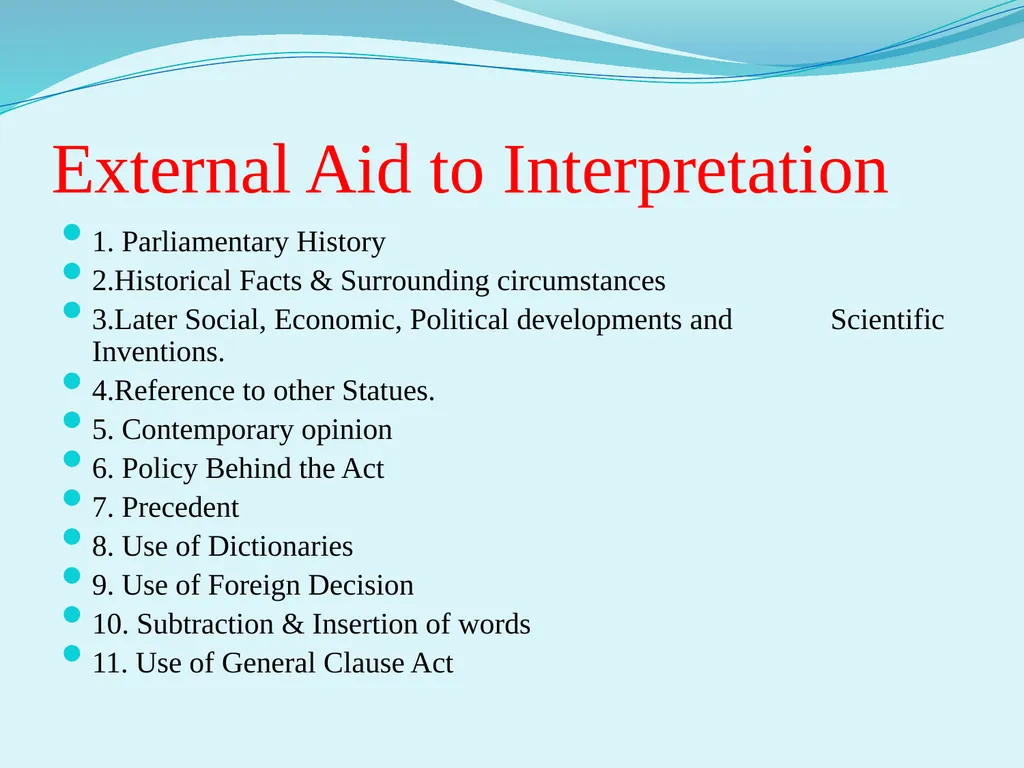
slide7. External Aid to Interpretation 1. Parliamentary History
2.Historical Facts & Surrounding circumstances
3.Later Social, Economic, Political developments and Scientific Inventions.
4.Reference to other Statues.
5. Contemporary opinion
6. Policy Behind the Act
7. Precedent
8. Use of Dictionaries
9. Use of Foreign Decision
10. Subtraction & Insertion of words
11. Use of General Clause Act<br>
slide8. Parliamentary History, Historical Facts and Surrounding Circumstances Parliamentary History, Historical Facts and Surrounding Circumstances Historical setting cannot be used as an aid if the words are plain and clear. If the wordings are ambiguous, the historical setting may be considered in order to arrive at the proper construction. Historical setting covers parliamentary history, historical facts, statement of objects and reasons, report of expert committees. Parliamentary history means the process by which an act is enacted. This includes conception of an idea, drafting of the bill, the debates made, the amendments proposed etc. Speech made in mover of the bill, amendments considered during the progress of the bill are considered in parliamentary history where as the papers placed before the cabinet which took the decision for the introduction of the bill are not relevant since these papers are not placed before the parliament. The historical facts of the statute that is the external circumstances in which it was enacted in should also be taken into note so that it can be understood that the statute in question was intended to alter the law or leave it where it stood. Statement of objective and reasons as to why the statute is being brought to enactment can also be a very helpful fact in the research for historical facts, but the same if done after extensive amendments in statute it may be unsafe to attach these with the statute in the end. It is better to use the report of a committee before presenting it in front of the legislature as they guide us with a legislative intent and place their recommendations which come in handy while enactment of the bill. The Supreme Court in a numbers of cases referred to debates in the Constituent Assembly for interpretation of Constitutional provisions.
Recently, the Supreme Court in S.R. Chaudhuri v State of Punjab and others, (2001) 7 SCC 126 has stated that it is a settled position that debates in the Constituent Assembly may be relied upon as an aid to interpret a Constitutional provision because it is the function of the Court to find out the intention of the framers of the Constitution. (Para 33).<br>
slide9. External Aid to Interpretation Parliamentary History
Parliamentary history may include:
The bill in its original form or the amendments considered during its progress in the Legislature
Statements of Objects and Reasons (Speech of the minister)
Parliamentary debates
Reports submitted by different Committees and commissions.
These were not used as an aid to interpretation initially. However, occasionally courts have adhered to use them for expounding the true meaning of legislation.
Pepper v. Hart (1993)
“The reference to Parliamentary material should be permitted as an aid to the construction of legislation which is ambiguous or obscure or literal meaning of which leads to absurdity.”
Chiranjit Lal Chowdhury v. UOI (1951) Fazal Ali, J., admitted Parliamentary History including the speech of the minister introducing the bill as evidence of the circumstances which necessitated the passing of the Act.<br>
slide10. External Aid to Interpretation Indira Sawhney v. UOI (1993)
While interpreting Article 16(4) of the Constitution the Supreme Court referred to Dr. Ambedkar’s speech in the Constituent Assembly as the expression backward class of citizens’ is not defined. The court held that reference to Parliamentary debate is permissible to ascertain the context, background and objective of the legislatures but at the same time such references could not be taken as conclusive or binding on the courts.<br>
slide11. ऐतिहासिक पृष्ठभूमि किसी अधिनियमति का अर्थान्वयन करते समय न केवल प्रयुक्त शब्दों को देखा जाना चाहिए, बल्कि उस अधिनियम के इतिहास और उन कारणों को भी देखा जाना चाहिए जिनके आधार पर उसे पारित किया गया। उस रिष्टि को भी देखना है जिसे दूर करने की आवश्यकता थी और उस विचार को भी जो उसे दूर करने के लिए प्रदान किया गया था। वह विषय वस्तु जिस पर विधायिका कार्य कर रही थी, और वे तथ्य जो उस समय विद्यमान थे जिनके संदर्भ में विधायिका विधान बना रही थी, यह जानने के लिए कि अधिनियम पारित करने में विधायिका का उद्देश्य और प्रयोजन क्या था, ध्यान में रखने के लिए उपयुक्त विषय है।<br>
slide12. विधायी इतिहास प्राचीन काल में वास्तविक संदर्भ जानने के लिए कभी-कभी न्यायालय किसी कानून के विधायी इतिहास को भी देखना चाहता था। परंतु आधुनिक बहुमत विचारधारा कदाचित यही है की विधायी इतिहास को निर्वचन के ब्राहय सहयोगी के रुप में नहीं लिया जा सकता। अतः सदनों के मंच पर किए गए विचार विमर्श प्रवर, समिति की रिपोर्टों तथा उद्देश्यों और कारणों के कथन निर्वचन के बरस योगी के रूप में अग्राह्य हैं, इस नियम का आधार कदाचित यही है कि विधायकों के मस्तिष्क में जो कुछ था उसे उनके द्वारा स्पष्ट शब्दों में व्यक्त किया जा चुका है, तथा विधायक अपने व्यक्तिगत विचारों से न्यायालय को प्रभावित नहीं कर सकते।<br>
slide13. Developments—Social ,Political, Economic and Scientific Developments—Social ,Political, Economic and Scientific
According to Waisman:
“ Judges are not robots. They have to evolve various methods and techniques to tackle a problem which confronts them.”
R v. Ireland (1997)
The psychiatric injury which was caused by silent telephone calls was held to amount to “assault” or “bodily harm” under sections 20 and 47 of the Offence Against Person Act,1861 in the light of the current scientific appreciation of the link between the body and psychiatric injury.
R v. Fellows (1997)
The data stored in a computer disc, a technique not known in 1978 amounts to “indecent photograph” within the meaning of section 1 of the Protection of Children Act,1978 which penalizes taking or distribution of indecent photograph of children under the age of sixteen.
Bacchan Singh v. State of Punjab (1982)
SC, while upholding the constitutionality of death penalty, observed that Constitutional Law also raises economic, social, moral and political problems. And along with the history, the recent developments shall also be taken into account.<br>
slide14. Reference to other statutes Reference to other statutes
This may include referring to statutes in pari materia and earlier statutes.
Statutes which relate to the same subject, the same person or thing or the same class of persons or things are deemed to constitute one system of law, they are considered as one statute.
R v. Loxdale
“Where there are different statutes in pari materia though made at different times, or even expired, and not referring to each other, they shall be taken and construed together as one system and as explanatory of each other”.
Ahmedabad Pvt. P.T. Association v. Adm. Officer
It was observed that the word “employee” defined in section 2(e) of Payment of Gratuity Act is to be construed by referring to other Labour Enactments dealing with the same subject.
When the two legislations have different scopes it cannot be said that they are in pari materia.
Shah and Co., Bombay V. State of Maharashtra
The Bombay Rents, Hotel and Lodging Rates Control Act, 1947 and the Bombay Land Requisition Act, 1948 were not held to be Acts in pari materia as they do not relate to the same persons or thing or to the same class of persons or things.<br>
slide15. Legislative Debates/Speech It is referred as to debates or speeches which are made in the course of passing a bill in the parliament by the parliamentarians to put forth their view. It is not considered as a conclusive aid to interpretation and is therefore, not admissible because many times speeches are influenced by the political pressure or maybe incorrect to rely upon.<br>
slide16. Constituent Debates/Speech It shall compromises all such debate which had taken place in the parliament at the time of formation of Constitution of India. In case of inconsistency or repugnancy in the Constitution the court can clearly refer to such debates. Indra Sawhney v. Union of India AIR 1993 SC 477 the interpretation of the expression backward class of citizen' used in Article 16(4) was in question before the court. The SC under this case referred to the speech given by B.R. Ambedkar to understand the context, background and object behind its use of the given expression.<br>
slide17. Dictionaries When a word used in the statute is not defined therein or if defined but the meaning is unclear only in such situation, the court may refer to the dictionary meaning of the statute to find out meaning of the word in ordinary sense. The meaning of such words shall be interpreted so to make sure that it is speaking about the particular statute because words bears different meaning in different context. Motipur zamindary company private limited v. State of Bihar AIR 1962 SC 660 the question was whether sales tax can be levied on Sugarcane. The applicant argued that it is green vegetable and should be exempted from tax. The dictionary meaning of vegetable said anything which derived or obtained from the plants. The SC rejected dictionary meaning and held that in common parlance vegetable is something which is grown in kitchen garden and used during lunch and dinner and held that sugarcane is not vegetable.
किसी कानून में प्रयोग किए गए शब्दों का निर्वचन उनके साधारण अर्थ के संदर्भ में किया जाना चाहिए, क्योंकि शब्दकोश किसी शब्द के कई अर्थों को स्पष्ट करता है, इसलिए सामान्यतः उन अर्थों की जानकारी के लिए शब्दकोश सहायक है, अतः किसी शब्द के साधारण अर्थ को जानने के लिए न्यायालय शब्दकोश का सहयोग ले सकता है परंतु ऐसा करने के लिए न्यायालय को बहुत सावधान रहने की आवश्यकता है क्योंकि यह आवश्यक नहीं कि कानून के विशेष संदर्भ में उन अर्थों में से कोई अर्थ वास्तव में उचित ही हो, इसलिए कई बार न्यायालय बहुत से अर्थों में से कोई अर्थ ठीक मानकर चुन लेता है और कई बार कानून के सन्दर्भ को देखते हुए न्यायालय अर्थों को अस्वीकार भी कर देता है प्रत्येक परिस्थिति में न्यायालय को विशिष्ट कानून के उद्देश्य और सन्दर्भ को ध्यान रखना पड़ता है ।<br>
slide18. मोतीपुर जमीदारी कंपनी प्राइवेट लिमिटेड बनाम बिहार राज्य एआईआर 1962 एससी 660 प्रश्न यह था कि क्या बिहार विक्रय कर अधिनियम 1947 की अनुसूची के मद 6 के अंतर्गत गन्ना एक ग्रीन वेजिटेबल होने के कारण उसके विक्रय पर कर आरोपित नहीं किया जा सकता। अपीलार्थी ने अपने तर्क के पक्ष में अभिव्यक्त ‘ग्रीन वेजिटेबल’ का शब्दकोश अर्थ प्रस्तुत किया । उच्चतम न्यायालय ने इस तर्क से असहमति व्यक्त करते हुए कहा कि ‘ग्रीन वेजिटेबल’ का अर्थ प्रस्तुत संदर्भ में केवल वस्तुओं से है, जिन्हें रसोई उद्यान में उगाया जा सकता है और जो दोपहर व रात के खाने के साथ खाए जाते हैं, अतः इस शब्द का अर्थ केवल हरी सब्जियों से है, जिसके अंतर्गत गन्ना नहीं आता । क्योंकि गन्ने को खाने की मेज पर सब्जी के रूप में नहीं खाया जाता । विधायिका का आशय ग्रीन वेजिटेबल शब्द के प्रयोग में उन वस्तुओं से हैं जिन्हें सामान्य व्यक्ति ग्रीन वेजिटेबल के रूप में समझता है और गन्ना इस कोटी में नहीं आता, अतः प्रस्तुत संदर्भ में शब्दकोश अर्थ का कोई महत्व नहीं है ।<br>
slide19. Text Books The court while construing an enactment, may refer to the standard textbooks to clear the meaning. Although, the courts are not bound to accept such view. The court time and again referred to Mulla, Kautiliya, Manu, Arthshastra.
Example: in Kesavananda Bharthi case AIR 1973 SC 1461 , judges quoted large number of books.
किसी अधिनियमति के वास्तविक अर्थ को जानने के लिए न्यायालय पाठ्य पुस्तकों का सहयोग ले सकता है । परंतु यह आवश्यक नहीं कि उनमें दी गई राय न्यायालय की राय भी हो पाठ्य पुस्तकों में दी गई राय को न्यायालय द्वारा स्वीकृत किए जाने के तथा अस्वीकार किए जाने के दोनों प्रकार के ही दृष्टांत उपलब्ध है । मनु, याज्ञवल्क्य ,ज्ञानेश्वर ,जीमूत वाहन तथा कौटिल्य आदि को न्यायालय के द्वारा अनेक बार उद्धत किया गया तथा उनके विचारों को मान्यता दी गई है मुल्ला की पुस्तक भी इसी प्रकार सहायक सिद्ध होती रही है ।<br>
slide20. केशवानंद भारती बनाम केरल राज्य एआईआर 1973 एससी 1461 उपरोक्त वाद में पर्याप्त संख्या में पाठ्य पुस्तकों में उल्लिखित विचार न्यायालय के समक्ष रखे गए, परंतु उच्चतम न्यायालय के कई न्यायाधीशों ने यह विचार व्यक्त किए कि इनमें उल्लेखित विचारों और प्रतिकूल विचारों की अधिक संख्या को देखते हुए यही उचित है, कि उनको अधिक महत्व न देकर कानून के संदर्भ को सदा ध्यान में रखकर ही निर्वचन किया जाए यही कुशल नीति है ।<br>
slide21. Statement of objects and reasons The statement of object and reasons are attached to the bill which describe the objects, purpose and the reason for the bill. It also gives understanding of the background, the antecedent state of affairs and the object the law seeks to achieve. The parliament before passing a bill must take into consideration that what object a bill serve to achieve. However, it is not considered as conclusive aid to interpretation because doesn't impart the true meaning to the statutory provision.<br>
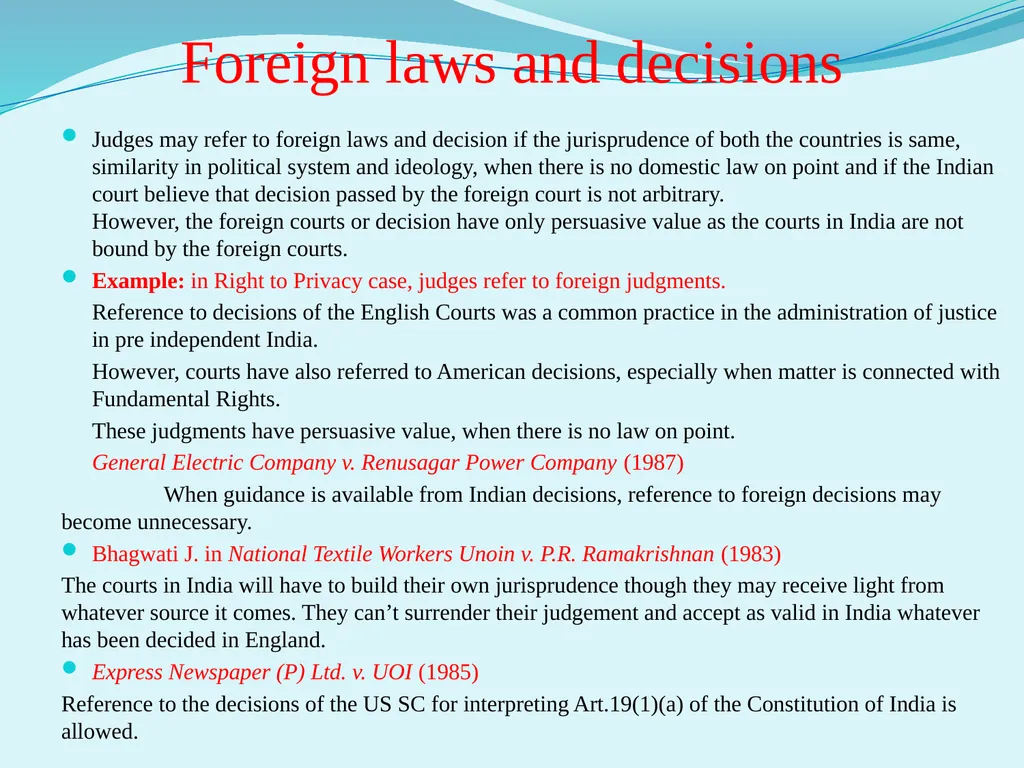
slide22. Foreign laws and decisions Judges may refer to foreign laws and decision if the jurisprudence of both the countries is same, similarity in political system and ideology, when there is no domestic law on point and if the Indian court believe that decision passed by the foreign court is not arbitrary. However, the foreign courts or decision have only persuasive value as the courts in India are not bound by the foreign courts.
Example: in Right to Privacy case, judges refer to foreign judgments.
Reference to decisions of the English Courts was a common practice in the administration of justice in pre independent India.
However, courts have also referred to American decisions, especially when matter is connected with Fundamental Rights.
These judgments have persuasive value, when there is no law on point.
General Electric Company v. Renusagar Power Company (1987)
When guidance is available from Indian decisions, reference to foreign decisions may become unnecessary.
Bhagwati J. in National Textile Workers Unoin v. P.R. Ramakrishnan (1983)
The courts in India will have to build their own jurisprudence though they may receive light from whatever source it comes. They can’t surrender their judgement and accept as valid in India whatever has been decided in England.
Express Newspaper (P) Ltd. v. UOI (1985)
Reference to the decisions of the US SC for interpreting Art.19(1)(a) of the Constitution of India is allowed.<br>
External aids to Interpretation
Dr Kalpesh Nikawat<br>
slide2. What is interpretation of statutes? Interpretation is the process which is employed by the judiciary to ascertain or to determine the meaning of the statutes or legal provision. It is basically a process by which court seeks to ascertain the true meaning of the expression or word or phrase which is in question in any statute before the court and determine the true intention of the legislature behind such statutory provision. A process of interpretation employed by the judiciary can be done through various tools or principles of statutory interpretation which include seeking help from internal or external aids to interpretation and applying primary or secondary rule of interpretation which has evolved over a period of time by the court.<br>
slide3. Interpretation of statutes The purpose of interpretation is to find out the intention of the legislature..
The aids to interpretation help a judge find out the same.
These also help in deriving proper context in which a statute is to be applied.<br>
slide4. Definitions According to Salmond:
Interpretation and construction is the process by which the court seek to ascertain the meaning of the legislature through the medium of authoritative forms in which it is expressed. According to Blackstone: The most fair and rational method for interpreting a statute is by exploring the intention of the legislature through texts, the subject matter, the effect and consequences or the spirit and reason of law.<br>
slide5. Types of interpretation aids Broadly two interpretation aids are available:-
(1) Internal aids - which are existing in the Statutes itself
(2) External aids - which are found outside the Statutes.<br>
slide6. External Aid to Interpretation External aids are the aids which are not available inside the statute but outside the statute, the court may seek help to the external aids in case of repugnancy or inconsistency in the statutory provision.
When internal aids are not adequate, the court has to take recourse to external aids. The external aids are very useful tools for the interpretation or construction of statutory provisions. As opposed to internal aids to construction there are certain aids which are external to the statute. External Aids may be parliamentary material, historical background, reports of a committee or a commission, official statement, dictionary meanings, foreign decisions, etc.
In Prabhakar Rao and others v. State of A.P. and others AIR 1986 SC 120 O. Chennappa, Reddy J. has observed: Where internal aids are not forthcoming, we can always have recourse to external aids<br>
slide7. External Aid to Interpretation 1. Parliamentary History
2.Historical Facts & Surrounding circumstances
3.Later Social, Economic, Political developments and Scientific Inventions.
4.Reference to other Statues.
5. Contemporary opinion
6. Policy Behind the Act
7. Precedent
8. Use of Dictionaries
9. Use of Foreign Decision
10. Subtraction & Insertion of words
11. Use of General Clause Act<br>
slide8. Parliamentary History, Historical Facts and Surrounding Circumstances Parliamentary History, Historical Facts and Surrounding Circumstances Historical setting cannot be used as an aid if the words are plain and clear. If the wordings are ambiguous, the historical setting may be considered in order to arrive at the proper construction. Historical setting covers parliamentary history, historical facts, statement of objects and reasons, report of expert committees. Parliamentary history means the process by which an act is enacted. This includes conception of an idea, drafting of the bill, the debates made, the amendments proposed etc. Speech made in mover of the bill, amendments considered during the progress of the bill are considered in parliamentary history where as the papers placed before the cabinet which took the decision for the introduction of the bill are not relevant since these papers are not placed before the parliament. The historical facts of the statute that is the external circumstances in which it was enacted in should also be taken into note so that it can be understood that the statute in question was intended to alter the law or leave it where it stood. Statement of objective and reasons as to why the statute is being brought to enactment can also be a very helpful fact in the research for historical facts, but the same if done after extensive amendments in statute it may be unsafe to attach these with the statute in the end. It is better to use the report of a committee before presenting it in front of the legislature as they guide us with a legislative intent and place their recommendations which come in handy while enactment of the bill. The Supreme Court in a numbers of cases referred to debates in the Constituent Assembly for interpretation of Constitutional provisions.
Recently, the Supreme Court in S.R. Chaudhuri v State of Punjab and others, (2001) 7 SCC 126 has stated that it is a settled position that debates in the Constituent Assembly may be relied upon as an aid to interpret a Constitutional provision because it is the function of the Court to find out the intention of the framers of the Constitution. (Para 33).<br>
slide9. External Aid to Interpretation Parliamentary History
Parliamentary history may include:
The bill in its original form or the amendments considered during its progress in the Legislature
Statements of Objects and Reasons (Speech of the minister)
Parliamentary debates
Reports submitted by different Committees and commissions.
These were not used as an aid to interpretation initially. However, occasionally courts have adhered to use them for expounding the true meaning of legislation.
Pepper v. Hart (1993)
“The reference to Parliamentary material should be permitted as an aid to the construction of legislation which is ambiguous or obscure or literal meaning of which leads to absurdity.”
Chiranjit Lal Chowdhury v. UOI (1951) Fazal Ali, J., admitted Parliamentary History including the speech of the minister introducing the bill as evidence of the circumstances which necessitated the passing of the Act.<br>
slide10. External Aid to Interpretation Indira Sawhney v. UOI (1993)
While interpreting Article 16(4) of the Constitution the Supreme Court referred to Dr. Ambedkar’s speech in the Constituent Assembly as the expression backward class of citizens’ is not defined. The court held that reference to Parliamentary debate is permissible to ascertain the context, background and objective of the legislatures but at the same time such references could not be taken as conclusive or binding on the courts.<br>
slide11. ऐतिहासिक पृष्ठभूमि किसी अधिनियमति का अर्थान्वयन करते समय न केवल प्रयुक्त शब्दों को देखा जाना चाहिए, बल्कि उस अधिनियम के इतिहास और उन कारणों को भी देखा जाना चाहिए जिनके आधार पर उसे पारित किया गया। उस रिष्टि को भी देखना है जिसे दूर करने की आवश्यकता थी और उस विचार को भी जो उसे दूर करने के लिए प्रदान किया गया था। वह विषय वस्तु जिस पर विधायिका कार्य कर रही थी, और वे तथ्य जो उस समय विद्यमान थे जिनके संदर्भ में विधायिका विधान बना रही थी, यह जानने के लिए कि अधिनियम पारित करने में विधायिका का उद्देश्य और प्रयोजन क्या था, ध्यान में रखने के लिए उपयुक्त विषय है।<br>
slide12. विधायी इतिहास प्राचीन काल में वास्तविक संदर्भ जानने के लिए कभी-कभी न्यायालय किसी कानून के विधायी इतिहास को भी देखना चाहता था। परंतु आधुनिक बहुमत विचारधारा कदाचित यही है की विधायी इतिहास को निर्वचन के ब्राहय सहयोगी के रुप में नहीं लिया जा सकता। अतः सदनों के मंच पर किए गए विचार विमर्श प्रवर, समिति की रिपोर्टों तथा उद्देश्यों और कारणों के कथन निर्वचन के बरस योगी के रूप में अग्राह्य हैं, इस नियम का आधार कदाचित यही है कि विधायकों के मस्तिष्क में जो कुछ था उसे उनके द्वारा स्पष्ट शब्दों में व्यक्त किया जा चुका है, तथा विधायक अपने व्यक्तिगत विचारों से न्यायालय को प्रभावित नहीं कर सकते।<br>
slide13. Developments—Social ,Political, Economic and Scientific Developments—Social ,Political, Economic and Scientific
According to Waisman:
“ Judges are not robots. They have to evolve various methods and techniques to tackle a problem which confronts them.”
R v. Ireland (1997)
The psychiatric injury which was caused by silent telephone calls was held to amount to “assault” or “bodily harm” under sections 20 and 47 of the Offence Against Person Act,1861 in the light of the current scientific appreciation of the link between the body and psychiatric injury.
R v. Fellows (1997)
The data stored in a computer disc, a technique not known in 1978 amounts to “indecent photograph” within the meaning of section 1 of the Protection of Children Act,1978 which penalizes taking or distribution of indecent photograph of children under the age of sixteen.
Bacchan Singh v. State of Punjab (1982)
SC, while upholding the constitutionality of death penalty, observed that Constitutional Law also raises economic, social, moral and political problems. And along with the history, the recent developments shall also be taken into account.<br>
slide14. Reference to other statutes Reference to other statutes
This may include referring to statutes in pari materia and earlier statutes.
Statutes which relate to the same subject, the same person or thing or the same class of persons or things are deemed to constitute one system of law, they are considered as one statute.
R v. Loxdale
“Where there are different statutes in pari materia though made at different times, or even expired, and not referring to each other, they shall be taken and construed together as one system and as explanatory of each other”.
Ahmedabad Pvt. P.T. Association v. Adm. Officer
It was observed that the word “employee” defined in section 2(e) of Payment of Gratuity Act is to be construed by referring to other Labour Enactments dealing with the same subject.
When the two legislations have different scopes it cannot be said that they are in pari materia.
Shah and Co., Bombay V. State of Maharashtra
The Bombay Rents, Hotel and Lodging Rates Control Act, 1947 and the Bombay Land Requisition Act, 1948 were not held to be Acts in pari materia as they do not relate to the same persons or thing or to the same class of persons or things.<br>
slide15. Legislative Debates/Speech It is referred as to debates or speeches which are made in the course of passing a bill in the parliament by the parliamentarians to put forth their view. It is not considered as a conclusive aid to interpretation and is therefore, not admissible because many times speeches are influenced by the political pressure or maybe incorrect to rely upon.<br>
slide16. Constituent Debates/Speech It shall compromises all such debate which had taken place in the parliament at the time of formation of Constitution of India. In case of inconsistency or repugnancy in the Constitution the court can clearly refer to such debates. Indra Sawhney v. Union of India AIR 1993 SC 477 the interpretation of the expression backward class of citizen' used in Article 16(4) was in question before the court. The SC under this case referred to the speech given by B.R. Ambedkar to understand the context, background and object behind its use of the given expression.<br>
slide17. Dictionaries When a word used in the statute is not defined therein or if defined but the meaning is unclear only in such situation, the court may refer to the dictionary meaning of the statute to find out meaning of the word in ordinary sense. The meaning of such words shall be interpreted so to make sure that it is speaking about the particular statute because words bears different meaning in different context. Motipur zamindary company private limited v. State of Bihar AIR 1962 SC 660 the question was whether sales tax can be levied on Sugarcane. The applicant argued that it is green vegetable and should be exempted from tax. The dictionary meaning of vegetable said anything which derived or obtained from the plants. The SC rejected dictionary meaning and held that in common parlance vegetable is something which is grown in kitchen garden and used during lunch and dinner and held that sugarcane is not vegetable.
किसी कानून में प्रयोग किए गए शब्दों का निर्वचन उनके साधारण अर्थ के संदर्भ में किया जाना चाहिए, क्योंकि शब्दकोश किसी शब्द के कई अर्थों को स्पष्ट करता है, इसलिए सामान्यतः उन अर्थों की जानकारी के लिए शब्दकोश सहायक है, अतः किसी शब्द के साधारण अर्थ को जानने के लिए न्यायालय शब्दकोश का सहयोग ले सकता है परंतु ऐसा करने के लिए न्यायालय को बहुत सावधान रहने की आवश्यकता है क्योंकि यह आवश्यक नहीं कि कानून के विशेष संदर्भ में उन अर्थों में से कोई अर्थ वास्तव में उचित ही हो, इसलिए कई बार न्यायालय बहुत से अर्थों में से कोई अर्थ ठीक मानकर चुन लेता है और कई बार कानून के सन्दर्भ को देखते हुए न्यायालय अर्थों को अस्वीकार भी कर देता है प्रत्येक परिस्थिति में न्यायालय को विशिष्ट कानून के उद्देश्य और सन्दर्भ को ध्यान रखना पड़ता है ।<br>
slide18. मोतीपुर जमीदारी कंपनी प्राइवेट लिमिटेड बनाम बिहार राज्य एआईआर 1962 एससी 660 प्रश्न यह था कि क्या बिहार विक्रय कर अधिनियम 1947 की अनुसूची के मद 6 के अंतर्गत गन्ना एक ग्रीन वेजिटेबल होने के कारण उसके विक्रय पर कर आरोपित नहीं किया जा सकता। अपीलार्थी ने अपने तर्क के पक्ष में अभिव्यक्त ‘ग्रीन वेजिटेबल’ का शब्दकोश अर्थ प्रस्तुत किया । उच्चतम न्यायालय ने इस तर्क से असहमति व्यक्त करते हुए कहा कि ‘ग्रीन वेजिटेबल’ का अर्थ प्रस्तुत संदर्भ में केवल वस्तुओं से है, जिन्हें रसोई उद्यान में उगाया जा सकता है और जो दोपहर व रात के खाने के साथ खाए जाते हैं, अतः इस शब्द का अर्थ केवल हरी सब्जियों से है, जिसके अंतर्गत गन्ना नहीं आता । क्योंकि गन्ने को खाने की मेज पर सब्जी के रूप में नहीं खाया जाता । विधायिका का आशय ग्रीन वेजिटेबल शब्द के प्रयोग में उन वस्तुओं से हैं जिन्हें सामान्य व्यक्ति ग्रीन वेजिटेबल के रूप में समझता है और गन्ना इस कोटी में नहीं आता, अतः प्रस्तुत संदर्भ में शब्दकोश अर्थ का कोई महत्व नहीं है ।<br>
slide19. Text Books The court while construing an enactment, may refer to the standard textbooks to clear the meaning. Although, the courts are not bound to accept such view. The court time and again referred to Mulla, Kautiliya, Manu, Arthshastra.
Example: in Kesavananda Bharthi case AIR 1973 SC 1461 , judges quoted large number of books.
किसी अधिनियमति के वास्तविक अर्थ को जानने के लिए न्यायालय पाठ्य पुस्तकों का सहयोग ले सकता है । परंतु यह आवश्यक नहीं कि उनमें दी गई राय न्यायालय की राय भी हो पाठ्य पुस्तकों में दी गई राय को न्यायालय द्वारा स्वीकृत किए जाने के तथा अस्वीकार किए जाने के दोनों प्रकार के ही दृष्टांत उपलब्ध है । मनु, याज्ञवल्क्य ,ज्ञानेश्वर ,जीमूत वाहन तथा कौटिल्य आदि को न्यायालय के द्वारा अनेक बार उद्धत किया गया तथा उनके विचारों को मान्यता दी गई है मुल्ला की पुस्तक भी इसी प्रकार सहायक सिद्ध होती रही है ।<br>
slide20. केशवानंद भारती बनाम केरल राज्य एआईआर 1973 एससी 1461 उपरोक्त वाद में पर्याप्त संख्या में पाठ्य पुस्तकों में उल्लिखित विचार न्यायालय के समक्ष रखे गए, परंतु उच्चतम न्यायालय के कई न्यायाधीशों ने यह विचार व्यक्त किए कि इनमें उल्लेखित विचारों और प्रतिकूल विचारों की अधिक संख्या को देखते हुए यही उचित है, कि उनको अधिक महत्व न देकर कानून के संदर्भ को सदा ध्यान में रखकर ही निर्वचन किया जाए यही कुशल नीति है ।<br>
slide21. Statement of objects and reasons The statement of object and reasons are attached to the bill which describe the objects, purpose and the reason for the bill. It also gives understanding of the background, the antecedent state of affairs and the object the law seeks to achieve. The parliament before passing a bill must take into consideration that what object a bill serve to achieve. However, it is not considered as conclusive aid to interpretation because doesn't impart the true meaning to the statutory provision.<br>
slide22. Foreign laws and decisions Judges may refer to foreign laws and decision if the jurisprudence of both the countries is same, similarity in political system and ideology, when there is no domestic law on point and if the Indian court believe that decision passed by the foreign court is not arbitrary. However, the foreign courts or decision have only persuasive value as the courts in India are not bound by the foreign courts.
Example: in Right to Privacy case, judges refer to foreign judgments.
Reference to decisions of the English Courts was a common practice in the administration of justice in pre independent India.
However, courts have also referred to American decisions, especially when matter is connected with Fundamental Rights.
These judgments have persuasive value, when there is no law on point.
General Electric Company v. Renusagar Power Company (1987)
When guidance is available from Indian decisions, reference to foreign decisions may become unnecessary.
Bhagwati J. in National Textile Workers Unoin v. P.R. Ramakrishnan (1983)
The courts in India will have to build their own jurisprudence though they may receive light from whatever source it comes. They can’t surrender their judgement and accept as valid in India whatever has been decided in England.
Express Newspaper (P) Ltd. v. UOI (1985)
Reference to the decisions of the US SC for interpreting Art.19(1)(a) of the Constitution of India is allowed.<br>