
Interpretation Of Statutes -Anusha M V Assistant
PM
Published · 60 slides · 0 views

1 / 1










Description
Interpretation Of Statutes -Anusha M V Assistant Professor Judge-made Law Statute Rule Constitution LAW What is a Statute? The law that has its source in legislation is called enacted law or statute law. It is the principal source of modern
Related Topics
Share
Embed code
Download this presentation From Below
"Interpretation Of Statutes -Anusha M V Assistant" is the property of its rightful owner. Permission is granted to download and print the materials on this website for personal, non-commercial use only, and to display it on your personal computer provided you do not modify the materials and that you retain all copyright notices contained in the materials. By downloading content from our website, you accept the terms of this agreement.
Presentation Transcript
01
Interpretation Of Statutes
-Anusha M V
Assistant Professor<br>
02
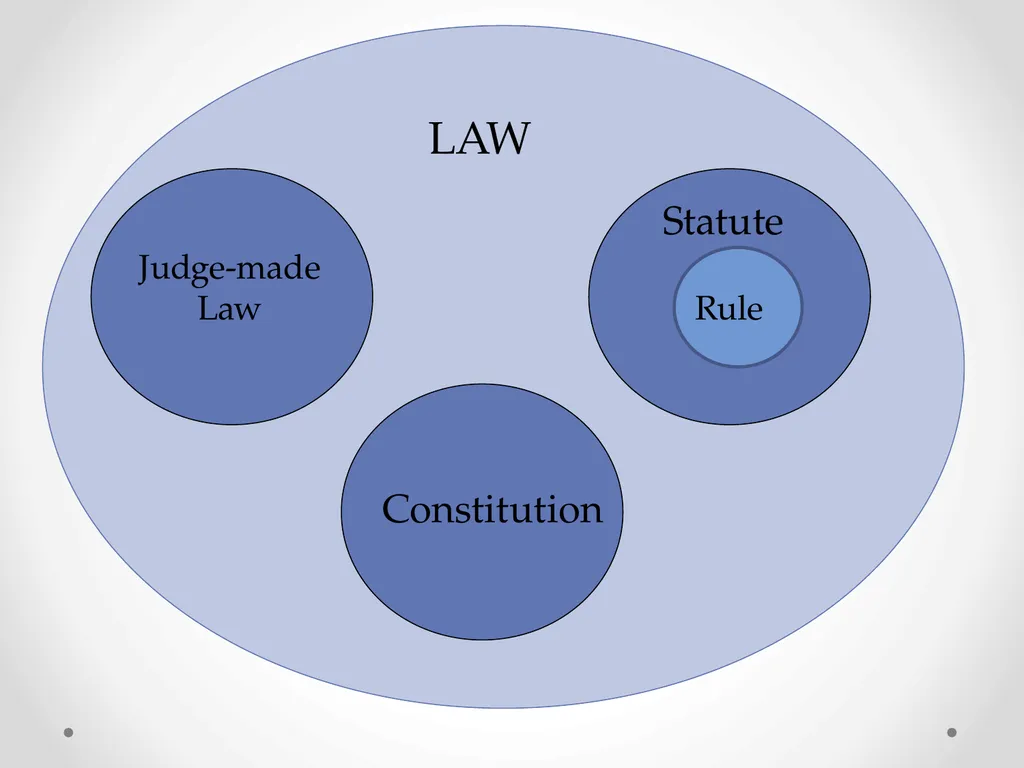
Judge-made Law Statute Rule Constitution LAW<br>
03
What is a Statute?
The law that has its source in legislation is called enacted law or statute law.
It is the principal source of modern law.
Created by legislature.
Statute may be regarded as a body of universal, absolute, binding rules.
It is the expression of will of legislature.<br>
The law that has its source in legislation is called enacted law or statute law.
It is the principal source of modern law.
Created by legislature.
Statute may be regarded as a body of universal, absolute, binding rules.
It is the expression of will of legislature.<br>
04
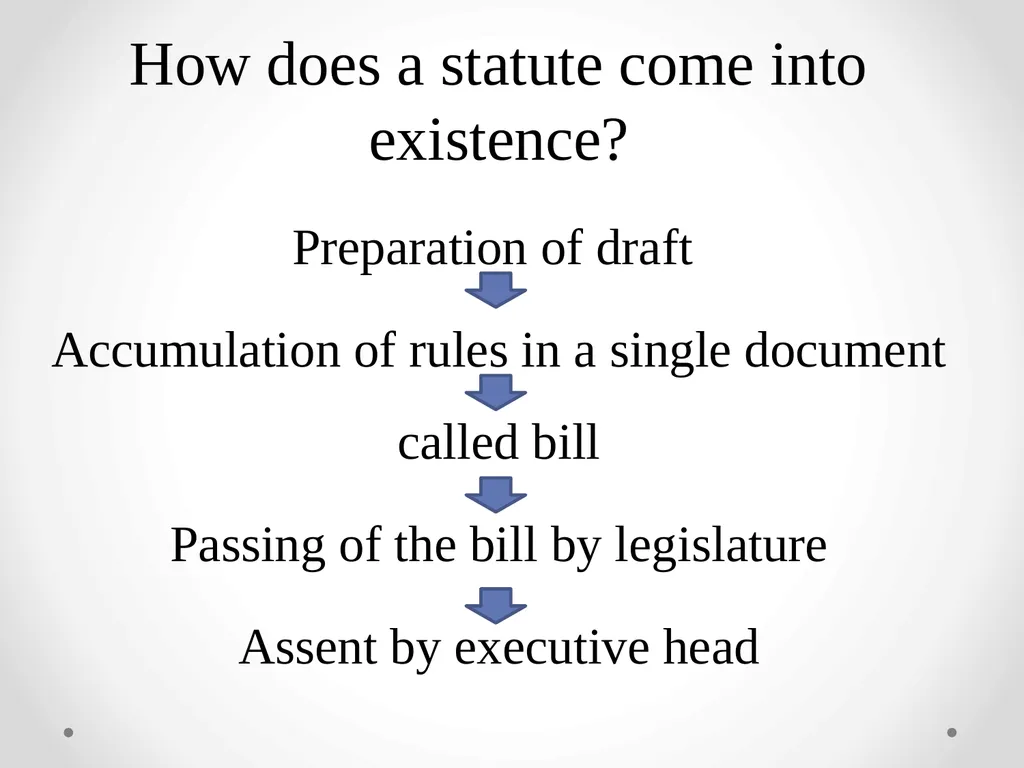
How does a statute come into existence?
Preparation of draft
Accumulation of rules in a single document called bill
Passing of the bill by legislature
Assent by executive head<br>
Preparation of draft
Accumulation of rules in a single document called bill
Passing of the bill by legislature
Assent by executive head<br>
05
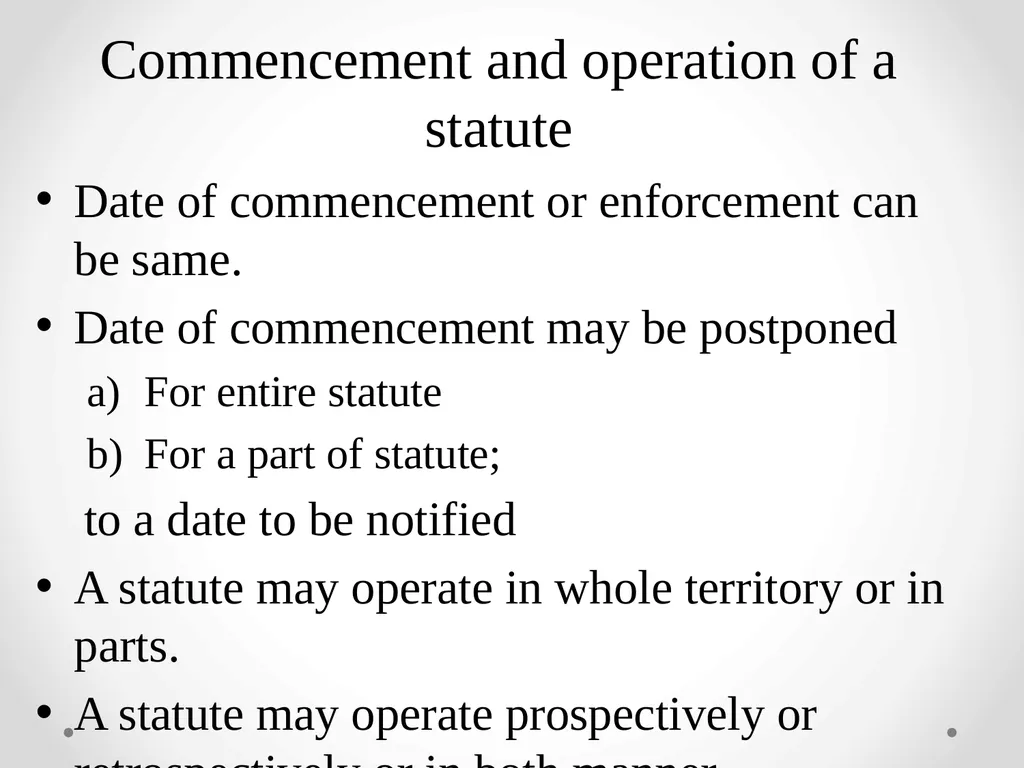
Commencement and operation of a statute
Date of commencement or enforcement can be same.
Date of commencement may be postponed
For entire statute
For a part of statute;
to a date to be notified
A statute may operate in whole territory or in parts.
A statute may operate prospectively or retrospectively or in both manner.<br>
Date of commencement or enforcement can be same.
Date of commencement may be postponed
For entire statute
For a part of statute;
to a date to be notified
A statute may operate in whole territory or in parts.
A statute may operate prospectively or retrospectively or in both manner.<br>
06
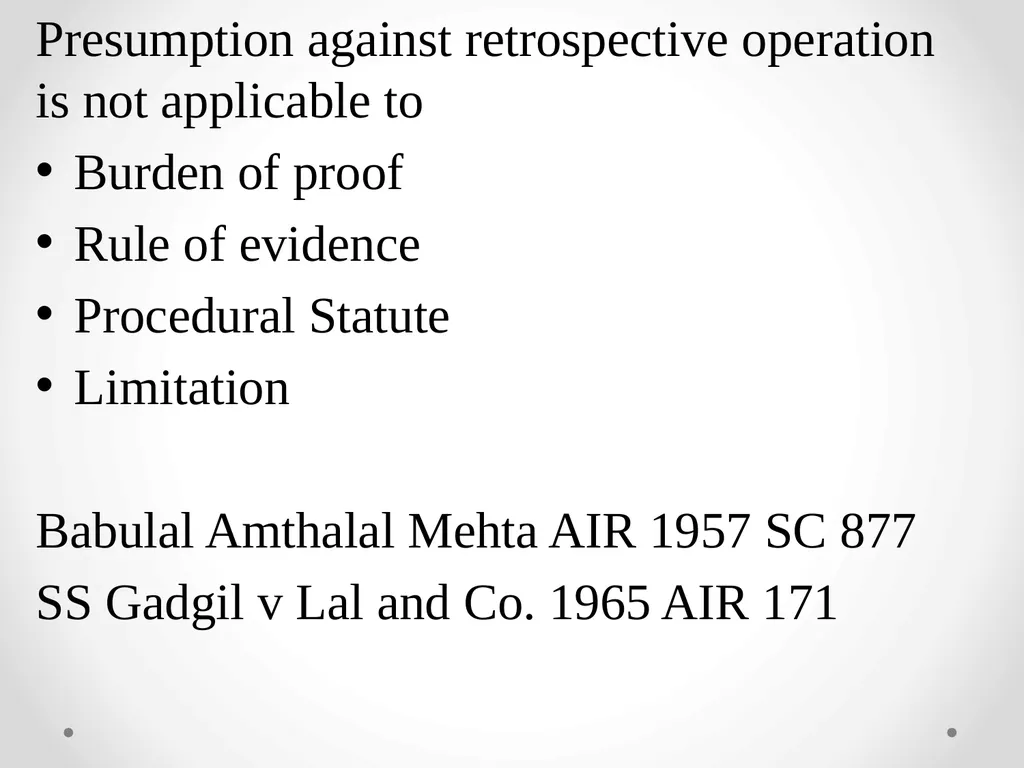
Presumption against retrospective operation is not applicable to
Burden of proof
Rule of evidence
Procedural Statute
Limitation
Babulal Amthalal Mehta AIR 1957 SC 877
SS Gadgil v Lal and Co. 1965 AIR 171<br>
Burden of proof
Rule of evidence
Procedural Statute
Limitation
Babulal Amthalal Mehta AIR 1957 SC 877
SS Gadgil v Lal and Co. 1965 AIR 171<br>
07
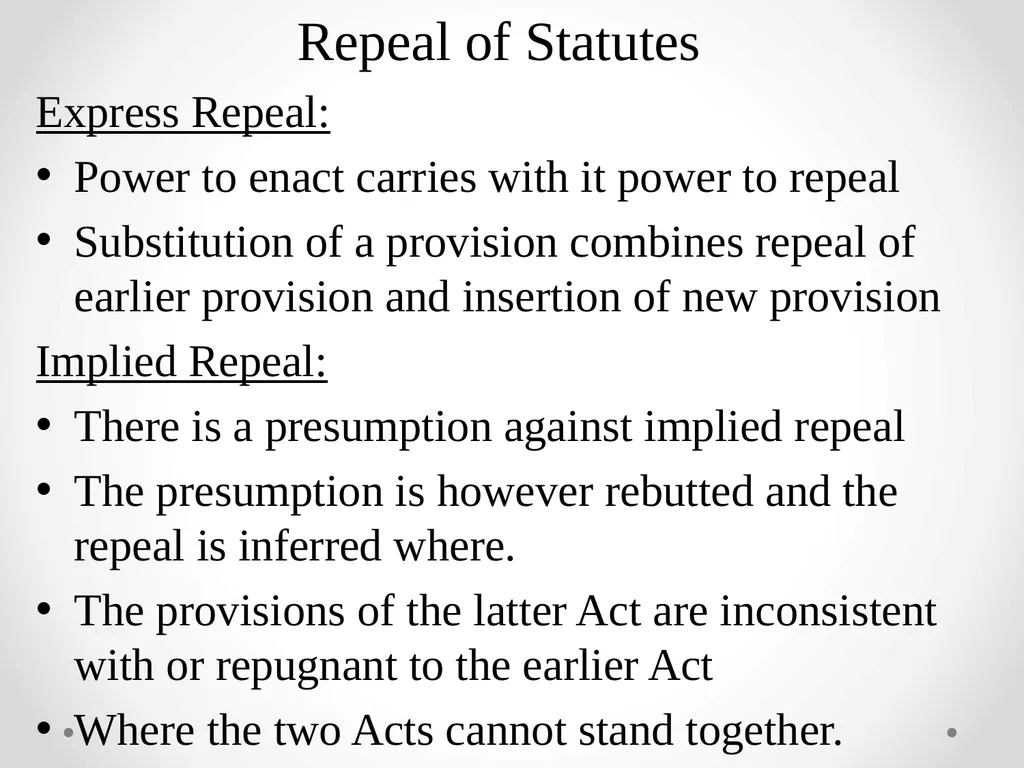
Repeal of Statutes
Express Repeal:
Power to enact carries with it power to repeal
Substitution of a provision combines repeal of earlier provision and insertion of new provision
Implied Repeal:
There is a presumption against implied repeal
The presumption is however rebutted and the repeal is inferred where.
The provisions of the latter Act are inconsistent with or repugnant to the earlier Act
Where the two Acts cannot stand together.<br>
Express Repeal:
Power to enact carries with it power to repeal
Substitution of a provision combines repeal of earlier provision and insertion of new provision
Implied Repeal:
There is a presumption against implied repeal
The presumption is however rebutted and the repeal is inferred where.
The provisions of the latter Act are inconsistent with or repugnant to the earlier Act
Where the two Acts cannot stand together.<br>
08
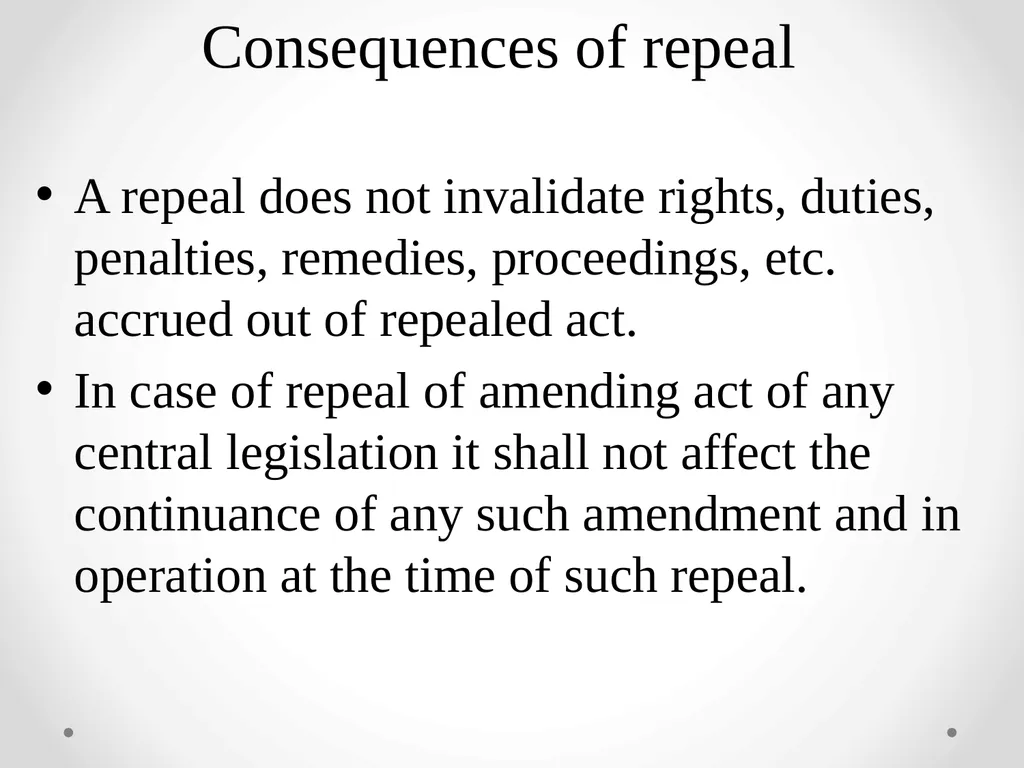
Consequences of repeal
A repeal does not invalidate rights, duties, penalties, remedies, proceedings, etc. accrued out of repealed act.
In case of repeal of amending act of any central legislation it shall not affect the continuance of any such amendment and in operation at the time of such repeal.<br>
A repeal does not invalidate rights, duties, penalties, remedies, proceedings, etc. accrued out of repealed act.
In case of repeal of amending act of any central legislation it shall not affect the continuance of any such amendment and in operation at the time of such repeal.<br>
09
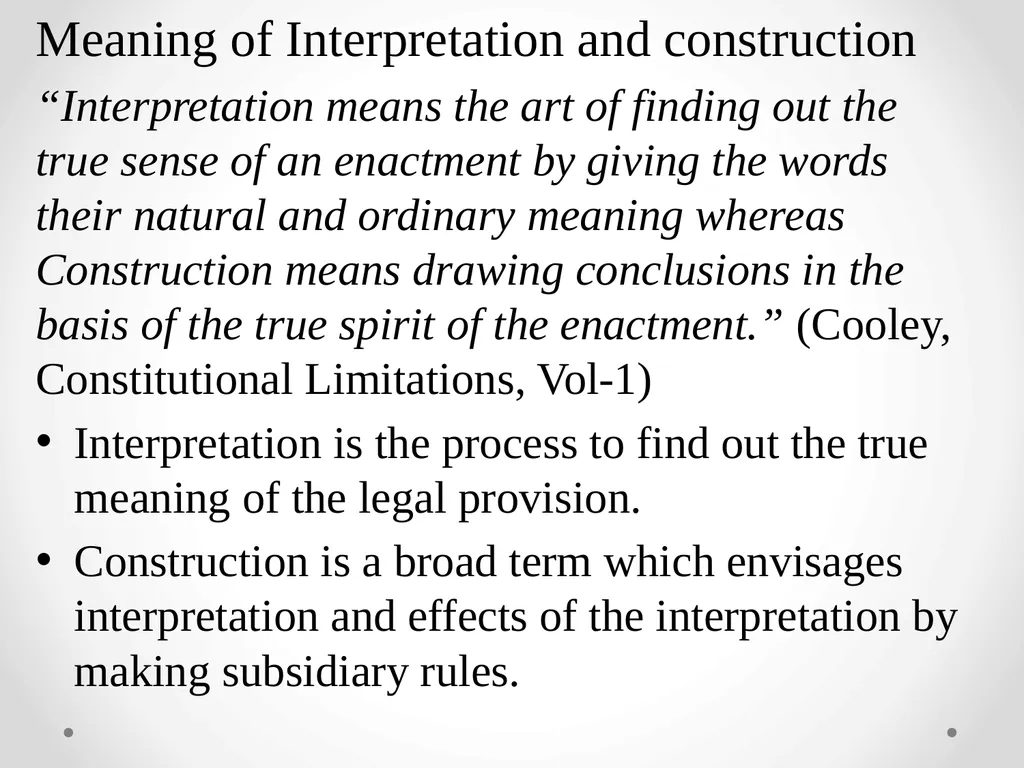
Meaning of Interpretation and construction
“Interpretation means the art of finding out the true sense of an enactment by giving the words their natural and ordinary meaning whereas Construction means drawing conclusions in the basis of the true spirit of the enactment.” (Cooley, Constitutional Limitations, Vol-1)
Interpretation is the process to find out the true meaning of the legal provision.
Construction is a broad term which envisages interpretation and effects of the interpretation by making subsidiary rules.<br>
“Interpretation means the art of finding out the true sense of an enactment by giving the words their natural and ordinary meaning whereas Construction means drawing conclusions in the basis of the true spirit of the enactment.” (Cooley, Constitutional Limitations, Vol-1)
Interpretation is the process to find out the true meaning of the legal provision.
Construction is a broad term which envisages interpretation and effects of the interpretation by making subsidiary rules.<br>
10
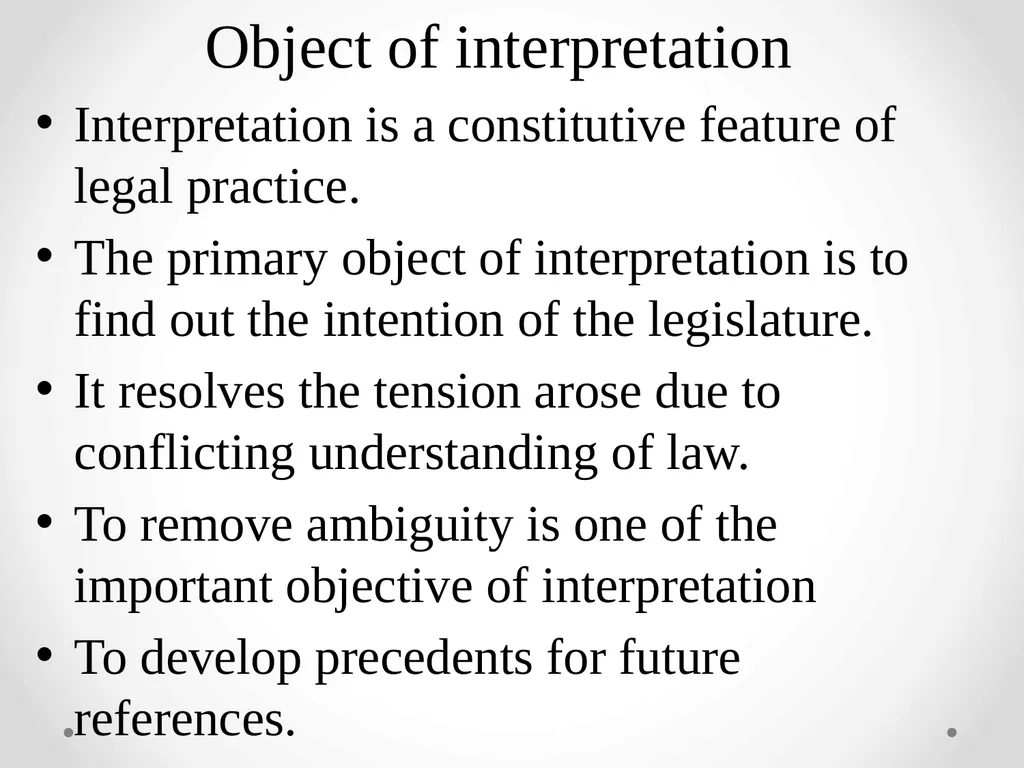
Object of interpretation
Interpretation is a constitutive feature of legal practice.
The primary object of interpretation is to find out the intention of the legislature.
It resolves the tension arose due to conflicting understanding of law.
To remove ambiguity is one of the important objective of interpretation
To develop precedents for future references.<br>
Interpretation is a constitutive feature of legal practice.
The primary object of interpretation is to find out the intention of the legislature.
It resolves the tension arose due to conflicting understanding of law.
To remove ambiguity is one of the important objective of interpretation
To develop precedents for future references.<br>
11
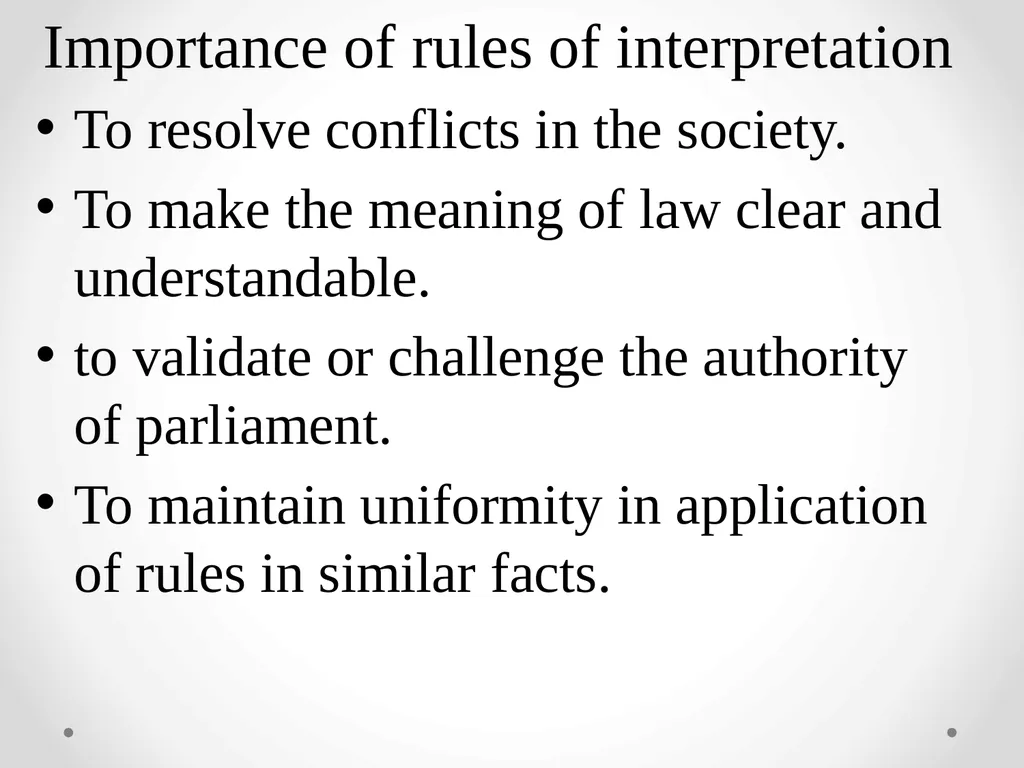
Importance of rules of interpretation
To resolve conflicts in the society.
To make the meaning of law clear and understandable.
to validate or challenge the authority of parliament.
To maintain uniformity in application of rules in similar facts.<br>
To resolve conflicts in the society.
To make the meaning of law clear and understandable.
to validate or challenge the authority of parliament.
To maintain uniformity in application of rules in similar facts.<br>
12
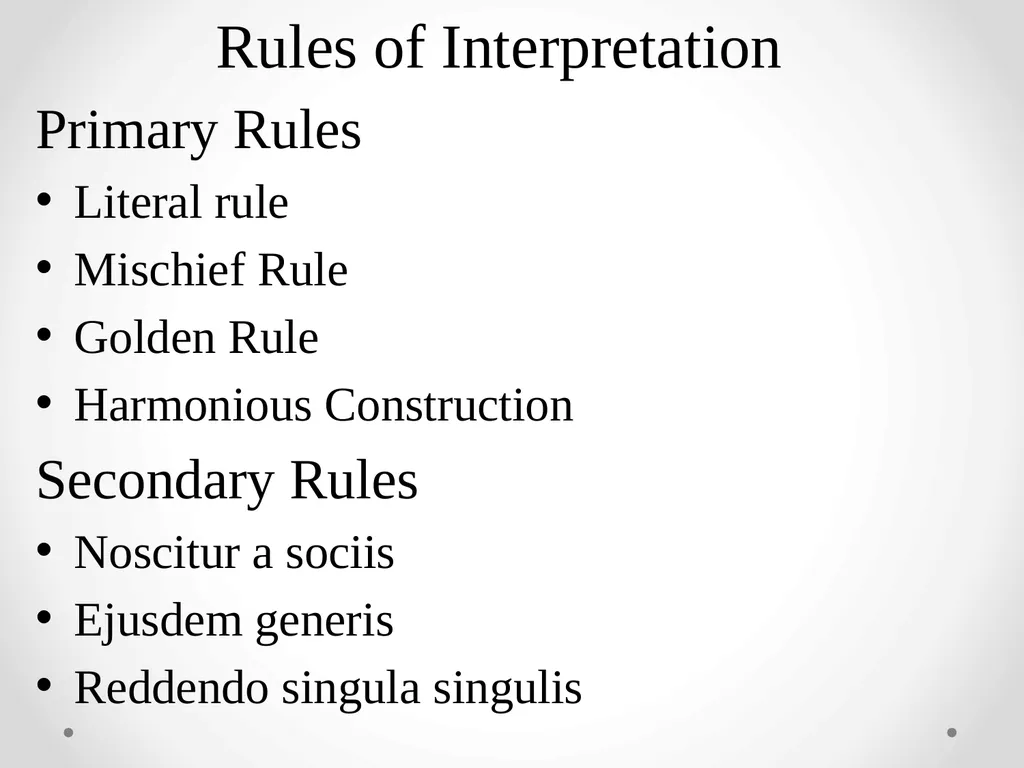
Rules of Interpretation
Primary Rules
Literal rule
Mischief Rule
Golden Rule
Harmonious Construction
Secondary Rules
Noscitur a sociis
Ejusdem generis
Reddendo singula singulis<br>
Primary Rules
Literal rule
Mischief Rule
Golden Rule
Harmonious Construction
Secondary Rules
Noscitur a sociis
Ejusdem generis
Reddendo singula singulis<br>
13
LITERAL RULE
The first primary rule- litera legis.
Verbis legis non est recelendum- there should be no departure from the words of law.
Giving words their ordinary and natural meaning is known as literal interpretation.
This rule was laid down in Sussex Peerage Case (1884):
“If the words of the statute are in themselves precise and unambiguous, then no more can be necessary than to expound those words in their natural and ordinary sense. But if any doubt arises from the terms employed by the Legislature, it has always been held a safe mean of collecting the intention to call in aid the ground and cause of making the statute, and to have recourse to the preamble”.<br>
The first primary rule- litera legis.
Verbis legis non est recelendum- there should be no departure from the words of law.
Giving words their ordinary and natural meaning is known as literal interpretation.
This rule was laid down in Sussex Peerage Case (1884):
“If the words of the statute are in themselves precise and unambiguous, then no more can be necessary than to expound those words in their natural and ordinary sense. But if any doubt arises from the terms employed by the Legislature, it has always been held a safe mean of collecting the intention to call in aid the ground and cause of making the statute, and to have recourse to the preamble”.<br>
14
The basic rule is to look at the intention of the legislature.
According to the proponents of this rule a judge cannot use his own subjectivity to replace legislator’s subjectivity.
This rule does not allow flexibility and discards any deviation from the legislative intent. Lord Esher in R. v. The Judge of the City of London Court stated that
“if the words of an Act are clear you must follow them, even though they lead to manifest absurdity”
The supporters of this rule say that It is the duty of the court not to modify the language of the Act.<br>
According to the proponents of this rule a judge cannot use his own subjectivity to replace legislator’s subjectivity.
This rule does not allow flexibility and discards any deviation from the legislative intent. Lord Esher in R. v. The Judge of the City of London Court stated that
“if the words of an Act are clear you must follow them, even though they lead to manifest absurdity”
The supporters of this rule say that It is the duty of the court not to modify the language of the Act.<br>
15
Maqbool Hussain v State of Bombay
The appellant, a citizen of India, on arrival at an airport did not declare that he brought gold with him. Gold, found in his possession during search in violation of government notification, was confiscated under Sea Customs Act, 1878. He was also charged under Foreign Exchange Regulation Act. The appellant pleaded that his trial under the Act was violative of Art 20(2) of the constitution relating to double jeopardy as he was already punished for his act by was of confiscation of the gold. It was held by the Supreme Court that the sea customs authority is not a court or a judicial tribunal and the confiscation is not a penalty.<br>
The appellant, a citizen of India, on arrival at an airport did not declare that he brought gold with him. Gold, found in his possession during search in violation of government notification, was confiscated under Sea Customs Act, 1878. He was also charged under Foreign Exchange Regulation Act. The appellant pleaded that his trial under the Act was violative of Art 20(2) of the constitution relating to double jeopardy as he was already punished for his act by was of confiscation of the gold. It was held by the Supreme Court that the sea customs authority is not a court or a judicial tribunal and the confiscation is not a penalty.<br>
16
Municipal board v State transport authority,Rajasthan
According to S. 64 A of the Motor vehicles Act, 1939 “an application against the change of location of a bus stand could be made within 30 days of receipt of order of regional transport authority”. The application was moved after 30 days on the contention that statute must be read as “30 days from the knowledge of the order”
The Supreme Court held that literal interpretation must be made and hence rejected the application as invalid.<br>
According to S. 64 A of the Motor vehicles Act, 1939 “an application against the change of location of a bus stand could be made within 30 days of receipt of order of regional transport authority”. The application was moved after 30 days on the contention that statute must be read as “30 days from the knowledge of the order”
The Supreme Court held that literal interpretation must be made and hence rejected the application as invalid.<br>
17
Madan mohan v K.Chandrashekara
“when a statute contains strict and stringent provisions, it must be literally and strictly construed to promote the object of the act.”
Bhavnagar University v Palitana Sugar Mills Pvt Ltd
“According to the fundamental principles of construction the statute should be read as a whole, then chapter by Chapter, section by section and then word by word.”<br>
“when a statute contains strict and stringent provisions, it must be literally and strictly construed to promote the object of the act.”
Bhavnagar University v Palitana Sugar Mills Pvt Ltd
“According to the fundamental principles of construction the statute should be read as a whole, then chapter by Chapter, section by section and then word by word.”<br>
18
The critics say that ordinary and natural meaning of the words should not be controlled by spirit of legislature.
This rule has been criticised on account of :
It being too rigid.
This rule fails to recognize error on part of legislature.
The natural and ordinary meaning of a word may get in conflict with the purpose of the law.<br>
This rule has been criticised on account of :
It being too rigid.
This rule fails to recognize error on part of legislature.
The natural and ordinary meaning of a word may get in conflict with the purpose of the law.<br>
19
Exact Meaning should be preferred to loose meaning
Prithipal Singh v. UOI (1982)- There is a presumption that words are used in an Act of Parliament correctly and exactly and not loosely or inexactly.
Spillers ltd. v. Caradix Assessment Committee and Pritchard (1931)- exact meaning of the word ‘contiguous’ – ‘touching’ was preferred over its loose meaning ‘neighbouring’.<br>
Prithipal Singh v. UOI (1982)- There is a presumption that words are used in an Act of Parliament correctly and exactly and not loosely or inexactly.
Spillers ltd. v. Caradix Assessment Committee and Pritchard (1931)- exact meaning of the word ‘contiguous’ – ‘touching’ was preferred over its loose meaning ‘neighbouring’.<br>
20
Technical words to be used in Technical Sense
“If the Act is passed with reference to a particular trade, business or transaction and the words are used which everybody conversant with trade, business or transaction knows or understands to have a particular meaning in it, then the words are to be construed as having that particular meaning”- Lord Esher in Unwin v. Hanson (1891).
Aswini Kumar Ghose v. Arabinda Ghose (1952)
Labour Inspector, Central v. Chittapur Stone Quarrying Co. Pvt. Ltd. (1972)<br>
“If the Act is passed with reference to a particular trade, business or transaction and the words are used which everybody conversant with trade, business or transaction knows or understands to have a particular meaning in it, then the words are to be construed as having that particular meaning”- Lord Esher in Unwin v. Hanson (1891).
Aswini Kumar Ghose v. Arabinda Ghose (1952)
Labour Inspector, Central v. Chittapur Stone Quarrying Co. Pvt. Ltd. (1972)<br>
21
Cassus omissus
It means cases omitted.
“a matter which should have been, but has not been provided for in a statute cannot be supplied by courts, as to do so will be legislation and not construction.”- Hansraj Gupta v. Dehra Dun Mussorie Electric Tramway Co. Ltd.
If the legislature has omitted to provide for in a statute, the court cannot fill the gap by means of adding or substituting.<br>
It means cases omitted.
“a matter which should have been, but has not been provided for in a statute cannot be supplied by courts, as to do so will be legislation and not construction.”- Hansraj Gupta v. Dehra Dun Mussorie Electric Tramway Co. Ltd.
If the legislature has omitted to provide for in a statute, the court cannot fill the gap by means of adding or substituting.<br>
22
State of Jharkhand v. Govind Singh
Section 53(3) and 68 of Forest Act, 1927 provided for ‘confiscation of vehicle used in a forest offence.’ Further it provided ‘release of vehicle only when offence is compounded and compensation money and full value of the vehicle is paid’. It did not provided for release of vehicle on payment of fine which was alleged by accused.
The court held that since the legislature has omitted to provide for the same it is not possible to read a power to levy fine in lieu of confiscation and release the vehicle.<br>
Section 53(3) and 68 of Forest Act, 1927 provided for ‘confiscation of vehicle used in a forest offence.’ Further it provided ‘release of vehicle only when offence is compounded and compensation money and full value of the vehicle is paid’. It did not provided for release of vehicle on payment of fine which was alleged by accused.
The court held that since the legislature has omitted to provide for the same it is not possible to read a power to levy fine in lieu of confiscation and release the vehicle.<br>
23
Cassus omissus creates a lot of difficulties while applying a provision of law especially when one is related to another and legislature fails to amend the latter.
An example of such difficulty is Amendment S. 25of CPC in 1976. it provided for transfer of cases from a High court or Civil court in one state to those located in another state. But a related provision S. 23 was not changed. It provided Where Several courts having jurisdiction are subordinate to different High Courts, the application of transfer shall be made to the High Court within local limits of jurisdiction the court of first instance is situated.<br>
An example of such difficulty is Amendment S. 25of CPC in 1976. it provided for transfer of cases from a High court or Civil court in one state to those located in another state. But a related provision S. 23 was not changed. It provided Where Several courts having jurisdiction are subordinate to different High Courts, the application of transfer shall be made to the High Court within local limits of jurisdiction the court of first instance is situated.<br>
24
Construction ut res magis valeat quam pereat
“It is better for a thing to have effect than to be made void.”
The Courts strongly lean against a construction which reduces the statute to a futility.
presumption in favour of constitutionality of Statute.<br>
“It is better for a thing to have effect than to be made void.”
The Courts strongly lean against a construction which reduces the statute to a futility.
presumption in favour of constitutionality of Statute.<br>
25
Viscount Simon, L.C. in Nokes v. Doncaster Amalgamated Collieries Ltd.
“We should avoid a construction which would reduce the legislation to futility or the narrower one which would fail to achieve the manifest purpose of the legislation. We should rather accept the bolder construction based on the view that Parliament would legislate only for the purpose of bringing about an effective result. Thus, if the language is capable of more than one interpretation, one ought to discard the literal or natural meaning if it leads to an unreasonable result, and adopt that interpretation which leads to reasonably practical results.”<br>
“We should avoid a construction which would reduce the legislation to futility or the narrower one which would fail to achieve the manifest purpose of the legislation. We should rather accept the bolder construction based on the view that Parliament would legislate only for the purpose of bringing about an effective result. Thus, if the language is capable of more than one interpretation, one ought to discard the literal or natural meaning if it leads to an unreasonable result, and adopt that interpretation which leads to reasonably practical results.”<br>
26
Avtar Singh vs State of Punjab (1955)
Appellant was convicted of theft of electricity under Section 39 of Electricity Act, 1990. He contented that the proceeding were illegal because they were not initiated by any of the persons as mandated by Section 50 of the act. It was held that under this principle, the requirement of Section 50 should be given effect.<br>
Appellant was convicted of theft of electricity under Section 39 of Electricity Act, 1990. He contented that the proceeding were illegal because they were not initiated by any of the persons as mandated by Section 50 of the act. It was held that under this principle, the requirement of Section 50 should be given effect.<br>
27
Corporation of Calcutta vs Liberty Cinema (1965) Under a. 413 of the Calcutta Municipal Act, 1951, no person shall without a license granted by the Corporation of Calcutta, keep open any cinema house for public amusement in Calcutta. Under s. 548(2), for every license under the Act, a fee may be charged at such rate as may from time to time be fixed by the Corporation. In 1948, the appellant (Corporation) fixed fees on the basis of annual valuation of the cinema house. The respondent, who was the owner and licensee of a cinema theater, had been paying a license fee of Rs. 400 per year on that basis. In 1958, the appellant, by a Resolution, changed the basis of assessment of the fee.<br>
28
Under the new method the fee was to be assessed at rates prescribed per show according to the sanctioned seating capacity of the cinema house; and the respondent had to pay a fee of Rs. 6,000 per year. The respondent, therefore moved the High Court for the issue of a writ quashing the resolution and the application was allowed.
In the appeal to the Supreme Court the appellant contended that (i) the levy was a tax and not a fee in return for services and (ii) s. 548(2) does not suffer from the vice of excessive delegation; While the respondent contended that (i) the levy was a fee in return for services to be rendered and not a tax, and as it was not commensurate with the costs incurred by the Corporation in providing the services, the levy was invalid; (ii) if s. 548 authorized the levy of a tax, as distinct from a fee in return for service rendered, it was invalid, as it amounted to an illegal delegation of legislative functions to the appellant to fix the amount of a tax without any guidance for the purpose and (iii) the levy was invalid as violating Art. 19(1) (f) and (g) of the Constitute.<br>
In the appeal to the Supreme Court the appellant contended that (i) the levy was a tax and not a fee in return for services and (ii) s. 548(2) does not suffer from the vice of excessive delegation; While the respondent contended that (i) the levy was a fee in return for services to be rendered and not a tax, and as it was not commensurate with the costs incurred by the Corporation in providing the services, the levy was invalid; (ii) if s. 548 authorized the levy of a tax, as distinct from a fee in return for service rendered, it was invalid, as it amounted to an illegal delegation of legislative functions to the appellant to fix the amount of a tax without any guidance for the purpose and (iii) the levy was invalid as violating Art. 19(1) (f) and (g) of the Constitute.<br>
29
HELD (per Sarkar, Raghubar Dayal and Mudholkar JJ) : (i) The levy was not a fee but a tax.
The word "fee" in s. 548 must be read as referring to a tax as any other reading would make the section invalid, and in interpreting a statute, it ought to be made valid if possible.<br>
The word "fee" in s. 548 must be read as referring to a tax as any other reading would make the section invalid, and in interpreting a statute, it ought to be made valid if possible.<br>
30
GOLDEN RULE
The rule propounded by Lord Wensleydale in Grey v Pearson (1857).
“The grammatical and ordinary sense of the words is to be adhered to unless that would lead to some absurdity or some repugnance or inconsistency with the rest of the instrument in which case the grammatical and ordinary sense of the words may be modified so as to avoid the absurdity and inconsistency, but no farther.”
This rule allows deviation from the literal rule and even disregards intention of legislature in some instances.<br>
The rule propounded by Lord Wensleydale in Grey v Pearson (1857).
“The grammatical and ordinary sense of the words is to be adhered to unless that would lead to some absurdity or some repugnance or inconsistency with the rest of the instrument in which case the grammatical and ordinary sense of the words may be modified so as to avoid the absurdity and inconsistency, but no farther.”
This rule allows deviation from the literal rule and even disregards intention of legislature in some instances.<br>
31
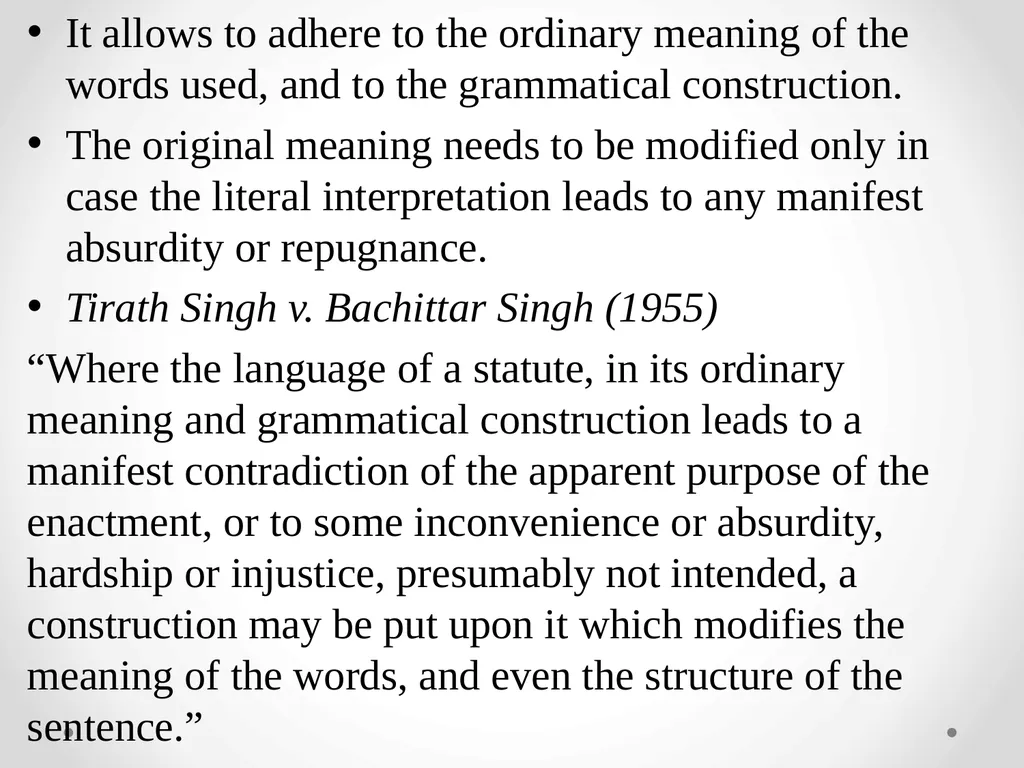
It allows to adhere to the ordinary meaning of the words used, and to the grammatical construction.
The original meaning needs to be modified only in case the literal interpretation leads to any manifest absurdity or repugnance.
Tirath Singh v. Bachittar Singh (1955)
“Where the language of a statute, in its ordinary meaning and grammatical construction leads to a manifest contradiction of the apparent purpose of the enactment, or to some inconvenience or absurdity, hardship or injustice, presumably not intended, a construction may be put upon it which modifies the meaning of the words, and even the structure of the sentence.”<br>
The original meaning needs to be modified only in case the literal interpretation leads to any manifest absurdity or repugnance.
Tirath Singh v. Bachittar Singh (1955)
“Where the language of a statute, in its ordinary meaning and grammatical construction leads to a manifest contradiction of the apparent purpose of the enactment, or to some inconvenience or absurdity, hardship or injustice, presumably not intended, a construction may be put upon it which modifies the meaning of the words, and even the structure of the sentence.”<br>
32
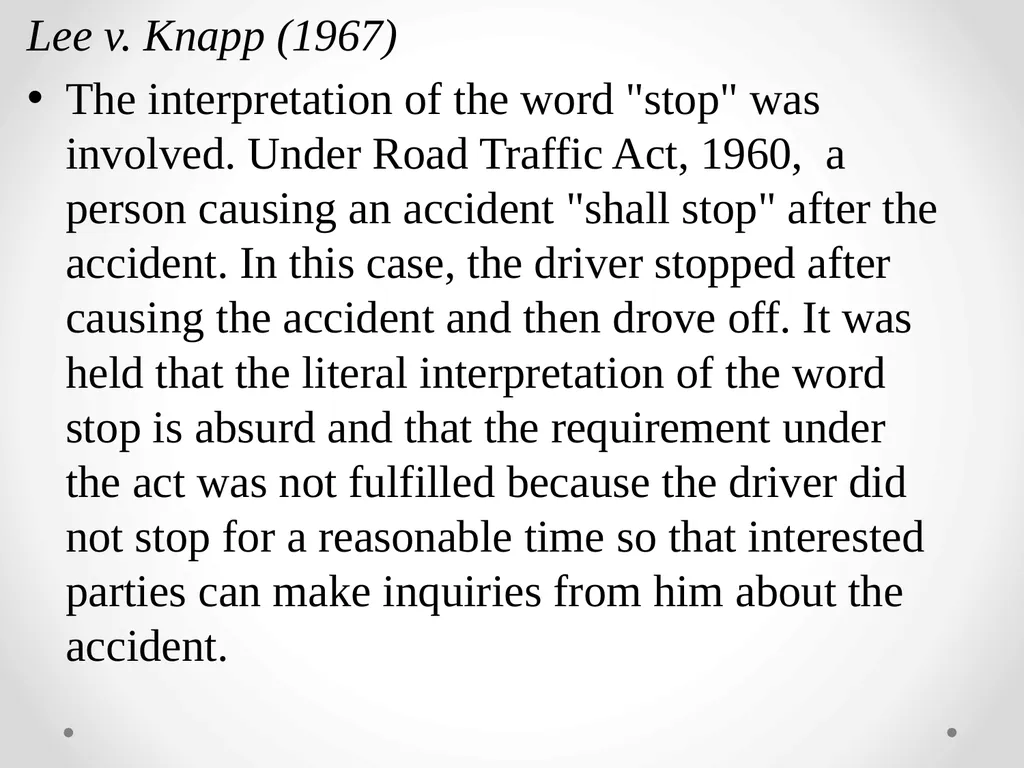
Lee v. Knapp (1967)
The interpretation of the word "stop" was involved. Under Road Traffic Act, 1960, a person causing an accident "shall stop" after the accident. In this case, the driver stopped after causing the accident and then drove off. It was held that the literal interpretation of the word stop is absurd and that the requirement under the act was not fulfilled because the driver did not stop for a reasonable time so that interested parties can make inquiries from him about the accident.<br>
The interpretation of the word "stop" was involved. Under Road Traffic Act, 1960, a person causing an accident "shall stop" after the accident. In this case, the driver stopped after causing the accident and then drove off. It was held that the literal interpretation of the word stop is absurd and that the requirement under the act was not fulfilled because the driver did not stop for a reasonable time so that interested parties can make inquiries from him about the accident.<br>
33
Uttar Pradesh Bhoodan Yagna Samiti v. Brij Kishore (1988)
the Supreme Court held that the expression “landless person” used in section 14 of U.P. Bhoodan Yagna Act, 1953 which made provision for grant of land to landless persons, was limited to “landless laborers”. A landless labour is he who is engaged in agriculture but having no agricultural land. The Court further said that “any landless person” did not include a landless businessman residing in a city. The object of the Act was to implement the Bhoodan movement, which aimed at distribution of land to landless labourers who were verged in agriculture. A businessman, though landless cannot claim the benefit of the Act.<br>
the Supreme Court held that the expression “landless person” used in section 14 of U.P. Bhoodan Yagna Act, 1953 which made provision for grant of land to landless persons, was limited to “landless laborers”. A landless labour is he who is engaged in agriculture but having no agricultural land. The Court further said that “any landless person” did not include a landless businessman residing in a city. The object of the Act was to implement the Bhoodan movement, which aimed at distribution of land to landless labourers who were verged in agriculture. A businessman, though landless cannot claim the benefit of the Act.<br>
34
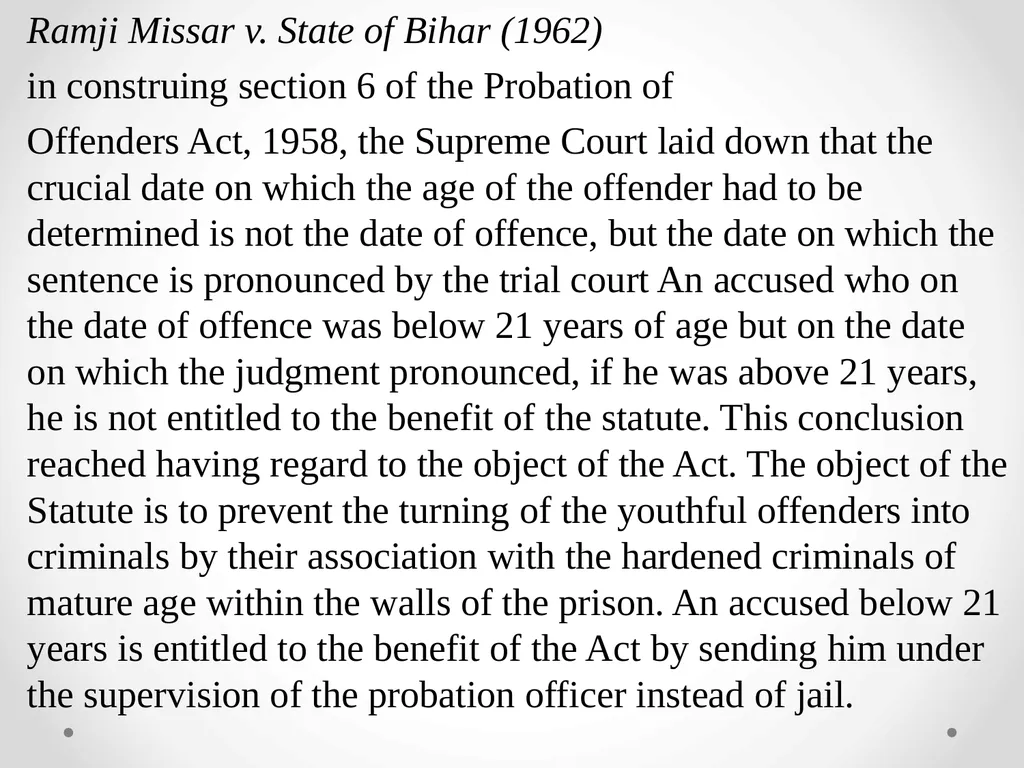
Ramji Missar v. State of Bihar (1962)
in construing section 6 of the Probation of
Offenders Act, 1958, the Supreme Court laid down that the crucial date on which the age of the offender had to be determined is not the date of offence, but the date on which the sentence is pronounced by the trial court An accused who on the date of offence was below 21 years of age but on the date on which the judgment pronounced, if he was above 21 years, he is not entitled to the benefit of the statute. This conclusion reached having regard to the object of the Act. The object of the Statute is to prevent the turning of the youthful offenders into criminals by their association with the hardened criminals of mature age within the walls of the prison. An accused below 21 years is entitled to the benefit of the Act by sending him under the supervision of the probation officer instead of jail.<br>
in construing section 6 of the Probation of
Offenders Act, 1958, the Supreme Court laid down that the crucial date on which the age of the offender had to be determined is not the date of offence, but the date on which the sentence is pronounced by the trial court An accused who on the date of offence was below 21 years of age but on the date on which the judgment pronounced, if he was above 21 years, he is not entitled to the benefit of the statute. This conclusion reached having regard to the object of the Act. The object of the Statute is to prevent the turning of the youthful offenders into criminals by their association with the hardened criminals of mature age within the walls of the prison. An accused below 21 years is entitled to the benefit of the Act by sending him under the supervision of the probation officer instead of jail.<br>
35
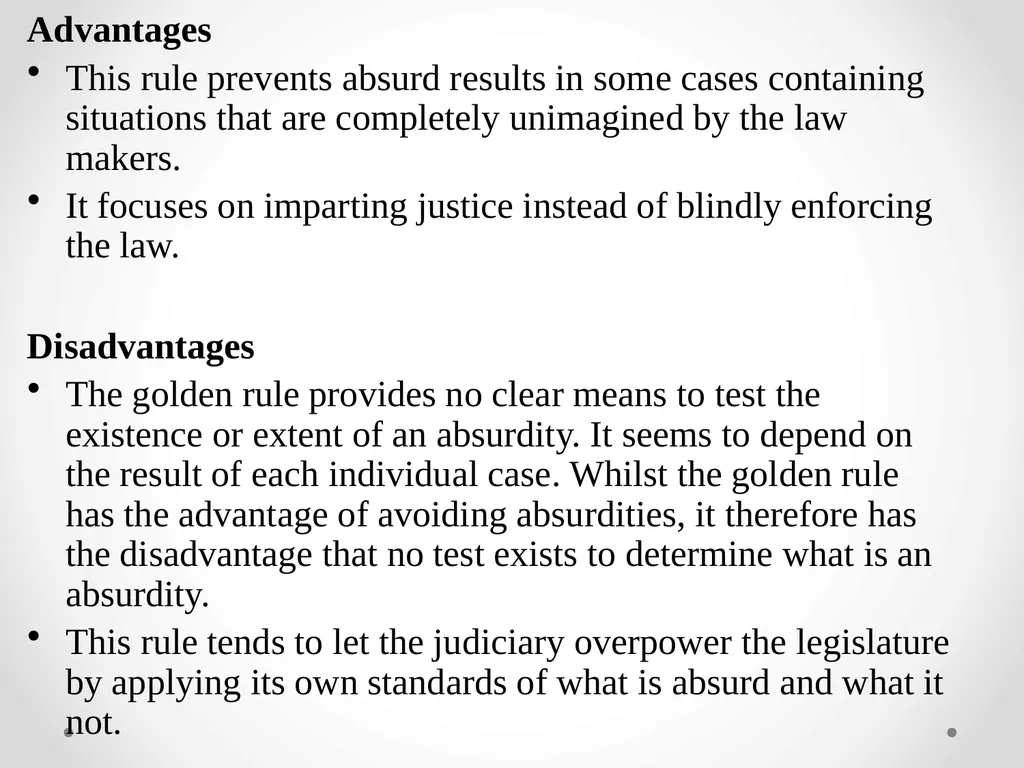
Advantages
This rule prevents absurd results in some cases containing situations that are completely unimagined by the law makers.
It focuses on imparting justice instead of blindly enforcing the law.
Disadvantages
The golden rule provides no clear means to test the existence or extent of an absurdity. It seems to depend on the result of each individual case. Whilst the golden rule has the advantage of avoiding absurdities, it therefore has the disadvantage that no test exists to determine what is an absurdity.
This rule tends to let the judiciary overpower the legislature by applying its own standards of what is absurd and what it not.<br>
This rule prevents absurd results in some cases containing situations that are completely unimagined by the law makers.
It focuses on imparting justice instead of blindly enforcing the law.
Disadvantages
The golden rule provides no clear means to test the existence or extent of an absurdity. It seems to depend on the result of each individual case. Whilst the golden rule has the advantage of avoiding absurdities, it therefore has the disadvantage that no test exists to determine what is an absurdity.
This rule tends to let the judiciary overpower the legislature by applying its own standards of what is absurd and what it not.<br>
36
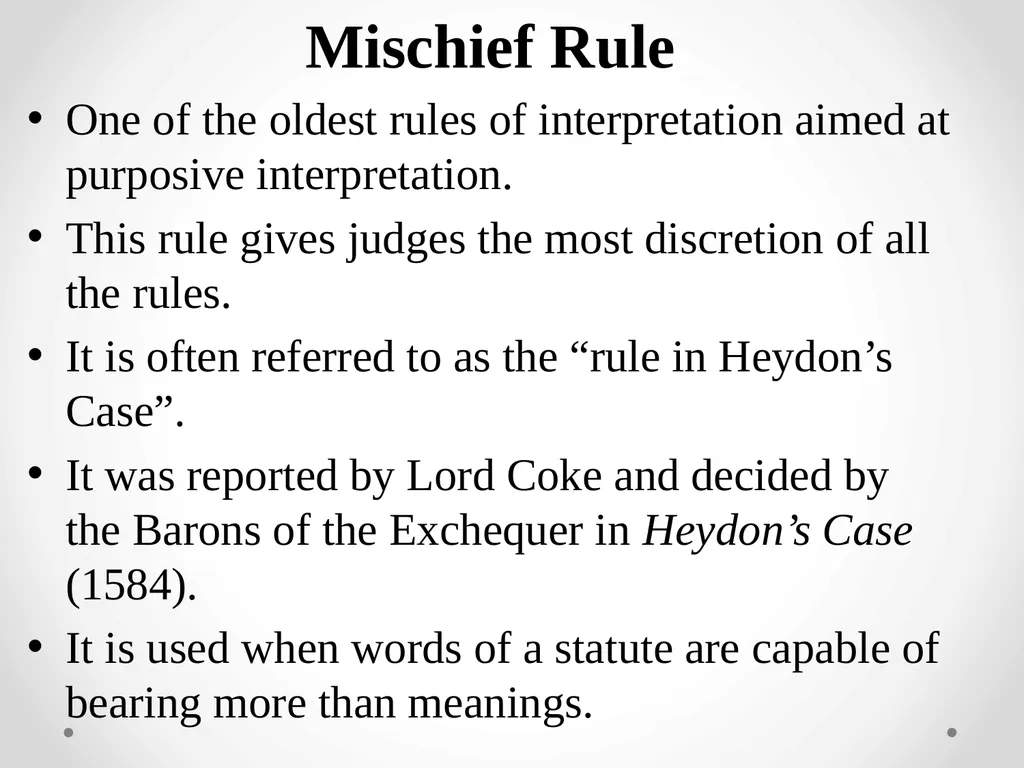
Mischief Rule
One of the oldest rules of interpretation aimed at purposive interpretation.
This rule gives judges the most discretion of all the rules.
It is often referred to as the “rule in Heydon’s Case”.
It was reported by Lord Coke and decided by the Barons of the Exchequer in Heydon’s Case (1584).
It is used when words of a statute are capable of bearing more than meanings.<br>
One of the oldest rules of interpretation aimed at purposive interpretation.
This rule gives judges the most discretion of all the rules.
It is often referred to as the “rule in Heydon’s Case”.
It was reported by Lord Coke and decided by the Barons of the Exchequer in Heydon’s Case (1584).
It is used when words of a statute are capable of bearing more than meanings.<br>
37
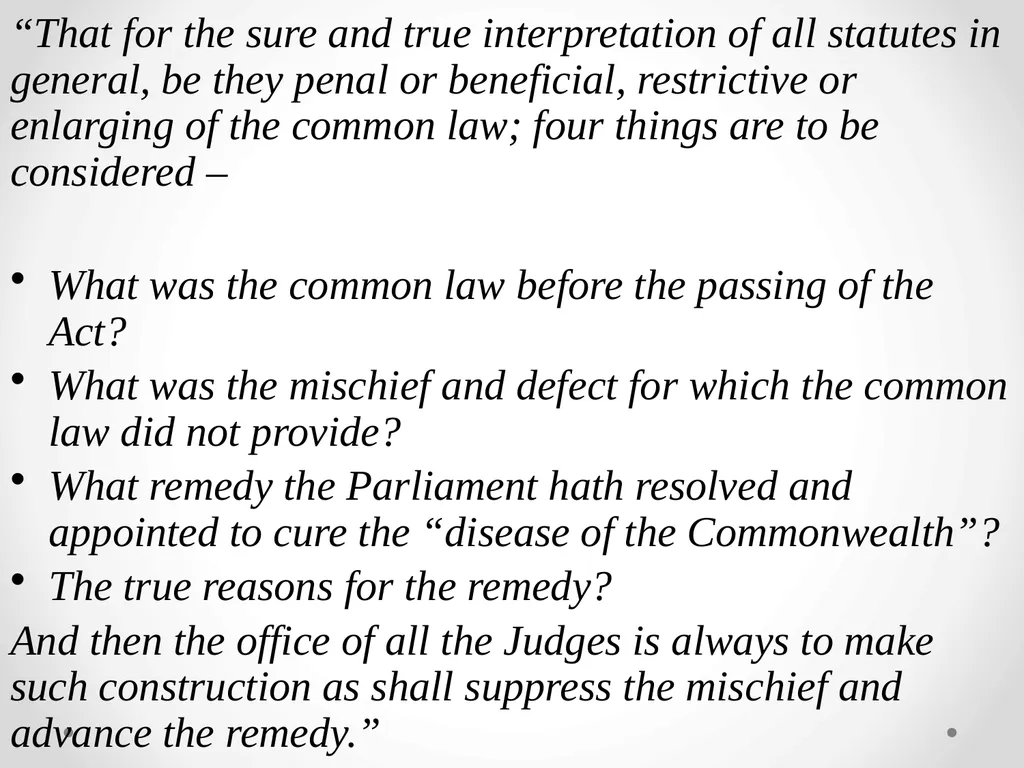
“That for the sure and true interpretation of all statutes in general, be they penal or beneficial, restrictive or enlarging of the common law; four things are to be considered –
What was the common law before the passing of the Act?
What was the mischief and defect for which the common law did not provide?
What remedy the Parliament hath resolved and appointed to cure the “disease of the Commonwealth”?
The true reasons for the remedy?
And then the office of all the Judges is always to make such construction as shall suppress the mischief and advance the remedy.”<br>
What was the common law before the passing of the Act?
What was the mischief and defect for which the common law did not provide?
What remedy the Parliament hath resolved and appointed to cure the “disease of the Commonwealth”?
The true reasons for the remedy?
And then the office of all the Judges is always to make such construction as shall suppress the mischief and advance the remedy.”<br>
38
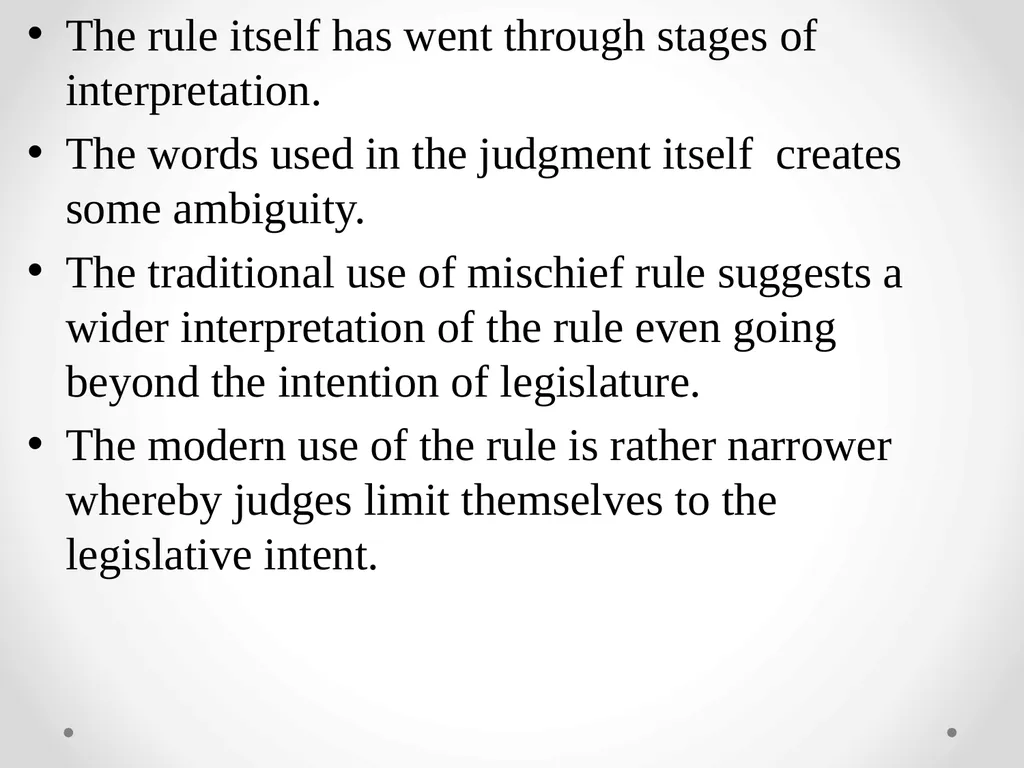
The rule itself has went through stages of interpretation.
The words used in the judgment itself creates some ambiguity.
The traditional use of mischief rule suggests a wider interpretation of the rule even going beyond the intention of legislature.
The modern use of the rule is rather narrower whereby judges limit themselves to the legislative intent.<br>
The words used in the judgment itself creates some ambiguity.
The traditional use of mischief rule suggests a wider interpretation of the rule even going beyond the intention of legislature.
The modern use of the rule is rather narrower whereby judges limit themselves to the legislative intent.<br>
39
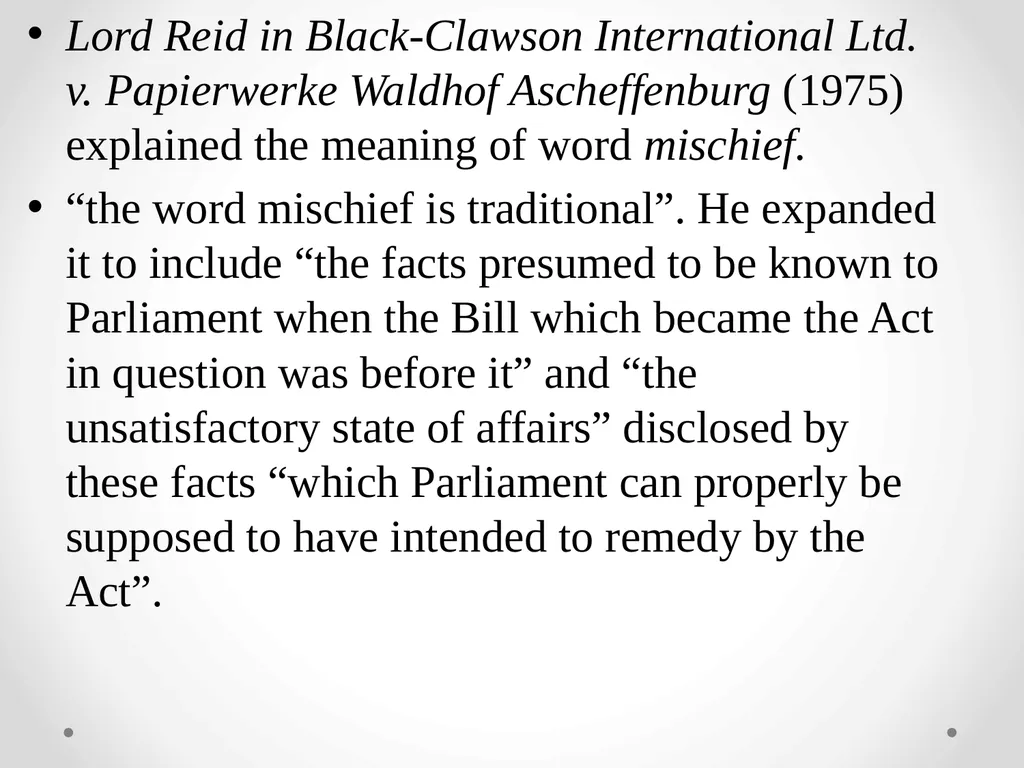
Lord Reid in Black-Clawson International Ltd. v. Papierwerke Waldhof Ascheffenburg (1975) explained the meaning of word mischief.
“the word mischief is traditional”. He expanded it to include “the facts presumed to be known to Parliament when the Bill which became the Act in question was before it” and “the unsatisfactory state of affairs” disclosed by these facts “which Parliament can properly be supposed to have intended to remedy by the Act”.<br>
“the word mischief is traditional”. He expanded it to include “the facts presumed to be known to Parliament when the Bill which became the Act in question was before it” and “the unsatisfactory state of affairs” disclosed by these facts “which Parliament can properly be supposed to have intended to remedy by the Act”.<br>
40
Lord Roskill in Anderton v. Ryan (1985)
“Statutes should be given what has
become known as a purposive construction, that is to say that the courts should identify the
“mischief” which existed before passing of the statute and then if more than one construction is
possible, favour that which will eliminate the mischief so identified.”
Lord Griffith in Pepper v. Hart (1993)
“The courts now adopt a purposive approach which seeks to give effect to the true purpose of legislation and are prepared to look at much extraneous material that bears on the background against which the legislation was enacted.”<br>
“Statutes should be given what has
become known as a purposive construction, that is to say that the courts should identify the
“mischief” which existed before passing of the statute and then if more than one construction is
possible, favour that which will eliminate the mischief so identified.”
Lord Griffith in Pepper v. Hart (1993)
“The courts now adopt a purposive approach which seeks to give effect to the true purpose of legislation and are prepared to look at much extraneous material that bears on the background against which the legislation was enacted.”<br>
41
New India Assurance Co. Ltd. v. Nusli Nerille Wadia (2008), Sinha J.-
“To interpret a statute in a reasonable manner the court must place itself in the chair of a reasonable legislator/author.”
Two elements of objectivity in the process of construction: “first the interpreter should assume that the legislature is composed of reasonable people seeking to achieve reasonable goals in a reasonable manner; and second the interpreter should accept the non – rebuttable presumption that members of the legislative body sought to fulfill their constitutional duties in good faith. This formulation allows the interpreter to inquire not into the subjective intent of the author, but rather the intent the author would have had, had he or she acted reasonably.”<br>
“To interpret a statute in a reasonable manner the court must place itself in the chair of a reasonable legislator/author.”
Two elements of objectivity in the process of construction: “first the interpreter should assume that the legislature is composed of reasonable people seeking to achieve reasonable goals in a reasonable manner; and second the interpreter should accept the non – rebuttable presumption that members of the legislative body sought to fulfill their constitutional duties in good faith. This formulation allows the interpreter to inquire not into the subjective intent of the author, but rather the intent the author would have had, had he or she acted reasonably.”<br>
42
The Supreme Court in Sodra Devi’s case (1957) expressed the view that the rule in Heydon’s case is applicable:
Only when the words in question are ambiguous
And are reasonably capable of more than one meaning.
In the case of Kanailal Sur v. Paramnidhi Sadhukhan Gajendragadkar J., stated that the recourse to object and policy of the Act or consideration of the mischief and defect which the Act purports to remedy is only permissible when the language is capable of two constructions.<br>
Only when the words in question are ambiguous
And are reasonably capable of more than one meaning.
In the case of Kanailal Sur v. Paramnidhi Sadhukhan Gajendragadkar J., stated that the recourse to object and policy of the Act or consideration of the mischief and defect which the Act purports to remedy is only permissible when the language is capable of two constructions.<br>
43
Elliot v Grey (1960)
The defendant’s car was parked on the road. It was jacked up and had its battery removed. He was charged with an offence under the Road Traffic Act 1930 of using an uninsured vehicle on the road. The defendant argued he was not ‘using’ the car on the road as clearly it was not driveable. It was held: The court applied the mischief rule and held that the car was being used on the road as it represented a hazard and therefore insurance would be required in the event of an incident. The statute was aimed at ensuring people were compensated when injured due to the hazards created by others.<br>
The defendant’s car was parked on the road. It was jacked up and had its battery removed. He was charged with an offence under the Road Traffic Act 1930 of using an uninsured vehicle on the road. The defendant argued he was not ‘using’ the car on the road as clearly it was not driveable. It was held: The court applied the mischief rule and held that the car was being used on the road as it represented a hazard and therefore insurance would be required in the event of an incident. The statute was aimed at ensuring people were compensated when injured due to the hazards created by others.<br>
44
Bengal Immunity Co. v. State of Bihar (1955)
Supreme Court applied the rule in construction of Art. 286 of the Constitution of India. After referring to the state of law prevailing in the provinces prior to the Constitution as also to the chaos and confusion that was brought about in inter-State trade and commerce by indiscriminate exercise of taxing powers by the different provincial Legislatures founded on the theory of territorial nexus S.R. Das, C.J.I., proceeded to say: “It was to cure this mischief of multiple taxation and to preserve the free flow of inter-State trade or commerce in the Union of India regarded as one economic unit without any provincial barrier that the Constitution-Makers adopted Art. 286 in the Constitution.”<br>
Supreme Court applied the rule in construction of Art. 286 of the Constitution of India. After referring to the state of law prevailing in the provinces prior to the Constitution as also to the chaos and confusion that was brought about in inter-State trade and commerce by indiscriminate exercise of taxing powers by the different provincial Legislatures founded on the theory of territorial nexus S.R. Das, C.J.I., proceeded to say: “It was to cure this mischief of multiple taxation and to preserve the free flow of inter-State trade or commerce in the Union of India regarded as one economic unit without any provincial barrier that the Constitution-Makers adopted Art. 286 in the Constitution.”<br>
45
RMD Chamarbaugwalla v. Union of India (1957)
Construction of section 2(d) of the Prize Competitions Act was involved. “Prize Competition means any competition in which prizes are offered for the solution of any puzzle based upon the building up arrangement, combination or permutation of letters, words or figures”. The question was whether in view of this definition, the Act applies to competitions which involve substantial skill and are not in the nature of gambling. The Supreme Court, after referring to the previous state of the law, to the mischief that continued under that law and to the resolutions of various States under Art. 252(1) authorizing Parliament to pass the Act stated: “Having regard to the history of the legislation, the declared object thereof and the wording of the statute, we are of opinion that the competitions which are sought to be controlled and regulated by the Act are only those competitions in which success does not depend on any substantial degree of skill”<br>
Construction of section 2(d) of the Prize Competitions Act was involved. “Prize Competition means any competition in which prizes are offered for the solution of any puzzle based upon the building up arrangement, combination or permutation of letters, words or figures”. The question was whether in view of this definition, the Act applies to competitions which involve substantial skill and are not in the nature of gambling. The Supreme Court, after referring to the previous state of the law, to the mischief that continued under that law and to the resolutions of various States under Art. 252(1) authorizing Parliament to pass the Act stated: “Having regard to the history of the legislation, the declared object thereof and the wording of the statute, we are of opinion that the competitions which are sought to be controlled and regulated by the Act are only those competitions in which success does not depend on any substantial degree of skill”<br>
46
Advantages
It gives effect to parliament's intentions
It allows judges to use their common sense and save parliament time
It allows judges to consider social and technological changes
It allows judges to look at external aids.
Disadvantages
Finding the intention of parliament can be difficult
It is reasonable to argue that what parliament intended can only be seen in what it actually wrote in the act
It is undemocratic
It might cause uncertainty if a judge changes the meaning of statute<br>
It gives effect to parliament's intentions
It allows judges to use their common sense and save parliament time
It allows judges to consider social and technological changes
It allows judges to look at external aids.
Disadvantages
Finding the intention of parliament can be difficult
It is reasonable to argue that what parliament intended can only be seen in what it actually wrote in the act
It is undemocratic
It might cause uncertainty if a judge changes the meaning of statute<br>
47
Rule of Harmonious Construction
Statute must be read as a whole
A statute should be read as a whole and one provision of the Act should be
construed with reference to other provisions in the same Act
This will make a consistent enactment of the whole statute.
This will reduce any inconsistency or repugnancy either within a section or between a section and other parts of the statute.<br>
Statute must be read as a whole
A statute should be read as a whole and one provision of the Act should be
construed with reference to other provisions in the same Act
This will make a consistent enactment of the whole statute.
This will reduce any inconsistency or repugnancy either within a section or between a section and other parts of the statute.<br>
48
According to rule of harmonious construction the court, while interpreting, must try to avoid a conflict between the provisions of Statute.
In a situation of apparent conflict, the courts must make attempt at reconciliation between the provisions in conflict to give effect to both, i.e., creating harmony between them.
It runs on the premise that Parliament did not make the provisions in a an enactment to defeat each other or to make one of them ineffective by giving only effect to the other/s.<br>
In a situation of apparent conflict, the courts must make attempt at reconciliation between the provisions in conflict to give effect to both, i.e., creating harmony between them.
It runs on the premise that Parliament did not make the provisions in a an enactment to defeat each other or to make one of them ineffective by giving only effect to the other/s.<br>
49
CIT v Hindustan Bulk Carriers (2003)
The courts must avoid a head on clash of seemingly contradicting provisions and they must construe the contradictory provisions so as to harmonize them.
The provision of one section cannot be used to defeat the provision contained in another unless the court, despite all its effort, is unable to find a way to reconcile their differences.
When it is impossible to completely reconcile the differences in contradictory provisions, the courts must interpret them in such as way so that effect is given to both the provisions as much as possible.
Courts must also keep in mind that interpretation that reduces one provision to a useless number or dead is not harmonious construction.
To harmonize is not to destroy any statutory provision or to render it fruitless.<br>
The courts must avoid a head on clash of seemingly contradicting provisions and they must construe the contradictory provisions so as to harmonize them.
The provision of one section cannot be used to defeat the provision contained in another unless the court, despite all its effort, is unable to find a way to reconcile their differences.
When it is impossible to completely reconcile the differences in contradictory provisions, the courts must interpret them in such as way so that effect is given to both the provisions as much as possible.
Courts must also keep in mind that interpretation that reduces one provision to a useless number or dead is not harmonious construction.
To harmonize is not to destroy any statutory provision or to render it fruitless.<br>
50
Sirsilk Ltd. v. Govt. of Andhra Pradesh (1964)
Certain disputes between the employer and the workmen adjudicated by an industrial tribunal and sent for publication to Government.
However, before the award was published, the parties came to a settlement and wrote a letter to the government intimating their settlement, with the request that award shall not be published.
Government refused to do so.
Matter went till Supreme court- decided in favour of petitioners.
The apparent conflict was between section 17 and 18 of the Industrial Disputes Act,1947.<br>
Certain disputes between the employer and the workmen adjudicated by an industrial tribunal and sent for publication to Government.
However, before the award was published, the parties came to a settlement and wrote a letter to the government intimating their settlement, with the request that award shall not be published.
Government refused to do so.
Matter went till Supreme court- decided in favour of petitioners.
The apparent conflict was between section 17 and 18 of the Industrial Disputes Act,1947.<br>
51
Unni Krishnan, J.P. and ors., etc. v. State of Andhra Pradesh and ors. (1996)
The writ petition was filed challenging whether the 'right to life' under Article 21 of the constitution guarantees a fundamental right to education to the citizens of India and right to education includes professional education.
This was challenged by certain private professional educational institutions
The Supreme Court held that right to basic education was implied by the fundamental right to life when read with article 41 of directive principle on education.
The court also looked at Article 45 and held there is no fundamental right to education for a professional degree that flows from article 21.
On issue of prevalence of Fundamental Right over DPSP, court stated the provisions of Part III and Part IV are “supplementary and complementary to each other.”<br>
The writ petition was filed challenging whether the 'right to life' under Article 21 of the constitution guarantees a fundamental right to education to the citizens of India and right to education includes professional education.
This was challenged by certain private professional educational institutions
The Supreme Court held that right to basic education was implied by the fundamental right to life when read with article 41 of directive principle on education.
The court also looked at Article 45 and held there is no fundamental right to education for a professional degree that flows from article 21.
On issue of prevalence of Fundamental Right over DPSP, court stated the provisions of Part III and Part IV are “supplementary and complementary to each other.”<br>
52
Raj Krushna Bose vs Binod Kanungo & others.(1954)
Two provisions of Representation of People Act were in apparent conflict.
Section 33 (2) says that a Government Servant can nominate or second a person in election but section 123(8) says that a Government Servant cannot assist any candidate in election except by casting his vote.
The Supreme Court observed that both these provisions should be harmoniously interpreted and held that a Government Servant was entitled to nominate or second a candidate seeking election in State Legislative assembly.
This harmony can only be achieved if Section 123(8) is interpreted as giving the government servant the right to vote as well as to nominate or second a candidate and forbidding him to assist the candidate in any other manner.<br>
Two provisions of Representation of People Act were in apparent conflict.
Section 33 (2) says that a Government Servant can nominate or second a person in election but section 123(8) says that a Government Servant cannot assist any candidate in election except by casting his vote.
The Supreme Court observed that both these provisions should be harmoniously interpreted and held that a Government Servant was entitled to nominate or second a candidate seeking election in State Legislative assembly.
This harmony can only be achieved if Section 123(8) is interpreted as giving the government servant the right to vote as well as to nominate or second a candidate and forbidding him to assist the candidate in any other manner.<br>
53
Calcutta Gas Company Pvt. Limited v State of West Bengal (1960)
The Legislative Assembly of WB passed the Oriental Gas Company Act in 1960.
The appellant challenged the validity of this act by holding that the state Legislative Assembly had no power to pass such an under Entries 24 and 25 of the State List because the Parliament had already enacted the Industries (Development and Regulation) Act, 1951 under Entry 52 of the Central List dealing with industries.
Entry 24 of the State List covers entire Industries in the State. Entry 25 is only limited to the Gas industry. Therefore Entry 24 covers every industry barring the Gas Industries because it has been specifically covered under Entry 25. Corresponding to Entry 24 of the State List, there is Entry 52 in the Union List. Therefore, by harmonious construction it became clear that gas industry was exclusively covered by Entry 25 of the State List over which the state has full control. Therefore, the state was fully competent to make laws in this regard.<br>
The Legislative Assembly of WB passed the Oriental Gas Company Act in 1960.
The appellant challenged the validity of this act by holding that the state Legislative Assembly had no power to pass such an under Entries 24 and 25 of the State List because the Parliament had already enacted the Industries (Development and Regulation) Act, 1951 under Entry 52 of the Central List dealing with industries.
Entry 24 of the State List covers entire Industries in the State. Entry 25 is only limited to the Gas industry. Therefore Entry 24 covers every industry barring the Gas Industries because it has been specifically covered under Entry 25. Corresponding to Entry 24 of the State List, there is Entry 52 in the Union List. Therefore, by harmonious construction it became clear that gas industry was exclusively covered by Entry 25 of the State List over which the state has full control. Therefore, the state was fully competent to make laws in this regard.<br>
54
When reconciliation is not possible
It is a general rule that when reconciliation is not possible the later provision shall prevail.
Eastbourne corporation v. Fortes Ltd(1959)
“If two section of an Act of Parliament are in truth irreconcilable, then prima facie the later will be preferred.”
However, a better approach has been devised where hierarchy of provisions is to set.
Institute of Patent Agents v. Lockwood(1894)
In case of irreconcilable provisions, “you have to determine which is leading provision, and which is subordinate provision and which must give way to other.”<br>
It is a general rule that when reconciliation is not possible the later provision shall prevail.
Eastbourne corporation v. Fortes Ltd(1959)
“If two section of an Act of Parliament are in truth irreconcilable, then prima facie the later will be preferred.”
However, a better approach has been devised where hierarchy of provisions is to set.
Institute of Patent Agents v. Lockwood(1894)
In case of irreconcilable provisions, “you have to determine which is leading provision, and which is subordinate provision and which must give way to other.”<br>