
Interpretivism Structure Vs Action Interactionism:
LO
Published · 77 slides · 0 views
1 / 1










Description
Interpretivism Structure Vs Action Interactionism: Essay Titles Assess the contributions interactionism has made to our understanding of society. (33 marks) Assess the extent to which structureagency debate has been resolved. (33 marks)
Related Topics
Share
Embed code
Download this presentation From Below
"Interpretivism Structure Vs Action Interactionism:" is the property of its rightful owner. Permission is granted to download and print the materials on this website for personal, non-commercial use only, and to display it on your personal computer provided you do not modify the materials and that you retain all copyright notices contained in the materials. By downloading content from our website, you accept the terms of this agreement.
Presentation Transcript
01
Interpretivism
Structure Vs Action<br>
02
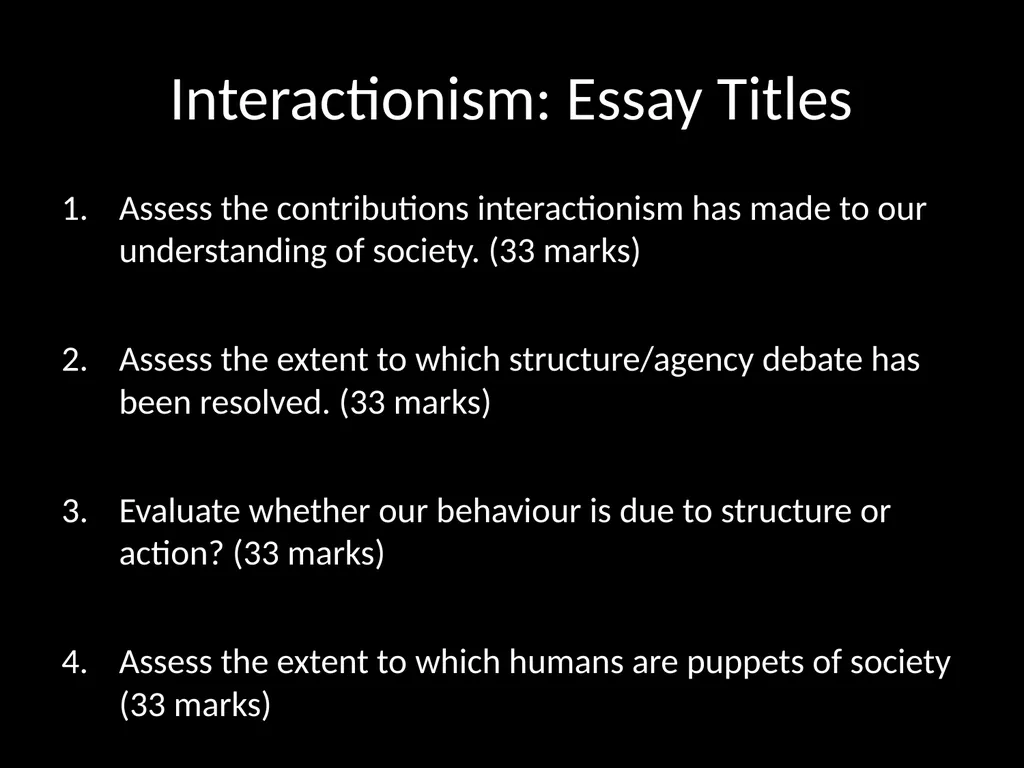
Interactionism: Essay Titles Assess the contributions interactionism has made to our understanding of society. (33 marks)
Assess the extent to which structure/agency debate has been resolved. (33 marks)
Evaluate whether our behaviour is due to structure or action? (33 marks)
Assess the extent to which humans are puppets of society (33 marks)<br>
Assess the extent to which structure/agency debate has been resolved. (33 marks)
Evaluate whether our behaviour is due to structure or action? (33 marks)
Assess the extent to which humans are puppets of society (33 marks)<br>
03
Starter: Post-it Note Challenge Write down concepts / writers we associate with interactionism / interpretivism.
SCLY 1
SCLY 2
SCLY 3
SCLY 4<br>
SCLY 1
SCLY 2
SCLY 3
SCLY 4<br>
04
Starter 2:<br>
05
Some clips … https://www.youtube.com/watch?v=jFQIIM8IRZU&list=PLhMMvN4zZVbe-aUu9DlZ1ANaVMnFwrNsE
https://www.youtube.com/watch?v=6E66iDghFkg
https://www.youtube.com/watch?v=yJrnwOPC2f8
https://www.youtube.com/watch?v=Ql0XPwtfFGY<br>
https://www.youtube.com/watch?v=6E66iDghFkg
https://www.youtube.com/watch?v=yJrnwOPC2f8
https://www.youtube.com/watch?v=Ql0XPwtfFGY<br>
06
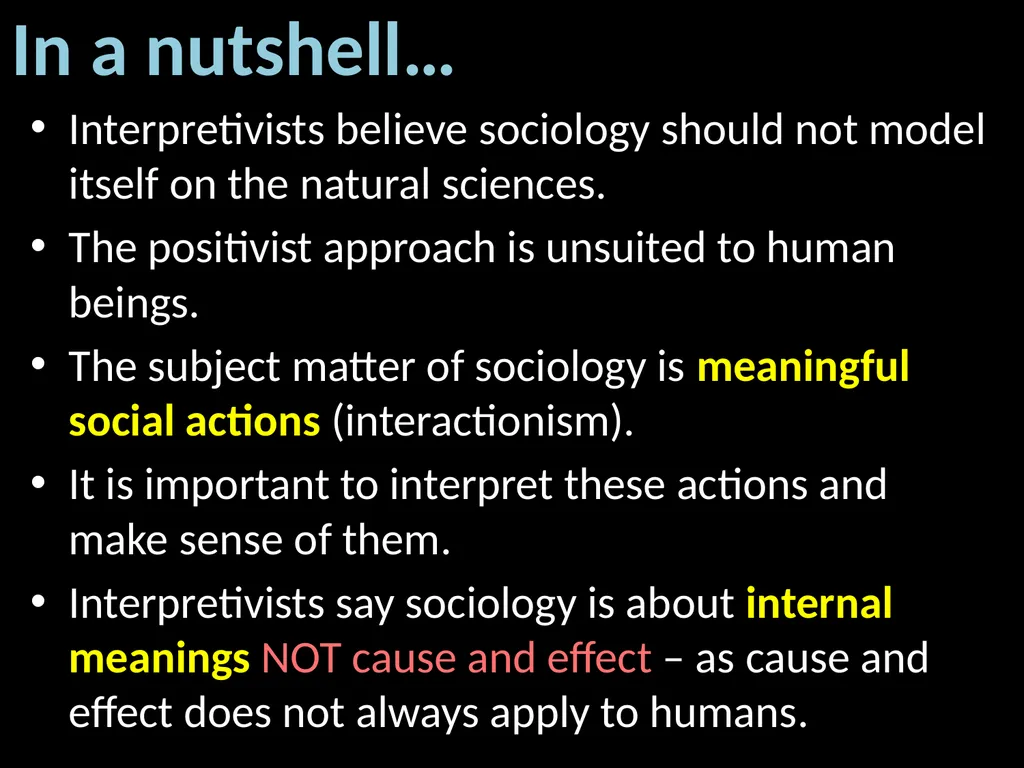
In a nutshell… Interpretivists believe sociology should not model itself on the natural sciences.
The positivist approach is unsuited to human beings.
The subject matter of sociology is meaningful social actions (interactionism).
It is important to interpret these actions and make sense of them.
Interpretivists say sociology is about internal meanings NOT cause and effect – as cause and effect does not always apply to humans.<br>
The positivist approach is unsuited to human beings.
The subject matter of sociology is meaningful social actions (interactionism).
It is important to interpret these actions and make sense of them.
Interpretivists say sociology is about internal meanings NOT cause and effect – as cause and effect does not always apply to humans.<br>
07
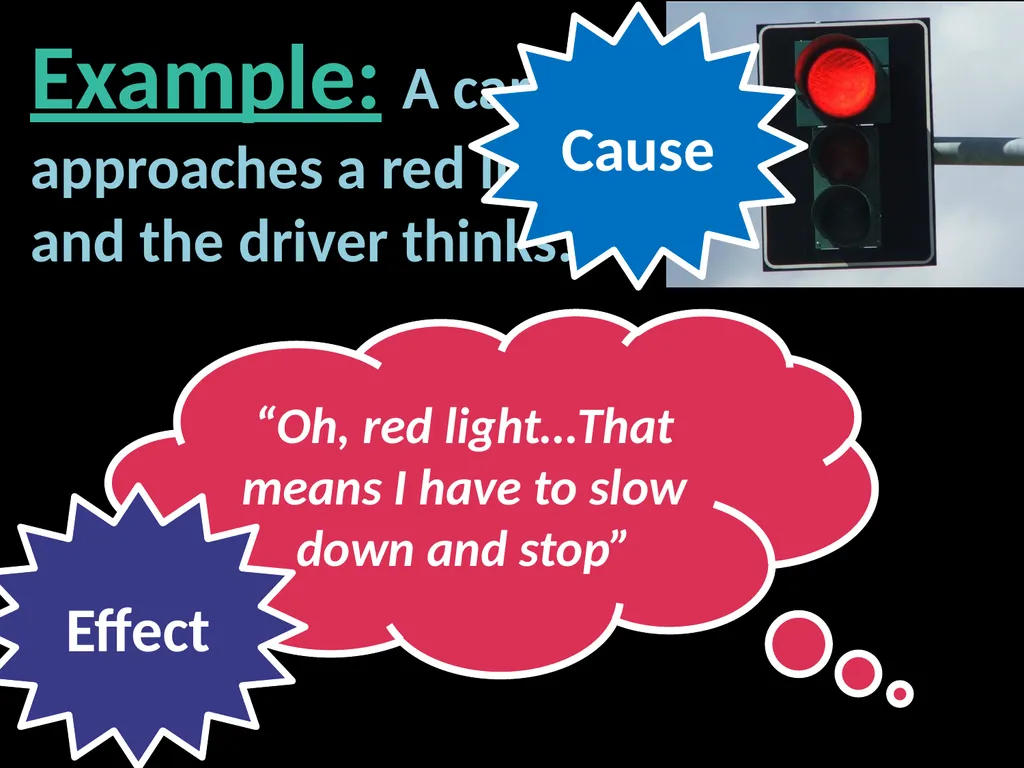
Example: A car approaches a red light and the driver thinks… “Oh, red light…That means I have to slow down and stop” Cause Effect<br>
08
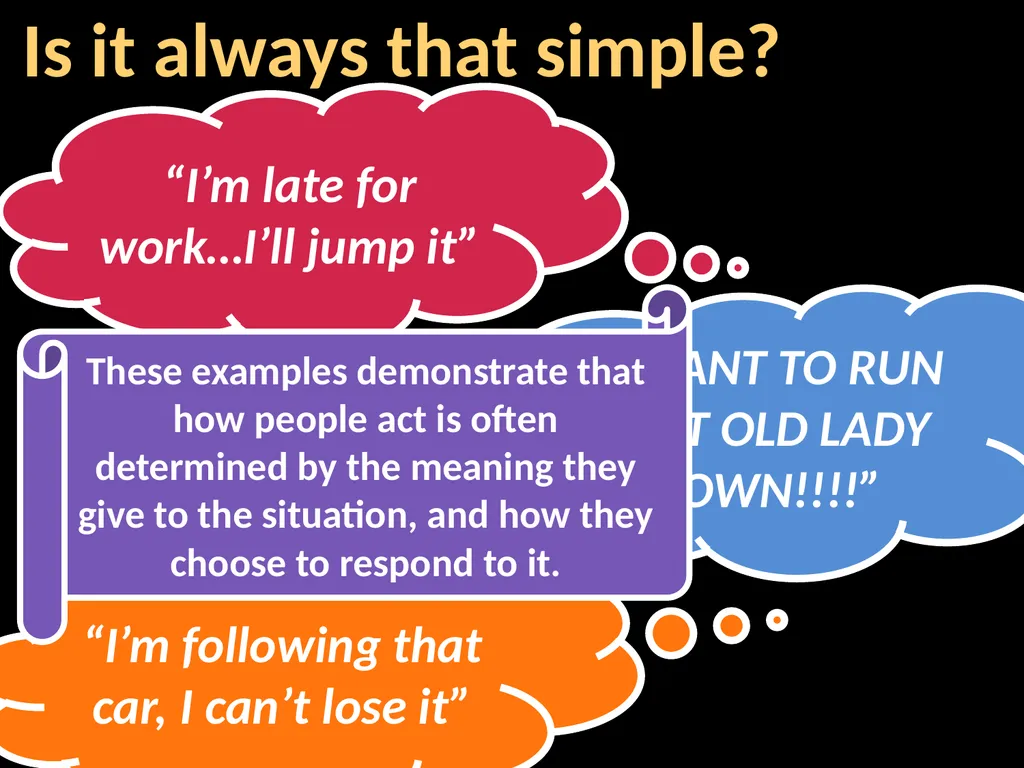
Is it always that simple? “I’m late for work…I’ll jump it” “I WANT TO RUN THAT OLD LADY DOWN!!!!” “I’m following that car, I can’t lose it” These examples demonstrate that how people act is often determined by the meaning they give to the situation, and how they choose to respond to it.<br>
09
If a motorist does stop, it is not because of an external force determining their behaviour, it is because they have chosen to stop.
Interpretivists do not see individuals as puppets on a string, that are manipulated by external ‘social facts’.
We are autonomous, and we construct our world by the meanings we choose to give things.<br>
Interpretivists do not see individuals as puppets on a string, that are manipulated by external ‘social facts’.
We are autonomous, and we construct our world by the meanings we choose to give things.<br>
10
G.H. Mead (Social Action Theorist) He argues that people have free will and choice.
They are not like ‘rocks’ in the natural sciences.
Rocks are unconscious, and dependent on external factors/stimuli for change.
Humans are conscious beings who interpret the meaning of a stimulus, then choose how they act upon it.
An apple does not choose when it falls from the tree.
But a human could choose whether or not to eat the apple and explain why they made that choice.<br>
They are not like ‘rocks’ in the natural sciences.
Rocks are unconscious, and dependent on external factors/stimuli for change.
Humans are conscious beings who interpret the meaning of a stimulus, then choose how they act upon it.
An apple does not choose when it falls from the tree.
But a human could choose whether or not to eat the apple and explain why they made that choice.<br>
11
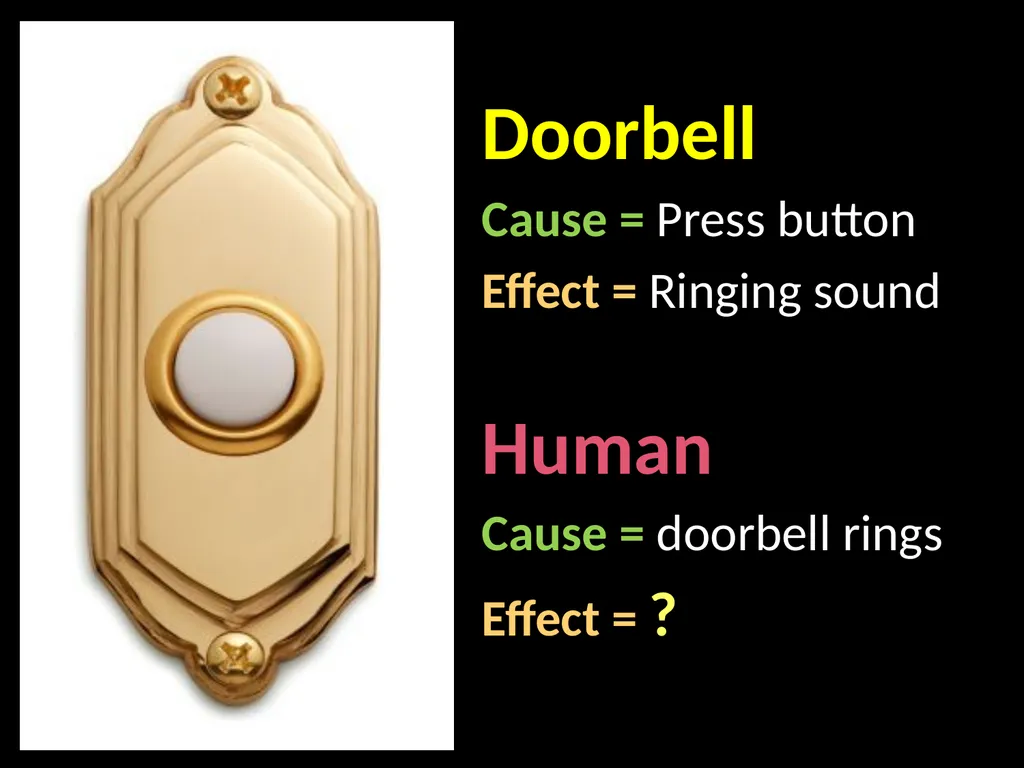
Doorbell
Cause = Press button
Effect = Ringing sound
Human
Cause = doorbell rings
Effect = ?<br>
Cause = Press button
Effect = Ringing sound
Human
Cause = doorbell rings
Effect = ?<br>
12
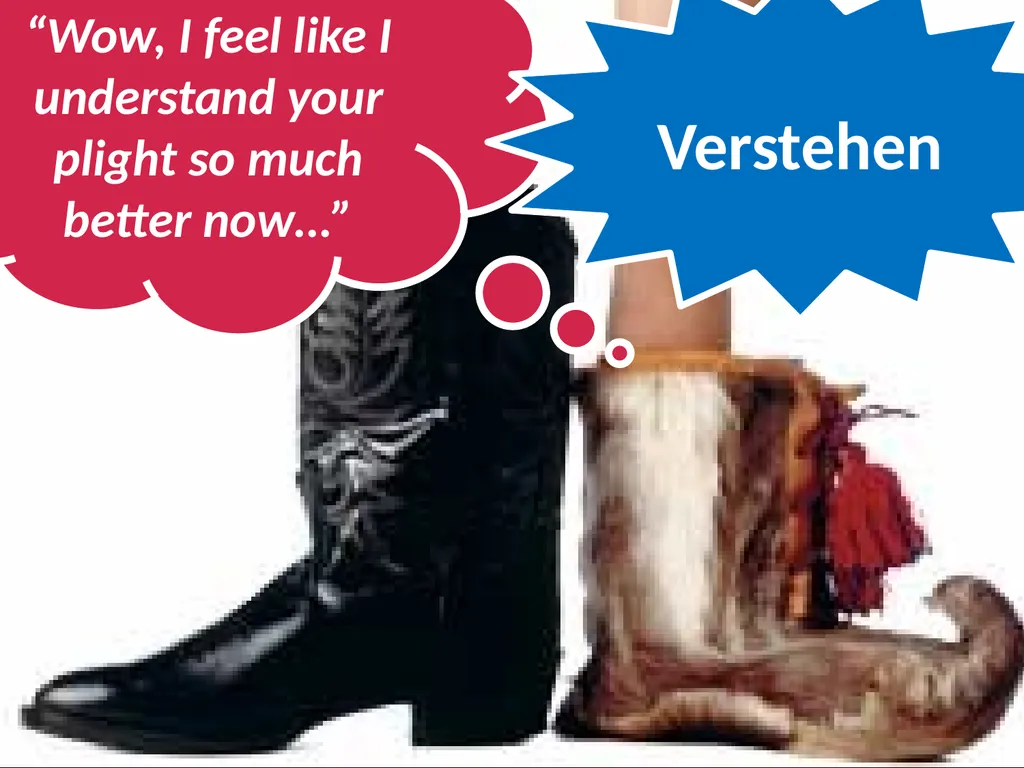
“Wow, I feel like I understand your plight so much better now…” Verstehen<br>
13
Verstehen: ‘to understand’ To discover the meanings people give to their actions, we need to see the world from their viewpoint.
Interpretivists abandon detachment and objectivity favoured by positivists.
Weber argued that we must put ourselves in the place of the actor in order to achieve verstehen – empathetic understandings.<br>
Interpretivists abandon detachment and objectivity favoured by positivists.
Weber argued that we must put ourselves in the place of the actor in order to achieve verstehen – empathetic understandings.<br>
14
So, which methods help us achieve Verstehen and why? Task: List the methods Interpretivists favour
Task: Now create a detailed paragraph that explains why they favour these methods (in your own words).<br>
Task: Now create a detailed paragraph that explains why they favour these methods (in your own words).<br>
15
Social Action Perspectives Also known as Interpretivism
Micro Sociology<br>
Micro Sociology<br>
16
Overview – 4 variations Social Action
Symbolic Interactionism
Phenomenology
Ethnomethodology<br>
Symbolic Interactionism
Phenomenology
Ethnomethodology<br>
17
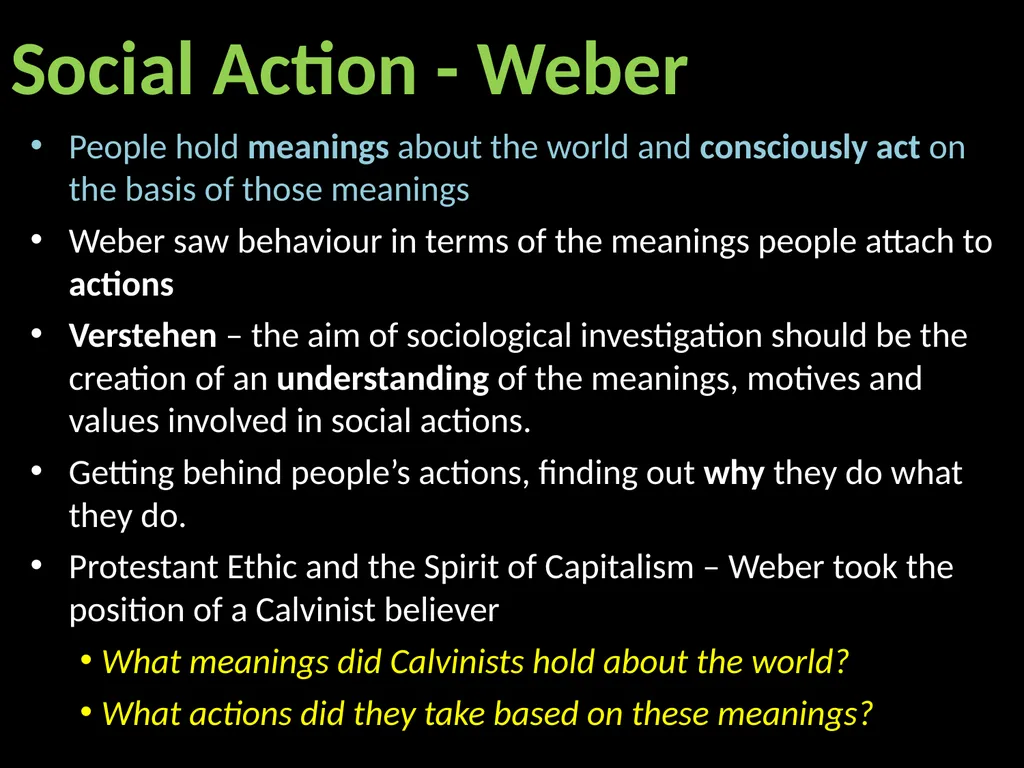
Social Action - Weber People hold meanings about the world and consciously act on the basis of those meanings
Weber saw behaviour in terms of the meanings people attach to actions
Verstehen – the aim of sociological investigation should be the creation of an understanding of the meanings, motives and values involved in social actions.
Getting behind people’s actions, finding out why they do what they do.
Protestant Ethic and the Spirit of Capitalism – Weber took the position of a Calvinist believer
What meanings did Calvinists hold about the world?
What actions did they take based on these meanings?<br>
Weber saw behaviour in terms of the meanings people attach to actions
Verstehen – the aim of sociological investigation should be the creation of an understanding of the meanings, motives and values involved in social actions.
Getting behind people’s actions, finding out why they do what they do.
Protestant Ethic and the Spirit of Capitalism – Weber took the position of a Calvinist believer
What meanings did Calvinists hold about the world?
What actions did they take based on these meanings?<br>
18
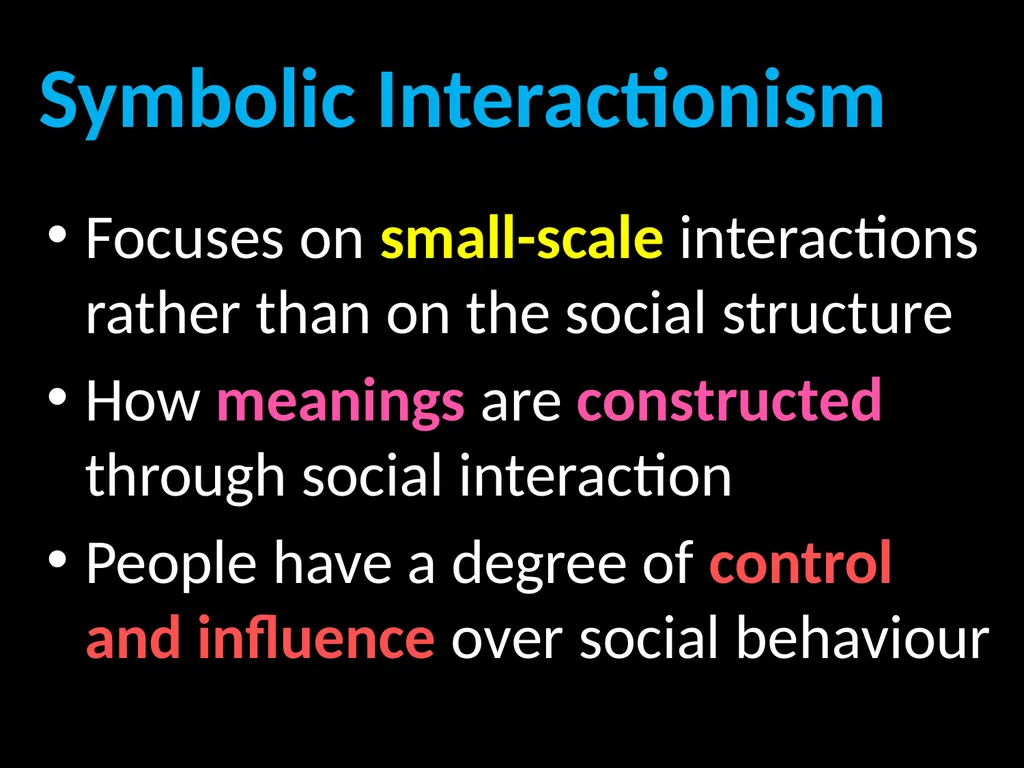
Symbolic Interactionism Focuses on small-scale interactions rather than on the social structure
How meanings are constructed through social interaction
People have a degree of control and influence over social behaviour<br>
How meanings are constructed through social interaction
People have a degree of control and influence over social behaviour<br>
19
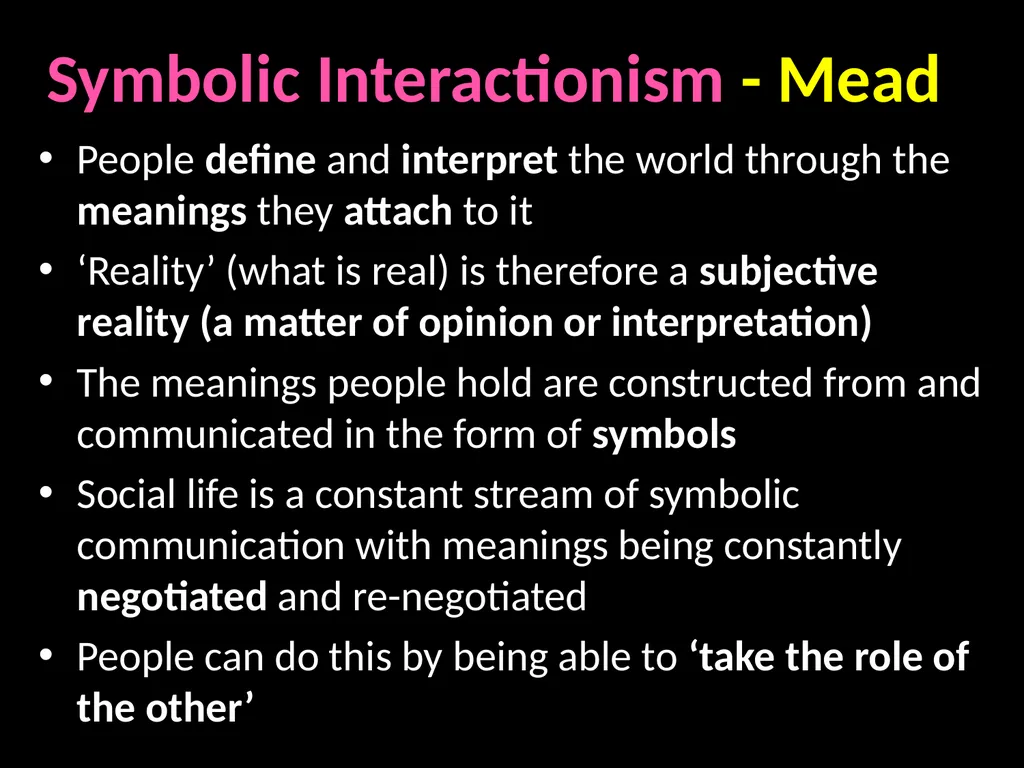
Symbolic Interactionism - Mead People define and interpret the world through the meanings they attach to it
‘Reality’ (what is real) is therefore a subjective reality (a matter of opinion or interpretation)
The meanings people hold are constructed from and communicated in the form of symbols
Social life is a constant stream of symbolic communication with meanings being constantly negotiated and re-negotiated
People can do this by being able to ‘take the role of the other’<br>
‘Reality’ (what is real) is therefore a subjective reality (a matter of opinion or interpretation)
The meanings people hold are constructed from and communicated in the form of symbols
Social life is a constant stream of symbolic communication with meanings being constantly negotiated and re-negotiated
People can do this by being able to ‘take the role of the other’<br>
20
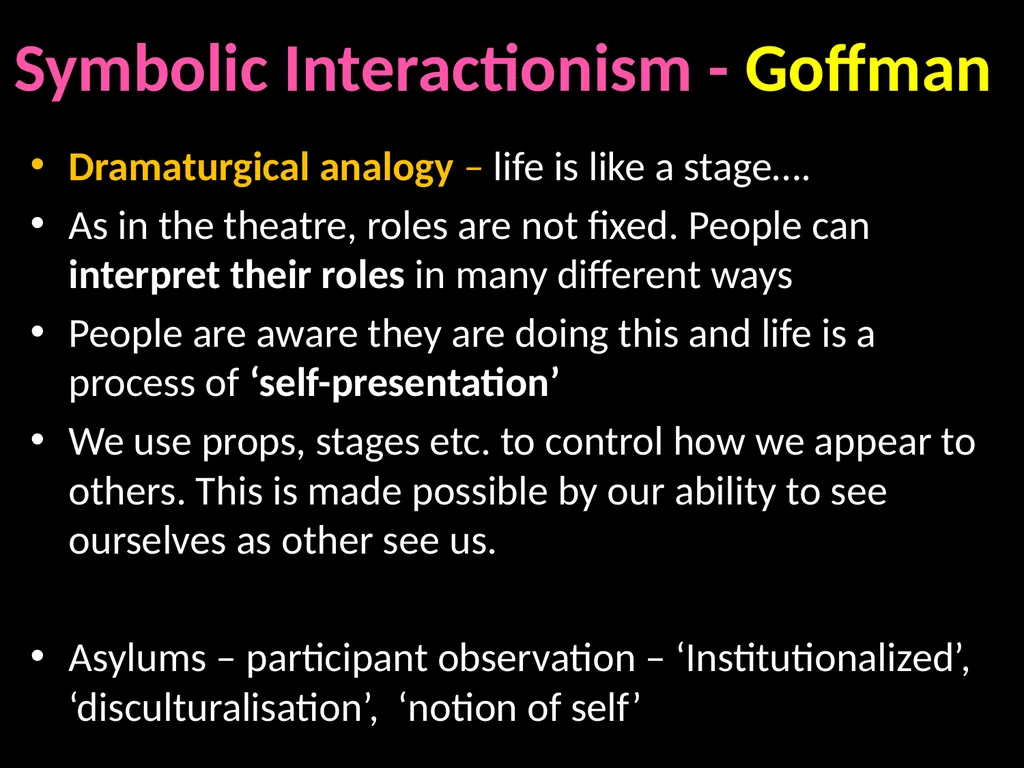
Symbolic Interactionism - Goffman Dramaturgical analogy – life is like a stage….
As in the theatre, roles are not fixed. People can interpret their roles in many different ways
People are aware they are doing this and life is a process of ‘self-presentation’
We use props, stages etc. to control how we appear to others. This is made possible by our ability to see ourselves as other see us.
Asylums – participant observation – ‘Institutionalized’, ‘disculturalisation’, ‘notion of self’<br>
As in the theatre, roles are not fixed. People can interpret their roles in many different ways
People are aware they are doing this and life is a process of ‘self-presentation’
We use props, stages etc. to control how we appear to others. This is made possible by our ability to see ourselves as other see us.
Asylums – participant observation – ‘Institutionalized’, ‘disculturalisation’, ‘notion of self’<br>
21
Symbolic Interactionism - Becker Labelling theory
Self-fulfilling prophecy
Master status
You know this one :-)<br>
Self-fulfilling prophecy
Master status
You know this one :-)<br>
22
Phenomenology
– Husserl and Schutz Phenomenology – internal workings of the human mind and the way humans make sense of and classify the world around them.
We have a series of typifications (categories) we use to organise the world as we see it
We have a store of common-sense knowledge which helps in everyday interactions. We assume everyone has these. Phenomenologists believe sociology should be concerned with things on the surface – not things that are hidden<br>
We have a series of typifications (categories) we use to organise the world as we see it
We have a store of common-sense knowledge which helps in everyday interactions. We assume everyone has these. Phenomenologists believe sociology should be concerned with things on the surface – not things that are hidden<br>
23
Phenomenologists DON’T look for the causes of phenomena, they look at how we CATEGORISE phenomena
For example, Atkinson (a phenomenologist) looked at suicide. His research was concerned with how coroners reached their verdicts of suicide and what they used to make these decisions (notes, mode of death, location, life history)
The categories and verdicts are therefore social constructions based on common sense typifications of how we see the world.<br>
For example, Atkinson (a phenomenologist) looked at suicide. His research was concerned with how coroners reached their verdicts of suicide and what they used to make these decisions (notes, mode of death, location, life history)
The categories and verdicts are therefore social constructions based on common sense typifications of how we see the world.<br>
24
Ethnomethodology - Garfinkel The study of the methods used by people to construct, account for and give meaning to their social world. (Atkinson and the methods coroners use in suicide)
Unwritten rules govern everyday situations
Deny there is a real thing called society with a structure, instead we actively construct our social world every time we interact with others
Conversation analysis (Saks), naturalistic (disruptive) experiments (Garfinkel)<br>
Unwritten rules govern everyday situations
Deny there is a real thing called society with a structure, instead we actively construct our social world every time we interact with others
Conversation analysis (Saks), naturalistic (disruptive) experiments (Garfinkel)<br>
25
Links to issues Suicide – Douglas and coroners interpretations
Labelling – education, crime, media
Choice of research methods
The issue of value-free sociology
The social construction of crime statistics
Weber – Protestant Ethic and Spirit of Capitalism<br>
Labelling – education, crime, media
Choice of research methods
The issue of value-free sociology
The social construction of crime statistics
Weber – Protestant Ethic and Spirit of Capitalism<br>
26
Evaluation Where do meanings and labels come from? The similarity of meanings and labels suggest they come from a social structure.
If individuals have such influence, why do people act in such similar ways? Social structure again?
Social behaviour is not randomly created, it is influenced by the social and historical context
Research methods used do not meet scientific criteria<br>
If individuals have such influence, why do people act in such similar ways? Social structure again?
Social behaviour is not randomly created, it is influenced by the social and historical context
Research methods used do not meet scientific criteria<br>
27
Tip: Structure and Agency This is a commonly referred to debate in sociology.
It means structural theories VS social action theories.
Obviously they look at society in different ways (octopus picture)
Are the actions of individuals the prime social phenomena or are social structures the most important aspect of social activity?<br>
It means structural theories VS social action theories.
Obviously they look at society in different ways (octopus picture)
Are the actions of individuals the prime social phenomena or are social structures the most important aspect of social activity?<br>
28
Structure VS Agency Many people think the structure/agency debate is pointless, because most sociologists deal in both aspects.
However, the major perspectives do fit into two the two main camps.
The biggest attempt to dissolve the debate was developed by Giddens (late-modernist) His theory is called structuration, and it stresses that the inter-dependence of structure and agency.
By this, he means that structures (class, family, law, religion) are created by the patterned activities of individuals, who call upon structures to perform those actions.<br>
However, the major perspectives do fit into two the two main camps.
The biggest attempt to dissolve the debate was developed by Giddens (late-modernist) His theory is called structuration, and it stresses that the inter-dependence of structure and agency.
By this, he means that structures (class, family, law, religion) are created by the patterned activities of individuals, who call upon structures to perform those actions.<br>
29
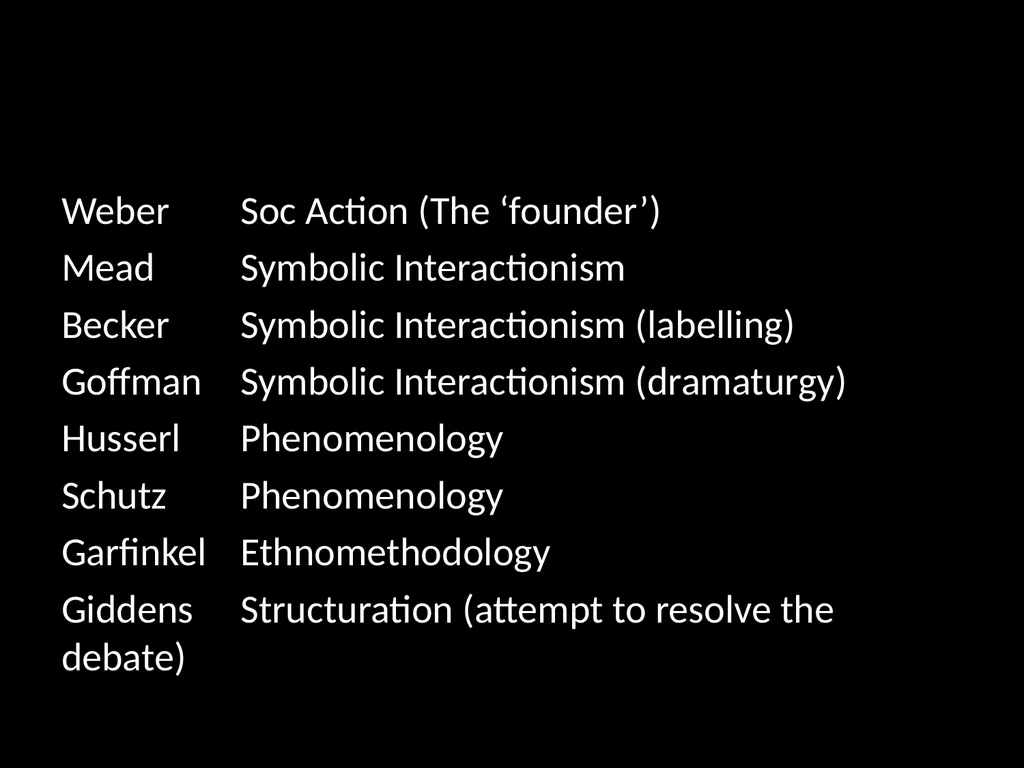
Weber Soc Action (The ‘founder’)
Mead Symbolic Interactionism
Becker Symbolic Interactionism (labelling)
Goffman Symbolic Interactionism (dramaturgy)
Husserl Phenomenology
Schutz Phenomenology
Garfinkel Ethnomethodology
Giddens Structuration (attempt to resolve the debate)<br>
Mead Symbolic Interactionism
Becker Symbolic Interactionism (labelling)
Goffman Symbolic Interactionism (dramaturgy)
Husserl Phenomenology
Schutz Phenomenology
Garfinkel Ethnomethodology
Giddens Structuration (attempt to resolve the debate)<br>
30
Symbolic Interactionism
How meanings are constructed through social interaction. How we shape the world through interaction. People have a degree of control and influence over social behaviour
Phenomenology
Phenomenology – internal workings of the human mind and the way humans make sense of and classify the world around them.
Ethnomethodology
The study of the methods used by people to construct, account for and give meaning to their social world<br>
How meanings are constructed through social interaction. How we shape the world through interaction. People have a degree of control and influence over social behaviour
Phenomenology
Phenomenology – internal workings of the human mind and the way humans make sense of and classify the world around them.
Ethnomethodology
The study of the methods used by people to construct, account for and give meaning to their social world<br>
31
Who would you give flowers to?
Who would you give red roses to?
If your gave your Grandma red roses would it mean the same as if you gave your girlfriend red roses?
Would your Grandma/Girlfriend thank you in the same way?
Meanings are a product of social interaction
Meanings are handled through a process where people try to make sense of situations.<br>
Who would you give red roses to?
If your gave your Grandma red roses would it mean the same as if you gave your girlfriend red roses?
Would your Grandma/Girlfriend thank you in the same way?
Meanings are a product of social interaction
Meanings are handled through a process where people try to make sense of situations.<br>
32
Who would you give flowers to?
Who would you give red roses to?
If your gave your Grandma red roses would it mean the same as if you gave your girlfriend red roses?
Would your Grandma/Girlfriends thank you in the same way?
Meanings are a product of social interaction
Meanings are handled through a process where people try to make sense of situations.<br>
Who would you give red roses to?
If your gave your Grandma red roses would it mean the same as if you gave your girlfriend red roses?
Would your Grandma/Girlfriends thank you in the same way?
Meanings are a product of social interaction
Meanings are handled through a process where people try to make sense of situations.<br>
33
Who’s ever been in a play? What are you required to do?
What roles do you play?
How do you modify your performance?<br>
What roles do you play?
How do you modify your performance?<br>
34
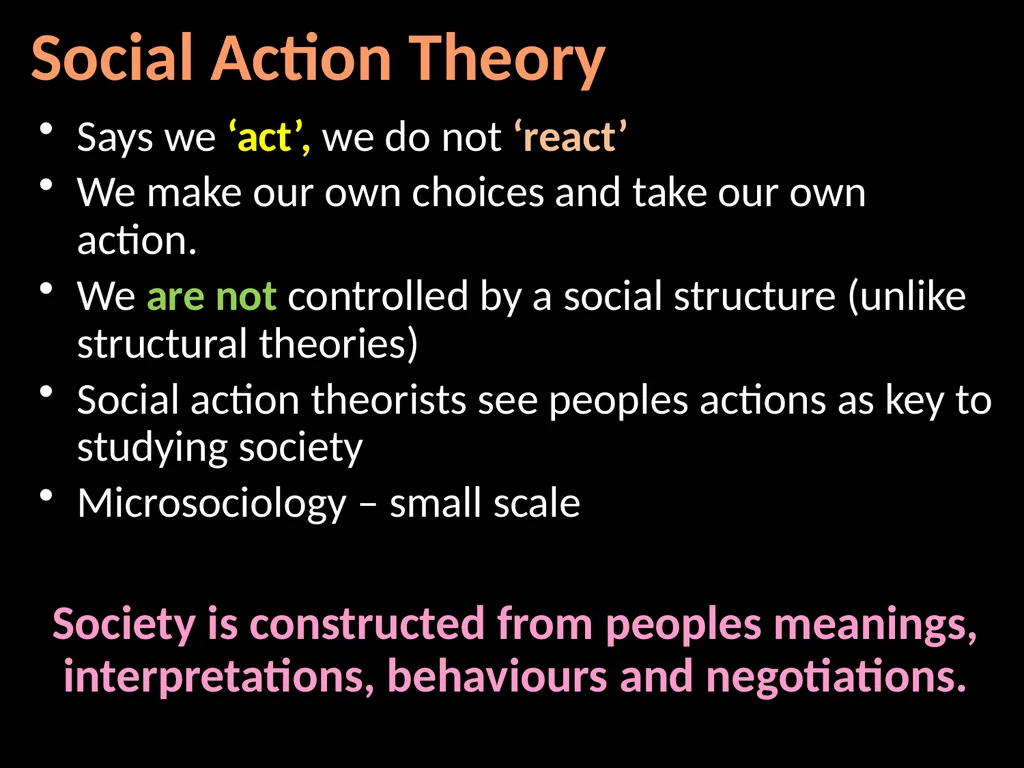
Social Action Theory Says we ‘act’, we do not ‘react’
We make our own choices and take our own action.
We are not controlled by a social structure (unlike structural theories)
Social action theorists see peoples actions as key to studying society
Microsociology – small scale
Society is constructed from peoples meanings, interpretations, behaviours and negotiations.<br>
We make our own choices and take our own action.
We are not controlled by a social structure (unlike structural theories)
Social action theorists see peoples actions as key to studying society
Microsociology – small scale
Society is constructed from peoples meanings, interpretations, behaviours and negotiations.<br>
35
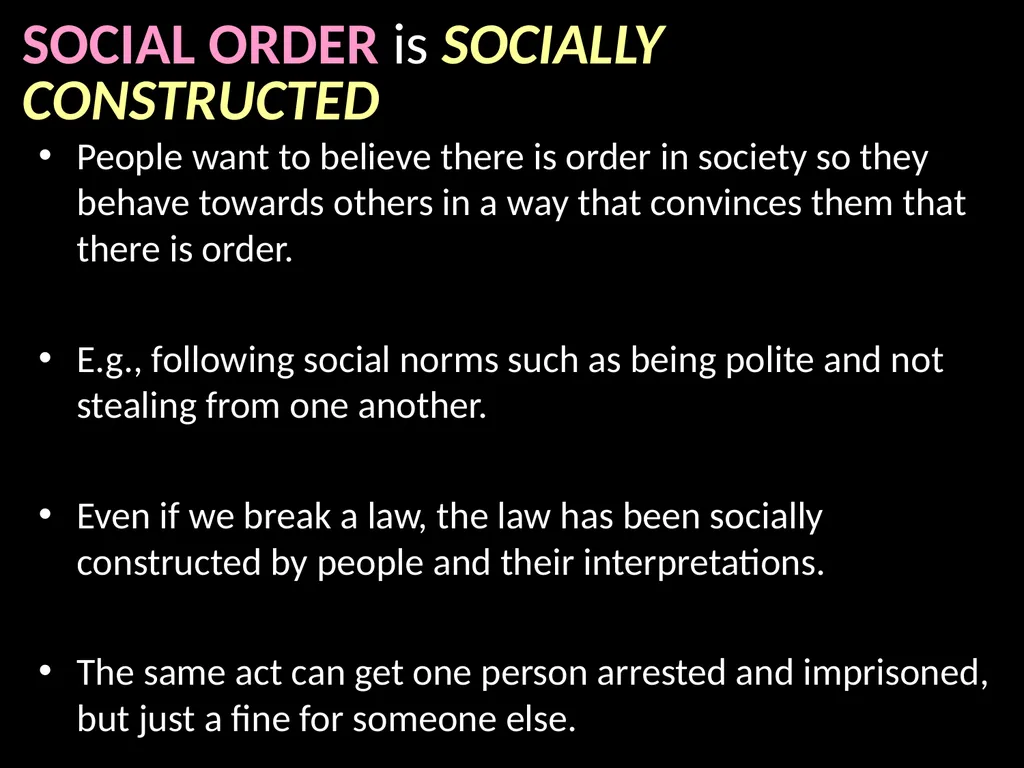
SOCIAL ORDER is SOCIALLY CONSTRUCTED People want to believe there is order in society so they behave towards others in a way that convinces them that there is order.
E.g., following social norms such as being polite and not stealing from one another.
Even if we break a law, the law has been socially constructed by people and their interpretations.
The same act can get one person arrested and imprisoned, but just a fine for someone else.<br>
E.g., following social norms such as being polite and not stealing from one another.
Even if we break a law, the law has been socially constructed by people and their interpretations.
The same act can get one person arrested and imprisoned, but just a fine for someone else.<br>
36
Social action theorists are INTERPRETVISTS because they say sociology cannot be objective – it is always biased
People will always interpret things differently
It is subjective – human behaviour cannot be predicted.<br>
People will always interpret things differently
It is subjective – human behaviour cannot be predicted.<br>
37
So, Durkheim's suicide typology would be rejected… According to SA theorists, social facts cannot exist<br>
38
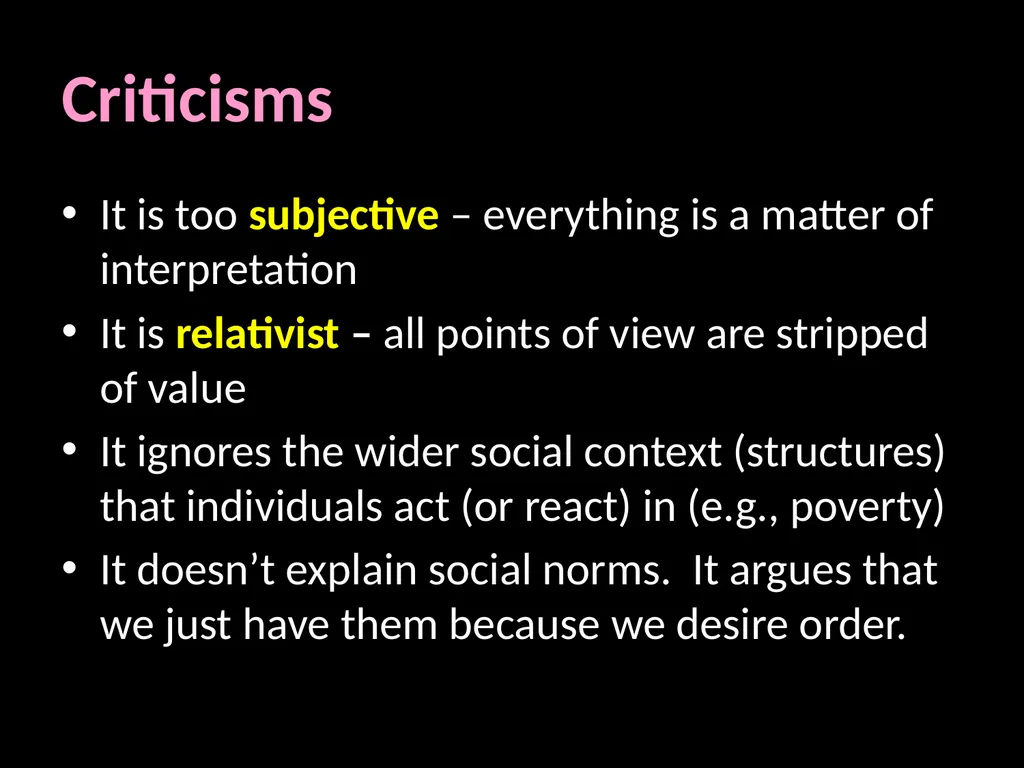
Criticisms It is too subjective – everything is a matter of interpretation
It is relativist – all points of view are stripped of value
It ignores the wider social context (structures) that individuals act (or react) in (e.g., poverty)
It doesn’t explain social norms. It argues that we just have them because we desire order.<br>
It is relativist – all points of view are stripped of value
It ignores the wider social context (structures) that individuals act (or react) in (e.g., poverty)
It doesn’t explain social norms. It argues that we just have them because we desire order.<br>
39
Structuration Where Structuralism and Social Action theory meet!
Giddens is a structuration theorist
People are subject to restrictions and pressures generated by social structures and systems (e.g. laws)
But, individuals respond to these in different ways (the SA bit)
Individuals have an awareness of the social rules and structures and have some level of choice about how to react to them.
Social structures and systems can be changed by the actions of individuals say structuration theorists<br>
Giddens is a structuration theorist
People are subject to restrictions and pressures generated by social structures and systems (e.g. laws)
But, individuals respond to these in different ways (the SA bit)
Individuals have an awareness of the social rules and structures and have some level of choice about how to react to them.
Social structures and systems can be changed by the actions of individuals say structuration theorists<br>
40
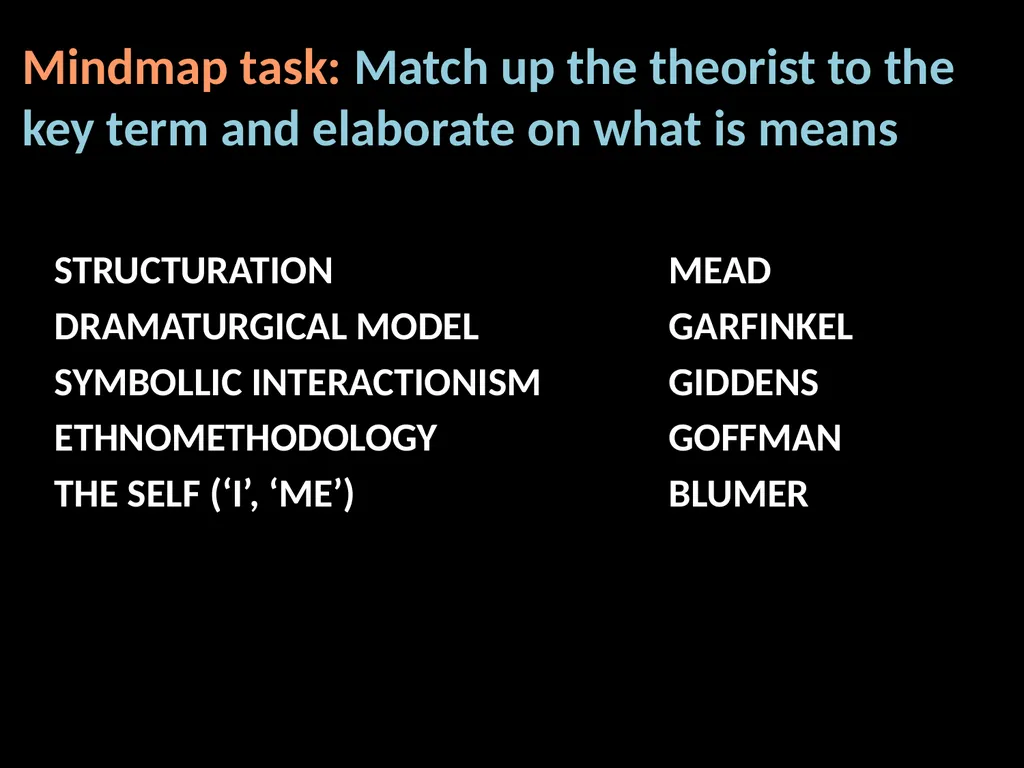
Mindmap task: Match up the theorist to the key term and elaborate on what is means STRUCTURATION MEAD
DRAMATURGICAL MODEL GARFINKEL
SYMBOLLIC INTERACTIONISM GIDDENS
ETHNOMETHODOLOGY GOFFMAN
THE SELF (‘I’, ‘ME’) BLUMER<br>
DRAMATURGICAL MODEL GARFINKEL
SYMBOLLIC INTERACTIONISM GIDDENS
ETHNOMETHODOLOGY GOFFMAN
THE SELF (‘I’, ‘ME’) BLUMER<br>
41
Who’s ever been in a play? What are you required to do?
What roles do you play?
How do you modify your performance?<br>
What roles do you play?
How do you modify your performance?<br>
42
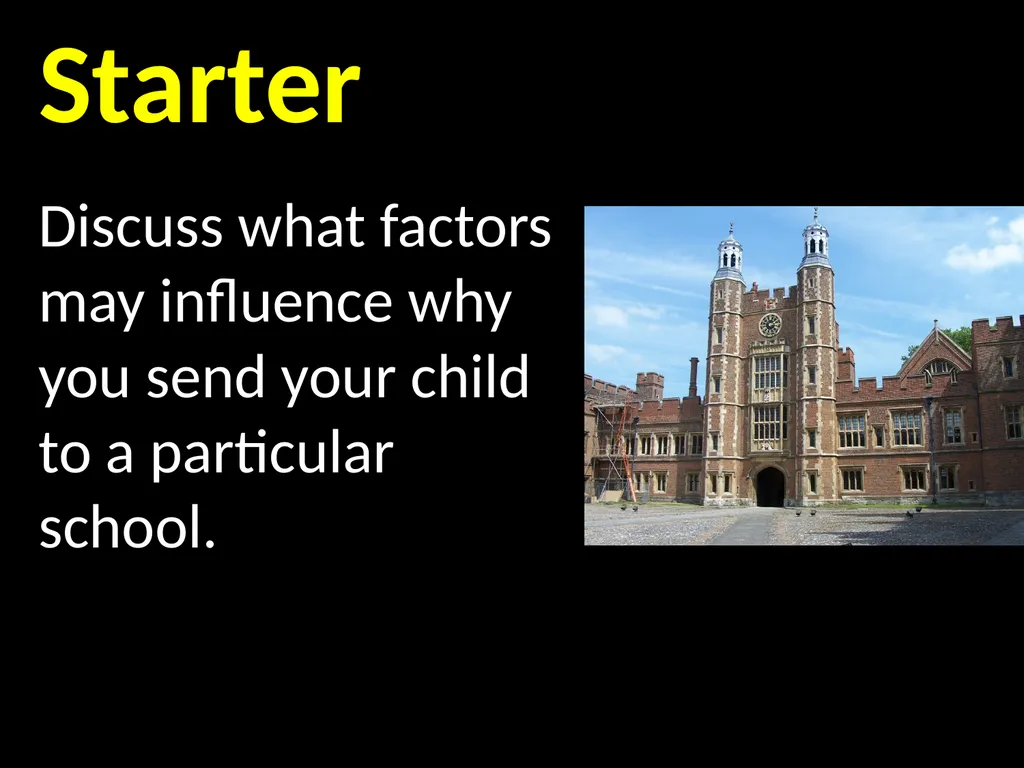
Starter Discuss what factors may influence why you send your child to a particular school.<br>
43
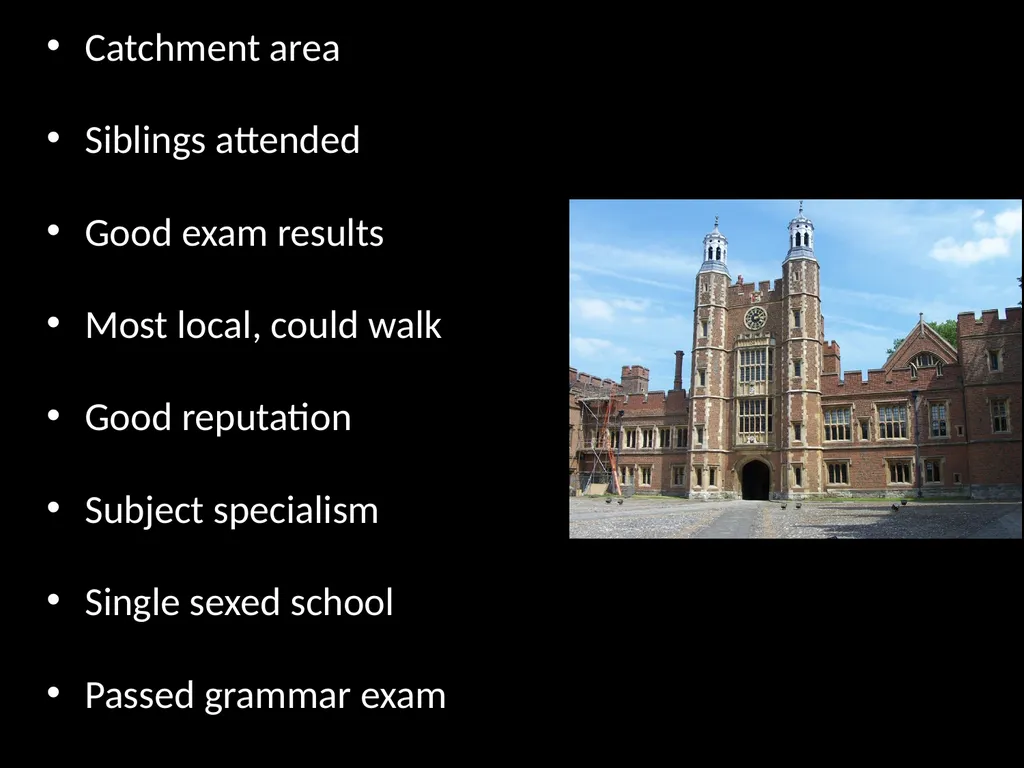
Catchment area
Siblings attended
Good exam results
Most local, could walk
Good reputation
Subject specialism
Single sexed school
Passed grammar exam<br>
Siblings attended
Good exam results
Most local, could walk
Good reputation
Subject specialism
Single sexed school
Passed grammar exam<br>
44
In pairs Take the list we have just discussed, and explain which ones would be linked to structural factors and which ones are to do with individual choice.<br>
45
Structure and agency To summarise:
Structural approaches emphasise how people are influenced by major structural forces.
Social action studies may describe how individuals operate in society as relatively free agents, creating identities for themselves.<br>
Structural approaches emphasise how people are influenced by major structural forces.
Social action studies may describe how individuals operate in society as relatively free agents, creating identities for themselves.<br>
46
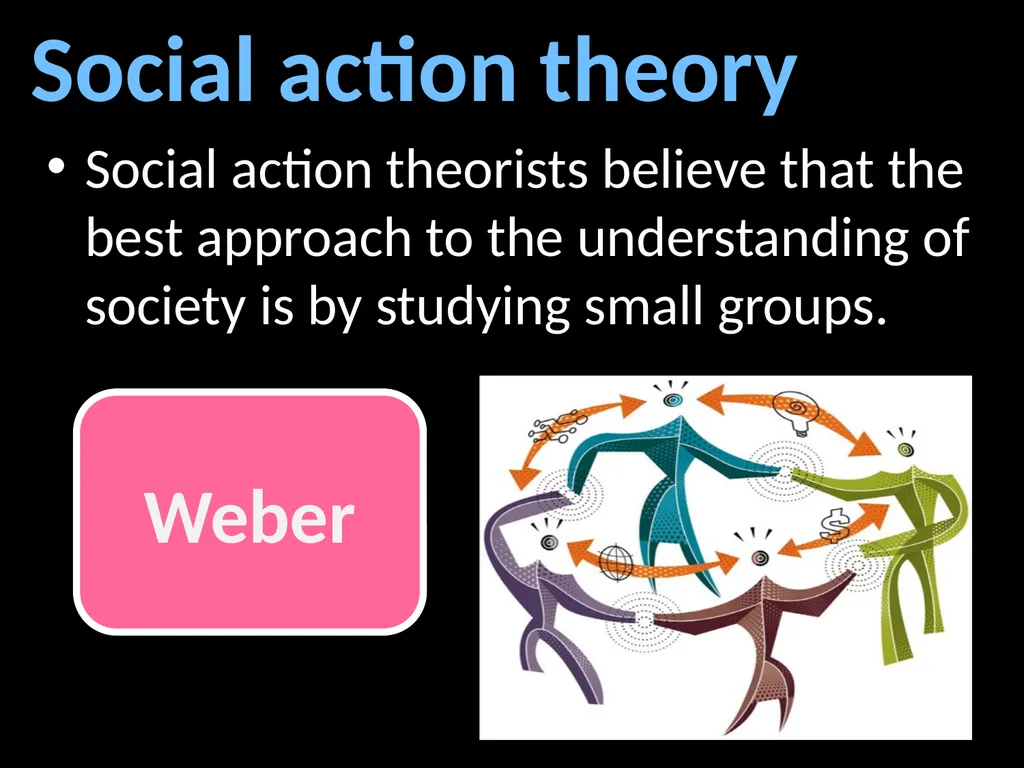
Social action theory Social action theorists believe that the best approach to the understanding of society is by studying small groups. Weber<br>
47
AO2 to Structuralism One of the criticisms made of some structuralist research, such as work by Functionalists and Marxists, has been that all-embracing theories may be thought of first and then evidence selected to back them up.
Instead SA theorists recommended doing close and detailed observation of some aspect of social life first and then deriving a grounded theory from their findings.<br>
Instead SA theorists recommended doing close and detailed observation of some aspect of social life first and then deriving a grounded theory from their findings.<br>
48
Bottom Up A good example of grounded theory is the work of David Gillborn. He carried out observations over 2 years in a comprehensive school.
This approach can be described as bottom-up, because the sociologist studies a specific set of behaviours, experiences or attitudes but then identifies their wider relevance by relating them to some aspect of the social structure.<br>
This approach can be described as bottom-up, because the sociologist studies a specific set of behaviours, experiences or attitudes but then identifies their wider relevance by relating them to some aspect of the social structure.<br>
49
Weber and Social Action Weber argues that we should avoid generalising theories because people are not determined by general laws.
Social science should proceed by understanding human action.
Weber’s work has been influential in the development of the sociology of everyday life.
Weber’s approach lead to a view called methodological individualism which focuses on how people actively engage in social interaction. Structures do not determine our behaviour.
Weber is critical of Marx, and believes that it is individuals that shape the development of society.<br>
Social science should proceed by understanding human action.
Weber’s work has been influential in the development of the sociology of everyday life.
Weber’s approach lead to a view called methodological individualism which focuses on how people actively engage in social interaction. Structures do not determine our behaviour.
Weber is critical of Marx, and believes that it is individuals that shape the development of society.<br>
50
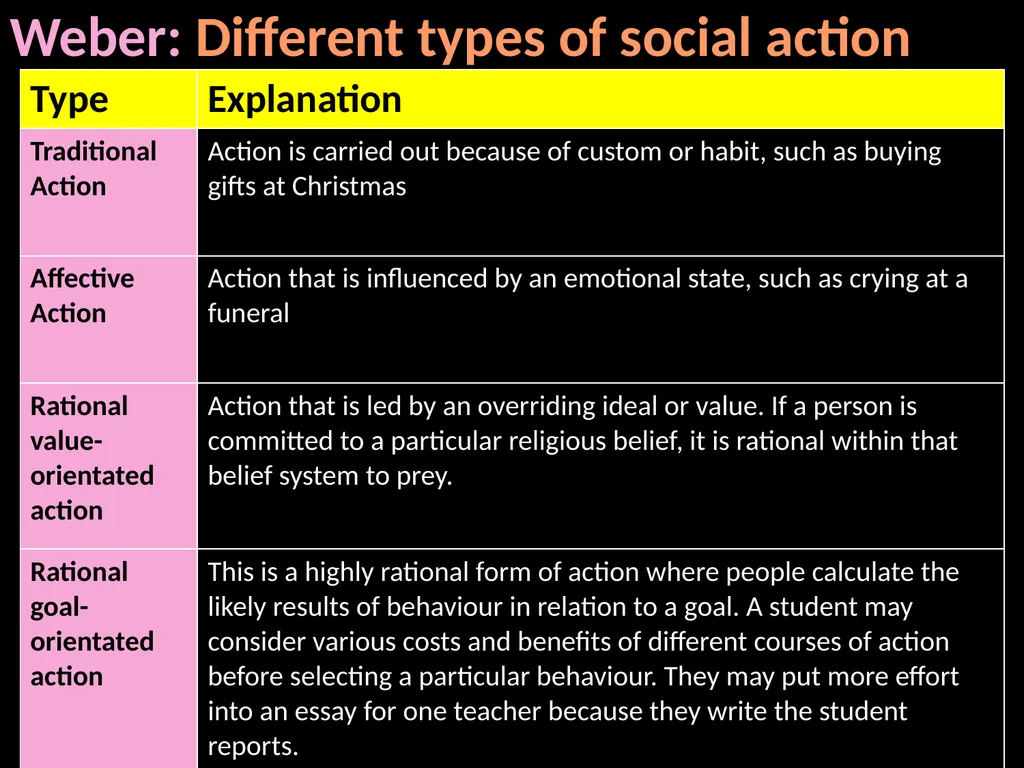
Weber: Different types of social action<br>
51
Criticisms of Weber: Schutz (1972) argues that the action theory is too individualistic and cannot explain the shared nature of meanings.
Weber’s typology of action is difficult to apply and some actions belong to more than one type of action identified by Weber.
We can never truly understand an individual’s actions so Weber’s idea of verstehen cannot be applied.
Lee and Newby (1983) describe Weber as a methodological individualist who ignores the structure of society.<br>
Weber’s typology of action is difficult to apply and some actions belong to more than one type of action identified by Weber.
We can never truly understand an individual’s actions so Weber’s idea of verstehen cannot be applied.
Lee and Newby (1983) describe Weber as a methodological individualist who ignores the structure of society.<br>
52
Symbolic Interactionism – Meads Theory Mead is usually seen as the founder of symbolic interactionism.<br>
53
Symbolic Interactionism Symbolic interactionists emphasise the ways in which society is actively shaped by individuals and the meanings they attach to ‘everyday things’.
Symbolic interactionism is usually regarded as a social action theory.<br>
Symbolic interactionism is usually regarded as a social action theory.<br>
54
The ‘I’ and the ‘me’ G. H. Mead in 1934 described our awareness of how others see us.
The ‘I’ is the spontaneous side of our personality which would like to act freely, but we are aware of the way ‘generalised others’ of our society view us and expect us to behave.
This more inhibiting self concept seen through the eyes of others is termed the ‘me’.<br>
The ‘I’ is the spontaneous side of our personality which would like to act freely, but we are aware of the way ‘generalised others’ of our society view us and expect us to behave.
This more inhibiting self concept seen through the eyes of others is termed the ‘me’.<br>
55
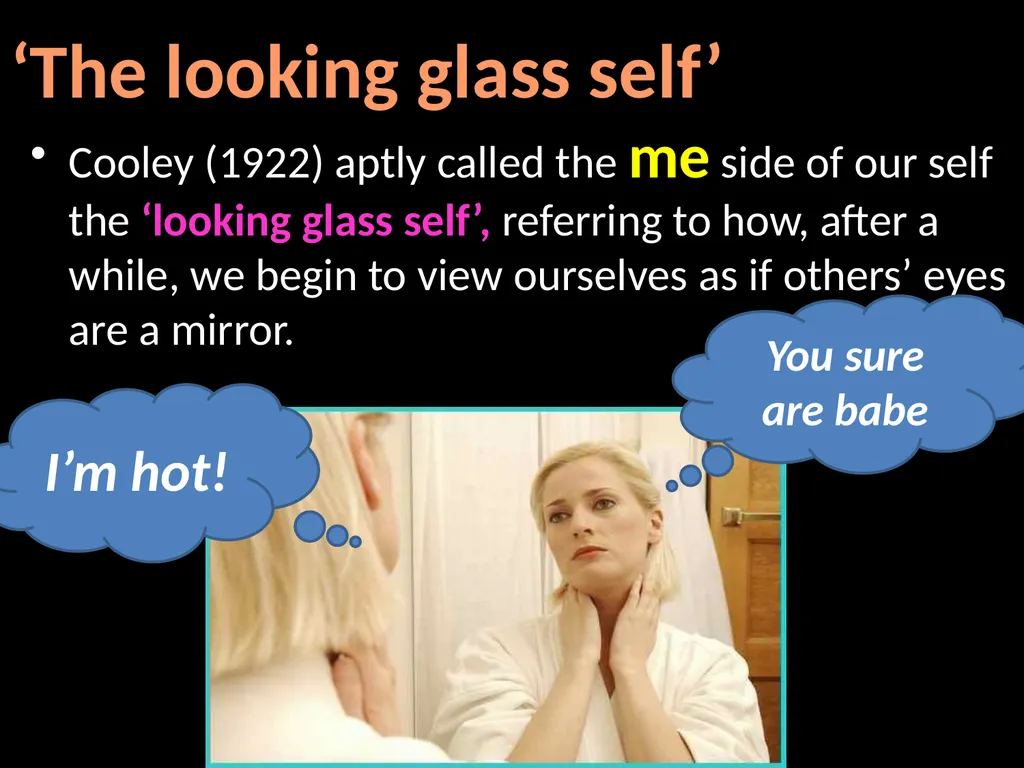
‘The looking glass self’ Cooley (1922) aptly called the me side of our self the ‘looking glass self’, referring to how, after a while, we begin to view ourselves as if others’ eyes are a mirror. I’m hot! You sure are babe<br>
56
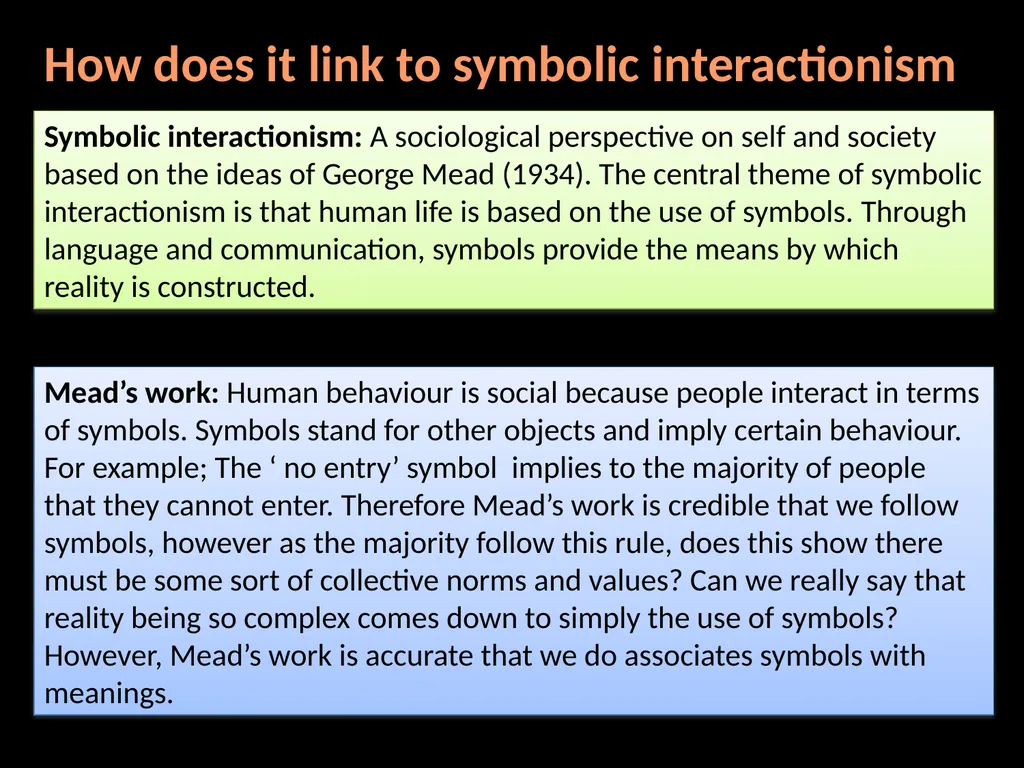
How does it link to symbolic interactionism Symbolic interactionism: A sociological perspective on self and society based on the ideas of George Mead (1934). The central theme of symbolic interactionism is that human life is based on the use of symbols. Through language and communication, symbols provide the means by which reality is constructed. Mead’s work: Human behaviour is social because people interact in terms of symbols. Symbols stand for other objects and imply certain behaviour. For example; The ‘ no entry’ symbol implies to the majority of people that they cannot enter. Therefore Mead’s work is credible that we follow symbols, however as the majority follow this rule, does this show there must be some sort of collective norms and values? Can we really say that reality being so complex comes down to simply the use of symbols? However, Mead’s work is accurate that we do associates symbols with meanings.<br>
57
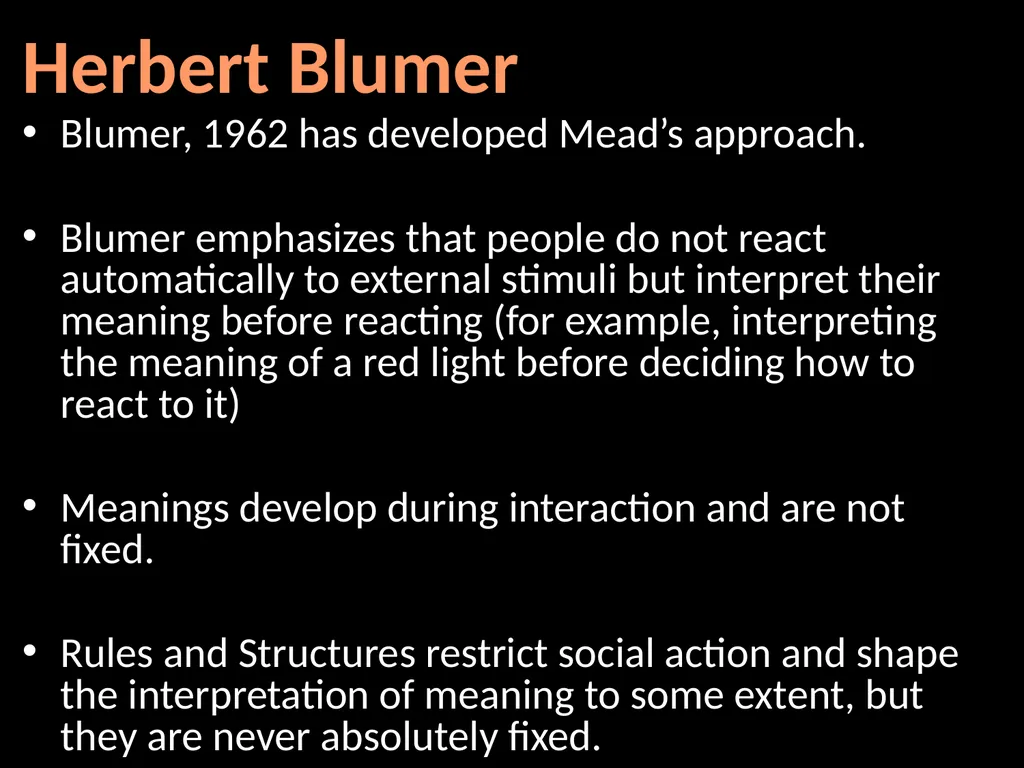
Herbert Blumer Blumer, 1962 has developed Mead’s approach.
Blumer emphasizes that people do not react automatically to external stimuli but interpret their meaning before reacting (for example, interpreting the meaning of a red light before deciding how to react to it)
Meanings develop during interaction and are not fixed.
Rules and Structures restrict social action and shape the interpretation of meaning to some extent, but they are never absolutely fixed.<br>
Blumer emphasizes that people do not react automatically to external stimuli but interpret their meaning before reacting (for example, interpreting the meaning of a red light before deciding how to react to it)
Meanings develop during interaction and are not fixed.
Rules and Structures restrict social action and shape the interpretation of meaning to some extent, but they are never absolutely fixed.<br>
58
http://www.youtube.com/watch?v=Ql0XPwtfFGY&feature=related<br>
59
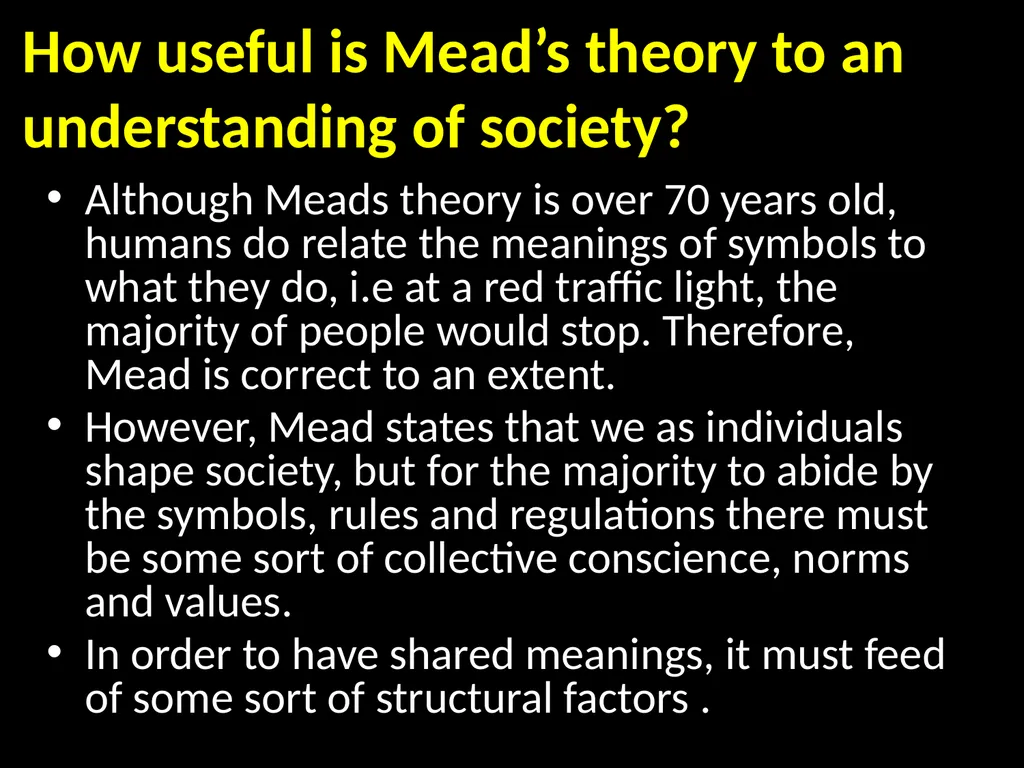
How useful is Mead’s theory to an understanding of society? Although Meads theory is over 70 years old, humans do relate the meanings of symbols to what they do, i.e at a red traffic light, the majority of people would stop. Therefore, Mead is correct to an extent.
However, Mead states that we as individuals shape society, but for the majority to abide by the symbols, rules and regulations there must be some sort of collective conscience, norms and values.
In order to have shared meanings, it must feed of some sort of structural factors .<br>
However, Mead states that we as individuals shape society, but for the majority to abide by the symbols, rules and regulations there must be some sort of collective conscience, norms and values.
In order to have shared meanings, it must feed of some sort of structural factors .<br>
60
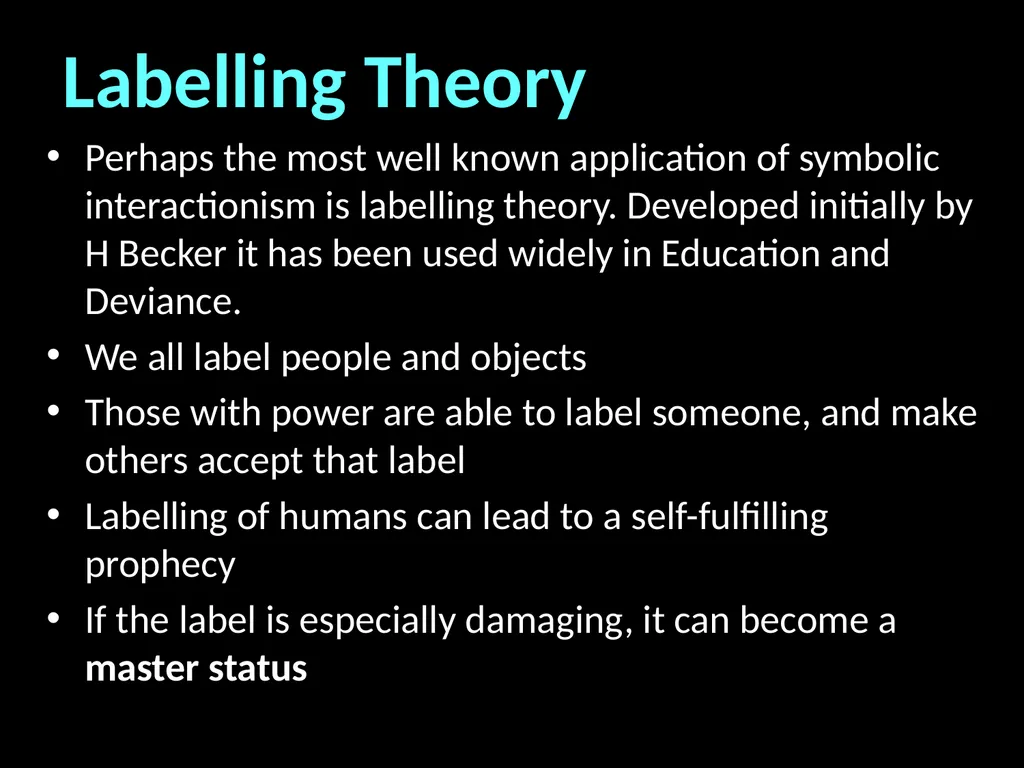
Labelling Theory Perhaps the most well known application of symbolic interactionism is labelling theory. Developed initially by H Becker it has been used widely in Education and Deviance.
We all label people and objects
Those with power are able to label someone, and make others accept that label
Labelling of humans can lead to a self-fulfilling prophecy
If the label is especially damaging, it can become a master status<br>
We all label people and objects
Those with power are able to label someone, and make others accept that label
Labelling of humans can lead to a self-fulfilling prophecy
If the label is especially damaging, it can become a master status<br>
61
Dramaturgy http://www.youtube.com/watch?v=UdNQ4SuinEI&feature=related<br>
62
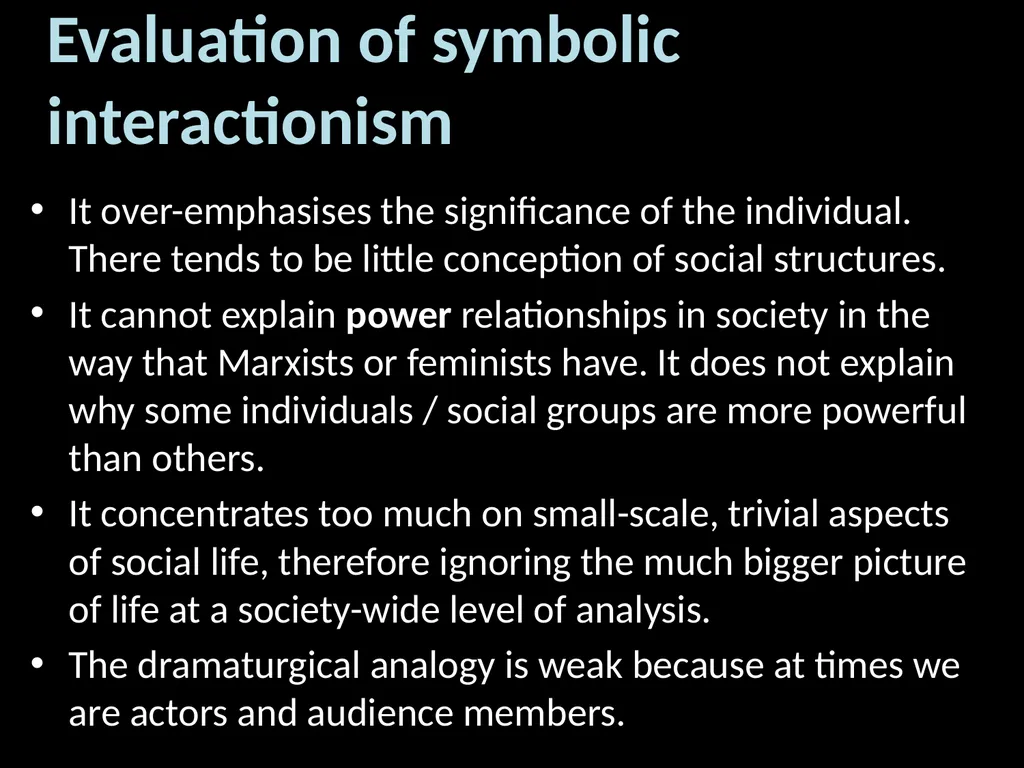
Evaluation of symbolic interactionism It over-emphasises the significance of the individual. There tends to be little conception of social structures.
It cannot explain power relationships in society in the way that Marxists or feminists have. It does not explain why some individuals / social groups are more powerful than others.
It concentrates too much on small-scale, trivial aspects of social life, therefore ignoring the much bigger picture of life at a society-wide level of analysis.
The dramaturgical analogy is weak because at times we are actors and audience members.<br>
It cannot explain power relationships in society in the way that Marxists or feminists have. It does not explain why some individuals / social groups are more powerful than others.
It concentrates too much on small-scale, trivial aspects of social life, therefore ignoring the much bigger picture of life at a society-wide level of analysis.
The dramaturgical analogy is weak because at times we are actors and audience members.<br>
63
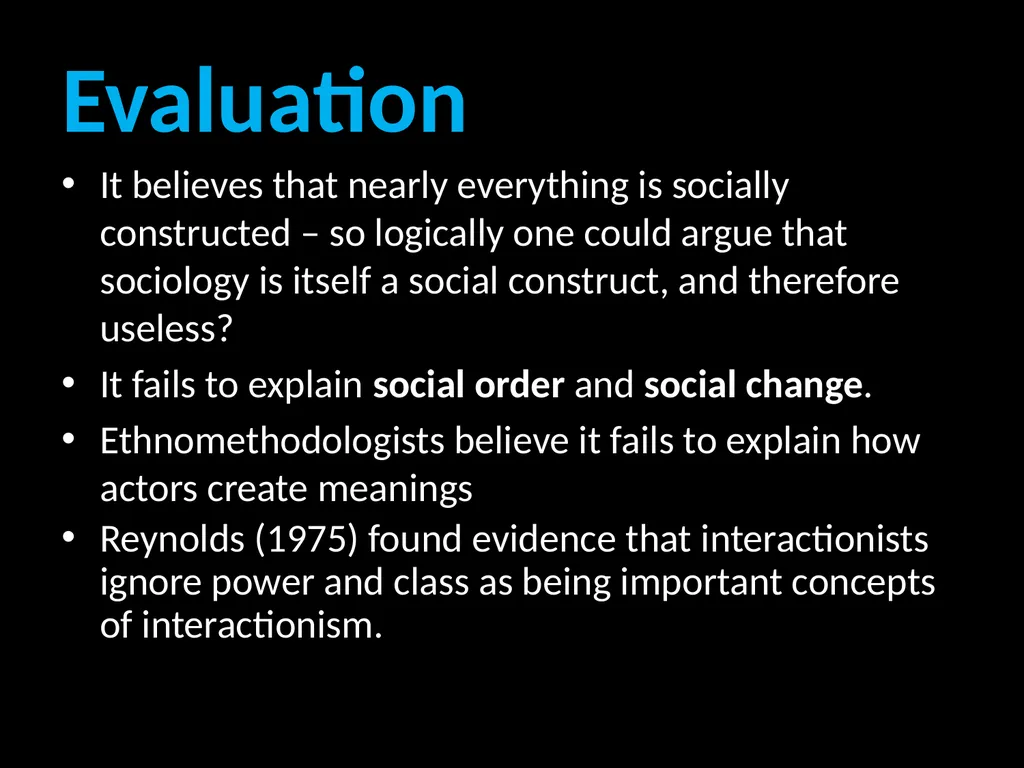
Evaluation It believes that nearly everything is socially constructed – so logically one could argue that sociology is itself a social construct, and therefore useless?
It fails to explain social order and social change.
Ethnomethodologists believe it fails to explain how actors create meanings
Reynolds (1975) found evidence that interactionists ignore power and class as being important concepts of interactionism.<br>
It fails to explain social order and social change.
Ethnomethodologists believe it fails to explain how actors create meanings
Reynolds (1975) found evidence that interactionists ignore power and class as being important concepts of interactionism.<br>
64
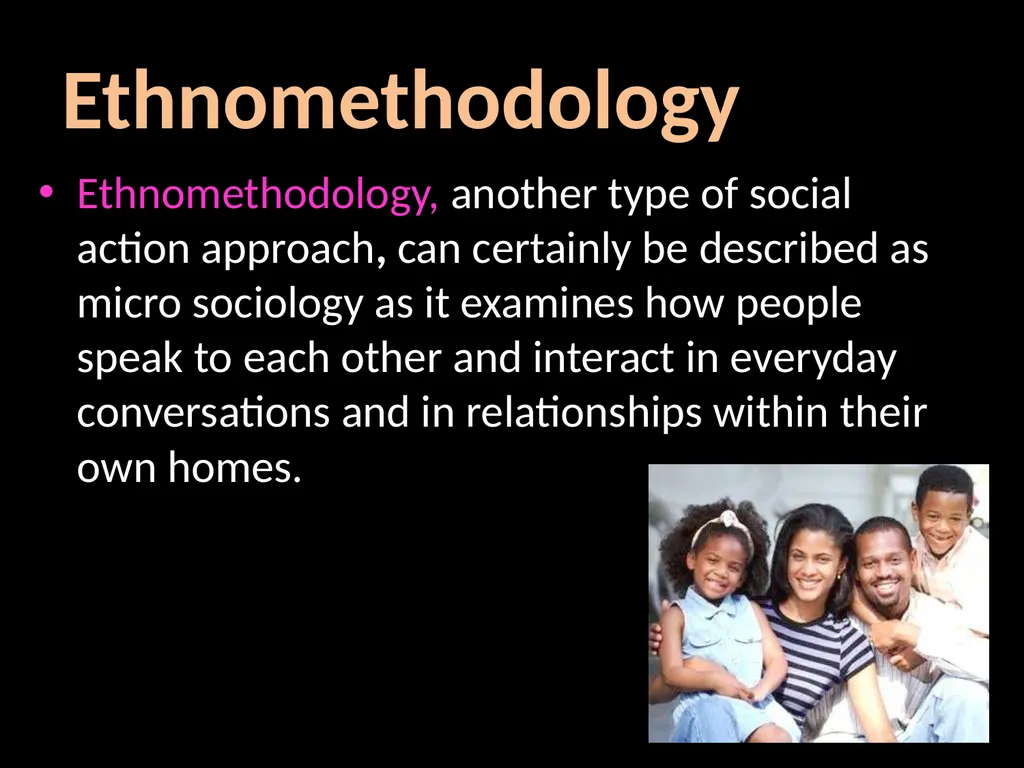
Ethnomethodology Ethnomethodology, another type of social action approach, can certainly be described as micro sociology as it examines how people speak to each other and interact in everyday conversations and in relationships within their own homes.<br>
65
Phenomenology Phenomenology is another branch of social action theory with a slightly different emphasis. It examines the social construction of particular phenomena and the results of this subjective way of seeing and talking about them (a discourse) on people’s attitudes and behaviour.<br>
66
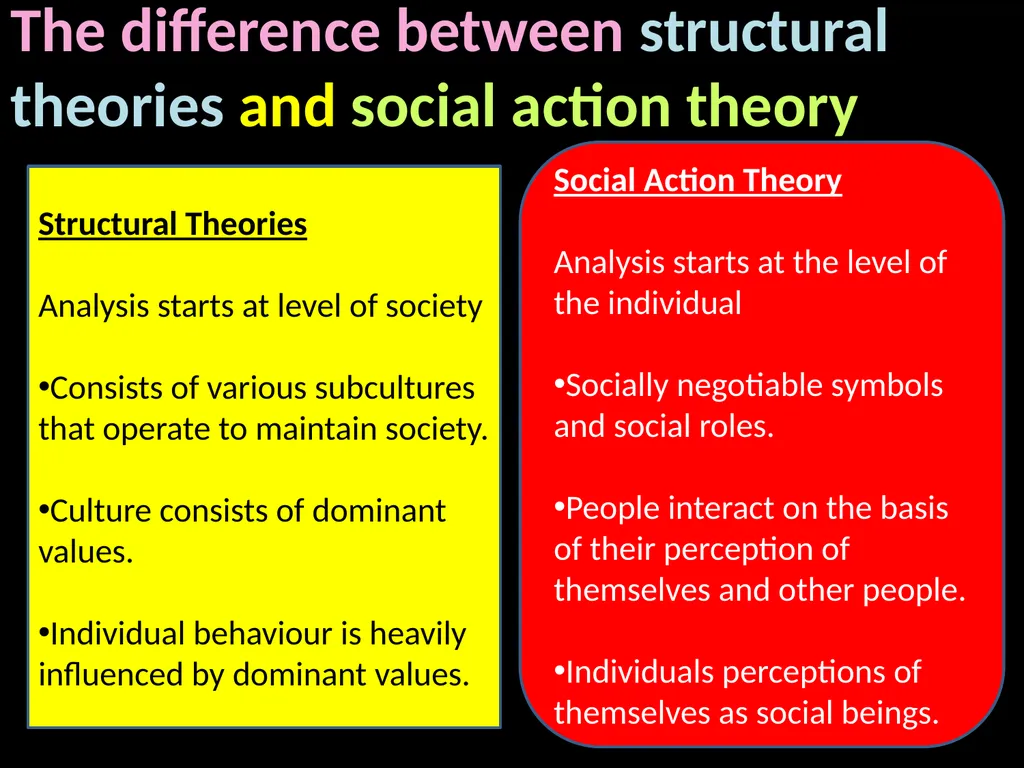
The difference between structural theories and social action theory Structural Theories
Analysis starts at level of society
Consists of various subcultures that operate to maintain society.
Culture consists of dominant values.
Individual behaviour is heavily influenced by dominant values. Social Action Theory
Analysis starts at the level of the individual
Socially negotiable symbols and social roles.
People interact on the basis of their perception of themselves and other people.
Individuals perceptions of themselves as social beings.<br>
Analysis starts at level of society
Consists of various subcultures that operate to maintain society.
Culture consists of dominant values.
Individual behaviour is heavily influenced by dominant values. Social Action Theory
Analysis starts at the level of the individual
Socially negotiable symbols and social roles.
People interact on the basis of their perception of themselves and other people.
Individuals perceptions of themselves as social beings.<br>
67
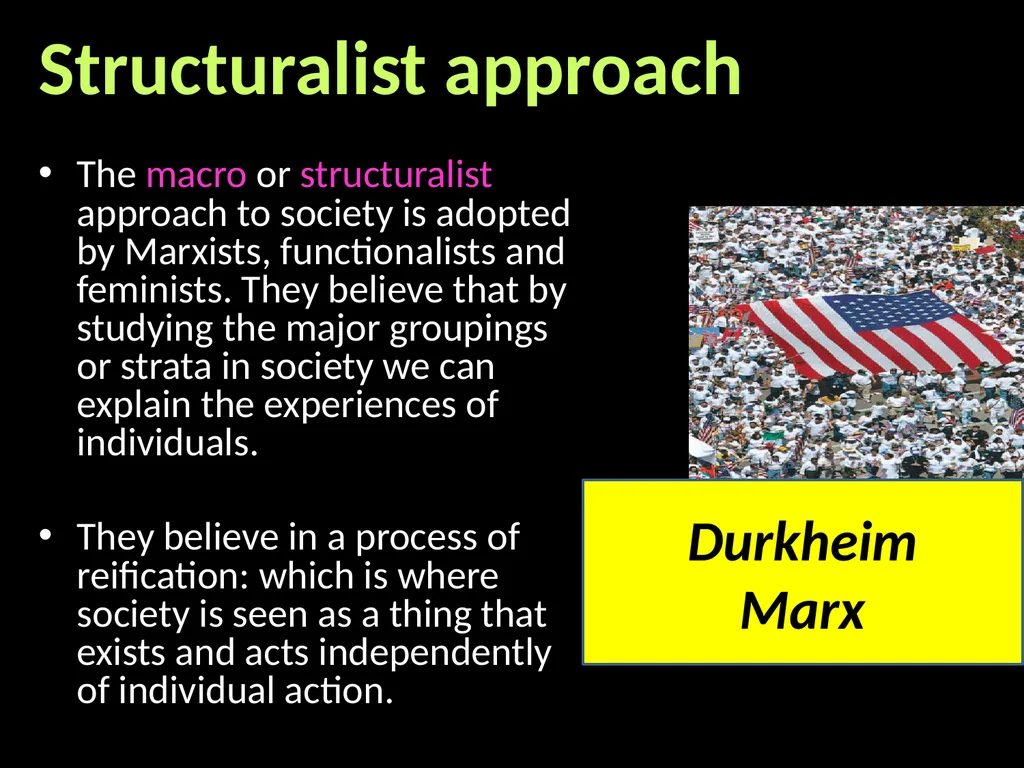
Structuralist approach The macro or structuralist approach to society is adopted by Marxists, functionalists and feminists. They believe that by studying the major groupings or strata in society we can explain the experiences of individuals.
They believe in a process of reification: which is where society is seen as a thing that exists and acts independently of individual action. Durkheim
Marx<br>
They believe in a process of reification: which is where society is seen as a thing that exists and acts independently of individual action. Durkheim
Marx<br>
68
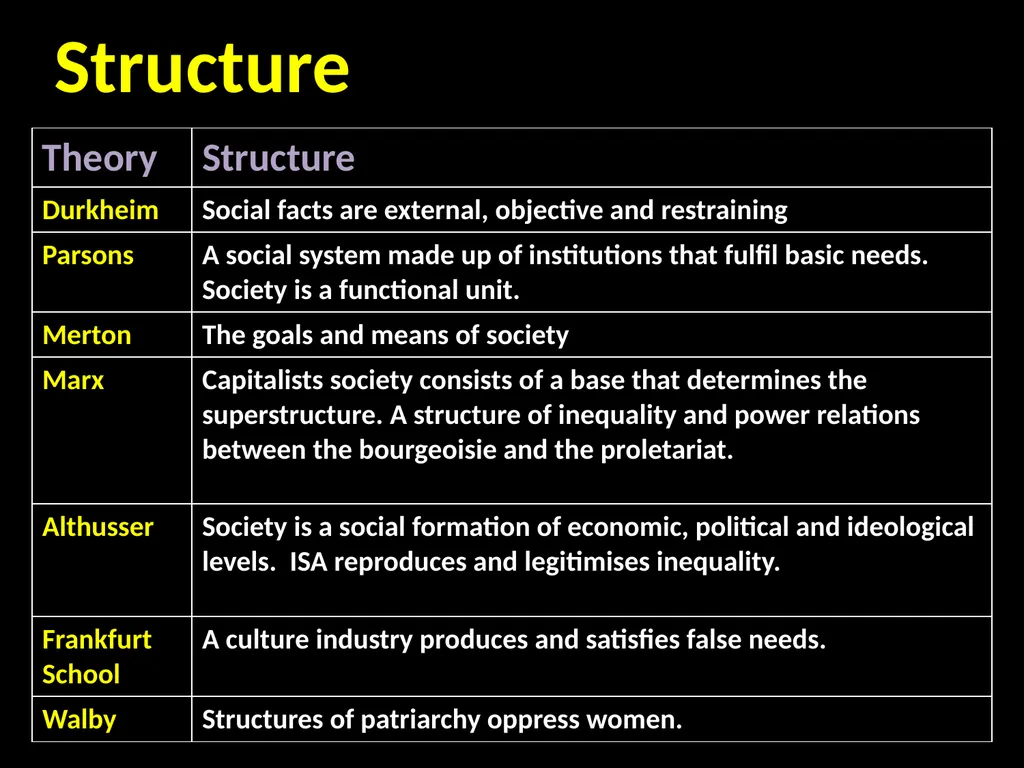
Structure<br>
69
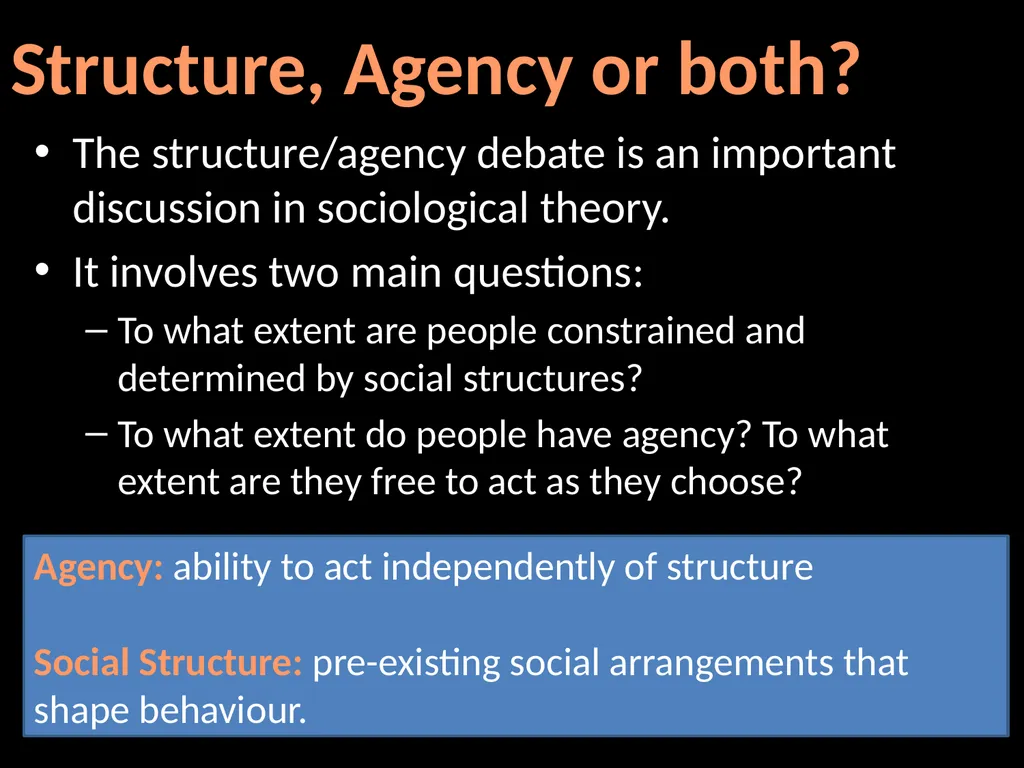
Structure, Agency or both? The structure/agency debate is an important discussion in sociological theory.
It involves two main questions:
To what extent are people constrained and determined by social structures?
To what extent do people have agency? To what extent are they free to act as they choose? Agency: ability to act independently of structure
Social Structure: pre-existing social arrangements that shape behaviour.<br>
It involves two main questions:
To what extent are people constrained and determined by social structures?
To what extent do people have agency? To what extent are they free to act as they choose? Agency: ability to act independently of structure
Social Structure: pre-existing social arrangements that shape behaviour.<br>
70
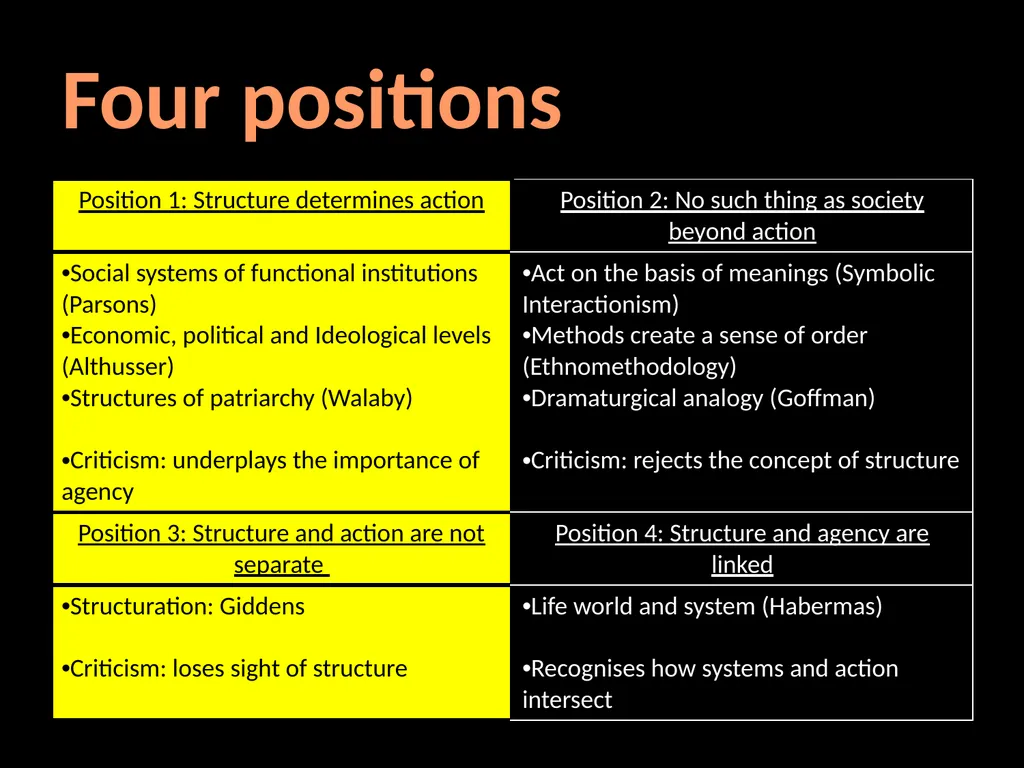
Four positions<br>
71
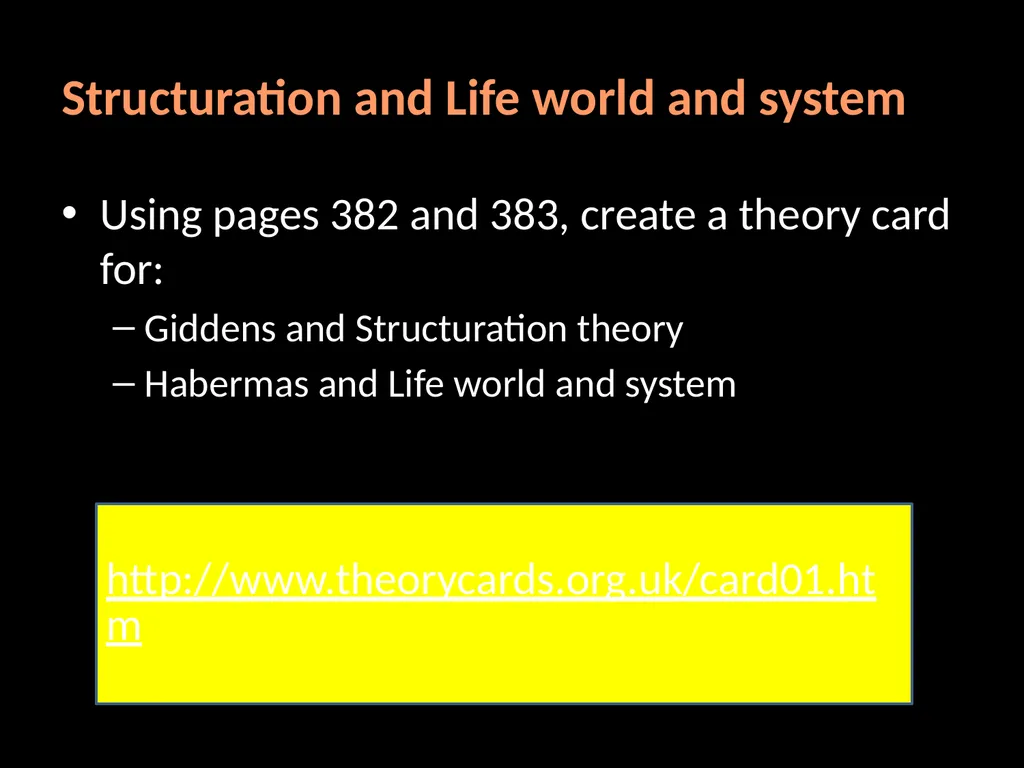
Structuration and Life world and system Using pages 382 and 383, create a theory card for:
Giddens and Structuration theory
Habermas and Life world and system http://www.theorycards.org.uk/card01.htm<br>
Giddens and Structuration theory
Habermas and Life world and system http://www.theorycards.org.uk/card01.htm<br>
72
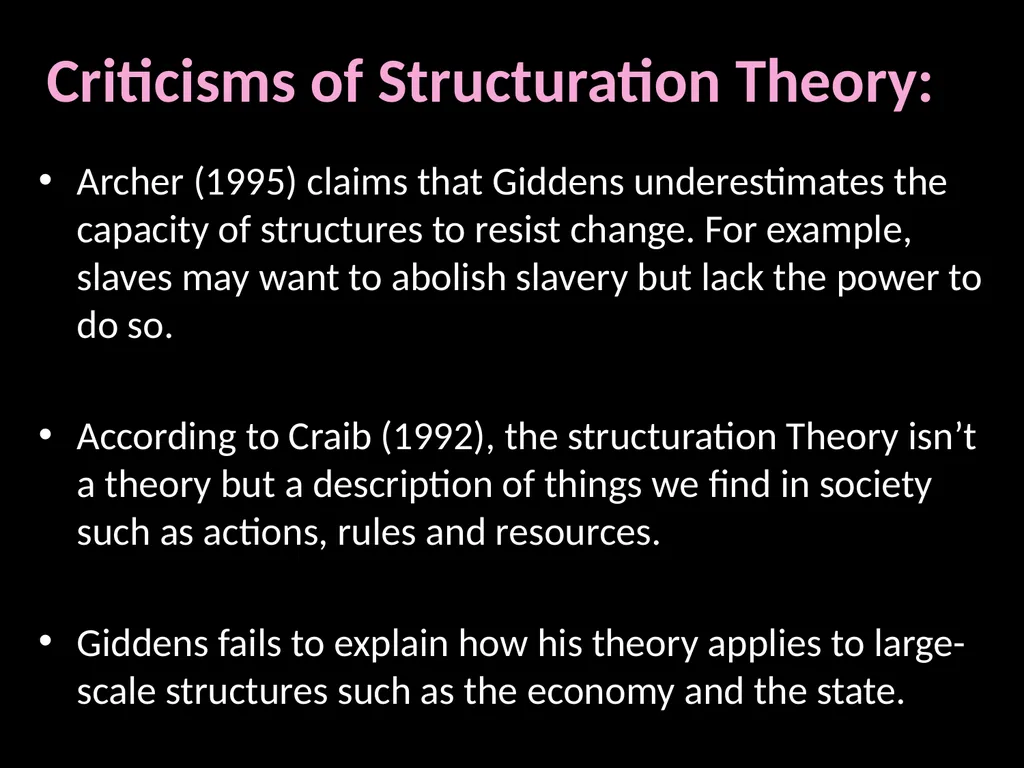
Criticisms of Structuration Theory: Archer (1995) claims that Giddens underestimates the capacity of structures to resist change. For example, slaves may want to abolish slavery but lack the power to do so.
According to Craib (1992), the structuration Theory isn’t a theory but a description of things we find in society such as actions, rules and resources.
Giddens fails to explain how his theory applies to large-scale structures such as the economy and the state.<br>
According to Craib (1992), the structuration Theory isn’t a theory but a description of things we find in society such as actions, rules and resources.
Giddens fails to explain how his theory applies to large-scale structures such as the economy and the state.<br>
73
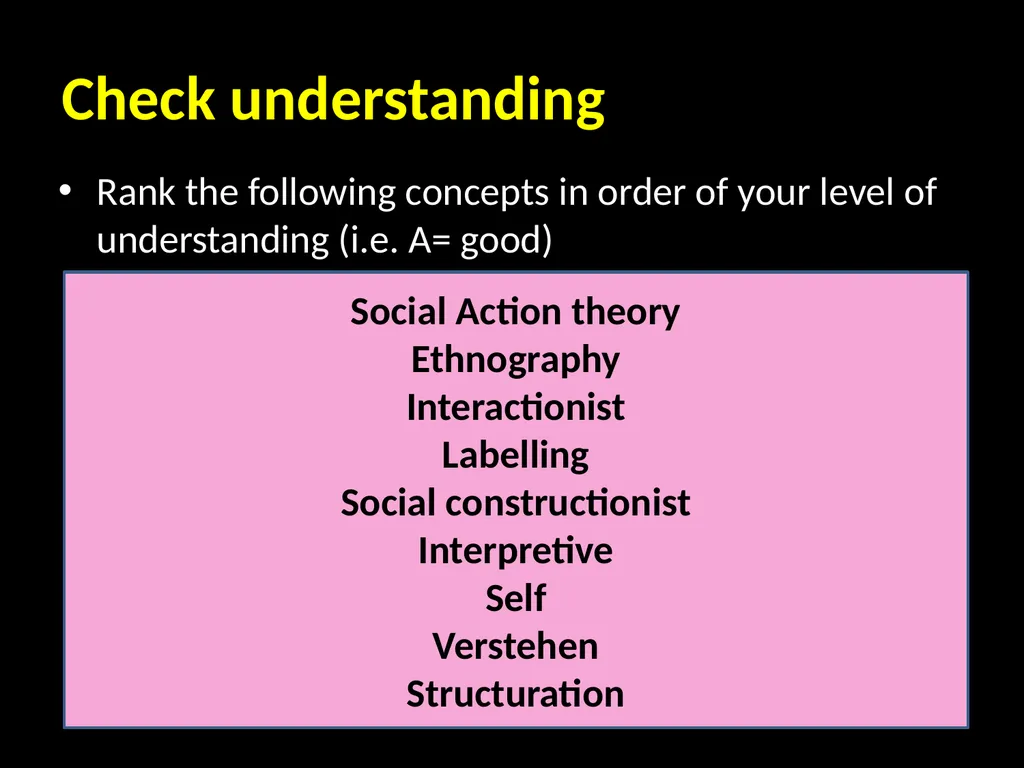
Check understanding Rank the following concepts in order of your level of understanding (i.e. A= good) Social Action theory
Ethnography
Interactionist
Labelling
Social constructionist
Interpretive
Self
Verstehen
Structuration<br>
Ethnography
Interactionist
Labelling
Social constructionist
Interpretive
Self
Verstehen
Structuration<br>
74
Exam Practice Assess the extent to which structure/agency debate has been resolved.
(33 marks)<br>
(33 marks)<br>
75
Home Learning Each person will be given an area of Theory and Methods to research.
We are creating our own student guide.
You must produce revision material for the topic you have been given =2 sides of info.
It needs to be succinct (no long text – bullet if necessary) Use other sources – not just our textbook. (LIBRARY)
If you don’t do this, you’re letting the class down You have two weeks.<br>
We are creating our own student guide.
You must produce revision material for the topic you have been given =2 sides of info.
It needs to be succinct (no long text – bullet if necessary) Use other sources – not just our textbook. (LIBRARY)
If you don’t do this, you’re letting the class down You have two weeks.<br>