
Intro to Networking Intro to Layering Network
MS
Published · 31 slides · 0 views
1 / 1


Description
Intro to Networking Intro to Layering Network Layering COS 316: Principles of Computer System Design Lecture 6 Wyatt Lloyd Intro to Networking How do I let two computers talk to each other? If they are connected via a physical wire? If they
Related Topics
Share
Embed code
Download this presentation From Below
"Intro to Networking Intro to Layering Network" is the property of its rightful owner. Permission is granted to download and print the materials on this website for personal, non-commercial use only, and to display it on your personal computer provided you do not modify the materials and that you retain all copyright notices contained in the materials. By downloading content from our website, you accept the terms of this agreement.
Presentation Transcript
01
Intro to Networking
Intro to Layering
Network Layering COS 316: Principles of Computer System Design
Lecture 6
Wyatt Lloyd<br>
Intro to Layering
Network Layering COS 316: Principles of Computer System Design
Lecture 6
Wyatt Lloyd<br>
02
Intro to Networking How do I let two computers talk to each other?
If they are connected via a physical wire?
If they are in the same room?
If they are both on Princeton’s campus?
If one is in Princeton and the other in Tokyo?
If one is in Princeton and the other is in Space?<br>
If they are connected via a physical wire?
If they are in the same room?
If they are both on Princeton’s campus?
If one is in Princeton and the other in Tokyo?
If one is in Princeton and the other is in Space?<br>
03
Networking A series of layers and protocols and systems that allow machines to communicate with each other<br>
04
“Modularity based on abstraction is the way things get done”
2009 Turing Award Lecture Barbara Liskov Intro to Layering<br>
2009 Turing Award Lecture Barbara Liskov Intro to Layering<br>
05
Modularity Through Layering Systems on systems on systems though layering
Each layer hides complexity with abstraction
Network layers today!<br>
Each layer hides complexity with abstraction
Network layers today!<br>
06
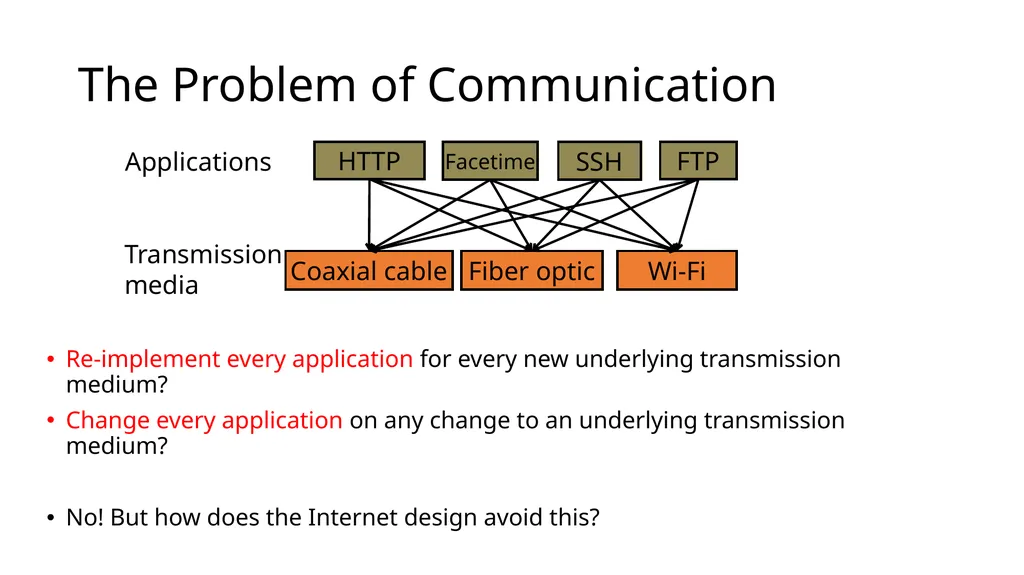
The Problem of Communication Re-implement every application for every new underlying transmission medium?
Change every application on any change to an underlying transmission medium?
No! But how does the Internet design avoid this? Applications Transmission
media Facetime HTTP SSH FTP Coaxial cable Fiber optic Wi-Fi<br>
Change every application on any change to an underlying transmission medium?
No! But how does the Internet design avoid this? Applications Transmission
media Facetime HTTP SSH FTP Coaxial cable Fiber optic Wi-Fi<br>
07
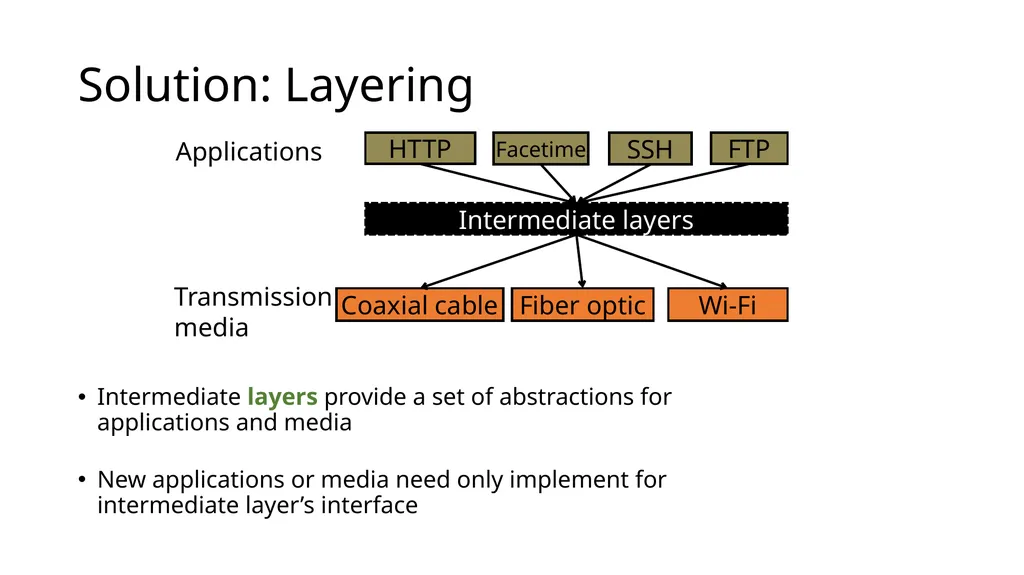
Solution: Layering Intermediate layers provide a set of abstractions for applications and media
New applications or media need only implement for intermediate layer’s interface<br>
New applications or media need only implement for intermediate layer’s interface<br>
08
The Art of Layering How many layers?
What goes in each layer?
What abstraction (interface) does each layer provide?<br>
What goes in each layer?
What abstraction (interface) does each layer provide?<br>
09
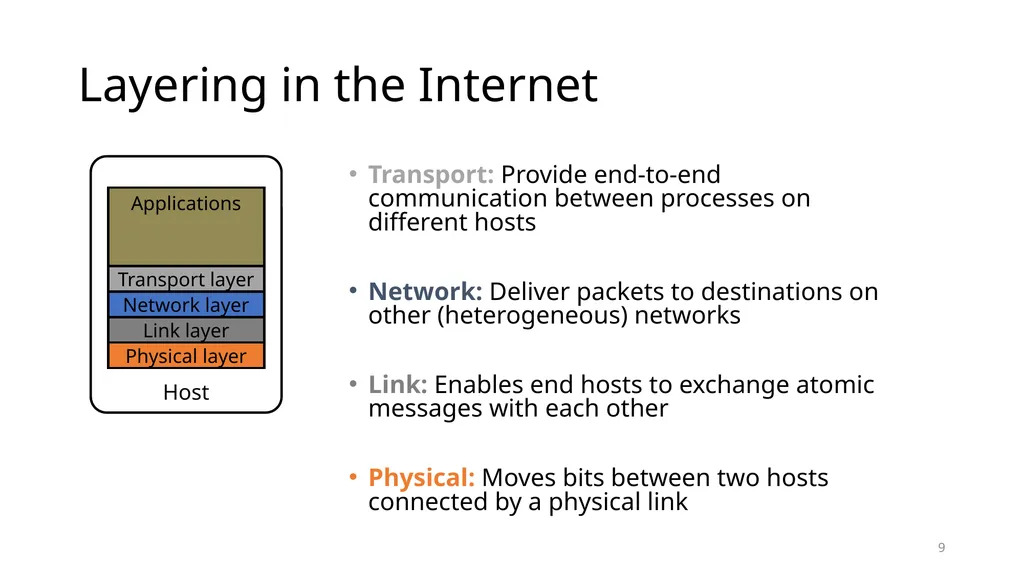
Transport: Provide end-to-end communication between processes on different hosts
Network: Deliver packets to destinations on other (heterogeneous) networks
Link: Enables end hosts to exchange atomic messages with each other
Physical: Moves bits between two hosts connected by a physical link 9 Layering in the Internet Applications Transport layer Network layer Link layer Physical layer Host<br>
Network: Deliver packets to destinations on other (heterogeneous) networks
Link: Enables end hosts to exchange atomic messages with each other
Physical: Moves bits between two hosts connected by a physical link 9 Layering in the Internet Applications Transport layer Network layer Link layer Physical layer Host<br>
10
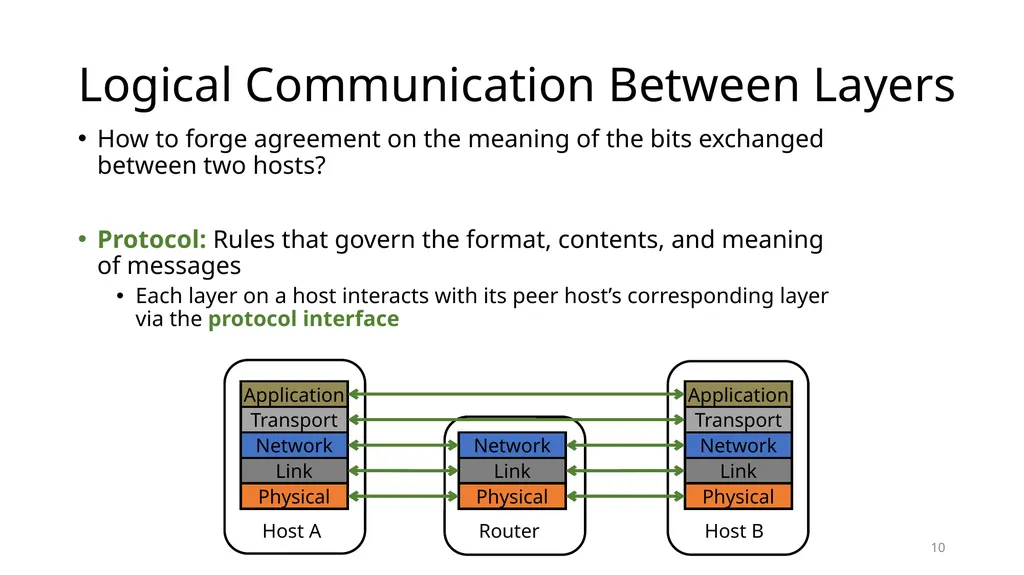
Logical Communication Between Layers How to forge agreement on the meaning of the bits exchanged between two hosts?
Protocol: Rules that govern the format, contents, and meaning of messages
Each layer on a host interacts with its peer host’s corresponding layer via the protocol interface Application Transport Network Link Physical Network Link Physical Application Transport Network Link Physical Host A Host B Router 10<br>
Protocol: Rules that govern the format, contents, and meaning of messages
Each layer on a host interacts with its peer host’s corresponding layer via the protocol interface Application Transport Network Link Physical Network Link Physical Application Transport Network Link Physical Host A Host B Router 10<br>
11
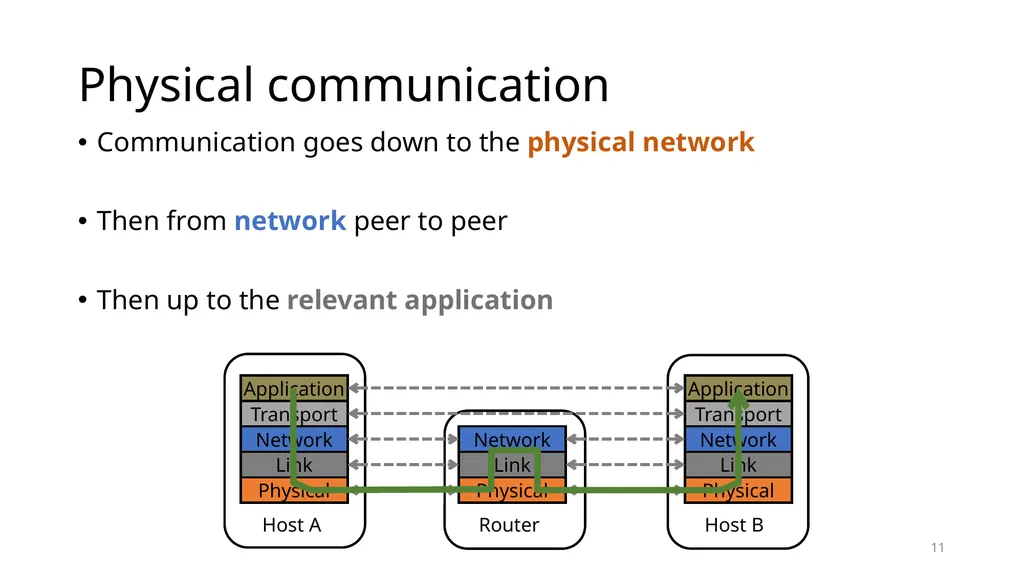
Physical communication Communication goes down to the physical network
Then from network peer to peer
Then up to the relevant application Application Transport Network Link Physical Network Link Physical Application Transport Network Link Physical Host A Host B Router 11<br>
Then from network peer to peer
Then up to the relevant application Application Transport Network Link Physical Network Link Physical Application Transport Network Link Physical Host A Host B Router 11<br>
12
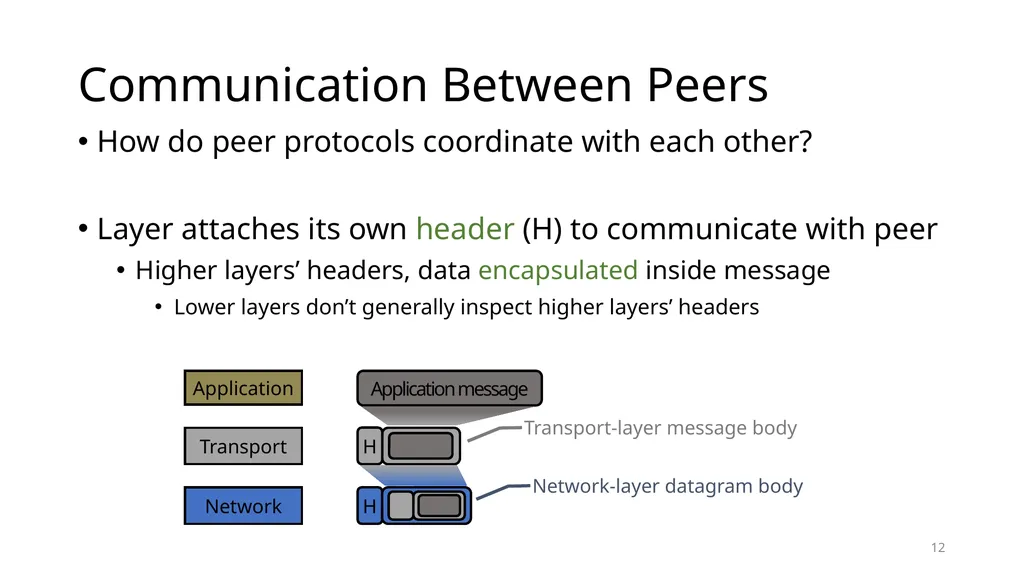
Communication Between Peers How do peer protocols coordinate with each other?
Layer attaches its own header (H) to communicate with peer
Higher layers’ headers, data encapsulated inside message
Lower layers don’t generally inspect higher layers’ headers Application Transport Network Application message H H Transport-layer message body Network-layer datagram body 12<br>
Layer attaches its own header (H) to communicate with peer
Higher layers’ headers, data encapsulated inside message
Lower layers don’t generally inspect higher layers’ headers Application Transport Network Application message H H Transport-layer message body Network-layer datagram body 12<br>
13
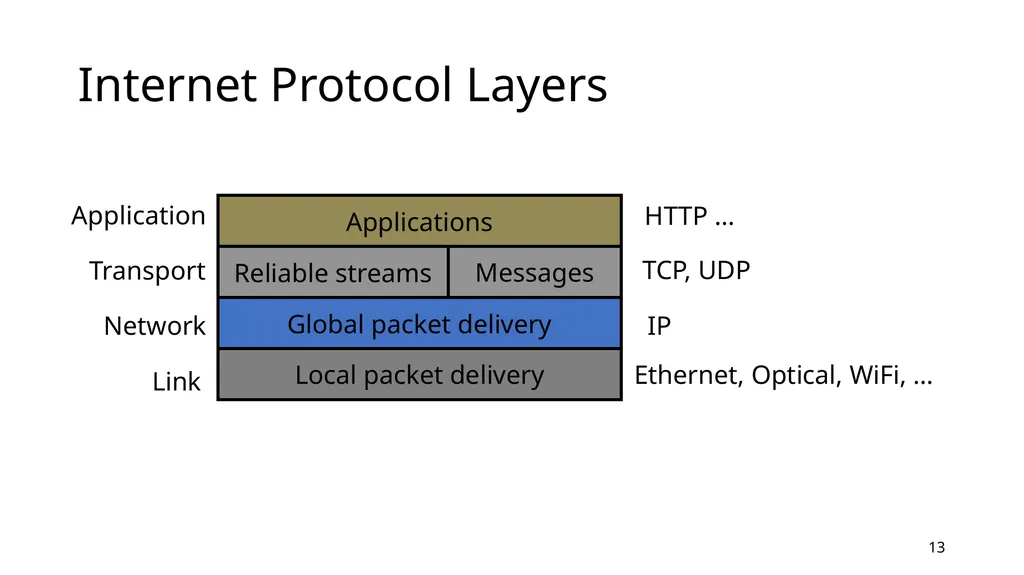
Internet Protocol Layers 13 Local packet delivery Global packet delivery Reliable streams Applications Messages Link Network Transport Application HTTP … IP Ethernet, Optical, WiFi, … TCP, UDP<br>
14
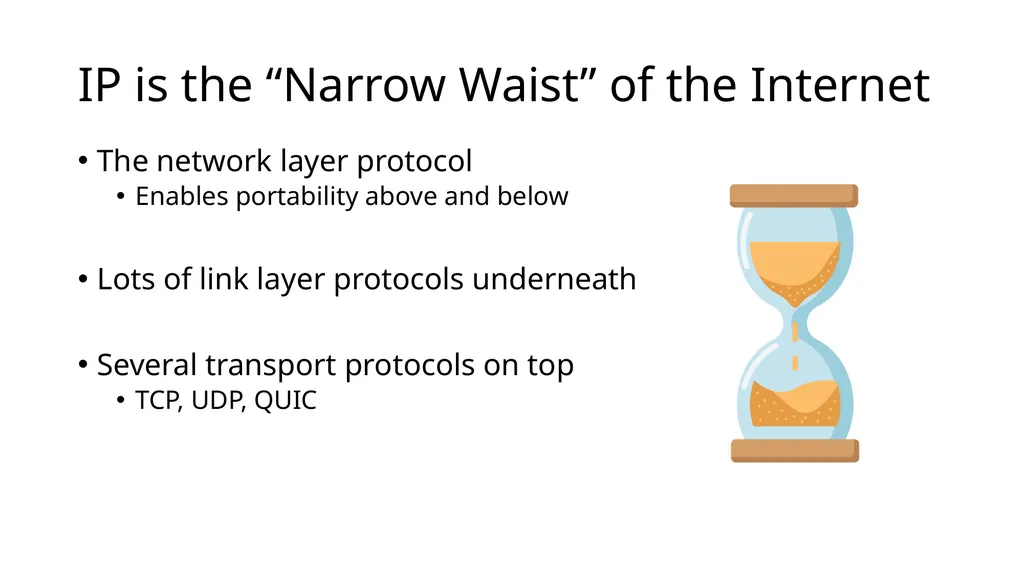
IP is the “Narrow Waist” of the Internet The network layer protocol
Enables portability above and below
Lots of link layer protocols underneath
Several transport protocols on top
TCP, UDP, QUIC<br>
Enables portability above and below
Lots of link layer protocols underneath
Several transport protocols on top
TCP, UDP, QUIC<br>
15
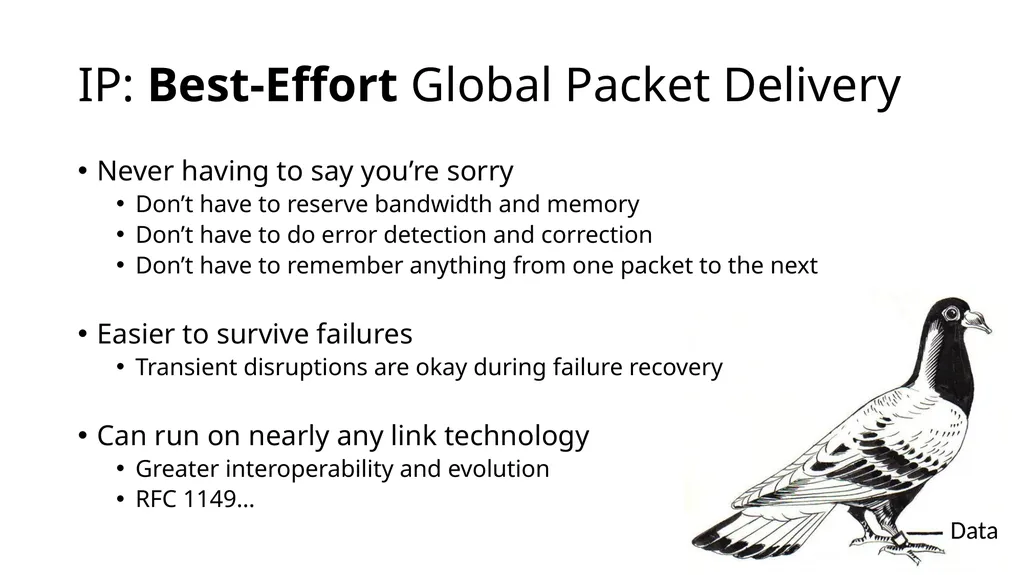
IP: Best-Effort Global Packet Delivery Never having to say you’re sorry
Don’t have to reserve bandwidth and memory
Don’t have to do error detection and correction
Don’t have to remember anything from one packet to the next
Easier to survive failures
Transient disruptions are okay during failure recovery
Can run on nearly any link technology
Greater interoperability and evolution
RFC 1149…<br>
Don’t have to reserve bandwidth and memory
Don’t have to do error detection and correction
Don’t have to remember anything from one packet to the next
Easier to survive failures
Transient disruptions are okay during failure recovery
Can run on nearly any link technology
Greater interoperability and evolution
RFC 1149…<br>
16
Transport: Application to Application Network layer is host-to-host
Transport layer is port-on-host-to-port-on-host
think application to application
demultiplexing
e.g., port 80 is HTTP, port 443 is HTTPS, port 22 is SSH
Why transport and not network layer?<br>
Transport layer is port-on-host-to-port-on-host
think application to application
demultiplexing
e.g., port 80 is HTTP, port 443 is HTTPS, port 22 is SSH
Why transport and not network layer?<br>
17
Transport: Application to Application Network doesn’t have error detection
Transport layer does have error detection
Why transport and not network layer?
Why not both?<br>
Transport layer does have error detection
Why transport and not network layer?
Why not both?<br>
18
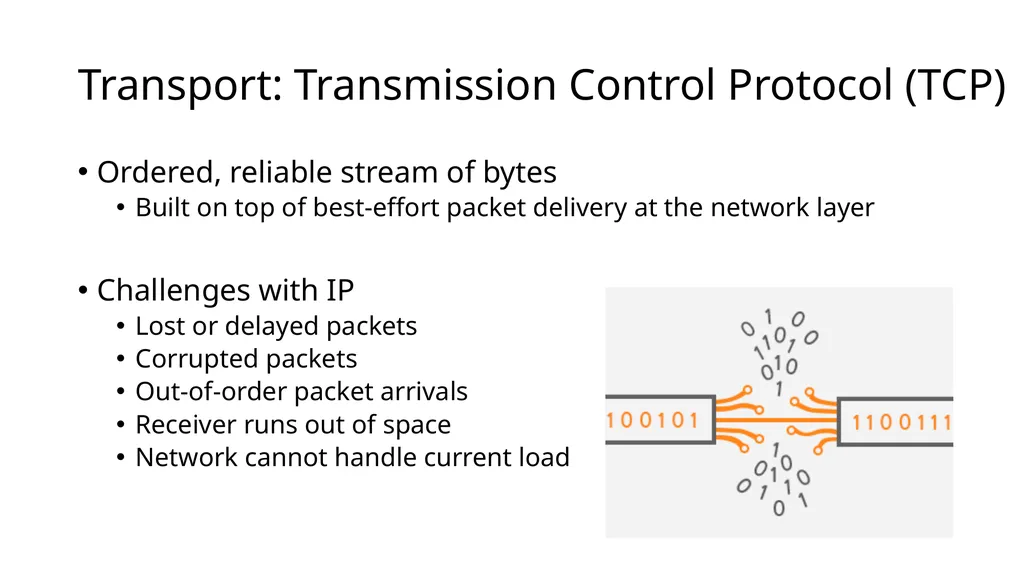
Transport: Transmission Control Protocol (TCP) Ordered, reliable stream of bytes
Built on top of best-effort packet delivery at the network layer
Challenges with IP
Lost or delayed packets
Corrupted packets
Out-of-order packet arrivals
Receiver runs out of space
Network cannot handle current load<br>
Built on top of best-effort packet delivery at the network layer
Challenges with IP
Lost or delayed packets
Corrupted packets
Out-of-order packet arrivals
Receiver runs out of space
Network cannot handle current load<br>
19
TCP: Lost or Delayed Packets Problem: Lost or delayed data
Solution: Timeout and retransmit
Receiver sends acknowledgement of data<br>
Solution: Timeout and retransmit
Receiver sends acknowledgement of data<br>
20
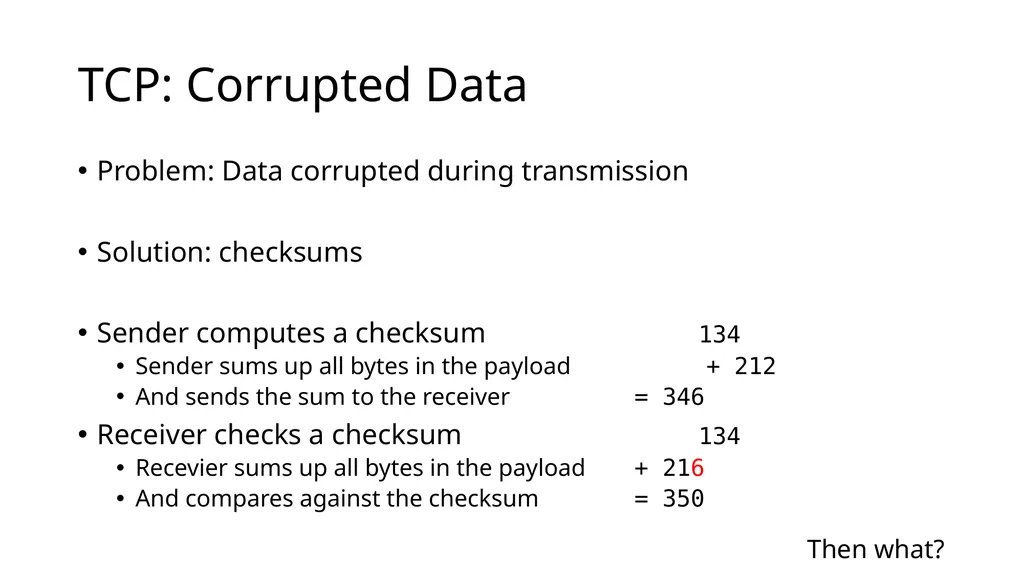
TCP: Corrupted Data Problem: Data corrupted during transmission
Solution: checksums
Sender computes a checksum 134
Sender sums up all bytes in the payload + 212
And sends the sum to the receiver = 346
Receiver checks a checksum 134
Recevier sums up all bytes in the payload + 216
And compares against the checksum = 350 Then what?<br>
Solution: checksums
Sender computes a checksum 134
Sender sums up all bytes in the payload + 212
And sends the sum to the receiver = 346
Receiver checks a checksum 134
Recevier sums up all bytes in the payload + 216
And compares against the checksum = 350 Then what?<br>
21
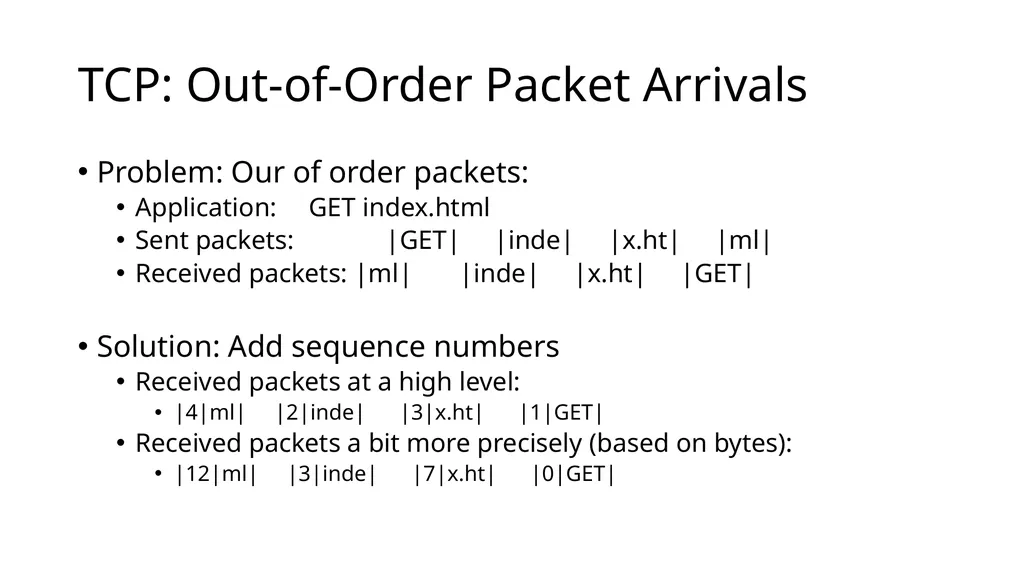
TCP: Out-of-Order Packet Arrivals Problem: Our of order packets:
Application: GET index.html
Sent packets: |GET| |inde| |x.ht| |ml|
Received packets: |ml| |inde| |x.ht| |GET|
Solution: Add sequence numbers
Received packets at a high level:
|4|ml| |2|inde| |3|x.ht| |1|GET|
Received packets a bit more precisely (based on bytes):
|12|ml| |3|inde| |7|x.ht| |0|GET|<br>
Application: GET index.html
Sent packets: |GET| |inde| |x.ht| |ml|
Received packets: |ml| |inde| |x.ht| |GET|
Solution: Add sequence numbers
Received packets at a high level:
|4|ml| |2|inde| |3|x.ht| |1|GET|
Received packets a bit more precisely (based on bytes):
|12|ml| |3|inde| |7|x.ht| |0|GET|<br>
22
TCP: Receiver Runs Out of Space Problem: No more space to receive packets
Solution: Flow control
Receiver maintains a window size
Amount of data it can buffer
Advertises window to the sender
Amount sender can send without acknowledgement
Ensures that sender does not send too much<br>
Solution: Flow control
Receiver maintains a window size
Amount of data it can buffer
Advertises window to the sender
Amount sender can send without acknowledgement
Ensures that sender does not send too much<br>
23
TCP: Network that Cannot Handle the Load Problem: Too many packets at once
Solution: Congestion control
Future lectures!<br>
Solution: Congestion control
Future lectures!<br>
24
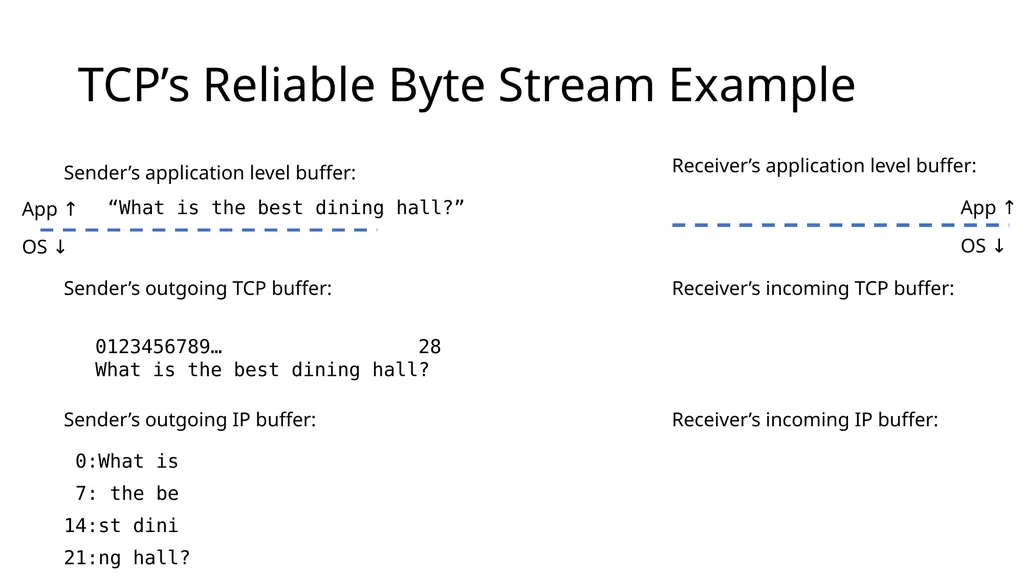
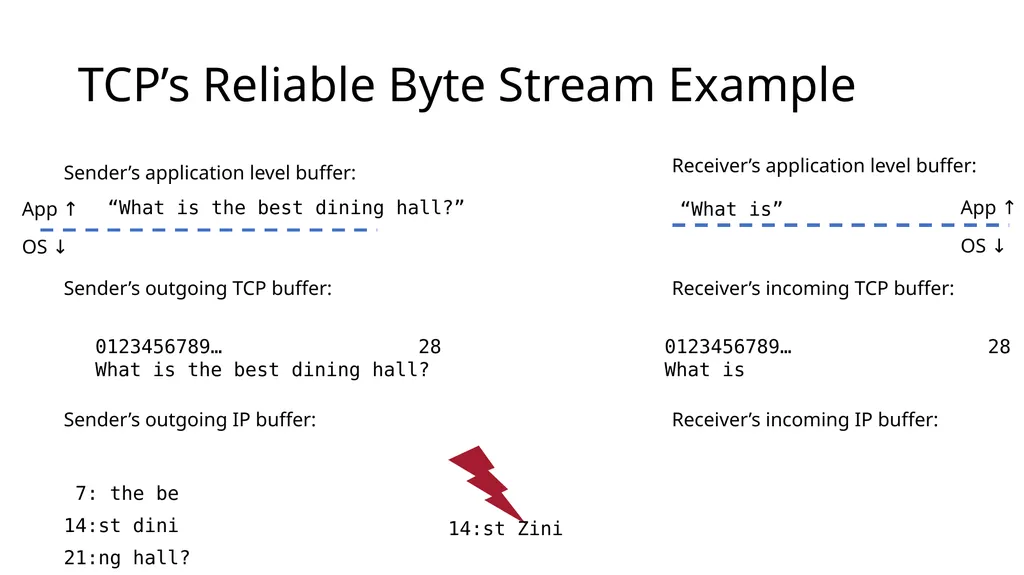
TCP’s Reliable Byte Stream Example Receiver’s incoming TCP buffer: Sender’s outgoing TCP buffer: Sender’s outgoing IP buffer: Receiver’s incoming IP buffer: Sender’s application level buffer: Receiver’s application level buffer: App ↑ OS ↓ App ↑ OS ↓ “What is the best dining hall?” 0123456789… 28
What is the best dining hall? 0:What is 7: the be 14:st dini 21:ng hall?<br>
What is the best dining hall? 0:What is 7: the be 14:st dini 21:ng hall?<br>
25
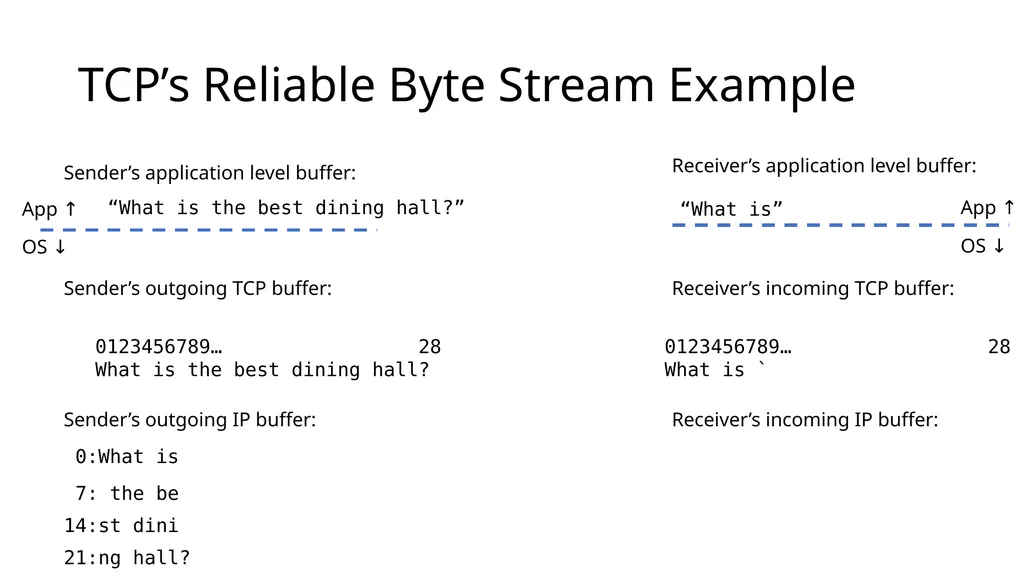
TCP’s Reliable Byte Stream Example Receiver’s incoming TCP buffer: Sender’s outgoing TCP buffer: Sender’s outgoing IP buffer: Receiver’s incoming IP buffer: Sender’s application level buffer: Receiver’s application level buffer: App ↑ OS ↓ App ↑ OS ↓ “What is the best dining hall?” 0123456789… 28
What is the best dining hall? 0:What is 7: the be 14:st dini 21:ng hall? 0123456789… 28
What is ` “What is”<br>
What is the best dining hall? 0:What is 7: the be 14:st dini 21:ng hall? 0123456789… 28
What is ` “What is”<br>
26
TCP’s Reliable Byte Stream Example Receiver’s incoming TCP buffer: Sender’s outgoing TCP buffer: Sender’s outgoing IP buffer: Receiver’s incoming IP buffer: Sender’s application level buffer: Receiver’s application level buffer: App ↑ OS ↓ App ↑ OS ↓ “What is the best dining hall?” 0123456789… 28
What is the best dining hall? 7: the be 14:st dini 21:ng hall? 0123456789… 28
What is 14:st Zini “What is”<br>
What is the best dining hall? 7: the be 14:st dini 21:ng hall? 0123456789… 28
What is 14:st Zini “What is”<br>
27
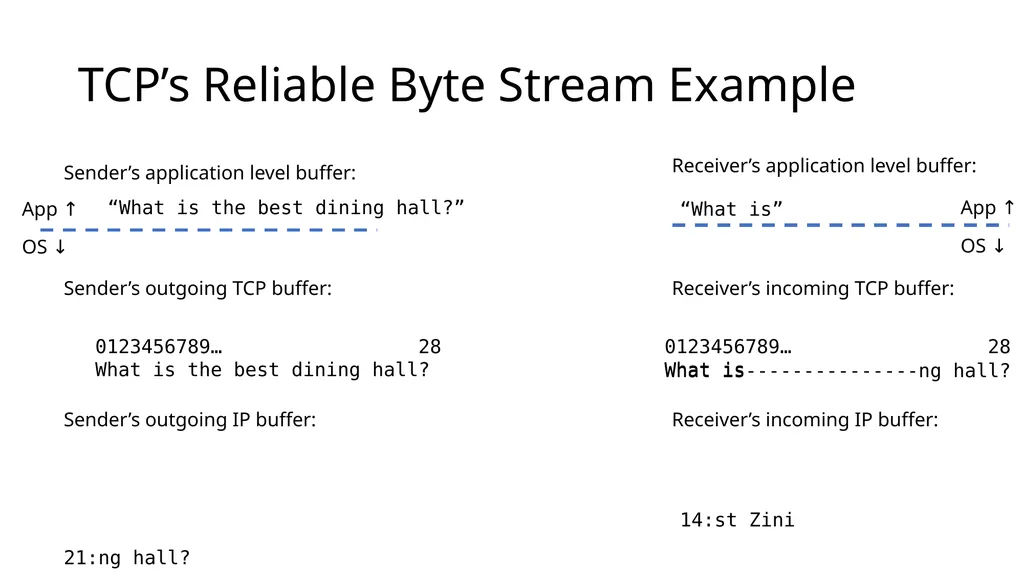
TCP’s Reliable Byte Stream Example Receiver’s incoming TCP buffer: Sender’s outgoing TCP buffer: Sender’s outgoing IP buffer: Receiver’s incoming IP buffer: Sender’s application level buffer: Receiver’s application level buffer: App ↑ OS ↓ App ↑ OS ↓ “What is the best dining hall?” 0123456789… 28
What is the best dining hall? 21:ng hall? 0123456789… 28
What is 14:st Zini What is---------------ng hall? “What is”<br>
What is the best dining hall? 21:ng hall? 0123456789… 28
What is 14:st Zini What is---------------ng hall? “What is”<br>
28
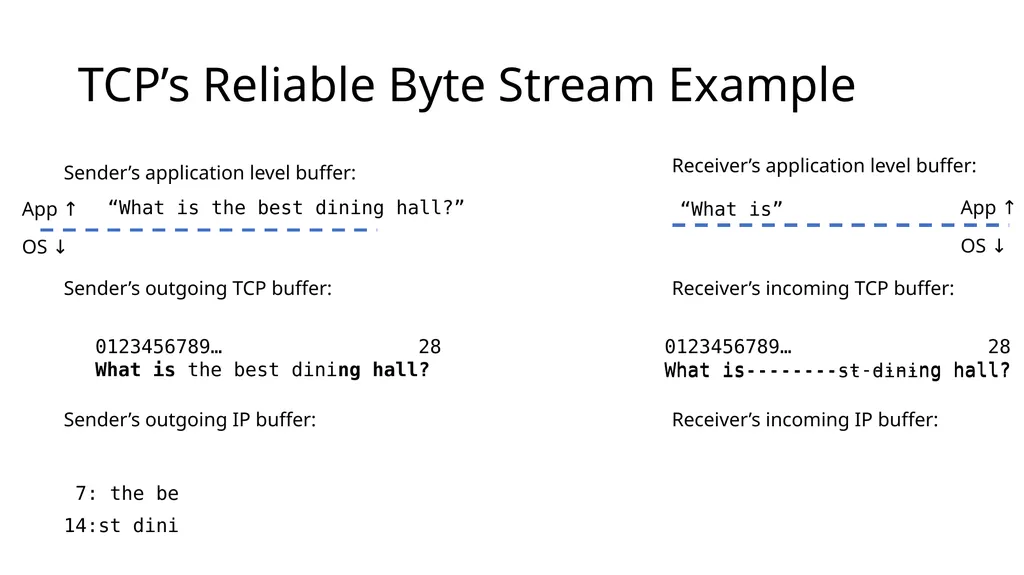
TCP’s Reliable Byte Stream Example Receiver’s incoming TCP buffer: Sender’s outgoing TCP buffer: Sender’s outgoing IP buffer: Receiver’s incoming IP buffer: Sender’s application level buffer: Receiver’s application level buffer: App ↑ OS ↓ App ↑ OS ↓ “What is the best dining hall?” 0123456789… 28
What is the best dining hall? 0123456789… 28 What is---------------ng hall? 7: the be 14:st dini What is--------st dining hall? “What is”<br>
What is the best dining hall? 0123456789… 28 What is---------------ng hall? 7: the be 14:st dini What is--------st dining hall? “What is”<br>
29
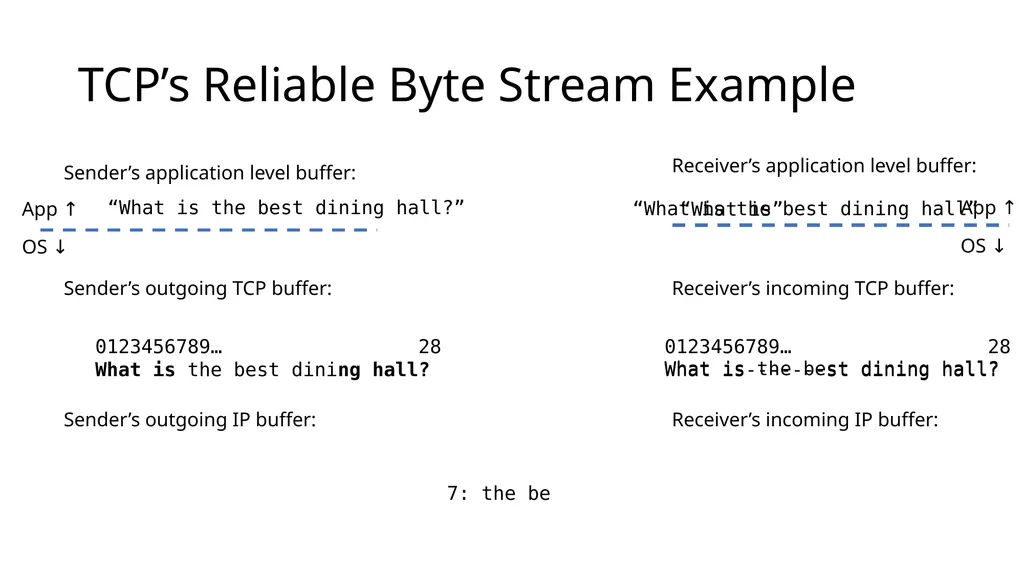
TCP’s Reliable Byte Stream Example Receiver’s incoming TCP buffer: Sender’s outgoing TCP buffer: Sender’s outgoing IP buffer: Receiver’s incoming IP buffer: Sender’s application level buffer: Receiver’s application level buffer: App ↑ OS ↓ App ↑ OS ↓ “What is the best dining hall?” 0123456789… 28
What is the best dining hall? 0123456789… 28 7: the be What is-------st dining hall? “What is” What is the best dining hall? “What is the best dining hall”<br>
What is the best dining hall? 0123456789… 28 7: the be What is-------st dining hall? “What is” What is the best dining hall? “What is the best dining hall”<br>
30
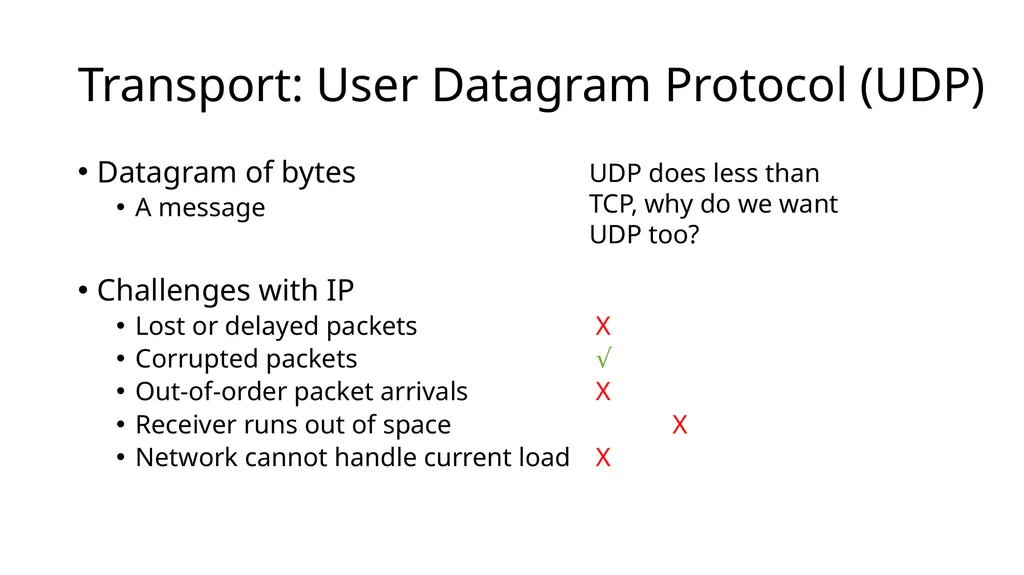
Transport: User Datagram Protocol (UDP) Datagram of bytes
A message
Challenges with IP
Lost or delayed packets X
Corrupted packets √
Out-of-order packet arrivals X
Receiver runs out of space X
Network cannot handle current load X UDP does less than TCP, why do we want UDP too?<br>
A message
Challenges with IP
Lost or delayed packets X
Corrupted packets √
Out-of-order packet arrivals X
Receiver runs out of space X
Network cannot handle current load X UDP does less than TCP, why do we want UDP too?<br>
31
Layering & Network Layers Conclusion The art of layering
Network layers
Protocol, headers, encapsulation
IP layer: best-effort global packet delivery between host
TCP layer: ordered, reliable byte stream between applications<br>
Network layers
Protocol, headers, encapsulation
IP layer: best-effort global packet delivery between host
TCP layer: ordered, reliable byte stream between applications<br>