Introducing a Nutrition Dialogue Event Materials for Stakeholder Dialogue Convenors Introducing a Nutrition Dialogue Event Usually there will be a brief introduction (maximum 10 minutes). The presenter could draw on the following materials,
"Introducing a Nutrition Dialogue Event Materials" is the property of its rightful owner. Permission is granted to
download and print the materials on this website for personal, non-commercial use only, and to display it
on your personal computer provided you do not modify the materials and that you retain all copyright
notices contained in the materials. By downloading content from our website, you accept the terms of this
agreement.
Presentation Transcript
01
Introducing a Nutrition Dialogue Event Materials for Stakeholder Dialogue Convenors<br>
02
Introducing a Nutrition Dialogue Event Usually there will be a brief introduction (maximum 10 minutes).
The presenter could draw on the following materials, supplementing them as necessary, and ensuring they are adapted to the context.
The materials cover:
Definitions of Hunger, Food Insecurity, Malnutrition
The Global Context for Hunger and Nutrition
The Focus of Dialogues on People's Nutrition
Determinants of Good Nutrition
Outcomes of Improved Nutrition
Definitions and Impacts of Malnutrition (2 slides)
Who is at risk of Malnutrition
Information about the Global Nutrition Situation (2 slides)
Sources for Nutrition Data<br>
03
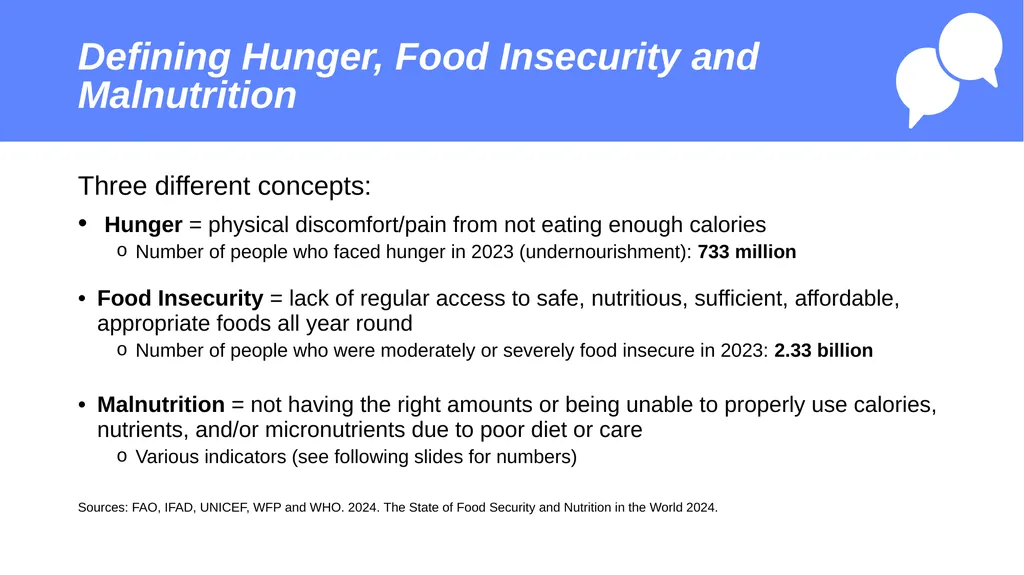
Defining Hunger, Food Insecurity and Malnutrition Three different concepts:
Hunger = physical discomfort/pain from not eating enough calories
Number of people who faced hunger in 2023 (undernourishment): 733 million
Food Insecurity = lack of regular access to safe, nutritious, sufficient, affordable, appropriate foods all year round
Number of people who were moderately or severely food insecure in 2023: 2.33 billion
Malnutrition = not having the right amounts or being unable to properly use calories, nutrients, and/or micronutrients due to poor diet or care
Various indicators (see following slides for numbers)
Sources: FAO, IFAD, UNICEF, WFP and WHO. 2024. The State of Food Security and Nutrition in the World 2024.<br>
04
Global context for hunger and nutrition Over the past years, a succession of shocks, including the COVID-19 pandemic, weather extremes, conflicts and economic shocks affected countries around the world.
This led to high food prices and a cost-of-living crisis, and set the world further off track to end hunger and malnutrition in all its forms by 2030.
Millions of people, in particular women, children and vulnerable groups, are pushed into malnutrition and hunger. Without urgent action, policies and investments, the consequences could last for generations.<br>
05
The Dialogues Programme is focused on people's nutrition NUTRITION is...
related to food, health, education, care, water, sanitation and hygiene, gender, climate, investment and more.
a right for all.
central to the achievement of the Sustainable Development Goals. At least 12 SDGs are highly relevant to nutrition.<br>
06
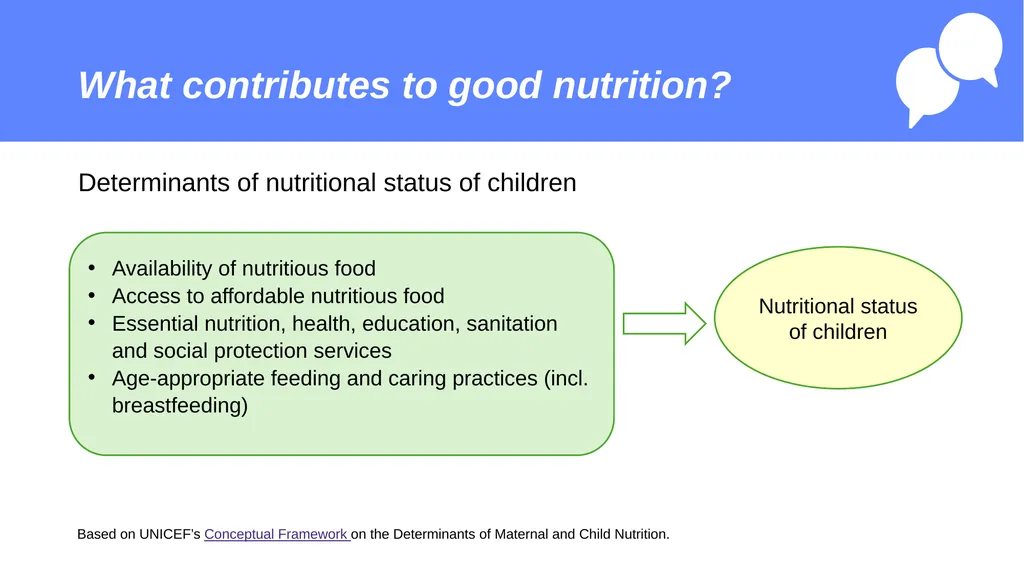
What contributes to good nutrition? Determinants of nutritional status of children
Based on UNICEF’s Conceptual Framework on the Determinants of Maternal and Child Nutrition. Availability of nutritious food
Access to affordable nutritious food
Essential nutrition, health, education, sanitation and social protection services
Age-appropriate feeding and caring practices (incl. breastfeeding) Nutritional status of children<br>
07
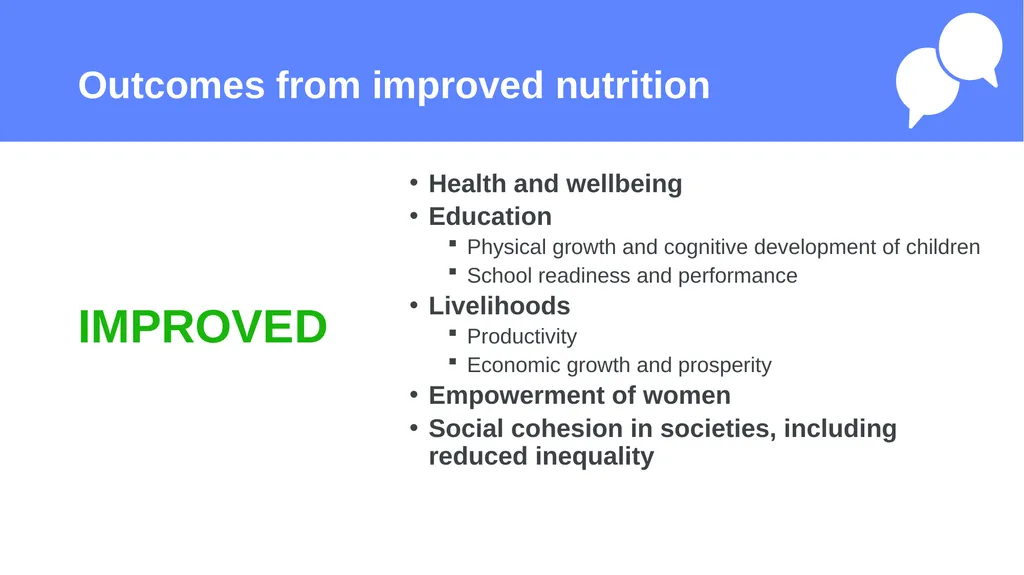
Outcomes from improved nutrition Health and wellbeing
Education
Physical growth and cognitive development of children
School readiness and performance
Livelihoods
Productivity
Economic growth and prosperity
Empowerment of women
Social cohesion in societies, including reduced inequality IMPROVED<br>
08
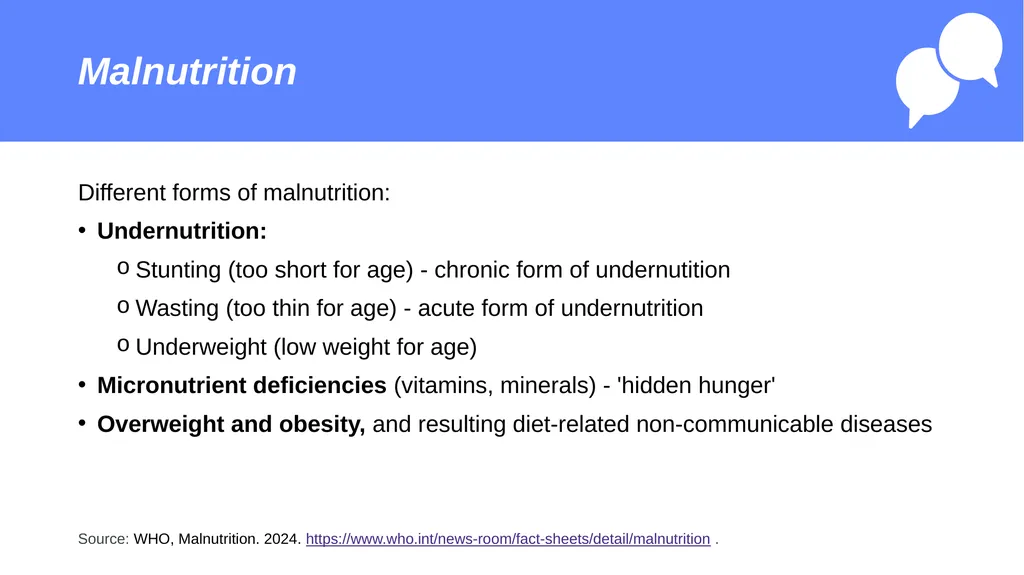
Malnutrition Different forms of malnutrition:
Undernutrition:
Stunting (too short for age) - chronic form of undernutition
Wasting (too thin for age) - acute form of undernutrition
Underweight (low weight for age)
Micronutrient deficiencies (vitamins, minerals) - 'hidden hunger'
Overweight and obesity, and resulting diet-related non-communicable diseases
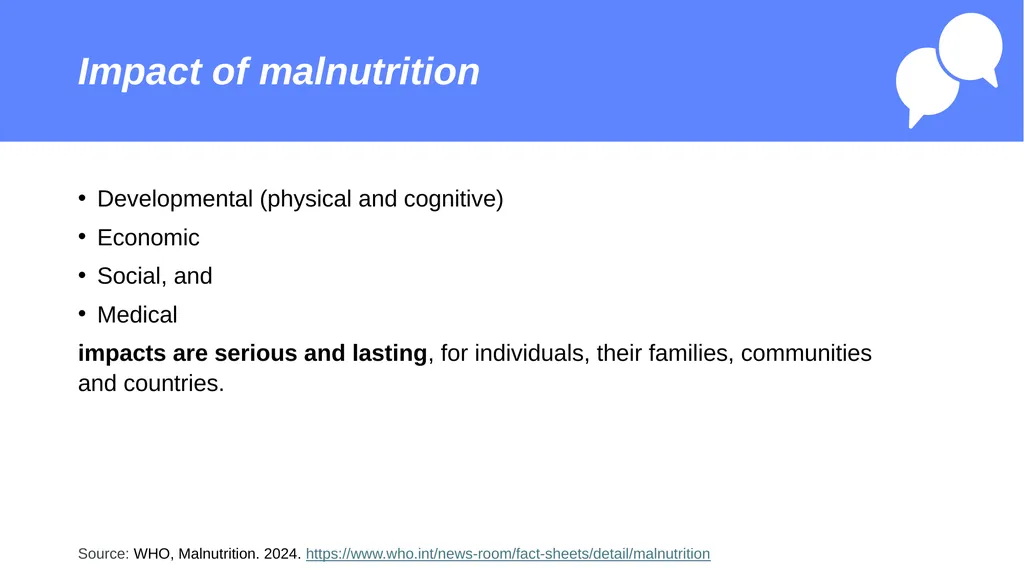
Impact of malnutrition Developmental (physical and cognitive)
Economic
Social, and
Medical
impacts are serious and lasting, for individuals, their families, communities and countries.
Malnutrition - who is at risk Every country in the world is affected by one or more forms of malnutrition.
Women, infants, children, and adolescents are at particular risk of malnutrition.
Optimizing nutrition early in life – including the 1000 days from conception to a child’s second birthday – ensures the best possible start in life, with long-term benefits.
Poverty amplifies the risk of, and risks from, malnutrition.
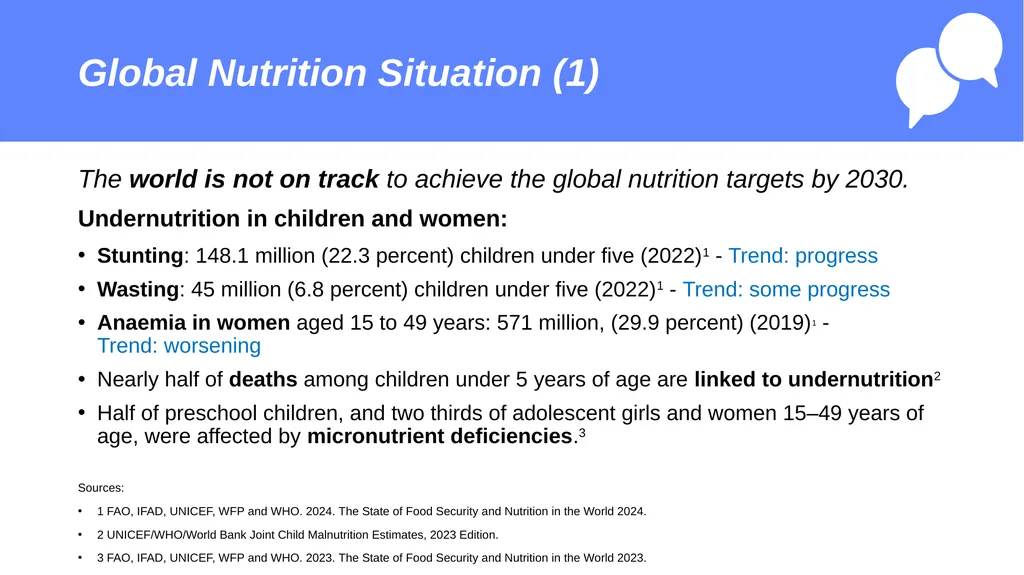
Global Nutrition Situation (1) The world is not on track to achieve the global nutrition targets by 2030.
Undernutrition in children and women:
Stunting: 148.1 million (22.3 percent) children under five (2022)1 - Trend: progress
Wasting: 45 million (6.8 percent) children under five (2022)1 - Trend: some progress
Anaemia in women aged 15 to 49 years: 571 million, (29.9 percent) (2019)1 - Trend: worsening
Nearly half of deaths among children under 5 years of age are linked to undernutrition2
Half of preschool children, and two thirds of adolescent girls and women 15–49 years of age, were affected by micronutrient deficiencies.3
Sources:
1 FAO, IFAD, UNICEF, WFP and WHO. 2024. The State of Food Security and Nutrition in the World 2024.
2 UNICEF/WHO/World Bank Joint Child Malnutrition Estimates, 2023 Edition.
3 FAO, IFAD, UNICEF, WFP and WHO. 2023. The State of Food Security and Nutrition in the World 2023.<br>
12
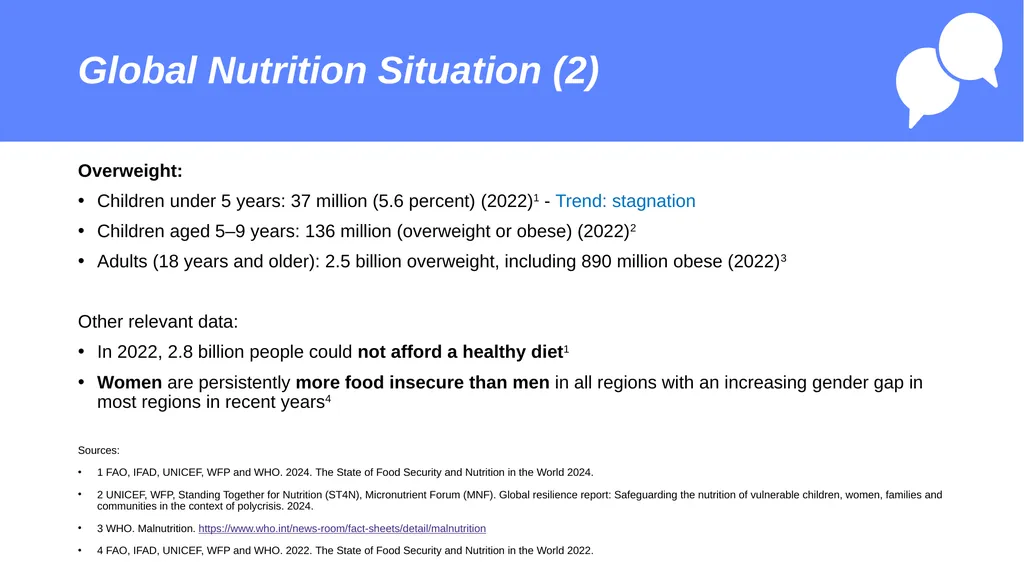
Global Nutrition Situation (2) Overweight:
Children under 5 years: 37 million (5.6 percent) (2022)1 - Trend: stagnation
Children aged 5–9 years: 136 million (overweight or obese) (2022)2
Adults (18 years and older): 2.5 billion overweight, including 890 million obese (2022)3
Other relevant data:
In 2022, 2.8 billion people could not afford a healthy diet1
Women are persistently more food insecure than men in all regions with an increasing gender gap in most regions in recent years4
Sources:
1 FAO, IFAD, UNICEF, WFP and WHO. 2024. The State of Food Security and Nutrition in the World 2024.
2 UNICEF, WFP, Standing Together for Nutrition (ST4N), Micronutrient Forum (MNF). Global resilience report: Safeguarding the nutrition of vulnerable children, women, families and communities in the context of polycrisis. 2024.
3 WHO. Malnutrition. https://www.who.int/news-room/fact-sheets/detail/malnutrition
4 FAO, IFAD, UNICEF, WFP and WHO. 2022. The State of Food Security and Nutrition in the World 2022.<br>
13
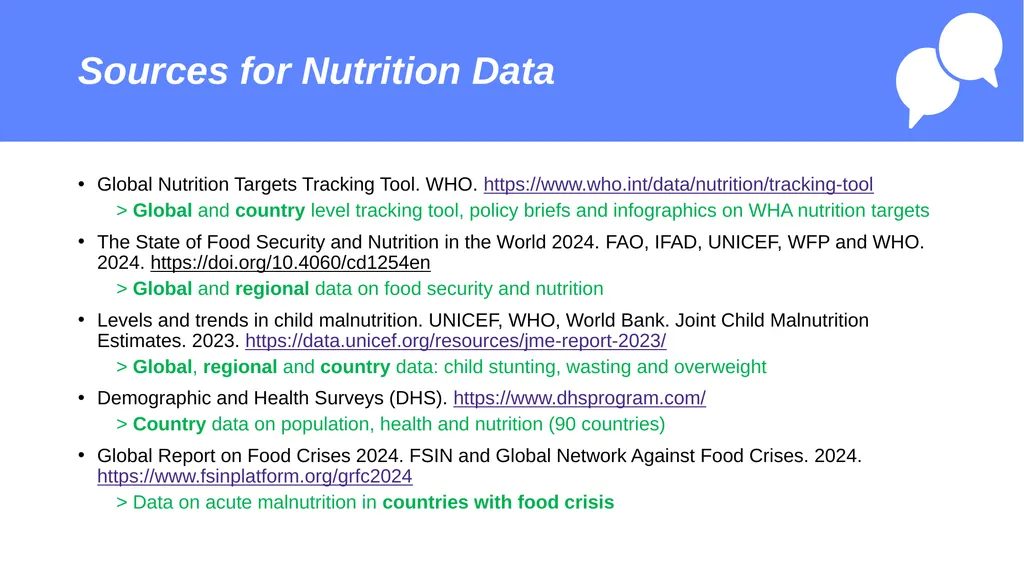
Sources for Nutrition Data Global Nutrition Targets Tracking Tool. WHO. https://www.who.int/data/nutrition/tracking-tool
> Global and country level tracking tool, policy briefs and infographics on WHA nutrition targets
The State of Food Security and Nutrition in the World 2024. FAO, IFAD, UNICEF, WFP and WHO. 2024. https://doi.org/10.4060/cd1254en
> Global and regional data on food security and nutrition
Levels and trends in child malnutrition. UNICEF, WHO, World Bank. Joint Child Malnutrition Estimates. 2023. https://data.unicef.org/resources/jme-report-2023/
> Global, regional and country data: child stunting, wasting and overweight
Demographic and Health Surveys (DHS). https://www.dhsprogram.com/
> Country data on population, health and nutrition (90 countries)
Global Report on Food Crises 2024. FSIN and Global Network Against Food Crises. 2024. https://www.fsinplatform.org/grfc2024
> Data on acute malnutrition in countries with food crisis<br>