
Introducing... the Internet by Nephele Troullinos,

Description: Introducing... the Internet by Nephele Troullinos, mentor: Miriam Posner Methods and design for an Internet literacy curriculum which adapts online participatory culture into the secondary-education classroom by coordinating factual
Related Topics
Download Presentation
"Introducing... the Internet by Nephele Troullinos," is the property of its rightful owner. Permission is granted to download and print the materials on this website for personal, non-commercial use only, and to display it on your personal computer provided you do not modify the materials and that you retain all copyright notices contained in the materials. By downloading content from our website, you accept the terms of this agreement.
Presentation Transcript
slide1. Introducing... the Internet by Nephele Troullinos, mentor: Miriam Posner Methods and design for an Internet literacy curriculum which adapts online participatory culture into the secondary-education classroom by coordinating factual instruction with informal learning formats.<br>
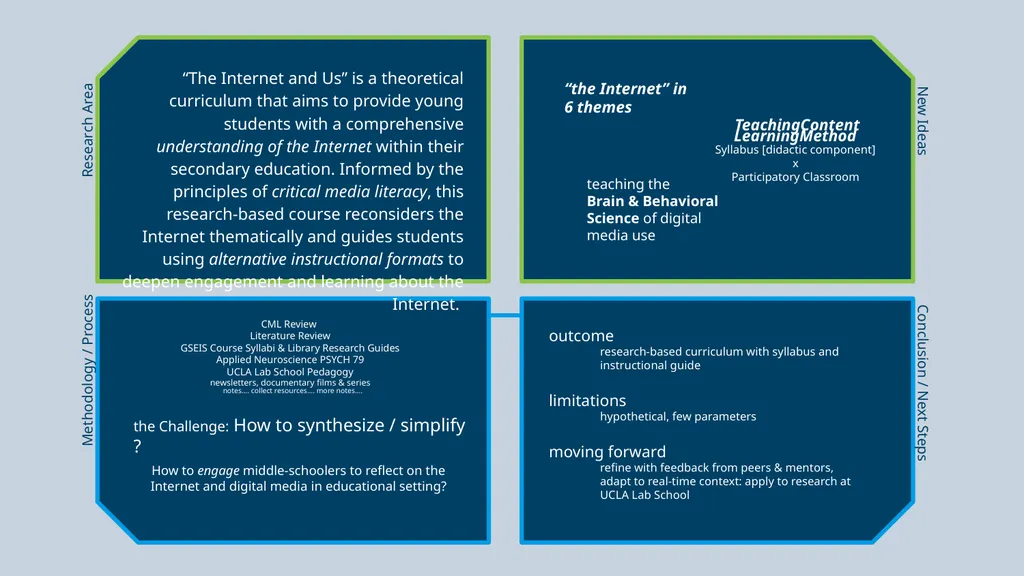
slide2. “The Internet and Us” is a theoretical curriculum that aims to provide young students with a comprehensive understanding of the Internet within their secondary education. Informed by the principles of critical media literacy, this research-based course reconsiders the Internet thematically and guides students using alternative instructional formats to deepen engagement and learning about the Internet. Research Area Methodology / Process Conclusion / Next Steps New Ideas CML Review
Literature Review
GSEIS Course Syllabi & Library Research Guides
Applied Neuroscience PSYCH 79
UCLA Lab School Pedagogy
newsletters, documentary films & series the Challenge: How to synthesize / simplify ? How to engage middle-schoolers to reflect on the Internet and digital media in educational setting? notes…. collect resources…. more notes…. “the Internet” in
6 themes teaching the
Brain & Behavioral Science of digital media use outcome
research-based curriculum with syllabus and instructional guide
limitations
hypothetical, few parameters
moving forward
refine with feedback from peers & mentors, adapt to real-time context: apply to research at UCLA Lab School<br>
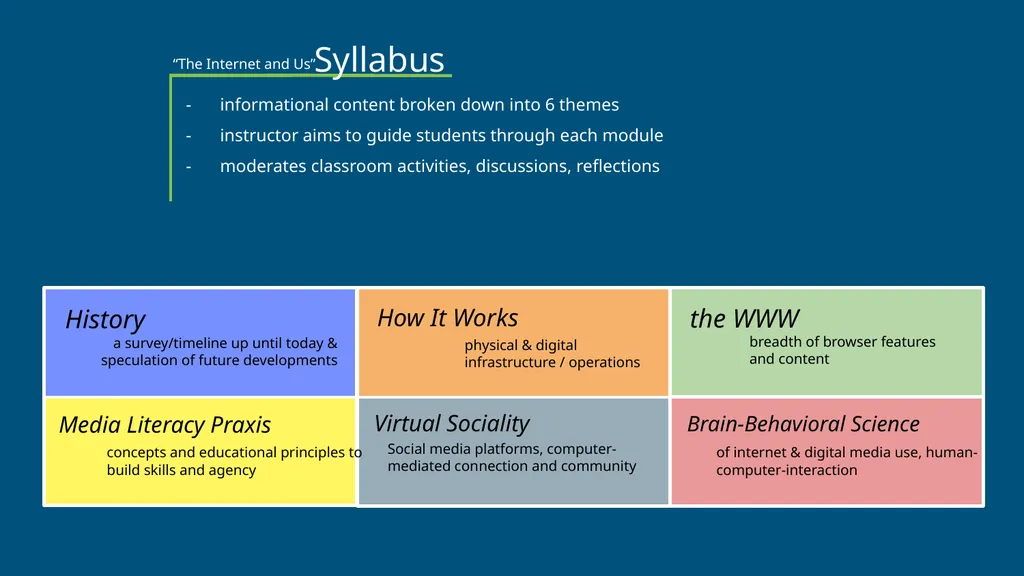
slide3. a survey/timeline up until today & speculation of future developments informational content broken down into 6 themes
instructor aims to guide students through each module
moderates classroom activities, discussions, reflections History How It Works physical & digital
infrastructure / operations the WWW breadth of browser features
and content Media Literacy Praxis concepts and educational principles to
build skills and agency Virtual Sociality Social media platforms, computer-mediated connection and community Brain-Behavioral Science of internet & digital media use, human-
computer-interaction “The Internet and Us” Syllabus<br>
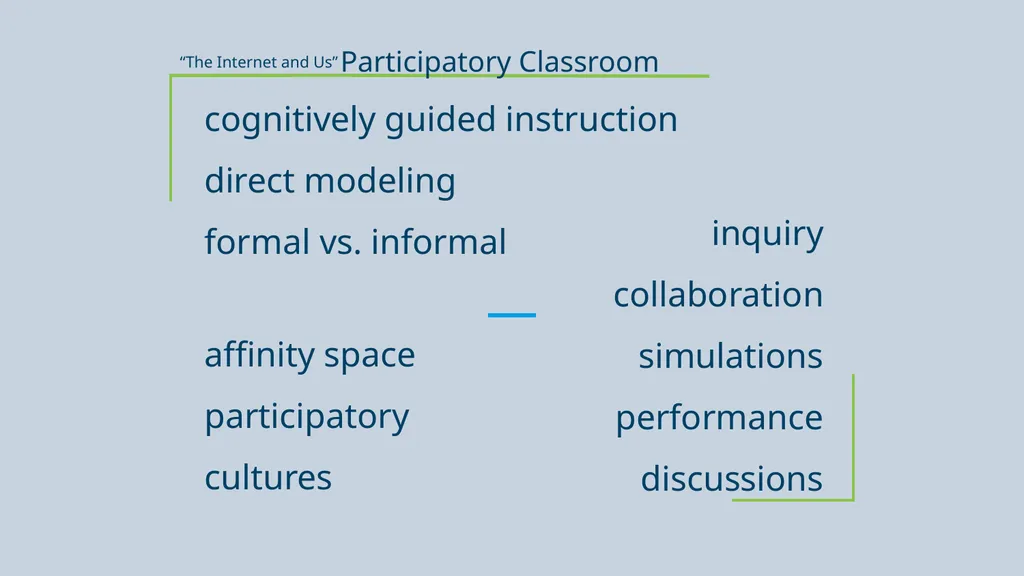
slide4. “The Internet and Us” cognitively guided instruction
direct modeling
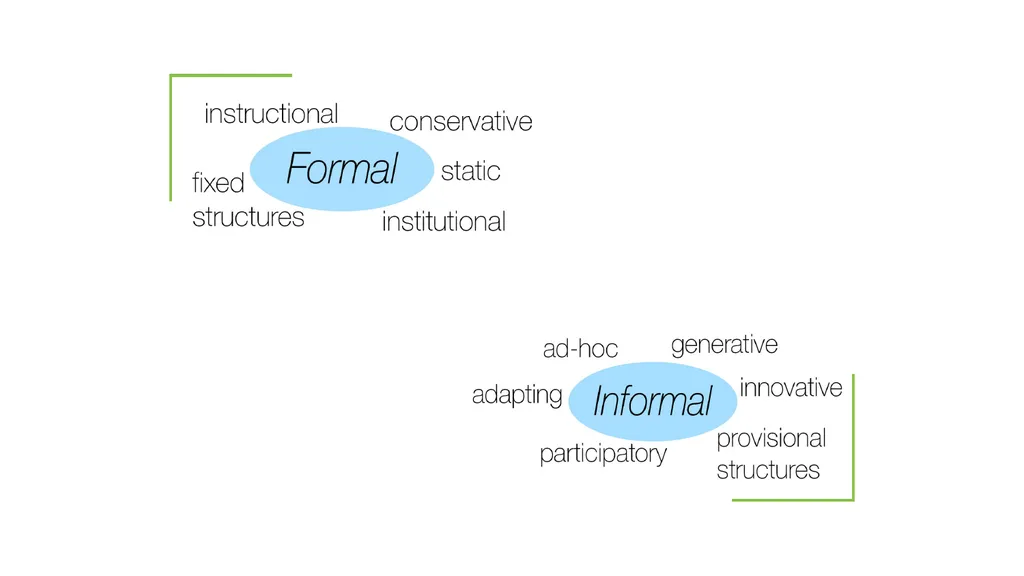
formal vs. informal Participatory Classroom inquiry
collaboration
simulations
performance
discussions affinity space
participatory cultures<br>
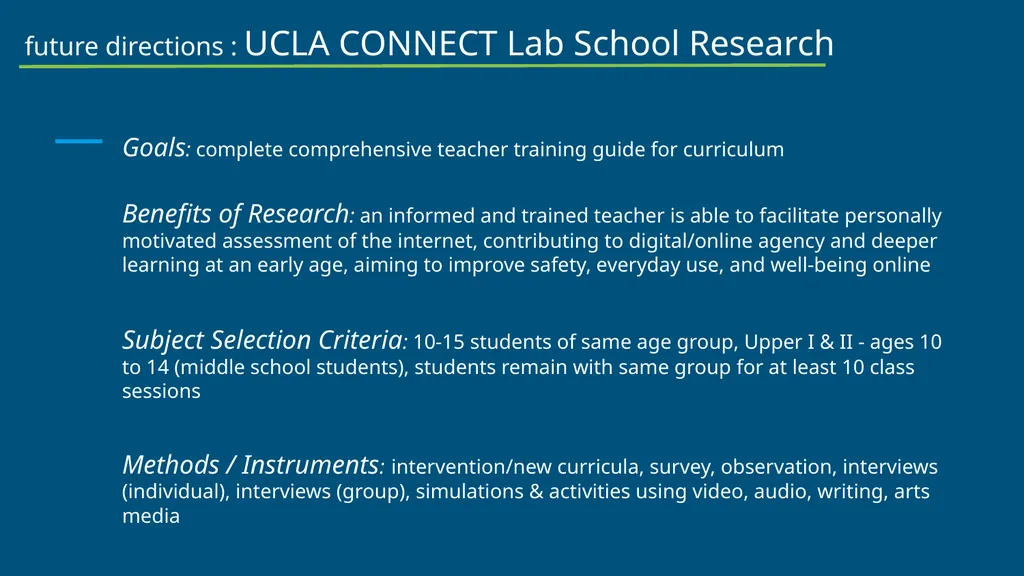
slide6. future directions : UCLA CONNECT Lab School Research Goals: complete comprehensive teacher training guide for curriculum
Benefits of Research: an informed and trained teacher is able to facilitate personally motivated assessment of the internet, contributing to digital/online agency and deeper learning at an early age, aiming to improve safety, everyday use, and well-being online
Subject Selection Criteria: 10-15 students of same age group, Upper I & II - ages 10 to 14 (middle school students), students remain with same group for at least 10 class sessions
Methods / Instruments: intervention/new curricula, survey, observation, interviews (individual), interviews (group), simulations & activities using video, audio, writing, arts media<br>
slide2. “The Internet and Us” is a theoretical curriculum that aims to provide young students with a comprehensive understanding of the Internet within their secondary education. Informed by the principles of critical media literacy, this research-based course reconsiders the Internet thematically and guides students using alternative instructional formats to deepen engagement and learning about the Internet. Research Area Methodology / Process Conclusion / Next Steps New Ideas CML Review
Literature Review
GSEIS Course Syllabi & Library Research Guides
Applied Neuroscience PSYCH 79
UCLA Lab School Pedagogy
newsletters, documentary films & series the Challenge: How to synthesize / simplify ? How to engage middle-schoolers to reflect on the Internet and digital media in educational setting? notes…. collect resources…. more notes…. “the Internet” in
6 themes teaching the
Brain & Behavioral Science of digital media use outcome
research-based curriculum with syllabus and instructional guide
limitations
hypothetical, few parameters
moving forward
refine with feedback from peers & mentors, adapt to real-time context: apply to research at UCLA Lab School<br>
slide3. a survey/timeline up until today & speculation of future developments informational content broken down into 6 themes
instructor aims to guide students through each module
moderates classroom activities, discussions, reflections History How It Works physical & digital
infrastructure / operations the WWW breadth of browser features
and content Media Literacy Praxis concepts and educational principles to
build skills and agency Virtual Sociality Social media platforms, computer-mediated connection and community Brain-Behavioral Science of internet & digital media use, human-
computer-interaction “The Internet and Us” Syllabus<br>
slide4. “The Internet and Us” cognitively guided instruction
direct modeling
formal vs. informal Participatory Classroom inquiry
collaboration
simulations
performance
discussions affinity space
participatory cultures<br>
slide6. future directions : UCLA CONNECT Lab School Research Goals: complete comprehensive teacher training guide for curriculum
Benefits of Research: an informed and trained teacher is able to facilitate personally motivated assessment of the internet, contributing to digital/online agency and deeper learning at an early age, aiming to improve safety, everyday use, and well-being online
Subject Selection Criteria: 10-15 students of same age group, Upper I & II - ages 10 to 14 (middle school students), students remain with same group for at least 10 class sessions
Methods / Instruments: intervention/new curricula, survey, observation, interviews (individual), interviews (group), simulations & activities using video, audio, writing, arts media<br>